
同儕教導式重複閱讀法與國中生之英語口頭閱讀流暢度:個案研究過程中的學習機會與挑戰 - 政大學術集成
157
0
0
全文
(2) 立. 政 治 大. ‧. ‧ 國. 學. n. er. io. sit. y. Nat. al. Ch. engchi. i n U. v.
(3) Peer-Mediated Repeated Reading with EFL Junior High School Students’ Oral Reading Fluency: A Case Study on Affordance and Challenges. Presented 治to 政 大 Department of English, 立. ‧. ‧ 國. 學 sit. y. Nat. n. er. io. National Chengchi University a l In Partial Fulfillment i v n of Ch of the Requirements for the U Degree en chi Masterg of Arts. by Yi-hsun Tsai June, 2014.
(4) 立. 政 治 大. ‧. ‧ 國. 學. n. er. io. sit. y. Nat. al. Ch. engchi. i n U. v.
(5) 立. 政 治 大. ‧. ‧ 國. 學. n. er. io. sit. y. Nat. al. Ch. engchi. i n U. v.
(6) 立. 政 治 大. ‧. ‧ 國. 學. n. er. io. sit. y. Nat. al. Ch. engchi. i n U. v.
(7) 立. 政 治 大. ‧. ‧ 國. 學. n. er. io. sit. y. Nat. al. Ch. engchi. i n U. v.
(8) 立. 政 治 大. ‧. ‧ 國. 學. n. er. io. sit. y. Nat. al. Ch. engchi. i n U. v.
(9) Acknowledgements I would like to acknowledge and share my true appreciation for all of those individuals who helped me throughout this incredibly challenging process. Foremost, to my thesis advisor, Dr. Chin-Chi Zhao, a huge thank you for your conscientiousness and endless patience to review my work again and again. You provided me the encouragement to continue my study and to overcome difficulties.. 政 治 大 research and human interaction. I could not have imagined having a better advisor 立. Your unique perspective led me to a new level of understanding and appreciation of. and mentor during my graduate study. I am also greatly indebted to the committee. ‧ 國. 學. members, Dr. Chen-kuan Chen and Dr. Chieh-yue Yeh, whose invaluable advice and. ‧. encouraging words help me refine my thesis. Last but not least, my most heartfelt. sit. y. Nat. thanks to my parents. You are my greatest support, my pillar. Without you, I would. io. n. al. er. never have had the mental strength to complete this journey.. Ch. engchi. iii. i n U. v.
(10) 立. 政 治 大. ‧. ‧ 國. 學. n. er. io. sit. y. Nat. al. Ch. engchi. i n U. v.
(11) Table of Contents. Chinese Abstract ..........................................................................................................vii English Abstract ............................................................................................................ ix CHAPTER ONE INTRODUCTION ......................................................................... 1 Background and Motivation ....................................................................................... 1 Purpose of the Study .................................................................................................. 4. 政 治 大. Research Questions .................................................................................................... 4. 立. Significance of the Study ........................................................................................... 5. ‧ 國. 學. CHAPTER TWO LITERATURE REVIEW ............................................................ 7 Oral Reading Fluency................................................................................................. 7. ‧. Repeated Reading ....................................................................................................... 8. sit. y. Nat. Peer-Mediated Repeated Reading .............................................................................. 9. er. io. L2 Research on Repeated Reading........................................................................... 11. al. v i n CHAPTER THREE METHODS C ............................................................................. 15 hengchi U n. Studies on Repeated Reading in Taiwan .................................................................. 12. Context and Participants........................................................................................... 15 The Peer-mediated RR Program .............................................................................. 16 Materials ............................................................................................................... 16 Pre-test, Two Mid-Program Check Points, and Post-test ..................................... 16 Student Paring....................................................................................................... 18 Selection of Three Focus Dyads ........................................................................... 19 Classroom Activities ................................................................................................ 24 Data Collection......................................................................................................... 26 Data Analysis ........................................................................................................... 29. iv.
(12) CHAPTER FOUR RESULTS .................................................................................. 31 Oral Reading Performance of the Whole Class ....................................................... 31 The Three Focus Dyads............................................................................................ 33 Dyad A: Holly and Lola ........................................................................................... 34 Holly ..................................................................................................................... 34 Lola ....................................................................................................................... 35 Critical Events Experienced by Dyad A ............................................................... 38 Dyad A: Peer-Mediated Repeated Reading Learning Processes .......................... 42 Dyad B: Hannah and Lily......................................................................................... 50. 政 治 大 Lily........................................................................................................................ 52 立. Hannah .................................................................................................................. 50. ‧ 國. 學. Critical Events Experienced by Dyad B ............................................................... 55 Dyad B: Peer-Mediated Repeated Reading Learning Processes .......................... 61. ‧. Dyad C: Hank and Lucy ........................................................................................... 67. sit. y. Nat. Hank...................................................................................................................... 67. io. er. Lucy ...................................................................................................................... 69 Critical Events Experienced by Dyad C ............................................................... 73. al. n. v i n Dyad C: Peer-MediatedC Repeated Reading Learning Processes .......................... 83 hengchi U Hank’s Reflection After the Peer-mediated RR Program .................................... 89 CHAPTER FIVE DISCUSSION .............................................................................. 91 The Cross-Case Analysis ......................................................................................... 91 (a) Interaction between the Members of Each Dyad ............................................ 91 (b) Accuracy or Speed Focus in Peer-Mediated Repeated Reading ..................... 95 (c) Methods Applied for Peer Tutoring ................................................................ 97 (d) Strategies Used for Learning .......................................................................... 99 (e) Progress Made because of the Peer-mediated Repeated Reading Program .. 101 Summary of Cross-Case Analysis ...................................................................... 102. v.
(13) Affordances of Peer-Mediated Repeated Reading ................................................. 104 Peer-Mediated Repeated Reading Increases Oral Reading Rate ........................ 104 Peer-Mediated Repeated Reading Enhances Oral Reading Accuracy ............... 107 Peer-Mediated Repeated Reading Arouses Learning Motivation ...................... 111 Challenges of Peer-Mediated Repeated Reading ................................................... 114 Repeated Errors .................................................................................................. 114 Careless Oral Reading ........................................................................................ 116 Over-reliance on Partner’s Feedback or Mandarin Phonetic Symbols............... 120 CHAPTER SIX CONCLUSION ............................................................................ 123. 政 治 大 Pedagogical Implications ....................................................................................... 124 立. Summary of the Findings ....................................................................................... 123. ‧ 國. 學. Limitation of the Study .......................................................................................... 126 Suggestions for Future Research ............................................................................ 127. ‧. Conclusion.............................................................................................................. 128. y. Nat. RERERENCES ........................................................................................................ 129. io. sit. APPENDIXES .......................................................................................................... 134. n. al. er. Appendix A ............................................................................................................ 135. Ch. i n U. v. Appendix B ............................................................................................................ 138. engchi. Appendix C ............................................................................................................ 138. vi.
(14) 立. 政 治 大. ‧. ‧ 國. 學. n. er. io. sit. y. Nat. al. Ch. engchi. i n U. v.
(15) 國立政治大學英國語文學系碩士在職專班 碩士論文提要 論文名稱:同儕教導式重複閱讀法與國中生之英語口頭閱讀流暢度:個案研究. 政 治 大. 過程中的學習機會與挑戰. 立. 指導教授: 招靜琪 博士. ‧ 國. 學. 研究生: 蔡宜薰 論文提要內容:. ‧. 重複式閱讀法(repeated reading)最初在英語為母語的國家施行,藉由重複閱. Nat. sit. y. 讀同一文章方式,達到認字自動化(automaticity),用以提升閱讀的速度與理解. n. al. er. io. 度。多項實驗研究顯示,口語流暢度與閱讀能力有高度的正向相關,而重複式. i n U. v. 閱讀法能有效提升口語流暢度。此研究是為期十二週的同儕教導式閱讀教學法. Ch. engchi. (peer-mediated repeated reading)運用於台灣北部一所國中英語課程中,參與者為 二十八名八年級學生。以學校教科書內文章和學校採用的學習補充閱讀內容為 學習教材。重複閱讀活動每週兩次,共二十四節活動。 此研究採個案研究法,選擇三組學習者作為觀察對象,以深入探討學習者 於同儕教導式重複閱讀法中的學習過程,以及觀察探討關鍵事件(critical event) 於學習的影響。資料蒐集包含質性資料:(1)課堂觀察記錄,(2)學生學習日誌, (3)四次個人訪談,以及(4)四次文章一分鐘口語閱讀正確字數(correct words read per minute)的量化資料。 根據三組個案研究得到的結果顯示,於國中英語課堂中實行同儕教導式閱. vii.
(16) 讀教學法,對口語流暢度產生的學習機會為:(1)因累積的練習影響與斷句運用 而導致口語速度的增加。(2)口語閱讀準確度的增加。同儕提供的口語錯誤糾正, 學習者自身對於正確度的自覺提升,以及自我學習狀態監測對正確度提升有正 向影響。(3)因閱讀速度增加的學習成果或指導同儕提高自我信心而提升的英語 學習動機。而在運用同儕教導式閱讀教學法於課堂活動,可能遭遇到的挑戰為: (1)同儕無法提供糾正性回饋,導致口語錯誤一再重複。(2)因欲增加口語速度或 因重複的過程無聊,而未清楚地唸出英文字彙的發音,隨意帶過。(3)過度依賴 同伴提供的立即口語回饋,以及標示的中文注音符號來念出不會的單字。最後,. 治 政 大 閱讀法對於口語流暢度產生正向的增進效果和提供的學習機會,建議於國中英 立. 依據本研究結果,針對此三項挑戰提出建議。並基於此研究中同儕教導式重複. 語課堂中採用此學習法,有助於增進國中生口語能力。. ‧. ‧ 國. 學. n. er. io. sit. y. Nat. al. Ch. engchi. viii. i n U. v.
(17) Abstract This study was conducted to determine affordances and challenges pertaining to peer-mediated repeated reading (RR) as a regular classroom activity in junior high schools. Although RR has been widely used in L1 countries as a method to develop oral reading fluency, it has only been studied by Taiwanese researchers in the last decade. However, limited research has been conducted regarding the implementation of RR in junior high school English classrooms. Therefore, this. 政 治 大. qualitative study was conducted to obtain further understanding of the impact of RR. 立. regarding the improvement of oral reading fluency among junior high school. ‧ 國. 學. students. Changes in oral reading performance among 28 participants from a junior high school in Northern Taiwan were observed over the course of a 12-week. ‧. peer-mediated RR program; furthermore, the learning processes among all. y. Nat. io. sit. participants, which featured three focused dyads, and the critical events experienced. n. al. er. along with the impact of these events, were observed. The collected data included. i n U. v. classroom observation notes and videos, students’ learning journals, four interviews,. Ch. engchi. and quantitative oral reading rate data (correct words read per minute). The affordances of this method were determined as follows: (1) oral reading rates increased because of the effect of accumulated practice and more practice with sentence chunking; (2) oral reading accuracy was enhanced because participants were provided corrective feedback and developed a sense of accuracy; furthermore, some high achievers demonstrated an enhanced metacognitive ability; and (3) having a partner motivated the participants to learn and facilitated the development of a sense of self-competence during the RR sessions. The following challenges were also encountered: (1) repeated errors resulted from the lack of corrective. ix.
(18) feedback from partners, (2) careless oral reading owing to the pursuit of a higher oral reading rate or the boredom arising from repetition, and (3) overreliance on corrective feedback from partners and the use of Mandarin phonetic symbols to read out unknown words. Overall, the findings of this study suggested that the peer-mediated RR method could be effectively applied as a regular classroom activity in junior high schools to enhance the oral reading fluency of students.. 立. 政 治 大. ‧. ‧ 國. 學. n. er. io. sit. y. Nat. al. Ch. engchi. x. i n U. v.
(19) CHAPTER 1 INTRODUCTION Background and Motivation In all types of standardized English proficiency tests, reading ability is always considered to be an important indication of an individual’s language competence. Reading fluency is highly correlated to the reading comprehension, especially strong. 政 治 大. among the readers who are beginners (Jenkins, et al, 2003; Rupley, Willson, &. 立. Nichols, 1998; Spear-Swerling &Sternber, 1994). The National Assessment of. ‧ 國. 學. Educational Progress (NAEP) measured the fourth graders’ oral reading on a large scale, and this study (Pinnell et al., 1995) found that these participants’ oral reading. ‧. fluency is a strong predictor of silent reading comprehension. Furthermore, oral. y. Nat. io. sit. reading fluency has long been used to test learners’ reading competence or to diagnose. n. al. er. the reading difficulty. Through the test of oral reading performance, several aspects. Ch. i n U. v. are taken into consideration, such as speed, accuracy, and comprehension.. engchi. The training for better oral reading fluency can help learners become better readers (Samuels, 1979). When the learners’ reading speed, accuracy and comprehension are enhanced, they are closer to the stage of ‘automaticity (LaBerge & Samuels, 1974).’ That means they can spend less time on decoding the meaning of the words one by one. Instead, they can devote more energy or processing time on the comprehension of articles. In order to achieve the state of ‘automaticity,’ how to improve learners’ oral reading fluency becomes an essential issue. In 2000, the National Reading Panel found that systematic, guided practice was the answer to increase oral reading. 1.
(20) fluency. One way to provide guided practice is through repeated reading which was initially introduced by Samuels (1979) and Dahl (1974). Repeated reading literally means to have learners read out a passage several times until achieving a certain reading rate. With the increasing familiarity of an article, the reading speed, accuracy and comprehension of the material will increase. During the repeated reading process, correction is important. Therrien (2004) noted that employing error correction in the reading fluency practice enhances reading comprehension. There are two types techniques of correction when repeated. 政 治 大 called peer-mediated repeated reading. It is widely acknowledged that when learners 立 reading is employed in the classroom-teacher-student and student-student, also. work together, their learning motivation is obviously promoted and the scaffolding is. ‧ 國. 學. also provided. Most importantly, the chances of practice can be expected to increase. ‧. and more feedbacks are provided by their peers in the classroom setting. These. sit. y. Nat. advantages are hardly realized when the teacher is the only one source of input and. io. er. feedback. According to the study of Fuchs and Fuchs (1997), peer-mediated repeated reading (RR) can considerably increase learners’ oral reading fluency and. n. al. comprehension.. Ch. engchi. i n U. v. Repeated reading (RR) has been widely adopted as a way to foster beginners’ oral reading fluency in L1 settings, and it has been demonstrated to be effective in improving the reading fluency and comprehension of learners with or without special needs (Homan, et al, 1993; Musti-Rao, 2006;Taguchi, et al, 2004;Yurick, et. al, 2006). In Taiwan, there are a few thesis studies using repeated reading as a treatment to improve English learners’ oral reading fluency and comprehension at elementary schools and a university (Fang, 2012; Hung, 2012; Liao, 2011; Lin, 2011; Tsai, 2012; Wang, 2009).Among the three most recent studies, Tsai (2012) found that an accumulated practice effect from repeated reading leads to the improvement 2.
(21) of reading accuracy, reading rate, and reading prosody. In Fang’s study (2012), the repeated reading group outperformed the control group, especially with “phrasing and expression” and “pacing” abilities. Furthermore, Hung’s study (2012) found that most of the fourth graders who received RR instruction gave positive evaluation on the influence of RR due to the progress of their English word recognition, oral reading fluency, and the increasing confidence and motivation in English picture book reading. Although the results of these experiments all come to the conclusion that RR. 政 治 大 classrooms, none of these research settings is a junior high school classroom. Up to 立. brings out positive effects on the reading fluency and should be applied in English. now, no study has been done in Taiwan to focus on the process of how learners. ‧ 國. 學. improve their oral reading fluency through repeated reading.. ‧. It is unfathomable that such a lack actually exists. Reading ability is. sit. y. Nat. emphasized as the main competence that should be fostered through junior high. io. er. school English education in Taiwan given that the focused training in elementary school English classrooms tend to be listening and speaking. As the reading passage. al. n. v i n gradually lengthens in juniorChigh school English textbooks, however, many hengchi U. students start to read laboriously word by word. The slow reading rate severely hinders them from learning from the reading materials in the textbooks and becomes one of the more salient problems in English learning. As many junior high school learners struggle with reading, the word number of the reading materials in the textbooks is still increasing and the sentence structures of them becomes more and more complex over time. What makes this situation worse is that in Taiwan, reading is the primary learning material in English classrooms. A lot of students give up learning English in junior high school because they encounter too much difficulty in reading the passages in the textbook or answering the items on the test papers. From 3.
(22) this period onwards, many of them will not be able to learn anything from the English textbook because the reading material will only become harder. Even worse, these junior high school students who give up learning English will also forget all the words they learned in elementary school. In other words, developing reading ability plays a critical role in the English education of Taiwanese junior high school. As a result, helping learners develop reading fluency becomes an essential issue. It is important to understand how repeated reading, one of the effective methods supported by previous studies, could be useful to these students. Through repeated. 政 治 大 their peers’ assistance and increased opportunity of practicing. 立. 學. ‧ 國. reading, other students have been found to increase their reading rate gradually with. Purpose of the Study. This study aims to understand how exactly using peer-mediated RR in the. ‧. junior high school as the main learning activity could impact on the beginners of. sit. y. Nat. English reading. More importantly, case study methods are adopted to further. n. al. er. io. develop an understanding of the process of and experience how the peer-mediated RR activity is perceived by the learners.. Ch. engchi. i n U. v. Research Questions. Two research questions will be used to guide this study: 1. What are the processes of peer-mediated repeating reading like for three dyads of learners during a 12-week peer-mediated repeated reading program? What critical events do they experience? 2. Based on the process with the three dyads, what can be concluded about affordances and challenges of peer-mediated repeated reading, particularly for the development of oral reading fluency?. 4.
(23) Significance of the Study This study is expected to provide a primary insight into the affordances and challenges when the peer-mediated RR is applied in the junior high school classroom. Furthermore, different from prior related quantitative studies in Taiwan, this study focuses on the learning processes of the learners to illustrate how oral reading fluency is improved through peer-mediated RR. The findings will provide a better understanding and insights of the implementation of this method for junior high school English teachers who would like to enhance students’ oral reading fluency.. 立. 政 治 大. ‧. ‧ 國. 學. n. er. io. sit. y. Nat. al. Ch. engchi. 5. i n U. v.
(24) 立. 政 治 大. ‧. ‧ 國. 學. n. er. io. sit. y. Nat. al. Ch. engchi. 6. i n U. v.
(25) CHAPTER 2 LITERATURE REVIEW. This chapter aims to present the literature related to the current study. The theoretical and literature background of oral reading fluency, repeated reading, and peer-mediated repeated reading is introduced respectively in the first three sections. The fourth section focuses on repeated reading research in L2 settings. At last,. 政 治 大. studies on repeated reading in Taiwan are discussed.. 學. ‧ 國. 立. Oral Reading Fluency. Oral reading fluency is an essential part of reading competence. Archer et al.. ‧. (2003) provide a clear measurable definition of oral reading fluency: accuracy of. y. Nat. io. sit. word recognition and reading speed. In fact, early in 1974, LaBerge& Samuels. n. al. er. pointed out that reading fluency is highly correlated with reading proficiency because. Ch. i n U. v. the more quickly and accurately the reader decode words, the more energy can be. engchi. conserved for comprehension. Furthermore, they maintained that ‘automaticity’ is the key to build up reading ability. The automaticity theory is supported by many researchers. Meyer and Felton (1999) also suggested that fluency is “the ability to read connected text rapidly, smoothly, effortlessly, and automatically with little conscious attention to the mechanics of reading such as decoding (p. 284).” In order to achieve the state of “automaticity,” readers need a lot of deliberate practice. For instance, there are many examples of automatic activities performed in daily lives that require little consciousness, such as driving cars, swimming, or skiing. However, to make those activities an intuitive response requires considerable hours of cumulative. 7.
(26) practice. While teachers usually employ the prevalent silent reading method in the classroom to build up reading fluency to achieve the state of automaticity, the U. S. National Reading Panel (2001) found that reading fluency has more to do with the guided, practiced oral reading, rather with the extensive reading (ER) or sustained silent reading (SSR). Repeated reading is a promising guided oral reading method for learners. Moyer (1982) suggested that this practice is able to “facilitate general reading fluency for some unskilled readers, for normal readers given difficult texts,. 政 治 大. and in regular classroom instruction (p. 620).”. 立. Repeated Reading. ‧ 國. 學. Repeated reading (RR) was first introduced by Samuels (1979) and Dahl. ‧. (1974). Its concept is that the learners repeatedly read out a paragraph of an. sit. y. Nat. appropriate difficulty level until they achieve a required oral reading speed, that is,. io. er. correct words read per minute. After the speed has been achieved, the readers can move on to another cycle of practice with more challenging materials.. al. n. v i n C hthat the outcome U Nowadays, a lot of research shows of the assisted RR is more engchi. effective than non-assisted RR. Since Chomsky (1976) used the tape as a model for. the learners to listen to and repeatedly read out the passage on it, different models of assisted RR have been created. The four main types are tape assisted reading (i.e., listening-while-reading assisted RR), choral reading, student-adult reading, and student-student reading, which is also called peer-mediated RR. When the learners practice the tape assisted RR, they first listen to the audio source of an article three times, and then they read the text out loud by themselves. After this, they go back to listen to the taped reading again, and they can replay the part they cannot read well several times and repeated with the recording until they 8.
(27) can read the part fluently. Another type of RR which also gives practice in oral reading is choral reading, sometimes called “unison reading.” As part of the classroom activity, teachers can also read to help set the pace and model the proper pronunciation. Still another type of RR is student-adult reading. The student reads one-on-one with an adult or a more fluent, older reader. For instance, a seventh grader can be paired with a fluent ninth grader. The student can benefit from not only having a fluent model but also getting assistance and encouragement from the older reader.. 政 治 大 preferable to have an error correction activity, so that the learner can avoid making 立. Furthermore, the more fluent reader can help with error correction. Apparently, it is. the same errors repeatedly without awareness. Therrien (2004) noted that employing. ‧ 國. 學. error correction in the reading fluency practice brings out better reading. ‧. comprehension. There are two types of assisted RR that can offer error correction. io. er. student-student (peer-mediated) repeated reading.. sit. y. Nat. and feedback to the readers. One is student-teacher reading, and the other is. However, in the common language classroom, there is only one teacher giving. al. n. v i n C hhave little time to U instructions, so learners usually get feedback from the teacher. To engchi increase the opportunity of getting feedback and error correction, the latter model,. peer-mediated RR would be more practical and feasible in the English classroom.. Peer-Mediated Repeated Reading Peer-mediated strategies have been used by many researchers to deliver RR instruction (e.g., Fuchs et al., 2001; Fuchs & Fuchs, 2005; Green, Alderman, &Liechty, 2004; Oddo et al., 2010; Staubitz, Cartledge, Yurick, & Lo, 2005;Yurick et al., 2006). The participants, six urban fifth-grade students, in the study of Staubitz et al.(2005) all read more fluently and with superior comprehension during the 9.
(28) peer-mediated RR phase of the study than they had during the sustained silent reading condition. Furthermore, Yurick et al.(2006) conducted three experiments to evaluate the effects of peer-mediated RR on the oral reading fluency and comprehension of learners. The results showed that the students who received peer-mediated RR instruction demonstrated a mean increase of 68 wpm over those students who adopted sustained silent reading. The positive results, increased reading rate, accuracy and better comprehension, brought by peer-mediated RR is due to the immediate feedback and error corrections,. 政 治 大 the oral reading practice, the proficient readers serve as good models. Rasiniski (2003) 立 the practice with a more competent reader, and, most importantly, partnership. During. maintains that the more fluent reader is able to provide support and adjust the pace. ‧ 國. 學. and volume to provide maximum assistance (p. 29).Moreover, the benefits gained are. sit. y. Nat. his partner and become more motivated to read more.. ‧. reciprocal because the more competent reader also get the confidence from helping. io. er. In the study of Yurick et al. (2006), the partner took turns pointing out the following types of miscues: the omission, insertion, or substitution of words, the. al. n. v i n C h or incomplete pronunciation reader’s self-corrections, and the incorrect of words. engchi U. Moreover, in this study, when the researchers use peer dyads to provide feedback and error correction, a three step correction procedure is taught to the learners before the implementation of peer-mediated RR. The three steps are: “Stop and sound it out,” “Say the group of words.”, and “Say the group of three words fast.” or “Say the group of words backward and forward.” The exact phrasing and fixed procedure provide a clear framework for peer-mediated error correction. While abundant research has been conducted to demonstrate the positive effects of RR in English L1 settings, an increasing number of studies on repeated reading implemented in ESL/ EFL settings also shows that RR could be a promising method 10.
(29) for building up L2 learners’ reading fluency and comprehension.. L2 Research on Repeated Reading Though the studies of RR in L2 is relative few comparing with the number of research conducted in L1, RR is getting more attention and being used as a English classroom activity. Since 1997, Taguchi, Gorsuch, and their research colleagues have started to conducted a serious of experiential research to see if the Automaticity Theory also. 政 治 大 and reading comprehension was still not clear. After a series of studies, from 立. worked in the L2 settings because the relation between the improved reading fluency. ten-week RR program (Taguchi & Gorsuch, 2002) to an extended 17-week RR. ‧ 國. 學. treatment period with Japanese colleague students (Taguchi, Takayasu-Massa,. ‧. Gorsuch, 2004) and with different group L2 learners-low-intermediate Vietnamese. sit. y. Nat. English learners (Gorsuch& Taguchi, 2008), the leading researcher found RR. io. er. practice does increase L2 learners’ reading speed and comprehension. Among all of the L2 studies on repeated reading, there are only few studies. al. n. v i n C hIn the most recentUcase study, published in 2012, conducted as qualitative studies. engchi. Taguchi et al. used diary entries to understand the effect of tape assisted RR on the oral reading fluency and comprehension of an advanced-level Japanese EFL reader. In this study, the researchers pointed out that the studies exploring what is actually happening while participants engage in RR are scarce in L2 settings, while most of the research has used quantitative approaches. In this in-depth case study, it was found that the decision on the number of repetitions should be based on reader’s present level of fluency, instead of the suggested optimal number of times-that is, four repetitions, as suggested by O’Shea et al. (1985). Moreover, the study also found that the slow mean reading rate for this advanced-level reader’s first reading 11.
(30) was associated with a rate for reading to learn (i.e., about 200 CWPM or less), even when the goal of the reading was not for learning, and the reader was not asked to take a follow-up test. This phenomenon could be confirmed by her refection in several diary entries. The researchers suggested that the L2 readers usually read at a slower rate, comparing with L1 readers, because L2 advanced readers tend to constantly engaged in questioning semantically and syntactically ambiguous parts of the text in order to obtain a high-level of comprehension.. 政 治 大 Repeated reading first appeared in the practice of Readers’ Theater in Taiwan, 立 Studies on Repeated Reading in Taiwan. and it was also applied in elementary school Chinese classroom (Hung, 2008; Peng,. ‧ 國. 學. 2003; Wang, 2009). It was used as a method to help Taiwanese children’s Chinese. sit. y. Nat. special needs Chinese in elementary schools.. ‧. character recognition. Besides, RR was also implemented to teach students with. io. er. It is not until 2009 that some researchers (Chen, 2009; Hung, 2009) implemented a set of repeated-reading-based pedagogical and learning procedures to. al. n. v i n teach English in the school settings C in Taiwan. The participants h e n g c h i U are elementary. school students and college students respectively. Both of the studies focus on oral reading fluency and comprehension. Gradually, the research on repeated reading in elementary school English classroom has been increasing. For instance, Lin (2011) compared the effects of repeated reading and non-repeated reading on 59 fourth grader' oral reading rate and accuracy rate. Besides, Jan (2011) also compared the effects of extensive reading and repeated reading on EFL sixth graders’ reading speed. Though findings of the studies show that the reading rate of the RR implemented classes did not outperform the classes which received non-repeated reading and extensive reading instructions respectively, Lin (2011) and Jan (2011) 12.
(31) still suggested that RR can be employed in English teaching because it still promoted students’ reading speed and accuracy. This conclusion is similar to the suggestion of other research conducted in Taiwan, studying the impact of RR on different aspects, such as the effect on the oral reading fluency, reading comprehension, prosody, English word recognition, and reading speed (Fang, 2012; Hung, 2012; Liao, 2011; Tsai, 2012). Based on the literature reviews, reading competence is strongly correlated with oral reading fluency. Furthermore, RR can be an effective method to enhance. 政 治 大 study is very likely the first study which adopts RR in the junior high school 立. learners’ reading fluency. However, as the researcher’s best knowledge, this present. classroom in Taiwan. This case study provides in-depth insights into what exactly is. ‧ 國. 學. happening to learners when they are engaged in peer-mediated RR. The affordances. ‧. and challenges of this method will then be summarized based on the findings.. n. er. io. sit. y. Nat. al. Ch. engchi. 13. i n U. v.
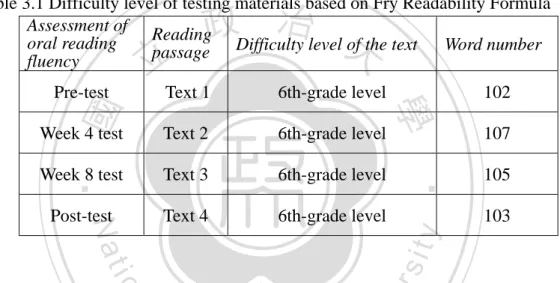
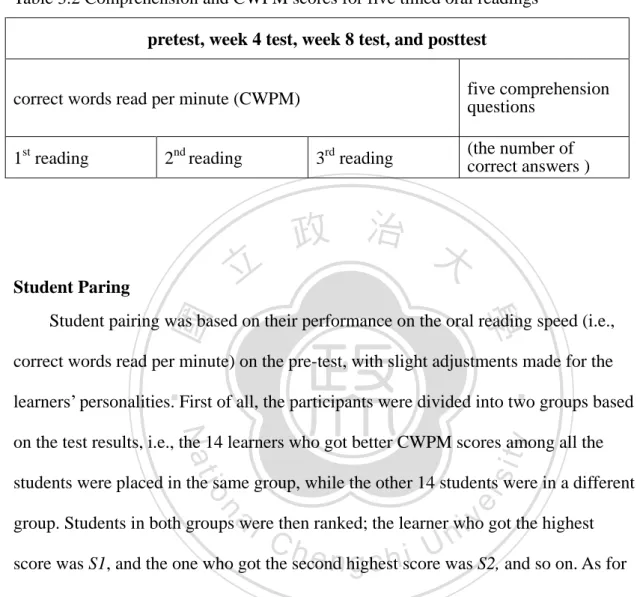
(32) 立. 政 治 大. ‧. ‧ 國. 學. n. er. io. sit. y. Nat. al. Ch. engchi. 14. i n U. v.
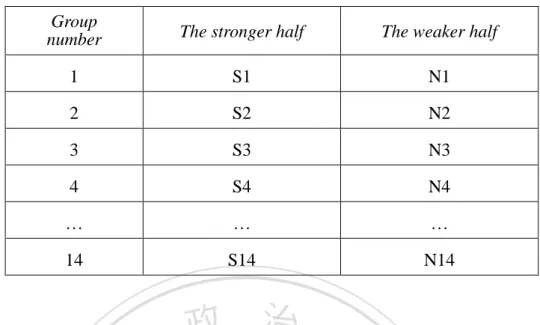
(33) CHAPTER 3 METHODS. The study employs the qualitative case study methods to obtain an inside look at the learning process and changes brought by peer-mediated RR through a close observation of three dyads. This chapter first introduces the context and participants, and then the peer-mediated RR program. The third section describes the classroom. 政 治 大. activities. After that, the research activities of data collection and data analysis are. 立. presented in the last two sections.. ‧ 國. 學 Context and Participants. ‧. This study was conducted in a junior high school located in northern Taiwan.. y. Nat. io. sit. The school adopted heterogeneous grouping policy; therefore, the students’ English. n. al. er. scores for all classes were presented as a bell curve, a normal distribution. The. Ch. i n U. v. participants were eighth graders in an intact class, consisting of 15 males and 13. engchi. females, 28 in total. Their English performance also showed a normal distribution, and the majority was average-achievers. The researcher of the study had been their English teacher for a year in September, 2012. After teaching them for a year, the researcher noticed that as the reading material in the textbook gradually became lengthy, some students started to struggle in comprehending while reading these passages word by word laboriously. To facilitate the learners to have a better reading fluency, the peer-mediated RR program was introduced to the English class in the new school year, starting from September, 2013. The eighth graders had five English classes per week, lasting 45 minutes each period.. 15.
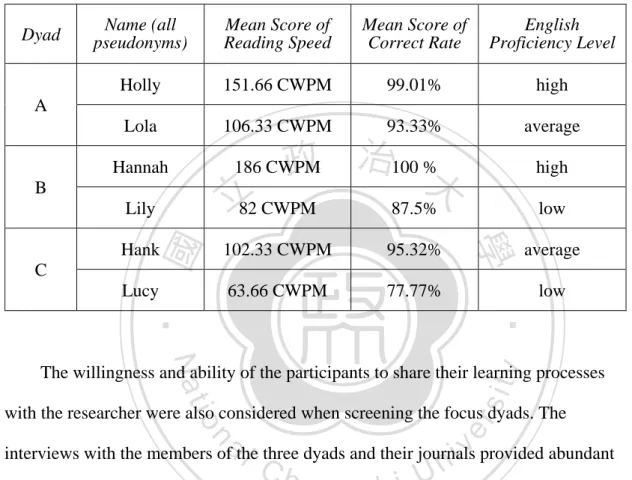
(34) The Peer-mediated RR Program The program of peer-mediated RR was conducted twice each week, lasting for 12 weeks and containing 24 sessions in total (see Appendix A). It started from the beginning of the school year, September 24th, 2013. Before the session of peer-mediated RR began, the researcher provided a reviewing session based on what the participants had learned in the seventh grade, including letter-sound correspondence, stress, intonation, and chunking. Reviewing these features would help learners read the written text orally with more confidence, while the timed. 政 治 大 a minute was measured, and this type of assessment was also used in the pre-test 立. reading was also practiced at the same time. The number of words read orally within. after the one-week reviewing session.. ‧. ‧ 國. 學. Materials. In this study, two kinds of reading materials were used. One was the “Reading”. sit. y. Nat. section of the school mandated textbook (Book Three, Kang Hsuan Edition, 2012).. n. al. er. io. The other was the reading passages from a popular English teaching magazine, Let’s. i n U. v. Talk in English. The September, October, November, and December issues of the. Ch. engchi. magazine in 2013 were used as an assigned extra learning material for all the students at the school. Learners were able to assimilate more useful daily words and expressions from the magazine, including topics like using GPS, traveling, or shopping. Pre-test, Two Mid-Program Check Points, and Post-test Oral reading fluency was measured by the amount of correct words read per minute (CWPM). This was conducted for all 28 participants who were evaluated pre-test, week 4 test, week 8 test, and post-test. The measurement used to represent fluency showed how they performed before, during and after the RR program.. 16.
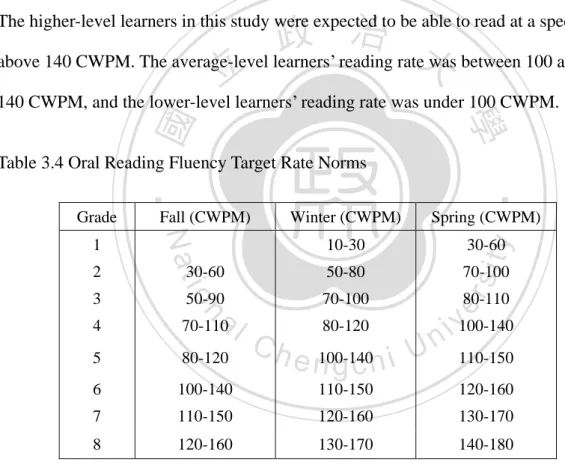
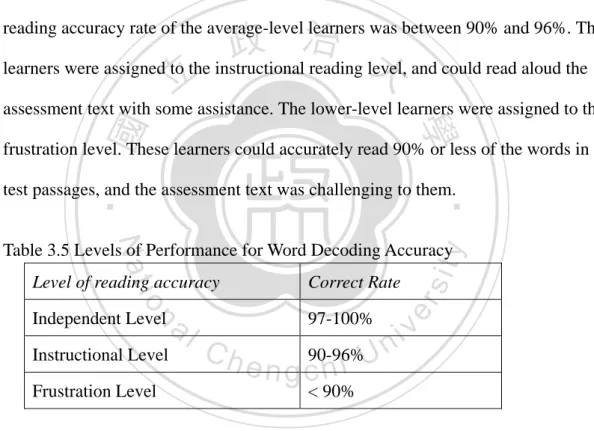
(35) Testing materials. In the test, the participants read out loud a short paragraph adapted from a passage of the GEPT (The General English Proficiency Test) oral test item. The passage has a meaningful context of reading about 100 words (see Appendix B). The reading level of the texts used is all at Grade 6, measured with the Fry Graph Readability Formula and its associated Graph, a readability metric for English texts, and it is often used to provide a common standard by which the readability of articles can be measured.. Table 3.1 Difficulty level of testing materials based on Fry Readability Formula Assessment of Reading oral reading Word number passage Difficulty level of the text fluency. 立. 6th-grade level. 102. Week 4 test. Text 2. 6th-grade level. 107. Week 8 test. Text 3. 6th-grade level. 105. Post-test. Text 4. 6th-grade level. 學. Text 1. ‧. ‧ 國. Pre-test. 政 治 大. er. io. sit. y. Nat. 103. al. Scoring system. Oral reading fluency was measured with the form, correct. n. v i n C h Reading errors were words read per minute (CWPM). e n g c h i U recorded through a. well-established marking code developed by the Language in the National Curriculum (LINC) team (see Appendix D). The types of miscued words include mispronunciation, repetition, deviation, substitution, etc. Five comprehension questions followed the procedure designed to assess the comprehension level of the readers (see Appendix C). This evaluation aims to prevent the readers from attempting to speed up their oral reading rate without fully understanding the text. During the test, they read the text three times, and the reading speed was recorded after each round, in order to compare the differences after repeated reading (see. 17.
(36) Table 3.2 below). This assessment method was adapted from the study of Taguchi et al. (2012).. Table 3.2 Comprehension and CWPM scores for five timed oral readings pretest, week 4 test, week 8 test, and posttest five comprehension questions. correct words read per minute (CWPM) 1st reading. 2nd reading. 立. Student Paring. (the number of correct answers ). 3rd reading. 政 治 大. ‧ 國. 學. Student pairing was based on their performance on the oral reading speed (i.e., correct words read per minute) on the pre-test, with slight adjustments made for the. ‧. learners’ personalities. First of all, the participants were divided into two groups based. y. Nat. sit. on the test results, i.e., the 14 learners who got better CWPM scores among all the. n. al. er. io. students were placed in the same group, while the other 14 students were in a different. i n U. v. group. Students in both groups were then ranked; the learner who got the highest. Ch. engchi. score was S1, and the one who got the second highest score was S2, and so on. As for the other group, the learner who got the best grade in the group was N1 (whose score was ranked number 15 in the whole class), and the one who got the second highest score was N2, the rest following suit. S1 was paired with N1, and S2 formed a dyad with N2, and so forth (see Table 3.3). This pairing method made each student of the weaker half practice with a more competent reader. Of primary interest to the researcher were how the more fluent readers assisted their partners with the oral reading and how the dyad members with proficiency gaps worked together during the peer-mediated RR program.. 18.
(37) Table 3.3 Student pairing Group number. The stronger half. The weaker half. 1. S1. N1. 2. S2. N2. 3. S3. N3. 4. S4. N4. …. …. …. 14. S14. N14. 政 治 大. After all the participants were assigned a partner, they simulated the. 立. peer-mediated RR with their partner and were taught what to do during the 24. ‧ 國. 學. sessions. They also learned the whole procedure, including how to record their reading speed and miscued words. When practicing repeated reading, students used. ‧. the coding symbols (see Appendix D) and counted correct word read per minute.. y. Nat. sit. The members of a dyad remained the same throughout the following 12-week. n. al. er. io. peer-mediated RR program.. Ch. Selection of Three Focus Dyads. engchi. i n U. v. The 28 participants in the class were divided into 14 dyads. Three of these dyads were selected as focus groups. The three targeted dyads, Holly and Lola, Hannah and Lily, and Hank and Lucy (all pseudonyms) were chosen for two reasons: the 6 members represented three distinct English proficiency levels (i.e., high, middle, and low levels), and they were willing and able to explain their learning processes. The first criterion for selection was learning level; the 6 students contained two representatives of each learning level. The fluency levels of the students were determined using the reading speed results (measured in words correct per minute; 19.
(38) WCPM) of an oral reading pretest. Because no oral-reading-rate norms exist for Taiwanese junior high school students, reading-rate norms (Table 3.4) suggested by Rasinski (2004), based on several empirical data sources, were adopted in this study. Target oral-reading-fluency-rate norms are used in the United States for students from Grades 1 to 8. The reading materials in the four measurements of oral-reading rate were all at the sixth-grade level, based on Fry’s Readability Formula, and the peer-mediated RR program started in fall; therefore, based on Rasinski’s reading rate norms, the oral-reading-rate norm for learners in this study was 100 to 140 CWPM.. 政 治 大 above 140 CWPM. The average-level learners’ reading rate was between 100 and 立. The higher-level learners in this study were expected to be able to read at a speed. 140 CWPM, and the lower-level learners’ reading rate was under 100 CWPM.. ‧ 國. 學. Table 3.4 Oral Reading Fluency Target Rate Norms. 10-30. 30-60. 50-80. 70-100. 30-60. y. Spring (CWPM). 4. 70-110. 5. 80-120. 6. 100-140. 110-150. 120-160. 7. 110-150. 120-160. 130-170. 8. 120-160. 130-170. 140-180. 50-90. n. al. 70-100. Ch. 80-120. e n100-140 gchi. er. 3. io. sit. 2. Winter (CWPM). Nat. 1. Fall (CWPM). ‧. Grade. 80-110. i n U. v100-140 110-150. Accuracy of the participants’ oral reading also determined the learners’ English proficiency level. Accuracy, measured using the rate of correct word recognition, is another component of oral reading fluency. It is counted by dividing the number of words read correctly per minute (CWPM) by the total number of words read (CWPM and misread words). In a study by Pinnell et al. (1995), higher-fluency readers not. 20.
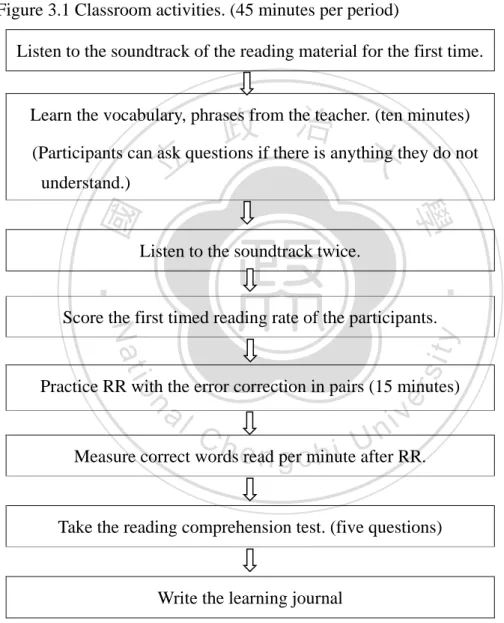
(39) only exhibited substantially faster reading rates, but also more accurately recognized spoken words. The accuracy levels in Table 3.5 were also suggested by Rasinski (2004), reflecting various levels of word-decoding accuracy. Readers are categorized into three levels: independent, instructional, and frustration. The participants in this study were assigned to the three levels of word recognition based on their English proficiency level. The higher-level learners, assigned to the independent level, were able to accurately pronounce 97% or more of the words given, and read the assessment text or other texts without difficulty. The. 政 治 大 learners were assigned to the instructional reading level, and could read aloud the 立. reading accuracy rate of the average-level learners was between 90% and 96%. These. assessment text with some assistance. The lower-level learners were assigned to the. ‧ 國. 學. frustration level. These learners could accurately read 90% or less of the words in the. ‧. test passages, and the assessment text was challenging to them.. Nat. al. n. Independent Level. Instructional Level Frustration Level. Correct Rate 97-100%. er. io. Level of reading accuracy. sit. y. Table 3.5 Levels of Performance for Word Decoding Accuracy. i n Ch e n g c90-96% hi U. v. < 90%. The 6 members of the three chosen dyads (Dyads A, B, and C) consisted of two representatives of each of the three English proficiency levels. These learners’ levels were mainly determined by their CWPM measured in pretest (see Table 3.6), and their oral reading accuracy of the same test was also examined based on the levels of word-decoding accuracy suggested by Rasinski (2004). The higher-level learners were Holly and Hannah (>140 CWPM, 97-100% correct rate) ; Hank and Lola were average-level learners (100-140 CWPM, 90-96% correct rate); and Lily and Lucy. 21.
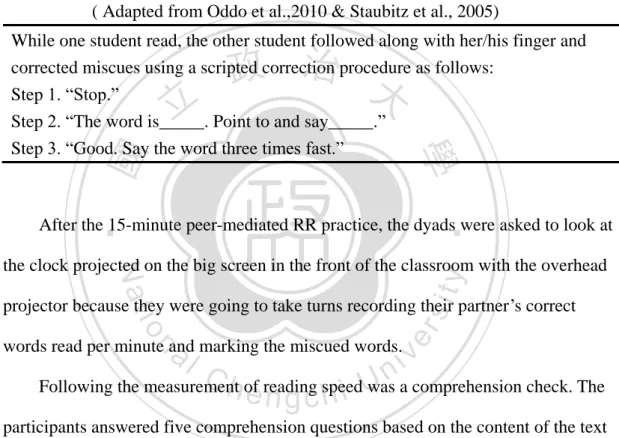
(40) were lower-level learners (<100 CWPM, <90% correct rate). An equal number of representatives from each level was selected to elucidate the learning processes and the effects of peer-mediated RR on learners of various levels.. Table 3.6 Pre-test result of the three focus dyads Dyad. Name (all pseudonyms). Mean Score of Reading Speed. Mean Score of Correct Rate. English Proficiency Level. Holly. 151.66 CWPM. 99.01%. high. Lola. 106.33 CWPM. 93.33%. average. Hannah. 186 CWPM. A. 政 治100 %大 87.5%. Hank. 102.33 CWPM. 95.32%. Lucy. 63.66 CWPM. 77.77%. C. low average low. ‧. ‧ 國. Lily. 學. 立82 CWPM. B. high. y. Nat. sit. The willingness and ability of the participants to share their learning processes. n. al. er. io. with the researcher were also considered when screening the focus dyads. The. i n U. v. interviews with the members of the three dyads and their journals provided abundant. Ch. engchi. information about their learning processes. All participants were asked to write down their CWPM records and to describe their learning processes in class as much as possible. It was found that the focus and expression of students at various levels were slightly distinctive. Holly and Hannah, the higher-level learners, were able to describe in every journal entry the difficulties they encountered or events happened between them and their partners. For instance, they wrote down the words or phrases that were hard for their partners to pronounce and then analyzed the possible reasons that caused the difficulties for their partners to read, such as inflectional suffixes. Moreover, the higher-level learners in the present study described the emotions. 22.
(41) generated by interactions with their partners. The average-level learners, Hank and Lola, also tried diligently to describe their learning processes in their journals, but they revealed less about the difficulties they faced and what they learned during the RR sessions. Instead, they talked more about the feelings and emotions they experienced in class. The lower-level learners, Lily and Lucy, seldom discussed the difficulties they encountered and their feelings during the RR sessions. Lily often only gave a simple description of the classroom activity procedures, and rarely commented on her performance during the RR sessions. Lucy used the fewest words. 政 治 大 incorrectly, and occasionally one or two comments on her performance. Although 立 to depict the process, typically using CWPM numbers and a list of words read. Lucy did not provide adequate information in her journals compared with the other. ‧ 國. 學. participants, the researcher was able to compile sufficient details about her learning. ‧. process during her four interviews because she was willing to provide information.. sit. y. Nat. In summary, the three dyads were selected based on the willingness of the 6. io. er. members to convey their learning processes to the researcher and the sufficient amount of information about the peer-mediated RR program that they provided in. n. al. Ch. their learning journals or interviews.. engchi. i n U. v. Although the whole class received peer-mediated RR instruction, the observation focused on the three dyads that were chosen to be the representatives of higher-, average-, and lower-level learners. The three dyads facilitated a broader understanding of how students perceive peer-mediated RR. Furthermore, based on the detailed information provided by the 6 dyad members, different from the prior quantitative studies on RR, the results of this research provide other teachers with a more holistic view and more in-depth insights regarding how learners of various reading fluency levels can cooperate and provide feedback for each other.. 23.
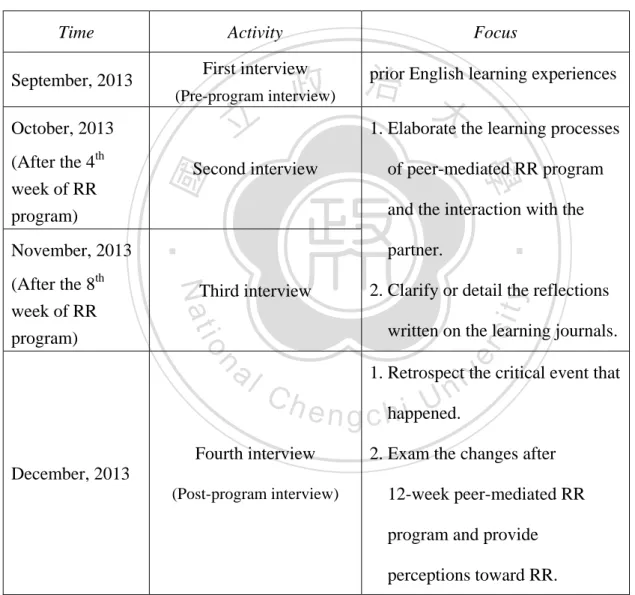
(42) Classroom Activities The participants had two repeated reading sessions per week, twenty-four sessions in total. The classroom activities in every session are shown in Figure 3.1 below. The procedure is adapted from the studies of Fuchs & Fuchs et al. (2001), Taguchi et al. (2012), and Yurick et al. (2006). Figure 3.1 Classroom activities. (45 minutes per period) Listen to the soundtrack of the reading material for the first time.. 治 政 大 they do not (Participants can ask questions if there is anything 立 understand.) 學 Listen to the soundtrack twice.. ‧. ‧ 國. Learn the vocabulary, phrases from the teacher. (ten minutes). io. sit. y. Nat. Score the first timed reading rate of the participants.. n. al. er. Practice RR with the error correction in pairs (15 minutes). Ch. engchi. i n U. v. Measure correct words read per minute after RR.. Take the reading comprehension test. (five questions). Write the learning journal The first part of a session took about 10 minutes, and then after participants read the passage for one minute and the rate was recorded by his or her partner, they started working with their partner and taking turns to repeatedly read aloud the text for 15 minutes, at least four times per person. During the process, the dyads. 24.
(43) corrected their partner's miscued words. Within each pair, each student alternatively served as the reader and the tutor, who pointed out the miscued words, for an equal amount of time. Drawing on the study of Staubitz et al. (2005), three steps of error correction were used in the present study as a required procedure for participants to mark the miscued words. Table 3.6. A scripted correction procedure. ( Adapted from Oddo et al.,2010 & Staubitz et al., 2005) While one student read, the other student followed along with her/his finger and corrected miscues using a scripted correction procedure as follows:. 政 治 大. ‧. ‧ 國. 立. 學. Step 1. “Stop.” Step 2. “The word is_____. Point to and say_____.” Step 3. “Good. Say the word three times fast.”. After the 15-minute peer-mediated RR practice, the dyads were asked to look at. sit. y. Nat. the clock projected on the big screen in the front of the classroom with the overhead. io. er. projector because they were going to take turns recording their partner’s correct. al. v i n C h of reading speedUwas a comprehension check. The Following the measurement engchi n. words read per minute and marking the miscued words.. participants answered five comprehension questions based on the content of the text they just read during the RR practice, and then exchanged their test papers and checked the answers for each other five minutes later. While answering the five questions, they were not able to refer to the text. This was to prevent the learners from only focusing on increasing their reading speed, at the expense of comprehension. According to Han and Chen (2010), the purpose of the timed reading is to improve reading speed to the optimal rate that supports comprehension rather than developing speedy readers. For the remaining class time, they wrote the. 25.
(44) learning journal to describe what had happened during the session and to reflect back on the learning process. The same procedure repeated at every session before the post-test, which was conducted after the 24th session. During the 12 weeks, two other assessments of oral reading fluency were carried out right after the 8th and the 16th sessions to record the progress.. Data Collection. 政 治 大. The data was collected from multiple sources in four ways (1) four tests of the. 立. oral reading fluency, (2) classroom observation (assisted by video-recording), (3). ‧ 國. 學. weekly learning journals of the three dyads, and (4) interviews with the students from the three dyads individually.. ‧. (1) Four tests of oral reading fluency. To obtain an overview of performance of. y. Nat. io. sit. the whole class, the 28 participants took the pre-test, two mid-program assessments,. n. al. er. and post-test during the RR session. The oral reading fluency of each participant was. i n U. v. measured in terms of correct words read per minute (CWPM). The miscued words of. Ch. engchi. students’ oral reading were also counted. Another experienced English teacher, with a TESOL background, was also invited to measure the reading rate and accuracy at the same time, to allow for more accurate reading speed and correct rate to be recorded. Furthermore, the oral reading was audio recorded for later analysis. The two authors were 97.5% consistent in their calculation of reading speed and miscued words. Differences were resolved through discussion. (2) Classroom observation. Three targeted dyads were closely observed during each of the 24 sessions. Besides the field notes the researcher took in class, the interactions of the three dyads during the peer-mediated RR practice were also video. 26.
(45) recorded during every session. Accordingly, the researcher could have another source of data to analyze the information obtained from the interviews and students’ learning journals. Once the students adjusted to the presence of the video camera, their nervousness subsided, and they started to act naturally. The content of the video reflected how the students behave in a typical classroom setting. (3) Learning journals. The learning journals of the three dyads were analyzed. The content of the journal revealed certain problems that the participants encountered during the process of peer-mediated RR, the progress they made, the. 政 治 大 about the program, and their personal perspectives or attitudes toward the program. 立. events that happened between the dyads, the benefit or drawbacks they considered. Any contents from participants’ journals presented in the present study were. ‧ 國. 學. translated from Chinese into English. The learning journals of these 24 sessions. ‧. provided rich, consistent, and prolonged qualitative data on the participants’ learning. io. er. the learners’ introspective processes over time as well.. sit. y. Nat. process and attitude during the peer-mediated RR program. The journals captured. (4) Interviews. The researcher interviewed the six students from the three dyads. al. n. v i n individually four times-before C hthe peer-mediatedURR program, after engaging in 4 engchi. weeks of peer-mediated RR, after engaging in 8 weeks of peer-mediated RR, and after the RR program. The interview took place in a closure consulting room at school. The interviewer and interviewee were able to sit comfortably on the. cushioned chairs on the opposite side, and the interview with each person was about 20 minutes each time. Before the interview, the researcher analyzed the collected observation data and learning journals first and then formulated questions. The interview data was aimed to obtain more information which was not revealed in the learning journal. In addition, the members of the three days also clarified or confirmed the circumstances described in the journals and the observation that the 27.
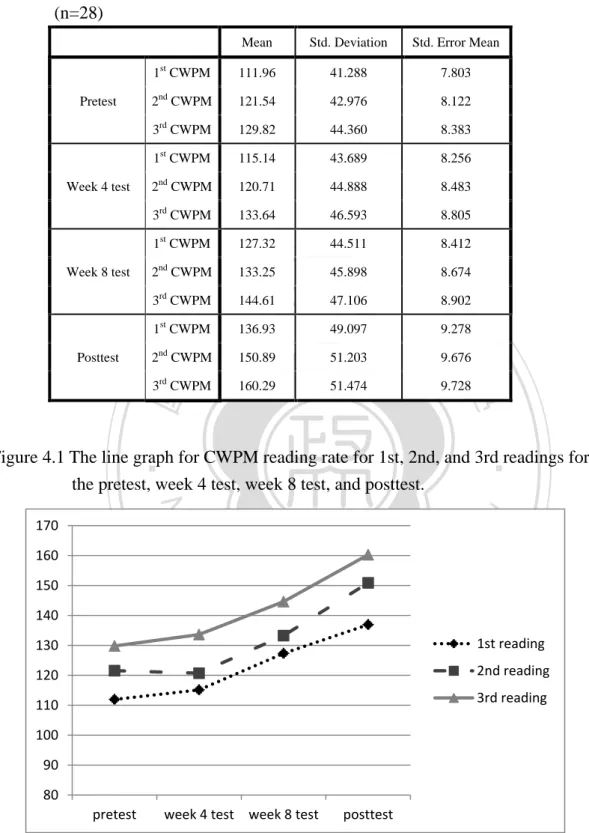
(46) researcher written down on the teacher’s log during the four interviews. All the interviews with the three dyads were conducted in Chinese, so their words presented in the study were transited into English by the researcher and were checked by another English teacher with a TESOL background. Table 3.7 presents the time and focus of the four semi-structured interviews.. Table 3.7 Timetable of the interviews and the focus Time. and the interaction with the partner.. Nat. 2. Clarify or detail the reflections. sit. y. Third interview. io. (After the 8th week of RR program). of peer-mediated RR program. ‧. November, 2013. Second interview. 學. (After the 4th week of RR program). prior English learning experiences 治 政 (Pre-program interview) 大 1. Elaborate the learning processes 立 First interview. written on the learning journals.. n. al. er. October, 2013. Focus. ‧ 國. September, 2013. Activity. Ch. i n U. v. 1. Retrospect the critical event that. i e n g c hhappened.. Fourth interview. 2. Exam the changes after. December, 2013 (Post-program interview). 12-week peer-mediated RR program and provide perceptions toward RR.. Thanks to the openness of reveling learning experiences of the six learners of the three chosen dyads, aside from the video record data, the learning processes of peer-mediated RR were vividly recorded and understood through learning journals,. 28.
(47) which were written after every RR session, and interviews.. Data Analysis The results of the four oral reading measurements taken by the 28 participants -a pre-test, another two as check points during the RR program, and a post-test- was listed chronically in a table. Furthermore, by using interviews, learning journals, video-recording observation, and field notes, the data is triangulated, and the analysis is supported by more than a single source of evidence. In addition, to guard. 政 治 大 was invited to code the raw date with the researcher and exam the correctness of the 立 the trustworthiness of the study, an experienced teacher with TESOL background. verbatim transcribed interview data. While the researcher and the other teacher. ‧ 國. 學. coded the date, the holistic-content approach (Lieblich et al., 1998) was used. The. ‧. researcher reread the material several times to find out the reoccurring themes or. y. Nat. patterns, and then reconstructed the learning processes of the three dyads to find out. er. io. sit. how the critical events affect the three dyads’ English learning. The critical event is an event selected because of its unique, illustrative and confirmatory nature. Woods. al. n. v i n C hevents promote student (1993 a) maintains that critical learning in accelerated ways. engchi U This learning involves a holistic change.. As the participants wrote the learning journal in and took the interview in Chinese, only the parts presented in the study were translated into English. The other experienced English teacher made sure the translation was correct and the content of the journal was not misunderstood, and the researcher also confirmed the content with three dyads. Hence, this present qualitative study can provide an in-depth understanding of the learning process that junior high school students may have when peer-mediated repeated reading is employed to improve students’ oral reading fluency. In the end, 29.
(48) based on the changes of oral reading fluency, the reconstruction of the learning process, and the critical events happening to the three dyads, the researcher was able conclude the possibilities or challenges brought by peer-mediated repeated reading when it is applied in the junior high school English classroom in Taiwan.. 立. 政 治 大. ‧. ‧ 國. 學. n. er. io. sit. y. Nat. al. Ch. engchi. 30. i n U. v.
(49) CHAPTER 4 RESULTS. The study aims to provide an in-depth understanding of the learning process that junior high school students may experience when peer-mediated repeated reading is employed as a classroom activity to improve oral reading fluency. This chapter presents the findings to the first research question:. 政 治 大. What are the processes of peer-mediated repeating reading like for three dyads of. 立. learners during a 12-week peer-mediated repeated reading program? What critical. ‧ 國. 學. events do they experience?. ‧. There are five sections in this chapter. The first one shows the oral reading. y. Nat. io. sit. performance of the whole class. The second section provides an overview of three. n. al. er. dyads. As for the next three sections, each one focuses on the critical events and. Ch. i n U. v. what the processes of peer-mediated RR like for Dyads A, B, and C respectively,. engchi. addressing the second research question.. Oral Reading Performance of the Whole Class In order to provide an overview of the performance of the whole class, the 28 participants took a pretest, week 4 test, week 8 test, and post-test. The participants’ correct words read per minute (CWPM) results for oral fluency of each reading were calculated for each test and can be seen in Table 4.1. It can be observed that the mean CWPM reading rate for all 28 participants increased through repeated reading of the same text during each test.. 31.
(50) Table 4.1 Descriptive statistics for CWPM reading rate for 1st, 2nd, and 3rd readings for the pretest, week 4 test, week 8 test, and posttest. (n=28) Mean. Std. Deviation. Std. Error Mean. 111.96. 41.288. 7.803. 2 CWPM. 121.54. 42.976. 8.122. 3rd CWPM. 129.82. 44.360. 8.383. 1st CWPM. 115.14. 43.689. 8.256. 2nd CWPM. 120.71. 44.888. 8.483. 3 CWPM. 133.64. 46.593. 8.805. 1st CWPM. 127.32. 44.511. 8.412. 2nd CWPM. 133.25. 45.898. 8.674. 3rd CWPM. 144.61. 47.106. 8.902. 1 CWPM. 136.93. 49.097. 9.278. 2nd CWPM. 150.89. 51.203. 9.676. 3rd CWPM. 160.29. 51.474. 9.728. 1st CWPM nd. Pretest. Week 4 test. rd. Week 8 test. st. 立. 學 ‧. ‧ 國. Posttest. 政 治 大. Figure 4.1 The line graph for CWPM reading rate for 1st, 2nd, and 3rd readings for the pretest, week 4 test, week 8 test, and posttest.. sit. n. al. er. io. 160. y. Nat. 170. 150 140. 130. Ch. engchi. i n U. v. 1st reading. 120. 2nd reading. 110. 3rd reading. 100 90 80 pretest. week 4 test week 8 test. posttest. Table 4.2 presents participants’ performances in the pre-test and the post-test. Although there might be time and practice effects, the result shows that students did. 32.
(51) perform better at the post-test.. Table 4.2 The comparison between the pretest and posttest. Pretest Posttest Difference between pre and post test. 1st. 2nd. 3rd. Mean. 111.96 136.93. 121.54 150.89. 129.82 160.29. 121.10 149.37. 24.97. 29.35. 30.47. 28.27. 政 治 大 When the study was conducted, the class consisted of 28 students, who were 立 The Three Focus Dyads. ‧ 國. 學. grouped into 14 dyads. Three of the dyads that the researcher focused on included higher-, middle-, and lower-level English learners. The three dyads, Holly and Lola,. ‧. Hannah and Linda, and Hank and Lucy (all pseudonyms) were closely observed to. sit. y. Nat. obtain an in-depth understanding of the affordances and challenges associated with. io. er. the peer-mediated RR method implemented in a junior high school classroom. In the. al. three dyads, Holly, Hannah, and Hank were the more capable learners, and they. n. v i n C h high level learner, represented a higher level learner, e n g c h i U and middle-level learner,. respectively. Their partners (Lola, Lily, and Lucy) were middle-, low-, and low-level (almost bottom) learners, respectively. To gain a holistic understanding of the learning processes experienced by the three dyads during the peer-mediated RR program, the characteristics and the prior English learning experiences of each member of a dyad are first presented, followed by a report of the critical event experienced by the dyads and its impact on them. The learning processes associated with each dyad are then addressed in the last section on the findings of each dyad. In the last section, two essential aspects of the. 33.
(52) peer-mediated RR activity-error correction and the measurement of the oral reading rate-are discussed to obtain a full picture of the learning processes. The findings on all three cases are reported in the same sequence. The first case, Dyad A: Holly and Lola, is discussed first.. Dyad A: Holly and Lola Holly Holly, a higher-level learner, was in the eighth grade when this study was. 政 治 大 This trait was also reflected in her singing. Because she could always sing at the 立. conducted. She was so sensitive to sounds that she was aware of off-key singing.. right pitch, she always achieved the highest score for music class singing tests. This. ‧ 國. 學. feature also affected her ability to learn English-she could detect slight differences. ‧. in sounds when she read English sentences aloud. Holly stated in her first interview. sit. y. Nat. that whenever she caught herself reading words out strangely, she would stop to. io. correct to her.. er. pronounce the words or phrases again and again until the articulation sounded. al. n. v i n When asked about her EnglishC learning strategies, Holly h e n g c h i U felt that her English. learning methods or experience were the same as those of her peers. She added that her English grades were probably slightly better than most of her classmates’ grades because she paid more attention in English class and ensured that she reviewed the vocabulary, phrases, and grammar that had been taught that day immediately after school. Although she seldom read English articles aloud while reviewing lessons, sometimes she spoke to her mom in the simple English that she had learned. However, after thinking further, she recalled a different method of learning vocabulary that she had used while studying in elementary school. Because Holly’s mom, a waitress at a breakfast shop, recognized the importance of English education, 34.
(53) occasionally, approximately every 6 months, she gave Holly copies of English song lyrics to learn. Holly repeatedly listened to the songs and sang along with them to learn the pronunciation of the words in the lyrics. In this way, Holly naturally acquired new words by listening to the songs and understood their meanings by reading the translation. Her mom also hired an English tutor to teach her from the fourth grade to the sixth grade. Holly attended extra English classes twice a week for an hour each. Something that an English tutor once said had made a great impression on Holly, “If words are pronounced incorrectly, you would be a joke”. 政 治 大 that precisely and properly articulating words was important. In the first interview, 立. (First interview, September, 2013). She remembered what her tutor said and realized. she used the inflectional affix –ed as an example. “When I read the –ed form of a. ‧ 國. 學. past tense verb, which we are learning now, I focus on whether it is read /t/ or /d/.If I. ‧. don’t pronounce the words correctly, my oral reading feels very strange” (First. sit. y. Nat. interview, September, 2013).. io. er. In fact, Holly could correctly pronounce words and rapidly read passages aloud at approximately 180 words per minute. She said that “there is still room for. al. n. v i n improvement, but I think myCoral reading fluency U h e n g c h i was fine (Holly’s journal,. 10/04/2013).” Generally, she was not worried about her speaking ability at all. In her first interview, she felt that grammar was her biggest weakness. Although she usually scored over 90 on her English tests, she hoped that she could improve and achieve higher grades.. Lola Lola was an outgoing, straight-forward girl. She mentioned that her teachers in the third grade regarded her as a responsible and pro-active person. However, she often went home crying in the third and fourth grades because she was bullied at 35.
(54) school. Although the situation improved after the fifth grade, at the time of the interview, she still experienced problems with relationships. Sometimes, when she quarreled with friends or when her friends ignored her, she expressed her negative feelings in a teacher-student communication notebook, in which students noted their assignments, the next day’s tests, and a short record of their day. When issues disturbed her, she became more sentimental, moody, and tended to think negatively. During the first interview, she was hurt by a rumor that had been spread in class. She stated that many boys in the class had teased her about her weight, and some of them. 政 治 大. occasionally attacked her by calling her hurtful names in public. She also felt “inferior to other girls in the class.”. 立. ‧ 國. 學. I am one of the few girls who do not perform well academically in the class. The other girls all work diligently and get good grades. I really could not accept my lousy English grade from the recent monthly test. I could not keep getting 2013). ‧. such horrible grades. I need to make progress. (First interview, September,. sit. y. Nat. Lola was not as proficient at English as those at the top of her class; she was. n. al. er. io. ranked in the middle. Lola mentioned in the first interview that her mom had played. i n U. v. a significant role in her English learning. Because her mom was in charge of. Ch. engchi. international trade at her office, she used a tape recorder to record conversations with international visitors, especially people with heavy accents (such as British accents), and then tried to determine what had been said in the tapes. Because many jobs require proficient English, Lola’s mother often encouraged and pushed Lola to perform well at English. Lola claimed during her first interview that she was only allowed to watch English-speaking programs most of the time, and her family watched English-speaking movies over the weekends. When she watched cartoons on the Animax Channel, her mom asked her to switch the spoken language from Chinese to English. The frequent exposure to spoken English helped Lola learn new. 36.
數據
+7
Outline
相關文件
幫助教師掌握跨課程閱讀的理念,規劃實 踐的方法;透過校本經驗分享,促進教師
本篇教材本文長約2000字,學生正常 閱讀速度下(國中生平均閱讀速度約 200~250字),最慢應能於15分鐘內閱
教師可讓學生在閱 讀本文前,先試著 回答教材封面上的 提問,再請學生閱
培養美感和欣賞、創作能力 開放學習材料,重視經典閱讀 加強品德情意教育
哈佛大學教授夏爾(Jeanne Chall)1983 年曾以六個階段描述兒童學習 閱讀的歷程,這六個階段又可分成兩大部份,分別是: 「學習如何讀」(learn to read ),「透過閱讀學習知識」(read to
設計閱讀教學活動時,教師要注意哪些因素?Marie Carbo 曾 總結 12 個設計閱讀教學活動的原則,詳見 Becoming a great teacher of reading: Achieving high rapid reading gains
中國語文科卷一 閱讀理解 學生做小測.. 中國語文科卷一 閱讀理解
透過適切的活動提升閱讀深度及加強學習連 貫性 —— 優化中一單元中華文化及品德情意 範疇的學習內容
