
中國太陽光能行業轉變–由演化經濟面解決分析 - 政大學術集成
85
0
0
全文
(2) 中國太陽光能行業轉變–由演化經濟面解決分析 China‟s Energy Transition to Solar Photovoltaic Energy – an Evolutionary Economics Approach. Student: Eran Navon Advisor: Professor Leng Tse-Kang. 立. 政 治 大. ‧ 國. 學 ‧. 國立政治大學 商學院國際經營管理英語碩士學位學程 碩士論文. er. io. sit. y. Nat. A Thesis. Submitted to International MBA Program. n. a. iv. l C Chengchi University National n. hengchi U. in partial fulfillment of the Requirements for the degree of Master in Business Administration. 中華民國一百年七月 July 2011. i.
(3) Abstract China‟s growing energy needs have turned renewable energy into a crucial factor necessary for its social stability and national security. This paper has been written with the understanding that the role renewable energy plays in the Chinese industry and market will be nothing less than critical in coming decades. Solar PV electricity is one of the most promising renewable energy technologies and is a fast growing industry. However in China there exists a huge gap between its market potential and current achievements in the field. This thesis paper depicts the evolutionary path China is currently undergoing from a heavy reliance on fossil produced energy to a balanced energy mix by examining its solar PV industry and market. Its major argument is that as transitional processes require long term vision and planning, the potential of china‟s energy transition to solar energy needs to be assessed under a set of criteria that. 政 治 大 evolutionary economics theory, this 立paper presents a unique in depth analysis of China‟s transitional can trace a long term development path. By using the six core elements introduced by the. ‧ 國. 學. efforts toward solar PV grid parity.. The paper has reached three major conclusions. The first and most important is that the Chinese. ‧. central government seems to be making genuine efforts in promoting solar PV as one of the nation‟s future energy sources. These efforts have been marked by assessing governmental legislation. y. Nat. sit. concerning Bounded Rationality issues and various incentive programs. The Renewable Energy. er. io. Law and the Medium and Long-Term Development Plan have served as instrumental driving forces. al. iv n C substantial support to the PV industry as well h etonCo-evolutionary i U technologies such as inverters and h c g batteries. Legislation has had limited success in handling Lock In issues such as connection to the n. to the immature market. Local governments have shown significant commitment by providing. national grid and real price reflection of conventional energy. The second conclusion is that although the market is still at an early stage of its development, it relies too heavily on Selection promotions, namely direct subsidies. Recent developments in the PV market growth in China can mostly be regarded to the Golden Sun program and the BIPV program. These efforts have been an important promoter in raising global awareness to the potential of its solar sector. However this form of subsidy does not present a long term sustainable growth solution. The lack of a national Fid in Tariff scheme (despite few specific provincial schemes) and existing problems concerning projects tendering process cause an imbalance in terms of market and industry Diversity. This unbalance appears in the form of lack of Diversity in project developers, being mostly local state owned or highly affiliated with the government enterprises. ii.
(4) The third conclusion is that China‟s government can and should give more focus on domestic Innovation. Currently the country‟s national R&D investment is significantly lower than market leaders in Europe. China‟s education system does not support more than several world class solar PV electricity research centers and its industry development relies on expensive imported technology and international collaboration. Most companies in the industry hold a short term development vision which affects technological Diversity, mostly in the upstream segments of polysilicon and ingot production. Lack of attention towards a diverse range of future PV and Coevolutionary technologies limits industry development to specific sectors that have low technological barriers. The paper concludes that while China is well positioned for further expansion of its market it still lacks in specific aspects of its transitional path. This analysis is unique as it presents not only an up to date market and industry status but also refers to their future growth potential. This paper. 政 治 大. presents a wide range of aspects that directly affect solar PV‟s future development. Its true value. 立. lies within the usage of the evolutionary economics approach as a theoretical framework, which. ‧ 國. 學. allows us to gain better understanding of how the different aspects related to the solar PV world affect each other and the fitness of this historic transition.. ‧. n. er. io. sit. y. Nat. al. Ch. engchi. iii. i Un. v.
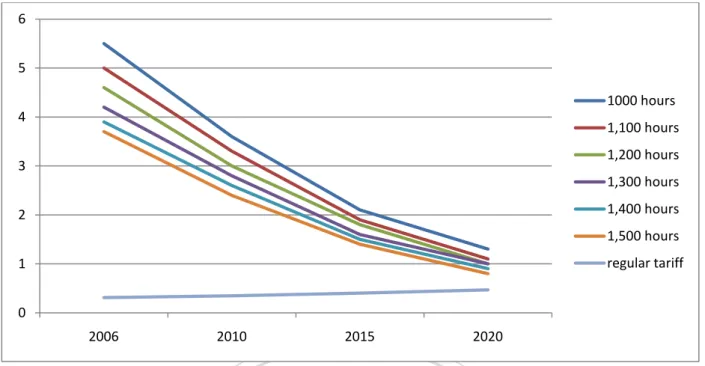
(5) Acknowledgements The idea of conducting research in the field of renewable energy came to me during the first weeks of my studies in IMBA. I would like to thank the program‟s professors who have each in their own way brought to my attention the importance and urgency of promoting clean energy. They have inspired me to further enhance my understanding of the challenges and needs concerning this historical transitional process. A special thank you goes to my advisor, Professor Leng Tse-Kang for his support and guidance throughout the project and for his comments and insights. I would like to thank my family for showing the outmost confidence in me during my stay in Taiwan; my dad for proving to me that nothing is impossible, my mom for showing me that believing is everything, Shiri for teaching me about passion and Adi for helping me keep the right perspective on it all.. 治 政 大 and support, for turning every A big thank you goes to Brent and Avishai for their companionship 立 problem into a simple daily matter through a discussion over lunch or a drink in the park. One last ‧ 國. 學. special thank you goes to the members of T.E.A.M for helping me diminish the boundaries between dream and reality.. ‧ y. Nat. n. al. er. io. forget your perfect offering. sit. “Ring the bells that still can ring. there is a crack in everything. Ch. engchi. that’s how the light gets in”. iv. i Un. v.
(6) Table of Contents. Abstract ................................................................................................................................................ii Acknowledgements ............................................................................................................................. iv Table of Contents ................................................................................................................................. v List of Figures and Tables ..................................................................................................................vii Introduction .......................................................................................................................................... 1 Chapter 1 - China‟s Transition to Clean Energy .................................................................................. 3 1.1.. Energy in China‟s Modern Economy............................................................................... 3. 1.2.. Transition to Renewable Energy ...................................................................................... 6 1.2.1.. Energy Security and the Optimization of the Energy Mix................................... 6. 治 政 1.2.3. Social and Economic Development Goals大 for Rural Areas ................................. 9 立 1.3. Introducing Solar Energy ............................................................................................... 10 學. Analytical Framework.................................................................................................... 12 Price Competitiveness of PV ............................................................................. 12. 1.4.2.. PV Cost Reduction ............................................................................................. 13. 1.4.3.. Integration of Systems Into the Energy Markets ............................................... 14. ‧. 1.4.1.. Nat. y. 1.4.. Environmental Concerns and Climate Change .................................................... 7. ‧ 國. 1.2.2.. 1.6.. Hypothesis ...................................................................................................................... 18. er. sit. Theoretical Background – Evolutionary Economics ..................................................... 14. io. 1.5.. al. 2.3.. Barriers to Renewable Energy ....................................................................................... 23. n. 2.2.. iv n C Exogenous and Endogenous Selection .............................................................. 20 h e n gFactors hi U c Early Renewable Policy ................................................................................................. 21. Chapter 2 - Government Policy ......................................................................................................... 20 2.1.. 2.3.1.. Institutional Barriers .......................................................................................... 23. 2.3.2.. Renewable Energy Cost ..................................................................................... 24. 2.3.3.. Connection to the Grid ....................................................................................... 25. 2.4.. The Renewable Energy Law .......................................................................................... 26. 2.5.. PV Promotion Policy ..................................................................................................... 28. 2.6.. Feed in Tariff ................................................................................................................. 30. 2.7.. Connection to the Grid ................................................................................................... 34. Chapter 3 - China‟s Photovoltaic Industry ......................................................................................... 37 3.1.. Production of Solar Grade Silicon ................................................................................. 38 3.1.1.. Early Development ............................................................................................ 38 v.
(7) 3.2.. 3.3.. 3.1.2.. Between Shortage and Oversupply .................................................................... 39. 3.1.3.. Industry Leaders ................................................................................................. 41. 3.1.4.. Technological barriers........................................................................................ 41. Ingots and Wafers .......................................................................................................... 42 3.2.1.. Market Share and Global Trends ....................................................................... 42. 3.2.2.. Industry Leaders ................................................................................................. 43. 3.2.3.. A Non Diverse Industry Segment ...................................................................... 44. Cell and Module Industry .............................................................................................. 46 3.3.1.. Sector Growth .................................................................................................... 46. 3.3.2.. Industry Leaders ................................................................................................. 47. 3.3.3.. Municipal Drivers Toward Industry Selection................................................... 49. 3.4.. Cost of the Domestic PV Modules ................................................................................. 51. 3.5.. Balance of System Components .................................................................................... 52. 3.5.2.. 學. ‧ 國. 3.5.1.. 政 治 大 Inverters ............................................................................................................. 53 立 Batteries ............................................................................................................. 54. Chapter 4 – Future Technologies and R&D....................................................................................... 56 Alternative Technologies ................................................................................................... 56. ‧. Thin Film............................................................................................................ 56. 4.1.2.. Concentrating Solar Power ................................................................................ 58. y. Nat. 4.2.. 4.1.1.. Research and Development ............................................................................................ 60. sit. 4.1.. n. al. er. io. Conclusion ......................................................................................................................................... 64. i Un. v. Bibliography....................................................................................................................................... 69. Ch. engchi. vi.
(8) List of Figures and Tables. Figure 1.1 China‟s Annual Net Electricity Generation (GW) ............................................................. 4 Table 1.1 Structure of Primary Energy Consumption.......................................................................... 5 Figure 1.2 World‟s Five Largest CO2 Emitters (thousand metric tons of CO2) ................................. 8 Figure 1.3 Components of China‟s Renewable Energy Development Objectives and Correlations . 10 Figure 1.4 A Schematic Representation of the Evolutionary Economy ............................................ 18 Figure 2.1 Solar Energy Resources Distribution in China ................................................................. 21. 政 治 大 Figure 2.3 Barriers that Prevent Renewable 立 Sources of Electricity from Connecting to the Grid in Figure 2.2 Factors Contributing to the High Cost of Renewable Energy in China in 2004 .............. 25. ‧ 國. 學. 2004 .................................................................................................................................................... 26 Chart 2.1 PV Installations in China Since 1990 (MW)...................................................................... 28. ‧. Figure 2.4 PV Installations in China Since 1990 (MW) .................................................................... 28. y. Nat. io. sit. Table 2.2 Market Share of PV Power Generation ............................................................................. 29. n. al. er. Figure 2.5 Grid Connected PV and Conventional Electricity Estimated Cost 2006-2020 (Yuan/KW). i Un. v. ............................................................................................................................................................ 32. Ch. engchi. Table 3.1 Annual Cell Production...................................................................................................... 37 Figure 3.1 Crystalline Silicon Manufacturing Process ...................................................................... 38 Table 3.2 Polysilicon Production and Demand 2006-2010 ............................................................... 39 Table 3.3 PV Industry Segments Economic Features in 2007 ........................................................... 45 Table 3.4 Manufacturing Equipment Providers in the PV Industry .................................................. 47 Table 3.5 Cost and Price of PV Manufacturing Components in China and Overseas (USD/W) ...... 51 Figure 3.2 Cost Breakdown of Grid Connected PV System .............................................................. 53. vii.
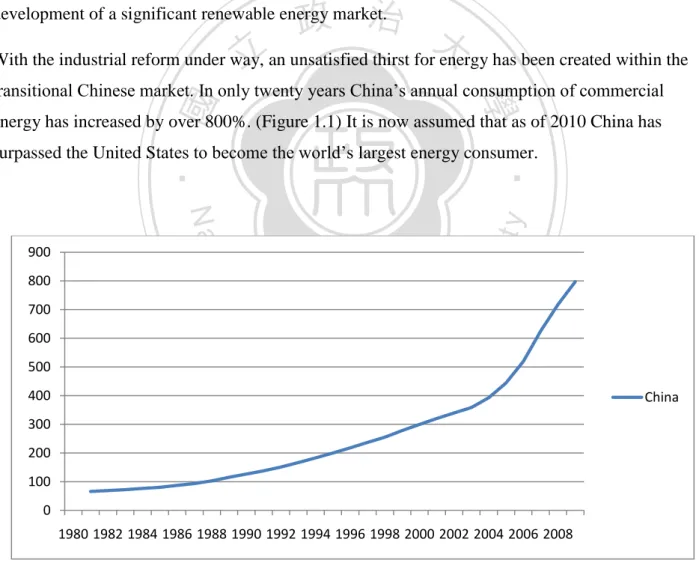
(9) Introduction Clean energy has been a rising star in the world of energy for well more than a decade. With awareness towards the threats of global warming on the rise, both public and private sectors have been enthusiastic on exploring a new world of technological possibilities. Global investment in clean energy reached USD 243 billion in 2010 alone, a thirty percent rise from 2009‟s USD 186.5 billion. (Renewable Energy World, 2011) Among the different technologies, solar energy seemed to have always been underrated and underexploited. With the sun being the most fundamental form of energy it has been viewed by many generations as a potential savior from dependence on fossil fuels. Technological developments made in the last three decades have turned solar photovoltaic technology into a feasible commercial technology. As a result governments around the world have recently invested. 政 治 大. great resources in developing related technology, industry and infrastructure, with Germany, Spain and Italy acting as market leaders.. 立. ‧ 國. 學. The discussion about clean energy should not be restricted to the developed world. Much of the mass of the global energy demand has shifted to developing countries such as the BRIC countries –. ‧. Brazil, Russia, India and China. China has become a global concern in recent years as it has become the world‟s biggest consumer of electricity, and as such the world‟s leading country in fossil fuels. y. Nat. sit. consumption and green house gas emission. It has become a global priority to help China maintain. n. al. er. io. its rapid economic development while pursuing a sustainable path for green energy.. i Un. v. This paper explores the potential of China‟s clean energy transition in regards to the solar. Ch. engchi. photovoltaic sector. Its emerging market and industry has shown significant development in recent years and is expected to become a global market leader in the near future. The solar PV industry and market have indeed been regarded by government offices as a technological sector which holds the highest development priority. As such, significant funds have been allocated to encourage its development. Transition to non fossil fuels should not be regarded as a common technological challenge. This process involves not only an efficient industry but also enthusiastic investors and developers. Creating a change from complete reliance on one form of energy production to another is no less than an evolutionary transition as it encompasses change in the entire energy production system. As will be shown below, PV technology is not yet a mature technology and cannot compete with conventional energy production methods. It requires the combined will and commitment of. 1.
(10) government agencies, research institutions, entrepreneurs and industry leaders if solar PV is to reach grid parity. This paper presents an in depth analysis of China‟s efforts on transition to solar PV energy. Using an analytical framework derived from the field of evolutionary economics this research defines the strengths and weaknesses of China‟s transitional process. In order to depict a clear balanced picture of China‟s domestic market and industry the research combines a broad literature review from government agencies, international energy agencies, forums, academic articles, various blogs and news articles. Using the evolutionary economics model this research presents new perspectives and insights on the market and describes the path the sector is expected to go through in coming years. Chapter one presents a literature review, describes the driving forces behind China‟s search for clean energy transition and presents the theoretical framework. Chapter two discusses barriers to. 政 治 大 these obstacles. Chapter three provides an industry analysis and describes the industries effect on 立 China‟s domestic market. Chapter four discusses the status of future technologies in the domestic. developing renewable energy and solar PV as well as improving government efforts to overcome. ‧ 國. 學. market and the research and development barrier to sustainable transition. Chapter five concludes.. ‧. n. er. io. sit. y. Nat. al. Ch. engchi. 2. i Un. v.
(11) Chapter 1 - China’s Transition to Clean Energy In the past two years China has positioned itself as the world‟s largest manufacturer of solar panels with over 96% of its output designated for export. In 2009 alone Chinese manufacturers sold solar panels to Germany with a total power capacity exceeding 1 GW, which accounts to nearly half of the total capacity acquired in Germany that year. There is a gap between China‟s flourishing solar industry and its nearly unexploited market. With an annual market of only 160 MW in 2009 and a total of 305 MW cumulative PV power installed by 2009, solar energy did not play a significant role in China‟s power generation mix until 2010. (EIA, 2010) On September 8th 2009 Wu Bangguo, chairman of the standing committee of the National People‟s. 治 政 Ordos city, Inner Mongolia. In 2019, a 2,000 megawatt power大 plant will be built in what is expected 立 to become the worlds‟ biggest photovoltaic project yet. The project will generate enough electricity Congress of China, signed an agreement with „First Solar‟ for a photovoltaic farm to be built in. ‧ 國. 學. to power around three million Chinese homes, with a total cost of up to USD 5 billion. Reports have announced that First Solar, the world‟s largest photovoltaic cell manufacturer, has thus „cracked‟. breakthrough in the traditionally slow Chinese market.. Nat Energy in China’s Modern a Economy. er. io. sit. y. ‧. the Chinese market. (New York Times, 2009) A project of this magnitude is considered a real. n. iv l C n h ng h i U by looking at the development The gap between the PV market and industryecan be c explained 1.1.. policy and structure of China‟s modern economy. China‟s transformation into market economy was initiated in 1978 shortly after Chairman Mao‟s death when its centrally planned economy gradually started to be replaced by a decentralization of policy implementation. With individual farming restored and the increase in productivity, labor required in agriculture was reduced and transferred to higher productivity jobs in the Township Village Enterprises (TVE). TVEs became the growth engine of the economy, reaching a peak in 1996 accounting for 26% of GDP. Since the late 70s China has hurried to open up to foreign trade and investment in what proved to be a crucial element in its economic reforms. The successful establishment of the first special economic zones led to a proliferation of special zones and foreign trading companies licensed to 3.
(12) contract with domestic enterprises. Exports expanded rapidly under these trade openings and by the late 1990s China became the second largest recipient of foreign direct investments. (OECD, 2009) Capitalizing on its cheap labor force and rich natural resources the country has emerged as what is sometimes called the world‟s „manufacturing hub‟. It is therefore only natural for China to become involved with the PV production industry as it has done successfully with other sectors such as the automotive and fertilizers industries. However, it is the thermal and hydro industries which have been the fastest growing of all industrial sectors in China in the 90‟s and first half of the 2000‟s. This papers aim is to identify the significance of the solar PV industry in modern China and the driving forces and mechanisms behind it. As noted, China‟s actual market for solar power is limited. We need to look at the country‟s power sector reforms in the past twenty years to gain a clear understanding of past barriers to the. 政 治 大. development of a significant renewable energy market.. 立. With the industrial reform under way, an unsatisfied thirst for energy has been created within the. ‧ 國. 學. transitional Chinese market. In only twenty years China‟s annual consumption of commercial energy has increased by over 800%. (Figure 1.1) It is now assumed that as of 2010 China has. 600. y. sit er. al. n. 700. io. 800. Nat. 900. ‧. surpassed the United States to become the world‟s largest energy consumer.. Ch. engchi. i Un. v. 500 400. China. 300 200 100 0 1980 1982 1984 1986 1988 1990 1992 1994 1996 1998 2000 2002 2004 2006 2008 Figure 1.1 China’s Annual Net Electricity Generation (GW) Source: Energy Information Association (2011) http://www.eia.gov/cfapps/ipdbproject/iedindex3.cfm?tid=2&pid=2&aid=7&cid=regions&syid=1980&eyid=2008&unit =MK. 4.
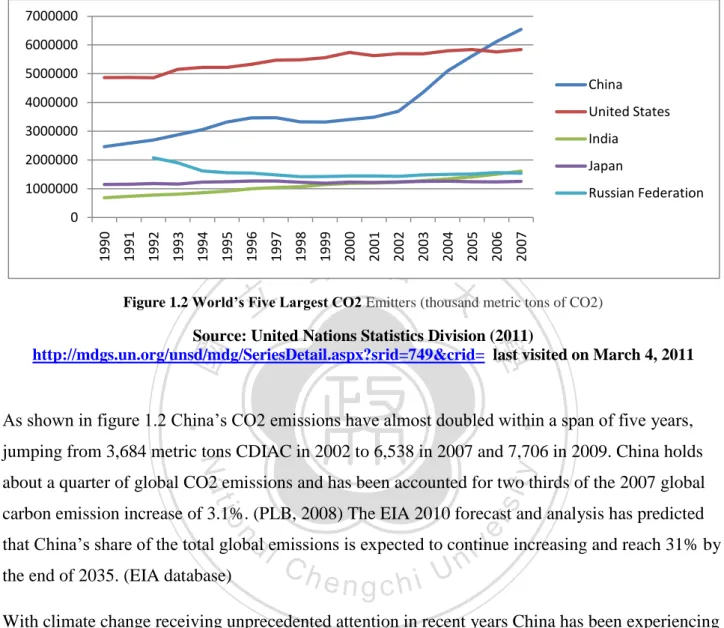
(13) In 1993 China became a net oil importer as energy demand had, for the first time, exceeded domestic production. Since 1991 the nation has become the world‟s biggest producer of coal utilizing its abundant coal reserves, which rank third in the world. Coal had reached its peak contribution to the energy sector in the mid 90s averaging 75% of the total energy structure. Along with oil it makes up around 90% of its total energy mix.. Table 1.1 Structure of Primary Energy Consumption. Coal Oil Natural Gas Hydro, nuclear and renewables. 1980 72.2% 20.7% 3.1% 4.0%. 1985 75.8% 17.1% 2.2% 4.9%. 1990 76.2% 16.6% 2.1% 5.1%. 1995 74.6% 17.5% 1.8% 6.1%. 2000 66.6% 23.4% 2.3% 6.7%. 2005 69.1% 21.0% 2.8% 7.9%. 2010 (E) 71% 19% 3% 7.2%. 政 治 大. Source: Andrews-Speed (2004) Pg. 11. Energy Policy and Regulation in the People’s Republic of China. (Hague: Kluwer Law Internationsl) and IEA, International Energy Statistics. http://www.eia.gov/cfapps/ipdbproject/iedindex3.cfm?tid=2&pid=2&aid=7&cid=regions&syid=1980&eyid=2008 &unit=MK last visited on July 17, 2011. 立. ‧ 國. 學. While industrialization proceeded in fast motion, China‟s energy consumption had risen by over 80 %. ‧. between 2002 and 2007. The continued success of its rapid economic growth has therefore become dependent on the parallel growth of its electricity sector. In order to improve the commercial and. y. Nat. sit. technical performance of the power sector the Chinese government has undertaken a series of. al. er. io. reforms beginning in the late 90s. At the center of the reforms the government has attempted to. n. separate the assets and operations of power generation from those of transmission and distribution,. Ch. as has become the standard in developed markets.. engchi. i Un. v. In 2002 the government began to reform three main elements in the electric energy sector: (OEDC, 2009) The restructuring of the State Power Corporation into five generating companies, two grid companies and a few other service companies, thus assuring a more equal distribution of assets and the privatization of major state owned generating capacity. The restructuring of the sector‟s regulatory agencies, which included an increase in the number of regulating agencies, redistribution of functions and the creation of new functions. The most important of these measures was the creation of the State Electricity Regulatory Commission which reports directly to the State Council.. 5.
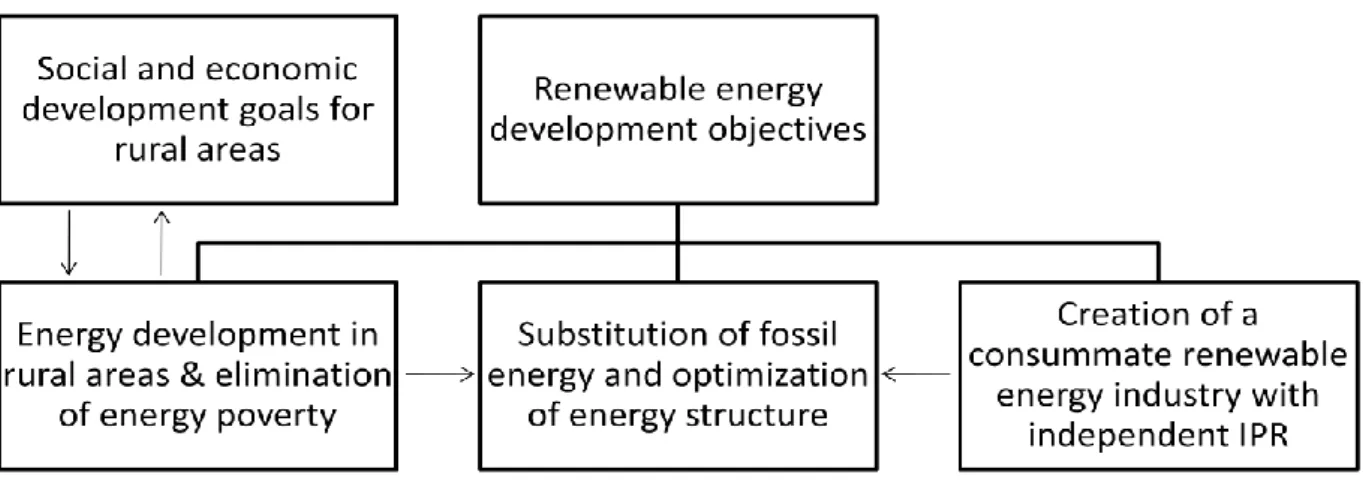
(14) Adopting a new approach to market pricing and the development of competitive markets for power generation has been adopted in a few selected regions which included the creation of three different tariff systems for generation, transmission and distribution. The main focus of these reforms was to supply the needs of the fast growing industry sector, although a significant increase of power demand in domestic households was also noted. The reforms targeted promotion of the existing coal market with a focus on price reduction and financial efficiency. All five big state power corporations did have a limited investment in hydro plants during the first years of the 21st century, but a promotional framework for renewable energy was still missing. To sum up China‟s energy strategy in the years since the beginning of the reforms it is clear that the main focus has been towards simply increasing the production of energy.. 1.2.. 政 治 大. Transition to Renewable Energy. 立. This paper focuses on China‟s efforts to create a significant and sustainable renewable energy. ‧ 國. 學. market with a specific focus on its solar energy market and industry. As we have seen above, the rapid development process which the country has undertaken has left little room for young. ‧. advanced technologies to penetrate the market. 2004 however, saw the beginning of a gradual shift. y. Nat. with environmental policy giving higher attention to energy efficiency and energy conservation.. sit. Starting that year the development of various forms of renewable energy has been receiving. al. n. technologies.. er. io. growing attention and significant efforts have been made towards promoting various new. Ch. engchi. i Un. v. The main reasons for which China has developed real interest in renewable energy falls under three main categories: energy security and optimization of the energy mix, environmental concerns and social and economical development goals for rural areas.. 1.2.1. Energy Security and the Optimization of the Energy Mix As mentioned above China has created a reliance on imported energy during the 90s when becoming a net importer of oil and gas. This situation has forced the country to spread its economic and diplomatic presence to wherever there is untapped supply. It has also led Beijing to pursue close diplomatic ties with countries that in many cases hold foreign policies that rival most developed countries. (Zha, 2006) Chinese companies have only a short history of dealing with the 6.
(15) political risks of venturing into foreign markets and in some cases have been rejected and blocked from participating in development of oil fields. As the world has experienced two oil crises within the last 50 years, the significance of developing a more self reliant energy market has become a priority. The list of possible reasons for the 2003-8 oil crises includes political tension in the Middle East as well as reports showing a decline in petroleum reserves and oil peak speculations. Middle Eastern countries have been and will likely continue to be China‟s largest source of energy. China‟s eagerness to develop relations with Middle Eastern countries has been the trigger for political conflicts with some EU countries and The US. An example for the challenges presented to China by maintaining good relations with its international oil suppliers is its relations with Iran, China‟s third biggest oil supplier, as its nuclear aspirations causing political tension between China and the US. (Liu et al, 2010). 政 治 大 exact amount of exploitable petroleum reserves in order to estimate the maximum rate of global 立 petroleum extraction. Based on the Hubbert peak theory (1956), once that point is reached Since the first major oil crises in 1973 governments have been continuously trying to assess the. ‧ 國. 學. petroleum production is expected to go into a constant stage of decrease. In 2010 the International Energy Association acknowledged that conventional crude oil production has peaked in 2006 and. ‧. that gas production is expected to peak around 2035. (IEA, 20101) With that in mind, countries. y. sit. io. er. era.. Nat. around the world are preparing themselves for an efficient transition into a new energy consumption. Li and Woodrow have depicted (2010) the path China has gone through, from self reliance to. n. al. Ch. i Un. v. market dependence. They claim that the new stage in its policy making calculations is the transition. engchi. to green energy: “China‟s deep sense of its energy insecurity and vulnerability is changing its development policy towards clean and renewable energy... (it) is trying to rely primarily on domestic resources while strengthen mutually beneficial international energy cooperation.” (pg 18). 1.2.2. Environmental Concerns and Climate Change In July 2007 a report by the PLB Netherlands Environmental Assessment Agency declared that China has for the first time surpassed the USA to become the world‟s largest emitter of greenhouse gases. In the last two decades it has become a scientific consensus that global warming is an occurring phenomenon that is caused mostly by increased global greenhouse gas emissions, inflicted by human activities such as burning of fossil fuel and deforestation. Although the direct results of the world‟s climate crises are difficult to assess, likely effects are expected to be the rise 7.
(16) of the sea level, flooding of many coastal cities, more frequent extreme weather events and the expansion of desertification processes.. 7000000 6000000 5000000. China. 4000000. United States. 3000000. India. 2000000. Japan. 1000000. Russian Federation 2007. 2006. 2005. 2004. 2003. 2002. 2001. 2000. 1999. 1998. 1997. 1996. 1995. 1994. 1993. 1992. 1991. 1990. 0. 政 治 大 Figure 1.2 World’s Five Largest CO2 Emitters (thousand metric tons of CO2) 立 ‧. ‧ 國. 學. Source: United Nations Statistics Division (2011) http://mdgs.un.org/unsd/mdg/SeriesDetail.aspx?srid=749&crid= last visited on March 4, 2011. As shown in figure 1.2 China‟s CO2 emissions have almost doubled within a span of five years,. y. Nat. jumping from 3,684 metric tons CDIAC in 2002 to 6,538 in 2007 and 7,706 in 2009. China holds. sit. about a quarter of global CO2 emissions and has been accounted for two thirds of the 2007 global. n. al. er. io. carbon emission increase of 3.1%. (PLB, 2008) The EIA 2010 forecast and analysis has predicted. v. that China‟s share of the total global emissions is expected to continue increasing and reach 31% by the end of 2035. (EIA database). Ch. engchi. i Un. With climate change receiving unprecedented attention in recent years China has been experiencing growing criticism from the international community concerning the environmental price claimed by its rapid economic growth. Much of that criticism addresses the extent to which China should take measures to reduce its CO2 emissions. It has been shown that economic development in the past two centuries has gone hand in hand with the deterioration of the ecological system as a result of environmental unfriendly technologies. It is therefore a great challenge for China and other developing economies to ensure similar rates of GDP growth along with transition to greener technologies. It is important to mention in this context that although China is the world‟s largest emitter, its emission per capita still measures below the world average. Chinese leadership is aware of this environmental challenge and in 2007 the National Development and Reform Committee (NDRC) has came up with a national climate change program. The paper 8.
(17) provides key policies and measures to be approached directly by the government. The optimization of the energy mix by developing renewable energy is of course listed under efforts to mitigate climate change but interesting enough it came only second behind efforts to improve traditional energy efficiency. Through the discussion on solar energy markets in China this paper will treat the challenges of transition from existing technologies of energy production to new advanced technologies.. 1.2.3. Social and Economic Development Goals for Rural Areas China, more than any other country, represents the trend of urbanization and expansion of urban industrial service sector in the expense of rural areas. China‟s rural society is estimated at around 55% of the total population, a rapid decrease from an estimated 98% in the early days of the PRC. It has. 政 治 大. been indicated by Chinese leaders that the rising gap between mostly rich urban and mostly poor. 立. rural citizens is one of the most serious challenges for modern china today. Whereas a small number. ‧ 國. 學. of coastal provinces and the special development zones in south eastern China can be mostly attributed to China‟s growth rate, many regions have lagged behind.. ‧. In order to initiate a more rapid development of rural hinterland, the central government has taken. y. Nat. three leading measures: liberalization of the land tenure system in order to protect land owners from. sit. land rights extortion; a more pragmatic rural-urban migration and hukou system of household. n. al. er. io. registration in order to better canalize human resources; a large scale infrastructure project which. v. includes railways, water channels, reservoirs, roads and electrification projects. (Heilig, 2003). Ch. engchi. i Un. Within the span of 50 years, China has increased the population with access to electricity from roughly 40% in the 50‟s to 95% in 2004. This however leaves 9 to 22 million people in remote areas without access to electricity. (To, 2009) In areas where connection to the main electricity grid is not viable China focuses its efforts on renewable energy projects. Unlike the National level in which energy generation heavily relies on coal, local generation in china‟s rural areas has been dominated by small hydro projects which amounts to over half the production. The next most common energy production form is thermal power which plays an important role in ensuring stable supply. In order to promote sustainable development that is both economically viable and socially acceptable authorities are pursuing for measures that will be less destructive towards the environment. Renewable energy is expected to play a key factor in assuring sustained utilization of natural resources for generations to come.. 9.
(18) Figure 1.3 Components of China’s Renewable Energy Development Objectives and Correlations Source: Shi Dan, 2010 China’s Renewable Energy Development Targets and Implementation Effect Analysis, in The Globalization of Energy: China and the European Union, pg. 204. ed. M. Parvizi Amineh and Yang Guang. (Leiden: Koninklijke Brill NV). 政 治 大. 立. ‧ 國. 學. The substitution of fossil energy and optimization of energy structure is a goal shared by all countries. China perceives that the establishment of a renewable energy industry is a must if it. ‧. wishes to protect its national interests within the global competition in renewable energy development. As shown in figure 1.3 below, energy development in rural areas and the creation of a. Nat. sit. y. renewable energy industry have a supportive relation to the main goal, which is substitution of. n. al. er. io. fossil energy and the optimization of energy structure.. 1.3.. Ch. Introducing Solar Energy. engchi. i Un. v. Since ancient times men has tried harnessing the sun for its own usage. The sun has been used as far as the 7th century BC as a tool for making fire using a magnifying glass to concentrate sun rays. The photovoltaic effect was discovered by Edmond Becquerel in 1839 while experimenting with the effect of exposure to light on electricity generation using two metal electrodes placed in an electricity conducting solution. The word photovoltaic is derived from the word photon, meaning light, and volt, meaning unit of electric potential and refers to the conversion of sunlight into electricity. Like all renewable technologies, there are pros and cons to solar PV systems. Unlike hydropower systems, generating energy from the sun is limited to fixed daily intervals whereas during night time energy needs to be extracted from an alternative energy source or from a battery backup system. 10.
(19) Solar panels require a large area of installation that cannot be used otherwise for agriculture, unlike wind harvesting farms. Its greatest disadvantage is the initial cost of installing a solar energy system mainly because of the high price of semi-conducting materials. Using solar to produce electricity does have some significant advantages. There is more than enough solar irradiation available to satisfy the world‟s energy demands. Each square meter of land on earth is exposed on average to enough sunlight to generate 1700 kWh of energy every year, 10,000 times more than the existing global energy needs. Only a small percentage of this potential can be tapped with today‟s existing technology, however unlike fossil fuels there is no issue of finite resource wastage. Moreover, PV modules can be used for around 25 years, which after can be recycled and re-used under appropriate treatment. Unlike hydropower dams than have a significant negative. 政 治 大 minimum. PV systems are easy to install, are reliable and recoup the energy spent on their creation 立 within a short time span (6 months to 3 years). (EPIA, 2011 ). environmental impact on surrounding ecological systems, solar power systems keep their affect to a 1. ‧ 國. 學. 40 years separate the first basic PV applications which were used in space and the GW systems. ‧. which are being used today. PV technology has become in the last couple of years a major source of world power generation. From 16 GW of cumulative installed PV capacity at the end of 2008,. Nat. sit. y. capacity has grown to 23 GW and almost 40 GW in 2009 and 2010 (120% annual growth in 2010. io. er. alone). This major increase is directly linked to the rapid growth of the German market in 2010 (7.4 GW) as well as the Italian market (2.3 GW). It is no surprise therefore to find the EU as the leader. n. al. Ch. i Un. v. with 30 GW installed capacity, accounting for around 75% of the total global market. Outside the. engchi. EU, Japan and the USA have a developing market as well with 3.6 and 2.5 GW of installed capacity. (EPIA, 20112) Despite these significant accomplishments, PV electricity still constitutes only 0.2% of the world power consumption. It trails hydropower which holds 15% of global capacity and constitutes over 80% of the total renewable power capacity. Apart from hydropower, wind power is the only other significant grid connected renewable technology with over 160 GW installed by 2010 but still less than a single percentage of total capacity. (REN21, 2010) Aside from grid connected technologies, biomass heating and solar hot water heating technologies are other renewable based technologies that are commercially used around the world. As mentioned above, the cost of PV systems has been the main obstacle to its technology‟s evolution. The competitiveness of the industry relies on its ability to reach grid parity, defined as 11.
(20) the “moment in time when the savings in electricity cost and/or the revenues generated by selling electricity on the market are equal to or higher than the long-term cost of installing and financing a PV system”. (EPIA, 20111) This paper aims at analyzing and asserting the PV industry and market in China. Using an analytical framework taken from the European Photovoltaic Industry association (EPIA) under an evolutionary economics framework of analysis, this paper will evaluate the progress made in China in recent years and the future of its PV electricity sector.. 1.4.. Analytical Framework. The European Photovoltaic Industry Association (EPIA) is the world‟s largest industry association devoted to exploring the solar PV electricity industry and market. In their 2011 industry report the. 政 治 大. organization has set several criteria for the achievement of price competitiveness of PV, factors affecting PV systems cost reduction and issues concerning the integration of systems into the. 立. energy markets. This paper will discuss the current status of china‟s solar industry in regard to the. ‧. ‧ 國. 學. elements mentioned below.. 1.4.1. Price Competitiveness of PV. y. Nat. sit. Module price – In general PV module prices have reduced by 22% each time the cumulative. n. al. er. io. installed capacity has doubled. This is mostly the result of the industry gaining economies of scale. i Un. v. and experience. Innovation, research, development and political support have been the major drivers to price cuts.. Ch. engchi. System price – While modules take the greater part of the price of a complete system, other components, referred to as Balance of System (BOS) components, are also to be considered. These elements such as inverters, wiring switches etc. have had more volatile pricing. BOS has also shown a constant decrease in price with the increase of cumulative installed capacity. Electricity generation cost – The Levelised Cost of Electricity (LCOE) compares the profitability of different power generation plants according to their investment and operational costs of a system‟s life time. As expected, electricity generation is more expensive (per kWh) in areas that have less exposure to irradiation such as northern Europe than in the Middle East. LCOE is a common tool in comparing renewable energy systems to other conventional electricity producing systems such as gas and nuclear production. 12.
(21) Electricity price evolution – With conventional electricity being subsidized in many countries by governments, conventional prices do not reflect actual production costs. Government support is therefore a key component of the success of solar PV. Moreover, as the current market price of CO2 emissions is considered to be below its realistic price, any investment which is made now in renewable energy will be paid in the future with prices rising. Above all, as PV is already becoming competitive in countries that have high sun irradiation, it is expected to become more competitive as prices of conventional energy resources increase. Market segments – Off grid applications are already cost competitive compared to diesel generators. Grid connected applications are not yet competitive, however research has shown that in some countries both large utility scale PV systems and systems for the residential segment are already competitive during summer or winter peak demand.. 立. 1.4.2. PV Cost Reduction. 政 治 大. ‧ 國. 學. Technological innovation – This aspect mainly refers to efficiency. More efficient PV modules less raw material, less manufacturing energy and lower the BOS costs. Other than that, the PV sector is. ‧. trying to replace toxic and scarce materials with common environmentally friendly materials.. sit. y. Nat. Production optimization – As companies scale-up production, they use more automation and larger. io. er. line capacities. Improved production processes can also reduce wafer breakage and line downtime.. al. iv n C stages: bulk buying of raw materials, obtaining favorable interest rates for financing, efficient h e nmore hi U c g marketing. n. Economies of scale – Economies of scale can be achieved at the following supply and production. Extended life of systems – 25 years is considered the minimum lifetime of a PV module. With research being made in the encapsulating material field, systems are expected to reach lifetime of 40 years. Development of standards and specifications – Standards and consistent technological specifications help manufacturers work towards common goals and contribute to costs reduction in design production and development. Next generation technologies – Here lies the greatest potential in cost reduction. Today‟s main research fields are on increasing stability over time and increasing the solar cell area.. 13.
(22) 1.4.3. Integration of Systems Into the Energy Markets High penetration of PV in the grids – With small amounts of PV connected to the grid, most of the electricity produced is consumed at the site or in the immediate neighborhood. Studies show that PV could account for up to 20% of supply without affecting the grid, after which broad technical development will have to be made. Also, since PV depends on the sun it is variable and needs to be balanced by other sources of power. Although irradiation prediction is quite accurate and much easier than wind forecasts it still remains a challenge, especially on a small scale. From centralized to decentralized energy generation – Many countries are now starting an evolutionary process of moving from a mainly centralized electricity generation to a decentralized form. However as electricity grid operators need to rethink how to guarantee the quality of electricity delivery some areas need to be further improved and developed. The major areas. 政 治 大 natural resources of greater areas, transition to more efficient smart grids, storage and demand 立 management.. concerned are peak load shaving, global management of the super grid to better capitalize on the. ‧ 國. 學. Theoretical Background – Evolutionary Economics. ‧. 1.5.. Nat. sit. y. As mentioned above, transition to alternative sources of energy consumption cannot be achieved. io. er. over night and requires comprehensive changes within a variety of elements within the industry and market. This paper will approach the issue of China‟s transition to PV electricity usage from the. n. al. Ch. i Un. v. perspective of evolutionary economics. The significance of the usage of the word „transition‟ as in. engchi. contrast to „change‟ is that this term links up with the notion of sustainable development and shifts the attention to the process itself as a more concrete step. Transitions can be described as either spontaneous or goal oriented as well as by their degree of complexity. Spontaneous transition all hold a major degree of complexity and include the invention and use of fire, the rise of agriculture and the industrial revolution. These transitions have not been planned in advance and have been impossible to predict. Intermediate kinds of transition would be electrification and transitions in transport, from horse and wagon to cars for example. The green revolution is a considered a minor transition, the only kind of transitions that are goal oriented. The strive for a minor transition compensates for major transitions being out of the reach of public regulation by man.. 14.
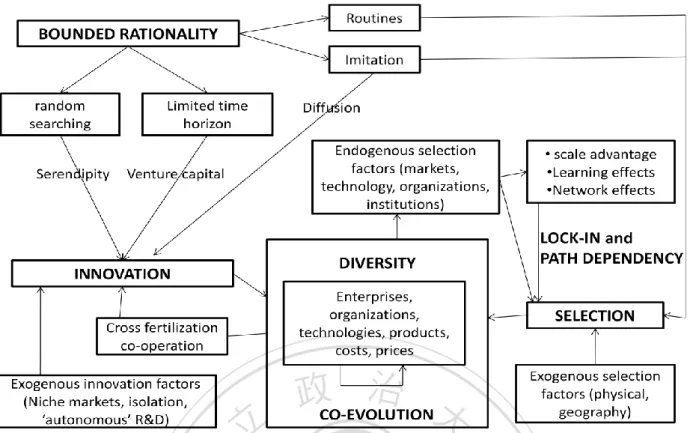
(23) The term evolutionary economics was first used by Thorstein Veblen in 1898, but it was Joseph Schumpter that became the first influential of evolutionary economics. Schumpeter showed a great interest in the dynamics of economics and considered qualitative economic and technical change in a wider context of social change. He used the term creative destruction to describe a process in which revolutionary forces from within the economy destroy old processes and create new ones. This process of change follows a major invention that encourages the formation of clusters of derived innovation. In 1982 Richard Nelson and Sidney Winter have published “An Evolutionary theory of Economic change”, which has become the most influential text dealing with evolutionary transition in economics. This publication deploys the three core Darwinian principles, variety, inheritance and selection, which make the building blocks of their theory. In this text Nelson and winter claim that as changes continuously occurs in technology and routines, the mechanisms that provide these three. 政 治 大. elements need to be identified and structured.. 立. Based on this and other works in the field of evolutionary economics, Jeroen van den Bergh and. ‧ 國. 學. Frans Oosterhuis from the institute of environmental studies of the Free University in the Netherlands have introduced six core concepts of evolutionary economics. These concepts are. ‧. Bounded Rationality, Diversity, Innovation, Selection, Path Dependence and Lock In and Co-. io. y. er. structural change taking place in China‟s PV industry and market.. sit. Nat. Evolution. These six concepts will be used in this paper as guidelines in assessing the process of. An overview of each concept will be provided first: (van den Bergh and Oosterhuis, 2008). n. al. Ch. engchi. i Un. v. Bounded Rationality Bounded rationality replaces the traditional neoclassical assumption of rational and optimizing behavior. This implies that agents are not fully informed and will not include all possibilities in their considerations for performing any behavioral or economic act. Gathering complete set of information is constrained by time and energy and therefore agents are inclined to rely on routines, heuristics and imitation. A satisfactory decision is often as good as or better than a perfect decision in terms of costs related to achieving a solution. Bounded rationality therefore takes the form of routines, habits, imitation and limited time horizon. As will be shown below, in the capital intensive market of PV the short time horizon of investors plays a major role. PV projects‟ financial performance is highly dependent on the discount rates or payback period applied by investors.. 15.
(24) Diversity Diversity or heterogeneity in strategies of an economic agent is a consequence of bounded rationality. It is a central concept in the evolutionary framework as it is regarded as a measure for the flexibility and evolutionary potential of an economic system (also referred to as fitness). Diversity relates to economic strategies, technologies, knowledge, agents and institutions. It can be categorized by the number of options on a portfolio, the evenness of representation of the different options and the degree to which the options differ one from the other. Diversity is high in the PV electricity world as companies dealing with PV technology display a large variety in size and type of industry. A range of technologies exist and within a wide range of applicative areas.. Innovation. 立. 政 治 大. ‧ 國. 學. Innovation and selection are two concepts that influence diversity directly. Innovation implies an increase in opportunities for creative combinations that contribute to the system‟s survival and. ‧. fitness. Innovation is often the result of serendipity, the combination of insight and expertise with chance. Knowledge and systematic search are the two methods in which the chances for innovative. sit. y. Nat. combinations can occur. Incremental innovation refers to improving the performance of existing. io. er. technologies whereas radical innovation usually involves the combination of very different concepts and technologies. Serendipity, cross fertilization and niche markets have played an important role in. n. al. Ch. i Un. v. the development of PV so far, although the lack of a coherent future perspective on the role of PV. engchi. technology has been a restraining factor up until the second half of the last decade.. Selection Selection is a process that reduces diversity. It refers to the survival and reproduction of successful agents or strategies in a system. Selection environments are complex, with technological, organizational, economic and institutional dimensions. It is difficult to plan and forecast transition in such an environment, especially since each kind of economic evolution has its own unique environment. PV is still an expensive technology, as mentioned above, therefore is dependent on subsidies and other preferential policy measures. As will be shown below, governmental policies play a crucial role in the selection process of PV.. 16.
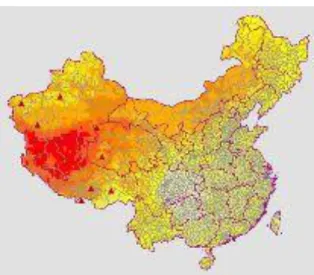
(25) Path Dependence and Lock-in Repeated selections causes changes in the population systems. This can occur because of scale advantages, imitation or bandwagon demand side effects, technological interrelatedness or complementarities etc. In competition against technologies whoever gets a larger market share first will have an advantage and could grow relatively quicker. Increasing returns can give rise to the dominance of a particular technological or economic regime that does not let other (efficient and inefficient) technologies arise – these dominant technologies are called a lock-in. Other systems outside the lock-in look irregular and lack repetition, and therefore are considered as path dependent - adaptations need to be made before they are cumulated. Since technology tends to follow irreversible pathways it requires a major effort to shift away from lock-ins and promote path. 政 治 大 systems of decentralized electricity supply. It is a great challenge to fit the grid system for this kind 立 of technology. dependence technologies. PV systems hardly benefit from economies of scale and are suitable for. ‧. ‧ 國. 學. Co-evolution. sit. y. Nat. This concept refers to the mutual influence and interference between two or more systems or. io. er. populations. The pressure exerted by one system over the other leads to related evolutionary developments. Co-Evolution is thus a particular concept of dynamic interaction between two. n. al. Ch. i Un. v. populations with internal diversity. Solar PV technology, having an intermittent character due to. engchi. fluctuations in solar energy influx, will have implications for other components of the energy system such as energy storage devices. Solar PV technology also requires development in other BOS components that are technologies shared with other fields such as inverters and smart grid.. 17.
(26) 立. 政 治 大. Figure 1.4 A Schematic Representation of the Evolutionary Economy. ‧ 國. 學. y. sit. io. er. Hypothesis. Nat. 1.6.. ‧. Source: Jeroen van den Bergh and Frans Oosterhuis, 2008. An Evolutionary-Economic Analysis of Energy Transitions, in Managing the Transition to renewable Energy: Theory and Practice from Local, Regional and Macro Perspectives. Pg. 149-173. Ed. By Jeroen C.J.M. van den Bergh and Frank R. Bruinsma. (Great Britain: MPG Books LTD). As shown above, the success of achieving a balanced economic transition depends on a variety of. n. al. Ch. i Un. v. variables, some which are beyond the direct influence of stakeholders and policy makers. As. engchi. transition is a long process that does not begin at a specific point in time and end at another, a criteria needs to be set in order to define whether the process of transition is advancing in the desired direction. This paper regards to PV grid parity in China as criteria of success. PV has not yet reached grid parity anywhere in the world, although the EPIA 2010 annual report has shown great optimism in reaching that goal in some countries within the coming decade. According to the evolutionary economy theory, all six elements mentioned above need to be balanced and well positioned in order to allow transition to take place. The hypothesis of this paper is therefore: Bounded Rationality, Diversity, Innovation, Selection, Path Dependent and Lock-In and Co-Evolution need to be balanced and well positioned in order to promote solar PV grid parity in China. Although the greater part of the discussion will relate 18.
(27) directly to these elements as they appear in china, one cannot separate them from the international PV industry and market and therefore they will also be mentioned during the analysis. The uniqueness of Van den Bergh and Oosterhuis‟s schematic representation is that it places the six evolutionary elements in a relative correspondence. The assessment of not only each element‟s features within a process but also the way they effect each other makes the evolutionary approach a well balanced tool. The interaction between the elements plays a more important role than the elements do alone, and is a key component to the success of the evolutionary process. A large amount of researches and reports have been written concerning China‟s solar PV efforts in the past few years. Some of the reports have been mostly informative, depicting trends and events in the industry and market. The European Photovoltaic Industry Association and International Energy Agency have both prepared an in depth analysis on China‟s market which are highly informative.. 政 治 大 as Tour et al‟s analysis on innovation and technology transfer or Chen‟s analysis on the 立 development of solar PV as a niche market. (Chen, 2008) Governmental reports have either given. More specific papers have been written concerning specific aspects of China‟s solar PV sector such. ‧ 國. 學. an in depth description on the industry (REDP, 2008) or the market and government incentives (CTCREP, 2009) with little analytical integration.. ‧. This paper was written in an attempt to integrate two elements. First, it aims at introducing the. Nat. sit. y. relationship between the Chinese PV market and industry. As mentioned above there is currently a huge potential gap between the current market and its potential expansion. This paper will show that. io. n. al. er. both the PV industry and market have direct influence on each other‟s development and mutual dependant for future success.. Ch. engchi. i Un. v. Secondly, this paper will present an in depth analysis of the relationship of the government with the industry and market players. As almost every aspect of business and industry in China one must understand the role played by the central government, as well as provincial and municipal governments. The paper relies on existing information found in current literature as well as news articles various company websites and data bases. Using the evolutionary economics theory, this paper provides a unique analysis of the interaction between government, market and industry and assesses the extent to which China has positioned itself to carry out an energy transition to solar electricity in coming years and decades. Having set a clear goal in the form of grid parity and a specific list of bench marks, this paper can serve as a practical tool for decision makers and investors looking for business opportunities in the Chinese market. 19.
(28) Chapter 2 - Government Policy Government policy has served as a key component in promoting renewable energy technology since before the 1990‟s. (Loiter and Norberg-Bohm) Like many countries, China uses fiscal support as a tool to promote renewable energy deployment. As mentioned above, the development of PV technology and market is heavily dependent on government incentives and subsidies in order to develope. This chapter will analyze the role of the government in promoting a sustainable transition in China‟s electricity market. The chapter will focus on past barriers to transition, the range and efficiency of laws and regulations, incentive programs and present transitional challenges.. The role China‟s central government plays in promoting the PV market can be best seen in the. 治 政 the different instruments which have been put in effect in the 大 last decade in order to promote solar 立 PV in the grid electricity market. As will be shown below, Bounded Rationality is a key factor. relationships between two concepts: Bounded Rationality and Selection. This chapter will focus on. ‧ 國. 學. which prevents the Chinese PV market from fulfilling its potential. Significant efforts have been made in recent years in order to foster a balanced Selection environment that will promote the. Ch. sit. y. n. al. er. Exogenous and Endogenous Selection Factors. io. 2.1.. Nat. 2.. ‧. market in a sustainable transition path.. i Un. v. In terms of exogenous selection factors, selecting a path to solar energy utilization is nothing less. engchi. than expected of China, as it has abundant solar radiation resources. Average daily radiation in many areas in China exceeds 4 kWh/m2 and the total annual radiation it receives equals to 1.7 trillion tons of coal, more than 700 time its current annual consumption. Areas which are richest in radiation are Tibet, Xinjiang, Inner Mongolia and Qinghai provinces which together account for over 50% of China‟s solar sources. (CTCREP, 2009). 20.
(29) Figure 2.1 Solar Energy Resources Distribution in China Source: Cleanergy Septenber 9th, 2009. Huge Solar Power Plant in China – first solar and Chinese Government MOU. http://cleanergy.blogspot.com/2009/09/fwd-huge-solar-power-plant-in-china.html visited on May 27, 2011. 治 政 China‟s endogenous selection factors are however unique and大 play a significant role in its energy 立 transition efforts. The most radiation abundant regions are located in China‟s north west which is ‧ 國. 學. significantly less developed then the costal rich eastern provinces. Although these regions contain vast unutilized land resources they are mostly rural and are a great distance away from the country‟s. ‧. central grid. Most of china‟s PV manufacturing is done in developed provinces which are mostly located in the eastern coastal region and it is a current challenge for the central government to. y. Nat. n. er. io. al. 2.2.. Early Renewable Policy. sit. breach the gap between these two sides of the country.. Ch. engchi. i Un. v. Chinese renewable energy policy has entered an advanced phase in 2005 with the issuance of the national Renewable Energy Law (REL). This law serves as an umbrella framework for developing renewable energy whereas specific regulations and measures followed in order to support the development of specific sectors such as wind, solar and biomass energy sources. Prior to the adoption of the REL few laws have been passed which encouraged the development and utility of clean energy. (REN21, 2009) China‟s first successful application of solar cells was on the “No. 2 East Red Satellite” in 1971. However due to the technology‟s high price, terrestrial use was very limited until the 6th and 7th five year plans (1981-1990) under which the government started to support a wider use of. (REDP, 2008). 21.
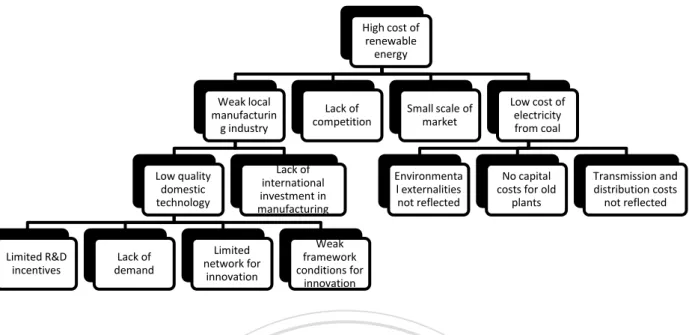
(30) The 1995 Electricity Law was enacted to promote the development of the electric power industry and protect the industry‟s stakeholders. Two years later the Energy Conservation Law was embedded, providing preliminary tools for facilitation of energy savings and improving economic benefits of energy use. The Law for Prevention and Control of Air pollution was passed in 2000 with a goal of prevention and control of atmospheric pollution. Backed up by these general legislative efforts, some more concrete measures have been taken in the renewable and PV sector PV technology started to be applied in special industries such as the military as well as for operation of household systems and power supply systems in rural villages. In 2001 the NDRC launched the Township Electrification program in an attempt to solve power supply problems in isolated rural areas. In just 20 months, the program electrified more than 1,000 townships in nine western provinces. This project has brought power to nearly one million people and is considered as China‟s first major electrification project using renewable energy. Out of a. 政 治 大. total of 221 MW of installed capacity 20 came from deployment of PV systems, with the bulk of the. 立. energy produced using hydropower systems. The government has provided USD 240 million to. ‧ 國. 學. subsidize the capital costs of equipment. (NREL, 20041). Programs smaller in scope and scale in which PV played a significant role have been launched since.. ‧. The “Sunlight program” which has run up until 2010 attempted to establish large scale grid. y. Nat. connected PV projects, PV/hybrid village power demonstration systems and home PV projects for. sit. remote areas. However due to inefficient financing regulations and lack of concrete goals it did not. n. al. er. io. play an important role in promoting the market.. i Un. v. Two more notable programs have been implemented by the NDRC. The “Brightness Program”. Ch. engchi. instituted multilateral assistance to install several solar and wind systems in North West china. The “Ride the Wind” program supported the development of domestic manufacturing of wind turbine components. (NREL, 20042) China‟s commitment to growing its renewable energy industry is best shown at the Bonn Renewable Energy Conference in 2004 where it has first declared that it will commit to generate 10% of its electricity from renewable by 2010:. Renewable energy is the ultimate way to solve the problems of energy resources and environment faced by humankind at present… The Chinese Government highly values the development and application of renewable energy… In order to accelerate the development and application of renewable energy, China is setting about formulating the China Renewable 22.
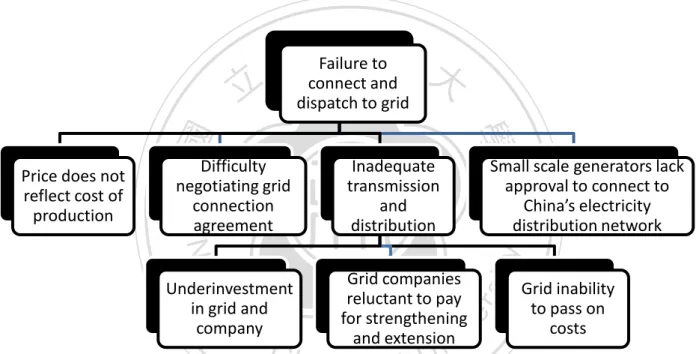
(31) Energy Development and Utilization Promotion Law… We hope to promote the commercial and scalable development of renewable energy in order to realize the common progress of the entire human race and to promote the sustainable development of society together with all countries all over the world. (Zhang Guobao, Vice president of NDCR, Cherni and Kentish, 2007. Pg. 3620). 2.3.. Barriers to Renewable Energy. Three main elements have been identified as overall barriers to promoting renewable energy in China. These elements are institutional barriers, cost of renewable energy and connection to grid.. 2.3.1. Institutional Barriers. 立. 政 治 大. It is evident that the Chinese government is interested in playing an active role in the Selection. ‧ 國. 學. element of renewable energy in general and PV technology in particular. The 2005 REL has been the result of this willingness and was aimed at overcoming institutional barriers that interfered with. ‧. renewable energy industry development. Some of the barriers given most attention at the time were:. sit. y. Nat. Import tariff reduction for complete equipment – Since 1996, general average customs rate has been. io. er. reduced by 23% with wind turbines and PV equipment treated preferentially. Criticism has been raised concerning this incentive as it damaged local industry with developers saving costs by. n. al. Ch. i Un. v. importing components. While the wind power developers enjoyed a 3% tariff rate and no import tax. engchi. which had a strong negative effect of the local industry, PV developers had to add 12% tax on their imported components at the time. (Development Research Center, 2002) Few government low interest loans – Up until 1994 energy conservation infrastructure projects received low interest loans that were 30% lower on average than interest on commercial loans. However after the reform of the financial and tax systems these favorable interest rates were eliminated with another low interest loan program terminated in 1997. (Development Research Center, 2002) Foreign loans and lack of international and local financing mechanisms – With an industry that lags behind international standards, developers rely heavily on foreign grants and loans. These usually are tied to purchase obligations of donor country generation equipment which keeps the local Chinese industry at the same status. In general there has been a lack of domestic and international 23.
(32) financing channels and mechanisms which left the renewable energy sector with insufficient capital. (Cherni and Kentish, 2007) All three barriers are a result of a policy which focuses on the Selection and Bounded Rationality elements. The main driver behind them is the need to reduce the high cost of renewable energy, which mostly results from the undeveloped industry and lack of financing mechanisms, and attract developers to a market that does not offer immediate returns. However, these policies have damaged the local industry‟s Innovation and Diversity as they created over dependence on a limited range of local and foreign agents and significantly limit venture capital in local projects.. 2.3.2. Renewable Energy Cost. 政 治 大 generation. China strives to keep electricity prices low in support of its GDP, however this goal 立 conflicts with renewable energy promotion. Weak pollution controls fail to reflect the real The greatest barrier for renewable energy in China is its high cost in comparison to coal fired. ‧ 國. 學. economical price paid with the growth of CO2 emissions. Moreover China had many old coal fired generation plants which have fully depreciated their capital cost and are less capital intensive than. ‧. renewable projects.. sit. y. Nat. This is an example of the Lock-In condition the renewable market is facing while trying to compete. io. er. with the current dominant electricity industry. Coal fired plants are expected to have the upper hand for years to come and it will require great calculated efforts in order to shift away from the current. al. n. energy producing model.. Ch. engchi. 24. i Un. v.
(33) High cost of renewable energy. Weak local manufacturin g industry. Lack of international investment in manufacturing. Low quality domestic technology. Limited R&D incentives. Limited network for innovation. Lack of demand. Lack of competition. Low cost of electricity from coal. Small scale of market. Environmenta l externalities not reflected. No capital costs for old plants. Transmission and distribution costs not reflected. Weak framework conditions for innovation. 政 治 大. Figure 2.2 Factors Contributing to the High Cost of Renewable Energy in China in 2004 Source: Cherni A. Judith and Kentish Joanna, 2007. Renewable energy Policy and Electricity Market Reforms in China. Energy Policy, 35 (2007) pg. 3616-3629. 立. ‧ 國. 學. Another factor which contributed to renewable energy‟s high cost was China‟s weak local manufacturing industry. The lack of R&D incentives and demand limited networks for innovation. ‧. and the lack of framework for innovation have all caused domestic technology to remain low in. sit. y. Nat. quality which further weakened the local manufacturing industry. The lack of substantial market demand and fixed price guarantees has also discouraged international manufacturers from investing. io. al. n. the concept of Diversity.. er. in the local industry. Chapter 3 will focus on the Chinese PV industry and on the ways it relates to. Ch. engchi. i Un. v. 2.3.3. Connection to the Grid More barriers to renewable energy can be found at the connection of renewable projects to the national grid. These barriers mostly originated as a result of lack of cooperation and conflict of interest between developers and grid operators. In 1994 the Ministry of Electric Power issued a regulation which required provincial electric grid authorities to connect wind farms with nearby power grids and purchase all generated electricity. A similar regulation has not been issued for solar PV powered projects as most of PV projects at the time were for rural off grid application.. 25.
(34) However, the regulations failed to work in practice due to a number of barriers. Grid companies found it difficult to gain government approval for the increase in their sales price due to high cost of production. They were also reluctant to share the costs of renewable energy projects connected to other parts of the grid which led to failures of a number of projects. On the technical side, many parts of the grid were too weak to dispatch intermittent renewable energy. In other cases developers either experienced bottle necks which prevented the energy from dispatching or found that the grid needed an expansion which the grid company refused to pay for. In addition, small scale generators have found it impossible to gain approval to connect to the grid. 政Failure治 to 大 connect and. 立. ‧ 國. Inadequate transmission and distribution. Small scale generators lack approval to connect to China’s electricity distribution network. Nat. n. al. Ch. Grid companies reluctant to pay for strengthening and extension. er. io. Underinvestment in grid and company. sit. y. ‧. Difficulty negotiating grid connection agreement. 學. Price does not reflect cost of production. dispatch to grid. engchi. i Un. v. Grid inability to pass on costs. Figure 2.3 Barriers that Prevent Renewable Sources of Electricity from Connecting to the Grid in 2004 Source: Cherni A. Judith and Kentish Joanna, 2007. Renewable energy Policy and Electricity Market Reforms in China. Energy Policy, 35 (2007) pg. 3616-3629. 2.4.. The Renewable Energy Law. The REL came into effect on January 1st 2006 with a clear design to address barriers to renewable energy and to facilitate the growth of the industry. Some specific policies and mechanisms were introduced as a part of these efforts. As a primary means to ensure that renewable energy projects recover their operation costs the REL set up guaranteed grid access and cross subsidization. Enterprises that operate electricity grids (mostly the State Power Grid and the China South Power Grid) will purchase all grid connected generated electricity from approved renewable electricity generators. The price of purchase will not be decided by the market but will follow government 26.
數據
+7
相關文件
Menou, M.著(2002)。《在國家資訊通訊技術政策中的資訊素養:遺漏的層 面,資訊文化》 (Information Literacy in National Information and Communications Technology (ICT)
Skype provide better security than most VoIP system and PSTN. – Just because most VoIP system and PSTN do not provide any
然而,由於美中貿易衝突未完全化解,中國大陸經濟成長 走緩,加上英國脫歐前景未明,影響全球投資信心,仍不利全 球經濟成長,多數經濟預測機構預估 2019
事實上,就算不是經濟不景,由於現代化下都市生活的發展,經濟和社會情況轉變,對
花兒為甚麼這樣紅?還需要用物理學原理來解釋。太陽光經過三稜鏡或
2-1 化學實驗操作程序的認識 探究能力-問題解決 計劃與執行 2-2 化學實驗數據的解釋 探究能力-問題解決 分析與發現 2-3 化學實驗結果的推論與分析
推理論證 批判思辨 探究能力-問題解決 分析與發現 4-3 分析文本、數據等資料以解決問題 探究能力-問題解決 分析與發現 4-4
There is a growing recognition that China will change the world, not only economically, but also politically, intellectually, ideologically and culturally...
