國 立 交 通 大 學
管 理 學 院
企業管理碩士學位學程
碩 士 論 文
企業社會責任和足球:分類,分析和評估企業社會責任倡議實
施的英國和西班牙的職業足球隊
CSR and Football: categorization, analysis and assessment
of the CSR initiatives implemented by the English and
Spanish professional football clubs
研 究 生:馬保羅
指導教授:黃仕斌
CSR and Football: categorization, analysis and assessment
of the CSR initiatives implemented by the English and
Spanish professional football clubs
研 究 生:馬保羅
Student: Pablo J. Martin Guerrero
指導教授:黃仕斌
Advisor: Prof. Kevin Huang
國 立 交 通 大 學
管理學院
企業管理碩士學位學程
碩 士 論 文
A Thesis
Submitted to Master Degree Program of Global Business Administration College of Management
National Chiao Tung University In partial Fulfillment of the Requirements
For the Degree of Master
in
Business Administration July 2012
Hsinchu, Taiwan, Republic of China
i
Abstract: ... ii
Chapter 1: Introduction ... 1
1. Research background: ... 1
2. Research objectives: ... 7
3. Significance and potential contribution ... 8
Chapter 2: CSR and Sport: Literature review ... 9
CSR – A Conceptual Approach ... 9
CSR and sports ... 10
Football and communities ... 12
Chapter 3: Research method ... 14
Research framework and purpose ... 14
Chapter 4: CSR programs of the 2010/2012 Spanish and English football clubs ... 19
La liga ... 19
Premier league ... 36
Chapter 5: Analysis, conclusions and limitations ... 65
Appendix: ... 69
ii
Abstract:
The global diffusion and the wide reach of sport events and competitions have converted sport organizations in prominent members of the global communities. Moreover they have transcended the sport borders and become huge companies themselves, sport industry have become a globalize and profitable business, where sports organizations deals with millions in concepts like merchandising, TV rights, salaries, player trades, and sponsoring. Sport organizations, in this information society, are publicly very exposed and it acts and deeds are always broadly broadcasted and have media repercussions all over the word. CSR initiatives carried out by the sport organizations include among many activities: athlete volunteerism, educational initiatives, philanthropic/charitable donations, community development, community initiatives, fan appreciation, health-related initiatives, and community-based environmental programs. Some of these activities are non monetary and some are represent funds spending for the clubs like philanthropy and charitable initiatives. Monetary actions are normally executed by clubs foundations created with this purpose. The methodology used in this research consists in Qualitative content analysis conducted on wide ranging review of secondary sources and internal football clubs and football organization with the aim of qualitative data reduction and sense-making effort in an
attempts to identify core consistencies and meanings. This study revises and analyses professional papers and articles about CSR, and more
specifically about CSR in the sport world and in football. After developing a framework for our study, the next step consists of gathering data and information about the CSR programs carried out by the English Premier League and the Spanish La Liga clubs and to classify the
iii
data according to our study framework. A final analysis identified patterns, trends and made a comparison between the two countries.
The data of this article will be secondary data mainly extracted from the websites of football clubs, football organization and football clubs foundations.
1
Chapter 1: Introduction
1.
Research background:
Football has a very relevant importance nowadays, it’s the number one sport in the world in terms of fans and practicing, and team have become city ambassadors and big multinationals money making machines. The activity of a football team towards society cannot resume to sports, they have to correspond, what they get from the fans and governments in terms of financial and supporting resources, with CSR programs. As shown, their giving back to the community through CSR takes many and different forms. Our two main field of study will be the English and Spanish football leagues.
The premier league1
The English top professional league is the Premier League. It is formed from 20 clubs and it operates in a system of promotion and relegations with the football league under it. The Premier League work like a corporation in which the 20 member clubs act as shareholders. Seasons starts on august and normally ends by may. Each team plays 38 games and the total of games played during the seasons is 380. Most games are played on Saturdays and Sundays, with a few games played during weekday evenings. From 1993 to 2007, the competition was known as the Premiership. Nowadays for commercial reasons, having Barclays Bank as a main sponsor is therefore officially known as the Barclays Premier League.
1
2
The premier league was created on 20 February 1992. The 20 teams forming the Football League First Division at that time broke up with The Football League, the league organizers, that was originally founded in 1888, in the seek of better and more lucrative television rights deals.
Currently it is considered to be the number one league in Europe based in the performance of the English teams in the in European competitions over the last five years by Union of European Football Associations (UEFA) coefficients . The second on the list is the Spanish La Liga and German Bundesliga. Worth mention is that the Premier League has the second highest average match attendance records after the German Bundesliga. Since the foundation of the professional football league in England by 1888, a total of 23 clubs have been crowned champions of the English football system. The current champions are
Manchester United, who won the title in the 2010–11 seasons. The premier League has had a main sponsor figure since 1993. This sponsor was entitled to
decide the name of the league. The list of sponsors since it re foundation is:
• 1993–2001: Carling (FA Carling Premiership) • 2001–2004: Barclaycard (Barclaycard Premiership) • 2004–2007: Barclays (Barclays Premiership) • 2007–present: Barclays (Barclays Premier League)
Finances: Premier league financial strength is well known in the football world. As Deloitte Football report confirms the Premier League has the highest revenue of any football league in the world, with total club revenues of €2.479 billion in 2009–10, and is the second most profitable after the German Bundesliga. In 2010 the Premier League was granted the
3
Queen's Award for Enterprise in the International Trade category by Her Majesty Queen Elizabeth II. This awards intendeted to thanks the premier League for its important role of developing and sharing the image of Britain overseas as well as fomenting international trade and English economy. Premier League has some of the wealthiest clubs in the world. As Deloitte revealed in it annually football report, 7 out of the 20 richer football teams in Europe are in England. After the Premier League's new TV deal went into effect, the league-wide increase in revenues is expected to increase the Premier League clubs' standing in the list, and there is a possibility that a Premier League club will be top of the list.
Media coverage: The Premier sold its TV rights collectively, in contrast to the Spanish League and Italian Serie A, where clubs sell their rights individually. The television money is divided into three parts: half is shared equally between the clubs. A quarter is distributed according to the classification of teams at the end of the competition and the remaining quarter is paid based on the TV audiences, with the biggest clubs getting more money to be logically the most audience have. The money paid by foreign television is distributed equally among the 20 teams. The television money has steadily increased. The Football League received £ 6.3 million for four years in 1986, but the contract was renewed in 1988 and the price rose to 44 million for another 4 years. The 1988 negotiations were the first sign of rupture of the League. 10 clubs threatened to leave and create a "super league", but finally were persuaded to stay. The seed was planted the Premier and then, With the creation of the Premier decides to allocate the TV rights to Sky TV. Football faced serious charges. This was a totally new concept that was at first very unpopular with viewers, but the marketing campaign for Sky TV in which football was sold again, with the best players coming now because of the money they had teams of the Premier, showed that the measure
4
would be the right one. The business initially was 191 million pounds over 5 years. For the period from 2007 to 2010, SKY and SETANTA SPORTS pay 1.7 billion pounds. Sky paid
£ 1.134 million by offering 92 games and Setanta 392 million to provide 46. Internationally, the Premier League is particularly popular in Asia, where it is the most
widely distributed sports program, especially in India and china. According to the UK tourism body VisitBritain up to 750,000 visitors to United Kingdom also went to a Premier League match in 2010, spending a total £595 million and an average of £766.
La Liga2
The Primera División (First Division) of the Liga Nacional de Fútbol Profesional (LFP), commonly known outside Spain as La Liga (The League) or, for sponsorship reasons, Liga BBVA (BBVA League) since 2008, is the top professional association football division of the Spanish football league system. It is contested by 20 teams, with the three lowest placed teams relegated to the Segunda División and replaced by the top three teams in that division. A total of 59 teams have competed in La Liga, nine of which have been crowned champions. Since the 1950s, Real Madrid and Barcelona have dominated the championship. Barcelona has won the last three seasons of La Liga.
La Liga is currently the second strongest league in Europe according to UEFA's league coefficient. La Liga is one of the most popular professional sports leagues in the world, with an average attendance of 28,286 for league matches in the 2009–10 seasons. This is the sixth highest of any domestic professional sports league in the world and the third highest of any professional association football league, behind the German Bundesliga and English Premier League.
2
5
Deportivo La Coruña, Hércules from Alicante, and Almería were relegated to the 2011–12 Segunda División after finishing in the bottom three spots of the table at the end of the 2010–11 season. Deportivo were relegated to the Segunda División after 20 seasons of continuous membership in the top football league of Spain, while Almería ended four-year tenure in La Liga and Hércules made their immediate return to the second level.
The three relegated teams were replaced by three 2010–11 Segunda División sides.The second division Champions, Real Betis, and runners-up Rayo Vallecano, earned direct promotion. The third promoted team was decided in the promotion play-offs, where Granada returned to the league for the first time in 35 years, having spent 26 of them in Segunda División B and Tercera División.
Finances: According to the study'' Annual Review of Football Finance'' by professional services firm Deloitte' 2012 the Spanish football league, despite the country economical situation, is the second league in Europe revenues generation after the English Premier League and the third more profitable after the German Bundesliga and the English premier League. According with this data, one could suppose that the Spanish league teams financial heath is robust and that the almost all the team enjoys large and considerable budgets. The reality couldn’t be farther from this assumption. As can be seen in the table 1, Spain has only three teams among the most profitable and money generation teams. One of them is Valencia situated in the 19th position. The preponderant situation of the Spanish league in the Deloitte rankings comes for the existence in Spain the football colossus, Real Madrid and FC Barcelona, the two football clubs in the world with the largest incomes. Real Madrid reached last season a turnover of 479.5 million Euros, up 9% from the season
6
2009/10, and distributed as follows: 123.6 million Euros in tickets (4% less than last season), 183.5 million for TV rights (16%) and 172.4 million in advertising, sponsorship and merchandising (14%).
These figures consolidated Real Madrid, for the seventh consecutive year as the Football club with higher incomes in the world, standing to one year equal the record of Manchester United, who remained in first place in the ranking between the seasons 1996/97 and 2003/2004.
In the other hand, F.C. Barcelona remains the second football club in the world with more income for the third consecutive year. Its revenue rose 13% to 450.7 million Euros. Only for sold ticked they received 110.7 million (13% more than last season), television rights ascended to 183.7 million (up 3%) and advertising, sponsorships and merchandising 156.3 million (28 % more). The increase in the latter concept is due to the agreement signed with the Qatar Foundation, worth 30 million Euros. Looking ahead to the next edition of the 30 million agreements with three and a half million that is estimated to generate the victory of the FC Barcelona in Club World, can vary for the first time in seven years the leading position of this ranking.
Media Coverage: Spain is the only first world country football where each team negotiates its rights individually. The greater autonomy of clubs leads to disproportionate allocation of money, where the mighty Real Madrid and Barcelona are 140 million Euros each a year and little teams like Levante, Malaga and Real Sociedad are left with 12 million. Between the extremes, survives a middle class composed of Valencia and Atletico Madrid (42 million), Villarreal (25 million) and Seville (24 million). The differences that set the TV
7
market, obviously have a determinant influence of much of what happens in the field of play during the season, and that based on the money raised is then assembled templates players.
The absence of a collective bargaining for the sale of television rights to both the Spanish and the rest of the world makes the Spanish teams lose millions of Euros each passing week. It is risky to quantify how much more could join the club if they sold their rights in England.
Spanish clubs are currently negotiating a collective model for the distribution of La Liga broadcast revenues, potentially from 2015/16. The revenue advantage that
Real and Barca enjoy over their European peers indicates that a more even distribution of La Liga broadcast revenues would not necessarily challenge the two clubs’ dominance at the top of the Money League.
2.
Research objectives:
Through a Qualitative content analysis we seek to identify core consistencies and meanings from a general overview of the CSR activities carried out for the football clubs in England and Spain, attempt to identity patterns, trends and make a comparison between the two countries. The objective of this thesis is to try to identify which of the two countries have a more develop and professional CSR culture in the professional football world, how CSR schemes are presented in the football world and which type or programs and CSR activates are more frequently performed by the clubs.
8
3.
Significance and potential contribution
Motivation for this research is penetrating into world, the CSR in Football and sport, which it is into its infancy and lack of formal investigations and research. There is also a Personal motivation because of the author country origin in Europe and his personal passion in football.
Moreover, once a comparison framework is being created and set up between the two countries, new countries could be studied and added to the comparison. With all the raw date, a CSR Index or ranking for clubs could be created and developed as well.
This study focus in a industry, analyzing football clubs from two countries, does not show in a very close detail how a clubs develops its CSR activities, how much money is involved, which people run it and how, what are the outcomes, etc. This could be object of further study.
9
Chapter 2: CSR and Sport: Literature
review
CSR – A Conceptual Approach
There many different definitions of CSR and many ways to approach and study it. In this study we are going use the official definition of „Corporate Social Responsibility“of the European Union:
“Most definitions of Corporate Social Responsibility describe it as a concept whereby companies integrate social and environmental concerns in their business operations and in their interaction with their stakeholders on a voluntary basis. Being socially responsible means not only fulfilling legal expectations but also going beyond compliance and investing ‘more’ into human capital, the environment and the relations with stakeholders. The experience with investment in environmentally responsible technologies and business practice suggests that going beyond legal compliance can contribute to a company’s competitiveness. Going beyond basic legal obligations in the social area, e.g. training, working conditions, management-employee relations, can also have a direct impact on productivity. It opens a way of managing change and of reconciling social development with improved competitiveness.”
10
According with this definition, CSR Can be interpreted as the company contribution to sustainable improvement of the society and try to define the extent of business responsibility using four key elements (Jenkins, 2006):
• Economic responsibility: to develop your business strategy in harmony with markets, meaning producing what the market needs and want and delivering it at a fair price
• Legal responsibilities: to behave and function within the established law and order. • Ethical responsibilities: to act in accordance with society expectations expressed by social rules
• Discretionary responsibilities: emanate for the free will of the company manager or owners to give back to the society or community (philanthropy)
CSR and sports
The relationship of CSR and Sports are still in its infancy, as stated by Babiak and Wolfe (2006), 2 decades ago, CSR practices did not have a significant importance in sport management and development. Nowadays we can see and incipient source of scholars and research working on it and how most of the sport organization engage and participate in social responsibility activities.
Based on the research of (Lau, Makhanya, & Trengrouse, 2004) several factors of sport organizations role in the society are responsible for the growing importance of the CSR for sport and the perception in the society.
11
1. The global diffusion and the wide reach of sport events and competitions have converted sport organizations in prominent members of the global communities. Moreover they have transcended the sport borders and become huge companies themselves. In our days, sport industry have become a globalize and profitable business, where sports organizations deals with millions in concepts like merchandising, TV rights, salaries, player trades, and sponsoring.
2. Society is nowadays very aware and cares about the social policies of the corporations and big organizations. Sport organizations, in this information society, are publicly very exposed and it acts and deeds are always broadly broadcasted and have media repercussions all over the word.
3. As many authors avowed, the sport organizations are much embedded into the societies and communities. Sport organizations become identifying symbols of the communities and some of them also possess certain degree of symbolism in some ways, political, ideological or social.
4. CSR initiatives carried out by the sport organizations include among many activities: athlete volunteerism, educational initiatives, philanthropic/charitable donations, community development, community initiatives, fan appreciation, health-related initiatives, and community-based environmental programs (Walker & Kent, 2009). Some of these activities are non monetary and some are represent funds spending for the clubs like philanthropy and charitable initiatives. Monetary actions are normally executed by clubs foundations created with this purpose.
12
Football and communities
For some, Football is not just a sport, but an important factor for economic growth and development. Sparvero and Chalip (2007) listed some of the benefits that solid elite football organizations for the communities, considering communities as individuals and cities, are:
• The Creation of multiple jobs, some directly and some indirectly related with the
football club.
• The increasing revenue for sales and income taxes.
• The improvement of the city marketing and image as Clubs act as ambassadors and
promote the cities excellences.
• Football clubs also favors tourism for cities. People associate football team with
cities and football games and stadiums have become landmarks and excuses to visits cities and in some extreme cases, to pilgrimage.
• Area development in terms of accessibility to the city and football facilities and
infrastructures.
• Finally it also affect the business environment of the cities and communities by
attracting companies willing to sponsors the team and invest in the communities.
The latter can be test out with a report publish by the Chamber of Commerce of the city of Granada (2011), Spain, about the benefits that the promotion of the local football club, Granada CF to the Spanish first division, will bring to the city.
The research estimates that, in total, the economic impact would be, at the end of the year, of 28,356,585 Euros, 16,064,838 of them belong to the so called indirect effect or
13
"multiplier" effects from economic transactions. The direct effects accounts for 6,818,584 Euros and finally 2,551,215 Euros for media effect, the impact of advertising of the city. The direct impacts refers to the impact on the restaurant, accommodation offers of the city, and the local merchants and shops by the supporters of other teams and professional from those teams.
More supporting examples extracted from the Scottish premier league Community report. It mentions a recent study from the University of Liverpool that found that for every £1 spent by football clubs, 34 pence remains within the local economy. Regarding the Scottish League, The Fraser of Allander Institute at the University of Strathclyde found that the biggest and famous Scottish clubs alone, Celtic FC and Rangers FC, were considered to have made a direct contribution to Scottish GDP of £80.3 million, with Old Firm (this is the name of the classic match that they perform together four times a season) associated spending add up £ 204 million, with £ 11.4 million coming from overseas. The study recorded a total net positive impact of Celtic and Rangers on the Scottish economy as being an additional £118 million to Scottish GDP and additional employment of over 3,000 jobs.
For these reasons it is not rare to see that frequent times local authorities help football club through taxes reductions, financial aids, facilities grants or developing public services for them.
14
Chapter 3: Research method
Research framework and purpose
First section consists on Qualitative content analysis defined as “a research method for the subjective interpretation of the content of text data through the systematic classification process of coding and identifying themes or patterns” (Hsieh & Shannon, 2005, p.1278), that consist on studying and analyzing professional papers and articles about CSR, and more specifically about CSR in the sport world and in football. The aim of this section is to understand the concept of CSR, it relationship with the sports and it benefits for sports organizations, and finally with the purpose of developing a framework for our study. The next step consists of gathering data and information about the CSR programs carried out by the Premier League and La Liga clubs and to classify the data according to our study framework. A final analysis will try to identity patterns, trends and make a comparison between the two countries. Finally suggestions and further study recommendation will be given.
Data resources and collection
The data of this article will be secondary data mainly extracted from the websites of football clubs, football organization and football clubs foundations. We believe this information has high Validity and academic value because 3 reasons:
15
1. It’s a steady official source of first hand information and websites conveniently communicate the organization's understandings and recognition of social reporting and how it is applied to their associated activities (Brietbarth & Harris, 2008).
2. A second reason supporting the use of official websites is that the kind of information that they serve, according to Esrock & Liechty, 1998, these websites offer data for active seeking information audiences rather than information for passive audiences that normally is conveyed via traditional mass media. This offer the sport club a chance to “set the agenda” on public policy and other social issues.
3. Websites offers the opportunity to study organization and its deeds remotely, independent of their location, being nationally or transitionally (Walker & Parent, 2010).
A minor source of data will be online soccer and general newspapers that are very prolific in football information and some of them are even devoted to inform about a particular team. Some important clubs also own periodic magazines that will be subjected to revision too.
The limitation of collecting data is that even a lot of news are generated and consumed about football clubs daily in the general media, ie, newspapers, TV, radio, etc, not much of it is CSR information.
It is also a limitation the layout and style of the websites is obviously not homogeneous and every search or surfing is a different endeavor.
16
Research methodology and data analysis
The methodology used in this research consists in Qualitative content analysis conducted on wide ranging review of secondary sources and internal football clubs and football organization with the aim of qualitative data reduction and sense-making effort in attempts to identify core consistencies and meanings.
The information will be from the year 2010 until the present 2012 and the two main football leagues in the world will be analyzed, premier league and la liga. Each league has 20 clubs competing every year at the same level. As mention before, both have implemented the relegation – promotion system at the end of every year. This means that the last 3 team in the classification table at the end of every season will be relegated to the second division and substituted by the first three teams of this second division. This means 46 football teams will be object of our study.
In order to classify and categorize the CSR activities carried out by football clubs we have studied various classifications proposed by several academics. The social implication of sports clubs was brilliantly classified by Walker & Parent (2010) in different types of programs. CSR activities for professional sport:
1) Philanthropy
2) Community involvement 3) Youth educational initiatives 4) Youth health initiatives.
17
Based on this work, other researchers created their own classifications. Vlad Rosca (2011) used for the following framework for his researches:
1) Educational Programs, 2) Sport Programs
3) Social Inclusion Programs 4) Cultural Integration Programs 5) Family Programs
6) Health Programs 7) Charity Programs.
Their work was definitively helpful for this author of this research on designing his own classification system and categories.
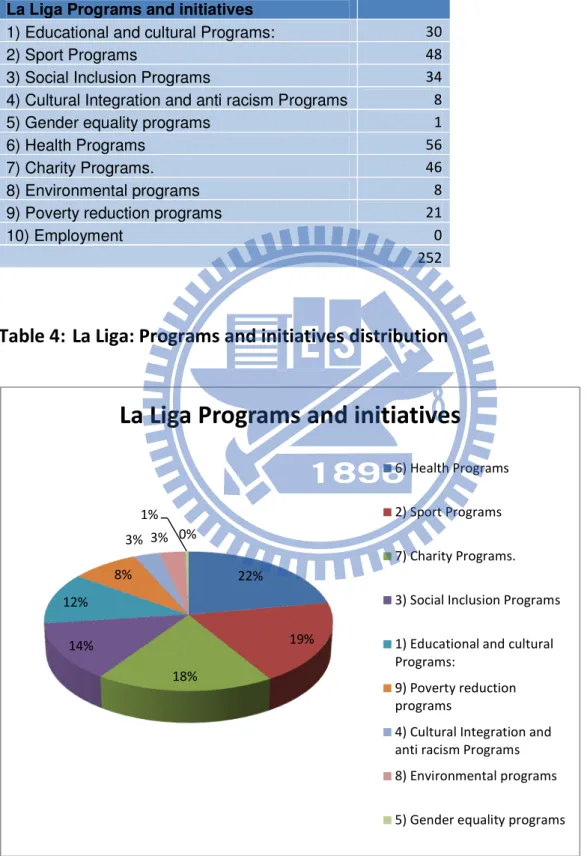
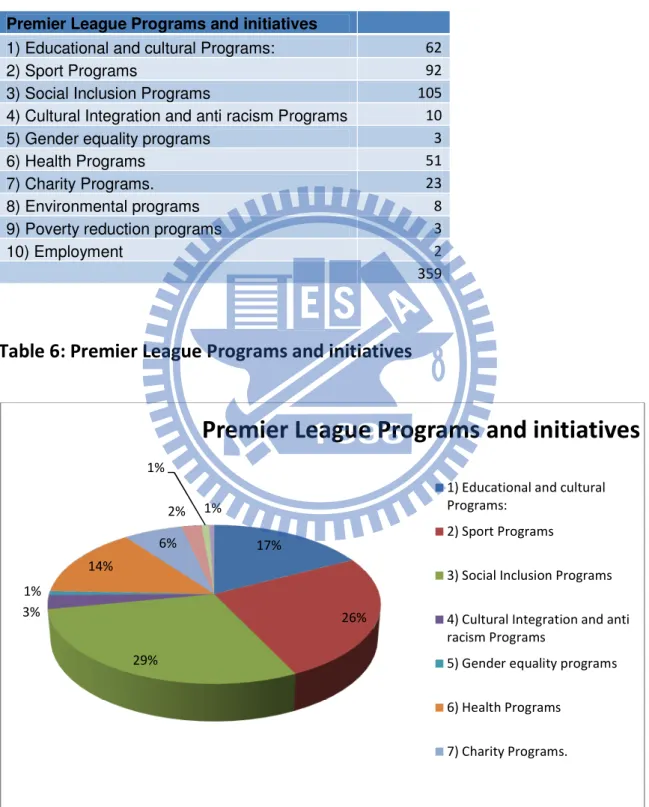
1) Educational and cultural Programs 2) Sport Programs
3) Social Inclusion Programs
4) Cultural Integration and anti racism Programs 5) Gender equality programs
6) Health Programs 7) Charity Programs. 8) Environmental programs 9) Poverty reduction programs 10) Employment
considering the big number of studied clubs and the diverse form in which CSR programs can be depicted or presented, this research opted for a broad classification with many
18
categories. This classification is inspired from the Walker & Parent (2010) one, and it takes as well, some elements from the structure proposed by Vlad Rosca (2011). From the latter, this research eliminates the family programs category, for being those programs, sometimes, diffuse and difficult to categorize. Apart for a category devoted to the poverty reduction programs, this study, wanted to assure that there is a category for Environmental, gender equality, and Employment programs, both cause of great concern and having enormous importance in the current European societies. The presentation of the categories and it content will be run in the next chapter. Finally two subcategories will be added. Fist it will be studied of the clubs activities also have international reach or repercussion. Secondly the CSR actions and plans will be divided into Programs and initiatives. Programs are well established, organized, funded and normally steady in the time actions, and initiatives are little actions that are not repeated in time and are not very demanding in terms of resources or infrastructures. An illustrative example of programs is the “Disability Football” program performed by the British club West Bromwich Albion and that that includes a FA Blind Football Centre of Excellence, Power chair Football A & B Teams & Development Squad, Visually Impaired Football & PAN Disability Juniors & Seniors. Another very illustrative example is FC Barcelona giving 1.5 million per year to UNICEF (7) implementation of joint projects. For Initiatives, in the other hand we could have a football club sending players as official ambassadors to hospital for delivering toys for kids in deprived homes during the Christmas day, both initiatives, very common for Spanish clubs. Nevertheless should be said that sometimes, border are thin, information not enough and it is difficult whether to categorize an action as an initiatives or a programs, consequently both are equality considered and gathered in this report.
19
Chapter 4: CSR programs of the
2010/2012 Spanish and English football
clubs
The next step is by using our CSR football program classification framework; to analyze the 46 football teams from both the English “Premier League” and the Spanish “La liga” tournaments. A list of our categories is presented below as a reminder.
1) Educational and cultural Programs: 2) Sport Programs
3) Social Inclusion Programs
4) Cultural Integration and anti racism Programs 5) Gender equality programs
6) Health Programs 7) Charity Programs. 8) Environmental programs 9) Poverty reduction programs 10) Employment
La liga
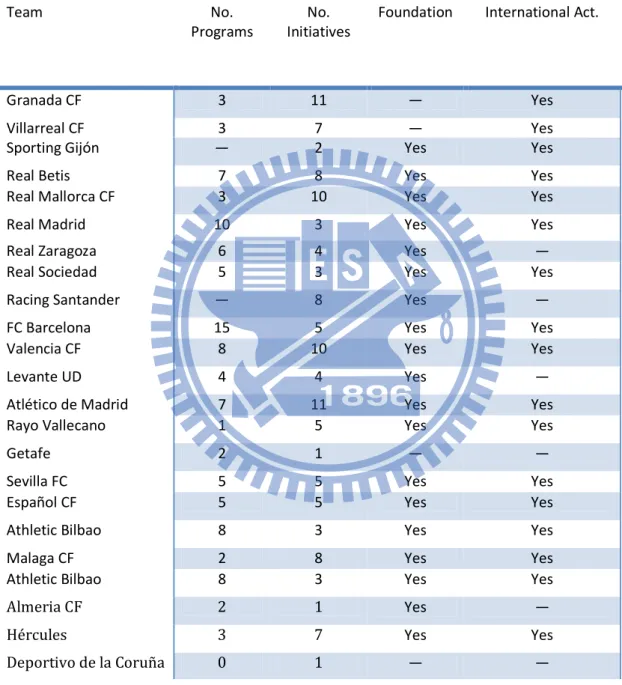
1. Real Sociedad3: 3 http://www.realsociedad.com/20
This Basque club has a foundation since the beginning of 2011. This team programs are an agreement with a NPO named DOA to send used sport material and equipment from the team and supporters to Bolivia and Guatemala (1, 7), two sport programs celebrated during the kids holidays, eastern week and summer, consisting in football camps and camps to educated kids in the values of sports and life (1,2). Seems that this team is very conscious of the importance of kids in the society and consequently they have many programs in this direction. Apart from the two already mentioned, there is a agreement with locals schools called “Amets Bat” regular visits from the schools to the stadium, the teams and the club facilities (1, 2). Finally a collaboration with some entities in an El Salvador district called
Tacuba, sending materials and organizing a local football league for youngsters (3). Initiatives include visits to hospitals every Christmas and reckoning of society contributions
like receiving and honoring the recipient of the civil merit medal and African sport runners.
2. Racing Santander4:
This clubs for the northern city of Santander has very recently created his foundation. It’s a modest clubs and it CSR actions are always presented as initiatives like guided visits of schools (1), from Spain and abroad, giving away match tickets to blood donors (6) or toy donors (7), the visits of hospitals (6), Support cancer funds raisings (6), free attendance for unemployed people one day (3), a calendar on the benefit of a non common disease (6), and a collect of food for an local charity association (7).
3. RCD Mallorca5:
4
21
This year was the 10th anniversary of this club´s foundation which is the mean of the club to conduct all their CSR efforts. It foundation carry out the following programs, summer, eastern holidays and Christmas sport camp (2), a Soccer Schools (2)that started In 2006, being the result of an agreement with the Department of Immigration aimed at immigrant population and their families and children at risk of social exclusion and lack of economic resources using sport as a mean of integration, and a regular Paddle Tournament with the charity objective of raising funds for the Association “in Marxa Llevant” for the reconstruction of two basic infrastructure in a village in Peru (health center and school) demolished by the earthquake that struck the area this year 2012 (7). Finally they organize for several years an intercultural football tournament aimed to promote immigrants integration (4). Initiatives: Weekly visits of players to local schools (1), visits to geriatrics (6), campaign supporters to donate blood at the stadium (6), borrowing club image to a UNICEF campaign called “my name is Kimbo” for children survival (9), two campaign of recollecting money for 2 specific kids with non common diseases (6), a players calendar where benefits when a Down syndrome association (6), 2 events collecting food for local NPO (7), and agreement of collaboration with Project Hombre (target addicts and homeless) (3) and the sending of some money, a tour of a former players team to benefit tournaments a jail to play against the inmates (3), and clothes to Japan after the 2011 ear quake (7).
5
22
4. Villareal CF6:
Villarreal CF, lately, developed the next CSR programs: Program Wanda (2) that every year brings 10 young players from China to be trained and formed in the Villarreal training schools and is a very interesting form of collaboration, the sponsoring and supporting of local sport teams and athletes (not only linked with football) (2), Christmas and summer football camps for kids (2), and the so called “Club Groget” a children club formed by 9
subprograms like summer camps, football tournaments and scholarships (1,2). Initiatives are the visiting of hospital by players (6), a blood donation day implanted for 11
years (6), visits of schools (1), giving the tickets money of a certain match and food to Caritas, an organization that fights poverty and distributes food and shelter in the cities (7), and also giving ticket money of a certain game to an association of children with paralysis (6)
5. Malaga CF7:
This team for the famous costa del sol (coast of the sun) region in Spain created his foundation in 2011 and ever since them have a strong agreement with UNESCO (United Nations Educational, Scientific and Cultural Organization), "Imagine Peace" is the motto of the agreement, for which UNESCO and the Málaga CF mobilize their networks and communities to promote actions in favor of intercultural dialogue, education and the fight against doping and racism (1, 4). Along with another foundation they collaborated in the construction of a football field in Morocco (7, 9).
6
http://www.villarrealcf.es/
7
23
Initiatives are frequent visits to hospitals, disability centers, and schools (1,6), a CUDECA Foundation’s charity match between Málaga C.F. and Hamilton F.C (7), a “Mucho mas que futból” Foundation (Work for social integration of prison inmates) charity match (3), and their support of an Organ donation campaign in a nearby city (6). Finally, they organize every season for 11 years a donating blood day (6).
6. Real Sporting Gijon8:
This team from the small and picturesque town of Gijón, although have a foundation, seems not to have any CSR programs. Not much information is available in the website either, only few initiatives like traditional visits to hospitals in Christmas time carried out by players (6) and the sending of some material to Gambia, Africa (7).
7. Granada CF9:
This historic team from the famous southern city of the same name is very active in giving back to the community.
Programs: collaboration agreement the Environmental department of the local government of Andalucía to fight the global warming and to improve the urban environment (8), collaboration agreement with a football school (2), and common project with the NPO
8
http://www.realsporting.com/
9
24
“Asociación solidaria Andaluza por el Desarrollo” for creating a football school in Guinea and Cape Verde (1,2).
Initiatives are countless: regular visits to and from schools (1), campaign for donating blood for a player´s son disease (6), visits to hospital (6), visits to geriatrics (6), visits to orphanages (3) , support of organ donation campaigns (6), donation of toys for “Aldeas infantiles” (7), campaign of recollecting non perishable food for local NPG (7), campaign for collecting money for the victims of an earthquake in Lorca (Spain) (7), and support tor organization like ASPACE (brain paralysis) (6) and the day for fighting the breast cancer (6).
8. RCD Espanyol 10
This club from the city of Barcelona is very dynamic in giving out to the community, both nationally and internationally. Its foundation was set in 1997 and the main projects that are carrying out in the past two years are the project Africa (2,7,9), formed by several sportive and educational subprojects in Africa, project XEF (1,2), that aim to educate kid using sports during Christmas and summer camps (2), and finally the implementation of the football school in Brazil (2,9), and collaboration with “Futbol al carrer” that aim youngsters to be back to the schools (3).
It more praised initiatives are, visits to hospitals (6), the collaboration with an associations that fights Alzheimer (6), donation of items for being bid and whose profits going to an
10
25
association fighting cancer (6), support to Trace (brain damage) (6), collaboration NPO that works in a little town in south Africa, and the most recent activity, a Solidarity football match in the benefit, support in a campaign against land mines with the NOG “Moviment per la Pau” (7).
9. Real Zaragoza11:
This club has a foundation created in 2007 that channels all their programs and activities. During the last two years, it can be remark the following programs: A summer Football camps for kids (2), a football tournament for kids (2), two collaboration agreements with University of Zaragoza and Universidad Autónoma de Madrid, 2 universities in Spain (1), agreement with the Foundation “Ser Mas” and FEAPS Aragón (3) and a programs for Parent Education “Conferencias para la Educacion” (1) carried out by their foundation. As for short initiatives we had a donation of equipment for a juvenile center (3), a campaign for gathering toys at Christmas of less favor kids run during the last years (7), support in diffet ways for a fighting the cancer in Kids organization called ASPANAO (6) and the presence some conferences about education arranged by the program called “Universidad de los niños” (1). 10. Deportivo de la Coruña12: 11 http://www.realzaragoza.com/ 12 http://www.canaldeportivo.com/
26
This team, although historic, played this current season in the second division. This team is known in Spain for carrying a huge debt that constrains all its activities, Sportive or communitarian ones. This added to the ongoing recession and the fact that this year they played in the second division might help to understand that only one initiative was found. They helped gathering toys for deprived children during the last Christmas season (7).
11. UD Almeria13:
Another club that this season was forced to play in the 2nd division. This southern club perform two main programs, a summer camps for kids started to be organized annually 2 years ago (2) and a series of football schools that work in collaborations with City halls , elementary schools, public organizations and school parents associations (2). As main initiatives it was found the visiting of children at hospital (6).
12. Hercules Alicante14:
This is the third club of the list that is currently in the 2nd level of the professional football in Spain. They have a foundation in charge of its programs and initiatives: Football camps
for kids for 6 years (2) and a football school in camiri, Bolivia (2,9), a school campaign (1). Initiatives are to invited collectives like young offender institution members (3) and down
13
http://www.udalmeriasad.com/
14
27
syndrome group to attend the matches (6), support for the Tudela foundation that helps mentally challenge people (6), 2 clinics about sport and life in prisons (3) a Christmas parade and toy donations (7), support to a charity race in the benefit of a prison organization (3), and some donations of money (7).
13. Athletic Club Bilbao15:
This exotic Basque team, due to its particular idiosyncrasy, has always pride in cultivating and strengthen it relations with the local community. Even though they are a successful team, they compete only with local players, they do not sign from other parts of Spain or foreign players. This make their programs to be very directed to the local community, like its sport program (2,6) that helps small clubs from region with technologies, money and material, or it medical center, that offer those clubs physical checkups and injury recovering sessions. More programs are “Thinking Football” (1), a series of conferences about football and society, summer and Christmas football training camps for kids (2), receive frequent visits from schools (2), a Beach football tournament since 2005 (2). The Foundation also has a program of sports equipment donations to social projects that are focused in sports in general and football in particular. Since its launch, in collaboration with various institutions, civic associations and NGOs, the Foundation has sent sports equipment to project sites in places like Nepal, Venezuela, Bolivia, Tanzania, Sahara, Belarus, Congo, Angola, Peru, Mexico, Ecuador, Israel, Chad, Democratic Republic of Congo, Gambia, Guatemala, Cameroon, Nicaragua, Palestine, Argentina, Honduras, Burkina Faso and
15
28
Algeria (7,9).
The Foundation of the Athletic Club, the City of Bilbao Bilbao, and the NGO maintains a development agreement called Bultzaide Program, aimed at social integration and employment of homeless people (3, 7).
Initiatives: they participated “Hora del planeta” arrange by WWF (8), collaboration in a project that is building a football schools for girls in India (9), and the sponsoring of a football team in the Romanian town of Darmanesti, named Athletic Club Darmanest (7).
14. Levante UD16:
This modest team located in Valencia, as it has become usual in Spain has a foundation. Programs are summer camps for kids (2), hockey team electric wheelchairs (3), the
di_capacidad project that support handicapped sportsmen (3) and also a veteran players program that visits prisons (3).
Initiatives are the collecting of clothes for caritas (religious org that works for homeless and poor collectives) (7), campaign for donating blood at the stadium (6), collecting toys of less favored kids (7) and donation of tickets money to ANAR (3), and org that cares about children in risk.
15. Valencia CF17:
16
29
This well-known team from the homonymous city prides themselves with their activities towards the society. It foundation has the following programs:
Summer camps (2), women camps (2,3), football school for children called 7VCF (2), endorse of feminine football team (3), the next generation program that comprises football schools in two Japan, one in Bermuda, Costa Rica and Egypt , as well as camps in UK, Jamaica and Malta (2). More programs are football league for companies celebrated in the clubs premises (2), a UNICEF tournament arranged for 11 years that collect money for
Unicef (7), and multidiscipline academy center that collaborated with universities (1). Initiatives: The VCF Foundation develops a remarkable number of activities such as the
International Day support (Alzheimer's, of the Deaf, penis ...), (6) support for awareness campaigns (poverty, gender violence ...) () and the donation of sports equipment to needy groups Valencia and NGOs (per the Solidarity valencianista Penya, Play4Africa ...)(). Not to mention the collaboration with institutions such as Universidad CEU Cardenal Herrera (1), Valencia CF Footballers Association, (2), Association of Road Safety of Valencia (6), Valencia Food Bank Foundation, (7) and ONCE an organization pro visually impaired and handicapped persons in risk of social exclusion (3). “Dóna Sang en Mestalla" (6) "is the motto of a special day of blood donation, in collaboration with the Transfusion Center of Valencia. Finally they also collect toys for distribution to minors without resources of various associations (7), with funding from the City of Valencia and the Valencian Institute of Creative Teaching MSM.
17
30
16. Atletico de Madrid18:
Known as the second club of the Spanish capital, this club has his programs divided in the next categories:
Sport education: Development, training and promotion of "Youth teams" (2) with more than 800 children and young homegrown players, development of football camps and clinics during the holiday periods (2), with more than 800 students, development and promotion of modernization of football schools, both in Spain and abroad, with over 700 students, own football championships, sponsorship of interscholastic football games.
Teaching work: Atletico de Madrid has a Sport Educational Development Center that offers academic advising for professional young players, collaboration agreement with student residences, schools, colleges and universities, and to finish training courses for sports coaches (1,2)
Health: they Seminar on medical education applicable to the sport (6), support a Congress on Sports Medicine (6), and have a Training plan programs for children and youth:” Vida sana y deporte” (healthy living and sport) (6).
Veteran players: Personal advice on careers and reintegration into the workplace, Partnerships in Schools Foundation around the country, and Agreements with companies for career opportunities (3).
Beneficial social initiatives Visits sick children in hospitals with gift-giving (6) and Cooperation agreements with foundations and NGOs different projects (3): Against Racism
18
31
(4),"Children without Borders" (7), "Food Bank"(7,9), "SOS Children" (), "Action against Hunger"(7,9), "Small Foundation Desire"(7), "Rais Foundation" (7), "Angelman Syndrome Association (6), and finally some School Development Support (1): grants, collaboration agreements with certain educational centers.
17. Real Madrid19:
This football giant multinational is obviously has many programs and initiative conducted by its foundation:
Social projects: Real Madrid has integration schools that works in deprived areas, prisons and young offender institution (3), also has a physical activity center (6) that more than 200 old persons are using, a program of material donation to areas suffering wars, natural disasters, extreme poverty, etc (7,9), two integration campus for disable persons (3), the program “basketball at the hospitals” (6) and the “programa voluntarios” that helps
immigrants integration at the schools and handicapped persons in the football stadium (3,4). They also include Programs of international cooperation, the club has vast net of football
schools overseas (2, 3, 9) that aim to achieve social integration and bring the possibility to practice football in deprived areas (see map), 26 football schools in Spain (2) and summer sports camps for kids (2). Initiatives, they are very prolific in arranging football charity matches (7), a Charity golf tournament (7) and other charity events (7).
19
32
18. Real Betis Balompié20:
This southern team from the city of Seville is widely known for its peculiar fans. It foundation carries out several major programs:
A football schools (2) in the town of Aznalcollar, a collaboration agreement with the local government in terms of Environmental care (8), the support of a football team in Gambia (Africa) (9), the program “del cole at futbol” (from the school to the football) (1) that encourage students to improve though the sport values, a occupational center (3) for the integration of diverse collective at risk, summer camps (2), and an agreement with the “Prodean foundation” that aims society (2)It foundation it is also active in its initiatives number, some are the support for Paralympics athletes (3), a campaign against famine in the Sahel (Africa) (7,9), visits to geriatrics (3), visits to hospitals (6), adhesion to the “hora del planeta” event for saving energy (8), a campaign of recollecting toys for kids during Christmas (7) and blood donating day at the stadium (6) for fans.
19. Rayo Vallecano21:
This is the team of a notorious working class neighborhood. It foundation runs programs
like an Urban football camp (2) that his years is being held for the 5th time. Initiatives they send a delegation from the team to a blood donation marathon in a local
hospital (6), last March 21 they held a International Day against racism (4), they cooperate with the NOG “vida sana” (6), and this year they participated in the XII edition of the Solidarity Campaign "A Toy, An Illusion", whose goal is to send toys to disadvantaged
20
http://www.realbetisbalompie.es/
21
33
countries in Africa, Latin America and the Middle East, and children living in poverty situations (7,9). Finally they regularly visited kids at hospitals (6).
20. Getafe22
This team for the suburban city of Getafe, near Madrid, has a football school aiming to train and educate children (2), a summer football camp (2) as principal programs and the visits of hospitals by the first team players as main initiative (6).
21. Sevilla FC:23
This andalucian team is very proud of their foundation. Its programs are football camps during summer, winter and eastern week holidays (2), a football school named after a deceased former player (2), they have School campaign "Make the most of the Cole" educational values and healthy lifestyles among young children, using as threads of this message to the players, real mirrors where you look at the youth(1), they endorse football immigration world cup (4), agreement for promotion of football in developing countries (football team in Malawi, Africa) (9).
As initiatives, they have a Master (1), scholarships(1), Exhibitions Conferences and debates(1), Solidarity visits(1,6), Collaboration with NOG “Crecer con futuro”, that works for families in exclusion risk in Paraguay and recollecting of food day with charity purposes.(7,9). 22 http://www.getafecf.com/ 23 http://sevillafc.es/nuevaweb/
34
22. Club Atletico Osasuna24:
This team from the city of Pamplona, has Summer football camps for 11 years, a football schools that aims to educate through football and to improve the physical condition of the kids (2), a programs of visiting school and giving motivational and educational speeches to the kids (1), and social project in Nicaragua culminated with the opening of a football schools for poor children (9).
Initiatives are the Collaboration with NGO like Anfas (Down syndrome, Autism) (6), Cormin (incapacity (6), Asoc. Síndrome Down-Centro San José-Berriztu (6), visits to prisons (3), and collaboration with Tasubinsa, Adisco, Isterria, and Saray-Adano companies and associations that works with and for physically and mentally handicapped persons, for their health and their inclusion (3,6).
23. FC Barcelona25:
FC Barcelona, the Catalan giant through its foundation has Partnership with UNICEF, a pioneer Collaboration in the world of sports. FC Barcelona gives 1.5 million per year to UNICEF (7) implementation of joint projects for vulnerable children throughout the world. Furthermore it has CSR programs in almost every field:
Research, development and innovation, in this area the Foundation exemplifies their commitment to scientific progress and commitment that can improve knowledge, health and welfare of society. The Foundation has opened two lines of research (6) in this area:
24
http://www.osasuna.es/dev/index.php
25
35
Heart disease
- The musculotendinous pathologies
Arts and Letters: as it is believed that Sport is part of culture. They have program to promote reading 'Lletres to Camp' (Lyrics on the field) (1) and a International Journalism Award named “Vázquez Montalbán” (1.)
In the important social area of Exclusion and Poverty integration is where they are more dynamic. They have social cohesion programs between immigrants and the sports tournament "Tot Colors" (All Colors) (4) fight against the practice of positions decidedly reluctant or adverse cultural and ethnic diversity. Moreover, actions such as "A somni per a regal" (A dream for a gift) (3,7) allow athletes of different sections and partners to show their solidarity with children who are in distress situations or health reasons social exclusion, by donating toys and their distribution in hospitals. FC Barcelona have the XICS, a International Network of Solidarity Centers (3) for children and youth at risk of social exclusion worldwide providing educational support, psychosocial support and access to sport and leisure.
They also penned an alliance with the Inter-American Development Bank (IDB), that made possible a Project (7,9) launched in Rio de Janeiro for the remodeling of 18 Olympic Villages (sports facilities in the slums of the city), which promote social inclusion through sport. Also, they have an alliance with the” food bank” of Boosting food collection campaigns like “mandemos el hambre a la porra” (7,9) to raise awareness of food poverty in Catalonia and to palliate it. Finally in this sector, FC Barcelona Foundation and the “pies descalzos” foundation (Barefoot) (2,6) works a football project together in the development of youth and healthy living, which includes the construction of sports
36
facilities and recreation facilities in Cartagena (Colombia) and Miami (USA). Education Programs, they have is the online educational program "Play it!" (2), available in
Latin America and Spain, and “Sport for project” (2) that promotes education models of conduct based on the sportsmanship among members of sports clubs base. Last but not least are their Sportsmanship Programs, their program "Fem equip, fem city" (We team, we make city) (1) promotes civic values and awareness-raising in local sports clubs, Football Clean (1) is a program based on the methodology of Soccer 3, whose mission is re-educate children and youth through sport. Finally they have the typical initiatives, common in Spanish teams, like visiting hospitals (6), plus adhesion to campaigns like the Bill & Melinda Gates´s one "More than a goal, End Polio “ (6), or the invitation of collective in risk or social exclusion or racism (3,4) to the club matches and facilities.
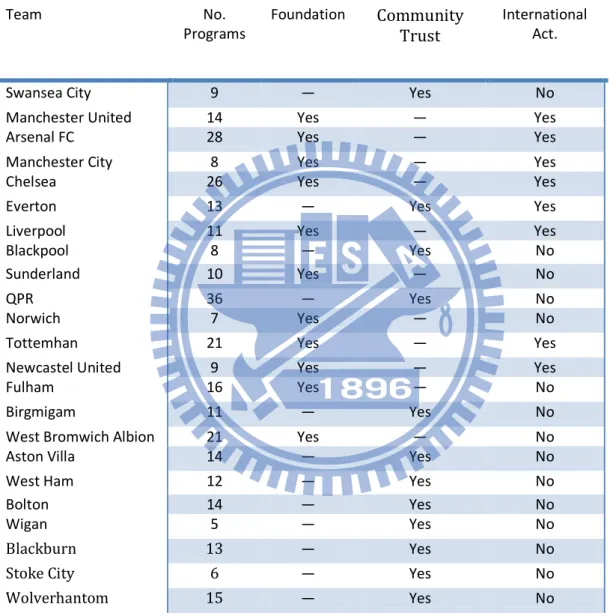
Premier league
1. Aston villa26
They have subdivided their programs in the next categories: Education:CIC programs, Aston Villa is the first Premiership football club to set up a
Community Interest Company (CIC).The CIC program is a government backed project,
designed to provide new and exciting educational and training opportunities (2).
26
37
The Aston Villa is a founder member of the Premier League 4Sport initiative, which started up in September 2009.The innovative project is looking to encourage more kids in the area to take part in a wide range of sports, including volleyball, judo, badminton and table-tennis (2). They also have Villa Vitality (6) that teaches kids about healthy eating nutrition and sport. For Sports, “the villans” have football Development Weeks (2), football Development Clinic (2) and Special Needs programs: Villa runs a full development program for children with special needs that include curriculum, after-school and holiday courses(2,3) Social inclusion: Disability program The "Special Needs Ability Counts" program helps identify and develop talented footballers, providing quality coaching and increasing participation (3).
Villa vocation: This project enables 36 physically disabled students aged 16-19 to spend four full-time days a week studying the “Aston Villa Disability Life Skills Program”(3). Ice Gym As part of the city's "Be Active" campaign, there are 6 dedicated free-of-charge children's gyms located across the city, with a dedicated Ice Gym located directly in the stadium at Villa Park(3).
Finally Aston Villa FC have several initiativesº likes a strong partnership that funds activities for the benefit the children with life-limiting conditions under the care of the Acorns Trust (3) and they make and annual contribution to the Marie Curie Cancer Care (6),Age UK (6) and the UCH (University Hospitals Birmingham NHS Foundation Trust) (6).
38
2. Bolton Wanderers FC27
This small club is very dynamic in giving back to the community. They programs are broken down as follows:
They work for Community cohesion and inclusion through the Kickz project (3), the Street 20 (3) where Bolton Wanderers Community Trust has teamed up with Cricket for Change and works in school, muga's mosques and other community buildings, “Positive Chances” (3) which is a community based sport and education project being delivered by Bolton Wanderers Community Trust across Bolton and its surrounding boroughs, a collaboration with the The Zesh Rehman Foundation through F.C. Wanderers Project (3) that aims to integrate minorities and underrepresented communities in the UK, and One Bolton In Action (3) that look for increasing awareness of different communities and unite them together.
They also united The Premier League “4 Sport (PL4S)” (2) offers young people aged 11 - 19 the chance to experience Olympic disciplines judo, badminton, table tennis and the additional sport hockey, all as part of its 2012 legacy plans. Bolton also organizes Football Campus during the holidays (2), a Bolton Primary School Football League (2), and the Bolton Wanderers Disability Football Club (2,3)
For health and Well Being, Bolton has “Active Families, Bolton” (6), dealing with family health through increasing education, sports provisions and activities in the local community, also has “Family Events “an range of family events throughout the year looking to increase opportunities for parents and children to exercise together (6), they also cooperate with
27
39
Primary Schools through a 5 week health education program (6), backed by NHS Bolton, about healthy eating, and with High Schools. Bolton Wanderers Community Trust is proud of carrying out “Imagine Your Goals” (3, 6), a two-year program funded by the Premier League and Sport Relief which aims to improve social inclusion and wellbeing for people across the UK with mental health problems.
3. Newcastle United28
This northern team has the next programs supervised by it foundation:
Train Like a Professional' with Newcastle´s weekly skills centres, holiday soccer schools and specialist outfield and goalkeeping clinics at venues throughout the region (2). Kickz helps young people achieve their goals through football. (3)The aim is to engage young people in constructive activities, increase playing and coaching opportunities, break down barriers between the police and young people and reduce crime and anti-social behaviour in the target area.
Match Fit is Newcastle United Foundation's flagship health project promoting healthy eating and keeping fit among children (6).
Newcastle United Enterprise Academy offers young supporters the chance to improve their enterprise skills whilst mixing their love of the sport (2).
28
40
Newcastle United Foundation is running community sports clubs for young people across Tyneside in Badminton, Judo, Table Tennis, Volleyball and Basketball (2). Newcastle United Foundation is tackling the health issues that men suffer through an initiative called Premier League Health (6). The plan, funded by the New Football Pools, NHS North East and National Social Marketing Centre, is working with local dads to help them become more fit and healthy. Prince´s trust Newcastle United has been supportive of leading UK
youth charity on both a national and regional level for over 10 years (7). Funded by the Big Lottery Fund, Family Football aims to encourage families to enjoy
learning together (1), and finally this year they send some football material and equipment to Gambia, Africa (7).
4. Wigan Athletic FC29
This small but proud team better known as “Latics” arrange almost all it programs and activities through it Community trust. Some of their programs are JUST JOIN IN that they joined and it is a brand new PL/PFA funded project that launched in September 2010. It is focused on providing equality of opportunities to a part of the schools system and creating opportunities for disability sport in Wigan (3). A very important program is Latics Literacy, which is a literacy based initiative with the mission for all participants to become Reading Champions. Latics Literacy wants to show Year 5 pupils that reading and writing are fun (1). More programs are PL4Sport, Through PL4Sport, Wigan Athletic are offering school children the opportunity to take up badminton, table tennis, volleyball and judo via five hub
29
41
clubs and 16 satellite clubs based in local schools (2). Participants benefit from expert coaching, regular competitions (local, regional and national), and the opportunity to progress in their chosen sport. They are also partaking in the The Kickz project that desire to provide positive activities for young people throughout the year (3); finally they have soccer camps during the holidays (2).
5. Blackburn Rovers FC30
This historic club from the region of Lancashire was founded in 1875. Listing their programs from their Community trust, we find an Education centre for kids and teenagers that also sends coaches to schools (1), they have many cricket coaching football coaching activities(1), holidays programs(1), indoor leagues organization (1), participating in the Kickz program (3), participation in the premier league program “PL4Sport” sport(1), the “street soccer” (youngsters in risk) (3), and the altogether club that works for disabled and handicapped kids (3). In the Health are they perform their Health engagement program that seek a brighter future for the students and try to improve their employment options (3), the café hub recovery league program they joined to assist recovery from addictions (3,6), the program “extra time/active 8” program that joined and fund tries to improve old people physical activity and social inclusion(3,6), “ My life project” try to through sport get better the mental health of people (6). Finally, their “Time to change” program is designed increase social inclusion of 16 19 aged kids (3).
30
42
6. Everton FC31
This legendary team from the city of Liverpool, in the Mersey area, main tool for giving back to the community is “Everton in the community” which is an independent, registered charity operating on a 'not-for-profit' basis, which is affiliated to and supported by Everton Football Club. Working towards Social inclusion, they joined the “Kickz” programs that as we know works towards creating stronger, more respectful communities thorough football (3), they also set a food in the field of unemployment, a main problem in many developed societies, “Everton 4 Employment” is a pioneering program that aims to assist unemployed people across Merseyside back into service (3). Moreover, working in partnership with Liverpool Football Club and Merseyside Police, Everton in the Community lead football sessions in areas which have high incidents of crime and anti-social behavior to encourage children to develop their potential (3), and finally in this area, “Safe Hands” is a 5-year project that targets young offenders in the Merseyside area, aiming to help them back into the community (3).
Everton in the Community and The Prince's Trust have a strong partnership, that labor strongly in the charity world (7).
In the educational ground, Everton Football Club is the first Premier League team to receive government approval to open a Free School that is available those that have been excluded or are in danger of exclusion, and have become disengaged or disillusioned with mainstream education (1,3). Everton in the Community, in partnership with Intraining, launched a new educational program called Foundation Learning in 2010 (1) aimed at
31