
從學生和老師的角度來探討台灣國中英語課室教學中動機策略的應用 - 政大學術集成
112
0
0
全文
(2) The Use of Motivational Strategies in the Secondary EFL Setting in Taiwan: Teacher and Student Perspectives. A Master Thesis Presented to Department of English, National Chengchi University. 立. 政 治 大. ‧. ‧ 國. 學. n. al. er. io. sit. y. Nat. In Partial Fulfillment. i n U. v. of the Requirements for the Degree of. Ch. engchi. Master of Arts. by Chun-Ling, Chen January, 2012.
(3) ACKNOWLEDGEMENTS. I owe a debt of gratitude to many people for their assistances and supports in the preparation of my thesis. The numerous kindnesses I have received from those people. The present thesis would not have been accomplished without their help. I would like to express my deepest gratitude to my advisor Dr. Shu-Chen Huang. Her generous assistances and enlightening instruction have enabled me to finish the thesis and minimize its errors. She always gives me encouragements and supports all the time during my graduate school life. Her profound knowledge and unselfish advice to my thesis are deeply rooted in my heart. Equal appreciation is extended to my committee members, Dr. Ming-Chung Yu and Dr. Ping-Huang Sheu,. 政 治 大 revising and editing. They are so knowledgeable and resourceful. Without their help, I could never 立 finish my thesis.. for spending time reading my thesis, giving me constructive advices and precious comments for. ‧ 國. 學. To my family, I owe a great deal for their support. Their love, tolerance and encouragement always accompany with me. I would like to share the honor with them. They accompanied me. ‧. through my hard time in the finishing of my work. Their suggestions and encouragement had. y. Nat. always given me the confidence in pursuing my degree during the past years. I am so lucky that I. n. al. er. io. sit. can have so many people I love and who also love me. Thank you so much and love you all.. Ch. engchi. iii. i n U. v.
(4) TABLE OF CONTENTS ACKNOWLEDGEMENTS………………………..…………………………………… ………. iii TABLE OF CONTENTS………………………..……………………………………… ………. iv LIST OF TABLES…………………………………………………...…………………… …….. vii CHINESE ABSTRACT………………………………………………………………… ……….viii ENGLISH ABSTRACT………………………………………………………………… ………...ix CHAPTER ONE ........................................................................................................................... 1 INTRODUCTION......................................................................................................................... 1 Background of the Study....................................................................................................... 3. 政 治 大 Significance of the Study....................................................................................................... 5 立 Statement of the Problem...................................................................................................... 4. ‧ 國. 學. Research Questions ............................................................................................................... 6 Organization of the Thesis .................................................................................................... 7. ‧. CHAPTER TWO .......................................................................................................................... 8. y. Nat. LITERATURE REVIEW ............................................................................................................. 8. er. io. sit. The Definition and Significance of Motivation..................................................................... 9 The Dynamic Nature of Motivation...................................................................................... 9. n. al. Ch. i n U. v. The Prominent Motivational Theories ............................................................................... 11. engchi. Expectancy-value theory............................................................................................... 11 Self-determination theory ............................................................................................. 12 Gardner’s motivational theory...................................................................................... 13 Dörnyei’s L2 Motivation Framework................................................................................. 16 Motivational Strategies ....................................................................................................... 17 Studies Concerning Motivational Strategies ...................................................................... 19 CHAPTER THREE .................................................................................................................... 25 METHODOLOGY ..................................................................................................................... 25. iv.
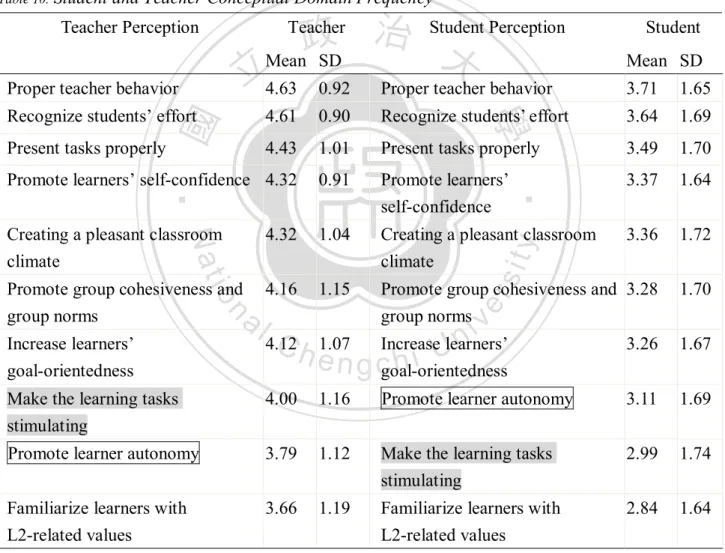
(5) Participants.......................................................................................................................... 25 Questionnaire participants-teachers ............................................................................. 25 Questionnaire participants-students ............................................................................. 27 Observation participants ............................................................................................... 28 Instrument ........................................................................................................................... 30 Instrument-questionnaires............................................................................................ 30 Language of Questionnaires/Instruments .................................................................... 32 Instrument of Classroom Observation -the MOLT Classroom Observation Scheme.... 32 Procedure............................................................................................................................. 35 Pre-Implementation Stage ............................................................................................ 35. 政 治 大. Implementation Stage ................................................................................................... 36. 立. Classroom Observation Procedure................................................................................ 37. ‧ 國. 學. Post-Implementation..................................................................................................... 39 Data Analysis ....................................................................................................................... 39. ‧. CHAPTER FOUR....................................................................................................................... 42. Nat. sit. y. RESULTS.................................................................................................................................... 42. er. io. The Results .......................................................................................................................... 42. al. v i n Ch The Means of the Result ............................................................................................... 43 engchi U n. The Results from the Questionnaire ............................................................................. 42. Further Breakdown of the Micro-strategies....................................................................... 46 A Comparison of Teacher and Student Questionnaire on Strategy Use ............................ 49 The Results from Classroom Observation.......................................................................... 51 Students’ Perceived Effectiveness of Motivational Strategies ............................................ 55 Summary ............................................................................................................................. 57 CHAPTER FIVE ........................................................................................................................ 59 CONCLUSION ........................................................................................................................... 59 Discussion and Implication of Results from Questionnaire ............................................... 59 v.
(6) Discussion and Implication of Results from Observation.................................................. 60 Discussion and Implication of Results from Students’ Opinions on Strategy Effectiveness .............................................................................................................................................. 62 A Comparison with Previous Studies.................................................................................. 63 Discussion and Implication on Specific Strategies ............................................................. 66 Promoting learner autonomy........................................................................................ 66 Creating a pleasant classroom climate.......................................................................... 67 Recognizing students’ effort.......................................................................................... 67 Proper teacher behavior................................................................................................ 68 Making the learning tasks stimulating.......................................................................... 69. 政 治 大. Presenting tasks properly .............................................................................................. 69. 立. Increasing learners’ goal-orientedness ......................................................................... 70. ‧ 國. 學. Familiarizing learners with L2-related values .............................................................. 71 Promoting group cohesiveness and group norms ......................................................... 71. ‧. Limitations of the Study...................................................................................................... 72. Nat. sit. y. Suggestion for Future Research.......................................................................................... 73. er. io. REFERENCES ........................................................................................................................... 74. al. v i n Ch The Questionnaire of Motivational version(Chinese) ......... 82 e n gStrategies-teacher’s chi U n. Appendix A: The Questionnaire of Motivational Strategies-teacher’s version ........................ 78. Appendix B: The Questionnaire of Motivational Strategies-student’s version ........................ 85 The Questionnaire of Motivational Strategies-student’s version(Chinese).......... 89 Appendix C: The Questionnaire of Motivational Strategies-student’s version......................... 92 The Questionnaire of Motivational Strategies-student’s version(Chinese).......... 95 Appendix D: Teacher’s Use of Motivational Strategies: Observation Schedule ...................... 99 Appendix E: Final descriptive statistics of the 10 conceptual domains and the individual constituent strategies.......................................................................................... 100. vi.
(7) LIST OF TABLES. Table 1. Basic information of the teacher participants ................................................................ 26 Table 2.Basic information of the students participants-version 1 (asking for observation of frequency)....................................................................................................................... 27 Table 3. Basic information of the students participants-version 2 (asking for student opinions). 28 Table 4. The basic information of the classroom observations ..................................................... 29 Table 5. Nine categories and the activities under in the observation schedule (MOLT) .............. 33 Table 6. The comparison between the two schemes...................................................................... 34. 政 治 大 Table 8 Data Analysis Table ........................................................................................................ 40 立. Table 7. The procedure of the present study ................................................................................. 35. Table 9 presents the descriptive statistics of the ten strategy domains from both teacher and. ‧ 國. 學. student questionnaire........................................................................................................ 43. ‧. Table 10. Student and Teacher Conceptual Domain Frequency................................................... 44 Table 11. Most frequently used strategies as reported by teachers................................................ 46. y. Nat. sit. Table 12. Most frequently used strategies as observed by students ............................................... 46. n. al. er. io. Table 13. The five least employed strategies as reported by teachers............................................ 47. i n U. v. Table 14. The five least employed strategies as observed by students ........................................... 48. Ch. engchi. Table 15. T-test result comparing teacher and student questionnaire........................................... 49 Table 16. Strategies for which teacher and student data showed no significant difference .......... 50 Table 17. The percentages of each category from the ten classes................................................ 52 Table 18. The comparison between the two schemes ................................................................... 53 Table 19. The order listed by the frequency between the two schemes.......................................... 53 Table 20. The result of student questionnaire on the effectiveness of motivational strategies...... 56 Table 21. The top ten motivational strategies which students think more helpful ........................ 56 Table 22 Comparison of the results among related studies........................................................... 64 vii.
(8) 摘要 本研究之目的在探討台灣國中課室中英語教師動機策略應用的情形,此研究調查學生和 老師雙方面對於在課堂中動機策略使用頻率的感知,比較其中差異。很少研究同時參考雙方 面的意見,本研究透過問卷的方式詢問老師使用動機策略的頻率,也詢問學生對於相同教師 策略使用頻率的感受,目的在找出何種動機策略最常被使用,也最常被學生體驗到。另一個 目的是要收集學生對於課室內動機策略的觀點,以瞭解在學生的觀點中,哪些策略可以有效 提升他們學習興趣。問卷收集樣本共有老師 135 人,學生 216 人。另外,研究者還進行了 10 堂課的課室觀察,期以觀察所得的資料與師生填寫的問卷資料做對照。 研究結果顯示,學生和老師大致上對使用頻率較高的策略有共識。在 48 個動機策略當 中,老師和學生對各項的排序幾乎相同。前幾名分別是適當的教師行為、辨別出學生的努力、 適當地呈現教學任務、提升學習者的自我信心、創造愉悅的教室氣氛等。但是程度上老師表 示的和學生體認到的卻大不相同,以 T 檢定比較學生和教師問卷,發現大部分項目都達顯著 性差異,教師表示使用的頻率高,但學生體驗到的頻率卻相對較低。在課室觀察的資料中, 發現最常被觀察到教師使用的動機策略為:呈現教學工作、提供回饋、教師行為、提升學習 者自主性,和提升與第二語言相關的價值,可能因為這些外顯行為的項目較其他容易被實際 地觀察到。 此外,比較學生對不同策略重要性的看法問卷當中也指出,學生對於動機策略的想法的 確和老師報導的使用頻率不相同。學生對重要性前幾項依序為:提升學習者的自主性、創造 愉悅的教室氣氛、辨別學生的努力、適當的教師行為,和提升學習者的自信心。特別在提升 學習者的自主性這個類別裡,老師和學生的看法就很不一樣。老師們最少使用這個類別的策 略,但是學生卻認為這些是最有效於提升他們對學習語言動機的策略。. 立. 政 治 大. ‧. ‧ 國. 學. n. er. io. sit. y. Nat. al. Ch. i n U. v. 關鍵字:動機策略、英語為第二外語之學習環境、教師角色、學習者自主性. engchi. viii.
(9) ABSTRACT The purpose of the present study is to find out the use of motivational strategies in secondary EFL settings in Taiwan. Questionnaires were sent to inquire teachers’ reported use and students’ perception of such use of motivational strategies. Few studies have included questionnaire results from both students and teachers. The present study elicited answers from both parties to find out which motivational strategies were frequently used by teachers and which were perceived by learners in the foreign language classroom. Another purpose is to collect data from students about their opinion on the importance of various motivational strategies used in the classroom. The number of teacher sample is 135, and the number of students is 216. Besides, ten classroom observations were conducted by the researcher in order to complement self-reported questionnaire data. The results of this study revealed that students and teachers generally agree on which motivational strategies were frequently used in class. The rank order of teachers and students were almost the same. The top ones, in the order of frequency, were proper teacher behavior, recognizing students’ effort, presenting tasks properly, promoting learners’ self-confidence, and creating a pleasant classroom climate. However, the frequency as reported by teachers and stated by students was very different. The data collected from teachers and students was examined by performing an independent sample t-test, and the result indicated that difference between them was statistically significant. Teachers reported that they frequently used the strategies, but students didn’t experience those strategies as frequently as teachers reported using. In the data collected from classroom observation, the most observable and frequently used strategies were: presenting tasks properly, providing feedback, teacher behavior, promoting learner autonomy, and promoting L2-related values. The fact that these domains appeared to be more prominent in the observation data may probably be associated with the nature of their being more observable. In addition, the result from the student questionnaire asking about students’ expectation toward the motivational strategies also indicated that students’ perceived importance of them was different from teachers’ reported frequency of use. The rank-order of the ten clusters of students’ expectation were: promoting learner autonomy, creating a pleasant classroom climate, recognizing students’ effort, proper teacher behavior, and promoting learners’ self-confidence. As to the conceptual domain of “promoting learning autonomy”, it is viewed very differently by teachers and students. Teachers put this one on the last place, but students regarded this domain as the most effective strategy in promoting their motivation toward language learning.. 立. 政 治 大. ‧. ‧ 國. 學. n. er. io. sit. y. Nat. al. Ch. engchi. i n U. v. Keywords: motivational strategies, EFL setting, English as a foreign language, teacher’s role, learner autonomy ix.
(10) CHAPTER ONE INTRODUCTION. As a psychological concept, motivation is one of the most important factors in determining success or failure in any learning situation. Teachers and students commonly use the term to explain why some learners succeed and others fail. Without sufficient motivation, individuals, even with the most remarkable abilities, can not accomplish long-term goals (Dörnyei & Csizér, 1998). The notion is also of great importance in language education. Positively, motivation provides the. 政 治 大. primary impetus to initiate second or foreign language learning and later the driving force to sustain. 立. the long and often tedious learning process. It is believed that language learners with higher levels. ‧ 國. 學. of motivation will be higher achievers. Motivation functions as the initial engine to generate. ‧. learning and later serves as an ongoing driving force that helps to sustain the long and strenuous. sit. y. Nat. journey of acquiring a second or foreign language (L2). That is why English teachers should make. io. al. n. motivation in language learning.. er. more effort on encouraging students to be fond of learning the language and to raise students’. Ch. engchi. i n U. v. Learners' motivation is a key variable that frequently concerns and challenges practitioners in language classrooms (Cheng & Dörnyei, 2007). Researchers used to focus on the definition of what motivation is. They tried to figure out what drives individuals to learn. However, an area of similar importance but much less researched is how teachers can better motivate learners. In recent decades, more and more researchers have decided to examine the pedagogical implications of research by conceptualizing motivational strategies. What’s more, researchers also started to examine the pedagogical implications by conceptualizing motivational strategies.. 1.
(11) Due to the importance of motivation, it has received abundant attention from L2 researchers during the past decades (Bernaus & Gardner, 2008; Cheng & Dörnyei, 2007; Dörnyei & Csizér, 1998; Guilloteaux & Dörnyei, 2008). Motivation research was inspired and spearheaded by social psychologist Robert Gardner. According to Gardner (1985), motivation for L2 learners consists of three elements: motivational intensity, desire to learn the language, and attitudes towards learning the language. Another key issue of Gardner’s motivation theory is the distinction of integrative and instrumental concepts. Integrative orientation is about holding a positive attitude toward the target culture or a willingness to be accepted as a member of the target language community, while. 政 治 大. instrumental orientations (Gardner & MacIntyre, 1991) means studying a language to gain. 立. something, such as securing a better job, getting a higher salary, and passing an examination.. ‧ 國. 學. According to the socio-educational model (Gardner & MacIntyre, 1992, 1993), learners’. ‧. affective variables, such as motivation, have an influence on their achievement in language learning.. sit. y. Nat. In turn, language achievement and learning experience also have an effect on learners’ affective. io. al. er. attributes. In other words, motivation is not only a cause but also a result of language learning. v. n. success. Motivation is a key factor that influences the extent to which learners are ready to learn. Ch. engchi. i n U. autonomously, and that teachers might therefore endeavor to ensure motivation before they train students to become autonomous. The 1990s witnessed a general dissatisfaction with the somewhat “narrow” scope of Gardner’s conceptualization of motivation. In other words, there seemed to be a need to make motivation theory more applicable to classroom applications. Dörnyei then conducted several researches which helped to design and summarize motivational techniques for classroom applications and published one book being particularly relevant to this topic “Motivational Strategies in the Language Classroom” (2001). 2.
(12) With motivation being an important element that might determine success in L2 learning, strategies in motivating language learners should be seen as an important aspect of the theoretical analysis of L2 motivation. Some studies have been done (Guilloteaux & Dörnyei, 2008; Dörnyei & Csizér, 1998; Dörnyei & Cheng, 2007) to investigate teachers’ motivational strategies in classrooms. Dörnyei says “the most pressing question related to motivation is not what motivation is but rather how it can be increased” (Dörnyei, 2001, p. 51). The main finding of these studies is that there are relationships between motivational strategies and the motivation toward L2 learning. Also they identified the most important and frequently used. 政 治 大. strategies. In those studies, the researchers emphasized on the role of teachers, and discovered that. 立. when teachers applied more motivational strategies in class, students would be more willing to. ‧. ‧ 國. 學. learn.. sit. y. Nat. Background of the Study. io. al. er. Under the educational system in Taiwan, students receive compulsory education from grades. v. n. one to nine. They are required to attend an elementary school for six years and then study at a junior. Ch. engchi. i n U. high school for another three years. After completing compulsory education, the students must take the Basic Competence Test for further studies. In addition, based on Grade 1-9 Curriculum Guidelines, English became one of the school subjects for students in grade 5 to 9 in September 2001. Later, the policy changed and students began learning English in grade 3, starting from the 2005 school year. In some cities, like Taipei City and New Taipei City, English is even taught from grade 1. Under stress from the Basic Competence Test, students have to experience many emotions related to learning English. Traditionally, Chinese teachers have had total control over the teaching/learning process and 3.
(13) some motivational strategies listed are easily perceived as incompatible with their core teaching beliefs and values. The common belief among Chinese educators is that the teacher is the ultimate source of knowledge, which he/she has then to transmit to the learners. Therefore, Chinese teachers are likely to be sceptical of activities such as peer teaching or peer evaluation, which require them to hand some teaching functions over to the students themselves. Interestingly, Chinese learners are often similarly unwilling to adopt new roles. It has been observed by many that they display a strong tendency to be dependent on the teachers’ instructions, show little initiative in participating in group discussion and often lack critical or reflective thinking (e.g. Cortazzi & Jin, 1996).. 政 治 大. Despite the wide spread use of English and the importance of English learning for Chinese. 立. students, many teachers struggle to motivate L2 learners in the classroom. The problem is. ‧ 國. 學. exacerbated when teachers use lecture-based instruction focusing on grammar and linguistic. ‧. features whilst ignoring interactive communication between teachers and students, resulting in. sit. y. Nat. learners having little chance to practice English (Zeng & Murph, 2007). In Taiwan, the importance. io. al. er. of examinations driving student motivation towards acquiring a good grade as opposed to. n. developing communicative skills further compounds the problem.. Ch. engchi. i n U. v. Statement of the Problem With motivation being an important construct that might have a huge impact on learners’ achievement as discussed earlier, there is no doubt that teachers play an important role in motivating their students. For teachers and practitioners, the most important thing is not the characteristics of motivation itself; instead, how to motivate the students is what really matters. As suggested in the book “Motivational Strategies in the Language Classroom” (2001), many motivational strategies can be used in class to promote learners’ motivation. Dörnyei and Cheng 4.
(14) conducted a modified replication of the Dörnyei and Csizér’s (1998) study: 387 Taiwanese teachers of English were asked to rate a list of comprehensive motivational strategies in terms of the importance they attached to these and the frequency they implemented them in their teaching practice. Yet, Dörnyei and Cheng’s study didn’t put any emphasis on students’ perception. Since few studies have included the opinions of both the students and teachers, the present study elicited the opinions of both students and teachers to find out which motivational strategies were frequently used and perceived in the foreign language classroom. By gaining an understanding of which motivational strategies teachers used more often, and which ones students perceived more. 政 治 大. and found motivational, we can find out which strategies teachers can use to connect more to. 立. students in the foreign language classroom. ‧ 國. 學 ‧. Significance of the Study. sit. y. Nat. Now, more and more educators realized that knowing what teachers think and do is not enough.. io. al. er. Students are the key component and also the target participants in class. Teachers should try their. v. n. best to motivate learners intrinsically and help them to become autonomous learners. Both teachers’. Ch. engchi. i n U. and students’ opinions toward the teaching/learning process should be taken into consideration in promoting a better learning environment. However, little of the research examined the students’ perception on the frequency of strategies used by teachers and how students feel about the motivational strategies used. The purpose of the present study is therefore to investigate the issue of not only teachers’ but also students’ perceptions of strategy use. Furthermore, most participants in previous studies were elementary, senior high school, or university teachers (Dörnyei & Csizer, 1998; Dörnyei & Cheng, 2007), but few studies have been done on junior high school teachers as participants. Although most researches had examined L2 5.
(15) teachers’ perceptions of their own motivational strategy use and teaching instruction in EFL setting (e.g. Dörnyei & Cheng, 2007), little of them compared students’ perceptions with teachers’. On the basis of these reasons, the present study concentrated on revealing what strategies are reported by teachers as being frequently used in EFL classrooms, especially in junior high school level, and examine if students report being given the same strategies as frequently as claimed by teachers. The purpose of this study is to explore the most frequently and the least employed motivational strategies among junior high school English teachers in the EFL setting in Taiwan. Another purpose is to collect data from students about their perceptions to the motivational strategies used in the. 政 治 大. classroom and their opinions toward them.. 立. ‧ 國. 學. Research Questions. ‧. This study attempted to gain a better understanding of how teachers fostered students’. sit. y. Nat. motivation to learn in order to help teachers develop and find a balance among different. io. al. er. motivational strategies in classroom.. n. The questions underlying my research are:. Ch. engchi. i n U. v. 1. What motivational strategies are used frequently by English teachers in the classroom of junior high school, (a) as claimed by teachers, (b) as perceived by students, and (c) as observed by the researcher? 2. Are there differences among the three sources of data? More specifically, are there differences (a) between teacher and student questionnaires and (b) between questionnaire and observation results? 3. What motivational strategies are viewed effective by students in promoting their motivation toward language learning? 6.
(16) Organization of the Thesis This thesis consists of five chapters. Chapter one is the introduction of the study. The background of the study, purpose of the study, and research questions are addressed. Chapter two discusses about theoretical framework of language learning motivation, motivational teaching strategies and related studies. Chapter three elaborates information of participants, instruments, procedure of data collection and analysis. Next, chapter four provides and examines the result of this research. Finally, in chapter five, the result of the data analysis is discussed and then the pedagogical implications are provided. In addition, the limitation of this study and suggestion for. 政 治 大. future research are given at the end of this chapter.. 立. ‧. ‧ 國. 學. n. er. io. sit. y. Nat. al. Ch. engchi. 7. i n U. v.
(17) CHAPTER TWO LITERATURE REVIEW. This chapter first starts with an understanding of the definition and significance of motivation and a discussion of its dynamic nature. Secondly, some prominent motivation theories are introduced. In the past decades, a number of motivational theories have been proposed and employed to study language learner motivation in the learning process; however, as Dörnyei (1998:131) concludes that “no available theory has yet managed to represent it in its total. 政 治 大. complexity.” Although theories are usually not used to assist learners, it is necessary for researchers. 立. and practitioners to know basic knowledge of well-documented frameworks and theories. When it. ‧ 國. 學. comes to motivation theories, we can refer to what Dörnyei (1998b:118) has stated: “it is not the. ‧. lack but rather the abundance of motivation theories which confuses the scene”. Some of the. sit. y. Nat. famous motivation theories are: expectancy-value theory, achievement motivation theory,. io. al. er. self-efficacy theory, attribution theory, self-worth theory, goal-setting theory, goal orientation. v. n. theory, self-determination theory, social motivation theory, and theory of planned behavior.. Ch. engchi. i n U. Here, the researcher will discuss expectancy-value theory, self-determination theory as well as Gardner’s motivational theory. These theories are chosen because, according to Dörnyei (2001b), they are the most important paradigms. Gardner’s motivational theory is the pioneer theory which influenced many follow-up studies in second language learning. The others also have a great impact on the later research in second language (L2) motivation. Thirdly, and more specifically, Dörnyei’s motivational framework (2001a) is discussed as it serves as the foundation from which the motivational strategies employed in this study are developed. Lastly, the said motivational strategies are presented along with some elaboration of relevant studies conducted in this area. 8.
(18) The Definition and Significance of Motivation When language teachers describe successful or lower achiever learners, they frequently use the term “motivation” to distinguish them. Motivation is typically defined as an internal status that activates, guides, and maintains behavior (Schunk,1990). Moreover, motivation can also be defined as language learners’ enthusiasm, their being commitment and persistence when engaged in the target task, therefore it is a key determinant of success (Dörnyei, 1998, 2001b). Although opinions differ as to the definition of L2 learning motivation, there is a general agreement on both the important role that motivation plays in the success of language learning.. 政 治 大. Dörnyei & Csizér (1998) stated the following:. 立. “L2 motivation is one of the most important factors that determine the rate and success of. ‧ 國. 學. L2 attainment: it provides the primary impetus to initiate learning the L2 and later the. ‧. driving force to sustain the long and often tedious learning process. Without sufficient. sit. y. Nat. motivation, even individuals with the most remarkable abilities cannot accomplish. io. al. er. long-term goals, and neither are appropriate curricula and good teaching enough to ensure. n. student achievement.” (p. 203).. Ch. engchi. i n U. v. The significance of motivation is a contributing factor in second language (L2) acquisition. It is shown here that a lot of research and theories have emphasized the significance of motivation, and the nature of motivation also needs to be discussed here. It is not fixed but has changed over time.. The Dynamic Nature of Motivation Recently, scholars have theorized and explained many different reasons for language learners’ motivation. Motivation to achieve is tied to individuals’ personal, scholastic, and 9.
(19) professional goals, as well as to their self-concept and identities, both imagined and real. Motivation is also linked to interaction within the target community and a potential desire to integrate into either the target community, or the global community of language learners (Ryan, 2006). Researchers have also asserted that motivations may not only be intricate, but they also might change over time. Green (1999) asserts that “few research findings take into account the dynamic potential of motivational drives to change with the maturation, experience and developing world view of the individual learner” (p. 267). Dörnyei (2001) terms this idea the “temporal dimension of motivation” (p. 45), and agrees that student motivation undergoes constant change instead of. 政 治 大. staying the same. The original motives for language learning may change as learners gain more. 立. experience with language learning. Oxford and Shearin (1994) illustrate this idea with an example. ‧ 國. 學. of one woman’s changing motivational drives as she learned Russian. Her initial motive for. ‧. learning was to communicate with her boyfriend using the Cyrillic alphabet as a secret code. Later. sit. y. Nat. she was motivated by the idea of learning a valuable and prestigious language, and by possible. io. al. er. career options. By the end of the study, the learner saw Russian as a valuable communication tool.. v. n. Since most of the researchers agree on the importance of motivation on L2 learning, there have. Ch. engchi. i n U. been many studies that have investigated the relationship between motivational variables and L2 achievement and many influential motivational theories were established. In the past decades, a number of motivational theories have been proposed and employed to study language learner motivation in the learning process; however, as Dörnyei (1998:131) concludes that “no available theory has yet managed to represent it in its total complexity.” Although theories are usually not used to assist learners, it is necessary for researchers and practitioners to know basic knowledge of well-documented frameworks and theories. When it comes to motivation theories, we can refer to what Dörnyei (1998b:118) has stated: “it is not the 10.
(20) lack but rather the abundance of motivation theories which confuses the scene”. Some of the famous motivation theories are: expectancy-value theory, achievement motivation theory, self-efficacy theory, attribution theory, self-worth theory, goal-setting theory, goal orientation theory, self-determination theory, social motivation theory, and theory of planned behavior. Expectancy-value theory, self-determination theory, and Gardner’s motivational theory will be discussed later because they are the prominent ones in the field of motivational research.. The Prominent Motivational Theories Expectancy-value theory. 立. 政 治 大. Probably, in the field of motivational psychology, expectancy-value theories are the most. ‧ 國. 學. prominent ones. Expectancy-value theories (Brophy, 1999; Eccles & Wigfield, 1998) refer to one’s. ‧. expectancy of success in a given task and the values one expects to benefit from the task.. sit. y. Nat. According to the theory, motivation is the product of two key factors, namely the expectancy in a. io. al. er. given task and the value the individual attaches to success. The greater the perceived likelihood of. v. n. success and the greater the incentive value of the goal, the higher the degree of the individual’s. Ch. engchi. i n U. positive motivation. It is a belief that human beings are active in learning with an intrinsic curiosity to know their learning situation and meet challenges. The main issue is how to shape and direct learners’ natural motivations. People do excellently due to their belief that they can succeed. For example, we learn perfectly if we expect success, and it can be referred to as expectancy of successes’. Indeed, expectancy of success is not the only key factor to success; it should be accompanied by positive values. Therefore, expectancy of success and values are interconnected; that is, motivation is based on expectancy of success and values. Dörnyei (2001b: 57) has stated that ‘Expectancy is in the mind of the learner.’ Thus, the main concern is to increase learners’ 11.
(21) expectancies through arranging the positive mood or environment for learners. For example, teachers should not give learners tasks that are too difficult for them. There are several techniques provided by Dörnyei (2001a) to strengthen learners’ expectations of success: provide sufficient preparation, offer assistance, let students help each other, make the success criteria as clear as possible, model success, and consider and remove potential obstacles to learning. As for offering assistance, if the students know that they can rely on a teachers’ guidance while students are involved in a learning activity, this instruction will increase students’ expectation of success. In comparison to completing a task individually, offering students guidance can help them value the outcome more.. 立. 政 治 大. According to the “expectancy-value theory” a learner’s motivation is determined by how. ‧ 國. 學. much they value the goal, and whether they expect to succeed. The greater the perceived likelihood. sit. n. al. er. io Self-determination theory. y. Nat. positive motivation.. ‧. of success and the greater the incentive value of the goal, the higher the degree of the individual’s. Ch. engchi. i n U. v. Motivational theories are almost always associated with the concepts of intrinsic and extrinsic motivation. Intrinsic motivation deals with behavior performed for its own sake in order to have pleasure or satisfaction, such as the joy of doing a particular activity or satisfying one’s curiosity. Extrinsic motivation deals with behaviors as a means to an end, that is, to receive some extrinsic reward (e.g. good grades) or to avoid punishment. Deci and Ryan (1985) set up a more sophisticated model to replace the dichotomy of intrinsic/extrinsic motivation with a more elaborate construct called self-determination theory. According to the theory, various types of regulations exist and these can be placed on a continuum between people’s inherent growth tendencies and heir 12.
(22) innate psychological needs, depending on how internalized they are. It is concerned with the motivation behind the choices that people make without any external influence and interference. Self-determination theory focuses on the degree to which an individual’s behavior is self-motivated and self-determined (Deci & Ryan, 2002). Intrinsic motivation refers to initiating an activity for its own sake because it is interesting and satisfying in itself, as opposed to doing an activity to obtain an external goal (extrinsic motivation). Deci and Ryan (1985) state that people will be more self-determined in performing a certain behavior when three fundamental psychological needs are met. They are autonomy (experiencing oneself as the origin of one’s. 政 治 大. behavior), competence (feeling efficacious and having a sense of accomplishment), and relatedness. 立. (feeling close to and connected to other individuals). Autonomy motivation in psychology is related. ‧ 國. 學. and influenced by ‘self-determination theory’ (Dörnyei, 2001b:103).. ‧. Students’ learning autonomy can be related to ‘self-determination theory’ (Benson, 2000; Deci. sit. y. Nat. & Ryan, 1985) which has been highlighted as one of the most influential motivation theories. As. io. al. er. Ushioda (2003: 90-101) states, “Autonomous language learners are by definition motivated. v. n. learners”. Students are free to choose rather than being forced to perform according to someone. Ch. engchi. i n U. else’s preference. In addition, ‘autonomy’ is discussed by Ushioda under the categories of ‘self-regulation’ and much research have been published in L2 field about its significant value.. Gardner’s motivational theory The most influential of the early studies on motivation and second language learning centered on the work of social psychologists in Canada is headed by Robert Gardner. Gardner and Lambert initially introduced their instrumental / integrative model of motivation in the field of second language acquisition (SLA) in l959 (Gardner & Lambert, 1959). This theory later became known as 13.
(23) the socio-educational model. It was the first real attempt to deal with SLA motivation and became the standard research tool and generated many studies until the 1990’s, when it began to undergo some criticism. A key tenet of Gardner’s theory is that attitudes to the L2 community have a strong influence on one’s language learning. It is also assumed by Gardner that there are two broad categories of language learners’ goals, integrative orientation and instrumental orientation. Integrative motivation occurs when students want to learn a language to become part of a speech community. People who immigrate to new countries are some examples of people who may want to identify with the community around them. An important aspect of this form of language learning is. 政 治 大. using language for social interaction. Learners may be positively drawn to the culture of the target. 立. language and may desire to integrate into that culture. This form of motivation is thought to produce. ‧ 國. 學. success in language learners.. ‧. Integrative motivation is often contrasted with the more externally influenced instrumental. sit. y. Nat. motivation. That is to say, when individuals wish to study a language in order to achieve an end,. io. al. er. such as getting a job, obtaining a salary increase, or having a competitive edge over another, their. v. n. goals arise from an instrumental orientation. Instrumental motivation (Gardner & MacIntyre, 1991). Ch. engchi. i n U. means studying a language to gain something, such as money or a better job, both of which can be powerful instrumental motivators (Dörnyei, 1990; Gardner & MacIntyre, 1991; Grosse, Tuman & Critz, 1998). Gardner’s main idea was that the integrative orientation is positively related to L2 achievement and there is a direct cause and effect relationship. Gardner also developed the Attitude / Motivation Test Battery to measure student motivation, and it is still the only major published standardized test for L2 motivation.. 14.
(24) However, many researchers are not satisfied with Gardner’s theory regarding L2 motivation. Ely (1986) states that it is not always easy to distinguish integrative and instrumental motivation in that learners may have both orientations at the same time or might learn the L2 for other reasons that are unrelated to either of two motivational orientations. Similarly, Dörnyei (1990) asserts that instead of being opposite ends of a continuum, these two orientations should be seen as overlapping constructs which have the same nature in part. Lamb (2004) stated that “we have seen that integrative and instrumental orientations are difficult to distinguish as separate concepts (p.15).” Also, it is possible that in certain social settings, instrumental orientation is the only prominent. 政 治 大. reason for learners to acquire a second language as Warden and Lin (2000) in their study in Taiwan. 立. concluded, “This preliminary study has discerned the existence of two temporal orientations in the. ‧ 國. 學. Taiwanese EFL environment. An integrative motivational group is notably absent (p.544).” In. ‧. addition, Irie (2003) in an article on motivation research in Japan stated ambiguous remark toward. sit. y. Nat. integrative motivation: “However, the researchers avoid using integrative motivation as a label, as. io. al. er. they believe the factor does not fit the original definition (p.90).”. v. n. As Gardner’s theory mainly evolved from the English as a second language(ESL) context and. Ch. engchi. i n U. developed mostly in North America, Dörnyei (1990) states that general assumptions derived from the ESL context may not be applicable to the EFL context where English is typically encountered only in academic settings such as schools for example, he believes that integrative motivation might not be as important as instrumental motivation in a foreign language setting where students have limited exposure to the target community and its people. Later Dörnyei extabilshed a framework of second language learning motivation, which is viewed as a great finding in the motivational theories.. 15.
(25) Dörnyei’s L2 Motivation Framework Dörnyei’s (1998) work has been considered as one of the most influential contemporary motivational constructs in second language learning. He classified student motives into three dimensions; namely, language level, learner level, and learning situation level. 1. Language level, which includes an integrative and instrumental motivational subsystem, consists of loosely related, context-dependent motives. 2. Learner level, there are two motivational components underlying the motivational processes at this level; that is to say, need for achievement and self-confidence, the latter encompassing. 政 治 大. various aspects of language anxiety, perceived L2 competence, attributions about past experiences, and self-efficacy.. 立. ‧ 國. 學. 3. Learning situation level, consisted of intrinsic and extrinsic motives and motivational conditions. ‧. concerning three areas; a) Course-specific motivational components are related to the syllabus,. sit. y. Nat. the teaching materials, the teaching method, and the learning tasks, b) Teacher-specific. io. al. er. motivational components include the drive to please the teacher, authority type, and direct. v. n. socialization of student motivation, c) Group-specific motivational components are involved four. Ch. engchi. i n U. main components: goal-orientedness, norm and reward system, group cohesion, and classroom goal structure. Dörnyei (2001b) states that the rationale for separating the three motivational levels is because they seem to have a vital effect on overall motivation independently of each other; that is, by changing the parameters at one level and keeping the other two dimensions constant, overall motivation might completely change. The learner might show a very different degree of motivation in the same learning situation depending on what the target language is. Each of the three levels of motivation might influence the others, and each has sufficient power to deduct the effects of the 16.
(26) motives associated with the other two levels. . Motivational Strategies Dörnyei (2001a) defines motivational strategies as techniques that promote the individual’s goal-related behavior. He states that motivational strategies refer to (a) instructional interventions applied by the teacher to elicit and stimulate student motivation and (b) self-regulating strategies that are used purposefully by individual students to manage the level of their own motivation. Motivational strategies consist of four main motivational dimensions:. 政 治 大. (1) Creating basic motivational conditions. 立. By establishing a good teacher student rapport, creating a pleasant and supportive classroom. ‧ 國. 學. atmosphere, and generating a cohesive learner group with appropriate group norms. English classes. ‧. still tend to be teacher-centered, and those who cannot keep up with classes are prone to behaving. sit. y. Nat. poorly, such as paying less attention to teachers, talking to other students, being too quiet and so on.. io. al. er. In order to change this situation and to get the unsuccessful learners more involved in class,. v. n. changing the classroom atmosphere is considered indispensable. Moreover, Dörnyei (2001) goes on. Ch. engchi. i n U. to argue that students can feel comfortable taking risks because they know that they will not be embarrassed or criticized if they make a mistake in a safe and supportive classroom. (2) Generating initial motivation It is, “whetting the students’ appetite” by using strategies designed to (a) increase the learners’ expectancy of success and (b) develop positive attitudes toward the language course and language learning in general.. Classroom teachers in primary and secondary schools, however, tend to have. perceptions that are in a sharp contrast with this idyllic view. School attendance is compulsory, and the content of the curriculum is almost always selected on the basis of what society –rather than the 17.
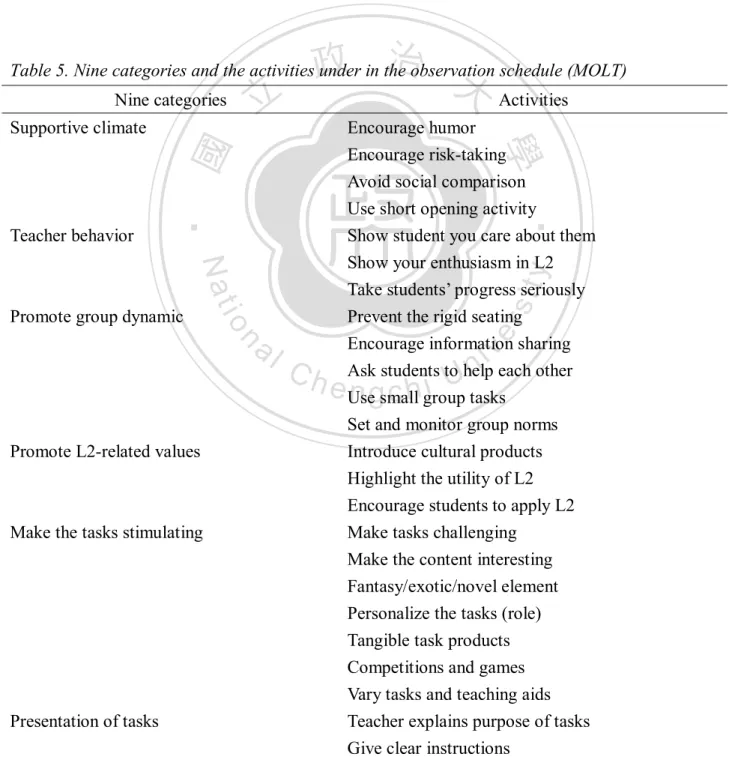
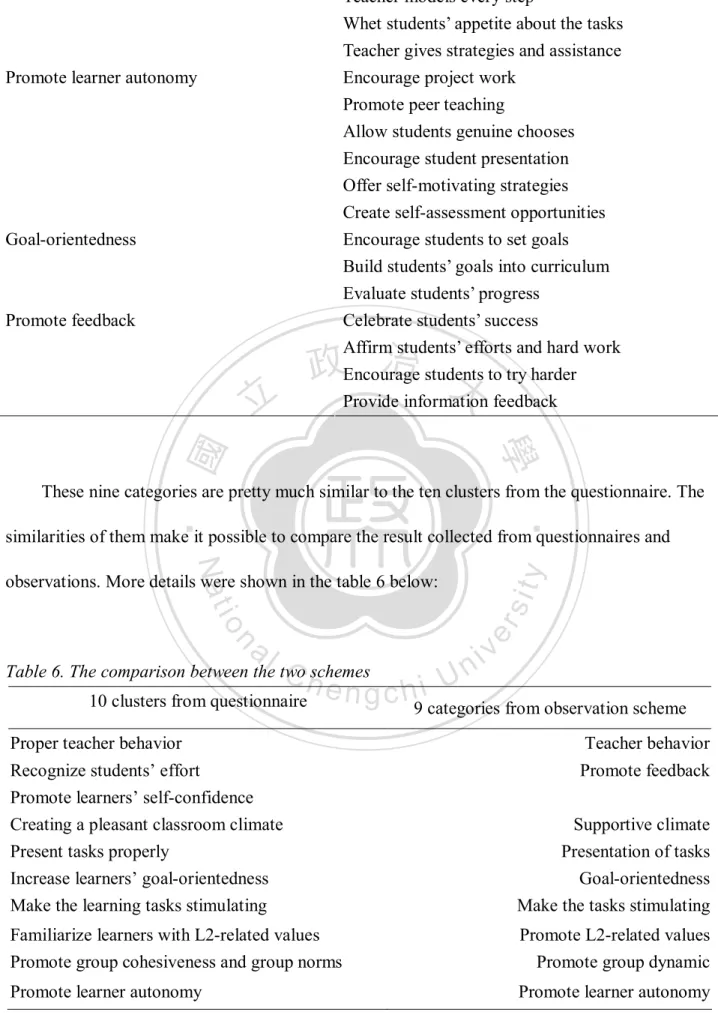
(27) learners themselves- considers important (Brophy, 1998). For most teachers the goals of the given classroom activities, regardless of whether or not the students enjoy these activities or would choose to engage in them if other alternatives were available. (3) Maintaining and protecting motivation By promoting situation-specific task motivation (e.g., through the use of stimulating, enjoyable, and relevant tasks), it provides learners with experiences of success, allowing them to maintain a positive social image even during the often face-threatening task of having to communicate with a severely limited language code, and promoting learner autonomy. That is to build students’. 政 治 大. responsibility. Students shouldn’t just listen to teachers but get more involved in class. According to. 立. Oxford (1990), “When students take more responsibility, more learning occurs, and both teachers. ‧ 國. 學. and learners feel more successful”(p11). One way to help students become more independent and. ‧. responsible is applying student-centered activities, such as those in task-based learning, in which. sit. y. Nat. students are assigned specific roles in the meaningful and purposeful context. Another way to help. io. al. er. students be more responsible is to develop students’ self-awareness by allowing them to do. v. n. self-assessment of tasks during class activities. These techniques would be crucial ways for teachers. Ch. engchi. i n U. to employ in the classroom because of their effectiveness in making students responsible for their learning. (4) Encouraging positive retrospective self-evaluation By promoting adaptive attributions, providing effective and encouraging feedback, increasing learner satisfaction, and offering grades in a motivational manner. It may also be practiced as building students’ confidence. Students tend to have no confidence in learning English. Not surprisingly these feelings lead to a downward spiral of unsuccessful learning. As Brown (2001) mentions, “Self-confidence: Another way of phrasing this one is the ‘I can do it’ Principle, or the 18.
(28) Self-Esteem Principle. At the heart of all learning is a person’s belief in his or her ability to accomplish the task”(p.62). Then, how to build students’ confidence? One crucial way to do this is to reduce students’ anxiety in the classroom. As Oxford (1990) argues, “A certain amount anxiety sometimes helps learners to reach their peak performance levels, but too much anxiety blocks language learning. Harmful anxiety presents itself in many guises: worry, self-doubt, frustration, helplessness, insecurity, fear, and physical symptoms” (p.142). As Scarcella & Oxford (1992) suggest, using pair work, group work, or cooperative learning activities, help in not putting too much pressure on individual students in front of the whole class. In addition, optimistic beliefs. 政 治 大. cause better results. For example, if students have an optimistic belief such as, “I feel confident. 立. when I speak English”, the classroom will be very active and interactive.. ‧ 國. 學 ‧. Studies Concerning Motivational Strategies. sit. y. Nat. There are some researches exploring the use of motivational strategies in the classroom in. io. al. er. recent years (Dörnyei & Csizér, 1998; Cheng & Dörnyei, 2007; Guilloteaux & Dörnyei, 2008).. v. n. These researches can be roughly categorized into two main directions: language teachers’. Ch. engchi. i n U. motivational strategies and teachers’ pedagogical knowledge behavior in the classroom. Dörnyei and Csizér (1998) conducted a research to investigate teachers’ motivational strategies use and the frequency they used them in language teaching. The study involved two hundred Hungarian teachers of English, teaching in a variety of institutional contexts, ranging from elementary schools to universities. Those teachers were asked to fill in the questionnaire indicating how important they considered a selection of fifty-one strategies and how frequently they used them in their teaching practice. Finally, on the basis of participants’ responses, Dörnyei and Csizér compiled a concise set of ten motivational macro-strategies, which they have called the ‘Ten 19.
(29) commandments for motivating language learners.’ The final wording of the ten macro-strategies is as follows: 1. Set a personal example with your own behavior. 2. Create a pleasant, relaxed atmosphere in the classroom. 3. Present the tasks properly. 4. Develop a good relationship with the learners. 5. Increase the learners’ linguistic self-confidence. 6. Make the language classes interesting. 7. Promote learner autonomy.. 立. 政 治 大. 8. Personalize the learning process.. ‧ 國. 學. 9. Increase the learners’ goal-orientedness.. ‧. 10. Familiarize learners with the target language culture.. sit. y. Nat. According to this study, the finding showed that the participants think that the teacher’s own. io. al. er. behavior was the single most important motivational tool; moreover, the survey also revealed that a. v. n. pleasant and supportive atmosphere in the classroom is also a very important key concept in. Ch. engchi. i n U. creating the basic motivational conditions. Last but not least, the significance of their study had offered language teachers various motivational strategies that they can apply it in their classroom. Dörnyei (1998) emphasized that no certain motivation strategy’s value exists in a classroom absolutely and generally since the learning contexts are various, dynamic and changing often. In addition, the results only offer a tentative ranking of the diverse motivational strategies, since teachers’ beliefs might not correspond with actual strategy effectiveness. Therefore, it is necessary to examine whether the commandments actually work in EFL classrooms.. 20.
(30) Responding to this call, Cheng and Dörnyei (2007) conducted a replication study of Dörnyei and Csizér’s (1998) Hungarian study to investigate the use of motivational strategies in language instruction in EFL teaching in Taiwan. The purpose of the studies focused on how important the participants perceive certain motivational strategies and the frequency they used these strategies in classroom. The participants in both researches were English teachers in all levels of institutes and were asked to fill in two types of questionnaires developed by the authors. One type of questionnaire was directed toward the perceived importance of motivational strategies, and the other type of questionnaire was directed toward the frequency of use based on teachers’ past. 政 治 大. teaching experience. Cheng & Dörnyei claimed that the study was the first research looking at. 立. motivational strategies in the Asian EFL context. The findings showed that Taiwanese L2 teachers. ‧ 國. 學. were better at employing certain strategies than others. They were aware of their roles as leaders,. ‧. and the findings confirmed that teachers also projected their enthusiasm. For instance, while most. sit. y. Nat. teachers reported frequently creating a supportive learning atmosphere and recognizing students’. io. al. er. efforts, strategies such as promoting learner autonomy, introducing L2-related values, and setting. v. n. learning goals received low endorsement by most of the Taiwanese English teachers. This indicates. Ch. engchi. i n U. that autonomy is not as highly appreciated by Chinese teacher as in Western learning contexts. Additionally, Guilloteaux and Dörnyei (2008) conducted an investigation of Korean teachers and students of English to examine the link between the teachers’ motivational teaching practice and the effects of motivational strategies on students’ language learning motivation. The participants in this study were 27 teachers and more than 1,300 learners. There was also a classroom observation scheme developed for this investigation and students’ motivation was measured by a self-report questionnaire. The classroom observation record was conducted by using the motivation orientation of language teaching (MOLT) scheme. The MOLT follows the real-time coding 21.
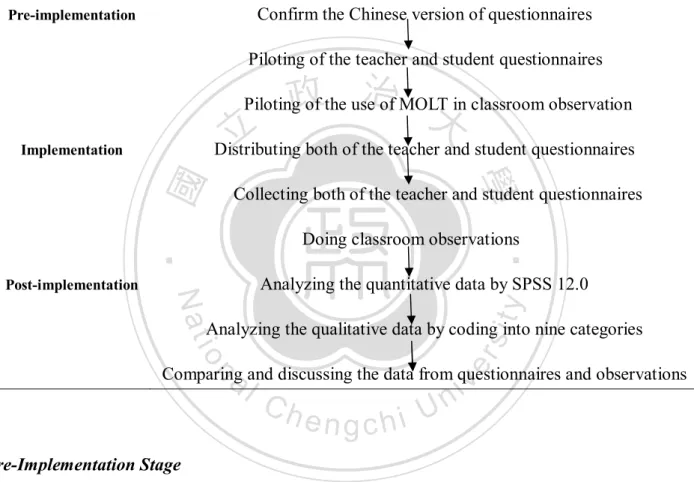
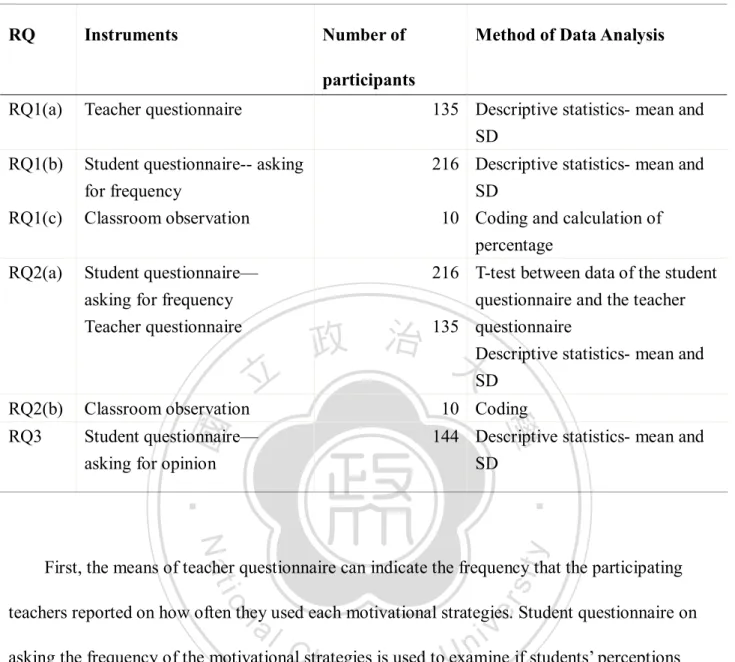
(31) principle of Spada and Frohlich’s (1995) communication orientation of language teaching (COLT) scheme but applies categories of observable teacher behaviors derived from Dörnyei’s (2001b) motivational strategies framework for foreign language classrooms. The results indicate that the language teachers’ motivational practice is connected to increased levels of the learners motivated learning behavior and their motivational state. The significant positive correlations in Guilloteaux and Dörnyei’s (2008) study, indicate that in classroom traditions teachers do not employ motivational strategies and the limited motivational practice as applied by the participating teachers was associated with a significant difference in student. 政 治 大. motivation due to there was a lack of motivation. In fact, the teaching and learning situation in. 立. junior high school in Taiwan also indicate limited motivational practice as applied in the classroom. ‧ 國. 學. due to an examination-oriented system. Therefore, teachers have space to develop and find a. ‧. balance of motivational strategies practice in classroom. The results indicate that the language. sit. y. Nat. teachers’ motivational practice is connected to increased levels of the learners’ motivated learning. io. al. er. behavior and their motivational state.. v. n. The latest relevant research was conducted in Japan by Nakata in 2011. The study attempts to. Ch. engchi. i n U. explore Japanese high school teachers’ readiness with regard to (1) the perceived importance of and the perceived use of strategies for promoting learner autonomy and professional autonomy by Japanese EFL high school teachers, and (2) these teachers’ perception of their readiness for promoting learner autonomy. Eighty English teachers working in high schools in Japan participated in the study. Despite the fact that the development of learner autonomy and teacher autonomy is constantly influenced by contextual factors, these factors remain relatively underexplored. Unlike the existing literature on motivational strategies or strategies for promoting learner autonomy (e.g., Chang, 2007; Cheng & Dörnyei, 2007; Dörnyei & Csizér, 1998) that targeted teachers of English in 22.
(32) a wide variety of educational contexts, the present study focuses on Japanese high school teachers of English. It is based on the assumption that teachers’ perceptions of such strategies are likely to be influenced by the educational context to which they belong, and the teaching experiences they have accumulated; therefore, it is crucially important for such a study to focus on teachers at one educational level high school teachers of English in Japan. Nakata used a questionnaire with some items adopted from Chang & Dörnyei (2007), and asked the participant teachers to rate their perceived importance of certain strategies for promoting learner autonomy. He then conducted several focus group interviews to collect more data in detail.. 政 治 大. Several interesting findings were observed from the study. For some reason teachers are in practice. 立. not employing strategies as much as they consider important for promoting their learners’ autonomy. ‧ 國. 學. and their own teacher autonomy, suggesting that there is a gap between the ideal and the reality. ‧. inherent in their educational context. Because of the Japanese EFL classroom context is. sit. y. Nat. teacher-centered, grammar-translation, and the authoritarian methods are dominant (Nakata. 2011),. io. al. er. some strategies for promoting learner autonomy may not be feasible. It seems that teachers cannot. v. n. employ this strategy despite their expressed wishes, perhaps owing to the limitations and constraints. Ch. engchi. i n U. inherent in the school context (e.g., limited time available, curricular goal, textbook, university entrance exam). The condition in Japan is very much alike as that in Taiwan. The results in Nakata’s study (2011) show that many Japanese EFL high school teachers, while displaying different dimensions of autonomy in different ways, are not fully ready to promote autonomy in their learners. In this chapter, the literature reviewed included a definition of an understanding of the definition and significance of motivation and a discussion of its dynamic nature. Some prominent motivation theories are introduced more specifically. Dörnyei’s motivational framework (2001a) is 23.
(33) discussed as it serves as the foundation from which the motivational strategies employed in this study are developed. Finally, the motivational strategies are presented along with some elaboration of relevant studies conducted in this area. Although many studies have been done to investigate teachers’ motivational strategies use (Cheng & Dörnyei, 2007; Dörnyei & Csizér, 1998; Guilloteaux & Dörnyei, 2008), only a few researches have focused on both teachers’ and students’ points of view toward the motivational strategies. The central purpose of this research is to investigate the use of motivational strategies in language instructions concerning both teachers’ self-report of the use of motivational strategies and students’ reports and viewpoints on them.. 立. 政 治 大. ‧. ‧ 國. 學. n. er. io. sit. y. Nat. al. Ch. engchi. 24. i n U. v.
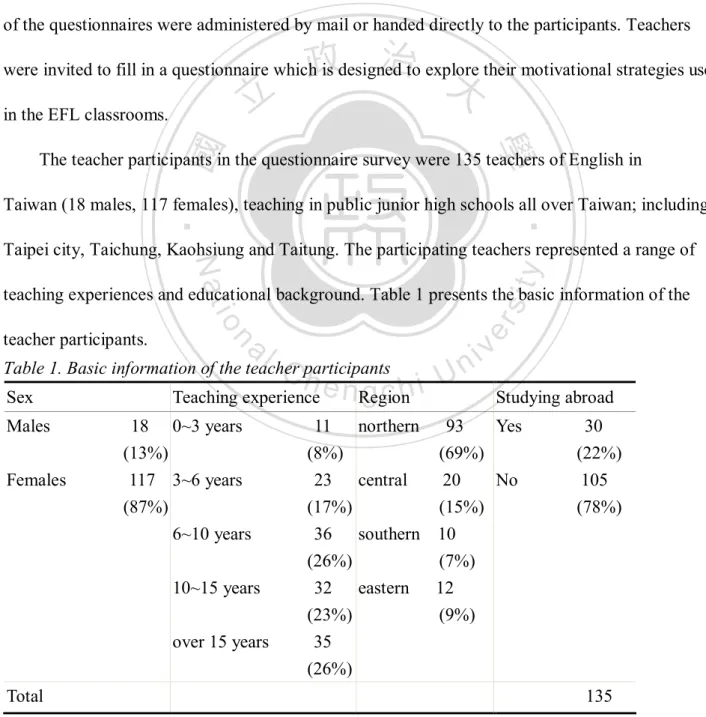
(34) CHAPTER THREE METHODOLOGY. The main purpose of this research is to investigate, in the EFL setting in Taiwan, what motivational strategies are used frequently by English teachers as reported separately by teachers and students. Besides, more objective data of teacher and student behavior were collected by the researcher through classroom observation. In addition, the effectiveness of teachers’ motivational strategies especially from students’ perception is discussed. The four questions underlying the. 政 治 大. present research were stated on page 6 in Chapter One.. 立. By beginning with a description of the participants involved in the study, this chapter will. ‧ 國. 學. provide an overview of this study’s research design, the instruments by which data were collected,. ‧. and the methodology employed in the analysis. Next it will describe the questionnaires used to elicit. sit. y. Nat. data from teachers and students. The following section will describe the procedure used. Finally,. io. n. al. er. this chapter will provide a brief description and justification for the data analysis that was used.. Participants. Ch. engchi. i n U. v. Questionnaire participants-teachers The focus of the present study is to better understand the actual situation and collect both students perceptions on teachers’ use of the motivational strategies and teachers’ self-report of the use of motivational strategies. The data was collected from different parts of Taiwan (including the capital city Taipei, the middle, the eastern, and the southern parts of Taiwan) to ensure that the data come from diverse classroom settings rather than being limited to one single region. Furthermore, to obtain data from teachers of a range of teaching experiences and educational background, the 25.
(35) questionnaires were filled by teachers with different educational background and a wide range of teaching experience. In the present study, random sampling was ideal but not quite possible. However, with the personal connection resources from past teacher training experiences, the researcher has many friends who also teach in junior high schools all over Taiwan. They helped distribute the questionnaire to teachers and students in different areas. As a result, a convenience sampling strategy was adopted in the research. The participants comprised a convenience sample , and most of the questionnaires were administered by mail or handed directly to the participants. Teachers. 政 治 大. were invited to fill in a questionnaire which is designed to explore their motivational strategies used. 立. in the EFL classrooms.. ‧ 國. 學. The teacher participants in the questionnaire survey were 135 teachers of English in. ‧. Taiwan (18 males, 117 females), teaching in public junior high schools all over Taiwan; including. sit. y. Nat. Taipei city, Taichung, Kaohsiung and Taitung. The participating teachers represented a range of. io. al. n. teacher participants.. er. teaching experiences and educational background. Table 1 presents the basic information of the. Ch. Table 1. Basic information of the teacher participants Sex Males Females. Teaching experience 18 0~3 years (13%) 117 3~6 years (87%) 6~10 years 10~15 years over 15 years. e nRegion gchi. 11 (8%) 23 (17%) 36 (26%) 32 (23%) 35 (26%). northern. i n U. v. Studying abroad. 93 Yes (69%) central 20 No (15%) southern 10 (7%) eastern 12 (9%). Total. 30 (22%) 105 (78%). 135 26.
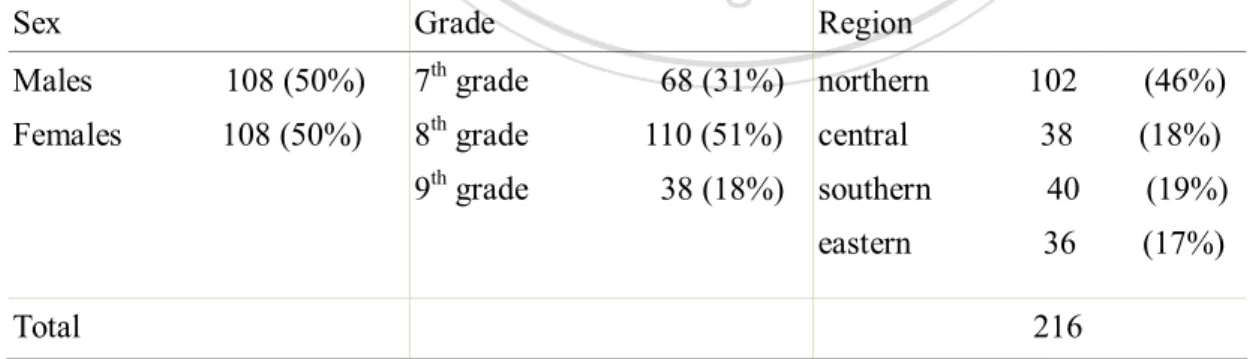
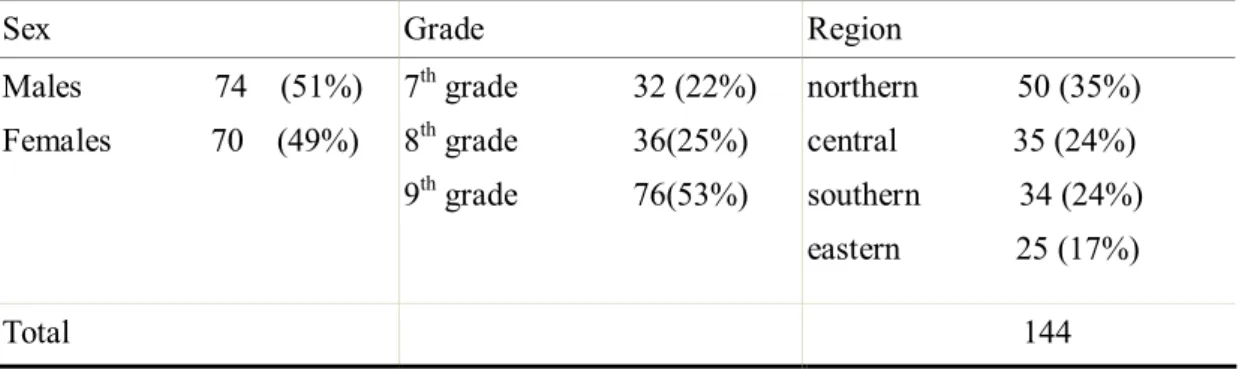
(36) Questionnaire participants-students The students participated in this study were junior high school students from different parts of Taiwan (including the capital city Taipei, the middle, and the southern parts of Taiwan). Students in seventh, eighth, and ninth grade all participated in the study. Their ages ranged from 13 to 15 years old. Both male and female students were included. With the help of many teacher participants, two kinds of student questionnaire were delivered. The researcher collected 216 student questionnaire on how often students felt that their teachers implemented various motivational strategies, and another 146 student questionnaire on students’ opinions of the effectiveness of these motivational. 政 治 大. strategies. These students were in classes with normal class grouping, which means students in. 立. every class were in diverse abilities; some had high proficiency level but others were much less. ‧ 國. 學. proficient. The two kinds of questionnaire were filled by two different groups of students because it. ‧. was likely that students would check the same item without thinking carefully if they had to fill out. y. sit. io. n. al. er. student pqrticipants:. Nat. the two kinds of questionnaire at the same time. Table 2 and 3 shows the basic information of the. Ch. engchi. i n U. v. Table 2.Basic information of the students participants-version 1 (asking for observation of frequency) Sex Males Females. Grade 108 (50%) 108 (50%). 7th grade. Region 68 (31%). th. 110 (51%). th. 38 (18%). 8 grade 9 grade. Total. northern. 102. (46%). central. 38. (18%). southern. 40. (19%). eastern. 36. (17%). 216. 27.
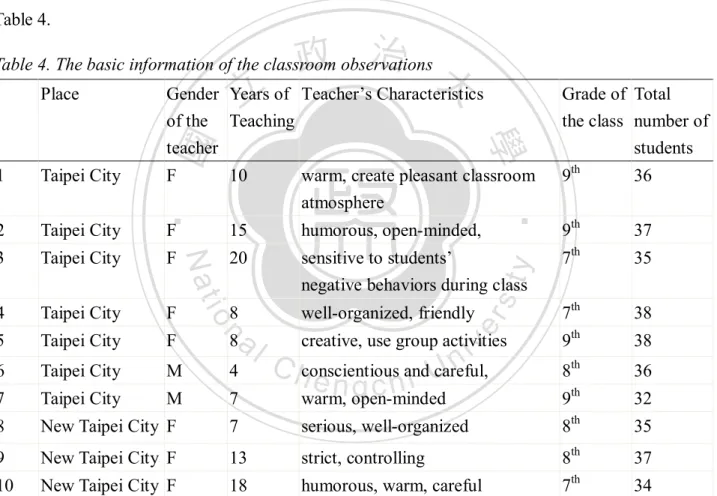
(37) Table 3. Basic information of the students participants-version 2 (asking for student opinions) Sex. Grade. Males Females. 74 (51%) 70 (49%). Region. th. 32 (22%). northern. 50 (35%). th. 36(25%). central. 35 (24%). th. 76(53%). southern. 34 (24%). eastern. 25 (17%). 7 grade 8 grade 9 grade. Total. 144. Observation participants In the meanwhile, the researcher asked for permission from several teachers to let the. 政 治 大. researcher observe their classes. At the beginning, the researcher contacted her former English. 立. teacher, who had taught English in junior high school for more than fifteen years. She immediately. ‧ 國. 學. showed willingness to participate in the study. Other participating teachers were later introduced to. ‧. the researcher as well. They all taught in public schools in Taipei. Their classes were all in normal. sit. y. Nat. class grouping with the average group size at about 35. They gave their consent for the researcher to. io. n. al. er. do the observation in their classroom. The participants’ background information will be illustrated. i n U. v. here in table 4. The researcher then conducted ten classroom observations.. Ch. engchi. The researcher unobtrusively observed the English class by sitting at the back of the classroom. The length of each class observation was 45 minutes. The main focus was on teachers’ use of the motivational strategies, and the researcher also kept a research journal during and after each observation. Some key points were recorded, for example, the atmosphere in the class, interactions not only between students and students but also between the teacher and the students, the seat arrangement, the way of teaching, and the performance of the students. They were all the information that helped the researcher discover more details to supplement the data collected from questionnaires. All participants were invited because of the personal connection or relationship. Due 28.
數據
+7

Outline
Gardner’s motivational theory
Studies Concerning Motivational Strategies
Observation participants
Language of Questionnaires/Instruments
The Results from Classroom Observation
Students’ Perceived Effectiveness of Motivational Strategies
Suggestion for Future Research
Below is a list of motivational strategies that your teachers may use in class. We would like to ask you to decide about each strategy how often your teacher uses it in your class
Below is a list of motivational strategies that your teachers may use in class. We would like to ask you to think about each strategy how helpful for you if your teacher uses it in your class
相關文件
• 4.1 學校尚需提升學與教 效能。學校仍需持續探討 不同的教學策略, 以助 教師促進課堂互動,及 提升學生的共通能力...
初中聆聽範 疇的學與教 策略-
戶外考察活動 是歷史 科教師於課堂教學 以 外評估學生的常見方法。教師 在外 出之前應為學 生提供 明確的學習目標和 評 估準則。教師可以從以
中學中國語文科 小學中國語文科 中學英國語文科 小學英國語文科 中學數學科 小學數學科.
Rebecca Oxford (1990) 將語言學習策略分為兩大類:直接性 學習策略 (directed language learning strategies) 及間接性學 習策略 (in-directed
大學教育資助委員會資助大學及絕大部分專上院 校接納應用學習中文(非華語學生適用)的「達 標」
為配合中學中國語 文課程的實施,教育局課 程發展處邀請教師、學者 推薦適合中學生學習的材
在整個學與教過程中,教師按不同因素(如課程和學習目標、學生的興趣、能力和需要等)運 用適切的學與教策略 [
