國立政治大學商學院資訊管理學系
碩士學位論文
企業整合系統之設計原則分析:平衡管控和彈性
Understanding the Design Principles of Enterprise Integration System:
A Balance between Control and Flexibility
指導教授:尚孝純 博士
研究生:劉瀚徽
I
Abstract
Enterprises adopt integrated information systems to obtain various types of advantages for their ultimate goal of increasing competitiveness; however, there are common circumstances under which the expected outcomes fail to be realized because of inappropriate control and flexibility system configurations.
This research extends Adler and Borys’ 1996 discussion on coercive and enabling systems to situations of misuse, which is construed as over-control and over-flexibility in this work. To acquire a fundamental understanding of the interests that enterprises should evaluate regarding these two, often contrary, integrated information system configurations, a contextual analysis is conducted to organize the pros and cons from organizational and operational perspectives. Additionally, feasible conflict resolution approaches that are proposed in contingency theories are also investigated to establish assumptions about practical approaches that enterprises could apply.
To shed light on these problems, empirical case studies and cross-case analyses will be conducted to verify the findings in the literature and to answer the research questions: the “what,” “why,” and “how” dimensions of integrated information system over-control and over-flexibility.
II Contents Abstract ... I Contents ... II 1. Introduction ... 1 1.1 Research Background ... 1
1.2 Research Motivation and Objective ... 2
2. Literature Review ... 3
2.1 Integrated System Control and Flexibility ... 3
2.2 Control versus Over-Control ... 3
2.3 Flexibility versus Over-Flexibility ... 4
2.4 Conflicts between Integrated Information System Control and Flexibility ... 5
2.5 Balancing Control and Flexibility ... 7
3. Research Method ... 9
References ... 11
1
1. Introduction
1.1 Research Background
Enterprises adopt integrated information systems, such as enterprise resource planning (ERP) systems, customer relationship management (CRM) systems, and business process management (BMP) systems, for the purpose of enhancing efficiency and innovation capability and standardizing operations across business units and functions. In one aspect, by controlling each business process through an integrated information system, enterprises bring order to activities, enhance the
transparency of their data across organizations, and, hence, acquire more information for making efficient and responsive decisions. From a different aspect, flexibility is also strengthened when information systems support enterprises in making business changes, achieving higher service levels, and delivering customized products more rapidly. Enterprises need both control and flexibility powered by integrated information systems to strengthen business capability.
However, excessive control may occur when business processes are required to follow rigid information system configurations, such as, for instance, when a business decision has to be
approved and reviewed by multiple units and levels in a hierarchy because of the default setting in an information system, which significantly lowers the efficiency of decision making. Another instance of over-control can also be observed in daily operations when business operators are asked to maintain vast amounts of data in their systems, and the time they spend doing so greatly exceeds their efforts in those daily operations. Over-control may also bring other disadvantages to enterprises, such as lowering employees’ commitment to work, reducing their willingness to seek ways to
improve their work processes (Jørgensen and Messner 2009), and the risk of transforming
organizations into bureaucratic forms of management, which have often been criticized as not being appropriate for organizations that require flexibility (Burns and Stalker 1966; Mintzberg 1979). Similarly, over-flexibility on integrated information system configurations may also occur when no clear business rules are implied in a system or there is no clear data type definition regarding the input data. These situations may be costly and detrimental to enterprises because employees must spend extra time configuring business rules or cleansing the data they need. Moreover, being overly flexible may also lead to a lack of discipline and the misuse of business resources and may thus result in wasted time, lower productivity, and higher costs for product delivery. With undue
flexibility, it is also possible that the expected outcomes will not be achieved (Jørgensen and Messner 2009).
Control and flexibility are the two important aspects to be evaluated in any integrated information system. Both are equally important, but they are usually contrary to each other, which causes conflicts when considering both at the same time. Balancing control and flexibility in integrated
2
information systems becomes a key issue for enterprises that hope to get the most out of their systems (Duncan 1976; Tushman 1997).
1.2 Research Motivation and Objective
The shortcomings of integrated information system over-control and over-flexibility can be observed not only in enterprises but also in our daily lives when we receive services from these enterprises. For example, a well-known internet service provider in Taiwan requires its workers to maintain a series of operational data after installing each modem in a household, and it is observed that workers spend much more time maintaining data than conducting their primary business operations. As a control mechanism, maintaining data increases the information transparency of the service provider as a whole, but this process greatly reduces workers’ service capacities and efficiency. In a case study of Restaurant Division in UK (Ahrens and Chapman 2004), branch managers enjoyed a certain degree of flexibility and discretion in choosing and applying the tools provided by the restaurant’s information system. Nevertheless, there is the concern that overly flexible system configurations could allow restaurant managers to manipulate the numbers in the financial reports from each restaurant branch to falsely overstate its margin.
From the cases above, we obtain a basic understanding that there are constant trade-offs between control and flexibility with integrated information systems. Enterprises must determine the causes of any conflicts and how to address those conflicts while designing or applying integrated information systems, especially under conditions of over-control or over-flexibility.
Moreover, a majority of existing studies only focus on control and/or flexibility, which limits their discussions to single dimensions such as business strategy, system design, operation management, or organization, leaving the others to exclusively stand at one end of the control/flexibility spectrum. To that end, this research aims to investigate the conflicts between control and flexibility from multiple perspectives. By conducting empirical case studies of enterprises that had experienced information system over-control and over-flexibility, the aim was to answer the questions below:
What types of problems could enterprises encounter while balancing control and flexibility? Why do they encounter these problems?
3
2. Literature Review
This section consolidates the literature related to control and flexibility in enterprise systems and management practice to establish a research framework for this paper. First of all, by understanding the advantages, disadvantages, and conflicts between coercive and enabling (Adler and Borys 1996) settings of integrated information systems, we acquire a fundamental understanding of the interests that enterprises should evaluate regarding these systems. Second, to obtain a more systematic point of view regarding the conflicts between the two contrary information system configurations, a typology should be established to categorize the different types of conflicts. Finally, possible solutions to many of the conflicts that are proposed in existing studies are investigated to build assumptions about the actual approaches that enterprises apply to resolve these conflicts.
2.1 Integrated System Control and Flexibility
Adler and Borys (1996) proposed the concepts of coercive and enabling, which are the two types of formalization often believed to conflict with each other; however, some contingency studies have discovered that these two formalizations do not appear to be opposite and could be applied at the same time in many businesses (Brown & Eisenhardt 1997). There is also evidence that implementing both formulizations could yield better enterprise performance (Chenhall 1986; Adler 1999) and that, in terms of integrated systems, an organization can achieve the objectives of both efficiency and flexibility with the simultaneous use of both mechanisms in its enterprise system (Simons 1990). This research draws on these concepts to develop its fundamental framework and applies the terms control and flexibility to represent the two, often contrary, enterprise system settings and business objectives. Furthermore, to picture the circumstances of misuse, this research introduces the terms over-control and over-flexibility, which are the key issues the study aims to address and resolve.
2.2 Control versus Over-Control
The idea of control can be traced back to Frederick Winslow Taylor’s work “Principle of Science Management”, which applies scientific approaches to formalizing procedures, specializing employees’ tasks, and standardizing outputs. By utilizing control mechanisms in management practices, enterprises have acquired numerous advantages, such as bringing order to activities (Jørgensen & Messner 2009), enhancing efficiency, and ensuring output quality (Lee 2003). Additionally, by further enforcing control through integrated information systems, enterprises can also improve data reporting quality and access to more and better information, reduce dependency on employees (Shaw 1999), and gain competitive advantage (Roberts & Wood 1997). Organizations can enjoy the abovementioned benefits if their integrated systems are designed to fit their primary tasks (Adler, Goldoftas, & Levine 1999): for instance, when an organization’s tasks are simple and its goal is efficiency, the organization will benefit from adopting a mechanistic form of control (Burns and
4
Stalker 1961). Strong control has also proved to be essential in organizations with strict budget or schedule constraints and those that require high-quality results (Harris, Collins, & Hevner 2009). However, when too much control—that is, over-control—is enforced by integrated systems, enterprises may lose the flexibility to nimbly reallocate resources and smoothly adjust processes; hence, they may also lose the capability of flexible responses to business changes (Kurke 1988). The centralized nature of bureaucratic control has often reduced personal discretion by specializing employees’ tasks to certain scopes, and this type of mistrust lowers employees’ commitment to finding alternative solutions to resolving new business problems and improving current business operations (Jørgensen & Messner 2009). In terms of local operations, a case study on a UK restaurant chain presented the concern from local restaurant managers that the meal portions and accounting methods that had been defined by the central office and the information system might not comply with local operations and customer services (Ahrens and Chapman 2004). Other backfire effects can also be identified in numerous studies that have found that over-control in enterprise systems caused by tight information and inter-department links could delay decision making, slow the responses to customers’ needs (Goodhue et al. 1992), increase the complexity of issue sourcing (Singletary 2003), and reduce the ability to manage unanticipated situations (Shang & Liao 2006). To that end, bureaucratic forms of management and control have often been criticized as not being appropriate for organizations that require flexibility (Burns & Stalker 1961; Mintzberg 1979), and these organizations therefore encounter a dilemma between efficiency and flexibility.
2.3 Flexibility versus Over-Flexibility
Flexibility is the ability to respond to new situations with little time or effort (Upton 1995), and it provides more freedom and options for employees to complete their tasks (Noori & Radford 1995). Enterprises pursue flexibility for purposes of fulfilling new business requirements and constantly changing customer demands, and thereby ensure their advantage over competitors (Leana & Barry 2000; Chen et al. 2009). In terms of information system flexibility, Easton and Rothschild (1988) described it as the ability of a system to take different forms. With adequate information system flexibility, enterprises could extend their systems’ periods of use and gain more IT investment efficiency (Chang & King 2005; Moitra & Ganesh 2005; Gebauer & Schober 2006). In today’s constantly changing business environment, the tendency toward enterprise system flexibility rather than control is presented in multiple studies across different industries (Adler et al. 1999; Ahrens & Chapman 2004; Zhang 2006). With manufacturing for instance, the combination of flexibility and traditional control in enterprise systems will bring the industry greater product variety, faster
response times, and increased productivity (Chase & Garvin 1989; Pine 1993; Hayes & Pisano 1994; Goldhar and Lei 1995), which can be found in practice as well at New United Motor Manufacturing Inc. (NUMMI) by Adler et al. (1999). In other areas such as the service industry, businesses can also
5
benefit from flexible enterprise systems to acquire innovation capability in providing services, which is especially important in today’s changing environment (Ahrens & Chapman 2004; Zhang 2006) Although the majority of contemporary research focuses on the benefits of flexibility, there is another voice that claims that too much flexibility, which is introduced as over-flexibility in this research, may be detrimental to organizations with regard to budget and outcome control, business objective alignment, employee behavior management, and investment efficiency. Jørgensen and Messner (2009) state that enterprises may risk not reaching expected business outcomes when too much flexibility is allowed, and this flexibility also comes at the price of additional investment and complexity in enterprise systems (Gebauer & Schober 2006). At that point, given the input and compromise required for the flexibility, it is difficult to verify whether this flexibility can generate practical benefits for enterprises (Chen et al. 2009). On an individual level, over-empowerment among employees may lead to their feeling of confusion, especially at lower levels of a given hierarchy (Leana & Barry 2000). Although contemporary theories provide limited access to the issues that arise from over-flexibility, Ahrens and Chapman (2004) addressed the concern of a head office manager that an overly flexible enterprise system configuration could allow for malicious employee behavior such as tampering with data in the system.
2.4 Conflicts between Integrated Information System Control and Flexibility
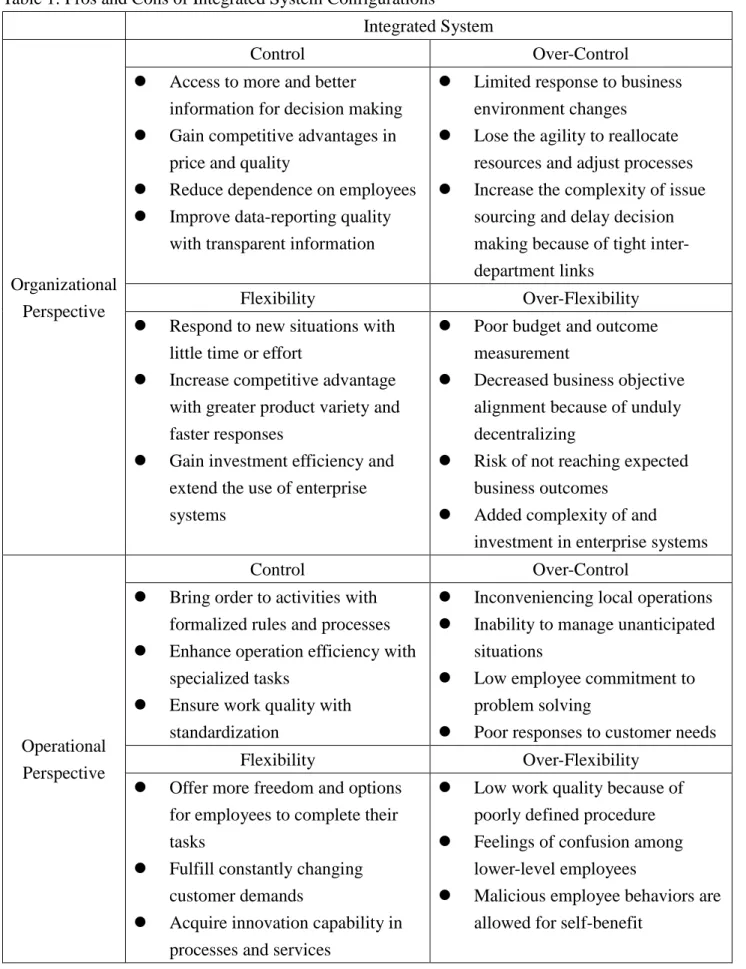
To conceptualize the abovementioned conflicts between integrated information system control and flexibility, this research establishes a typology framework to categorize different types of conflicts from either the organizational or the operational perspective, within which the different system configurations would make positive or negative impacts. A review of a number of studies in the literature also found that the configuration of integrated information systems plays an important role in organizational and operational success or failure (Upton 1995; Lei et al. 1996; Palanisamy & Sushil 2004; Zhang 2006). In other words, integrated system configurations can bring about advantages and disadvantages from both the organizational and the operational perspectives.
6
Table 1: Pros and Cons of Integrated System Configurations
Integrated System
Organizational Perspective
Control Over-Control Access to more and better
information for decision making Gain competitive advantages in
price and quality
Reduce dependence on employees Improve data-reporting quality
with transparent information
Limited response to business environment changes
Lose the agility to reallocate resources and adjust processes Increase the complexity of issue
sourcing and delay decision making because of tight inter-department links
Flexibility Over-Flexibility Respond to new situations with
little time or effort
Increase competitive advantage with greater product variety and faster responses
Gain investment efficiency and extend the use of enterprise systems
Poor budget and outcome measurement
Decreased business objective alignment because of unduly decentralizing
Risk of not reaching expected business outcomes
Added complexity of and
investment in enterprise systems
Operational Perspective
Control Over-Control Bring order to activities with
formalized rules and processes Enhance operation efficiency with
specialized tasks
Ensure work quality with standardization
Inconveniencing local operations Inability to manage unanticipated
situations
Low employee commitment to problem solving
Poor responses to customer needs Flexibility Over-Flexibility
Offer more freedom and options for employees to complete their tasks
Fulfill constantly changing customer demands
Acquire innovation capability in processes and services
Low work quality because of poorly defined procedure Feelings of confusion among
lower-level employees
Malicious employee behaviors are allowed for self-benefit
7
2.5 Balancing Control and Flexibility
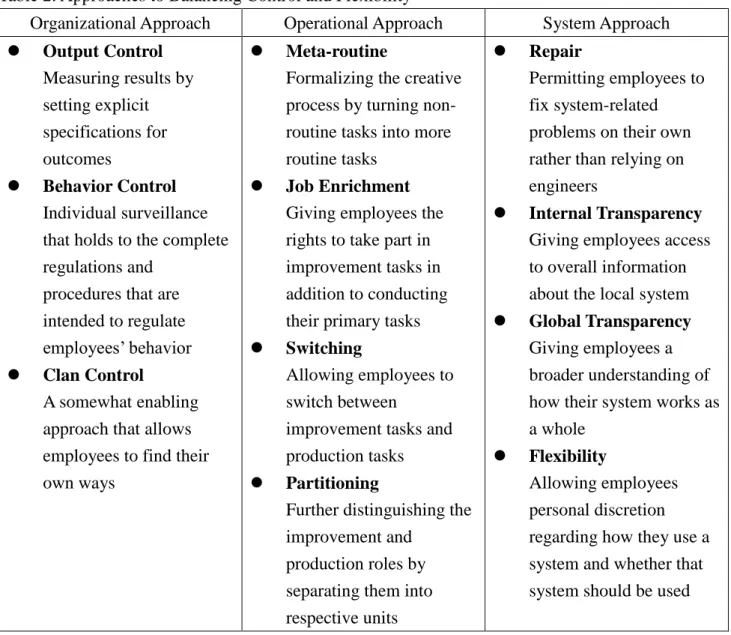
To address the solutions to the different types of conflicts between enterprise system over-control and over-flexibility, this research draws on three approaches that have been proposed in contingency theories (Ouchi 1977, 1979, 1980; Adler and Borys 1996; Adler et al. 1999): organizational, operational, and system.
The organizational approach adopts the control theory proposed by Ouchi (1977, 1979, & 1980) and aggregated by Harris et al. (2009) into three types of control, output, behavior, and clan. Output
control entails measuring results by setting explicit specifications for outcomes, and it can be
performed when actual results can be verified based on definable and measurable expectations of outcomes. Behavior control is individual surveillance that entails complete regulations and procedures to regulate employees’ behavior, and it can be conducted when a cause-and-effect relationship between certain behaviors and expected goals is well understood. Whereas output and behavior control are known as bureaucratic forms of control, clan control is, rather, an enabling approach that allow employees to find their own ways under the assumption that they share the same goals as the organization and will work for the organization’s best interest.
The Operational approach applies the four operational mechanisms presented by Alder et al. (1999) to balance control and flexibility in individuals tasks, specifically, meta-routine, job enrichment, switching, and partitioning. Meta-routines formalize the creative process by turning non-routine tasks into more routine tasks to gain more control over unstructured works under certain levels of flexibility; it is assumed that control can be enforced using the integrated information system. Job
enrichment gives employees the rights to take part in improvement tasks and propose solutions for
optimizing their work in addition to their primary production tasks, which allows them to become more innovative and flexible. Switching allows employees to switch between improvement tasks and production tasks, which gives them the time to focus on each task by distinguishing between the two roles. Partitioning further differentiates the improvement role and the production role by separating them into respective units. It permits each unit to concentrate on its task while both units support each other and function in parallel.
The System approach highlights Adler and Borys’ (1996) four system design elements for supporting a system’s usability: repair, internal transparency, global transparency, and flexibility.
Repair permits employees to fix system-related problems such as applying procedures to operations
and breakdowns during work on their own rather than relying on engineers each time an issue arises. This ensures the smoothness of operations without interruptions from system configurations or fails by involving employees in resolving problems, thereby reducing the downtime spent waiting for help. Internal transparency gives employees access to overall information about the local system regarding its management control processes, operation status, and functioning logic. Employees can
8
therefore understand what should be done for the department’s best interest and to be in line with customers’ expectations, and they can at the same time intelligently fix errors. Global transparency, as opposed to internal transparency, gives employees a broader understanding of how the system works as a whole; a wide range of the information that is provided can assist with inter-department collaboration and communication and let employees keep track of how their work fits into the entire organization. Flexibility allows employees personal discretion on how they use systems and whether those systems should be used. Employees can choose to apply the system’s suggestions or not and also modify the system to fit their specific needs.
Table 2: Approaches to Balancing Control and Flexibility
Organizational Approach Operational Approach System Approach Output Control Measuring results by setting explicit specifications for outcomes Behavior Control Individual surveillance that holds to the complete regulations and
procedures that are intended to regulate employees’ behavior Clan Control
A somewhat enabling approach that allows employees to find their own ways
Meta-routine
Formalizing the creative process by turning non-routine tasks into more routine tasks
Job Enrichment Giving employees the rights to take part in improvement tasks in addition to conducting their primary tasks Switching
Allowing employees to switch between
improvement tasks and production tasks Partitioning
Further distinguishing the improvement and
production roles by separating them into respective units
Repair
Permitting employees to fix system-related problems on their own rather than relying on engineers
Internal Transparency Giving employees access to overall information about the local system Global Transparency
Giving employees a broader understanding of how their system works as a whole
Flexibility
Allowing employees personal discretion regarding how they use a system and whether that system should be used
9
3. Research Method
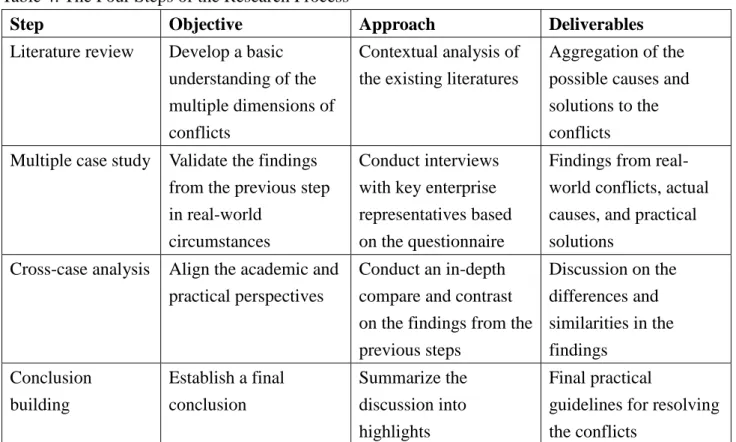
To answer the “what”, “why”, and “how” questions regarding the conflicts that arise from balancing the over-control and over-flexibility of integrated information systems, multiple case studies among four enterprises are carried out to shed light on the research questions of this work.
Table 3: Target Case Study Enterprises
Enterprise Interviewee
Company A (Information Tech) Business manager, system manager Company B (Software) Senior manager, system coordinator
Company C (Consulting) Senior manager, business consultant, IT consultant Company D (Consumer Goods) Business manager, IT department manager, user Table 4: The Four Steps of the Research Process
Step Objective Approach Deliverables
Literature review Develop a basic understanding of the multiple dimensions of conflicts
Contextual analysis of the existing literatures
Aggregation of the possible causes and solutions to the conflicts Multiple case study Validate the findings
from the previous step in real-world
circumstances
Conduct interviews with key enterprise representatives based on the questionnaire
Findings from real-world conflicts, actual causes, and practical solutions
Cross-case analysis Align the academic and practical perspectives
Conduct an in-depth compare and contrast on the findings from the previous steps Discussion on the differences and similarities in the findings Conclusion building Establish a final conclusion Summarize the discussion into highlights Final practical
guidelines for resolving the conflicts
Before the interviews with business managers, system managers, system coordinators, and users of select enterprises, a contextual analysis was first conducted in the literature review section. This review aggregated the “what” dimension of the conflicts that have been mentioned in the existing literature, and it organized the pros and cons of two enterprise aspects under different system configurations. Furthermore, the “why” dimension was also investigated through the possible solutions that have been presented in numerous studies to understand the approaches to resolving different aspects of conflict. The findings from the contextual analysis provided this research with a number of assumptions and directions to be raised during the interviews, and therefore, a
semi-10
structured questionnaire (Appendix 1) with open-ended questions was designed based on the literature that was reviewed.
11
References
1. Adler, P. S., & B. Borys. (1996). Two types of bureaucracy: enabling and coercive. Administrative Science Quarterly 41: 61-89.
2. Adler, P., B. Goldoftas, & D. Levine. (1999). Flexibility versus Efficiency? A case study of model changeovers in the Toyota production system. Organization Science 10 (1): 43-68. 3. Ahrens, T., & Chapman, C. S. (2004). Accounting for flexibility and efficiency: A field study of
management control systems in a restaurant chain*. Contemporary Accounting Research, 21(2), 271-301.
4. Brown, S., & K. M. Eisenhardt. (1997). The Art of Continuous Change: Linking complexity theory and time-paced evolution in relentlessly shifting organizations. Administrative Science Quarterly 42 (1): 1-34.
5. Burns, T. & Stalker G. M. (1961). The Management of Innovation. Tavistock, London. 6. Chang, C. J., & King, W. R. (2005). Measuring the performance of information systems: A
functional scorecard. Journal of Management Information Systems, 22(1), 85-115.
7. Chase, R. & D. Garvin. (1989). The Service Factory. Harvard Business Review 67 (4): 61-69. 8. Chen, R., Sun, C., Helms, M. M., & Jih, W. (2009). Factors influencing information system
flexibility: An interpretive flexibility perspective. International Journal of Enterprise Information Systems, 5(1), 32-43.
9. Chenhall, R., & D. Morris. (1986). The impact of structure, environment and interdependence on the perceived usefulness of management accounting systems. The Accounting Review 61 (1): 16-35.
10. Duncan, Robert B. (1976). The ambidextrous organization: Designing dual structures for innovation, in Ralph H. Kilman, Louis R. Pondy, Dennis P. Slevin, eds. The Management of Organization Design. North-Holland, New York, vol. 1, 167-188.
11. Gebauer, J., & Schober, F. (2006). Information system flexibility and the cost efficiency of business processes. Journal of the Association for Information Systems, 7(3), 122-146. 12. Goldhar, J. & D. Lei. (1995). Variety Is Free: Manufacturing in the Twenty-first Century.
Academy of Management Executive 9 (4), 73-86.
13. Goodhue, D. L., Wybo, M. D., & Kirsch, L. J. (1992). The impact of data integration on the costs and benefits of. MIS Quarterly, 16(3), 293.
14. Harris, M. L., Collins, R. W., & Hevner, A. R. (2009). Control of flexible software development under uncertainty. Information Systems Research, 20(3), 400-419,478-479.
15. Hayes, R., & G. Pisano. (1994). Beyond World-class: The New Manufacturing Strategy. Howard Business Review 73: 77-86.
16. Kurke, Lance B. (1988). Does adaptation preclude adaptability? Strategy and performance. L. G. Zucker, ed. Institutional Patterns and Organizations: Culture and Environment. Ballinger, Cambridge, MA. 199-222.
12
organizational life. Academy of Management. The Academy of Management Review, 25(4), 753-759.
18. Lee, C. Y. (2003). Total manufacturing information system: A conceptual model of a strategic tool for competitive advantage. Integrated Manufacturing Systems, 14(2), 114-122.
19. Lei, D., M. Hitt, & J. Goldhar. (1996). Advanced Manufacturing Technology: Organizational Design and Strategic Flexibility. Organization Studies 17 (3): 501-517.
20. Mintzberg, Henry. (1979). The Structuring of Organizations. Prentice-Hall, Englewood Cliffs, NJ.
21. Moitra, D., & Ganesh, J. (2005). Web services and flexible business processes: Towards the adaptive enterprise. Information & Management, 42(7), 921-933.
22. Noori, H., & Radford, R. (1995), Production and Operations Management: Total Quality and Responsiveness, McGraw-Hill, New York, NY.
23. Ouchi, W. (1977). The relationship between organizational structure and organizational control. Admin. Sci. Quart. 22(1) 95-113.
24. Ouchi, W. (1979). A conceptual framework for the design of organizational control mechanisms. Management Sci. 25(9) 833-848.
25. Ouchi, W. (1980). Markets, bureaucracies, and clans. Admin. Sci. Quart. 25(1) 129-141. 26. Palanisamy, R., & Sushil. (2004). Measurement and Enablement of Information Systems for
Organizational Flexibility: An Empirical Study. Journal of Services Research, 3(2), 81-103. 27. Pine, B. (1993). Mass Customization: The New Frontier in Business Competition. Boston, MA:
Harvard Business School Press.
28. Roberts, M., & Wood, M. (1997). The use of computerized information systems to gain strategic competitive advantage: The case of a start-up manufacturing company. Logistics Information Management, 10(4), 178-183.
29. Shang, S. C., & Liao, K. (2006). Understanding the Inflexibility of Process Integration. Americas Conference on Information Systems (AMCIS 2006)
30. Shaw, M. (1999). Customer service, cost control drive information system upgrades. Pulp & Paper, 73(4), 44-45+.
31. Simons, R. (1990). The role of management control systems in creating competitive advantage: New perspectives. Accounting, Organizations and Society 15 (1/2): 127-43.
32. Singletary, L. A. (2003). Empirical study of attributes and perceived benefits of applications integration for enterprise systems.
33. Tushman, Michael L. (1997). Winning through Innovation. Strategy & Leadership, 25(4), 14-19 34. Upton, D. (1995). What Really Makes Factories Flexible? Harvard Business Review 82, 74-84. 35. Zhang, M. J. (2006). IS support for strategic flexibility, environmental dynamism, and firm
13
Appendix 1 Questionnaire
Integrated system misuse
In your company or department, what processes are integrated within the enterprise system?
What do you think about your company’s integrated system? Does it control too much, or is it too flexible?
Over-Control
General
Do you find any over-control cases caused by the coercive integrated information system setting in your company?
If you do, what do you find? Please describe it in detail.
Organization
Does the system affect your company as a whole?
Does it lower your company’s responsiveness to external or internal changes?
Does it raise the complexity for issue sourcing when issues arise?
Does it delay your business processes, such as decision making?
If any of the above applies, how do they affect your organization?
Why do these situations happen?
How do you resolve these problems? Do your solutions help? Is there any trade-off?
Do you think the system should be more flexible and give employee more freedom to fix problems? Is there any trade-off?
Operation
Does the system affect employees’ daily operations? Does it lower employees’ commitment to improving
operation?
Does it impede local operations, for instance within specific business units?
Does it impede addressing unexpected situations such as unexpected customer requests?
If any of the above occurs, how do these events affect operations?
Why do these things happen?
How do you resolve these problems? Do your solutions help? Is there any trade-off?
14
employees more freedom to fix problems? Is there any trade-off?
Over-Flexibility
General
Do you find any cases of over-flexibility that are caused by the enabling integrated information system setting in your company?
If you do, what do you find? Please describe it in detail.
Organization
Does your system affect your company as a whole? Does it impede your company’s outcome or budget
measurement?
Does it decrease business units’ alignment with your company’s business objective?
Does it require additional investment or cause additional complexity within your company’s integrated system? If any of above applies, how do these problems affect
your organization?
Why do these situations happen?
How do you resolve these problems? Do your solutions help? Is there any trade-off?
Do you think the system should enforce more control to keep track of business outcomes or employee behavior? Is there any trade-off?
Operation
Does your system affect employees’ daily operations? Does it lower employees’ work quality, for instance,
because of missing standard procedure?
Does it cause confusion among the employees? Does it benefit the employees rather than the
organization?
If any of the above applies, how does it affect your organization?
Why do these situations happen?
How do you resolve these problems? Do your solutions help? Is there any trade-off?
Do you think the system should enforce more control to clearly define employee roles and tasks? Is there any trade-off?