1
Integrating Innovative CDIO and TLD Modes in Literature Learning and Teaching
(1) 研究動機與目的
Motivation and Rationale
Years ago, in the “Qualitative Research Design” course, Dr. John Creswell, while sitting in the University of Nebraska, Lincoln, talked with several graduate students (including myself) and my advisor, Dr. Edith King, as we huddled around a speakerphone in Denver, Colorado. Dr. Creswell made the remarks that he was revising the second edition of his book titled Research Design: Qualitative,
Quantitative, and Mixed Methods Approaches (2003). In the second edition of his
book, he stated the cover illustration of a mandala, a Hindu or Buddhist symbol of the universe, served much like creation of a research design, requires looking at the big picture as well as tremendous attention to details. Dr. Creswell also emphasized that in the qualitative research synthesis, “the whole could be greater than the sum of its parts”. Yes, what Dr. Creswell stated that day is the most interesting, stimulating, and inspiring part in conducting qualitative research for the researcher. That is the first reason for her to apply for this project.
The second reason to apply for the project is that in Taiwan, while many people have become so convinced that learning English as a foreign language (EFL) means acquiring skills, the teaching of literature seems to have become much less significant nowadays. The common scenario shows that the majority of college students find many literary works too boring, too long, and too hard to comprehend. In some ways, the teacher’s concern with the learning of his/her students is similar to a mother’s concern with the nutrition of her children. Most mothers surely desire their children to develop healthy and strong bodies and they understand the general relationship
between the quality of food they provide and the status of their child’s health. But in planning their meals the nutritional value of the foods they use is thought of in the broadest terms. Many other variables, such as cost, convenience, appealing quality, and personal taste play a part in the selection and preparation of the family diet. Like mothers, teachers have responsibility for positive aspects of their students’ growth. The current study, combined with the transactional literature discussion (TLD) learning mode, aims to break new ground by integrating CDIO program
2
students from College of Social Sciences and Humanities to reconsider and reassess the value of literature learning.
Originally CDIO is an innovative educational framework for producing the next generation of engineers, but now a new version is applied in both science and liberal arts. Kontio (2012) reported that CDIO is based on a commonly shared premise that engineering graduates should be able to conceive-design-implement-operate complex value-added engineering systems in a modern team-based engineering environment to create systems and products. Penttila, Kontio, Kairisto-Mertanen and Mertanen (2013) also shared the ideology about defining the key competences needed in working life and both intend to activate the student and define the learning goals deriving from the needs of the surrounding environment. CDIO in this study serves as the specific motivational and innovative component in the transformation in EFL education. CDIO for undergraduate students means engaging in practical and cross-disciplinary project-based work to cultivate and develop their communication skills, social awareness, team spirits, and project management abilities.
In language education and professional teacher development, Manning, Morrison and McIlroy (2014) state that “there may be a role for using a new approach for flipped learning whereby students develop their knowledge around a topic outside the classroom then come together in class to share their understanding and views, with the teacher facilitating the interactions, maintaining an appropriate group dynamic and introducing further issues and content as appropriate” (p. 295). Generally speaking, literature course is one of the demanding, exigent and important core courses in the Department of Foreign Languages and Literature (DFLL) in the university located in central Taiwan. Students’ learning attitudes are crucial to reading engagement and class participation. Unlike traditional teaching strategy, the integration of TLD and CDIO ideally would open a completely diverse window for English majors and flip and renovate the traditional learning environments.
The purpose of this study is to explore the pedagogical integration of TLD and CDIO modes into students’ literature learning and evaluate students’ responses toward the innovative programs in two literature classes. This study mainly draws on
Rosenblatt’s reader-response theory to illustrate college students’ responses to literary works through diverse perspectives to complete CDIO group projects in this study.
(2) 文獻探討
Literature Review
Reader-response in the Classroom
Studies of student’s response to literature can be traced back to two seminal and inspiring works: I. A. Richards’ Practical Criticism (1929) and Louis Rosenblatt’ The
3
Reader, the Text, the Poem: the Transactional theory of the Literary Work (1994). In Practical Criticism (1929), Richards examined the responses to poetry of Cambridge
undergraduates. He made good use of unidentified texts – thirteen poems in which authorship/title were not identified and asked students to respond to those poems. Richards’ findings including students’ “ignorance” (p.185), “inability to construe meaning” (p.294), “reliance on stock responses” (p.295), and “lack of clues about authorship, period, school, the sanction of anthology, or the hint of a context” (p.296), demonstrate that in all types of educational settings “we must cease to regard
misinterpretation as an unlucky accident; we must treat it as a normal ad probable event” (p.315). The reader response theory in Rosenblatt’s The Reader, the Text, the
Poem: the Transactional Theory of the Literary Work (1994) is the innovative
landmark that serves as the important origin of the whole language movement in the field of English language arts. In choosing poems without any contextual markers, Richards (1929) and Rosenblatt (1994) created unusual instructional situations. In everyday reading experiences, readers know the name of the author and can easily discover dates and other important information about the context of the literary works. Nowadays, literature circle’s open-ended, natural discussion of a literary work and role rotation, both of which enable readers to approach a text from various
perspectives, are simply practicing Rosenblatt’s transactional theory model.
Prompted by Rosenblatt’s framework of the reader’s transactional relationship to the text, Becker(1999) also states that the text presents a set of linguistic, conceptual, and referential stimuli as “the reader engages in a synergistic process of experiencing literature to build an interpretation” (p.103). Furthermore, Probst shares similar thoughts and notes that readers must be “individually responsible for what they make of the literature” (R. Probst, 1988, p. 34) because the interpretation of literature derives from a person’s individual response through literature itself. Hancock (2000) points out clearly that meaning results from the interaction between the text and the reader and that readers’ diverse comprehension adds in new insights.
Although reader-response theory does not represent one clearly unified
theoretical perspective, all reader-response theory “focuses on the mind of the reader during the act of reading” (M. R. Cherland, 2002). Accordingly, the reader-response perspective allows students to look past the words of the text, to search for deeper meanings, and to see different perspectives of others. In the reader-response-oriented classroom, students are encouraged to approach the text with their personality traits and their past and present experiences. In brief, students are motivated to interpret the text in various ways.
However, critics of reader-response theory argue that it is too individualistic and subjective; reader-response theory fails to make explicit the many ways in which the
4
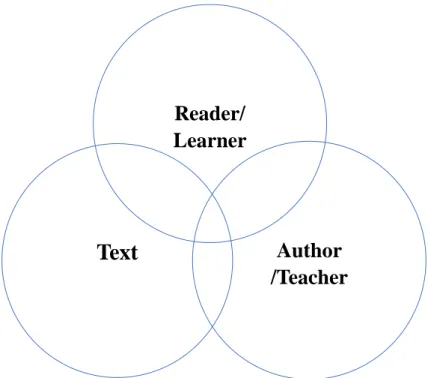
social world shapes reading and the identity of the reader (M. Cherland, 2000). In their opinion, reading a literary text is part of a complex process that involves collaboration and interaction among the author, the text, and the reader. (Figure 1.) The text itself is a stimulus that elicits responses from readers based on their thoughts, feelings, and previous reading experiences.
Figure 1. Relationship among the reader/learner, the text, and the author/teacher in the classroom practice
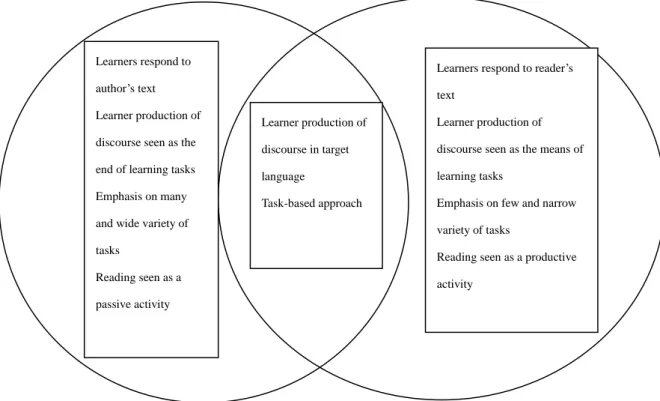
Within a classroom context, Hirvela (2006) states that communicative uses of literature would be strengthened considerably by an emphasis on the learner as a reader and he or she is encouraged to tell a story of reading. Hirvela also characterizes the difference between personal-response approach and reader-response approach and emphasizes the key features of reader-response approach, including learners respond to reader’s text, focus on a limited variety of tasks, and reading as a productive activity. Figure 2 provides a visual representation of the relationship between the two approaches.
Text
Reader/
Learner
Author
/Teacher
5
Personal-Response Approach Reader-Response Approach
Figure 2. Comparison of personal-response and reader-response approaches (adapted from Hirvela, 2006)
Several EFL educators have already embraced reader-response theory and experimented with it in their classrooms. Liaw’s study (2001) showed that “the use of literature, if taught in a response-based manner, need not be only a vehicle for
language teaching but a form of aesthetic experience that enhances the enjoyment of reading in a foreign language” (p.43). Ho (2006) stated that “in literary transactions, both the reader and the text play an equally important role in the reading process, mutually acting on, affecting and conditioning each other” (p. 390). Furthermore, Wang (2009) argues that EFL students deserve the opportunities to experience an active role in learning to discover that English, like their own language, not only can accommodate facts and information but also can express feelings and ideas about love, death, hope, and fear through reader-response reading strategy.
Transactional Literature Discussion (TLD)
Literature instructors should recognize students’ limited individual perspectives and strike a balance between the reader’s individual response and the influence of the social world on the reader. The invisible dialogue between the reader and the text involves a “constant exchange of ideas that look at literature first from one
Learners respond to
author’s text
Learner production of
discourse seen as the
end of learning tasks
Emphasis on many
and wide variety of
tasks
Reading seen as a
passive activity
Learners respond to reader’s
text
Learner production of
discourse seen as the means of
learning tasks
Emphasis on few and narrow
variety of tasks
Reading seen as a productive
activity Learner production of
discourse in target
language
6
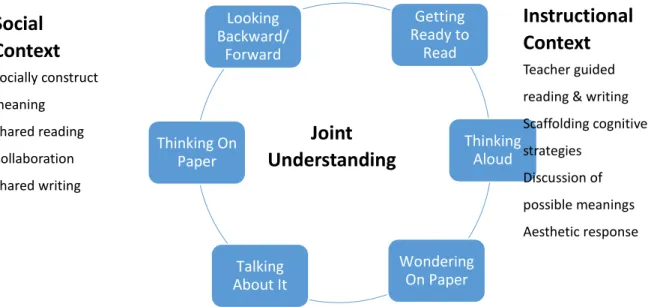
perspective and then from another” (Edwards et al.). Dugan (1997) brought us one step closer to a comprehensive model of transactional reading instruction with the development of transactional literature discussion (TLD) mode which would serve as the catalyst for students to enhance their individual and social responses abilities. TLD, grounded in the primary theoretical perspective from Rosenblatt’s transactional theory, was initially developed by Dugan (1997) in a qualitative study involving a group of six struggling readers and is an instructional framework for reading, writing, and discussing about literature. Dugan’s TLD in Figure 3 takes place in both an instructional context – getting ready to read, thinking aloud, wondering on paper – and a social context – talking about it, thinking on paper, and looking back/forward. TLD shows cycles of literacy events involving three key players: students, teacher, and text. The ultimate goal of TLD is for students and teachers to understand the literary work by transacting with the text and interacting with one another.
Figure 3. Dugan’s Conceptualization of Transactional Literature Discussion (TLD), (Dugan, 1997)
(3) 研究方法 Methodology
Qualitative Case Study
The current study draws on three main categories of qualitative data to explore Taiwanese college students’ responses to literature learning: the teacher/researcher’s field notes and observation of students’ group discussions, an open-ended
questionnaire, and focus group interviews. Furthermore, this study is an interpretative
Getting Ready to Read Thinking Aloud Wondering On Paper Talking About It Thinking On Paper Looking Backward/ Forward
Joint
Understanding
Social
Context
Socially construct meaning Shared reading Collaboration Shared writingInstructional
Context
Teacher guided reading & writing Scaffolding cognitive strategiesDiscussion of possible meanings Aesthetic response
7
case study because it contains rich and vivid description to elaborate students’
perceptions. As Creswell (2003) indicates the characteristics of qualitative case study as an interpretative research in which “the researcher explores in depth a program, an event, an activity, a process, or one or more individuals” (p. 15) With inquiry in mind, the teacher/researcher will be involved in a sustained and intensive experience with participants, developing a mutual sense of “we are in the same boat together”. In the case study, theoretical assumptions refer to the integration of Dugan’s (1997)
transactional literature discussions and CDIO learning mode. The following three research questions are addressed:
1. In the literature class, how do college students respond to TLD mode from learners’ perspectives?
2. In the literature class, how do college students respond to the innovative CDIO learning mode from learners’ perspectives?
3. What pedagogical implications does this study have? Setting, Participants, and the Procedure
Two elective courses were offered in the fall semester, 2018, and the spring semester, 2019, respectively at the department of foreign languages and literature (DFLL) in Feng Chia University. They are “Juvenile and Children’s Literature” course in the fall semester, 2018, and “Literary Works of American and English Literature” course in the spring semester, 2019. Students from DFLL would participate in the project-based program in this study. The participants consist of all levels of DFLL students, including freshmen, sophomores, juniors and seniors. The teacher/researcher would follow Institute Review Board (IRB) guidelines through the research process and explain the consent forms to the participants, if needed. It is also noted that the teacher/researcher would provide a full explanation of the study to the participants in order to ensure a mutually trustful relationship with one another.
Procedure
There were two different stages for the students to be involved in this project. The first stage, the implementation of TLD, were conducted from the first week to the mid-term exam week; the second stage, the implementation of CDIO was conducted after mid-term exam week to the 18th week in the semester.
(A) The First Stage: Implementation of TLD
The flowchart in Figure 4 would help us map the TLD steps in literature learning in this study.
8
Fig. 4. Flowchart Summarizing the Activity
Dugan’s (1997) description of the six reading-related tasks involved in TLD is as follows:
Getting ready – “Getting ready is a pre-reading activity that makes a text more familiar to students by developing background, building interest, and giving students choices” (Dugan, 1997, p. 87). Students get ready to working together to preview a collection of literary works recommended by the teacher. Getting ready also involves
Getting Ready
prereading activity by developing background information
Reading and Thinking Aloud
modeling thinking aloud, pausing at intervals during reading to voice thoughts about literary works
Wondering on Papers
students writing their wonderings on self-sticking notes
Literature Talking
opportunities for students and teachers to share their wonderings, jointly construct understandings
Thinking on Paper
students choose some aspect, theme, or interpretation to explore further in the journal writings
Looking Backward and Forward
encouraging students to reevaluate their own learning in the literature reading
Literature Discussion and Writing Logs
everyone can express their overall opinions toward the literary works
Questionnaire & Focus Group Interviews
9
students in making predictions at different stages during reading.
Reading and thinking aloud – For Dugan (1997), thinking is an “integral part of reading” (p. 88). “By modeling thinking aloud, actually pausing at intervals during reading to voice thoughts about the story, teachers shed light on the thinking processes used to make sense of texts” (Dugan, 1997, p. 88). To help students respond more actively and meaningfully, teachers had better encourage their students to think aloud whenever they have comments or questions while reading.
Wondering on paper – Wondering on paper is a short written response, jotted down on any sticky notes, which is typically complete during reading or immediately after the reading (Dugan, 1997). Students are encouraged to take any form while in “wondering on paper” section.
Talking – The talk sessions are opportunities for both teachers and students to share their wonderings, respond to each other, and jointly construct understanding and meanings (Dugan, 1997). As for the length of talking, it varies from 15 to 30 minutes, depending on students’ doubts and responses.
Thinking on paper – Following talking, students would choose their aspect, theme, or interpretation to explore further in their writing journals. Dugan (1997) stated that “Because the primary purpose of thinking on paper is to explore and extend ideas, students should focus on express themselves” (p. 88).
Looking back/forward – This session encourages students to evaluate their learning and reflect about their reading and journal writing by summarizing, retelling parts of the story, or making predictions about what will happen next.
With the theoretical foundation of TLD, teachers/researcher would be careful to stress again that the purpose of the literature discussion is to experience the text and explore literature in a more meaningful and personal way. Following the above pedagogical mode, the present study assumes that literature teachers should not only teach students literary facts but also empower students with both personal and social reading competency to cope with the changing world in their lives.
(B) The Second Stage: Implementation of CDIO
The second stage of the procedure would be helpful for students to follow what has to be done in the final project.
Discussion (Conceive – Design – Implement)
In-class discussion: 30 minutes is allocated for in-class discussion weekly, students are given time to conceive their ideas in class and they are required to design the product for their project. Professor and TA are in presence to assist students in discussion.
10
Extra discussion: The students are also encouraged to discuss their project in addition to their discussion in class. They are also welcome to approach TA to guide them in their discussion after class.
Production (Implement – Operate)
Students may choose one of the following two cases as their group products:
Case A: A complete product: A complete product is required as the outcome of the project. The product is welcome to be presented in any form, such as a play or a video, or a board game, according to the type of project the group chooses as long as it is suitable.
Case B: Website design and management: Website should be designed and managed according to what students do or wish to present. It is also
considered as a part of the product as it serves to promote what they intend to do.
Presentation (Operate)
Final Oral Presentation: The students have to figure out how they would like their products to be presented at the end of the semester.
By the end of the semester, each group had to hand in the followings:
(1) Meeting agenda / Discussion record (With Brainstorming and Mind mapping);
(2) Working Distribution;
(3) Related Files (e.g. Story plot, poster and film storyboard);
(4) Reflection and In-group Assessment Table (Everyone; with SWOT analysis);
(5) Final product & soft-copy of all documents. Data Collection and Analysis
In addition to students’ team project, the following data were collected. First, the researcher observes all classroom activities – both during the regular class interactions and small group discussions. Such data are important, especially in a large classroom, in offering the knowledge of the context, specific classroom incidents, and students’ perspectives. Furthermore, the teaching assistant would keep a weekly teaching journal entry for the TLD learning mode and CDIO project, interactions and
conversations among students themselves or among students and instructor. Second, the class-wide open-ended survey questionnaire (Appendix II); third, focus group interviews regarding TLD mode were conducted in the 9th week (Appendix I) and CDIO mode in the 17th week (Appendix III) of the semester, respectively.
11
The researcher made good use of Nvivo 7.0, a software designed to help
researchers organize, analyze and find insights in unstructured or qualitative data for the data analysis process. From the researcher’s previous experience, Nvivo would help researchers make sense of the data, and could be used to ease the process of organizing, storing, retrieving, and analyzing qualitative data in the research project. For example, through coding, unstructured data could be coded at multiple “nodes”, and we may move free nodes into “trees” where appropriate. And then organize trees based on the conceptual relationships in order to find themes through thematic coding.
(4) 教學暨研究成果
Assessment
In the real classroom settings, the researcher would encourage students to preview readings for the class ahead of time and come prepared to discuss them; the quality of the class depends upon students’ preparation beforehand and the
engagement during class discussions. Grading was weighed according to the following scheme:
(1) Participation and discussion: 30% -- including attendance, small group discussion, asking questions, individual responses, team work spirits; (2) Mid-term exam: 20% -- materials covered in the class lecturing and
discussions to ensure students’ comprehension of the texts;
(3) Writing Journals: 10% -- critical thinking, insightful opinions and comments are welcome;
(4) Peer assessment: 5% -- encourage students to value peers’ efforts and give feedback;
(5) CDIO project & presentation: 35% -- group project presentations with posters, website introduction, or any product from the group work. Significance of the Study
With regard to the classical literary works, Lazar (1993) stated clearly even though it is true that literary texts which “may appear to be very remote in time and place from the world today may still have appeal for students in different countries around the world”. It is because the literary works “touch on themes or the works deal with human relationships and feelings which strike a chord in the students’ own lives”. (p.53) Student participants in this study did value the opportunities to work with peers
12
from different perspectives and incorporate literature with practical matters as the initiative to step out their comfort zones.
This study did provide insights into problems and issues currently being experienced in EFL classrooms throughout the challenges such as students’ lack of motivation, poor attitudes toward literature learning, underachievement and reliance on rote-learning and memorization (Liaw, 2001). Moreover, the findings of the study would encourage the integration of authentic literature discussion, such as TLD, and CDIO mode into the EFL curriculum and inspire high interest and low anxiety for EFL learners in reading authentic literary works.
Outcome:
As an English teacher, the teacher researcher definitely wants her students to have the same love of reading and appreciation of literature. This study is designed to build EFL student’s competence and confidence as a learner. Both TLD and CDIO modes involve a student-centered approach. Probst (2004, p. 73) notes that “unless students read and respond, there is no literature to teach – only texts and information about texts”. Both TLD and CDIO modes would offer one of the practical
opportunities for our EFL learners to respond to and connect with literature. Students would learn from each other as they interact. By striving to discuss different
multicultural and global issues clearly in the literary works, students are encouraged to consider various perspectives and develop an appreciation for their differences. The result of this study may encourage the integration of TLD and CDIO modes in
authentic literature reading and literature discussion into the EFL curriculum. In general, this study may contribute to the ongoing research investigating approaches and methods of English literature learning and teaching not only at Feng Chia University but also at other universities as well.
After completing this course, students would:
● Be familiar with representative works of major writers; ● Be familiar with opportunities for peer cooperative learning;
● Be equipped with a critical mind to a broader exploration of the human condition;
● Be able to apply this literature reading in a literary and social framework; ● Be able to develop students' aural/oral fluency by asking questions and
sharing their feedback;
13
● Be able to connect literature readings with students’ real life settings;
● Be able to conceive the ideas from what they have learned in the class, design a group project, implement, and present their products;
● Be able to develop critical thinking skills; ● Be able to develop problem-solving skills; Small Group Discussion Pictures 1-5
Picture 1. Picture 2
14
Picture 5.
The following information offered in the appendix section are:
Appendix I. Focus group interview questions regarding Transactional Literature Discussion (TLD) (Wiseman & Many, 1992) -- p.17
Appendix II. Open-ended Questionnaire --p.18
Appendix III. Focus Group Interview Questionnaire for CDIO –p.19 Appendix IV: Students’ Group Works
Examples from class in “Children and Juvenile Literature” –p.20 Appendix V: Students’ Individual Reports – p.42
Appendix VI: Students’ Lesson Plan –p.51 Appendix VII: Feedbacks from students –p.60
Both “group presentation” and “individual report writing” did show students’ potentiality to apply their literature understanding to different oral performances and real world commercial advertisements, such as CDIO projects in the “Children and Juvenile Literature” class. Even though there still existed some negative feedbacks from students in the current study, the teacher researcher and students were trying hard to take the challenge to explore literature teaching, especially the integration of TLD mode in this study to enhance students’ discussion on literature and help students’ mutual understanding in the first few weeks in both semesters in the academic year of 2018.
15
(5)參考書目 References
Becker, R. R. (1999). Reader response: Students develop text understanding. Reading
Horizons, 40(2), pp.103-126.
Cherland, M. (2000). Teaching beyond reader response: reading the culture to know the self. In B. R. Barrel & R. F. Hammet (Eds.), Advocating Change:
Contemporary Issues in Subject English (pp. 104-116). Toronto: Irwin
Publishing.
Cherland, M. R. (2002). Criticism of reader response. In B. J. Guzzetti (Ed.), Litercy
in America: An encyclopedia of history, theory, and practice. Santa Barbara,
CA: ABC-CLIO.
Creswell, J. W. (2003). Research design: Qualitative, quantitative and mixed methods
approaches (2nd ed.). Thousand Oaks: Sage Publications.
Dugan, J. (1997). Transactional literature discussions: Engaging students in the appreciation and understanding of literature. The Reading Teacher, 51(2), 86-96.
Edwards, K., Mclntyre, A., & Glabb, F. Reader response: Advantages & disadvantages. Retrieved from
http://readerresponsecriticism.weebly.com/advantagesdisadvantages.html Hancock, M. J. (2000). A celebration of literature and response: Children, book, and
teachers in K-8 classrooms. Upper Saddle River, N.J.: Merrill.
Hirvela, A. (2006). Computer-mediated communication in ESL teacher education.
ELT Journal, 60(3), 233-250.
Ho, I. P. (2006). Using young adult literature and reader response in the EFL
classroom Paper presented at the the Fifteenth International Symposium on
English Teaching, Taipei, Taiwan.
Konto, J. (2012). Higher education development with the CDIO initiative. In Stenroons-Vurio (Ed.), Experiences of higher education development with
CDIO initiative (Vol. Report 145, pp. pp.7-11). Turun Yliopisto: Turku
University of Applied Sciences.
Lazar, G. (1993). Literature and language teaching: A guide for teachers and trainers. Cambridge: Cambridge University Press.
Liaw, M. L. (2001). Exploring literary responses in an EFL classroom. Foreign
Language Annals, 34(1), 35-44.
Manning, C., Morrison, B. R. & McIlroy, T. . (2014). MOOCS in language education and professional teacher development: Possibilities and potential. Studies in
Self-Access Learning Journal, 5(3).
16
innovation pedagogy and CDIO approach -- Pedagogic and didactic
viewpoints. Paper presented at the Proceedings of ICEE/ICIT 2013 Conference,
Cape Town.
Probst, R. (1988). Response and analysis: teaching literature in the junior and senior
high school. Portsmouth, N.H.: Heinemann.
Probst, R. (2004). Response & Analysis: Teaching literature in secondary school (2nd ed.). Portsmouth, NH: Heinemann.
Richards, I. A. (1929). Practical criticism: Discourse and the surplus of meaning. New York: Harcourt, Brace & Co.
Rosenblatt, L. M. (1994). The reader, the text, the poem: The transactional theory of
the literary work. Carbondale, IL: South Illinois University Press.
Wang, J. Y. (2009). Aactivating aesthetic reading experience in EFL education: A
study of literature teaching through reader-response approach. Paper
presented at the International Symposium on Teaching Literature in the Age of Global English Fooyin University of Technology, Koahsiung.
Wiseman, D., & Many, J. (1992). The effects of aesthetic and efferent teaching approaches on undergradute students' responses to literature. Reseach
17
Appendix I. Focus group interview questions regarding Transactional Literature Discussion (TLD) (Wiseman & Many, 1992)
1. Write anything you want about the literary work/story you just read.
2. Have you or anyone you know ever experienced anything which reminds you of something in this literary work/story?
3. What was the most powerful emotion you felt as you read the literary work/story? What in the story caused that reaction?
4. What character in the literary works/story do you feel has personality traits similar to your own?
5. Imagine you are one of the characters in the literary work/story at a particular point in the story. Write a poem, journal entry, a letter, or any other form of written expression to give voice to what your feelings are.
6. Imagine your favorite place in the literary work/story, what do you see, smell, feel, hear?
18
Appendix II. Open-ended Questionnaire
Students are given a questionnaire to complete after the final presentation of their project. There are seven questions in the open-ended questionnaire:
1. What do you like about CDIO part in the course? 2. What do you dislike about CDIO part in the course?
3. Which section of C, D, I, O is the most enjoyable process? Why?
4. What is your attitude toward the implementation of CDIO strategy into the course?
5. In what way do you think the CDIO project has influenced you?
6. Do you think the implementation of CDIO is helpful in your understanding of literature? In what way?
19
Appendix III. Focus Group Interview Questionnaire for CDIO
1. Which would you describe as the most challenging part in this project? Conceiving? Designing? Implementing? Operating? Explain with details and examples from your experience in the project.
2. Do you feel a sense of accomplishment in the project? Yes or no? If yes, in what aspect? Conceiving? Designing? Implementing? Operating? Explain with details and examples from your experience in the project.
3. How do you feel about implementing CDIO in literature course? Do you agree or disagree? Support your opinions with reasons and details.
20
Appendix IV: Students’ Works
Examples from class in “Children and Juvenile Literature” Students’ Group Work -1
2018-2019 Children and Juvenile Literature
Feng Chia University
Children's Literature and Creative Industries
21
Group member:
鄭伊晴、張庭瑞、林家瑜、沈曉彤
張皓韋、陳靖棠、陳力齊、陳毓祥
Contents
I. Executive strategy
A. Intension
II. Descriptions
A. Motif & Concept
B. Product & Design Concept
C. Marketing Strategies
D. Product
III. Appendix
A. Meeting Photo
B. In-Group Works-sharing
C. Design Layout & Concept
D. Brainstorming Layout
E. Reference
22
Executive strategy
A. Intension
Time flies, with the development of technology people
become disliked to write, the text becomes more colder on the
screen. According that kind of situation, we want to use the
method of buying a book to send a set if postcards to let our
reader recover the warmth of the text, and the friendship that
has not been seen for a long time.
23
Descriptions
A. Motif & Concept
a. Theme: Friendship
b. About Company:
Name: Harper & Brothers Publisher
Address: Butler library, 6
thfloor Columbia
university 535 west 114
thstreet New York NY
10027
Tel: (212) 854-5053
c. Target Costumer: People who are interesting in
read juvenile literature.
d.
Book:
Charlotte’s Web
e. Product: Postcard*8
f. Ted Talk:
https://www.ted.com/talks/jane_fonda_and_lily
_tomlin_a_hilarious_celebration_of_lifelong_fe
male_friendship/transcript?utm_campaign=teds
pread&utm_medium=referral&utm_source=ted
comshare#t-895823
24
g. Our Website:
https://oscar12345507.wixsite.com/charlottes
web
h. Our advertisement:
https://www.youtube.com/watch?v=N1-mVOK
6lC8&feature=youtu.be
25
B. Product & Design Concept
Our concept is from the very special friendship
between Fern, the heroine in Charlotte’s Web, and
Wilbur, and between Wilbur and Charlotte. We
want to make postcard for our costumer to retrieve
their lost-line friendship.
26
C. Marketing Strategies
We made those postcards from the
background of famous juvenile literature
“Charlotte’s Web”, hoping that the reader will be
attract to this giveaway and raise the willingness to
buy this book.
F. Product
Postcard:
29
Appendix
30
B. In-Group Works-sharing
Meeting Record: Take turns
Proposal Writing: 鄭伊晴、張皓韋、陳力齊
Web Design: 陳靖棠
Filmmaker: 張庭瑞、林家瑜、沈曉彤
Making postcard: 陳毓祥
C. Design Layout & Concept
Character
Quote
Reason
Charlotte
“‘Salutation’ is just a fancy
way of saying hello or
good morning.” (p.30
line.11)
“Solutation” a fancy
word to say hello.
This word is the first
word which
Charlotte said to
Wilbur. I think this
word is very
beautiful just like
the words that
appear in classical
literature. This
31
word very
represented
Charlotte, because
it shows the reader
that what kind of
person Charlotte is,
and her
characteristic. She is
a very wise and
graceful spider I
very like her in this
book.
Wilbur
“I’m really too young to go
out into the world alone.”
The reason why I
choose it is that I
think Wilbur is just
like us, “A rebellious
teenager.” In this
story he tried to get
out of the place he
32
lived, but he faced
some challenges
and failed.
Suddenly, he
noticed that the
warm of the home.
Wilbur
“To you, her daughter, I
pledge my friendship,
forever and ever.”
(p.153 last line)
This line is what
Wilbur said to
Charlotte’s children.
I think this sentence
has the meaning of
inheriting his
friendship with
Charlotte.
Mr. Goose “An hour of freedom is
worth a barrel of slops.
The goose is born to
be living in the farm
in her whole life,
so I think this
33
how the goose
desperate for the
freedom is. When
the goose said it out
loud, I could even
feel how excited she
is, as if she is Wilbur
who can get away
the farm.
Dr. Dorian “I’m a doctor. Doctors are
supposed to understand
everything. But I don’t
understand everything,
and I don’t intend to let it
worry me.”
Fern
“But it’s unfair! If I had
been very small, would
you have killed me?” (p.3
line.12)
The reason I choose
this sentence to
represent Fern is
because I think it is
34
powerful enough to
describe how
benevolent she is.
In the story, she
said this sentence
to her dad and
saved Wilbur’s life,
this action shows
that she really a
brave and caring
girl.
Mr. Arable “You will have to learn to
control yourself.”
Templeton “Good things come to
those who find it and
shove it in their mouth!”
In Charlotte's Web,
Templeton's words
and actions told us
that he was
35
selfish, and a
glutton. He loves to
eat more than
anything else. So I
think this sentence
can represent
Templeton's
characteristics.
36
37
E. Reference
Advertisement background music:
https://www.youtube.com/watch?v=Pojy0rTWO40&featu
re=youtu.be
Picture:
https://www.google.com.tw/search?q=%E5%A4%8F%E7%
B6%A0%E8%92%82%E7%9A%84%E7%B6%B2&source=ln
ms&tbm=isch&sa=X&ved=0ahUKEwj-3cKOuK7fAhWM2Lw
KHWXJAvMQ_AUIDigB&biw=1440&bih=790#imgrc=TnTxN
nnJMy30pM:
Website’s picture:
https://www.google.com.tw/search?biw=1440&bih=790&
tbm=isch&sa=1&ei=G48bXO27LYuN8wWYipOAAw&q=%E
5%A4%8F%E7%B6%A0%E8%92%82%E7%9A%84%E7%B6
%B2+some+pig&oq=%E5%A4%8F%E7%B6%A0%E8%92%8
2%E7%9A%84%E7%B6%B2+some+pig&gs_l=img.3...7043.
11272..11699...2.0..0.293.784.10j0j1...1....1..gws-wiz-im
g...0j0i24.xUxeqDQ2fWw#imgrc=urg2TLcwkq-oaM:
38
https://www.google.com.tw/search?biw=1440&bih=790&
tbm=isch&sa=1&ei=KY8bXMSFAsGk8QWV04yQBg&q=Har
per+%26+Brothers+Publisher&oq=Harper+%26+Brothers+
Publisher&gs_l=img.3..0i24.122025.123948..124296...0.0.
.0.51.643.14...1....1j2..gws-wiz-img...0..0j35i39.z09kMP
ZTtdM#imgrc=HuNV9TTrNTdLyM
39
Students’ Group Work -2
42
Appendix V: Students’ Individual Report -1 Individual Paper Writing
外文三乙 D0561673 北野原碧
(1) Why?
Our group choose“Number the Stars” by Lois Lowry as our main topic for educational institution. This story’s theme is the difficulty of growing up in the world with faith and discrimination. Two and half years has already passed since I came to Taiwan. I spent a lot of time with many Taiwanese people, and learned the importance of valuing the relationships I have even our culture and faith are different. However, I know it’s very difficult to avoid meeting the discriminatory people in the world because discrimination is made from education by school or parents. It is impossible that everyone knows correct history completely. Furthermore, the opportunity to know the real war and discrimination is decreasing year by year, a lot of children don’t know how ignominious discrimination is. I think this book can tell children the importance of respecting another faith through this story, and also can give them idea of how we make peaceful world bravely. This book is very suitable for education. This is the reason why we choose this book.
(2) How?
We present our idea through the teaching plan for education. Teaching plan is very useful way to teach students the important points of story, and also can make them think about the feelings of story’s characters. Moreover, we can teach new adverbs through the sentences. To study adverbs is very useful for students because students need to know many words if they want to improve their English ability. Our teaching plan would be used at the class of short-term English camp that English center of Global Village Organization organized for junior high school students at Feng Chia University.
(3) What?
First, we tell students the summary of this book, and ask them how they feel about war and discrimination. Students talk about own idea with classmates, and write down on the paper. After that, we start teaching adverbs appear in the story with teaching materials like work sheet. Because most adverbs are appear with behavior of
43
characters, students can know the feelings of the characters in each scene deeply. Students pay attention to emotional changes even a small one. They also can know a lot of adverbs that would be helpful in their writing and speaking. We prepare a list of adverbs, and make students study new words. Moreover, we use “Kahoot” as a teaching material. It will help students to notice their weak points.
(A) Questions related to authors, background, and cultural perspectives; Q1. Where is the story setting?
A. Copenhagen, Denmark Q2. When is the story happened? A. In 1943, during World War II. Q3. What did Germany do to Denmark?
A. Germany invaded Denmark, and the Jewish people fear for their lives.
(B) Questions related to the text and context, vocabulary, expressions, and so on; Q1. How do the Rosens keep from being caught by the Nazis?
A. They escape to Sweden.
Q2. Why the soldiers stop Annemarie on her way to Uncle Henrik's boat? A. Because they are looking for Jews who escaping.
Q3. Why Annemarie hid Ellen’s pendant?
A. Ellen’s pendant is a symbol of the Jews. If it was noticed by soldiers, she will be caught. And also it is a very important for Ellen, so Annemarie hid it to keep safety.
(C) Questions related to students’ responses to the text, such as questions connected to students’ lives, learning styles, reflections, and more.
Q1. If you are Annemarie, can you be brave for Ellen as real Annemarie?
A. I can’t. Because it’s too dangerous, and perhaps my behavior affects my family’s safety.
Q2. Do you think teenagers would grow up in a time of war faster than normal life? A. Yes. In “Number the Stars,” we can see some scenes that Annemarie’s way of
thinking turns into more maturing way. It shows us teenagers would grow up in short time because of the experience of war.
44
(4) Your Role?
I think I did my work when we discuss the contents, prepare presentation and make ppt. Because I did CDIO last year, I know how to present our idea. I offered idea of work sheet, how to practice and more. When we prepare the first presentation about the book, I wrote two chapter’s summary as extra work. Some members didn’t know what should we do for this topic, and also didn’t do their own work occasionally, so I think my work helped our team’s work. However, my speaking is not good, so when we hold a presentation, I didn’t speak anything except my question and idea. Some members speak a lot instead of other, so I want to practice more.
(5) Reflection
I think it is important to understand the contents of the book, and to make an idea of how we use it as a product or as a teaching material effectively. When we reading a book, not only read a book, but also understand the feeling of the character, and imagine. It would cultivate our creativity. The book has various merits for students. About our presentation and group works, I did my works seriously, and could create our teaching plan for students, so I am contented with my work. It is very significant to create new thing with other classmates. However, some students didn’t cooperate with us. For example, they didn’t give us their questions for first presentation on time, and use questions that other member had. Although I can understand what professor was saying, but it is a problem that can be disturbed us.
(6) Pictures or Photos in group works; (this is optional) I’m sorry, I don’t have pictures of group works.
45
Students’ Individual Report -2 D0549560 劉冠妏 外文三甲
Children and Juvenile Literature Individual Report
(1) We choose this topic is because our book “The Graveyard Book” is mainly about a child growing up in a graveyard and learn the world from his “home”. We want to demonstrate our presentation by focusing on the adventure that Bod have and the theme of home. Home is always a haven.
(2) After we participated in the speech which briefly talked about children’s book, we realized that we could use children’s book to demonstrate our presentation in order to learn more from the project. The organization we choose is Joy English Institute since this institute has provided a wide variety of theme to teach children English in a different age. We could tell stories to the children in the institute and play some activities which are related to English and the book.
(3) The contents of our project are that we draw our own children’s book by choosing a theme “home” to teach not only English but also some morals behind it.
(A) Q: Silas is a vampire, while Miss Lupescu is a werewolf. In legend, vampires and werewolves are sworn enemies. However, Neil Gaiman put these two species together as friends. Silas even asks Miss Lupescu for help to take care of Bob. Why? (p.65 line1)
46
A: From my perspective, I think the author tries to portray a kind of peaceful surrounding for children to understand that there are no permanent friends or
permanent enemies. Although the ghouls are nice to Bob they tried to lead him to the road which there is no way to turn back.
(B) Q: Why the author had this role of setting that the ghouls named themselves after famous men? (p.74 line17)
A: The author didn’t mention it in the book. But from my perspective, maybe the author wants to express a concept of no matter how famous a person was, he or she still became ghouls’ food when they die.
(C) Q: “(It) is good for you.” Many parents or teachers often keep saying this over and over again. Is this a good sentence to teach children? Or is it just confining children? (p.69 line17)
A: In my opinion, some sentence like “It is good for you, Everything I do is for your own good” really confine children’s ability to know what’s really good for them. Their parents help them decide their life path, their interests or even control them from developing their possibilities. This may cause serious problems not only between the parents and the child but also between the society and the child.
(4) My role in this presentation is a group leader. In order to run the group smoothly and decide the content of the presentation, my job is to schedule the appointment with
47
everyone and to record our meeting agenda. Furthermore, I wrote the lesson plan in order to make a film about our storytelling and activities. Moreover, I set up our website and edit our film. I am satisfied with my own work in a certain role. As a group leader, I have the responsibility to manage every detail and to distribute
everyone’s role in this project. I understand how to write a lesson plan, edit videos and set up a website. My strength is that I am willing to do the things that others can’t and to teach them how to do their job well rather than just do everything myself. However, my weakness is that I have a bad temper. I get easily annoyed by others who always have their own appointment that they couldn’t show up while we were in a
shorthanded. Also, because we were in a time rush, I couldn’t assemble some works for those who needed to learn from scratch. If we have the chance next time, I will try to distribute the works and to teach others how to do them.
(5) My reflection is that after having a great time with my group mate, I understand how to be patient and to listen to others opinions. Since I am not always the right one, it is crucial to adopt others opinion. This is my first time working with them, I enjoy different points of view and to exchange our idea while we were discussing the project.
48
Students’ Individual Report -3
CHILDREN AND JUVENILE LITERATURE Final Individual paper
外文二乙 D0671887 陳圓融
In our final project, we decided to design a lesson in an English novel based Winter camp. In that camp, students are provided a chance to learn by reading the English novel Number the stars.
(1) Why? Why do you choose this topic (you have the "title", right?) for the
advertisement for the “company”, “organization”, or “institution”?
Our project is to write a lesson plan for a vocabulary class. The title is Number the Stars – Adverbs. We have come up this idea when we were reading the book. In this book, the author has used tons of adverbs and adjectives to describe the scene and the mood of the characters, which not only made the story much more vivid and interesting but also let the readers to sense the mood of the situation of the story.
However, Asian students usually have difficulty recognizing the meaning when reading textual materials and using adverbs in a sentence. Also, after analyzing, we found that is influenced by two things. First, it’s the thinking logic of their mother tongue. Second, it’s the deficiency of the vocabulary they know. Therefore, we hope we can let them know the basic usage of adverbs in English and try to inspire them to know the importance of learning new adverbs.
(2) How? How to present your idea through the specific “category”? What is the
connection between the “category” and the “company”, “organization” or “institution”?
Education. We designed a lesson for an English based camp. Although we had made up a fake camp about English novel, actually, it could be taught in any kind of educational camps.
(3) What? Tell us the contents and elaborate your steps which could fulfill your
team goals for the “company”, “organization”, or “institution”.
The main content is to guide the students to know more about adverbs. First, we are going to explain the basic ideas of English adverbs. Then,
49
we are going to teach them 15 adverbs chosen from the book Number the
stars. Eventually, we are going to impress their memorization through
two activities: Playing a guessing game and Kahoot!.
To clarify the "contents" -- please clearly write down "your questions" in different chapters and offer the possible answers or reasons.
There are three major categories of questions to be covered in the critical thinking stage:
(A) Questions related to authors, background, and cultural perspectives;
Lois Lowry, an American writer author of several famous books such as
Number the Stars and The Giver, has written many books that are based
in different cultural backgrounds. How could she make that?
After doing a research on her life and career, I found that she was born in Hawaii, her family consists of people from different countries, and her mother speaks several languages. I think that is why she is able to talk about various issues and incidents happened in places.
(B) Questions related to the text and context, vocabulary, expressions, and so on; Could the author use less adjectives and adverbs to describe the story? It could be, but the atmosphere in the book will be different. The readers
won’t be able to “sense” the events as they could do now.
(C) Questions related to students’ responses to the text, such as questions connected to students’ lives, learning styles, reflections, and more.
Will students have any difficulties understanding the culture behind the story background or understanding the meaning that the author is trying to express?
Yes. After all English isn’t our first language. That is why we are trying to design a lesson for them to understand more about the story. We would like to guide reading and explain the meaning in classes.
(4) Your Role? Are you satisfied with your own work as a certain role in this
project? What are your strength (the advantages, the contributions) and the weaknesses (the disadvantages, something you could do better)?
My role in our team is to be the one to organize everyone’s work. In the midterm presentation, I collected the questions written by my teammates and correct the grammatical and lexical mistakes in the file. This time in the final project, I am the one to do the presentation and the one to set up
50
the website. I think I had done my best efforts.
My advantage is that I have the ability to guide my team to be on the right way toward our goal. My weakness is that I am having more classes than others, so sometimes I’m too tired to do any work.
(5) Reflection
This semester, I have learned a lot from the class. The two movies we watched in class is very interesting that made me also read the two novels afterward. Also, I like the class about children picture books. Professor Zhuang explained the concept of writing picture books in an impressive way. I did learn a lot in that class. Eventually, while working as a group, I found that happy to work with different people. Although we have
different thoughts toward the same issue, we are all finding a way to finish our project. I’m really glad to know my groupmates in this class this semester.
(6) Pictures or Photos in group works; (this is optional)
51
Appendix VI: Students’ Lesson Plan School: Joy
English Language Institute
Target Group: Kids from 7-10 Time: 45 min
Date: 2018.12.20
Material: The Graveyard Book Children’s Book
Storyteller: Wendy Illustrator: Kiki
Teaching plan designer: Sonya
Activities designers: Jessie, Michelle
New Vocabulary Freedom 自由 Protect 保護 Outside 外面 Defeat 打敗 Dangerous 危險的 Belief 信念 Bored 無聊 Explore 探索 Know 知道 Haven 避風港 Happily 快樂地 Graveyard 墓園 Strange 奇怪 Return 返回 Moment 時刻 Chat 聊天 Remember 記得 Teach 教導 Suddenly 突然地 Monster 怪獸
Theme Home is always the haven. Teaching
Method Audiolingual Method
Objectives and Goals
Objectives:
Being able to understand basic sentences
Being able to understand the vocabulary in the children’s book. Understand what the story is about to convey.
Could pay attention on teachers’ storytelling and focus on the activities. Learn how to cooperate with team in the activities.
Goals:
○1 Teach children that “Home is always the haven”.
- We want to express that no matter how old we grow or someday we choose to leave our home for freedom, home is always the haven to every child.
○2 Not to follow strangers.
52
The purpose of the game
First, teacher will review the vocabulary and teach students how to read and know the meaning before reading the books. After it, we will play two games. One is
minesweeper, the other is charade. In the beginning, students are not familiar with vocabulary so I will use the first game to enhance the impression of vocabulary.
Through this game, we want to let children know how to read and spell the words.The second game is to test if students really know the meaning of vocabulary.
Contents
Steps Activities Teaching Aids Time
1. Warm-up Greeting and settle down 5
2.Story telling P. 1-16 Children’s book Light music 15 3.Activity Minesweeper(踩地雷)
Now, Teacher Jessie is going to introduce how to play the first game. Teacher will divide students into groups. Every group will have four or five students. The most important is the teacher have to separate students with different level of English proficiency into one group. For example, there are four students in the group. Maybe one is good, the others are average, so the good one can help each other. Now, we will have twenty words in this lesson. First, teacher will choose one word, for example, graveyard and write it down but cannot let students know what you choose. The students in the different groups will start to read the words but if someone read the words which other people has read before or teacher pick, he will lose the game. In addition, everyone in the group have to read one time or the team will lose game too.
Youtube video 5 4.Story telling P. 17-32 Children’s book Light music 15 5. Activity Little Painters(小畫家)
The second game is Little Painters. One student sits in front of the vocabulary card so he won’t know what the
Blackboard with chalk or whiteboard
53
Our Website: https://sonya90345.wixsite.com/joyenglishstory
Meeting Agenda
Date: 12/1
Members: 吳雨芹 Kiki,朱思穎 Jessie, 梁晏綾 Michelle,徐郁雯 Wendy, 劉冠妏 Sonya vocabulary behind him is. The other student draws the
imagery and meaning of the vocabulary. One student passes the own part and changes to the next student. Through this game, the teacher can know whether the students really understand the meaning of the word, and the student can make a deeper impression on the word by the classmates and his own painting.
with marker
Wrap-up Ask them if they understand the vocabulary and the
54
Agenda Details:
We decided how to plan our teaching agenda and how to present our teaching demonstration. (1) We decided to demonstrate our teaching by using children’s book. We will compress some of the story plot, draw them into the children’s book and decide a theme to teach children.
(2) We divide our works into drawing the children’s book, design the teaching plan and design the activities.
(3) We will discuss what is our theme and what are we going to share with the children. (4) We will read the children’s book with some activities according to the theme.
(I)
Divide our works.
(Planning Stage)
1. Meeting Record: Sonya 2. Story Plot: Discuss together
3. Draw the children’s book: Kiki, Wendy
4. Design the activities between the story: Jessi, Michelle 5. Design the teaching plan: Sonya
(Demonstration)
1. Story teller: Kiki, Wendy
2. Lead the activities: Jessi, Michelle 3. Undergo the teaching procedure: Sonya
55
Meeting Agenda
Date: 12/3
56
Agenda Details:
I.
We decided our target group, theme and goal. Moreover, we discussed how to focus on the theme and deleted some part in the book, making it easier to convey our idea to children.(1) Target group: Elementary school first grade to fourth grade
(The children’s book is suitable for children from 6-12 years old, but our teaching plan is better for students in elementary school.)
(2) Theme: Home is always the haven.
- We want to express that no matter how old we grow or someday we choose to leave our home for freedom, home is always the haven to every child.
(3) Goal/Objective:
Objective: Vocabulary, sentence in the children’s book and what the story is about to convey. Goals: ○1 Teach children that “Home is always the haven”.
○2 Not to follow strangers.
○3 What we believed is useless could become a lifesaver.
II. Decide story plot
Main idea: The adventure of nobody.
Outline: Nobody is a boy growing up in a graveyard. After he grows up, nobody wants freedom outside the graveyard. He meets three ghouls, saying that they could bring Nobody to a wonderful place. Nobody go on his journey with the three ghouls. What will happen next? Will Nobody truly free?
58
Meeting Agenda
Date: 12/25
Members: 吳雨芹 Kiki,朱思穎 Jessie, 梁晏綾 Michelle,徐郁雯 Wendy, 劉冠妏 Sonya
Agenda Details:
We made sure that every detail in our presentation is nearly perfect. We co-designed the website and made sure everything is on the website for us to present. And we play the game for three times to ensure the game runs smoothly. After that, we rehearsed our presentation twice to prevent mistake and measured our time.
60 Appendix VII: 學生學習回饋 Student A: 一位熱情開朗的老師能使學生激發對學習的渴望,一位目光長遠的老師能把 學生訓練成一位出類拔萃的成功之士。我所認識的麗秋老師正是一位兩者兼具的 慧黠老師。抽象的英國文學,老師使用 CDIO 將它變的具體又實用,文學加創意 蹦出了新事物,學生學到了知識也激發了無限可能。兒童文學的改造,從書面走 向就業。老師善加利用學生之前所學,讓學生奠定就業實力。不管是英國文學還 是兒童文學,老師運用小組討論的方式培養學生批判性思考,讓我們同儕之間能 一起腦力激盪,更欣賞彼此的能力並互相學習。老師更適時從旁協助學生、引導 學生登上更寬廣的知識殿堂。就個猶太人大屠殺這件事來說明。在台灣,我們對 於猶太人大屠殺並沒有太大的理解,我們身處的環境也讓我們認為這不是件特別 需要知道的歷史慘劇。但這在國外是常識,而不是新知。老師透過課堂討論讓我 們去認識去了解一件我們陌生的領域,也讓我們理解我們的世界觀是如此的狹隘。 讓我更認真去學習許多未曾觸及的領域。老師開朗熱情的性格打破僵化的師生關 係,歡樂溫馨的學習環境使我們更加深求知的慾望。能遇見這麼可愛又積極的老 師是我們的福氣。 Student B:
兒童與青少年文學課後感想
我是來自外文四乙的游謦妅。經過了一個學期的兒童與青少年課程後,我對 於兒童與青少年文學有了更深一層的認知,也漸漸產生了興趣。當初會選擇這門 課,是因為上個學期選修了一門稱為「兒童文學」的課程,在兒童文學課程中, 我發現到,原來在大家以前耳熟能詳的童話故事例如《白雪公主》、《綠野仙蹤》、 《愛麗絲夢遊仙境》中,有這麼多隱含的議題可以去探討,而不僅單單只是表面 上所看見單純的一個童話故事而已。在這一個學期的課堂中,我認為我收穫最多 的就是老師上課時一直希望傳達給大家的「批判性思考」。以前還沒上大學時, 在課堂中,學生總是扮演被動的角色,只是一味地接收老師所傳授的知識,很少 有機會去想,我們到底為甚麼學這個,而學的這些又是什麼?這些資訊是對的, 還是錯的?但是在這堂課程中,老師總是會給我們很多和組員交流意見、發表及 表達自己想法的時間。例如老師和我們討論到以前所閱讀過的兒童與青少年文學 的書籍中有那些是以女性的視角來寫的,或是有哪些是以非白人為中心及背景所61
撰寫的書籍,我和組員才有機會討論到以前大家都看過哪幾本兒童書,也突然發 覺到原來我們小時候所讀過的那些童話故事書中,幾乎都是以男性視角來撰寫的。 在課堂中,老師除了教我們有關兒童與青少年文學的歷史背景、定義以及種類外, 老師更邀請了來自澳洲迪肯大學的陳詩雯教授到班級上來做演講,以 Yang, Gene Luen 所寫的《American Born Chinese》這本書為例子,介紹了近幾年才出現的文 學類型 Postsecular Young Adult Literature。此外,我認為這項新的文學所想要傳 達的含意,其實也正好符合了老師在課堂上教學的方法,老師提供給我們的是一 項問題,思考的方向,而不是一個絕對的答案。