科技部補助專題研究計畫成果報告
期末報告
與競爭者合作:動態競合之多階段研究
計 畫 類 別 : 個別型計畫 計 畫 編 號 : MOST 103-2410-H-004-197- 執 行 期 間 : 103 年 08 月 01 日至 104 年 07 月 31 日 執 行 單 位 : 國立政治大學企業管理學系 計 畫 主 持 人 : 彭朱如 計畫參與人員: 博士班研究生-兼任助理人員:顏孟賢 處 理 方 式 : 1.公開資訊:本計畫涉及專利或其他智慧財產權,2 年後可公開查詢 2.「本研究」是否已有嚴重損及公共利益之發現:否 3.「本報告」是否建議提供政府單位施政參考:否中 華 民 國 104 年 09 月 29 日
中 文 摘 要 : 廠商間的競合互動已是策略管理領域中備受重視的議題,過 去許多研究也已經對競爭者間合作的原因與作法有所討論, 延伸了傳統純粹競爭的思維。然而,當競爭者間合作後,若 雙方仍須在市場上競爭時,他們將採取怎樣的競爭模式?與 純粹競爭者間的互動又有何不同?本研究即由競爭者間合作 的情境著手,探討合作關係下的競爭者間如何競爭,並瞭解 他們在競合並存的情境下,採取哪些行動以維持平衡的互動 關係。由動態競爭的視角出發,本研究以台灣自行車產業中 的兩大龍頭廠商為例,探討他們如何在競爭中追求合作,並 持續在合作中彼此競爭的過程。透過多方深度訪談及多重次 級資料的蒐集與分析,逐漸歸納為本研究的兩大主要命題: 第一,雖然競爭者間的合作會因為相互學習而促使彼此的資 源相似性提高,競爭廠商將會在資源的運用方式上有所區 別;其二,若合作的競爭廠商間仍無可避免具有高度的市場 共同性時,彼此將會透過產品或地理市場區隔,藉以避免直 接的敵對互動。本研究在有限的一年期間內,蒐集了大量縱 段面報導資料,並進行與五位關鍵受訪者之訪談,透過嚴謹 分析與比對程序,逐漸萃取出在理論與實務上有所進展的概 念。本研究同時與英國學者合作,並已投稿至科技部推薦之 管理類 SSCI 國際學術期刊。 中文關鍵詞: 競合、動態競爭、合作為基礎的競爭、自行車產業
英 文 摘 要 : The competition-cooperation interaction between firms has become an increasingly central topic in the field of strategic management. Prior studies of coopetition have explained the what, how and why of firms
cooperating with competitors, less attention is being devoted to the situation of what happens to
competition after the competitors cooperate. This study sheds light on the issue of cooperation-based competition by answering the question: while
cooperating with competitors, how do rival partners compete based on cooperation? Using the theoretical lens of competitive dynamics, this study conducted case studies to analyse the competition between two leading competitors in the Taiwanese bicycle
industry. By means of both in-depth interviews and secondary data analysis, this study extracted two propositions. Firstly, despite cooperation inevitably facilitating higher resource similarity, rival
develop situations where the companies do not overlap competitively in a given market. Secondly, given high market commonality, rival partners are more likely to avoid head-on competition through product
differentiation and dispersed geographical market segmentation. By collaborating with the scholar in the UK, this study has submitted to a SSCI journal. 英文關鍵詞: coopetition, competitive dynamics, cooperation-based
1
與競爭者合作:動態競合之多階段研究
摘要 廠商間的競合互動已是策略管理領域中備受重視的議題,過去許多研究也已經對競 爭者間合作的原因與作法有所討論,延伸了傳統純粹競爭的思維。然而,當競爭者間合 作後,若雙方仍須在市場上競爭時,他們將採取怎樣的競爭模式?與純粹競爭者間的互 動又有何不同?本研究即由競爭者間合作的情境著手,探討合作關係下的競爭者間如何 競爭,並瞭解他們在競合並存的情境下,採取哪些行動以維持平衡的互動關係。由動態 競爭的視角出發,本研究以台灣自行車產業中的兩大龍頭廠商為例,探討他們如何在競 爭中追求合作,並持續在合作中彼此競爭的過程。透過多方深度訪談及多重次級資料的 蒐集與分析,逐漸歸納為本研究的兩大主要命題:第一,雖然競爭者間的合作會因為相 互學習而促使彼此的資源相似性提高,競爭廠商將會在資源的運用方式上有所區別;其 二,若合作的競爭廠商間仍無可避免具有高度的市場共同性時,彼此將會透過產品或地 理市場區隔,藉以避免直接的敵對互動。本研究在有限的一年期間內,蒐集了大量縱段 面報導資料,並進行與五位關鍵受訪者之訪談,透過嚴謹分析與比對程序,逐漸萃取出 在理論與實務上有所進展的概念。本研究同時與英國學者合作,並已投稿至科技部推薦 之管理類 SSCI 國際學術期刊。 關鍵詞:競合、動態競爭、合作為基礎的競爭、自行車產業 ABSTRACTThe competition-cooperation interaction between firms has become an increasingly central topic in the field of strategic management. Prior studies of coopetition have explained the what, how and why of firms cooperating with competitors, less attention is being devoted to the situation of what happens to competition after the competitors cooperate. This study sheds light on the issue of cooperation-based competition by answering the question: while cooperating with competitors, how do rival partners compete based on cooperation? Using the theoretical lens of competitive dynamics, this study conducted case studies to analyse the competition between two leading competitors in the Taiwanese bicycle industry. By means of both in-depth interviews and secondary data analysis, this study extracted two propositions. Firstly, despite cooperation inevitably facilitating higher resource similarity, rival partners are more likely to deploy their resources to develop situations where the companies do not overlap competitively in a given market. Secondly, given high market commonality, rival partners are more likely to avoid head-on competition through product differentiation and dispersed geographical market segmentation. By collaborating with the scholar in the UK, this study has submitted to a SSCI journal.
Keywords: coopetition, competitive dynamics, cooperation-based competition, bicycle industry
2
計畫成果報告自評
此計畫研究成果包括兩部份,一為發表於 SMS 國際研討會,之後經增加收集研究 分析資料及修改,與英國學者 Professor Mike Bourne 合作,已投稿至科技部推薦之管理 類 SSCI 國際學術期刊。成果發表如下:
1. Yen, Meng-Hsien and Tzu-Ju Ann Peng (2014/09/20-2014/09/23). "Cooperation-based competition: Resource and Market" 2014 Annual International Conference of the Strategic
Management Society. Spain.
2. Peng, Tzu-Ju Ann , Meng-Hsien Yen, and Mike Bourne. “How do rival partners compete based on cooperation?” British Journal of Management (2015/0/30 submission confirmation 如附 件一)。 本研究在計劃期間有限的一年內,透過大量的次級資料蒐集與分析,並與五位個案 關鍵人物進行深入訪談,逐步萃取出動態競合的核心概念。在次級資料的蒐集上,本研 究網羅公開報導、雜誌訊息、企業內訊與專利資料庫等多重來源,進行詳實的事實資料 分析,有助於提高本研究的真實度與可信度。 本研究延續本人過去一系列的競合研究主軸,進一步探討動態競合的理論與實務內 涵。在理論面上,本研究延伸了動態競爭與競合理論的範疇,對於競爭與合作間的互動 關係有更深入的剖析;在實務面上,藉由一競爭者間合作的實際案例分析,有助於其他 產業參考學習之用,並對競爭者間形成合作關係的原因與做法有具體的瞭解。以下摘錄 研究成果投稿文章之部份內容。 INTRODUCTION
Cooperation with competitors, also denoted as coopetition, has recently attracted academic study (Burgers, Hill, and Kim, 1993; Bengtsson and Kock, 2000; Gnyawali and Park, 2009, Peng, Pike, Yang, and Roos, 2012). Given the paradoxical nature of simultaneous competition and cooperation (Bengtsson and Kock, 2014), to compete with a rival partner is even more complex than to compete with a normal competitor. Outside the coopetition literature, prior studies on competitive dynamics have offered significant insights of various competitive situations. However, in the context of cooperation with competitors, the behaviours, motives, and interactions between rival firms are much more complex. In order to address the theoretical gaps in both coopetition and competitive dynamics literatures, I re-examine the competitive dynamics under the phenomenon of competition-cooperation dynamics, with the intention of answering the question: While cooperating with competitors, how will rival partners compete based on cooperation?
To illustrate the theoretical perspectives on competition-cooperation dynamics, I firstly undertake a literature review both on coopetition and competitive dynamics. I then conducted an in-depth case study and selected the “A-Team” alliance for my research setting. The A-Team is a coopetition alliance formed by the two largest competing firms in the Taiwanese bicycle industry, Giant and Merida. The context of A-Team provides a unique example to
3
investigate how two leading rival partners compete based on cooperation. My study therefore presents some interesting results including cooperation in the A-Team and competition between two rival partners in three competitive settings.
THEORETICAL BACKGROUNDS
To elaborate the concept on competition-cooperation dynamics, I re-examine literatures on coopetition and competitive dynamics in cooperation-based competition. The research on coopetition can be traced back to 1996 when Brandenburger and Nalebuff published their book Co-opetition. Bengtsson and Kock (2014) redefine coopetition as a paradoxical relationship between two or more actors simultaneously involved in cooperative and competitive interactions, regardless of whether their relationship is horizontal or vertical. Nevertheless, as Chen (2008) argued, the paradoxical, either/or relationship may limit the understandings of real relationships between firms. Therefore, a new transparadox perspective may fill the gap by stressing the interplay or interrelation between the two concepts.
For the purpose of probing the essence into coopetition, I then focus on exploring the strategy of cooperation with competitors (e.g. Bengtsson and Kock, 2000; Luo, Rindfleisch and Tse, 2007; Ritala and Hurmelinna-Laukkanen, 2009; Gnyawali and Park, 2009; Peng, et al., 2012). A recent review of the coopetition literature carried out by Peng et al. (2012) indicates three streams that have focused on the antecedents, dynamics, and outcome of coopetition. In the antecedent-stream, homogeneous or similar resources (Ritala and Hurmelinna-Laukkanen, 2009; Gnyawali and Park, 2009), heterogeneous or complementary resources (Bengtsson and Kock, 2000; Gnyawali and Park, 2009; Peng and Bourne, 2009), knowledge sharing (Tsai, 2002), organizational learning (Dussauge, Garrette, and Mitchell, 2000), and compatible but distinctly organizational structures (Peng and Bourne, 2009) are internal antecedents that facilitate competitors to cooperate. External antecedents such as competitive position or pressure in the markets (Bengtsson and Kock, 2000; Zeng and Chen, 2003; Ritala and Hurmelinna-Laukkanen, 2009), product life cycle and technological convergence (Gnyawali and Park, 2009) higher market diversity (Gnyawali, He, and Madhavan, 2006), and industrial structure (Clarke-Hill et al., 2003) are the factors driving competitors to cooperate. The dynamics-stream elucidates the dynamics in alliance formation between competitors (Gimeno, 2004) and their network structure (Madhavan et al., 2004). This stream addresses the typology of competition-cooperation relationships (Lado, Boyd and Hanlon, 1997; Luo, 2007; Chen, 2008) and the motives, behaviours, and evolution of coopetition (Madhavan et al., 2004; Luo, 2007; Ritala and Hurmelinna-Laukkanen, 2009). The third stream focuses on coopetition outcome, ranging from failure (Park and Russo, 1996), dissolution (Dussauge, et al., 2000) and exit rate (Silverman and Baum, 2002) to productivity and profitability (Oum, Park, Kim and Yu, 2004) and performance (Luo et al.,
4
2007; Kim and Parkhe, 2009; Peng et al., 2012).
The competitive dynamics perspective is a useful theoretical lens to reveal the dynamic nature of competition (Hoskisson, Hitt, Wan, and Yiu, 1999). A series of studies carried out by Ming-Jer Chen and his colleagues (e.g., Chen and MacMillan, 1992; Chen and Miller, 1994; Chen, 1996; Chen, Su, and Tsai, 2007) have yielded significant insights for understanding the dynamics of competitive analysis and inter-firm rivalry. Competitor analysis is conceptualised as the study of two vital firm-specific factors: market commonality and resource similarity. Market commonality is defined as the degree of presence that a competitor manifests in the market overlap with the focal firm; whereas resource similarity is defined as the extent to which a given competitor possesses strategic endowments comparable to those of the focal firm (Chen, 1996: 106, 107). The overlap of each factor will influence the awareness and the motivation of the competition. The greater the overlaps, the higher the possibility of competition being triggered.
In the scenario of cooperation with competitors, the interactions between rival firms are much more complex because the line between competition and cooperation is obscured (Chen, 2008). The behaviours and motives of rivals in such cooperation-based competition could be different from that in conventional competition. As has been pointed out by Chen and Miller (2015), a move toward a relational variety of competition-cooperation dynamics requires greater attention. There is an urgent need to examine the competitive dynamics in the context of coopetition. I therefore focus on cooperation-based competition to reveal how rival partners compete in the aspects of resource and market.
METHODOLOGY Research setting
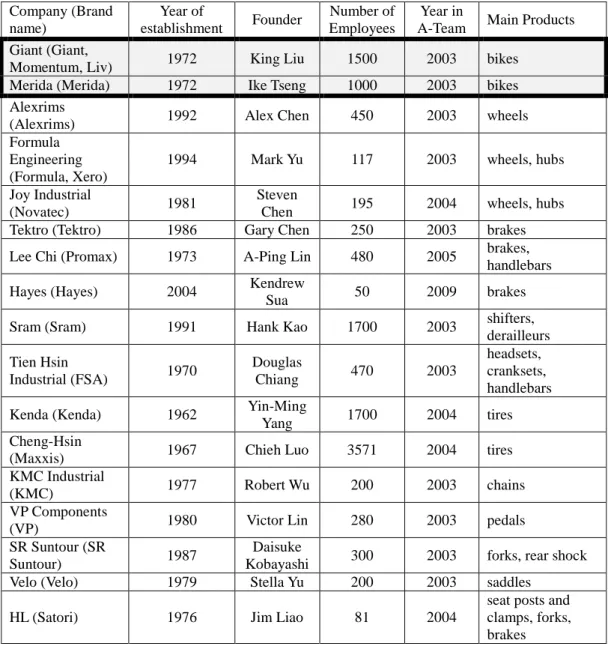
Given the unexplored and complex nature of cooperation-based competition, I conducted this study by means of in-depth case studies and selected the “A-Team” as research setting. The A-Team was jointly led by two competing firms, Giant and Merida. Giant is the largest bicycle assembler and Merida is the second one in Taiwan. Giant invited Merida to form the alliance. They then coordinated the parts suppliers to form the A-Team in 2003, which was originally composed of 13 firms (Lee, 2013: 132). Almost all of the A-Team members have founders or presidents who own their companies. Until 2014, the members of A-Team included two assemblers and 18 parts suppliers, as Shown in Figure 1 and Table 1.
- Insert Figure 1 and Table 1 here –
The A-Team not only enhanced members’ capabilities but also created benefits. For example, Taiwanese bicycle export volumes keep steady between 2003 and 2014. The average export unit price increases rapidly from NT$ 4,744 in 2003 to NT$ 14,504 in 2014, indicative of the production of high quality and high value-added bikes in Taiwan. Therefore, the context of A-Team makes a prominent example of cooperation with competitors for
5
understanding the dynamics of cooperation-based competition.
Data collection
As noted by MacMillan et al.(1985), this research explores the cooperation-based competition at the dyadic level between rival partners since the identification of the pair of action-response dyads was the most important element when studying competitive interaction. Such firm-specific, pair-wise analysis of competitors mirrors the fine-grained examination of interfirm rivalry (Chen and MacMillan, 1992). For the purpose of gathering data of competitive actions, this research have taken an event history approach emulating the study carried out by Yu and Cannella (2007). This study collects history data from industrial journals and newspapers. However, the essence of complexity made it hard to distinguish between each issue and to classify them into pairs of dyads. To improve clarity this study chose to study three specific competitive settings. This enables this research to be more focused and practical in the analysis of the competitive dynamics between the two rival partners. The three competitive settings are i) launching the e-bike project, ii) entering into ladies-bike in Taiwan market, and iii) competing in European market.
Data collection on “e-bike project”. This study investigated various public sources of secondary data, finding that an industrial journal TBEA Newsletter (Taiwan Bicycle Exporters’ Association) offered the most complete information of Taiwanese bicycle industry. By reviewing the reported news, I found that the e-bike has been the anchoring new product in Giant and Merida in recent years. Particularly between 2006 and 2011, many events refer to the e-bike project. This study comprehensively reviewed the issues that were identified by searching out the key words such as “e-bike,” “electric (power) system,” “battery (for e-bike),” etc. Finally, 20 issues were identified and further classified into three action types: production action, R&D action, and marketing action.
Data collection on “ladies-bike in Taiwan market”. For Giant and Merida, Taiwan is absolutely a strategic battlefield. Competing in the same home market, any moves initiated by one firm may trigger a prompt response from their competitors. This study therefore choose “launching ladies-bike in Taiwan market” as the second competitive setting. Following the same procedure, I reviewed all the issues reported in the TBEA Newsletter by searching out the key words, such as “ladies bike”, “domestic market,” “Taiwan,” “cities such as Taipei, Taichung, Kaohsiung, or Changhua,” etc. and found that 14 issues refer to the actions of ladies-bike in the Taiwanese market.
Data collection on “European market”. The European market has an iconic meaning for firms in the bicycle industry. For example, bicycling accounts for 30% of all trips in
6
Netherlands cities (Pucher, 1997). Other countries, such as Denmark, Germany, Switzerland and Sweden, also rely on the bicycle for about 10-20% of urban trips. According to the statistics of Taiwan bicycle exports, the European market accounts for 55.97% of all exports by quantity from Taiwan in 2013 (the second largest market, North America, accounts for 19.25%). For Giant and Merida, the European market is absolutely the main and critical battlefield in the global market. The competition interactions on the European market have reflections on their strategic intentions. This study also collected reported issues from TBEA Newsletter and supplemented this with data from udn.com (website: http://udndata.com/) between 2006 and 2013, by searching out the key words such as “Europe,” “sponsor” “Netherland,” “German,” “Norway,” and “Eurobike,” etc. and found that 49 issues are related to competition in the European market. I then categorized the issues into R&D/product actions (25 issues) and marketing actions (32 issues). The R&D/product category includes R&D, launch new bike, high-value product, and production. The marketing category is composed of sponsoring sport marketing, channel system, branding, and promotion. When one issue refers to at least two actions, I code the issue as two action codes.
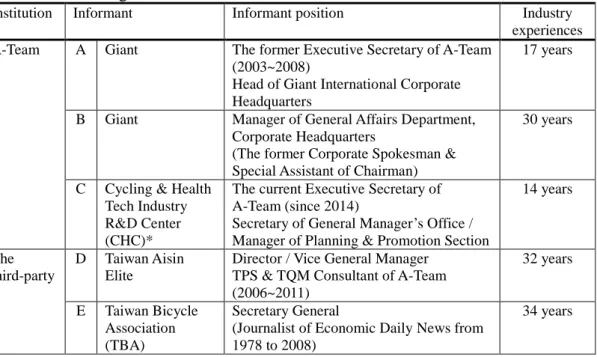
In-depth interview. This research also collected primary data by conducting in-depth interviews with key informants from Giant, A-Team, and other third-party institutions that were deeply involved in the A-Team. Table 2 shows the informant backgrounds. They have been in their positions for a considerable time and during the key period before and after the A-Team formation, having significant roles in making decisions and taking actions. For gathering information on behalf of Merida, this study examines an important secondary data from an article published in Harvard Business Review (Chinese edition) recording an interview with the CEO, Michael Tseng. In addition, this study also collected a special issue published by Cycle Press , which delineates the evolutionary history of the A-Team.
- Insert Table 2 here –
Data analysis
The data gathering from primary and secondary sources were analysed firstly by creating a list of competitive actions categorised by action code. This yielded 20 reported issues on e-bike, 14 issues on ladies-bike, and 49 issues on European market competition. I then analysed the competitive dynamics between two rival partners across three competitive settings. The in-depth interviews were to validate the analysis and to inform the interpretation of these issues.
Given a qualitative approach, the validity and reliability of a measure is of prime concern (Kinner and Taylor, 1979: 291). To ensure accuracy (Eisenhardt, 1989; Martin and Eisenhardt, 2010) and authenticity (Golden-Biddle and Locke, 1993), the analysis is based on the public reports that enhance content validity. I used triangulation between secondary data
7
sources and primary face-to-face interviews to validate data collection. All interviews were recorded and transcribed within two days. The contents of transcriptions were sent to be reviewed and confirmed by the informants. Such triangulation provides more accurate information and improves the robustness of the results (Anand, Gardner, and Morris, 2007; Martin and Eisenhardt, 2010). To further increase reliability, I triangulated our interviews across informants, incorporating both insider informants from the two competing firms and A-Team members and outsider informants from the third-party organizations.
RESULTS Cooperation between competitors
The change of industrial environment fostered the formation of the A-Team. The Taiwanese bicycle manufacturers started as original equipment manufacturing (OEM) suppliers in the late 1970s. To expand production and to lower manufacturing costs, those OEM suppliers began to set up their manufacturing bases in mainland China. However, a fierce competition caused by a proliferation of local Chinese bicycle manufacturers, resulting in a huge drop in Taiwanese bicycle export volumes between 1998 and 2002. Taiwan was no longer the leading bicycle exporting country. There was a perception that “this trend must be changed.” In 2002, the two major assemblers, Giant and Merida, called for the strong willingness of cooperation. They, together with some major suppliers, formed the A-Team in 2003. The Giant President, Tony Lo, also the former chairman of A-Team stated:
“The background to the original purpose of the A-Team and the selection of member firms to begin the project was the terrible difficulties facing Taiwan’s industry at that time: it was reaching the limit of the mass production of mainly low-priced bikes in mainland China and there was market chaos because of worldwide oversupply. We were at a point there was no choice: something has to be done about the situation.” (Cycle Press, 2008: 75)
The A-Team has set rules for partner selection. By elaborately selecting partners, the A-Team members share the same vision that “Taiwan, to become the global innovation and supply hub of best quality cycling products and services with best value.” Common plans in every three-year-period from 2003 to 2014 were identified as shown in Table 3.
- Insert Table 3 here -
The extensive cooperation between the A-Team members can be seen from all the activities above, but our interest was in “during this cooperation, how do the two leading competitors compete?” In the next section, I present the competition that took place in the three competitive settings.
Competition on e-bike project
8
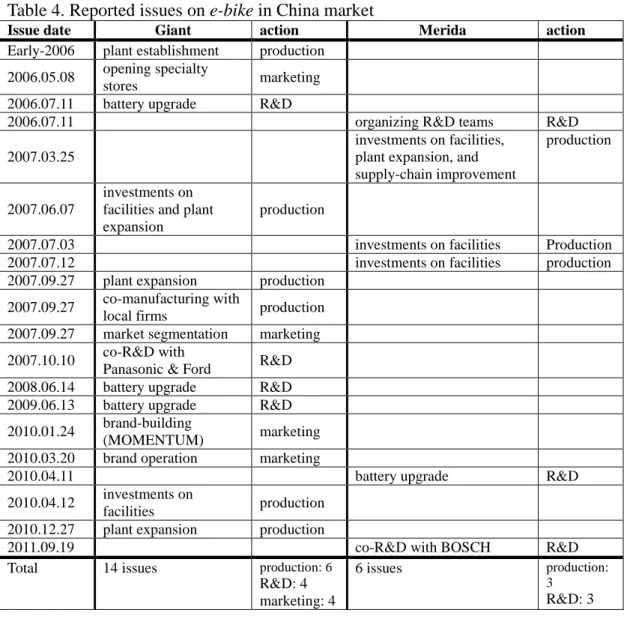
prohibited gasoline-fuel motorcycles in many cities. Giant, Merida and many local makers have devoted themselves to the production of e-bikes. Table 4 shows the dynamic moves on the e-bike project between two competing firms.
Giant initiated the first move to establish a manufacturing plant in China in early 2006. An announcement to open specialty stores followed. As reported: “To serve customers, the specialty stores of Giant display the newest e-bikes with professional and speedy services” (8 May 2006). Two months later, “Giant redesigns the power supply system equipped with dual-battery module. It doubles the efficiency of e-bikes” (11 July 2006). These early moves reveal Giant’s high commitment, including its resource configuration in production, R&D, and marketing. As the Giant’s informant A indicated:
“Due to the policy of prohibition gasoline-fuel motorcycles, China has become the largest e-bike market in the world. How can Giant not be a part of it? However it is quite a tough battle to compete with the local makers…”
The Giant’s informant B echoed:
“There, the consumers and bicycle makers all emphasize price rather than standards. We have fulfilled all the requirements of product standards set by the Chinese government, but many local makers do not follow. However, we believe that one day the Chinese government will strictly execute the standards. Those makers who do not comply with the policy will be ruled out eventually...”
On the other side, Merida kept close steps with Giant’s moves. As reported: “Merida has already organized a R&D team for the development of e-bikes in Shenzhen” (11 July 2006). The next year, Merida also established its manufacturing plant. “The most critical thing is to establish a manufacturing plant in Shandong for the demands in China market.” (25 March 2007).
As shown in Table 4, both Giant and Merida took the actions in facility investment and plant expansion. Giant took ten actions to strengthen its resource configuration, including co-manufacturing with local firms, co-R&D with foreign firms, and brand building. However, Merida only took six actions in production and R&D investments. Obviously, Giant communicated their aggressive moves but Merida kept a low profile on the e-bike project in China. Taking marketing actions for example, four out of 14 issues demonstrate Giant’s efforts on marketing e-bikes, whereas no issues were disclosed regarding Merida’s marketing action, reflecting Merida’s strategy of targeting Europe but not China market. As reported: “Merida manufactured the high-class e-bikes actively by having the module developed by BOSCH. The new e-bikes were mainly targeted in European market” (19 September 2011).
It seems that in China, Giant has shown its strong commitment to the e-bike market, whilst Merida took less action to respond to Giant’s moves. Theory would suggest that as a major competitor, Merida is supposed to react with aggressive responses. However, we believe based on the cooperation in A-Team, Merida chose not to respond actively to avoid head-on competition in China e-bike market.
9
- Insert Table 4 here –
Competition over ladies-bikes in the Taiwanese market
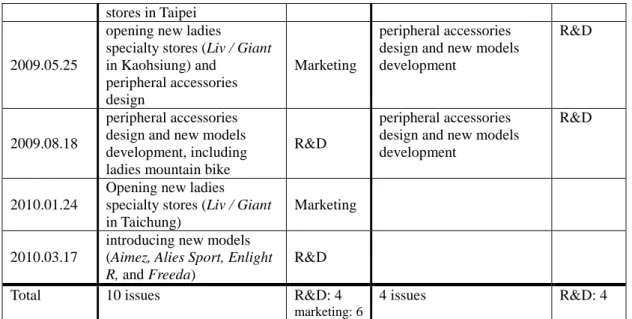
Table 5 shows the competitive moves on ladies-bike in the Taiwanese market. Giant first announced their strategic intent of ladies-bike in June 2006. “For launching the ladies-bike in Taiwan, Giant developed two models, “Freestyle” and “Aimee”, which were designed for ladies users in terms of ergonomics and aesthetics. Giant also open the first specialty store “Miss Giant” in Taichung to serve the target market” (23 June 2006). In June 2006, Giant also announced another ambitious goal to enter into the global market, demonstrating its strong commitment to the ladies-bike market.
Given high market commonality in the relatively small Taiwanese market, the irreversible actions initiated by Giant might force Merida to respond head-to-head. Just half a month later in July 2006, Merida responded quickly. However, Merida targeted the ladies-mountain-bike market, differentiating itself from Giant. “Merida will promote their ladies-mountain-bike for female riders” (11 July 2006). In December 2006, they individually launched new ladies-bikes with similar models, pushing the intensive competition to the edge. For example, “Giant will upgrade many of their ladies-bikes including “Jolli,” “Aimee,” “Bella,” and “Meme” in the next year” (13 November 2006). “Merida’s ladies-bike, “Juliet”, is more popular than expected. Merida will continuously upgrade its products for female riders” (13 November 2006).
In the following years, no other competition issues were reported (with the exception of two issues reporting Giant opening new ladies-specialty-stores). Intensive interaction between them occurred again in May 2009. Giant not only continued its strategy of opening more specialty stores but also designed peripheral accessories. As reported: “Giant’s ladies-specialty-store, “Liv /Giant,” not only actively expands in foreign market but also develops many peripheral accessories for Asian ladies users.” (18 August 2009). During this period, Merida responded actively by designing new models and developing peripheral accessories, showing moves highly overlapping with Giant’s strategy. As reported: “Merida has introduced more than 10 models of ladies-bike this summer.” (18 August 2009).
In August 2009, Giant responded aggressively and announced to enter into ladies-mountain-bike, which is the core product of Merida. In 2010, Giant continued investing in new product development. During this period, Merida had no issues disclosed. However, although the competition in Taiwanese ladies-bike market was intensive, they did not engage any self-destructive activities, such as price-cutting. As the Giant informant A noted:
“Giant is the first one to propose brand for ladies users in the world. Last year in the European exhibition, we announced our specialty store channel “Liv/Giant”, demonstrating our commitment to ladies-bike. We provide total solution from bicycles to peripheral accessories.”
10
“We will always care about the competitor who is the closest to us. However, our attitude is that, we all compete in the market that is open to everyone, like the saying “two brothers climb the mountain together but individually strive for reaching the top.”If Merida is successful, it is positive for the whole Taiwan bicycle industry. If Merida has any better creation, we will have to run faster to create a bigger gap of product differentiation.”
- Insert Table 5 here -
Competition in the European market
Taiwanese bicycle makers have entered into the European market since 1983. Giant set up a branch in the Netherlands in 1986. This was followed by branches in Germany and France in 1987 and 1988. Merida targeted Europe in 1986 in Norway and later in Germany in 1988. Table 6 demonstrates their competitive strategies in the European market, including 19 R&D/product actions and 30 marketing actions.
- Insert Table 6 here -
Competition in R&D/product. Table 6 reveals nine and ten R&D/product issues in Giant and Merida respectively. They both emphasized a high-value product strategy by developing high-tech bikes and launching high-priced bikes into the European market. However, they differentiated by launching different types of bikes. In 2006, Giant launched e-bikes in Netherlands by redesigning the battery for professional users. Giant also launched the city-bike. Merida developed high-level racing-bike and mountain-bike. In 2007, Giant was excellent at racing-bike whereas Merida was remarkable for the mountain-bike. Although they both launched all-terrain bikes into the market, Merida targeted the markets in Germany, Austria, and Swaziland, avoiding the Netherlands where Giant was the market leader. In 2008, Giant’s e-bike and Merida’s mountain-bike were excellent and sold at high unit prices. During 2009 and 2010, the high-value product strategy in both companies was strengthened by highlighting the above-average unit price and increasing the price on each new product launch. In 2011, five years after Giant’s success in e-bike, Merida cooperated with Bosch to develop a brand new e-bike, “E-Spresso”.
Although two rival partners have similar resource configuration in R&D/product, they differentiated from each other by having excellence in different types of bikes. In addition, they launched the e-bike at different times. The informant E stated:
“I guess they (Giant and Merida) have different strategies. Giant promotes its brand name “Giant” with full-range of product lines. Whereas Merida selected mountain-bike as the first priority…”
The informant C also noted:
“Giant seems to be equally developing all types of bicycle. The average unit price of Giant is lower because Giant has wider product lines whereas Merida focused on narrower product lines.”
11
Competition in marketing. Table 6 reveals that two firms’ competition in marketing strategy covering the actions in sponsoring racers and teams, channel, branding, and promotion.
First, this study examine the sponsoring strategy. By sponsoring the teams and racers in many prominent contests, both companies are able to win greater exposure. In 2006, Giant renewed a four-year sponsorship for the German T-Mobile team in the Tour de France, whereas Merida sponsored racers and teams from Italy, Spain, and Norway. During 2008~2009, Merida input efforts into sponsoring teams particularly in mountain-bike marathons. Between 2012 and 2013, racers sponsored by Giant and Merida have won many awards.
To execute sponsoring strategy, both companies invested not only money but also R&D resources in developing high-tech bikes. This study found that they differentiated in sponsoring strategy; Giant showed its excellence in racing-bike whereas Merida focused on mountain-bike. In addition, they sponsored racers with different nationalities. Giant supports Dutch racers since the Netherlands is the most important base market; whereas Merida supports Germany, Norwegian, Italian, and Polish racers and teams. Both companies have heavily invested in sport marketing in Europe despite there being more issues for Merida (3 Giant’s actions vs. 7 Merida’s actions). As the Giant’s informant A noted:
“The reason why Giant is the leader is because we are always “the first”. Whether this is “the best”? It depends. Merida adopted “follower strategy”. They would not be “the first”. Since we started to go for own-brand very early, we entered into international market very early, particularly in Europe. Giant started to sponsor sport teams in Europe. Merida noticed the effectiveness of sponsoring and then followed. In recent years, Merida has been having a stronger brand power. They changed the sponsoring strategy to become more aggressive…. This is not the issue of “who learns from whom”. Merida has been doing these at the right timing.”
Second, this study looks at the channel strategy. There are more issues indicating Giant’s actions in channel innovation (8 for Giant vs. 2 for Merida). Giant moved channel strategy earlier. The GRP (Giant Retailing Partner) plan, aimed at improving the retailing systems and opening more retailing stores, was launched in 2006 starting with the European market. Moreover, the GSI (Giant Store Inside) plan was initiated in 2007, launched to create 400 stores by 2007 and 2000 stores by 2010. In 2010, Giant initiated a “global channel plan” in 13 nations to open specialty chain stores named “Liv/giant” for ladies-bike.
On the other side, Merida did not take actions regarding store plans, except for one issue regarding Merida’s cooperation with a Spanish dealer in 2007 and another issue indicating Merida’s JV company in Norway and subsidiary in Sweden in 2009. As the Giant’s informant A noted:
“We’ve (Giant) got more steps ahead of Merida in channel system. In Europe and the USA, we opened many chain stores but Merida did not. We insist on having our own channel system. Merida
12
may just find a local dealer but does not invest their own stores.” The informant C also mentioned:
“Merida collaborates with local dealers but Giant opens its wholly-owned stores.”…“Merida is moving via “partnership” while Giant is moving via “employer-employee relationship”, which is better to control.”
Third, this study review branding strategy. Giant focused on a single brand but Merida has multiple brands. In 2006, Merida operated two brand names: “Merida” and “Specialized”. In 2009, Merida added its third brand name, “Centurion”, which emphasizes a German design style for targeting the high-priced market. As the Giant’s informant B mentioned:
“Giant and Merida have different channel and brand strategies. Giant prefer to have our 100%-owned sales companies because fully-owned strategy is better to control. … Merida chooses share-equity strategy. …In their joint equity with Specialized, Merida sells its products under the brand name of Specialized.”
The informant E echoed:
“Giant started its global strategy earlier than Merida. People might reckon that Merida seems to be more conservative. However, Merida moved fast in recent years.”… “I think Merida’s investment in Specialized is a critical step. Merida has not only secured its orders but also benefited from Specialized’s profits.”
Lastly, this study review promotion strategy. Both companies had promotion campaigns. Giant started earlier in 2006 for the Sport Life exhibition in the Czech Republic, expecting to reach the Central European market. In 2008, Giant received a Gold medal in the design competition IF EUROBIKE, whereas Merida was nominated as the Milestone 2008 by the Germany magazine BIKE. In 2009, Merida chose Mallorca in Spain for its “2010 new bike global demonstration”. In 2010, Giant’s Founder and Chairman King Liu invited chain suppliers and Taiwanese government officers to visit the cycling infrastructure in Netherlands. During the 2012 London Olympics, they both took part in the exhibition held by the Taiwan External Trade Development Council.
Despite the two rival partners’ investment in sponsoring, branding, channel, and promotion, they compete with distinct action contents in terms of resources and markets. They allocate resources to non-overlapping product lines to show their innovative specialties in different types of bike. They input marketing resources in dispersed geographical markets where they have respectively occupied different market positions in those European countries. As the Giant’s informant B indicated:
“We focus much more on the West-European market such as Netherlands, France, and British, where were considered the early-developed base markets of bicycle industry. In contrast, Merida has better market position in the North-Europe such as Norway and Denmark.”
The competition between two rival partners in the marketing arena also echoes that in the R&D/product arena. In terms of resource, they might have similar resource advantages in
13
R&D, product innovation, and manufacturing activities. However, they compete in the way of differentiating from each other by achieving excellence in different types of new bikes, creating a wider gap in product differentiation. In terms of market, they target dispersed geographical markets with different channel systems, decreasing the extent of market commonality in Europe.
DISCUSSION AND PROPOSITIONS
Based on the competitive dynamics perspective, this study analysed the competition-cooperation setting in both resource and market aspects. According to the results derived from in-depth interviews and secondary data, I developed two main propositions to illuminate the differences between cooperation-based competition and conventional competition.
Firstly, from the case of A-Team, the cooperation guided by four three-year-stage tasks has led to stronger resource advantages in member companies. Based on cooperation, they have strengthened their resource configurations, particularly for the up-stream activities. Inevitably, the 12-year co-evolution in A-Team has made the extent of resource similarity more prominent. In conventional competition, competitors with higher resource similarity are more likely to trigger competitive actions when one party initiates an attack. The question is, in cooperation-based competition, given that their resource similarity is getting higher, how do the rival partners maintain close cooperation and still compete simultaneously?
In the case of e-bikes, Giant demonstrated its commitments in China. Despite Merida having similar resources in R&D and production, Merida responded by deploying different resource configurations in down-stream activities. Similarly, the competition in ladies-bike in Taiwan also shows their different resource deployment. Giant signalled its resource commitment to ladies-bike, Merida responded quickly to also develop ladies-bike but launched ladies-mountain-bike. Moreover, the competition in the European market indicate that two competitors have allocated resources into non-overlapping product lines to show their resource configuration in product development and marketing.
The results demonstrate that despite cooperation facilitating higher resource similarity and competition in a given common market being inevitable, rival partners wanting to collaborate and compete over a period of time are more likely to allocate resources into the areas where they are able to decrease overlap of resource configuration. Therefore, from a resource perspective, I propose the following proposition 1.
Proposition 1: Despite cooperation inevitably facilitating higher resource similarity, rival partners are more likely to deploy their resources to develop situations where the companies do not overlap competitively in a given market.
14
Secondly, based on cooperation, how do rival partners compete in market activities? In a coopetition scenario, competition is a win-win game (Brandenburger and Nalebuff, 1996; Chen and Miller, 2015). Under the circumstance of high market commonality, initiating an attack and retaliatory response may not be the major concern in the win-win logic. On the contrary, previous coopetition studies have indicated that firms with high market overlap are more likely to cooperate than those with low market overlap (e.g. Luo, 2005; Baum and Korn, 1999). The intensive competition perspective argues that competitors cooperate because they face similar resource constraints and market situations. They have a strong incentive to understand each other so that they can benchmark themselves and prepare for the consequences of competition (Tsai, 2002). Thus, high market overlap with intensive competition fosters competitors to collaborate to attain great market power and reach better strategic positions, creating a win-win situation.
In this study, I found that under high market commonality, two rival partners act and react to avoid head-on competition not because of the fear of retaliation and mutual forbearance but because of gaining greater market power and better positions based on the mutual trust in cooperation. For example, Giant has signalled its commitment to e-bikes in China whereas Merida shifted to target in Europe. In the case of ladies-bike in Taiwan, despite the competition is intensive, they would never initiate any cutthroat war. They compete by developing new models and peripheral accessories. Moreover, the competition in Europe reveals more evidence that two companies avoid head-on battle and expand their markets respectively. The analysis of competition indicates that two rival partners compete by avoiding fierce and head-on competition to create win-win benefits. Therefore, from a market perspective, we propose the following proposition 2.
Proposition 2: Given high market commonality, two rival partners are more likely to avoid head-on competition by product differentiation and dispersed geographical market segmentation. The way they compete is not based on the mutual forbearance in retaliation but on the mutual trust in cooperation.
CONCLUSION
How competing companies continue to compete after they embark on an intensive long-term cooperative project? This study adopts the theoretical lens of competitive dynamics to explore the setting of cooperation with competitors. I have developed the propositions that highlight three theoretical implications for understanding the difference between cooperation-based competition and conventional competition.
Firstly, the competitive dynamics perspective argues that in conventional competition, market commonality and resource similarity are useful in predicting the possibilities of move and countermove. The visibility of attack initiated by the first mover may show their
15
commitment toward winning in the market place. The more effort and resources committed, the less reversible the attacking move (Chen and MacMillan, 1992). With high market commonality (as well as high resource similarity) between rivals, the possibility of the initiator’s attack is lower but the likelihood of the defender’s response to an attack is higher (Chen, 1996). However, in the situation of cooperation with competitors, producing higher resource similarity and higher market commonality is inevitable as time goes by. On one hand, cooperation makes the extent of resource similarity even higher since the rival partners have learned and co-evolved with each other through collaboration. On the other hand, high market commonality facilitated cooperation between competitors since they face similar resource constraints and market situation. Thus, the major concern in the competitive dynamics is not the prediction of opponent’s retaliation response but is how to compete in a way that makes both cooperation and competition beneficial to both parties in the longer term.
Secondly, the conventional view of competition has mainly focused on head-on competition with a zero-sum logic, whereas the competition-cooperation dynamics focuses more on win-win, sustainable and mutually beneficial interactions among competitors. As the results in this study, since high resource similarity and market commonality are inevitable, both rival partners compete in ways to decrease overlap of resource configuration and to avoid head-on competition in common markets. In conventional competition, the fierce competition between rivals is deterred by mutual forbearance in fear of retaliation. However, in cooperation-based competition, rival partners compete based on the mutual trust and for mutual benefits.
Thirdly, this study advocate that based on cooperation, two rival partners should compete in ways that balance between competition and cooperation as stated in the coopetition literatures (e.g., Jorde and Teece, 1989; Peng and Bourne, 2009; Park, Srivastava, and Gnyawali 2014). The interactions between rival partners in this study reflect an Ancient Chinese saying: “To search for homogeneity in heterogeneity, to search for heterogeneity in homogeneity”, mirroring how they can balance between competition and cooperation. On one side, the stage-by-stage cooperation in A-Team drive rival partners to search for homogeneity in heterogeneity, resulting in stronger resource advantages for both companies. On the other side, the way they compete to decrease overlap of resource configuration and to avoid head-on competition demonstrates their searching for heterogeneity in homogeneity, resulting in their greater market power and better positions. Thus, balancing between competition and cooperation not only enhances rival partners’ competitive advantages in resources but also elevates their power and positions in the market.
There are some issues which are worthy for future research. Firstly, it is possible that behaviours of rival partners may vary across industries. For example, the bicycle industry is not as oligopolistic as in the other industries, such as the smartphone industry, where the
16
global market is shared by a small number of big brands. The relatively non-concentrated industrial structure with many more brand names in the bicycle industry allows the players to compete and still find niches to survive well even when the competitors cooperate. Therefore, I suggest replicating this study in the other industries.
Secondly, this study shows how rival partners compete based on cooperation. Further questions as to “when will be the better circumstances for rival partners to compete” deserve investigation. The exogenous and endogenous factors may influence how rival partners compete based on cooperation. In this study, the global bicycle market was growing, the results could be different if the markets were contracting placing different pressures on the competing firms. Further, as time goes by, when the market reaches saturation, the overlap of market may force two rival partners to compete head-on. This may totally change the way they compete compared with when the market was still growing with opportunities.
Lastly, this study explores the cooperation-based competition, demonstrating how the cooperation affects the rival partners’ behaviours in competition. As time passes, what will be the evolutionary interplays between competition and cooperation? Ancient Chinese wisdom suggests that “opposites (Yin and Yan) define and are defined by each other”. Any action or relationship may contain the seeds of its opposite (Chen, 2008; Peng, et al., 2012). There is an old saying “Things merge if they have split long enough. Things split if they have merged long enough”, which mirrors an array of competition–cooperation interplays (Chen, 2008). In this study, the A-Team members have been together experiencing co-evolution for 12 years. As their global market activities have impinged on each other and the resource configurations have became much more homogeneous, what will be the affect on the cooperation in the A-Team? As Peng and Bourne (2009) argue, there is always a new equilibrium point where coopetition will work, at least for a period, until the dynamics are disrupted again. Future research should investigate the forces that change the equilibrium and the evolutionary interplays between competition and cooperation.
References
Anand, N., H. K. Gardner and T. Morris (2007). 'Knowledge-based innovation: emergence and embedding of new practice areas in management consulting firms', Academy of Management Journal, 50, pp. 406-428. Barnett, W. P. (1993). 'Strategic deterrence among multipoint competitors', Industrial and Corporate Change, 2,
pp. 249-278.
Baum, J. A. and H. J. Korn (1999). 'Dynamics of dyadic competitive interaction', Strategic Management Journal,
20, pp. 251-278.
Bengtsson, M. and S. Kock (2000). '“Coopetition” in business networks—to cooperate and compete simultaneously', Industrial Marketing Management, 29, pp. 411-426.
Bengtsson, M, and S. Kock (2014). 'Coopetition - Que vadis? Past accomplishments and future challenges', Industrial Marketing Management 43, pp.180-188.
17
Brandenburger, A. M. and B. J. Nalebuff (1996). Co-opetition, Crown Business.
Burgers, W. P., C. W. Hill and W. C. Kim (1993). 'A theory of global strategic alliances: the case of the global auto industry', Strategic Management Journal, 14, pp. 419-432.
Chen, M. J. (1996). 'Competitor analysis and interfirm rivalry: toward a theoretical integration', Academy of
Management Review, 21, pp. 100-134.
Chen, M. J. (2008). 'Reconceptualizing the competition-cooperation relationship: a transparadox perspective',
Journal of Management Inquiry, 17, pp. 288-304.
Chen, M. J. and I. C. MacMillan (1992). 'Nonresponse and delayed response to competitive moves: the roles of competitor dependence and action irreversibility', Academy of Management Journal, 35, pp. 539-570. Chen, M. J., K. G. Smith and C. M. Grimm (1992). 'Action characteristics as predictors of competitive
responses', Management Science, 38, pp. 439-455.
Chen, M. J. and D. Miller (1994). 'Competitive attack, retaliation and performance: an expectancy‐valence framework', Strategic Management Journal, 15, pp. 85-102.
Chen, M. J., K. H. Su and W. Tsai (2007). 'Competitive tension: the awareness-motivation-capability perspective', Academy of Management Journal, 50, pp. 101-118.
Chen, M. J. and D. Miller (2015). 'Reconceptualizing competitive dynamics: a multidimensional framework',
Strategic Management Journal, 36, pp. 758-775.
Clarke-Hill, C., H. Li and B. Davies (2003). 'The paradox of co-operation and competition in strategic alliances: towards a multi-paradigm approach', Management Research News, 26, pp. 1-20.
Cycle Press. (2008). 'Tracing the A-Team Evolution'. Tokyo: Cycle Press.
Dussauge, P., B. Garrette and W. Mitchell (2000). 'Learning from competing partners: outcomes and durations of scale and link alliances in Europe, North America and Asia', Strategic Management Journal, 21, pp. 99-126.
Eisenhardt, K. M. (1989). 'Building theories from case study research', Academy of Management Review, 14, pp. 532-550.
Fernandez, A. Ss, F. Le Roy, and D. R. Gnyawali (2014). 'Sources and management of tension in co-opetition case evidence from telecommunications satellites manufacturing in Europe', Industrial Marketing
Management 43, pp. 222-235.
Galvagno, M. and F. Garraffo (2010). 'The promise of coopetition as a new theoretical perspective in strategic management'. In: S. C. Yami, S. Dagnino, G. and Le Roy, F (ed.) Coopetition: Winning Strategies for the
21st Century. pp. 40-57. Cheltenham, UK: Edward Elgar.
Gimeno, J. (2004). 'Competition within and between networks: the contingent effect of competitive embeddedness on alliance formation', Academy of Management Journal, 47, pp. 820-842.
Gimeno, J. and C. Y. Woo (1999). 'Multimarket contact, economies of scope, and firm performance', Academy of
Management Journal, 42, pp. 239-259.
Gnyawali, D. R. and J. He (2006). 'Impact of co-opetition on firm competitive behavior: An empirical examination', Journal of management, 32, pp. 507-530.
Gnyawali, D. R. and B. J. R. Park (2009). 'Co‐opetition and technological innovation in small and medium‐sized enterprises: a multilevel conceptual model', Journal of Small Business Management, 47, pp. 308-330. Golden-Biddle, K. and K. Locke (1993). 'Appealing work: An investigation of how ethnographic texts convince',
Organization Science, 4, pp. 595-616.
Hamel, G., Y. L. Doz and C. K. Prahalad (1989). 'Collaborate with your competitors and win', Harvard Business
Review, 67, pp. 133-139.
Hoskisson, R. E., M. A. Hitt, W. P. Wan and D. Yiu (1999). 'Theory and research in strategic management: swings of a pendulum', Journal of Management, 25, pp. 417-456.
Jorde, T. M. and D. J. Teece (1989). 'Competition and cooperation: striking the right balance', California
Management Review, 31, pp. 25-37.
Ketchen, D. J., C. C. Snow and V. L. Hoover (2004). 'Research on competitive dynamics: recent accomplishments and future challenges', Journal of Management, 30, pp. 779-804.
Kim, J. and A. Parkhe (2009). 'Competing and cooperating similarity in global strategic alliances: an exploratory examination', British Journal of Management, 20, pp. 363-376.
Kinner, T. C. and J. R. Taylor (1979). Marketing Research: An Applied Approach, McGraw-Hill, New York. Lado, A. A., N. G. Boyd and S. C. Hanlon (1997). 'Competition, cooperation, and the search for economic rents:
a syncretic model', Academy of Management Review, 22, pp. 110-141.
Lee, Y.-Y. (2013). 'Coopetition of the ants: the revelation of A-Team'. Harvard Business Review (Chinese
18
Luo, X., A. Rindfleisch and D. K. Tse (2007). 'Working with rivals: The impact of competitor alliances on financial performance', Journal of marketing research, 44, pp. 73-83.
Luo, Y. (2005). 'Toward coopetition within a multinational enterprise: a perspective from foreign subsidiaries',
Journal of World Business, 40, pp. 71-90.
Luo, Y. (2007). 'A coopetition perspective of global competition', Journal of World Business, 42, pp. 129-144. MacMillan, I., M. L. McCaffery and G. Van Wijk (1985). 'Competitors' responses to easily imitated new
products—exploring commercial banking product introductions', Strategic Management Journal, 6, pp. 75-86.
Madhavan, R., D. R. Gnyawali and J. He (2004). 'Two's company, three's a crowd? Triads in cooperative-competitive networks', Academy of Management Journal, 47, pp. 918-927.
Martin, J. A. and K. M. Eisenhardt (2010). 'Rewiring: Cross-business-unit collaborations in multibusiness organizations', Academy of Management Journal, 53, pp. 265-301.
Oum, T. H., J.-H. Park, K. Kim and C. Yu (2004). 'The effect of horizontal alliances on firm productivity and profitability: evidence from the global airline industry', Journal of Business Research, 57, pp. 844-853. Park, S. H. and M. V. Russo (1996). 'When competition eclipses cooperation: an event history analysis of joint
venture failure', Management Science, 42, pp. 875-890.
Park, S. H. and G. R. Ungson (2001). 'Interfirm rivalry and managerial complexity: a conceptual framework of alliance failure', Organization Science, 12, pp. 37-53.
Park, B. J., M. K. Srivastava, and D. R. Gnyawali (2014). 'Walking the tight rope of coopetition: Impact of competition and cooperation intensities and balance on firm innovation performance', Industrial Marketing
Management 43, pp. 210-221.
Peng, T. J. A. and M. Bourne (2009). 'The Coexistence of Competition and Cooperation between Networks: implications from Two Taiwanese Healthcare Networks*', British Journal of Management, 20, pp. 377-400.
Peng, T. J. A., S. Pike, J. C. H. Yang and G. Roos (2012). 'Is cooperation with competitors a good idea? An example in practice', British Journal of Management, 23, pp. 532-560.
Pucher, J. (1997). 'Bicycling boom in Germany: a revival engineered by public policy', Transportation Quarterly,
51, pp. 31-46.
Ritala, P. and P. Hurmelinna-Laukkanen (2009). 'What's in it for me? Creating and appropriating value in innovation-related coopetition', Technovation, 29, pp. 819-828.
Rumelt, R. P. (1984). 'Towards a strategic theory of the firm'. In: R. Lamb (ed.) Competitive Strategic
Management. pp. 556-570. Englewood Cliffs, NJ: Prentice Hall.
Silverman, B. S. and J. A. Baum (2002). 'Alliance-based competitive dynamics', Academy of Management
Journal, 45, pp. 791-806.
Teece, D. J., G. Pisano and A. Shuen (1997). 'Dynamic capabilities and strategic management', Strategic
Management Journal, 18, pp. 509-533.
Tsai, W. (2002). 'Social structure of “coopetition” within a multiunit organization: coordination, competition, and intraorganizational knowledge sharing', Organization Science, 13, pp. 179-190.
Yin, R. K. (1994). Case Study Research: Design and Methods (2nd ed.). Sage, Newbury Park, CA.
Yu, T. and A. A. Cannella (2007). 'Rivalry between multinational enterprises: an event history approach',
Academy of Management Journal, 50, pp. 665-686.
Zeng, M. and X.-P. Chen (2003). 'Achieving cooperation in multiparty alliances: a social dilemma approach to partnership management', Academy of Management Review, 28, pp. 587-605.
19
Figure 1. Members
of A-Team (2014)
Table 1. The backgrounds of A-Team members
Company (Brand name) Year of establishment Founder Number of Employees Year in
A-Team Main Products Giant (Giant,
Momentum, Liv) 1972 King Liu 1500 2003 bikes Merida (Merida) 1972 Ike Tseng 1000 2003 bikes Alexrims
(Alexrims) 1992 Alex Chen 450 2003 wheels Formula
Engineering (Formula, Xero)
1994 Mark Yu 117 2003 wheels, hubs Joy Industrial
(Novatec) 1981
Steven
Chen 195 2004 wheels, hubs Tektro (Tektro) 1986 Gary Chen 250 2003 brakes Lee Chi (Promax) 1973 A-Ping Lin 480 2005 brakes,
handlebars Hayes (Hayes) 2004 Kendrew
Sua 50 2009 brakes Sram (Sram) 1991 Hank Kao 1700 2003 shifters,
derailleurs Tien Hsin Industrial (FSA) 1970 Douglas Chiang 470 2003 headsets, cranksets, handlebars Kenda (Kenda) 1962 Yin-Ming
Yang 1700 2004 tires Cheng-Hsin
(Maxxis) 1967 Chieh Luo 3571 2004 tires KMC Industrial
(KMC) 1977 Robert Wu 200 2003 chains VP Components
(VP) 1980 Victor Lin 280 2003 pedals SR Suntour (SR
Suntour) 1987
Daisuke
Kobayashi 300 2003 forks, rear shock Velo (Velo) 1979 Stella Yu 200 2003 saddles
HL (Satori) 1976 Jim Liao 81 2004
seat posts and clamps, forks, brakes
20 JD Components
(TranzX) 1986 Gino Tsai 160 2009
seat posts and clamps, forks Chia Cherne (Jag
Wire) 1986
Jerry
Huang 290 2004 cables, brakes TransArt
(TransArt) 1973
Chao-I
Hung 185 2005
screen print, mud guard
Source: Wheel Giant Inc. website: http://www.wheelgiant.com.tw/index.html
Table 2. The backgrounds of interviewees
Institution Informant Informant position Industry experiences A-Team A Giant The former Executive Secretary of A-Team
(2003~2008)
Head of Giant International Corporate Headquarters
17 years
B Giant Manager of General Affairs Department, Corporate Headquarters
(The former Corporate Spokesman & Special Assistant of Chairman)
30 years
C Cycling & Health Tech Industry R&D Center (CHC)*
The current Executive Secretary of A-Team (since 2014)
Secretary of General Manager’s Office / Manager of Planning & Promotion Section
14 years
The third-party
D Taiwan Aisin Elite
Director / Vice General Manager TPS & TQM Consultant of A-Team (2006~2011) 32 years E Taiwan Bicycle Association (TBA) Secretary General
(Journalist of Economic Daily News from 1978 to 2008)
34 years
* CHC joined A-Team as the ninth sponsor member in 2014. The A-Team bureau is now located in CHC as Merida passed down the chairmanship to KMC Chain Industrial Co. at the end of 2014.
Table 3. The co-evolutionary plans of A-Team by 3-year stage
Year Plan
2003-2005
A three-step plan in the first stage: 2003: Manufacturing improvement
-Enhance all members’ manufacturing and operation toward Just-in-Time (JIT) and onwards.
2004: R&D improvement
-Enhance all members’ capability, tools, system of new product development, and onwards.
-Team projects to develop new trend collaborate. 2005: Marketing improvement
-Collaborate with SBRs (Specialty Bicycle Retailers) worldwide, endeavour to develop innovative added-value, high quality products, at reasonable price and margin.
-Through seamless, efficient supply/service chain operation, enable the specialty retailers to have a unique competitive advantage over other channel.
2006-2008
There are three breakthrough points in coming 3 years: 1. JIT
2. Best quality 3. Value innovation.
2009-2011
There are three breakthrough points in coming 3 years: 1. capability strength
2. co-marketing 3. cycling island
21
1. Strength: TPS, TQM, TPM in daily management. To execute VA/VE for value upgrade.
2. Image: Good quality, short delivery, leading fashion, and reducing the carbon footprint.
3. Cycling LoHas: To construct Taiwan as a bicycle paradise. To expand the home market of the bicycle ride culture.
Source: The A-team website: http://www.a-team.tw/
Table 4. Reported issues on e-bike in China market
Issue date Giant action Merida action
Early-2006 plant establishment production 2006.05.08 opening specialty
stores marketing 2006.07.11 battery upgrade R&D
2006.07.11 organizing R&D teams R&D 2007.03.25
investments on facilities, plant expansion, and supply-chain improvement
production
2007.06.07
investments on facilities and plant expansion
production
2007.07.03 investments on facilities Production 2007.07.12 investments on facilities production 2007.09.27 plant expansion production
2007.09.27 co-manufacturing with
local firms production 2007.09.27 market segmentation marketing 2007.10.10 co-R&D with
Panasonic & Ford R&D 2008.06.14 battery upgrade R&D 2009.06.13 battery upgrade R&D 2010.01.24 brand-building
(MOMENTUM) marketing 2010.03.20 brand operation marketing
2010.04.11 battery upgrade R&D 2010.04.12 investments on
facilities production 2010.12.27 plant expansion production
2011.09.19 co-R&D with BOSCH R&D Total 14 issues production: 6
R&D: 4 marketing: 4
6 issues production: 3 R&D: 3
Table 5. Reported issues on ladies-bike in Taiwan market
Issue date Giant action Merida action
2006.06.23
Opening new ladies specialty stores (Miss Giant in Taichung)
Marketing
2006.06.27 introducing new models
(Freestyle & Aimee) R&D
2006.07.11 developing new models of ladies mountain bike
R&D
2006.12.13 models redesign (Jolli,
Aimee, Bella, and meme) R&D
introducing new models (Juliet)
R&D
2008.04.07
Opening new ladies specialty stores (Liv / Giant in Taipei)
Marketing 2008.05.27 opening ladies specialty Marketing
22 stores in Taipei
2009.05.25
opening new ladies
specialty stores (Liv / Giant in Kaohsiung) and
peripheral accessories design
Marketing
peripheral accessories design and new models development
R&D
2009.08.18
peripheral accessories design and new models development, including ladies mountain bike
R&D
peripheral accessories design and new models development
R&D
2010.01.24
Opening new ladies specialty stores (Liv / Giant in Taichung)
Marketing
2010.03.17
introducing new models (Aimez, Alies Sport, Enlight
R, and Freeda)
R&D Total 10 issues R&D: 4
marketing: 6
4 issues R&D: 4
Table 6. Reported issues in European market
Issue date Giant action* Merida action*
2006.03.13 Focuses on “increase value” R&D 2006.07.11 launch new e-bike in
Netherlands battery upgrade of e-bike
New bike R&D
2006.07.18 develop more high-level racing bikes R&D 2006.09.19 Keep innovation in mountain bike R&D 2006.12.05 technical upgrade of “XtC SE” R&D 2006.12.14 Launch new city bike
“City Storm”
New bike 2007.02.12 launch new racing bike
“Dura Ace”
New bike mountain bike “Carbon Mission” reached to € 5000 per unit.
expand the production in high-price bikes to invest more R&D in high-price products High value production R&D 2007.08.08 Technical upgrade of all-terrain bikes
R&D Technical upgrade to launch 6 new styles of all-terrain bikes in Germany, Austria, and Swaziland.
The unit price of all-terrain bike lies between NT$ 70,000~200,000.
R&D New bike High value
2008.05.25
launch 3 styles of new bikes, including the “Ninety Six” mountain bike at unit price of € 9000
New bike
2008.06.16 e-bike reaches to €
1700 per unit High value
2009.07.13 keep innovation and R&D of high-value bicycle
R&D 2009.04.22 high-value bicycle High value
2010.07.02 launch “Reacto” with the unit price around NT$ 280,000.
New bike High value 2010.07.21 production begins one Production Higher average unit price High value
23 month earlier
2010.07.29 lift the sales price of new bikes High value lift the sales price of new bikes High value 2011.09.19 cooperated with Bosch to
develop e-bike E-Spresso” R&D Subtotal in R&D Product 9 issues R&D: 4 New bike: 3 High value: 2 production: 1 10 issues R&D: 6 New bike: 3 High value: 5 production: 1 2006.04.14 Sport Life exhibition in
Czech promotion 2006.07.04 launches GRP (Giant
Retailing Partner) plan in European market
Channel
2006.07.18 sponsor Italian and Spanish racing teams Sponsor 2006.09.19 sponsor European teams and racers Sponsor 2006.10.02 Renew a sponsorship to
German T-Mobile team Sponsor
two brands, “Merida” and “Specialized” in Europe
brand 2007.03.05 cooperate with a Spanish
dealer
Channel Dealer 2007.05.07
The GRP plan has reached to run160 stores in Europe.
Channel
2007.06.26
brand-owned sales with 70% of the total revenue
GRP plan and GSI (Giant Store Inside) plan
Brand Channel
“Merida” plus
“Specialized” have created 95% of its total sales revenue.
brand
2007.09.26 developing European
agents and dealers Channel 2008.06.16 GRP plan and channel
innovation Channel 2008.09.09 “City Speed” has been
awarded a Gold in 2008 IF EUROBIKE
Design competition
2008.09.11 Merida’s “Ninety Six” has been nominated by the Germany magazine BIKE as the award of Milestone
2008
promotion
2008.11.26 The European racers selected “Ninety Six” for
2008 Olympic
Sponsor
2009.02.24 Focused on three brands: Merida, Specialized, and Centurion,
brand
2009.02.27 sponsor Germany racers “2010 new bike global presentation” in Spain
Sponsor promotion 2009.09.09 Giant’s own marketing companies in Europe Channel
2009.11.28 subsidiary starts operation in Sweden
Channel 2009.12.2 open a sales and
exhibition center Channel 2010.01.24
A global channel with specialty chain stores of “Liv/giant” for ladies bikes.
Channel 2010.3.18 The Giant’s Founder is
planning to have a long-distance cycling in Amsterdam.
24 2010.06.01 visit the cycling
infrastructure in Netherlands
Promotion
2012.08.25 Sponsor Dutch racer Marianne Vos
Sponsor Sponsor Norwegian Gunn Rita Dahle Flesjå
Sponsor 2012.08.30 exhibition in 2012
London Olympic
promotion exhibition in 2012 London Olympic
promotion 2013.03.18 sponsor Italian Team Sponsor
2013.10.26 Sponsor Dutchman Van der Haar
Sponsor sponsor Polish Team Sponsor
Subtotal in Marketing 16 issues Sponsor: 3 Channel: 8 Branding: 1 Promotion: 5 14 issues Sponsor: 7 Channel: 2 Branding: 3 Promotion: 3
Total 25 issues R&D/Product: 10
Marketing: 17
24 issues R&D/Product: 15
Marketing: 15 *The subtotal and total figures in this column show the number of coded actions.
25