
「道歉」語言行為研究:言談情境填充問卷及言談情境角色扮演之比較
209
0
0
全文
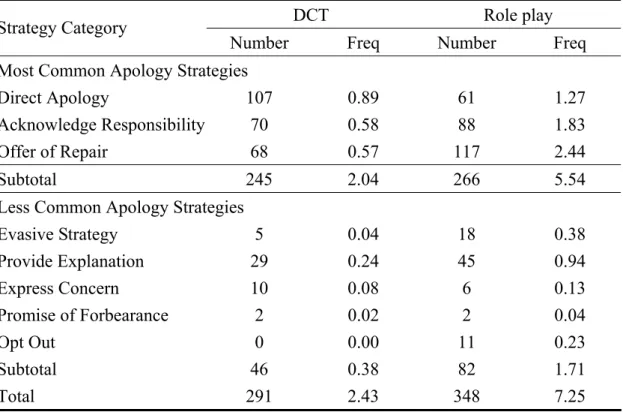
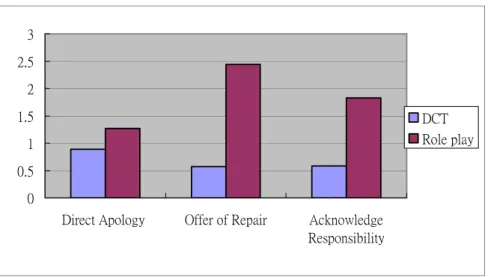
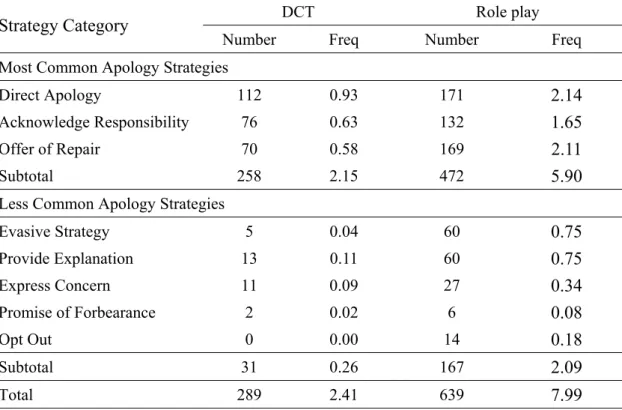
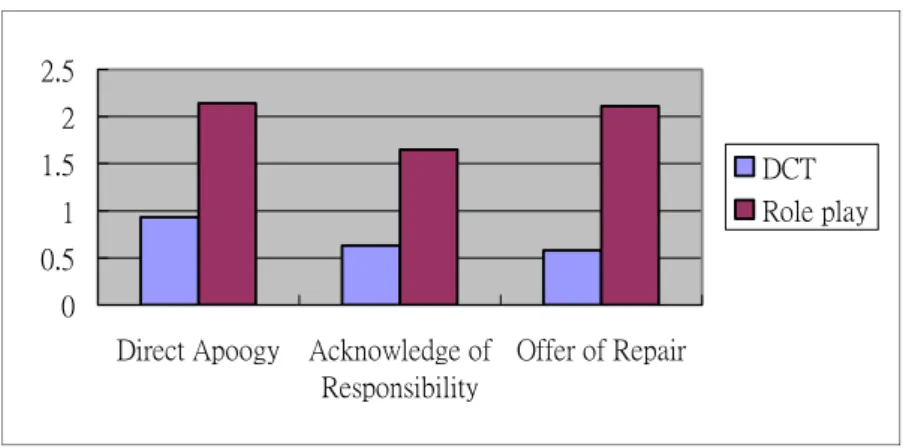
(2) 摘要. 在中介語語用學 (Interlanguage Pragmatics) 領域裡,過去文獻已廣泛討論由不同 語料收集工具所收集的語料之效度。本研究透過語言行為 (speech act) 領域中二 種最普遍的研究方法,亦即,言談情境填充問卷 (Discourse Completion Task) 及 言談情境角色扮演 (role play),收集道歉語言行為之語料並比較道歉策略 (apology strategies) 及內在修飾語 (internal modification) 之使用。六十名以中文 為母語的台灣大學生及六十名學習英語為第二語言之台灣大學生填寫言談情境 填充問卷;二十四名以中文為母語的台灣大學生及四十名學習英語為第二語言之 台灣大學生參與言談情境角色扮演。研究結果顯示,無論是在言談情境填充問卷 亦 或 在 言 談 情 境 角 色 扮 演 裡 , 受 試 者 者 們 傾 向 使 用 直 接 道 歉 策 略 (Direct Expression of Apology)、承認錯誤 (Acknowledge Responsibility) 及提出補償措施 (Offer of Repairs) 做為他們主要的道歉策略。此外,受試者在此二種研究方法 中,也都傾向使用增強道歉程度的修飾語 (MAXIMIZERs) 多於降低冒犯程度的 修飾語(MINIMIZERs) 。然而,進一步分析道歉策略及內在修飾語之使用頻率及 分佈,結果發現二種研究方法之間存在些許不同之處。相較於言談情境填充問 卷,受試者在言談情境角色扮演中使用較多道歉策略及較多的內在修飾語。此 外,受試者在填寫言談情境填充問卷時,也使用較少類別的道歉策略及較少類別 的內在修飾。另外,由於英語能力較低落,以及對於面對面的互動較沒把握 (Rintell and Mitchell, 1989),學習英語為第二外語的非外文系學生,使用較多的 「無爭議性策略」(‘play-it-safe’ strategy) (Faerch and Kasper, 1989; Trosborg, 1987)。換句話說,學習英語為第二外語的非外文系學生使用較多的直接道歉, 並在所有的道歉情境下使用增強道歉程度的特徵(MAXIMIZERs)多於降低冒犯程 度的特徵(MINIMIZERs)。除此之外,若將以中文為母語的台灣大學生再劃分成 二組不同的組別:英語系學生及非英語系學生,結果顯示出一些群體內的差異。 ii.
(3) 例如,在言談情境角色扮演的語料上顯示,英語系學生及非英語系學生之道歉策 略的喜好順序不同。另外,英語系學生也比非英語系學生使用較多的中文語氣 詞,「啊」、「吧」、及「呢」。研究結果意味,將台灣大學生依照其教育背景,另 外分成不同組別是必要的。本研究也另外指出,傳統上,根據英語系統所分類的 內在修飾模式可能無法完整解釋中文的道歉語言行為。中文的語氣助詞在英文中 沒有可相對應之詞 (Tang and Tang, 1997),然而回顧以往道歉語言行為之研究, 內在修式模式的分類卻都將中文語氣詞忽略了。因此,本研究藉由將中文語氣詞 「啊」、「吧」、及「呢」列入內在修式語的分類中,修改了傳統上對於道歉語言 中的內在修式語的分類 (Blum-Kulka & Kasper, 1989; Lin and Ho, 2006; Trosborg, 1995)。結果指出,雖然先前關於道歉語言內在修飾模式的研究 (Lin and Ho, 2006) 顯示英語母語人士較中文母語人士使用較多的內在修飾語,然而,若將中文語氣 詞列入內在修飾語的分類之中,結果卻顯示中文母語人士較英文母語人士更常修 飾其言語的語氣。此結果暗指中文語氣詞對於中文母語人士在表達說話時的態度 的重要性。最後,為了提高語料的效度,未來相關研究應收集真實語境之語料並 分析言談情境填充問卷及言談情境角色扮演是否皆能代表真實言語。此外,為了 針對跨文化及中介語做更進一步分析,未來研究也應收集中文母語人士、英語母 語人士、學習英文為第二外語的學生之語料。. iii.
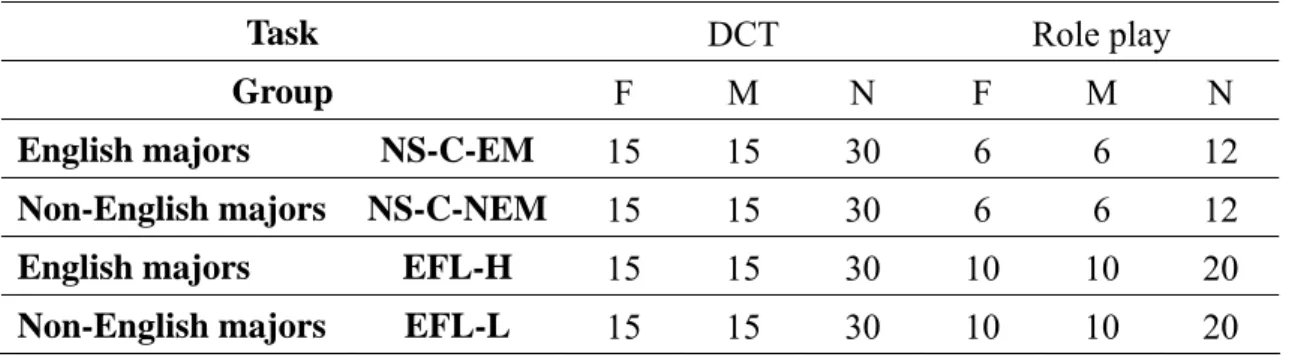
(4) ABSTRACT. The validity of the speech act data obtained from different types of elicitation instruments has been widely debated in the Interlanguage Pragmatics literature. This study compared the use of apology strategies and modality markers from apology speech act data collected from two most popular speech act elicitation tasks, namely, Discourse Completion Task (DCT) and role plays. Sixty native speakers of Chinese (NS-C) and sixty EFL learners responded to DCT. Twenty four NS-C and forty EFL learners participated in role plays. Results show that subjects tended to use Direct Expression of Apology, Acknowledge Responsibility and Offer of Repairs as their main strategies in apology situations both on DCT and in role plays. In addition, participants tended to exploit MAXIMIZERs more than MINIMIZERs in both methods. However, differences between two approaches were revealed when frequencies and distributions of apology strategies and modality markers were examined. Role plays elicited overall more apology strategies and modality markers than DCT did. Participants were also found to employ a narrower range of strategies and modality markers on DCT. Because of the feeling of insecurity in face-to-face encounters (Rintell and Mitchell, 1989), EFL-L exhibited more ‘play-it-safe’ strategies (Faerch and Kasper, 1989; Trosborg, 1987) by giving more direct apologies, and exploiting more MAXIMIZERs than MINIMIZERs across four situations. When dividing NS-C into two separate groups: English majors (NS-C-EM) and non-English (NS-C-NEM), some in-group differences were revealed. For instance, in role-play data, the preference order for apology strategy choice was different between NS-C-EM and NS-C-NEM. Also, NS-C-EM tended to exploit overall more Chinese particles, a, ba, and ne, than their NS-C-NEM counterparts. The finding suggests that it is necessary to divide NS-C into different groups based on their educational background such as iv.
(5) English majors and non-English majors. The present study also pointed out that traditional categorization of apology internal modification which was based on the language system of English may fail to fully capture Chinese apology behaviors. Chinese modal particles which have no English equivalent (Tang and Tang, 1997) have been ignored in the categorization of apology internal modifications in the literature. Thus, a modified coding system which included Chinese particles, namely, “A” (啊), “BA” (吧), and “NE” (呢), was proposed based on traditional categorization of apology internal modification developed in the previous studies (Blum-Kulka & Kasper, 1989; Lin and Ho, 2006; Trosborg, 1995). The result indicates that while the previous study (Lin and Ho, 2006) on apology internal modification which excluded Chinese particles has revealed that NS-C exploited less modality markers than their native speakers of English (NS-E) counterparts, the result in the present showed an opposite pattern in that by tagging Chinese particles at the end of the utterances, NS-C were found to modulate their tone more often than NS-E. This might imply the importance of the Chinese particles for NS-C in conveying attitude. Finally, in order to increase the validity of data elicitation methods, further studies addressed to the methodological issue should include the analysis of the responses obtained from naturally occurring data and examine whether both data obtained from DCT and role plays are representative of ‘natural speech’ . Also, in order to have cross-cultural and cross-linguistic comparison, speech acts data produced by NS-E, NS-C, and EFL learners collected through DCT, role plays, and naturally occurring data are needed for future researches.. v.
(6) ACKNOWLEDGEMENTS. Without supports from many people, this thesis can never be accomplished. This thesis is the product of the National Science Council project “Interlanguage Speech Acts” (NSC 94-2411-H-110-010; NSC95-2411-H-110-005) conducted by Dr. Yuh-Huey Lin. Therefore, I would like to acknowledge with profound gratitude to her for offering me opportunity to participate in the “Interlanguage Speech Act Project”. She has aroused my great interest in the field sociolinguistics. Throughout the entire period of doing this research, she has provided me with invaluable insights and opinions which have inspired me a lot. An exceptional gratitude goes to my committee members: Dr. Syu-Ing Shyu, and Dr. Tsai-Ling Liang. They have given me insightful comments and suggestions which made my study more significant. I also wish to acknowledge a debt to all the people who have been helpful: all informants of this study, and the members of the Interlanguage Speech Act Project: Chia-Hui, Chin-Yen, Hsiang-Yi, Hung-Wei, Miao-Tzu, Po-Chin, Sami, and Xiang-Ling for their precious advice and constant supports. I would like to express my special thanks to Hsiang-Yi, Po-Chin, and Sami, for their kindness and generosity of offering me data they have collected and coded. I would like to thank my dear classmates: Chia-Hua, Chia-Wen, Chih-Chieh, Hsin-Chin, Meng-Ting, and Ya-Li, and my senior, Bao-Yu, for their long-term support and encouragement. Finally, my deepest gratitude goes to my dearest family: my parents, my sister and brother, for their everlasting love and total support. This thesis would not exist without their encouragement and patience. Their confidence in me has made the completion of this thesis meaningful.. vi.
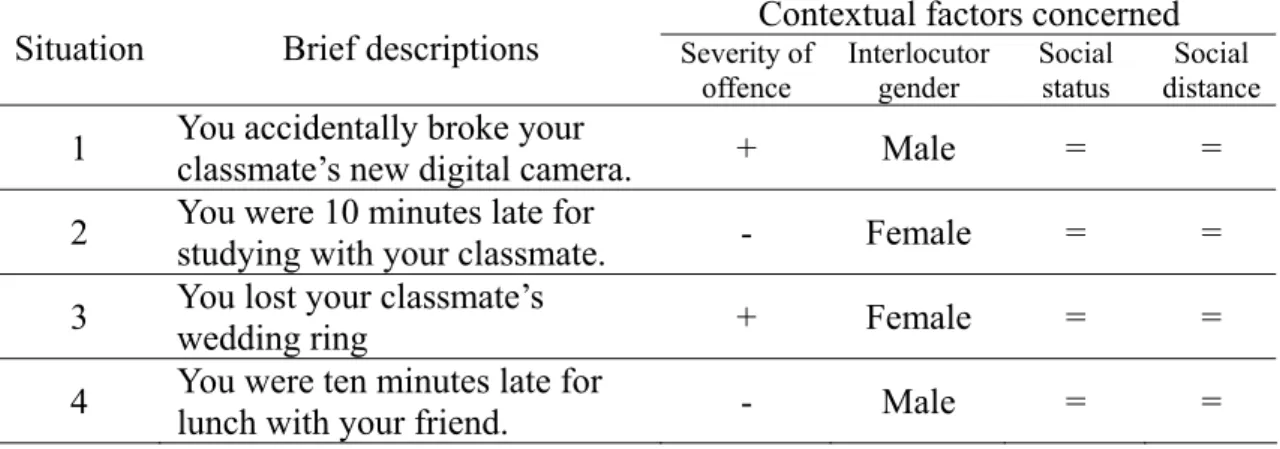
(7) TABLE OF CONTENTS ABSTRACT……………………………………………………………………...… IV ACKNOWLEDGEMENTS ..................................................................................... VI LIST OF TABLES....................................................................................................... X LIST OF FIGURES .................................................................................................XII CHAPTER 1. INTRODUCTION .............................................................................1. 1.1. METHODOLOGICAL ISSUES IN INTERLANGAGE STUDIES .............................1. 1.2. APOLOGY SPEECH ACT STUDY AND MOTIVATION........................................3. 1.3. PURPOSE OF THE STUDY ................................................................................7. CHAPTER 2 2.1. LITERATURE REVIEW .................................................................8. DATA COLLECTION IN SPEECH ACTS AND INTERLANGUAGE PRAGMATICS STUDIES............................................................................................................8. 2.1.1. Methods Eliciting Perception Data ............................................................9. 2.1.1.1. Multiple Choice Questionnaire ........................................................10. 2.1.1.2. Rating Scales.................................................................................... 11. 2.1.1.3. Stimulated Recall .............................................................................12. 2.1.2. Methods Eliciting Production Data..........................................................13. 2.1.2.1. Authentic Discourse.........................................................................13. 2.1.2.2. Discourse Completion Tasks............................................................14. 2.1.2.3. Role play ..........................................................................................17. 2.2. THE USE OF MULTIPLE APPROACHES IN SPEECH ACT PRODUCTION .......20. 2.3. COMPARING DIFFERENT MEASURES IN SPEECH ACT BEHAVIORS ............21. 2.4. THE SPEECH ACT OF APOLOGY ..................................................................28. 2.4.1. Definition .................................................................................................28 vii.
(8) 2.4.2. Apology Strategies...................................................................................30. 2.4.3. Previous Studies on the Speech Act of Apology......................................39. 2.4.3.1. L1 Studies .........................................................................................40. 2.4.3.2. Cross-cultural and Interlanguage Studies .........................................41. CHAPTER 3. METHOD.........................................................................................45. 3.1. INFORMANTS................................................................................................45. 3.2. INSTRUMENT ................................................................................................47. 3.3. PROCEDURES ...............................................................................................51. 3.4. DATA ANALYSIS AND TRANSCRIPTION ........................................................52. 3.5. CODING SYSTEM ..........................................................................................53. 3.5.1 APOLOGY STRATEGIES .............................................................................53 3.5.2 INTERNAL MODIFICATIONS ......................................................................66 3.5.2.1. MAXIMINZERs vs. MINIMIZERs ................................................66. 3.5.2.2. Chinese Particles: A, BA, and, NE ..................................................70. CHPATER 4. RESUTLS AND DISCUSSION ......................................................77. 4.1 DISTRIBUTION OF APOLOGY STRATEGIES ......................................................77 4.1.1 Overall Pattern of Apology Strategies Used on DCTs and in Role plays ...77 4.1.2. Apology Strategy Preference Order on the DCT and in role plays .........80. 4.1.3. Apology Strategies Used Among the Four Groups..................................90. 4.1.4 TASK INFLUENCES ON APOLOGY STRATEGIES ............................................95 4.1.4.1 Response Differences between DCT and Role Plays for NS-C-EM ...95 4.1.4.2. Responses Differences between DCT and Role Plays for NS-C-N. ............................................................................................................................104 4.1.4.3. Responses Differences between DCT and Role Plays for EFL-H.. 113. 4.1.4.4. Responses Differences between DCT and Role Plays for EFL-L .. 118 viii.
(9) 4.2. Effect of L2 Proficiency: Pragmalinguistic Transfer........................126. 4.3. DISTRIBUTION OF MODALITY MARKERS ON DCT AND ROLE PLAY .......132. 4.3.1. Overall Use of Modality Markers ..........................................................132. 4.3.2. MAXIMIZERs vs. MINIMIZERs .........................................................137. 4.3.3. MINIMIZING Upgraders vs. Downgraders ..........................................140. 4.3.4. Chinese Particles: A, BA, and NE .......................................................144. 4.3.5. Preference of Modality Markers ............................................................148. 4.3.6. MAXIMIZERs vs. MINIMIZERs Across Four Situations....................155. 4.3.7. Problems Resulted from Traditional Apology Internal Modifications ..158. CHAPTER 5. CONCLUSION..............................................................................161. 5.1. SUMMARY ..................................................................................................161. 5.2. IMPLICATION FOR FUTURE RESEARCHES .................................................164. APPENDIX A: QUESTIONNAIRE: CHINESE VERSION FOR NS-C .....................178 APPENDIX B: Questionnaire: English Version for EFL...............................186 APPENDIX C: ROLE PLAY SITUATIONS: CHINESE VERSION FOR NS-C .........194 APPENDIX D: ROLE PLAY SITUATIONS: ENGLISH VERSION FOR EFL...........195 APPENDIX E: ROLE PLAY TRANSCRIPTION CONVENTIONS ...........................196. ix.
(10) LIST OF TABLES Table 1. Groupings of the participants of DCT and role plays................................47. Table 2. Descriptions and contextual factors of four scenarios on DCT and in role plays ...........................................................................................................50. Table 3. Categorization of Modality Markers in Apology Realization ...................76. Table 4. Mean number of apology strategies used on DCT and in role plays.........77. Table 5. Apology strategy preference order on DCT ..............................................81. Table 6. Apology strategy preference order in role plays .......................................83. Table 7. Relative Frequency of Apology Strategy for DCT....................................92. Table 8. Relative frequency of apology strategies for role play..............................93. Table 9. Frequency of the eight main apology strategies used by NS-C-EM on DCT and in role plays .........................................................................................97. Table 10 Frequency of the eight main apology strategies used by NS-C-NEM on DCT and in role plays ..............................................................................105 Table 11 Frequency of the eight main apology strategies used by EFL-H on DCT and in role plays ....................................................................................... 114 Table 12 Frequency of the eight main apology strategies used by EFL-L on DCT and in role plays ....................................................................................... 119 Table 13. Frequency of Explicit Acceptance of the Blame in the four situations on the DCT and in role plays for EFL-L.......................................................124. Table 14 Number and frequency of negative pragmalinguistic transfer in EFL learners’ interlanguage apologies ............................................................127 Table 15 Number and frequency of modality markers on DCT and role play by NS-C, EFL-H and EFL-L ........................................................................133 Table 16 Number and frequency of modality markers on DCT and role play by NS-C-EM, NS-C-NEM, EFL-H and EFL-L............................................134 x.
(11) Table 17 Numbers and frequencies of each type of modality markers by 4 groups on DCT..........................................................................................................136 Table 18. Numbers and frequencies of each type of modality markers by 4 groups in Role play ..................................................................................................137. Table 19 Number and frequency of MAXIMIZERs and MINIMIZERs used by the four groups ...............................................................................................138 Table 20 Number and frequency of MAXIMIZERs and MINIMIZERs by the four groups in Role play ..................................................................................139 Table 21 Number and frequency of upgraders vs. downgraders used as MINIMIZERs by the four groups ............................................................141 Table 22 Number and frequency of MINIMIZING Downgraders in role play for four groups ...............................................................................................143 Table 23 Numbers and frequencies of each type of Chinese particles on DCT and in role plays..................................................................................................145 Table 24 Preference order of modality markers for four groups on DCT ..............149 Table 25 Preference order of modality markers for four groups in role play.........150 Table 26 Number and frequency of MAXIMIZERs and MINIMIZERs across four situations on DCT ....................................................................................155 Table 27 Number and frequency of MAXIMIZERs and MINIMIZERs across four situations in role plays .............................................................................157 Table 28 Number of modality markers used by NS-E and NS-C with exclusion of Chinese particles ........................................................................................159 Table 29 Number of modality markers used by NS-E and NS-C with inclusion of Chinese particles ........................................................................................160. xi.
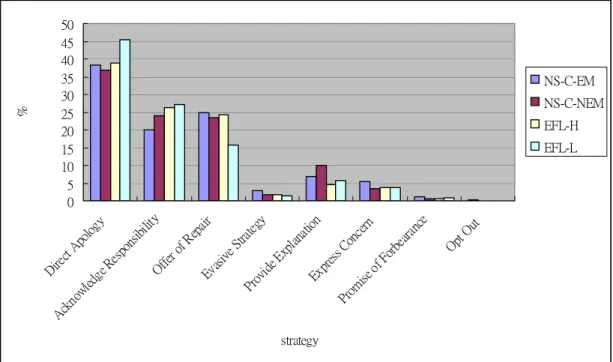
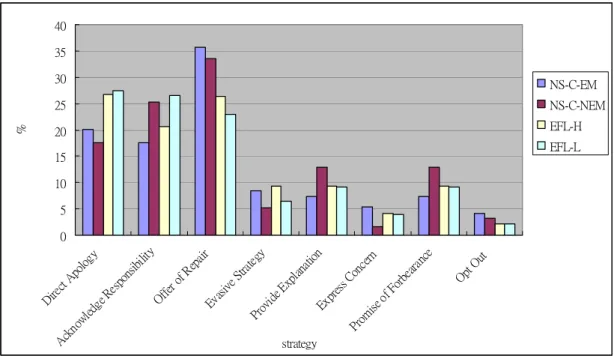
(12) LIST OF FIGURES Figure 1. Kasper and Dahl’s categorization of data collection methods related to modality of language use and degree of control (1991: 217) ....................8. Figure 2. Occurrence frequency of the eight main strategies used by NS-C-EM, NS-C-NEM, EFL-H, EFL-L on DCT ......................................................82. Figure 3. Occurrence frequency of the eight main strategies used by NS-C-EM, NS-C-NEM, EFL-H, EFL-L in role play.................................................84. Figure 4. Frequency differences of Provide Explanation in role plays...................95. Figure 5. Distribution of the three most common strategies on DCT.....................97. Figure 6. Frequency differences of Opt Out and Evasive Strategy for NS-C-EM..98. Figure 7. Distribution of most common strategies on DCT and in role plays for NS-C-NEM ............................................................................................106. Figure 8. Distribution of Opt Out, Evasive Strategy on DCT and in role play for NS-C-NEM ............................................................................................109. Figure 9. Distribution of most common strategies on DCT and in role plays for EFL-H .................................................................................................... 115. Figure 10 Occurrence of Opt Out, Evasive Strategies, and Provide Explanation for EFL-H .................................................................................................... 116 Figure 11 Distribution of most common strategies on DCT and in role plays for. 119 Figure 12 Occurrence of Opt Out, Evasive Strategy, and Provide Explanation for EFL-L.....................................................................................................120 Figure 13 Overall frequency of modality markers used by NS-C, EFL-H and EFL-L on DCT and role play.............................................................................133 Figure 14 Overall frequency of modality markers used by NS-C, EFL-H and EFL-L on DCT and role play.............................................................................135 Figure 15 Frequency of MAXIMIZERs on DCT and role play for four groups ...139 xii.
(13) Figure 16 Frequency of MINIMIZERs by four groups on DCT and in role play .140 Figure 17 Frequency of MINIMIZING Upgraders on DCT and in role play ........142 Figure 18 Frequency of MINIMIZING Downgraders on DCT and in role play ...143 Figure 19 Frequency of Chinese particles on DCT and in role plays ....................145 Figure 20 Frequency of Chinese particles used by NS-C-EM and NS-C-NEM on DCT and in role plays ............................................................................148 Figure 21 Frequency of MAXIMIZERs and MINIMIZERs across four situations on DCT........................................................................................................156 Figure 22 Frequency of MAXIMIZERs and MINIMIZERs across four situations in role plays................................................................................................157 Figure 23 Frequency of modality markers with exclusion of Chinese particles....159 Figure 24 Frequency of modality markers with inclusion of Chinese particles ....160. xiii.
(14) CHAPTER 1 INTRODUCTION. 1.1 Methodological Issues in Interlangage Studies Cross-cultural and interlanguage pragmatics researches have become a very important issue in the area of second language acquisition. Many empirical studies have employed a variety of methods to compare speech act behaviors between native and nonnative speakers in different sociocultural contexts, such as apologies (Bergman and Kasper, 1993; Holmes, 1990; Olshtain, 1983, 1989; Olshtain and Cohen, 1987; Trosborg, 1987), complaints (DeCapu, 1988; House and Kasper, 1981; Olshtain and Weinback, 1993; Piotrowska, 1987; Trosborg, 1995), requests (Blum-Kulka, 1982; Blum-Kulka and Olshtain, 1984; Takahashi and DuFon 1989;Trosborg , 1995; Rintell, 1981; Rose, 1992), refusals (Bardovi and Hartford, 1991, 1993; Beebe, Takahashi, and Uliss-Welts, 1990; Félix-Brasdefer, 2003; Liao and Bresnahan, 1996; Takahashi and Beebe, 1987), gratitude (Aston, 1995; Bodman and Eisenstein, 1988; Eisenstein and Bodman, 1986, 1995; Lin and Yu, 2006), disagreements (Beebe and Takahashi, 1989; Garicía, 1989; Edstrom, 2004; Rees-Miller, 2000), and compliments (Morrow, 1995; Murphy and Neu, 1996; Olshtain and Weinback, 1987; Wolfson, 1989; Holmes, 1988; Holmes and Brown, 1987). Cohen (1996) also pointed out that the main concern for the researchers in cross-cultural and interlanguage pragmatics is to establish a set of universal speech act realization patterns under a specific situation in question. Olshtain and Cohen (1983: 21) have defined this set of strategies as the speech act set of a particular speech act. Thus, in order to understand speech act realizations in different cultures, researchers have devoted themselves to the analysis speech acts data obtained from a variety of languages through employing various instruments, such as natural occurring data (e.g., 1.
(15) Ellis 1992; Holmes, 1990; Bardovi and Hartford, 1993), multiple choice questionnaires (e.g. Carrell, 1981; Rose, 1992, 1994), scale-rating questionnaires (e.g., Olshtain and Blum-Kulka, 1985; Olshtain and Blum-Kulka, 1985; Lin and Yu, 2006), discourse completion tasks (e.g., Blum-Kulka, 1982; Blum-Kulka and Olshtain, 1984; Bergman and Kasper, 1993; Lin and Ho, 2006) , and role plays (e.g., Eisenstein and Bodman, 1993; Houck and Gass, 1996; Trosborg, 1987, 1995). However, as noted by Kasper and Dahl (1991), while uncovering sociopragmatic and pragmalinguistic variation in our “real world” is the main concern in pragmatic studies, in order to have valid interpretations to observed variability, researchers have to minimize the task effects derived from methods of data collections. Cohen (1996) further pointed out that the process of speech act realizations and the selection of strategies are complex; therefore, a careful development of research design is necessary. Researchers in the field of interlanguage studies have emphasized the importance of methodological issues (Cohen, 1996; Kasper and Dahl; 1991; Houck and Gass, 1996; Liu, 1997) since it is obscure that whether different data collection techniques elicit the same or different results. It has been noted that discourse completion tasks (DCT) and role plays are two primary elicitation measures employed in speech acts studies and cross-cultural pragmatic studies (Kasper and Dahl, 1991; Austin, 1995; Chaudron, 2005) with requests and apologies being the most commonly investigated (Chaudron, 2005). Therefore, the validity of these two tasks has become especially important for researchers. So far, a large number of researches have been done to compare the strengths and weaknesses of different types of methods (e.g., Beebe and Cummings, 1985; Hartford and Bardovi-Harlig, 1992; Golato, 2003; Johnston, Kasper, and Ross, 1998; Rintell and Mitchell, 1989; Rose 1992, 1994; Sasaki, 1998; Schauer and Adolphs, 2006). Yet, only two researches have addressed the methodological 2.
(16) issues by comparing DCT and role-play data. Rintell and Mitchell (1989) conducted a comparative study of DCT and closed role plays on native and non-native informants’ strategy selection to perform requests and apologies. They concluded that “language elicited in this study is very similar whether collected in written or oral form… both methods elicit representations of spoken language” (p. 270). However, since Rintell and Mitchell employed closed role plays which required only one turn response, Kasper and Dahl (1991) pointed out that the similarity of the results between oral and written tasks is due to the fact that both instruments are non-interactive. Sasaki (1998) compared DCT and role-play data obtained from 12 Japanese EFL learners on the speech acts of request and refusals. The results showed that written questionnaire and role plays elicited somewhat different samples. Role play induced longer responses, and a larger number and greater variety of strategies/formulas than did DCT. Sasaki suggested that the differences between two tasks were due to the interactive nature of role plays. Nevertheless, both Rintell and Mitchell (1989) and Sasaki (1998) compared DCT with closed role-plays instead of open role plays. Moreover, participants of either speakers or interlocutors in their study were asked to play a variety of roles, like professors and bosses.. 1.2 Apology Speech Act Study and Motivation An apology is called for when the offender admit responsibility for some infractions that have proved costly to the offended party, so the act of apologizing is a face-supportive act (Holmes, 1989) which differs from face-threatening acts like requests and refusals in that they impose on the hearer’s face (Brown and Levinson, 1987). Previous speech acts studies on apologies have revealed the universality of apology. Olshtain (1989) explored the effect of social distance and power on apology strategy preference by speakers of English, French, German, and Hebrew. She 3.
(17) concluded that ‘‘different languages will realize apologies in very similar ways’’ (1989:171). That is to say, the strategies used to realize apologies are mostly universal. Apart from the apology strategies, Blum-Kulka, House, and Kasper (1989: 21) specified that apologies can be realized with different degrees of intensity. Speakers can increase the intensity of their apologies by using intensifiers within illocutionary force indicating devices (IFIDs), like ‘I’m really sorry’, or by using multiple strategies. On the other hand, speakers can downgrade the offense through minimizations of the offence, such as ‘I dropped your ring – it’s around here somewhere...’. House and Kasper (1981) introduced two types of politeness markers, namely upgraders and downgraders. Based on their categorization, Trosborg (1987, 1995) established a classification of internal apology modifiers, including downgraders, which serves to “minimizing the guilt” and upgraders, which is used to “maximize the apology”. For instance, the adverbial ‘very’ and ‘just’ have different functions in the utterances such as ‘I’m very sorry’ and ‘I’m just late for ten minutes’. The upgrader ‘very’ is used to intensify the apology while the downgrader ‘just’ is used to mitigate the degree of the offence that had caused the complainable. In Lin and Ho’s (2006) investigation of the cross-cultural difference of the use of modality markers produced by native speakers of English and Chinese and EFL learners, they nevertheless pointed out some potential problems of the traditional classifications of the apology internal modifications. In apology, lexical upgraders may take different functions in different situational contexts. The following examples illustrate different functions of the intensifier “so”:. (1.1). Functions of the intensifier “so” (Lin and Ho, 2006: 11-12) a. I’m so sorry to have spilled coffee on you. b. Laura, sorry I’m late. I didn’t know the traffic to your house would be 4.
(18) so bad at this time.. In (1.1), the lexical form “so” functions differently. In (a) the “so” takes the function of “maximizing the apology”, while the “so” in (b) is used to play down the complainable serving to “minimize the guilt” (Trosborg, 1987, 1995). Lin and Ho (2006) have suggested that while traditional categorization of modality markers only focused on the function of intensifiers like so/very/really in upgraders, the other function like “minimize the guilt” has been neglected in previous researches on apology speech act. Thus, they established a coding scheme that distinguishes lexical and functional form of modality markers in the hope of revamping traditional categorization of modifications. Yet, while traditional development of internal modifications was categorized based on language system of English (e.g., Blum-Kulka, House, and Kasper, 1989; Faerch and Kasper, 1989; House and Kasper, 1981; Trosborg, 1987, 1995; Lin and Ho, 2006), it is questionable whether the traditional categorization would be applicable to every language. For example, Chinese and English are two separate language systems which possess distinct features since Chinese belongs to Sino-Tibetan language family whereas English belongs to Indo-European family. As House and Kasper (1987) suggested, modality markers, viz. upgraders and downgraders, have the function of modulating the speaker’s attitude and opinions. Conventionally, researchers classified modality makers in accordance with the pragmatic functions of specific linguistic forms based on the English system, yet some Chinese markers like sentence-final particles which serve to modulate speaker’s tone have been ignored in the categorization of internal modifications. The main functions of the Chinese final particles such as “A” (啊) , “BA” (吧), and “NE” (呢) are to soften the speakers’ tone and build the solidarity between interlocutors (Alleton, 1981; Chu, 1984; 5.
(19) Lee-Wong, 1998; Li and Thompson, 1981; Lin, 1981). According to Tang and Tang (1997), there is no equivalent translation of Chinese final particles in English. Since traditional classification of internal modifications were mostly based on language system of English, up to now, researches on Chinese speech act behaviors in the literature have ignored Chinese final particles when establishing the coding system for internal modifications. Therefore, the study aimed at modifying Lin and Ho’s (2006) classification of apology internal modifications by adding Chinese particles, A, BA, and NE into the coding scheme. After the modified coding system was established, for the purpose of the comparison of written and oral tasks, data collected from DCT and data collected from role plays on apology behaviors by native speakers of Chinese and EFL learners were compared in order to investigate what factors may affect the results. Besides, examination of apology realizations between different backgrounds of native speakers of Chinese has also been taken into consideration in the present study.. As Hymes. (1972) has specified, a speech community refers to “a community sharing rules for the conduct and interpretation of speech, and rules for the interpretation of at least one linguistic variety” (p. 54). Wolfson (1989: 14) further defined “sociolinguistic relativity” as “the norms and values which inform speakers’ knowledge as to what is appropriate to say to whom, and under which conditions”. Thus, speakers of a specific language may form different speech communities with their own rules of speaking (Hymes, 1972). All in all, speakers of a language might not pertain to the same set of rules of speaking; hence, they may belong to members of different speech communities. Consequently, in order to testify how native speakers of different backgrounds behave differently from one another, the present study distinguished native speakers of Chinese according to their educational background, that is, whether they were English majors or non-English majors. 6.
(20) 1.3. Purpose of the Study. The purpose of the present study was to compare the data obtained from DCT and role plays by exploring the use of apology strategies and internal modifications performed by native speakers of Chinese (NS-C) and EFL learners. Unlike the previous studies on the comparison of DCT and role plays which employed closed role play, the present study dealt with the comparison of data obtained from DCT and open role plays which allow subjects to interact in a full-discourse context. In addition, the participants were asked to perform a role that was part of their life in order to obtain data as natural as possible. Finally, the study will provide some implications for the future researches on cross-cultural or interlanguage pragmatics. Thus, this study addresses the following questions: (1) Do data collected from DCT and role plays elicit the same or different results? (2) What might be the similarities and differences between the two tasks when the results of the two measures are compared? (3) What are the possible factors that might influence the subjects’ responses on different tasks? (4) Do native speakers of Chinese realize apologies in a similar or different way when they are differentiated according to their educational background (viz. English majors vs. non-English)? (5) Can the modified coding scheme of the apology internal modifications supplement traditional categorizations and apply to apology speech act studies in Taiwan?. 7.
(21) CHAPTER 2 LITERATURE REVIEW. 2.1 Data Collection in Speech Acts and Interlanguage Pragmatics Studies Researchers in the field of speech act studies and interlanague pragmatics studies have been concerned with the appropriateness of data collection instruments. It has been suggested that effective instrument is critical to research outcomes (Chaudron, 2005; Kasper and Dahl, 1991). Comparison of the advantages and disadvantages of research methods have begun to be discussed in the literature (Blum-Kulka, House, and Kasper, 1989; Hartford and Bardovi-Harlig, 1992; Kasper and Dahl, 1991; Wolfson, Marmor, and Jones, 1989). As one of the most comprehensive reviews of data elicitation instruments, Kasper and Dahl (1991) offered an extensive review of research methods employed in thirty nine L2 pragmatics studies. They distinguished the methods according to two dimensions: “the degree to which the data are predetermined by the instrument, and the modality of language use subjects/informants are engaged in” (p. 216). Figure 1 below classifies methods based on these two dimensions.. Rating /MC/. discourse. Interview tasks. completion. closed. open. RP. RP. Perception/compression. observation of authentic discourse. production. elicited. observational. Figure 1 Kasper and Dahl’s categorization of data collection methods related to modality of language use and degree of control (1991: 217). 8.
(22) Note: MC = multiple choice questionnaire RP = role play. According to Kasper and Dahl’s (1991) categorization, multiple choice questionnaire, interview and different types of rating tasks including scale rating questionnaire, paired comparison, and card sorting offer perception data, such as perception of degree of politeness. On the other hand, discourse completion tests, role plays, both closed and open, and authentic discourse provide production data. In this section, methods of data collections commonly employed in the field of speech acts studies and interlangauge pragmatics studies will be reviewed based on Kasper and Dahl’s (1999) categorization: (1) methods eliciting perception and comprehension data, and (2) methods eliciting production data.. 2.1.1. Methods Eliciting Perception Data. As Kasper and Dahl (1999) have noted, most of the early studies of speech act behaviors which investigated non-native speakers’ perception and comprehension gathered data from multiple choice questionnaires, rating scales, and stimulus recalls. Chaurdon (2005) specified that results obtained from these types of data collection instruments reflected participants’ indirect linguistic performance. In other words, the obtained data was a description of subjects’ language use, and “internal reconstructions or representations of what they have said and how they arrived at their performance” (Chaudron, 2005: 782). The three measures, namely, multiple choice questionnaires, rating scales, and stimulus recalls will be presented respectively in 2.1.1.1.. 9.
(23) 2.1.1.1 Multiple Choice Questionnaire Multiple-choice questionnaire (MCQ) was employed as an elicitation instrument in several speech act studies, such as request (Rose, 1992, 1994; Rose and Ono, 1995), and advice (Hinkel, 1997). By using multiple choice questionnaires, researchers can elicit information on production, comprehension, and metapragmatic judgments. On the questionnaire, a description of the situational context and a prompt for a response are provided. Informants are asked to choose one of the response alternatives listed on the questionnaire. Kasper and Dahl (1991: 216) suggested that methods based on rating tasks and multiple choice selections “provide information about subjects’ perception of alternative speech act realization…or about the pragmatic meaning subjects assign to offered stimulus material”. The example below is a question from a multiple-choice questionnaire adopted from a request study:. (2.1) Sample MCQ (Rose and Ono, 1995:221) You are watching television in the living room. You want to change the channel. The remote control is next to your younger sister, who is reading a magazine. What would you say or do? a. I would say, “Pass me the remote control.” b. I would say, “I’d like to see what’s on the other channels.” c. I would walk to my sister and take the remote control. d. I would say, “Can you pass me the remote control?”. Multiple-choice responses require respondents’ evaluation of a few number of alternatives listed under the descriptions based on their perception. In addition, Kasper (2000: 331) has suggested that “as far as opting out goes, tasks may not be compatible unless the possibility for opting out is expressly specified as a legitimate option in the. 10.
(24) production questionnaire”. Finally, the design of a multiple-choice questionnaire has to rely on previous studies on speech acts in question for the purpose of making selections of the response alternatives plausible as Kasper (2000: 331) has noted:. It is not good enough to invent responses intuitively because pragmatic strategies might escape the researcher’s attention. Valid source to select response alternatives from are speech act realization strategies collected through production questionnaires (Rose and Ono, 1995) or from spoken discourse (authentic or elicited), and free responses to comprehension questionnaire (Bouton, 1988) (Kasper, 2000: 331).. 2.1.1.2 Rating Scales Researchers in social pragmatics are often interested in revealing how people perceive the notion of politeness and appropriateness of a specific selection of strategies of a speech act in a certain context. Moreover, they may be concerned with how people weigh contextual variables that might affect the selection of strategies and linguistic forms (Kasper and Rose, 2002). Such variables between participants include social status, social distance, and the degree of imposition involved in a certain context. On of the most common methods of collecting metapragmatic assessments is by obtaining responses from scale-response questionnaires (SRQ) (Kasper, 2000). Collecting metapragmatic assessments through rating scales might have several purposes: “as a research issue in its own right; as an additional resource to help interpret performance data; as a preliminary step towards developing the instrument for the main study; or as a combination of the above” (Kasper, 2000:331). The following is an example of SRQ extracted from a study of cross-cultural perception of apology (Hou, 2006: 79). The responses in the questionnaire were designed to elicit respondents’ perception of severity of offense, offender’s obligation to apologize, likelihood for the apology to be accepted, and offender’s face loss: 11.
(25) (2.2) Sample SRQ (Hou, 2006: 79) Situation 15: You are going to have lunch with your friend today on campus. Since you don’t have a class this morning, you went to do some shopping first. When you arrive at the cafeteria, you were 10 minutes late. severity of the situation is -----------------------high---- 5 the possibility of you apologizing is ---------- high---- 5 difficulty of the apology for me is -------------high---- 5 likelihood of the apology accepted is ----------high---- 5. 4 4 4 4. 3 3 3 3. 2 2 2 2. 1 ---- low-1 ---- low-1 ---- low-1 ---- low—. 2.1.1.3 Stimulated Recall The last type of instruments commonly used in speech act studies for eliciting perception data is stimulated recall which encompasses a variety of measures, such as introspective interviews, retrospective interviews, think-aloud (protocols), verbal reports, and cued recall (Chaudron, 2005). During the tasks, the subjects are asked to reconstruct their memory about their performance. It has been suggested that this type of research methods is important in the cycle of data collection, that is, from (1) observation, to (2) role-plays, to (3) discourse completion tasks, to (4) learner acceptability checks because this type of instruments validates the range of acceptability of learner behaviors (Cohen and Olshtain 1994; Olshtain and Blum-Kulka, 1985). In the literature, stimulated recall has been employed to collect data on speech act studies, such as gratitude (Eisenstein and Bodman, 1993; Kotani, 2002) and compliment (Benander, 1990). However, due to memory limitation, it is difficult for informants to accurately report their experiences (Gumperz, 1982; Kasper, 2000). Cohen (1991: 136-138) criticized that data collected from verbal reports: (1) do not access unconscious skill learning; (2) may simplify a particular process just by virtue of accessing it; (3) may distort the original process by virtue of constructing a verbal report, and, therefore, 12.
(26) become distant from the underlying events; (4) may repress information (e.g., for social-affective reason); (5) may intrude on the process investigated; (6) may also distort the reality of the process by using a different (target or native) language for the report.. 2.1.2 Methods Eliciting Production Data A number of techniques have been developed to elicit learners’ productive language performance in a more concentrated and focus fashion (Chaudron p.772). These methods include observation of authentic discourse, discourse completion tasks, and role-play. In this section, these three types of elicitation instruments are introduced.. 2.1.2.1 Authentic Discourse It has been argued that ethnographic data collection is the most reliable means of learning about the social and linguistic constraints on a particular speech act (Wolfson, 1981; Wolfson, Marmor and Jones, 1989). Data obtained from authentic speech allow investigators to observe spontaneous speech events in natural setting. Naturally occurring data also have an advantage of reflecting what the speakers actually say rather than what they think they would say in real-life interchanges (Bardovi-Harlig and Harford, 1993; Beebe and Cummings, 1996). However, several drawbacks have been pointed out in the literature. First, contextual variables like social status, distance, age, gender, and L2 proficiency are difficult to control (Rintell and Mitchell, 1989). Second, collecting naturally occurring data might be time-consuming in that it is hard to predict the occurrence of a particular speech event in question, and the occurrence of some speech acts like apologies may be more situation-dependent than others; therefore, it is difficult to collect a sufficient number of data (Olshtain and Cohen, 1983; Kasper and Dahl, 1991; 13.
(27) Rintell and Mitchell, 1989). Finally, the accuracy of note taking during observation largely relies on researchers’ memory (Bardovi-Harlig and Harford, 1993; Beebe and Cummings, 1996; Kasper, 2000; Schauer and Adolphs, 2006).. 2.1.2.2 Discourse Completion Tasks Discourse completion tasks, a prominent elicitation procedure in pragmatics studies, was originally adopted by Blum-Kulka’s (1982) for comparison of indirect strategies between native and non-native Hebrew speakers. It has been noted that 54 percent (19 out of 35) of the pragmatics studies reviewed by Kasper and Dahl (1991) employed DCTs, with about one-third relying exclusively on them (Bardovi-Harlig and Harford, 1993; Rose and Ono, 1995). DCTs are written questionnaires consisting of a brief description of a situation which requires informants to fill in the most appropriate response based on their intuition in the given situation. They can be open-ended or accompanied by a hearer’s response. The example below is a sample open-ended DCT which is extracted from the questionnaire in Shih (2006). The scenario is designed to elicit apologies for breaking a classmate’s new digital camera.. (2.3) Sample open-ended DCT (Shih, 2006: 152) Situation 5: Your classmate Paul Levinson bought a new digital camera. You ask him to let you try it. However, you carelessly drop it and it breaks!. Discourse completion tasks also can be accompanied by a hearer’s response added after the description of the situation as illustrated below:. 14.
(28) (2.4) Sample DCT with inclusion of a hearer response (Sasaki, 1998: 458). You are in a meeting. You want to take some notes, and need to borrow a pen. A friend of yours (an American male) happens to be sitting next to you, and might have an extra pen. You: Friend: Sure, here you are.. Nowadays, DCT has been widely employed to elicit data produced by NS and NNS socio-pragmatic behaviors. The most prominent research project on speech acts, the Cross-cultural Speech Act Realization Patterns (CCSARP) project, which investigated requests and apologies across eight languages (viz., Australian English, American English, British English, Canadian French, Danish, German, and Hebrew and Russian) also employed DCT to collect data in order to investigate (1) cross-cultural variability, (2) social contexts, and (3) interlanguge variations of apology and request realization patterns (Blum-Kulka, and Olshtain, 1989). Numerous other speech act studies have been undertaken by using this instrument including: apologies (Bergman and Kasper, 1993; Blum-Kulka and Olshtain, 1984; Cohen, Olshtain and Rosenstein, 1986), refusals (Beebe, Takahashi, and Uliss-Welts, 1990; Kwon, 2004; Robinson, 1991; Takahashi and Beebe, 1987), requests (Blum-Kulka, 1982; Blum-Kulka and Olshtain, 1984; Blum-Kulka and Olshtain, 1986; Faerch and Kasper, 1989; Hill, 1997; House and Kasper, 1987; Olshtain and Weinback, 1987; Takahashi and Beebe, 1987; Yu, 1999), complaints (DeCapu, 1988; Du, 1995; Olshtain and Weinback, 1987; Piotrowska, 1987), compliments (Murphy and Neu, 1996; Nakabachi, 1996; Olshtain and Weinback, 1987), disagreements (Beebe and Takahashi, 1989; Du, 1995) and expressions of gratitude (Eisenstein and Bodman, 1986; Eisenstein and Bodman, 1993; Lin and Yu, 2006).. 15.
(29) Discourse completion task was widely employed in speech acts studies because of the following advantages: (1). Gather a large amount of data quickly (Beebe & Cummings, 1996; Ellis, 2004; Houck and Gass, 1996; Johnston, Kasper, & Ross, 1998; Wolfson, 1989; Wolfson, Warmor, and Jones 1989; Yamashita, 1996).. (2). Situational variables such as social status, social distance, age, gender, L2 proficiency, and ethnicity can be efficiently control (Beebe and Gummings, 1985; Blum-Kulka et al, 1989; Golato, 2003; Houck and Gass, 1996; Johnston, Kasper, & Ross, 1998; Kasper, 2000) which “lead to easy replicability” (Golato, 2003: 93).. (3). There is no need for transcription (Johnston, Kasper, and Ross 1998), thus making it easy to statistically compare responses from native and non-native speakers (Blum-Kulka, House, and Kasper 1989; Chaudron, 2005).. In addition to the above benefits DCTs have brought, Beebe and Cummings (1996: 80) concluded that DCTs are a very effective means of:. (4). Creating an initial classification of semantic formulas and strategies that will likely occur in natural speech ;. (5). Studying the stereotypical, perceived requirements for a socially appropriate response;. (6). Gaining insight into social and psychological factors that are likely to affect speech and performance; and. (7). Ascertaining the canonical shape of speech acts in the minds of speakers of that language. 16.
(30) However, discourse completion test is not problem-free. Questions have been raised about its validity (Kasper and Dahl, 1991; Rose, 1994; Golato, 2003). The shortcomings of DCTs have been noted in the literature. First, data do not always equate spontaneous conversation (Aston, 1995; Cohen and Olsthtain, 1994; Beebe and Cummings, 1985; Golato: 2003; Hartford and Bardovi-Harlig 1992; Holmes 1991; Rintell and Mitchell, 1989; Wolfson, 1989) since DCT was decontextualized in which the informants do not face with real-life encounters; therefore, the obtained data represented ‘what people think they would say’ rather than ‘what people actually do say’ in a hypothetical setting (Aston, 2004; Golato, 2003; Houck and Gass, 1996; Wolfson, Marmor and Jones, 1989). Second, completors of DCTs may perceive the written task as a formal activity or a test; therefore, they may use more formal language (Beebe and Cummings, 1996; Rintell and Mitchell 1989) and “may choose linguistic form based on familiarity with the spelling of one word rather than another (Rintell and Mitchell 1989: 250)”. Third, it is hard for subjects to imagine what they would say in the given situations due to the absence of an interlocutor on DCT and some of them even claimed that they never came across some situations in real-life interactions (Austin, 2004; Golato, 2003; Rose; 1992). Finally, the space limitation might force informants to write down the whole sequences of a specific speech act within the first turn, hence making it difficult to capture how discourse is managed and negotiated turn-by-turn (Beebe and Cummings, 1985; Beebe and Cummings, 1996; Rintell and Mitchell 1989).. 2.1.2.3 Role play In addition to DCTs, open or closed role-play is the other main method used to obtain production data. Role play was first employed by Cohen and Olshtain (1981) for comparing the apologies performed by native speakers of Hebrew and English, and 17.
(31) Hebrew learners of English. In role plays, a description of a context calling for the performance of a particular speech act is provided for the participants. Relative to discourse completion tasks, subjects are asked to respond orally in role plays. In closed role-plays, informants were given an oral version of DCT and asked to give a one-turn oral response. An example of a closed role-play can be found in Rintell and Mitchell’s (1989) study of the comparison of DCTs and role plays on requests and apologies behaviors. However, due to the fact that informants only have a single-turn to respond to the given situation in a closed role play which does not involve a full operation of interaction, data obtained from closed role plays might result in non-symmetry with authentic speech (Gass and Houck, 1995, 1999). On the other hand, in open role-plays, settings as well as each actor’s role would be specified on each participant’s role cards, so a complete conversation is investigated and recorded. The following example is a description of a scenario in open role-play extracted from the present study:. (2.5) Sample role play scenario Situation 1 A. Your classmate Paul bought a new digital camera. You ask him to let you try it. However, you carelessly drop it and it breaks!. B. You bought a new digital camera. Your classmate asks you to let him/her try it. However, he/she carelessly drops it and it breaks.. Role-play has been widely adopted for eliciting native and nonnative speakers’ speech act behaviors, such as apologies (e.g. Mir, 1992), requests (e.g. Rintell, 1981), refusals (e.g. Houck and Gass, 1996), complaint (e.g. Trosborg, 1995), compliment 18.
(32) (e.g. Morrow, 1995), and gratitude (e.g. Eisenstein and Bodman, 1993) because it solves some of the problems associated with discourse completion tasks. First, compared to DCTs, role plays provide data in an oral mode rather than a written mode; therefore, the informants have chances to say what and as much as what they would say (Rintell and Mitchell, 1989; Houck and Gass 1996). Also, their spoken responses have been considered to be reflecting natural speeches which provide features of natural discourse, including turn-taking, false starts, and hesitation (Kasper, 2000; Kasper and Dahl, 1991; Rintell and Mitchell, 1989; Houck and Gass 1996; Houck and Gass, 1999). Finally, open role plays have the advantage of allowing an examination of a specific speech act behavior in its full discourse context; therefore, open role plays provide a much richer data source relative to DCTs (Kasper and Dahl, 1991). Nevertheless, the accuracy of the outcomes that role plays yielded has been questioned. In role plays, subjects were just role playing the roles in given situations and they did not engage in the natural occurring interactions under investigation. Thus, it is unclear whether the responses in role plays would mirror their spoken language in real settings (Gass and Houck, 1999; Kasper, 2000; Rintell and Mitchell, 1989; Yuan 2001). Despite the drawbacks mentioned above, role-plays are still widely used in cross-cultural and interlanguage pragmatics studies mainly because role-plays are online production tasks (Golato, 2003: 94) which would provide more naturalistic data (Kasper and Dahl, 1991). In addition, they have the advantage of simplicity of use, allowing controlling contextual variables like power, status, gender, and age of informants, and allowing for a close analysis of a speech act behavior in long interaction sequences (Kasper, 2000).. 19.
(33) 2.2 The Use of Multiple Approaches in Speech Act Production Due to the fact that no single method can entirely assess the behavior of a speech act (Cohen, 1996; Cohen and Olsthain, 1994), several studies employed multiple approaches in order to increase cross-task validation of the results. Rintell (1984) observed non-natives speakers’ perception of expressions of emotion by combining the multiple choice questionnaire and a 9-point scale rating questionnaire. After listening to tape conversations, informants were asked to identify the closest description of the expressed emotion on the answer sheet and rate the intensity of the emotion on the scale-rating questionnaire. The results showed that age, gender and intensity scores have no effect on informants’ perception of emotion. Learners’ native language and language proficiency were the two main variables that influenced non-native speakers’ perception of emotion. Chinese informants’ responses consistently contrasted with Arabic and Spanish students’ responses, and beginners’ perceptions were sharply different from intermediate to advance learners’ perceptions. Bergman and Kasper (1993) examined English native speakers’ and Thai EFL learners’ apology perception and performance by using two approaches: (1) an assessment questionnaire in which subjects were asked to rate different offense contexts on a five-point rating scale for four context-internal factors and two context-external factors; (2) discourse completion tasks which included the same offense contexts as the assessment questionnaire. They concluded that:. DCT, in whatever version, provides learners with an opportunity for knowledge display that is precluded for many NNS by the cognitive demands of face-to-face interaction. Comparison of learners’ pragmatic performance in interactive discourse and DCT may thus throw light on the state of learners’ discourse production systems, or the extent to which available pragmatic knowledge is readily accessible in conversation. (Bergman and Kasper, 1993: 101). 20.
(34) Apart from employing multiple approaches to increase the validity of the results, researchers also made effort to compare different types of data collection instruments. In the following passages, the issue of methodological validation will be introduced.. 2.3 Comparing Different Measures in Speech Act Behaviors In order to examine whether a certain kind of data-gathering method is valid and accurate for collecting speech act data, many researches have been done for the comparison of results obtained from different types of instruments so as to observe the strengths and weaknesses of different pragmatics research methods. Beebe and Cummings (1985) are the pioneers concerned with the issue of methodological validation. They compared rejections elicited from spontaneous telephone conversations and DCT. Interlocutors were all female and American in these dialogues. Both on DCTs and in telephone dialogues, informants were asked whether they would like to assist with the TESOL convention in New York. Beebe and Cummings concluded that the responses from DCTs did not represent natural speech with respect to:. (1) actual wording used in real interaction; (2) the range of formulas and strategies used (some, like avoidance tend to get left out); (3) the length of response or the number of turns it takes to fulfill the function; (4) the depth of emotion that in turn qualitatively affects the tone, content, and form of linguistic performance; (5) the number of repetitions and elaborations that occur; (6) the actual rate of occurrence of a speech act—e.g., whether or not 21.
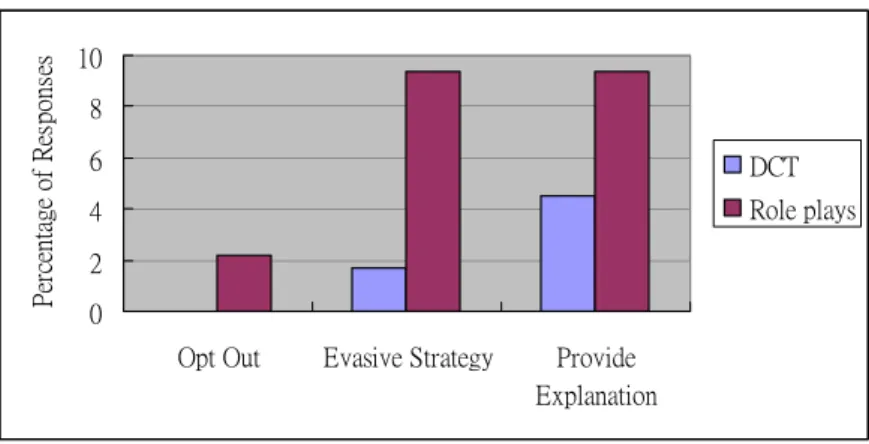
(35) someone would refuse at all in a given situation (Beebe and Cummings, 1996: 80).. The other study which compared responses obtained from DCTs with those of from authentic data was conducted by Hartford and Bardovi-Harlig (1992). They compared naturally occurring rejections in academic advising sessions with rejections from a DCT. Nevertheless, in contrast to Beebe and Cummings’ research in which participants. only. included. native. speakers,. participants. in. Harford. and. Bardovi-Harlig’s research design comprised of both native and non-native graduate students. They found some differences between naturally occurring rejections and DCT rejections. DCT yielded fewer status-preserving strategies than did the authentic data. DCTs elicited a narrower range of semantic formula than naturally occurring data did. Semantic formulas like Accept as Reject and Delays were very common in naturally occurring data whereas no such responses were found on the DCT. Yet, they recommended the continued use of discourse completion tasks in that DCT is an effective instrument for testing hypotheses derived from natural observation, and is helpful for explaining and interpreting data gathered through the authentic interactions. In the study of compliment responses, Golato (2003) compared data derived from DCT and naturally occurring talk. The results showed that DCT induced longer responses than authentic speech did. This outcome contrasted with the findings of other studies which found that DCT, the written tasks, yielded shorter responses than oral tasks (Beebe and Cumming 1996; Bodman and Eisentein 1988; Hartford and Bardovi-Harlig 1992; Rintell and Mitchell 1989; Sasaki 1998; Yuan 2001). Also, none of respondents chose to ignore a compliment on DCT. Golato concluded that “recording naturally occurring talk-in-interaction enables the researcher to study how 22.
(36) language is organized and realized in naturally setting, whereas responses from elicitation procedures such as DCTs indirectly reflect the sum of prior experience with language” (p. 90). In addition to the comparison of discourse completion tests with naturally occurring data, other validation studies concerned with the effect of rejoinders on DCT. Most studies of this type have aimed at the effect of inclusion and exclusion of the hearer response (Blum-Kulka et al. 1989, Rose 1992). Rose (1992) examined NS request behaviors from two different formats of DCT: with and without a hearer response. Rose found that inclusion and exclusion of hearer responses had no significant effect on the data elicited. Bardovi-Harlig and Hartford (1993) compared rejections of native speakers of English and non-native speakers on two types of DCT. One was an ‘open questionnaire’ with no interlocutor initiation and the other one was a ‘classic dialogue completion task’ in which a description of the situation and a prompt were provided. They pointed out that while both natives and non-natives showed task effects across two questionnaire types, nonnative speakers appeared to have greater task effects than their native speaker counterparts. That is, non-native speakers’ responses were more likely to be influenced by different formats of DCT than those of native speakers. Nonnative speaker responses were closer to those of native speakers when a hearer response was included on the DCT. This might due to the fact that native speakers were “more adept at imagining a plausible conversational turn given a scenario than NNS” as noted by Bardovi-Harlig and Hartford (1993:159). Johnston, Kasper, and Ross (1998) compared three types of hearer responses on DCT (positive, negative, and no response) on the speech acts of complaints, requests, and apologies. They concluded that type of rejoinders had an effect on the selection of strategy. Also, the three speech acts were affected to some extent with complaint least influenced by type of rejoinders, requests, the second most, and apologies were most 23.
(37) strongly affected. They suspected the comparability of data in researches which employed different types of discourse completion tasks as a method of data collection. Other validation studies have made efforts to compare DCT with multiple choice questionnaires (MCQ). In his study of exploring directness in requests made by Japanese, Rose (1994) questioned the appropriateness of the use of DCT in non-western culture. Comparing request responses obtained from DCT with multiple choice questionnaire (MCQ) involving three levels of directness (direct, conventionally indirect, and non-conventionally indirect) and an option of opting-out, he found that both native speakers of Japanese and American chose more indirect and opting-out strategies in the MCQ than on DCT. On DCT, the Japanese preferred direct requests than the Americans did. Rose pointed out that the results from MCQ were more consistent with the previous literatures that have shown that Japanese tended to opt for indirectness and hints. Based on the above results, Rose concluded that DCTs may not be the most appropriate data-gathering methods in non-Western contexts and suggested that data derived from MCQ were more representative of authentic conversations than those of on DCT. Based on the results of Rose’s study conducted in 1994, Rose and Ono (1995) acknowledged that DCTs employed in Rose (1994) might be biased because some situations were not culturally plausible for Japanese respondents. In addition, the DCT and MCQ were administered separately which might result in incomparability of the results. In order to solve these two problems, Rose and Ono (1995) concurrently administered a revised DCT and MCQ in which the request situations listed on the two questionnaires had been proved to be culturally plausible and appropriate. Results were congruent with Rose’s (1994) finding in that significant differences were shown in most majorities of the situations (11 of 12) between the responses from DCT and MCQ. The respondents tended to opt out or hint more often when making requests in 24.
(38) the multiple choice questionnaire more than they did on DCT. Since results of MCQ were closer to the Japanese behaviors observed in real-life interactions than those of elicited from DCT, they concluded that the results obtained from DCTs should be interpreted carefully in speech act studies. In the study of English and Taiwanese Chinese advice giving, Hinkel (1997) addressed the issue of validity of methods of data-collection by comparing results obtained from DCT and MCQ. Hinkel found that on the DCT, English respondents were more likely to give more forms of advice and hedges than Chinese respondents did. On the other hand, when responding to MCQ, native speakers of English chose generally fewer options with either direct or hedged advice than the non-native speakers did. Similar to findings in Rose (1994), the result on MCQ was consistent with the findings of previous researches on native and non-native speakers’ socio-pragmatic behaviors. The DCT finding was conflicting with earlier researches which found that advice giving was viewed as an act of solidarity and friendliness in Chinese-speaking community than English speaking society. Still other researches have investigated the differences and similarities between DCT and role-play data. Rintell and Mitchell (1989), as a part of the CCSARP, compared results obtained from DCTs and closed role-plays on native and non-native informants’ strategy selection to perform requests and apologies. They modified the CCSARP DCT by excluding the hearer’s response, and pointed out that they “feared it might in some way influence the response” (p. 251). They found that DCT and role-play data differed in two ways: non-native speakers’ responses in role plays were significantly longer than their responses on DCTs, and both natives and non-natives were more direct on the DCT than in role-plays in some situations. Despite these differences, Rintell and Mitchell concluded that “language elicited in this study is very similar whether collected in written or oral form… both methods elicit 25.
(39) representations of spoken language” (p. 270).. As Kasper and Dahl (1991) has. pointed out, since Rintell and Mitchell employed closed role plays which required only one turn response in their study, the similarity of the results between oral and written tasks is due to the fact that both instruments are non-interactive. Sasaki (1998) conducted a comparative study of DCT and role plays on the speech acts of requests and refusals. Twelve Japanese university students representing three different English proficiency levels responded to both measures. Contrary to most of the previous studies in the literature, she administered both tasks to the same group of informants instead of having different respondents for different tasks. The results showed that written questionnaire and role play elicited somewhat different samples. Role play induced longer responses, and a larger number and greater variety of strategies/formulas, than did DCT. Sasaki suggested that the differences between the two tasks were due to the inactive nature of role plays. Yamashita (1996) compared the six measures developed by Husdon et al. (1995) in order to determine the most effective methods for measuring the pragmatic competence of English speaking learners of Japanese. The six measures included open discourse completion tests (OPDCT), listening laboratory oral production tests (LL), multiple-choice discourse tests (MCDCT), role plays (RP), self-assessment (SA) and role play self-assessment (RPSA).. The finding suggested that except for MCDCT,. the rest of the five measures were found to be reliable and valid. Yamashita concluded that cross-cultural pragmatic tests (excluding the MCDCT) originally developed in English by Hudson, Detmer, and Brown (1992, 1995) for measuring ESL/EFL learners’ cross-cultural pragmatics competence also can “be used with other populations to study other target language (i.e., Japanese in this study) with a few minor adjustments in some of the situations” (Yamashita, 1996: 123). In addition, the length of exposure to the target language culture seemed to influence respondents’ 26.
(40) performance on oral tasks, the LL and RP. The informants’ level of language proficiency also appeared to influence their performance on the three production tests, the OPDCT, LL, and RP tests. Yuan (2001) conducted a study that compared four data collection instruments: written DCTs, oral DCTs, field notes, and audio-taped interviews. Yuan collected a large amount of data on two speech acts of compliments and compliment responses in the southwestern Mandarin spoken in Kunming, China. The results showed that informants “provide longer responses, more exclamation particles, more repetitions, more inversions, more omissions, and occasionally even more turns in their oral DCT responses than in their written responses (Yuan, 2001: 288)”. Yuan also pointed out that oral DCT shared most of the features found in natural speech, hence the oral DCT was better than the written form for obtaining speech act realization. On the other hand, observational notebook data had the advantage of providing realistic data. Yuan concluded that the selection of a method of data collection for a speech act study should be based on research questions and purpose of the research. The most recent research dealt with the comparison of different types of data elicitation was conducted by Schauer and Adolphs (2006). They explored the similarities and differences between corpus and DCT data on gratitude. They aimed at examining whether DCT and corpus data were useful tool in language teaching. They found that the use of Cheers was much more common in corpus than on DCT which reflected the interactive nature of the corpus. Corpus also induced more conversational turns because of involvement of a human interlocutor. They suggested that corpus data can elicit repeated patterns of collaborative negotiation of the expression of gratitude which DCT cannot offer. Based on their findings, they concluded the combination of both methods of data collection would be beneficial for English language teaching in that they might provide formulaic sequences commonly 27.
(41) used by native speakers.. 2.4 The Speech Act of Apology Austin (1962), in his famous work How to do things with words, defined speech act as actions accomplished by utterances such as greeting and apologizing. Followed by Austin’s work, Searle (1969) suggested that speech act is the basic unit of human linguistic communication that are rule-governed forms of behavior. Based on Austin and Searle’s definition, a speech act is realized and accomplished by words which require speaker’s knowledge of language as well as the appropriate use of the language in a culture in order to minimize misunderstandings (Cohen and Olshtain, 1981; Hatch, 1992). In this section, the main focus is the speech act of apology. Thus the definition of apology, classification of semantic formulas from previous researches will be introduced.. 2.4.1. Definition. Goffman (1971) defined apology as a remedial interchange used to restore social equilibrium after an infraction of social norms. Based on Goffman’s framework, the social function of apologies is. …to change the meaning that otherwise might be given to an act, transforming what could be seen as offensive into what can be seen as acceptable. This change seems to be accomplished, in our Western society at least, by striking in some way at the moral responsibility otherwise imputed the offender (Goffman, 1971: 109).. Olshtain and Cohen (1983) who introduced the notion of ‘speech act set’. 28.
數據
+7
相關文件
About the evaluation of strategies, we mainly focus on the profitability aspects and use the daily transaction data of Taiwan's Weighted Index futures from 1999 to 2007 and the
秦王怒,不許。於是相如前進缻,因跪請秦王。秦王不肯擊缻。相如
多跟孩子說故事及看圖書,既可 訓練孩子專注力,又可鼓勵孩子
「要讀書讀得通,沒有捷徑,只有靠 平日積累。除了多看,還要多想。古
•比起單調地教授語音知識,不同的聽、説 活動更能激發學生學習的興趣,如把語音
2.「情境」創設對非華語學生學中文的影響 3.應用「調適架構」配合情境訂立教學目標 二、 第二語言教學流派..
This article was compared with the survey results from the article, “Skills requirements for MIS staffs – the study of enterprises’ requirements for the high school,
The purpose of this paper is to use data mining method in semiconductor production to explore the relation of engineering data and wafer accept test.. In this paper, we use two
