http://doi.org/10.6251/BEP.201912_51(2).0007
Positive affect creative self-efficacy on the ability and
confidence to predict problem solving avoidance
motivation in a digital advertisement design course
Jon-Chao Hong
Jian-Hong Ye
Ya-Yun Shih
Department of Industrial Education National Taiwan Normal University
Department of Industrial Education, National Taiwan Normal University institute for Research Excellence in Learning Sciences
National Taiwan Normal University
A successful goal-achieving behavior in a design-based learning environment requires a balance between positive emotions and creative self-efficacy. However, most past studies related to the field of design education have emphasized learners’ creativity and creative performance. However, few studies have discussed avoiding motivation. To understand the influence of positive affect and creative self-efficacy on the problem-solving motivation in the context of design practice, this study explored an advertisement design course and categorized self-reported self-efficacy into confidence and ability for predicting the problem-solving motivation. Based on the mood-as-information model, which states that individuals’ positive mood influence their cognitive processes in problem solving, this study explored the levels of psychological traits and states, such as positive affect, creative self-efficacy in ability, creative self-efficacy in confidence, and problem-solving avoidance motivation in digital advertisement design. Sixty-six students majoring in advertising design at a technical high school were recruited for this study, and the average age of the participants was 17.8 years. They were asked to fill out a questionnaire after completing the project design course task. Confirmatory factor analysis was conducted on the collected data by using structural equation modeling, and a positive relationship was found between positive affect and both ability and confidence in creative self-efficacy. The two types of creative self-efficacy were negatively related to problem-solving avoidance motivation. For instance, the findings revealed that people with a high level of creative self-efficacy were less likely to face challenging problems. However, the students with a high level of motivation avoidance in terms of problem solving who had to complete a project may have less motivation to continue design improvement. By understanding these relationships appropriately, teachers can be in a better position to enhance the positive affect and the two types of creative self-efficacy of vocational high school students when they are involved in project design that can decrease their avoidance motivation to solve problems.
KEY WORDS: Creative self-efficacy, Problem-solving avoidance motivation, Project design, Positive affect, Vocational high school students
Self-efficacy relates to one’s beliefs in one’s capability to perform a particular course of action in order to achieve one’s goals (Bandura, 1997). It also refers to one’s beliefs in one’s ability to regulate one’s behavior and to influence engagement in events that have an effect on oneself (Bandura, 1997). It is therefore possible that prolonged effort in performing learning activities may result in a sense of confidence in the performance of those activities (Lunenburg, 2011). Moreover, self-efficacy belief is also considered to be experience-dependent (Caprara et al., 2008), indicating that self-efficacy in relation to creative experience can be viewed as creative self-efficacy (CSE), which Tierney and Farmer (2002) defined as “the belief that one has the ability to produce creative outcomes” (p. 1138). In regard to components of self-efficacy, Bandura (2012) has defined two components of self-efficacy: ability and confidence. Abbott (2010) highlighted that creative self-efficacy consists of two dimensions, namely creative thinking self-efficacy and creative performance self-efficacy. According to the suggestion of Amabile (1983), creative problem solving (CPS) is influenced by two core processes: a motivational process and a cognitive process. Combining previous arguments, creative self-efficacy can be divided into two types: ability of creative self-efficacy and confidence in creative self-efficacy. In project design, innovation needs raising self-efficacy in the design process (Darwin, 2007). Thus, the role that these two types of self-efficacy play in some kinds of tasks which require creative problem solving, such as digital advertisement design, was the focus of this study.
Students always find that problems are dynamic, and that the problem situation might even change by itself or lead to an uncertain end (Funke, 2010). This perplexing dynamic problem is often linked to individual avoidance-motivation to maintain or search for information in working memory and to inhibit responses (Spielberg et al., 2011). When faced with obstacles, individuals in uncertain environments will usually struggle with avoidance motivation (Sadler, Shluzas, Blikstein, & Katila, 2015). According to Bandura’s (1997) self-efficacy theory, the level of self-efficacy an individual has for a certain task is related to that individual’s motivation, perceptions of control, and self-doubt, but how creative self-efficacy may affect outcome expectations and influence behavior inhibition is unclear. Particularly, students may focus on uncertainty avoidance during the process of project design (Ladbury & Hinsz, 2009). Accordingly, this study chose the digital advertisement design unit from a vocational high school project-based learning course as the context to study avoidance motivation with design-related purposes.
According to cognitive-affective models, trait emotionality is a factor in the development of cognitive response styles which may influence the development, maintenance, and/or recurrence of emotional states (e.g., Hyde, Mezulis, & Abramson, 2008). There are two aspects of trait emotionality: trait positive affect (trait PA) and trait negative affect (trait NA) (Nelis, Bastin, Rases, Mezulis, & Bijttebier, 2016). Trait PA, which is a component of disposition, has been defined as “individual differences in the tendency to experience positive emotions and feeling states” (Stanton & Watson, 2014, p. 556). On the other hand, trait NA is related to the inclination to experience “feeling upset or unpleasantly engaged rather than peaceful and encompasses various aversive states including upset, angry, guilty, afraid, sad, scornful, disgusted, and worried” (Clark & Watson, 1991, p. 321). Trait affect has been found to be a predictor of response styles and has a reciprocal relationship with enhancing confidence and ability (Nelis et al., 2016). Thus, the role that trait PA plays in vocational students’ performance in an advertisement project was explored in this study.
Advertising is a functional communication system with clear goals of capturing consumer attention and encouraging the purchase of advertising products (Bartal, 2013), and has been described as the art of beautifying products (Van Rompay, De Vries, Bontekoe, & Tanja‐Dijkstra, 2012). Advertising design is defined as solving problems through technology and focusing on aesthetics, social issues, and cultural and personal significance (Vande Zande, 2007). In line with this, students’ trait PA and CSE are essential to their advertisement design performance. In this paper, we explore the effects of both positive affect and two types of creative self-efficacy beliefs in relation to problem-solving avoidance in an advertisement design course. The findings of this work highlight the effects that individual positive affect and creative self-efficacy have on the attributes of problem-solving avoidance over the course of an advertisement class in a vocational high school.
Hypotheses
Based on the broaden-and-build theory proposed by Fredrickson (1998, 2001), cultivating positive emotions can contribute to building resources which will enhance well-being and increase the chances of stimulating positive emotions. Tugade and Fredrickson (2007), and Yang and Chen (2011) highlighted that positive states, for example calmness and contentment, can enhance effective coping by encouraging positive reinterpretation and the search for alternative behavioral approaches. More correlations among the cognitive and affective factors are elaborated as follows.
Positive affect related to two types of creative self-efficacy
Mitchell and Walinga (2017) argued that “creative problem solving combined with the holistic problem framing and unlocking qualities of insight problem solving opens a pathway for organizations seeking more radical and breakthrough solutions to solve problems” (p. 1872). Taking positive affect as a psychological state in project design (Folkman, 1997), those with positive affect can distract themselves from their sadness and relieve themselves from depressive situations (Gomez-Baya, Mendoza, Paino, & Gillham, 2017; Nelis et al., 2016; Lai, Luh, & Tung, 2011; Lo, Guu, & Tseng, 2013). In addition, it can be interpreted as the situation when one encounters failure in a design project but recovers from negative thoughts and takes action to improve the design; in particular, it relates to how participants react to their experienced frustration in project design and recover their cognitive and motivational process. That is, positive affect regulates the choice of activities and behaviors, while the thought patterns determine the amount of effort and the perseverance that an individual puts into the activities, and finally lets him/her organize and execute the necessary course of action to achieve a good performance (Bandura, 1997).
Bandura (1997) emphasized that self-efficacy is a situational construct specifically related to delimited behavioral domains. It is therefore important that it be evaluated using instruments that take into consideration such specificity. Various domain-specific self-efficacy measures have been developed over the years, and have been applied in a wide range of research contexts (e.g., Dietz, Carrozza, & Ritchey, 2003) such as computer self-efficacy (Scherer & Siddiq, 2015), teacher-student self-efficacy (Chiu & Hong, 2015), knowledge creation efficacy (Ching Sing, Liang, Tsai, & Dong, in press), creative self-efficacy (Chang, Chen, Chuang, & Chou, 2019). Self-efficacy is usually considered to be either task or domain specific (Luszczynska, Scholz, & Schwarzer, 2005). These studies found that creative self-efficacy has a direct positive impact toward creativity (Hung, Huang, & Lin, 2008). When individuals believe that they can produce creative results, their CSE is expected to increase (Zimmerman, 2000). For example, Karwowski (2011) noted that there is a positive relationship between Polish secondary students’ domain-general CSE and their creative emotion. In project design, individuals need to understand the properties of the problem and the structure of all problems in order to find and integrate strategies to solve them (Mitchell & Walinga, 2017, p. 1872). Accordingly, considering task-specific CSE, this study explores the correlates between positive affect and two types of CSE when students design advertisements for mobile devices. The following hypotheses were proposed:
H1: Positive affect is positively related to creative self-efficacy in ability H2: Positive affect is positively related to creative self-efficacy in confidence
Two types of CSE related to avoidance-motivation
Problem-solving motivation (PSM) is related to achievement motivation and influences the mindset to engage in a situation (Sternberg, 2010). That is, PSM can be considered as a core factor of the creative process (Mumford, Mobley, Reiter-Palmon, Uhlman, & Doares, 1991), leading to enhanced creative task engagement and generated solutions in project design (Isen & Reeve, 2005). In an alternative model of approach-avoidance motivation, both approach motivation and avoidance motivation are in conflict (Ito
& Lee, 2016), with success leading to approach motivation, but failure causing avoidance motivation (Scott, Hauenstein, & Coyle, 2017). Moreover, how strong individuals’ beliefs are about the efficacy of their behavior may decide whether or not they will try to cope with certain situations, indicating that there is a strong correlation between self-efficacy and problem-solving motivation (Caldas, Broaddus, & Winch, 2016). However, designers may experience project underestimates, changes in ideas or scope, unrealistic expectations, inappropriate methodologies, and so on in the course of designing (Cerpa & Verner, 2009; Jun, Qiuzhen, & Qingguo, 2011).
Self-efficacy is also an influential motivation (Schunk & DiBenedetto, 2016). According to Schunk (2012), it can influence how much effort people put into activities, and how long they persist when facing obstacles. A previous study showed that people with higher self-efficacy face challenges when they encounter difficult tasks, rather than choosing to avoid problems (Bandura, 2010). Therefore, we evaluated the intention to explore avoidance-motivation in problem solving as PSM when participants had experience of advertisement design. We hypothesized the negative connotation attached to problem solving avoidance in the context of creative self-efficacy in the project design as follows:
H3: Creative self-efficacy in ability is negatively related to avoidance motivation to solve problems H4: Creative self-efficacy in confidence is negatively related to avoidance motivation to solve problems
Bandura (1986) highlighted that peoples’ self-beliefs about their capabilities have an influence on their behavior and motivation. That is, self-efficacy can also enhance positive outcome expectations because those people who have more confidence in their skills are more likely to feel optimistic about the possibility of gaining those things that they value (Lent, Ireland, Penn, Morris, & Sappington, 2017). Boyle (2018) posited that an interactional theory of self-efficacy can provide researchers with a suitable lens for focusing on behavioral problems when completing a task. For example, in regard to psychological state, self-efficacy, as the mediated role in the competitive conditions, Dissanayake, Mehta, Palvia, Taras, and Amoako-Gyampah (in press) suggested cognitively flexibility will affect performance. Accordingly, whether students’ trait PA and perceptions of a digital advertisement design being too difficult or not may affect their achievement motivation was hypothesized as follows:
H5: Positive affect is negatively related to problem solving avoidance motivation mediated by two types of creative self-efficacy
Research Design
Research setting
Designing a learning environment at least in principle should enable, elicit, or afford effective learning activities, such that the learner can use the opportunities provided by the environment and actually engage in the activities (Gerjets & Hesse, 2004). Project design for students majoring in advertising is a required course in a technical-vocational high school in Taiwan. The course tests students’ knowledge application after they have learned “color foundation,” “form design,” “design principles,” and so on. In order to motivate students to engage in project design, an exhibition is arranged at the end of the semester. However, students have to use computer graphics and/or video to design their projects. The design topics are limited to product parcels and commercial posts on mobile devices. In addition to applying knowledge they have learned before, the students have to self-learn to familiarize themselves with decomposing and assembling animations or films for digital advertisement design. For example, Figure 1 shows a character designed by a student for an elderly learning platform according to the following requirements: 1) characteristic of Taiwan’s elderly people; 2) a human-like character ; 3) show its vitality, but the character must still maintain a steady image; 4) the expressions should be joyful; 5) it cannot wink; and 6) the physical accessories or objects held in the hands can be part of the learning objects for the elderly, so that the whole character presents a lifelong learning atmosphere.
Procedure and participants
This study started in the spring semester of the third year before the technical-vocational students’ graduation from school in 2017. Purposive sampling was employed, with 66 students from a public technical-vocational high school targeted. They received a questionnaire survey at the end of the design process but before the exhibition. To conduct the questionnaire survey, agreement was obtained from the two teachers teaching the advertisement design course. In addition, to ensure that ethical research standards were met, we advised the participants that participation in the study was optional. Their informed consent to participate was elicited, and we guaranteed the anonymity and confidentiality of their questionnaire response data. The importance of maintaining the confidentiality of their personal information was also stressed in the introduction to the questionnaire.
In this study, a total of 66 samples were collected and three incomplete data were removed. The effective sample number was therefore 63, giving an effective return rate of 95%. The average age of the participants was 17.8 years old, of whom 23 (36.5%) were male and 40 (63.5%) were female.
Statistical method
In SEM analysis, if there are data collection restrictions, it is recommended that the ideal sample size should range from 50 to 200 samples (Kline, 2015). However, the appropriate number of samples for the SEM model depends on the method used. Specifically, the number of samples required for PLS-SEM is less than that of CB-SEM. (Astrachan, Patel, & Wanzenried, 2014). PLS-SEM has the characteristics of effectively processing small samples and complex models, and hardly makes any assumptions about the underlying data (Hair, Hult, Ringle, & Sarstedt, 2014; Hair, Ringle, & Sarstedt, 2013). However, it lacks an overall fit analysis, so it is not possible to assess whether the data used by the model is appropriate. This is the difference between PLS-SEM and CB-SEM (Sarstedt, Ringle, Henseler, & Hair, 2012). In addition, Hair et al. (2014) suggested that the hypothesis path of a single facet of the PLS partial least squares method is at most two, and that the verification result is assumed to be 1% significant, and the preset R2 value may be a minimum of 0.25 (i.e., the explanatory power is 25). The number of samples should be greater than 44; the number in this study is significantly higher than the scholars suggest. Therefore, this study uses the PLS-SEM statistical method to verify the structural model with Visual PLS. The reliability, validity, external validity, intrinsic validity, and the difference between the constructive knowledge and the validity of the facet were analyzed. We also conducted questionnaire consistency analysis and combined reliability analysis to ensure the reliability of the data. It should be confirmed that the research tool has good reliability and validity to make up for the inadequacies caused by the inability to present the overall fitness.
Measuring Questionnaire
The questionnaire items were drawn from previous studies. The items were translated from English into Mandarin using the forward-backward translation method by asking three domain experts to revise the questionnaire content. This meant that we could ensure the face validity of the translated questionnaire by verifying the accuracy and clarity of the items. A 5-point Likert scale from 1 (Disagree
strongly) to 5 (Agree strongly) was used, as shown in Table 1. Because this was a confirmatory study, the
reliability and validity of the questionnaire must be re-tested for the useful data by using confirmatory factor analysis (CFA).
Measuring instruments
Positive affect
The Positive and Negative Affect Schedule (PANAS), a 20-item self-report measure consisting of 10 items each assessing positive and negative affect was adopted in this study (Watson, Clark, & Tellegen,
1988). The reliability of internal consistency had a Cronbach’s α value of .86 in the original scale. This study only adopted positive affect, and asked the participants to rate how they felt for each item of the scale.
Creative self-efficacy
Self-efficacy can be viewed as a psychological trait, but can also be considered as a psychological state (Bandura, 1977). Extremera and Rey (2016) posited self-efficacy as a state disposition which acts as a mediator between variables. Considering this state concern, the two types of creative self-efficacy were measured using a self-reported questionnaire. Moreover, six items each for creative self-efficacy in ability or confidence in relation to project design at vocational high school were adapted from previous studies (Wang, Zhang, & Martocchio, 2011), which indicates the reliability of internal consistency of self-efficacy had a Cronbach’s α value of .86.
Problem solving avoidance motivation
Approach and avoidance motivations are the over-arching dimensions which underpin a variety of approach- and avoidance-oriented constructs. Self-report assessments were adapted from the studies of Ottenbreit and Dobson (2004) to properly assess whether avoidance motivation to solve problems was specific to the participants’ goal achievement aims, which indicates the reliability of internal consistency of self-efficacy had a Cronbach’s α value of .72. Thus, in this study, we adapted this scale and designed avoidance motivation to solve problems to explore the students’ motivation in project design.
Item analysis
The content of the original questionnaire was designed based on the previous literature review including: positive affect, ability of CSE, confidence of CSE, and problem-solving avoidance motivation. Before performing the item analysis, the questionnaires consisted of eight items for positive affect, six for ability of CSE, six for confidence of CSE, and seven for problem-solving avoidance motivation. After conducting the first-order CFA introduced by Kline (2015), items with residual values greater than 0.5 were removed. The final questionnaire retained six items for positive affect, five for ability of CSE, four for confidence of CSE, and five for problem solving avoidance motivation. Next, the reliability and validity of the questionnaires were analyzed as described below.
Reliability and validity analysis
Hancock and Mueller (2006) argued that a Cronbach’s α value in excess of .70 indicates acceptable reliability. For the constructs’ composite reliability (CR), the suggested threshold value is .7 (Fornell & Larcker, 1981). Convergent validity was evaluated by verifying that (1) the average variance-extracted (AVE) values exceeded .5, and (2) all item loading values were significant and exceeded .5. Acceptable construct validity is achieved when all of these conditions are met (Iacobucci & Churchill, 2010).
Table 1 shows that the CR values of Positive affect, Creative self-efficacy in ability, Creative self-efficacy in confidence, and problem solving avoidance motivation were .89, .93, .95, and .89, respectively, and the Cronbach’s α values of Positive affect, Creative self-efficacy in ability, Creative self-efficacy in confidence, and Problem solving avoidance motivation were .87, .90, .93, and .85, respectively. As all of the conditions were met, we can state that there was acceptable reliability. Moreover, the AVE values all exceeded .50 as they were .58, .73, .88, and .64, and the loading values were also all above .50, as shown in Table 1. Once again, as all conditions were met, the data achieved acceptable convergent validity.
Table 1
Reliability and validity analysis
Items M SD FL t-value
Positive affect:
CR = .89, AVE = .58, α = .867, M = 3.6, SD = .68
1. When my work gets ruined, I am aware that everyone makes mistakes and that all I have to do is start over.
3.85 .91 .82 17.34 2. When my work is imperfect, I am aware that modifications can
be made to meet the standard.
3.55 .82 .70 5.16 3. When others criticize my work, I think it’s good that they are
helping me identify problems.
3.61 .87 .72 5.11 4. When my work gets ruined, I believe that modifications can bring
about outcomes that are better than expected.
3.55 .86 .75 5.93 5. When I am asked to modify my work, I make my best efforts to
do so.
3.57 .98 .79 9.55 6. When my work gets ruined, I can immediately figure out a
strategy and initiate modifications.
3.46 .80 .83 21.72
Creative self-efficacy in ability:
CR = .93, AVE = .73, α = .903, M = 3.55, SD = .70
1. When I encounter a problem in designing a product, I can always find the root of that problem.
3.33 .78 .85 25.03 2. When I encounter trouble in designing a product, I can always
analyze the conditions of that trouble. 3.52 .84 .90 19.86 3. When I encounter a problem in designing a product, I can always
generate new ideas to solve that problem. 3.77 .83 .84 17.98 4. When I encounter unrealistic expectations in designing a product,
I can always adjust my design planning. 3.55 .76 .88 30.65 5. When I encounter inappropriate methodology in designing a
product, I can always evaluate the consequence of changing methods or techniques.
3.55 .91 .80 9.84
Creative self-efficacy in confidence:
CR = .95, AVE = .88, α = .931, M = 3.7, SD = .97
1. I always have confidence in dealing with problems in project design.
3.66 .96 .95 78.67 2. I always have confidence to calm down to think of ideas to solve
project design problems.
3.68 .99 .95 63.48 3. I always have confidence in solving project design problems by
myself.
3.76 .93 .92 40.44 4. I always have confidence to face challenging problems. 3.70 .97 .93 51.32
Problem-solving avoidance motivation:
CR = .89, AVE = .64, α = .851, M = 2.74, SD = .91
1. When I have to plan my work again and again, I feel frustrated and want to give up.
3.11 .88 .75 8.17 2. When I have to revise my work, I feel so tired and just revise as
little as I can.
3.12 .96 .77 9.30 3. When I have to redesign my work, I will try to postpone it as
much as possible. 2.68 .92 .78 11.49 4. When I have to redesign my work, I will be reluctant to revise. 2.61 .91 .85 18.86 5. When I have to redesign my work, I will avoid considering what
is a better method or technique, and just use the first one that comes to mind.
The AVE rule is that the square root of each constructed AVE should be significantly greater than the relevance of a particular construct to any other construct (Chin, 1998). Table 2 shows the results of the construct discriminant validity. Table 2 shows that the square roots of all AVE values exceeded the correlation coefficient for each construct, and it was revealed that construct discriminant validity was exhibited in this study.
Table 2
Construct discriminative validity
Constructs 1 2 3 4
1. Positive affect (.767)
2. Self-efficacy in ability .815 (.852)
3. Self-efficacy in confidence .732 .597 (.938)
4. Problem solving avoidance motivation -.515 -.534 -.528 (.798)
Results
According to Hair et al. (2014), if the sample size is between 40 and 110, least squares structural equation modeling is most often used to examine the correlation between constructs by testing those values in CFA. Therefore, CFA was used in this study to verify and confirm the factors, and to analyze the nature of the parameters or factors. In this study, structural equation modeling (SEM) was used to analyze the results of the study, and the validation factor was analyzed using Visual PLS 1.04 to evaluate the results of the study model by using the net least squares.
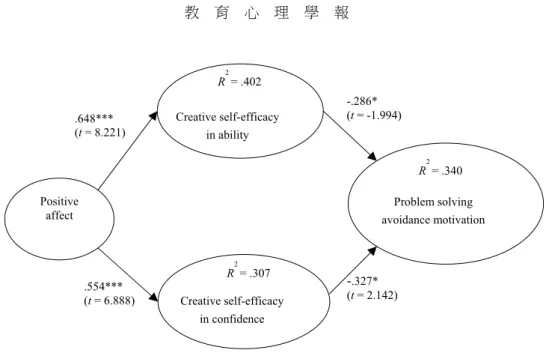
Figure 2 shows the path relation results among the hypotheses, and indicates support for Hypotheses 1 to 4. We can also see in Figure 1 that the relationship between Positive affect and Creative self-efficacy in ability was significant (β = -.648, t = -8.221, ***p < .001); Positive affect and Creative self-efficacy in confidence was significant (β = -.554, t = -6.888, ***p < .001); Creative self-efficacy in ability and Problem solving avoidance motivation was significant (β = -.286, t = -1.994, *p < .05); and finally Self-efficacy in confidence and Problem solving avoidance motivation was significant (β = -.327, t = 2.142, *p < .05). Hypotheses 1 and 2 were positively supported, but Hypotheses 3 and 6 were negatively supported.
Figure 1 Result of the research model
In Figure 1, we can see the path relationship results among the hypotheses, showing that Hypotheses 1 to 4 were all supported. Moreover, the Positive affect on Self-efficacy in ability was 40.2%; Positive affect on Self-efficacy in confidence was 30.7%; and Self-efficacy in ability and Self-efficacy in confidence on Problem solving avoidance motivation was 34%.
Discussion
The broaden-and-build theory (Fredrickson, 1998, 2001), which highlights individuals’ positive emotion, is a problem-focused approach when individuals face problems, and hypothesizes that they would study for a solution. Accordingly, the present study explored participants’ positive affect and how it correlated to two types of self-confidence reflected in problem-solving avoidance motivation in a vocational school design project. The results revealed that positive affect was positively related to self-efficacy in ability and confidence, and the two types of self-efficacy were negatively related to problem-solving avoidance motivation.
Positive affect can distract from a person’s sad experience and relieve their depressive state so that they can face and solve problems (Gomez et al., 2017; Nelis et al., 2016; Lo et al., 2013). Hanley and colleagues (2015) argued that positive reappraisal is positively associated with academic self-efficacy after a perceived failure. In project design, individuals need to understand the properties of the problem and the structure of all of the problems to find and integrate strategies to solve the problems (Mitchell & Walinga, 2017). An individuals’ affective state can directly influence his or her self-efficacy because personal mood could operate as a sign or information to judge ones’ capacities and confidence (Karwowski, 2011). Moreover, Bandura (1997) noted that one’s emotional state can influence one’s self-efficacy judgments in two ways, directly and indirectly. Consistent with the above assertions, H1 and H2 were positively supported.
Mitchell and Walinga (2017) pointed out that “creative problem solving combined with the holistic problem framing and unlocking qualities of insight problem solving opens a pathway for organizations seeking more radical and breakthrough solutions to solve problems” (p. 1872). Individuals with higher levels of self-efficacy make more efforts to face challenging problems, and are more likely to adopt productive problem-solving strategies (Pajares & Graham, 1999). How strong individuals' beliefs are
Positive affect .648*** (t = 8.221) .554*** (t = 6.888) -.327* (t = 2.142) -.286* (t = -1.994) Creative self-efficacy in confidence Creative self-efficacy in ability R2= .402 R2 = .307 R2 = .340 Problem solving avoidance motivation
about the efficacy of their behavior could play a role in determining whether they will try to cope with certain situations, indicating that self-efficacy and problem solving motivation are strongly correlated (Caldas et al., 2016). That is, having a high level of self-efficacy may in fact be problematic as it may result in reduced motivation and effort due to expecting to easily succeed (Vancouver & Kendall, 2006). However, in their meta-analysis of self-efficacy effects on work performance, Stajkovic and Luthans (1998) found that self-efficacy reduced and achievement motivation decreased with the increase in task complexity. The results of H3 and H4 seem to support Stajkovic and Luthans’ findings; the reason may be that advertising project design requires students to experience project underestimates, changes in idea or scope, unrealistic expectations, inappropriate methodology, and so on in the course of the design process (Cerpa & Verner, 2009; Jun et al., 2011). Their avoidance motivation could therefore be evoked.
Conclusion
Based on the mood-as-information model which states that individuals’ positive mood affects their cognitive processes in problem solving, this study firstly explored the levels of psychological traits and states, including positive affect, creative self-efficacy in ability, creative self-efficacy in confidence, and problem-solving avoidance motivation in digital advertisement design. Those Means of each construct indicated that only problem-solving avoidance motivation scored below average, while the Means of the other constructs presented above the average, revealing that the participants of this study had high levels of positive affect and CSE, and low avoidance of solving problems in digital advertisement design. Taken together, this study contributes an advanced understanding of separating two types of creative self-efficacy to explore their correlates, in comparison with most previous studies which took self-efficacy as a whole. Conclusively, supporting previous studies, for example Zimmerman (2000), which found that self-efficacy can positively predict students’ learning motivation, this study showed that when students have high levels of the two types of self-efficacy, their intention to avoid problem solving will be low.
Theoretical implications
The past research only discussed a single facet of creative self-efficacy. In contrast, in this study, creative self-efficacy was divided into creative self-efficacy in ability and self-efficacy in confidence. A comparison of the construct average of self-efficacy in ability to the construct average of self-efficacy in confidence indicated that there is a slight difference, implying that self-efficacy can be divided into ability and confidence constructs when examining creative design works. This result provides an advanced understanding of developing subcategories of self-efficacy for participants to self-rate their confidence and ability.
While project design in the school curriculum provides students with a dynamic goal of learning practical skills, this exercise captures the current school reality by stimulating creative ideas about how projects can be improved (e.g., Selby, Treffinger, & Isaksen, 2007; Treffinger, Isaksen, & Stead-Dorval, 2006). Motivation is considered to be vital for completing goal-directed activities (Spielberg et al., 2011), and is important for maintaining goal-directed behavior over an extended period of time (Dickinson & Balleine, 1994). In the past, most research related to the field of design education emphasized the theme of learners’ creativity and creative performance, but few studies having discussed avoiding motivation. This study provides a strong example of the importance of contextualized approaches to goal achievement motivation research by developing explanations that integrate a component of personal motivation with a design course in which students execute and coordinate their work.
Practical implications
The results of this study have implications for teaching practice. First, they indicate that teachers could benefit from focusing more on how personal traits affect specific design-relevant behaviors, particularly in contexts like those of vocational schools where some aspects of students’ hands-on design interest may be more germane than they are for general high school students. A related practical implication is the need for vocational teachers to consider how individual traits interact with aspects of design context. This may be particularly important for teachers deciding where to expend effort in developing positive affect. For instance, where previous research has shown that developing a strong positive affect should encourage experience sharing among all members, developing strong team social support will have an even stronger effect for those who have low positive affect.
A second practical implication is that teachers in vocational schools need to recognize that students may vary in their CSE. Findings suggest that bringing together students with varying levels of CSE and who place varying importance on the motivation to achieve design goals. For instance, the findings from this study show that people with high CSE are less likely to face challenging problems, those students with motivation avoidance who need to complete a project may have less motivation to continue improvement in design. Thus, meaningful design product sharing may be performed by those individuals who are perceived as being better at design that can be learned by those with high levels of motivation avoidance.
Limitations and future study
This study invited students majoring in advertisement design to participate, and found that, in general, the results supported the hypotheses of this study. Future studies may differentiate between gender, educational levels, and so on to understand what kinds of participants’ problem-solving motivation are impacted more in relation to positive affect and creative self-efficacy in different kinds of design projects. In addition, in this study, we emphasize the path relationship between emotion and cognition. The participants' learning performance is not included in the research model for analysis, but this part can be extended in the future.
Hong and colleagues (2016) reported that positive mood relevant to epistemic curiosity was reflected in students’ continuance intention for a hands-on making contest. Their study indicated that underlies contest in project design may enhance the mood in the design process. Therefore, future studies may apply different incentive schemes with contests to explore how they influence participants’ positive affect and creative self-efficacy.
Scientific ability related to solve science problems ((Lin, Lin, & Wu, 2018). As the present study divided creativity self-efficacy into confidence and ability to explore the correlates with advertisement performance, how scientific self-efficacy can serve two types of beliefs to investigate their relationships with solving science problem should be further studied. Moreover, to test the creative performance, by using used eye tracker can explore the problem-solving and creative process (Huang, Liu, & Chen, 2019), future study may apply eye tracker to identify how creative performance can be changed by self-efficacy. Finally, creativity include divergent thinking, insight, and remote association (Wu & Chen, 2019), how those psychological traits affect creative performance in advertisement does not distinct in this study, future study may identify the correlates between those reasoning ability and advertisement creativity.
Acknowledgement
This work was financially supported by the “Institute for Research Excellence in Learning Sciences” of National Taiwan Normal University (NTNU) from The Featured Areas Research Center Program
within the framework of the Higher Education Sprout Project by the Ministry of Education (MOE) in Taiwan.
References
Abbott, D. (2010). Constructing a creative self-efficacy inventory: A mixed methods inquiry (Doctoral dissertation). The University of Nebraska, Lincoln, NE.
Amabile, T. M. (1983). Social psychology of creativity: A componential conceptualization. Journal of
Personality and Social Psychology, 45, 357-377.
Astrachan, C. B., Patel, V. K., & Wanzenried, G. (2014). A comparative study of CB-SEM and PLS-SEM for theory development in family firm research. Journal of Family Business Strategy, 5(1), 116-128.
Bandura, A. (1986). Social foundations of thought and action: A social cognitive theory. Englewood Cliffs, NJ: Prentice-Hall.
Bandura, A. (1997). Self-efficacy: The exercise of control. W. H. Freeman and Company.
Bandura, A. (2010). Self‐efficacy. In I. B. Weiner, & W. E. Craighead (Eds.), The Corsini encyclopedia of
psychology (pp. 1-3). Hoboken, NJ: John Wiley & Sons, Inc.
Bandura, A. (2012). On the functional properties of perceived self-efficacy revisited. Journal of
Management, 38(1), 9-44.
Bartal, O. (2013). Text as image in Japanese advertising typography design. Design Issues, 29(1), 51-66. Boyle, M. P. (2018). The importance of self-efficacy for individuals who stutter. In B. J. Amster, & E. R.
Klein (Eds.), More than fluency: The social, emotional, and cognitive dimensions of stuttering (pp. 19-44). San Diego, CA: Plural Publishing, Inc.
Caldas, S. V., Broaddus, E. T., & Winch, P. J. (2016). Measuring conflict management, emotional self-efficacy, and problem solving confidence in an evaluation of outdoor programs for inner-city youth in Baltimore, Maryland. Evaluation and Program Planning, 57, 64-71.
Caprara, G. V., Giunta, L. D., Eisenberg, N., Gerbino, M., Pastorelli, C., & Tramontano, C. (2008). Assessing regulatory emotional self-efficacy in three countries. Psychological Assessment, 20, 227-237.
Cerpa, N., & Verner, J. M. (2009). Why did your project fail? Communication ACM, 52, 130-134. Chang, Y. S., Chen, M. Y. C., Chuang, M. J., & Chou, C. H. (2019). Improving creative self-efficacy and
performance through computer-aided design application. Thinking Skills and Creativity, 31, 103-111. http://doi.org/10.1016/j.tsc.2018.11.007
Chin, W. W. (1998). The partial least squares approach for structural equation modeling. In G. A. Marcoulides (Ed.), Modern methods for business research (pp. 295-336). Mahwah, NJ: Lawrence Erlbaum Associates.
Ching Sing, C., Liang, J. C., Tsai, C. C., & Dong, Y. (in press). Surveying and modelling China high school students’ experience of and preferences for twenty-first-century learning and their academic and knowledge creation efficacy. Educational Studies. http://doi.org/10.1080/03055698. 2019.1627662
Chiu, S. I, & Hong, F. Y. (2015). Examining a model of self efficacy, collective efficacy, and school effectiveness, and the moderating effects of collective efficacy in senior high school teachers and students. Bulletin of Educational Psychology, 46(3), 333-355. http://doi.org/10.6251/bep.20140611 Clark, L. A., & Watson, D. (1991). Tripartite model of anxiety and depression: Psychometric evidence
and taxonomic implications. Journal of Abnormal Psychology, 100, 316-336.
Darwin, S. (2007). The changing contexts of vocational education: Implications for institutional vocational learning. International Journal of Training and Research, 5(1), 55-71.
Dickinson, A., & Balleine, B. (1994). Motivational control of goal-directed action. Animal Learning &
Behavior, 22(1), 1-18.
Dietz, B. E., Carrozza, M., & Ritchey, P. N. (2003). Does financial self-efficacy explain gender differences in retirement saving strategies? Journal of Women & Aging, 15(4), 83-96.
Dissanayake, I., Mehta, N., Palvia, P., Taras, V., Amoako-Gyampah, K. (in press). Competition matters! Self-efficacy, effort, and performance in crowdsourcing teams. Information & Management. https://doi.org/10.1016/j.im.2019.04.001
Extremera, N., & Rey, L. (2016). Ability emotional intelligence and life satisfaction: Positive and negative affect as mediators. Personality and Individual Differences, 102, 98-101.
Folkman, S. (1997). Positive psychological states and coping with severe stress. Social Science &
Medicine, 45, 1207-1221.
Fornell, C. R., & Larcker, F. F. (1981). Structural equation models with unobservable variables and measurement error. Journal of Marketing Research, 18, 39-51.
Fredrickson, B. L. (1998). What good are positive emotions? Review of General Psychology, 2, 300-319. Fredrickson, B. L. (2001). The role of positive emotions in positive psychology: The broaden-and-build
theory of positive emotions. American Psychologist, 56(3), 218-226.
Funke, J. (2010). Complex problem solving: A case for complex cognition? Cognitive Processing, 11, 133-142.
Gerjets, P. H., & Hesse, F. W. (2004). When are powerful learning environments effective? The role of learner activities and of students’ conceptions of educational technology. International Journal of
Educational Research, 41(6), 445-465.
Gomez-Baya, D., Mendoza, R., Paino, S., & Gillham, J. E. (2017). A two-year longitudinal study of gender differences in responses to positive affect and depressive symptoms during middle adolescence. Journal of Adolescence, 56, 11-23.
Hair, J. F., Hult, G. T. M., Ringle, C., & Sarstedt, M. (2014). A primer on partial least squares structural
equation modeling (PLS-SEM). Thousand Oaks, CA: Sage.
Hair, J. F., Ringle, C. M., & Sarstedt, M. (2013). Partial least squares structural equation modeling: Rigorous applications, better results and higher acceptance. Long Range Planning, 46(1-2),1-12. Hancock, G. R., & Mueller, R. O. (2006). Structural equation modeling: A second course. Greenwich, CT:
Information Age Publishing.
Hanley, A. W., Palejwala, M. H., Hanley, R. T., Canto, A. I., & Garland, E. L. (2015). A failure in mind: Dispositional mindfulness and positive reappraisal as predictors of academic self-efficacy following failure. Personality and Individual Differences, 86, 332-337.
Hong, J. C., Hwang, M. Y., Szeto, E., Tai, K. H., & Tsai, C. R. (2016). Positive affect relevant to epistemic curiosity to reflect continuance intention to join a hands-on making contest. Eurasia
Journal of Mathematics, Science and Technology Education, 12(9), 2267-2279.
Huang, P. S., Liu, C. H., & Chen, H. C. (2019). Examining the applicability of representational change theory for remote associates problem-solving with eye movement evidence. Thinking Skills and
Creativity, 31, 198-208. http://doi.org/10.1016/j.tsc.2018.12.001
Hung, S.-P., Huang, H.-Y., & Lin, S.-S.-J. (2008). Do significant others’ feedback influence one’s creative behavior? Using structural equation modeling to examine creativity self-efficacy and creativity motivation mediation effect. Bulletin of Educational Psychology, 40(2), 303-322. (in Chinese) Hyde, J. S., Mezulis, A. H., & Abramson, L. Y. (2008). The ABCs of depression: Integrating affective,
biological, and cognitive models to explain the emergence of the gender difference in depression.
Psychological Review, 115, 291-313.
Iacobucci, D., & Churchill, G. A. (2010). Marketing research: Methodological foundation (10th ed.). New York: Dryden Press.
Isen, A. M., & Reeve, J. (2005). The influence of positive affect on intrinsic and extrinsic motivation: Facilitating enjoyment of play, responsible work behavior, and self-control. Motivation and
Ito, R., & Lee, A. C. H (2016). The role of the hippocampus in approach-avoidance conflict decision-making: Evidence from rodent and human studies. Behavioural Brain Research, 313, 345-357.
Jun, L., Qiuzhen, W., & Qingguo, M. (2011). The effects of project uncertainty and risk management on IS development project performance: A vendor perspective. International Journal of Project
Management, 29(7), 923-933.
Karwowski, M. (2011). Doesn’t hurt to ask . . . But sometimes it hurts to believe: Polish students’ creative self-efficacy and its predictors. Psychology of Aesthetics, Creativity, and the Arts, 5(2), 154-164.
Kline, R. B. (2015). Principles and practice of structural equation modeling (4th ed.). New York: Guilford publications.
Ladbury, J. L., & Hinsz, V. B. (2009). Uncertainty avoidance influences choices for potential gains but not losses. Current Psychology, 28 (3), 187-193.
Lai, Y.-C., Luh, W.-M., & Tung, Y.-Y. (2011). The effects of self-esteem, life goals, hope, and campus interpersonal relationships on the depressive mood of college students in Taiwan. Bulletin of
Educational Psychology, 2011, 42(4), 677-700. (in Chinese)
Lent, R. W., Ireland, G. W., Penn, L. T., Morris, T. R., & Sappington, R. (2017). Sources of self-efficacy and outcome expectations for career exploration and decision-making: A test of the social cognitive model of career self-management. Journal of Vocational Behavior, 99, 107-117.
Lin, H. H., Lin, S. H., & Wu, H. K. (2018). Developing and validating a constructed-response assessment of scientific abilities: A case of the optics unit. Journal of Research in Education Sciences, 63(1), 173-205. http://doi.org/10.6209/JORIES.2018.63(1).06
Lo, W.-E, Guu, M.-F., & Tseng, W.-C. (2013). Examining an experimental emotional training course for junior high school students. Bulletin of Educational Psychology, 44(3), 609-628. (in Chinese) Lunenburg, F. C. (2011). Self-efficacy in the workplace: Implications for motivation and performance.
International Journal of Management, Business, and Administration, 14(1), 1-6.
Luszczynska, A., Scholz, U., & Schwarzer, R. (2005). The general self-efficacy scale: multicultural validation studies. Journal of Psychology, 139(5), 439-457.
Mitchell, I. K., & Walinga J. (2017). The creative imperative: The role of creativity, creative problem solving and insight as key drivers for sustainability. Journal of Cleaner Production, 140(3), 1872-1884.
Mumford, M. D., Mobley, M. I., Reiter-Palmon, R., Uhlman, C. E., & Doares, L. M. (1991). Process analytic models of creative capacities. Creativity Research Journal, 4(2), 91-122.
Nelis, S., Bastin, M., Raes, F., Mezulis, A., & Bijttebier, P. (2016). Trait affectivity and response styles to positive affect: Negative affectivity relates to dampening and positive affectivity relates to enhancing. Personality and Individual Differences, 96, 148-154.
Ottenbreit, N. D., & Dobson, K. S. (2004). Avoidance and depression: the construction of the Cognitive-Behavioral Avoidance Scale. Behaviour Research and Therapy, 42(3), 293-313.
Pajares, F., & Graham, L. (1999). Self-efficacy, motivation constructs, and mathematics performance of entering middle school students. Contemporary Educational Psychology, 24, 124-139.
Sadler, J., Shluzas, L., Blikstein, P., & Katila, R. (2015). Building blocks of the maker movement: Modularity enhances creative confidence during prototyping. In H. Plattner, C. Meinel, & L. Leifer (Eds.), Design thinking research: Making design thinking foundational (pp. 141-154). Cham, CH: Springer.
Sarstedt, M., Ringle, C. M., Henseler, J., & Hair, J. F. (2014). On the emancipation of PLS-SEM: A commentary on Rigdon (2012). Long Range Planning, 47(3), 154-160.
Scherer, R., & Siddiq, F. (2015). Revisiting teachers’ computer self-efficacy: A differentiated view on gender differences. Computers in Human Behavior, 53, 48-57.
Schunk, D. H. (2012). Social cognitive theory. In K. R. Harris, S. Graham, & T. Urdan (Eds.), APA
educational psychology Handbook (Vol. 1, pp. 101-123). Washington, DC: American Psychological
Association.
Schunk, D. H., & DiBenedetto, M. K. (2016). Self-efficacy theory in education. In K. R. Wentzel, & D. B. Miele (Eds.), Handbook of motivation at school (pp. 34-54). New York, NY: Routledge.
Scott, M. D., Hauenstein, M. A., & Coyle, P. T. (2017). Measuring approach-avoidance motivation: Expanding dimensionality through implied outcomes. Personality and Individual Differences, 106, 312-324.
Selby, E. C., Treffinger, D. J., & Isaksen, S. G. (2007). VIEW: An assessment of problem solving style.
Technical manual (2nd ed.). Sarasota, FL: Center for Creative Learning.
Spielberg, J. M., Miller, G. A., Engels, A. S., Herrington, J. D., Sutton, B. P., Banich, M. T., & Heller, W. (2011). Trait approach and avoidance motivation: Lateralized neural activity associated with executive function. NeuroImage, 54(1), 661-670.
Stajkovic, A., & Luthans, F. (1998). Self-efficacy and work-related performance: A metaanalysis.
Psychological Bulletin, 124, 240-261.
Stanton, K., & Watson, D. (2014). Positive and negative affective dysfunction in psychopathology. Social
Sternberg, R. J. (2010). Teaching for creativity. In R. A. Beghetto, & J. C. Kaufman (Eds.), Nurturing
creativity in the classroom (pp. 394-414). New York, NY: Cambridge University.
Tierney, P., & Farmer, S. M. (2002). Creative self-efficacy: Its potential antecedents and relationship to creative performance. Academy of Management Journal, 45(6), 1137-1148.
Treffinger, D. J., Isaksen, S. G., & Stead-Dorval, K. B. (2006). Creative problem solving: An introduction (4th ed.). Waco, TX: Prufrock.
Tugade, M. M., & Fredrickson, B. L. (2007). Regulation of positive emotions: Emotion regulation strategies that promote resilience. Journal of Happiness Studies, 8(3), 311-333.
Van Rompay, T. J., De Vries, P. W., Bontekoe, F., & Tanja‐Dijkstra, K. (2012). Embodied product perception: Effects of verticality cues in advertising and packaging design on consumer impressions and price expectations. Psychology & Marketing, 29(12), 919-928.
Vancouver, F. B., & Kendall, L. N. (2006). When self-efficacy negatively relates to motivation and performance in a learning context. Journal of Applied Psychology, 91, 1146-1153.
Vande Zande, R. (2007). Design, form, and function in art education. Art Education, 60(4), 45-51. Wang, S., Zhang, X., & Martocchio, J. (2011). Thinking outside of the box when the box is missing: Role
ambiguity and its linkage to creativity. Creativity Research Journal, 23(3), 211-221.
Watson, D., Clark, L. A., & Tellegen, A. (1988). Development and validation of brief measures of positive and negative affect: The PANAS scales. Journal of Personality and Social Psychology,
54(6), 1063-1070.
Wu, C. L., & Chen, H. C. (2019). The influence of creativity on incongruity-resolution and nonsense humor comprehension. Creativity Research Journal, 31(1), 110-118. http://doi.org/10.1080/10400 419.2019.1577675
Yang, M.-J., & Chen, M.-H. (2011). Effect of altruism on the regulation of negative emotion. Bulletin of
Educational Psychology, 42(4), 701-718. (in Chinese)
Zimmerman, B. J. (2000). Self-efficacy: An essential motive to learn. Contemporary Educational
Psychology, 25, 82-91. 收 稿 日 期:2018 年 12 月 19 日 一稿修訂日期:2019 年 04 月 26 日 二稿修訂日期:2019 年 06 月 18 日 三稿修訂日期:2019 年 06 月 21 日 接受刊登日期:2019 年 06 月 25 日
國 立 臺 灣 師 範 大 學 教 育 心 理 與 輔 導 學 系 教育心理學報,2019,51 卷,2 期,321-339 頁