
場地獨立/場地依賴學習風格與高中生英語閱讀策略運用之研究 - 政大學術集成
212
0
0
全文
(2) A Study of FD/FI Learners’ Learning Styles and the Use of English Reading Strategies in EFL Senior High School. 立. A Master 治Thesis 政 Presented to 大. ‧ 國. 學. Department of English,. National Chengchi University. ‧. n. er. io. sit. y. Nat. al. Ch. engchi. i n U. v. In Partial Fulfillment of the Requirements for the Degree of Master of Arts. By Yung-ching Kao July, 2012.
(3) To My Beloved Parents, Wife and Son 獻給我親愛的爸爸媽媽、妻子及兒子 高正杉先生及高周純美女士 李玉芬小姐與高廷睿小朋友. 立. 政 治 大. ‧. ‧ 國. 學. n. er. io. sit. y. Nat. al. Ch. engchi. i. i n U. v.
(4) Acknowledgements. I would like to express my sincere gratitude to several people who helped me in the process of writing this thesis. First, I felt an immense gratitude to my thesis advisor, Dr. Chi-yee Lin, who spent a lot of time and efforts giving me numerous valuable advice and intellectual insights. Without his guidance, the completion of this thesis would be impossible.. 政 治 大. Gratitude is also extended to committee members, Dr. Ming-chung Yu and. 立. Dr. Chia-yi Lee for their insightful comments and suggestions about the content. ‧ 國. 學. and organization during the oral defense.. My sincere thanks are also extended to all the teachers in the ETMA. ‧. program of National Cheng-Chi University (NCCU), for their devoted instruction,. y. Nat. sit. profound inspiration, and teaching enthusiasm. Special thank goes to Dr.. n. al. er. io. Hsueh-ying Yu for her assistance and guidance in my presentation of the thesis,. i n U. v. and I really appreciate Dr. Chien-ching Mo for his effective instruction in reading comprehension.. Ch. engchi. Also, I would like to express my appreciation to all the colleagues, students, and my close friends, Huang Shu-pin and Ku Hsiu-yuan for their wholehearted support and assistance. Finally, I really appreciated China National Knowledge Infrastructure (CNKI) abundant in research resources for offering me the GEFT test paper designed by the Psychology Department of Beijing Normal University. After a two-year long laborious search I eventually acquired this GEFT test paper from CNKI. ii.
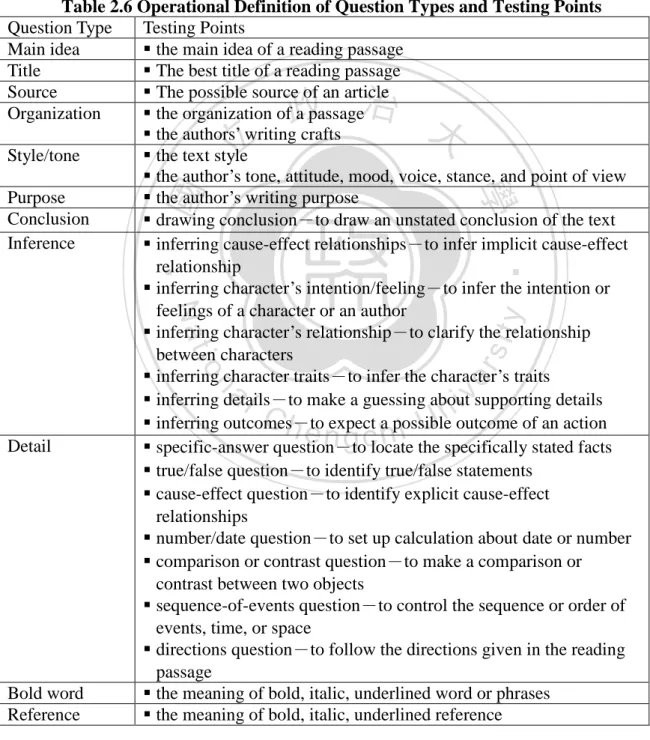
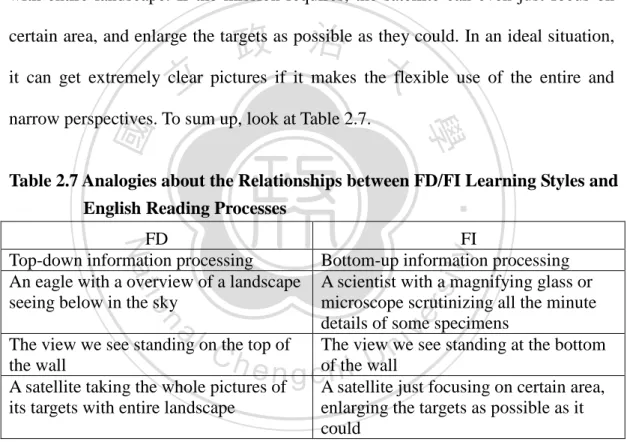
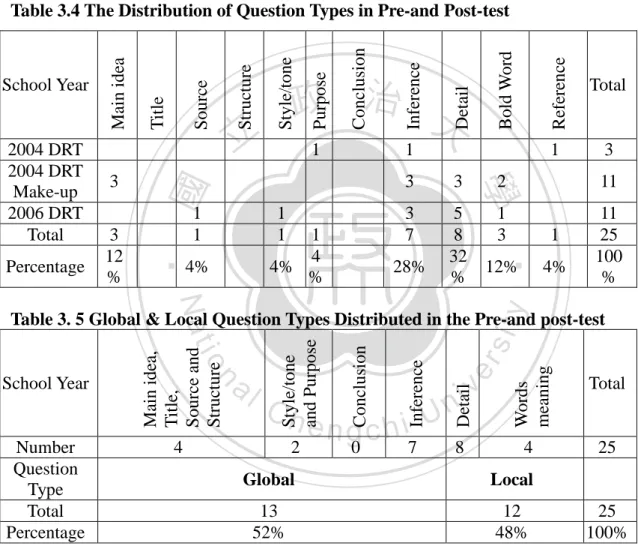
(5) Table of Contents Page. Dedication .................................................................................................... i Acknowledgements.....................................................................................ii Table of Contents .......................................................................................iii List of Tables ...........................................................................................viii List of Chart ............................................................................................... xi Chinese Abstract .......................................................................................xii English Abstract....................................................................................... xiv CHAPTER 1 INTRODUCTION....................................................................... 1. 政 治 大. 1.1 Background and Motivation ................................................................................... 1. 立. 1.2 Purpose of the Study ............................................................................................... 4. ‧ 國. 學. 1.3 Significance of the Study ........................................................................................ 4 1.4 Organization of the Thesis ...................................................................................... 5. ‧. y. Nat. CHAPTER 2 LITERATURE REVIEW......................................................... 7. io. sit. 2.1 FD/FI Learning Styles and Left/Right Brain Functioning ...................................... 7. n. al. er. 2.1.1 The Origin of FD and FI ............................................................................ 7. Ch. i n U. v. 2.1.2 FD/FI Learners’ Learning Styles ............................................................. 10. engchi. 2.1.3 Left/Right Brain Functioning ................................................................... 17 2.2 Global and Local Reading Strategies.................................................................... 19 2.3 Types of Reading Comprehension Questions ....................................................... 41 2.4 FD/FI learners’ Learning Styles and the Use of English Reading Strategies ....... 43 2.5 Research Questions ............................................................................................... 46. CHAPTER 3 METHODOLOGY ................................................................... 49 3.1 Participants............................................................................................................ 49 3.2 Instruments............................................................................................................ 50 3.2.1 Group Embedded Figure Test (GEFT) .................................................... 50 iii.
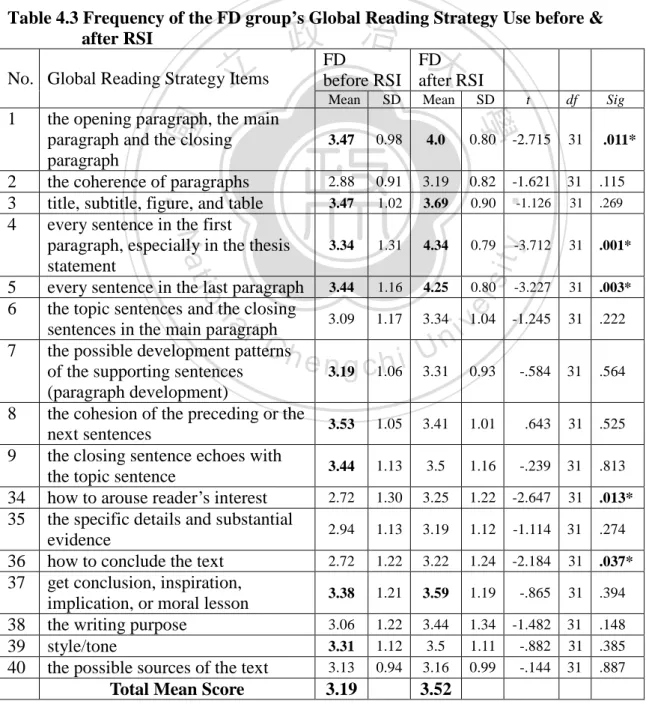
(6) 3.2.2 General English Proficiency Test (GEPT) .............................................. 53 3.2.3 Reading Strategy Questionnaire before & after RSI (Questionnaire I) ... 54 3.2.4 Reading Comprehension Test before & after RSI ................................... 55 3.2.5 An Analysis of Question Types of Reading Comprehension Test 1996~2011 ............................................................................................... 56 3.2.6 Students’ Responses to RSI (Questionnaire II) ....................................... 63 3.3 Procedure .............................................................................................................. 63 3.3.1 Pilot Study ............................................................................................... 65 3.3.2 Main Study .............................................................................................. 66. 政 治 大. 3.4 Data Analysis ........................................................................................................ 70. 立. CHAPTER 4 RESULTS .................................................................................... 73. ‧ 國. 學. 4.1 Research Question 1: How do FD/FI Learners Perform in English Reading Comprehension before and after Instruction? And Which Group of Learner. ‧. Benefit More from the Reading Strategy Instruction, FD Learners, or FI. sit. y. Nat. Learners? .................................................................................................... 73 4.1.1 How do FD/FI Learners Perform in English Reading Comprehension. io. n. al. er. before and after Instruction? .................................................................... 73. Ch. i n U. v. 4.1.2 Which Group of Learner Benefit More from the Reading Strategy. engchi. Instruction, FD Learners, or FI Learners? ............................................... 74 A Summary of Responses to Research Question 1 .......................................... 74 4.2 Research Question 2: How frequently do FD/FI Learners use different reading strategies before and after instruction? ...................................................... 75 4.2.1 Frequency of the FD group’s Global Reading Strategy Use before & after RSI ........................................................................................................... 75 4.2.2 Frequency of the FD group’s Local Reading Strategy Use before & after RSI ........................................................................................................... 77 4.2.3 Frequency of the FI group’s Global Reading Strategy Use before & after RSI ........................................................................................................... 79. iv.
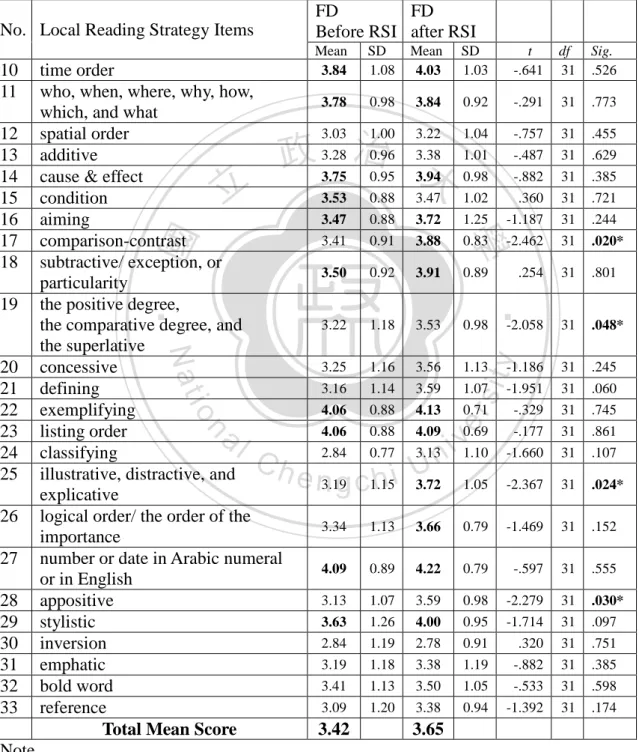
(7) 4.2.4 Frequency of the FI group’s Local Reading Strategy Use before & after RSI ........................................................................................................... 80 A Summary of Responses to Research Question 2 ........................................... 83 4.3 Research Question 3: How do FD/FI Learners perform in reading comprehension question types before and after instruction: the main idea, the best title, possible source, organization, style/tone, writing purpose, conclusion, inference, specific detail, bold word and reference? .................................. 88 4.3.1 The FD Group’s Performance in Question Types before RSI ................. 89 4.3.2 The FI Group’s Performance in Question Types before RSI .................. 90 4.3.3 The FD Group’s Performance in Question Types after RSI .................... 93. 政 治 大. 4.3.4 The FI Group’s Performance in Question Types after RSI .................... 94. 立. A Summary of Responses to Research Question 3 ......................................... 97. ‧ 國. 學. 4.4 Research Question 4: How well do FD/FI Learners perceive the effectiveness of the reading strategy instruction? ...................................................................... 98. ‧. 4.4.1 Students’ Responses to the Effects of RSI on Reading Strategies Use ... 99. sit. y. Nat. 4.4.2 Students’ Responses to the Effects of RSI on Writing ............................ 99. io. al. er. 4.4.3 Students’ Responses to the Future Classes on RSI ................................ 100. n. 4.4.4 Students’ Responses to the Most Beneficial Global Reading Strategies in. Ch. i n U. v. RSI ......................................................................................................... 101. engchi. 4.4.5 Students’ Responses to the Most Beneficial Local Reading Strategies in RSI ......................................................................................................... 102 4.4.6 Students’ Responses to the Most Difficult Global Reading Strategies in RSI ......................................................................................................... 105 4.4.7 Students’ Responses to the Most Difficult Local Reading Strategies in RSI ................................................................................................................ 106 4.4.8 Students’ Responses to FD/FI Learning Style Instruction in RSI ......... 108 A Summary of Responses to Research Question 4 ......................................... 110 A Grand Summary of the Description of Each Reading Strategy Used by FD/FI ... 113. v.
(8) CHAPTER 5 CONCLUSION AND DISCUSSION ............................... 125 5.1 Discussion of the Major Findings ....................................................................... 125 5.1.1 The Effects of RSI on Students’ Reading Comprehension ................... 125 5.1.2 The Effects of RSI on FD/FI Students’ Reading Strategy Use before and after RSI ................................................................................................. 128 5.1.3 Students’ Performance in Each Question Type ..................................... 131 5.1.4 Students’ Feedbacks on the Effect of RSI ............................................. 133 5.2 Pedagogical Implications.................................................................................... 143 5.3 Limitations of this Study and Suggestions for Future Research ........................ 144. 政 治 大. REFERENCES .................................................................................................... 147. 立. ‧ 國. 學. APPENDIXES. A. A Statistics on the Text and Word Number in Reading Comprehension Test (JCEE,. ‧. RE, GSAT, and DRT) 1996 ~ 2011 .......................................................... 155 B. Questionnaire I-Reading Strategies Questionnaire (English Version) .............. 158. y. Nat. io. sit. C. Cooperative Teaching Plan .................................................................................. 162. n. al. er. D. Group Embedded Figure Test (GEFT) ................................................................ 164. i n U. v. E. The Results of General English Proficiency Test (GEPT)................................... 165. Ch. engchi. F. Questionnaire I-Reading Strategies Questionnaire (Chinese Version) ............. 166 G. Cronbach’s Alpha ................................................................................................ 169 H. Reading Comprehension Test (Pre-test & Post-test) ........................................... 170 I. Question Types of Reading Comprehension Tests1996 ~ 2011 ........................... 177 J. Questionnaire II-Responses to RSI and FD/FI Learning Style Instruction ........ 191 K. The Original Data of the FD Group's Answers in Pre-test .................................. 196 L. The Original Data of the FI Group's Answers in Pre-test .................................... 197 M. The Original Data of the FD Group's Answers in Post-test ................................ 198 N. The Original Data of the FI Group's Answers in Post-test .................................. 199. vi.
(9) O. The Original Data of the FD Group's Responses to Questionnaire I before RSI 200 P. The Original Data of the FI Group's Responses to Questionnaire I before RSI... 201 Q. The Original Data of the FD Group's Responses to Questionnaire I after RSI ... 202 R. The Original Data of the FI Group's Responses to Questionnaire I after RSI ..... 203 S. The Original Data of the FD Group's Responses to Questionnaire II after RSI... 204 T. The Original Data of the FI Group's Responses to Questionnaire II after RSI .... 205 U. The Original Data of the FD Group's Responses to the Beneficial Global & Local Reading Strategies in Questionnaire II ............................................................... 206 V. The Original Data of the FI Group's Responses to the Beneficial Global & Local. 政 治 大 W. The Original Data of the FD Group's Responses to the Difficult Global & Local 立 Reading Strategies in Questionnaire II ............................................................... 208 Reading Strategies in Questionnaire II ............................................................... 207. ‧ 國. 學. X. The Original Data of the FI Group's Responses to the Difficult Global & Local Reading Strategies in Questionnaire II ............................................................... 209. ‧. n. er. io. sit. y. Nat. al. Ch. engchi. vii. i n U. v.
(10) List of Tables. Table 2.1 A Dichotomy of the FD/FI Learners’ Characteristics ................................ 12 Table 2.2 Left- and Right- brain Characteristics ........................................................ 18 Table 2.3 Classifications of Global and Local Reading Strategies ............................ 22 Table 2.4 Organization and Content in a Text............................................................ 26 Table 2.5 Paragraph Development/ Organization Pattern/ Rhetorical Structure........ 39 Table 2.6 Operational Definition of Question Types and Testing Points .................. 42 Table 2.7 Analogies about the Relationships between FD/FI Learning Styles and. 政 治 大 Table 3.1 Results of GEFT ......................................................................................... 52 立 English Reading Processes .......................................................................... 45. ‧ 國. 學. Table 3.2 The Ratio of FD Boys to FD Girls and the Ratio of FI Boys to FI Girls ... 53 Table 3.3 Results of GEPT in Independent Sample T-test ......................................... 54. ‧. Table 3.4 The Distribution of Question Types in Pre-and Post-test ........................... 56. sit. y. Nat. Table 3.5 Global & Local Question Types Distributed in the Pre-and Post-test ....... 56 Table 3.6 A Statistics of Question Types of Reading Comprehension Test (JCEE, RE,. io. n. al. er. GSAT, and DRT) 1996~2011 ..................................................................... 59. Ch. i n U. v. Table 3.7 A Summary of Statistics on Question Types of Reading Comprehension. engchi. Tests (JCEE, RE, GSAT, and DRT) 1996~2011 ........................................ 61 Table 3.8 An Integration of Question Types of Reading Comprehension Tests (JCEE, RE, GSAT, and DRT) 1996~2011 into Several Categories........................ 62 Table 3.9 Global and Local Question Types on Statistics of Reading Comprehension Tests (JCEE, RE, GSAT, and DRT) 1996~2011 ........................................ 62 Table 3.10 A Schedule for the Pilot Study and the Main Study................................. 67 Table 4.1 Results of the Paired Samples T-test in the Pre-and Post-test with FD and FI Groups ......................................................................................................... 73 Table 4.2 Results of the Independent Sample T-test in the Pre-and Post-test with FD and FI groups .............................................................................................. 74. viii.
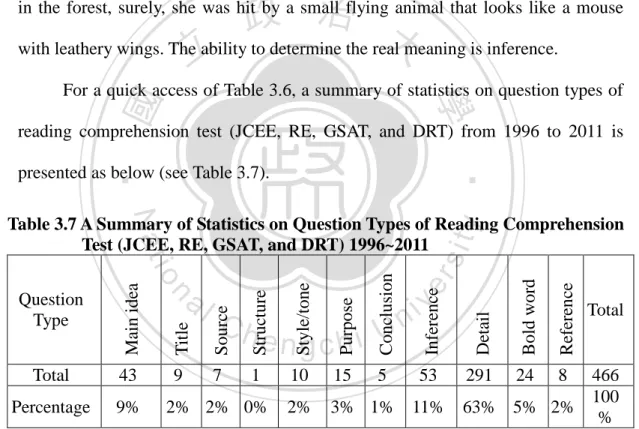
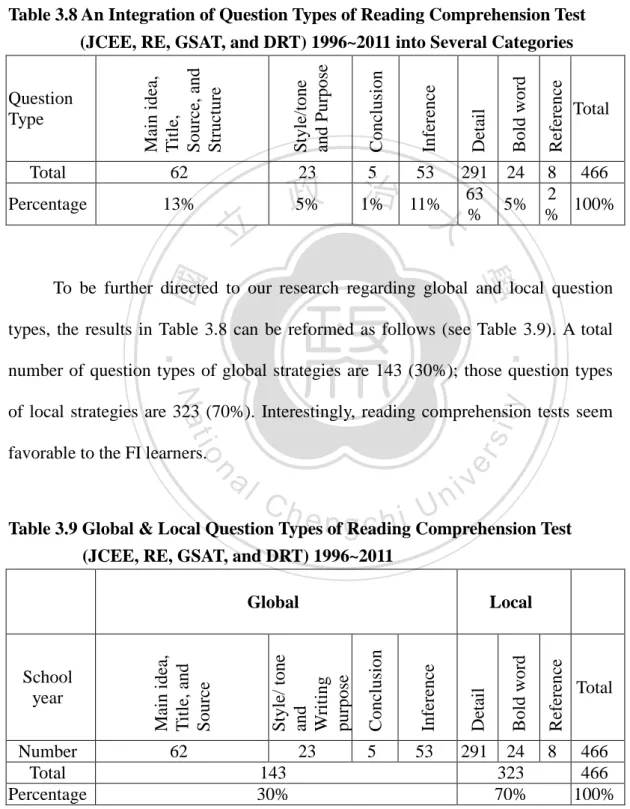
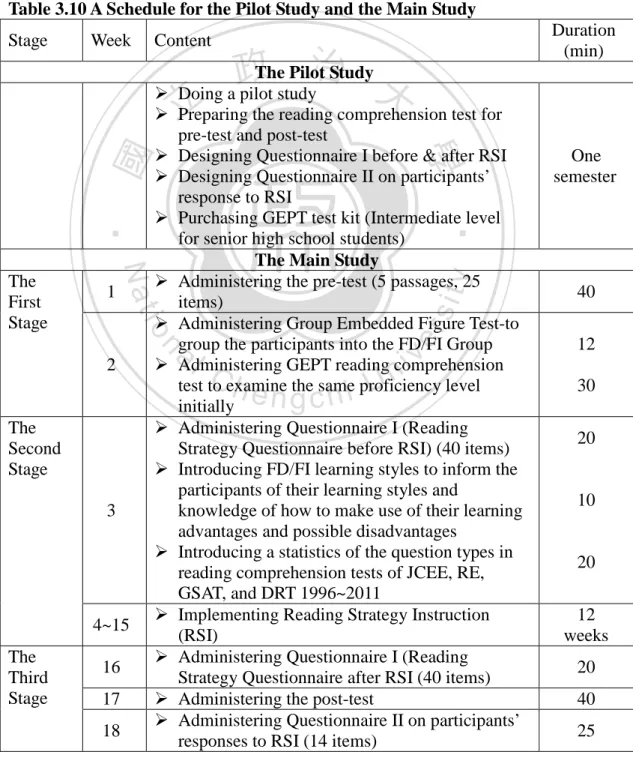
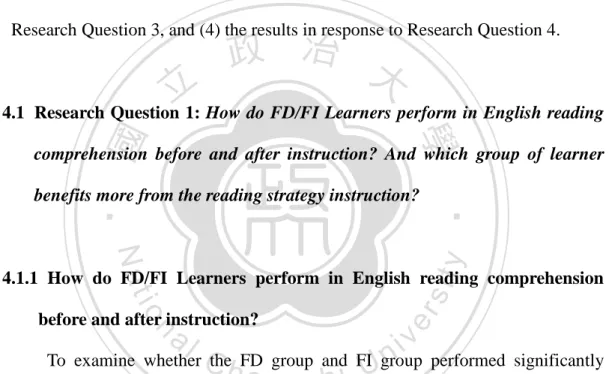
(11) Table 4.3 Frequency of the FD group’s Global Reading Strategy Use Before & after RSI ............................................................................................................... 76 Table 4.4 Frequency of the FD group’s Local Reading Strategy Use Before & after RSI ..................................................................................................................... 78 Table 4.5 Frequency of the FI group’s Global Reading Strategy Use before & after RSI ..................................................................................................................... 81 Table 4.6 Frequency of the FI group’s Local Reading Strategy Use before & after RSI ..................................................................................................................... 82 Table 4.7 A Comparison of Significantly Different Global/Local Reading Strategies Used by FD/FI Groups before/after RSI ................................................... 84. 政 治 大 Reading Strategies in the Identical Items after RSI 立. Table 4.8 (A) FD and FI Groups Used the Significantly Different Global/Local ........................... 85. ‧ 國. 學. Table 4.8 (B) FD and FI Groups Used the Significantly Different Global/Local Reading Strategies in the Different Items after RSI ........................... 85. ‧. Table 4.9 Frequently Used Global/Local Reading Strategies by the FD/FI Groups before/after RSI ........................................................................................... 86. y. Nat. sit. Table 4.10 (A) The FD and FI Groups Most Frequently Used the “Same” Items in. er. io. Global/Local Reading Strategies before RSI ..................................... 87. al. n. v i n CReading Global/Local after RSI ........................................ 87 h e n Strategies gchi U. Table 4.10 (B) The FD and FI Groups Most Frequently Used the “Same” Items in. Table 4.11 (A) The FD and FI Groups Most Frequently Used the “Different” Items in. Global/Local Reading Strategies before RSI ..................................... 88 Table 4.11 (B) The FD and FI Groups Most Frequently Used the “Different” Items in Global/Local Reading Strategies after RSI ........................................ 88 Table 4.12 (A) A Statistics of the Pre-test Question Types in the Sequential Order for the FD Group before RSI ................................................................... 89 Table 4.12 (B) A Statistics of the Pre-test Global & Local Question Types for the FD Group before RSI ............................................................................... 89 Table 4.12 (C) A Sum-up Statistics of the Pre-test Global & Local Question Types for the FD Group before RSI ................................................................... 90 ix.
(12) Table 4.13 (A) A Statistics of the Pre-test Question Types in the Sequential Order for the FI Group before RSI .................................................................... 90 Table 4.13 (B) A Statistics of the Pre-test Global & Local Question Types for the FI Group before RSI............................................................................... 91 Table 4.13 (C) A Sum-up Statistics of the Pre-test Global & Local Question Types for the FI Group before RSI .................................................................... 91 Table 4.13 (D) A Sum-up Statistics of the Pre-test Global & Local Question Types for the FI Group....................................................................................... 92 Table 4.14 (A) A Statistics of the Post-test Question Types in the sequential Order for the FD Group after RSI ..................................................................... 93. 政 治 大 Group after RSI ................................................................................. 93 立. Table 4.14 (B) A Statistics of the Post-test Global & Local Question Types for the FD. ‧ 國. 學. Table 4.14 (C) A Sum-up Statistics of the Post-test Global & Local Question Types for the FD Group after RSI ..................................................................... 94. ‧. Table 4.15 (A) A Statistics of the Post-test Question Types in the sequential Order for the FI Group after RSI ....................................................................... 94. y. Nat. sit. Table 4.15 (B) A Statistics of the Post-test Global & Local Question Types for the FI. er. io. Group after RSI ................................................................................. 95. al. n. v i n C...................................................................... the FI Group after RSI. 95 hengchi U. Table 4.15 (C) A Sum-up Statistics of the Post-test Global & Local Question Types for. Table 4.15 (D) A Sum-up Statistics of the Pre-test Global & Local Question Types for the FI Group before RSI .................................................................... 96 Table 4.16 A Sum-up Statistics of the Pre-and Post-test to the FD/FI Groups in Each Question Types ......................................................................................... 97 Table 4.17 Students’ Responses to the Effects of RSI on Reading Strategy Use ...... 99 Table 4.18 Students’ Responses to the Effects of RSI on Writing ........................... 100 Table 4.19 Students’ Responses to the Future Classes on RSI ................................ 100 Table 4.20 Students’ Responses to the Most Beneficial Global Reading Strategies in RSI .......................................................................................................... 102. x.
(13) Table 4.21 Students’ Responses to the Most Beneficial Local Reading Strategies in RSI .......................................................................................................... 103 Table 4.22 Students’ Responses to the Most Difficult Global Reading Strategies in RSI ................................................................................................................. 106 Table 4.23 Students’ Responses to the Most Difficult Local Reading Strategies in RSI ................................................................................................................. 107 Table 4.24 Students’ Responses to FD/FI Learning Style Instruction in RSI .......... 109 Table 4.25 The Most Beneficial Global/Local Reading Strategies by the FD/FI Groups ................................................................................................................. 110 Table 4.26 The Least Beneficial Global/Local Reading Strategies by the FD/FI Groups. 政 治 大. ................................................................................................................. 111. 立. Table 4.27 Six of the Most Difficult Global/Local Reading Strategies by the FD/FI. ‧ 國. 學. Groups ..................................................................................................... 112 Table 4.28 Six of the Easiest Global/Local Reading Strategies by the FD/FI. ‧. Groups………………………………………………..............................112 Table 4.29 A Grand Summary of the Description of Each Reading Strategy Used by. y. Nat. sit. FD/FI ......................................................................................................... 114. n. al. er. io. Table 5.1 Pattern of Narration-Time Order............................................................ 140. i n U. v. Table 5.2 Pattern of Description-Spatial Order...................................................... 140. Ch. engchi. Table 5.3 Pattern of Exposition: Induction and Deduction-Induction or Deduction ... ................................................................................................................... 140 Table 5.4 Table 2.7 Pattern of Argumentation-Logical Order ............................... 141. List of Charter Chart 3.1 Research Procedure ..................................................................................... 64. xi.
(14) 國立政治大學英國語文學系碩士在職專班 碩士論文提要 論文名稱:場地獨立/場地依賴學習風格與高中生英語閱讀策略運用之研究 指導教授:林啟一博士 研究生:高永欽. 本研究的目的是透過閱讀策略的教學,探討場地依賴/場地獨立學習風格與 高中生閱讀策略使用的關係。研究對象是 75 位桃園縣二所高中三年級的學生。 主要研究工具包括:用以測量學生學習風格的鑲嵌圖形測驗、了解起始點是否 一致的全民英檢中級閱讀測驗及一份用於前、後測的閱讀理解測驗,以及一份. 政 治 大 用來瞭解學生在教學前後閱讀策略使用改變情形的閱讀策略問卷,最後進行一 立 份教學後回饋問卷以了解學生對於此實驗教學的態度及觀感。 ‧. ‧ 國. 學. 研究過程分為三個階段。第一階段:執行閱讀測驗前測及閱讀策略問卷前 測。閱讀測驗前測是為了瞭解受試者起始點的語言程度;閱讀策略問卷前測則是 為了瞭解不同學習風格的學生,在實驗教學前閱讀策略的使用情形;第二階段: 實施場地依賴/場地獨立學習風格教學、閱讀策略教學、85 年至 100 年歷屆學測 及指考閱讀測驗題型分析與練習。場地依賴/場地獨立學習風格教學是為了介紹 學習風格並讓學生瞭解自己學習風格的優勢與侷限;閱讀策略教學的目的是為 了介紹整體型及局部型的閱讀策略,讓學生瞭解在實際的閱讀過程中有那些策 略可供運用;85 年至 100 年歷屆閱讀測驗題型分析是為了讓學生掌握閱讀測驗 的考題趨勢,練習是要讓學生熟悉使用這些閱讀策略;第三階段:執行閱讀測 驗後測、閱讀策略問卷後測及教學回饋問卷。閱讀測驗後測是為了瞭解實驗教 學的成效;閱讀策略問卷後測是為了瞭解不同學習風格的學習者,在經過十八週 的閱讀策略教學後,在整體型及局部型的那些閱讀策略使用上產生顯著的差異; 教學回饋問卷則是為了進一步了解學生對於閱讀策略教學之觀感並尋求教學改 進上的建議。 根據研究結果,主要的發現如下: (1) 此「閱讀策略教學」實驗,對場地依賴與場地獨立學習者的英語閱讀理解 成績皆有正面影響;場地獨立學習者較場地依賴學習者進步尤為顯著。 (2) 不同的學習風格確會造成學習者在整體型及局部型閱讀策略上使用的不 同。經過「閱讀策略教學」後,[相同之處]-在閱讀策略的使用:注意引 言段、主要論述段及結論段、注意第一段的每一句話(特別是主旨陳述)、 注意最後一段的每一句話以瞭解篇章內容、注意作者如何撰寫第一段以引 起讀者興趣及注意出現同位語之處,無論是場地依賴或場地獨立的學習. n. er. io. sit. y. Nat. al. Ch. engchi. xii. i n U. v.
(15) 者,都出現顯著性的閱讀策略使用改變。[相異之處]-場地依賴學習風格 的學習者,在運用整體型閱讀策略:注意作者如何撰寫最後一段,及在運 用局部型閱讀策略:注意有無表達比較或對照、注意有無表達原級、比較 級或最高級、注意有無表達說明、解釋或換言之的閱讀策略使用上,表現 不同於場地獨立學習風格的學習者;而場地獨立學習風格的學習者,在運 用整體型閱讀策略:注意作者的寫作目的、注意表達作者風格、語調、態 度、立場或觀點之處、注意推斷出文章可能的來源及出處,及在運用局部 型閱讀策略:注意有無表達方位順序、注意有無表達讓步、注意出現特殊 體例之處、注意出現倒裝句、注意出現加強語氣之處的閱讀策略使用,表 現不同於場地依賴學習風格的學習者。 (3) 不同的學習風格確會影響學習者在不同閱讀測驗題型上的表現。在「閱讀 策略教學」後,場地依賴學習風格的學習者,在運用整體型閱讀策略:文 章風格/作者態度、推論題型,以及在運用局部型閱讀策略:粗體單字題型 上表現較佳;而場地獨立學習風格的學習者,則在運用整體型閱讀策略: 主旨題、作者的寫作目的,以及在運用局部型閱讀策略的細節題及指涉題 型上表現較佳。 (4) 在接受「閱讀策略教學」後,無論是場地依賴或場地獨立,大部份的受試 者都給予正面肯定的評價;對閱讀較有信心;對長篇文章不再那麼畏懼; 對於場地依賴/場地獨立學習風格的教學普遍認同。然對於「閱讀策略教學」 在英文寫作上的助益,贊成者與態度保留者幾占各半比率;對於學習風格 的教學時機因大考在即,多持謹慎保留態度。受試者也表達了他們對於最 有幫助及最困難的整體型及局部型閱讀策略的看法。 根據本研究的發現,研究者在文末提出數點教學建議及未來相關研究方向。. 立. 政 治 大. ‧. ‧ 國. 學. n. er. io. sit. y. Nat. al. Ch. i n U. v. 關鍵字: 學習風格、場地獨立、場地依賴、閱讀策略. engchi. xiii.
(16) Abstract. The present study aims to probe into the relationship between FD/FI learning styles and reading strategy use through RSI. Seventy five students of two 12th-grade senior high school classes in Tao-Yuan County were selected as one field dependent (FD) group and one field independent (FI) group. Five instruments were used: Group Embedded Figure Test (GEFT), General English Proficiency Test (GEPT), a reading strategy questionnaire (Questionnaire I), a pre-and post-test, and a students’ responses questionnaire (Questionnaire II). Research procedures are divided into three major stages. At the first stage, Reading Comprehension Test and Questionnaire I before RSI were conducted. Reading Comprehension Test is to understand the subjects’ language proficiency on the initial stage. Questionnaire I is employed to check out student’s reading strategy use before RSI; At the second stage, FD/FI learning styles’ instruction, RSI, and an analysis and practices of the GSAT/DRT reading comprehension tests in the JCEE from 1996 to 2011 were executed. FD/FI learning style instruction is to make students understand learning styles and be aware of their learning styles’ tendencies and possible limitations. RSI is to introduce global and local reading strategies to students. The analysis of the reading comprehension tests of the GSAT/DRT in the. 立. 政 治 大. ‧. ‧ 國. 學. n. al. er. io. sit. y. Nat. JCEE from 1996 to 2011 is to have students grasp the JCEE’s reading testing trends. The practices are to familiarize students with using these global and local reading strategies. At the third stage, Reading Comprehension Test after RSI, Questionnaire I after RSI, and Questionnaire II were carried out. Reading Comprehension Test after reading strategy instruction (RSI) is to examine the teaching effectiveness of RSI. Questionnaire I after RSI is to see if there is any significant difference in reading strategy use by the FD/FI groups before and after RSI. Questionnaire II is to draw participants’ feedbacks on RSI and seek pedagogical suggestions. Major findings are summarized as follows. (1) There were significant differences between the FD group and the FI group in the pre-test and post-test. The FD group performed better than the FI group both before and after RSI; however, the FI group improved better than the FD group after RSI. (2) Different FD/FI learning styles affected the use of global and local reading strategies. After RSI, the FD and FI groups used the significantly different global/local reading strategies in the “identical” items [see Table 4.8 (A), p.81]. in addition, the FD and FI groups used the significantly different global/local reading strategies in the “different” items [see Table 4.8 (B)].. Ch. engchi. xiv. i n U. v.
(17) (3) Different FD/FI learning styles virtually affected learners’ performance in different reading question types. After RSI, the FD group performed better than the FI group in the global question types “style/tone,” “inference,” and in the local question type “bold word,” while the FI group performed better than the FD group in the global question types “the main idea,” “writing purpose,” and in the local question types “detail” and “reference.” (4) Most students considered RSI useful, giving positive responses to this Reading Strategy Instruction (RSI) and learning style instruction. They were not so afraid of reading lengthy passages and became more confident. Half of the students agree with the effectiveness of RSI on writing, while another half of them held a conservative attitude towards that of RSI due to the upcoming General Scholastic Ability Test (GSAT). The most beneficial and difficult reading strategies were also discussed about students’ responses. Based on the findings of this study, some implications were provided and several suggestions for future studies were offered at the end of this thesis.. 學. ‧ 國. 立. 政 治 大. Key words: learning style, FD, FI, reading strategies. ‧. n. er. io. sit. y. Nat. al. Ch. engchi. xv. i n U. v.
(18) 1. CHAPTER 1 INTRODUCTION. The introduction consists of four parts: (1) background and motivation; (2) the purpose of the study; (3) the significance of the study, and (4) the organization of the thesis.. 立. 政 治 大. 1.1 Background and Motivation. ‧ 國. 學. Undoubtedly, students have a lot of differences. Town (2003) noted that physical differences such as height, facial characteristics and tone of voice, are the. ‧. most obvious ones. It is also observable in the class that some students around us are. y. Nat. sit. good at memorizing something, while others think of memorizing as boring, good at. n. al. er. io. analyzing or thinking inherently, instead. Some are specialized in arts, literature,. i n U. v. history and language learning, while others are interested in science, physics,. Ch. engchi. chemistry, engineering, and the like. Some pay close attention to the lectures teachers give, take note of what their teacher says and everything on the blackboard, while others may be absent-minded or day-dreaming even though they are in class. Some may be more concentrated but slow-witted, while others speak more actively in response to teacher’s questions. Some may look “indifferent, cold, and distant” (Richard & Stephen, 1998, p.2), while others are friendly, sensitive and sociable. Understanding all these differences can be a prerequisite for recognizing the existence of individual learner differences among students, which may directly or indirectly influence their learning outcomes since learners will bring several.
(19) 2. individual characteristics to their learning process. The better researchers understand learner’s differences, the more constructive and facilitative instructions researchers can provide. That is the reason why the present study attempts to concentrate on the individual differences, in learning styles in the educational context (Brown, 2000) to probe into their relations to language learning and teaching. Reading comprehension has always been of great concern in the academic community. Tsao (1992) observed two great shortcomings of reading instructions in Taiwan. The first one is the incapability of fostering, developing and cultivating. 政 治 大 pay so close attention to the words in detail, or overanalyze the sentence structures, 立. students’ autonomous or independent reading habits. The second one is that students. ‧ 國. 學. as to miss the “main ideas” or the “central thoughts” of the text. That is, they only read word for word and phrase by phrase without reading lexical chunks. They. ‧. cannot make an educated guess for the real meanings by using the context and their. sit. y. Nat. background knowledge. These dilemmas they encountered come as a result of our. n. al. er. io. traditional examination-oriented learning environments, i.e., learning not for information and pleasure, but exams.. Ch. engchi. i n U. v. Too caring about the scores deprives them of the pleasure of reading and they are naturally and inevitably being directed to the details. That is, they read bits and pieces, word for word, and sentence by sentence. They cannot help striving to keep everything in mind, and definitely, the time for reading comprehension and getting the “whole” picture of the article is occupied. They just see “the trees,” but lose “the entire fascinating and marvelous forest.” They unconsciously adopt the so-called “riot learning,” instead of “meaningful learning” (Anderson & Ausubel 1965, cited by Brown, 2000). It is natural and habitual for them to be led to read the text in an analytic way. This is one kind of the characteristics of the FI learner’s.
(20) 3. learning style, tending to be attentive to details, and processing information in parts (Riding & Rayner, 1998). In a sense, while reading they are too clear-cut and too demanding learners without any ambiguity tolerance (Brown, 2000). They can’t stand up with any vague, uncertain, ambiguous contexts, situations or surroundings as long as they come across some unfamiliar words or complex structures. Apart from the above unfavorable learning phenomenon, another trend should be noticed that the reading workload for test-takers has recently been increased (see Appendix A). According to a statistics on the word numbers in the. 政 治 大 the average word numbers of the reading passages are increasing. The average word 立. reading comprehension tests from 1996 to 2011 (words in question items included),. ‧ 國. 學. number of the reading passage was 377 from 1996 and 2001; 420 words from 2002 and 2006, and close to 450 words from 2007 and 2011. Apparently, the requirement. ‧. of the reading test is getting more and more demanding. Students should not only. sit. y. Nat. increase their reading speed but enhance their skills in reading comprehension.. n. al. er. io. Simply put, reading is no longer an exciting, thrilling, inviting and intoxicating. v. adventure of “a psychological guessing game” (Goodman, 1967, p.497). It is more. Ch. engchi. i n U. like crawling into the swamp for those learners who are accustomed to reading word for word and sentence by sentence. This experience turns out to be a kind of slow, slimy, unpleasant, strenuous, painstaking, and grueling ordeal (Tsao, 1992). However, if FI and FD learners are given particular treatment as done in this thesis, FI learners could understand FD learners’ learning advantages that could be complementary to FI learners’ disadvantages, and vice versa. Just take FI for instance, after the treatment, they are able to learn to perceive or interpret information as a whole. They will no longer pay too much attention to details. They can avoid being caught on the spot. They will get the literal meanings, and simultaneously read between the lines..
(21) 4. They can get the implying meaning, read beyond the surface of the text, and further appreciate more valuable information the text conveyed.. 1.2 Purpose of the Study The purpose of the present research was first to examine the effects of reading strategy instruction (RSI) on both FD and FI groups. Accordingly, the researcher designed a teaching program in reading strategies, including global and local reading strategies. The researcher also intended to find out an overall picture of FD/FI. 政 治 大 instruction. Besides, through a careful analysis of reading comprehension test from 立. learners’ most frequently used global & local reading strategies before and after the. ‧ 國. 學. 1996 to 2011, the researcher aimed to probe into reading question types, and further examine the relations between FD/FI learners and their performance in each question. ‧. type. In addition, students’ responses to the instruction were to be explored.. sit. y. Nat. n. al. er. io. 1.3 Significance of the Study. v. This study may serve as a practical guide and pave a feasible teaching and. Ch. engchi. i n U. learning way for either teachers or students. That is, teachers and students may benefit from the results and implications of this research. From a teaching perspective, this study will provide teachers with a better understanding of individual differences in the use of reading strategies. Then through teachers’ reading strategy instruction, students would be able to tackle most of the reading problems, knowing how to read independently, how to tackle numerous unfamiliar words in the context, how to pay close attention to some details, and how to get the gist of a text. In addition to familiarizing teachers with their students’ underlying learning styles, we hope that this study may propose a.
(22) 5. possible feasible and effective reading strategy teaching program to teach reading skills. From a learner’s perspective, learners who know their own learning styles and preferred strategies through teacher’s instruction not only broaden their cognitive horizons but also usher in more efficient learning. Through consciously and selectively reinforcing their cognitive strengths and advantages, hopefully, this study may provide EFL learners with valuable suggestions and profound insights. They could make good use of these reading strategies provided in this study, which. 政 治 大. may be more consistent with their learning styles, and thus greatly enhance their. 立. 學. ‧ 國. reading proficiency.. 1.4 Organization of the Thesis. ‧. The organization of this thesis is comprised of five chapters. Chapter 1 is an. sit. y. Nat. introduction of the study, including background and motivation, purpose and. n. al. er. io. significance of the study, and the organization of this thesis. Chapter 2 deals with. v. literature review of the dichotomy of FD/FI, reading strategies, types of reading. Ch. engchi. i n U. questions, and the relationships between FD/FI learning styles and reading strategy use. Then, research questions will follow to end the chapter. Chapter 3 describes participants, instrument, research procedures and data analyses. Chapter 4 centers on the research results. Finally, chapter 5 carries out a full discussion of the major findings, provides some pedagogical implications, presents limitations of this study, and gives suggestions for future research into teaching and learning FD/FI learning styles & reading strategies..
(23) 6. 立. 政 治 大. ‧. ‧ 國. 學. n. er. io. sit. y. Nat. al. Ch. engchi. i n U. v.
(24) 7. CHAPTER 2 LITERATURE REVIEW. In this chapter, the literature review is divided into five sections. The first section briefly defines FD/FI and elaborates on FD/FI learners’ learning styles. The second section describes English reading strategies including global and local. 政 治 大. reading strategies, and then a total of 40 reading strategies to be used in reading. 立. comprehension instruction. The third section elaborates on the types of reading. ‧ 國. 學. comprehension questions. The fourth section involves FD/FI learners’ learning styles and their use of English reading strategies. The last section puts forwards the. ‧. research questions of this study.. sit. y. Nat. n. al. er. io. 2.1 FD/FI Learning Styles and Left/Right Brain Functioning. i n U. v. This section will deal with the origin of FD/FI, discuss FD/FI learners’. Ch. engchi. learning styles, and clarify the relationships between right/left brain functions and FD/FI learning styles.. 2.1.1 The Origin of FD and FI Originating from the cognitive psychology, field-dependence (FD) and field-independence (FI) have received greatest attention and have been one of the most widely researched in second language acquisition. The FD and FI were originally found by Witkin (1948) in a laboratory trying to understand and determine how people locate perception of the upright. Quite unexpectedly, the.
(25) 8. findings of the three orientation tests-the Body-Adjustment Test (BAT), the Rod-and-Frame Test (RFT), and the Rotating-Room Test (RRT) (Liao, 2007; Witkin & Goodenough, 1981), revealed that “the subjects were markedly different from one another” (p.7), and “the individual differences represented differences in the tendency to use the external visual field, or internal body itself as a primary referent for perception of the upright (p.13).” Later, Witkin (1950a, as cited in Witkin & Goodenough, 1981) designed a test, the Embedded-Figures Test (EFT), requiring the subjects to find a simple. 政 治 大 break up the organized pattern so as to expose the embedded figure. He discovered 立. figure hidden in a complex design. To locate the simple figure, the subjects need to. ‧ 國. 學. that those subjects who had difficulties separating the simple figure from the embedding or complex design were field dependent (FD). They also could not. ‧. easily keep body or rod separate from room or frame in the orientated tasks.. sit. y. Nat. Conversely, those subjects who could easily locate or differentiate the simple figure. n. al. er. io. within the organized complex design were field independent (FI). The field. v. dependence and field independence were therefore generally used to involve. Ch. engchi. i n U. “individual differences in ease or difficulty in separating an item from an organized field or overcoming an embedding context” (Witkin et al., 1954, cited by Witkin & Goodenough, 1981, p.15). Afterwards, the findings were applied to social behavior and interpersonal relations. Witkin & Goodenough (1981) mentioned that those people who were field dependent (FD) and did less well on the EFT were “warm, affectionate, accommodating, tactful, non-evaluative and accepting of others, not likely to express hostility directly against others, and want to help others.” It is reasonable that FD people have less cognitive restructuring skills or competencies because of.
(26) 9. doing less well on the EFT, but have more interpersonal competencies because of their sensitive to others. In contrast, those people who were field independent (FI) and do well on the EFT were “demanding, inconsiderate, manipulating others as a means of achieving personal ends, cold and distant in relation with others” (p.44). It makes sense that FI people have more cognitive restructuring skills or competencies because of doing well on the EFT, but have less interpersonal competencies because of their insensitive to others. Therefore, people who like to be with others, sensitive to others that helps them to acquire social skills and. 政 治 大 tendency to be occupied with own thoughts and responses, insensitive to others, 立. interpersonal competencies are field-dependent (FD), while people who have. ‧ 國. 學. insensitive to social undercurrents, and relatively less need to be with people are field-independent (FI).. ‧. Since FD and FI have relation with social behavior and interpersonal. sit. y. Nat. competencies, environmental variables, for instance culture and socialization,. n. al. er. io. would inevitably play important roles in the development of FD and FI. In. v. sedentary farming groups, agricultural farmer-herder cultures and societies,. Ch. engchi. i n U. obedience and compliance are more emphasized. So those groups, cultures and societies tend to evolve and develop greater field dependent people. In contrast, in migratory hunting groups, in nomadic, mobile hunter-gatherer cultures and societies, autonomy and self-reliance are more emphasized. So those groups, cultures and societies tend to evolve and develop greater field independent people. Moreover, regarding very early studies on the role of socialization, for example in child-rearing practices, researches on the FD and FI cognitive styles also had fruitful outcomes. Witkin et al. (1962, cited by Witkin & Goodenough, 1981) indicated that families encouraging “continued reliance on parental authority”, i.e.,.
(27) 10. families urging conformity and authority (non-self) are more likely to have field dependent children. Contrarily, families encouraging “less reliance on parental authority”, i.e., families promoting “separate autonomous functioning” (self) are more likely to have field independent children.. 2.1.2 FD/FI Learners’ Learning Style There is no one universally accepted definition of learning style. The most frequently cited appears to be “cognitive, affective, and physiological [psychomotor]. 政 治 大 respond to the learning environment” (Keefe, 1979, cited by Wyss, 2002, p.1). 立. traits that are relatively stable indicators of how learners perceive, interact with, and. ‧ 國. 學. Messick (1984) defined learning style as “consistent orientation toward learning and studying.” Rebeccca (2004) stated that “learning styles are on a continuum and. ‧. they are not black or white categories.” The continuum, according to Messick. sit. y. Nat. (1994), is “not a point”, but “a range or a scope.” He also made the following. n. al. er. io. statement, “Persons with a broader range might be flexible, mobile, and adaptive in. v. their manifest behavior, depending on the environmental contexts or particular. Ch. engchi. i n U. circumstances” (p. 124). Entwistle (1988) referred to learning style as a kind of general tendency to adopt a particular strategy to tackle problems. Oxford described that “Learning styles refer to the learners’ preferred mode of dealing with new information, includes a construct known as cognitive style” (1990b, as cited by Chiang, 2004, p. 7). That is, learning style is “a consistent, and relatively stable tendency,” and can be characteristically defined as cognitive, affective, and social factors that influence how learner perceive, interact with and react to learning environment. Since this research will concentrate on cognitive factors, we must proceed to.
(28) 11. define cognitive styles. According to Messick (1984), “cognitive styles are individual consistencies in perception, memory, thinking, and judgment such as field dependence versus field independence (p.121).” Riding and Rayner (1998) also indicated that “cognitive style is understood to be an individual’s preferred and habitual approach to organizing and representing information (p.15).” Chapelle and Green (1992) defined FI/D as a cognitive style, a bipolar, stable trait affecting how one thinks, feels, and behaves. In other words, cognitive styles are individual consistent, preferred, and habitual approach to perceiving, memorizing, pondering,. 政 治 大 To distinguish learning style from cognitive style, the former is a broader 立. judging, organizing and representing information.. ‧ 國. 學. term; even most people often view them as exactly the same in some ways, or do not give clear definitions. Wyss (2002) and Brown (2000) noted, “When cognitive. ‧. styles are related to an educational context, they are generally referred to as. sit. y. Nat. learning styles.”. n. al. er. io. However, a multitude of researchers have made comparisons between FD/FI. v. learners learning styles (Ellis, 1993; Ferrell, 1971; Garger and Guild, 1987;. Ch. engchi. i n U. Jonassen & Grabiwsju, 1993; Linda Suskie, 2002; Musser, unknown; Pask, 1988; Riding & Rayner, 1998; Saracho & Spodek, 1981; Whitefield, 1995; Willing, 1988; Witkin & Goodenough, 1981; Wyss, 2002). With a view to having direct and reader-friendly understanding and catching the key concepts of FD/FI, a dichotomy between FD/FI learners’ learning styles is one-to-one presented (see Table 2.1)..
(29) 12. Table 2.1 A Dichotomy of FD/FI Learners’ Characteristics Field Dependence. Field Independence. Information Processing 1. Global/Whole/ Holistic i.e. perceive field as a whole; parts are fused with background focus on the whole rather than the parts process information as a whole rely on the surrounding perceptual field see things in the entire perceptual field see the perceptual field as a whole experience in a global fashion perceive globally global have less analytic skills conceptually oriented generalized perception not attentive to detail broad categorizing make broad general distinctions among concepts, see relationship have difficulty separating the part from the complex organization of the whole (see the forest rather than the trees) adopt the holist-like style of cognition use one’s entire surroundings to process information process information globally, less analytical be inclined to organize information into loosely clustered wholes experience their environment in a relatively global fashion by conforming to the effects of the prevailing field or context experience item as fused with its context; what is interesting is the impression of the whole resist analysis or decomposition have less disembedding ability have less cognitive restructuring skills/competencies. 政 治 大. n. engchi. y. sit. er. io. Ch. ‧. Nat. al. 學. ‧ 國. 立. 1. Analytic/Serial i.e. perceive a field in terms of its component parts; parts are distinguished from background focus on the parts rather than the whole process information in parts perceive objects as separate from the field see things in separate perceptual field see the perceptual field as separate experience in an articulate fashion perceive analytically analytic have analytic skills detail-oriented focused perception attentive to details narrow categorizing make specific concept distinctions, little overlap good at separating the part from the complex organization of the whole (see the trees rather than the forest) rely more on a serialist-like style of cognition can make choices independent of the perceptual field can easily break the field down into its component parts tend to organize information into clear-cut conceptual groupings can abstract an item from the surrounding field reorganized in different contexts find it relatively easy to detach a perceived item from its given background like to analyze or decompose have relatively high disembedding ability have greater cognitive restructuring skills/competencies. i n U. v.
(30) 13. tendency to be "impulsive" in thinking tasks; "plays hunches” person’s mental processing is activated by relatively higher-intensity stimulus; therefore likes rich, varied input. tendency to be "reflective" and “cautious” in thinking task the person’s mental processing can be strongly activated by low-intensity stimulus; hence dislikes excessive input. Autonomous Functioning &Learning Strengths 2. Dependent i.e. the self view is derived from others less autonomous fashion greater reliance on external referents less individual autonomy non-self (rely more on the teacher and peer support) externally directed externally motivated depend on authority. y. sit. er. n. engchi. ‧. io. Ch. 學. Nat. rely on external frame of reference in processing information rely on external referents for psychological functioning require externally defined goals and reinforcements take the field “as is” use spectator approach for concept attainment conventional, traditional influenced by the salient features accept structure need organization provided search for social cues in those around them as a source of information accept ideas as presented get feelings/decisions from others attend best to material relevant to own experience perceptions are influenced by the environment need more explicit instructions when material to be learned is disorganized must be provided with an external structure affected by instructor’s interaction and respond more to. al. more autonomous fashion greater reliance on internal referents greater individual autonomy self (rely more on the self); self-reliant internally directed intrinsically motivated depend on their own standards and values rely on internal frame of reference in processing information rely on themselves as primary referents have self-defined goals and reinforcements change the field use hypothesis-testing approach to attain concepts experimental generate own hypotheses generate structure can self-structure situations oriented towards active striving by themselves. 政 治 大. ‧ 國. 立. 2. Independent i.e. sense of separate identity. i n U. v. represent concepts through analysis less affected by format/structures interested in new concepts for their own sake perceptions are not influenced by the environment create their own models for things they want to understand or articulate to others typically not influenced by the existing structure be capable of imposing their own cognitive structure on situations.
(31) 14. reward and punishment appear likely to adhere to the field as given learning performance much improved if group or authority figures give praise less likely to direct own learning; may function well in quasi-autonomy (e.g. "guided discovery") perform best on tasks calling for intuitive "feel" for language (e.g. expression; richness of lexical connotation; discourse; rhythm and intonation) prefer material which has a human, social content, or which has fantasy or humor; personal, musical, artistic have affinity for methods in which various features are managed simultaneously, realistically in significant context global approach to learning right hemisphere strengths. perform best on “analytical” language tasks (e.g. understanding and using correct syntactical structures; semantically ordered comprehension of words; phonetic articulation) favor material tending toward the abstract and impersonal, factual or analytical, useful ideas. 政 治 大. have affinity for methods which are: focused, systematic, sequential, cumulative. 學. local approach to learning left hemisphere strengths. ‧. ‧ 國. 立. may be more likely to go beyond the information given high self-esteem, not ultimately dependent upon the opinion of others likely to set own learning goals and direct own learning. Nat. n. al. Ch. need friendship warm, affectionate, tactful, accommodating, non-evaluation and accepting of others strongly interested in people affected by stress more affected by criticism learn material with social content best attentive to social information. sit. 3. Not so socially aware i.e. less skilled in interpersonal/social relationships impersonal orientation individualistic have less interpersonal skills/ competencies competitive prefer to work independently like to be alone relatively less need to be with people reserved, aloof, distant in. er. io. 3. Socially sensitive i.e. greater skilled in interpersonal/social relationships interpersonal orientation sociable and gregarious have greater interpersonal skills/ competencies communication style prefer to work collaboratively like to be with people greater desire to be with people. y. Human Relations. engchi. i n U. v. relation with others cold, demanding, inconsiderate, manipulating others as a means of achieving personal ends appear to be cold and distant ignore external stress less affected by criticism learn social material only as an intentional task inattentive to social information.
(32) 15. sensitive to others that helps them to acquire social skills pays more attention to social cues conflict resolution affiliation oriented get closer to the person with whom they are interacting tend to show traits of extraversion prefer occupations that require involvement with others be good at social science: social science teachers, business teachers, personnel manager in business, writers, psychiatric nursing, personal management, health counselor tendency to experience and relate not as a completely differentiated "self” but rather as---to a degree--- fused with group and with environment greater tendency to defer to social group for identity and role-definition more other-oriented (e.g. looking at and scrutinizing other "faces”); usually very aware of other" feelings” in an interaction; sensitive to "cues". differentiation and complexity. 學. personal identity and social role to a large extent self-defined more tendency to be occupied with own thoughts and responses; relatively unaware of the subtle emotional content in interpersonal interactions. n. er. io. sit. y. ‧. Nat. al. tend to show traits of introversion prefer occupations that allow them to work by themselves be good at scientific field: natural science teachers, pilots, astronauts, engineers, surgical nursing, architects, production managers in business. tendency to experience 政 治 greater self as a separate entity; with, 大 also a great deal of internal. ‧ 國. 立. insensitive to others that makes them lacking social skills insensitive to social undercurrents philosophical, cognitive distant in social relations socially detached. i n U. v. To sum up, on one hand, those FD learners with a global perspective see. Ch. engchi. things in the entire perceptual field, i.e., seeing “the forest” rather than “the trees”. On the other hand, those FI learners with an analytic style create their own models for things they want to understand or articulate to others, i.e., seeing “the trees” instead of “the forest” (Musser, n. d.). To put it another word, FD learners have difficulty separating the part from the complex organization of the whole, whereas FI learners have trouble getting the broad or global picture or perspective. That is, the main characteristics of the FD learners are as follows: First of all, they perceive field as a whole or parts as fused with background, and they are personal-orientated relying on external frame of reference in information.
(33) 16. processing. Second, they are dependent deriving the self view from others. Third, they are socially sensitive in interpersonal or social relationships. On the contrary, the FI learners are firstly analytic perceiving a field in terms of its component parts, or see parts distinguished from background, and they are impersonal-orientated relying on internal frame of reference in processing information. Second, they are independent with a sense of separate identity. Third, they are not so socially aware or less skilled in dealing with interpersonal or social relationships.. 政 治 大 FL learning. In reading comprehension the FD learners with a holistic/whole/ 立. Both FD and FI learning styles have their advantages and disadvantages in. ‧ 國. 學. global perspective may have better performance in identifying main idea, drawing conclusions, or moral lesson, finding out the writing purpose, the best title of the. ‧. article, and the source of the passage, drawing implications and inferences, as well. sit. y. Nat. as recognizing style or tone. However, the FD learners with a global perspective. n. al. er. io. may not perform better in analyzing, which causes difficulty in focusing on details. v. or getting better grasp of the precise meaning of specific words or phrases.. Ch. engchi. i n U. The FI learners, by contrast, may be good at finding details and determining the meaning of words or phrases in a context. Yet, “cognitive tunnel vision (FI)” (Wyss, 2002, p.1; Brown, 2007, p.121) prevents FI learners from seeing a big picture. It is easy for them to get "stuck" in those unfamiliar words or ambiguous grammatical structures. Thus, the FI learners with an analytic perspective may not excel in answering those reading question types requiring them to get broad or general ideas about the whole text. To conclude, the strengths and weaknesses of FD/FI are complementary. That is, the strengths of FD can make up for the weaknesses of the FI learners’ in getting.
(34) 17. the general or broad idea of the reading tasks, and vice versa. How can the FD learners be taught to focus on details or get better grasp of the precise meaning of words or phrases, and how can the FI learners be taught to ignore details or tolerate ambiguity to get the main idea of a reading passage? The key to success for the learners lies in the profound understanding of the advantages and disadvantages of their FD/FI learning styles.. 2.1.3 Left/Right Brain Functioning. 政 治 大 closely related to FD/FI respectively, it is worthy of our mentioning about the right/ 立. Before we further move on to global and local reading strategies, which are. ‧ 國. 學. left brain functioning, which is also tightly linked to FD/FI respectively. So to facilitate us better understanding FD/FI learning styles, it is necessary for us to add. ‧. a discussion about left- and right-brain functioning.. sit. y. Nat. Researchers put lots of emphases on the study on the functions of the left-and. n. al. er. io. right-brain to develop a theory of second language acquisition. Torrance (1980,. v. cited by Brown, 2007) listed several characteristics of left-and right-brain dominance (see Table 2.2).. Ch. engchi. i n U. Brown (2000) noted that” the left brain is associated with logical, analytical thought, with mathematical and linear processing of information. The right brain perceives and remembers visual, tactile, and auditory images; it is more efficient in processing with holistic, integrative and emotional information” (p.125). Krashen, Seliger, and Hartnett (1974, cited by Brown, 2000) proved that left-brain-dominant learners preferred a deductive teaching environment, while right-brain-dominant learners preferred an inductive style teaching classroom..
(35) 18. Table 2.2 Left- and Right-brain Characteristics. 政 治 大. al. er. io. sit. Nat. (Adapted from Torrance, 1980). ‧. ‧ 國. 立. Holistic/ synthesizing reader Experiments randomly and with less restraint Fluid and spontaneous Prefers open-ended questions Favors intuitive problem solving Intuitive Prefers elusive, uncertain information Frequently uses metaphors More free with feelings good at interpreting body language Remembers faces Responds to demonstrated, illustrated, or symbolic instructions Reliance on images in thinking and remembering Prefers drawing and manipulating Make subjective judgments Prefers inductive teaching style Better at producing whole images, generalizations, metaphors, and emotional reactions. 學. Analytic reader Experiments systematically and with control Planned and structured Prefers multiple-choice tests Favors logical problem solving Intellectual Prefers established, certain information Rarely uses metaphors Control feelings Not good at interpreting body language Remembers names Responds to verbal instructions and explanations Reliance on language in thinking and remembering Prefers talking and writing Make objective judgments Prefers deductive teaching style Better at producing separate words, gathering the specifics of language, carrying out sequences of operations, and dealing with abstraction, classification, labeling and reorganization. Right-Brain Dominance. y. Left-Brain Dominance. v i n C h separate words,Ugathering the specifics of language learners are better at producing engchi n. Brown also cited Stevick’s conclusion (1982) that “left-brain-dominant. language, carrying out sequences of operations, and dealing with classification, labeling and reorganization. On the contrary, the right-brain-dominant language learners seem to deal better with whole images, with generalizations, and with emotional reactions and artistic expressions” (p.119). That is, the right-left brain is, in some ways, in correspondence to the FD-FI learning styles. The characteristics of the right-brain, such as synthesizing, fluid, and spontaneous, more free with feelings, good at interpreting body language, better at producing whole images, generalizations, metaphors, and emotional.
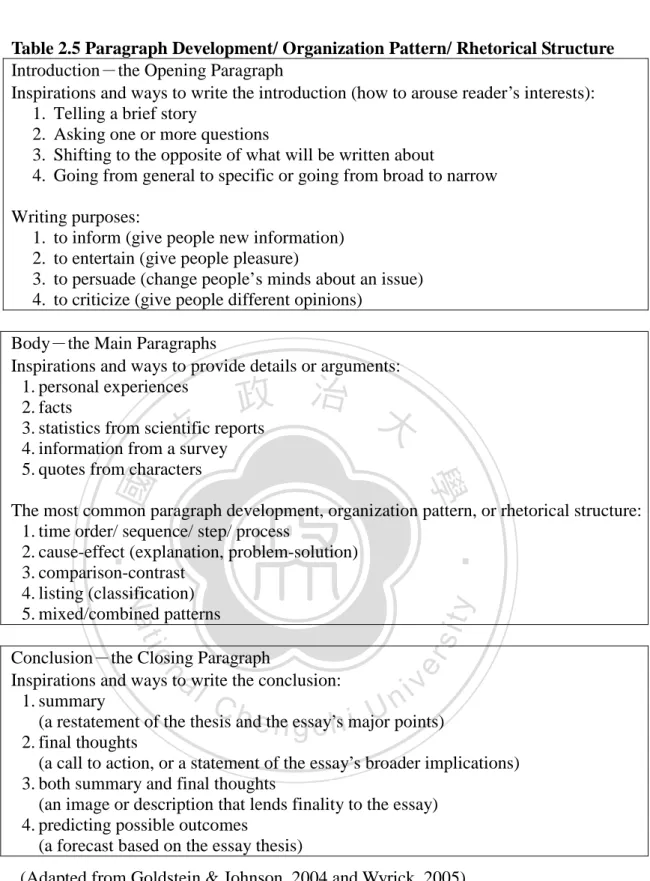
(36) 19. reactions, are similar to those of the FD learning style. In contrast, the characteristics of the left-brain, such as analytic, planned and structured, less free with feelings, not good at interpreting body language, better at producing separate words, gathering the specifics of language, carrying out sequences of operations, and dealing with abstraction, classification, labeling and reorganization, are similar to those of the FI learning style. To conclude, the functions of the right-brain are close to those of the FD; the functions of the left-brain are close to those of the FI. However, Brown (2007). 政 治 大 two factors (p.126)”. At least, better understanding the different functions in the 立 reminded that” few studies in the literatures have set out explicitly to correlate these. ‧ 國. 學. left- and right-brain are beneficial to help us better realize the differences in the FD and FI learning styles.. ‧. Much like the left- and right-brain functioning, FD and FI, as one branch of. sit. y. Nat. cognitive styles, or learning styles in educational context, could be an effective way. n. al. er. io. to distinguish individual differences in strategy use. The study on the left- and. v. right-brain functioning may help us get profound meanings, draw implications,. Ch. engchi. i n U. understand FD/FI learners’ learning styles, and further facilitate second language learning and teaching.. 2.2 Global and Local Reading Strategies Under no circumstance is reading an easy interpreting process. Goodman (1970) proposed that “reading is a psycholinguistic guessing game” (p. 497). This indicates that reading is closely related to learners’ mental activities. It is definitely more associated with learners’ learning styles/cognitive styles/field dependence (global) and field independence (analytic), the main focus in this study. Frank (n.d.).
(37) 20. also pointed out that “reading is from behind the eyes” (p. 12), indicating that the essential skill of reading is to depend upon the eyes as little as possible. Reading is a mysterious behavior which involves conscious and unconscious use of various strategies, including problem-solving strategies, to build a model of the meaning which the writer is assumed to have intended. That is why numerous researchers make every effort to uncover the mysterious veils on reading comprehension, to tackle difficult reading problems or tasks, and to find useful and effective reading strategies.. 政 治 大 definitions of strategy identified from cognitively focused reading research. They 立 In defining reading strategies, Janice et al. (1991) provided precious. ‧ 國. 學. stated:. ‧. Strategies are thought of as conscious, instantiated, and flexible plans readers apply and adapt to a variety of texts and tasks. . . .Strategies emphasize intentional and deliberate plans under the control of the reader. . . .Strategies are inherently flexible and adaptable. . . .Strategies imply metacognitive awareness. (p.242). n. er. io. sit. y. Nat. al. v. They further furnished learners with five strategies: (1) determining. Ch. engchi. i n U. importance finding the main idea, i.e., topic, topic sentence, key word, thesis, or theme, etc.; (2) summarizing information; (3) drawing inference from what they read; (4) generating questions to lead to deeper levels of text processing, and (5) monitoring comprehension to modify learners’ strategic processes while reading (p.242-249). While Janice et all classified strategies into five kinds, Young (1993) categorized strategies into two major groups that would facilitate the research of this thesis-the global strategies and the local strategies..
(38) 21. The global reading strategies include: (1) skimming, reading headings, subheadings subtitles and looking at pictures; (2) anticipating content; (3) recognizing text structure; (4) integrating information; (5) reacting to the text; (6) speculating beyond the information in the text; (7) acknowledging lack of background knowledge; (8) reading ahead; (9) visualizing; (10) identifying main ideas; (11) drawing conclusions or using inference, and (12) using background knowledge. The local reading strategies include: (1) stating understanding of words/vocabulary; (2) skipping unknown words; (3) expressing use of gloss; (4) breaking lexical into parts; (5) using cognates L1 and l2 to comprehend; (6) solving vocabulary problem; (7) translating a word or phrase into L2; (8) questioning meaning of a word; (9) identifying through circling, underlining, or placing an arrow, words/phrases not understood; (10) questioning meaning of a clause or sentence; (11) using knowledge of syntax and punctuation or other grammar; (12) monitoring reading pace and reading behavior, and (13) paraphrasing. (p. 463-467).. 政 治 大 global strategies and the local strategies. The global reading strategies include three 立. Therefore, the reading strategies in this study will comprehensively cover the. ‧ 國. 學. parts: the organization and content in the text, the organization in the paragraph, and the author’s writing crafts. The local reading strategies entail more specific. ‧. strategies about the content in the paragraph.. sit. y. Nat. Before elaborating on the global and local strategies, it is worth noting that. n. al. er. io. the difference between these two strategies is a relative concept. In a text, the. v. formation of introduction, body and conclusion, and the content (to achieve qi,. Ch. engchi. i n U. cheng, zhuang, ho) is from a global perspective relative to global strategies. In each body paragraph, the structure of the opening sentence/the topic sentence, the supporting sentences, and the closing sentence are also from a global perspective relevant to global strategies. Except for achieving coherence through the successful use of cohesions, the content in a paragraph (to achieve cohesion) is from a local perspective related to local strategies. Considering the author’s writing crafts, only by finishing the whole text could readers realize the writer’s attitude, and determine the text source, get the final ideas about how the writer starts his/her introduction, and conclusion, which are from a broader perspective related to global strategies..
數據
+7
Outline
Background and Motivation
FD/FI learners’ Learning Styles and the Use of English Reading Strategies
Research Questions
Pilot Study
Data Analysis
Frequency of the FI group’s Global Reading Strategy Use before & after
The Effects of RSI on Students’ Reading Comprehension
Students’ Feedbacks on the Effect of RSI
Limitations of this Study and Suggestions for Future Research
相關文件
中國語文科卷一 閱讀理解 學生做小測.. 中國語文科卷一 閱讀理解
學生平均分班,非 華語學生與本地學 生共同學習主流中 文課程,參與所有 學習活動,並安排 本地學生與非華語 學生作鄰座,互相
3) 日常逐步發展不同的學與教策略,尋求校內 ( 行政 ) 與校外 ( 資源 ) 支援,留意機會,以擴闊學生的學習 經驗. 4)
二、 學 與教: 第二語言學習理論、學習難點及學與教策略 三、 教材:. 運用第二語言學習架構的教學單元系列
Rebecca Oxford (1990) 將語言學習策略分為兩大類:直接性 學習策略 (directed language learning strategies) 及間接性學 習策略 (in-directed
趣 趣、 、 、 、學習風格 學習風格 學習風格 學習風格等的不同,並有不同的學習需要。2.
• 提升 提升 提升學生獨立自主的 提升 學生獨立自主的 學生獨立自主的 學生獨立自主的閱讀 閱讀 閱讀 閱讀 能力.. 能力
在整個學與教過程中,教師按不同因素(如課程和學習目標、學生的興趣、能力和需要等)運 用適切的學與教策略 [
