科技部補助專題研究計畫成果報告
期末報告
想法中心設計之教學理論在電腦支援合作學習環境中之研究與
發展(第3年)
計 畫 類 別 : 個別型計畫
計 畫 編 號 : NSC 101-2628-S-004-001-MY3
執 行 期 間 : 103年08月01日至104年07月31日
執 行 單 位 : 國立政治大學教育學系
計 畫 主 持 人 : 洪煌堯
計畫參與人員: 碩士級-專任助理人員:蔡函汝
碩士級-專任助理人員:李佩蓉
碩士級-專任助理人員:張宇慧
報 告 附 件 : 出席國際會議研究心得報告及發表論文
國際合作計畫研究心得報告
處 理 方 式 :
1.公開資訊:本計畫可公開查詢
2.「本研究」是否已有嚴重損及公共利益之發現:否
3.「本報告」是否建議提供政府單位施政參考:否
中 華 民 國 104 年 10 月 28 日
中 文 摘 要 : 本研究旨在發展、測試與修正「想法中心設計」(idea-centered
design)之教學設計理論。研究者在過去數年一直致力於此教學設計
理論的探究(see Hong & Sullivan, 2009; Hong, Chen,
Chang, Liao, & Chan, 2009)。「想法中心設計」是一個正在
發展中(emerging)的教學設計理論,也是一個創新的教學觀點。它
強調將「學習」視為一個持續創造知識的歷程(Hong &
Sullivan, 2009; Paavola, Lipponen, & Hakkarainen, 2002,
2004)、將「教學」視為是一個把學生培養成為知識工作者或創造者
的歷程(Cohen, 1989; Bereiter & Scardamalia, 1993, 2003;
Sawyer, 2004, 2006; Hong, Chen, Chai, & Chan, 2011)、以
及將「學校」視為是一個生產和創新知識的組織;其主要教育目標
則是要將學生轉化成為一個在知識社會中具有高創意和生產力的公
民(Hargreaves, 1999; Scardamalia & Bereiter, 1999;
Brown, 1997; Zhang, Hong, Scardamalia, Teo, & Morley,
2011)。本研究透過文獻的回顧與探討,包括教學(pedagogical)、
心理(psychological)和科技(technological)等面向的文獻與理論
分析,來強化「想法中心設計」的教學理論。其次,本研究編製一
個可以評量以「想法中心設計」為基礎的電腦支援協作學習
(CSCL)環境的量表。再者,本研究關注於個案研究上。透過實證以
探討並嘗試將「想法中心設計」之教學設計理論應用在真實情境的
CSCL 環境中,同時也應用研究中所編製的量表,來測量此個案中的
受試者。最後,本研究使用「設計本位研究法」(design-based
research, DBR)。透過DBR,本研究進一步修正並重新設計必要的變
項和研究設計,以改進前一年研究中所發現的設計缺點,並藉以修
正本「想法中心設計」教學設計理論。
中 文 關 鍵 詞 : 知識翻新、知識創新、創意氛圍、電腦支援協作學習
英 文 摘 要 : The purpose of this research is to develop, test, and
strengthen a potential instructional design theory called
“idea-centered design” that I have been working on for
several years (see Hong & Sullivan, 2009; Hong, Chen,
Chang, Liao, & Chan, 2009). As a potential, emerging
instructional design theory, it represents a new view of
pedagogy that highlights learning as a process of knowledge
creation (Hong & Sullivan, 2009; Paavola, Lipponen,
& Hakkarainen, 2002, 2004), views teaching as a process
of facilitating and cultivating students to become
knowledge-creators (Cohen, 1989; Bereiter &
Scardamalia, 1993, 2003; Sawyer, 2004, 2006; Hong, Chen,
Chai, & Chan, 2011), and considers schools as
knowledge-creating organizations whose aim is to transform
students into creative and productive citizens in a
knowledge-based society (Hargreaves, 1999; Scardamalia
& Bereiter, 1999; Brown, 1997; Zhang, Hong,
Scardamalia, Teo, & Morley, 2011).
First, my study focused on reviewing, exploring and
strengthening the pedagogical, psychological, and
technological ground of the “idea-centered design”
theory. Secondly, my study created a survey scale for
assessing “idea-centered” CSCL (computer-supported
collaborative learning) environments. Thirdly, my study
focused on a case study that explores and tests the
“idea-centered design” theory in authentic CSCL environments
with the survey scale we developed for testing the theory
in this case study. Last, I adopted design-based research
method and re-iterate my study administered in the previous
year after carefully calibrating all necessary variables
and research design.
英 文 關 鍵 詞 : Idea-centered design, computer-supported collaborative
learning (CSCL), instructional design theory, knowledge
creation
行政院國家科學委員會補助專題研究計畫
□
期中進度報告
█期末報告
想法中心設計之教學理論在電腦支援合作學習環境中之研究與發展
計畫類別:▓個別型計畫
□
整合型計畫
計畫編號:NSC 101-2628-S-004 -001 -MY3
執行期間:2012/08/01~2015/07/31
執行機構及系所:國立政治大學教育系
計畫主持人:洪煌堯
共同主持人:無
計畫參與人員:張宇慧、李佩蓉、蔡函汝
本計畫除繳交成果報告外,另須繳交以下
出國
報告:
□赴國外移地研究心得報告
□赴大陸地區移地研究心得報告
▓
出席國際學術會議心得報告及發表之論文
▓
國際合作研究計畫國外研究報告
處理方式:
除列管計畫及下列情形者外,得立即公開查詢
□涉及專利或其他智慧財產權,□一年□二年後可公開
查詢
中 華 民 國 104 年 10 月 22 日
目錄
中英文摘要及關鍵詞--- 第 02 頁
報告內容--- 第 04 頁
前言(Introduction) --- 第 04 頁
研究目的(Study purpose) --- 第 04 頁
文獻探討(Literature review) --- 第 04 頁
研究方法(Method) --- 第 07 頁
結果與討論(Results) --- 第 09 頁
參考文獻--- 第 14 頁
附錄一:本計畫產出之論文發表--- 第 16 頁
2
摘要
本研究旨在發展、測試與修正「想法中心設計」(idea-centered design)之教學
設計理論。研究者在過去數年一直致力於此教學設計理論的探究(see Hong &
Sullivan, 2009; Hong, Chen, Chang, Liao, & Chan, 2009)。
「想法中心設計」
是一個正在發展中(emerging)的教學設計理論,也是一個創新的教學觀點。它強
調將「學習」視為一個持續創造知識的歷程(Hong & Sullivan, 2009; Paavola,
Lipponen, & Hakkarainen, 2002, 2004)、將「教學」視為是一個把學生培養成
為知識工作者或創造者的歷程(Cohen, 1989; Bereiter & Scardamalia, 1993,
2003; Sawyer, 2004, 2006; Hong, Chen, Chai, & Chan, 2011)、以及將「學
校」視為是一個生產和創新知識的組織;其主要教育目標則是要將學生轉化成為
一個在知識社會中具有高創意和生產力的公民(Hargreaves, 1999; Scardamalia
& Bereiter, 1999; Brown, 1997; Zhang, Hong, Scardamalia, Teo, & Morley,
2011)。本研究在過去三年中透過文獻的回顧與探討,包括教學(pedagogical)、
心理(psychological)和科技(technological)等面向的文獻與理論分析,強化了
「想法中心設計」的教學理論。其次,本研究在這三年中也編製一個可以評量以
「想法中心設計」為基礎的電腦支援協作學習(CSCL)環境的量表。此外,本研究
也進行了數個個案研究上。透過個案的實證資料以探討並嘗試將「想法中心設計」
之教學設計理論應用在真實情境的 CSCL 環境中,同時也應用了本研究中所開發
編製的量表,測量了一些個案中的受試者。本來研究將延續本研究並進一步使用
「設計本位研究法」(design-based research, DBR)。透過 DBR,本研究將進一
步修正並重新設計必要的變項和研究設計,以改進本研究計畫中所發現的一些設
計上的缺點。並藉以修正本「想法中心設計」教學設計理論。
關鍵詞: 知識翻新、知識創新、創意氛圍、電腦支援協作學習
Abstract
The purpose of this research is to develop, test, and strengthen a potential instructional design
theory called “idea-centered design” that I have been working on for several years (see Hong &
Sullivan, 2009; Hong, Chen, Chang, Liao, & Chan, 2009). As a potential, emerging
instructional design theory, it represents a new view of pedagogy that highlights learning as a
process of knowledge creation (Hong & Sullivan, 2009; Paavola, Lipponen, & Hakkarainen,
2002, 2004), views teaching as a process of facilitating and cultivating students to become
knowledge-creators (Cohen, 1989; Bereiter & Scardamalia, 1993, 2003; Sawyer, 2004, 2006;
Hong, Chen, Chai, & Chan, 2011), and considers schools as knowledge-creating organizations
whose aim is to transform students into creative and productive citizens in a knowledge-based
society (Hargreaves, 1999; Scardamalia & Bereiter, 1999; Brown, 1997; Zhang, Hong,
Scardamalia, Teo, & Morley, 2011).
Over the past three eyars, my study has focused on reviewing, exploring and strengthening the
pedagogical, psychological, and technological ground of the “idea-centered design” theory.
Moreover, my study has created a survey scale for assessing “idea-centered” CSCL
(computer-supported collaborative learning) environments. Furthermore, my study has also
studies a case study that explores and tests the “idea-centered design” theory in authentic
CSCL environments with the survey scale we developed for testing the theory in this particular
case study. In the future, I plan to adopt design-based research method and re-iterate my study
administered in this research project after carefully calibrating all necessary variables and
research design.
Keyword: Idea-centered design, computer-supported collaborative learning (CSCL),
4
報告內容
Introduction (前言)
Student perceptions of learning may be generally categorized into two types: one regards learning as knowledge acquisition and another sees learning as knowledge creation (Hong & Sullivan, 2009; Paavola, Lipponen, & Hakkarainen, 2004; Sfard, 1988). The former represents a conventional view that treats learning mainly as a process of acquiring, storing, and organizing desired pieces of knowledge and perceives knowledge as possessed by an individual, specifically within his or her mind-as-a-container (Hyman, 1999; Popper, 1972). In contrast, the later represents a more progressive review that treats learning as an innovative process of creating something new and “the initial knowledge is either substantially enriched or significantly transformed during the process” (Paavola, Lipponen, & Hakkarainen, 2002, p.24).
Traditional instruction tends to be more didactic and teacher-centered in which learning usually emphasizes personal knowledge acquisition, rather than collaborative knowledge construction. However, with recent advances in online collaborative learning, more creative learning and collective knowledge construction become possible (Hong & Sullivan, 2009; Stahl, Koschmann, & Suthers, 2006). Nevertheless, despite the widespread use of online collaborative learning environments, less attention has been given to learners’ perception of such environments. Tsai (2009) argues that students’ conceptions and attitudes of Web-based learning are important prerequisites for effective Web-based instruction. If students think that learning is an individualistic activity, they may see learning as individual efforts and will be less likely to get involved in collaborative learning and knowledge construction. On the other hand, if students are often engaged in environments that emphasize knowledge sharing and co-construction, their conception of learning will be more team-oriented, collaborative, student-centered, and constructivist-oriented. Given the increasing importance of online learning in today’s education, it is timely to investigate students’ perceptions of online learning environments.
Purpose of this study
The purpose of this study was to explore students’ perceptions of learning and online performance in a learning environment.
Literature review
Knowledge building theory
In the present study, we are interested in investigating students’ perceptions of different online learning environments, especially an online collaborative knowledge building environment. Whitehead (1970) argues that learning should not be regarded as a process of accumulation of personal knowledge; instead, as educators, we have to take an innovative viewpoint that highlights the reproduction and transformation of knowledge in education and emphasizes learning as active, critical, constructivist, and collaborative activities. From a knowledge building perspective, knowledge can be revised or improved through continual and collaborative work and improvement (Hong & Sullivan, 2009; Scardamalia & Bereiter, 2006). The concept of knowledge building theory was originally proposed by Scardamalia and Bereiter (2006). According to them, knowledge and/or ideas should not be seen as personal properties, but should be treated as public, social, epistemic entities, which can be continuously refined via community members’ efforts in collaboration, interaction, elaboration, and innovation of their initial knowledge or understanding. When engaged in knowledge building, members of a community are guided to address authentic problems (i.e., problems related to students’ real-life experiences), and to facilitate the exchange and transformation of information and ideas, in order to achieve the goal of collective knowledge advancement.
To facilitate knowledge building, Scardamalia (2002) proposed a set of principles to help conceptualize the complex social dynamics involved in a knowledge building environment. For example, the principle of ‘community knowledge’ indicates that contributions to “shared, top-level goals of the organization are prized and rewarded as much as individual achievements. Team members produce ideas of value to others and share responsibility for the overall advancement of knowledge in the community” (p. 80; see Scardamalia, 2002, for detailed explanations of other principles). These principles are useful reference to help and guide instructional designers and/or teachers to better design learning environments for engaging students in the process of knowledge building and for supporting the process of knowledge work among these students. Empirical
research has demonstrated positive effects of knowledge building pedagogy and technology on depth of inquiry, collaboration, and co-construction of knowledge, both from Western and Eastern cultures (Chai & Tan, 2009; Hong, 2011; Hong & Lin-Siegler, 2012; Hong, Chen, Chai, & Chan, 2011; Scardamalia & Bereiter, 2006; van Aalst & Chan, 2007; Zhang, Hong, Scardamalia, Teo, & Morley, 2011; Zhang, Scardamalia, Reeve, & Messina, 2009).
Knowledge Forum—A knowledge building environment
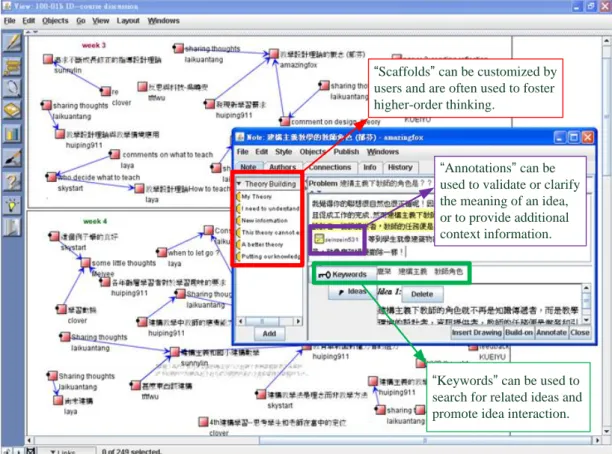
As an online learning environment, Knowledge Forum (KF) is designed based on knowledge building principles (Scardamalia, 2002). As such, its design features are very different from most conventional online learning environments that highlight learning as a process of knowledge acquisition rather than knowledge building or creation. To support knowledge building, KF’s design features are concerned mainly with sustained idea production and improvement. And one way to do this may be to ask students to continuously provide improvement feedback on one another’s knowledge work and continuously revise it. Generally speaking, the design features in KF can be categorized into two types. The first type consists of three main KF activities: posting/contributing notes, building on/replying to notes, and reading notes. These design features can be seen on the top left side of Figure 1. Overall, Figure 1 represents a KF view—a collaborative problem-solving space—in which a square represents a note and a link represents a collaborative relationship (e.g., a building-on relationship). Virtually all online learning platforms contain similar design features. The main difference is that KF encourages the use of these design features for sustained idea generation and improvement. For instance, ‘posting notes’ is a key way of contributing ideas; ‘reading notes’ helps members share ideas and information, and be aware of community knowledge advancement; ‘building on notes’ facilitates idea exchange and integration among diverse ideas. In contrast, the second type of KF design feature plays a complementary, and yet perhaps even more important, role in knowledge building. These features are such as ‘scaffolds’ (which can be customized by users and are often used to foster higher-order thinking, e.g., critiquing ideas, asking higher-level questions), ‘annotations’ (which can be used to validate or clarify the meaning of, or to elaborate, a particular idea within a note, to contribute alternative explanations, or to provide additional context information), and ‘keywords’ (which can be used to search for related ideas and/or speed up the process of idea interaction and synthesis that is otherwise less likely). The use of these supporting KF features is optional. Nevertheless, effective use of them can substantially facilitate idea connectedness and refinement, and thus enhance the possibility of generating new knowledge that is progressively evolved from initial ideas. Overall, it is posited that the more frequent the use of these key and complementary KF features, the more likely the effectiveness of KF as a knowledge building environment that can be exploited. A key difference between the two generic types of KF design feature, however, is that the first type of KF feature was designed to promote main online KF activities. As such, students usually spend most of their time on these activities. On the other hand, the second type of KF feature was designed to play a complementary role to extend idea improvement, and its use is designed as part of the main KF features (i.e., it cannot be used independently of the main KF design features, and thus its use is optional). The right side of Figure 1 shows the complementary KF design features and their corresponding location in a note.
6
“Scaffolds” can be customized by users and are often used to foster higher-order thinking.
“Annotations” can be used to validate or clarify the meaning of an idea, or to provide additional context information.
“Keywords” can be used to search for related ideas and promote idea interaction.
Figure 1. A screenshot of a Knowledge Forum ‘view’ and examples of two types of KF design feature: (1) main KF features (i.e., contribution; reading; and build-on) and (2) complementary KF features (e.g., scaffolds,
annotations, and keywords) Two types of learning environment
Previous studies concerning knowledge innovation and creativity have been mainly focused on business organization and most of them in particular looked into organizational climates in working environments (Amabile & Conti, 1999; Ekvall & Tangeberg-Anderson, 1986; Zain & Rickards, 1996). To this end, many studies have tried to single out important factors that may affect a group or team’s knowledge-creating capacity, and they have designed different instruments to evaluate the innovative climate within an organization (e.g., Amabile, Conti, Coon, Lazenby, & Herron, 1996; Ekvall, 1996).
Similarly, previous research studying classroom environments has demonstrated that the learning environments constructed by designers and/or teachers have significant effects on students’ learning (Eggen & Kauchak, 2007; Pierce, 2001). To date, at least two broad types of learning environment can be identified (Duff & Jonassen, 1992). One is a teacher-centered learning environment, which usually focuses on learning from and instilling textbook knowledge, and hopes that students’ academic achievement can be improved by means of direct knowledge delivery (Adams & Engelmann, 1996; Engelmann, 1980; Goodnough, 2001, 2003; Peters & Kortecamp, 2010). In Taiwan, teaching is still quite often presented this way, emphasizing the importance of knowledge acquisition and neglecting students’ creative capacity for knowledge creation. Another is a student-centered environment, which in contrast pays more attention to students’ innovative learning processes and needs, with the role of teachers being seen as someone whose main function is not to feed students with authoritative knowledge, but to guide or provide support for students to learn in a more self-initiated and self-directed manner (Saywer, 2004). Pratt (2002) argues that student-focused learning environments provide students with more encouragement to build mutual confidence between teachers and students. Therefore, it is important to create more student-centered learning environments and it is posited that engaging students in a collaborative knowledge building environment should have positive effects on their views and practices of learning. Yet, such an assumption remains to be tested (especially in an Eastern cultural context). As such, the purpose of this study was to investigate: (1) students’ perceptions of a knowledge building environment, i.e., Knowledge Forum (as compared with a non-knowledge building environment); (2) their online performance (e.g., interaction and collaboration, and peer feedback) in this knowledge building environment; and (3) the relationships between students’ perceptions of a knowledge building environment and their online performance in this environment.
Method
Participants and learning environment
The participants in this study included 93 teacher-education students (57 females) who were studying, for the purpose of becoming teachers (e.g., natural sciences or mathematics teachers), in a teacher-education program in a Taiwanese university. The duration of this study was a semester. An online learning environment enabled by Knowledge Forum was employed to allow the participants to learn together and develop their knowledge work/artifacts (e.g., lesson plans, learning sheets, and teaching slides). In Knowledge Forum, students were guided to engage in sustained knowledge building through giving one another feedback for sustained improvement on their knowledge work (e.g., lesson plans). Knowledge building is very different from a conventional view of learning that sees learning as knowledge acquisition and accumulation, which is usually implemented for the purpose of helping students achieve high scores in standardized tests in Taiwan and is still very much considered as a social norm in the nation. Instead, the adoption of a knowledge building pedagogical approach in this teacher-education program represents a novel instructional approach. The Knowledge Forum platform was implemented to provide students with a learning environment that emphasized collaborative learning and knowledge creation. To facilitate the adoption of knowledge building pedagogy and Knowledge Forum technology, a tutorial lesson was given, in the form of PowerPoint slides, at the beginning of the semester (e.g., teaching students how to create notes and build on others’ notes). The course instructor/designer was familiar with knowledge building pedagogy, and had six years of experience of using Knowledge Forum in college teaching. But specifically for this study, the teacher did not intervene in students’ online learning. The teacher only specified that the course requirement necessitates each participant to provide peer feedback by contributing to or building on at least two KF notes per week. Thus, the main online instructional activities were designed to be ‘peer feedback’ in Knowledge Forum. For example, students were required to first generate their initial ideas for their lesson plans; then, through sustained interaction and collaboration, they needed to continuously provide one another with feedback for improving their initial teaching ideas. As mentioned above, Figure 1 shows a screenshot of a Knowledge Forum ‘view’ (a discussion and collaboration space); and it also shows two main types of design feature in Knowledge Forum, with the first type concerning the main Knowledge Forum features (see left side), including note contribution (i.e., indicated by each little square), note reading (i.e., indicated by color change of each little square), and build-on (i.e., indicated by each link between two little squares), and the second type concerning the complementary KF features, including scaffolds, annotations, and keywords (see the right side of the figure for more explanation).
Data sources and analysis
The data of this study mainly came from students’ online activities; in addition, this study employed a five-point Likert survey called Student Perception of Classroom Knowledge Building (SPOCK) (Shell, Husman, Turner, Cliffel, Nath et al., 2005). The survey was conceptually developed based on a review of Scardamalia and Beretier’s previous research works (e.g., Scardamalia & Beretier, 2006). It measures six aspects of students’ perceptions in class: (a) Self-regulation (nine survey items; e.g., in this class, I take notes and jot down questions when I am reading the class materials; and in this class, I try to determine the best approach for studying each assignment); (b) Knowledge building (10 survey items; e.g., in this class, I think about different approaches or strategies I could use for studying the assignments; and in this class, I focus on developing my own understanding of the important ideas in what I am studying or reading); (c) Question asking (three high-level survey items, e.g., in this class, I ask questions about things I am curious about, and four low-level survey items, e.g., in this class, I ask questions so that I can be sure I know the right answers for tests); (d) Lack of initiative (10 survey items; e.g., in this class, I rely on someone else to tell me what to do; and I only do things related to this class when the instructor says I have to); (e) Cooperative learning (five survey items; e.g., in this class, my classmates and I actively share ideas); and (f) Teacher-directed classroom (seven survey items; e.g., in this class, I get most of the information from the textbook and the instructor; and in this class, the instructor focuses on getting us to learn the right answers to questions). According to Shell et al. (2005), coefficient alpha reliability estimates for this SPOCK questionnaire were consistent with those obtained for similar instruments, such as the Motivated Strategies for Learning Questionnaire (Pintrich, Smith, Garcia, & McKeachie, 1993; Weinstein, Zimmermann, & Palmer, 1988). The factor structure of the SPOCK instrument was further validated by Chai, Foo, and Vijayan (2012), using secondary and tertiary level students with background similar to the participants in this study; and it was found to be a reliable and valid survey to measure students’ perceptions of learning environment. The Cronbach’s alpha for SPOCK in the pre-test for this study was .92 as a whole, and .85, .87, .88, .71, .80, .77 respectively for each separate construct of the SPOCK as follows: General Self-Regulation, Knowledge Building, Question Asking, Lack of Initiative, Cooperative Learning, and Teacher Directed Classroom. Further, the Cronbach’s alpha for SPOCK in the post-test for this study was .93 as a whole,
8
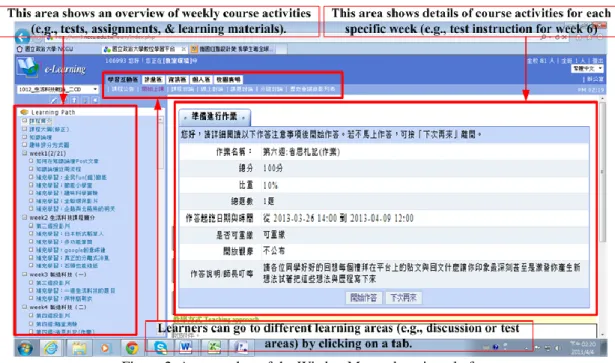
and .81, .86, .85, .80, .82, .77 respectively for each separate construct of the SPOCK in the same order as mentioned above. A commonly accepted rule for describing internal consistency using Cronbach's alpha is as follows (see Kline, 1999): acceptable (0.7 ≤ α < 0.8), good (0.8 ≤ α < 0.9), and excellent (α ≥ 0.9). For survey instruments in particular, it is recommended that Cronbach's alpha be higher than 0.7. So the reliability for SPOCK in this study is acceptable. Before the study, all participants had other online learning experiences of using WisdomMaster (see its online manual here: http://webbuilder.scu.edu.tw/builder/upload/web213/files/web_file_61.pdf), a non-knowledge building environment which was designed based on a conventional view of learning as knowledge acquisition and accumulation. As an example, Figure 2 shows a main screenshot of the WisdomMaster learning platform. As can be seen, it provides a clearly structured, step-by-step learning path for learners (left side of the figure), detailed instruction for doing assignments, performing activities, and/or taking tests (right side of the figure), and well organized learning areas (e.g., discussion forum) as divided by different tabs (top side of the figure). This environment was structured with a view that sees learning as knowledge telling or acquisition, whereas Knowledge Forum was designed with a view that sees learning as knowledge building or creation. A pre-post test was conducted using the same SPOCK survey. In the pretest, students were asked to rate their perceptions of the non-knowledge building learning environment. In the post-test, they were asked to rate their perception of the current knowledge building environment. The results derived from the non-knowledge building and the knowledge building environments were then compared by means of a paired-sample t-test.
Figure 2. A screenshot of the WisdomMaster learning platform Content analysis on quality of feedback
Further, in order to better understand the quality of the main instructional activity (i.e., collaborative peer feedback) as a learning measure in the Knowledge Forum platform, content analysis on KF notes was conducted. From the perspective of situated cognition, learning is a process of participating in shared activities (e.g., Brown, Collins, & Duguid, 1989; Lave & Wenger, 1991). Under this view, activities are seen as the focus of learning and the essence of learning is about activities (“knowing”) more than about outcomes (“knowledge”). Building upon this conceptualization, therefore, collaborative feedback activities were treated as a central ‘learning measure” in this research and analyzed accordingly. This analysis is necessary and important because a critical factor in developing critical thinking and knowledge elaboration (i.e., knowing) skills is application of formative feedback for evaluating and improving learning (Shute, 2008). Of particular importance for collaborative/interactive learning is the quality and extent to which feedback can be provided to help peers elaborate their knowledge in a community, and thus achieve deeper understanding of the topic inquired during discussion. As such, peer feedback as a formative assessment should be regarded as an important way of collective knowledge building practices in a learning environment (Wiliam, 2007). To do so, students (n=40) with more teaching experiences (i.e., junior-year and senior-year students) were conveniently sampled for further analysis. There were two reasons for such sampling. One is to focus on constructing a set of unbiased samples to ensure the validity of the data analysis. The main instructional activity is focused on improving
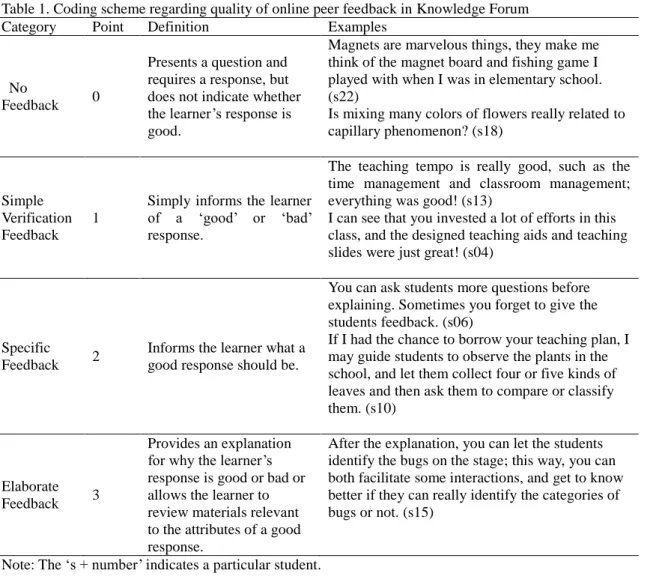
teaching ideas, and the students from the freshman and sophomore years have no or very little teaching practice experience. The other is because it was too time-consuming for content analysis as there were too much data. For analysis purposes, a coding scheme regarding feedback quality originally designed by Dempsey, Driscoll, and Swindell (1993) was adopted, with some minor text modification in this study. Table 1 shows the coding scheme, with a description of each feedback code and coding examples also being provided. Depending on the quality of the feedback, a 0, 1, 2, or 3 points were given; for example, a ‘3’ is given to the highest quality of ‘elaborate feedback’. Using Spearman’s correlation coefficient, inter-coder reliability was computed to be .91 (p < .01). Using notes as unit of analysis, each note was categorized into one of four types of feedback and was given a corresponding score based on the feedback quality. A paired-sample t-test was computed to see whether there was any change between the early and later stage of student online learning (i.e., the first and the second half of the semester, using mid-term as a separation point) in terms of feedback quality. The reasons of using mid-term to divide the first and the second half of this course for comparison were because change takes time and it is easier to see change over a longer period of time. It was also because the instructional format of the two halves of the semester was comparable as: (1) both halves have the same length (seven weeks), (3) both focused extensively on online discussion, and (3) both end with a term exam (mid-term and final-term).
Table 1. Coding scheme regarding quality of online peer feedback in Knowledge Forum Category Point Definition Examples
No
Feedback 0
Presents a question and requires a response, but does not indicate whether the learner’s response is good.
Magnets are marvelous things, they make me think of the magnet board and fishing game I played with when I was in elementary school. (s22)
Is mixing many colors of flowers really related to capillary phenomenon? (s18)
Simple Verification Feedback
1
Simply informs the learner of a ‘good’ or ‘bad’ response.
The teaching tempo is really good, such as the time management and classroom management; everything was good! (s13)
I can see that you invested a lot of efforts in this class, and the designed teaching aids and teaching slides were just great! (s04)
Specific Feedback 2
Informs the learner what a good response should be.
You can ask students more questions before explaining. Sometimes you forget to give the students feedback. (s06)
If I had the chance to borrow your teaching plan, I may guide students to observe the plants in the school, and let them collect four or five kinds of leaves and then ask them to compare or classify them. (s10)
Elaborate Feedback 3
Provides an explanation for why the learner’s response is good or bad or allows the learner to review materials relevant to the attributes of a good response.
After the explanation, you can let the students identify the bugs on the stage; this way, you can both facilitate some interactions, and get to know better if they can really identify the categories of bugs or not. (s15)
Note: The ‘s + number’ indicates a particular student.
Results
Overall contribution in KF
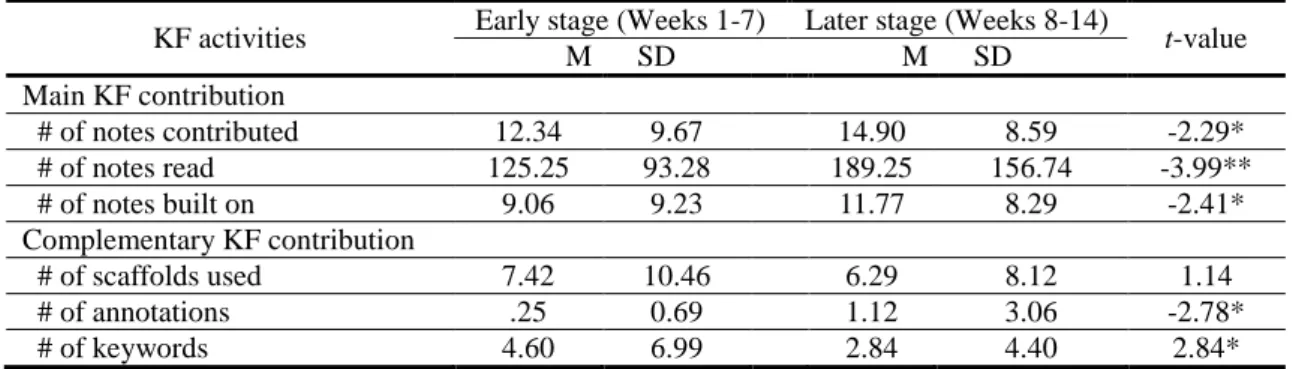
Table 2 summarizes basic knowledge building (KB) activities in Knowledge Forum (KF). The results show the intensity of online KF learning activities over a semester (which was divided into two KB stages, using midterm as a separating point, with each stage lasting for seven weeks). Paired-sample t-tests indicated that there were significant pre-post differences between the two KB stages for all online KF activities (p < .01 for all measures). Of the two types of KF design features (or activities), it was found that there was a progressively
10
significant increase over time in the primary KF activities (including number of notes contributed, number of notes read, and number of notes built on). In parallel, there were only two significant changes in the complementary KF activities. The number of annotations was increasing while the number of keywords was decreasing, with the number of scaffolds being used quite consistently across both stages. The findings confirmed our speculation that the use of the primary KF design features was more consistent, while the use of the complementary KF features was not (as their use was not required in this study). Basically, the overall findings suggested that the time and effort spent on online KF discussion helped student engagement become progressively more active in terms of the main KF design features, but it also indicates that students were less likely to invest time on the intentionally designed high-lever, although supplementary, KF activities that required additional mental efforts.
Table 2. Basic knowledge building activities
KF activities Early stage (Weeks 1-7) Later stage (Weeks 8-14) t-value
M SD M SD Main KF contribution # of notes contributed 12.34 9.67 14.90 8.59 -2.29* # of notes read 125.25 93.28 189.25 156.74 -3.99** # of notes built on 9.06 9.23 11.77 8.29 -2.41* Complementary KF contribution # of scaffolds used 7.42 10.46 6.29 8.12 1.14 # of annotations .25 0.69 1.12 3.06 -2.78* # of keywords 4.60 6.99 2.84 4.40 2.84* * p < .05. ** p < .01. Interaction patterns in KF
To further understand the social dynamics in KF, a social network analysis was conducted to describe online collaborative efforts in the two different stages. To this end, the network measure ‘betweenness centrality’, which illustrates the democracy level of the KF community, was used to examine interaction patterns in KF. To elaborate, ‘betweenness centrality’ is a measure of control for idea or information flow. A lower average betweenness value or level in a network indicates that the network represents a more democratic knowledge building community since there are more direct note links between community members.
Table 3 shows comparisons of the betweenness measure between the two KB stages in terms of two major types of interaction in KF, which are note-reading and note-linking. As a knowledge building community, KF is designed to foster more equitable participation; the design allows every member of KF to be given equal opportunities to contribute and improve ideas. So it is expected that there should be progressively decreased average value of betweenness centrality from the early KB stage to the later KB stage. As expected, there was a higher betweenness centrality level of note-reading measure in the early stage (suggesting that the information or idea flow was less fluent in this stage); but the level of betweenness centrality had dropped in the later stage (therefore, the idea flow became easier in this stage). Overall, the KF network showed among students a relatively better sense of ‘democratizing knowledge’ (a knowledge building principle that encourages all community members to be equal knowledge contributors; see Scardamalia, 2002, for details about this principle) as there were more connected reading activities to allow ideas to flow or to be shared among members (see Table 3). Nevertheless, no significant change in betweenness centrality level occurred between the two stages in terms of note-building-on. This showed that the quantity of participants’ feedback interactions or connections was not significantly increased and seemed to represent an area for future instructional improvement. But perhaps it is more important to also look into the quality (not just the quantity) of feedback content in KF (see below for the analysis on feedback analysis).
Table 3. Mean (SD) of the betweenness centrality for the two stages Betweenness
Early stage (Weeks 1-7) Later stage (Weeks 8-14)
t-value M SD M SD Note-reading 35.35 78.31 13.17 28.10 3.64*** Note-building-on 33.42 85.04 36.23 77.98 -0.32 *** p < .001. Survey analysis
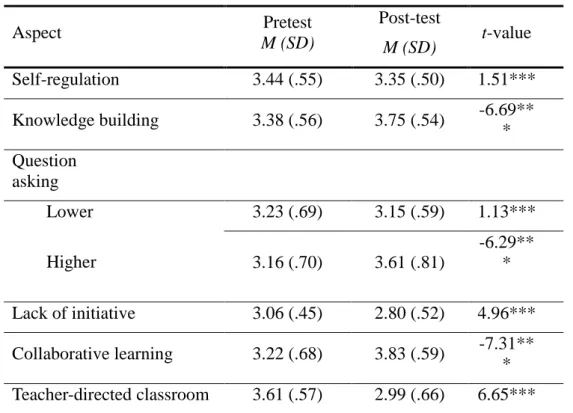
Table 4 shows a comparison between student perceptions of learning in the online knowledge building environment and their perceptions of the non-knowledge building environment students experienced in the same
teacher-education program before they used Knowledge Forum. As a result, it was found that there were significant differences between the two different kinds of environment perceived for all SPOCK aspects measured (all p’s<.001), including self-regulated learning, knowledge building activities, low-level question asking, high-level question asking, lack of initiative, collaborative learning, and teacher-directed instruction. The findings turned out to be as expected, except for the aspect of self-regulation. There was a decrease in ratings in this aspect. In an after-the-fact review of all survey items in this aspect, it was found that a possible explanation may be that all the items initially designed and included in this aspect were mainly concerned with individual learning with routine class assignments (for example, an item asks: ‘In this class, I think about the best ways to study each assignment.’). As such, self-regulation is defined based on (1) an individualistic (rather than collective) sense of learning, and (2) a knowledge-acquiring (rather than knowledge-building) sense of self-regulation. For the former, it is evident that the statements of all the nine survey items developed for this aspect used ‘I’ instead of ‘We’ to be the subject of the sentences (e.g., “In this class, I take notes and jot down questions when I am reading the class materials”). For the latter, it is also clear that none of the items included the term ‘idea’ in them; but ‘idea’ is considered essential for knowledge building (Hong & Sullivan, 2009). This is in sharp contrast with the features of Knowledge Forum that were pedagogically designed to highlight the purpose of collective community knowledge advancement through sustained idea generation and improvement (rather than just individual knowledge growth). So, it is likely that the survey items in this aspect did not really reflect the collective and innovative nature of knowledge creation activities in Knowledge Forum as a knowledge building environment. This might be why the rating dropped from pretest to post-test. Further study is needed to confirm this speculation. Nevertheless, the general results still suggested that students tended to perceive the knowledge building environment as a highly constructivist-oriented and student-centered online learning environment.
Table 4. Pre-post differences in terms of students’ perceptions of classroom learning
Aspect
Pretest
M (SD)
Post-test
M (SD)
t-value
Self-regulation
3.44 (.55)
3.35 (.50)
1.51***
Knowledge building
3.38 (.56)
3.75 (.54)
-6.69**
*
Question
asking
Lower
level
Higher
level
3.23 (.69)
3.15 (.59)
1.13***
3.16 (.70)
3.61 (.81)
-6.29**
*
Lack of initiative
3.06 (.45)
2.80 (.52)
4.96***
Collaborative learning
3.22 (.68)
3.83 (.59)
-7.31**
*
Teacher-directed classroom
3.61 (.57)
2.99 (.66)
6.65***
*** p < .001. Correlation analysisAs mentioned above, in this study we divided online KF activities into two generic kinds: main KF contribution activities that played a dominant role in online KF activities (i.e., number of notes contributed, number of notes read, and number of notes built on) and complementary, high-level KF activities that are designed to further foster higher-level thinking activities by complementing the main KF activities--thus requiring students’ extra mental efforts to perform these activities (e.g., number of scaffold supports, number of annotations, and number of keywords). In comparing these two types of KF activity in analysis, it was found that there was a significant correlation between the complementary, higher-level KF activities and the combined SPOCK scores (which was computed by summing the ratings of all the SPOCK aspects in the post-test) (see Table 5). The findings suggest that in general, the more mental (higher-level) effort students made in the
12
complementary KF activities, the more likely they would perceive KF as a positive and effective online learning environment.
Table 5. Correlations among knowledge building activities between Knowledge Forum and SPOCK KB activity/KB scores 1 2 3 4 5 6 Main KF features 1. # of notes contributed - 2. # of notes read .63** - 3. # of notes built on .98** .65** - Complementary KF features 4. # of scaffolds used .22* -.12 .17 - 5. # of annotations .14 .33** .16 .06 - 6. # of keywords .00 -.40** -.02 .51** -.03 - Average scores of SPOCK 7. combined scores -.06 -.16 -.05 .23* .22* .40** * p < .05. ** p < .01.
Analysis of online feedback quality
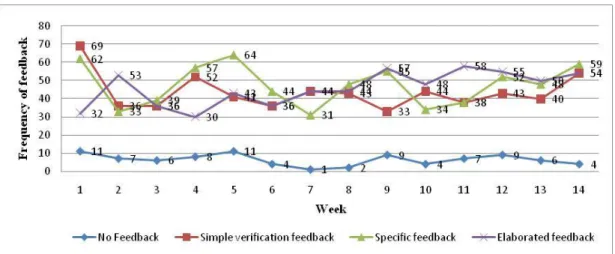
The next important question to ask is about the quality of online feedback content, and this is because the major learning activity in Knowledge Forum was to provide feedback to peers in order to help one another advance their teaching knowledge—e.g., better understanding of how to teach. As such, the participating teacher-education students who engaged in Knowledge Forum were guided to exchange ideas and provide one another with peer feedback related to teaching improvement. When analyzing the quality of online peer feedback, special attention was directed at looking into whether the quality of feedback had improved or not over time (sees Figure 3 for the trend in change). In addition, the general finding showed that there were in total 89 ‘no feedback’ notes (M=2.23, SD=3.08), 610 ‘simple feedback’ notes (M=15.25, SD=6.41), 660 ‘substantial feedback’ notes (M=15.25, SD=6.41), and 641 ‘explanatory feedback’ notes (M=16.03, SD=12.79). Specifically, it was found that the total number of student notes within the no feedback category was significantly fewer than the numbers of the other three categories. This indicates that students’ discussion was mainly focused on providing useful suggestions, rather than less productive social chatting. Figure 3 shows the change in online feedback behavior over 14 weeks.
Figure 3. Change in feedback quality over 14 weeks
Moreover, to explore whether there is a change in terms of students’ feedback quality, the number of student feedbacks was compared between early KB stage (weeks 1-7) and later KB stage (weeks 8-14) for all four types of feedback. Table 4 further shows the results of comparison. As it shows, students were able to progressively provide more elaborate feedback towards the end of the courses (t = -4.67, p < .001.). In addition, the number of ‘simple feedback’ notes also significantly dropped toward the end of the courses (t = 2.42, p <.05). Overall, it was found that when engaged in a knowledge building environment, students became progressively more capable of moving away from providing superficial and less useful feedback to providing more focused and constructive feedback, in order to help one another advance their knowledge about teaching improvement. Table 4. Change of feedback quality between two phases
Early stage (Weeks1-7) Later stage (Weeks 8-14)
t value
M (SD) M (SD)
No feedback 0.04 (0.05) 0.03 (0.06) 1.02 Simple verification feedback 0.36 (0.17) 0.30 (0.13) 2.42* Specific feedback 0.37 (0.17) 0.34 (0.17) 1.18 Elaborate feedback 0.23 (0.15) 0.33 (0.17) -4.67*** *p < .05 ***p < .001
Discussion
In summary, the findings in the present study showed that engaging students in a knowledge building environment was helpful to positively change (1) how they perceived their online learning as more effective and collaborative, and (2) how they actually perform peer feedback activities. First, the results indicated that students involved in a knowledge building environment, as compared with their prior experiences of learning in a non-knowledge building environment in the same teacher-education program, tended to perform more active collaborative behaviors and demonstrated more positive perceptions that see the involved online environment as an effective learning environment. Second, based on social network analysis, it was found that through sustained interaction, students were more likely to carry out more democratic ways of collaboration as an essential part of their learning processes. Third, this study also suggests that if students were willing to spend more time performing complementary higher-level mental activities designed in Knowledge Forum, they would be more likely to possess more positive perceptions of an online environment as an effective collaborative learning environment. It would be interesting to further explore how each of these complementary design features designed in Knowledge Forum may actually affect students’ online learning perceptions and behaviors. Finally, from a knowledge building perspective, being able to provide more elaborate feedback is considered as an essential skill in knowledge building (Shute, 2008; Taras, 2006), and it was found that students were gradually more capable of providing one another with more good-quality (i.e., elaborate) feedback for advancing their teaching-related knowledge.
Overall, engaging students in online knowledge building activities seemed to help them develop more positive perceptions towards Knowledge Forum as a knowledge building environment and progressively demonstrate useful knowledge building skills (e.g., providing more critical and elaborate feedback). Moreover, this study also revealed that it is necessary to re-examine the concept of self-regulation in SPOCK from a more collective, communal perspective, as the findings suggest that student ratings in terms of the individualistic-oriented view of self-regulation decreased after engaging in a knowledge building environment over a semester. This also represents an interesting area for future research. To sum up, Knowledge Forum is designed to support knowledge building, and knowledge building supports the view of learning that sees learning not as merely knowledge acquisition, but also as knowledge creation. In this study, we investigated whether the design of Knowledge Forum is effective as an online collaborative learning environment using a validated survey and content analysis as a means of assessment. Such evaluation of a learning environment is important because better understanding of students’ perceptions of learning in an environment can serve as a useful means to help teachers reflect on instructional processes and also to help designers reflect on how to better design a learning environment. Finally, to make a learning environment more effective, it is important to explore how students perform their learning activities online. As shown in this study, this also represents an important way to help educators better understand students’ perceptions of online learning. Doing so is helpful for educational stakeholders to figure out how to improve future instructional processes in order to help students develop more positive and enthusiastic perceptions of online learning. It is also an essential way to help instructional technology designers evaluate and design better learning environments for fostering more positive and motivating learning experiences for students.
This study provided an initial look at students’ perceptions of a knowledge building environment and their online performance (e.g., online collaboration and feedback). Admittedly, there are limitations in this study. One concerns the generalizability of results derived from a university setting. In particular, the study was implemented among Asian Taiwanese students. It is unclear how well the results can be generalized to other cultural contexts. Further studies will be necessary to address such issues. Moreover, the present study only investigated student perceptions of learning environments using surveys. Future studies may additionally look into other related psychological constructs such as students’ epistemic beliefs in, and dispositions towards, different learning environments, using more complex measures (e.g., in-depth interview), so as to better understand how to design effective learning environments. Third, participants in this study were asked to get engaged in a non-knowledge building environment first and then a knowledge building environment using Knowledge Forum. It may be possible that novelty of using Knowledge Forum as a new learning environment somewhat enhanced participants’ perceptions towards the new learning environment. Implementation of future studies should also take into consideration of the possibility of novelty effects in the study design. Fourth, the
14
present research employed SPOCK to measure students’ perceptions of a knowledge building class as a creative learning environment. Literature review, however, suggests that there are similar instruments that can be used to measure creative climate (e.g., see Amabile et al., 1996; Watkins & Marsick, 1999). Nevertheless, these instruments were designed to be used mainly in business environments or workplaces, rather than educational or learning environments. This is also a main reason why SPOCK was selected for use in this study. Other researchers may want to adapt other types of instruments to measure students’ perceptions of learning environments. Finally, the analysis employed in the present study was mainly quantitative. For future research, it would be fruitful to conduct some qualitative or more detailed case analysis, for example, by looking deeply into how students with different perceptions of learning would actually participate in discussion, interact with peers, and/or work with ideas/knowledge online for advancing knowledge.
Acknowledgement
Support for writing this article was provided, in part, from Taiwan’s National Science Council (NSC) grants NSC #99-2511-S-004-002-MY3 and NSC #101-2628-S-004-001-MY3. The opinions expressed in this article are those of the author only and do not reflect the opinions of the NSC.
References
Adams, G. L., & Engelmann, S. (1996). Research on direct instruction: 25 years beyond DISTAR. Seattle, WA: Educational Achievement System.
Amabile, T. M., Conti, R. (1999). Changes in the work environment for creativity during downsizing.
Academy of Management Journal, 42(6), 630-641.
Amabile, T. M., Conti, R., Coon, H., Lazenby, J., & Herron, M. (1996). Assessing the Work Environment for Creativity. Academy of Management Journal, 39, 1154-1184.
Brown, J. S., Collins, A., & Duguid, P. (1989). Situated cognition and the culture of learning. Educational
Researcher, 18(1), 32-42.
Chai, C. S., and Tan S. C. (2009). Professional Development of Teachers for computer-Supported Collaborative Learning (CSCL) through Knowledge Building. Teacher College Records, 111(5), 1296-1327.
Chai, C. S., Foo, J., & Vijayan, N. (2012). Measuring Singaporean students’ perception of self-regulated and collaborative learning in the context of technology oriented education. Asian Journal of Educational
Research and Synergy 3(1). 40-50.
Dempsey, J. V., Driscoll, M. P., & Swindell, L. K. (1993). Text-based feedback. In J. V. Dempsey, & G. C. Sales (Eds.), Interactive instruction and feedback (pp. 21-54). Englewood Cliffs, NJ: Educational Technology Publications.
Duffy, T. M., & Jonassen, D. H. (Eds.). (1992). Constructivism and the technology of instruction. Hillsdale, NJ: Lawrence Erlbaum Associate, Inc.
Eggen, P., & Kauchak, D. (2007). Educational psychology: Windows on classrooms. Upper River Saddle, NJ: Pearson Prentice Hall.
Ekvall, G. (1996). Organizational climate for creativity and innovation. European Journal of Work and
Organizational Psychology, 5(1), 105-122.
Ekvall, G., Tangeberg-Anderson, Y. (1986). Working climate and creativity: a study of an innovative newspaper. Journal of Creative Behavior, 20(3), 215-225.
Engelmann, S. (1980). Direct instruction. Englewood Cliffs, NJ: Educational Technology Publications. Goodnough, A. (2001, May 23). Teaching by the book, no asides allowed. New York Times, pp. A1, B7.
Goodnough, A. (2003, January 19). Fearing a class system in the classroom: A strict curriculum, but only for failing schools, mostly in poor areas of New York. New York Times, pp. A25, A27.
Hong, H.-Y. (2011). Beyond group collaboration: Facilitating an idea-centered view of collaboration through knowledge building in a science class of fifth-graders. The Asia-Pacific Education Researcher, 20(2), 248-262.
Hong, H.-Y., & Sullivan, F. R. (2009). Towards an idea-centered, principle-based design approach to support learning as knowledge creation. Educational Technology Research & Development, 57(5), 613-627. Hong, H.-Y., Chen, F. C., Chai, C. S., & Chan, W. C. (2011). Teacher-education students’ views about
knowledge building theory and practice. Instructional Science, 39(4), 467-482.
Hong, H.-Y. & Lin-Siegler, X. (2012). How learning about scientists’ struggles influences students’ interest and learning in Physics. Journal of Educational Psychology, 104(2), 469-484.
Hyman, J. (1999). How knowledge works. The philosophical quarterly, 49(197), 433-451. Kline, P. (1999). The handbook of psychological testing (2nd ed.). London: Routledge.
Paavola, S., Lipponen, L., & Hakkarainen, K. (2002). Epistemological foundations for CSCL: A comparison of three models of innovative knowledge communities. In G. Stahl (Ed.), Computer-supported collaborative
learning: Foundations for a CSCL community (pp. 24-32). Hillsdale, NJ: LEA.
Paavola, S., Lipponen, L., & Hakkarainen, K. (2004). Models of innovative knowledge communities and three metaphors of learning. Review of Educational Research, 74(4), 557-576.
Peters, M. & Kortecamp, K. (2010). Rethinking Undergraduate Mathematics Education: The importance of classroom climate and self-efficacy on mathematics achievement. Current Issues in Education, 13(4). Retrieved from http://cie.asu.edu/
Pierce, C. (2001). Importance of classroom climate for at-risk learners. Journal of Educational Research, 88, 37-42.
Pintrich, P. R., Smith, D., Garcia, T., & McKeachie, W. (1993). Predictive validity and reliability of the Motivated Strategies for Learning Questionnaire (MSLQ). Educational and Psychological Measurement,
53, 801-813.
Popper, K. R. (1972). Objective knowledge: An evolutionary approach. London: Oxford University Press. Pratt, D. (2002). Analyzing perspectives: Identifying commitments and belief structures. In D. Pratt (Ed.), Five
perspectives on teaching in adult and higher education (pp. 217-255). Malabar, Florida: Krieger Publishing
Company.
Sawyer, R. K. (2004). Creative teaching: collaborative discussion as disciplined improvisation. Educational
Researcher, 33(2), 12-20.
Scardamalia, M. (2002). Collective cognitive responsibility for the advancement of knowledge. In B. Smith (Ed.), Liberal education in a knowledge society (pp. 67–98). Chicago: Open Court.
Scardamalia, M., & Bereiter, C. (2006). Knowledge building: theory, pedagogy, and technology. In R. K. Sawyer (Ed.), The Cambridge handbook of the learning sciences (pp. 97–119). New York: Cambridge University Press.
Sfard, A. (1998). On two metaphors for learning and the dangers of choosing just one. Educational Researcher,
27(2), 4-13.
Shell, D. F., Husman, J., Turner, J. E., Cliffel, D. M., Nath, I., et al. (2005). The impact of computer supported collaborative learning communities on high school students' knowledge building, strategy building, strategic learning, and perceptions of the classroom. Journal of Educational Computing Research, 33(3), 327-349
Shute, V. (2008). Focus on formative feedback. Review of Educational Research, 78(1), 153-189. Shute, V. (2008). Focus on formative feedback. Review of Educational Research, 78(1), 153-189.
Stahl, G., Koschmann, T., & Suthers, D. (2006). Computer-Supported Collaborative Learning. In Sawyer (Ed.),
Cambridge handbook of the learning sciences (pp. 409-425). New York: Cambridge University Press.
Taras, M. (2006). Do unto others or not: Equity in feedback for undergraduates. Assessment & valuation in
Higher Education, 31, 365-377.
Tsai, C. C. (2009). Conceptions of learning versus conceptions of web-based learning: the differences revealed by college students. Computers & Education, 53(4), 1092–1103.
Upper River Saddle, NJ: Pearson Prentice Hall.
van Aalst, J., & Chan, C. K. K. (2007). Student-directed assessment of knowledge building using electronics portfolios. Journal of the Learning Sciences, 16(2), 175-220.
Watkins, K. E. & Marsick, V. J. (1999). Dimension of the Learning Organization Questionnaire. Warwick, RI: Partners of the learning organization.
Weinstein, C., Zimmermann, S., & Palmer, D. (1988). Assessing learning strategies: The design and development of the LASSI. In C. Weinstein, E. Goetz, & P. Alexander (Eds.), Learning and study
strategies: Issues in assessment, instruction, and evaluation (pp. 279-306). Hillsdale, NJ: Erlbaum.
Whitehead, A. N. (1970). Science and the modern world. New York: New American Library.
Wiliam, D. (2007). Keeping learning on track: classroom assessment and the regulation of learning. In F.K. Lester Jr. (Ed.) Second Handbook of Mathematics Teaching and Learning. (1053- 1098). Greenwich, CT.: Information Age Publishing.
Zain, M., Rickards, T. (1996). Assessing and comparing the innovativeness and creative climate of firms.
Scandinavian Journal Management, 12(2), 109-121.
Zhang, J., Hong, H.-Y., Scardamalia, M., Teo, C. L. & Morley, E. A. (2011). Sustaining knowledge building as a principle-based innovation at an elementary school. Journal of the Learning Sciences, 20(2), 262-307. Zhang, J., Scardamalia, M., Reeve, R., & Messina, R. (2009). Designs for collective cognitive responsibility in
16