
LUXGEN7 SUV在俄羅斯以文化為基礎的行銷創新 - 政大學術集成
103
0
0
全文
(2) Abstract The purpose of this research is to develop a marketing plan for a new brand, which intends to enter a foreign market. The basis of the research is a proposal of marketing plan for LUXGEN7 SUV, the vehicle, which the company Yulon Motor is going to introduce into the Russian market in Q3 of 2013. Russia is an absolutely new market for Yulon. Russia has a severe climate and specific road conditions. There is a huge cultural gap between the Taiwanese and the Russians: the customs, traditions, way of life, values and preferences of the Russian consumers are strikingly different from the Taiwanese.. 政 治 大. The main premise of the research is that the cultural-centric marketing approach will be the key mechanism for LUXGEN to increase its brand awareness among the Russian. 立. consumers, to build a reputation of the brand, which puts their traditions, cultural values. ‧ 國. Russian people.. 學. and preferences on the first place and to establish warm and sincere relationship with the The theoretical framework of this research is not limited by only marketing study. ‧. literature, but it also includes the analysis of the books and articles on psychology and. y. Nat. culture studies for deeper understanding of the subject.. sit. The main results of the research are:. er. io. - Choosing females as main targeted customers of LUXGEN in Russia;. al. n. iv n C accordingh to e ntheglinguistic c h i Uand color. - Finding out what localization of its brand name and exterior design LUXGEN should undertake Russians;. preferences of the. - Creating a special advertisement campaign for LUXGEN taking into consideration psychological and cultural aspects and defined what communication media should be used to make advertisement message reach the potential customers; - Designing several marketing events and activities for LUXGEN to organize in order to provide its consumers with special experiences.. Keywords: automobile marketing, archetypes, brand awareness, consumer behavior, cultural-based marketing, LUXGEN, localization, Russia . II .
(3) Table of Contents Chapter 1 -‐ Introduction ..................................................................................................................... 1 1.1. Research motivation ......................................................................................................................................... 1 1.2. Research objective ............................................................................................................................................. 1 1.3. Research question .............................................................................................................................................. 1 1.4. Research method ................................................................................................................................................ 2 Chapter 2 -‐ Literature review ............................................................................................................ 3 2.1. Marketing innovation ...................................................................................................................................... 3 2.2. Product-‐centric vs. customer-‐centric marketing ................................................................................. 4 2.3. Brand localization and culture .......................................................................................................... 4 . 治 政 2.3.2. The role of culture in localization process ............................................................................... 大.......................................................... 66 2.3.3. The specifics of national Russian culture and character 立 2.3.4. Language localization ........................................................................................................................ 7 2.3.1. The definition of culture .............................................................................................................................. 5 . ‧ 國. 學. 2.3.5. Color localization ................................................................................................................................ 8 2.3.5.1. Color effects in marketing ....................................................................................................................... 8 2.3.5.2. The necessity for color localization ..................................................................................................... 9 . ‧. 2.4. Experiential marketing .................................................................................................................................. 9 2.5. The theory of advertising psychology and archetypes in marketing ...................................... 10 2.5.1. The structure of psyche ................................................................................................................. 11 . y. Nat. 2.5.1.1. The personal unconscious .................................................................................................................... 11 2.5.1.2. The collective unconscious and archetypes .................................................................................. 12 . sit. n. al. er. io. 2.5.2. The personal unconscious and the concept of nostalgic advertising ........................ 12 2.5.3. The archetypes of collective unconscious and advertising .......................................... 13 2.5.4. Ethno-‐cultural archetypes ............................................................................................................ 14 . v. Chapter 3 – Russia Automotive Market Analysis ...................................................................... 15 3.1. Russian automotive market overview ................................................................................................... 15 3.2. Russian SUV market: major players ....................................................................................................... 15 3.3. Marketing of top-‐5 SUVs in Russia ...................................................................................................... 16 3.3.1. Lada 4х4 (Lada Niva) and Niva Chevrolet .............................................................................. 16 3.3.2. Renault Duster .................................................................................................................................. 18 3.3.3. Nissan Qashqai .................................................................................................................................. 19 3.3.4. Kia Sportage ....................................................................................................................................... 20 3.3.5. Marketing of top-‐5 SUVs in Russia: summary ..................................................................... 22 . Ch. engchi. i n U. Chapter 4 –The Challenges of LUXGEN7 SUV in Russia ........................................................... 24 4.1. Yulon Motor: company description ......................................................................................................... 24 4.2. The LUXGEN brand ........................................................................................................................................ 24 4.2.1. LUXGEN brand values .................................................................................................................... 25 4.3. LUXGEN in Russia ........................................................................................................................................... 25 4.4. LUXGEN7 SUV: characteristics and description ................................................................................ 26 4.5. LUXGEN7 SUV: current positioning in the Russian market .......................................................... 28 4.6. LUXGEN7 SUV: potential obstacles in the Russian market ........................................................... 28 4.7. LUXGEN 7 SUV and the competitors ....................................................................................................... 29 . . III .
(4) 4.7.1. Price and quality ratio .................................................................................................................... 29 4.7.2. Comparison of technical specifications .................................................................................. 30 4.8. LUXGEN in the Russian market: SWOT analysis ............................................................................... 30 Chapter 5 -‐ Market Research ........................................................................................................... 32 5.1. Method ................................................................................................................................................................. 32 5.2. Collecting secondary data ........................................................................................................................... 32 5.2.1. Russia`s automotive market trends ......................................................................................... 32 5.2.1.1.The consumer behavior of Russian married female drivers ................................................... 33 5.2.1.2. Psychographic profile of female consumers ................................................................................. 34 . 5.2.2. The symbolism of colors in traditional Russian culture ................................................. 34 5.3. Opinion survey .................................................................................................................................................. 35 Chapter 6 -‐ Marketing Innovation Proposal ............................................................................... 41 6.1. The goals of marketing innovation for LUXGEN in the Russian market ................................ 41 6.2. LUXGEN7 SUV: defining targeted customers ...................................................................................... 41 6.2.1. Mentality and spiritual values of Russian females ............................................................ 42 6.3. Cultural-‐centric marketing approach for LUXGEN ......................................................................... 43 6.3.1. Language localization of the brand name .............................................................................. 44 6.3.2. Localization of the exterior design ........................................................................................... 45 6.4. Creating specific advertisement of LUXGEN7 SUV for the Russian consumers ................... 46 6.4.1. Nostalgic advertisement ............................................................................................................... 46 . 立. 政 治 大. ‧ 國. 學. 6.4.1.1. The case of Volkswagen nostalgic advertisement ...................................................................... 47 6.4.1.2. Option for LUXGEN nostalgic advertisement: cartoon in the style of classic illustrations from children`s books ................................................................................................................... 48 . ‧. 6.4.2. The archetypes of collective unconscious in advertising ............................................... 48 6.4.2.1. Archetypes in advertising of top-‐5 automobile brands in Russia ........................................ 48 6.4.2.2. LUXGEN advertisement: matching positioning and values with archetypes .................. 49 . al. er. io. sit. y. Nat. 6.4.3. Russian ethno-‐cultural archetypes in LUXGEN advertisement ................................... 50 6.4.4. Archetypes in LUXGEN advertisement: summary ............................................................. 51 6.4.5. A plot for LUXGEN advertisement ............................................................................................ 51 6.4.6. LUXGEN advertisement: a fairy tale cartoon series .......................................................... 52 . n. Chapter 7 -‐ Cooperation Network and Strategic Alliance ...................................................... 54 7.1. LUXGEN7 SUV advertisement and communication media ........................................................... 54 7.1.1. Internet ................................................................................................................................................. 54 . Ch. engchi. i n U. v. 7.1.1.1. QR code access Internet commercial and interactive on-‐line banners ........................ 54 7.1.1.2. Interactive Internet game ................................................................................................................. 55 . 7.1.3. Magazines ............................................................................................................................................ 55 7.1.4. Outdoor advertising ................................................................................................................... 56 7.2. Opinion leaderships ........................................................................................................................................ 56 7.2. Incorporate with HTC to breaking the stereotype of being Chinese brand ...................... 57 7.3. Experiential marketing for LUXGEN7 SUV ...................................................................................... 58 7.3.1. LUXGEN Show+ experiential theater ....................................................................................... 58 7.3.2. Creating the community of LUXGEN lady motorists ......................................................... 58 7.3.3. Event marketing ............................................................................................................................... 59 7.3.3.1. Creative Blind Drive Show .................................................................................................................... 59 7.3.3.2. Family travelling with photo contest ........................................................................................... 60 . Chapter 8 -‐ Conclusion ....................................................................................................................... 62 List of Tables ......................................................................................................................................... 65 Table 1: Difference between marketing innovation and other types of innovation ....... 65 . . IV .
(5) Table 2: Comparison of the product-‐centric and customer-‐centric approaches .............. 65 Table 3: Archetypes in branding and 4 groups of motivation .................................................. 66 Table 4: Marketing activities of top-‐5 SUVs in the Russian market ....................................... 69 Table 5: Technical specifications of Luxgen7 SUV, Infiniti FX 35 and Mercedes-‐Benz GLK 350 ............................................................................................................................................................ 70 Table 6: Percentage of Russians who intend to purchase a car ............................................... 71 Table 7: The number of female drivers in 2006 and in 2012 in the statistical population is people aged 18 years and older, living in cities with a population of more than 100 thousand .......................................................................................................................................................... 71 Table 8: The most important factors for males and females in the process of making decision to purchase an automobile .................................................................................................... 71 Table 9: Cultural-‐specific semantics of color in Russian culture ............................................. 71 Table 10: Archetypes in the advertisement of top-‐5 automobile brands in Russia ........ 72 Table 11: Archetypes in the advertisement of top-‐5 automobile brands in Russia and in the proposed advertisement for LUXGEN ......................................................................................... 73 Figure 12: Top-‐3 most read magazines among male and female motorists ...................... 74 . 政 治 大. List Of Figures ....................................................................................................................................... 75 Figure 1: Cultural attitudes relating to brands ................................................................................ 75 Figure 2: A hypothetical model of color application in marketing (arrows show the direction of influence) ................................................................................................................................ 76 Figure 3: Top-‐15 SUV sales in Russia, 2005-‐2012 ......................................................................... 77 Figure 4: Price-‐quality ratio of SUV vehicles in the Russian market ..................................... 78 Figure 5: The most likely buyers of cars in Russia ........................................................................ 79 Figure 6: Psychographic profile of female motorists in Russia ................................................ 80 Figure 7: Gender proportion of the respondents of the survey “Linguistic and color preferences of the Russians in automobile branding” ................................................................. 80 Figure 8: Age proportion of the respondents of the survey “Linguistic and color preferences of the Russians in automobile branding”, Y-‐axis shows the number of respondents who belong to a certain age group ............................................................................ 81 Figure 9: Marital status proportion of the respondents of the survey “Linguistic and color preferences of the Russians in automobile branding”, Y-‐axis shows the number of respondents who chose a certain answer ......................................................................................... 81 Figure 10: The proportion of the respondents of the survey “Linguistic and color preferences of the Russians in automobile branding”, who have and who do not have children, Y-‐axis shows the number of respondents who chose a certain answer ........... 82 Figure 11: Car ownership proportion of the respondents of the survey “Linguistic and color preferences of the Russians in automobile branding”, Y-‐axis shows the number of respondents who chose a certain answer ......................................................................................... 82 Figure 13: Attitude to unusual colors among the respondents of the survey “Linguistic and color preferences of the Russians in automobile branding”, x-‐axis shows the number of respondents who prefer a certain answer ................................................................. 83 Figure 14: Attitude to gold color of a car among the respondents of the survey “Linguistic and color preferences of the Russians in automobile branding”, Y-‐axis shows the number of respondents who prefer a certain answer ........................................... 84 Figure 15: Attitude to purple color of a car among the respondents of the survey “Linguistic and color preferences of the Russians in automobile branding”, Y-‐axis shows the number of respondents who prefer a certain answer ........................................... 84 Figure 17: The pronunciation of “LUXGEN” by the respondents of the survey “Linguistic and color preferences of the Russians in automobile branding”, Y-‐axis . 立. ‧. ‧ 國. 學. n. er. io. sit. y. Nat. al. . Ch. engchi. V . i n U. v.
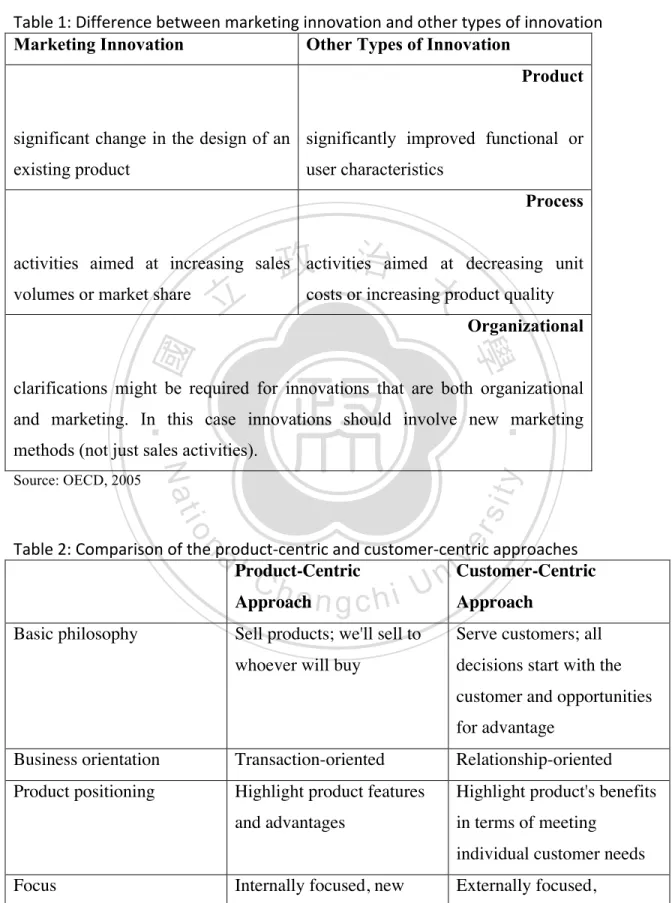
(6) shows the number of respondents who think that a certain variant of pronunciation is correct ............................................................................................................................................................... 85 Figure 18: More euphonious variant of “LUXGEN” pronunciation for the respondents of the survey “Linguistic and color preferences of the Russians in automobile branding”, Y-‐axis shows the number of respondents who prefer a certain variant of pronunciation .............................................................................................................................................................................. 86 Figure 19: Clarity of the meaning of the brand through the pronunciation as [l'uks 'gen] for the respondents of the survey “Linguistic and color preferences of the Russians in automobile branding”, Y-‐axis shows the number of respondents who prefer a certain answer ............................................................................................................................................................... 86 Figure 20: Illustrations by Y. Vasnetsov ............................................................................................. 87 References ............................................................................................................................................. 88 . . 立. 政 治 大. ‧. ‧ 國. 學. n. er. io. sit. y. Nat. al. . Ch. engchi. VI . i n U. v.
(7) . Chapter 1 -‐ Introduction 1.1. Research motivation Unique implementation of advanced technology and safety innovations has helped automobile industry newcomer LUXGEN to make a successful start in its home market of Taiwan. Now the ambitious young brand is going to conquer new markets, and Russia is supposed to be the first one. However, due to culture differences it will be quite a challenge for LUXGEN to set up a successful operation procedure in the Russian market. Despite the trend of globalization,. 政 治 大 values and have a hostile attitude to the brands that neglect or do not respect these values. 立. Russian consumers are still very conservative. They are proud of their traditional cultural Thus, it is vitally important for LUXGEN to demonstrate to the Russian consumers that,. ‧ 國. 學. although is it a foreign brand, it treats their national cultural values with consideration and respect.. ‧. It goes without saying that developing a mere marketing plan for LUXGEN in the. y. Nat. Russian market will not be enough. We believe that a deeper research in which such. sit. subjects as psychology and cultural studies are incorporated into a marketing plan might. n. al. er. io. make a bigger contribution to LUXGEN`s successful performance in Russia.. 1.2. Research objective . Ch. engchi. i n U. v. This study aims to gain better understanding on how a customer-centric marketing approach can be used as a mechanism for a new brand to enter a foreign market and increase its brand awareness. This premise will be based on the example of LUXGEN, for which we are going to develop a marketing plan, integrated with such subjects as psychology and cultural studies in order to provide it with recommendations how to create a positive brand image from the point of view of the Russian consumers and stand out of the crowd of the competitors.. 1.3. Research question . . 1 .
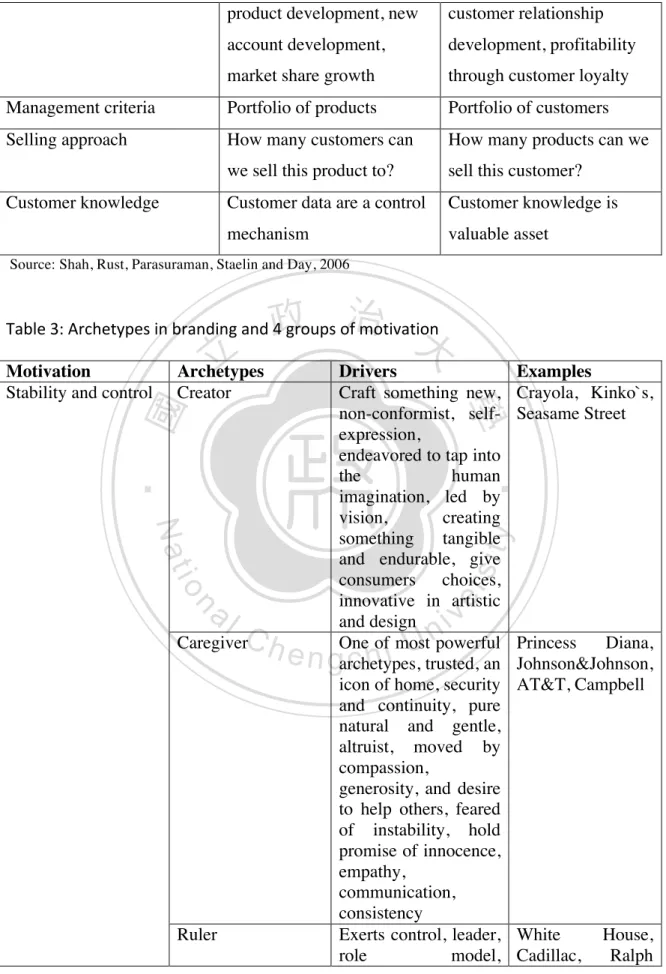
(8) - What is the potential of the Russian market for LUXGEN? - What are the challenges for LUXGEN in Russia? - Who will be the targeted customers of LUXGEN in Russia? - What steps should LUXGEN undertake to overcome the challenges and gain the attention of consumers in Russia?. 1.4. Research method In this research we use the following methods: - The review of marketing study, psychology and culture studies literature;. 政 治 大 - Amplification with questionnaire survey for Russian native speakers to present the 立 empirical data in the research; - Collecting secondary data;. ‧ 國. . ‧. . 學. - Result analysis.. n. er. io. sit. y. Nat. al. . Ch. engchi. 2 . i n U. v.
(9) . Chapter 2 -‐ Literature review 2.1. Marketing innovation According to Levitt (1962), who analyzes the perspective of “growth and profit through planned marketing innovation”, “marketing is a neglected frontier” since most marketing innovations were characterized as accidental and originated from outside the central cores of the industries in which they have ultimately developed. He argues that product innovations demanded a creative thought and imagination about new marketing methods. Moore (2004) has given a customer-focused definition of marketing innovation. He. 政 治 大 marketing communications (e.g. use of the Web and trailers for viral marketing of The 立 Lord of the Rings movie) or in consumer transactions (e.g. Amazon’s e-commerce. believes that marketing innovation improves customer-touching processes either in. ‧ 國. 學. mechanisms and eBay’s online auctions). Apart from defining different types of innovation, Moore (2004) has also matched them to the stages of product life cycle. More. ‧. specifically, he matched the initial phases with disruptive, application innovation, and product innovation. As the product matures, process innovation, experiential innovation. y. Nat. sit. and marketing innovation are important while in the declining phase business model. al. er. io. innovation and structural innovation can be used.. n. A very clear definition of marketing innovation can be found in the Oslo Manual by. Ch. i n U. v. OECD, the 3-rd edition: “marketing innovation is the implementation of a new marketing. engchi. method involving significant changes in product design or packaging, product placement, product promotion or pricing” (OECD, 2005) aimed at “better addressing customer needs, opening up new markets, or newly positioning a firm’s product on the market, with the objective of increasing the firm’s sales” (OECD, 2005). The Oslo Manual, the 3-rd edition, provides us with the differences between the various types of innovation. In Table 1 we summarized the comparison between marketing innovation and the other forms of innovations: 1) Marketing Innovations presuppose significant change in the design of an existing product, not significantly improved functional or user characteristics, like product innovations do;. . 3 .
(10) 2) Marketing Innovations are the activities aimed at increasing sales volumes or market share, but not the activities aimed at decreasing unit costs or increasing product quality, which is the main feature of process innovations; 3) Clarifications might be required for innovations that are both organizational and marketing. In this case innovations should involve new marketing methods (not just sales activities). . 2.2. Product-‐centric vs. customer-‐centric marketing Galbraith (2002) provides a clear distinction between the goals of a product-centric and a. 治 政 大 customers as possible for its products”, whereas “a customer-centric company tries to 立 for its customer" through focusing on the product find as many products as possible. customer-centric focus: a “product-centric company tries to find as many uses and. ‧ 國. 學. integration. Table 2 shows that the customer-centric approach puts the customer's needs and the relationship with the customer at every core aspect of the business, whereas the. ‧. more traditional product- centric approach focuses on the transactional sale of products. Fader (2012) underlined the importance of customer experience in customer-centric. Nat. sit. y. marketing. Unlike product centric marketing approach, which is focused on the products. io. er. that the company brings to market rather than the customers who buy those products, customer centric marketing have robust mechanisms designed to augment customer. n. al. i n U. v. experiences. Such firms value and consider customer satisfaction in everything they do.. Ch. engchi. They talk about experiences, and benefits, and often feature imagery of people on their marketing pieces. They design pricing models to fit customers’ lives and often integrate them with partners and offer platform deals. 2.3. Brand localization and culture Speaking about the approaches, which brands should develop to meet consumer expectations when they intend to penetrate into a foreign market, Baker and Sterenberg (2003) state that the nature of the local culture in which the brand must operate is one of the main factors that should be taken into primary consideration. Countries included in their study were plotted on two axes depending on whether their. . 4 .
(11) orientation toward brands is individualistic or collectivist and on whether they are oriented more toward their own culture and values (local focus) or more receptive to global influences (global focus). As Baker and Sterenberg (2003) point out, Cultural Individualists are the countries (in their research Russia belongs to this group), which have a high pride in their culture combined with strong individualistic values. This requires both localization and an individual connection with local consumers, with the individual connection probably more important than the cultural one. Global Individualists have a weaker interest or pride in their own culture and a correspondingly greater openness to the world. While there is thus a low need for. 政 治 大 an individual level. They may thereby feel part of a wider global “tribe”. 立. localization, consumers in these cultures still have a high need to connect with brands at Global Sensitives are collectivist societies that are open to the world. Connectivity. ‧ 國. 學. through and availability of global brands is often more important than pride in local culture. There is thus a medium need for localization in these cultures, more a matter of. ‧. translation than adaptation. A product or brand's origin and where it is manufactured are. y. Nat. important.. sit. Cultural Sensitives are the collectivist markets consumers take high pride in local. al. er. io. culture. They expect global brands to understand and respect their culture and, when. v. n. possible, adapt to local situations both in terms of communication and product features (Baker & Sterenberg, 2003).. 2.3.1. The definition of culture . Ch. engchi. i n U. The term “culture” is very broad. It has different meanings in the fields of communication, psychology, sociology, anthropology, and information studies. In this research we use the notion “national culture”, which definition is borrowed from anthropology. According to Hofstede, (1980) national culture is equivalent to the collective mental programming of a group, tribe, minority, or a nation. It is the aggregate of individual personality traits. He defines national culture as “the collective programming of the mind which distinguishes the members of one group or category of people from another” (Hofstede, 1991). He suggests that people share a collective . 5 .
(12) national character that represents their cultural mental programming. This mental programming shapes values, beliefs, assumptions, expectations, perceptions and behavior.. 2.3.2. The role of culture in localization process As claimed and proven by Hoft (1995), Marcus and Gould (2000) and Faiola (2002), culture plays a central role in the localization process. They have described numerous cases of market failures where companies did not thoroughly consider local culture issues.. 治 政 According to the Localization Industry Standards Association 大 (LISA), an international 立localization is “the process of modifying products or association founded in 1990, Culture is highlighted in the definitions of localization in industry and academia.. ‧ 國. 學. services to account for differences in distinct markets” which covers three main categories: linguistic issues, content and cultural issues, and technical issues.. ‧. Academia researchers make even bigger emphasis on culture when discussing the concept of localization. Gribbons (1997) defines localization in a similar way as LISA. sit. y. Nat. does, but he gives prominent status to culture by putting cultural issues above technical issues. In his two-level localization process, localization includes adjusting the features of. io. er. the product (e.g., translation, punctuation, dates, etc.) to mirror the needs and conventions. al. n. iv n C h e n g cpatterns colors, logic, functionality, and communication h i Uon the cultural level.. of the target audience on the surface level and adjusting the aesthetic appeal, images, To illustrate the importance of culture and its complexity in localization practices, Hoft (1995) presented an Iceberg analogy. The researcher suggests that issues of translation, punctuation, and aesthetic appeal are just the tip of the iceberg (the visible section above the water that is only 10 percent of the whole). But the iceberg’s huge body is invisible. Ninety percent of the iceberg consists of unspoken and unconscious rules, i.e. common knowledge, values, traditions and cultural archetypes shared within a culture.. 2.3.3. The specifics of national Russian culture and character. . 6 .
(13) Being holistic and influential, Russian culture (Slavic-Orthodox culture) is treated as one of few global cultures (Huntington 1993). Russian culture can neither be defined as western or eastern one. Through the centuries Russia absorbed the basic values of both the West and the East - reason and inspiration. And it served as a bridge between Western and Eastern cultural traditions, with the certain psychological dependence on both (Trubetzkoy, 1991). Due to different tendencies of world history coming from the east and the west and which coincided in the Russian people, Russia became a nation of inherent opposites and contrasts. These contradictions of Russian character were often discussed by historians. According to one of the best Russian historians of the nineteenth century V. Kluchevski,. 政 治 大 struggle against misfortunes and hardships; ability to concentrate efforts; ability to 立. the national character combined among the others such qualities as: the habit of patient cooperate within large geographic space (Kluchevski, 1904). The other famous. ‧ 國. 學. intellectual, P. Chaadaev defined contradictive Russian national character by such features as: brutality and inclination to violence; impersonal collectivism; Messianism;. ‧. internal freedom; kindness; humanism; gentleness; search for truth (Chaadaev, 1991).. y. Nat. People in Russia take great pride in their cultural uniqueness and expect the rest of the. n. er. io. al. 2.3.4. Language localization . sit. world to admire their cultural heritage.. Ch. engchi. i n U. v. According to GALA (2013) definition, language localization “describes the process of adapting a product to a specific international language or culture so that it seems natural to that particular region” so that to make a product or service appear as if it had been developed specifically in and for the local market and allow a company to communicate effectively with international consumers and users (GALA, 2013). Ibeh, Luo and Dinnie (2005) found that by offering consumers an experience in their preferred language that is both sensitive and relevant to the local culture, localization affords to: - Build a community of users (or potential users) within a region or who share language and culture;. . 7 .
(14) - Expand accessibility and connectivity for global consumers; - Customize the brand for the target market; - Offer a better consumer experience and more convenience.. 2.3.5. Color localization . 2.3.5.1. Color effects in marketing Schmitt and Pan (1994) consider color to be a vital part of products, services, packages, logos, displays and collateral.. 政 治 大. According to Madden, Hewitt and Roth (2000), color design is a potent cue for product,. 立. brand differentiation and for creating a sustaining corporate identities as well as. ‧ 國. 學. consumer perceptions.. Aslam (2006) describes color as an integral element of corporate and marketing. ‧. communications. It induces moods and emotions, influences consumers’ perceptions and behavior and helps companies to position in the market and differentiate from the. sit er. io. Color and the product. y. Nat. competitors.. al. n. iv n C U product including pleasantries, consumption package and that buyers h respond e n g toc the h itotal Kotler (1973) argues that the tangible product is only a small part of the total. imagery and collateral. Cheskin & Masten Inc. (1987) state that, while product quality is the ultimate determinant of consumer satisfaction, imagery is the vehicle that generates interest via “sensation transference” (Cheskin & Masten Inc., 1987) among the target population, thereby implying that the emotional response so triggered by colors in products, packages and logos influences consumer perceptions of the product and the company. Color and the advertising messages Color is instrumental in attracting consumer attention to media advertisements. Researches of Hornik (1980), Berg-Weitzel and Laar (2001) showed that adapting . 8 .
(15) advertisement execution to the local preferences, culture and marketing mix for each foreign market is effective. Lee and Barnes (1989) found that the product and color of print advertisements and the product and type of magazine were correlated and there were differences in the use of color in racially oriented magazine advertising but not so between gender-sensitive magazines.. 2.3.5.2. The necessity for color localization Aslam (2006) believes that different cultures differ in their aesthetic expressions as colors. 政 治 大. represent different meanings and aesthetic appeals in different cultures. The meanings. 立. given to some colors may be pan-cultural, while some are regional and some are unique. ‧ 國. 學. to specific cultures and it is imperative to explore the meanings and effects of a chosen color in the target market before the launch of a product or promotion campaign. Figure 2 is the model of color application in marketing, developed by the researcher.. ‧. Nat. sit. y. 2.4. Experiential marketing . er. io. Holbrook and Hirschman consider experience an essential element of the relations. al. iv n C (1982) within the realms of management, involves a personal h e n g c h i U occurrence with emotional significance created by an interaction with product or brand related stimuli. n. between the brand and consumers. Experience, as defined by Holbrook and Hirschman. Schmitt (1999) defines experiential marketing as a unique approach to the task of marketing goods and services, a concept that integrates elements of emotions, logic, and general thought processes to connect with the consumer. As the researcher pointed out, the goal of experiential marketing is to establish the connection in such a way that the consumer responds to a product offering based on both emotional and rational response levels (Schmitt, 1999). Caru and Cova (2003) argue that for any experience to become part of experiential marketing the result must be “something extremely significant and unforgettable for the consumer immersed into the experience”.. . 9 .
(16) McCole (2004) believes that experiential events group people according to their values, enjoyment, personality type and social group. This can create groups with quite diverse traditional segmentation characteristics. Once the brand resonates with this value set the link between individual and brand becomes emotional rather than merely functional and the customer is therefore far more likely to be loyal. Smilansky (2009) defines the main goal of experiential marketing as “giving something positive back to the people who spend their hard-earned cash purchasing your products and services”, in this way “strengthening and building a real relationship between your customers and brands”.. 治 政 2.5. The theory of advertising psychology and archetypes 大 in marketing 立 ‧ 國. 學. Any advertisement message appeals to a potential consumer of a certain type of product or service. The effectiveness of the advertising message first and foremost depends on a research on the portrait of the consumer – determining his/her psychological and social. ‧. attitudes and stereotypes, understanding his way of life. In order to predict the person's. y. Nat. motivation and make a certain impact on it, a marketing specialist need to identify the. n. al. er. io. changeable according to the aims which an advertiser set.. sit. structural elements of this person`s psyche, which can be controlled, and therefore can be. iv n C on the psych theories h eperson`s ngchi U. Identification of these elements, or points of impact is the main challenge of advertising psychology, which is based psychological schools.. developed by different. Recently, the theory of archetypes has become widely spread in marketing. The reasons for the popularity of this theory is the fact that, as Mark and Pearson (2002) believe, an effective and targeted advertising should base on an integral and understandable brand concept. The main condition of the integrity of the brand is provided only if it is based on the homogeneous image. This image should be simple and straightforward. And archetype is exactly such a homogeneous, simple and understandable image. The theory of archetypes derives from the theory of analytic psychology of Swiss psychologist K. -G. Jung (1875 – 1961). In regards to marketing, applying some provisions of this theory allows to create integral brand images of products and services . 10 .
(17) in the mind of the consumer. From the point of view of Jung`s theory, brand identity is a coherent set of archetypal characters, psychological programs, emotionally attached associations, which are closely interconnected with each other and which can strongly influence the consumer`s behavior. Beneath we will briefly explain the basic concepts of C. Jung`s theory of analytical psychology: the structure of psyche, conscious and personal unconscious, collective unconscious, and then we will try to see how they can be applied to advertising practices.. 2.5.1. The structure of psyche . 政 治 大. According to Jung (1969), we can schematically present the human psyche in the form of. 立. globe with three layers. In its center there is consciousness, which Jung (1969) called. ‧ 國. 學. Ego. The ego is the bearer of personality, it is the organizer of our thoughts and intuitions, feelings, and sensations, and has access to memories which are not repressed. Above it there is much more extensive layer of forgotten or repressed personal memories,. ‧. feelings, and behaviors, which Jung (1969) called the personal unconscious. Above all is. y. Nat. the collective unconscious, filled with ancient images and behavioral responses that are. sit. repeated many times in the history of mankind.. n. al. er. io. According to the ideas of Jung (1969), the human mind is holistic in nature and. v. represents the unity of complementary and constantly interacting with each other. Ch conscious and unconscious processes.. engchi. i n U. 2.5.1.1. The personal unconscious The personal unconscious is a product of the interaction between the collective unconscious and the development of the individual during life. Jung’s (1969) definition of the personal unconscious is as follows: “Everything of which I know, but of which I am not at the moment thinking; everything of which I was once conscious but have now forgotten; everything perceived by my senses, but not noted by my conscious mind; everything which, involuntarily and without paying attention to it, I feel, think, remember, want, and do; all the future things which . 11 .
(18) are taking shape in me and will sometime come to consciousness; all this is the content of the unconscious”.. 2.5.1.2. The collective unconscious and archetypes In Jungian psychology, an inherited pattern of thought or symbolic imagery derived from the past collective experience and present in the individual unconscious. According to Jung (1971), “Archetypes are like riverbeds which dry up when the water deserts them, but which can be found again at any time. Archetype is like an old watercourse along which the water of life has flowed in this channel, the more likely it is,. 政 治 大. the sooner or later the water will return to its old bed”.. 立. Archetypes are forms or images of a collective nature worldwide as constituents of myths. ‧ 國. 學. and as individual products of unconscious. These are imprinted and hardwired into our psyches. Archetypes predispose us to approach life and to experience it in certain ways, according to patterns laid down in the psyche. Archetypes include figures, events and. ‧. objects. These images find expression in the psyche, in behavior and in myths. It is only. y. Nat. archetypal images that are capable of being known and coming to consciousness, the. sit. archetypes themselves are deeply unconscious and unknowable. Archetypes have a. er. io. fascinating, numinous quality to them which makes them difficult to ignore, and attracts. n. al. v. people to venerate or worship archetypal images. As Jung (1969) said, “All the most. i n powerful ideas in history go backC to h archetypes”. engchi U. 2.5.2. The personal unconscious and the concept of nostalgic advertising There are different levels of psychological structure, and each of them has its own patterns of perception (in our case, the perception of advertising messages) and interaction with others. According to Brovkin (1999), an effective advertising message should affect both the conscious and the unconscious structure of the consumer`s psyche as conscious behavior is often caused by deep psychological processes and is only a reflection of the unconscious.. . 12 .
(19) One of psychological methods, which can be used in advertising, is increasing subconscious impressions in order to transfer it to the conscious, or stirring up forgotten memories. If these memories are pleasant, the pleasure caused by them can be transferred to the product and its brand image (Brovkin, 1999). In his research Hirsch (1992) found out that nostalgic feelings and thoughts drive the behavior of people. Goulding (2001) proves that nostalgia is a part of people’s consumption experience and, therefore, a part of preference or choice. Reisenwitz, Iyer, and Cutler (2004) consider nostalgia an important marketing topic (that influences trends in designing, decorating, entertaining, collecting, retailing, media, arts,. 政 治 大 supposed to show higher purchase likelihood with regard to the advertised products 立. and advertising. When experiencing nostalgia in a consumption context, consumers are (Reisenwitz et al, 2004).. ‧ 國. 學. According to the ideas of Sierra and McQuitty (2007) people are often not only influenced by immediate circumstances, but also by their pasts and their anticipated. ‧. futures. Consumers cannot return to the past, but they can try to preserve it through. y. Nat. nostalgic consumption activities (Sierra and McQuitty, 2007). Consumers who are. sit. exposed to a nostalgic advertisement, are supposed to transfer evoked memories of. al. er. io. former times to products; thus, having nostalgic feelings as well as having mental images. v. n. of former times in mind may positively influence consumers’ judgment processes, which. Ch. i n U. results in more favorable product evaluations (Sierra and McQuitty 2007).. engchi. 2.5.3. The archetypes of collective unconscious and advertising Geraschenko (2006) pointed out that the human brain uses the archetypes of the collective unconscious to facilitate the process of decoding information to response to it rapidly. No extra efforts are required to interpret the meaning of the advertising image, based on archetypes, because the interpretation inherited from our predecessors can be easily and quickly reproduced in our minds. Mark and Pearson (2002) believe that the best way to create emotional affinity through meaning is to use archetypal images to fulfill “basic human desires and motivations and evoke deep emotions and yearnings”. The narratives and meanings behind archetypes let . 13 .
(20) customers relate to brands by making brands seem alive. The authors list twelve archetypes arranged along four groups of motivations. Each archetype fulfills a deepseated need. Table 3 classifies the twelve archetypes.. 2.5.4. Ethno-‐cultural archetypes Besides universal cultural archetypes mentioned above, there are ethno-cultural ones. Although these archetypes have a more narrow range of influence, they are the “constants of national spirit”, as Pendikova and Rakitina (2008) describe them, because they express. 政 治 大. fundamental properties of the ethnic group as a cultural entity. It is difficult to overestimate ethno-cultural archetypes in every national culture, since they determine the. 立. characteristics of art, historical destiny, character and outlook of the people who belong. ‧ 國. 學. to the given culture (Pendikova & Rakitina, 2008). These archetypes represent in condensed form the collective experience and mental characteristics of ethnic groups. Ethno-cultural symbols include mythological and legendary characters and personalities. ‧. of a given ethnic group, real historical events, national heroes, etc. Pendikova and. y. Nat. Rakitina (2008) suggest that these characters can be incorporated into advertising images.. sit. Advertising, based on these characters, brings positive emotions (feelings of pride,. er. io. belonging, patriotism), to the viewer, its semantic content is easily decoded and. al. n. iv n C easily find the way to the heart ofh the consumer, i U as they convey in the most eRussian ngch. interpreted correctly by any representative of the nation. These advertising images can distinct way a unique national character of the Russian people.. According to Pivneva (2003), the most fundamental images of the Russian cultural archetypes are the wise woman, the hero and the leader.. . . . 14 .
(21) . Chapter 3 – Russia Automotive Market Analysis . 3.1. Russian automotive market overview With a population of over 140 million, Russia is a huge market, measured by the number of potential consumers. The consumer potential together with increasing income makes Russia one of the most attractive markets for the world automotive industry. According to Autostat Analytical Agency [AAA], 2012), Russia ranked seventh among the world's leading automobile markets with 2.81 million new cars in 2011, among them there are 2.48 million passenger cars.. 政 治 大 mainly driven by increasing立 consumer confidence, receding unemployment, available car Beginning from 2010, the Russian automotive market demonstrates consistent growth,. ‧ 國. 學. lending programs, recovery of demand and government support initiatives aimed at boosting the development of the vehicle market. Light vehicle sales in Russia increased by 30% in 2010 and by 39% in 2011 (Bonchev, 2012).. ‧. Russia’s automotive market is the second largest in Europe, after Germany, and has. y. Nat. significant growth potential. The light vehicle density in Russia is 250 cars per 1,000. sit. people compared to more than 500 cars in Germany and more than 640 cars in the US. er. io. (Bonchev, 2012). In 2015, Russia is expected to be the largest car market in Europe,. al. iv n C An important consequence of Russia’s accession to the h e n g c h i UWTO in 2012 is a considerable reduction of customs duties on vehicles in 2012–2018, which is supposed to result in a n. overtaking Germany (Bonchev, 2012).. certain shift in the demand structure in favor of foreign vehicles and increase their share in overall sales (AAA, 2012).. 3.2. Russian SUV market: major players . SUV is the fastest growing segment of the Russian automotive market in recent years. In the period from 2007 to 2012 its share of the passenger car market rose from 14.5% to 30.6% (AAA, 2013). Figure 3 depicts the sales and market shares of top-15 SUVs in the Russian market, from the period since 2005 till 2012. Nowadays, most popular SUVs are represented by . 15 .
(22) Japanese, Korean, German, French and Russian brands. The figure shows that competition in the SUV segment becomes more severe every year, as more and more brands appear in the Russian market.. 3.3. Marketing of top-‐5 SUVs in Russia . Here we will briefly describe the specific features of marketing of top-5 SUVs in Russia. These top-5 SUVs are: 1. Niva Chevrolet (59331 vehicles sold in 2012); 2. Lada 4х4 (54656 vehicles sold in 2012); 3. Renault Duster (47344 vehicles sold in 2012);. 政 治 大 KIA Sportage (32716 立 vehicles sold in 2012).. 4. Nissan Qashqai (36793 vehicles sold in 2012);. 3.3.1. Lada 4х4 (Lada Niva) and Niva Chevrolet . 學. ‧ 國. 5.. ‧. Lada 4х4 (Lada Niva), produced by Russian automaker AvtoVAZ, is considered to be the. y. Nat. progenitor of contemporarily crossovers. Before Lada Niva appeared in 1978, SUVs were. sit. bulky and very expensive. However, Lada Niva`s low price allowed more people. er. io. purchase 4x4, and due to its multifunctionality it became very popular in Russia. Its. al. n. iv n C Chevrolet, the SUV, produced by GM-AvtoVAZ, h e n g c ha joint i Uventure between AvtoVAZ and original name was Lada Niva, but in 2006 the brand Niva was passed on to Niva. General Motors. Niva Chevrolet is an upgraded model of Lada4х4. Its price is more expensive than Lada4х4`s, because of improved design and equipment. Their targeted consumer groups differ in terms of income. Lada 4х4 targeted consumers: the people with low or medium income who prefer active way of life and don't need luxury. 85% of them are males. People who live in rural areas with poor condition of roads or the ones who prefer active leisure - fishing, hunting, travelling in remote districts without roads. Lada 4х4 reasons for popularity: lowest price in the class, low repairing cost, excellent passability in off-road conditions.. . 16 .
(23) Niva Chevrolet targeted consumers: the same as Lada4х4`s, but with higher income. Niva Chevrolet reasons for popularity: reasonable price, reasonable repairing cost, excellent passability in off-road conditions. Lada 4х4 and Niva Chevrolet marketing: creating the community of funs of the legendary brand This automobile has many records and achievements: in 1998 Lada 4х4 reached the North Pole; in 1999 it reached the height of 5762 meters in Himalayan mountains; this car has been used in Antarctic continent by Russian members of Antarctic expedition for. 政 治 大 through mud, and underwater. So, in Russia Lada SUV is considered to be a legendary 立 more than 15 years (TopCar, 2008). Lada Niva have been driven on land, up mountains, car famous for its incredible passability in off-road conditions, so it does not need any. ‧ 國. 學. advertising. Thus, the AvtoVAZ company does not spend much money on TV, online, outdoor or in-door advertising. It promotes the brand by event marketing, organizing. ‧. expeditions and competitions. The aim of these events is to promote the brands and. y. Nat. demonstrate the unique capabilities of these SUV in the conquering hard to reach places. sit. of Russia. For example, in 2012 the GM-AvtoVAZ company hold the themed rally. al. er. io. expedition called “Discover the treasures of Russia driving Niva Chevrolet”. A total. v. n. distance covered by the expedition was 7000 km. The GM-AvtoVAZ team, who were. Ch. i n U. driving Niva Chevrolet SUVs, together with the representatives of regional and federal. engchi. media were able not only to appreciate the recent improvements of the automobile, but also to get acquainted with the culture and places of interest of Russia`s northern districts - the Urals, Siberia and Altai. On the route the team visited authorized dealers of GMAVTOVAZ in some cities, who introduced famous sights, "treasures" of the city. There were reports on each day of the rally on the website. Thus, the potential customers could see the unique capabilities of Chevrolet NIVA and get convinced that the vast expanses of Russia and its countless treasures are worthy of special attention. The company also regularly holds annual all-Russia competitions, such as Cup of Lada or Chevrolet Niva: on and off the road to Shanghai, as well as local competitions like circular race track and various winter rally competitions. It is the motorists who drive Lada cars who participate. . 17 .
(24) in these events. All-Russia competitions may last 2-3 months, since usually they have several stages and cover huge territories – various hard-to-reach places of Russia and even other countries, being hold in the areas without roads in tough weather conditions. The owners of Lada SUVs who participate in these competitions consider themselves a community of people with common interests, values and lifestyle. They call themselves “Niva-drivers”. Besides taking part in competitions, Niva-drivers also like traveling over long distances by car and camping together in wild places of Russia. There are reports about these competitions with photos in printed and on-line automobile magazines, some competitions are broadcasted on TV, so potential customers can see the vehicle in real life and got convinced in its excellent passability. This is more convincing. 政 治 大 members of Niva-drivers community is a big motivation for many consumers to puchase 立. for them than a filmed advertisement. What is more to the point, becoming one of the these SUVs.. ‧ 國. 學 ‧. 3.3.2. Renault Duster . y. Nat. The automobile appeared in the Russian in the beginning of 2012 and became one of the. er. io. Dacia Duster.. sit. bestsellers for a short period of time. In European market it is known under the name. al. n. iv n C Most of them have family. Thesehconsumers are interested e n g c h i U in new SUV models of international brands, but they are not reach enough to purchase one of them. They are Targeted consumers: the people who prefer active way of life, with medium income.. looking for the most affordable model with the highest passability, but do not want to buy the vehicles produced by Russian or Chinese automakers. Reasons for popularity: well-known foreign brand SUV at the most affordable price. Marketing: “SUV 4х4 for everyone” campaign TV and online commercial Renault attracts Russian customers by highlighting its models` low prices and the cars` functionality. The commercial is based on comparison. Once upon a time people believed . 18 .
(25) that the earth was flat, until they found out that it was not; they believed that it was impossible to reach the sky until they got convinced that it was not true; people did not believe that they could not control the elements, until they could do it; it was believed that SUV was only for the elite, until Renault has shown that it is for everyone. In the beginning of the commercial the background is wild, beautiful nature, and in the end the car is driven in a city street, featuring that Renault Duster is a multi-purposed vehicle, which is suitable for no-road conditions as well as for urban life. Outdoor advertising There are banners with the image of the automobile and the slogan “SUV 4х4 for everyone” in the cities.. 政 治 大 Within the framework of this campaign, cars have been placed in shopping malls for one 立 In-door advertising. month in nine big cities: Moscow, Voronezh, Volgograd, Perm, Chelyabinsk,. ‧ 國. 學. Krasnoyarsk, Saratov, Yaroslavl and Tyumen. Information terminals have been installed near the cars, where consumers could sign up for a test drive, get a brochure or contact a. ‧. dealer. Promotional staff consulted visitors on the advantages of the new model.. sit. y. Nat. io. al. er. 3.3.3. Nissan Qashqai . iv n cities U and. n. Nissan Qashqai appeared in Russia in 2007 and at once became one of the bestsellers. Targeted customers: young. Ch people. appreciate reliability and modernity.. live in ewho ngchi. practical families who. Reasons for popularity: convenient for everyday use in a city, good price-quality ratio, combines the advantages of crossover and golf class vehicles. Marketing: creative “Urban Proof” saga – on&off-line campaign The “Urban Proof” slogan proposed for this advertisement campaign clearly reflects the positioning of the Nissan Qashqai as elegant, compact and functional SUV, which can overcome all the difficulties in city jungles. So, although part of Qashqai’s positioning was based around protection in the concrete jungle, advertising emphasized its fun, . 19 .
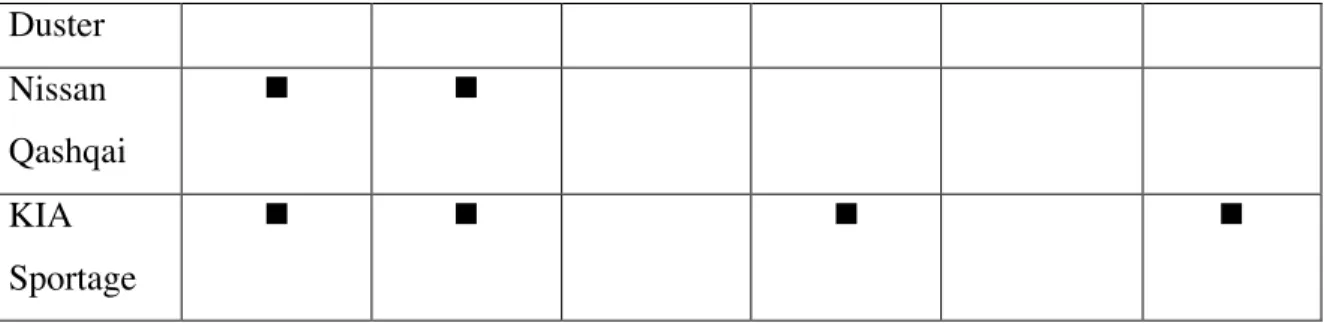
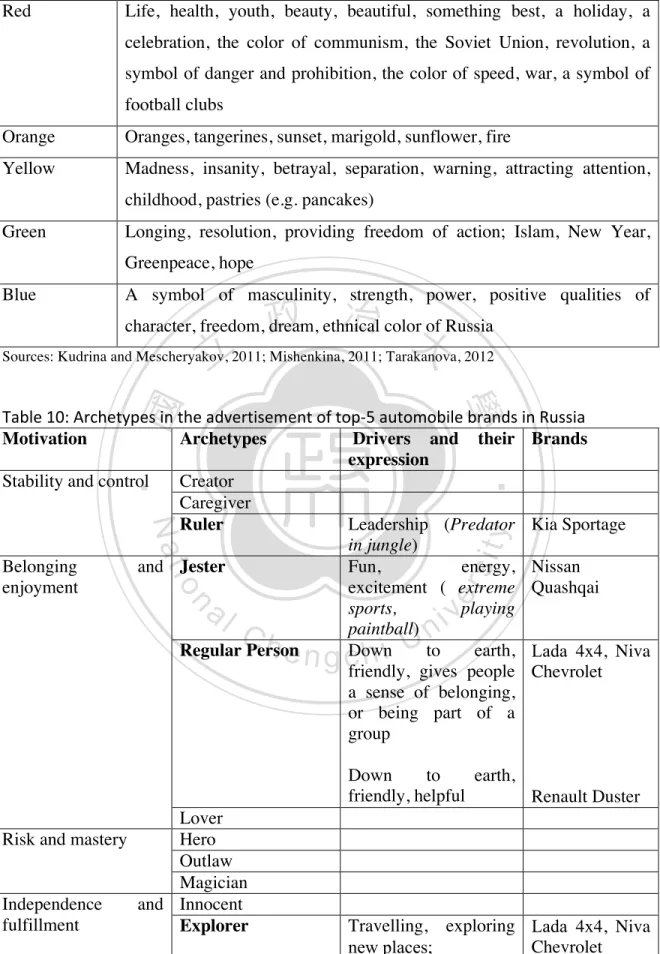
(26) dynamic quality. In 2006, within the framework of pre-launch campaign, "Soon in the City" banners appeared in the streets. Then the advertising campaign was supported by a series of «Urban Proof» themed online advertising. The prelude to the off-line campaign "100% Urban Proof" was the online activity of Nissan. The videos of unrealistic extreme tricks on huge ramps and jumps performed by cars were posted on the Qashqai Car Games site. These videos were posted on YouTube as well to redirect the viewers to Qashqai`s website. Then Qashqai`s commercials appeared on TV. These commercial looked like a parade of extreme sports: a giant "driver" used the car instead of a skateboard. The next part of advertising was «Artistic Paintball», a fresh and daring urban. 政 治 大 city is trying to “kill” Qashqai in a paintball game, but the maneuvering car escapes from 立. performance. This minute-long commercial is a gigantic one-sided paintball show: the the balls of paint without any effort and does not have even a single drop of paint on its. ‧ 國. 學. shiny surface at the end of the commercial.. ‧. 3.3.4. Kia Sportage . y. Nat. io. way of life and are interested in sport cars.. al. n. Reasons for popularity: good price-quality ratio. Ch. engchi. er. sit. Targeted customers: young, confident men with average income who prefer an active. i n U. v. Marketing: interactive advertisement campaigns “KIA Makes the Weather” campaign TV commercial. The idea of the campaign is expressed through familiar Russian idiom “to make the weather”, which means “to set a trend”. If a product begins to influence the situation in the market and determine a new trend, the Russians say that it “makes the weather”. On the other hand, such expression allows focusing more attention on the weather, an important factor in Russia. In the advertisement concept the two meanings of the expression “make the weather” are used. In TV commercial Sportage is shown as a . 20 .
(27) weatherproof car, which can easily solve any problems, bringing vivid emotions in the life of his owner, and the world around. Prints and street banners The bright orange color of Sportage model in magazine prints and street banners creates a sunny and positive aura of the car, which always remains so despite of the changeable weather. Interactive Internet advertisement There was an interactive banner where the user could choose the weather for KIA Sportage, moving the slider between sunny summer and rainy, gray urban landscapes. That demonstrates that the car always remains reliable in spite of time of the year and the. 政 治 大 “Occupy Your Territory” campaign 立 weather.. Prints and banners. ‧ 國. 學. KIA Sportage Limited Edition (SUV in two aggressive and audacious colors - black and orange) appeared in the Russian market in 2010. Within the framework of advertising. ‧. campaign, it was positioned as a predator, an inhabitant of urban jungle that is able to. y. Nat. suppress the other inhabitants due to its unique qualities - an exclusive design and. sit. defiantly striking styling. The visual image in magazine prints and street banners were the. al. er. io. contours of a night city roads from the bird's eye view, which form a tiger grin.. n. Such a concept of the advertising campaign was designed taking into consideration. Ch. i n U. v. mentality of Russian targeted customers – young males: no one wants to be a herbivore. engchi. on the roads of a city, everyone sees himself as a predator, aggressive and full of quiet dignity. KIA advertising message summons to occupy your own territory in the surrounding urban environment. Interactive on-line game Within the framework of the promotion of KIA in the promotion of KIA Sportage limited edition SUV, an interactive online game “The Battle of Cities. Occupy your territory” was launched. The players had to conquer other cities and protect their own territory. The one who occupied the largest territory could win iPad at the end of every week. Event marketing. . 21 .
(28) In 2010 13 000 km-long Seoul-Moscow rally was held. Three new Sportage cars crossed the territory of South Korea, China, Mongolia and Russia. The reports about the rally were posted on the official blog page of Kia Motors Russia. The photo contest “Who makes the weather?” was held before the launch of an upgraded version of Kia Sportage in 2010. The reward for the winner was participating in the test of the upgraded Sportage for 3 days in the Caucasus with Russian automotive journalists. 3.3.5. Marketing of top-‐5 SUVs in Russia: summary . . . 立. 政 治 大. ‧. ‧ 國. 學. n. er. io. sit. y. Nat. al. . Ch. engchi. 22 . i n U. v.
(29) Table 4 summarizes the marketing activities of top-5 SUVs, which have lead them to success in the Russian market: - Creative commercials; - Interactive on-line activities; - In-door advertisement; - Outdoor advertisement; - Community of motorists; - Events marketing.. . . 立. 政 治 大. ‧. ‧ 國. 學. n. er. io. sit. y. Nat. al. . Ch. engchi. 23 . i n U. v.
數據


+7




Outline
Brand
localization
and
culture
The
theory
of
advertising
psychology
and
archetypes
in
marketing
Marketing
of
top-‐5
SUVs
in
Russia
Collecting
secondary
data
Opinion
survey
Cultural-‐centric
marketing
approach
for
LUXGEN
Creating
specific
advertisement
of
LUXGEN7
SUV
for
the
Russian
consumers
Experiential
marketing
for
LUXGEN7
SUV
-‐
Conclusion
相關文件
本文將就俄羅斯養豬 產業高達 業、肉豬市場 概況進行探討 況進行探討 , 並就台灣豬肉 產業高達 品拓展俄羅斯市場之優劣勢與可行作法 提出建議,以作
The hashCode method for a given class can be used to test for object equality and object inequality for that class. The hashCode method is used by the java.util.SortedSet
6. To complete the ‘What’s Not’ column, students need to think about what used to be considered a fashionable thing to do, see, listen to, talk about and is no longer
1.8 Teachers should take every opportunity to attend seminars and training courses on special education to get a better understanding of the students’ special needs and
隨著經濟實力的衰退,基輔的 公王越來越沒有影響力,而羅斯人 的文化傳統中,沒有固定的家族繼
隨著經濟實力的衰退,基輔的 公王越來越沒有影響力,而羅斯人 的文化傳統中,沒有固定的家族繼
Let and be constants, let be a function, and let be defined on the nonnegative integers by the recu rrence. where we interpret to mean either
To look at the most appropriate ways in which we should communicate with a person who has Autism and make it.. applicable into our day to
