1)Department of Forestry and Nature Conservation, Chinese Culture University, Taipei 11114, Taiwan.
中國文化大學森林暨自然保育學系,11114台北市陽明山華岡路55號。
2)Department of Applied Science of Living, Chinese Culture University, Taipei 11114, Taiwan. 中國
文化大學生活應用科學系,11114台北市陽明山華岡路55號。
3)Forestry Economics Division, Taiwan Forestry Research Institute, 53 Nan-Hai Rd., Taipei 10014, Taiwan. 林業試驗所林業經濟組,10014台北市中正區南海路53號。
4)Corresponding author, e-mail:[email protected] 通訊作者。
Received April 2012, Accepted September 2012. 2012年4月送審 2012年9月通過。
Procurement Decision-Making by Wood-Based Industries in Taiwan
Yi-Chung Wang,
1)Shu-Hsin Ko,
2)Jiunn-Cheng Lin
3,4)【 Summary】
About 99% of the wood used in manufacturing in Taiwan is imported, so there is a great de- pendence on imported materials. Considering issues of future environmental sustainability and prevention of illegal logging, it is necessary to fully understand sources of wood imports and procurement strategies of importing industries in order to enhance their competitiveness. In this study, a questionnaire survey of domestic wood-based manufacturing and trading firms was con- ducted. The 376 valid returned questionnaires showed that Taiwanese wood-based manufacturing and trading firms are mostly small-scale, and production is the primary function of these firms. Of the responding firms, 58.2% reported that 100% of their sources of raw wood materials for sale or manufacturing were imported over the past 3 yr. As to essential considerations in selecting sources of wood raw materials by firms, 4 factor dimensions were chosen from 23 questions by a factor analysis: “supplier experience,” “competitiveness,” “import considerations,” and “environmental friendliness”. Based on a single-factor analysis of variance and Duncan’s new multiple-range post- hoc test, these 4 dimensions were significantly more important for importers and agents of foreign companies than for manufacturers and combined manufacturer-importers/manufacturer-agents. As to the reasons for importing foreign wood raw materials, 4 factor dimensions, including “meeting demands,” “domestic harvest restrictions,” “quality,” and “domestic supply,” were selected from 14 questions by a factor analysis. Responding firms had significantly different reasons for import- ing foreign wood raw materials, and “meeting demands” and “quality” were significantly more important for importers and agents of foreign firms than for manufacturers or combined manufac- turer-importers/manufacturer-agents. In addition, for firms that were 100% reliant on imported raw materials, “meeting demands” and “quality” were significantly more important factors than for firms which partly used domestic timber.
Key words: market preferences, softwood, hardwood, import value, forest products, forest products industry.
Wang YC, Ko SH, Lin JC. 2012. Procurement decision-making by wood-based industries in Tai-
wan. Taiwan J For Sci 27(4):333-44.
研究報告
台灣木材產業採購決策之研究
王義仲
1)柯澍馨
2)林俊成
3,4)摘 要
在台灣有99%以上的木材來自進口,因此對進口材需求的依賴程度相對提高,另為因應未來環境
永續及防止非法砍伐問題,欲提高其競爭力,有充分瞭解進口木材來源及進口業者採購決策之必要。
在回收的有效問卷376份中,顯示台灣木基工業廠商及貿易商均以小型、公司型態為生產工廠為主,
受訪廠商近三年生產或銷售之木材或木製品的原料來源有58.2%受訪廠商的原料100%為進口。在選 擇木材原料供應之考慮因素之重要性問項,經因素分析結果可萃取出「供應」、「競爭力」、「進口 考量」、「環境友善」4個因素構面,經由單因子變異數分析及Duncan法進行事後檢定,則「公司型 態」為進口商或外國公司之代理商之業者,在這4個因素構面之重要性結果皆明顯高於公司型態為工廠 或工廠兼具進口商或外國公司之代理商之業者。在進口國外木材原料之原因所萃取的「符合需求」、
「國內伐採限制」、「品質」、「國內供應」4個因素構面,則在「公司型態」及「原料進口來源」兩 項,在「符合需求」及「品質」因素構面結果,皆明顯高於公司型態為工廠或工廠兼具進口商或外國 公司之代理商之業者。而「原料進口來源」100%仰賴進口的業者,皆明顯高於部分進口的業者。由結 果可知,不同的公司型態其採購決策也有差異。
關鍵詞:市場偏好、針葉材、闊葉材、進口值、林產品、林產工業廠商。
王義仲、柯澍馨、林俊成。2012。台灣木材產業採購決策之研究。台灣林業科學27(4):333-44。
INTRODUCTION
In Taiwan, annual wood consumption is about (5~8) x 10
6m
3, of which over 99%
is imported with an almost complete de- pendence on timber imports (Wang and Lin 2011). Most forest product companies need to obtain raw materials from abroad for further processing, manufacturing, or marketing, all of which creates greater added value and profit. Because raw material procurement is essential to manufacturing operations, raw material supplier selection and evaluation are important considerations (Dahel 2003, Millington et al. 2006). With global wood resources dwindling and environmental con- sciousness surging, wood-producing coun- tries are increasingly attaching importance to domestic forest resources and are restricting
the range of timber exports, which will have
structural impacts on timber supply and de-
mand. In recent years, under the influence of
issues such as slowing global warming, con-
serving biodiversity, combating illegal timber
harvesting (logging), and the Reducing Emis-
sions from Deforestation and Forest Degrada-
tion (REDD) Program initiated by the United
Nations, increasing numbers of consumers
have begun to pay attention to environmental
issues in addition to considering the more-
traditional economic aspects of price, deliv-
ery time, and quality (Dickson 1966, Shipley
1985, Weber et al. 1991, Chao et al. 1993,
Zhang et al. 2003, Wang and Lin 2011). Also,
whether the production processes of products
purchased have negative environmental or
social impacts is of great concern.
The term “illegal forest activity” refers to any illegal activity associated with forest ecosystems, forestry, wood (timber), harvest- ing of non-forest products, and the transport, processing, and trade in forest products (Tac- coni and Kaimowitz 2007, WWF 2008). Past studies showed that on a worldwide average, 8% of logs and 6% of lumber were derived from illegal tree harvesting, and as much as 90% of harvests are illegal in some countries, such as Indonesia and Cambodia, compared to about 30~80% in West and Central Af- rica and the Amazon River basin (SCA and WRI 2004, Greenpeace 2008). In addition, a study by Lee (2011) estimated the propor- tions of suspicious log and lumber imports into Taiwan in 2009 to be 11.6~27.0% and 5.8~10.5%, respectively. Toyne et al. (2002) estimated that the proportion of imports of illegally harvested trees was as high as 45%.
Internationally, influencing international trade can be used to prevent illegal goods from reaching the international market. For ex- ample, the US Lacey Act of 1900 (16 U.S.C.
SS 3371-3378), amended under the Food
Conservation and Energy Act of 2008 (110P.L. 246; 122 Stat. 1651; 2008 Enacted H.R.
6124; 110 Enacted H.R. 6124) prohibits trade in a wide range of wildlife, fish, and plants that have been illegally taken, transported, or sold. The European Union (EU) in 2003 presented an action plan on Forest Law En- forcement, Governance and Trade (FLEGT), which relates to problems of governance and the resolution of illegal timber harvesting, combating illegal timber harvesting, and ban- ning sales of wood from deforestation in the EU market. Its work focuses on improving governance, strengthening land use rights and the rights of forest-dependent communities, and strengthening all stakeholders, especially promoting the effective participation of pri-
vate individuals and aboriginal groups. In addition, it increases transparency, reduces corruption, and encourages bilateral voluntary partnership agreements (VPAs) with other countries (EFI 2008).
Illegal forest activities impact world timber prices and seriously threaten national sustainable development. Therefore, a con- cept of sustainable procurement has gradually arisen. For instance, sustainable procurement of forest products means considering maxi- mizing the monetary value while minimizing social and environmental impacts of the pur- chased products and services. To aid ordinary consumers and industrial consumers achieve sustainable procurement through purchasing, the World Business Council for Sustainable Development (WBCSD) and the World Re- sources Institute (WRI) proposed sustainable wood and paper products procurement deci- sions in 2009. Sustainable wood and paper products procurement decisions should con- sider the following: (1) product origin, (2) the accuracy of product information, (3) product legality, (4) sustainability of forest manage- ment, (5) special area and sensitive ecosystem protection, (6) related climate-change issues, (7) appropriate environmental protection, (8) appropriate wood-fiber recycling, (9) appro- priate use of other resources, and (10) needs of local communities and indigenous peoples (WBCSD and WRI 2009).
Moreover, due to rising land and labor
costs and influences of trade liberalization, in-
ternationalization, and information technolo-
gy trends, Taiwan’s forest industries no longer
have an advantage of possessing a low-cost,
production-oriented marketing strategy. They
need to respond to sustainable procurement
issues for future environmental sustainability
and prevent illegal logging. Because forest
industries in Taiwan rely on imported raw
materials, demand elasticity in raw material
prices is low. In order to enhance the com- petitiveness of wood-based industries during these times of economic change, exchange rate fluctuations, and other phenomena, it is necessary to fully understand sources of imported wood and procurement decision- making by importers.
MATERIAL AND METHODS Questionnaire design
Prior to designing the questionnaire, the relevant literature and previous research were consulted to ensure that the layout of the questionnaire and presentation of questions would be clear and easy for respondents to answer. In the questionnaire design process, to ensure that the questionnaire was clear and easy to answer, it was pre-tested by manag- ers of forest industries, and the feasibility of the questionnaire was discussed. After delet- ing some questions and amending the text, a formal questionnaire survey was carried out.
The first section of the questionnaire included 5 questions that concerned basic information on the responding firms, including the number of employees, firm type, plant location, pro- portion of imported wood used, and operat- ing plan for the next 3 yr. The second section focused on the importance of considerations among timber importers when selecting wood raw material supplies, including 25 questions related to traditional procurement practices and also encompassing sustainable procure- ment concepts. The third section included 14 questions inquiring about the relative impor- tance of reasons for importing wood raw ma- terials. In the second and third sections of the questionnaire, each question asked responding firms to evaluate the degree of agreement or importance on a scale of 1 to 5, with 1 being very unimportant (disagree or unconcerned) to 5 being very important (agree or concerned).
Sampling and data collection
Information on the firms was drawn from a list of Taiwanese timber and lumber import- ing manufacturers and traders in an industrial directory issued by the National Federation of Industries of Taiwan, which targets domestic forest industry firms. In total, 3347 firms were selected as a sample. Questionnaires were de- livered by mail; the first 3347 questionnaires were mailed in June 2011, and a second mail- ing was delivered only to non-respondents in August 2011. In total, 410 questionnaires from the 2 mailings were returned during the period of June~October 2011, for an effective response rate of 11.23% (376) after excluding invalid questionnaires.
Analytical methods
Valid questionnaires were assigned serial numbers, and response data were processed and analyzed using the statistic tool Statisti- cal Product and Service Solutions vers. 17.0 (SPSS; IBM, Armonk, NY, USA). Descrip- tive statistics were analyzed first, including basic information on respondents’ firms, and the mean and standard deviation of responses to questions in the second and third sections of the questionnaire were analyzed in order to estimate their validity and reliability. This study used an item analysis to check the accu- racy (validity) of questions in the second and third sections of the questionnaire. Criteria required a correlation value of 0.30 between a question item and the total score, and a significance level of p < 0.05 or 0.01 was re- quired before the question item was used. In the reliability analysis using Cronbach’s α co- efficient, a given item should be deleted if the total Cronbach’s α increased after deleting the item. In general, Cronbach’s α should be >
0.5 to have research value (Wang 1997). After
the validity and reliability analysis, question
items were further subjected to a factor analy-
sis based on extraction of common factors us- ing a principle component analysis. Common factors with an eigenvalue of > 1 were select- ed and subjected to orthogonal rotation using the Varimax rotation approach, with a factor loading of > 0.4, which served as the selection criterion for factor question items. We also conducted a reliability analysis on the factor dimensions of the items and used Cronbach’s α coefficients to test the level of internal con- sistency of the factor dimensions of the items.
An analysis of variance (ANOVA) was used to determine whether there were significant differences among questionnaire respondents in terms of the importance of considerations in selecting wood raw material supplies and reasons for importing wood raw materials. If the results indicated significant differences, then Duncan’s multiple-range test was used to further explain the differences.
RESULTS AND DISCUSSION Basic information on responding firms
Based on the 376 returned valid ques- tionnaires, firms which hired 1~10 employees accounted for 39.7% of the responding firms.
Firms with 11~50 employees accounted for 47.8%, and firms with over 50 employees accounted for 12.5%. This shows that wood- based manufacturing and trading firms are primarily small in scale. As to the type of business, manufacturers accounted for the highest proportion at 72.6%, followed by combined manufacturer and importing firms at 19.6%. Importing timber directly instead of raw materials can shorten the procurement path for lower costs and higher profits. For the nearly 90% of the responding firms with fewer than 50 employees, it is obvious that the forest products industry in Taiwan is cur- rently dominated by small- to medium-sized firms (Table 1). Further inquiry as to whether
the responding firm had plants in other coun- tries revealed that firms with plants only in Taiwan accounted for the highest number of returns at 90.0%, with an average number of 30 employees. Firms with plants in the other countries accounted for only 9.1% of the returned questionnaires, but the number of employees of those firms was greater than for those firms with plants only in Taiwan. In Jen et al.’s (1999) questionnaire survey, 60% of respondents said that they planned to main- tain the status quo in their operating plans for the next 3 yr. The results (64.1%) in this study were similar (Table 1).
Among responding firms, 58.2% said that their sources of wood raw materials for sale or manufacture over the past 3 yr were 100% imported, with 41.8% of firms partly using domestic timber; a further analysis showed that 76.1% of the total average amount of timber used by those firms was im- ported. Wang and Lin’s survey (2011) in 2009 also found a similar low usage rate of domes- tic wood by firms that partly used domestic and foreign raw materials. Because the quan- tity of domestically produced wood in Taiwan is relatively low, the quantity of foreign wood raw materials utilized is relatively high.
Important considerations when selecting wood raw material supplies
Regarding the importance of consider-
ations in selecting sources of wood raw ma-
terials, among the 25 questions, respondents
considered item 2 (stable source of wood or
wood product supply) as the most important
(mean = 4.58), followed by items 5 (qual-
ity of wood or wood products; mean = 4.52)
and 6 (on-time delivery; mean = 4.39), while
items 8 (supplier reputation; mean = 2.99)
and 18 (domestic production of wood or
wood products; mean = 3.43), were consid-
ered relatively less important (Table 2). Wang
and Lin (2011) reported similar survey results in a 2009 survey, and Jen et al. (1999), in an analysis of Taiwan timber industry firms at that time, found that their greatest concern among business problems they faced in the subsequent 3 yr was a steady source supply of raw materials. Lee and Xu (1996) ana- lyzed data of a questionnaire survey in 1995 and found that one of the biggest difficulties facing wood-based industries in Taiwan was unstable sources of raw material supplies, and Jen (1996), in an analysis of determinants of log procurement by Taiwanese firms, found that firms considered wood quality, reliable delivery quantities, and stable supplies ap- proximately equal in importance. It can be seen that raw material sources are and have been a continued concern for wood-based in- dustries in Taiwan (Table 2).
Through an item analysis and reliability estimation, correlations of items 1 (provides low-priced wood or wood products; mean =
4.15) and 18 (domestically produced wood or wood products; mean = 3.43) were both <
0.30, so these items were deleted. After dele- tion, Cronbach’s α value slightly increased.
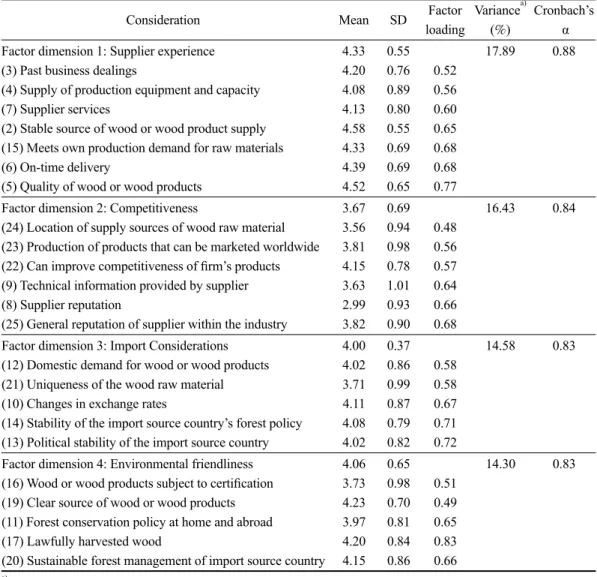
Bartlett’s spherical test showed that the re- maining 23 question items had a Chi-squared value of 2211.00, up to a significance level of p = 0.00. In addition, the KMO coefficient value of 0.928 indicated that the 23 ques- tion items were appropriate for performing a factor analysis. Four factor dimensions were extracted with a total cumulative vari- ance of 63.19% (Table 2). Factor dimension 1 included 7 questions (2~7, and 15) with a variance of 17.89% and Cronbach’s α of 0.88.
Factor dimension 1 primarily embodied con- siderations related to past supply procurement experience, a firm’s own demands, etc., and could be generalized as “supplier experience”.
Factor dimension 2 included 6 questions (8, 9, and 22~25) with a variance of 16.43% and Cronbach’s α of 0.84. Factor dimension 2 Table 1. Basic information on respondents’ firms
Basic information Percentage (%)
Number of employees
1~10 39.7
11~50 47.8
> 50 12.5
Type of business
A. Manufacturer 72.6
B. Importer or agent of foreign firm 7.8
A and B 19.6
Plant location
Only in Taiwan 90.9
Also in an other country 9.1
Operating plan for next 3 yr
Increase production capacity in Taiwan or expand with new plants 25.0
Reduce capacity or close plants in Taiwan 10.9
Maintain status quo 64.1
Source of imported raw materials
Partly domestic timber 41.8
100% imported timber 58.2
embodied considerations related to supplier characteristics, market competitiveness, etc., and could be generalized as “competitive- ness”. Factor dimension 3 included 5 ques- tions (10, 12~14, and 21) with a variance of 14.58% and Cronbach’s α of 0.83. Factor di- mension 3 embodied considerations related to the choice of import source country and could be generalized as “import considerations.”
Factor dimension 4 included 5 questions (11, 16, 17, 19, and 20) with a variance of 14.30%
and Cronbach’s α of 0.83. Factor dimension 4 embodied considerations related to environ- mental friendliness and could be generalized as “environmental friendliness.” Cronbach’s α reliability coefficients were all > 0.80, so the factor dimensions extracted exhibited consis- tency and credibility (Table 2).
Based on the means of the 4 factor di- mensions, “supplier experience” was high- est at 4.33, followed by “environmental friendliness” at 4.06, with “competitiveness”
Table 2. Factor analysis of factors considered important by responding firms in selecting wood raw material supply
Consideration Mean SD Factor Variancea) Cronbach’s loading (%) α Factor dimension 1: Supplier experience 4.33 0.55 17.89 0.88
(3) Past business dealings 4.20 0.76 0.52
(4) Supply of production equipment and capacity 4.08 0.89 0.56
(7) Supplier services 4.13 0.80 0.60
(2) Stable source of wood or wood product supply 4.58 0.55 0.65 (15) Meets own production demand for raw materials 4.33 0.69 0.68
(6) On-time delivery 4.39 0.69 0.68
(5) Quality of wood or wood products 4.52 0.65 0.77
Factor dimension 2: Competitiveness 3.67 0.69 16.43 0.84 (24) Location of supply sources of wood raw material 3.56 0.94 0.48
(23) Production of products that can be marketed worldwide 3.81 0.98 0.56 (22) Can improve competitiveness of firm’s products 4.15 0.78 0.57 (9) Technical information provided by supplier 3.63 1.01 0.64
(8) Supplier reputation 2.99 0.93 0.66
(25) General reputation of supplier within the industry 3.82 0.90 0.68
Factor dimension 3: Import Considerations 4.00 0.37 14.58 0.83 (12) Domestic demand for wood or wood products 4.02 0.86 0.58
(21) Uniqueness of the wood raw material 3.71 0.99 0.58 (10) Changes in exchange rates 4.11 0.87 0.67 (14) Stability of the import source country’s forest policy 4.08 0.79 0.71 (13) Political stability of the import source country 4.02 0.82 0.72
Factor dimension 4: Environmental friendliness 4.06 0.65 14.30 0.83 (16) Wood or wood products subject to certification 3.73 0.98 0.51
(19) Clear source of wood or wood products 4.23 0.70 0.49 (11) Forest conservation policy at home and abroad 3.97 0.81 0.65 (17) Lawfully harvested wood 4.20 0.84 0.83 (20) Sustainable forest management of import source country 4.15 0.86 0.66
a)Total cumulative variance of 63.19%.
lowest at 3.67. This showed that “supplier experience” issues of traditional procurement practices, including “stable sources of wood or wood products supplies,” “good quality of wood or wood products,” and “on-time de- livery,” were still primary considerations of the industry. In addition to “supplier experi- ence” issues, firms had also begun to consider
“environmental friendliness” issues, such as
“a clear source of wood or wood products,”
“lawfully harvested wood,” and “sustainable forest management of the import source coun- try,” in the procurement process (Table 2).
In analyzing relationships among factors considered to be important in choosing wood raw material supplies by responding firms, based on the ANOVA results, there were significant differences among firms only for
“type of firm” at a p value of 0.05. Based on Duncan’s multiple-range test, of the 4 factor dimensions, considerations of wood raw ma- terial supplies were significantly more impor- tant for importers and agents of foreign com- panies than for manufacturers and combined manufacturers-importers/manufacturers- agents of foreign companies. The main reason is that importers and agents of foreign com- panies are purely engaged in the import trade of raw materials and are not concerned with further production; while the choice of wood raw material supplies is of greater concern to
manufacturers (Table 3).
Reasons for importing exotic wood raw materials
Among the 14 questions concerning reasons for importing foreign wood raw ma- terials, “domestic wood supply sources and quantities insufficient” was the major reason (4.30) of all responding firms for importing foreign wood raw materials. Values associat- ed with “diverse import supply sources” (4.11) and “import quantity sufficient” (4.10) were also high as well. Inasmuch as “poor quality of domestic wood” was considered relatively low in importance (2.83), it can be concluded that the quality of domestic wood is not a se- rious issue (Table 4).
Using the item analysis and reliability estimates, correlations of all items were >
0.30, and thus, those items were retained. We conducted a factor analysis of the 14 items with results shown in Table 4. Four factor dimensions were extracted with a total cumu- lative variance of 70.96% (Table 4). Factor dimension 1 contained 5 items (8~12), which accounted for 23.7% of the total variance, with Cronbach’s α of internal consistency of 0.88. This group of items covered firms’
demands, including “imports reduce costs due to lower prices,” “imports improve com- petitiveness of products,” “import supply Table 3. Analysis of variance among responding firms of factors considered important in choice of wood raw material supply
Basic information\ Supplier Import Environmental Duncan’s Factor dimension experience Competitiveness
considerations friendliness multiple-range test Number of employees 0.469 0.712 1.929 0.519 B. importer or
Plant location 0.298 0.450 0.060 0.555 agent of
Type of business 3.171* 10.577** 4.675* 5.142** foreign firm >
Source of imported raw materials 0.000 0.088 0.605 0.621 A. manufac Operating plan for next 3 yr 1.827 0.624 0.916 0.293 turer, A and B
* p < 0.05; ** p < 0.01, each entry value in the table is the F-value.
quantity sufficient,” “diverse import supply sources,” and “import types and specifications meet demands,” so they were labeled “meet- ing demands.” Factor dimension 2 contained items 5~7, which accounted for 18.13% of the total variance, with Cronbach’s α of inter- nal consistency of 0.89. Items in this factor dimension were related to various domestic harvesting restrictions, including “bans on harvesting domestic natural forests,” “do- mestic forests have annual harvest quotas,”
and “cumbersome domestic forest harvesting procedures,” so they were labeled “domestic harvesting restrictions.” Factor dimension 3 contained 4 items (3, 4, 13, and 14), which accounted for 17.01% of the total variance, with Cronbach’s α of internal consistency of 0.89. This group of items related to com- parative quality of domestic and imported wood, including “domestic wood types and
specifications do not meet demand,” “poor quality of domestic wood,” “imports are of high quality,” and “imports can be marketed worldwide,” so they were labeled “quality.”
Factor dimension 4 contained items 1 and 2, which accounted for 12.12% of the total variance, with Cronbach’s α of internal consis- tency of 0.69. The items in this factor dimen- sion were related to domestic wood sources and prices, including “high domestic timber prices” and “domestic wood supply sources and quantity insufficient,” so they were la- beled “domestic supply.” Cronbach’s α reli- ability coefficient for factor dimension 4 was less than but close to 0.70, while Cronbach’s α values for factor dimensions 1~3 were >
0.80, so the factor dimensions extracted pos- sessed consistency and credibility (Table 4).
Based on the mean of the 4 factor di- mensions, “domestic supply” had the highest Table 4. Analysis of causal factors in the import of exotic wood raw material
Consideration Mean SD Factor Variancea) Cronbach’s loading (%) α Factor dimension 1: Meeting demands 4.07 0.71 23.70 0.88 (12) Import types and specifications meet demands 4.07 0.76 0.60
(9) Imports improve competitiveness of products 4.01 0.91 0.66 (8) Imports to reduce costs due to lower prices 4.02 0.96 0.78 (11) Diverse import supply sources 4.11 0.81 0.82 (10) Import supply quantities sufficient 4.10 0.87 0.86
Factor dimension 2: Domestic harvesting restrictions 3.93 0.83 18.13 0.89 (7) Cumbersome domestic forest harvesting procedures 3.81 0.91 0.73
(5) Bans on harvesting domestic natural forests 4.00 0.92 0.91 (6) Domestic forests have annual harvest quotas 3.96 0.90 0.93
Factor dimension 3: Quality 3.43 0.75 17.01 0.72
(13) Imports are of high quality 3.53 0.97 0.76 (14) Imports can be marketed worldwide 3.52 0.90 0.62 (3) Domestic wood types and specifications do not meet demand 3.82 1.05 0.63 (4) Poor quality of domestic wood 2.83 1.06 0.76
Factor dimension 4: Domestic supply 4.10 0.79 12.12 0.69 (2) Domestic wood supply sources and quantities insufficient 4.30 0.96 0.71
(1) High domestic timber prices 3.90 0.82 0.86
a)Total cumulative variance of 70.96%.