Research Express@NCKU - Articles Digest
Research Express@NCKU Volume 5 Issue 9 - September 26, 2008 [ http://research.ncku.edu.tw/re/articles/e/20080926/2.html ]
Synthesis and properties of novel HMS-based
sulfonated poly(arylene ether sulfone)/silica
nano-composite membranes for DMFC
applications
Jie-Cheng Tsai, Jen-Feng Kuo, Chuh-Yung Chen
*Department of Chemical Engineering
*Email: [email protected]
Journal of Power Sources, 174 (2007), 103-113.
F
uel cells have attracted significant attention because of their ability to produce energy with higher efficiency than a turbine. Over the past few years, several efforts have been made to replace the Nafion® membranes by cheaper and ecologically more acceptable materials. Sulfonated PES have been extensively studied and also tested for fuel cell applications. Membranes made of these compounds possess many good attributes such as good mechanical properties, high heatdistortion temperature, good heat-aging resistance, environmental endurance and good processing capacity. In the present study, a novel sulfonated PES blended with silica sol was used to form organic/ inorganic nano-composite membranes. The non-planar trans-stilbene derivative exhibits a lower melting point and high solubility, overcoming the brittle weakness in growing molecules. The introduction of finely dispersed inorganic silica particles was expected to improve thermal stability, swelling, water content, conductivity and single cell performance with no sacrifice for mechanical property.
1H NMR spectroscopy has been employed to provide structural confirmation of the synthesized HMS-based sulfonated copolymers (HMSHS). By integration and rationing of known reference protons, the integration area revealed that 10, 20, 31, and 41 mol% of sulfonated dichlorodiphenyl sulfone was incorporated into the polymers.
The FT-IR spectra was observed that the absorption intensity of the sodium form sulfonate groups (– SO3Na) at 1030 and 1098 cm–1 increased with increasing degree of sulfonation of the copolymers. The
copolymer spectra were normalized using the absorption of the Ar–O–Ar linkage at 1012 cm–1 in the copolymer backbone.
SEM micrographs of HMSHS20/3% and HMSHS40/3% are illustrated in Fig. 1. With an increase in sulfonic acid content, the silica particles were well dispersed and revealed relatively small particle size <50 nm. Due to the cage effects of the clusters of sulfonic acid groups, the increase in sulfonic acid content gave a more uniform dispersion.
Research Express@NCKU - Articles Digest
Figure 1: The cross-section morphology of SEM micrographs: (a) HMSHS20/3 % (b) HMSHS40/3%
The thermal stability of nano-composite membranes were observed that the feature shifted to higher temperatures with increased silica loading. The improvement in thermal stability for high temperature applications is attributed to the inhibition of SO2 evolution due to immobilization in the copolymer by
silica cages.
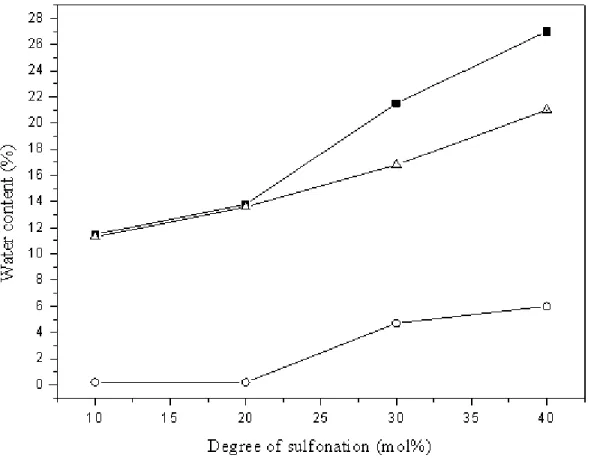
Fig. 2 shows the water content corresponding to the free, bound, and total water content versus degree of sulfonation. The total water content of the HMSHS/silica nano-composite membranes decreased with increase in silica content. In HMSHS30 and HMSHS40, with 0–5% silica content, the bound water increased from 16.8 to 17.3% and 21.0 to 23.6%.
Figure 2: The water content versus to degree of sulfonation from 10 mol% to 40 mol%. (■) total water, (○) free water, and (△) bound water.
Research Express@NCKU - Articles Digest
Figure 3: The proton conductivity of the HMSHS/silica nano-composite membranes with various content of silica at 80°C: (■) HMSHS10, (○) HMSHS20, (△) HMSHS30, and (▽) HMSHS40.
Fig. 3 shows the proton conductivity of HMSHS/silica nano-composite membranes with various contents of silica at 80°C. In HMSHS30/silica and HMSHS40/silica, the bound water increased from 16.8 to 17.3% and 21.0 to 23.6%, the conductivity increased in HMSHS30/silica (0.058–0.063 S cm-1) and HMSHS40/silica (0.1–0.11 S cm-1) with increase in silica content.
The cell property with HMSHS40/silica nano-composite membranes had higher open circuit voltage (OCV = 0.57–0.60V) and maximal power density than commercial Nafion® 117 (OCV = 0.56V). The higher open circuit voltage indicates that silica introduced into HMSHS40 membrane has decreased the rate of methanol crossover. The higher maximal power density indicates a better performance of
HMSHS40/silica than commercial Nafion® 117.
In this paper, organic/inorganic nano-composite membranes have been prepared by incorporation of silica into sulfonated HMS-based PES copolymers. The introduction of silica into composite copolymers not only enhanced the thermal properties of the composite membranes, but also improved their swelling and conductivity. Compared with Nafion® 117 membrane, the sulfonated HMS-based organic/inorganic composite membranes exhibit higher conductivity and single cell performance.