碩士論文
Graduate Program in Translation and Interpretation College of Liberal Arts
National Taiwan University Master Thesis
非母語口音對專業與學生口譯員 在跟述與同步口譯表現的影響 The effect of non-native accent on
professional and trainee interpreters in performing shadowing and simultaneous interpreting tasks
梵雅戈
Iago Valin Lopez
指導教授:范家銘 博士 Advisor: Damien Fan, Ph.D.
中華民國 107 年 7 月 July 2018
Abstract
Non-native English has become the standard language of communication in conferences with interpreting services all around the world. Previous studies have shown that interpreters consider non-native foreign-accentedness a factor that adds a layer of difficulty to their every day work. So far, most research done in the area of foreign accentedness has centred on student interpreters. This study investigates the differences between professional and trainee interpreters when presented with non-native English speech via an experimental design with a retrospective interview. The subjects are asked to shadow and interpret non-native foreign accented texts, followed by a series of comprehension questions to shed light on the strategies they used during the experiment to understand their decision processes and opinions on interpreting non-native English in general. The results show that professional interpreters’ approach and their better command at utilising different interpreting skills, allows them to have higher quality outputs and understand non-native accented speech better. On the other hand, trainee interpreters struggle with the interpreting tasks because they do not yet know how to employ the different skills effectively.
Keywords: Intelligibility, Comprehension, Foreign accent, Shadowing, Expertise
Table of contents
Table of contents ... iii
Index of Tables ... vi
Index of Figures ... vii
1 Introduction ... 1
1.1 English as a Lingua Franca ... 1
1.1.1 Effects on Interpreters ... 2
1.2 The study ... 3
2 Literature review ... 5
2.1 Defining accent, intelligibility and comprehensibility... 5
2.1.1 Accent ... 5
2.1.2 Intelligibility and comprehension ... 6
2.2 Accent and Intelligibility and Comprehension ... 7
2.2.1 Factors influencing intelligibility and comprehension ... 7
2.3 Accent and Interpreting ... 9
2.3.1 Interpreting. ... 9
2.3.2 Effects of Accent in interpreting ... 10
2.3.3 Past Research ... 11
2.4 Expertise in Interpreting and Accent ...12
2.4.1 Expertise and interpreting ... 12
2.4.2 Past research factoring in accent and expertise ... 13
2.5 The Gap in the Literature ...14
2.6 Research Questions ...15
3 Methodology ... 17
3.1 Experimental Design ...17
3.1.1 Shadowing ... 17
3.1.2 Simultaneous interpreting ... 18
3.1.3 Comprehension questions. ... 18
3.1.4 Retrospective interview ... 18
3.2 Participants...19
3.3 Materials ...21
3.3.1 Text Preparation ... 21
3.3.2 Speaker ... 22
3.3.3 Recording Equipment. ... 24
3.4 Procedure ...24
3.5 Data Analysis ...26
3.5.1 Intelligibility ... 26
3.5.2 Comprehension ... 27
3.5.3 Retrospective Interview ... 27
4 Results ... 28
4.1 Shadowing Results ...28
4.2 Interpreting Results ...32
4.3 Comprehension Question Results...34
4.4 Perceived difficulty of accent ...38
4.5 Retrospective interview results ...39
4.5.1 Attitudes to the task ... 40
4.5.2 Comments on the accent ... 41
4.5.3 Comments on intelligibility and comprehensibility ... 44
4.5.4 Strategy use ... 46
5.1 Accent, intelligibility and comprehension ...54
5.1.1 Accent and intelligibility ... 54
5.1.2 Accent and comprehensibility ... 57
5.1.3 Intelligibility and comprehensibility ... 59
5.2 Shadowing as a type of interpreting ...64
5.3 Comparison of Trainees and Professionals...66
5.3.1 Differences in Intelligibility and Comprehension ... 67
5.3.2 Differences in Shadowing ... 69
5.3.3 Differences in Interpreting ... 71
5.3.4 Usage of interpreting skills ... 71
5.3.5 Mind-set ... 80
5.4 Accent and pedagogy ...81
6 Conclusion ... 84
6.1 Summary of the study ...84
6.2 Limitations of the current study ...86
6.3 Directions for future research ...87
References... 89
Appendix ... 94
Appendix i: Speech Materials ...94
Speech 1 ... 94
Speech 2 ... 97
Appendix ii: Marking Materials ... 100
Appendix iii: Comprehension assessment ... 102
Appendix iv: Accent assessment ... 103
Index of Tables
Table 1 Readability scores of the speech materials ... 21
Table 2 Phonemic deviations in Speaker's speech ... 23
Table 3 Shadowing intelligibility resutls (Professionals) ... 29
Table 4 Shadowing intelligibility results (Trainees) ... 29
Table 5 Descriptive statistics of all participants' intelligibility ... 29
Table 6 Statistics of all participant's intelligibility scores ... 30
Table 7 Most commonly mis-shadowed words ... 31
Table 8 Most commonly mis-shadowed phrases ... 32
Table 9 Main idea units correclty intepreted (Professionals) ... 32
Table 10 Main idea untis correclty interpreted (Trainees) ... 33
Table 11 Desrcriptive statistics of all participant's comprehensibility ... 33
Table 12 Statistics of all participants' interpreting scores ... 34
Table 13 Results of comprehension questions (Trainees) ... 35
Table 14 Results of comprehension questions (Professionals) ... 36
Table 15 Participants' comprehension scores ... 36
Table 16 Quantitative results summary ... 37
Table 17 Trainees' perceived difficulty of accent ... 38
Table 18 Professionals' perceived difficulty of accent ... 39
Table 19 Unintelligible words resulting in erroneous renditions ... 55
Table 20 Words with [w] or [v] in the commonly mis-shadowed words ... 57
Table 21 Summary of comprehensibility results ... 68
Index of Figures
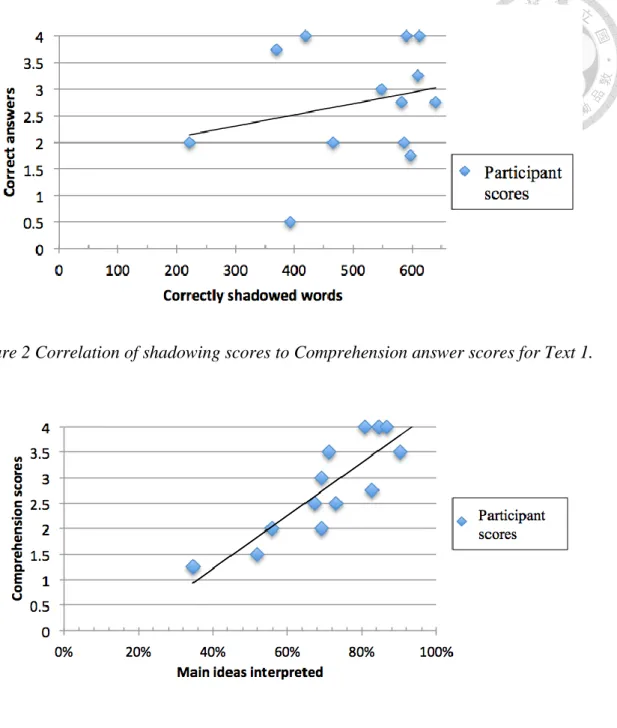
Figure 1 Kachru’s concentric circles of English ... 2 Figure 2 Correlation of shadowing scores to comprehension ... 65 Figure 3 Correlation of interpreting scores to comprehension ... 65
1 Introduction
1.1 English as a Lingua Franca
English has become the Lingua Franca of the world (Kurz, 2008). It is the language most widely taught as a foreign language in over 100 countries and is the chief foreign language to be encountered in schools (Crystal, 2003). The consequence of this is that the number of non-native English speakers is increasing at an unprecedented rate.
According to Crystal (2003) 400 million people use English as a native language, and another 400 million speak English as a second language.
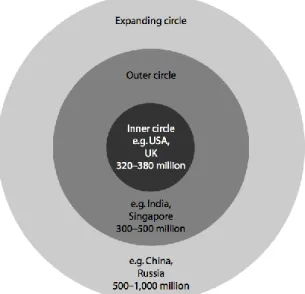
This second group of speakers is very diverse, with a wide variety of first languages and proficiency levels. A way of describing these different kinds of Englishes can be found in Kachru (1989), with the “Three Concentric Circles” model (Shown in Figure 1) where native English speakers of varieties such as British or American English are located in the centre, the middle circle encompasses the speakers of Singaporean and Indian English among others, and lastly an outer circle with the millions of learners of English from non-English speaking countries.
Figure 1: Kachru’s concentric circles of English (Crystal 2003)
1.1.1 Effects on Interpreters
The increased used of English in the world has had an enormous impact on the interpreting profession (Gentile & Albl-Mikasa, 2017). Not only has it brought about a decline in interpreter status, but it has also reduced the demand for language
combinations without English, making English and another language the most common language combination for interpreters (Donovan, 2004; 2009). Even international institutions like the EU, that advocate for speakers’ rights to speak their native
language, are moving away from full multilingualism (Gentile & Albl-Mikasa, 2017).
Interpreters are thus increasingly confronted with non-native speakers and a diversity of accents (Kurz, 2008). In Taiwan, professional interpreters estimate that in around a third to two fifths of conferences, speakers use non-native English to deliver their speech in spite of interpreting services from their native language being provided (Chang & Wu, 2013).
This is a problem for interpreters, who see English Lingua Franca as one of the three main obstacles for the interpreting profession today together with remote
interpreting and poor communication skills of meeting participants (Jones, 2014). It also takes a psychological toll on the interpreter as can be seen in the AIIC workload survey (AIIC, 2002), in which interpreters rated foreign accent as the fourth most important source of stress. This is due to the fact that speakers using English greatly misjudge their proficiency (Gentile & Albl-Mikasa, 2017) and often do not manage to present their speech in the most appropriate way, causing interpreters to have to adapt to a segmentally and prosodically degraded source text (Mazzetti, 1999).
Since English Lingua Franca and its foreign accents seem to be here to stay, studying the effects of foreign accents of interpreters is of utmost importance.
1.2 The study
In this study, the effect that non-native foreign accent has on interpreters will be analysed through a framework based on the concepts of intelligibility and
comprehensibility, explained in Chapter 2. This is because foreign accents have a negative effect on the intelligibility and comprehensibility of a text (Smith and Nelson 1985), which in turn causes problems in the interpreting process, where listening and comprehending the text play a key role (Moser 1978).
In order to be able to see the effects that accent has on intelligibility, comprehensibility and interpreting, this study adopts an experimental design,
introducing a variety of methods, such as phonemic (strict) shadowing and simultaneous interpreting to obtain quantitative and qualitative data to answer the following
questions:
1) How does a non-native foreign accent impact intelligibility, comprehensibility
2) What differences exist between professional and trainee interpreters when dealing with a foreign accent?
3) What different processes play a role in strict shadowing and simultaneous interpreting?
2 Literature review
In this section the basic constructs of accent, intelligibility and comprehensibility, will be defined and analysed in terms of their relationship within normal spoken
language. These three concepts will then be explained within the context of interpreting, going over general interpreting studies that have attempted to explain the effects of accent on students interpreters. A more specific discussion will follow going over methodological improvements such as the incorporation of expertise and strict shadowing to better understand the phenomenon.
2.1 Defining accent, intelligibility and comprehensibility 2.1.1 Accent
It is difficult to find a good definition of what an accent is (Pennington, 1996).
Interpreters tend to use the term accent to refer to the combination of phonemic, prosodic, lexical and syntactic deviations of a speaker (Mazzetti, 1999). However, strictly speaking, that definition which incorporates grammatical and lexical variations would be closer to that of dialect (Crystal, 1995, p. 298). Some authors also use sociolinguistics to explain the phenomenon, using the term accentedness to refer to a pattern of speech sounds that differs from the local variety (Derwing & Munro, 2009) or simply to the characteristics in individual’s pronunciation (Stewart & Vaillette, 2001, p.
489). In this piece of research accent will refer solely to deviations in pronunciation which indicate the speakers’ geographical origin as defined in Crystal (1995, p. 298).
2.1.1.1 Non-native English accent
There is also much debate as to what a non-native English accent is. A basic definition would be to say that it is the pronunciation of a speaker whose native language is not English (Wells, 1982). A non-native accent generally involves variations which do not occur in the language, often in an inconsistent manner, in contrast to native accents which are coherent (Floccia, Goslin, Girard, & Konopczynski, 2006; Kao, 2014; Wells, 1982).
The reason for these differences is because foreign speakers make assumptions about the phonology of their L2 based on their L1 (Derwing & Munro, 2009; Floccia et al., 2006). The vast majority of L2 speakers will have a non-native accent (Derwing &
Munro, 2009) because L2 learners face greater difficulty with phonetics than with vocabulary and grammar, which can be learnt in a theoretical manner and immediately produced (Matras, 2009).
2.1.2 Intelligibility and comprehension
In this essay the scope of intelligibility and comprehension will be as described in Smith & Nelson (1985), where intelligibility is the phonological recognition of a word or utterance and comprehension involves understanding and making sense of the meaning of the utterance. This definition is akin to the difference between hearing and listening, where hearing is merely differentiating sounds, and listening requires active comprehension (Opitz & Zbaracki, 2004 as cited in Kao, 2014). It should be kept in mind that intelligibility and comprehension are relatively independent concepts, thus a text that is highly intelligible might be incomprehensible, and a text that is
comprehensible might be unintelligible (Smith & Nelson, 1985).
Although there are other definitions of these two concepts, such as Derwing &
Munro (2009) that use intelligibility to mean the listener’s degree of understanding of an utterance and comprehension as the listener’s perceived difficulty in understanding such utterance, the author has decided to adhere to Smith and Nelson’s definition for the sake of uniformity with other literature on the topic.
2.2 Accent and Intelligibility and Comprehension
Accent is often blamed for miscommunication, since foreign accents can be considered to pose a problem for intelligibility and comprehension (Lin, Chang, & Kuo, 2013); however, just because an utterance is accented it does not mean that it will necessarily cause communication problems (Derwing & Munro, 2009).
Accent on its own is not generally the sole cause for miscommunication, several studies show that when it is combined with other factors like fast or excessively slow delivery, or a high level of technicality, it can cause miscommunication (Chang & Wu, 2013;
Derwing & Munro, 2009). The following section includes some of the factors most relevant to this study that affect intelligibility and comprehensibility of non-native accents.
2.2.1 Factors influencing intelligibility and comprehension 2.2.1.1 Segmental features
Segmental features refer to the individual sounds of a language, such as its consonants and vowels. The segmental feature variations of non-native accents lower the intelligibility of a text but they are generally not a trigger for miscommunication since more serious problems only arise when there is deficient comprehensibility (Smith
intelligibility is passed, the loss in intelligibility might lower the comprehensibility of a segment.
2.2.1.2 Suprasegmental features
Suprasegmental features refer to the way in which groups of segments, such as syllables, words and sentences are pronounced in terms of intonation, prosody, pauses, speed and stress. According to Anderson-Hsieh, Johnson, & Koehler, (1992), prosody plays a key role in producing comprehensible utterances and has a bigger effect on listeners’ perceived difficulty of understanding the speaker than segmental features, especially at higher speeds. Non-native suprasegmental features such as pauses and intonation all have a big impact on the comprehensibility of an utterance (Lin et al., 2013).
In terms of intelligibility, features like a shifted lexical stress lower the intelligibility of words for both native and non-native listeners (Field, 2005).
2.2.1.3 Familiarity
Familiarity with any aspect of the text is an influential factor in every aspect, be it with the topic, with the accented speech or with the speaker (Gass & Varonis, 1984).
This is corroborated by other authors such as Smith and Nelson (1985) who emphasize that the greater the active involvement with any of these factors will make the accented speaker more intelligible, and Chang and Wu (2013) whose research showed that listeners find it easier to understand familiar non-native varieties of English.
Moreover, intelligibility and comprehension can also be higher with indirect familiarity, by simply knowing the native language of the speaker (Mazzetti, 1999, Kurz and Basel 2009 as cited in Reithofer 2011).
2.2.1.4 Native language of listener
Native and non-native listeners have different intelligibility judgements of the same non-native accented text. For native listeners, native pronunciation is the most intelligible, whereas for non-native listeners, speech from a high-proficiency non-native speaker is just as intelligible as a native speaker (Bent & Bradlow, 2003). In fact, in some cases, non-native listeners can have higher intelligibility ratings than native listeners when the speaker is also non-native (Field, 2005). However, this ‘non-native listener benefit’ has not been consistently attested for; for instance, in Huh (2017), non- native listeners found the native speaker the easiest to understand, whereas they
struggled with non-native varieties.
2.2.1.5 Expectations
If there is an expectation that the listener is not going to be able to understand the speaker, they will likely not understand them (Smith & Nelson, 1985). As Derwing and Munro (2009) put it, listeners will fail to understand even the clearest non-native
speaker, simply because they have made up their minds that they cannot understand accented speech.
2.3 Accent and Interpreting 2.3.1 Interpreting.
Simultaneous interpreting is a highly complex cognitive activity that involves intensive information processing (Kurz, 2008). As a way to explain the SI process Gile’s Effort model identifies several efforts which the interpreter must manage and
adjust according to circumstances, and capacity assigned to each of the efforts varies continually depending on demand.
The interpreting process starts with hearing the input message (Moser, 1978).
At this point the interpreter must not just recognise there words in the source text but must also understand the message (Bajo et al., 2001; Gass & Varonis, 1984). From there the other efforts take part in transferring those messages to a target text.
In terms of proportion, it is estimated that around 80% of cognitive resources are devoted to listening and understanding the discourse and only 20% is assigned to
speech production (Bajo et al., 2001), which shows how arduous the listening process is. Conversely, a good understanding of a segment of speech leaves more capacity for the other requirements (Kurz, 2008)
2.3.2 Effects of Accent in interpreting
As mentioned above, comprehension is an essential part of interpreting and any added difficulty could cause problems for the interpreter. The non-standard linguistic features of non-native speech causes difficulties in interpreting for this reason (Huh, 2017). The accentedness reduces the intelligibility and comprehensibility of the input text because of its deviating segmental and suprasegmental features. If the accent is particularly strong, it becomes a problem trigger in the Effort Model paradigm because the accented utterance requires more processing capacity, causing the other efforts to suffer.
In order to manage the extra burden on the interpreter’s capacity or to
compensate for comprehension failures (Field, 2005), interpreters may turn to strategies or survival strategies to alleviate the burden and save output quality. These techniques
include anticipation, inferencing and drawing from background knowledge among others (Kalina, 2000) and become automated with expertise (Liu, 2008).
2.3.3 Past Research
While there are several studies that deal with the issue of how accented input affects interpreting quality, most studies such as Kurz (2008), Lin et al. (2013), Mazzetti (1999) and Sabatini (2000) have been inconclusive due to several methodological factors summarised in Kuo (2012). Some of the concerns raised include the fact that only students were selected as subjects and the experiments consisted of full
simultaneous interpreting. This combination of lack of expertise, full interpreting and a reported high difficulty of the original texts which would sometimes cause the output error rate to be above 80% (Mazzetti, 1999), reducing the validity of the experiments.
Moreover, some of these studies were not very consistent in controlling all of the
variables for the experiment. For instance, when comparing native speech to non-native speech, the recordings used were not adjusted for speed, meaning that the native speech would be faster than the non-native and thus could offset the ‘benefit’ of not having a foreign accent.
The studies also centred mainly on ‘non-native speech’, incorporating lexical and syntactic variations or comparing different versions of non-standard Englishes (Sabatini, 2000).
As Kuo (2012) puts it, there is no way of knowing whether the interpreting failure was due to the accent, the non-standard grammar, the difficulty of the text or the
trainees not yet being very good at the interpreting process itself and not being able to allocate their cognitive resources well (Kurz, 2008).
2.4 Expertise in Interpreting and Accent 2.4.1 Expertise and interpreting
According to Ericsson (2008) There are different stages of developing expertise from being a novice at any task and following mentors’ instructions, up to becoming an expert where individuals can respond to any situation rapidly and intuitively. This happens because experts can monitor their own performance and identify errors, and in the case of failure can minimize the effects of the disruption and maximize the chances of a successful overall outcome.
This is also the case in the acquisition of expertise in interpreting. Moser- Mercer (1997) describes the transition in three stages, from simply having cognitive knowledge about interpreting, to associating the theory with practice and finally becoming autonomous at deciding the adequate strategies for the occasion to manage cognitive resources efficiently.
As a result of practice, experts’ decisions become automatic in terms of choosing the most appropriate strategy in comprehension, translation and production (Liu, 2008).
In terms of comprehension, experts develop strategies that work from the known to the unknown, using a more semantic-based approach, drawing from context and previous knowledge to anticipate where the speaker is going in their talk and alleviate stress put on the listening effort (Moser-Mercer, 1997). Experts are also more selective in processing information, being able to distinguish essential meaning units and linking them together thanks to an awareness of structure of the source speech (Liu, 2008).
2.4.2 Past research factoring in accent and expertise
One of the first studies conducted on the issue of interpreting foreign accents by professional interpreters in Taiwan was that of Chang and Wu (2013), who conducted interviews to learn more about attitudes and strategies of professional interpreters in conferences with non-native speakers. The results of the interviews suggested that although there are more and more speakers utilising non-native English as a means for communications, professional interpreters are still able to cope with the added difficulty of non-native English. They also offered some insights on the strategies they use to maintain a high-quality output, including keeping a longer EVS span to get the general sense of the speaker, and working from contextual cues, from the known towards the unknown. They also mentioned that despite accent being indeed a factor that makes the task of interpreting harder, it was nonetheless not something that would cause a
breakdown of communications, which is also an opinion shared by the professional interpreters in Kuo (2012).
The interpreters also mentioned some preparation strategies for when they know that the speaker is going to be speaking in a language other than their native. The preparation involves becoming more familiar with the content of the speech, rather than the form, or accent itself.
In Kuo's (2012) experiment, strict shadowing was used as a means to test foreign-accented English intelligibility in both trainee and professional interpreters whose B language was English. The results of the study point to both expert and trainee interpreters finding the foreign non-native accented texts less intelligible, the two
groups utilised different coping strategies. Although both expert and trainee interpreters mentioned that their general comprehension had not been affected, the foundation for
this claim was based on retrospective interviews and the author calls for further research in that direction.
Kao (2014) builds on the foundation laid down by Kuo (2012), designing a more comprehensive experiment where context was removed by having the subjects shadow lists of words and nonsensical sentences so that word recognition would be completely based on phonology. The subjects were also to carry out smart shadowing (shadowing where paraphrasing and omissions are not penalised) and incorporated listening
comprehension questions at the end of each text. The results showed that professional interpreters and trainees both suffered a similar intelligibility loss with the foreign non- native speech. However experts, unlike trainees, did not suffer comprehension
degradation due to foreign accentedness.
2.5 The Gap in the Literature
As mentioned in the previous sections, although there have been studies on the effects of foreign non-native accent on interpreters in terms of intelligibility,
comprehension and strategies, many of them are limited in their scope and have limited methodological validity; some source texts were too hard or included grammatical variation (Kurz, 2008; Sabatini, 2000), the subject selection was limited to students, sometimes with a variety of language combinations and proficiencies (Mazzetti, 1999), or the interpreting mode was just consecutive (Huh, 2017; Lin et al., 2013).
This study takes on Kuo (2012) and Kao's (2014) approach of comparing the performance of trainees and professional interpreters and goes an extra step in the methodology. These two studies were conducted in a simultaneous-like setting, by using shadowing as a way to test intelligibility. However they provided no data on the effects of foreign accent during a real simultaneous task and we are still left with the
question of whether the conclusions drawn on those two papers are applicable in real simultaneous interpreting.
In addition, some of Kao's (2014) conclusions were drawn from shadowing tasks in which sense and context were removed from the source text, which despite being a valid way to test for intelligibility is not applicable to real-life situations where every utterance has a context and generally makes sense.
2.6 Research Questions
Due to the gaps in the literature highlighted in the section above and on the literature review, the following questions are formulated to better understand the effects of accent on interpreters:
1. What differences exist between professional and trainee interpreters in terms of intelligibility and comprehension when performing simultaneous interpreting of non-native foreign accented text?
2. What strategies and skills do professional and trainee interpreters use to process non-native foreign accented text?
3. How do perceptions of foreign accented speech differ between the two groups?
The answers to these three questions would hopefully shed some light on how interpreters react to difficulties in simultaneous interpreting. The significance of the results which would greatly like lie in interpreting pedagogy, helping to inform and train interpreters to face the reality of non-native English in international conferences all over the world. The study is also a way to expand the knowledge we have on the
acquisition of interpreting expertise as well as on effects of problem triggers in the task of managing efforts in simultaneous interpreting.
3 Methodology
This section will introduce the different research methods utilised in this study, followed by the experiment materials, participants and the way all the data is processed.
This study takes Kuo (2013) and Kao’s (2014) methodology as a foundation, combining and adding elements for more complete results.
3.1 Experimental Design 3.1.1 Shadowing
Strict shadowing, the method used in this experiment, is an auditory tracking task which involves the immediate verbatim repetition of the input message word by word (Lambert 1998 as cited in Christoffels & De Groot, 2004; Kurz, 1992).
There are authors that claim that this focus on repeating words is simply a mechanical process of phonetic repetition which is unrelated interpreting and in fact is the absolute contrary of what interpreting is about (Seleskovitch & Lederer, 1989, p.
168). However, there are studies that show that in the process of shadowing, the input text is analysed to a semantic level just as in simultaneous interpreting (Christoffels &
De Groot, 2004).
This method was used by Kuo (2012) to assess intelligibility ratings of professional and trainee interpreters shadowing non-native foreign accented speech because the output matches the input language, so it is a useful method to get an insight on subject’s problems in recognising lexical items (Sabatini, 2000); that is to say, it can help determine the intelligibility of an input text for a subject by comparing the source and output transcripts word for word, which would be an impossible task to assess if
a word had been unintelligible but translated, or intelligible but mistranslated or omitted.
It should be noted that the shadowing used in this experiment is strict shadowing, as opposed to smart shadowing, which encourages paraphrasing. The differences between these two will be discussed in Chapter 5.
3.1.2 Simultaneous interpreting
This study uses simultaneous interpreting as a means to get an insight on interpreters’ reactions to non-native foreign accented input. This is useful to assess the comprehension of interpreters by comparing their output to the input message, which is often seen as the benchmark for a successful interpretation (Liu & Chiu, 2009).
Moreover, interpretation strategies such as EVS lengthening and shortening, summarising and omission can also be observed directly.
3.1.3 Comprehension questions.
After each experiment session, the subjects were asked to answer a set of four comprehension questions about the text. The questions do not ask for specific details of the text but rather focus on the main points or ideas presented in the text. These
answers were scored with the help of two experts for a maximum core of four. This is used as an indicator of text comprehensibility.
3.1.4 Retrospective interview
After the experimental shadowing and interpreting tasks are complete, a semi- structured retrospective interview is carried out as a means to triangulate data. By
asking the interpreters about their thought processes, we can get an insight on their decision making, attitudes and comprehension, in a similar way to Kuo (2012).
A set of standardised questions was elaborated separated into three categories:
The first set of questions consists on asking the interpreters about their perceived intelligibility and comprehension as well as pointing out the effect that accent had on their interpreting, and if they were able to discern any specific problem triggers. For a better discussion of these issues, the interpreters will be shown transcripts of the
speeches with annotations made by the researcher on specific points the interpreter feels were of particular significance.
The second group of questions consist of better understanding the interpreting strategies and process of each of the participants. They are asked about general opinions on the task, their mind-set and the strategies they adopted to maintain a high quality performance, as well as any strategic failures or problems.
Lastly, the interpreter will ask the interpreters about the pedagogy of accentedness, whether they believe that non-native accents should be included in interpreting curriculums and whether non-native accents and non-native English has an effect on the way they prepare for conferences or classes.
3.2 Participants
The participants consist of professional and trainee interpreters in Taiwan whose A language is Chinese and B language is English, and who do not have knowledge of the native language of the non-native speaker.
In a similar way to Kao (2014) and Kuo (2012), the definition of professional is based on AIIC membership standards. Thus, professional interpreters are defined as
of conference interpreting experience (AIIC, 2011).Trainee interpreters consist of current interpreting students who have had at least one year of training in simultaneous interpreting and have not started working as an interpreter.
Basic personal information was also collected, including their working languages as well as other languages that they have studied in the past, education history and experience. They were also asked questions on the frequency in which they interact with non-native speakers of English.
In total eight trainee interpreters (T1-T8) and five professional interpreters (P1-P5) participated in the study.
All trainee interpreters were in the second year of their Master’s programs, and were all enrolled in universities in Taipei. Although some could speak or had studied other languages besides English, such as Spanish, French, Turkish, Russian or Southern Min, none had learnt Slovakian or other languages of the West Slavic language family that could have altered the results of the experiment. All of them stated to seldom interact or listen to non-native speakers of English, contact with whom was often limited to using non-native speakers as class or practice material.
As for the professional interpreters, all of them hold master’s degrees in interpreting from different universities in Northern Taiwan, and 4 to 10 years of interpreting experience, with the average being 5.4 years. Three of the professionals also stated having some degree of proficiency in other languages besides English and Chinese, including Turkish, Dutch, French and Spanish. Although some of the professionals stated that they had had prolonged interactions with non-native English for long periods of time in some interpreting assignments, they stated that that was the exception rather than the norm and that most of the contact with non-native English speakers occurred in conferences with relative frequency.
3.3 Materials
3.3.1 Text Preparation
Two speeches were adapted from original English speeches. Both are around the same length. Text 1, the text used for the shadowing exercise is 776 words long and Text 2, used for the interpreting task is 744 words long.
In order to control the difficulty of the texts to be equally challenging, both texts were adjusted in vocabulary and syntax to result in similar Flesche-Kincaid and Dale- Chall readability scores (Table 1). Although it has been suggested that Flesche-Kincaid scores, which rely on word length for its calculations, might have an effect on perceived on simultaneous interpreting difficulty, it should be taken into account that these are readability scores and that a text that is easy in print may not necessarily have the same difficulty when presented orally (Liu & Chiu, 2009).
Table 1
Readability scores of the speech materials.
Text Flesche-Kincaid Dale-Chall
Words / sentence (average)
Readability score
Difficulty % of difficult words
Readability Score
Grade level
Text 1 (776 words)
20.6 61.1
Average
difficulty 14% 6.8 7-8
Text 2 (744 words)
21.4 61.1
Average
difficulty 14% 6.9 7-8
The topics ‘Contradictions in Astronomy’ (Text 1) and ‘The problems of the Fashion Industry’ (Text 2) do not require any specific background knowledge to be understood and no technical vocabulary is necessary to shadow and interpret successfully.
Both text follow a similar structure, where the speaker introduces himself, follows by giving some background information on the topic that he is going to talk about, which would be reasonably familiar to the listener. At approximately the two- thirds mark of the speech, the speaker introduces some more complex ideas about the two topics that might not be as well known.
The reason for choosing texts of two different topics is to avoid the familiarity effect, where understanding a certain text becomes easier the more the speaker listens to it (Christoffels & De Groot, 2004). By dealing with two different topics, the participants will both start from the same level of unfamiliarity.
3.3.2 Speaker
A non-native speaker of English whose L1 is not Chinese was invited to record non-native accented renditions of the two texts. The speaker was given the texts in advance to become familiar with them and was asked to perform the texts in a natural way as if they were speaking to an audience at an international conference.
The speaker’s mother tongue is Slovak because since it has a small number of speakers, it is unlikely that many interpreters in Taiwan are familiar with this accent, as opposed to, say, Japanese or Korean, which are more common in Taiwan (Chang & Wu 2013) A brief non-exhaustive description of the features present in his accent is listed below in Table 2, using Anderson-Hsieh et al's (1992) categorisation of common non- native accent deviations.
Table 2
Phonemic deviations present in Speaker’s speech
Deviation Type Example
word
Deviation Phonemic transcription Segmental Consonant Phonemic world [w] →
[v]
[vɜld]
vintage [v] → [w]
[wɪntɪʒ]
Subphonemic individuality [th] → [t] [ɪndɪvɪdjʊalɪti]
stores [ɹ] → [r] [stors]
Vowel Phonemic total [ə] → [a] [toʊtal]
Syllabic Epenthesis Consonant side [ø] → [ł] [siłd]
Vowel cars [ø] → [ɑ] [khɑɾɑs]
Deletion Consonant its [t] → [ø] [ɪs]
Vowel focus [ə] → [ø] [foks]
Metathesis clothing [lo] →
[oł]
[khołðɪŋ]
In addition to deviations in segmental and syllabic features, the speaker’s speech also features many deviated suprasegmental features listed in Field, (2005), and
Anderson-Hsieh et al., (1992), including shifted lexical stress, intonation, changing the relative duration of strong and weak syllables, and phrasing and pausing at in unnatural places.
3.3.3 Recording Equipment.
The speeches were recorded in a quiet environment with a microphone linked directly to the computer audio program Audacity. Special attention was taken for the speaker to read each text aloud as is without altering the syntax or structure.
The recordings were then edited in Audacity to remove any background noise and alter the speed so that both recordings have a speech rate of 120 words per minute, which is considered a good speed for simultaneous interpreting (Liu & Chiu, 2009). The resulting speeches are 6:18 for Text 1 and 6:12 minutes for Text 2.
3.4 Procedure
The participants were first asked to fill in their personal information sheet, with items such as their language combination, interpreting experience and frequency of contact with non-native English. The playback equipment was tested and adjusted for volume.
The participants were then provided with a blank sheet of paper to write any thoughts they may have throughout the experiment and given instructions on the tasks that they would have to do.
First, the shadowing task is carried out in which the interpreters were instructed to deviate as little as possible from the words used by the speaker, in other words to do strict shadowing. They were told the topic of the speech and invited to start the
experiment by pressing a button on the computer when they felt they were ready.
During the shadowing task, the researcher noted down any omissions,
substitutions and anything significant, such as places where the participants seemed to hesitate or struggle to later discuss in the retrospective interview.
After the shadowing task was complete, the participants were asked to type in the answers to a set of comprehension questions written in English on a computer using either English or Chinese. In case of having doubts about an answer, they were asked to write their thoughts and state what part of their answers they were unsure about or what they felt was the reason for not being certain of the answer. If they did not know the answer to the question, they were told to fill in the blank by simply stating the reason why they felt they did not know the answer.
Once the participants felt satisfied with their answers, the instructions for the interpreting task were given. The participants were reminded that the task would be to perform simultaneous interpreting from English into Chinese and they were informed of the topic of Text 2.
Again, they were asked to click a button on the computer to start the exercise when they felt ready. During this task, the researcher also made some annotations on a transcript of the speech, noting down major omissions, pauses or anything deemed interesting for discussion during the retrospective interview. Once again, after the interpreting task was over, they were asked to answer a new set of comprehension questions by typing the answers on the computer in either English or Chinese.
In both tasks, the output of the participants was recorded to be later transcribed for calculations of intelligibility and output quality.
The last section of the experiment is the retrospective interview, which was conducted in a mixture of English and Chinese depending on the preferences of the participant. In this section they were first asked to share any thoughts they had on the task overall.
From that point onwards, the researcher asked questions related to their answers covering all the topics mentioned in section 3.1.4. The questions were not necessarily
possible. The researcher also showed the subjects the annotated transcripts to aid in some points of the interview and to see whether the participants had heard or understood certain parts of the text. Additional questions were also asked when the researcher deemed it necessary or significant for the research. Overall, the tone of the conversation was kept light and the participants were welcome to provide their own comments and questions.
Each participant was also asked to assess the difficulty the accent posed in terms of recognising words (intelligibility) and understanding the message
(comprehensibility) by circling a number on a seven-point Likert scale (Appendix 2).
The interviews were recorded, transcribed and translated into English, when applicable.
3.5 Data Analysis
3.5.1 Intelligibility
The output of the shadowing tasks was marked for omissions, changes with respect to the input texts. From these markings, the intelligibility score is calculated by calculating the proportion of correctly rendered words to incorrectly rendered or omitted words in the shadowing task. Incorrect renderings include omissions, paraphrases and unintelligible words uttered by the participant. The first 119 words of input text were not included in the calculations, as a way for the participants to warm up to the topic and accent. The intelligibility scores are then presented in total mis-shadowed words and as a percentage of correctly shadowed words.
3.5.2 Comprehension
Comprehension was measured in two different ways: as the total correctly answered comprehension questions as well as by the correctly interpreted key ideas in the interpreting text.
For the comprehension questions, two experts read the answers with a transcript of the text and calculated a score for each one.
As for the interpreting comprehension results, two experts were called to decide on the key ideas of the source text, resulting in a total of 26 main ideas. With the list in hand, each recording was listened and scored separately by the experts, who afterwards got together to discuss any discrepancies and agree on a final score for each participant.
In order to determine whether the propositions are equivalent, the evaluation criteria proposed by (Moser-Mercer, 1997) was followed, taking into account: faux-sense (changing the original meaning), contre-sense (changing the meaning to its opposite), omission and nuance. When deducting points, the experts discussed which of the abovementioned characteristics the output had, if any, and judged whether the
difference it had been of a core idea change or a secondary detail, adjusting the scores accordingly.
3.5.3 Retrospective Interview
The retrospective interview transcripts provide qualitative information on the subjects’ thought processes and opinions. Due to the nature of the material, it was categorised into different thematic groups such as comments on the relationship between accent and intelligibility and comprehension, attitudes towards the task, strategy use, opinions on the role of accent in interpreting in conferences and in the
4 Results
This chapter will present the results from the experiment, starting with the quantitative data obtained from the shadowing, interpreting and comprehension
question tasks and accent ratings, and finishing with the qualitative data obtained from the retrospective interviews. This combination of data can give a more complete insight of the way interpreters process foreign accented speech.
4.1 Shadowing Results
After the experiments concluded, the researcher listened to the recordings, marking a transcript of the shadowing exercise text in detail. Any words that were omitted, changed or unintelligible were marked as wrong to calculate the total intelligibility score. This penalising of substitutions and paraphrasing is the same method as Kuo (2014). The reason for this is that if they were to be taken into
consideration, it would be very difficult to discern whether the participants had indeed recognised the words or whether they were not recognising the words, just
comprehending the text and drawing from that. In addition, since the participants were instructed to perform strict shadowing, most of the errors counted were actually not substitutions, but omissions, and with that there is a higher certainty that the words were not recognised.
In order to avoid changes in intelligibility and comprehension caused by unfamiliarity with the speaker’s accent or the topic, the first 119 words of the text (1 minute) were not counted. The results for Professionals and interpreters can be seen in Tables 3 and 4 respectively, and their averages can be found on Table 5.
Table 3
Shadowing intelligibility results arranged from highest to lowest (Professionals) Participant Words correctly shadowed
(out of 657)
Intelligibility Score (Percentage)
P5 640 97.26%
P1 613 93.16%
P4 591 89.82%
P2 548 83.28%
P3 419 63.68%
Table 4
Shadowing intelligibility results arranged from highest to lowest (Trainees) Participant Words correctly shadowed
(out of 657)
Intelligibility Score (Percentage)
T8 610 92.71%
T1 598 90.88%
T2 587 89.21%
T7 582 88.45%
T6 466 70.82%
T3 395 60.03%
T4 370 56.23%
T5 222 39.08%
Table 5
Descriptive statistics of all participants’ intelligibility score
Participants N Correctly shadowed average Standard Deviation
Trainees (T) 8 73.43% .2004
Professionals (P) 5 85.44% .1320
As can be seen, there is a wide variation between the subjects in terms of words correctly rendered in the shadowing output. The average score trainee interpreters is 478.5 words correctly shadowed, resulting in an average intelligibility score of 73.43%.
For professionals the average intelligibility score was higher, at 85.44%, with a smaller deviation.
An independent T-test was performed to determine whether the differences in shadowing output was significant between trainees and Professionals (Table 6)
Table 6
Statistics of all participants’ intelligibility scores
F-Test T-Test
Equal variance Assumed
F t df t-critical (2-tail)
2.306 -1.180 11 2.210
The T-Test performed between the two groups shows that the two groups do not differ significantly in their shadowing performance, so based on these results alone it cannot be determined whether the performance of Trainees and Professionals differs significantly in this aspect.
However, these results should be taken with caution and simply be used as an approximation for intelligibility as paraphrased sentences and substitutions were marked as errors with this method and the output deferring from the source text does not
necessarily mean that the utterance was unintelligible. Likewise, there may be cases where the utterance was unintelligible but the interpreter correctly rendered the word by making use of interpreting strategies.
There were several words that were frequently missed by interpreters as shown
Table 7
Most commonly mis-shadowed words
Word Number of errors Substitution Omission
Wacky 11 wicked (3), worky (2), crazy
(1),weird (1), ridiculous (1)
3
Redder (II) 11 water (1) 10
Redder (I) 11 warmer (1) 10
Hotter 11 11
Wavelengths 11 11
Bluer 10 or more (1), lower (1) 8
wavelength 10 10
could 10 can (1) 9
Exoplanets 9 planets (4), existing planets (1) 4
Currently 9 9
Orbit 9 are (3), have (1) 5
Emit 9 have (2), has (1) 6
Redder (III) 9 other (1), lighter (1) 7
Uniquely 9 mainly (1), initially (1),
really (1)
6
Interweaving 9 Interviewing (4), the
combination (1), using (1), intervening (1)
1
No trainee interpreters rendered the words bluer, redder (ii) or wacky correctly.
In addition to this, Trainee interpreters found the word planet (ii) challenging as well, with only one trainee interpreter correctly rendering it. A full analysis of the shadowing outputs is discussed in Chapter 5
In addition, there were some phrases in the text which as a whole were seldom fully rendered, shown in Table 8.
Table 8
Most commonly mis-shadowed phrases
Phrase Correctly rendered
we currently possess 2
what I do picks up where their job ends 2
take the planet Venus 3
whether a planet can support life 4
In some of the phrases mentioned in the table, the failure to fully render the text was due to paraphrasing the whole sentence or individual words. However, some, such as we currently posses and what I do picks up where their job ends were omitted by almost every interpreter the possible reasons behind this will also be explained in Chapter 5.
4.2 Interpreting Results
As mentioned in the methodology section, the interpreting text was divided into 26 main idea units and the results are shown in Tables 9, 10 and 11.
Table 9
Main idea units correctly interpreted by professional interpreters sorted from highest to lowest
Participant Main ideas correctly interpreted (out of 26)
Correct main ideas as a percentage
P5 23.5 90,38%
P3 22.5 86.54%
P2 21.5 82.69%
P1 21 80.77%
P4 19 73.08%
Table 10
Main idea units correctly interpreted by Trainees sorted from highest to lowest Participant Main ideas correctly
interpreted (out of 26)
Correct main ideas as a percentage
T6 22 84.62%
T2 18.5 71.15%
T7 18 69.23%
T3 18 69.23%
T8 17.5 67.31%
T1 14.5 55.77%
T5 13.5 51.92%
T4 9 34.52%
Table 11
Participants’ intelligibility score averages
Participants N Average Correct Standard Deviation
Trainees (T) 8 62.98% .1517
Professionals (P) 5 82.69% .0065
From these results it can be seen that on average trainee interpreters correctly translated 16.38 sentences out of 26, which gives an average accuracy rate of 62.98%.
The results for the Professional interpreters show that their average is much higher, at 21.50 main ideas correctly interpreted on average, resulting in an average score of 82.69%.
A t-test was also performed on this data to determine whether the differences between the two groups are significant (Table 12).
Table 12
All participants’ interpreting scores
F-Test T-Test
Equal Variance Assumed
F t df P
5.409 -2.7178 11 0.02
As shown in the unpaired t-test above, the differences between the two groups are significant in their performance during the interpreting task because p < 0.5.
4.3 Comprehension Question Results
Two experts scored the comprehension questions on the basis that only a
complete grasp of the source text was counted as a full point. Answers that had partially correct items were also given a partial score depending on the importance of the item, thus there are 5 possible scores for each question. 0, when no answer is given or the answer given is completely incorrect, 0.25 when some keywords were mentioned but not explained, 0.5 for answers that show a partial comprehension of the text, 0.75 for answers that proved the main point but are missing secondary information and 1, for a fully correct answer. Some points may also be subtracted for incorrect information provided. For example, the answer the following question in Text 2 was given the following scores:
Question: Why does the speaker like going to thrift stores?
T4: I didn’t hear it. (0 points)
T1: Because he wants to find many types of clothes as an inspiration for him to make new clothes. (0.25 points)
T2: To create his unique piece of clothing. (0.5 points)
T5: He likes to hunt for goodies in these stores and put pieces together with his sewing machine. It makes what he wears always a piece of originality. (0.75 points)
T3: I think it’s because he buys cheap clothes there, takes them home, and redesigns them. (1 point)
Since each text has four questions, the maximum score awarded for a full comprehension is a 4. See Table 13 and 14 for Trainee and Professional scores and Table 15 for a descriptive analysis.
Table 13
Results of comprehension questions for Trainees Participant Shadowing comprehension
(Text 1)
Interpreting comprehension (Text 2)
T1 1.75 2
T2 2 3.5
T3 0.5 2
T4 3.75 1.25
T5 2 1.5
T6 2 4
T7 2.75 3
T8 3.25 2.5
Note: Text 1 average = 2.25, Text 2 average = 2.47
Table 14
Results of comprehension questions for Professionals Participant Shadowing
comprehension (Text 1) Interpreting comprehension (Text 2)
P1 4 4
P2 3 2.75
P3 4 4
P4 4 2.5
P5 2.75 3.5
Note: Text 1 average = 3.55, Text 2 average = 3.25
Table 15
Participants’ comprehension question scores statistics
t df p
Equal Variance
Assumed (Text 1) -2,5865 11 0.025
Equal Variance
Assumed (Text 2) -1,7580 11 0.106
As can be seen in the three tables above, the average score for correctly
answered questions is over 1 point higher for Professional interpreters than for Trainee interpreters. 5 Trainee interpreters (62.75%) had higher scores for the shadowing comprehension questions than for the interpreting questions, whereas most Professional interpreters had higher or equal scores for the shadowing comprehension questions as compared to the interpreting comprehension questions. None of the eight trainees managed to get a full score in any group of comprehension questions except for T6 who got a full score in the interpreting comprehension questions, whereas both P1 and P3 got full scores in both the interpreting and shadowing sections and P5 in the shadowing section questions.
According to the T-test the differences between the two groups for the comprehension questions asked about the shadowing text (Text 1) were significant, whereas the differences in scores for the interpreting text (Text 2) were not. These differences will be addressed in the Discussion section.
To sum up, all the quantitative data has been summed up in Table 16 below.
Table 16
All quantitative scores of participants
Participant Shadowing Score
Shadowing Comprehension
Questions
Interpreting Score
Interpreting Comprehension
Questions
T1 90.88% 1.75 55.77% 2
T2 89.21% 2 71.15% 3.5
T3 60.03% 0.5 69.23% 2
T4 56.23% 3.75 34.62% 1.25
T5 39.08% 2 51.92% 1.5
T6 70.82% 2 84.62% 4
T7 88.45% 2.75 69.23% 3
T8 92.71% 3.25 67.31% 2.5
P1 93.16% 4 80.77% 4
P2 83.28% 3 82.69% 2.75
P3 53.68% 4 86.54% 4
P4 89.82% 4 73.08% 2.5
P5 97.26% 2.75 90.38% 3.5
From Table 16 above, it can be seen that professional interpreters overall had much higher scores overall, especially in the interpreting sections. As can be seen, the lowest score for interpreters interpreting output (P4’s 73.08%) is already higher than all
with professionals scoring full marks in five occasions, in contrast with only once by trainee interpreters, who are more in number. The scores also show some interesting relationships between the different exercises, for instance T3 has the second lowest shadowing score, but the highest comprehension question mark for that section among the other trainees. A more detailed discussion of these scores and their implications will take place in Chapter 4.
4.4 Perceived difficulty of accent
The subjects were asked to select a point on a seven-point Likert scale (Appendix 2) to judge how hard the accent made it to distinguish words and understand the
message, measuring the perceived intelligibility and comprehension of the speeches.
The scale starts with a 1, signifying no difficulty and ends in 7, signifying extreme difficulty. These two scores can be used as an assessment for perceived difficulty and compare them to real performance. The individual scores can be seen in Table 17 and 18.
Table 17
Trainees’ perceived difficulty of accent
Participant Perceived intelligibility Perceived comprehension
T1 6 6
T2 5 4.5
T3 6 4
T4 4 5
T5 3.5 3
T6 5 3
T7 4 3
T8 5 6
Note: Average intelligibility rating = 4.81, average comprehensibility rating = 3.1
Table 18
Professionals’ perceived difficulty of accent
Participant Perceived intelligibility Perceived comprehension
P1 5 3
P2 5 2
P3 5 3
P4 3 5
P5 n/a n/a
Note: Average intelligibility rating = 4.5, average comprehensibility rating = 3.1
The tables show that on average Trainee interpreters judged the accent to be neither too hard nor too easy in terms of both intelligibility and comprehensibility, and Professional interpreters judged the accent to be moderately easy in terms of
understanding the overall message. Almost all of the interpreters judged the speaker’s accent to be less intelligible than comprehensible; only two, T4 and P5 felt that it was harder to understand the message than to recognise the words.
P5 did not directly address the difficulty of the accent by circling numbers on the Likert scale and so, that participant’s perceived difficulty results will not be included in the calculations.
4.5 Retrospective interview results
The results of the retrospective interview will be presented in thematic categories 1) Attitudes to the task, 2) Comments on the accent, 3) Comments on strategy choices, 4) Comments on accent training. The comments will later be analysed in the discussion section, relating them to the experiments.
4.5.1 Attitudes to the task
The Trainee interpreters used a wide variety of expressions to explain their mental attitude to the task. Some of the most common words to describe their mental state were confused and stressed, generally feeling quite apprehensive, even before the task begun.
T2: I felt stressed when I felt like I wasn’t understanding the speaker because of the accent or because of the content.
T3 tried to change their mind-set before the task as preparation and as a way to fight away the negative feelings.
T3: I was expecting it to be difficult when you told me there would be an accent, so I decided I would start adding points from zero (…) rather than subtracting points from 100, so I would be satisfied if I felt I had performed at a 50 or 60.
The vast majority of participants also uttered some form of relief when the task was over, and two even went as far as apologizing for what they perceived had been an underwhelming performance.
T1: It was a mess.
T2: I did horrible, I’m so sorry.
T4: It was horrible, because it was a total mess and I was quite worried.
However, there were some interpreters who actually felt relieved after they heard the accent and realised that it wasn’t as heavy as they had imagined it, but still felt like the it was a stressful experience.
T5: When I realised that the accent wasn’t as heavy as I expected I was kind of relieved, but I still found the parts where I didn’t understand the speaker to be quite stressful.
Expert interpreters, on the other hand did not mention feeling any stress before during or after the exercises except for the tasks being somewhat tiring.
P3: After hearing the accent, no matter if it was while shadowing or doing SI I was quite tired.
4.5.2 Comments on the accent
All of the subjects noticed that there was indeed a foreign accent that sounded unfamiliar to them.
T1: Weird accent, […] it confuses me T5: The way he speaks is a bit weird.
Most interpreters also attempted locating the accent, with a wide variety of options including: European (T1), Somewhere in the former Soviet Union (T2), Middle east (T3), Argentina (T4), India (T5, P5), Russia (T6), Spain or Portugal (T8), China or
When asked what about the accent made it unclear, or if they had been able to tell apart some characteristics of the accent, some segmental and suprasegmental features were pointed out. The effects of such features on the interpreters will be discussed in Chapter 5.
4.5.2.1 Segmental Features mentioned
Some of the participants mentioned ways in which they thought the sounds of the words were different from what they deem as native English pronunciations.
T1: He pronounces hot as /hat/ and not as /hæ t/.
T5: I think his most predominant feature is the [r], I’m not sure, he also has a lot of retroflex consonants. He doesn’t tend to drop consonants, but the quality of some of his vowels changes, it’s as if they are too far back.
T7: There is quite a big difference between his vowels and American English P1: He said /laʊ/ when he pronounces the word love
As can be seen, the participants who made comments on the segmental features of the accent did so with varying degrees of accuracy. T1, T7, and P1 are correct in their analysis, whereas the speaker’s accent does not feature any retroflexion of consonants.
4.5.2.2 Suprasegmental Features mentioned
The participants were also able to point out some key features of the speaker’s prosody. For instance, three participants made comments on his pauses.
T2: His accent at sentence level is what bothered me the most, for example, the pauses between words.
T4: The speaker doesn’t have any clear pauses. I think he just went through the whole text without any stops.
P1: There are some unnatural pauses that make it sound weird.
Some participants also made mention to the speaker’s enunciation.
T1: The way he speaks sometimes becomes mumbling, his enunciation is not very clear and he wasn’t very articulate.
T6: He doesn’t articulate, he doesn’t pronounce the words clearly, it’s as if he wasn’t opening his mouth.
P2: There are some parts where he might be rushing a little or parts he might not think are that important and he just starts mumbling away.
The participants also pointed out some features regarding intonation.
T1: He sounds so disengaged, because if you hear people who care about their topic, they will change their intonation.
T3: It was pretty monotonous.
T5: The speaker was being very monotonous. There was no rise or fall in his speech.
P1: He has a strange intonation pattern.