國立臺灣大學理學院化學所 博士論文
Department of Chemistry College of Science
National Taiwan University Doctoral Dissertation
微調二吡啶萘啶二胺配基及
其直線型多核金屬串分子之合成與研究
Syntheses and Studies of Fine Tuning of
2,7-bis(α-pyridylamino)-1,8-naphthyridine Ligand and Their Linear Oligo-Nuclear Metal Strings
林耿民 Geng-Min Lin
指導教授:彭旭明 博士
Advisor: Shie-Ming Peng, Ph.D.
中華民國 105 年 2 月
February 2016
I
目錄
中文摘要 ... VIII Abstract ... XI
第一章 緒論 ... 1
1-1 分子導線 ... 2
1-2 一維直線型多核金屬錯化合物 ... 3
1-2.1 無架橋配基之金屬錯化合物... 3
1-2.2 經由架橋配基連結之金屬錯化合物... 5
1-3 多氮配基及其錯化合物 ... 7
1-3.1 多吡啶胺配基... 8
1-3.2 多萘啶胺配基... 10
1-3.3 多萘啶吡啶胺配基... 12
1-4 微調金屬串系統 ... 14
1-5 研究方向 ... 17
第二章 實驗部分 ... 21
2-1 試藥與儀器 ... 21
2-1.1 試藥... 21
2-1.2 儀器... 22
2-2 配基合成 ... 25
2-3 金屬錯化合物之合成 ... 37
2-3.1 六核鎳金屬串的合成... 38
2-3.2 多核鈷金屬串的合成... 46
2-3.3 尚未成功純化或養晶的多核金屬串之合成... 52
II
第三章 鎳金屬串之研究 ... 64
3-1 研究概念 ... 64
3-2 探討在六核鎳金屬串中,推拉電子基對於萘啶其穩定還原電子能 力的影響 ... 66
3-2.1 合成與結構解析... 66
3-2.2 磁性的探討... 75
3-2.3 電化學的研究... 89
第四章 鈷金屬串之研究 ... 93
4-1 研究概念 ... 93
4-2 探討在六核鈷金屬串中,推拉電子基對於萘啶其穩定還原電子能 力的影響 ... 95
4-2.1 合成與結構解析... 95
4-2.2 磁性的探討... 106
4-2.3 電化學的研究... 112
4-2.4 單分子導電度的研究... 116
第五章 總結 ... 128
參考文獻 ... 131
附錄 ... 138
Appendix A. IR, NMR, Mass spectra about starting materials, ligands and the corresponding complexes ... 139
Appendix B. Crystal data ... 177
III
圖目錄
Figure 1-1. A macrowire (a) and a molecular wire (b) as defined in this work……... 3 Figure 1-2. A schematic representation of a square planar [Pt(CN)4]n- stack, to emphasize the overlapping dz2 orbitals.………...….4 Figure 1-3. The structure of the [Re2Cl8]2- ion is found in K2Re2Cl8·2H2O. Bond
distancesare in angstroms and angles in degrees.The symmetry is D4h within the uncertaintiesof the dimensions. There is a rigorous (crystallographic) center of symmetry. The fully refined structure has Re-Re 2.24 Å ……….5 Figure 1-4. Molecular structure of the tetrapalladium cation, [Pd4(DPOT)2]2+ (DPOT
= all-trans-1,8-diphenyl-1,3,5,7-octatetraene).………... 6 Figure 1-5. The helical structure of extend metal atom chains (EMACs)…………....7 Figure 1-6. Molecular structure of Hdpa.………...…………..…………8 Figure 1-7. Oligo-α-pyridylamine ligands and oligonuclear metal string complexes.
The structures of these metal string complexes consist in a linear transition metalframework helically wrapped by four ligands……….…9 Figure 1-8. The cation in [Co3(mpeptea)2]Cl2·3CH2Cl2·H2O, with displacement ellipsoids drawn at the 40% probability level and hydrogen atoms omitted forclarity.………..………...……10 Figure 1-9. Crystal structure (left) and the molecular orbital diagram of [Ni2(ny)4Br2]+ ion (right).………...…11 Figure 1-10. Oligo-naphthyridylamine ligands and oligonuclear metal string
complexes. The structuresof these metal string complexes consist in a linear transition metalframework helically wrapped by four ligands………...12 Figure 1-11. In the oilgo-pyridiylnaphthyridyl amine system and symmetrical ligand:
a. 2,7-bis(α-pyridylamino)-1,8-naphthyridine (H2bpyany); b.
2,6-bis(1,8-naphthyridylamido)pyridine (H2bnapy), and asymmetrical ligand: c.
2-(α-pyridylamino)-1,8-naphthyridine (Hpyany); d.
2-(dipyridyldiamino)-1,8-naphthyridine (H2dpdany).………13 Figure 1-12. Fine tuning of oligo-pyridylamine ligands and oligonuclear metal string
complexes.………..………14 Figure 1-13. Views illustrating the quadruple helix along the metal-chainaxis: (a)
D-[Ni5((-)camnpda)4]; and (b) L-[Ni5((+)camnpda)4].The hydrogen atoms and solvent molecules are omitted. In each case,one of the ligands is highlighted in orange to depict the helicity of themetal chain more clearly.……….…………15
IV
Figure 1-14. Fine tuning ligand, bis(α-pyridyl)-2,6-diaminopyridine (H2tpda), bis(α-pyridyl)-2,6-diaminopyrazine (H2dppzda), and bis(2-pyrazinyl)-2,6-diaminopyridine (H2dpzpda).………..………..16 Figure 1-15. 2,7-bis(α-pyridylamino)-1,8-naphthyridine (H2bpyany) and its
derivatives.………..…19 Figure 3-1. The strategy for probing the electronic communication………..…65 Figure 3-2. ORTEP views of two independent molecular structures in
crystallography of [Ni6(bphpyany)4Cl2](PF6)2 (1). Thermal ellipsoids are drawn at 30% probability level. Hydrogen atoms and PF6-
are omitted for clarity……….….70 Figure 3-3. ORTEP view of the molecular structure of [Ni6(bphpyany)4Cl2](PF6) (2).
Thermal ellipsoids are drawn at 30% probability level. Hydrogen atoms and PF6-
are omitted for clarity………..71 Figure 3-4. ORTEP views of two independent molecular structures in crystallography of [Ni6(bphpyany)4(NCS)2]2+ (32+). Thermal ellipsoids are drawn at 50% probability level. Hydrogen atoms and PF6-
are omitted for clarity……….….72 Figure 3-5. ORTEP view of the molecular structure of [Ni6(bphpmany)4Cl2](PF6)2
(4). Thermal ellipsoids are drawn at 30% probability level. Hydrogen atoms and PF6-
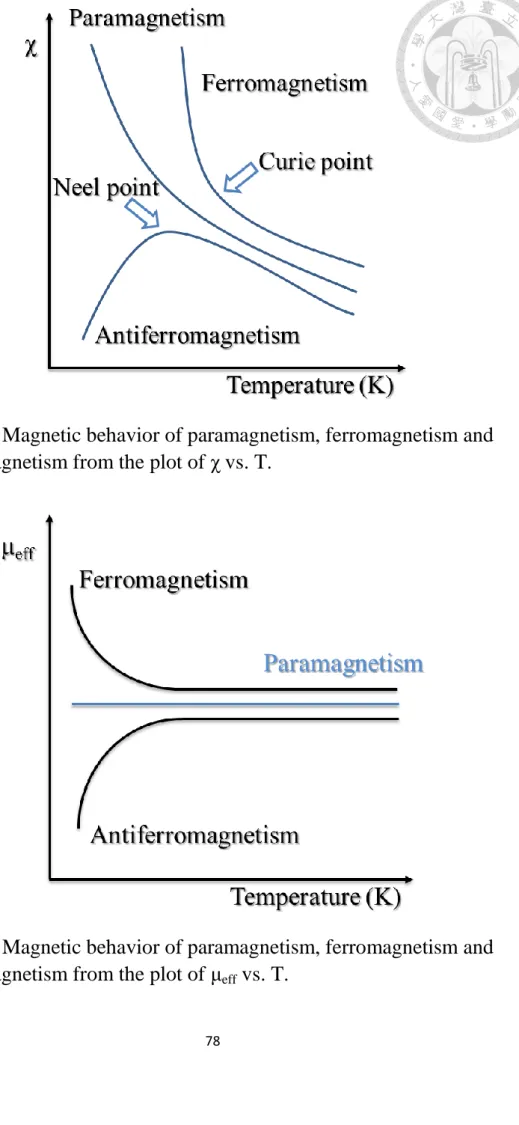
are omitted for clarity……….….73 Figrue 3-6. (a) paramagnetism (b) ferromagnetism (c) antiferromagnetism (d) ferrimagnetism………75 Figure 3-7. Magnetic behavior of paramagnetism, ferromagnetism and antiferromagnetism from the plot of χ vs. T………...78 Figure 3-8. Magnetic behavior of paramagnetism, ferromagnetism and
antiferromagnetism from the plot of μeff vs. T………78 Figure 3-9. Plot of χM (■) and μeff (■) versus T of complex 1 and the simulated line of χM () for complex 1.………….………82 Figure 3-10. Plot of χM (■) and μeff (■) versus T of complex 2 and the simulated line
of μeff () for complex 2………..83 Figure 3-11. Plot of χM (■) and μeff (■) versus T of complex 4 and the simulated line of χM () for complex 4………….………..85 Figure 3-12. Plot of χM (■) and μeff (■) versus T of complex 5…………...86 Figure 3-13. Least-squares fit correlating the magnetic coupling coefficient (-J) of
various linear chains of Ni(II) atoms with the inverse cube of the distance between the magnetic centers (r-3)………..89 Figure 3-14. The cyclic voltammogram for complex 1 in CH2Cl2 containing 0.1 M TBAP with scan rate: 100 mV/s……….………90
V
Figure 3-15. The cyclic voltammogram for complex 4 in CH2Cl2 containing 0.1 M
TBAP with scan rate: 100 mV/s……….91
Figure 4-1. ORTEP view of the molecular structure of [Co6(bphpyany)4(NCS)2](PF6) (6). Thermal ellipsoids are drawn at 30% probability level. Hydrogen atoms and PF6- are omitted for clarity………...100
Figure 4-2. ORTEP view of the molecular structure of [Co6(bphpyany)4(NCS)2](PF6)2 (7). Hydrogen atoms are omitted for clarity………....100
Figure 4-3. ORTEP view of the molecular structure of [Co5(bphpzany)4(NCS)2] (8). Thermal ellipsoids are drawn at 30% probability level. Hydrogen atoms are omitted for clarity……….101
Figure 4-4. ORTEP view of the molecular structure of [Co5(bphpzany)4(OTf)2] (9). Thermal ellipsoids are drawn at 50% probability level. Hydrogen atoms are omitted for clarity. Terminal ligands, OTf- , are high disorderliness………….101
Figure 4-5. ORTEP view of the molecular structure of [Co6(bphpzany)4(NCS)2](PF6) (10). Thermal ellipsoids are drawn at 50% probability level. Hydrogen atoms and PF6- are omitted for clarity………...…………..102
Figure 4-6. Plot of χM (■) and μeff (■) versus T of complex 6………...….106
Figure 4-7. Plot of χM (■) and μeff (■) versus T of complex 7…...………...107
Figure 4-8. Plot of χM (■) and μeff (■) versus T of complex 8…………...108
Figure 4-9. Plot of χM (■) and μeff (■) versus T of complex 9…………...109
Figure 4-10. Plot of χM (■) and μeff (■) versus T of complex 10………...110
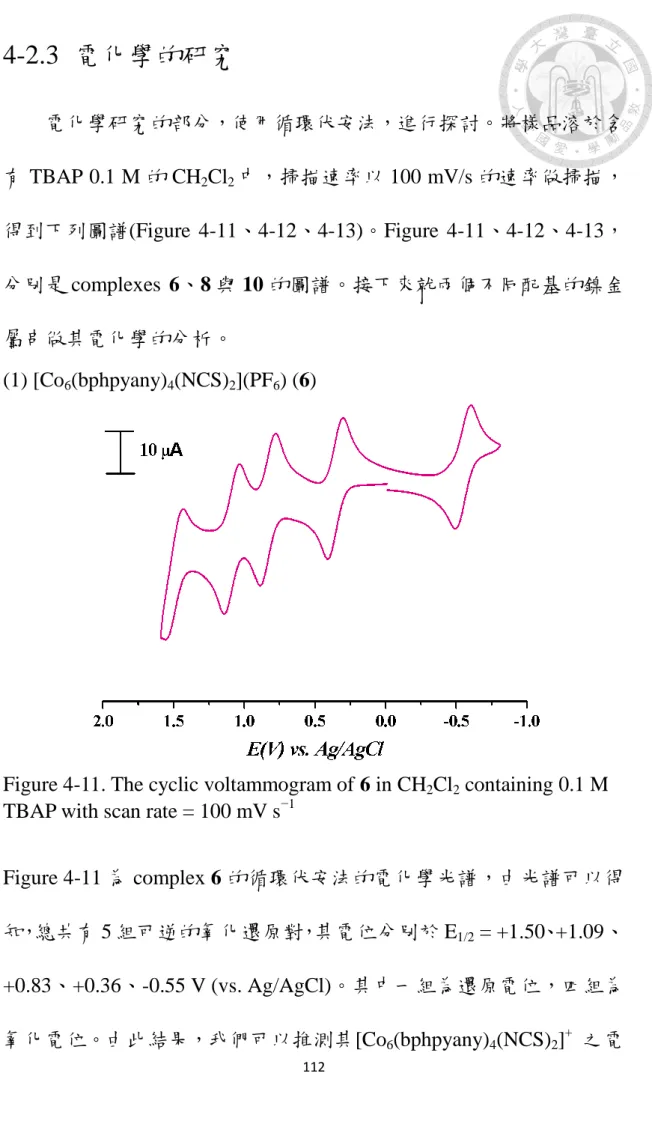
Figure 4-11. The cyclic voltammogram of 6 in CH2Cl2 containing 0.1 M TBAP with scan rate = 100 mV s−1………..112
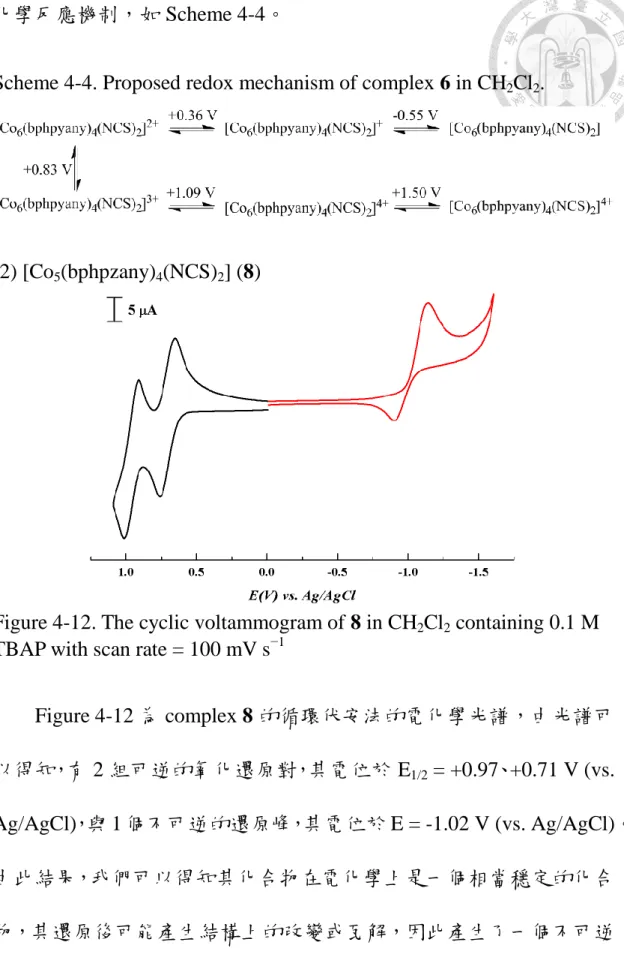
Figure 4-12. The cyclic voltammogram of 8 in CH2Cl2 containing 0.1 M TBAP with scan rate = 100 mV s−1………..113
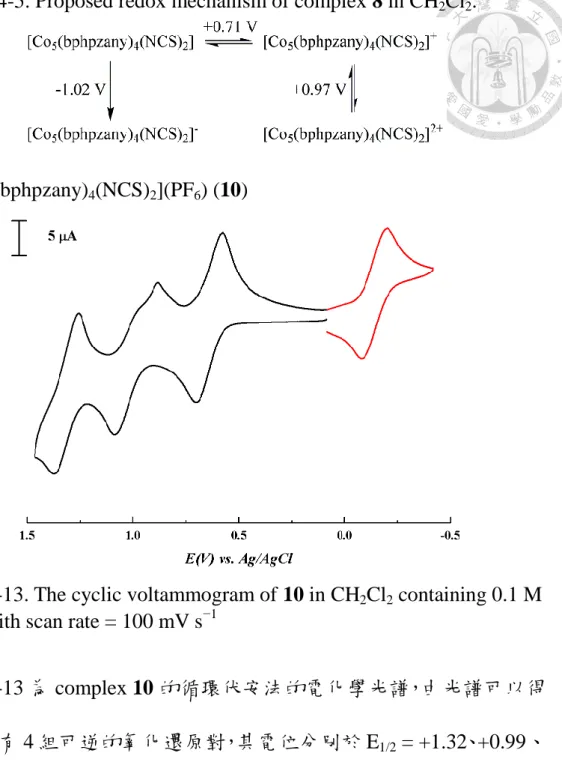
Figure 4-13. The cyclic voltammogram of 10 in CH2Cl2 containing 0.1 M TBAP with scan rate = 100 mV s−1………..114 Figure 4-14. (A) Conductance of a gold contact formed between a gold STM tip and
a gold substrate decreases in quantum steps near multiples of G0 (= 2e2/h) as the tip is pulled away from the substrate. (B) A corresponding conductance histogram constructed from 1000 conductance curves as shown in (A) shows well-defined peaks near 1 G0, 2 G0, and 3 G0 due to conductance quantization.
(C) When the contact shown in (A) is completely broken, corresponding to the collapse of the last quantum step, a new series of conductance steps appears if molecules such as 4,4’-bipyridine are present in the solution. These steps are due to the formation of the stable molecular junction between the tip and the substrate electrodes. (D) A conductance histogram obtained from 1000
VI
measurements as shown in (C) shows peaks near 1 ×, 2 ×, and 3 × 0.01 G0 that are ascribed to one, two, and three molecules, respectively. (E and F) In the absence of molecules, no such steps or peaks are observed within the same conductance range……….117 Figure 4-15. Conductance of a single molecule of 6 (top), 8 (middle), and 10 (bottom)
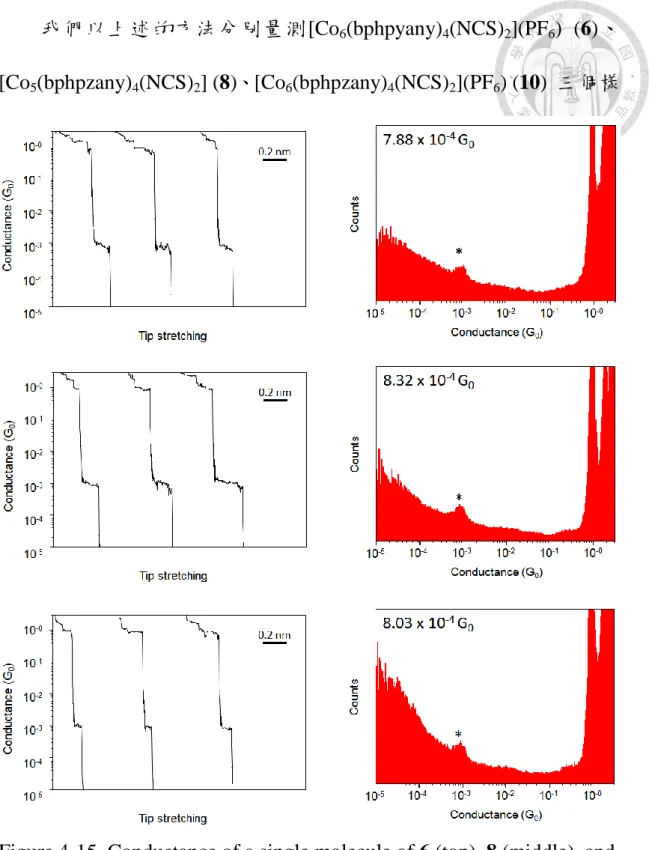
measured by STM break-junction method. The curves are presented with arbitrary x axis offsets. The vertical axes represent conductance, calculated from the measured currents divided by the corresponding G0 and Ebias, which are 30 and 50 mV for these teaces, respectively, for 6, 8, and 10 (bottom). The conductance histograms have been obtained from more than 1000 measurements………....118 Figure 4-16. Isosurfaces of frontier orbitals for 8 (right) and 10 (left), their corresponding energy, and bond orders between cobalt atoms. Isovalues of all isosurfaces are 0.02. Each red circle on the isosurfaces of frontier orbitals indicates location of a cobalt atom. Numbers under each orbital are the bond orders between adjacent cobalt atoms. Extended Hückel method is used for all calculations………..….122 Figure 4-17. Conductance of a single molecule of 6+ (upper) and 62+ (under) in
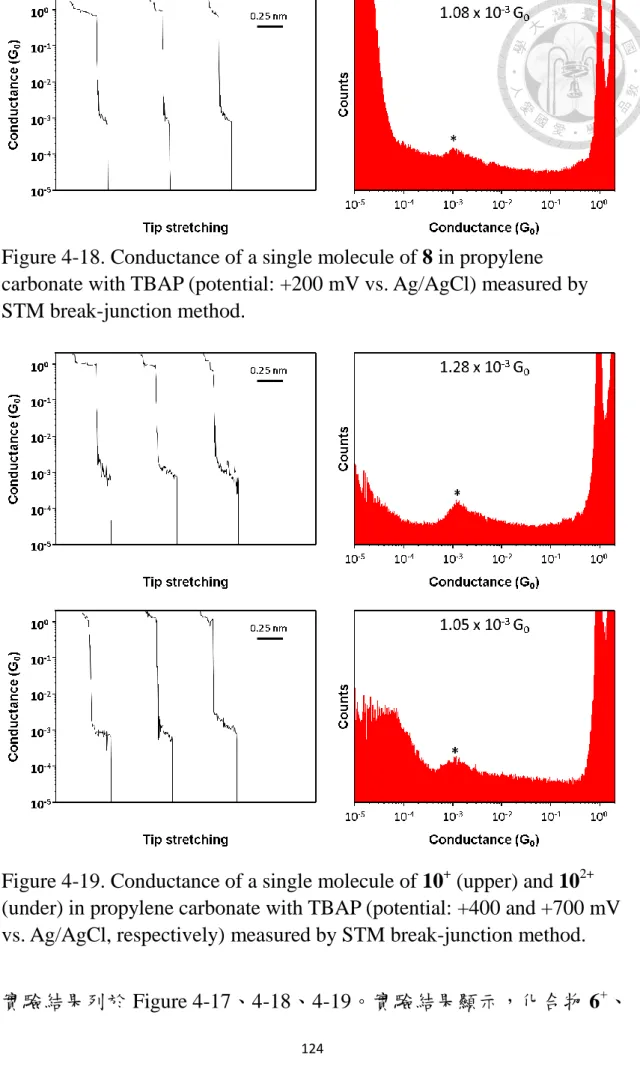
propylene carbonate with TBAP (potential: +100 and +500 mV vs. Ag/AgCl, respectively) measured by STM break-junction method...123 Figure 4-18. Conductance of a single molecule of 8 in propylene carbonate with TBAP (potential: +200 mV vs. Ag/AgCl) measured by STM break-junction method………...124 Figure 4-19. Conductance of a single molecule of 10+ (upper) and 102+ (under) in propylene carbonate with TBAP (potential: +400 and +700 mV vs. Ag/AgCl, respectively) measured by STM break-junction method………..…124 Figure 4-20. The qualitative molecular orbital diagram of the linear six Cobalt(II), CoIICoIICoIICoIICoIICoIII system for [Co6(bmpyany)4(NCS)2]3+……...126
VII
表目錄
Table 3-1. X-ray crystallographic data for 1-4………...…….69 Table 3-2. Average bond distances (Å) and torsion angles (◦) for 1-4………74 Table 3-3. The conditions of magnetic measurements and data analyses…………...76 Table 3-4. Pascal’s constants………...77 Table 3-5. The magnetic coupling coefficient (-J) and the distance between the magnetic centers (S = 1) of linear multinuclear Ni(II) metal-string complexes.88 Table 3-6. Redox potential of [Ni4(N4-ligand)4X2]+ and [Ni6(N6-ligand)4X2]2+…….92 Table 4-1. X-ray crystallographic data for 6-10………...99 Table 4-2. Average bond distances (Å) and torsion angles (◦) for 6, 7, and 10……103 Table 4-3. Average bond distances (Å) and torsion angles (◦) for 8, and 9………..104 Table 4-4. Redox potential of [Co5(N6-ligand)4X2] and [Co6(N6-ligand)4X2]+…….115 Table 4-5. Conductance and resistance of [M5(N5-ligand)4(NCS)2]n+, [M5(N6-ligand)4(NCS)2] and [M6(N6-ligand)4(NCS)2]+.……...………...120 Table 4-6. Conductance and resistance of [M5(N6-ligand)4(NCS)2] and
[M6(N6-ligand)4(NCS)2]+ in toluene (black) and propylene carbonate (red)…125
VIII
中文摘要
隨著人們對於電子產品精緻化與效能化的要求,將電子元件微小 化甚至分子化是科學家們追求的目標,因此分子電子元件成為相當熱 門的研究題材,在分子導線探討的領域中,金屬串分子是相當具有潛 力的,我們實驗室致力於發展的金屬串分子中,包含兩個系列,一是 以修飾配基上的官能基改變金屬串分子的特性,二是以改變金屬的組 合合成不同的混金屬串分子。多吡啶胺與多萘啶胺皆已被廣泛地使用 在金屬串的研究,而另外還有一個系列是將上述兩個部分做組合,形 成一個新的系列,吡啶萘啶胺系列。在此系列中,最短且對稱的配基 為 2,7-bis(α-pyridylamino)-1,8-naphthyridine (H2bpyany),六核的鎳金 屬串與鈷金屬串皆已發表,包含結構、電化學和磁性都有詳細的研 究。
在我的研究部分,修飾已發表的 H2bpyany 配基,在兩末端吡啶 的 5 號位上修飾苯基,以及將兩端吡啶以嘧啶或吡嗪做取代,藉此達 到修飾的效果。因此合成出三個配基,H2bphpyany、H2bphpmany 和 H2bphpzany,再以此三個配基合成出鎳金屬串與鈷金屬串。
在六核鎳金屬串的部分,利用 H2bphpyany、H2bphpmany 這兩個 配基,成功的合成出 5 個化合物,[Ni6(bphpyany)4Cl2](PF6)2 (1)、
IX
[Ni6(bphpyany)4Cl2](PF6) (2) 、 [Ni6(bphpyany)4(NCS)2](PF6)2 (3) 和 [Ni6(bphpmany)4Cl2](PF6)2 (4)、[Ni6(bphpmany)4Cl2](PF6) (5),經由 X 光單晶繞射鑑定,發現結構與已發表的[Ni6(bpyany)4X2](PF6)n (X = Cl, NCS; n = 2, 1)相同,且相關鍵長也幾乎一樣。在磁性方面,化合物 1、
3、4 的兩末端五配位的 Ni2+為高自旋,因此是屬於反鐵磁性。而 2、
5 中間的萘啶單元具有 Ni23+的磁性中心,所以由磁性表現來看是屬於 順磁性物質。
在第二個部分為鈷金屬串的研究,利用修飾配基 H2bphpyany 和 H2bphpzany , 成 功 合 成 出 [Co6(bphpyany)4(NCS)2](PF6) (6) 、 [Co6(bphpyany)4(NCS)2](PF6)2 (7) 、 [Co5(bphpzany)4(NCS)2] (8) 、 [Co5(bphpzany)4(OTf)2] (9) 和 [Co6(bphpzany)4(NCS)2](PF6) (10) 五個 化合物,從結構上可以分為兩個部分,化合物 8 和 9 為缺陷的五核鈷 金屬串,左右兩端為燈籠型的雙核鈷單元,中間為一個罕見的八配位 鈷離子,形成一個直線型的[Co2…Co…Co2]金屬串。磁性方面雙核鈷 單元為逆磁性單元,中間八配位的鈷離子是屬於高自旋的電子組態。
化合物 6 和 10 具有 Co611+的結構,其磁性具有 spin-crossover 的現象。
化合物 7 的結構與 6 相似,磁性是一個順磁性的表現。導電度方面,
缺陷的五核鈷金屬串與全未定域化的六核鈷金屬串,其導電值並沒有
X
明顯的差異。利用理論計算其化合物 8 與 10,藉由分析分子軌域的 組成與其鍵級分布,成功解釋其導電度的現象。
XI
Abstract
In the past several decades, molecular electronics have been widely discussed in many fields and extended metal atom chains (EMACs) are of considerable significance for their potential applications as molecular wires. In order to develop new generation of metal string complexes, two series of them, which contain fine tuning of ligands or a heterometallic framework, have been studied. Ligands such as oligo-α-pyridylamines and oligo-naphthyridylamine are usually used in the linear metal string complex, and another series of ligands made up of pyridyl and naphthyridyl moieties, are designed and used for the development of metal-string complexes. For the series, the shortest symmetrical ligand, 2,7-bis(α-pyridylamino)-1,8-naphthyridine (H2bpyany), has been used for the syntheses of a series of hexa-nuclear metal string complexes, [M6(μ6-bpyany)4X2](PF6)n (M = Ni, Co; X = Cl, NCS; n = 1, 2), and their structural characterizations, electrochemistry, and magnetic properties have been published.
In the present work, we modified the published ligand, H2bpyany, replacing the 5-position hydrogen atom of pyridyl groups with phenyl groups and the pyridyl groups with pyrimidyl and pyrazine groups. Three fine-tune ligands, H2bphpyany, H2bphpmany, and H2bphpzany, were synthesized and used to synthesize nickel and cobalt metal-string complexes.
In hexanickel metal-string complexes, four linear extended Ni chains complexes, [Ni6(bphpyany)4Cl2](PF6)2 (1), [Ni6(bphpyany)4Cl2](PF6) (2), [Ni6(bphpyany)4(NCS)2](PF6)2 (3), [Ni6(bphpmany)4Cl2](PF6)2 (4), and [Ni6(bphpmany)4Cl2](PF6) (5), have been synthesized using the modified H2bphpyany and H2bphpmany ligands, and their structures have been determined by single-crystal
XII
X-ray diffraction. The crystal structure of these complexes show that the Ni‒N and Ni‒Ni distances are similar with [Ni6(bpyany)4X2](PF6)n (X = Cl, NCS; n = 2, 1) in the literature. The temperature dependent magnetic measurements performed on two independent high-spin nickel(II) ions of 1, 3, and 4, demonstrating that metal strings are antiferromagnetic. Complexes 2 and 5 contain two independent high-spin nickel(II) ions like 1 and one mixed-valence Ni23+
, displaying that it is paramagnetic.
In the second part, five hexacobalt metal-string complexes, [Co6(bphpyany)4(NCS)2](PF6) (6), [Co6(bphpyany)4(NCS)2](PF6)2 (7), [Co5(bphpzany)4(NCS)2] (8), [Co5(bphpzany)4(OTf)2] (9), [Co6(bphpzany)4(NCS)2](PF6) (10), supported by four bphpyany2- or bphpzany2- ligands have been synthesized, and characterized. The structure of complexes 8 and 9 consist of two lantern-type dinuclear Co2 fragments at the terminal positions and one rare octacoordinated cobalt at the centre forming a linear [Co2…Co…Co2] chain. The magnetic susceptibility measurements show a quartet ground state with a significant spin-orbital contribution of the centre Co(II) ion. Complexes 6 and 10 consist of a linear Co611+
configuration wrapped by four ligands and their magnetic susceptibility measurement reveal a spin-crossover process (S = 1/2 ⇆ S = 3/2). The structure of 7 is similar with 6, and its magnetic behavior measurement reveals paramagnetism. In the study of single molecular conductance, defective pentacobalt and fully delocalized hexacobalt atom chains also do not show any difference. We use the theoretical calculation, Extended Hückel method, to analyze the consisting of molecular orbitals and the distributing of bond order about 8 and 10, and successfully explain the interesting phenomenon.
1
第一章 緒論
奈米,這個名詞早已充斥在我們的日常生活中,不論在食、衣、
日常生活用品等,亦或高科技產品,如手機、電腦等,也都早已將奈 米科技應用於其中。現今電子元件,如電阻、電容、二極體等元件,
目前已能廣泛的積體化,使得記憶體容量與計算核心運算速度都有相 當大的提升,且體積也都大幅的縮小。然而,現今仍然繼續在追求更 小的體積及更快的速度。因此,我們需要持續研發更小尺寸的材料、
更新的製程。依照奈米材料的製程方法,通常可以分為兩種方式:一 種是由上而下 (top-down) 的方式,將一巨觀的材料經由外力作用,
將材料的尺寸由上而下降至奈米的尺度範圍;另一種方式則是由下而 上 (bottom-up) 的方式,是一種由原子、分子所建構而產生的奈米材 料。
諾貝爾物理獎得主 Richard Phillips Feynman,1959 年在一次的演 講中,以〝There’s plenty of room at the bottom〞為題,首次提及了關 於奈米化的概念。直到西元 2000 年,美國前總統柯林頓在一次的公 開發表演說中,全力支持美國國家奈米計畫 (National Nanotechnology Initiative, NNI),獲得了廣大的回響,除了美國之外,其他國家也紛 紛投入奈米的世界,不論政府組織或私人企業也都紛紛投入大量資金,
2
成立專案計畫全力發展奈米科技。台灣大學也於 2001 年規劃成立奈 米科技研究中心,於 2003 年正式營運,研究領域橫跨奈米材料、奈 米元件、奈米機電、奈米生醫與奈米教學等五大項目,提供跨領域合 作的良好環境。
本實驗室早期主要的研究,以 bottom-up 的方式,合成多核金屬 錯化合物之金屬—金屬鍵結理論的研究為主,而近十年來,奈米科技 盛行,且由奈米科技中心所提供的基礎設備及技術上大幅進步之下,
我們也朝分子導線、分子開關、分子整流器等方向進行應用上的研 究。
1-1 分子導線
導線是電子元件中,最基礎、最簡單也最重要的電子元件,用於 連接各個電子元件。因此,分子電子元件中,分子導線也是相當重要 的一環。分子導線主要是由一個分子或分子字組裝而成,且連接在兩 個分子元件之間,用於能量及價電荷的傳遞。而電子傳遞過程中,尤 其在分子間的電子傳遞與透過鍵結而傳遞的過程,都是相當重要且有 趣的。最早是由 A. Aviram 與 M. Ratner 在 1974 年所發表關於分子導
線的報導 1,爾後分子導線的相關研究變得相當熱門,本實驗室也投
入其相關研究,分子金屬串的研究。
3
1-2 一維直線型多核金屬錯化合物
在分子導線這個研究領域中,其中具有一維直線金屬離子排列的錯化 合物具有相當大的潛力。在微觀的世界中,排成一列的金屬離子骨架,
可以用以傳遞電子,做為電子的傳遞通道。此一概念,就像巨觀世界 中的電線一般,藉由金屬線來傳遞電子,連接於多個電氣與元件之間。
由於傳遞電子的骨架,僅以單原子排列而成,因此稱為分子導線 (Figure 1-1)2。這類直線型多核金屬錯化合物,以金屬離子間是否有 配基做為架橋連接,可分為〝無架橋配基之金屬錯化合物〞與〝經由 架橋配基連結之金屬錯化合物〞。
Figure 1-1. An electric wire and a miniature molecular metal wire.
1-2.1 無架橋配基之金屬錯化合物
1969 年,第一個經由合成的分子金屬導線,[Pt(CN)4]n-,稱為 Krogmann salts3。中心 Pt 為 square-planar 的配位構型,主要是由 CN
4
上的 C 與 Pt 配位。而每個 Pt 之間,是面對面的方式做堆疊,藉由 dz2
軌域的重疊,形成金屬-金屬鍵,藉此無限延伸 (Figure 1-2)。也因 為金屬間金屬鍵的形成,使得具有高導電度的潛在能力。往後的 40 年間,開始大量的合成出具有一維直線金屬串的錯化合物。
而除了上述的 Krogmann salts 之外,此類未經架橋配基連接的金 屬鍊,還有 H. B. Gary 與 K. R. Mann 團隊於 1980 年發表的銠金屬錯 化合物[Rh4(1,3-diisocyanopropane)8Cl]5+ 4a, 4b、S. J. Lippard 團隊於 1978 年發表的鉑混價錯化合物 [Pt(NH3)8(C5H6NO)4]5+ 4c 通稱〝Platinum Blue〞、L. A. Oro 團隊發表一系列的〝Rhodium Blue〞和〝Iridium Blue〞
4d-f、K. R. Dunbar 團隊於 1999 年發表的一維無限延伸的銠金屬鍊
Figure 1-2. A schematic representation of a square planar [Pt(CN)4]n- stack, to emphasize the overlapping dz2 orbitals.
5
Figure 1-3. The structure of the [Re2Cl8]2- ion is found in K2Re2Cl8·2H2O.
Bond distancesare in angstroms and angles in degrees.The symmetry is D4h within the uncertaintiesof the dimensions. There is a rigorous (crystallographic) center of symmetry.The fully refined structure has Re-Re 2.24 Å .
[Rh(CO)2(MeCN)2][BF4]4g等。還有一典型例子,由 F. A. Cotton 所發 表的 [Re2Cl8]2- (Figure 1-3),3 價錸之間的 bond order 是 4。5上述皆 是未經架橋配基連接之金屬錯化合物,但在合成上,不易調控長度,
因此另一方面的研究,就發展出經由架橋配基連接的金屬串分子。
1-2.2 經由架橋配基連結之金屬錯化合物
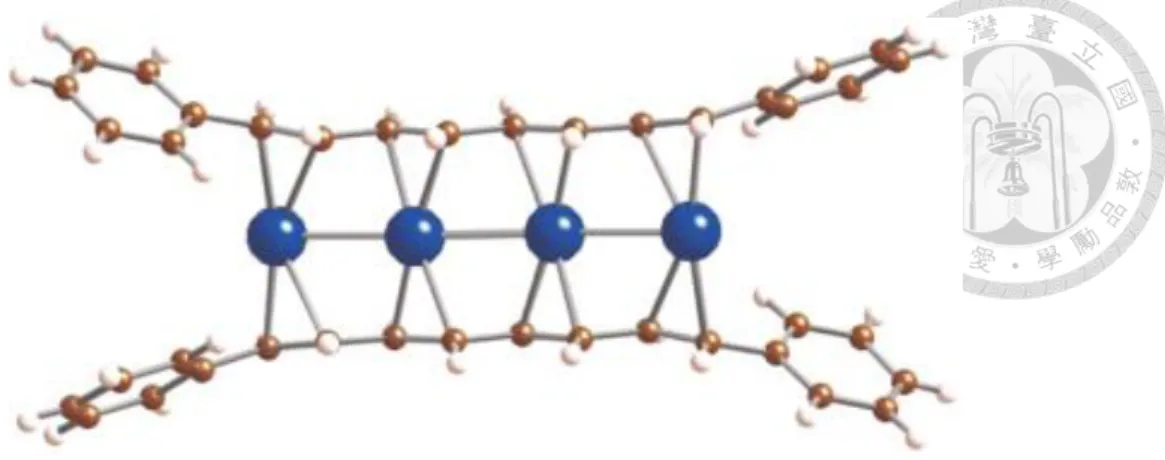
T. Murahashi 與 H. Kurosawa 團隊率先發表了一系列利用不飽和之 碳氫化合物做為架橋配基,建構出一維的鈀金屬串,這類化合物因其 結構上的特殊性,因此被稱為〝Sandwich Chains〞(Figure 1-4)6。以及 T. Tanase 與 K. Mashima 團隊分別以多磷及 P-N-O 配基做為架橋配基,
合成出六核鉑及四核銠-鉬-鉬-銠等金屬錯化合物 7。而我們實驗室與 F. A. Cotton 團隊則是以多吡啶胺配基 (oligo-α-pyridylamine) 做為架
6
Figure 1-4. Molecular structure of the tetrapalladium cation,
[Pd4(DPOT)2]2+ (DPOT = all-trans-1,8-diphenyl-1,3,5,7-octatetraene).
橋配基,藉以合成直線型多核金屬串。這類的金屬錯化合物,金屬的 個數與配基上的氮數息息相關,四個配基常以四螺旋環繞在金屬串的 周圍 (Figure 1-5)8,每一個氮與一個金屬做配位,因此氮的個數就決 定了金屬的個數。所以在配基的合成與設計就相當的重要,且金屬種 類的不同,其配位化學也有所不同,因此,在金屬種類的選擇,與合 成的方式,皆有相當大的研究空間。我們實驗室在經過近幾十年來的 研究成果累積,已經漸漸找到其系統性的合成,不論是配基上的設計,
亦或金屬上的選擇與設計,皆有不錯的成果。配基的部分,大致可以 分成三種類型:一、多吡啶胺配基;二、多萘啶胺配基;三、多萘啶 吡啶胺配基。
7
Figure 1-5. The helical structure of extend metal atom chains (EMACs).
1-3 多氮配基及其錯化合物
1923 年 J. P. Wibaut 團隊,首次成功合成 α,α’-dipyridylamine (Hdpa) (Figure 1-6) 並發表後9,學界對於多吡啶胺配基開始了源源不絕的研 究。而本實驗室從 1994 年起,利用多吡啶胺配基,合成出相當多的 金屬串錯化合物,且對其金屬金屬鍵有著相當不錯的研究成果。後來 也開始研究多萘啶胺配基的金屬串合成及研究,發現了與吡啶胺配基 有著不同的特性,但礙於純萘啶胺配基不易合成金屬串,因此,我們
8
開始將萘啶胺系統與吡啶胺系統混合,發展出了多萘啶吡啶胺配基,
因排列組合的多樣性,開發了許多對稱與不對稱的配基,順利的改善 了純萘啶系統在合成金屬串上的困難。以下簡單介紹各個系統的研究 成果。
Figure 1-6. Molecular structure of Hdpa.
1-3.1 多吡啶胺配基
早期在配基的合成,只能合成出二吡啶胺與三吡啶二胺,在更長 的配基部分,一直無法順利合成,直到 1996 年 S. Wagaw 與 S. L.
Buchwald 團隊發表了一篇以鈀金屬進行催化的相關研究 10,成功的 解決了我們在長配基上的合成困難。因此,展開了一系列吡啶胺配基 的合成 (Figure 1-7),我們成功合成出十一吡啶十胺配基 (Figure 1-7, n = 9),是我們合成出最長且具有單晶結構的配基。在同核金屬串 (homonuclear metal string complexes) 的合成部分 (Figure 1-7),三核 金屬串錯化合物,可合成不同金屬離子的錯化合物,包含 Cr、Co、
Ni、Cu、Ru、Rh 等金屬離子 11,且有完整的研究,包含電化學、磁 性、導電度等研究;五核金屬串,成功合成出 Cr、Co、Ni、Ru 等同
9
n M
0 Cr, Co, Ni, Cu, Ru, Rh 1 Cr, Co, Ni, Ru
2 Cr, Co, Ni
3 Cr, Ni
Figure 1-7. Oligo-α-pyridylamine ligands and oligonuclear metal string complexes. The structures of these metal string complexes consist in a linear transition metalframework helically wrapped by four ligands.
核金屬串 12;七核金屬串,有 Cr、Co、Ni 等金屬離子化合物 13;九 核金屬串,只有成功合成出 Cr 金屬串與 Ni 金屬串 14。由上述可知,
長配基不易合成之外,長金屬串也不易合成,且多個單鍵容易旋轉,
10
形成兩個配基夾數個金屬的形成發生 (Figure 1-8)15。往後引進萘啶系 統,有較佳的鋼性,改善過於 flexible 的特性,降低形成夾子型金屬 串的發生機率,且萘啶具有穩定低價金屬的能力,因此,萘啶系統也 成了研究的主要方向之一。
Figure 1-8. The cation in [Co3(mpeptea)2]Cl2·3CH2Cl2·H2O, with
displacement ellipsoids drawn at the 40% probability level and hydrogen atoms omitted for clarity.
1-3.2 多萘啶胺配基
萘啶 (1,8-naphthyridine) 配基及其衍伸物,在 1970 年代即有大量 的研究報導。1973 年,L. Sacconi 團隊,即利用萘啶與 NiBr2合成出 鎳雙核錯化合物 [Ni(ny)4Br2]+ (Figure 1-9)16 ,其鎳鎳距離為 2.415(4) Å ,萘啶配基之扭轉角 (torsion angle)約為 25o。由此結果可知,其萘 啶 配 基 可 以 穩 定 還 原 一 個 電 子 的 產 物 , 且 此 鎳 雙 核 為 一 fully
11
Figure 1-9. Crystal structure (left) and the molecular orbital diagram of [Ni2(ny)4Br2]+ ion (right).
delocalized,class III 的混價錯化合物,未成對電子透過σ*的分子軌 域,在兩個鎳金屬之間快速來回自由移動。
我們實驗室從 2003 年開始,投入萘啶胺的研究,從萘啶單元做 延伸,有成功合成出五氮、八氮、十一氮及十四氮配基 (Figure 1-10)。
金屬串方面,只合出五核、八核、十一核鎳金屬串17,但在鎳金屬串
中,萘啶單元依然可以穩定低價鎳金屬離子,使得 Ni24+單元,還原 一個電子為 Ni23+,且具有鎳鎳間的金屬鍵,其 bond order 為 0.5。雖 然有不錯的成果,但就目前的結果不難發現,在金屬串的合成上,只 有鎳金屬串成功合成出來,相較於吡啶胺系統,其他金屬離子無法成 功合成。因此,我們開始嘗試將吡啶與萘啶做結合,發展出多萘啶吡 啶胺系統,也開啟了更多偶數核的金屬串研究。
12
Figure 1-10. Oligo-naphthyridylamine ligands and oligonuclear metal string complexes. The structuresof these metal string complexes consist in a linear transition metalframework helically wrapped by four ligands.
1-3.3 多萘啶吡啶胺配基
在多吡啶胺配基系統與多萘啶胺配基系統中,我們實驗室都有不 錯的研究成果,而在努力研究及發展這兩個系統之外,我們也致力於 多萘啶吡啶胺的混合系統,期望合成出其他偶數核之金屬串,並利用 吡啶的取代,使萘定存在配基的中間與末端的兩種情形,研究其結構 與性質上的差異 (Figure 1-11)。18
以上述概念,2,7-bis(α-pyridylamino)-1,8-naphthyridine (H2bpyany) 為此系統中最短且對稱的配基 18a-b,也順利的合成了六核鎳金屬串 [Ni6(bpyany)4Cl2]2+,經由加入還原劑後,顏色明顯由深棕色轉變為深
13
綠色,進行還原反應得到[Ni6(bpyany)4Cl2]+,中間萘啶單元的鎳鎳距 離由 2.281(2) Å 縮短為 2.201(3) Å 。亦或萘啶在末端的最短對稱配基 H2bnapy 18c,合成金屬串後,一樣保有萘啶可以穩定低價金屬離子的 能力。
Figure 1-11. In the oilgo-pyridiylnaphthyridyl amine system and symmetrical ligand: a. 2,7-bis(α-pyridylamino)-1,8-naphthyridine (H2bpyany); b. 2,6-bis(1,8-naphthyridylamido)pyridine (H2bnapy), and asymmetrical ligand: c. 2-(α-pyridylamino)-1,8-naphthyridine (Hpyany);
d. 2-(dipyridyldiamino)-1,8-naphthyridine (H2dpdany).
14
1-4 微調金屬串系統
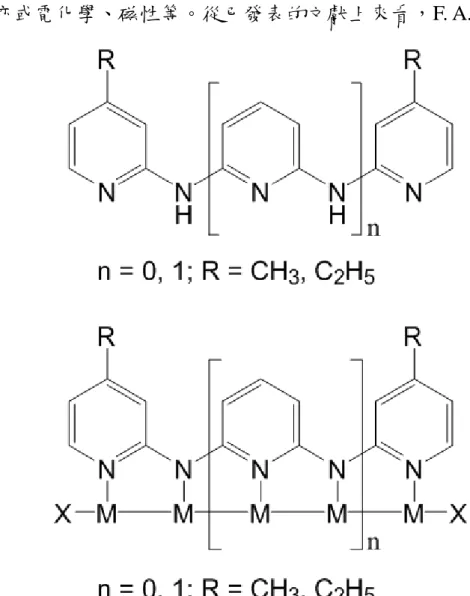
在吡啶胺系統,或者萘啶吡啶胺系統,在發展的過程中,我們也 嘗試在吡啶上做修飾,藉此調整金屬串的系統,研究在不同取代上對 金屬串性質的影響。在微調方面,大致上可以分為三個部分。第一類 型,在吡啶上的 4 號位上修飾上甲基或乙基等 (Figure 1-12)19,或者 其他位置上修飾其他推拉電子基,試圖改變其金屬串之溶解度、產率 等,亦或電化學、磁性等。從已發表的文獻上來看,F. A. Cotton 於
Figure 1-12. Fine tuning of oligo-pyridylamine ligands and oligonuclear metal string complexes.
15
2003 年所發表的[Ni3(depa)4Cl2] (depa- = the anion of 4,4’-diethyl-2,2’- dipyridylamine)19a,成功的增加了配基與金屬串的溶解度,在未來長 串的溶解度方面,是一個改善的方法。在電化學表現方面,修飾上乙 基後,鎳金屬串的氧化電位從 0.908 V 降到 0.778 V,且其氧化態更為 穩定。
第二類型是在末端將吡啶置換成推拉電子基,例如 phenyl、
toluenesulfonyl、anisyl、camphorsulfonyl 等基團 20。近期比較有驚艷 的成果是在末端修飾 camphorsulfonyl 的配基 (Figure 1-13)20d,因為配 基上具有 chiral,所以期望可以調控金屬串旁四螺旋配基的光學性質,
很幸運的合成出金屬串,而且成功控制金屬串其配基螺旋方向,並於 2014 年發表。
Figure 1-13. Views illustrating the quadruple helix along the
metal-chainaxis: (a) D-[Ni5((-)camnpda)4]; and (b) L-[Ni5((+)camnpda)4].
The hydrogen atoms and solvent molecules are omitted. In each case,one of the ligands is highlighted in orange to depict the helicity of themetal chain more clearly.
16
第三類型,是將末端或中間的吡啶換成嘧啶或吡嗪,舉下列一個 較有系統的例子。將傳統的三吡啶二胺,分別在中間以吡嗪或兩端以 吡嗪取代,分別得到了鈷金屬串,且做了詳細的研究。分別合成出 [Co5(tpda)4(NCS)2]、 [Co5(dppzda)4(NCS)2]、 [Co5(dpzpda)4(NCS)2] 等 三個金屬串分子,在電化學方面的研究,第一個還原電位分別是 -0.53V、-0.14 V、+0.02 V,從初步的結果來看,吡嗪具有可以幫助穩 定還原電子的能力,且吡嗪愈多還原電位愈低,甚至在兩個吡嗪取代 的鈷金屬串,[Co5(dpzpda)4(NCS)2] 加入還原劑 N2H4(aq),成功還原一 個電子得到了(Ph4P)[Co5(dpzpda)4(NCS)2]。21
Figure 1-14. Fine tuning ligand, bis(α-pyridyl)-2,6-diaminopyridine (H2tpda), bis(α-pyridyl)-2,6-diaminopyrazine (H2dppzda), and bis(2-pyrazinyl)-2,6-diaminopyridine (H2dpzpda).
17
1-5 研究方向
在前言部分,介紹了金屬串的各個系統,且在同核金屬串的部分,
配基上的突破也遇到了瓶頸,因此,介紹了後續微調的部分,想藉由 配基上的微調,改變金屬串的性質,例如電化學、磁性、導電度等。
比較明顯的例子,相同的五合鎳金屬串, [Ni5(tpda)4(NCS)2]11d 與 [Ni5(bna)4(NCS)2]17a,藉由二萘啶胺在兩端奈啶配基的鎳金屬單元上,
個還原一個電子,利用電子非定域化的表現,此種新型鎳金屬串的電 阻值為17.6 MΩ,比起三吡啶二胺系統的五核鎳金屬串的電阻值 24.4 MΩ,導電值足足提升 40%。因此,希望在微調上做努力,提升現有 同核金屬串的導電值,藉由降低還原電位,得到還原更多電子的金屬 串分子。
本篇的研究,我設計了一系列的配基,主要是微調簡智賢學長與 曹廷賓學長所發表過的二吡啶奈啶胺配基,H2bpyany 與 H2bpmany (Figure 1-15)18a-b,22,分別在他們所發表過的配基上,於末端的吡啶/
嘧定的 5 號位上修飾上一個苯基 (H2bphpyany/H2bphpmany),試圖增 加其溶解度,使在反應過程中可以得到較佳的產率。另外我還設計了 將末端的吡啶置換為吡嗪 (H2bpzany)21c,藉由 4 號位上 N 的拉電子 效應,試圖改變其金屬串的電子組態。以及於末端吡嗪的 5 號位上修 飾上一個苯基 (H2bphpzany)。以及蔣青宏學長的論文,在 H2bpyany
18
的末端吡啶上,於 4 號位上修飾甲基 (H2bmpyany),也有完整的研究,
因此我試圖將蔣青宏學長的配基末端吡啶置換成嘧啶,形成密啶上的 4 號位也有修飾甲基的配基 (H2bmpmany)。另外我還修飾了 H2bpyany 末端吡啶 5 號位上,以強拉電子基 NO2基團取代氫原子。和末端吡 啶改為 1,3,5-triazine,試圖分散 amine 上的 H 脫去後產生的負電荷。
共 10 個配基 (Figure 1-15),但於 2014 年,王文珍博士發表了一篇關 於 [Co5(bpzany)4(NCS)2]21c,因此在後續的相關研究討論中,我也會 一併介紹與討論。主要分為兩個部分,同核鎳金屬串與同核鈷金屬串。
在鎳金屬串的部分,由簡智賢與曹廷賓學長的研究可以發現 18a-b,22, 中間萘啶單元的鎳金屬單元,都具有穩定還原一個電子的能力,且末 端將吡啶改為嘧啶後,其還原一個電子的還原電位由 -0.21 V 下降至 +0.01 V,以及第二個還原電位由 -0.71 V 下降至 -0.40 V。因此,藉 由修飾苯基或吡嗪,期望可以降低第二個還原電位,藉此探討其結構,
在還原第二個電子後,其鍵長的變化,與導電值的改變。第二部分,
主要探討同核鈷金屬串的研究,在含有萘啶單元的配基中,此系統配 基是少數目前可以合成出鈷金屬串的配基系統,因此希望可以有更深 入 的 研 究 與 對 含 有 萘 啶 配 基 之 鈷 金 屬 串 有 更 多 的 認 識 。 在 [Co6(bpyany)4(NCS)2]+ 與 曹 廷 賓 學 長 的 博 士 論 文 中 [Co6(bpmany)4(NCS)2]+ 做比較可以發現,吡啶換成嘧啶後,第一個氧
19
Figure 1-15. 2,7-bis(α-pyridylamino)-1,8-naphthyridine (H2bpyany) and its derivatives.
20
化電位分別是 +0.38 V 與 +0.57 V,而第一個還原電位為 -0.55 V 與 -0.35 V。由上述可知,第一個氧化電位上升,而第一個還原電位下降,
使得更容易還原的二個電子。因此,藉由修飾苯基或吡嗪,期望可以 降低第一個還原電位,甚至得到其單晶結構,對於六核鈷金屬串有更 深入的探討。
21
第二章 實驗部分
2-1 試藥與儀器
2-1.1 試藥
試藥名稱 藥品廠商 試藥名稱 藥品廠商
Acetone TEDIA CH2Cl2 Merck
n-Hexane Merck Methanol TEDIA
Toluene Fisher tert-BuOH ACRÕ S Diethyl ether TEDIA NH4OH TEDIA H2SO4 SHIMAKYU Ethyl acetate TEDIA DMSO-d6 Merck CDCl3-d1 Merck NiCl2 Strem Ni(OAc)2·4H2O Alfa Aesar
CoCl2 Strem FcPF6 Aldrich
KPF6 ACRÕ S Pd2(dba)3 Strem Naphthalene Alfa Aesar Na2CO3 SHOWA
tert-BuOK ACRÕ S POCl3 Aldrich
PCl5 Aldrich NaNO2 ACRÕ S
NaSCN ACRÕ S Pd(PPh3)4 ACRÕ S
試藥名稱 藥品廠商
2,6-Diaminopyridine ACRÕ S
2-Amino-5-bromopyridine ACRÕ S 2-Amino-5-bromopyrimidine Alfa Aesar 2-Amino-5-bromopyrazine Maybridge
Phenylboronic acid ACRÕ S
1,3-Bis(diphenylphosphino)propane Alfa Aesar
D,L-Malic acid ACRÕ S
Hydrazine (64% aq.) ACRÕ S
22
2-1.2 儀器
1. X 光單晶繞射儀(X-ray Single Crystal of Diffractometer,簡稱 X-ray) : 荷 蘭 Nonius CAD4 Kappa Axis CCD 繞 射 儀 (Diffractometer),配備 X 光產生器 3.0 kW 與低溫繞射溫控系統 (Oxford Cryosystems),委託科技部台大貴儀中心李錦祥先生代 測。
2. 超 導 量 子 干 涉 磁 量 儀 (Superconducting Quantum Interference Device Magnetometer,簡稱 SQUID):Quantum Design MPMS7 型 (magnetic property measurement system)量測系統,Model 1802 Temperature controller,Model 1822 MPMS controller,每件樣品均 以固態測量,自行將樣品封入保鮮膜中,溫度範圍 2 ~ 300 K,自 行操作。
3. 循環伏安法 (cyclic voltammetry,簡稱 CV):係使用三電極電位 測定儀(CH Instruments,Model 750A)進行電位掃瞄實驗。三電極 系統:工作電極 (working electrode) 為 BAS 面積 0.02 cm2的白 金電極或 0.07 cm2玻璃質碳電極,輔助電極 (auxiliary electrode) 為直徑 0.25 mm 的白金絲,參考電極 (reference electrode) 則為 自 製 Ag/AgCl(sat’dKCl) 電 極 。 參 考 電 極 則 以 飽 和 甘 汞 電 極 (saturated calomel electrode,SCE) 校正,誤差在 ±3 mV 內,電
23
解質溶液為 0.1M TBAP,並以 Ferrocene 在不同溶劑下的氧化還 原電位校正。委託中興大學葉鎮宇教授實驗室代測。
4. 核磁共振光譜 (Nuclear Magnetic Resonance Spectrometer,簡稱 NMR):1H NMR 光譜使用 Varian 400 MHz NMR 測量。委託台 大化學系蘇仁寬先生代測。
5. 紅外線光譜儀(Infrared Spectrometer,簡稱 IR):Nicolet MAGNA-IR 550 型,樣品均以 KBr 打片,自行操作。
6. 快速原子撞擊質譜儀(Fast Atom Bombard Mass Spectrometer,簡稱 FAB-MS):委託中研院化學所質譜中心代測。
7. 基質輔助雷射脫附游離飛行時間質譜儀 (Matrix-Assisted Laser Desorption Ionization Time-of-Flight Mass Spectrometer , 簡 稱 MALDI-TOF-MS):Voyager DE-PRO 型。委託中研院化學所質譜 中心代測。
8. 元素分析儀 (Elemental Analysis,簡稱 EA):美國 PERKIN-ELMER CGB-2400 型,委託科技部台大貴儀中心代測。
9. 光譜電化學法 (Spectroelectrochemical Method):係在一個光徑長 1.0 cm 的石英比色槽中,置入一片白金網當工作電極,輔助電極 則 為 白 金 絲 , 參 考 電 極 為 Ag/AgCl(sat’d) 電 極 , 並 使 用 Bioanalytical system Mode SP-2 Potentiostat 提供固定電位進行電
24
化學反應,以 Hewlett-Packard Model8453 或 Perkin Elmer Lambda 900 光譜光度計 (spectrophotometer) 偵測石英比色槽中樣品的 UV/Vis 光譜。
10. 導電度的量測:MultiMode SPM (NanoScopeIIIa、Veeco、Santa Barbara CA、USA)。。STM 配合 low-current converter,穿隧電流 可設定至 picoampere。委託台灣大學化學系陳俊顯教授實驗室洪 爾謙同學代測。
25
2-2 配基合成
配基合成流程圖
a. D,L-Malic acid, 110 oC in H2SO4, 12 hr, neutralize with NH4OH.
b. NaNO2, dissolved in H2SO4, 6 hr, neutralize with NH4OH.
c. PCl5, POCl3, refluxed for 6 hr, neutralize with NH4OH.
d. Phenylboronic acid, Pd(PPh3)4, Na2CO3, toluene, MeOH, H2O, refluxed for 12 hr.
e. t-BuOK, Pd2(dba)3, dppp, refluxed in toluene, 5 days.
26
(A) 2-Amino-7-hydroxy-1,8-naphthyridine
取 2,6-diaminopyridine 13.21 g (120 mmol) 和 D,L-malic acid 18.03 g (132 mmol) 磨碎混合放入 500 mL 的單頸圓底瓶中,在冰浴中 慢慢加入 60 mL 濃硫酸。待反應物溶解後,加熱至 110 oC (不可超過 120 oC) 迴流,反應 12 小時。反應完成,待其冷卻,倒入裝有冰塊的 燒杯 (5.0 L) 中,在冰浴下以濃氨水中和至 pH ~ 8,過程會產生大量 的黃色沉澱。將水溶液過濾取沉澱,以水、丙酮和乙醚沖洗。晾乾後 得黃棕色固體 18.20 g,固體產率約 94%。
IR (KBr, cm-1): (Figure A-1) 3388 s, 3167 vs, 1635 vs, 1547 m, 1511 s, 1401 s, 1371 s, 1112 s, 874 m, 834 m, 617 s
1H NMR (DMSO-d6, 400 MHz): (Figure A-2) δ11.49 (1H, broad, OH), 7.59 (2H, m), 6.71 (2H, s, NH), 6.29 (2H, d, J = 8.4 Hz), 6.06 (2H, d, J = 10 Hz)
FAB-MS (m/z): (Figure A-3) 162.1 [M+H]+
27
(B) 2,7-Dihydroxy-1,8-naphthyridine
取 2-amino-7-hydroxy-1,8-naphthyridine 53.38 g (332 mmol) 放入 2.0 L 的燒杯中,在冰浴中慢慢加入 200 mL 濃硫酸。待反應物溶解後,
取 50.33 g (729 mmol) 緩慢加入其中(會產生棕色氣體),反應 8 小時。
反應完成,待其冷卻,倒入裝有冰塊的燒杯 (5.0 L) 中,在冰浴下以 濃氨水中和至 pH ~ 8,過程會產生大量的黃色沉澱。將水溶液過濾取 沉澱,以水、丙酮和乙醚沖洗。晾乾後得黃棕色固體 33.33 g,固體 產率約 62%。
IR (KBr, cm-1): (Figure A-4) 3035 s, 2804 s, 1638 vs, 1508 s, 1402 s, 1359 s, 1283 m, 1229 m, 1147 s, 1040 m, 1014 m, 931 m, 865 m, 836 s, 715 m, 673 m, 639 m, 618 m, 550 m
1H NMR (DMSO-d6, 400 MHz): (Figure A-5) δ7.67 (1H, d, J = 9.2 Hz), 6.14 (2H, d, J = 8.8 Hz)
FAB-MS (m/z): (Figure A-6) 163.1 [M+H]+
28
(C) 2-7-Dichloro-1,8-naphthyridine
取 2,7-dihydroxy-1,8-naphthyridine 24.87 g (154 mmol) 和 PCl5
62.07 g (298 mmol) 在冰浴中混合放入 500 mL 的雙頸圓底瓶中,快速 加入 15 mL 的 POCl3 (最少要可以完全溶解,此步驟劇烈放熱),等待 完全溶解後再開攪拌,加熱至 90 oC 迴流 12 小時。反應完成,待其 冷卻,倒入裝有冰塊的燒杯 (5.0 L) 中,在冰浴下以濃氨水中和至 pH
~ 8,過程會產生大量的深棕色固體。將水溶液過濾取沉澱,以水、
丙酮和乙醚沖洗。晾乾後得深棕色固體,藉由管柱層析法,可得到最 終產物 17.10 g,產率約 56%。
IR (KBr, cm-1): (Figure A-7) 3046 s, 2986 m, 1995 m, 1965 m, 1538 vs, 1473 s, 1423 s, 1392 m, 1367 m, 1268 m, 1141 vs, 1125 vs, 998 m, 943 m, 851 vs, 794 s, 782 s, 659 m, 615 m
1H NMR (DMSO-d6, 400 MHz): (Figure A-8) δ8.60 (2H, d, J = 8.4 Hz), 7.78 (2H, d, J = 8.4 Hz)
FAB-MS (m/z): (Figure A-9) 199.0 [M]+
29
(D) 2-Amino-5-phenylpyridine
取 2-amino-5-bromopyridine 11.88 g (69 mmol)、phenylboronic acid12.50 g (103 mmol)、50% Na2CO3(aq) 3.84 g (35 mmol) 溶於 120 mL 的水和 0.5% Pd(PPh3)4 0.4143 g (0.36 mmol),混合放入 500 mL 的雙 頸圓底瓶中,加入 150 mL 甲苯和 30 mL 甲醇,加熱至 120 oC 迴流,
反應 12 小時。反應完成,用 EA 萃取至少三次(留有機層),藉由管柱 層析法純化產物,最後可得到亮白色鱗粉狀固體 7.27 g,產率約 62%。
IR (KBr, cm-1): (Figure A-10) 3354 s, 3159 s, 3058 m, 3030 m, 2741 m, 1657 s, 1609 s, 1577 m, 1515 s, 1483 vs, 1448 m, 1386 s, 1321 m, 1258 m, 1148 m, 831 s, 771 s, 747 m, 699 s
1H NMR (DMSO-d6, 400 MHz): (Figure A-11) δ8.21 (1H, dd, J = 1.6, 0.8 Hz), 7.67 (1H, dd, J = 10.4, 1.6 Hz), 7.53 (2H, d, J = 7.6 Hz), 7.37 (2H, m), 7.24 (1H, m), 6.50 (1H, dd, J = 9.6, 0.8 Hz), 6.02 (2H, s, NH) FAB-MS (m/z): (Figure A-12) 171.1 [M+H]+
30
(E) 2-Amino-5-phenylpyrimidine
取 2-amino-5-bromopyrimidine 9.93 g (57 mmol)、phenylboronic acid 9.75 g (80 mmol)、50% Na2CO3(aq) 3.20 g (28 mmol) 溶於 120 mL 的水和 0.5% Pd(PPh3)4 0.3543 g (0.31 mmol),混合放入 500 mL 的雙 頸圓底瓶中,加入 150 mL 甲苯和 30 mL 甲醇,加熱至 120 oC 迴流,
反應 12 小時。反應完成,用 EA 萃取至少三次(留有機層),藉由管柱 層析法純化產物,最後可得到淡黃色粉狀固體 7.42 g,產率約 78%。
IR (KBr, cm-1): (Figure A-13) 3310 s, 3152 s, 3008 s, 2731 m, 2146 m, 1684 vs, 1597 s, 1549 s, 1521 vs, 1489 s, 1448 s, 1383 s, 1331 m, 1301 m, 1227 s, 1205 s, 1062 m, 951 m, 799 s, 755 s, 697 s, 673 m, 664 m, 570 s, 536 s
1H NMR (DMSO-d6, 400 MHz): (Figure A-14) δ8.55 (2H, s), 7.59 (2H, m), 7.41 (2H, m), 7.30 (1H, m), 6.75 (2H, s, NH)
FAB-MS (m/z): (Figure A-15) 172.1 [M+H]+
31
(F) 2-Amino-5-phenylpyrazine
取 2-amino-5-bromopyrimidine 9.91 g (57 mmol)、phenylboronic acid 9.74 g (80 mmol)、50% Na2CO3(aq) 3.04 g (28 mmol) 溶於 120 mL 的水和 0.5% Pd(PPh3)4 0.3567 g (0.31 mmol),混合放入 500 mL 的雙 頸圓底瓶中,加入 150 mL 甲苯和 30 mL 甲醇,加熱至 120 oC 迴流,
反應 12 小時。反應完成,用 EA 萃取至少三次(留有機層),藉由管柱 層析法純化產物,最後可得到橘黃色粉狀固體 6.02 g,產率約 62%。
IR (KBr, cm-1): (Figure A-16) 3334 s, 3169 vs, 3016 m, 2710 m, 1650 s, 1588 s, 1537 vs, 1479 s, 1447 m, 1388 s, 1340 m, 1216 m, 1198 m, 1026 m, 1010 m, 883 m, 752 m, 695 m, 513 m
1H NMR (DMSO-d6, 400 MHz): (Figure A-17) δ8.48 (1H, d, J = 1.2 Hz), 7.94 (1H, d, J = 1.6 Hz), 7.89 (2H, d, J = 7.2 Hz), 7.39 (2H, m), 7.28 (1H, m), 6.53 (2H, s, NH)
FAB-MS (m/z): (Figure A-18) 172.1 [M+H]+
32
(G) 2,7-bis(5-phenylpyridylamino)-1,8-naphthyridine (H2bphpyany)
取 2-amino-5-phenylpyridine 2.4336 g (14.3 mmol)、2,7-dichloro- 1,8-naphthyridine 1.3029 g (6.5 mmol)、t-BuOK 2.0823 g (17.0 mmol)、
Pd2(dba)3 0.1808 g (0.2 mmol) 和 dppp 0.1629 g (0.4 mmol),混合放入 裝有冷凝管的 500 mL 雙頸圓底瓶中,抽真空後,以雙針導入除水後 的甲苯 300 mL,在氬氣下加熱至 120 oC 迴流,反應 120 小時。反應 完成時溶液呈紅色有黃色沉澱。冷卻後直接過濾並以甲苯清洗至濾液 呈現無色,曬乾後可得黃色粉狀固體 2.06 g,產率約 68%。
IR (KBr, cm-1): (Figure A-19) 3275 m, 3059 m, 3028 m, 1600 vs, 1513 vs, 1477 vs, 1448 s, 1376 vs, 1337 vs, 1254 m, 1226 m, 1140 m, 836 m, 766 m, 695 m
1H NMR (DMSO-d6, 400 MHz): (Figure A-20) δ10.32 (1H, s, NH), 8.61 (1H, d, J = 1.6 Hz), 8.40 (1H, d, J = 8.8 Hz), 8.10 (1H, dd, J = 8.8, 2.8 Hz), 8.03 (1H, d, J = 8.4 Hz), 7.71 (2H, d, J = 7.2 Hz), 7.63 (1H, d, J = 8.4 Hz), 7.46 (2H, m), 7.34 (1H, m)
MALDI-MS (m/z): (Figure A-21) 467.2 [M+H]+
33
(H) 2,7-bis(5-phenylpyrimidylamino)-1,8-naphthyridine (H2bphpmany)
取 2-amino-5-phenylpyrimidine 3.2574 g (19.0 mmol)、2,7-dichloro- 1,8-naphthyridine 1.6350 g (8.2 mmol)、t-BuOK 2.8400 g (23.2 mmol)、
Pd2(dba)3 0.1653 g (0.2 mmol) 和 dppp 0.1431 g (0.4 mmol),混合放入 裝有冷凝管的 500 mL 雙頸圓底瓶中,抽真空後,以雙針導入除水後 的甲苯 300 mL,在氬氣下加熱至 120 oC 迴流,反應 120 小時。反應 完成時溶液呈紅色有黃色沉澱。冷卻後直接過濾並以甲苯清洗至濾液 呈現無色,曬乾後可得黃色粉狀固體 2.92 g,產率約 76%。
IR (KBr, cm-1): (Figure A-22) 3403 m, 3231 m, 1592 s, 1436 s, 1498 s, 1454 s, 1427 vs, 1389 s, 1360 s, 1308 vs, 1175 m, 1136 m, 845 m, 799 m, 756 m, 692 m, 651 m
MALDI-MS (m/z): (Figure A-23) 469.1 [M+H]+