國
立 交 通 大 學
管
理 科 學 系
碩
士 論 文
探討口碑來源親近度與社會比較對於客製化商品
購買意圖之影響-以自身能力為調節變數
The Impact of Source of Word-of-mouth and Social Comparison
on Customization Product’s Purchase Intention
-The Moderating Role of Self-Assessed Ability
研
究 生:陳依婷
指導教授:張家齊 博士
探討口碑來源親近度與社會比較對於客製化商品
購買意圖之影響-以自身能力為調節變數
The Impact of Source of Word-of-mouth and Social Comparison on Customization Product’s Purchase Intention -The Moderating Role of Self-Assessed Ability
研究生:陳依婷 Student:Chen, Yi-Ting 指導教授:張家齊 博士 Advisor:Dr. Chang, Chia-Chi
國立交通大學
管理科學系
碩士論文
A Thesis
Submitted to Department of Management Science
College of Management
National Chiao Tung University
In Partial Fulfillment of the Requirements
For the Degree of
Master in Business Administration
August 2010
Hsinchu, Taiwan, Republic of China
i 探討口碑來源親近度與社會比較對於客製化商品購買意圖之影響 -以自身能力為調節變數 研究生:陳依婷 教授:張家齊 博士
國立交通大學
管理科學系
碩士論文
中文摘要
大量客製化可以廣泛地定義為廠商透過消費者共同參與產品設計的過程,以 達到每一位消費者的個人需求與偏好。本篇研究旨在探討消費者接收到不同親近 度的口碑推薦人推薦時,並產生社會比較情形之下,對於客製化產品的購買意願 高低效果,是否會受到口碑接收者本身能力不同而有所差異。因此本研究設計為 2(口碑來源人親近程度)x2(社會比較)x2(本身能力)的形式。結果顯示,本身能力並 不會調節口碑推薦與社會比較之間的效果。研究發現,高(低)能力消費者在向上比 較比在向下比較之下的有較高(低)的購買意圖。此外,高(低)能力消費者對於陌生 人(朋友)的推薦則是比朋友(陌生人)的推薦之下,有較高的購買意圖,然而平均而 言,購買意願分數仍然高於低能力消費者。 對於客製化廠商而言,口碑推薦的效果可有效經由親近的高能力消費者傳遞 給低能力的消費者,以達到購買意圖的提升,可視為一個極佳的商業機會,若能 成功創造正面口碑,對於利潤的提升會有很好的幫助。 關鍵字:口碑、社會比較、客製化、購買意圖ii
The Impact of Source of Word-of-mouth and Social Comparison on Customization Product’s Purchase Intention -The Moderating Role of Self-Assessed Ability Student:Chen, Yi-Ting Advisor:Dr. Chang, Chia-Chi
Department of Management Science National Chiao Tung University
ABSTRACT
Mass customization is generally defined as “a customer co-design process of products and services which meet the needs of each individual customer.” This study examined the change of customer’s purchase intention when a customer received a recommendation from different close people and occurred social comparison. We want to test how the customer’s self-skill will affect the interaction. Thus a 2(source of WOM)x2(social comparison )x 2 (self-assessed skill) experimental design was employed. Results show there is no interaction between three factors. Our study results reveal that the purchase intention of high (low) skill people is higher (lower) in the upward comparison than in the
downward comparison. In addition, the purchase intention of high (low) skill people is higher when the WOM information is from a stranger (friend) than from a friend (stranger). Moreover, purchase intention of high skill people is higher than low skill people in average.
For firms, this is good news for knowing low skill people’s purchase intention can be increased by a high skill close friend. It is a good opportunity for gaining profit if the firms can make positive word-of-mouth information through their customers.
Keywords:Word-of-Mouth, Social Comparison, mass customization, purchase intention
iii
誌謝
兩年研究所生涯飛外地結束,認識許多很優秀的同學、朋友,讓我留下很多 很美好的回憶。碩二這一年過得非常充實,從暑期跟著大家一起討論文章,每個 禮拜雖然辛苦,會抱怨、無奈,還是很慶幸自己有這樣紮實的訓練,讓自己真的 學到很多,尤其是口條的表達這一塊,真是受益良多。論文的研究上,想要謝謝 同門的信堯、依璇、大萱、新嵐、郁珊、宥文、力仁等,還有佳誼學長、愛華學 姐、柏宇學長的鼓勵與幫助,讓我在這段煎熬的日子,有動力可以撐下去,真的 很感激大家。當然,最重要的是謝謝張家齊老師的批評與指導,我知道老師都是 為了我們未來在職場上能夠經的起考驗,才會如此的嚴苛。 最後,我想謝謝我自己,因為我真的做的到了,我真的在這麼短的時間內完 成了!雖然這不是一個多偉大或多有貢獻的研究,但是,真的花了我很多時間與 精神,也謝謝媽媽的支持,讓我可以無生活顧慮的完成我的碩士學位。在交大生 活的點滴回憶,將會永遠留在我心中,謝謝你們給我這麼美好的記憶。 陳依婷 謹誌 于 交通大學管理科學研究所 中華民國九十九年八月iv
Contents
中文摘要 ... i ABSTRACT ... ii 誌謝 ... iii Table Index ... viFigure Index ... vii
Chapter 1:Introduction ... 1
1.1 Background and research motivation ... 1
1.2 Research Objectives ... 2
1.3 Organization of the Research ... 4
Chapter 2:Literature Review ... 6
2.1 Research Framework ... 6
2.2 Self-Designed Products ... 7
2.3 Word of Mouth ... 9
2.4 Social Comparison ... 11
2.5 Hypothesis ... 13
Chapter 3:Research Methodology ... 17
3.1 Overview ... 17
3.2 Designing scenario ... 17
3.3 Experiment Design ... 18
3.4 Manipulation of closeness relationship ... 18
3.5 Manipulation of social comparison and Stimulus ... 19
3.6 Measurements ... 21
3.6.1 Measures of Independent Variables - Closeness ... 21
3.6.2 Measures of Independent Variables - Social Comparison ... 21
3.6.3 Measures of Independent Variables - Skill Level ... 21
3.6.4 Measures of Dependent Variable-Purchase Intention ... 22
3.6.5 Realistic Check Items ... 22
Chapter 4:Results ... 23
4.1 Background of participants ... 23
4.2 Reliability ... 26
4.3 Manipulation Check ... 27
4.3.1 Manipulation Check of Closeness ... 27
4.3.2 Manipulation Check of Comparison... 27
4.3.3 Self-assessed skill ... 28
4.4 Hypothesis Testing ... 29 4.4.1 Interaction between WOM Sender’s Closeness Level and Social
v
Comparison across Different Skill Level ... 29
Chapter 5:Discussion ... 32
5.1 Discussion ... 32
5.2 Implication ... 37
5.3 Limitation and Future Research ... 38
Reference ... 41
Appendix Ⅰ ... 44
Appendix Ⅱ ... 45
vi
Table Index
Table 1 Results of stimulus in pretest ... 20
Table 2 Experience of Participants ... 24
Table 3 Experience of Participants ... 24
Table 4 Demographics of Participants ... 24
Table 5 Reliability Statistics ... 26
Table 6 Manipulation Check of Closeness ... 27
Table 7 Manipulation Check of Comparison ... 28
Table 8 Three-way ANOVA of Purchase intention ... 30
Table 9 Descriptive Statistic of Purchase Intention ... 31
vii
Figure Index
Figure1 Research Flow Chart ... 5
Figure2 Research Framework ... 6
Figure 3 Interaction between Source of WOM and Self-Assessed Skill in Upward Comparison ... 35
Figure 4 Interaction between Self-Assessed Skill and Comparison ... 36
Figure5 Interaction between Self-Assessed Skill and Source of WOM ... 36
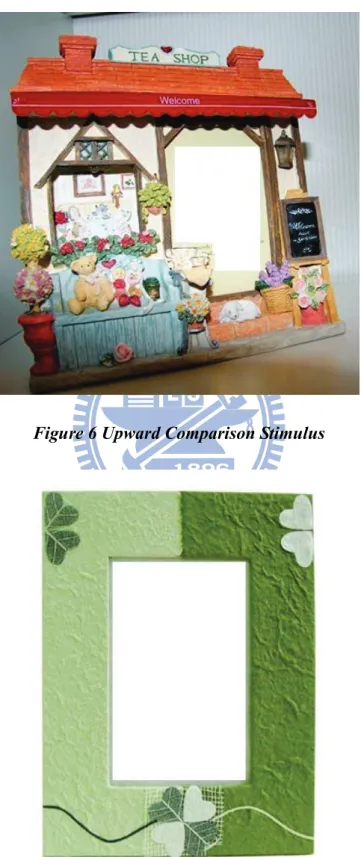
Figure 6 Upward Comparison Stimulus ... 44
1
Chapter 1:Introduction
1.1 Background and research motivation
Recent years, we can observe that many firms strive to develop mass customization technologies to try to meet every customer’s needs. The firms believe as long as they provide the “self-design” opportunity for consumers, they will benefit more than just offer those standard goods. “In product categories, ranging from running shoes to pet beds to ceiling fans, consumers are becoming the designer of their own products” (Moreau and Herd 2010), this statement points out it is much possible for extensive firms to provide a self-design opportunity in their market. Even though there are studies examine related phenomenon, for instance, giving constraint choice than free choice condition will generate more creativity (Moreau and Dahl 2005), or providing instructions to consumer can help increase consumers’ enjoyment during a creative task (Darren and Moreau 2007; Darren and Moreau 2007). There are rarely researches investigating the effects of word- of-mouth behavior in self-designed experiences in mass customization area.
Reviewing earlier word-of-mouth literatures, we can find almost all the word-of-mouth studies were discussed on pure product market or on service market. In mass customization market, however, it includes both the product and service traits.
2
In recent years, with the growth of self-designed trends, we think it is interesting to discuss the effects of recommendation behavior in self-designed experiences.
1.2 Research Objectives
From Herr’s (1991) study, he asserts that vivid (face to face) word-of-mouth information is more effective than printed word-of-mouth message. Accordingly, we take this argument into account in our study. We would like to know when a vivid recommendation occurred in real life, if the customer would be willing to purchase this self-design experience and make their efforts to complete a customization product.
Besides, another interesting factor is the closeness level in a relationship. In previous study of word of mouth, Brown and Reingen (1987) indicates strong tie relationship such as family and friends was more persuasive than general magazine expert or strangers. However, in general social comparison theory, it indicates that people will feel more threatened when compared with close others, although it also has opposite arguments. Summarizing above, if the word-of-mouth sender show with a creation in his recommendation (vivid visual information we focused on here), this situation may cause an upward or downward social comparison consequently. Then, it may bring totally different results of the customer’s willingness to self-design. Additionally, there was also scholars believe “assimilation” effect would happen
3
when people compared with other close. They claimed people who have confident self-views may feel “birds of a feather heuristic“, regardless of comparison direction (Pelham and Wachsmuth 1995).
According to discussions in word-of-mouth and social comparison mentioned above, we think there must have some interaction in close relationship in word-of-mouth and in social comparison simultaneously. However, we have no idea about which side will decide the whole interaction. Finally, we think there must be another factor “self skill” will determine the effects.
In research of Page and Moreau (2007), they list seven motivations for doing creative tasks from twelve high skill interviewers in first pilot study. The first and most mentioned is autonomy and competence. And they claimed the people with more prior experiences about baking will have more enjoyment in a baking cookie task. And high skill person also has more motivations than those who are lack of similar experiences to undertake a creative task. From their research of the moderator “prior skill” and two different inherent motivations in two skill level people, the author are interesting in testing the moderator effects of word-of-mouth and social comparison.
Summarized the statements mentioned above, the research purposes are showed as following:
4
2. How is the effect of close relationship between word-of-mouth and social comparison?
3. Does self-assessed skill moderate the effects between word-of-mouth and social comparison?
1.3 Organization of the Research
This research had five chapters outlined as follows.
Chapter one introduces the researching background and the motivation, the objectives and the research structure.
Chapter two reviews the literatures of each factor. They are word-of-mouth, mass customization and social comparison. In this section, also includes the hypothesis and research framework.
Chapter three introduces the research methods, including the pretest, data collection and experiment design, measurement and manipulation check items of every variable in this study.
Chapter four tests the hypothesis and showed the results. Analysis methods the author used in this study include Reliability Analysis, ANOVA. Further, we explained some findings behind these statistic results.
Chapter five discusses the results and states some implications in this study, listing limitations, and gives some suggestions for future research.
5
Figure1 Research Flow Chart Sampling and Data Collection
Data Analysis and Result Discussion
Conclusion, Limitations, and Future Research Research Direction and Purpose
Literature Review
Measurement of Variables
Designing Scenarios
6
Chapter 2:Literature Review
2.1 Research Framework
In this study, there are three major issues to identify. First, understand the effects of word-of-mouth recommendation behavior to self-designed market. Second, find the effects of social comparison power on consumer’s decision about paying and designing a handmade product in a recommendation situation. The third one, we are most interesting in the joint factor “closeness relationship” between WOM recommendation behavior and the social comparison theory in mass customization market. The last one, we would like to know customer’s purchase intention (willingness to make an effort to self-design). These variables will be discussed in the following literature reviews.
Source of WOM
(friend vs. stranger) Purchase Intention Social Comparison
(upward vs. downward)
Self-AssessedSkill
(high vs. low)
7
2.2 Self-Designed Products
In recent years, relevant research about self-designed experience has been widely discussed from many aspects. Include progressive online website toolkits for mass customization (Taylor Randall 2003) in many firms, or examining the variation of creativity in a designing experience (Moreau and Dahl 2005), and the extra value-generated from the “self-designed effects” (Franke 2010), topics like these have been studying vastly. Previous research has clearly indicated the design task role shift from manufacturers to customers will increase higher preference fit to consumers. And some empirical studies also showed that at a constant product quality, consumer have intense preference for their self-designed products(Deng 2009; Franke, Schreier et al. 2010). For recent years, new issues about “self-design experience” have been increasingly studied.
From Moreau’s series studies of creative experience (2005; 2007; 2010), we can obtain some important principles to increase the willingness to design. While much evidence reveals that “self-designed” is a tendency in marketing without a doubt, little attention has been focused on the customer’s willingness (or purchase intention in this study) to implement a design task inherently, that is why the author would like to test the effects of recommendation on general people. For customization firms, maybe it is worthy to examine. They might wonder “Is the word-of-mouth still
8
effective in this market?”
Here exactly some serious problems exists in customization market. For example, Richard (2006) has proposed the question as to“ how many consumers will have the creativity, desire, time, and energy to customize or design their own products” especially in the society with hurried life style. This is a fundamental part we want to know about consumers. When or what kind of situation that a consumer will consume and self-design a customization product spontaneously or even having more willingness to join a creative task? All mentioned above is we want to know in this study. According to research of C. Page Moreau (2007), he asserted when people have some prior experiences about baking, they may get more enjoyment during a creative baking task. Also, the group of “high skill” person will have more motivations like autonomy and competence in their study. The more motivations in consumers, the higher the probability the people will join a craft activity.
For the reason above mentioned, the author would like to focus on customer’s purchase intention. That is, if someone recommends them to self-design a creative product, how will the person’s intention to design and make efforts to make one. We believe this can help obtain some interesting results from consumers about specific creative self-design task. And furthermore, give some implications to firms or have some contributions to related theories.
9
2.3 Word of Mouth
Since the early 1950s, Word-of-mouth communications have received considerable discussion in both academics and practitioners for decades.
Many researchers have demonstrated that personal conversations and informal exchange of information among acquaintances will influence consumers' choices and purchase decisions (Johan 1967). Besides, most of the managerial literature also claims that the word-of-mouth (WOM) communications activity is one of the most powerful forces in the marketplace (Silverman 1997). This is mainly because consumers usually rely on informal and/or personal information sources in purchase decision making process as opposed to more formal and/or organizational sources such as media advertising campaigns (Bansal and Voyer 2000). For examples, there are researches proved that WOM influence is stronger than print ads, personal selling, and broadcast advertising (Feldman 1965; Engel 1969).
The author reviews previous researches of word of mouth, and find many aspects about word of mouth have been studied so far. However, there’s an interesting part in WOM should be focused is why some word-of-mouth information have more influences in persuasion than others. In view of this, many studies has actually reported specific variables, for example, source expertise (Gilly 1998; Bansal and Voyer 2000), tie strength (Brown and Reingen 1987; Frenzen and Nakamoto 1993),
10
and demographic similarity (Brown and Reingen 1987) will affect WOM’s effects significantly.
In our research, we would like to focus on one special factor in word of mouth: tie strength. Tie strength can be defined as the closeness of the social relationship between the source sender and the receiver of word-of-mouth (Brown and Reingen 1987). The work of Brown & Reingen (1987) clearly indicates that strong ties have greater influence on the receiver’s behavior than weak ties (such as strangers). So far, arguments that strong tie such as friends and family have more influences on consumers’ attraction to products that has been supported in literatures (Frenzen and Nakamoto 1993; Bansal and Voyer 2000). Tie strength has been found as one of the most critical factors explaining the effects of WOM communications (Arnaud De Bruyn 2008).
Especially, Word-of-mouth is particularly important in service market, because inherently intangible characteristic of service will raise consumers’ perceived risk (Berry 1980; Zeithaml 1981; Zeithaml 1985). WOM in service market has being seen as a more credible information source for consumers (Silverman 2001).
Summarized these statements mentioned above, we found that almost the discussion on word-of-mouth is within material product market or service market. With the growth of mass customization market these years, we think the
11
word-of-mouth effects may possibly be different in creative self-design area. We considered that into mass customization markets, including creative self-designed experiences, for example, craft activity. This can be seen as a special kind of consumption possesses both product and service characteristics.
Thus, we assume interpersonal recommendation behavior (word of mouth behavior) may generate different effects on this unique consumption experience. In this study, we take a special situation into account that a recommendation about self-designed experience may possibly happened. For example, people who recommend others to join a creative task often showed their creation to another people at the same time. Thus, it may possibly lead to social comparison and bring complex effects on this recommendation.
2.4 Social Comparison
The social comparison theory (Festinger 1954), suggests that people always desire to know a stable and precise appraisal of themselves. Festinger (1954) maintains that if people are uncertain of their self-evaluations about their opinion or ability, they will try to use objective and nonsocial standards to evaluate themselves. But if there is no objective standard available, then people will often compare with other close people to obtain information and find where they stand.
12
For almost 50 years, this theory indeed has played an important role in not only the pure social perspectives, but also has extended to personality psychology (Mussweiler 2000; Mussweiler 2002). For instance, this kind of comparing behaviors may influence people to meet specific motives or goals (Argo, White et al. 2006). Earlier researches indicate some kinds of social comparison information can be threatening to the self under certain circumstances, such as be outperformed by someone else (upward social comparison), and it is one thing of interest in this study. On the contrary, downward comparison is also includeed and discussed. In general, downward comparison was considered as fewer threats to the self. Most people compared with worse-off others for self-enhancement. It can serve as a safer comparison direction.
According to the work of Moreau (2010), they suggest customer who faces an upward comparison will have lower evaluations to their self-designed backpack than parallel comparison. In creative self-design experiences, they also indicate customers who undertake a creative activity will apparently compare with other people in terms of the product and the designer. It is an innate drive to the customer. Their results support the generally social comparison theory. Upward comparison has much threat to the self. On the other side, some people assume people won’t feel threaten even when they face an upward comparison with close person or won’t feel better with a
13
downward comparison (Pelham and Wachsmuth 1995). They propose a “social assimilation” process for people with high self-certainty. They believe people who know where they stand would not make explicit comparison with close others, instead, they reflect directly. Another self-evaluation maintenance theory (Tesser, Millar et al. 1988), however, provide different argumentation. According to Tesser’s (1988) assertion in this model, he assumes most people have motives to maintain or to increase self-evaluation, so people tend to compare themselves with other people, especially close people than not-close ones. In this model, when people compared with a psychologically close one and upward comparison happened (self is outperformed by other), people will decrease self-evaluation only “in a relevant domain”. On the other hand, self-evaluation may possibly be raised if other’s outstanding performance is highly “irrelevant”. It means which outcome will happen is determined by whether the other’s performance is relevant or irrelevant to one’s self-definition. Self-definition can be seen as the importance of a task for someone.
From above, we can know many different views in related social comparison theory, especially in the upward comparison. Thus, we have many interests in the effects of closeness in word-of-mouth and also in social comparison.
2.5 Hypothesis
14
have great interests in one joint factor between the two areas: closeness relationship. Closeness relationship between word of mouth and social comparison exactly bring entirely different effects. In aspect of word of mouth, from the work of Brown & Reingen (1987), they clearly indicate that strong ties have greater influences on the receiver’s behavior than weak ties (for example, information from strangers). So far, arguments about strong ties, such as friends and family, have more influences on consumers’ attractions to products has been supported in literatures (Frenzen and Nakamoto 1993; Bansal and Voyer 2000). On the other hand, from the view of general social comparison theory, there was scholar assert that compared with psychologically close people will cause more threat to the self, especially in upward social comparison. But we can still get the opposite arguments about close upward comparison. In view of these discussions above, the author assume interaction between word of mouth (close people vs. not close people) and social comparison (upward comparison vs. downward comparison) may have no significant interaction consequently. For the reason, we try to figure out the third factor to possibly test their effects. We predict that one factor may clarify the effects. That is customer’s inherent ability.
Followed the research of Moreau’s qualitative study (2007), we can obtain high skill customer’s motivations who have high frequency undertake creative tasks.
15
For example, autonomy and competence are the most mentioned by interviewers in their study. Most of the interviewers said they obtain satisfaction from completing a creative project, or indicated they get more enjoyments derived from the freedom to choose the process and/or design of the task. Considering these results, the author believes that people often did handicraft or creative task spontaneously should have more interests in join a similar task. As long as you have more interests to a creative task, you will get more satisfaction from doing it. According to their third study (Darren and Moreau 2007), it also shows that the high skill persons have more prior experiences would more likely to have higher enjoyments when doing a creative task. Besides, we also consider low skill person have fewer interests in a creative task, opposite from high skill person. So, low skill person may be influenced much when facing an upward comparison in a recommendation condition (more than high skill person). Consequently, based on more motivations and enjoyments, we think high skill group won’t be threatened so much when facing an upward comparison. Again, we believe “self-assessed ability” will moderate the effects of word of mouth and social comparison in this study.
Additionally, the following hypothesis was formulated:
16
H2a: For low skill customers, when upward comparison occurred, the purchase intention will be lower in closer the WOM sender than in not close WOM sender. H2b: For low skill customers, when downward comparison occurred, the purchase
intention will be higher in closer the WOM sender than in not close WOM sender.
H2c: For high skill customers, purchase intention will higher in close WOM sender than not close WOM sender, regardless of comparison direction.
17
Chapter 3:Research Methodology
3.1 Overview
The experiment processes include three parts. The first part is stimulus pretest, and the second part is questionnaire of self-assessed skill, the third part is main investigation. We further analyze the data and show the results of next chapter.
3.2 Designing scenario
The scenario used in this study was: a scenic area in Taiwan. We have to choose a scenario that a recommendation behavior will happen possibly in our real life. Furthermore, for the reason of providing reasonable situation for each cell (source of WOM: friend v.s stranger; social comparison: upward comparison v.s downward comparison), the author decided to use a scenario that almost everyone might encounter in a scenic area, especially when someone have a holiday, they may probably go out to a scenic area. The most important reason why we choose “scenic area “is there are exactly handicraft shops in specific scenic area for tourists to play in Taiwan. This is a realistic phenomenon in Taiwan. And the scenario is a word of mouth behavior from a friend or from a stranger who recommended the subject to self-design a DIY photo frame.
18
3.3 Experiment Design
The author adopted a 2 (source of WOM: friend and stranger) x2 (social
comparison: upward comparison and downward comparison) x2 (self -assessed skill: high and low) between-subject factorial experiment to test our hypotheses. The dependent variable of interest was purchase intention.
The whole experiment process was divided into two parts. And the sample was from National Chiao Tung University (five classes) and Chung Hua University (four classes). The first part of our experiment is to measure the participants’ self-assessed skill about craft in the first week. After two weeks later, the other researchers will appear in the class and give the same participants a formal questionnaire. After collecting the second data, the experiment can be considered finished. By doing so, we can make sure the participants’ skill level would not be influenced by our manipulation of social comparison in scenario. Two weeks of time gap can obtain the participant’s self skill level more precisely.
3.4 Manipulation of source of WOM
According to previous research, the author followed the method of closeness relationship’s manipulation that most be used: divided the source of WOM into two groups: close and not close. We uses “friend” as close relationship group, and “stranger” as not close relationship group.
19
3.5 Manipulation of social comparison and Stimulus
In this study, although we interest in the effects of recommendation in such a mass customization market, the WOM receiver still need a possible image in their minds as a cue to participate this DIY task more possibly, that is here we have to choose two pictures to meet our needs for both social comparison and try to get closer to a more realistic situation. So, under this consideration, we decide to use two handmade photo frame pictures as upward social comparison and downward social comparison stimulus. We conduct an online pretest to pick out the two photo frame pictures. Two criteria were considered to choose the suitable photo frame pictures: the first, they must be perceived identical attractive; second, they must be critically different on perceived difficulty. Following the above two rules, we select twenty handmade photo frame pictures from “www.google.com.tw” randomly. Then, we conduct two surveys of attractiveness and difficulty on Internet respectively. That means a person will not judge one picture’s attractiveness and also give a difficulty grade simultaneously.
In attractiveness survey, the author additionally analyzes the effects of gender. From a statistic result, we found that there are four photo frame pictures that have a significant difference between male and female (p<.05). So, we dropped these four pictures. By doing so, we can avoid the risks of getting biases from gender difference
20
in our formal study.
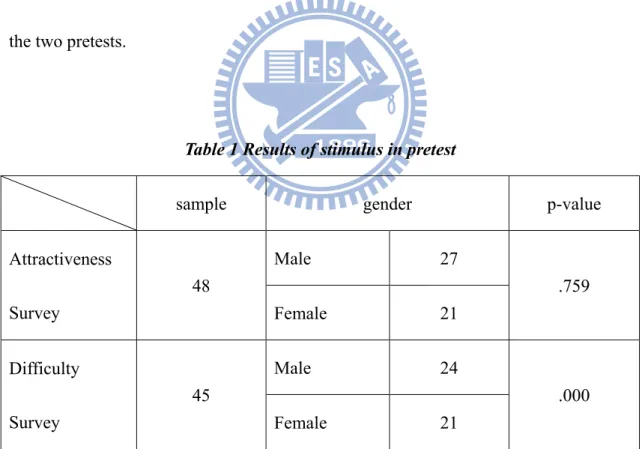
After collecting the remained data, we use SPSS (paired-sample t-test) to find all the pairs that have the same attractiveness. Then, we also use the same method (paired-sample t-test) to analyze difficulty data. To meet above two criteria, we finally decided a pair of photo frame pictures that have the same attractiveness (n.s. p=.759) and were perceived significantly different difficulty (p>.000).
Eventually, two stimulus of upward and downward comparison pictures were be confirmed in this study (see Appendix Ⅰ). Table1 summarized the information about the two pretests.
Table 1 Results of stimulus in pretest
sample gender p-value
Attractiveness Survey 48 Male 27 .759 Female 21 Difficulty Survey 45 Male 24 .000 Female 21
21
3.6 Measurements
In this study, the constructs used were measured by multiple items. All items
were verified on seven-points Likert-type scale (1=strongly disagree; 7=strongly agree).
3.6.1 Measures of Independent Variables - Source of WOM
There are two items used to measure the source of WOM. They were: “Before today, I have known this people for a few days.” and “I don’t know this person who just talked to me.”
3.6.2 Measures of Independent Variables - Social Comparison
The author used two items to measure two levels of social comparison. They were: “For me, it is very hard to make and design this photo frame,” and “This word-of-mouth sender is indeed having a better artistic talent than me.”
3.6.3 Measures of Independent Variables - Self-assessed Skill
In this study, the author believed the subjective craft ability is based on individual’s prior knowledge. To measure the skill level of each participant, the author used a four-item scale of self-assessed ability from Yi - Chaing Huang (2007), and in
22
order to fit our study much precisely, we modified these four item slightly. These items were more suitable for handicraft context. Finally, they were: “Compared to other people, I think my ability about handcrafts is excellent.”,“I am confident of choosing a beautiful handicraft”,“I think I can make a handicraft, which satisfies me” and “As to pick out a beautiful handicraft product, I am very experienced.”
3.6.4 Measures of Dependent Variable - Purchase Intention
In previous research by Dodds, Monroe and Grewal (1991), the purchase intention could be measured in three modified items: They were “The possibility of paying for self-designing a DIY photo frame is high.” ,“If I were going to buy a photo frame, I would consider paying for self-designing a DIY photo frame” ,“My willingness to self-design a DIY photo frame is high.”
3.6.5 Realistic Check Items
In scenario’s reliability, we use two items form Shu -Han Chang (2009). They are ”The story reflects what might happen in the real world” and “I had no difficulty imagining myself in this situation”.
23
Chapter 4:Results
In this chapter, it includes the analysis of data and qualified samples’ background, manipulation check, and the reliability of the results. Through 273 effective samples, we got a reality score of average 5.04 (above 4) by using 7-points Liket scales. Since the participants thought the scenario we designed could happen in a real world, the following analysis and discussions were to be considered meaningful. In this study, some statistic methodologies, such as ANOVA, Independent-Sample T Test were being used to test our hypothesis. Statistic software SPSS that broadly used in marketing as a tool is also being used in this study, edition is 17.00.
4.1 Background of participants
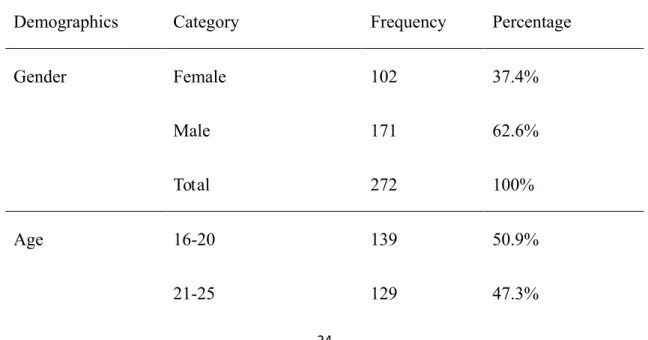
After collecting the second time questionnaires, there are total 273 samples in this study consequently qualified. All the samples are students, 62.6% are male, age between 16 to 20 years old are 50.9%, income from NT.4,001 to NT.6000 are 30.4% and 91.9% samples have educational level of college degree.
24
Table 2 Experience of Participants
Frequency Percentage I am or I have ever studied design
courses.
No 240 87.9%
Yes 32 12.1%
Total 273 100%
Table 3 Experience of Participants
Frequency Percentage I ever have related design
experiences.
No 159 58.2%
Yes 114 41.8%
Total 273 100%
Table 4 Demographics of Participants
Demographics Category Frequency Percentage
Gender Female 102 37.4%
Male 171 62.6%
Total 272 100%
Age 16-20 139 50.9%
25
26-30 4 1.5%
31-35 1 0.3%
Total 273 100.0%
Income Less than 4,000 72 26.4% 4,001-6,000 83 30.4% 6,001-8,000 58 21.2% 8,001-10,000 40 14.7% 10,001-30,000 17 6.2% 30,001-50,000 2 0.7% 50,001-70,000 1 0.4% Total 273 100%
Education degree College 251 91.9% Graduate upward 22 8.1%
Total 273 100.0%
Occupation students 273 100%
26
4.2 Reliability
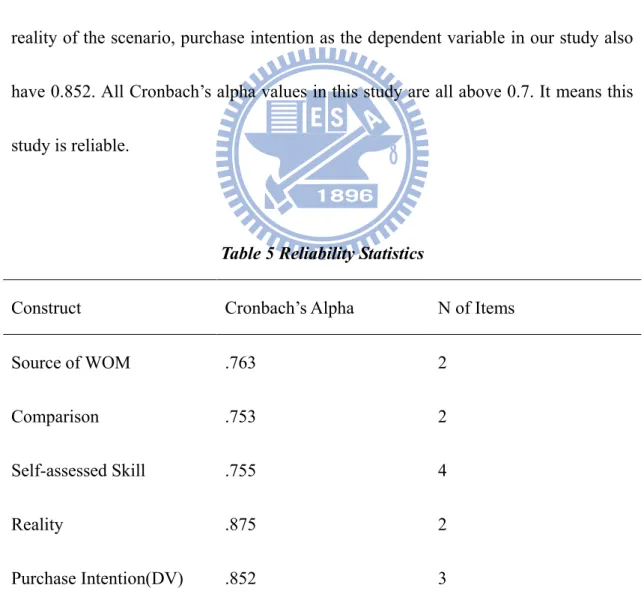
We test the reliability of each factor needed to ensure all items we used for the same factor have internal consistency. Cronbach’s alpha is mostly used to test the reliability, as long as the alpha value is above 0.7, it represents a good reliability of these items in this factor. The reliability of closeness is 0.763, and comparison is 0.753.
Cronbach’s alpha value of items to assess subjects’ skill level is 0.755, and 0.875 for reality of the scenario, purchase intention as the dependent variable in our study also have 0.852. All Cronbach’s alpha values in this study are all above 0.7. It means this study is reliable.
Table 5 Reliability Statistics
Construct Cronbach’s Alpha N of Items Source of WOM .763 2
Comparison .753 2
Self-assessed Skill .755 4
Reality .875 2
27
4.3 Manipulation Check
4.3.1 Manipulation Check of Source of WOM
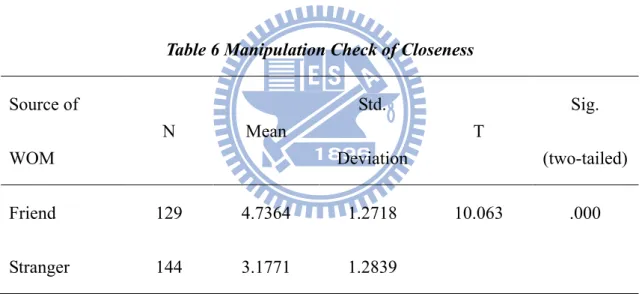
There are 129 and 144 samples in close relationship (friend) and not close relationship respectively. We use Independent-Sample T Test to do the source of WOM manipulation check. From the statistic result presented in Table 6, it shows significantly difference between friend group and stranger group (p<.000). Manipulation check is successful.
Table 6 Manipulation Check of Closeness
Source of WOM N Mean Std. Deviation T Sig. (two-tailed) Friend 129 4.7364 1.2718 10.063 .000 Stranger 144 3.1771 1.2839
4.3.2 Manipulation Check of Comparison
There are 132 samples in upward comparison group and 141 samples in downward comparison group. Also, by Independent-Sample T Test, we again have the result of significant difference between upward and downward comparison (p<.000). Thus, the manipulation is also successful.
28
Table 7 Manipulation Check of Comparison
Comparison N Mean Std. Deviation T Sig. (two-tailed) Upward 132 3.8371 1.1892 -5.145 .000 Downward 141 4.6099 1.2860
4.3.3 Self-assessed skill
The average mean of all participants is 4.52162. We remained the number to five dots to separate participants to two groups more precisely. By doing so, we can avoid discarding too many effective samples. If the average mean of four skill items is higher than 4.51262, we assigned this group as high skill people. Also, average grades lower than 4.51262 will be considered as low skill group. High skill group mean is 5.42, and low skill group mean is 3.76.
29
4.4 Hypothesis Testing
4.4.1 Interaction between Source of WOM and Social Comparison
across Different Skill Level
The author use ANOVA to examine the interaction between source of word of mouth and social comparison across different self-assessed skill. For H2a, it suggested that for low skill customers, when an upward comparison occurred, the closer the WOM sender, the lower the purchase intention is. H2b indicated that, for low skill customers, when downward comparison occurred, the closer the WOM sender, the higher the purchase intention is. As stated in H2c, we predict the purchase intention will higher in close WOM sender than not close WOM sender, regardless of comparison direction. In order to test the effects, a 2 (friend; stranger) x 2 (upward comparison; downward comparison) x 2 (high skill; low skill) three way between-subjects ANOVA was adopted to analyze the interaction.
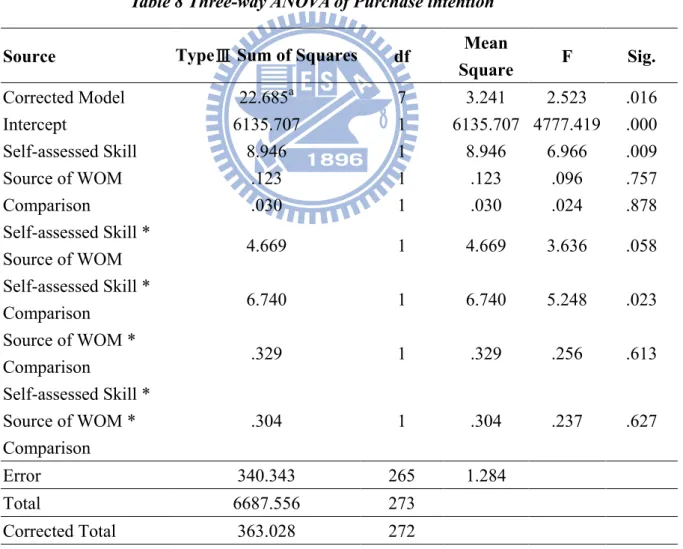
Table 8 shows the results of three-way ANOVA, and we can find there is no significant three-way interaction among source of word of mouth, social comparison and self-assessed skill level (F=.237, p=.627). However, we found a main effects of self-assessed skill (F=6.966, p<.05), so H1 is supported. To test H2a, we found no significant effect between close and not close word of mouth sender in upward comparison for low skill person. H2b were also not supported. To test H2c for high
30
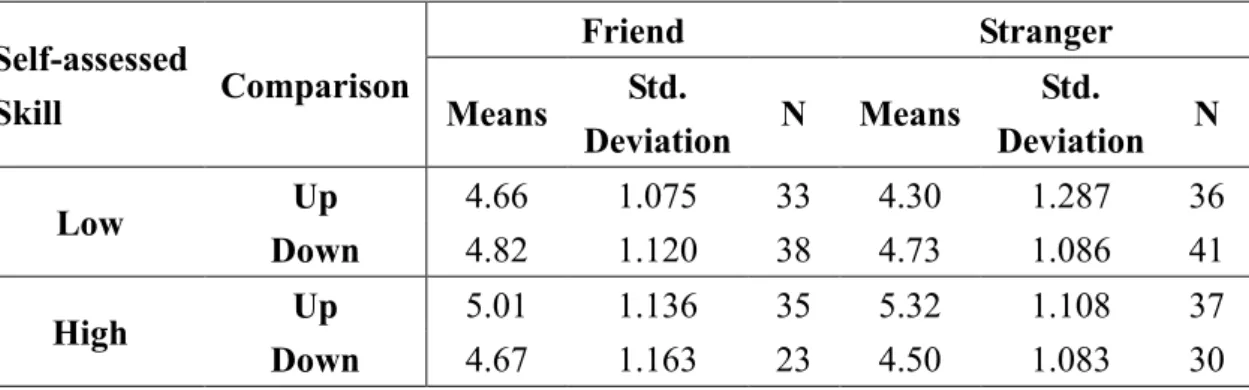
skill people, we use a two way ANOVA and the results showed there is no significant effect. (F=2.29, p=.133). Thus, H2c is not supported. Besides, there are two additionally significant interactions occurred that we didn’t predict in the first place. The two significant interactions will be further discussed in next chapter. And some descriptive statistics were showed in Table 9.
Table 8 Three-way ANOVA of Purchase intention Source TypeⅢ Sum of Squares df Mean
Square F Sig. Corrected Model 22.685a 7 3.241 2.523 .016 Intercept 6135.707 1 6135.707 4777.419 .000 Self-assessed Skill 8.946 1 8.946 6.966 .009 Source of WOM .123 1 .123 .096 .757 Comparison .030 1 .030 .024 .878 Self-assessed Skill * Source of WOM 4.669 1 4.669 3.636 .058 Self-assessed Skill * Comparison 6.740 1 6.740 5.248 .023 Source of WOM * Comparison .329 1 .329 .256 .613 Self-assessed Skill * Source of WOM * Comparison .304 1 .304 .237 .627 Error 340.343 265 1.284 Total 6687.556 273 Corrected Total 363.028 272 a. R Squared = .062 (Adjusted R Squared = .038)
31
Table 9 Descriptive Statistic of Purchase Intention Self-assessed Skill Comparison Friend Stranger Means Std. Deviation N Means Std. Deviation N Low Up 4.66 1.075 33 4.30 1.287 36 Down 4.82 1.120 38 4.73 1.086 41 High Up 5.01 1.136 35 5.32 1.108 37 Down 4.67 1.163 23 4.50 1.083 30
32
Chapter 5:Discussion
5.1 Discussion
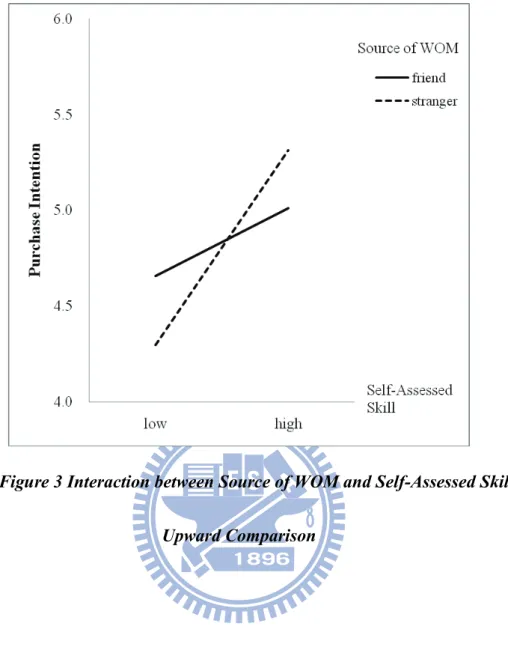
From the statistic results, we found there is no significant three-way interaction among source of word of mouth, social comparison and self-assessed skill level. However, the author uses two way ANOVA to analyze the data in upward comparison condition (shown in Table10), and we find a significant effect between skill and source of WOM. Figure 3 reveals that the purchase intention of low skill people will be higher when the word of mouth information is from a friend than from a stranger in an upward comparison condition, which suggests that low skill people feel less threatened to a friend than to a stranger in an upward comparison. This result is opposite to our original hypothesis, and the author thought this is a chance for customization firms to strive. In contrast to high skill people, low skill people reveal lower purchase intension when WOM is from a high skill friend than from a high skill stranger. In view of this, some important implications for customization firms will be listed in next section. On the other hand, although the purchase intention of high skill people decreases when the word of mouth information is from a friend than from a stranger in an upward comparison, high skill people show higher purchase intention than low skill people in average (Figure 3).
33
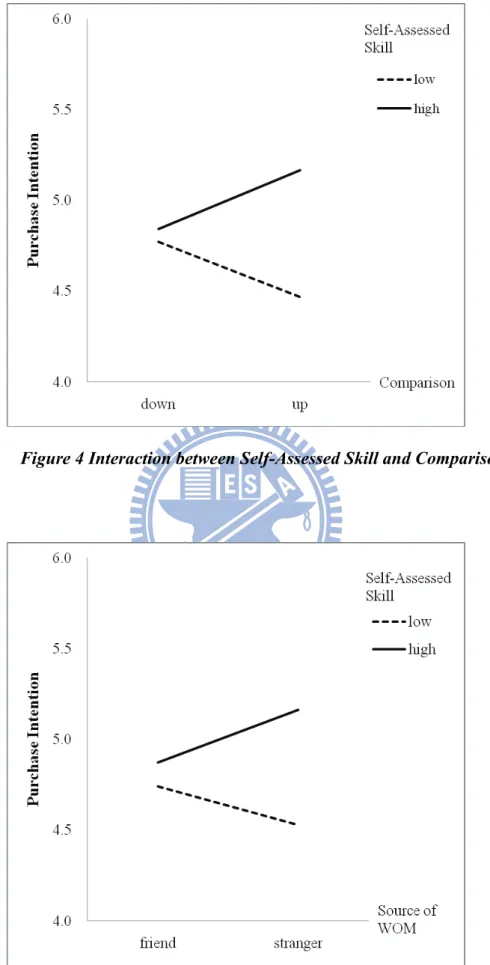
can be discussed as follows. The first interaction is between self-assessed skill and comparison (F= 5.248, p=.023, Figure 4). From the Figure 4, we can see the purchase intention of high skill people is higher in the upward comparison than in the downward comparison. On the other hand, for low skill people, purchase intention is higher in the downward comparison than in the upward comparison. Another significant interaction is between self-assessed skill and source of WOM (F= 3.636, p=.058, Figure 5). Figure 5 reveals that the purchase intention of high skill people is higher when the WOM information is from a stranger than from a friend. For low skill people, the purchase intention is higher when the WOM information is from a friend than from a stranger.
From the two interactions, we can find some interesting results that are different from our views. In the first interaction between self-assessed skill and comparison, it reveals that in an upward comparison, high skill people have more courage or other motives to drive them to have a higher purchase intention than in a downward comparison. It may be due to the fact that upward comparison serves as motivation to design a better product, yet, this speculation is to be examined in future study.. As the low skill people, the result is consistent with our prediction.
The second interaction between self-assessed skill and source of WOM also shows an interesting result. It shows that high skill people have more willingness to
34
try a customization product when they receive a recommendation from a stranger than from a friend. This result is inconsistent with findings in previous literature, and worth for further research. The fact that a stranger’s WOM information has more significant effect than a friend’s WOM to attract high skill people to buy a customization product may also have some important implications to firms. On the contrary, the purchase intention of low skill people will be higher from friend’s recommendation than from a stranger is also consistent with our prediction.
Table 10 Results of Two-way ANOVA for Upward Comparison Condition
Source TypeⅢ Sum of
Squares df Mean Square F Sig. Corrected Model 21.086a 3 7.029 5.261 .002 Intercept 3269.108 1 3269.108 2446.788 .000 Self-Assessed Skill 16.558 1 16.558 12.393 .001 Source of WOM .026 1 .026 .020 .889 Self-Assessed Skill * Source of WOM 3.903 1 3.903 2.921 .090 Error 183.043 137 1.336 Total 3486.778 141 Corrected Total 204.129 140 a. R Squared = .103 (Adjusted R Squared = .084)
35
Figure 3 Interaction between Source of WOM and Self-Assessed Skill in Upward Comparison
36
Figure 4 Interaction between Self-Assessed Skill and Comparison
37
5.2 Implication
Although our original prediction was not supported, we can still see interesting results fortunately. For example, for low skill customers, we think it is hard to push them to buy a self-design consumption experience in prediction, because of lack of intrinsic motivation and threats from close friend’s upward comparison. However, we got totally different conclusion from this prediction. Low skill people will have higher purchase intention when the word of mouth information is from a friend than from a stranger in an upward comparison. This means the word of mouth effects on low skill person is more effective when it is from a high skill friend than from a high skill stranger. This may due to that low skill feel less threatened in an upward comparison with a friend than with a stranger. On the other hand, for high skill person, although they will feel threatened from a friend in upward comparison, their purchase intention is still averagely higher than low skill people. The author thought the inner motivation of high skill people drives themselves to have higher purchase intention when facing an upward comparison.
From above discussions, the author think high skill level is important in the customization market. We believe more experiences can help increasing skill, as long as enough experiences accumulated, low skill person may possibly become high skill person and have higher purchase intention to a customization product. By doing some
38
activities to help accumulate customer’s experience and lift their skill level is important for firms. We suggest customization firms to do some promotions, such as low-price promotion, to attract low-skill customers. In addition, firms can provide some training program and instructions to low-skill customers when they design and make a customization product. Help customers to have high skill must be one of the important things in mass customization market.
5.3 Limitation and Future Research
We can draw some implications from results in this study, but there are still some limitations. First, as we mentioned earlier in chapter three, in order to avoid participants to be affected by our experiment scenario (manipulation of upward comparison or downward comparison), we measured their self-assessed skill points before the formal questionnaire. So, two times qualified samples are much fewer than we imagined. Some people may only have filled out only one time questionnaire, such kind of data became useless. One cell of our study is only 23 samples, so the result may be unstable.
Second, there are much more male sample than female (male=171vs. female=102). This causes problems for equal preference of stimulus picture in male and female people. There is a significant difference between gender (t=2.065, p<.04). However, we also find another significant difference between easy and hard photos
39
(t=-4.484, p<.000). We thought this is because the avoidless noise from scenario they just involved, or the critical curiosity to peek at other people’s picture. Nevertheless, we discovered an interaction between two picture and gender (F=5.838, p<.016), from this two-way ANOVA result, we see the main effect of gender has disappeared (F=2.18, p=.141), but the main effects of two photos’ appealing still remains (F=22.77, P<.000). The problem of photo mentioned above is not showing in our pretest. Another possibility is the sample number of pretest is not enough. It should be taken into account in future research.
The third is the difficulty of designing an appropriate scenario. We tried to design a more interactive scenario for participant to show a recommended behavior, such as animation, but this may cause more distractions, for example, the actor’s gender and or their looks.
The fourth limitation is that people have different levels of involvement to this product. When people received a recommendation of a product, the level of involvement in themselves may affect the intention to buy or consume this product. In future research, involvement can be measured or be controlled to ensure each participant was affected only by manipulation.
Thus we know the result is more consist with SEM model, but we think there still exists other possible outcomes about the effects of word of mouth in mass
40
customization market. Other different and more suitable scenario or manipulations can be reconsidered in the future. The effect of word of mouth to such a mass customization area is interesting.
41
Reference
Argo, J. J., K. White, et al. (2006). Social Comparison Theory and Deception in the Interpersonal Exchange of Consumption Information. Journal of Consumer
Research, 33(1), 99-108.
Arnaud De Bruyn, G. L. L. (2008). A multi-stage model of word-of-mouth influence through viral marketing. International Journal of Research in Marketing, 25(3), 151-163.
Bansal and Voyer (2000). World-of-mouth processes within a services purchase decision context. Journal of Service Research, 3(2), 166-177.
Berry, L. L. (1980). Services marketing is different. Business, 30(May/June), 24-29. Brown, J. J. and P. H. Reingen (1987). Social Ties and Word-of-Mouth Referral
Behavior. Journal of Consumer Research, 14(3), 350-362.
Chang, S. H. (2009). The impact of Customer Participation on Attribution of Service Outcomes: The Moderating Role of Self-Efficacy."
Darren, W. D. and C. P. Moreau (2007). Thinking Inside the Box: Why Consumers Enjoy Constrained Creative Experiences. Journal of Marketing Research, 44(3), 357-369.
Deng, X., J. W. Hutchinson. (2009). Aesthetic self-design: Just do it yourself. Working
Paper.
Dodds, W. B., K. B. Monroe, et al. (1991). Effects of Price, Brand, and Store
Information on Buyers' Product Evaluations. Journal of Marketing Research, 28(3), 307-319.
Engel, J. E., Kegerreis, Robert J., & Blackwell, Roger D. (1969). Word-of-mouth communications by the innovator. Journal of Marketing, 33, 15-19.
Feldman, S. P., & Spencer, Merlin C. (1965). The effect of personal influence in the selection of consumer services. Marketing and Economic Development.
42
Festinger, L. (1954). A theory of social comparison processes. Human relations, 7, 117-140.
Franke, N., M. Schreier, et al. (2010). The "I Designed It Myself" Effect in Mass Customization. Management Science, 56(1), 125-140.
Frenzen, J. and K. Nakamoto (1993). Structure, Cooperation, and the Flow of Market Information. Journal of Consumer Research, 20(3), 360-375.
Gilly, M. C., Graham, John L., Wolfinbarger, Mary Finley, & Yale, Laura J. (1998). A dyadic study of interpersonal information search. Journal of the Academy of
Marketing Science, 26(2), 83-100.
Herr, P. M., F. R. Kardes, et al. (1991). Effects of Word-of-Mouth and
Product-Attribute Information of Persuasion: An Accessibility-Diagnosticity Perspective. Journal of Consumer Research, 17(4), 454-462.
Huang, Y. C. (2007). The Effects of Providing Examples and Customer Participation on Product Satisfaction.
Johan, A. (1967). Role of product-related conversations in the diffusion of a new product. Journal of Marketing Research, (pre-1986) 4(000003), 291-5. Moreau, C. P. and D. W. Dahl (2005). Designing the Solution: The Impact of
Constraints on Consumers' Creativity. Journal of Consumer Research, 32(1), 13-22.
Moreau, C. P. and K. B. Herd (2010). To Each His Own? How Comparisons with Others Influence Consumers' Evaluations of Their Self-Designed Products.
Journal of Consumer Research, 36(5), 806-819.
Mussweiler, T., Shira Gabriel, and Galen V. Bodenhausen (2000). Shifting social identities as a strategy for deflecting threatening social comparisons. Journal
of Personality and Social Psychology, 79(3), 398-409.
Mussweiler, T. a. G. V. B. (2002). I Know You Are, but What Am I? Self-Evaluative Consequences of Judging In-Group and Out-Group Members. Journal of
43
Pelham, B. W. and J. O. Wachsmuth (1995). The waxing and waning of the social self: Assimilation and contrast in social comparison. Journal of Personality and
Social Psychology, 69(5), 825-838.
Richard, B. (2006). Personalization Paradox. Appliance Design, 54(12), 5. Silverman, G. (1997). Harvesting the power of word of mouth. Potemtials in
Marketing, 30(9), 14-16.
Silverman, G. (2001). Secrets of Word-of-Mouth Marketing. AMACOM Books New
York.
Taylor Randall, C. T. K. T. U. (2003). Principle for User Design of Customized Products. Harvard Business Review.
Tesser, A., M. Millar, et al. (1988). Some Affective Consequences of Social
Comparison and Reflection Processes: The Pain and Pleasure of Being Close.
Journal of Personality and Social Psychology, 54(1), 49-61.
Zeithaml, V. A. (1981). How consumer evaluation processes differ between goods and services. Marketing of Services IL, 186-90.
Zeithaml, V. A., Parasuraman, A. and Berry, L.L. (1985). Problems and strategies in services marketing. Journal of Marketing, 49(2), 33-46.
44
Appendix Ⅰ
Figure 6 Upward Comparison Stimulus
45
Appendix Ⅱ
Self-Assessed Skill Chinese Questionnaire
您好: 非常感謝您撥冗回答以下問題,您的回答對我們的研究將有極大的幫助。 本研究目的在於了解消費者對手工商品的態度,本問卷約三分鐘可以完成,所有資料 僅供學術研究之用,絕不對外公開,請您安心作答。衷心感謝您的合作! 敬祝 健康快樂、萬事如意 國立交通大學管理科學研究所 指導教授:張家齊 博士 學生: 陳依婷 敬上
第一部分
- 請您評估「本身實際情況」,回答下列問題。 非 常 不 同 意 1 不 同 意 2 有 點 不 同 意 3 沒 意 見 4 有 點 同 意 5 同 意 6 非 常 同 意 7 1. 與一般人比起來,我的手是較靈巧的 2. 我對於選出一個好看的手工藝品是有信心的 3. 我覺得我可以製做出令自己滿意的手工藝品 4. 對於選出一個好看的手工藝品,我是有經驗的 5. 請問您曾經購買可以親自設計並動手製作的手工藝品嗎 是 否 6. 續上題,若您回答「是」,請問平均一年內,您做手工藝品的頻 率約為46 以下每題敘述,請勾選出最能代表您意見的方格,以表示您對各個題項的同意程 度,其中1 表 示非常不同意,7 表示非常同意。
第二部分
— 請您提供您的「個人基本資料」 1. 請問您的性別 男 女 2. 請問您的年齡 15 歲以下 16~20 歲 21~25 歲 26~30 歲 31~35 歲 36~40 歲 41~45 歲 46~50 歲 51 歲以上 3. 請問您的最高教育程度 國中或初中 高中、高職 專科 大學或學院 研究所以上 4. 請問您每個月的可支配所得 4,000 以下 4,001~6,000 6,001~8,000 8,001-10,000 10,001~30,000 30,001~50,000 50,001-70,000 70,001-90,000 90,001 以上 5. 請問您目前的職業 軍、公、教 資訊科技 工商、貿易 農林漁牧業 服 務業 家管 學生 設計相關 其他 6. 請問您就讀或畢業的學院為 管理學院 理學院 人文學院 工學院 客家學院 電機學院 資訊 學院 生物科技學院 0 次 1~3 次 4~6 次 6 次以上 7. 請問您過去一年內,曾經購買的手工商品(他人做的)個數有多少 0 個 1~3 個 4~6 個 6~10 個 10 個以上 8. 續上題,這些手工商品又可分成幾個種類 0 種 1~3 種 4~6 種 6 種以上 9. 若您過去一年內曾經購買任何手工設計商品(他人做的),請問金額大約多少,購買的商品為何? (請舉例說明) ___________________________________________________________________________________ __47 其他_______________ 7. 請問您曾經就讀或正在就讀 是 否 設計相關科系嗎 8. 請問您有過任何設計經驗嗎 是 否
48
Appendix Ⅲ
Main Chinese Questionnaire
您好: 非常感謝您撥冗回答以下問題,您的回答對我們的研究將有極大的幫助。 本研究目的在於了解客消費者對於客製化商品的看法,我們會請您先看一小段情境故 事動畫,再請您針對故事情境回答問題。本問卷約三分鐘可以完成 敬祝 健康快樂、萬事如意 ,所有資料僅供學 術研究之用,絕不對外公開,請您安心作答。衷心感謝您的合作! 國立交通大學管理科學研究所 指導教授:張家齊 博士 學生: 陳依婷 敬上
第一部分、
請仔細觀看以下情境內容,
並想像自己就是故
事中的主角
。
他的作品,請參考下一頁所附。
某一個天氣晴朗的週末,你來到了一個風景遊憩區。 逛著逛著,你剛好停在一間蠻有特色的手工相框店前,而這時一位許久不見的朋 友 A 剛從裡面走出來,他主動地跟你說了一些話,對話內容如下: 朋友 A:嗨,好久不見,這家店還蠻好玩的耶! 你:好久不見呀。 朋友 A:這家手工相框店呀,提供很多種類的材料可以自由選擇,然後自己設計、 製作,我覺得還蠻有趣的。你看,這是我剛剛做的作品,推薦你參考看 看囉!49 ※現在請根據剛才您所看的「情境內容」,勾選出最能代表您意見的方格,以表 示您對各個題項的同意程度,其中1 表示非常不同意,7 表示非常同意。
第二部分、
請您提供您的「個人基本資料」 1. 請問您的性別 男 女 2. 請問您的年齡 15 歲以下 16~20 歲 21~25 歲 26~30 歲 31~35 歲 36~40 歲 41~45 歲 46~50 歲 51 歲以上 3. 請問您的最高教育程度 國中或初中 高中、高職 專科 大學或學院 研究所以上 非 常 不 同 意 1 不 同 意 2 有 點 不 同 意 3 沒 意 見 4 有 點 同 意 5 同 意 6 非 常 同 意 7 10. 我會去這家店自己設計並自己製作一個手工相框的可能性是 高的 11. 如果我正要購買一個相框,我會考慮去這家店自己設計並自 己製作一個手工相框 12. 我願意去這家店自己設計並自己製作一個手工相框 13. 在今天之前,我已經認識這位推薦人一段時間了 14. 我不認識這一位跟我說話的人 15. 對我來說,要自己製做出像對方那樣的手工相框是困難的 16. 這位推薦人有比我優秀的美術手工天份 17. 故事中類似的情況是有可能發生的 18. 發生描述的故事是可能在真實世界中發生的50 4. 請問您目前的職業 軍、公、教 資訊科技 工商、貿易 農林漁牧業 服 務業 家管 學生 設計相關 其他 5. 請問您就讀或畢業的學院為 管理學院 理學院 人文學院 工學院 客家學院 電機學院 資訊學 院 生物科技學院 其他_______________