行政院國家科學委員會專題研究計畫 成果報告
專業英語軟體融入任務型學習及其與學習策略關聯之探討:
國際參展個案研究
研究成果報告(精簡版)
計 畫 類 別 : 個別型 計 畫 編 號 : NSC 100-2410-H-151-024- 執 行 期 間 : 100 年 08 月 01 日至 101 年 07 月 31 日 執 行 單 位 : 國立高雄應用科技大學應用外語系 計 畫 主 持 人 : 蔡叔翹 計畫參與人員: 大專生-兼任助理人員:陳品瑄 大專生-兼任助理人員:林宜慧 公 開 資 訊 : 本計畫可公開查詢中 華 民 國 101 年 10 月 20 日
中 文 摘 要 : 本計畫以先前所研發的國際參展教育軟體結合任務型學習 (Task-based learning, TBL)方式融入應用外語系專業選修 課程的教學。學生分為實驗組(教育軟體融入教學)與控制組 (傳統面對面教學)兩部份實施教學,任務目標語言以英語為 主,執行任務所應具備的英語技能包括聽力、閱讀與寫作, 任務成效的評量是以學生在各項任務之前後測所達成的程度 作為依據,進行分析、統計並比較。此外,並透過問卷調查 與統計分析,探討技職院校學生在該專業英語學習過程中的 學習態度與策略,為國內發展階段中的專業英語教學,提供 得以持續研究的方向與應用。研究結果顯示,在情境解決問 題能力上的表現,實驗組同學比控制組同學相同或甚至更 好,同學在後測的任務執行及語文技能上都有顯著的進步, 而且對於教育軟體融入教學都感到滿意。 中文關鍵詞: 專業英語、教育軟體、數位學習、國際參展
英 文 摘 要 : This study reports on integrating courseware for participating in international trade fairs into ESP instruction at a technical university in Taiwan. An Information and Communication Technology (ICT) approach combining courseware integration with Task Based Learning (TBL), was adopted. Evaluation of implementing this courseware-integrated ESP
instruction was based on pre- and post-tests in three tasks and student responses to questionnaires
concerning satisfaction and attitude. Interviews were also conducted with recent graduates of this
courseware-integrated program now working in business fields. Meanwhile, teacher-centered, face-to-face instruction on the same topic was conducted with a control group. The courseware not only provided authentic materials for learning the target ESP in situational settings, but also offered learning
activities with corresponding instant self-evaluation so that students were engaged in cognitive processes based on individual need. Students enrolled in the courseware-integrated instruction made as much, and at times, even better, progress as those electing the teacher-centered instruction while completing the tasks of problem-solving and higher-order thinking. Their self-learning effectiveness in both task performance and linguistic skills was significantly
improved and they reported satisfaction with the integrated instruction. Thus, courseware-integrated TBL instruction may offer a potential solution to problems in the development of ESP courses.
英文關鍵詞: English for specific purposes, courseware,
1
□期中進度報告
行政院國家科學委員會補助專題研究計畫
█期末報告
專業英語軟體融入任務型學習及其與學習策略關聯之探討:國際參
展個案研究
計畫類別:█個別型計畫 □整合型計畫
計畫編號:NSC 100-2410-H-151-024-
執行期間:100 年 08 月 01 日至 101 年 07 月 31 日
執行機構及系所:國立高雄應用科技大學應用外語系
計畫主持人:蔡叔翹
共同主持人:
計畫參與人員:Dr. Boyd Davis,
Professor of Applied Linguistics/ English
University of North Carolina-Charlotte (USA)
本計畫除繳交成果報告外,另含下列出國報告,共 0 份:
□移地研究心得報告
□出席國際學術會議心得報告
□國際合作研究計畫國外研究報告
處理方式:除列管計畫及下列情形者外,得立即公開查詢
□涉及專利或其他智慧財產權,□一年□二年後可公開查詢
中 華 民 國 101 年 10 月 05 日
中、英文摘要及關鍵詞 (keywords)。 本計畫以先前所研發的國際參展教育軟體結合任務型學習(Task-based learning, TBL)方式融入應 用外語系專業選修課程的教學。學生分為實驗組(教育軟體融入教學)與控制組(傳統面對面教學)兩部 份實施教學,任務目標語言以英語為主,執行任務所應具備的英語技能包括聽力、閱讀與寫作,任務 成效的評量是以學生在各項任務之前後測所達成的程度作為依據,進行分析、統計並比較。此外,並 透過問卷調查與統計分析,探討技職院校學生在該專業英語學習過程中的學習態度與策略,為國內發 展階段中的專業英語教學,提供得以持續研究的方向與應用。研究結果顯示,在情境解決問題能力上 的表現,實驗組同學比控制組同學相同或甚至更好,同學在後測的任務執行及語文技能上都有顯著的 進步,而且對於教育軟體融入教學都感到滿意。
This study reports on integrating courseware for participating in international trade fairs into ESP instruction at a technical university in Taiwan. An Information and Communication Technology (ICT) approach combining courseware integration with Task Based Learning (TBL), was adopted. Evaluation of implementing this courseware-integrated ESP instruction was based on pre- and post-tests in three tasks and student responses to questionnaires concerning satisfaction and attitude. Interviews were also conducted with recent graduates of this courseware-integrated program now working in business fields. Meanwhile, teacher-centered, face-to-face instruction on the same topic was conducted with a control group. The courseware not only provided authentic materials for learning the target ESP in situational settings, but also offered learning activities with corresponding instant self-evaluation so that students were engaged in cognitive processes based on individual need. Students enrolled in the courseware-integrated instruction made as much, and at times, even better, progress as those electing the teacher-centered instruction while completing the tasks of problem-solving and higher-order thinking. Their self-learning effectiveness in both task performance and linguistic skills was significantly improved and they reported satisfaction with the courseware-integrated instruction. Thus, courseware-integrated TBL instruction may offer a potential solution to problems in the development of ESP courses.
關鍵詞: 專業英語、教育軟體、數位學習、國際參展
報告內容:包括前言、研究目的、文獻探討、研究方法、結果與討論(含結論與建議)等。
I. Introduction
International trade fairs are one of the major activities in the MICE (Meetings, Incentive travel, Conferences and Exhibitions) industry that has become one of the fastest growing segments of the service industry within the tourism industry, bringing in millions of dollars in revenue for participating countries. A few years ago, the Ministry of Economic Affairs in Taiwan began a major MICE service industry development project in order to promote hardware and software construction, speed up efforts to train and improve
manpower quality, and to provide incentives to attract international MICE events to Taiwan. To meet the global and industrial development within the MICE industry, several related programs, departments and colleges in higher technical education have been established in Taiwan to cultivate high quality MICE manpower by increasing English communication skills and related professional knowledge.
Taiwan’s Ministry of Education goals for foreign language education in technical and vocational education programs, stress program development. They specifically emphasize foreign language proficiency and advanced professional knowledge necessary for success in the job market. This emphasis has caused ESP instruction to be increasingly emphasized at technical universities in Taiwan in order to reduce the mismatch between skills acquired in higher educational institutions and the skill sets needed in industry. ESP instruction is designed to meet the needs of those wanting to learn English for use in their specific fields, such as business, science, technology, medicine, leisure, and academic studies. However, curriculum development and qualified staffing for the development of ESP courses in Taiwan are lacking, as illustrated in preliminary work by Lai (2005) and echoed in Tsou (2009). When the current research began, there were no practical courses in technical college programs which allowed students to apply integrative English skills, and to transfer them and learn how to participate in, prepare for and budget for activities such as international trade fairs. one of the basic abilities required for secretaries or assistants working in trading companies.
With the rapid development of ICT, computer-assisted language learning (CALL) can provide numerous advantages in the areas of contextual (Samsudin & Nesi, 2006; Tsai, 2009), self-paced, autonomous and individualized learning (Figura & Jarvis, 2007; Fischer, 2007), motivation (Chang, 2005; Papastergiou, 2009), feedback and evaluation (Dickinson, Eom, Kang, Lee & Sachs, 2008; Heift & Rimrott, 2008). Among
innovative ICT approaches, the integration of multimedia courseware into instruction is considered an
effective tool for learning (Brett, 2000; Roblyer, 2003; Tsai, 2009).Although courseware development and its application in classroom instruction is becoming more greatly emphasized, both its design and use have been more focused on courses related to sciences and technology (Azemi, 1996; Jiménez & Casado, 2004; Li, 2004; Shamsudin & Nesi, 2006). This trend is possibly due to the technology-related abilities of instructors in these fields, who have competent skills and knowledge of multimedia software and programming, and are able to convert lecture notes into interactive multimedia courseware for students. The effectiveness of these
instructional tools has not been fully studied with regard to ESP courseware development in Taiwan and elsewhere, an interdisciplinary task that requires coordination and integration of subject knowledge, language learning, and multimedia and information technologies.
II. Purposes of the study
The aim of this project was firstly, to integrate ESP courseware (Tsai & Davis, 2008) that simulates real-life situations such as participating in international trade fairs into TBL instruction, in which computers
play a central role as the means of information delivery to help students construct and promote content knowledge and problem solving skills while conducting situational tasks. Secondly, the project probed the effectiveness of the courseware integration in enhancing students’ content knowledge and linguistic fluency for participating in international trade fairs. In addition, the project investigated student satisfaction with and attitudes toward TBL instruction with courseware integration. During this study a teacher-centered,
face-to-face (F2F) style of instruction on the same topic was conducted with a control group for a further comparison with the courseware-enriched TBL format.
III. Methodology
A courseware-integrated ICT approach combined with a TBL approach (Ellis, 2006; Nunan, 2006; Skehan, 1998) was adopted. In general, TBL includes three principal phases: Pre-task, During-task, Post-task (Ellis, 2006). The pre-tests conducted in the Pre-task phase not only allowed students to preview the task objective, but to think ahead about how to perform the task and plan the language and content knowledge they would need. In addition, based on the feedback of these pre-tests, students understood better what would be expected of them while performing the tasks. In the During-task phase, the students had direct and
autonomous interaction with the ESP courseware according to the schedule arranged by the teacher, as
researcher. The teacher mainly played the role of an observer or counselor in order to understand the student’s ability to handle autonomous learning and to complete the post-tests. During the Post-task phase, the teacher provided written and oral feedback about language forms that students were using, problems with language and organization, and progress made.
At the end of the instruction phase, two questionnaires were administered. One focused on satisfaction with this courseware-integrated TBL instruction, and the second on comparing attitudes toward
courseware-integrated and F2F instructions. Finally, interviews were conducted with recent graduates of the courseware-integrated ESP course who had gone on to work in business fields, to understand the practical application and usefulness provided by the courseware-integrated instruction. The methodology of this study was divided into two phases, Design and development of the ESP courseware, and Courseware integration into instruction, and is discussed in that order.
II.1 Design and development of the ESP courseware
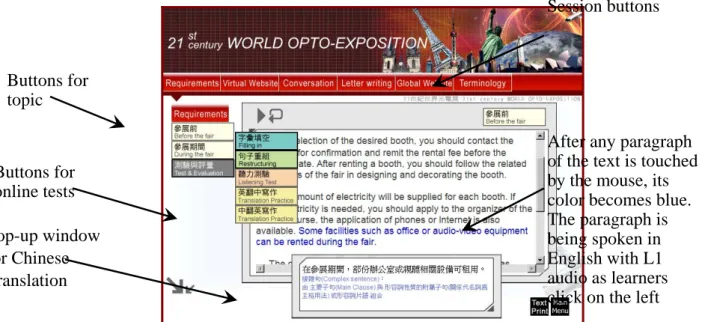
The integrated ESP courseware was developed in a previous study (Tsai & Davis, 2008), mainly based on Mayer’s multimedia learning cognitive theory. It includes subject texts with English as L1 audio and Chinese translation support, narration, language skills practice, online tests with instant self-checking, and a virtual trade fair website. According to the presentation sequence, the courseware consists of six sections: Requirements for participating in a trade fair; Virtual website of a trade fair; Conversation practice; Letter writing; Hyper-linking; and Terminology. These are hyperlinked on the main page of the courseware, as shown in Fig. 1. A “Text Print” on the bottom right of the screen allows teachers or students to print all courseware text to facilitate teaching or learning. The structure is explained as follows:
1. Requirements for participating in a trade fair: The tasks and responsibilities required before and during a trade fair are explained. A listing of six tasks for pre-fair activity is provided: registration; booth rental including selection, design and decoration of the booth and related facilities; preparation of products for display; flight and accommodation reservations for staff; and promotion. During the trade fair, a set of three responsibilities stresses the importance of maintaining discussion and interaction, including the examination of daily results; collection of market intelligence and information; and evaluation of staff
performance.
2. Virtual website of a trade fair: The virtual website includes all the important information usually provided on official trade fair websites such as registration, information for visitors, application, change of
venue/date, booth rental, facilities rental, setup/dismantling, security/liability, operation, breach of contract, accommodation. This design brings students into a simulated situation so that their learning can be tied to authentic activity and context, and cross-cultural issues of dealing with persons from other countries as naturally as possible. In addition, an online task-based evaluation system provides three real-life and problem-solving activities: (a) to learn how to research and present important information or facts for participating in a trade fair; (b) to learn how to prepare for a trade fair; (c) to learn how to budget for attending a trade fair.
3. Conversation practice: The conversation topics most frequently encountered by exhibitors and visitors to trade fairs were chosen for students to practice.
4. Letter writing: There are eight types of business letters that are often used for the preparation of
international trade fairs, including letters of registration, flight and hotel accommodation, and invitation. 5. Hyper-linking: Several official trade fairs websites, including Photonics, Computers, Telecommunication,
Electronics, Toys, Machines, and Gifts, are hyperlinked. The links to the Internet can offer another channel for learners to explore authentic materials from the Internet in real-life contexts.
6. Terminology: Since increasing vocabulary comprehension is seen as the most effective reading strategy, especially in ESP courses, relevant terminology is given in both English and Chinese, and is listed alphabetically in English.
Figure 1: Bilingual button design for selecting sections with their learning topics and units, shown on the main page of the courseware
The operational mode of the courseware means that when any section button is clicked, the buttons for the topics in the selected section will appear on the left side. When any topic button is clicked, its content will be shown in the center on a screen with a gray frame, which is the learning window where all the activities will be conducted. After any paragraph of the English text in the learning window is clicked on, the color of the paragraph becomes blue, shown in Fig. 1. The paragraph is then spoken in English with L1 audio as learners click on the left button of the mouse. This allows the practice of English reading skills and helps to improve the learners’ pronunciation and listening ability. Subtitled-multimedia courseware with L1 audio is
Session buttons Buttons for topic Buttons for online tests Pop-up window for Chinese Translation
After any paragraph of the text is touched by the mouse, its color becomes blue. The paragraph is being spoken in English with L1 audio as learners click on the left
similar to subtitled video, which positively enhances performance in listening and speaking and promotes more efficient comprehension for second language (L2) learners (Chang, Lei & Tseng, 2011; Herron, Morris, Secules & Curtis, 1995; Rubin, 1994). This multimedia message providing written words along with spoken language helps to construct verbal and visual cognitive representations and integrate them, which corresponds to Mayer’s modality and multimedia principles (Mayer, 2001; 2005). After clicking the right button of the mouse, the Chinese translation and grammar explanation of the paragraph will be simultaneously given in a pop-up window shown near the paragraph. This design corresponds to Meyer’s temporal and spatial contiguity principles by means of which better transfer occurs. The bilingual support will allow learners to improve comprehension, as well as practice English translation and writing skills.
The online evaluation system, including the five language tests of various degrees of difficulty, is
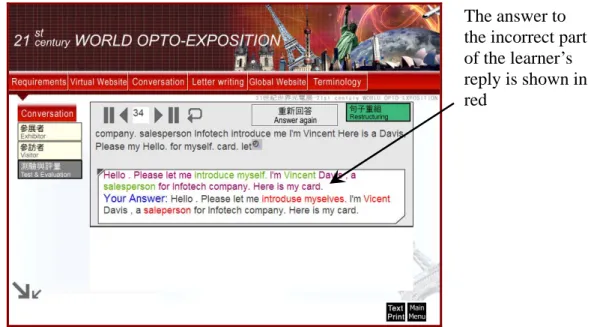
provided for students to practice applying integrative English skills: listening; speaking; reading; writing; and translation, as shown on the left of the learning window in Fig. 1. When any test is selected, the practice questions are chosen randomly by the program. In addition, all these learning activities are combined with an instant self-checking system so that students can monitor their progress and evaluate themselves immediately. If they do not know how to answer a question, the L1 audio of the reference answer can be played by clicking the button with a bell shown at the end of the question, which allows them to find the right answer. This learner-centered cue design should reduce cognitive load and learning difficulty and help learners find the answer by themselves, which meets various student learning needs when conducting assessment and evaluation activities. An example of the sentence re-structuring test is shown in Fig. 2.
Students access the bilingual website for a simulated trade fair shown in Fig 3, called “21st century World Opto-Exposition”, by clicking the button, “Virtual Website”. Each of the buttons shown on the left of the web page is related to different required information or activities completed before the fair and during it. After any button is clicked, its corresponding learning content combined with L1 audio, translation and explanations is presented, as shown in Fig. 3.
Figure 2: Self-checking system for the sentence re-structuring test
The answer to the incorrect part of the learner’s reply is shown in red
Figure 3: Virtual trade fair website: buttons for selecting required information and practicing online evaluation shown on the left of the screen
III.2 Courseware integration into TBL instruction
The courseware-integrated TBL instruction was based on the cognitive apprenticeship model which suggests that skills be acquired and constructed through authentic contexts, activities, and culture (Brown, Collins & Duguid, 1989; Kevin, 1999). Cognitive apprenticeship is a model of learning based on situated cognition theory. It provides practical steps and learning supports to enable students to acquire, develop and use cognitive tools in an authentic domain (Hung & Der-Thanq, 2001).
The courseware was integrated as a module incorporated in the first seven weeks of an elective course, “Practice for preparing for trade fairs”, for junior EFL students, offered at a technical university in Southern Taiwan, for two hours per week, and conducted in the multimedia laboratory. All students were individually assigned to computers in order to access and study subject content and language practices through the Intranet of the laboratory, according to the curriculum schedule controlled by the teacher. A teacher-centered F2F instruction course was conducted the following academic year for a further comparison with the
courseware-integrated instruction using ESP courseware in this study. The curriculum design of the course included:
1. Target Audience: Thirty-four (34) junior EFL students took the course which included the integration of the ESP courseware (ICT group). They had studied English for eight years at least: six years in junior and senior high school, and two years in college. Since the number of students was limited and “Practice for preparing for trade fairs” was an annual course, a teacher-centered F2F instruction course was
implemented as a control group (F2F group) the following academic year. Fifty-three (53) junior EFL students took the control course. They completed the same Test of English for International
Communication (TOEIC)-like test, and the same pre- and post-tests in the different task phases for a reliable comparison with the performance of students enrolled in the courseware-integrated ICT
instruction. Since not all the students in either group attended every class during the seven-week period, the number of students who completed the pre- and post-tests for each task varied.
2. Learning content set-up: The ESP courseware developed in the first phase was installed in the server of the laboratory so that students were able to easily access its content through their computers.
3. Instruction: In the During-task phase, the ESP courseware, as a silent partner, not only played the role of a medium and facilitator for delivering and transferring knowledge, but also as an language teacher or a Buttons for selecting
required information
Buttons for online practices
peer through which students actively explored and interacted with content knowledge and practiced relevant linguistic fluency. Since the aim of this work was to study student self-learning effectiveness in the situation integrating the courseware, the teacher played the role of supervising and observing
students’ behaviors and learning, controlling the schedule, and encouraging student interaction with the courseware. For the F2F instruction, the same learning content and the curricular schedule were used and the teacher led students to read the target content, explained the sentence structures and provided Chinese translations.
4. Task and Assessment: In addition to an online simulated TOEIC test conducted in the beginning of the course to find the baseline for students’ English proficiency, three tasks were assigned and a variety of pre- and post-tests related to language learning and problem-solving were conducted in the Pre- and Post-task phases of the tasks.
․Task 1: Essay writing for knowledge about trade fairs
In the Pre- and Post-task phases, students were asked to write an essay stating the importance or advantages of participating in an international trade fair for a Taiwanese trading company. The aim of this task was to understand whether or not students’ knowledge about trade fairs was raised by the course. The required skills for this task included reading, comprehension, and writing.
․Task 2: Budgeting for a trade fair
Students were asked to play the role of a secretary to perform the practical and real-life task of budgeting for a trade fair based on important information, data or facts provided by the virtual website embedded in the courseware. This situated task was designed to bring students into authentic activities, contexts, and cultures as naturally as possible. The required skills for this task were reading comprehension, analysis, problem-solving, and calculation.
․Task 3: Developing a plan to prepare for a trade fair
In order to understand the requirements and work process of preparing for a trade fair, the third task required students to play the role of manager in writing an English memorandum in the
Post-task phase to his/her assistant with instructions for developing a plan for attending a trade fair. This task supported the development of flexible, integrative and cognitive strategies to analyze unanticipated or ill-structured information or situations in order to produce meaningful solutions. In the memorandum, students were expected to integrate eleven (11) instructional items mentioned in the different sections of the courseware. The required skills for this task included reading, comprehension, writing, higher-order thinking, analysis and integration.
5. Questionnaire survey: Added evaluation of the courseware integration was obtained via two
questionnaires dealing with students’ satisfaction and attitude at the end of the instruction period. Each of the two questionnaires used a 5-point Likert scale ranging from 1 ("strongly disagree") to 5 ("strongly agree"). All returned questionnaires were analyzed using Statistical Package for the Social Sciences (SPSS) software. Finally, interviews were conducted with recently graduated students, who had experienced this courseware-integrated TBL instruction and were currently working in business fields. Details of the questionnaires are explained below:
․Questionnaire about student satisfaction with the courseware-integrated TBL instruction:
The questionnaire about student satisfaction (QF) included fifteen (15) questions which targeted the following concerns: QF1, improvement of cognition and skills for the target field; QF2-QF7, students’ perception of improvement in English skills including vocabulary, listening, speaking, reading, writing and translation; QF8, the relevance of the English content; and QF9, the layout of
the courseware. QF10 and QF11 focused on the instant online evaluation system and the virtual website with online practices. QF12 and QF13 focused on the bilingual multimedia design and navigation of the courseware; QF14 was related to student satisfaction with direct self-study with courseware; and QF15 elicited student opinions on whether they would recommend the
courseware (Tsai, 2011a; 2011b). ․Questionnaire about student attitude:
In order to further understand students’ attitude toward courseware-integrated instruction compared with the traditional F2F instruction that they had experienced during previous study, the
questionnaire about attitude (QA) included eight (8) positively-worded questions and three (3) negatively-worded questions regarding students’ self-studying under the courseware-integrated instruction, and was administered at the end of the instruction. The eight (8) positively-worded questions (QA1, QA3, QA4, QA6, QA7, QA8, QA9, QA11) related to improved concentration in learning, diverse learning practices, autonomous and flexible learning resources, students’
accommodation and willingness, effectiveness of the instant online evaluation system, an easy and favorable English environment, and supports for practicing language and learning subject content. The three (3) negatively-worded questions (QA2, QA5, QA10) related to boring, ineffective, and difficult learning.
․Interview with recently graduated students:
Finally, interviews with graduated students who took this ESP course with the courseware integration and are currently working in related fields, were conducted to get on-job qualitative feedback about the practical application and the learning usefulness of this courseware-integrated TBL instruction in order to triangulate the results of the quantitative analysis.
The pre- and post-tests of the tasks were designed as quizzes with scores included in the student’s final grade. This allowed for a higher instrumental motivation that is generally characterized by the desire to obtain something practical or concrete from the study of a second language (Hudson, 2000). In addition, all student essay texts in Task 1 were collected, analyzed and measured by the Computerized Propositional Idea Density Rater (CPIDR), a computer program to determine the propositional idea density (P-density) of an English text on the basis of part-of-speech tags (Brown, Snodgrass, Kemper, Hermen & Covington, 2008). P-density can be approximated according to the number of verbs, adjectives, adverbs, prepositions and conjunctions, divided by the total number of words in the text. Some experiments have also related idea density to readability, memory, and the quality of students’ writing (Kintsch, 1998; Takao, Prothero & Kelly, 2002; Tsai, 2010).
IV. Results
IV.1 Courseware integration into TBL instruction
Before the integration the students completed an online simulated TOEIC test, including
question-response, short talk and reading comprehension, to provide a baseline for their English proficiency. Students’ means of the simulated TOEIC test for the ICT and F2F groups were, respectively, 666.8 and 647.9. After an independent samples t-test, no significant difference was found to exist in the simulated TOEIC test between students in the two groups, indicating that their English proficiency determined by the simulated TOEIC test was equivalent. The results are explained below:
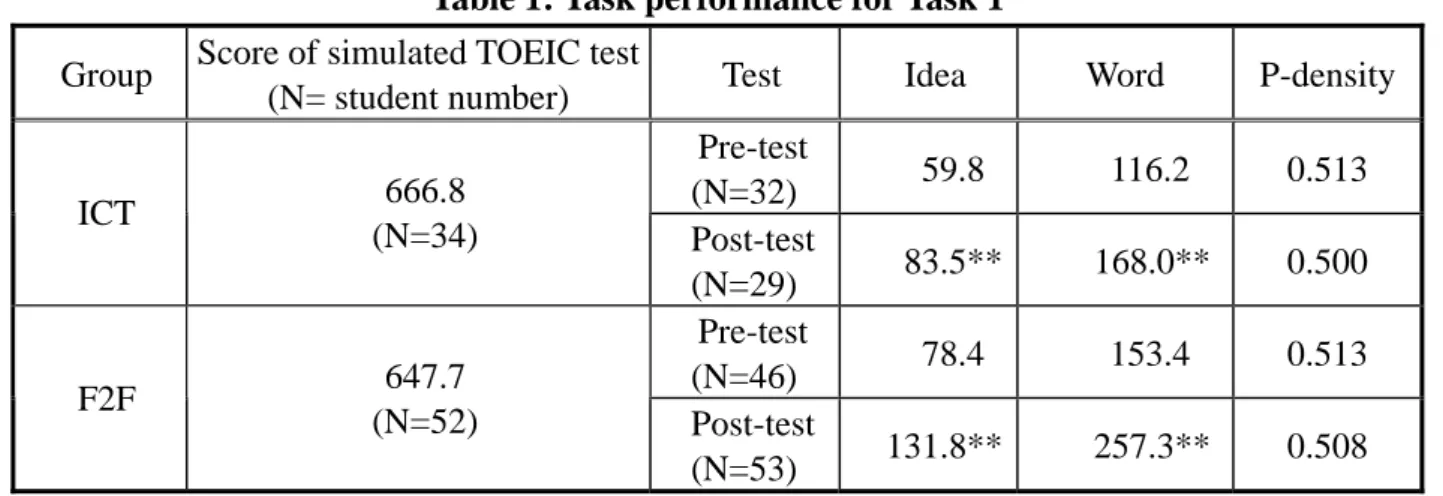
The CPIDR analysis indicated that for both groups the mean of idea count and word count in the post-test were higher than those in the pre-writing, but the mean of P-density in the post-writing was not far from those in the pre-test, as shown in Table 1. A further analysis of the above parameters through the paired samples t-test for the both groups showed there was a significant difference in idea count and word count between the pre- and post-writing. As for P-density, there was no significant difference found between the pre- and post-writing. When compared by groups, an analysis through the independent samples t-test indicated that F2F students expressed significantly more ideas and words than ICT students did in the pre- and post-writing of the Task. However, there was no significant difference existing in P-density between the two groups. In addition, a Pearson’s correlation analysis indicated that the idea count, word count and P-density in the pre- and post-writing by students in both groups had no significant positive correlation with their TOEIC English proficiency.
Table 1: Task performance for Task 1
Group Score of simulated TOEIC test
(N= student number) Test Idea Word P-density
Pre-test (N=32) 59.8 116.2 0.513 ICT 666.8 (N=34) Post-test (N=29) 83.5** 168.0** 0.500 Pre-test (N=46) 78.4 153.4 0.513 F2F 647.7 (N=52) Post-test (N=53) 131.8** 257.3** 0.508 *: p<.05; **: p<.01 in the pair samples t-test between the pre- and post-tests
Table 2: Task performance for Task 2
ICT group (N=34) F2F group (N=46) Mean frequency of giving right answers Group (N=student number)
Questions Pre-test Post-test Pre-test Post-test
Mean of the task achievement 22.4% 47.1%** 17.4% 39.0%**
Registration fee 0.0% 35.3%** 0.0% 17.4%**
Booth rental 5.9% 8.8% 2.1% 6.5%
Facility rental 67.6% 85.3% 72.3% 95.7%**
Daily expense 11.8% 29.4% 12.8% 37.0%**
Accommodation fee 26.5% 76.5%** 0.0% 37.0%**
*: p<.05; **: p<.01 in the pair samples t-test between the pre- and post-tests
2. Task 2: Budgeting for a trade fair
In order to get a reliable comparison of students’ performance, the pre- and post-tests of the task were similar, including five items of differing difficulty that were related to budget estimates for registration, booth rental, facility rental, daily expense and accommodation. This task was a real-life situation with specific, well-defined problem parameters that led to predetermined outcomes with one correct answer. However, only Question 3, which deals with facility rental, could be considered a direct question that can be easily calculated. Therefore, students had to take a closer look at the other four questions and then devote more effort and attention to surfing the virtual website to find the useful and necessary data by
which other fees for registration or booth rental could be calculated. In Table 2, Task 2 performance results reveal that students performed better on Question 3 and that more questions were correctly answered in the post-test. A paired samples t-test analysis indicated that there was a significant difference in the mean of the task achievement between the pre-test and post-test for both ICT and F2F groups (p=.000<.01). Although ICT students had a higher mean on the task’s achievement than F2F students, the independent samples t-test indicated that there was no significant difference in the mean between these two groups. 3. Task 3: Developing a plan to prepare for a trade fair
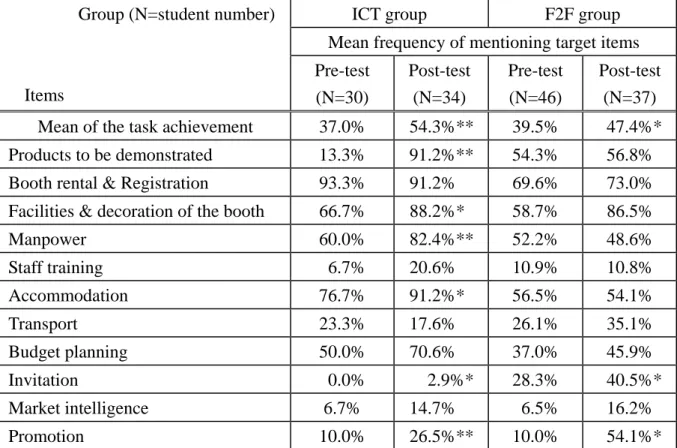
The task required students to play the role of a marketing manager in a computer manufacturing company who had to write an English report to his/her assistant with instructions about developing a plan for attending a trade fair. The mean frequencies in percentage for the eleven (11) target items that students incorporated in their reports are given in Table 3. The results indicated that the average frequency of the task achievement in the post-test was better than in the pre-test for both the ICT (from 37.0% to 54.3%) and F2F (from 39.5% to 47.4%) groups. A paired samples t-test analysis found a significant difference in the average frequency of the task achievement between the pre-test and post-test for both groups
(p=.000<.05 for ICT group and p=.01<.05 for F2F group).
Table 3: Task performance for Task 3
ICT group F2F group
Mean frequency of mentioning target items Group (N=student number)
Items Pre-test (N=30) Post-test (N=34) Pre-test (N=46) Post-test (N=37) Mean of the task achievement 37.0% 54.3%** 39.5% 47.4%* Products to be demonstrated 13.3% 91.2%** 54.3% 56.8% Booth rental & Registration 93.3% 91.2% 69.6% 73.0% Facilities & decoration of the booth 66.7% 88.2%* 58.7% 86.5%
Manpower 60.0% 82.4%** 52.2% 48.6% Staff training 6.7% 20.6% 10.9% 10.8% Accommodation 76.7% 91.2%* 56.5% 54.1% Transport 23.3% 17.6% 26.1% 35.1% Budget planning 50.0% 70.6% 37.0% 45.9% Invitation 0.0% 2.9%* 28.3% 40.5%* Market intelligence 6.7% 14.7% 6.5% 16.2% Promotion 10.0% 26.5%** 10.0% 54.1%*
*: p<.05; **: p<.01 in the pair samples t-test between the pre- and post-tests
When compared by groups, an independent samples t-test analysis indicated that there was no significant difference (p=.277>.05) in the pre-test between the ICT and F2F groups, but there was a marginal difference in the post-test between the two groups since its p value was 0.06, close to 0.05, the level of significant difference. A further analysis of individual items indicated that ICT students had a significantly better performance on five (5) items in the post-test, Products to be demonstrated, Booth rental & Registration,
Manpower, Accommodation, and Budget planning, and F2F students only had a significantly better
performance only on one item, Invitation. A Pearson’s correlation analysis indicated that no significant correlation was found in the pre-test for students in both groups. However, after seven week’s study, a
significantly positive correlation was found in the post-test for F2F students (r=.422, p=.01<.05), but not for ICT students (r=.092, p=.604>.05).
IV.2 Questionnaires survey
The Cronbach alpha reliability was 0.866 for the questionnaire about satisfaction with courseware-integrated instruction, and 0.846 for the questionnaire comparing attitude toward
courseware-integrated and F2F instructions. These results indicate that the collected data was highly reliable. 1. Questionnaire about satisfaction with courseware-integrated instruction
The results are displayed in Table 4. With the completed satisfaction questionnaires considered to represent the students’ learning motivation or results (Tough, 1982; Long, 1985), seven issues were highlighted:
(1) The overall mean of the fifteen (15) questions was 3.77, indicating that most students expressed a positive and satisfied response. In addition, according to the highest score for QF1 (M=4.15), most of the ICT students felt they had improved in content knowledge and skills for preparing for international trade fairs.
(2) QF3, relating to listening skills, also had the highest score (M=4.15). This suggests that the L1 audio component combined with its corresponding paragraph subtitles offers a favorable and positive learning environment for L2 students to practice English listening skills and achieve better comprehension.
(3) QF2, relating to vocabulary, had a higher score (M=3.94). It indicates that vocabulary is seen as a key factor in improving reading comprehension, and increasing vocabulary ability is seen as an effective strategy. The result showed that it is necessary to emphasize content-specific vocabulary that has semantic ties and conceptual relationships with the target content, which allows students to understand lectures, texts and class discussions.
(4) QF11 (M=3.91), relating to the online real-life practices, had a higher score, indicating such situational task-based activities helped students develop problem-solving and critical thinking abilities.
(5) Higher scores for QF12 (M=3.94) and QF13 (M=3.88), relating to bilingual multimedia design and navigation of the ESP courseware respectively, suggested that a friendly and easy learning interface design should be considered in the courseware development in order to promote students’ learning motivation which has been considered one of the key factors in L2 learning.
(6) A higher score for QF14 (M=3.79) indicated that students were satisfied with the learner-centered TBL instruction with courseware integration.
(7) QF4 (M=2.62), relating to speaking skills had the lowest score, probably due to its having been stressed less in the course. In fact, according to the teacher’s observation in the classroom, students rarely practiced their speaking skills during their interaction with the courseware.
Table 4: Results of the questionnaire about satisfaction
Questions (Student number=34) Mean
(STD) QF1. The courseware improves your related cognition and skills for
preparing for international trade fairs.
4.15 (.702)
QF2. The courseware is sufficiently helpful to improve vocabulary for international trade fairs.
3.94 (.814) QF3. The courseware is sufficiently helpful to improve listening skills
for international trade fairs.
4.15 (.657) QF4. The courseware is sufficiently helpful to improve speaking skill
for international trade fairs.
2.62 (1.101) QF5. The courseware is sufficiently helpful to improve reading skills
for international trade fairs.
3.53 (.788) QF6. The courseware is sufficiently helpful to improve writing skills
for international trade fairs.
3.79 (.641) QF7. The courseware is sufficiently helpful to improve translation skills
for international trade fairs.
3.38 (.888) QF8. The English content of the courseware is relevant. 3.94
(.776)
QF9. The layout of the courseware is relevant. 3.85
(.657) QF10. Online evaluation system enhances your skills of learning English. 3.76
(.741) QF11. Virtual website with situational online practices enhances your
problem-solving skills.
3.91 (.570) QF12. The bilingual and multimedia design of the courseware help
decrease learning barriers and promote learning motivation.
3.94 (.851)
QF13. The function keys improve navigation. 3.88
(.591) QF14. You are satisfied with a learner-centered TBL instruction with
ESP courseware integration
3.79 (.770) QF15. You would recommend this courseware to your friends 3.74
(.666) The overall mean score 3.77
(.746)
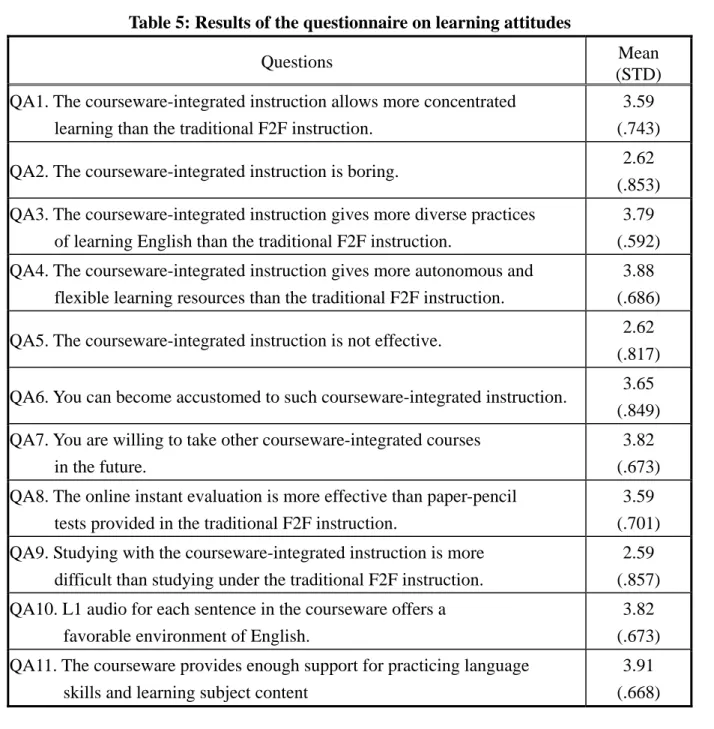
2. Questionnaire about attitude: comparison between the courseware-integrated and F2F instruction Since it was the first time for most of the students to experience courseware-integrated instruction, the questionnaire eliciting students’ attitudes toward this courseware-integrated TBL instruction was administered for a comparison with their attitude toward the F2F instruction that the students had experienced for many years. The results indicated that the eight (8) positively-worded questions had a higher mean, 3.76, and the negatively-worded questions had a lower one, 2.61. According to students’ responses to the questionnaire shown in Table 5, we may summarize as follows: Compared with F2F instruction, self-study with courseware-integrated instruction allowed students to concentrate more on language practice and content learning, and they did not feel bored. In addition, the courseware was able to provide enough resources and support for practicing language skills and learning subject content, so
that students rapidly grew accustomed to the easy, effective, flexible and autonomous learning environment provided by the courseware. Students also expressed their willingness to take other courseware-integrated courses in the future. The results indicated that students had a positive attitude toward this TBL instruction with ESP courseware integration.
Table 5: Results of the questionnaire on learning attitudes
Questions Mean
(STD) QA1. The courseware-integrated instruction allows more concentrated
learning than the traditional F2F instruction.
3.59 (.743) QA2. The courseware-integrated instruction is boring. 2.62
(.853) QA3. The courseware-integrated instruction gives more diverse practices
of learning English than the traditional F2F instruction.
3.79 (.592) QA4. The courseware-integrated instruction gives more autonomous and
flexible learning resources than the traditional F2F instruction.
3.88 (.686) QA5. The courseware-integrated instruction is not effective. 2.62
(.817) QA6. You can become accustomed to such courseware-integrated instruction. 3.65
(.849) QA7. You are willing to take other courseware-integrated courses
in the future.
3.82 (.673) QA8. The online instant evaluation is more effective than paper-pencil
tests provided in the traditional F2F instruction.
3.59 (.701) QA9. Studying with the courseware-integrated instruction is more
difficult than studying under the traditional F2F instruction.
2.59 (.857) QA10. L1 audio for each sentence in the courseware offers a
favorable environment of English.
3.82 (.673) QA11. The courseware provides enough support for practicing language
skills and learning subject content
3.91 (.668)
3. Interview with recently graduated students
Six recently graduated students who had taken this ESP course with courseware integration were
randomly selected for an interview, which was conducted by a questionnaire with open-ended questions. Three graduates returned the questionnaire in which they commented on the learning usefulness of this courseware-integrated TBL instruction. Selected responses follow:
Graduate student A: The graduate works as a customer support coordinator in the Taiwan branch of a German company that supplies equipment and process solutions for microstructure applications. She is in charge of customer support, and handles purchase documents or import and export orders. She strongly agrees on the importance of the three tasks given in this study, which allow students to increase their knowledge and skills for participating in international trade fairs. However, she feels
more business terms and related regulations, and more communication skills need to be included.
Graduate student B: The graduate works as an assistant for a Taiwan trading company that exports golf balls. She agrees it is important for Taiwanese export companies to participate in international trade fairs to promote global exposure. She thinks it is useful to learn the content knowledge and professional terms for attending trade fairs at school and the courseware could be part of a course through which students can learn basic knowledge of trade fairs and practice language skills. But, she adds, it would be even better to provide an internship to experience real-life work.
Graduate student C: The graduate works as a project manager for a LED Lighting Department in China. She agrees it is important for export companies to participate in international trade fairs. She strongly agrees that it is necessary for an undergraduate who would like to find a job in a trading company to learn some knowledge and skills for preparing for international trade fairs before entering the job market. She also agrees it is important for students to know how to budget and plan for trade fairs. In her opinion, it is quite useful to make the courseware part of a regular university class, but it would be improved if it provided more contextual practice or activities.
According to the interview results, the three interviewees agreed the ESP courseware and its integration into TBL instruction could be part of the undergraduate curriculum. They felt it was useful and important for their current jobs, implying that the content of the ESP courseware basically met workplace needs. Meanwhile, they suggested that more practical materials and learning activities could be added to the course and some relevant English courses could be offered at workplaces to promote on-the-job training.
V. Discussions
From the evaluation and evidence of a series of pre- and post-tests for each task, the questionnaire survey and the interviews, the discussion is as follows:
V.1 Knowledge about trade fairs
Students in both the ICT and F2F groups made significant progress in writing more words and expressed more ideas in the post-writing task, revealing that all students in both groups had developed and improved ideas after their seven week’s study. However, there was no significant difference in P-density, an index for writing quality, between the pre- and post-tests for both groups. This implied students’ writing quality did not show a significant improvement, probably due to the fact that writing requires conscious mental effort and is considered the most difficult and challenging task among the four language learning skills. While composing an article, students not only need to think about and organize their ideas, but also to transform them into meaningful text in English. Thus, it is a difficult task for students to show significant improvement in writing quality during such a short period. In addition, a Pearson’s analysis indicated that the idea count, word count and P-density in students’ pre- and post-writing in both groups had no significant correlation with their TOEIC English proficiency. The findings suggested that writing asks for more complex thinking and
cognitive processes and is not necessarily related to students’ reading and listening skills. Thus, the ability to appropriately interpret a read-to-write task in this study does not directly depend on students’ TOEIC
proficiency. The analysis of students’ texts by CPIDR is just a simple and quick measure of lexical proficiency. A detailed analysis can be conducted to provide insight into deeper cognitive measures of the acquisition of
L2 writing lexicons such as the development of word senses and lexical networks, which could lead to a better understanding of how L2 learners process and produce new lexicons.
V.2 Budgeting for a trade fair and preparing for a trade fair
In addition to memorizing rules and accumulating knowledge, the ability to complete indirect or ill-structured tasks was studied. For example, Task 2 dealt with budget estimation and required students to find useful, necessary data in the virtual website embedded in the courseware with which related fees were calculated. In addition, the aim of Task 3 was to understand the students’ abilities to acquire, develop,
organize and integrate cognitive skills and personal experiences in order to produce meaningful solutions for ill-structured problems. This constructive learning mode allowed the students to actively participate in their own learning process and apply what was presented in the courseware to formulate their own knowledge and experiences and to represent them in a more meaningful way. According to the results shown in Table 3, students in the ICT and F2F groups made significant improvement in the post-test of Task 2 and Task 3. While completing the two tasks, ICT students made as much, and at times, even better, progress as those electing under the teacher-centered instruction. It suggests that students using the courseware did not suffer by comparison, and they were able to apply what they had learned to complete the tasks. However, the average frequencies of giving right answers or mentioning target items in the post-tests were only close to 50% for students in both groups. This suggests that more intervention or explanation by the teacher may be needed to help EFL students, who generally are weak in mathematics and logical reasoning, to further improve their ability to deal with indirect or ill-structured problems that usually occur in the real world and reflect life beyond the classroom.
Students’ performance on Task 3 had a significant correlation with their English proficiency only in the post-test for F2F students. Prior to taking this course, students in both groups had no knowledge or experience about preparing for a trade fair, so that the task performance in the pre-test was not related to language skills. However, in order to complete Task 3, students had to carefully read information in the different sections on the virtual website and then select, organize, and integrate what had been learned to construct their own knowledge. In general, Chinese students are accustomed to teacher-centered instruction in which teachers provide both knowledge and moral instruction, and they learn by listening to what teachers relate and are shy about asking questions or looking for support within the classroom. During such teacher-centered instruction, often accompanied by less positive learning attitudes, student English proficiency in reading and
comprehension is an essential factor. That is probably the reason why F2F students’ performance was significantly correlated with their English proficiency in the teacher-centered instruction group.
In contrast, integrating courseware into instruction within the classroom shifted teacher-centered learning to student-centered learning. According to students’ responses to the questionnaire survey, the courseware that provided many supporting activities such as L1 audio with Chinese translation support, bilingual interface design, online tests with instant self-checking, reduced students’ cognitive load in studying the ESP course. The courseware activities also made students concentrate more on content learning and language practice based on their learning needs, interests and pace. The courseware in this study created an effective learning environment in which necessary and adequate support was provided to meet the learning needs of students with different English proficiency so that students with lower English proficiency performed Task 3 as well as those with higher English proficiency. Thus, students’ task performance had no significant correlation with their English proficiency under the courseware-integrated instruction. It suggests that such useful support and guidance provided in the courseware-integrated instruction should be considered for students with lower
English proficiency so that they can learn in a more motivated and less intimidating environment (Gu, 2002; Jeon-Ellis, Debski & Wigglesworth, 2005; Tsai, 2009; 2011a).
V.3 Questionnaire survey
A higher score for QF14 (M=3.79) indicated that students showed a better satisfaction with the learner-centered TBL instruction with ESP courseware integration. Based on the constructivism theory, learning is the process of adjusting learners’ mental models to accommodate new experiences. Moreover, the learner has greater control and responsibility over what needs to be learned. The students’ learning ownership is especially important in an interactive technology-supported environment. As integrating ESP courseware into instruction within the classroom shifted the teacher-centered learning to learner-centered learning, the teacher offering ICT instruction had to facilitate the students’ learning process, encouraging and enabling them to study with the courseware as independent and responsible learners. In addition, since most students had enough time and the total freedom to interact with the courseware, the use of the ESP
courseware-integrated instruction allowed learners to have more equal participation in the learning process. Except for speaking skills which were not stressed in the task requirement of this study, higher mean scores for the other language skills revealed that linguistic features emphasized in the courseware design and its instruction were necessary and helpful, including vocabulary, reading, L1 audio with its paragraph subtitles and grammar explanations. This outcome corresponds to Chapelle’s (1998) first suggestion to make key linguistic characteristics salient by highlighting them in a different color, in aural input, or through transcription of phrases containing linguistic elements. A higher score (M=3.91) for the online evaluation system which included five language tests with various difficulty, from cloze test, sentence restructuring, listening test to bilingual translation writing suggested that repeatedly practicing online integrative language skills met Chapelle’s (1998) second suggestion concerning linguistic input provided through either written or aural language and modified by several means such as repetition, simplification through restatements,
non-verbal cues, decreased speed, reference materials, and change of input mode. Repeated integrative language practice offered by the courseware provided students with opportunities for comprehensible output, either written or spoken, by using target language forms to stretch their competence, as mentioned in
Chapelle’s (1998) third suggestion. Moreover, the online evaluation activities with the instant self-checking function allow students to analyze, recheck, reflect, and identify, and even correct their errors. This design corresponded to Chapelle’s (1998) fourth and fifth suggestions: providing opportunities for learners to recognize their errors and to correct their linguistic output.
In addition, higher scores for bilingual multimedia design (M=3.94) and navigation (M=3.88) supported the courseware design in this study which aimed at developing a quick and user-friendly learning environment that could promote interest and motivation for learner-centered learning. According to Gardner and Lambert (1972), attitudes and motivation have a strong relation to language achievement no matter how high or low the learners’ aptitude and intelligence may be. Having studied the variables that might affect the learning strategies of 1200 EFL students, Oxford and Nyikos (1989) found that motivation had the most powerful influence on the choices of language learning strategies. Strong motivation leads to positive attitudes, and, consequently, better outcomes when learning the target language. The positive response here was gratifying.
Students had higher satisfaction with situational online exercises in the virtual website and felt that these exercises were helpful in enhancing their problem-solving skills (M=3.91). This result was reinforced by the responses of the recently graduated interviewees because they thought that the tasks assigned within the class were important. Such situational online practices allowed students to gain a better understanding about
content knowledge and its related language practices before entering the job market. Meanwhile, they suggested that more vocabulary and practical activities or training should be taught at school and the
courseware could be part of a course where learners could be engaged in tasks or activities rooted in real-life situations.
Due to a lack of qualified teachers, and difficulties with collaboration or relevant curriculum design, the fullest collaboration for ESP teaching conducted by a subject expert and a language teacher in team-teaching classes (Johns & Dudley-Evans, 1991) has not been feasible in higher technical education in Taiwan and elsewhere. The ESP courseware developed in this study provided a situational and logical structure for the target contexts in which students were exposed to a variety of situated activities and had to be engaged in interacting with courseware content for meaningful and relevant learning at their own pace and according to the teacher-controlled learning schedule. Meanwhile, students had to be more aware of the responsibility and role of their individual learning in order to complete content-based and linguistic tests in the Pre-Task and
Post-Task phases. In addition, students were able to get instant feedback from the online evaluation system
embedded in the courseware. These features led to a successful courseware-integrated ESP instruction in which students showed significantly better performance with higher satisfaction, in the Post-Task phases,. The results suggested that the ESP courseware integration into TBL instruction based on the cognitive
apprenticeship model provided practical steps for online content learning and computer-assisted language training to enable students to acquire, develop and construct the required abilities that were necessary to complete the content-based and linguistic tasks. Thus, the courseware-integrated TBL instruction can be considered as a potential solution to problems in the development and expansion in frequency of ESP courses.
V.I Conclusions
The ESP courseware developed in this study was based on Mayer’s multimedia learning cognitive theory and met Chapelle’s criteria for development of multimedia CALL. Its integration into TBL instruction
corresponded to an increasing awareness in ESP teaching that the curriculum frame should include three essential fields: content knowledge, language skills and its practices (Zhang, 2007). It not only included content knowledge and a variety of linguistic practices combined with English audio component and corresponding paragraph subtitle, but provided situational online training and an evaluation system with an instant feedback function to help students monitor what they already study. Its effectiveness has been achieved as follows:
1. The courseware not only incorporated subject knowledge and practices of English skills, but also provided a variety of online activities and problems rooted in situated cognition through which
students had multiple opportunities to construct their individual knowledge and experiences within the target field.
2. The courseware provided an L1 audio component which, combined with its corresponding paragraph subtitles and Chinese translations, gave a favorable and motivating learning environment for L2 students.
3. Based on the results of pre- and post-tests conducted in three tasks, students’ learning effectiveness in problem-solving and language was significantly improved. Moreover, students receiving the
courseware-integrated instruction made as much, and at times, even better, progress than those receiving the F2F instruction. This suggests that the well structured courseware was able to play the role of an adjunct teacher, peer and facilitator with which students had direct interaction enabling them to learn subject content, practice any language skills, understand the questions, and think of the
answers.
4. According to students’ responses to the questionnaire survey, they were satisfied with their self-study under the courseware-integrated instruction, which could be an effective tool to meet the target need of Taiwanese students taking ESP courses.
5. In comparison with traditional F2F instruction, students receiving courseware-integrated TBL instruction had a positive attitude toward the easy, effective, flexible and autonomous learning
environment provided by the courseware, and would be willing to take other courses with courseware integration in the future.
Teaching/learning using courseware should be much more frequently applied within ESP classes. In order to further determine and understand the impact of such courseware integration into instruction, more classroom-oriented research is required to analyze and discuss learning effectiveness, attitudes and strategies for learners with different English proficiency, learning achievement, educational and working backgrounds while completing tasks of different natures, subject-based or linguistic. In addition, through collaboration between different academic departments and industries, the development of ESP courseware can be expanded to more professional subjects in order to enhance the professional and English skills of learners in different fields.
Acknowledgements
The author thanks most sincerely Dr. Boyd Davis, Professor of Applied Linguistics/ English, University of North Carolina-Charlotte (USA), for her valuable suggestions during this study. He also thanks Dr. Ann Carver for her proofreading. This work was partially supported by the National Science Council (NSC), Taiwan, ROC, under Grant NSC 100-2410-H-151-024.
References
Azemi, A. (1996). Using multimedia courseware in engineering education. Proceedings of Annual Frontiers
in Education Conference, 1, 209–212.
Brett, P. (2000). Integrating multimedia into the business English curriculum: a case study. English for
Specific Purposes, 19, 269–290.
Brown, C., Snodgrass, T, Kemper, S. J., Hermen, R. & Covington, M. A. (2008). Automatic measurement of propositional idea density from part-of-speech tagging. Behavior Research Methods, 40(2), 540–545. Brown, J. S., Collins, A., & Duguid, P. (1989). Situated cognition and the culture of learning. Educational
Researcher, 18(1), 32–41.
Chang, C. C., Lei, H. & Tseng, J. S. (2011). Media presentation mode, English listening comprehension and cognitive load in ubiquitous learning environments: Modality effect or redundancy effect? Australasian
Journal of Educational Technology, 27(4), 633–654
Chang, M. M. (2005). Applying Self-Regulated Learning Strategies in a Web-Based Instruction–An Investigation of Motivation Perception. Computer Assisted Language Learning,
http://www.informaworld.com/smpp/title~db=all~content=t716100697~tab=issueslist~branches=18 - v1818, 217–230.
Chapelle, C. A. (1998). Multimedia CALL: lessons to be learned from research on instructed SLA. Language
Learning & Technology, 2, 22–34.
computer-generated feedback be provided in learner-to-learner interactions? Computer Assisted Language
Learning,
http://www.informaworld.com/smpp/title~db=all~content=t716100697~tab=issueslist~branches=21 - v2121, 369–382.
Ellis, R. (2006), Methodology of Task-Based Teaching. Proceedings of the Asian EFL Journal International
Conference, 2006.
Figura, K. & Jarvis, H. (2007). Computer-based materials: A study of learner autonomy and strategies.
System, 35, 448–468.
Fischer, R. (2007). How do we Know what Students are Actually Doing? Monitoring Students' Behavior in CALL. Computer Assisted Language Learning,
http://www.informaworld.com/smpp/title~db=all~content=t716100697~tab=issueslist~branches=20 - v2020, 409–442.
Gardner, R. C., & Lambert, W. E. (1972). Attitudes and motivation in second language learning. Rowley, MA: Newbury House Publishers.
Gu, P. (2002). Effects of project-based CALL on Chinese EFL learners. Asian Journal of English Language
Teaching, 1(12), 195–210.
Heift, T. & Rimrott, A. (2008). Learner responses to corrective feedback for spelling errors in CALL. System, 35, 196–213.
Herron, C., Morris, M., Secules, T., & Curtis, L. (1995). A comparison of the effects of video-based versus text-based instruction in the foreign language classroom. The French Review, 68, 775–796.
Hudson, G. (2000). Essential introductory linguistics. Blackwell Publishers.
Hung, D. W. L & Der-Thanq, C. (2001). Situated Cognition, Vygotskian Thought and Learning from the Communities of Practice Perspective: Implications for the Design of Web-Based E-Learning. Educational
Media International, 38(1), 3–12.
Jeon-Ellis, G., Debski, R. & Wigglesworth, G. (2005). Oral interaction around computers in the project-oriented CALL classroom. Language, Learning & Technology, 9(3), 121–125.
Jiménez, P. M. & Casado, E. (2004). Electros: development of an educational software for simulations in electrostatic. Computer Applications in Engineering Education, 12, 65–73.
Johns, A. & Dudley-Evans, T. (1991). English for specific purposes: international in scope, specific in purpose. TESOL Quarterly, 25, 297–314.
Kevin, O. (1999). http://www.edtech.vt.edu/edtech/id/models/powerpoint/cog.pdf [viewed 27 July 2010]. Kintsch, W. (1998). Comprehension: A paradigm for cognition. Cambridge: Cambridge University Press. Lai, C. Y. (2005). A study on applied English department students’ needs for taking English for specific
purposes courses and students’ perceptions of an effective ESP teacher. Master dissertation, Southern
Taiwan University of Technology, unpublished.
Li, Y. (2004). Incorporating contemporary education theories into Physics of Semiconductor Devices. The China Papers. http://science.uniserve.edu.au/ pubs/china/vol3/CP3_P5.pdf [viewed 19 May 2010]. Long, H. B. (1985). Contradictory expectations? Achievement and Satisfaction in adult learning. Journal of
Continuing Higher Education, 33(3), 10–12.
Mayer, R. E. (2001). Multimedia learning. New York: Cambridge University Press.
Mayer, R. E. (2005). The Cambridge Handbook of Multimedia Learning, Cambridge University Press. Nunan, D. (2006). Task-based Language Teaching in the Asia Context: Defining ‘Task’. Asian EFL journal.
Oxford, R. L., & Nyikos, M. (1989). Variables affecting choice of language learning strategies by university students. The Modern Language Journal, 73, 291–300.
Papastergiou, M. (2009). Digital Game-Based Learning in high school Computer Science education: Impact on educational effectiveness and student motivation. Computers & Education, 52, 1–12.
Roblyer, M. D. (2003). Integrating educational technology into teaching. (3rd ed.), New Jersey: Pearson Education Inc.
Rubin, J. (1994). A review of second language listening comprehension research. The Modern Language
Journal, 78, 199–221.
Shamsudin, S. & Nesi, H. (2006). Computer-mediated Communication in English for Specific Purposes: A case study with computer science students at Universiti Teknologi Malaysia. Computer Assisted Language
Learning, 19, Nos. 4 & 5, 317–339.
Skehan, P. (1998). A cognitive approach to language learning. Oxford: Oxford University Press.
Takao, A. Y., Prothero, W. A., & Kelly, G. J. (2002). Applying argumentation analysis to assess the quality of university oceanography students’ scientific writing. Journal of Geoscience Education, 50, 40–48.
http://www.nagt.org/ files/nagt/jge/abstracts/Takao_v50n1p40.pdf [viewed 27 March 2009]. Tough, A. (1982). International Change, Chicago: Follett.
Tsai, S. C. (2009). Courseware Development for Semiconductor Technology and its Application into instruction. Computers & Education, 52, 834–847.
Tsai, S. C. (2010). Developing and Integrating Courseware for Oral Presentations into ESP Learning Contexts. Computers & Education, 55, 1245–1258.
Tsai, S. C. (2011a). Courseware integration into task-based learning: a case study of multimedia courseware- supported oral presentations for non-English major students. ReCALL, 23(2), 117–134.
Tsai, S. C. (2011b). Multimedia courseware development for World Heritage sites and its trial integration into instruction in higher technical education. Australasian Journal of Educational Technology, 27 (7),
1171–1189.
Tsai, S. C. & Davis, B. (2008). The Trade Fair: Introducing ESP Multimedia at a Technical University in Taiwan, International Journal of Emerging Technologies in Learning, 3, 45–55.
Tsou, W. (2009). Needs-based curriculum development: A case study of NCKU’s ESP program. Taiwan
International ESP Journal, 1(1), 77–95.
Zhang, Z. (2007). Towards an Integrated Approach to Teaching Business English: a Chinese Experience.