國立臺灣大學管理學院資訊管理學研究所 博士論文
Department of Information Management College of Management
National Taiwan University Doctoral Dissertation
學習者使用線上學習社群意願之研究
The Study of Learners’ Intention to Use an Online Learning Community
劉一凡 I-Fan Liu
指導教授:孫雅麗 博士 陳孟彰 博士 Advisor: Yeali S. Sun, Ph.D.
Meng Chang Chen, Ph.D.
中華民國 99 年 6 月
June, 2010
學習者使用線上學習社群意願之研究 The Study of Learners’ Intention to Use an Online
Learning Community
本 論 文 係 提 交 國 立 台 灣 大 學 資 訊 管 理 學 研 究 所 作 為 完 成 博 士 學 位
所 需 條 件 之 一 部 份
研 究 生 : 劉 一 凡 撰
中 華 民 國 九 十 九 年 六 月
謝 辭
在博士班的求學生涯中,沒有任何比撰寫謝辭更高興的事了,它比起期刊論 文被接受更令人感到喜悅。因為這代表博士班的學習歷程即將劃上一個句點,另 一個嶄新的學術旅程正等待我去掌舵與啟航。在博士班求學期間,首先要感謝兩 位指導教授,分別為台大資管所孫雅麗教授與中研院資科所陳孟彰教授。兩位老 師治學嚴謹、研究紮實,為學生樹立良好的教學與研究之典範,影響學生甚巨。
若沒有兩位恩師的指導與協助,學生無法順利取得博士學位。
接下來,我要感謝論文口試委員們,包括柯華葳教授、衛友賢(David Wible) 教授、陳建錦教授們給予的寶貴意見,使得本論文得以更加完善與周延,真誠地 感謝各位老師。
感謝 IWiLL 團隊的主持人淡江大學資工系郭經華教授提供 IWiLL 線上英語學 習社群的環境,以及在狀輝、心儀的協助之下,讓本研究的資料分析工作得以順 利進行。
再來,感謝陳老師實驗室的學術伙伴們,子全學長、義堅、基善、智賢、君 銘、賢明、大意婷、小意婷、政彥、昕彥,以及新加入 Lab 的學弟妹們,謝謝這 個團隊成員每週輪流報告論文。由於大家努力的付出,讓我們得以了解相關研究 議題的發展,並與世界的趨勢接軌。還有,也感謝最常出現在 320A 研究室健誠 學弟的閒聊,讓 320A 變的不冷清。
另外,還要感謝尤瑞崇學長、洪英訓學長、李藍瑜同學。在您們的推薦之下,
才得以在博士班求學期間獲取教學經驗。同時,也要謝謝同屆的許欽嘉同學,不 僅時常提供我研習訊息、修課資料、研究資源等,更不時在各方面給予諸多寶貴 的意見,是我的良師兼益友。還要感謝賴榮裕學長適時給予我寶貴的意見,讓該 篇期刊論文能有更佳品質的呈現。
最後,我要感謝我的父母,尤其是勞苦功高的母親,一位上知天文、下知地 理的易經老師。當我碰到無法用理智思維來判斷的情況時,她總是能夠運用易經 六十四卦所呈現的啟示,提供我做重大決策的參考依據。更要感謝利年,在繁忙 的工作之餘,還得抽空陪我研究英文論文的寫作技巧,增進我不少英文寫作的觀 念。同時也要感謝小意婷適時地幫我整理相關的研究資料,佔用了不少週末的寶 貴時間。謝謝楷倫常聽我發牢騷和精神上的鼓勵。謝謝你們的幫忙,我的研究工 作才能按照預定的時程如期進行。還有我家那隻可愛的咪咪,也要感謝它時常乖
乖地趴在我的書桌上陪我讀書,讓我做研究的時候不會感到寂寞。最後,謹以此 論文獻給我摯愛的家人。
劉一凡 于台大醉月湖畔 中華民國九十九年六月
中文摘要
隨著網際網路的興盛與資訊科技的進步,愈來愈多的學習者加入線上學習社
群做為傳統課程延伸的另一種學習管道。在本研究中,我們提供線上學習社群讓
學習者可在社群中學習英文。同時,為了推廣優質的英文讀本,本社群定期舉辦
閱讀競賽讓線上成員參與相關的活動。因此,本研究的目的為使用科技接受模式
的延伸藉以探討學習者是否願意再度使用線上學習社群。
在本論文以科技接受模式為基礎,並延伸外部變數以及感知變項做為本研究
所提出的模型和假設,以探討學習者對於線上學習社群的使用意願。共有 436
份有效問卷,透過結構方程模式統計方法進行資料分析與模型驗證。研究結果顯
示本研究所提出的假設均受到支持,表示所提出的模型可以有效預測學習者是否
會繼續使用線上學習社群。
關鍵字:線上學習社群、使用意願、科技接受模式、動機理論
Abstract
With the booming of Internet and progress of information technology, more and
more learners join online learning community as another learning channel to be an
extension of traditional class. In this research, we provide an online learning
community for learners to study English on it. Meanwhile, to promote excellent
English books, our community holds regular related activity like reading contest for
online members. Hence, the purpose of this study is to use the extended TAM model
as our research framework, and would like to understand whether learners are willing
to reuse an online learning community.
The study of this thesis, we take the Technology Acceptance Model as a
foundation and extend the external variables as well as the perceived variables as our
model and propose a number of hypotheses. A total of 436 Taiwanese senior high
school students participated in this research, and the online learning community
focused on learning English. The research results show that all the hypotheses are
supported, which indicates that the extended variables can effectively predict whether
users will adopt an online learning community. Finally, we discuss the implications of
our findings for the future development of online English learning communities.
Keywords: intention to use an online learning community, Technology Acceptance
Model, participative motivation, motivation theory
Table of Contents
謝 辭... i
中文摘要... iii
Abstract ... iv
Table of Contents ... vi
List of Figures ... viii
List of Tables ... ix
Chapter 1: Introduction ... 1
1.1 Background ... 1
1.2 Purpose ... 5
1.3 Limitation ... 6
1.4 Organization ... 8
Chapter 2: Literature review ... 9
2.1 Online learning community ... 9
2.1.1 The definition of online learning community ... 9
2.1.2 The characteristics of online learning community ... 11
2.1.3 The principles of an online learning community design ... 14
2.2 Motivation theory... 18
2.2.1 Motivation ... 18
2.2.2 Learning motivation ... 21
2.3 Research model and Hypotheses ... 24
2.3.1 TAM ... 24
2.4 External variables ... 27
2.4.1 Online Course Design ... 29
2.4.2 User-interface Design ... 32
2.4.3 Previous Online Learning Experience ... 34
2.5 Perceived Variables ... 36
2.5.1 Perceived Ease of Use and Perceived Usefulness ... 37
2.5.2 Perceived Interaction ... 39
2.6 Outcome Variables ... 41
2.7 Summary ... 42
Chapter 3: The Design of an Online Learning Community ... 43
3.1 IWiLL ... 43
3.2 Reading Challenge ... 47
3.2.1 Introduction of Reading Challenge contest ... 47
3.2.2 The difference between Reading Challenge and other contests ... 50
3.3 Summary ... 55
Chapter 4: Research Methods ... 57
4.1 Instruments ... 57
4.2 Subjects ... 58
4.3 SEM ... 59
Chapter 5: Data Analysis and Results ... 65
5.1 Data Analysis ... 65
5.2 Results ... 69
5.2.1 Model testing criteria ... 69
5.2.2 Model testing results ... 70
Chapter 6: Discussion ... 74
Chapter 7: Conclusion... 77
References ... 80
Appendix A. ... 93
Appendix B ... 96
Appendix C ... 97
List of Figures
Figure 2.1 The elements of online learning communities ... 12
Figure 2.2 Fishbein and Ajzen’s Theory of Reasoned Action... 24
Figure 2.3 The proposed research model ... 42
Figure 3.1 Framework of the IWiLL online learning community ... 44
Figure 4.1 The basic procedures of SEM analysis ... 59
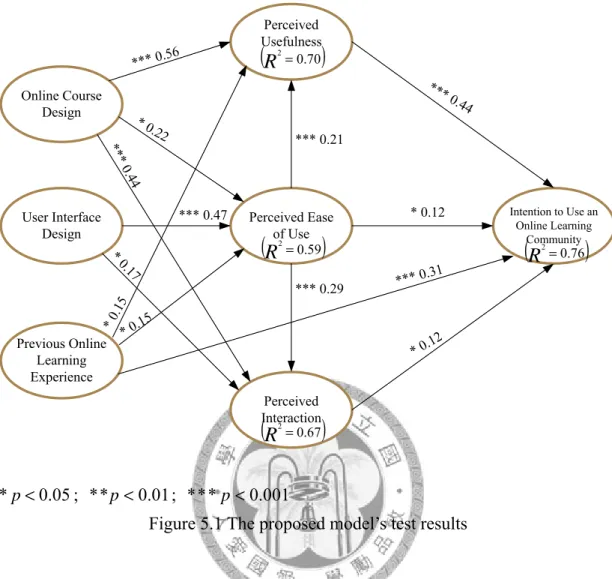
Figure 5.1 The proposed model’s test results ... 71
List of Tables
Table 4.1 The independent variables and dependent variables in our model ... 61
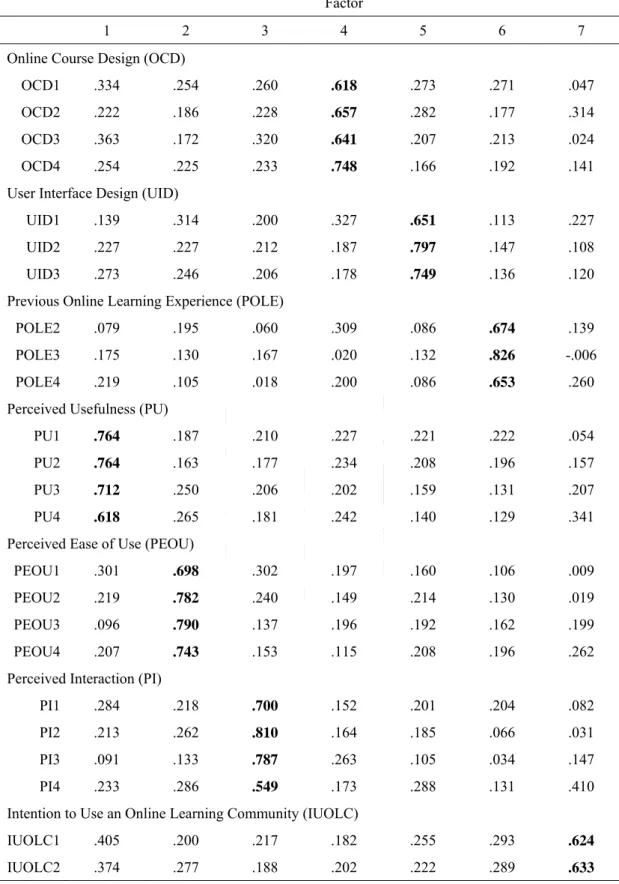
Table 5.1 Exploratory factor analysis results ... 67
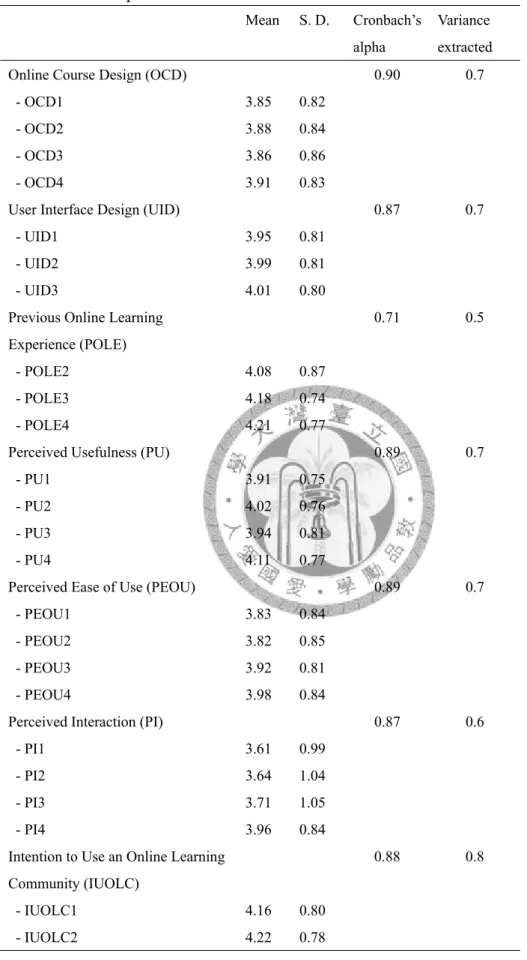
Table 5.2 Descriptive statistics of the constructs and items ... 68
Table 5.3 Statistics of the model fit measures ... 70
Table 5.4 The direct, indirect, and total effects of each construct ... 73
Chapter 1: Introduction
1.1 Background
With the development of World Wide Web, more and more people are participating
in learning activities on the Internet. When a number of people with a common
learning goal form a group, it is called a learning community. Online learning
communities are gradually altering traditional learning styles because of the
pervasiveness of the Internet. Members of these communities come from various
places, and have different educational backgrounds and different proficiency levels.
They interact for mutual learning of a common subject, such as a second language. In
general, online learning community provides a main subject to learn for high school
students. Take high school students in Taiwan as an example, English learning is one
of a main subject that government pays full attention to.
English has become an important tool of international communication in the era of
globalization and more frequent international exchanges among businesses as well as
education. As a non-English speaking country, it is important for Taiwan, which has
made English as a foreign language, to improve the English proficiency in order to
connect with the world stage. In 1998, the Panel of Grade 1-9 curriculum in Taiwan’s
Ministry of Education made English a learning subject for primary schools, taking
down the age of learning English in the compulsory education from junior high school
to primary school. In recent years, the government has been aware of the
incompetence of Taiwanese students’ in TOEFL scores when comparing with peers
from Singapore, Hong Kong and China; therefore, the Taiwan’s Ministry of Education
started promoting and encouraging all students to take the GEPT (General English
Proficiency Test) since 1999. The focus of the test is to provide a reliable and fair
examination for each level of English proficiency. Thus, English learning is not only
the personal demand, but also a global trend when heading towards the new century.
Rovai (2002) observed that, in an online learning community, all members expect
that their learning needs will be satisfied by pursuing a common learning goal. It
could be said that the members develop a common “collective consciousness”,
because they build relationships with one another and their instructors via the user
interface. The diverse interactive media play a support role in learning. Therefore, it is
necessary to consider the needs of learners and the characteristics of each online
learning community when designing online learning courses (Dede, 1996).
There are a lot of English online learning communities that provide rich materials
and contents, so that users could utilize the specialties such as the convenience of the
Internet and personalized learning. This is different from traditional way of learning
English in the classroom. The environment of online learning community has
gradually been formed as more and more people join the website and learn to each
other. Members of the community could share and exchange their experiences during
the process of learning through an interactive way. In the context of traditional
classroom learning, teachers who determine the curriculum guide the course through
face-to-face learning. Students absorb the course content from the teachers in the class
and interact with peers or instructors through discussions. In general, the teacher plays
an authoritative role. It is difficult for us to know whether students are active or
passive participants. They may need to complete the work or task assigned by the
teacher and get credits after passing the exam. However, we do not know whether
such a learning method is suitable for everyone. Undoubtedly, the traditional
classroom learning model is still the norm, despite the restrictions on time, space, and
class sizes.
To advocate excellent English books and to enhance English comprehension for
high school students, IWiLL, an English online learning community, has been
regularly holding annual English Reading Challenge contest since 2000. Averagely,
there are thousands of students who are also IWiLL online members signing up for
this contest. However, how are these online members going to be influenced in their
future language learning by participating in such a contest? What are their
participative motivations? All of these are intriguing issues for researchers.
The current trend in education is to apply technology in the learning process. As
more teachers adopt information technology to assist instruction, more researchers
will investigate the issue of technology-integrated education. Davis (1986), who
proposed the Technology Acceptance Model (TAM), suggested that the ease of use
and usefulness of a technology affect users' intention to use it. Therefore, we can
predict users’ willingness to accept technology based on their perception by using
TAM model. In this study, we build an Intelligent Web-based Interactive Language
Learning (IWiLL) community as an online English learning platform for high school
students throughout Taiwan. Members of this community can share their learning
experiences and discuss course contents with each other. Specifically, we use the
TAM model as our framework, and seek other factors that may affect Intention to Use
an Online Learning Community to construct our model. We also discuss the casual
relationships between the identified factors and explain the real-world phenomena.
1.2 Purpose
In this thesis, the aims of this study are as follows.
(1) To identify the factors affecting the intention to use an online learning community.
(2) To develop the extended TAM model as our framework and understand whether learners are willing to reuse an online learning community.
1.3 Limitation
This research has some limitations that we should acknowledge. First, although
IWiLL has many members, most of those who answered the questionnaire were high
school students. In other words, very few students who had graduated from high
school and entered university answered the questionnaire. This raises a potential
research issue in that future studies should seek ways to encourage such students to
respond to a questionnaire. Second, this study focuses on the context of high school
students learning a second language in the online learning community. Since most of
the respondents were high school students with higher homogeneity, we did not
analyze their demographic data. In the future, if we choose college students as our
targets, we will classify their profiles in terms of gender, age, educational background,
as well as freshman, sophomore, junior, or senior. Then, we will be able to compare
the difference of categories. Third, the proposed model contains seven constructs and
adopts the self-report approach for the users to answer the questionnaires. When
measuring users’ subjective psychological variables, it is inevitable that there will be a
common method bias. In the future, in addition to improving the questionnaire’s
design, we could compile the users’ learning portfolios by adding some objective
methods. For instance, we could extract the number of log-ins, the number of learning
hours, the frequency of interacting with others, and the learning scores from the user
profiles in the database. Then, we would be able to control and track the students’
learning situations in the online learning community. Fourth, all of the participants in
this research are all from online members of IWill and high school students
national-wide in Taiwan. IWiLL is also a well-known domestic large online English
learning community. Therefore, no matter the samples or the cases selected from
online community are representative. The findings cannot be generalized to other
settings without additional research. For example, high school students are quite
homogenous in terms of their academic background, whereas college students are
more heterogeneous because they major in a variety of subjects. Specifically, for
future research about the college students’ intention to use an online learning
community it will be interesting to include other variables to measure the proposed
model results. The last constraint is that the learners’ were encouraged to participate
in the IWiLL online learning community by their high school English teachers. For
example, a teacher might have asked the learners to join the discussions on some
issues, observe their interaction during the online session, and then evaluate their
learning performance. Thus, identifying the motivational factors that encourage
learners to participate in various learning activities continuously will be a part of our
future research.
1.4 Organization
The first chapter introduces the development of the online learning community.
Improvement in IT leads to a great change in the way how people learn. The learners’
intention to use an online learning community in the future will be our main research
issue. The technology-integrated learning plays a more and more important role in the
education. In addition, the learners’ participative motivation in reading contest on an
online learning community will be also mentioned in this chapter.
The theoretical development related to this research and literature review will be
discussed in details in the chapter 2. This is based on TAM model to discover from the
literature that what factors would affect the intention to use the online learning
community, and to inspect the conceptual model as well as tests the hypotheses.
The third chapter takes IWiLL as a case study to describe the current status of the
online learning community, including the current situations of the learning community,
system architecture, and system function. Moreover, the annual Reading Challenge
contest held by IWiLL is also introduced in this chapter in details.
Research methods, subjects, data analysis, results, and discussion are also presented
respectively in chapter 4, 5, 6. In the chapter 7, we make conclusions and suggestions
for further study in the future according to the research results.
Chapter 2: Literature review
2.1 Online learning community
2.1.1 The definition of online learning community
The concept of the online learning community comes from the virtual community.
The evolution of online learning community can be traced back to the technological
revolution. People have grouped an online learning community to share knowledge
and experience through history. Through Internet, the online learning community
extends the physical space of the community to the cyberspace (Lewis, 2002).
Virtual community is defined as a group of people who have the same interest and
background interact on the internet (Boczkowsk, 1999; Dennis, 1998; Foreman, 1999).
A community is a group of individuals with similar characteristics, communicating
and interacting through a framework connected by internet. This is the process of how
virtual community is formed (Umiker-Sebeok & Kim, 1999). Through the
connection of internet, people from different background can study, discuss and share knowledge with each other in specific domain. At the end, an online learning community is established (Heckscher & Donnellon, 1994). Learners
create their knowledge with peers, instructors, and digital learning materials.
Because the online learning community is a concept of knowledge sharing, each
learner could be a giver or a receiver of knowledge. The knowledge is gradually
constructed through interaction and communication by individuals with different
specialization, further creating a learning community (Collins & Bielaczyc, 1997). By
sharing a common learning goal and social interaction during a period, learners
discuss the learning details and share learning experiences with each other in an
online learning community (Augar et al., 2004). Therefore in an open online space,
members from different background gather on the Internet to discuss, communicate,
and share knowledge to reach the purpose of learning. This is so-called online
learning community. The purpose of the online learning is to construct a learning
community. It emphasizes on ”learning” not “teaching”. Students learning on the
Internet must actively “collaborate” and “create” to acquire knowledge (Hong,
1999).
2.1.2 The characteristics of online learning community
The online learning community is created by the development of education and ICT
(Information and communication technologies). The participants can learn together by
Internet. They can share the learning resource and experience without the limitation of
time and space. On top of it, manpower and time spent on data search can be saved
(Chang, 2004). Brown & Campione (1994) lists the characteristics of learning
community as follows:
(1) Distributed expertise
Distributed expertise (Saloman, 1993) is every member has different domain
knowledge of specialty.
(2) Participant structure
The community members play different roles by participating in all kinds of
activities. The members must understand and adapt themselves into the differences
of other participants, further playing a role that suits themselves.
(3) Community of discourse
The members in a community discover mistakes and revise immediately by
discussion, conversation and brain-storming with others. And then they
continuously communicate with other members.
(4) Multiple zone of proximal development (ZPD)
The concept of the zone of proximal development was proposed by Vygotsky
(1978). Learners can enhance their learning effects with others assistance by
different pace and methods. The knowledge and technology they learn are stored
separately in multiple zones of proximal development to facilitate the growth of
other domains.
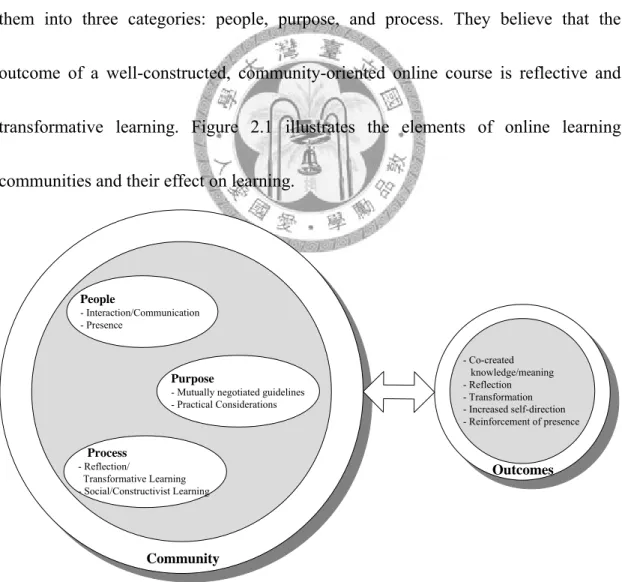
Regarding elements of online learning community, Palloff & Pratt (2007) divide
them into three categories: people, purpose, and process. They believe that the
outcome of a well-constructed, community-oriented online course is reflective and
transformative learning. Figure 2.1 illustrates the elements of online learning
communities and their effect on learning.
People
- Interaction/Communication - Presence
Purpose
- Mutually negotiated guidelines - Practical Considerations
Process - Reflection/
Transformative Learning - Social/Constructivist Learning
- Co-created knowledge/meaning - Reflection - Transformation - Increased self-direction - Reinforcement of presence
Community
Outcomes
Figure 2.1 The elements of online learning communities
(1) Human is a very critical element in the community establishment. An instructor
can play as an assistant to lead learners to be engaged in online curriculum
exploration and an online learning activity.
(2) In the online learning community, clear guidelines must be established and
members are expected to follow the guidelines for the purpose of the community.
Such as the time, the size of the group, and the ability to build a sense of security
would also affect the group cognition to the purpose.
(3) In the developmental process of the online learning community, interaction and
collaboration play critical roles. Member communication and interaction can be
enhanced by collaborative tasks and teamwork. At the same time, social learning
and constructivist learning with others are very critical for the development process
of the online learning community.
The quality of the online learning community operation results in different
outcomes. If online learners are limited by location, time, or content, it would perhaps
lead to a situation that less and less people are willing to use the online learning
community again. The outcome is an environment rich in the potential for
collaborative learning and the social construction of meaning, as transformative
learning and reflective practice.
2.1.3 The principles of an online learning community design
Wenger et al. (2002) proposed seven principles to improve the traditional rigid
community design and to inspire the internal drive of the community – the
participants are taking the intuitive to make the online learning community full of
energy and action (Wenger, 2002; Winkelen, 2003).
Principle 1: Advanced design
The structure of community in the beginning is simple. It then gradually attracts
potential members to join. New members will bring new interests to lead the
community to different direction. After establishing the community relationship, core
members gradually introduce other elements to make the community grow up. For
example, the online community is originally just a marginal group in an organization.
But then it is advanced to a crucial status when overall internet environment is widely
used.
Principle 2: Start a dialogue with different viewpoints inside and outside a community
The good design of a community needs to understand members’ potential to acquire
knowledge. But it usually helps members to see all kinds of possibility from the
outside point of view. A good leader can observe the design of other communities to
improve their operating strategy for their communities.
Principle 3: Invite different level of participations
The reasons people join a community are different. The degree of participation can
be divides into three levels. People in the first level are called small core group. This
level does not contain a large population, usually taking up 10%~20% of whole group.
The core group of people actively participates in discussion and often later become
leaders of communities. People in the second level are called active group. They
would regularly participate in community activities and occasionally express opinions.
But their participation degree is not higher than core group. The population at this
level usually occupies 15%~20% of the whole group. Obviously most of people in
communities are in the marginal region and inactive participants. They quietly
observe the interaction between core group and active group. Maybe this kind of
absent-minded participant would be frustrated in a traditional meeting in real world.
But it becomes another story when meeting online. This group isn’t passive as they
look like. They actually acquire knowledge by observing others' interaction and make
good use of it. Moreover, the so-called third level of group is the outsider. They who
observe community situation and inactively participate in the virtual learning
community are possibly researchers, educators, and even providers of the online
learning community. In conclusion, a good design of the community allows all of the
people from different levels to have a sense of participation.
Principle 4: Develop public and private domains
A public community activity makes members to consider themselves as a team
member by a ceremony and at the same time know other participants in this
community. But too many public group activities have wrong ideas of community
design. The core of community is to build the bonds between members. Member
relationship comes from one-to-one interaction. The tighter the bond between
members, the more they are familiar with each other. And they will have stronger
interaction in various ways in public domains.
Principle 5: Value is a focus
Most of community participation comes from volunteer. Usually, the core value of
a community is not clear in the beginning. But after continuous gathering, activities,
and relationship-building, the core value is then discovered.
Principle 6: Combine familiarity and stimulation
A community is not like a company or an organization. It can comfortablely
provide or accept others’ suggestions under the situation of no interest conflict.
Community connection will be more diversified when members interact with one
another through meeting, seminars and other forms of gathering.
Principle 7: Create community tempo
The community tempo would affect members’ online interaction frequency. For
example, some library community has an annual conference and an online forum.
Posting articles in the forum was not active after six months of the annual meeting.
Another engineering community holds a video conference every two weeks. There are
many face to face conferences in a year. The online activity increased sharply when
video conference and a face to face conference where held before and after. Each
community tempo is not absolutely the same. Finding the most appropriate tempo at
every stage is the key point of community development.
2.2 Motivation theory
2.2.1 Motivation
Motivation has been a term widely used in educational and psychological study
fields for decades. Motivation is an internal status and process making an individual
physically take action and maintain the action toward a goal (Chang, 1994).
Motivation is the internal drive to learn again. With this drive, individuals could
continually learn until achieving their learning purposes. It means that any learning
behavior must be driven by the learning motivation (Kasworm & Marienau, 1997). It
shows that motivation is an internal psychological status and also an internal factor to
facilitate an individual to be engaged in certain activity.
We will discuss the following several important related theories about the
development of the motivation theory for past several decades.
(1) Need hierarchy theory
Maslow’s need hierarchy theory (Maslow, 1954) puts human need in hierarchical
levels. He thought motivation is related to human multi-level needs. The needs could
be arranged and described by the hierarchical method from low-ordered physiological
needs to high-ordered mental needs - pursuing self-actualization. In general,
higher-ordered needs will not be produced when lower-ordered needs are not satisfied
yet.
(2) ERG theory
Alderfer’s ERG (Existence - Relatedness - Growth) theory (Alderfer, 1969) deemed
that individuals could pursue more than one kind of needs at the same time without
priority. In other words, all kinds of needs could exist and stimulate motivation at the
same time. This theory is generally similar with Maslow’s hierarchy need theory.
Alderfer classified humanity's needs into three levels from bottom to up.
(a) Existence needs.
It is equal to Maslow theory’s physiological needs and safety needs.
(b) Relatedness needs.
It is equal to Maslow theory’s social needs and esteem needs.
(c) Growth needs.
It is equal to self - actualization needs in Maslow theory.
But Alderfer thought that a person may be affected by more than one need to affect.
Moreover, when the satisfaction of higher-ordered needs is suppressed, willingness to
seek for the satisfaction of lower-ordered needs would be increased. Accordingly, the
extent of need for relationship and growth would be strengthened following higher
satisfaction level (Alderfer, 1969).
(3) Learned needs theory
McClelland et al. (1953) thought needs are deeply affected by culture and society,
including three needs, namely, need for achievement, need for affiliation, and need for
power. Everyone usually would have more or less three kinds of needs mentioned
above. However, individual has different focus. The theory content is as follows:
(a) Need for achievement
This indicates a person is not only willing to do but also dedicating themselves to
achieve with internal drive for an very important or valuable job in their minds.
(b) Need for power
It is an internal drive of individual’s hope to have an influence on others and do
their best for their work.
(c) Need for affiliation
It is an internal drive of individual’s expectation to maintain good relationship and
gain friendship with others.
Because of the theory above, needs are triggered by motivation so that different
needs are created under different environments. And different needs would lead to
different motivation. When individuals have needs, motivation is developed. Either
the motivation is resulted from the internal psychological satisfaction or the external
incentives cause, personal drive is created to have motivational behavior.
2.2.2 Learning motivation
In online learning environments, students are provided a great deal of autonomy
and personal responsibility to manage their own education. Two prominent theories
on this topic include both Wedemeyer’s theory of indepenent study and Moore’s
self-regulated learning theory. Wedemeyer (1988) describes distance learners as
operating in an isolated learning environment, where individuals must study
independently so that the learning effects will be produced. As a result, Wedemeyer
argues the factors most critical to a student’s success involve the student’s sense of
personal responsibility, and the role of educational institutes in providing real-time
learning resources as well as looking after the individual’s learning needs.
In Moore’s (1984) self-regulated learning theory, Moore thought that distance
learning institutes provide unique learning conditions for both learners and instructors.
Specifically, distance learning requires students to be independently engaged with the
learning process, and actively communicate with instructors rather than passively
absorbing information inside classrooms. Thus, the efficiency of the learning process
is deeply influenced by the relationships between learners, instructors, and
communication media.
From the view of Moore and Wedemeyer’s theories, learners are participating in
learning environments that are far more autonomous than in the past. The chance of
success in this educational format is also significantly influenced by each student’s
motivations (Miller & Miller, 2000; Porter, 1997). Accordingly, the learner’s
motivation is viewed as stemming from an internal drive to achieve some series of
personal goals.
Several other researchers hold similar ideas. Ausubel (1968) described the learner’s
motivation as a key support in the individual’s learning process. Huang (1996)
suggests that the individual’s motivation helps direct the individual to learn new
things, maintain their interest in the subject, and pursue the goals set forth by their
instructors. In learning, motivation is used to explain how learners start and maintain
certain learning behaviors in order to achieve a specific goal. It involves the student’s
interests, suitability, expectations, and results (Keller, 1983).
In this study, we focus on multiple types of possible motivation patterns. Here, the
concept of motivation can be divided into two categories: intrinsic and extrinsic
motivation. Intrinsic motivation refers to the interesting, satisfying, and pleasant
emotion that users feel when engaging in an activity. Extrinsic motivation refers to
external objects such as rewards used to encourage users to engage in various forms
of behavior (Deci, 1995). For example, learners who are interested primarily in
satisfying their curiosity or seeking knowledge for knowledge’s sake have intrinsic
motivations. Learners who are primarily motivated by external factors such as the
pleasure derived from appreciation from others, or by fear of punishment have
extrinsic motivations (Li, 2001).
Harter (1981) contends that the type of motivation, intrinsic or extrinsic, is an
essential factor for determining whether learners will be continually striving to
achieve perfection. Intrinsically motivated learners pursue satisfying and pleasant
activities. Throughout the learning process, they actively participate and precisely
evaluate their own situations before being assessed by instructors. Intrinsic learners
have a strong sense of curiosity, enjoy challenging tasks, and are more willing to
independently solve problems than extrinsically motivated learners. Extrinsically
motivated learners however are focused on substantial rewards and prizes as the
primary purpose behind their actions, and thus their enthusiasm for learning waxes
and wanes as these rewards are increased or reduced.
2.3 Research model and Hypotheses
2.3.1 TAM
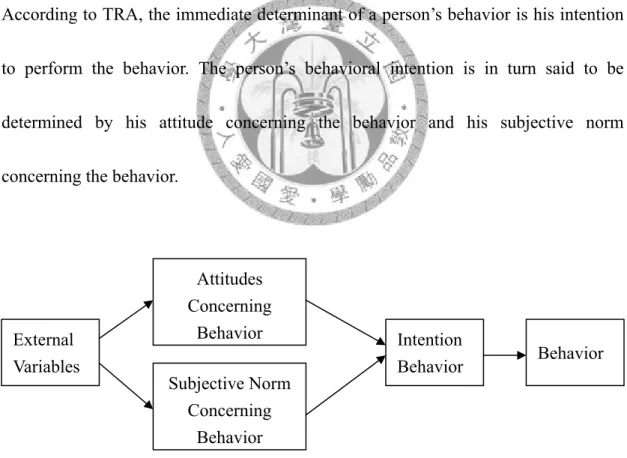
In 1975, Fishbein and Ajzen developed a well-supported behavioral theory called
Theory of Reasoned Action (TRA) that describes the psychological determinants of
behaviors, as shown in Figure 2.2 (Fishbein, 1980; Fishbein & Ajzen, 1975, 1977).
According to TRA, the immediate determinant of a person’s behavior is his intention
to perform the behavior. The person’s behavioral intention is in turn said to be
determined by his attitude concerning the behavior and his subjective norm
concerning the behavior.
Figure 2.2 Fishbein and Ajzen’s Theory of Reasoned Action External
Variables Intention Behavior
Behavior Attitudes
Concerning Behavior Subjective Norm
Concerning Behavior
Davis (1986; 1989; 1993) proposed the Technology Acceptance Model (TAM) to
investigate the impact of technology on user behavior. The model focuses on the
process of using technology, where “Perceived Usefulness” and “Perceived Ease of
Use” are the two key factors that affect an individual’s intention to use a technology.
Perceived Usefulness means that the user believes the technology will improve his/her
performance, while Perceived Ease of Use refers to the belief that using the
technology will be free of effort (Davis, 1989). Venkatesh and Davis (1996) suggested
that Perceived Usefulness and Perceived Ease of Use could be affected by external
variables. For example, they found that computer self-efficacy is an important
variable and assumed that a positive relationship exists between higher computer
self-efficacy on the one hand and Perceived Usefulness and Perceived Ease of Use on
the other. The studies of Venkatesh (2001) confirmed the hypotheses about positive
causal relationships posited in previous research.
Since Davis proposed TAM, several approaches that focus on the degree of
technological acceptance have been based on the model (Adams, Nelson & Todd,
1992; Igbaria, Guimaraes & Davis, 1995; Mathieson, 1991). However, TAM only
provides general information about whether a technology has been adopted by users.
Further information is needed regarding its use in specific fields, so that the
development of technology can be guided in the right direction (Mathieson, 1991).
With the development of Information Communication Technology, online learning
is becoming an increasingly important learning trend. A growing number of e-learning
systems and online courses are being applied by teachers in order to encourage
students to extend their learning after class. We have found that, in recent years, a
number of studies on education have used TAM to examine learners’ willingness to
accept e-learning systems (Lee, Cheung, & Chen, 2005; Liaw, 2007; Ngai, Poon, &
Chan, 2007; Ong, Lai, & Wang, 2004; Pan et al., 2005; Pituch & Lee, 2006; Raaij &
Schepers, 2006; Yi & Hwang, 2003) or online courses (Arbaugh, 2002; Arbaugh &
Duray, 2002; Gao, 2005; Landry, Griffeth, & Hartman, 2006; Selim, 2003). Overall,
e-learning systems have more abundant and diverse contents than online courses.
However, few studies have used TAM to examine the concept of online learning
communities. Based on TAM, as well as the extension and modification of the model
in accordance with related literature, we propose a new conceptual model that can
predict learners’ intentions to use an online learning community. The model includes
external variables, perceived variables, and outcome variables.
2.4 External variables
Perceived Usefulness and Perceived Ease of Use could be affected by the external
variables considered in the original TAM model. In this paper, we explore which
external variables directly or indirectly affect learners’ intentions to use an online
learning community. Conceptually, an online learning community is a microcosm of
the virtual community. Boczkowsk (1999) defined a virtual community formed
through interaction as a group of people pursuing common interests on the Internet
(Dennis, 1998; Foreman, 1999). By linking networks, people from different
backgrounds can study and discuss topics in a specific domain, and also share
knowledge with each other; hence they form an online learning community
(Heckscher & Donnellon, 1994). In our model, an online learning community is
composed of human elements and system elements. The former refers to the users of
the online learning community, including learners and instructors; and the latter refers
to computers connected to the Internet and used for learning activities, including
online courses and online learning systems.
From a human perspective, how a learner feels about using an online learning
community is our major concern in this study. The learner's previous learning
experience with computers and networks has a tremendous influence on participation
in an online learning curriculum (Reed & Geissler, 1995; Reed et al., 2000). Therefore,
we take Previous Online Learning Experience as one of our external variables and
discuss whether there it affects the other factors related to the use of an online
learning community.
Furthermore, it is widely recognized that, for students, the design of an online
course is the most important determinant of learning effectiveness (Fink, 2003). In our
opinion, the same holds true from the system’s viewpoint. Therefore, it is crucial that
instructors adopt the proper pedagogical strategy and technology when designing an
online learning course. From another perspective, a good interface design helps users
resolve technical problems that may arise when using a system (Metros & Hedberg,
2002). The interface design will not facilitate better learning outcomes if it is not
comprehensive or it does not meet users' needs (Wang & Yang, 2005).
Based on the above observations, the proposed model considers the influence of the
following three external variables of Intention to Use an Online Learning Community:
Online Course Design, User-interface Design, and Previous Online Learning
Experience. We explain the variables in detail and propose our hypotheses in the
following sub-sections.
2.4.1 Online Course Design
In general, the traditional learning method is paper-based, whereas the online
learning medium is Web-based; therefore, the type of content will play an important
role for learners in the design of an online course. McGiven (1994) observed that
Online Course Design is a key factor in determining the success or failure of online
learning. From the backward design model's viewpoint, the online course designer
should consider whether learners will be prepared to continue using the platform for
learning activities after they finish the current course (Wiggins, 1998). The
implication is that the quality of Online Course Design affects learners’ perceptions
about the ease of use and usefulness of such courses. In addition, Middleton (1997)
suggested that other factors affect the learner's perception of online learning, e.g.,
feelings of isolation and limited access to materials. Berge (1999) suggested that
Online Course Design should be considered from the viewpoint of interaction
between peers and instructors. Rovai (2004) also pointed out that the requirements of
learners should be considered when designing an online curriculum.
The central theme of the above studies is that the design of an online course
directly or indirectly affects learning efficiency. Therefore, in this research, we discuss
the relationship between Online Course Design and Perceived Usefulness, Perceived
Ease of Use, and Perceived Interaction individually. This leads to the following
hypotheses:
H1. Online Course Design will positively affect the Perceived Usefulness of an online
learning program.
H2. Online Course Design will positively affect Perceived Ease of Use of an online
learning program.
H3. Online Course Design will positively affect Perceived Interaction with an online learning community.
In this study, IWill plays a role of LMS (Learning Management System) offering
high school English teachers a platform for online courses. Usually, high school
teachers have face-to-face interaction with students by the means of traditional
classroom teaching. After class, location of learning has expanded from physical
space to cyberspace. Some of IWill teachers completed their teaching courses through
blended learning, traditional classroom and online courses.
Therefore, in this research, meaning of online courses is that teachers who
participate in IWill community use IWill platform to extend teaching and learning
outside of the class. Also, Online Course Design focuses on the programs that
teachers design to support physical teaching activities, including syllabuses,
self-learning materials, supplementary materials, multimedia files and so forth for
students to download and study after class. Meanwhile, teachers and students can
discuss issues related to English learning through Discussion Board.
2.4.2 User-interface Design
The quality of the User-interface Design is a critical factor when developing
information software. User-centered design is another important factor that should be
considered (McKnight et al., 1996). A well-designed user interface can help users
operate a system more easily and reduce their cognitive load (Jones et al., 1995;
Martin-Michiellot & Mendelsohn, 2000). From the viewpoint of Gestalt theory,
Leflore (2000) proposed some guidelines for the design of a user interface for online
instruction. He suggested that information should be arranged and integrated with
good figures and clear text so that it is easy for students to read and use. Moreover,
even a simple logo can clearly express a message. When we develop a Web-based
learning system, a user-friendly interface design would help users derive more
benefits (Najjar, 1996; Evans & Edwards, 1999). Liu et al. (2006) also noted that an
interactive interface design should quickly guide users to the correct way of learning.
Wang & Yang (2005) suggested that the following five principles of user-centered
design should be used to develop a user interface that can promote more interaction
between learners and the system. The principles are (1) make the most important
information distinct, (2) establish a visual order of importance for the user, (3)
organize information so that learners can see the “big” picture, (4) consistent button
design, and (5) visual feedback. These design principles have been adopted by a
number of researchers and organizations (IBM, 2004; Lohr, et al., 2007). When we
were developing the proposed system platform, we invited several instructors and
learners to participate in the project. Based on their feedback, we have designed a set
of authoring tools for instructors, so that they can design various types of online
learning curricula through the platform. The principles we followed for user-interface
design make the system easier to use and more interactive. Thus, we put forward the
following hypotheses:
H4. User-interface Design will positively affect the Perceived Ease of Use of an
online learning community.
H5. User-interface Design will positively affect Perceived Interaction with an online learning community.
2.4.3 Previous Online Learning Experience
Before discussing Previous Online Learning Experience, we should consider a
user’s previous learning experience with information and communication
technologies (ICT). Users may feel uncomfortable with computer assisted learning if
they lack experience in using a computer (Reed & Geissler, 1995). Research has
shown that Previous Online Learning Experience can affect learners’ perceptions of a
new online curriculum (Cereijo et al., 1999; Hartley & Bendixen, 2001). Song et al.
(2004) also noted that learners’ previous experience in using information technology
will affect the usefulness of future online learning activities. Before participating in
online learning, learners may perceive that a new system is easy to use if they have
detailed operating experience of the new IT (Adams et al., 1992; Straub, Keil, &
Brenner, 1997) and therefore spend relatively less time exploring the new system. In
addition, more satisfying experiences sometimes lead to better learning performance
in the future (Shih, Muroz, & Sanchez, 2006). The implication is that such a learning
style has Perceived Usefulness for learners. Arbaugh and Duray (2002) found that
students feel more satisfied with related online learning activities and are willing to
reuse them if they have had Previous Online Learning Experience. Thus, we propose
the following hypotheses:
H6. Previous Online Learning Experience will positively affect the Perceived
Usefulness of an online learning program.
H7. Previous Online Learning Experience will positively affect the Perceived Ease of
Use of an online learning program.
H8. Previous Online Learning Experience will positively affect the Intention to Use an Online Learning Community.
2.5 Perceived Variables
Perceived Usefulness and Perceived Ease of Use are two variables in the TAM
model used to explore the adoption of technology (Davis, Bagozzi, & Warshaw, 1989;
Davis, 1986, 1989, 1993). Perceived variable is a kind of psychological sense. In a
great number of researches about extended TAM model, perceived variable is mainly
used to measure the perception and belief created when a user adopts some kind of
technology. For examples: Perceived enjoyment (Lee, Cheung, & Chen, 2005; Teo,
Lim, & Lai, 1999; Igbaria, Iivari, & Maragahh, 1995; Yu et al., 2005; Hwang & Kim,
2007), perceived playfulness (Venkatesh & Davis, 2000; Moon & Kim, 2001; Lin, Wu,
& Tsai, 2005; Tao, Cheng, & Sun, 2009; Roca & Gagne, 2008), perceived interactivity
(Cyr, Head, & Ivanov, 2009; McMillan & Hwang, 2002). In Cyr et al. (2009)’s paper,
the goal of the investigation is to examine perceived interactivity in a proposed model
which explores usages of different web-poll interfaces. In McMillan & Hwang
(2002)’s research, it validated a measure of perceived interactivity, offering
researchers a tool for measuring consumer perception. The developed Measures of
Perceived Interactivity for a web-based interactivity investigation focused on a user’s
perception. The concept of perceived interaction was proposed by Newhagen, Cods,
& Levy (1995). It indicates a psychological sense in the interaction between message
senders and receivers. And the concept of perceived interaction is primarily based on
efficacy. This concept focuses on describing the relationship between a reader’s
psychological sense toward efficacy and an audience’s perceived interaction toward
media system. In addition, Wu (1999) defines perceived interaction as two types of
concepts: User’s browsing behavior and system response. He further examined two
e-cards websites, discovering that there was a positive relation between users’
perceived interaction and his/her evaluation toward the website.
In this study, we include a third variable, Perceived Interaction, in our proposed
model and examine its relationship with and impact on each of the other variables,
and whether or not it affects the Intention to Use an Online Learning Community.
2.5.1 Perceived Ease of Use and Perceived Usefulness
In TAM, the behavioral intentions of users regarding technology are affected by
two variables: Perceived Ease of Use and Perceived Usefulness. The former affects
the latter, which means that if users feel the system is easy to use, they will feel that
online learning is useful and they will be prepared to use the technology. The causal
relationship that exists between these two variables has been confirmed by a number
of empirical studies (e.g., Davis, 1989, 1993; Venkatesh & Davis, 1996). The
Technology Acceptance Model proposed by Davis predicts whether users will adopt a
general purpose technology, without focusing on a specific topic (Pituch & Lee, 2006).
In contrast, the current study extends TAM by focusing on specific topics and
exploring the Intention to Use an Online Learning Community. Moreover, certain
parts of Davis and Wiedenbeck’s (2001) proposed model, consider the relationship
between Perceived Ease of Use and Interaction. In their empirical study, they define
several kinds of interaction styles and demonstrate that the two factors have a
statistically significant relationship. Therefore, we also examine the relationship
between both factors in the proposed model.
2.5.2 Perceived Interaction
ICT-supported learning in education has been popular for a long time, and the
electronic media have improved in parallel with the development of technology.
Initially, audio, video, and CD-ROM teaching aids were used as the main online
tuition methods, but they have gradually been replaced by Web-based systems.
Viewed from the level of interaction, the process has evolved from one-way
human-system interaction to two-way instructor-learner interaction. The participants
enhance the communication of knowledge and sharing by interaction with others in
the online learning community. It has been suggested that knowledge is created
through a series of processes whereby individuals interact with each other to share,
recreate, and amplify knowledge (Nonaka & Nishiguchi, 2001). If learners are willing
to increase interaction with their instructors or peers, they will build on their
knowledge construction and have the opportunity to get to know each other. Such
interaction also affects the behavioral intention to use e-learning (Liaw et at., 2007).
Moreover, Cantoni et al. (2004) stressed that interaction between learners could be
improved by using games, quizzes, chat rooms, discussion boards, instant messenger
and email during online learning.
In this study, Perceived Interaction is defined as follows. When learners join an
online learning community, they perceive two types of interaction: human-system
interaction and interpersonal interaction. The former derives from the operating
environment of the online course; and the latter is the result of interaction with peers
and instructors. We focus on the characteristics of online learning, and try to develop
an online learning community from the perspective of the two types of interaction.
Thus, we put forward the following hypotheses:
H9. Perceived Ease of Use will positively affect the Perceived Usefulness of an online
learning program.
H10. Perceived Ease of Use will positively affect the Perceived Interaction with an
online learning program.
H11. Perceived Usefulness will positively affect the Intention to Use an Online
Learning Community.
H12. Perceived Ease of Use will positively affect the Intention to Use an Online
Learning Community.
H13. Perceived Interaction will positively affect the Intention to Use an Online Learning Community.
2.6 Outcome Variables
There are two outcome variables in the original TAM, namely Intention Behavior
and System Use. The model tries to predict the behavioral intentions of users, i.e.,
predict whether they will adopt a particular information technology. However, we
would like to know whether users are willing to adopt an online learning community.
Therefore, we incorporate Intention to Use an Online Learning Community as an
extra outcome variable in our research model.
2.7 Summary
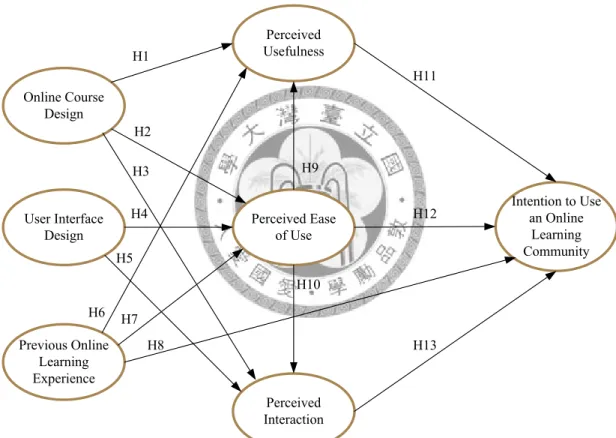
Based on the above theoretical variables, we present our research model and
discuss the relationships between all the factors that influence an online learning
community. The proposed model is illustrated in Figure 2.3.
Online Course Design
User Interface Design
Previous Online Learning Experience
Intention to Use an Online
Learning Community Perceived
Usefulness
Perceived Ease of Use
Perceived Interaction H1
H2
H6 H7
H8
H9
H10
H11
H12
H13 H4
H5 H3
Figure 2.3 The proposed research model
Chapter 3: The Design of an Online Learning Community
3.1 IWiLL
In Taiwan, English learning has become essential because of the need to connect
with the international community. High school students must reach a certain level of
English proficiency before going to college. In recent years, the government has
promoted the General English Proficiency Test (GEPT) to assess students’ English
skills. All students are encouraged to take the test because it provides a fair
assessment of their English proficiency level.
Intelligent Web-based Interactive Language Learning (IWiLL,
http://www.iwillnow.org) is a Taiwanese online learning community for people who
wish to learn a foreign language. The community was established in 2000 and
continually renews the system’s functions, online curricula, and relevant learning
activities (Wible, 2004). Sponsored by the Ministry of Education and the National
Science Council of Taiwan, IWiLL is now used in over 200 senior high schools, and
has about 100,000 students, 2,000 teachers, and 15,000 end-users throughout the
country. In addition, a nationwide English reading contest, called Reading Club, is
held every year and usually attracts thousands of students. The IWiLL platform is
being developed towards UWiLL (Ubiquitous Web-based Interactive Language
Learning), which will allow users to learn English in a ubiquitous environment. Next,
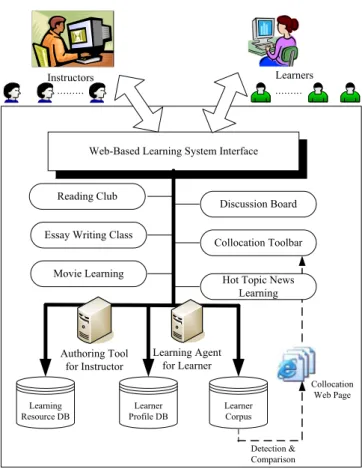
we introduce the important elements and functions of IWiLL. The framework is
illustrated in Figure 3.1.
Web-Based Learning System Interface
Reading Club Essay Writing Class
Movie Learning
Discussion Board Collocation Toolbar
Hot Topic News Learning
Learning Resource DB
Learner Profile DB
Learner Corpus Learning Agent
for Learner Authoring Tool
for Instructor
Collocation Web Page
Detection &
Comparison
Instructors Learners
……… ………
Figure 3.1 Framework of the IWiLL online learning community
(1) Learner
This is a learner-centered design that emphasizes interaction with peers and
instructors through the platform.
(2) Instructor
IWiLL instructors are teachers in senior high schools nationwide.
(3) Essay writing class
An interactive online writing curriculum is provided, and students are taught to
write in English through some teaching guides. The instructors edit and grade the
essays online and provide feedback to the learners.
(4) Movie learning
Teachers can select dozens of classical films and let students learn English by
watching them and studying the content, vocabulary, and phrases used in the
dialogue. If students want to know how a word or phrase in the dialogue of a film
should be used, they can conduct a keyword search to find the corresponding
segment of the film.
(5) Learning through hot news
IWiLL English teachers are always available to guide students in their learning
activities, and inspire learners through interactive discussion of hot news. For
example, the teacher may say: “We all know that Chien-Ming Wang is considered
one of the best pitchers in the Major League, but do you know his best pitch?”
(6) Discussion board
This is an authoring tool that allows a teacher to insert dedicated discussion boards
anywhere in the lesson flow. These are also spaces for learners to discuss English
learning with each other, and learners can post problems they encounter on the
discussion board to share with their peers. Teachers will also help learners find
solutions to the problems.
(7) Authoring tools for instructors and the learning resource database
IWiLL provides a series of advanced authoring tools for instructors to edit and
produce online English teaching materials that meet learners’ needs. After the
materials have been edited, they are stored in the learning resource database so that
other teachers can use them.
(8) Learner profile database
This database contains the personal profile and learning portfolio of each learner.
(9) Collocation toolbar and learner corpus
When learning English as a foreign language, beginners often make collocation
mistakes. A collocation is composed of two words. For example, “take medicine” is
a collocation, and “buy medicine” is a free combination (Wible et al., 2006). A
ubiquitous mechanism, called a collocator, is provided to help users with this
problem. When users randomly browse a webpage, the collocator automatically
detects whether there are any collocations appear in the article. If any collocations
are found, the system will highlight them for the user and compare them with the
learner corpus to detect corresponding collocations.
3.2 Reading Challenge
In this section, we will describe the details of Reading Challenge and the difference
between other contests.
3.2.1 Introduction of Reading Challenge contest
IWiLL regularly holds a nationwide English reading contest – Reading Challenge.
It has been held since 2000, and thousands of high school students have participated
in this contest. The details of the contest are described as follows:
(1) Purpose
The purpose of the contest is to test the English reading comprehension of students
from the online learning community.
(2) Goals
a. To introduce excellent English books in order to cultivate students’ interest in
reading.
b. To promote the habit of reading and strengthen the motivations of students to learn.
c. To improve the English reading proficiency of students and enrich their
understanding of a different culture.
(3) Activity Period
Every year, this contest starts from the beginning of summer break to the end.
(4) Participants
People who would participate in the Reading Challenge contest must first join the
IWiLL online learning community as an online member.
(5) Rules
a. Participants should select any novels from the Reading Challenge lists, including
six books for beginners, three for basic level, intermediate level, and advanced
level, respectively.
b. Participants must add in the books they choose to personal bookcases before
starting the challenge activity.
c. After reading every novel, participants start to answer 20 questions at most in a
comprehension test. The test time is 15 minutes. Participants can leave during the
process of the test. The computer will automatically store the answers and progress.
When they return to the test, they will begin from the next question. Time will
continue to be calculated until 15 minutes has expired. (The Beginner reading has
20 questions at most and the examination time is 10 minutes.)
d. In order to pass the comprehensive test, participants must score 80 points or higher.
Furthermore, participants may retake the test as many times as necessary in order to
pass.
e. While participating in the contest, participants will have access to discussion boards
through which they can interact with other participants. The numbers of articles and
discussion posts made by participants on the website during the contest will affect
each participant’s final score.
The contest style of IWiLL has changed since the 13th Reading Challenge in 2009.
From the online learning environment perspective, members own their individual
learning blog, My Cube, allowing the rest of the internet to know what they think and
what they learn. Additionally, participants join the Reading Club they like for more
discussion and interaction. My Cube also allows users to add friends in their lists for
knowledge and ideas sharing. Furthermore, participants in the Reading Club can read
other members’ comments on books to understand more about them. They can also
run learning blog My Cube to establish personal sharing spaces and present their ideas
on the reading. Lastly, members can share their own learning experiences and further
encourage others to earn rewards and prizes.