chapt 1
er
Business Essentials, 7
thEdition Ebert/Griffin
The U. S. Business Environment
Professor Shyue-Ping Chi
Department of Information Management
Fu Jen Catholic University
After reading this chapter, you should be able to:
1. Define the nature of U.S. business and identify its main goals and functions.
2. Describe the external environments of business and discuss how these environments affect the success or failure of any organization.
3. Describe the different types of global economic systems according to the means by which they control the factors of production.
4. Show how markets, demand, and supply affect resource distribution in the United States.
© 2009 Pearson Education, Inc.
L E A R N I N G O B J E C T I V E S
L E A R N I N G O B J E C T I V E S
After reading this chapter, you should be able to:
5. Identify the elements of private enterprise and explain the various degrees of competition in the U.S. economic system.
6. Explain the importance of the economic
environment to business and identify the factors used to evaluate the performance of an economic system.
L E A R N I N G O B J E C T I V E S (cont’d)
L E A R N I N G O B J E C T I V E S (cont’d)
The Concept of Business and Profit
• Business
– An organization that provides goods or services that are then sold to earn profits.
• Profits
– The difference between a business’s revenues and its expenses. The rewards owners get for risking their money and time.
• Consumer Choice and Demand
– The freedom of consumers to choose how to satisfy their wants and needs.
– The freedom of business owners to decide how to meet those wants and needs.
• Opportunity and Enterprise
– Success in business requires spotting a promising opportunity and then developing a good plan for capitalizing on it.
The Concept of Business and Profit (cont.)
• The Benefits of Business
– Provision of goods and services – Employment of workers
– Innovation and opportunities
– Increased quality of life and standard of living
– Enhanced personal incomes of owners and stockholders – Tax payments support government
– Support for charities and community leadership
The External Environments of Business
• External Environment
– Everything outside an organization’s boundaries that might affect it
• The domestic business environment
• The global business environment
• The technological environment
• The political-legal environment
• The sociocultural environment
• The economic environment
The External Environments of Business (cont.)
• Domestic Business Environment
– The environment in which a firm conducts its operations and derives its revenues by:
• Seeking to be close to its customers
• Establishing strong relationships with its suppliers
• Distinguishing itself from its competitors
The External Environments of Business (cont.)
• Global Business Environment
– The international forces that affect a business:
• International trade agreements
• International economic conditions
• Political unrest
• International market opportunities
• Suppliers
• Cultures
• Competitors
• Currency values
The External Environments of Business (cont.)
• Technological Environment
– All the ways by which firms create value for their constituents:
• Human knowledge
• Work methods
• Physical equipment
• Electronics and telecommunications
• Various business activity processing systems
The External Environments of Business (cont.)
• Political-Legal Environment
– The regulatory relationship between business and the government (legal system) and its agencies that define what organizations can and can’t do:
• Product identification laws
• Local zoning requirements
• Advertising practices
• Safety and health considerations
• Acceptable standards of business conduct
– Pro- or anti-business sentiment in government and political stability are also important considerations, especially for international firms.
The External Environments of Business (cont.)
• Sociocultural Environment
– The customs, mores, values, and demographic characteristics of the society in which an
organization functions
– Sociocultural processes determine the goods,
services, and standards of business conduct a
society is likely to accept
The External Environments of Business (cont.)
• Economic Environment
– The relevant conditions that exist in the economic system in which a company operates
– Examples:
• If an economy is doing well enough that most people have jobs, a growing company may find it necessary to pay higher wages and offer more benefits in order to attract workers from other
companies.
• If many people in an economy are looking for jobs, a firm may be able to pay less and offer fewer benefits.
Economic Systems
• Economic System
– A nation’s system for allocating its resources among its citizens, both individuals and organizations
• Factors of Production
– Labor: Human resources – Capital: Financial resources
– Entrepreneurs: Persons who risk starting a business – Physical resources: Tangible things used to conduct
business
– Information resources: Data and other information used by
businesses
Types of Economic Systems
• Planned Economy
– A centralized government controls all or most factors of production and makes all or most production and
allocation decisions for the economy.
• Market Economy
– Individual producers and consumers control production and allocation by creating combinations of supply and demand.
• Market
– A mechanism of exchange between buyers and sellers of a
good or service.
Planned Economies
• Communism
– A system Karl Marx envisioned in which individuals would contribute according to their abilities and receive benefits according to their needs.
• The government owns and operates all factors of production.
• The government assigns people to jobs and owns all
businesses and controls business decisions.
Market Economics
• Capitalism
– The government supports private ownership and encourages entrepreneurship.
– Individuals choose where to work, what to buy, and how much to pay.
– Producers choose who to hire, what to produce, and how much to charge.
• Mixed Market Economy
– Features characteristics of both planned and market economies.
– Privatization: The process of converting government enterprises into privately owned companies.
– Socialism: The government owns and operates select major industries such as banking and transportation. Smaller businesses are privately owned.
The Economics of Market Systems
• Demand
– The willingness and ability of buyers to purchase a product (a good or a service).
• Supply
– The willingness and ability of producers to offer a good or service for sale.
• The Laws of Demand and Supply in a Market Economy
– Demand: Buyers will purchase (demand) more of a product as its price drops and less of a product as its price increases.
– Supply: Producers will offer (supply) more of a product for sale as its price rises and less of a product as its price drops.
Demand and Supply in a Market Economy
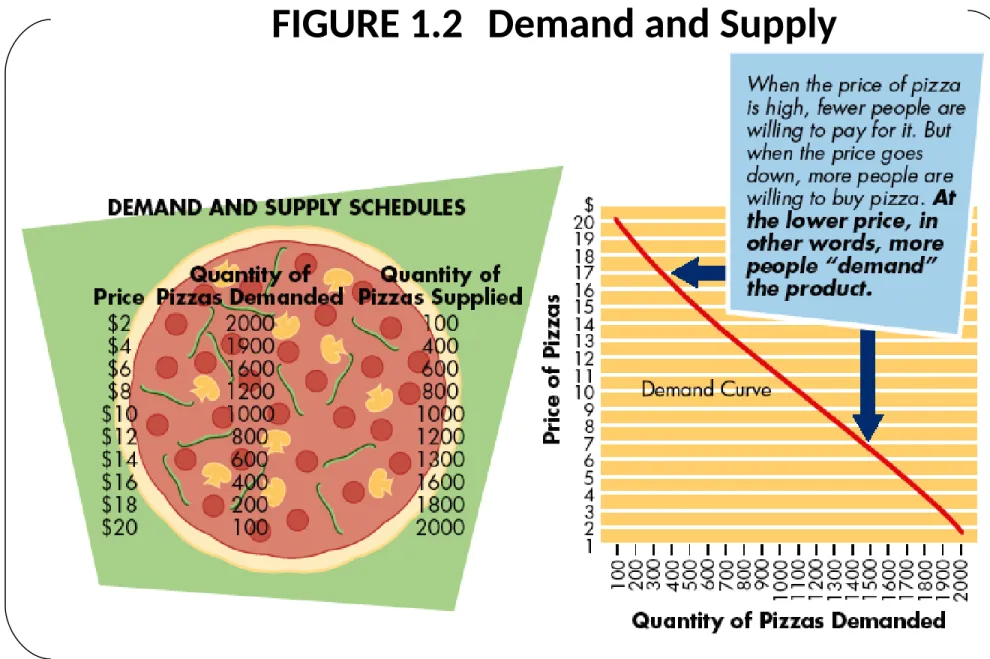
• Demand and Supply Schedule
– The relationships among different levels of demand and supply at different price levels as obtained from marketing research, historical data, and other studies of the market.
• Demand curve: How much product will be demanded (bought) at different prices.
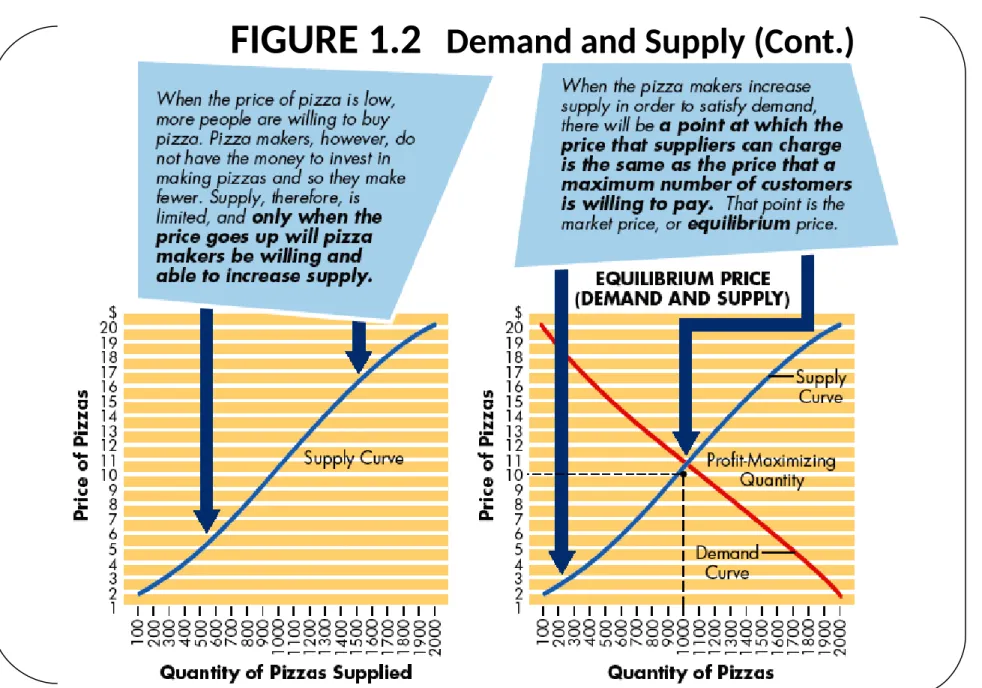
• Supply curve: How much product will be supplied (offered for sale) at different prices.
• Market price (equilibrium price): The price at which the quantity of goods demanded and the quantity of goods supplied are equal.
FIGURE 1.2 Demand and Supply
FIGURE 1.2 Demand and Supply (Cont.)
Surpluses and Shortages
• Surplus
– A situation in which the quantity supplied exceeds the quantity demanded
• Causes losses
• Shortage
– A situation in which the quantity demanded will be greater than the quantity supplied
• Causes lost profits
• Invites increased competition
Private Enterprise in a Market Economy
• Private Enterprise System
– Allows individuals to pursue their own interests with minimal government restriction.
• Elements of a Private Enterprise System
– Private property rights – Freedom of choice
– Profits
– Competition
Degrees of Competition
• Perfect Competition
– Prices are determined by supply and demand because no single firm is powerful enough to influence the price of its product.
• All firms in an industry are small.
• The number of firms in the industry is large.
– Principles of perfect competition:
• Buyers view all products as identical.
• Buyers and sellers know the prices that others are paying and receiving in the marketplace.
• It is easy for firms to enter or leave the market.
• Prices are set exclusively by supply and demand and accepted by both sellers and buyers.
Degrees of Competition (Cont.)
• Monopolistic Competition
– There are numerous sellers trying to differentiate their products from those of competitors so as to have some control over price.
– There are many sellers, though fewer than in pure competition.
– Sellers can enter or leave the market easily.
– The large number of buyers relative to sellers applies
potential limits to prices.
Degrees of Competition (Cont.)
• Oligopoly
– An industry with only a few large sellers.
– Entry by new competitors is hard because large capital investment is needed.
– The actions of one firm can significantly affect the sales of every other firm in the industry.
– The prices of comparable products are usually similar.
– As the trend toward globalization continues, most experts
believe that oligopolies will become increasingly prevalent.
Degrees of Competition (Cont.)
• Monopoly
– An industry or market that has only one producer (or else is so dominated by one producer that other firms cannot
compete with it).
• The sole supplier enjoys complete control over the prices of its
products; its only constraint is a decrease in consumer demand due to increased prices.
– Natural monopolies: Industries in which one firm can most efficiently supply all needed goods or services; typically
allowed and regulated by legislated acts and governmental agencies.
• Example: Electric company
Economic Indicators
• Economic Indicators
– Statistics that show whether an economic system is strengthening, weakening, or remaining stable
– Measure key goals of the U.S. economic system: economic growth and economic stability
– Economic growth indicators
• Aggregate output, standard of living, gross domestic product, and productivity
– Economic stability indicators
• Inflation and unemployment
Economic Growth, Aggregate Output, and Standard of Living
• Business Cycle
– The pattern of short-term ups and downs (or, better, expansions and contractions) in an economy.
• Aggregate Output
– Growth during the business cycle is measured by the total quantity of goods and services produced by an economic system during a given period.
• Standard of Living
– The total quantity and quality of goods and services that
consumers can purchase with the currency used in their
economic system.
Economic Indicators (cont.)
• Gross Domestic Product (GDP)
– An aggregate output measure of the total value of all goods and services produced within a given period by a national economy through domestic factors of production.
• If GDP is going up, aggregate output is going up; if aggregate output is going up, the nation is experiencing economic growth.
• Gross National Product (GNP)
– The total value of all goods and services produced by a
national economy within a given period, regardless of
where the factors of production are located.
Economic Indicators (cont.)
• Real Growth Rate
– The growth rate of GDP adjusted for inflation and changes in the value of the country’s currency
• Growth depends on output increasing at a faster rate than population.
• Real GDP
– GDP that has been adjusted to account for
changes in currency values and price changes.
Economic Indicators (cont.)
• Nominal GDP
– GDP measured in current dollars or with all components valued at current prices.
• GDP per Capita
– A reflection of the standard of living: GDP per capita means GDP per person.
– It is a better measure of the economic well-being
of the average person than GDP itself.
Economic Indicators (cont.)
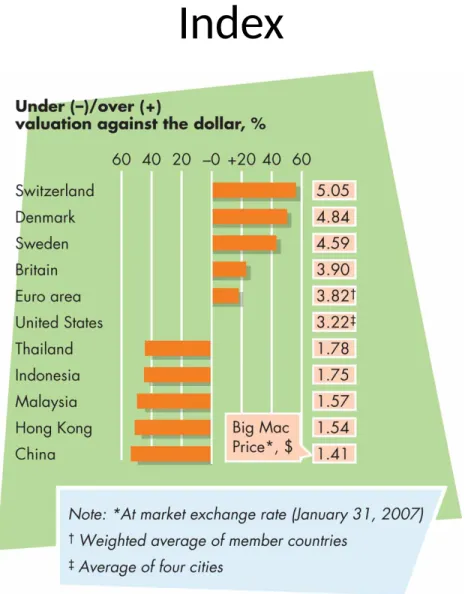
• Purchasing Power Parity
– The principle that exchange rates are set so that the prices of similar products in different countries are about the
same.
– Indicates what people can buy with the financial resources
allocated to them by their respective economic systems—a
better sense of standards of living across the globe.
FIGURE 1.3 Purchasing Power Parity – Big Mac
Index
Economic Growth
• Productivity
– A measure of economic growth that compares how much product a system produces with the resources needed to produce that product.
• If more product is produced with fewer factors of production, the price of the product decreases.
• The standard of living in an economy improves through
increases in productivity.
Economic Growth (cont.)
• Balance of Trade
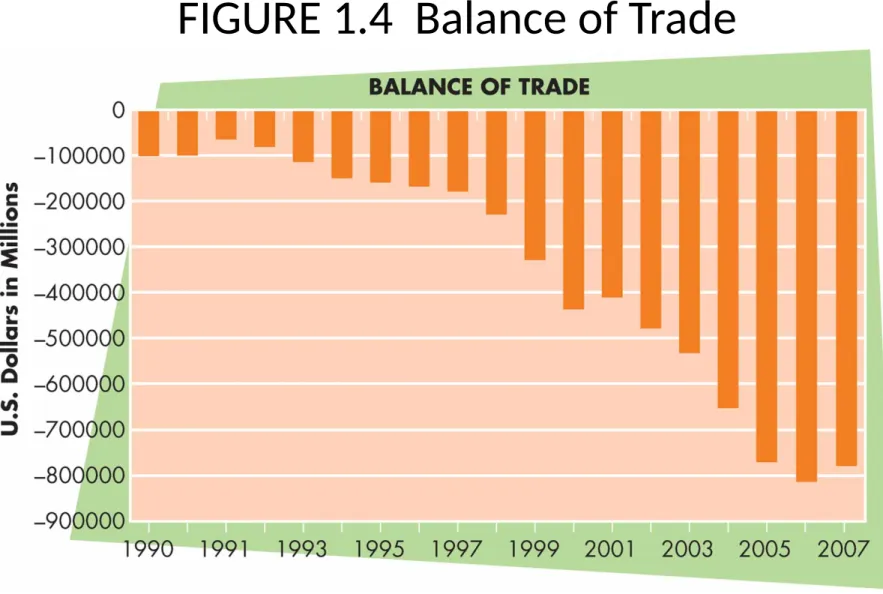
– The economic value of all the products a country exports minus the economic value of its imported products.
• Positive balance of trade: When a country exports (sells to other countries) more than it imports (buys from other countries).
• Negative balance of trade: When a country imports more than it exports. Commonly called a trade deficit.
Balance of Trade
• How does a trade deficit affect economic growth?
– The deficit exists because the amount of money spent on foreign products has not been paid in full. In effect,
therefore, it is borrowed money, and borrowed money costs more money in the form of interest.
– The money that flows out of the country to pay off the
deficit cannot be used to invest in productive enterprises,
either at home or overseas.
FIGURE 1.4 Balance of Trade
Economic Growth (cont.)
• National Debt
– The amount of money that the government owes its creditors.
• Financed by borrowing in the form of bonds: Securities through which the government promises to pay buyers certain amounts of money by specified future dates.
• Government competition with potential borrowers for available loan money reduces private borrowing for investments that would increase productivity.
Economic Growth (cont.)
• Stability
– A condition in which the amount of money available in an economic system and the quantity of goods and services produced in it are growing at about the same rate.
• Inflation
– Inflation occurs when the amount of money injected into an economy exceeds the increase in actual output,
resulting in price increases exceeding purchasing power increases.
• Inflation rate: The percentage change in a price index such as the CPI.
Economic Indicators
• Consumer Price Index (CPI)
– A measure of the prices of typical products purchased by consumers living in urban areas
• Compared against base period—an arbitrarily selected time period against which other time periods are
compared.
Economic Growth (cont.)
• Unemployment
– The level of joblessness among people actively seeking work in an economic system
• Low unemployment—a shortage of labor available for businesses to hire; results in higher wages.
• Higher wages reduce hiring, which increases unemployment;
results in lower wages.
• Cyclical Unemployment
– Businesses continuing to eliminate jobs during a business
cycle downturn cause more reduced revenues and further
job losses.
Economic Growth (cont.)
• Recession
– A period during which aggregate output, as measured by real GDP, declines
• Depression
– A prolonged and deep recession
Managing the U.S. Economy
• Fiscal Policy
– The ways in which a government collects and spends revenues.
• Tax rates can play an important role in fiscal policy.
• Monetary Policy
– The manner in which a government controls its money supply.
– Working mainly through the Federal Reserve System, the government can influence banks’ willingness to lend money and prompt interest rates to go up or down.
• Stabilization Policy
– Coordinating fiscal and monetary policies to smooth fluctuations in output and unemployment and to stabilize prices.
Key Terms
aggregate output balance of trade business
business cycle capital
capitalism communism competition
consumer price index demand
demand and supply schedule demand curve
depression
domestic business environment
economic environment economic indicators economic system entrepreneur
external environment factors of production fiscal policies
global business environment gross domestic product (GDP) gross national product (GNP) inflation
information resources labor (human resources) law of demand
Key Terms (cont.)
law of supply market
market economy
market price (equilibrium price) mixed market economy
monetary policies
monopolistic competition monopoly
national debt
natural monopoly nominal GDP
oligopoly
perfect competition physical resources
planned economy
political-legal environment private enterprise
privatization productivity profits
purchasing power parity real GDP
recession shortage socialism
sociological environment stability
stabilization policy