數位國情總綱調查(6)
─區域數位分級與 數位國情世代進展研析
國 家 發 展 委 員 會 編 印
中華民國 108 年 2 月
數位國情總綱調查(6)
─區域數位分級與 數位國情世代進展研析
受委託單位:臺灣電子治理研究中心 計畫主持人:廖興中
協同主持人:朱斌妤、黃婉玲 研究顧問:洪永泰、黃東益
研究助理:李洛維、楊閔筑、王昱文、陳順穆、
李 荃、蕭宏倉
國 家 發 展 委 員 會 編 印
中華民國 108 年 2 月
I
目次
目次 ... I 表次 ... III 圖次 ... IX 摘要 ... XI ABSTRACT ... XVIII
第一 章 緒論 ...1
研究背 景 ...1
研究目 的 ...3
第二 章 文獻 分析 ...9
數位國 情與 公共 價值 ...9
網路的 負面 影響 ...18
第三 章 研究 設計 ...41
第四 章 數位 治理 公共 價值 發展 的國 情分 析 ...51
操作性 價值 ...51
政治性 價值 ...58
社會性 價值 ...76
網路負 面影 響調 查結 果分 析 ...93
公共價 值不 同族 群比 較 ... 115
電子治 理公 共價 值正 向意 見變 化趨 勢 ... 128
電子治 理公 共價 值不 同年 齡層 六年 前後 態度 比較 ... 136
各調查 方法 受訪 者的 基本 資料 比較 ... 167
第五 章 網路 巨量 輿情 分析 與比 較 ... 189
網路輿 情的 變化 趨勢 ... 189
網路輿 情分 析與 問卷 調查 結果 之比 較 ... 205
II
第六 章 結論 與建 議 ... 211
研究發 現摘 要 ... 211
政策建 議 ... 219
後續研 究建 議 ... 225
參考 文獻 ... 229
附錄 ... 233
附錄一 、 調查問 卷 ... 233
附錄二 、 問卷題 目修 正一 覽表 ... 256
III
表次
表 1: 臺灣 電子 治理 公共 價 值架 構指 標定 義 ... 15
表 2: 陳氏 網路 成癮 量表 ( CIAS-26) ... 32
表 3: 網路 使用 習慣 量表 ( CIAS-10) ... 34
表 4: 數位 國情 研究 設計 摘 要 ... 41
表 5: 各種 調查 法所 包含 題 目面 向與 題目 數 ... 44
表 6: 2013-2018 年 各 調 查 方法 回收 之樣 本數 ... 47
表 7: 問卷 中政 策議 題相 關 題目 ... 50
表 8: 服務 流程 簡 化 1- 電子 治理 對民 眾洽 公手 續簡 化 的影 響 ... 52
表 9: 服務 滿意 度增 加 1-民 眾對 政府 網站 提供 資訊 的 滿意 度 ... 53
表 10: 服 務滿 意度 增加 2- 民眾 對政 府網 站提 供服 務的 滿意 度表 ... 54
表 11: 服 務滿 意度 增加 3- 民眾 對政 府主 動服 務的 滿意 度表 ... 55
表 12: 服 務項 目增 加 1─民 眾對 政府 服務 項目 的增 減 ... 57
表 13: 政 治透 明 1─從 政府 網站 搜尋 到法 律規 定相 關資 訊的 容易度 58 表 14: 政 治透 明 2─從 政府 網站 搜尋 到政 策相 關資 訊的 容易 度 ... 59
表 15: 行 政透 明 1─從 網路 上查 到政 府線 上服 務的 流程 ... 61
表 16: 行 政透 明 2─從 網路 上查 到政 府線 上服 務處 理進 度的 容易度 62 表 17: 行 政課 責 1─容 不容 易找 到業 務承 辦人 來處 理問 題 ... 63
表 18: 公 共事 務參 與的 網路 行為 1─ 透過 社群 網站 傳遞 公共 議題 ... 64
表 19: 公 共事 務參 與的 網路 行為 2─ 參加 網路 號召 的現 場活 動 ... 65
表 20: 公 共事 務參 與的 網路 行為 3─ 網路 討論 區提 出公 共問 題看法 67 表 21: 電 子化 政府 服務 使用 意願 1─ 透過 政府 網站 做「 線上 申請」 68 表 22: 電 子化 政府 服務 使用 意願 2─ 使用 政府 網站 來查 資料 或表達 意 見 ... 69
表 23: 網 路中 的政 治效 能感 1─ 因為 網路 所以 政府 官員 更在 乎民眾 的 想 法 ... 70
IV
表 24: 網 路中 的政 治效 能感 2─ 因為 網路 民眾 更了 解政 治 ... 71
表 25: 實 體公 民參 與中 的政 治效 能感 1─ 政府 不會 在乎 我們 一般民 眾 的 想 法... 73
表 26: 實 體公 民參 與中 的政 治效 能感 2─ 民眾 對政 府的 作為 沒有影 響 力 ... 74
表 27: 政 治參 與行 為 1─民 眾參 與 2016 年 總統 選舉 的投 票 ... 75
表 28: 政 治信 任 1─政 府所 做的 是大 多數 是正 確的 ... 76
表 29: 政 治信 任 2─政 府會 不會 把民 眾福 利作 為優 先考 量 ... 77
表 30: 網 路信 任 1─網 路上 的朋 友能 不能 相信 ... 79
表 31: 網 路信 任 2─網 路上 的資 訊能 不能 信任 ... 80
表 32: 對 電子 化政 府的 信任 1─ 透過 網路 就能 處理 好事 情 ... 81
表 33: 對 電子 化政 府的 信任 2─ 政府 網站 上提 供的 資訊 可不 可靠 ... 82
表 34: 教 育學 習 1─利 用網 路來 查證 資料 的頻 率 ... 83
表 35: 人 際關 係 1─網 路對 家人 關係 的變 化 ... 85
表 36: 人 際關 係 2─網 路對 朋友 關係 的變 化 ... 86
表 37: 人 際關 係 3─使 用線 上通 訊軟 體和 別人 聯絡 的頻 率 ... 87
表 38: 人 際關 係 4─在 社群 網站 上張 貼訊 息的 頻率 ... 88
表 39: 人 際關 係 5─在 網路 上張 貼作 品的 頻率 ... 89
表 40: 人 際關 係 6─在 網路 上轉 貼或 分享 連結 、作 品的 頻率 ... 91
表 41: 生 活滿 意度 ─網 路時 代生 活快 樂程 度。 ... 92
表 42: 網 路成 癮 1─想 上網 而無 法上 網時 ,會 感到 坐立 不安 ... 94
表 43: 網 路成 癮 2─一 段時 間沒 有上 網, 會覺 得心 裡不 舒服 ... 96
表 44: 網 路成 癮 3─每 週上 網休 閒的 時間 比以 前增 加許 多 ... 97
表 45: 網 路成 癮 4─因 熬夜 上網 休閒 ,導 致白 天精 神或 體力 很差 ... 98
表 46: 網 路霸 凌 1─遭 受到 網路 霸凌 ... 100
表 47: 網 路霸 凌 2─收 過色 情騷 擾與 言語 辱罵 電郵 ... 101
表 48: 網 路隱 私 1─擔 心網 路隱 私被 侵犯 ... 103
表 49: 網 路隱 私 2─擔 心被 政府 侵犯 網路 隱私 ... 105
V
表 50: 網 路隱 私 3─擔 心被 民間 企業 公司 侵犯 網路 隱私 ... 107
表 51: 網 路言 論自 由 1─網 路表 達政 治看 法是 安全 的 ... 109
表 52: 網 路言 論自 由 2─網 路上 能暢 所欲 言的 批評 政府 ... 111
表 53: 網 路言 論自 由 3─極 端言 論在 網路 上也 應受 保障 ... 113
表 54: B1-1 政 府 網 站資 訊滿 意度 與職 業交 叉分 析 ... 116
表 55: B1-2 政 府 網 路服 務滿 意度 與職 業交 叉分 析 ... 117
表 56: B1-3 政 府 主 動服 務滿 意度 與職 業交 叉分 析 ... 117
表 57: F3-2 網 友 可 信任 度與 職業 交叉 分 析 ... 118
表 58: F3-5 網 路 資 訊可 信任 度與 職業 交 叉分 析 ... 120
表 59: F4-2 對 電 子 化政 府的 信 任 1 與 職業 交 叉分 析 ... 121
表 60: F4-3 對 電 子 化政 府的 信 任 2 與 職業 交 叉分 析 ... 122
表 61: B1-1 政 府 網 站資 訊滿 意度 與居 住地 交叉 分析 ... 123
表 62: B1-2 政 府 網 路服 務滿 意度 與居 住地 交叉 分析 ... 123
表 63: B1-3 政 府 主 動服 務滿 意度 與居 住地 交叉 分析 ... 124
表 64: F3-2 網 友 可 信任 度與 職業 交叉 分 析 ... 125
表 65: F3-5 網 路 資 訊可 信任 度與 居住 地 交叉 分析 ... 126
表 66: F4-2 對 電 子 化政 府的 信 任 1 與 居住 地 交叉 分析 ... 126
表 67: F4-3 對 電 子 化政 府的 信 任 2 與 居住 地 交叉 分析 ... 127
表 68: 2013 與 2018 不 同 年 齡 層 分析 樣本 數 ... 137
表 69: 政 府運 用 ICTs 不 同 年 齡 層 六年 前後 態度 比較 ... 138
表 70: 政 府網 站資 訊滿 意度 不同 年齡 層六 年前 後態 度比 較 ... 140
表 71: 政 府網 路服 務滿 意度 不同 年齡 層六 年前 後態 度比 較 ... 142
表 72: 政 府網 站提 供服 務數 目認 知不 同年 齡層 六年 前後 態度 比較 145 表 73: 行 政透 明認 知世 代不 同年 齡層 六年 前後 態度 比較 ... 147
表 74: 行 政課 責認 知不 同年 齡層 六年 前後 態度 比較 ... 149
表 75: 電 子化 政府 服務 使用 行為 不同 年齡 層六 年前 後態 度比 較 .... 151
表 76: 電 子化 政府 使用 意願 不同 年齡 層六 年前 後態 度比 較 ... 154
表 77: 政 治效 能感 不同 年齡 層六 年前 後態 度比 較 ... 156
VI
表 78: 網 友可 信任 度世 代差 異分 析 ... 158
表 79: 網 路資 訊可 信任 度不 同年 齡層 六年 前後 態度 比較 ... 160
表 80: 對 電子 化政 府信 任度 1 不 同年 齡層 六年 前後 態度 比較 ... 163
表 81: 對 電子 化政 府信 任度 2 不 同年 齡層 六年 前後 態度 比較 ... 165
表 82: 不 同調 查方 法比 較 --整 體 受訪 者性 別 ... 167
表 83: 不 同調 查方 法比 較 --整 體 受訪 者年 齡 ... 169
表 84: 不 同調 查方 法比 較 --整 體 受訪 者教 育程 度 ... 170
表 85: 不 同調 查方 法比 較 --整 體 受訪 者居 住地 區 ... 171
表 86: 不 同調 查方 法比 較 --整 體 受訪 者職 業 ... 172
表 87: 不 同調 查方 法比 較 --網 路 使用 程度 ... 174
表 88: 不 同調 查方 法比 較 --網 路 使用 者性 別 ... 175
表 89: 不 同調 查方 法比 較 --網 路 使用 者年 齡 ... 176
表 90: 不 同調 查方 法比 較 --網 路 使用 者教 育程 度 ... 177
表 91: 不 同調 查方 法比 較 --網 路 使用 者居 住地 區 ... 178
表 92: 不 同調 查方 法比 較 —網 路使 用者 職業 ... 180
表 93: 不 同調 查方 法比 較 --政 府 網站 使用 程度 ... 181
表 94: 不 同調 查方 法比 較 --政 府 網站 使用 者性 別 ... 182
表 95: 不 同調 查方 法比 較 --政 府 網站 使用 者年 齡 ... 183
表 96: 不 同調 查方 法比 較 --政 府 網站 使用 者教 育程 度 ... 184
表 97: 不 同調 查方 法比 較 --政 府 網站 使用 者居 住地 區 ... 185
表 98: 不 同調 查方 法比 較 --政 府 網站 使用 者職 業 ... 187
表 99: 網 路輿 情分 析導 入流 程 ... 190
表 100: 人 工檢 核關 鍵字 代表 性 ... 192
表 101: 「 假新 聞」 議題 各頻 道 來源 分布 一覽 表 ... 193
表 102: 「 限塑 政策 」各 頻道 來 源分 布一 覽表 ... 194
表 103: 「 31 項 惠 臺政 策」 各頻 道來 源分 布一 覽表 ... 196
表 104: 「 31 項 惠 臺政 策」 各頻 道來 源分 布一 覽表 ... 196
表 105: 「 假新 聞」 議題 新聞 與 非新 聞類 議題 情緒 分析 表 ... 200
VII 表 106: 「 限塑 政策 」新 聞與 非 新聞 類議 題情 緒分 析表 ... 202 表 107: 「 31 項 惠 臺政 策」 新聞 與非 新聞 類議 題情 緒分 析表 ... 204 表 108: 研 究重 點、 研究 發現 與 研究 建議 對照 表 ... 225
VIII
IX
圖次
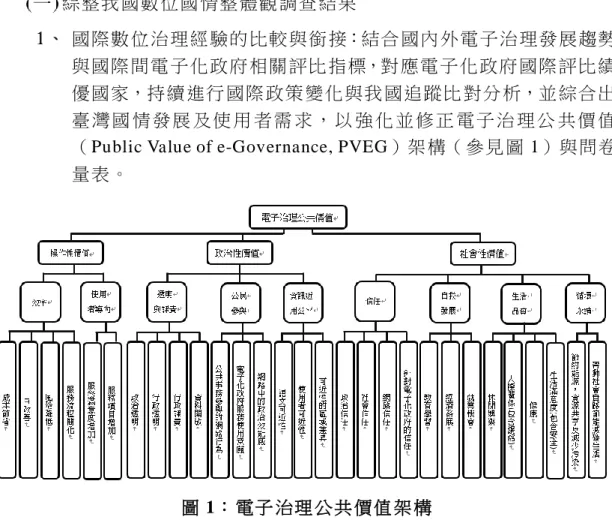
圖 1: 電子 治理 公共 價值 架 構 ... 6
圖 2: 本年 度實 際進 行調 查 PVEG 指 標 ... 44
圖 3: 操作 性價 值( A4-4、 B2-1) 歷 年 變化 趨勢... 129
圖 4: 操作 性價 值( B1-1、 B1-2) 歷 年 變化 趨勢 ... 129
圖 5: 政治 性價 值( C1-3、 C1-4) 歷 年 變化 趨勢 ... 130
圖 6: 政治 性價 值( C2-1、 C2-1、 C3-1) 歷 年 變化 趨勢 ... 131
圖 7: 政治 性價 值( D1-1、 D1-2、 D1-3) 歷 年 變化 趨勢 ... 132
圖 8: 政治 性價 值( D3-3、 Q9C) 歷 年 變 化趨 勢 ... 132
圖 9: 社會 性價 值( H4-1) 歷 年 變 化趨 勢 ... 133
圖 10: 社 會性 價值 ( H2-1、 H2-1、 H2-4) 歷 年 變化 趨勢 ... 134
圖 11: 社 會性 價值 ( Q16E、 Q16F、 G16G) 歷 年 變 化 趨勢 ... 134
圖 12: 社 會性 價值 ( F3-2、 F3-5) 歷 年 變 化趨 勢 ... 135
圖 13: 社 會性 價值 ( F4-2、 F4-3) 歷 年 變 化趨 勢 ... 135
圖 14: 社 會性 價值 ( G1-2) 歷 年 變 化趨 勢 ... 136
圖 15: 本 計畫 關鍵 字檢 核步 驟 ... 191
圖 16: 「 假新 聞議 題」 新聞 與非 新聞 類討 論聲 量變 化 ... 194
圖 17: 「 限塑 政策 」新 聞與 非新 聞類 討論 聲量 變化 ... 195
圖 18: 「 31 項 惠臺 政策 」新 聞與 非新 聞類 討論 聲量 變化 ( 2/27-4/24) ... 197
圖 19: 「 31 項 惠臺 政策 」新 聞與 非新 聞類 討論 聲量 變化 ( 7/30-8/7) ... 198
圖 20: 「 假新 聞」 議題 新聞 與非 新聞 類討 論情 緒分 析 ... 200
圖 21: 「 限塑 政策 」新 聞與 非新 聞類 情緒 分析 ... 201
圖 22: 「 31 項 惠臺 政策 」新 聞與 非新 聞類 情緒 分析 (2/27-4/24) ... 203
圖 23: 「 31 項 惠臺 政策 」新 聞與 非新 聞類 情緒 分析 (7/30-8/7) ... 204
X
圖 24: 「 假新 聞」 議題 新聞 類網 路聲 量與 市話 及手 機比 較 ... 206
圖 25: 「 假新 聞」 議題 非新 聞類 網路 聲量 與市 話及 手機 比較 ... 206
圖 26: 限 塑政 策新 聞類 網路 聲量 與市 話及 手機 比較 ... 207
圖 27: 限 塑政 策非 新聞 類網 路聲 量與 市話 及手 機比 較 ... 208
圖 28: 31 項 惠 臺政 策新 聞類 網路 聲量 與市 話及 手機 比較 ... 209
圖 29: 31 項 惠 臺政 策非 新聞 類網 路聲 量與 市話 及手 機比 較 ... 209
XI
摘要
研究源起與目的
聯合國 從 2003 年開 始持 續建 構與 修正 的電 子發 展階 段論 、電子 化政 府準備 度(E-Government Readiness) 指標 ,已 成為 各國 用來 了 解本身 電 子化政 府相 較於 國際 之優 劣的 重要 指標;世界 經濟 論壇( World Economic Forum) 每年 針 對世 界各 大經 濟體 之 資訊 通訊 科技 發展 與 整備 度 的調 查,
也 成 為 評 斷 國 家 競 爭 力 的 重 要 依 據 。 為 和 國 際 電 子 治 理 趨 勢 接 軌 並 發 展 我國電 子治 理衡 量架 構,國 家發 展委 員會 於 2013 年起委 託臺 灣 電子治 理 研究中 心(Taiwan E-governance Research Center, TEG)陳俊 明等(2014)
團隊首 度完 成「 數位 國家 治理:國 情分 析架 構與 方法 」研 究,該 團隊依 據 文獻與 層級 分析 法建 構 電 子治 理公 共價 值架 構( Public Value of Electronic Governance, PVEG),涵 蓋操 作性、政 治性 與社 會性 三大 價值,其下包 含 效率、使用 者導 向、透 明與 課責、公民 參與、資訊 近用 公 平、信 任、自 我 發展、生 活品 質與環 境永 續等 九面 向,並完 成第 一年 主觀 評量 資 料蒐集。
隨著 Web 2.0 等相關 社群 網路 的興起、多樣 性行 動載 具的 大量 普 及,
以 及 調 查 技 術 的 進 步 , 調 查 方 與 民 眾 接 受 與 表 達 資 訊 的 管 道 出 現 了 重 大 改變, 影響 計畫 團隊 蒐集 民意 取向 的模 式。 基此 ,TEG 研究 團 隊自 2013 年起,六年 來持 續針 對我 國數 位國 家發 展面 向以及 數位 治理 的相 關動態,
突破傳 統單 一調 查方 法的 侷限,同 時採 用傳 統室 內電 話調 查、手 機調查、
網 路 樣 本 調 查 與 巨 量 資 料 等 方 式 進 行 資 料 蒐 集 , 就 不 同 調 查 法 之 資 料 完 善 度 進 行 比 較 , 藉 以 評 估 數 位 國 家 治 理 發 展 所 追 求 之 公 共 價 值 的 實 踐 程 度,讓 計畫 結果 更貼 近數 位國 情全 貌。
本計畫 歷年 的調 查均 為呈 現全 國性 指標 的評 比結 果, 自 2010 年之後 地方政 府陸 續的 合併 與升 格, 數位 治 理 的發 展及 對應 的區域 差異 問題更 形重要 。因 此, 黃東 益等 (2017)特別 在該 年數 位國 情總綱 調查 中,觀 察六個 直轄 市之 間數 位治 理公 共價 值指 標達 成的 程度 差異, 開始 考慮到 納入或 者結 合區 域微 觀評 估的 可能 性, 嘗試 建立 臺灣 數位治 理的 多層次 樣貌。
基於補 充區 域微 觀比 較的 可能 性, 本計 畫的 核心 目標 安排兩 大部 分。首 先數 位國 情總 綱調 查 部 分, 透過 整合 多元 調查 方法, 以跨 年度、
世代或 領域 的觀 點, 綜整 分析 臺灣 的數 位國 情, 探討 資訊通 信科 技發展
XII
對政治 、社 會、 經濟 、教 育文 化、 永續 發展 等政 府治 理各層 面的 影響,
協助政 府規 劃未 來中 長程 我國 電 子 治理 發展 的前 瞻性 方向、 政策 架構及 社會重 要議 題因 應策 略等 。同 時 持 續著 重與 世界 網路 計畫、 聯合 國永續 發展大 會的 永續 發展 指標 等國 際重 要研 究指 標接 軌。 其次, 根據 過去兩 次鄉鎮 市區 數位 發展 分類 研究 的結 果為 基礎 ,參 考最 新國外 文獻 ,修正 公平數 位發 展指 標並 完成 本年 度我 國地 區數 位分 級調 查研析 。 此 外,本 計畫今 年也 納入 地理 資訊 系統 與空 間分 析方 法, 以地 圖化的 方式 展現臺 灣各地 區數 位發 展的 差異 。
簡言之 ,本 計畫 包含 數位 國情 世代 進展 分析 與區 域數 位分類 兩大 部 分,一 方面 延續 過去 巨觀 精神 ,調 查數 位國 情, 並納 入不同 年度 資料的 比較, 另一 方面 從微 觀的 角度 審視 臺灣 各鄉 鎮的 數位 發展狀 態。 除了兼 具微觀 與宏 觀的 分析 比較 外, 在納 入時 間軸 線的 審視 ,有助 我國 對於區 域數位 發展 與整 體數 位國 情進 展的 狀態 有更 立體 的瞭 解,有 助未 來的數 位發展 政策 規劃 與推 動。
研究流程及方法
就數位 國情 的部 分, 本計 畫包 含的 研究 方法 與內 容概 述如下 : 數位 治 理公 共 價值 治 理指 標 跨年 資 料蒐 集 與比 較 : 就 已 完成 修 正
之數 位 治理 公 共價 值 治理 指 標, 透 過問 卷 調查 方 法持 續 進行 主 觀 性題 目 追蹤 調 查, 以 了解 我 國數 位 治理 發 展在 操 作性 、 政治 性 、 社會 性 等治 理 指標 的 發展 現 況, 前 瞻規 劃 未來 中 長程 我 國數 位 治 理發展 願景 與方 向、 政策 規劃 架構 及重 要議 題施 政建 議。
網路 對 社會 的 影響 分 析: 透 過文 獻 分析 與 問卷 調 查的 方 式, 就 網 際網路 對社 會帶 來的 正面 與負 面影 響進 行分 析。正面 影響 的部 分,
聚焦於 網路 對公 民參 與以 及政 治效 能感 的影 響;負面 影響 的部 分,
著墨 於 網路 成 癮、 網 路霸 凌 、網 路 隱私 、 網路 言 論自 由 等議 題 的 分析。
網路輿 情與 傳統 調查 的整 合分 析: 選定 3 個公共 政策 議題( 假 新 聞、減塑 政策、31 項惠臺 政策 ),自 網路 輿論 資料 庫中 撈取相 同 期 間內的 文字 資料 後進 行分 析,並進 一步 與傳 統民 意調 查結 果比 較。
應用 歷 年的 調 查資 料 ,進 行 跨域 與 跨年 分 析, 提 出臺 灣 不同 領 域 與世代 之間 異同 與演 進的 觀察 。
就區域 數位 分類 的部 分, 本計 畫包 含的 研究 方法 與內 容概述 如下 : 建構 數 位發 展 評估 指 標架 構 :以 過 去國 發 會兩 次 研 究的 分 類架 構
XIII 與指標 為基 礎(數 位基 礎環 境、數位 人力 資源、社 會經 濟條 件 ),
結合國 外文 獻檢 閱與 專家 座談,確 認分 類架 構的 效度 與可 應用 性。
(二 )指 標資 料的 蒐集:盤 點目 前各 機關 就鄉 鎮市( 區 )層 級已 釋出 之客 觀資 料 ,並 與 國發 會 及各 機 關合 作 溝通 , 蒐集 各 構面 對 應之 指 標 或替代 指標 資料 。
(三 ) 區 域 數 位 發 展現 況 分 類 :整 理 與 轉 換 各指 標 資 料 後, 利 用 因 素分 析 方 法 取 得 因 素 函 數 值 , 再 透 過 集 群 分 析 法 中 的 華 德 法 ( Ward's method), 進行 各鄉 鎮數 位 發展 分類 。
(四 ) 數 位 分 類 之 空間 分 析 : 將各 構 面 之 因 素分 析 函 數 ,透 過 地 理 資訊 系統 以 圖像 方 式呈 現 ,並 針 對每 個 構面 各 鄉鎮 的 因素 分 析函 數 值 進行排 序。
研究發現
就數位 國情 的部 分, 研究 發現 概述 如下 : 數位治 理公 共價 值的 國情 追蹤 部分 :
操作性 價值:民眾對 於電 子化 政府 提供 的服 務滿 意度 有上升趨勢,
所感受 到的 電子 化政 府所 提供 網路 服務 項目 也是 增加 的。
政治性 價值:政治 透明 度近 年來 大幅 降低,行 政透 明度 則略 有提 升。此外,民眾 透過 社群 網站傳 遞重 要的 公共 議題 趨勢 與政 治效 能感有 明顯 消退 的趨 勢。
社會性 價值:民眾 對網 路依 賴程 度提 高,但人 際關 係親 密程 度卻 因使用 網路 而有 下降 。
網路對 社會 負面 影響 部分 :
網 路 成 癮 : 相 較 於 住 宅 電 話 調 查 與 手 機 調 查 所 接 觸 到 的 網 路 使 用 者 , 網 路 調 查 所 接 觸 的 網 路 使 用 者 在 上 述 四 項 網 路 成 癮 的 症 狀上, 都顯 示具 有更 高度 的成 癮風 險。
網路霸 凌:臺 灣民 眾自覺 曾遭 受網 路霸 凌的 比例,與 國際 相比 是 相對較 低的 。
網路隱 私外 洩:相 較於其 他國 家,臺 灣民 眾對於 政府 會侵 犯自 己 在網路 上的 隱私 部分 是顯 得擔 心許 多。
網路言 論自 由箝 制:我國 與國 際間 呈現 結果 一致,民 眾仍 是認 為
XIV
在網路 上表 達自 己對 政治 的看 法是 不安 全的 。
數位治 理公 共價 值於 不同 年齡 層的 六年 前後 比較 分析 :
操作性 價值:民 眾對 於政 府網站 所提 供的 資訊 滿意 度整 體略 有提 升,但 30 歲以下 及 45 以上的族 群對 於政 府網 站所 提供 的資 訊滿 意度較 差;在對 政府 提供 的網路 服務 滿意 度方 面整 體呈 現成 長趨 勢,但 學生 族群 (15 至 24 歲)的 滿意 度是下 降的 。
政治性 價值:各 年齡 層對 於政府 提供 網路 服務 的行 政課 責態 度皆 呈現正 向成 長。使 用政 府網 站線 上申 請項目 部分,僅有 年輕 人變 得較常 使用。至於 使用 政府 網站 查資 料與表 達的 使用 意願,僅有 35 歲至 39 歲的 民眾 呈現 微幅 上升 趨勢 。
社會性 價值:相 較於 六年 前,30 歲以 下的 民眾 更相 信政 府可 以透 過網路 就處 理好 事 情,而不 一定 要到 政府機 關去;然而 民眾 對於 政府在 網站 上提 供的 資訊 可靠 程度 ,呈 現下 降趨 勢。
網路 輿 情資 料 分析 : 在議 題 的發 酵 期間 , 新聞 類 與非 新 聞類 的 聲 量趨 勢 基本 上 是一 致 的, 不 會發 生 討論 熱 度僅 集 中於 某 一來 源 管 道上 ; 從聲 量 起伏 資 料發 現 ,網 路 討論 與 國內 新 聞有 相 對應 的 討 論峰 度 ,以 巨 量資 料 分析 作 為短 期 輿情 掌 握確 有 其效 果 ,但 是 如 欲推估 全國 性或 地方 性議 題 仍 有其 侷限 。
調查 方 法的 比 較分 析 發現 : 電話 調 查( 包 含住 宅 及手 機 )較 能 接 觸到 高 年齡 、 低學 歷 以及 主 管階 層 的受 訪 者, 而 網路 民 調則 幾 乎 接觸 不 到上 述 三類 性 質的 受 訪者 。 另外 , 歷年 來 住宅 電 話及 網 路 調查 所 接觸 到 的女 性 則遠 高 於男 性 。總 結 來說 , 運用 多 元調 查 方 法以接 觸到 不同 受訪 者的 趨勢 是愈 發重 要的 。
就區域 數位 分類 的部 分,鄉 鎮市(區)的數 位發 展情 況可 以分成 以下 五群:
(一 ) 分群 1:共有 4 個 鄉鎮 市( 區 )納 入該 分群,而該 分群 的特點 是 在 人力 資 源、 資 訊應 用 、社 會 經濟 、 教育 文 化、 生 活環 境 方面 的 數 值較 高 ,但 在 資訊 環 境構 面 的表 現 是最 差 的。 因 此, 資 訊環 境 的 改善將 成為 該分 群的 重點 。
(二 ) 分群 2:共有 153 個鄉 鎮市( 區 )納入,該分 群的 特點 是人力 資 源 數值 不 差, 資 訊應 用 、社 會 經濟 、 教育 文 化與 生 活環 境 的表 現 都 有待 加 強, 但 資訊 環 境的 數 值相 對 較佳 。 因此 , 資訊 應 用、 社 會
XV 經濟、 教育 文化 與生 活環 境都 還可 以再 提升 。
(三 ) 分群 3:共 包含 146 個鄉 鎮市 ( 區 ),人 力資 源的 數值 最差,資 訊 應用 、 社會 經 濟、 生 活環 境 等構 面 在因 素 分析 的 數值 上 也不 佳 。 但是 , 在教 育 文化 與 資訊 環 境兩 個 構面 的 表現 相 較其 他 分群 來 說 尚可 。 換言 之 ,該 分 群有 待 強化 的 構面 主 要是 人 力資 源 的數 值 最 差,而 資訊 應用 、社 會經 濟、 與生 活環 境構 面則 可以 再提升 。 (四 ) 分群 4:則 有 52 個鄉 鎮市 ( 區 )被 納入 該分 群,而 該 分群的 鄉 鎮
除了 教 育文 化 構面 的 表現 較 優以 外 ,其 他 像是 人 力資 源 、資 訊 應 用、 社 會經 濟 、生 活 環境 與 資訊 環 境等 構 面都 是 需要 著 重加 強 的 部分。
(五 ) 分群 5:則 有 13 個鄉 鎮市 ( 區 )被 歸類 到該 群,而該 分群除 了 教 育文化 構面 有待 加強 外,其 他構 面都 較其 他分群 表現 較優。因此,
教育文 化資 源是 該地 區可 能需 要加 強的 部分 。
政策建議
提升數 位治 理公 共價 值成 效的 建議 :
以需求 導向 設計 政府 線上 數位 服務,並提 供不 同族 群與 年齡 層使 用者客 製化 服務:短期 針對 使用 少的 族群提 升其 使用 之誘 因,並 強化服 務宣 導成 效;中 長期 必須 因應 資料治 理之 趨勢,建立 我國 資料治 理相 關準 則,以 加速 不同 機關 資料流 通交 換,並 透過 數位 服務準 則之 推動,落實 服務 設計 與需 求調查,並需 要特 別考 慮中 年及老 年族 群的 需求 。
提升政 府於 網路 上回 應民 眾的 品質:短期 內仍 應致 力於 強化 現行 政府所 推動 的各 項公 民參 與機 制,可 考慮 引入 外部 公關 公司 或新 聞媒體 輿情 危機 管理 的機 制,結 合內 部的教 育訓 練課 程。在 中長 期面向,應 該針 對民 眾根 本需求,結 合新 型態 網路 傳播 媒介特 性,
設計不 同與 以往 傳統 文字 回應 形式,加入 影音、圖片 等模 式,提 升官方 回應 之品 質。
提升政 府機 關網 站之 透明 與課 責程 度:為避 免資 訊爆 炸,政 府應 重新思 考資 訊分 類與 視覺 界面 的設 計。在行 政課 責的 改善 方面,
政 府 機 關 應 在 各 項 評 比 中 加 入 網 頁 版 面 設 計 對 於 資 訊 蒐 集 容 易 度的相 關指 標,同時 也應 要求在 網頁 上清 楚提 供機 關業 務職 掌表 與聯絡 方式 。
提升民 眾對 政府 機關 網站 的信 任度:在 網路 服務 的服 務流 程上,
XVI
應考量 不同 年齡 層的 科技 熟悉 程度,針對 中年 及老 年族 群做 更友 善的操 作介 面。同時 應改 善政 府網 站提 供資 訊的 正確 性與即時性,
藉以提 高民 眾對 於政 府網 站提 供資 訊的 信任 。
持續探 詢與 開發 政府 主動 資訊 服務 之需 求:應 在現 有的 正面 基礎 上,持續 探詢 和開 發民 眾對 於政 府主 動資訊 服務 的需 求,將 電子 化服務 直接 遞送 至民 眾眼 前。
降低網 路對 社會 負面 影響 的建 議 :
政府可 透過 鄰里、社 區按 不同年 齡層 的需 求多 舉辦 合適 的戶 外休 閒活動 ,並 透過 學校 教育宣 導正 確使 用 3C 的觀 念,定 期透 過網 路成癮 量表 過濾 出網 路成 癮風 險高 族群 ,及 早給 予適 當協助 。 政府可 擴大 網路 霸凌 防治 的目 標對 象,將 職場 網路 霸凌 的防 治列
入未來 政策 推動 重點 之一 。
政府應 強化 隱私 保障 規範,且在 個資 使用 同意 授權 的說 明上 精簡 易懂。同 時也 須強 化民 眾的 資訊 素養,使 其有 能力 保護 自己 的網 路隱私 。
網路言 論自 由反 映民 眾矛 盾心 態,政 府若 能有 效提 升人 民的 信任 感,也 許在 調查 結果 的呈 現上 ,就 會呈 現較 為一 致的 結果。
後續研究建議
就數位 國情 的部 分, 後續 研究 建議 包括 :
理論 架 構的 修 訂: 本 計畫 提 出的 數 位治 理 公共 價 值架 構 ,歷 經 六 年時 間 的追 蹤 調查 及 比對 , 驗證 了 此架 構 的完 整 性與 可 行性 , 以 發展 出 更完 善 的治 理 品質 。 然因 數 位治 理 的快 速 發展 以 及資 訊 科 技的進 步,加上 因民 眾生 活型 態 與 政府 數位 服務 遞送 形式 之改 變,
在數位 國情 的評 估 架 構與 指標 上,應該 做根 本的 檢討 與重 新設 計,
以與時 俱進 。
提高 巨 量資 料 分析 的 正 確 性 以及 了 解網 路 輿情 的 涵蓋 率 :以 情 緒 分析 的 正確 性 來看 , 電腦 判 讀文 本 仍有 其 侷限 , 應發 展 人機 互 動 程序,以 及適 時透 過專 家介 入的 方式,採 人工 判讀 提高 其正 確性;
此外 , 應關 注 不同 議 題網 民 的發 聲 與母 體 之間 , 是否 存 在一 定 程 度的代 表性 。
追蹤 樣本 資 料庫 的建 立 :建 議 未來 能夠 世 代研 究 ( panel study),
甚至設 計誘 因制 度來 建置 網路 民眾 定群 樣本(online panel),不 僅
XVII 在研 究 上可 以 更清 楚 有效 地 了解 網 路輿 論 對於 民 眾意 見 的影 響 , 在實務 上更 可作 為未 來常 態性 政策 民調 的來 源。
調查 法 實施 過 程缺 乏 真正 的 母體 真 值供 比 較: 建 議未 來 可 以 透 過 政府 開 放性 資 料的 取 得, 找 到更 多 、更 準 確的 母 體真 值 來和 調 查 結果做 比較 。
就區域 數位 分類 的部 分, 後續 研究 建議 包括 :
(一 ) 資料 可 得性 的 強化 : 本次 分 類研 究 遇到 最 大的 困 難在 於 構面 中 相 關資料 取得 的問 題。不論 是現 有主 觀調 查資 料樣 本數 不足 的問 題,
或是 對 應客 觀 資料 不 存在 的 問題 , 均可 能 影響 分 類的 效 度。 未 來 建議 可 利用 數 位 發 展 或數 位 國情 調 查等 計 畫, 每 四年 進 行一 次 大 樣本調 查, 以確 保各 鄉鎮 市區 有足 夠樣 本的 回覆 可供 分析。
(二 ) 資料 品 質的 確 保與 細 緻化 : 若欲 進 行空 間 分析 , 則取 得 之資 料 需 要細 緻 到點 位 ,換 言 之, 實 際的 座 標或 地 址都 必 須清 楚 且正 確 。 未來 建 議可 與 國土 測 繪中 心 合作 , 定期 建 立相 關 點位 資 料, 以 利 各項研 究利 用。
(三 ) 例行 性 數位 發展 分類 研究:以 目前 本計 畫所 分析 的各 項指 標來 看,
人口與 社會 經濟 指標 最可 能有 跨年 的資 料, 但這 些資 料在 104 至 106 年之 間 的變 化 趨勢 呈 現直 線 垂直 , 表 示每 個 鄉鎮 市 區在 這 些 指標 上 的變 化 不大 。 加上 未 來如 果 要納 入 樣本 數 夠大 的 客觀 調 查 資料 , 在考 慮 調查 成 本的 情 況下 , 建議 每 四年 進 行一 次 數位 分 類 研究。
關鍵 詞:電 子治 理、公 共價 值、網 路輿 情、調查 方法、巨量 資料、地理 資 訊系統 、空 間分 析、 數位 發展 分類
XVIII
Abstract
1. Background and Purpose
Since 2003, the United Nations (UN) has continuously constructed and rectified the stage theories of e-development and the indices of e -government readiness. Those indices have become important indices for governments around the world to compare their e -government capabilities. Studies conducted by the World Economic Forum (WEF) on the readiness and development of information and communication techn ologies (ICTs) of major economies have also become the basis for the judgment of national competitiveness. In order to connect with international e -governance developments and ensure the continued construction of Taiwan’s e - governance measurement framework , the National Development Council has entrusted the Chen et al. (2014) research team of the Taiwan E -governance Research Center (TEG) to conduct the research, titled “Public Value and Electronic Governance: Analytical and Methodological Reflections.” The research team was able to construct the first edition of the framework of public value e-governance (PVEG) through the use of literature analyses and the method of analytic hierarchy process. The framework includes three major values: operational, politica l, and social values. The three values are further divided into nine dimensions, including efficiency, use -oriented service, transparency and accountability, citizen participation, equity in accessibility, trust, self-development, quality of life, and envi ronmental sustainability. Data from the subjective indicators were also gathered through surveys.
With the rise of Web 2.0 and social media, the proliferation of diverse mobile devices, and the advancement of survey techniques have produced the major change on the channels of survey and opinion expression, affecting the way of the public opinion collection. Therefore, the TEG research team used a multi-survey method, such as telephone survey, mobile phone survey, online survey, and big data analysis, to understand the ongoing execution of public values pursued in the development of Taiwan’s e -governance.
Over six years, the survey results have been presented based on these national indicators. Since 2010, the successive consolidation and upgrade of local governments have enhance the importance digital governance in local governments, Huang et al. (2017) especially paid attention to this issue and
XIX included the difference of the public value indicators of e -governance among the six municipalities in the 2017 survey.
There are two core objectives in this year’s study. First, this study integrates multi-survey methods to analyze the national conditions of digital development of Taiwan in multiple years, explores the impact of the development of ICTs on various aspects of government governance, and develops policies for the future development of e -governance in Taiwan. At the same time, it continues to link with the focus of the internationally important research indicators, such as the World Internet Project and the Sustainable Development Indicators of the United Nations Sustainable Development Conference. Second, to revise the indicators of local digital development, as well as, to categorize the towns into different development group, based on foreign and domestic studies. This study also will use geographic information system and spatial analysis method to map the differences in digital development among various regions of Taiwan.
In sum, this study tends to analysis the regional digital develo pment and the progress of the national condition. On the one hand, this study continues the idea of the past national surveys. On the other hand, this study examines the digital development status of Taiwan's townships from a micro perspective. From micro, macro and temporal analysis, this study will help us to have a three-dimensional understanding of the regional digital development and the overall status of the national situation. The results can help the future development of policy on digital developme nt.
2. Methods and Procedures
The research methods employed in this research is outlined below:
(1) The collection and comparison of multi -year data on e-governance public value indicators: The sixth year execution of questionnaire surveys, based on the revised PVEG framework indicators, to collect data on subjective items. This is in order to understand the development of Taiwan’s e-governance, as measured by the operational, political and social indicators. The data is also used for policy foresight pla nning of Taiwan’s mid-turn and long-term e- governance development vision and direction, including policy planning frameworks and administrative suggestions regarding important issues.
XX
(2) Analysis on the effect of the Internet on society: Analysis of the positive and negative influence of t he Internet on society, with the use of literature review and questionnaire survey. Positive influences center on the effect of the internet on civic participation and political efficacy. Negative influences center on the iss ues of internet addiction, cyberbullying, internet privacy and online freedom of speech.
(3) Integration and analysis of online public opinion and traditional opinion survey: Text data from a set time interval on the three chosen public policy issues (fake new s, the reduction of the plastic products in fast food chains, 31 policies for Taiwan -funded enterprises) were crawled from online public opinion databases. These data were then analyzed and compared with the results obtained through traditional public opinion surveys.
(4) Conduct cross-domain and cross-year analysis and present the similarities and differences between different fields and generations.
For the part of the regional digital classification, the research methods and contents contained in this proje ct are summarized as follows:
(1) Constructing a digital development measurement index structure:
based on the classification structure and indicators of the two previous studies of the National Development Commission (digital infrastructure environment, digit al human resources, socio- economic conditions), combined with foreign literature review and expert discussions, to ensure the validity and applicability of the classification architecture.
(2) Collection of indicator data: inventory of the objective informatio n that has been released by various agencies at the township and town level, and cooperation with the National Development Commission and various agencies to collect indicators or substitute indicators of each perspective.
(3) Classification of regional digita l development status: After sorting and transforming the data of each index, the factor analysis method is used to obtain the factor function value, and then use the Ward's method in the cluster analysis method to carry out the classification of each township digital development.
XXI (4) Spatial analysis of digital classification: The factor analysis function of each per spective is presented graphically through the geographic information system, and is sorted by using the factor analysis function values for the perspective of the township and town.
3. Research Results
(1) Changes in national status of PVEG
i. Operational Values: Regarding public services provided by the government, citizens perceive an increase in public services, and they feel more satisfied with these servi ces provide by the government.
ii. Political Values: The citizens hold a more negative opinion towards political transparency, however, the perspective toward administrative transparency has improved slightly. In addition, the transmission of important public issues through social networking sites and the citizens’ political efficacy has declined.
iii. Social Values: Citizens are increasingly dependent on the Internet, and the interpersonal relationships have declined due to the use of the Internet.
(2) The internet’s negative influences on society
i. Internet Addiction: Compared with the Internet users reached by landline and cellphone survey, the Internet users reached by the online survey showed a higher risk of internet addiction.
ii. Online Bullying: Compared with the survey results of other countries, the proportion of our citizens suffered from onl ine bullying is relatively low.
iii. Internet Privacy leaks: Compared with the survey results of other countries, our citizens are much more worried about the government's violation of their privacy on the Internet.
iv. iv. Online Freedom of Speech: Like other countries, our citizens believe that it is not safe to express their vie ws on politics on the Internet.
(3) The comparison of the perspective of PVEG of diffe rent ages between 2013 and 2018
XXII
i. Operational Values: The overall satisfaction of the information provided by the government website has been slightly improved.
Young people and elderly people are less satisfied with the information provided by the government website. The overall satisfaction with the services provided by the government website is growing, but young people's satisfaction with the services provided by the government website is declining.
ii. Political Values: The citizen's perspective toward administrative accountability is growing positively. Only young people become more likely to use online application service provided by the government. As for the willingness to use the government website to check the information and expression, only the people aged 35 to 39 have shown a slight upward trend.
iii. Social Values: Young people have a much more positive attitude toward online service provided by the government. But the citizens’ perspective of the reliability of the information provided by the government is declining.
(4) Big Data analysis: Among three public policy issues chosen by this project, the volume of internet posts of news and non -news during the investigation period is basically the same, that is, the volume of internet posts does not concentrate on only one source. From the discussion of these three policies, this project finds that the degree of online discussions was higher in relation to the local news. This project suggests that Big Data analysis is efficient for collecting short-term public opinions, but that it may not be able to predict national or local issues well, due to either the features of the platform itself or the effect from the disrespectful atmosphere of the social network, which lowers the citizens' willing ness to express their opinions.
(5) The comparison of multiple survey methods: The landline survey has better access to respondents who are elders, low levels of education, and supervisors, while the internet survey has barely access to the above types of respondents. In addition, it is relatively easier to reach female respondents with these two types of survey.
XXIII In summary, it is important to reach different respondents by the adoption of multiple survey methods.
Regarding the regional digital classification, the digital development of 368 townships and towns in Taiwan can be divided into the following five groups:
(1) Group 1: A total of 4 townships and towns are included in the group, and the group is characterized by higher values in human resources, information applications, socio-economic conditions, edu cation and culture, and living environment, but the perspective of the information environment shows worst performance. Therefore, the improvement of the information environment will become the focus of this group.
(2) Group 2: A total of 153 townships and tow ns are included. The characteristics of the group are that the value of human resources are not bad, but the information application, socio -economic conditions, education and culture and living environment need to be strengthened, but the information envir onment is relatively better.
Therefore, information applications, socio -economic conditions, education and culture and living environment can be further improved.
(3) Group 3: A total of 146 townships and towns are included. The value of human resources is the worst. The information application, socio - economic conditions, and living environment are not good in factor analysis. However, the performance of the two perspectives of education and culture and information environment is better than other groups. In other words, the perspective to be strengthened by this group is mainly human resources which has the worst value, and the information application, socio -economic conditions, and living environment can be further improved.
(4) Group 4: 52 townships and towns are included in the group. Except for the perspective of education and culture which has better performance in the group townships and towns, the perspectives of human resources, information applications, socio -economic conditions, living environment and info rmation environment all need to be strengthened.
XXIV
(5) Group 5: There are 13 townships and towns that are classified into the group, and the other perspectives are better than other groups except for the perspective of education and culture. Therefore, educational and cultural resources are a part of the region that may need to be strengthened.
4. Policy Suggestions
(1) Suggestions for improving the effectiveness and efficiency through PVEG indicators
i. Design the government online services in a more demand -oriented way, and provide customized services for different groups: In the short-term, for those who rarely use government online services, the government should provide more incentives to enhance their usage. In the long -term, it is necessary to establish guidelin es for data governance to accelerate the exchange of data between different agencies. In addition, considering future online services design, the government must understand the needs of middle -aged and elderly people.
ii. Enhance the quality of the government's response to the people on the Internet: In the short term, efforts should be made to strengthen the various citizen participation mechanisms promoted by the government. In the long-term, the government should combine the characteristics of the new -type network communication media to respond citizens in different ways, such as audio-visual vedios and pictures.
iii. Enhance the transparency and accountability of government websites: Vaious levels of governments should reconsider the design and interface of their websites, and the information classification provide by the government website. In terms of the improvement of administrative accountabilities, thegovernment should clearly provide the organization charts and conta ct informations on the website.
iv. Enhance people's trust in government we bsites: The service process of government online services should consider the familiarity of technology at different ages and make a more friendly operation interface for middle -aged and elderly people.
XXV At the same time, the correctness and immediacy of information provided by government websites should be improved to increase public trust in the information provided on government websites.
v. Sustained exploration and development of the need for government’s active information service: The government should deliver e-services directly to the populace, instead of forcing citizens to surf the internet searching for needed information.
(2) Reduce the negative impact of the Internet on society
i. The Government can organize more outdoor leis ure activities according to the needs of different age groups through the neighborhoods and communities. Also, promote the correct concept of the use of 3C products through the school education.
ii. The government can expand the target of online bullying prevention and control, and put the prevention and control of workplace online bullying into one of the priorities of future policy.
ii. The government should strengthen the privacy protection regulations. At the same time, the information literacy of the citizens must be strengthened to enable them t o protect their online privacy.
iii. The freedom of online speech reflects the contradictory mentality of the people. I f the government can effectively enhance the people's sense of trust, it may present more consistent results in the presentation of the survey results.
5. Future Research Suggestion
(1) Revision of the PVEG framework: The existing dimensions and indicators need to be fundamentally reviewed, revised, and redesigned in response to the rapid developmen t of electronic governance.
(2) Improve the correctness of big data analysis and understand the coverage of Internet public opinion: In terms of the correctness of sentiment analysis, computer interpretation text still has its limitations, further research should focus on the development of
XXVI
human-computer interaction procedures, and timely intervene through experts.
(3) Establishing an information database for tracked s amples: It is suggested that in the future, panel research and even the incentive system will be designed to build an online panel of online people.
This will not only make it clearer and more effective in understanding the impact of Internet public opinion on public opinion. It can be used as a source of future normal policy polls.
(4) The infor mation to uncover the actual population that is contacted by each survey methodology is unavailable: It is suggested that in the future, through the acquisition of government open da ta, more and more accurate maternal truth values can be found to c ompare with the survey results.
For the portion of the regional digital classification, follow -up research recommendations include:
(1) Enhancement of the availability of data: The biggest diffi culty encountered in this classification study is the problems encountered in the r elevant materials in the key dimensions. Whether the number of existing subjective survey data is insufficient or the problem that the objective data does not exist may affe ct the validity of the classification. In the future it is recommended to use digital opportunities or digital survey on national conditions, and conduct a large sample survey every four years to ensure that there are enough samples of responses in urban a nd rural areas for analysis.
(2) Data quality assurance and sophistication: If spatial analysis is to be carried out, the information obtained needs to be meticulous and sophisticated. In other words, the actual coordinates or addresses must be clear and correct. In the future it is recommended to work with the Land Surveying and Mapping Center to regularly establish relevant points and locations information to facil itate utilization by various researches.
(3) Routine digital development classification study: According to the indicators currently analyzed in this plan, population and socio - economic indicators are most likely to have cross -year data, but these data vary between 2015 and 2017. The trend is linear and
XXVII vertical, indicating that each township and city has little change in these indicators. In addition, if it is necessary to include objective survey data with sufficient sample size in the future, it is recommended to conduct a one -time classification study every four years in consideration of the cost of survey.
Keywords: e-governance, public value, Internet public opinion, survey methods, big data, geographic information system, spatial analysis, digital development classification
1
第一章 緒論
研究背景
當 前 世 界 各 國 一 面 不 斷 地 努 力 跟 上 資 訊 通 訊 科 技 ( Information and Communication Technologies, ICTs)快速 發展的 腳步,另 一面 則 是嘗試 將 ICTs 應 用 在 公共 治理 的各 樣領 域當 中, 以期公 共價 值與 良善 治 理的目 標 能被充 分地 實現。全球各 國紛 紛將 電子 治理 列為 國家 發展 的重 要 途徑,也 因而產 生許 多有 關政 府運 用 ICTs 實 踐公 共價 值成 效的 評比。像 聯合國 自 2003 年 ,便 開始 建構 電子 發展 階段 論以 及電子 化政 府準 備度 指 標,至 今 仍 然 持 續 地 修 正 與 補 充 , 成 為 各 國 政 府 用 來 比 較 電 子 化 政 府 優 劣 的 重 要 依據;歐盟 也有 所謂 的「 電子 化政 府經 濟計 畫評估 架構 」( e-Government Economics Project Measurement Framework, MF ),從效 率、民 主 與效能 等 三項關 鍵要 素,來 評估 電子 化政 府服 務項 目或 計畫 的公共 價值;另外,像 日 本 早 稻 田 大 學 也 從 2004 年 起 , 與 亞 太 經 濟 合 作 會 議 ( Asia-Pacific Economic Cooperation, APEC ) 合作 進行 全球電 子化 政府 調查 。 世界經 濟 論壇(World Economic Forum, WEF)從 2012 年起,針對 全球 主 要國家 進 行網路 整備 評比 ;國 際電 信聯 盟( International Telecommunication Union, ITU)則 是 使用「資 訊通 訊發 展指標 」( ICTs Development Index, IDI )和
「資訊 通訊 價格 指數 」( ICTs Price Basket, IPB), 進行 電子 化 政府的 評 比調查 (黃 東益 、謝 翠娟 、曾 憲立 , 2016)。
我國國 家發 展委 員會( 簡稱 國發 會)有 鑑於 國際 電子 化政 府評比 的多 樣性,以 及實 務評 比缺 乏對 於公 共價值 落實 的 相 對應 評估, 自 2013 年起 便 委 託 臺 灣 電 子 治 理 研 究 中 心 ( Taiwan e-Governance Research Center, TEG ) 研 究 團 隊 建 構 我 國 的 「 電 子 治 理 公 共 價 值 架 構 ( Public Value of Electronic Governance, PVEG ) 」, 並在 後續計 畫中 不斷 地修 正 調整。 該 架構主 要包 括操 作性、政治 性、與 社會 性等 三大價 值面 向,透 過 三大面 向 所 涵 蓋 的 次 面 向 及 其 各 自 對 應 的 測 量 指 標 , 可 以 進 一 步 地 建 構 出 數 位 治 理 的 國 情 指 數 , 該 研 究 成 果 已 經 成 為 我 國 未 來 數 位 發 展 策 略 以 及 電 子 治 理政策 創新 必需 參考 的重 要依 據( 陳俊 明等,2014)。目前國 發 會一方 面 持 續 地 依 照 這 個 架 構 , 透 過 每 年 的 追 蹤 調 查 來 評 估 數 位 治 理 對 臺 灣 整 體 所帶來 的正 向與 負向 影響,並 據此 構思 相關 單位 的因 應策 略。另 一方面,
則會根 據世 界的 潮流 與社 會的 脈動,再 檢視 該架 構的 完整 性與 可 行性,以
2
便於政 府掌 握與 回應 數 位 社會 的需 求, 以達 到公 共價 值的完 整實 踐。
在 2017 年國發 會委 託電 子治 理中 心的 數位 國情 總綱 調查 計畫中 ,發 現過去 歷年 的評 比主 要是 呈現 臺灣 整體 的狀 態。 但是 , 2010 年 之後地 方 政 府 陸 續 的 合 併 與 升 格 , 數 位 治 理 的 發 展 及 對 應 的 區 域 差 異 問 題 更 形 重 要。因此,黃 東益 等(2017)特 別在 該次 的數位 國情 總綱 調查 中 的某些 指 標下,觀 察六 個直 轄市之 間數 位治 理公 共價 值指 標達 成的 程度 差 異,開始 考 慮 到 納 入 或 結 合 區 域 微 觀 評 估 的 可 能 性 , 並 嘗 試 建 立 臺 灣 數 位 治 理 的 多層次 樣貌 。
事實上,針對 臺灣 各區 域數 位治 理公 共價 值實 踐的 評比 確實缺 乏。針 對臺灣 各鄉 鎮的 數位 發展 分類 研究, 在 2012 年由國 發會 的前 身 ,行政院 研究發 展考 核委 員會(簡 稱行 政院 研考 會)進行 過一 次調 查。爾 後,經過 五年的 數位 發展 資源 的投 入和 數位 發展 策略 的推 動, 國發會 於 2015 年,
再 一 次 針 對 臺 灣 各 鄉 鎮 的 數 位 發 展 機 會 進 行 評 估 與 分 類 , 以 瞭 解 臺 灣 各 鄉 鎮 市 區 的 數 位 發 展 和 變 遷 的 狀 況 , 並 用 以 評 估 數 位 發 展 資 源 投 入 的 具 體成效,確保 有限 資源投 入於 最需 要的 區域,達 到各 區域 間數 位 發展平 等 的狀態(聯 合行 銷研 究股 份有 限公 司,2015)。雖然 國外 亦少 有 針對地 區 或城市 間數 位發 展進 行的 評估 ,但 是像 Gallardo(2017, 2014) 便曾經 提 出 2015 與 2014 年美 國各 郡的 數位 落差 指數 ( Digital Divide Index), 除 觀察美 國各 郡數 位落 差的 現況,並 比較 跨年 度之 間的 變化。另外,Thomas 等學者 (2016)則是 以數 位包 容指 數( Digital Inclusion Index ) 評估澳 洲 各個省 的數 位落 差現 況。由此 可見,以區 域或地 方為 分析 單位 的 數位治 理 發展評 估, 是未 來臺 灣數 位治 理相 關調 查 研 究可 以著 力的方 向。
此外,不 論是 數位 國情 總綱 調查 或是 鄉鎮 市區 數位 發展 分類研 究,目 前都至 少累 積了 兩年 以上 的資 料。換言 之,除了 可以 跨層 次的 藉 由前述 兩 項研究 過去 的成 果,可以 考慮 進行 兩個 不同 層次 的跨 時間 比較 分 析;同時,
從 整 體 與 區 域 兩 個 不 同 層 次 , 針 對 臺 灣 數 位 治 理 發 展 的 狀 態 進 行 瞭 解 與 評估。根 據歷 年的 數位國 情總 綱調 查資 料,可以 幫助 政府 瞭解 歷 年整體 狀 況的變 化,以 及整 體政 策推 動的 成效。另外,鄉 鎮市 區數 位發 展 分類研 究 跨年度 的資 料,則 可以更 細緻 地檢 視不 同地 區發 展的 趨勢,以 及 資源在 不 同地區 投注 後的 成效 差異 ,甚 至可 以產 生因 地制 宜的 政策思 考。
3
研究目的
本計畫 的核 心目 標分 為兩 大部 分,首 先,主 要根 據歷 年數 位國情 總綱 調查,整合 多元 調查 方法,以 跨年 度、世代、與 領域 的觀 點,綜 整分析 臺 灣的數 位國 情。 探討 ICTs 發展 對政 治、社 會、經 濟、 教育 文化 、永續 發 展 等 政 府 治 理 各 層 面 的 影 響 , 協 助 政 府 規 劃 未 來 中 長 程 我 國 電 子 治 理 發 展的前 瞻性 方向、政策 架構 及社 會重 要議 題因 應策 略等。同 時,持續著 重 與世界 網路 計畫 ( World Internet Project, WIP) 、聯 合國 永續 發 展大會 的 永續發 展指 標( Sustaniable Development Goals, SDGs)等 國際 重 要指標 接 軌。其次,以過 去兩 次鄉 鎮市 區數 位發 展分 類研究 的結 果為 基礎,參考最 新國外 文獻,修正 公平數 位 發 展發 展指 標,並完 成本 年度 我國 地 區數位 分 級調查 研析。由於 數位 發 展發 展指 標分 析的 對象 為鄉 鎮市 區,本 計畫將 納 入 地 理 資 訊 系 統 與 空 間 分 析 方 法 , 以 地 圖 化 的 方 式 展 現 臺 灣 各 地 區 數 位 發展的 差異 。詳 細的 研究 目的 分述 如下 :
過去研究的再深化
本計畫 主題 主要 分成 數位 國情 世代 研析,以 及鄉 鎮市 區數 位分級 兩個 部分,兩者 皆根 據過 去研 究的 基礎,針 對相 關架 構、指標、資 料 收集、分 析 方 法 等 面 向 進 行 創 新 精 進 的 思 考 。 以 下 將 先 針 對 過 去 有 關 的 研 究 進 行 簡單回 顧, 以確 立本 次計 畫的 基礎 。
歷年數 位國 情總 綱調 查
2013 年 臺 灣電子 治理 中心( TEG)接受 國發 會委 託,第一 次以公 共價 值的實 踐為 基礎,建立數 位治 理評 估的 架構,並 根據 該架 構作 為 數位國 情 調查的 原則,瞭解 我國在 數位 治理 發推 動上 的進 展。該計 畫從 國 際電子 化 政府相 關評 比出 發,分 析其 各項 指標、構面 與公共 價值 的相 關與 連結。進 而 建 構 出 以 公 共 價 值 為 基 礎 的 電 子 治 理 架 構 , 並 利 用 層 級 分 析 法 建 立 構 面的權 重,發 展出 結合 主客 觀意 見的 最佳 方式。同 時,該 計畫 運 用電話 調 查、手機調 查、網 路調查,以及政 府網 站會 員網 路等 多樣 調查 方 式,適當 搭配和 並設 計相 對的 權重,取 得更 佳的 母體 涵蓋 率,來改 善政 府 對於數 位 國情發 展現 況瞭 解的 正確 性。
2014 年 的計 畫 接續 先 前的 研 究成 果 ,以 同 樣的 分 析 架構 檢 視臺 灣的 數位治 理發 展狀 況,以 及電 子化 政府 對於 公共 價值 實現的 程度。然而,該 計畫為 配合 數位 技術 環境 的變 遷, 進一 步增 加了 網路 輿情 巨量 資 料( Big Data)的蒐 集,提高研 究方 法的 多樣 程度,以及 拓展 民意 資料 收 集的涵 蓋 廣度。而 由於 有了 兩個 年度 的調 查資 料,該 研究透 過時 序的 分析,進行了
4
跨年度 數位 國情 的比 較分 析。
在 2015 年的計 畫中 ,研 究團 隊考 量智 慧型 手機 使用 的迅 速擴散 ,導 致民眾 生活 習慣 的劇 烈變 化,使得 問卷 資料 收集 的方 式,需要 更 進一步 考 量民眾 的手 機使 用行 為習 慣。因 此,除 了傳 統的 電話、手機、網路 的調查,
以及輿 情巨 量資 料的 收集 之外。手 機行動 應用 程式( APP)在 該 年計畫 中 也被納 入, 更進 一步 擴大 母體 的涵 蓋率 。
由於 前 三年 已 經取 得 一 定程 度 的研 究 成果 , 2016 年 的計 畫 持續 針對 數位國 情調 查的 架構 進行 測量,並 針對 不同 調查 方法(包 括住 宅 電話調查、
手機調 查、網路 調查 )進 行比 較。其 次,由於開 放政 府漸 漸成 為 公共治 理 的重要 議題,因 此該 計畫 一面 針對 政府 開放 資料( Open Government Data, OGD)進 行盤點 分析,探索 政府 開放 資料 作為公 共價 值架 構中 客 觀資料 的 可能性,以及 如何 將政府 開放 資料 的構 面補 充於 原先 架構 的應 用 當中。另 外,研究 團隊 選定 四項 網路 聲量 較大 的公 共議 題( 同性 婚姻 合法 化、核電 存廢、勞 工休 假議 題、Uber 合法 化 ),以電 話調 查追 蹤樣 本設 計、蒐 集民 意資料 、結 合巨 量資 料分 析, 來了 解網 路輿 論導 引民 意可能 性。
2017 年 的數 位 國情 調 查計 畫 則是 就 修正 的 指標 , 利 用問 卷 調查 方法 進行第 五年 的主 觀性 民調 追蹤 研究。除了 應用 住宅 電話、手 機、網路等 方 式進行 調查 外,並 大幅增 加調 查樣 本數 量,以便 在各 直轄 市能 有 相當樣 本 數,來進 行區 域差 異的 比較 分析。同時,著重網 際網 路對 社會 帶 來的正 負 面影響 分析,正面 部分聚 焦在 公民 參與 以及 政治 效能 感的 影響;負面部 分 則著重 在網 路霸 凌、網路 隱私、網 路言 論自 由的 分析。另 外,透 過對於 近 年服務 品質 獎內 容分 析,結合 里幹 事專 家會 議,研擬 主動 資訊 服 務提供 內 容與方 式的 建議。最後,團 隊選定 一例 一休、前瞻 軌道 政策、減 香政策,
透 過 網 路 輿 論 資 料 庫 中 撈 取 相 同 期 間 內 的 文 字 資 料 進 行 分 析 , 並 與 傳 統 民意調 查結 果比 較之 間的 異同 。
兩年鄉 鎮市 區數 位發 展分 類研 究
臺灣鄉 鎮市 區數 位發 展分 類的 研究,由過 去的 行政 院研 考會,以 及後 續的國 發會,分別 於 2012 及 2015 年,各自 進行了 一次 調查 評估。過去的 行政院 研考 會曾 經於 2002 年,根據「偏 遠地區 設置 公共 資訊 服 務站策 略 規劃案 」編訂 了有 關的 鄉鎮 分類,當 初沿 用將 近 10 年且 指標 考 慮的內 容 較為簡 化,在考 量縣 市升 格對 於地 方政 府的 基礎 設施、人 口、交 通、財政 狀 況 等 可 能 有 的 影 響 與 改 變 , 各 鄉 鎮 市 區 也 可 能 會 因 此 產 生 不 同 的 發 展 情況。因 此,為 了評 估當 時各 鄉鎮 市區 的數 位發展 程度 狀況,行 政院研 考 會(2012)透 過當 時的研 究計 畫,在過 去有 關數 位發 展的 文獻 架 構下,以
5 過去學 界及 官方 有關 鄉鎮 市區 發展 的分 類研 究為 基礎(羅 啟宏,1992;許 勝懋、洪 永泰,2003;劉介 宇等 人,2006;侯佩君 等人,2008),建立公 平數位 發展 指標,透過基 礎設 施及 人力 潛質 兩個 構面 中的 幾個 次 構面,針 對臺閩 鄉鎮 市區 進行 分類,並 以地 圖方 式呈 現結 果進 行討 論。主 要是作 為 當時後 續深 耕數 位關 懷相 關計 畫推 動的 參考。詳 細的 內容,可 參 考後續 文 獻檢閱 的部 分。
到了 2015 年,由 於 2012 年的分 類研 究主 要是 利用 2011 年各鄉 鎮市 區的數 位發 展相 關數 據。經過 五年 後,有 可 能因 為數 位發 展資 源 的投入 和 數位發 展的 策略 推動,各 鄉鎮 市區 的數 位發 展狀 態會 產生 差異。國發會 為 了瞭解 在這 期間 臺灣 各鄉 鎮市 區的 數位 發展 現況 與變 化,利 用 2015 年取 得的新 資料,根據 先前 的架 構與 方法,進行 分析與 比較。同樣 以 地圖方 式 呈現, 並且 發 現 2012 年至 2015 年臺灣 各鄉鎮 市區 的數 位發 展 分類結 果 差異不 大,將 近九 成的 鄉鎮 市區 維持 在原 有的 數位 發展類 型中;同時,仍 舊有一 些鄉 鎮市 區需 要在 發展 上得 到更 多協 助。
小結
從前面 的回 顧來 看,不 論是 數位 國情 總綱 調查,或是 鄉鎮 市區數 位發 展分類 研究 報告,都已 經至 少有 執行 過兩 次的 基礎 了。而 歷 年的 調查,都 是在過 去的 調查 基礎 上,為了 配合 環境 變化 與政 府實 務的 需要,進行分 析 架構、內 容、方法 的調 整、修正、補 充、與 創新。綜 合來 看,這 兩項延 續 性的研 究有 以下 幾個 特點 :
分析架 構的 沿用:兩個 研究 幾乎 大量 地沿用 初期 的分 析架 構,但 也曾嘗 試修 正補 充順 應環 境變 化的 構面 與指 標。
跨年資 料的 比較:由於目 前都 至少 有跨 年的 成果 完成,因 此跨 年 度差異 性或 發展 趨勢 常被 納入 分析 的目 的當 中。
微觀區 域的 分類:不論是 數位 國情 調查 或數 位發 展分 類 研 究,都 開始重 視區 域差 異或 特質 分類 的可 能性 。
嶄新議 題的 納入:從開 放資 料、到 各式 當紅 議題的 分析,本計 畫 發現過 去幾 年的 研究 ,都 會順 勢納 入時 事議 題進 行應 用分析 。 研究方 法的 多元:特別在 數位 國情 調查 中,不同 的調 查方 式不 斷 地被納 入研 究方 法當 中,以擴 大涵 蓋的 母體。而 輿情 質性 的巨 量