行政院國家科學委員會專題研究計畫 成果報告
建言行為會助長領導成員交換關係嗎? 主管歸因的調節角 色
研究成果報告(精簡版)
計 畫 類 別 : 個別型
計 畫 編 號 : NSC 99-2410-H-011-002-
執 行 期 間 : 99 年 08 月 01 日至 100 年 07 月 31 日 執 行 單 位 : 國立臺灣科技大學企業管理系
計 畫 主 持 人 : 鄭仁偉
計畫參與人員: 博士班研究生-兼任助理人員:盧國銘
報 告 附 件 : 出席國際會議研究心得報告及發表論文
處 理 方 式 : 本計畫涉及專利或其他智慧財產權,2 年後可公開查詢
中 華 民 國 100 年 07 月 20 日
Does Voice Behavior Facilitate Leader-Member Exchange?
The Moderator Role of Supervisor Attribution
Introduction
Given increasingly turbulent business environments and heightened competition, organizations need to have more innovative, flexible and rapid responses (Edmondson, 1999; Grant, Parker, & Collins, 2009; Liu, Zhu, & Yang, 2010; Morrison & Phelps, 1999). The notion of voice behavior has become crucial for business processes because it makes an innovative suggestion for changes to operating procedures (Van Dyne & LePine, 1998; Walumbwa & Schaubroeck, 2009), which in turn
fundamentally contributes to organizational effectiveness and survival (Detert &
Burris, 2007; LePine & Van Dyne, 1998; Morrison & Phelps, 1999). Therefore, employee voice behavior plays an important role in organizations.
Voice behavior is defined as speech that emphasizes expression of constructive challenge intended to improve current circumstances rather than merely criticize (Van Dyne & LePine, 1998). The majority of research has attempted to understand the antecedents of voice behavior (Avery & Quinones, 2002; Detert & Burris, 2007;
Fuller, Barnett, Hester, Relyea, & Frey, 2007; Janssen, De Vries, & Cozijnsen, 1998;
LePine & Van Dyne, 1998; Walumbwa & Schaubroeck, 2009). Though this stream of research has provided many important insights, we still have an incomplete picture of voice behavior. Scholars noted that voice behavior impact on organizational
effectiveness (Detert & Burris, 2007; LePine & Van Dyne, 1998). Fuller et al. (2007) suggest that research on consequences of voice behavior requires further development.
Thus, whether voice behavior could bring positive cycle and increase performance become one of the main concern currently faced by organizations.
In order to response this calls and bridges the gaps, the present study explores the consequences of voice behavior. Voice behavior is a type of proactive behavior (Crant, 2000; Grant et al., 2009) and change-oriented organizational citizenship behavior (Bettencourt, 2004; LePine & Van Dyne, 1998), and emphasizes the expression of constructive challenge (Van Dyne & LePine, 1998). Supervisors encourage employees to generate voice behavior because such behavior creates value and benefits
organizational improvement. When employees speak up, their supervisors see them as vital assets to the organization. According to the norm of reciprocity (Gouldner, 1960), managers may provide more support and resources to maintain good exchange
relationships and work cycles in the organization. Empirical research shows that the discretionary organizational citizenship behavior (OCB) of employees can shape and maintain effective work relationships (Lapierre & Hackett, 2007). These arguments suggest that employee voice behavior may have an important effect on the
leader-member exchange (LMX).
In an organization, leader attribution and motivation affects employee behavior (Dienesch & Liden, 1986; Yukl, 2002). From an attribution perspective, Ferris, Bhawuk, Fedor and Judge (1995) indicate that supervisor-attributed motives are a critical triggering mechanism in the attitude and behavior of subordinates. In supervisor-attributed motivation theory, scholars classify supervisor-attributed motives into two types: prosocial motives and impression management motives (Ashford & Cummings, 1983; Ashford & Tsui, 1991; Grant, 2008; Lam, Huang, &
Snape, 2007). Supervisors make sense of employee behavior through their perceptions of employee intentions (Thomas & Pondy, 1977), thereby heightening or weakening work interaction and response. For example, Johnson, Erez, Kiker and Motowidlo (2002) found that employees who display helpful behaviors but who have
instrumental motives by supervisor-attributed interpretation, receive fewer rewards from supervisors. Lam et al. (2007) found that when supervisor-attributed interpreted feedback was seen as driven more by performance enhancement motives, the
relationship between feedback seeking and LMX was stronger. Based on these empirical findings, we contend that supervisor-attributed motives may interpret and judge employee voice behavior to be primarily driven by either prosocial motives or impression management motives, in turn affecting the interactions and relationship between subordinate and supervisor.
As LMX researchers have noted, LMX has important antecedents in determining work outcomes (Ilies, Nahrgang, & Morgeson, 2007; Janssen & Van Yperen, 2004;
Wang, Law, & Chen, 2008; Wayne, Shore, Bommer, & Tetrick, 2002). Higher quality of leader-member relationship is characterized by high trust, interaction, support and rewards, according to social exchange theory (Blau, 1964) and norm of reciprocity theory (Gouldner, 1960), employees perceive an obligation to reciprocate higher quality relationships (Dienesch & Liden, 1986; Nahrgang, Morgeson, & Ilies, 2009) by greater work engagement. Work engagement is defined as that “positive, fulfilling, work-related state of mind that is characterized by vigor, dedication, and absorption”
(Schaufeli, Salanova, Gonzalez-Roma, & Bakker, 2002, p. 72). Empirical study indicates that higher quality LMX can trigger employee work engagement (Atwater &
Carmeli, 2009; Hassan & Al Jubari, 2010). It appears that LMX impacts work engagement.
According to these aforementioned argument and further contribute to this line of voice behavior and attribution research. The aim of the present study is to: (1) examine the relationship between voice behavior and LMX quality; (2) investigate the moderating effect of supervisor-attributed motives on the relationship between voice behavior and LMX quality; and (3) explore the relationship between LMX quality and
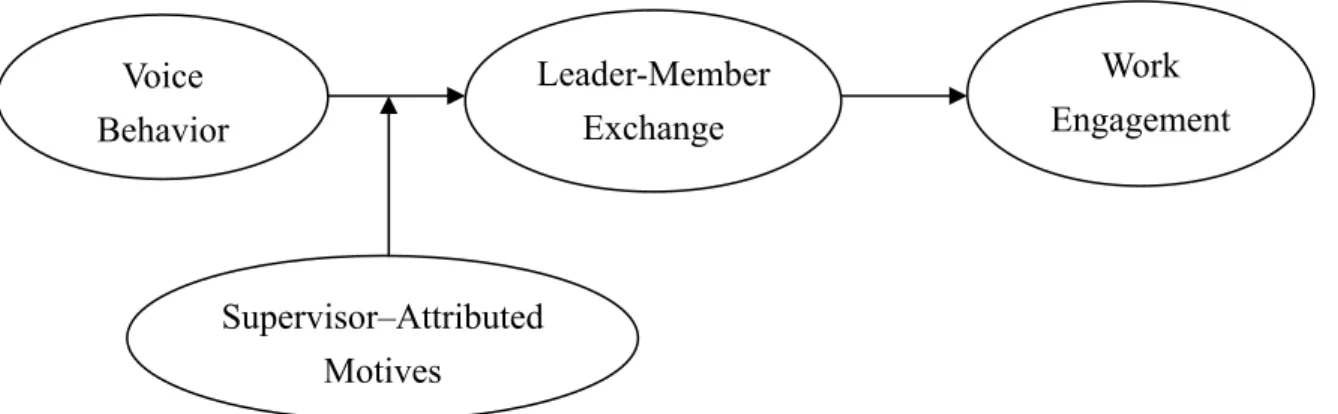
work engagement. The theoretical framework of this study is presented in Figure1.
--- Insert Figure 1 about here ---
Theory and Hypotheses
Voice Behavior and the Quality of LMX
Earlier research indicated that employee-upward voicing of ideas for improving a process, completing a task, or solving work-related issues is a crucial determinant of organizational survival (Detert & Burris, 2007; LePine & Van Dyne, 1998; Morrison
& Phelps, 1999) and may enhance individual impression (Fuller et al., 2007). Voice behavior may be related to high LMX because the voice behavior fosters positive exchange relationship. Moreover, employee may affect their supervisor positive evaluations and the quality of relationship by proactive voice behavior. In this study, we argue that social exchange and expectancy perspectives account for a positive association between voice behavior and LMX quality.
First, according to social exchange theory (Blau, 1964), when one party engages in beneficial actions directed at another party, they create an implicit obligation for the other party to reciprocate in the future, resulting in behavior that is advantageous to the initiating party (Cropanzano & Mitchell, 2005). Prior studies have indicated voice behavior is viewed as an improvement action that contributes to organizational
effectiveness (LePine & Van Dyne, 1998; Stamper & Van Dyne, 2001). Such behavior may create the positive value toward organization. Thus, supervisors are likely to reciprocate by offering more resources, information and emotional support, which is conducive to maintaining good work relationships with subordinates (Graen &
Uhl-Bien, 1995; Graen, Wakabayashi, Graen, & Graen, 1990; Kacmar, Witt, Zivnuska,
& Gully, 2003).
Additionally, from the expectancy theory perspective (Vroom, 1964) suggested that individuals will act in certain way, relying on the expectation that the behavior will be followed by a given outcome. Voice behavior is related to the follower’s desire to maintain a positive impression (Fuller et al., 2007) and enhance their social interactions with supervisors. From this perspective, employees engage in voice behavior because such behavior is a means to increase supervisors’ performance evaluations of the employee (Grant et al., 2009), increasing their individual success.
Therefore, when employees expect that voice behavior may reflect the respect, mutual trust, and good work relationship with their supervisors, they continue to engage in this behavior, in turn increasing and nurturing the relationship between subordinate and supervisor.
Although it seems intuitively obvious that voice behavior may potentially affect LMX quality, surprisingly, few studies to date have investigated this relationship.
Lapierre and Hackett (2007) provided a preliminary explanation for this idea, through examination of an integrative model of trait conscientiousness, LMX, job satisfaction and OCB (voice behavior is an important aspect of OCB). They found that employees display OCB as a means of enhancing the quality of the LMX relationship with their immediate supervisor. Following this line of reasoning and previous findings, we argue that employee voice behavior has a positive effect on the quality of LMX. We thus propose:
Hypothesis 1: Employee voice behavior is positively related to LMX quality.
The Moderating Role of Supervisor-attributed Motives
According to attribution theory, supervisors attempt to interpret and judge attitude and behavior from the standpoint of subordinate motivation (Green &
Mitchell, 1979; Heider, 1958; Weiner, 1985). As we noted earlier, supervisors are treated as categorizing employee motives as either prosocial and impression management motives (Ashford & Tsui, 1991; Grant, 2008; Lam et al., 2007).
Prosocial motives are attributed when the supervisor interprets the behavior of the employee as beneficial to others and the organization (Grant, 2008). Supervisors attribute impression management motives when the supervisor sees behavior from subordinates as ingratiating and conspicuous, and believes the subordinate’s intention is to convey and enhance a positive public image (Lam et al., 2007). When a
supervisor labels the subordinate’s voice behavior as prosocial in motivation, the supervisor views the employee as an important human asset and is more likely appreciate the subordinate. They will thus offer more resources to support the
subordinate in order to sustain high-quality LMX. On the contrary, when a supervisor perceives voice behavior as ingratiating and insincere, as in the case of extra-role behavior performed close to performance appraisal time (Eastman, 1994), such
behaviors trigger supervisor suspicions that the motivation is impression management.
The supervisor may thus be less likely to support the subordinate, and voice behavior would in turn be less likely to be related to LMX.
To date, no study has examined the moderating role of supervisor-attributed motives on the relationship between voice behavior and LMX. Some related research may provide similar evidence for this assertion. For example, Lam et al. (2007) conducted two studies to examine how supervisor interpretations of their employees’
motives for seeking feedback (feedback seeking and voice behavior are one important aspect of proactive behavior) affect the relationship between supervisors and
subordinates. They found that when supervisors attribute feedback seeking to strong prosocial motives and weak impression management motives, employee feedback
seeking was more positively associated with LMX. Eastman (1994) examined supervisor-attributed motives of subordinates’ extra-role behaviors and the response effect of the supervisor, and found that the employee received more rewards and profits only when the supervisor labeled the behaviors as citizenship. Based on the foregoing discussion, we propose that supervisor attribution interpretation may affect whether voice behavior is linked to LMX quality. Therefore, we propose:
Hypothesis 2a: Supervisor attribution of prosocial motives moderates the
relationship between voice behavior and LMX quality such that the positive association between voice behavior and LMX quality is stronger the more that supervisors who attribute the voice behavior to prosocial motives.Hypothesis 2b: Supervisor attribution of impression management motives
moderates the relationship between voice behavior and LMX quality such that the positive association between voice behavior and LMX quality is weaker the more that supervisors who attribute the voice behavior to impression management motives.The Quality of LMX and Work Engagement
In LMX literature, a considerable body research suggests that LMX has a significant impact on employee work attitudes and behaviours (e.g., performance, job satisfaction; Lapierre & Hackett, 2007; Wang, Law, Hackett, Wang, & Chen, 2005).
According to the social exchange theory perspective (Blau, 1964), in a high-quality LMX relationship, the leader gives more tangible and intangible rewards to an employee in the expectation of receiving benefits of equivalent value from the
employee in return (Blau, 1964). When high-quality relationships with supervisors are characterized by a feeling of supportive managerial environment (providing resources, support, and mutual trust), this in turn is reflected in the actual exchange relationship (Cropanzano, Prehar, & Chen, 2002; Dansereau, Graen, & Haga, 1975; Masterson, Lewis, Goldman, & Taylor, 2000). High quality LMX allows employees to contribute more fully to the organization in constructive ways (Blau, 1964). Work engagement is a form of currency in the social exchange, and a means of fulfilling obligations for reciprocity. Support for this relationship was provided by Hassan and Al Jubari (2010), who surveyed 218 employees from a Middle Eastern airline, they investigate the relationship between organizational justice, LMX and work engagement, and found a full mediation effect of LMX on interactional justice and work engagement. Similarly, Atwater and Carmeli (2009) surveyed 193 employees in a variety of jobs in Israel, examining LMX, feelings of energy, and creative work involvement. The results showed that higher quality LMX enhances employee feelings of energy, leading to a high involvement in creative tasks.
Given the foregoing discussion, we argue that under high quality LMX,
supervisors help subordinates on various tasks by offering resources and support (Graen & Scandura, 1987), and subordinates directly reciprocate with benefits to organizational commitment and performance (Gerstner & Day, 1997), especially devotion and engagement in job. Accordingly, we predict the quality of LMX will be positively connected to employee work engagement.
Hypothesis 3: The quality of LMX is positively associated with work
engagement.Method Participants and Procedures
Participants included employees and their immediate supervisors employed from a variety of organizations in Taiwan. Using a convenient-sampling approach, we contacted sampled firms via telephone and e-mail to confirm a contact person in each firm, and asked the contact person to ascertain supervisor willingness to participant.
After receiving company consent, we distributed 350 dyadic supervisor-employee questionnaires to participants. The supervisor questionnaire rated employee voice behavior, supervisor-attributed prosocial motives and supervisor-attributed impression management motives and demographic variables. Subordinate questionnaires
measured LMX, work engagement and demographic variables. In the cover letter, we explained the purpose of the study and ensured confidentiality, and provide a
self-addressed stamped envelope for return of the completed questionnaires directly to the researchers. Of the 350 pairs of questionnaires (350 to employees and 350 to their immediate supervisor) distributed, 442 questionnaires were returned (219 subordinate and 223 supervisor, 62.57% and 63.71%, respectively). After excluding unmatched samples, we had 206 valid subordinate-supervisor pairs for analysis.
Of the subordinates, males made up 51.5% of the samples. On average, they were 32.18 years old (SD = 6.44) and had 59.3 months organizational tenure (SD = 62.21). Most subordinates (55.3%) had a Bachelor’s degree. Of the industrial types, 53.4% of firms were in the financial industry and 46.6% were in the electronic industry. Of the supervisors, males comprised 60.7% of the participants, the average age was 38.4 (SD = 6.34), with an average organizational tenure of 117.08 months (SD = 74.50). About 46.6% of supervisors had a Bachelor’s degree.
Measures
Because the original survey items were developed in English, we followed Brislin’s (1980) recommendation. All scale items were translated into Chinese and then back-translated in English by two bilingual scholars in order to ensure semantic equivalency (Brislin, 1980).
Voice behavior
We measure voice behavior by adopting Van Dyne and LePine’s (1998) 6-item scale. Supervisors were asked to evaluate to the subordinate’s voice behavior.
Responses were made on a 7-point Likert-scale (1 = strongly disagree, 7 = strongly agree). Sample items were “This particular co-worker develop and make
recommendations concerning issues that affect this work group,” “This particular co-worker speak up and encourage others in this group to get involved in issues that affect the group,” and “This particular co-worker speak up in this group with ideas for new projects or changes in procedures.” The Cronbach’s α for this measure was .93.
LMX
We measured LMX with 7-item scale derived from Janssen and Van Yperen (2004). All items were measured using a 5-point Likert-scale with anchors from 1 (strongly disagree) to 5 (strongly agree). Sample items include, “My supervisor would be personally inclined to help me solve problems in my work,” “My working
relationship with my supervisor is effective,” “My supervisor and I are suited to each other.” The Cronbach’s α for this measure was .90.
Supervisor-attributed prosocial motives
To measure supervisor-attributed prosocial motives, we used a 4-item scale developed by Grant (2008). The original scale was used to measure the employee desire to benefit others. We slightly modify the object from “other” to “organization”.
Sample items are, “Desire to care about benefiting organization,” “Desire to have positive impact organization,” and “Desire to help organization.” We asked the supervisor the extent to which they perceived employee’s voice behavior as driven by prosocial motives. All items were scored on a 7-point rating scale ranging from 1 (strongly disagree) to 7 (strongly agree). The Cronbach’s α for this measure was .94.
Supervisor-attributed impression management motives
A 6-item scale validated by Allen and Rush (1998) was used in this study. We asked the supervisor the extent to which they perceived employee’s voice behavior as driven by impression management motives. Participants responded to a 7-point rating scale ranging from 1 (strongly disagree) to 7 (strongly agree). Example items included,
“Desire to build up favors for a later exchange,” “Desire to ‘show-off’ his or her expertise,” “Desire to capture my attention on him or her.” The Cronbach’s α for this measure was .92.
Work engagement
We adopted the 17-item scale of Salanova, Agut and Peiro (2005) to measure work engagement, composed of vigor (6 items), dedication (5 items), and absorption (6 items). All items were scored on a 5-point frequency rating scale ranging from 1 (never) to 5 (always). Examples of items include the following: for vigor, “In my job, I feel strong and vigorous”; for dedication, “I am enthusiastic about my job”; for
absorption “Time flies when I’m working.” Previous studies indicated that work engagement is a second-order construct reflecting three underlying dimensions (Edwards, 2001; Rich & LePine, 2010; Shimazu et al., 2008), and work engagement was hypothesize in this study at the construct level, we used composite score of three facets to represent work engagement. A higher-order confirmatory factor analysis (CFA) was conducted, and provides an acceptable fit to the data (χ2 354.21, df = 116, comparative-fit index (CFI) = .89, the goodness of fit index (GFI) = .80, normed fit index (NFI) = .83, and the root mean square error of approximation (RMSEA)
= .09). The Cronbach’s α for this measure was .91.
Control variables
In order to reduce the influence of confounding effects, we controlled for the subordinate’s gender (1 male, 0=female) and organizational tenure (in months).
Previous studies have indicated women to be more engaged than men (Mauno, Kinnunen, Makikangas, & Natti, 2005; Rothbard, 2001). Moreover, employees with senior tenure in their job may feel they have plateaued and display less engagement than newcomers (Allen, Poteet, & Russell, 1998). Accordingly, gender and tenure were included as control variables.
Data Analysis
Before testing our hypotheses model, we followed Anderson and Gerbing (1988) suggestions, first conducted a series of confirmatory factor analyses to assess the convergent and discriminant validities of the key variables, including voice behavior, LMX, supervisor-attributed prosocial motives, supervisor-attributed impression management motives, and work engagement. Next, hierarchical regression analysis was performed to test our hypotheses. We followed Baron and Kenny (1986) approach to test our hypotheses. In addition, in order to minimize possible multicollinearity, the independent variable and moderator variables were mean-centered (Aiken & West, 1991).
Results Confirmatory Factor Analyses
To begin with, we performed confirmatory factor analyses to examine the construct validity of the studied constructs (i.e., voice behavior, LMX,
supervisor-attributed prosocial motives, supervisor-attributed impression management motives, and work engagement) through convergent and discriminant validities. In the baseline model (five-factor), the results provide an acceptable model-to-data fit (χ2 678.98, df = 289. CFI = .90, GFI = .80, NFI = .85, RMSEA = .08), and all items loaded significantly at the p< .01 level on their intended latent variables, providing evidence for convergent validity. Because several variables were measured from the
same source, we tested four alternative models to ensure these scales were distinct.
Model 1 (four-factor model) combined LMX and work engagement into one factor that was measure by subordinates; Model 2 (three-factor model) combined voice behavior, supervisor-attributed prosocial motives, and supervisor-attributed
impression management motives to form a single factor that was rated by supervisors;
Model 3 (two-factor model), merged LMX and work engagement into one factor, and voice behavior, supervisor-attributed prosocial motives, supervisor-attributed
impression management motives to form another a single factor; and Model 4
(one-factor model) merged all five variables into a single factor. As shown in Table 1, the fit indices and the chi-square difference tests indicated that the baseline model yielded a better fit than the other models. These results provided evidence for discriminant validity.
--- Insert Table 1 about here --- Descriptive Statistics
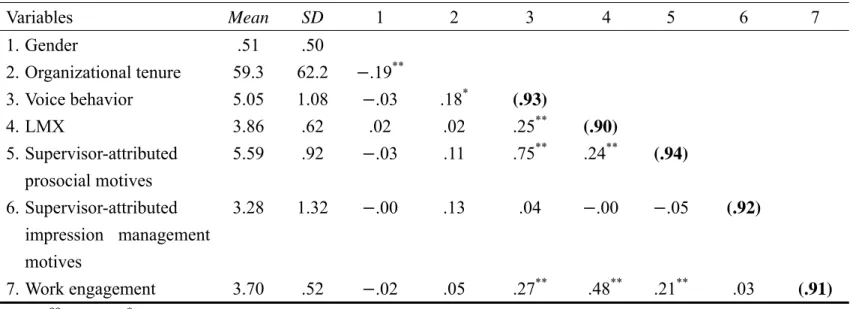
Means, standard deviations, intercorrelations and reliabilities for the study constructs are displayed in Table 2. As shown in the Table 2, the relationship between voice behavior and LMX, LMX and work engagement were significant and positive (γ = .25, .48, respectively, all ps < .01). These findings suggest that employee display of voice behavior can facilitate the quality of LMX. In addition, the higher the quality of LMX, the greater the work engagement.
--- Insert Table 2 about here --- Hypotheses Testing
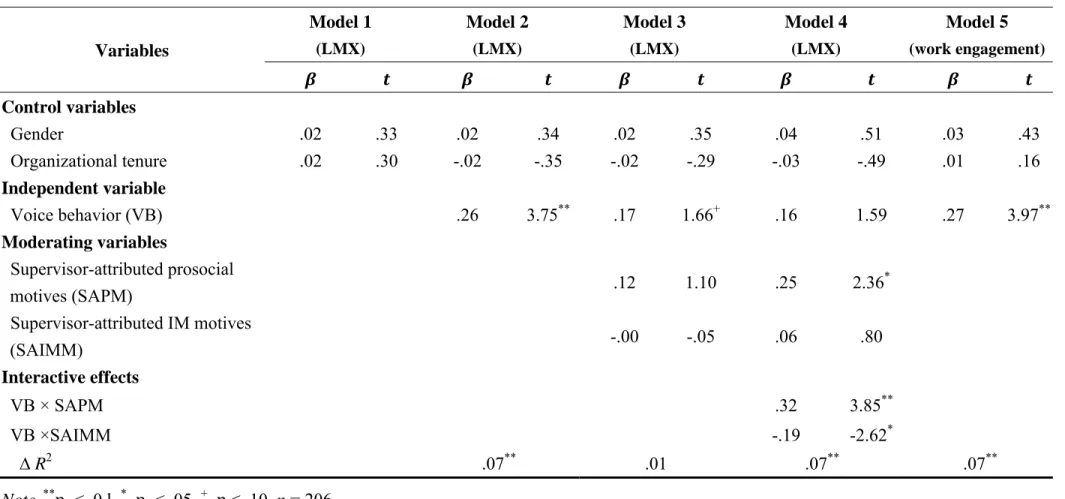
We test our hypotheses with the stepwise approach recommendation by Baron and Kenny (1986). As shown in Table 3, after controlling the gender and
organizational tenure of the subordinate in step 1, we entered voice behavior in step 2.
We found that the more willing employees were to display voice behavior, the greater the quality of LMX. Consistent with our prediction, Hypothesis 1 received support as voice behavior was positively related to LMX. Furthermore, in step 3 we entered the supervisor-attributed motives, and interactions were also entered in step 4. The findings indicated that either the interaction between voice behavior and
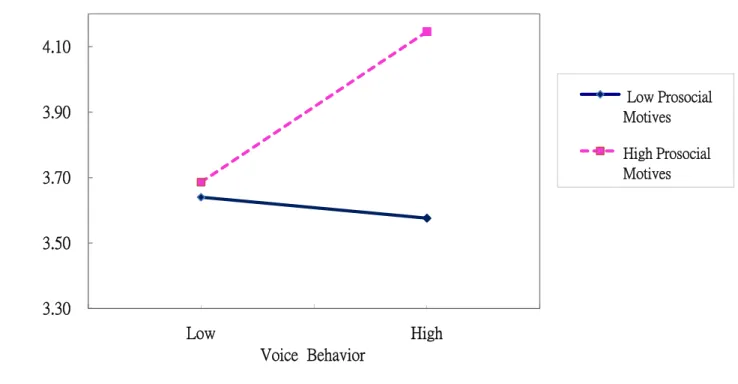
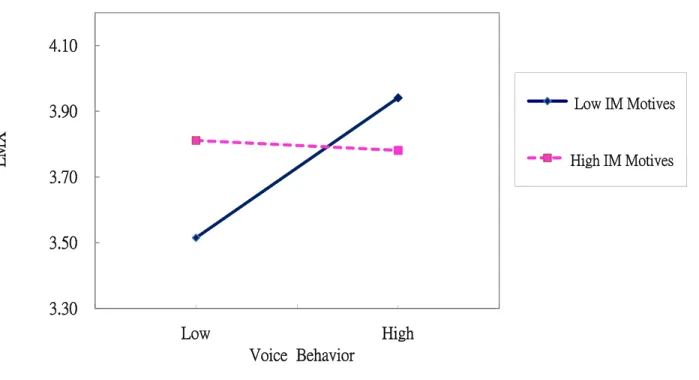
supervisor-attributed prosocial motives was significant (β = .32, p < .01; see Table 3), and or the interaction between voice behavior and supervisor-attributed impression management motives (β = .19, p < .01; see Table 3). We employed simple slopes to further analyze the interaction (see Figures 2, 3). As shown in Figure 2, the positive
relationship between voice behavior and LMX was stronger when supervisors explained voice behavior as driven by strong prosocial motives, supporting Hypothesis 2a. Moreover, as shown in Figure 3, the positive relationship between voice behavior and LMX was weaker when supervisors interpreted employee voice behavior as driven by impression management motives, supporting Hypothesis 2b.
Additionally, we regressed voice behavior on LMX after controlling the gender and organizational tenure, and found a significant positive effect of voice behavior on LMX (β = .27, p < .01; see Model 5 of Table 3). The results were consistent with our expectation in Hypothesis 3.
--- Insert Table 3 about here --- --- Insert Figure 2 about here --- ---
Insert Figure 3 about here ---
Discussion
In this study, we extend previous studies of voice behavior to investigate the relationship between voice behavior, LMX, supervisor-attributed motives and work engagement. As hypothesized, indeed, subordinate voice behavior was positively related to LMX, and the LMX positively influenced work engagement. This finding is similar to that of prior studies (Lapierre & Hackett, 2007) and supports the assertion of social exchange theory (Blau, 1964). Moreover, consistent with our inferences, this study found that the relationship between voice behavior and LMX was stronger, when supervisors judged the voice behavior as driven more by prosocial motives and less by impression management motives. These results demonstrate the importance of the supervisor-attributed motives in linking voice behavior to the quality of LMX.
The present study offers two contributions to the literature. First, most voice behavior researchers have focused mainly on exploring the antecedents of voice behavior (Detert & Burris, 2007; LePine & Van Dyne, 1998; Liu et al., 2010;
Nikolaou, Vakola, & Bourantas, 2008; Venkataramani & Tangirala, 2010; Walumbwa
& Schaubroeck, 2009). Surprisingly, however, little is known about consequences of voice behavior. Fuller et al. (2007) suggested that future study of the consequences of voice behavior should be clarified and explored. With this in mind, we undertook this study to extend the voice behavior literature by proposing a model detailing the consequences of voice behavior, examining the relationship between voice behavior,
LMX and work engagement. The results provide new and deeper insight into the consequences of voice behavior. Second, according to attribution theory (Ferris et al., 1995), subordinate behaviors are judged by supervisors. However, the literature on voice behavior paid less attention on supervisor-attributed motives, and we are not clear whether the boundary condition of supervisor-attributed motives for employee voice behavior may influence LMX. In order to further contributing to this line of voice behavior research, this paper investigates the moderating effect of
supervisor-attributed motives on the relationship between voice behavior and LMX.
The results provide important insight into the context of supervisor-attributed motives, voice behavior and the quality of LMX, showing that supervisor-attributed motives play a vital role in explaining the relationship between voice behavior and the quality of LMX.
Practical Implications
Our findings of the present study have important implications for managers. First, our results suggest that voice behavior is positive associated with the quality of LMX and that higher quality of LMX promotes work engagement. These results help employees to understand that voice behavior can improve the relationship between supervisors and subordinates, in turn enhancing their work engagement. Managers should attempt to build a secure work environment and encourage employees to speak up about work-related issues to improve organizational. In addition, the findings indicate that supervisor-attributed motives moderate the relationship between voice behavior and LMX. The major managerial implication is that supervisor
understanding of how to judge motives must be improved. Attribution biases often distort perceptions in ambiguous situations. Martinko (2002) suggested managers should attempt to remove as much ambiguity from work situations as possible. We suggest training programs to teach supervisors how to communicate, and how to avoid biased interpretation of the motives behind employee behavior.
Limitations and Recommendations for Future Research
Though the empirical findings of the present study support our hypotheses, the present research has limitations that should be addressed. First, because a
cross-sectional design was used in the current study, any inferences regarding causality are limited. Future studies should consider longitudinal or experimental designs using different time to collect data to provide firm evidence of causation.
Second, though we collected data from multiple sources, our study measured predictor (i.e., voice behavior) and moderator variables (i.e., supervisor-attributed prosocial motives and supervisor-attributed impression management) from the same source (supervisors), while the mediator (i.e., LMX) and criterion variables (i.e., work engagement) are measured from another source (subordinates), thus having the
potential for common method variance (CMV). We are concerned that potential CMV problems may inflate the true relationships among the study variables. We employed CFA to check the severity of CMV problems (Podsakoff, Mackenzie, Lee, &
Podsakoff, 2003; Podsakoff & Organ, 1986). CFA analysis results suggested that CMV did not appear to play an important role in shaping our findings. Nevertheless, we suggest that future researchers measure the research variables at different points in time in order to reduce the problems of CMV (Podsakoff & Organ, 1986). Third, the data was only gathered in Taiwan that may have concerns regarding the cross-culture generalizablility. Further study may corroborate our findings and generalize in other culture settings.
We provide two possible research directions for future study. First, in this study we adopt prosocial voice behavior. Other types of voice behavior (e.g., acquiescent voice and defensive voice; Van Dyne, Ang, & Botero, 2003) has not been explored.
Thus, future research could further examine the various forms of voice behavior and its consequences. Second, as mentioned above, supervisors interpret subordinate voice behavior as either prosocial- or impression management–motivated. However, the process by which supervisors assess and interpret the motives of employee voice behavior remains unclear. It would be interesting for future research to examine this process to enrich the attribution and voice behavior literatures.
REFERENCES
Aiken, L. S., & West, S. G. (1991). Multiple regression: Testing and interpreting
interactions. Newbury Park, CA: Sage.
Allen, T. D., Poteet, M. L., & Russell, J. E. A. (1998). Attitudes of managers who are more or less career plateaued. Career Development Quarterly, 47, 159-172.
Allen, T. D., & Rush, M. C. (1998). The effects of organizational citizenship behavior on performance judgments: A field study and a laboratory experiment. Journal
of Applied Psychology, 83, 247-260.
Anderson, J. C., & Gerbing, D. W. (1988). Structural equation modeling in practice: A review and recommended two-step approach. Psychological Bulletin, 103, 411-423.
Ashford, S. J., & Cummings, L. L. (1983). Feedback as an individual resource:
Personal strategies of creating information. Organizational Behavior and
Human Performance, 32, 370-398.
Ashford, S. J., & Tsui, A. S. (1991). Self-regulation for managerial effectiveness: The role of active feedback seeking. Academy of Management Journal, 34,
251-280.
Atwater, L., & Carmeli, A. (2009). Leader-member exchange, feelings of energy, and involvement in creative work. The Leadership Quarterly, 20, 264-275.
Avery, D. A., & Quinones, M. A. (2002). Disentangling the effects of voice: The incremental roles of opportunity, behavior, and instrumentality in predicting procedural fairness. Journal of Applied Psychology, 87, 81-86.
Baron, I. L., & Kenny, D. (1986). The moderator-mediator variable distinction in social psychological research: Conceptual, strategic, and statistical
considerations. Journal of Personality and Social Psychology, 51, 1173-1182.
Bettencourt, L. A. (2004). Change-oriented organizational citizenship behaviors: The direct and moderating influence of goal orientation. Journal of Retailing, 80, 165-180.
Blau, P. (1964). Exchange and power in social life. NY: John Wiley & Sons.
Brislin, R.W. (1980). Translation and content analysis of oral and written material. In H.C. Triandis & J.W. Berry (Eds.), Handbook of cross-cultural psychology:
methodology (Vol. 2, pp. 389-444): Boston: Allyn & Bacon.
Crant, J. M. (2000). Proactive behavior in organizations. Journal of Management, 26, 435-462.
Cropanzano, R., & Mitchell, M. S. (2005). Social exchange theory: An interdisciplinary review. Journal of Management, 31, 874-900.
Cropanzano, R., Prehar, C. A., & Chen, P. Y. (2002). Using social exchange theory to distinguish procedural from interactional justice. Group and Organization
Management, 27, 324-351.
Dansereau, F., Graen, G., & Haga, W. J. (1975). A vertical dyad linkage approach to leadership with formal organizations. Organizational Behavior and Human
Performance, 13, 46-78.
Detert, J. R., & Burris, E. R. (2007). Leadership behavior and employee voice: Is the door really open. Academy of Management Journal, 50, 869-884.
Dienesch, R. M., & Liden, R. C. (1986). Leader-member exchange model of leadership: A critique and further development. Academy of Management
Review, 11, 618-634.
Eastman, K. K. (1994). In the eyes of the beholder: An attributional approach to ingratiation and organizational citizenship behavior. Academy of Management
Journal, 37, 1379-1391.
Edmondson, A. C. (1999). Psychological safety and learning behavior in work teams.
Administrative Science Quarterly, 44, 350-383.
Edwards, J. R. (2001). Multidimensional constructs in organizational behavior research: An integrative analytical framework. Organizational Research
Methods, 4, 144-192.
Ferris, G. R., Bhawuk, D. P. S., Fedor, D. F., & Judge, T. A. (1995). Organizational politics and citizenship: Attributions of intentionality and construct definition.
In M. J. Martinko (Ed.), Advances in attribution theory: an organizational
perspective (pp. 231-252). Delray Beach, FL: St. Lucie Press.
Fuller, J. B., Barnett, T., Hester, K., Relyea, C., & Frey, L. (2007). An exploratory examination of voice behavior from an impression management perspective.
Journal of Managerial Issues, 19, 134-151.
Gerstner, C. R., & Day, D. V. (1997). Meta-analytic review of leader-member exchange theory: Correlates and construct issues. Journal of Applied
Psychology, 82, 827-844.
Gouldner, A. W. (1960). The norm of reciprocity: A preliminary statement. American
Sociological Review, 25, 161-178.
Graen, G. B., & Scandura, T. A. (1987). Toward a psychology of dyadic organizing. In L. L. Cummings & B. M. Staw (Eds.), Research in organizational behavior (pp. 175-208). Greenwich, CT: JAI Press.
Graen, G. B., & Uhl-Bien, M. (1995). Relationship-based approach to leadership:
Development of leader-member exchange (LMX) theory of leadership over 25 years: Applying a multi-level multi-domain perspective. The Leadership
Quarterly, 6, 219-247.
Graen, G. B., Wakabayashi, M., Graen, M. R., & Graen, M. G. (1990). International generalizability of American hypothesis about Japanese management progress:
A strong inference investigation. The Leadership Quarterly, 1, 1-23.
Grant, A., Parker, S., & Collins, C. (2009). Getting credit for proactive behavior:
supervisor reactions depend on what you value and how you feel. Personnel
Psychology, 62, 31-55.
Grant, A. M. (2008). Does intrinsic motivation fuel the prosocial fire? Motivational synergy in predicting persistence, performance, and productivity. Journal of
Applied Psychology, 93, 48-58.
Green, S. G., & Mitchell, T. R. (1979). Attributional processes of leaders in leader-member interactions. Organizational Behavior and Human
Performance, 23, 429-458.
Hassan, A., & Al Jubari, I. H. A. (2010). Organisational justice and employee work engagement: LMX as mediator. Journal for International Business and
Entrepreneurship Development, 5, 167-178.
Heider, F. (1958). The psychology of interpersonal relations. NY: John Wiley & Sons.
Ilies, R., Nahrgang, J. D., & Morgeson, F. P. (2007). Leader-member exchange and citizenship behaviors: A meta-analysis. Journal of Applied Psychology, 92, 269-277.
Janssen, O., De Vries, T., & Cozijnsen, A. J. (1998). Voicing by adapting and innovating employees: An empirical study on how personality and
environment interact to affect voice behavior. Human Relations, 51, 945-967.
Janssen, O., & Van Yperen, N. W. (2004). Employees’ goal orientations, the quality of leader-member exchange, and the outcomes of job performance and job satisfaction. Academy of Management Journal, 47, 368-384.
Johnson, D. E., Erez, A., Kiker, D. S., & Motowidlo, S. J. (2002). Liking and
attributions of motives as mediators of the relationships between individuals’
reputations, helpful behaviors, and raters’ reward decisions. Journal of Applied
Psychology, 87, 808-815.
Kacmar, K. M., Witt, L. A., Zivnuska, S., & Gully, S. M. (2003). The interactive effect of leader-member exchange and communication frequency on performance ratings. Journal of Applied Psychology, 88, 764-772.
Lam, W., Huang, X., & Snape, E. (2007). Feedback-seeking behavior and
leader-member exchange: Do supervisor-attributed motives matter. Academy
of Management Journal, 50, 348-363.
Lapierre, L. M., & Hackett, R. D. (2007). Trait conscientiousness, leader-member exchange, job satisfaction and organizational citizenship behavior: A test of an integrative model. Journal of Occupational and Organizational Psychology,
80, 539-554.
LePine, J. A., & Van Dyne, L. (1998). Predicting voice behavior in work groups.
Journal of Applied Psychology, 83, 853-868.
Liu, W., Zhu, R., & Yang, Y. (2010). I warn you because I like you: Voice behavior, employee identifications, and transformational leadership. The Leadership
Quarterly, 21, 189-202.
Martinko, M. J. (2002). Thinking like a winner: A guide to high performance
leadership. Tallahassee, FL: Gulf Coast Publishing.
Masterson, S. S., Lewis, K., Goldman, B. M., & Taylor, M. S. (2000). Integrating justice and social exchange: The differing effects of fair procedures and treatment of work relationships. Academy of Management Journal, 43, 738-748.
Mauno, S., Kinnunen, U., Makikangas, A., & Natti, J. (2005). Psychological
consequences offixed-term employment and perceived job insecurity among health care staff. European Journal of Work and Organizational Psychology,
14, 209-237.
Morrison, E. W., & Phelps, C. C. (1999). Taking charge at work: Extrarole efforts to initiate workplace change. Academy of Management Journal, 42, 403-419.
Nahrgang, J. D., Morgeson, F. P., & Ilies, R. (2009). The development of leader–member exchanges: Exploring how personality and performance influence leader and member relationships over time. Organizational Behavior
and Human Decision Processes, 108, 256-266.
Nikolaou, I., Vakola, M., & Bourantas, D. (2008). Who speaks up at work?
Dispositional influences on employees’ voice behavior. Personnel Review, 37, 666-679.
Podsakoff, P. M., Mackenzie, S. M., Lee, J. Y., & Podsakoff, N. P. (2003). Common method biased in behavior research: A critical review of the literature and recommended remedies. Journal of Applied Psychology, 88, 879-903.
Podsakoff, P. M., & Organ, D. W. (1986). Self-report in organizational research:
Problems and prospects. Journal of Management, 12, 531-544.
Rich, B. L., & LePine, J. A. (2010). Job engagement: Antecedents and effects on job performance. Academy of Management Journal, 53, 617-635.
Rothbard, N. P. (2001). Enriching or depleting? The dynamics of engagement in work and family roles. Administrative Science Quarterly, 46, 655-684.
Salanova, M., Agut, S., & Peiro, J. M. (2005). Linking organizational resources and work engagement to employee performance and customer loyalty: The mediation of service climate. Journal of Applied Psychology, 90, 1217-1227.
Schaufeli, W. B., Salanova, M., Gonzalez-Roma, V., & Bakker, A. B. (2002). The measurement of engagement and burnout: A two sample confirmatory factor analytic approach. Journal of Happiness Studies, 3, 71-92.
Shimazu, A., Schaufeli, W. B., Kosugi, S., Suzuki, A., Nashiwa, H., Kato, A., et al.
(2008). Work engagement in Japan: Validation of the Japanese version of the utrecht work engagement scale. Applied Psychology: An International Review,
57, 510-523.
Stamper, C. L., & Van Dyne, L. (2001). Work status and organizational citizenship behavior: A field study of restaurant employees. Journal of Organizational
Behavior, 22, 517-536.
Thomas, K. W., & Pondy, L. R. (1977). Toward and ‘‘intent’’ model of conflict management among principal parties. Human Relations, 30, 1089-1102.
Van Dyne, L., Ang, S., & Botero, I. C. (2003). Conceptualizing employee silence and employee voice as multidimensional constructs. Journal of Management
Studies, 40, 1359-1392.
Van Dyne, L., & LePine, J. A. (1998). Helping and voice extra-role behaviors:
Evidence of construct and predictive validity. Academy of Management
Journal, 41, 108-119.
Venkataramani, V., & Tangirala, S. (2010). When and why do central employees speak up an examination of mediating and moderating variables. Journal of
Applied Psychology, 95, 582-591.
Vroom, V. (1964). Work and motivation. NY: John Wiley & Sons.
Walumbwa, F. O., & Schaubroeck, J. (2009). Leader personality traits and employee voice behavior: Mediating roles of ethical leadership and work group
psychological safety. Journal of Applied Psychology, 94, 1275-7286.
Wang, H., Law, K. S., & Chen, Z. X. (2008). Leader-member exchange, employee performance, and work outcomes: An empirical study in the Chinese context.
International Journal of Human Resource Management, 19, 1809-1824.
Wang, H., Law, K. S., Hackett, R. D., Wang, D., & Chen, Z. X. (2005).
Leader-member exchange as a mediator of the relationship between transformational leadership and followers' performance and organizational citizenship behavior. Academy of Management Journal, 48, 420-432.
Wayne, S. J., Shore, L. M., Bommer, W. H., & Tetrick, L. E. (2002). The role of fair treatment and rewards in perceptions of organizational support and
leader-member exchange. Journal of Applied Psychology, 87, 590-598.
Weiner, B. (1985). An attribution theory of achievement motivation and emotion.
Psychological Review, 92, 548-573.
Yukl, G. (2002). Leadership in organizations (5th ed.). Upper Saddle River, NJ:
Prentice-Hall.
Figure 1. Proposed Model of the Present Study Voice
Behavior
Leader-Member Exchange
Work Engagement
Supervisor–Attributed
Motives
Table 1. Comparison of Measurement Models
Measurement models χ
2 df∆χ
2∆df CFI GFI NFI RMSEA
Baseline model (five-factor) 678.98 289 - - .90 .80 .85 .08 Model 1 (four-factor) 854.03 293 175.05
**4 .86 .74 .81 .10 Model 2 (three-factor) 1761.98 296 1083.00
**7 .64 .53 .60 .18 Model 3 (two-factor)
Model 4 (one-factor)
1935.14 2698.85
298 299
1256.16
**2019.87
**9 10
.60 .41
.51 .39
.56 .39
.19 .25
Note. The values of ∆χ2and ∆df were differences between the baseline model (five-factor) and other models.
Model 1: LMX and work engagement were combined into one factor (subordinates rated variables).
Model 2: Supervisor-attributed prosocial motives, impression management motives and voice behavior were merged into one factor (supervisors rated variables).
Model 3: All of supervisor rated variables were loaded on a single factor and all of the subordinate rated variables were loaded on another.
Model 4: All study variables were combined into one factor.
**
p < .01. n = 206.
Table 2. Means, Standard Deviations, Correlations and Reliabilities among Study Variables
Variables
Mean SD1 2 3 4 5 6 7
1. Gender .51 .50
2. Organizational tenure 59.3 62.2 .19
**3. Voice behavior 5.05 1.08 .03 .18
* (.93)4. LMX 3.86 .62 .02 .02 .25
** (.90)5. Supervisor-attributed
prosocial motives
5.59 .92 .03 .11 .75
**.24
** (.94)6. Supervisor-attributed impression management motives
3.28 1.32 .00 .13 .04 .00 .05
(.92)7. Work engagement 3.70 .52 .02 .05 .27
**.48
**.21
**.03 (.91)
Note. **p < .0 l.
*p < .05. n = 206. Cronbach’s α coefficient is presented on the diagonal
Table 3. The Results of Interactive Effect of Employees’ Voice Behavior and Supervisor-Attributed Motives on LMX
Variables
Model 1 (LMX)
Model 2 (LMX)
Model 3 (LMX)
Model 4 (LMX)
Model 5 (work engagement)
Control variables
Gender .02 .33 .02 .34 .02 .35 .04 .51 .03 .43
Organizational tenure .02 .30 -.02 -.35 -.02 -.29 -.03 -.49 .01 .16
Independent variableVoice behavior (VB) .26 3.75
**.17 1.66
+.16 1.59 .27 3.97
**Moderating variables
Supervisor-attributed prosocial
motives (SAPM) .12 1.10 .25 2.36
*Supervisor-attributed IM motives
(SAIMM) -.00 -.05 .06 .80
Interactive effects
VB × SAPM .32 3.85
**VB ×SAIMM -.19 -2.62
*∆ R
2.07
**.01 .07
**.07
**Note. **
p < .0 l.
*p < .05.
+p < .10. n = 206
Figure 2. Moderating Effect of Supervisor-attributed Prosocial Motives on the Relationship between Voice Behavior and LMX
3.303.50 3.70 3.90 4.10
Low High
LMX
Voice Behavior
Low Prosocial Motives High Prosocial Motives
Figure 3. Moderating Effect of Supervisor-attributed Impression Management Motives on the Relationship between Voice Behavior and LMX
3.303.50 3.70 3.90 4.10
Low High
LMX
Voice Behavior
Low IM Motives
High IM Motives
1
國科會補助專題研究計畫項下出席國際學術會議心得報告
日期:100 年 07 月 20 日
一、參加會議經過
本次學術研討會議,係在 7/13~7/15 於馬來西亞吉隆玻 JW MSSRRIOTT 飯店舉 辦,共計有十八場次,102 篇英文文章發表。我於 7/13 上午抵達會議地點,辦妥註冊 手續。我發表場次為 7/14 下午 14:00 ~ 16:00 的 Session D2(屬於 OB 領域共七篇文
章),會議全程均以英文進行互動,本場次與會學者來自台灣、菲律賓、馬來西亞、
土耳其等國家。另外,我也參與 7/14 上午 10:00 ~ 12:00 的 Session C2 及 7/15 上午 10:00
~ 12:00 的 Session E1。
二、與會心得
發表文章領域包括『建言行為、LMX、主管歸因與員工工作投入的關係』、『知識
特性、吸收性能力與知識轉移績效』、『團隊智慧資本與創新績效關係』、『工作自我效
能、主管支持、角色負荷與工作投入關係』、『負向心情、組織不正義與工作績效關係』
及『工作環境與工作能力、工作滿足及工作壓力的關係』。整體而言,與會較大的心
得,包括:
各篇文章均是集中探討微觀層次的組織行為為主軸。
本場次研討會的各篇文章主題具有相關性,例如『主管部屬關係、主管支持 及組織不正義對員工建言、角色負荷、工作能力、工作滿足、工作壓力及工
作投入關係』的影響。全程參與會議後,深深感受『知識全球化與普及化』,
台灣學者腦海中的組織行為特性與東南亞學者相去不遠,大家均可用相同研 究名詞來進行互動溝通與討論。
雖然均以期刊寫作,但顯著發現馬來西亞英語系國家的寫作表達較台灣文章 暢順。
來自馬來西亞、菲律賓學者的英文口述能力比台灣學者流暢許多。
台灣學者的統計分析方法使用,包括 LISREL、Multi-regression,較東南亞國 家嫻熟深入。
本場次研討會的文章發表人,均是大學教授為主,並無由碩博士生代為發表 的現象,其和台灣國內學術研討會較為不同。
計畫編號 NSC99-2410-H-011-002
計畫名稱 建言行為會助長領導成員交換關係嗎? 主管歸因的調節角色 出國人員
姓名 鄭仁偉
服 務 機 構 及職稱
台灣科技大學企管系副教授
會議時間 100 年 7 月 12 日至
100 年 7 月 15 日 會議地點 馬來西亞吉隆玻
會議名稱 (中文)
(英文)IAM 2011 International Conference on Innovation and Management 發表論文
題目
(中文)
(英文)Voice behavior to LMX, LMX to Employee’s Emgagement-The Moderator Role of Supervisor Attribution
2
最後,或許僅是亞洲國家與會的研討會性質,文章主題多數是跟隨現有歐美 期刊的趨勢在走
三、考察參觀活動(無是項活動者略) 無
四、建議
本次研討會的參與學者,仍是集中於東南亞國家為主,建議日後可多推廣歐 美日學者與會,以讓研討會深廣度增加。
五、攜回資料名稱及內容
會議摘要紙本一份。
會議中全部完稿文章光碟片乙份。
六、其他 無
Jen-Wei Cheng, Kuo-Ming Lu, Jyh-Hoei Kuo, Kang-Min Chien and Brenda Bernal
International Conference on Innovation and Management, Kuala Lumpur, Malaysia, July 12-15, 2011.
Voice Behavior to LMX, LMX to Employee’s Engagement - The Moderator Role of Supervisor Attribution
Jen-Wei Cheng1, Kuo-Ming Lu2, Jyh-Hoei Kuo3, Kang-Min Chien4 and Brenda Bernal5 Department of Business Administration, National Taiwan University of Science and
Technology, Taiwan1,2,4,5
Graduate Institute of Business Administration, Cheng Shiu University, Taiwan3 [email protected]1
[email protected]2 [email protected]3
[email protected]4 [email protected]5
Corresponding Author: [email protected]
Abstract
The purpose of this paper was to develop a theoretical model of the consequences of voice behavior. It is realistic to assume that voice behavior could result in the engagement of a subordinate provided that there is a high leader-member exchange between the supervisor and the subordinate. If the supervisor perceives the voice behavior of the subordinate as reflective of the desire to make innovative suggestions for challenging and changing standard procedures to improve performance, it is possible that voice behavior could facilitate the quality of supervisor-subordinate relationship and, in turn, lead to facilitating the engagement of the employee. We conceptualized the norm of reciprocity and social exchange as emergent phenomena that link the relationships between voice behavior, leader-member exchange (LMX) and engagement, and drew on the attribution theory to discuss its role in linking voice behavior and LMX quality. Our proposed model provides new insights into the relationship between the upward voice behavior of an employee and LMX, LMX and employee’s engagement, and the moderate effects of the interpretations of supervisors of the motives of their subordinates for voice behavior on LMX quality.
Keywords: Voice behavior, leader-member exchange, engagement, supervisor attribution
Jen-Wei Cheng, Kuo-Ming Lu, Jyh-Hoei Kuo, Kang-Min Chien and Brenda Bernal
International Conference on Innovation and Management, Kuala Lumpur, Malaysia, July 12-15, 2011.
1. Introduction
The voice behavior of employees serves as the “seed corn” for continuous improvement and organizational adaptation (Ashford, Rothbard, Piderit, & Dutton, 1998; Van Dyne &
LePine, 1998). As Senge stated, “it is just not possible any longer to ‘figure it out’ from the top” (Detert & Burris, 2007), pertaining to voice suggestions of employees playing a vital role in correcting mistakes, improving processes, and formulating novel solutions to organizational problems (Fuller, Barnet, Hester, Relyea, & Frey, 2007).
However, it is generally believed that not all supervisors are always pleased when employees engage in excessive complaints, personal criticism, or aggressive voice behaviors, as these can upset interpersonal relationships (Fuller, et al., 2007). Voice behaviors are attributed by supervisors. The attribution theory states that an individual makes attributions about an actor’s behavior based on the intentions and motives that guide the behavior.
Supervisors may attribute the behavior of their subordinates to two separate kinds of motives:
performance enhancement and impression management (Lam, Huang, & Snape, 2007).
Supervisors may judge their subordinates differently depending on what motives, beliefs, or intentions they associate with an observed behavior.
Social exchange is a relationship of mutually contingent, tangible, and intangible exchanges between people. It is the perceived obligation of return that connects it to the norm of reciprocity. The current paper shows that when an employee voices out his concerns to the supervisor, and this result in positive changes in an organization, such behavior brings delight to the supervisor. Social exchange takes place when an individual feels obligated to reciprocate to another person from whom he has personally received a favor, benefit, and reward. Westphal and Zajac (1997) indicated that the norm of reciprocity stresses the need perceived by an individual to return favors to others. Gouldner (1960) asserted that under the norm of reciprocity, the individual who receives the reward becomes morally obligated to return the favor.
The leader-member exchange (LMX) theory is a dyad relationship that is formed based on a mutual beneficial relationship between a follower and a supervisor in an organization.
Previous studies have reported that LMX between a supervisor and a subordinate is an indication of a social exchange relationship (Burton, Sablynski, & Sekiguchi, 2008; Ilies, Nahrgang, & Morgeson, 2007). Researchers categorize negotiated exchange as a form of lower quality LMX relationship where it is perceived to be more contractual in nature. As the quality of LMX relationship matures, the exchange relationship broadens to include a more reciprocal kind of exchange that generally leads to the employee becoming more engaged in in-role, extra-role, and attitudinal outcomes (Burton et al., 2008).
Although Graen and Scandura (1987) stated that “each party must offer something the other party sees as valuable and each party must see the exchange as reasonably equitable or fair,” social exchange theory and LMX researchers have pointed out that immediate and
Jen-Wei Cheng, Kuo-Ming Lu, Jyh-Hoei Kuo, Kang-Min Chien and Brenda Bernal
International Conference on Innovation and Management, Kuala Lumpur, Malaysia, July 12-15, 2011.
reciprocal giving something in return to their supervisor, subordinates with high quality LMX will engage in extra effort to be engaged more at work. Subordinates with high-quality LMX relationships perform better at their jobs (Lam et al., 2007) and display more organizational citizenship behaviors (OCBs) (Burton et al., 2008).
Thus, we argue that because individuals engage more often in reciprocal exchanges, over time their relationships may give way to social exchange relationships. Furthermore, studies have shown that higher quality LMX employees tend to receive better social support, more resources, and more guidance for career development (Lam et al., 2007). A sense of mutual support between the employee and the supervisor results in effective work behavior such as more engagement at work (Cropanzano & Rupp, 2008).
There have been previous studies on voice behavior. However, until now, the question of whether upward voice suggestions of employees would lead to engagement in the workplace remains unanswered. There is also insufficient information on the relationship between voice behavior, supervisor attribution motives, LMX quality relationships, and engagement. To address this issue, it is seems realistic to assume that voice behavior could result in the engagement of the subordinate provided that there is a high leader-member exchange between the supervisor and the subordinate. If the supervisor perceives the subordinate’s voice behavior as an intention to make innovative suggestions for challenging and changing to standard procedures to improve performance, it is possible that voice behavior could potentially facilitate the quality of supervisor-subordinate relationship and facilitate the engagement of an employee.
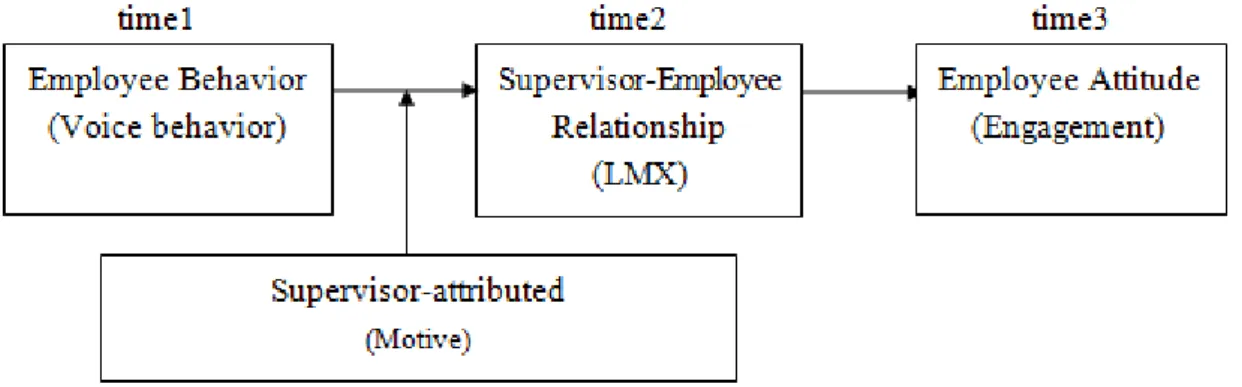
Drawing on the literature on attribution theory, social exchange, LMX, and engagement, we combined these theories to produce an integrative model. Figure 1 shows our theoretical model.
Figure 1. Research Conceptual Model
Figure 1 shows that time1: employee behavior (voice behavior) will influence time2:
supervisor-employee relationship (LMX) depending on how the supervisor will interpret the motivation of the employee for speaking up (supervisor-attributed), because a high quality
Jen-Wei Cheng, Kuo-Ming Lu, Jyh-Hoei Kuo, Kang-Min Chien and Brenda Bernal
International Conference on Innovation and Management, Kuala Lumpur, Malaysia, July 12-15, 2011.
supervisor-employee relationship will likely develop between the supervisor and the employee if the supervisor will attribute the behavior of the actor to performance enhancement. Based on LMX rationale, it can be stated that when there is a constant flow of reciprocity between two entities (supervisor and employee), an employee will likely become more motivated. When an employee is motivated, the employee will have a good attitude toward work (engagement), as shown in time3.
2. Theoretical Background and Propositions
2.1 Voice BehaviorVoice behavior is defined as a voluntary verbal expression with someone inside the organization with the perceived power to act, it involves constructive change with the intent of improving the situation rather than criticizing it (Walumbral & Schaubroeck, 2009; Van Dyne & LePine, 1998). Voice behavior as defined herein would qualify as proactive behavior.
According to Crant (2000), proactive behavior is “taking initiative in improving current circumstances or creating new ones; it involves challenging the status quo rather than passively adapting to present conditions.”
Voice is distinct from affiliative behavior normally associated with organizational citizenship behavior or contextual performance, because affiliative behavior is meant to preserve or improve relationships, whereas voice challenges existing interpersonal relationships. Voice is also distinct from prohibitive behaviors such as whistle-blowing.
Whistle-blowing is critical and meant to stop some activity as opposed to being constructive and wanting to change some activity. Voice is also distinct from complaining. Complaints convey anger and do not necessarily include suggestions for change (Kowalski, 1996).
Hirschman’s (1970) theory pertains to employees who are dissatisfied with some aspect of organizational functions, thereby voicing out their concerns and loyalty as a primary reason to voice suggestions. This attitude is what leads some subordinates to speak up. This theory stems from the notion that some subordinates are more likely than others to “go the extra mile” when it comes to speaking up (Crant, 2000). However, speaking up has some potential risks because it involves pointing out the need for improvement in a program or policy to those who may have devised, are responsible for, or feel personally attached to the status quo (Detert & Burris, 2007). No one wants to be characterized as a “troublemaker” and suffer the possible negative consequences in one’s professional career.
Voice is a non-required behavior and is not part of the role of the employee (Detert &
Burris, 2007). An individual will likely be motivated to speak up except when he feels that he will benefit or gain from doing so more than the risks involved.
2.2 Leader-Member Exchange (LMX)
LMX refers to the quality of the relationship between a subordinate and a supervisor (Liden, Sparrowe, & Wayne, 1997). Social exchange theory provides the main theoretical
Jen-Wei Cheng, Kuo-Ming Lu, Jyh-Hoei Kuo, Kang-Min Chien and Brenda Bernal
International Conference on Innovation and Management, Kuala Lumpur, Malaysia, July 12-15, 2011.
basis for LMX (Sparrowe & Liden, 1997). Individuals tend to feel obligated to reciprocate when they receive a benefit from another social entity. Previous findings suggest that a social exchange has occurred when there is an obligation to reciprocate a benefit to the other entity (subordinate or supervisor) (Whitener, Brodt, Korsgaard, & Werner, 1998). The norm of reciprocity suggests that when there is “give and take” between two parties, it reinforces their relationship.
Lower quality LMX is similar to negotiated exchange in which a more contractual rule exists and is tangible and “enforceable” by nature. Some LMX relationships may be high depending on the quantity of material resources, information, and support exchanged between the leader and follower. When an individual is a recipient of a good deed, the person feels obligated to return the favor; the bigger the benefits exchanged, the higher the quality of LMX relationship, which leads to a better attitude in the workplace (Ilies et al., 2007).
Moreover, as suggested by social exchange theory and found by LMX research, a high-quality LMX relationship enables subordinates to give extra effort on behalf of their supervisor even though they might think that their action might not be rewarded and reciprocated immediately.
2.3 Engagement
Work engagement has been defined as “the simultaneous employment and expression of a person’s ‘preferred self’ in task behaviors that promote connections to work and to others, personal presence (physical, cognitive, and emotional) and active, full performance.” Past studies have indicated that an individual’s role engagement in the workplace is characterized by motivation (Schaufeli, Salanova, Gonzales–Roma, & Bakker, 2002). Motivation manifests role engagement, which is characterized by vigor, dedication, and absorption. “Vigor” refers to high levels of energy and mental resilience while working, the willingness to invest effort in one’s work, and persistence even in the face of difficulties. “Dedication” is characterized by a sense of significance, enthusiasm, inspiration, pride, and challenge at work.
“Absorption” consists of being fully concentrated, happy, and deeply engrossed in one’s work whereby time passes quickly, and one has difficulty detaching himself from work (Pierro, Kruglanski, & Higgins, 2006).
2.4 Supervisor Attribution as a Moderating Mechanism
Supervisors make attributions about the behavior and actions of subordinates and react depending on their judgment of the behavior of subordinates. A supervisor tends to appreciate subordinates’ motivation when he interprets the behavior as performance enhancement. A performance enhancement motive is characterized as achievement-focused and is intended to meet a high standard in accomplishing work tasks (Ashford, Blatt, & Walle, 2003). When a subordinate displays this type of behavior, supervisors reciprocate by offering support, special benefits, and opportunities for career development (Graen & Uhl–Bien, 1995; Kacmar, Witt, Zivnuska, & Gully, 2003), which is conducive to high-quality LMX.