國立臺灣大學生命科學院生化科學研究所 碩士論文
Graduate Institute of Biochemical Science
College of Life Science
National Taiwan University Master Thesis
細菌的十一異戊基二烯焦磷酸合成酶之抑制劑的合成 與評測
Synthesis and Evaluation of Bacterial Undecaprenyl Diphosphate Synthase Inhibitors
陳曉萱
Hsiao-Hsuan Chen
指導教授:梁博煌 博士
Advisor: Po-Huang Liang, Ph.D.
誌謝
光陰似箭,一晃眼兩年的時間就這麼匆匆的溜走,但也留下許多深遠的回憶。
一路上因為眾人的協助,我才能完成碩士學位。首先最該感謝的人莫過於我 的父母,給予我極大的包容與支持,讓我可以勇敢地闖蕩我的夢想,累了還可以 躲回他們築起的避風港休息。謝謝梁博煌老師,願意給予我機會進入實驗室學習,
在每周會議時適時提出建議及修正方向。謝謝實驗室的眾多夥伴們,豐富了我的 研究生生活;謝謝彥槿學姊除了給予實驗上的建議外也指引我一些人生的方向,
滿足生理及心理上的溫飽;Vathan, thank you for teaching me organic chemistry synthesized experiment and NMR.謝謝俊宇學長在蛋白質純化、酵素動力學實驗上給 予很多建議,以及期中期末考前的大惡補;謝謝玉如、瑾融兩個買午餐及玩耍的 好夥伴,因為你們枯燥的實驗生活不再乏味;謝謝雍曄常聽我碎碎念,無論在課 業或實驗上都是學習的好夥伴;謝謝明憲每周會議時提供的精闢見解及實驗上的 小秘笈;謝謝有緯在學術論文寫作課程上的合作學習。謝謝聖偉學長協助貴重儀 器的使用也在蛋白質實驗方面提供許多有用的見解;謝謝鄧怡君小姐提供測量 Mass 上的協助;謝謝所上的同學們這兩年來的協助與鼓勵。最後我要謝謝我的男 友,包容我陪我談心紓解實驗上的不如意;也謝謝子凡姊,大學畢業後還繼續陪 伴我,陪我聊很多心事,還提供我很多有機實驗方面的幫助。
其實有太多太多的感謝,真的無法以短短幾行字簡單帶過,只好將一切點滴 記在心頭。
陳曉萱 謹誌於 國立台灣大學生化科學所 中華民國 一零八年六月
摘要
耐甲氧西林金黃色葡萄球菌(methicillin-resistant Staphylococcus aureus)等具多 重抗藥性的金黃色葡萄球菌,是種致命且需要新的抗生素治療的醫院感染細菌。
十一異戊基二烯焦磷酸合成酶 (undecaprenyl diphosphate synthase, UPPS) 將八當 量的異戊烯基焦磷酸 (isopentenyl pyrophosphates, IPP) 與一當量的法尼基焦磷酸 (farnesyl pyrophosphate, FPP) 聚合,形成十一異戊基二烯焦磷酸 (undecaprenyl diphosphate, UPP),是用於合成細菌細胞壁的肽聚醣的必要前驅物,因此十一異戊 基二烯焦磷酸合成酶可作為新抗生素的標靶。基於十一異戊基二烯焦磷酸合成酶 之結構和先前的研究,我們設計了一系列吡咯烷酮的衍生物,並使用法尼基焦磷
酸的螢光衍生物MANT-O-GPP 的活性測試法來測試它們對大腸桿菌及金黃色葡萄
球菌之十一異戊基二烯焦磷酸合成酶的抑制作用,其中具有鹵素或苯基的化合物 對抑制十一異戊基二烯焦磷酸合成酶更有效,而最小抑菌濃度的測試結果表明它 們具有抑制枯草桿菌 (Bacillus subtilis) 的活性,根據酵素動力學和結構模擬,這 些化合物對十一異戊基二烯焦磷酸合成酶而言是混合型的抑制劑。
ABSTRACT
The multiple antibiotic-resistant Staphylococcus aureus, such as methicillin-resistant Staphylococcus aureus (MRSA), is a fatal nosocomial infection that needs new antibiotics. Undecaprenyl diphosphate synthase (UPPS) condenses a farnesyl pyrophosphate (FPP) with eight isopentenyl pyrophosphates (IPP) to form undecaprenyl diphosphate (UPP) for the biosynthesis of peptidoglycan essential for bacterial cell wall, so it is a potential drug target for antibiotic. Based on UPPS structure
and previous research, we designed a series of
4-carboxy-1-(4-styrylcarbonylphenyl)-2-pyrrolidinone derivatives and used a fluorescent analog of FPP, MANT-O-GPP, to test their inhibition on E. coli and MRSA UPPS. The compounds with halogen or benzene group were more potent to inhibit UPPS. Then, the EC50 test showed that they have anti-bacterial activities to Bacillus subtilis. According to the enzyme kinetics and modeling, these compounds were mixed inhibitors of UPPS.
CONTENTS
摘要 ... I ABSTRACT ... II CONTENTS ... III LIST OF SCHEME & TABLE ... VI LIST OF FIGURE ... VII ABBREVIATIONS ... VIII
1 INTRODUCTION ... 1
1.1 Pathogens ... 1
1.2 Antibiotics and resistance ... 1
1.3 Undecaprenyl pyrophosphate synthase as a potential antibiotic target ... 3
1.4 Purpose of study ... 4
2 MATERIALS AND METHODS ... 5
2.1 Chemicals ... 5
2.2 Synthesize the inhibitor of UPPS ... 5
2.2.1 Synthesis of 1-(4-Acetylphenyl)-4-carboxy-2-pyrrolidinone (1) ... 5
2.2.2 General procedure of 4-Carboxy-1-(4-styrylcarbonylphenyl)-2-pyrrolidinones (2a-j)... 6
2.3 SaUPPS cloning ... 12
2.4 Purification of His-tagged EcUPPS or SaUPPS and removal of the tag ... 13
2.5 Kinetic measurements ... 14
2.5.1 General procedure... 14
2.5.2 Extinction coefficient of MANT-O-GPP elongated product formation 15 2.5.3 Kinetic constant measurements ... 15
2.5.4 EcUPPS and SaUPPS inhibition assays ... 16
2.5.5 Measure the inhibited type of compounds ... 16
2.6 Antibacterial experiments ... 17
2.7 Docking compound in SaUPPS ... 18
3 RESULT ... 19
3.1 Synthesis of pyrrolidinone derivatives ... 19
3.1.1 1-(4-Acetylphenyl)-4-carboxy-2-pyrrolidinone (1) ... 19
3.1.2 4-Carboxy-1-(4-styrylcarbonylphenyl)-2-pyrrolidinones derivatives (2a-j) ... 19
3.2 Purification of UPPS ... 20
3.3 Kinetic constant of UPPS ... 21
3.6 Compound 2d was a mixed inhibitor ... 24
3.7 Compound 2d docked in the activity site of UPPS with FPP ... 24
4 DISCUSSION ... 26
TABLE ... 29
FIGURE ... 32
REFERENCE ... 45
SPECTURM ... 52
LIST OF SCHEME & TABLE
Scheme 1. Synthesize the derivatives of pyrrolidinone ... 20
Table 1. The kinetic constants of EcUPPS and SaUPPS. ... 29
Table 2. The IC50 of compounds against EcUPPS and SaUPPS. ... 30
Table 3. The EC50 values of compound 2d, i, and j. ... 31
LIST OF FIGURE
Figure 1. The pathway of peptidoglycan synthesis. ... 3
Figure 2. SDS-PAGE analysis of the purified EcUPPS and SaUPPS. ... 33
Figure 3. The extinction coefficient of MANT-O-GPP convert to product. ... 33
Figure 4. The kinetic constant of EcUPPS. ... 34
Figure 5. The kinetic constant of SaUPPS. ... 35
Figure 6. The inhibition assay for EcUPPS. ... 38
Figure 7. The inhibition assay for SaUPPS. ... 41
Figure 8. The EC50 of compound 2d, I and j against B. subtilis. ... 42
Figure 9. Compound 2d is a mixed inhibitor of SaUPPS. ... 43
Figure 10. Docking of compound 2d in SaUPPS with FPP. ... 44
ABBREVIATIONS
DMSO, dimethyl sulfoxide;
Da, Dalton:
EA, Ethyl acetate;
EC50, Half maximal effective concentration
EcUPPS, Escherichia coli undecaprenyl pyrophosphate synthase;
EtBr, ethidium bromide;
FPP, farnesyl pyrophosphate;
IPP, isopentenyl pyrophosphate;
UPP, undecaprenyl pyrophosphate;
UPPS, undecaprenyl pyrophosphate synthase;
Hepes, 4-2(-hydroxyethyl)-1-piperazineethanesulfonic acid;
IC50, half maximal inhibitory concentration;
IPTG, isopropyl-β-thiogalactopyranoside;
MANT-O-GPP,
(2E,6E)-8-O-(N-methyl-2-aminobenzoyl)-3,7-dimethyl-2,6-octandien-1-pyrophosphate;
mp, melting temperature;
NMR, nuclear magnetic resonance;
PCR, polymerase chain reaction;
SaUPPS, Staphylococcus aureusundecaprenyl pyrophosphate synthase;
SDS-PAGE, sodium dodecyl sulfate-polyacrylamide gel electrophoresis;
TLC, thin-layer chromatography;
Tris, tris(hydroxymethyl)aminomethane
1 INTRODUCTION
1.1 Pathogens
Pathogens are microorganisms which can infect humans and cause diseases and death, such as bacteria, fungi, viruses1. Among them, the most common are bacteria.
Pathogenic bacteria often infect humans with compromised immunity. One of the most terrifying bacteria is Mycobacterium tuberculosis which caused tuberculosis and killed about 2 million people a year, mostly in sub-Saharan Africa2. Other significant bacterias are Streptococcus and Pseudomonas which cause pneumonia, and Shigella, Campylobacter, and Salmonella which cause foodborne illnesses3-4. Pathogenic bacteria also cause diseases such as tetanus, typhoid fever, diphtheria, syphilis, and leprosy5.
1.2 Antibiotics and resistance
Bacteria can be killed by antibiotics. The first commercialized antibiotic, penicillin,
was discovered by Alexander Fleming6 in 1928. It is a β-lactam interrupts the formation of peptidoglycan cross-linkages in the bacterial cell wall7. However, a few years later, a β-lactamase emerged in some bacteria to destroy and abolish the effect of penicillin. In 1960, scientists developed its derivatives, such as methicillin and
deadly threat to humans8. In 1992, scientists have noticed antibiotics resistance crisis10. As reported, bacteria had resistance to antimicrobial agents because of chromosomal changes or the exchange of genetic materials via plasmids and transposons.
Streptococcus pneumoniae, Streptococcus pyogenes, and staphylococci which cause
respiratory and cutaneous infections, and members of the Enterobacteriaceae and Pseudomonas families, organisms which cause diarrhea, urinary infection, and sepsis,
are resistant to all of the older antibiotics. The extensive use of antibiotics in the community and hospitals make this crisis even more serious. In 2008, Rice recommended “the ESKAPE bugs” referred to the six common antibiotic-resistant bacteria Enterococcus faecium, Staphylococcus aureus, Klebsiella pneumonia,
Acinetobacter baumanni, Pseudomonas aeruginosa, and Enterobacter species in hospitals11. Then, scientists sought other targets to fight resistant bacteria. For example, linezolid approved for commercial use in 2000 is an antibiotic used to treat Gram-positive bacteria that are resistant to other antibiotics. It binds to the 50S subunit of the prokaryotic ribosome and prevents the initiated complex forming for protein synthesis forming12. Other targets including the enzymes or elements participating cell wall biosynthetic pathways are being explored13-17.
1.3 Undecaprenyl pyrophosphate synthase as a potential antibiotic target
Undecaprenyl pyrophosphate synthase, UPPS, catalyzes consecutive condensation of eight molecules of isopentenyl diphosphate (IPP) with farnesyl diphosphate (FPP) to form UPP. It belongs to a prenyltransferase family which transfers prenyl groups to acceptors and participates in isoprenoid biosynthetic pathways18. UPP then acts as a
lipid carrier for bacterial peptidoglycan biosynthesis19-21. This pathway of peptidoglycan synthesis is shown in Figure 122. Due to its pivotal role in cell wall biosynthesis, UPPS has been suggested as a potential antibiotic target23-32.
Figure 1. The pathway of peptidoglycan synthesis.
1.4 Purpose of study
Based on the rationale, we wanted to design inhibitors against UPPS and evaluated them. A previous postdoctor in our laboratory, Dr. Vathan Kumar, discovered a hit
VK-278 he synthesized to inhibit UPPS. Following his discovery, I synthesized its
anaologues and measured their inhibition on UPPS. We chose E. coli and S. aureus UPPS as working subjects because S. aureus is a Gram-positive resistant species and E.
coli is a Gram-negative bacterium for comparison. We used a fluorescent analogue of
FPP, MANT-O-GPP, to monitor the activity of UPPS because of its fluorescent increase at 420 nm during chain elongation33-34. We also investigated their types of inhibition with steady-state kinetic measurements at different substrate and inhibitor concentrations and docking by iGEMDOCK. Then, the compounds with better inhibition on UPPS enzymes were tested for inhibiting bacterial growth.
2 MATERIALS AND METHODS
2.1 Chemicals
4- aminoacetophenone, itaconic acid, 4-bromobenzaldehyde, 4-cyanobenzaldehyde, 3-cyanobenzaldehyde, 3-nitrobenzaldehyde, 4-biphenylcarboxaldehyde, and 3,4-dichlorobenzaldehyde were purchased from AK Scientific (Union City, USA).
Benzaldehyde, 4-chlorobenzaldehyde, and 4-carboxybenzaldehyde were purchased from Acros Organics (New Jersey, USA). 4-fluorobenzaldehyde was purchased from Alfa Aesar (Ward Hill, USA). GenepHlowTM Gel/PCR kit was purchased from Geneaid (Taiwan). TLC, pET-32 Xa/LIC Vector Kit, and Ni-NTA were purchased from Merck (Darmstadt, Germany). Thrombin was purchased from GE Healthcare (Chicago, United States). MANT-O-GPP was synthesized previously in our laboratory. IPP was purchased from Echelon Biosciences (Salt Lake City, USA).
2.2 Synthesize the inhibitor of UPPS
2.2.1 Synthesis of 1-(4-Acetylphenyl)-4-carboxy-2-pyrrolidinone (1)
A mixture of 1 g (7.40 mmol) 4-aminoacetophenone and 1.2 g (8.89 mmol) itaconic acid was stirred and heated (110-130 ℃) under reflux for 18 hours. The
heated to dissolve in methanol, then cooled to room temperature to wait for recrystallization. Crystallization was filtered and washed with EA to yield the product.
The product was dissolved in the DMSO-d6 to test NMR by Bruker AVIIIHD 400MHz FT-NMR in the department of chemistry, National Taiwan University (Taiwan) and was dissolved in the methanol for mass measurement by Bruker UPLC-MS in the College of Life Science (TechComm, National Taiwan University, Taiwan) to confirm the product.
Then, the product was measured its melting temperature by Fargo MP-1D Melting Point Apparatus in our lab.
1-(4-Acetylphenyl)-4-carboxy-2-pyrrolidinone (1)
White solid, Yield : 49.8 %, mp 180-181 ℃, 1H NMR (400 MHz, DMSO-d6) δ: 2.54 (s, 3H), 2.70-2.85 (m, 2H), 3.33-3.40 (m, 1H), 3.99-4.12 (m, 2H), 7.80, 7.96 (2d, J=8.9 Hz, 4H), 13C NMR (100 MHz, DMSO-d6) δ: 26.5, 35.0, 35.3, 49.8, 118.4, 129.2, 132.1 ,143.1, 172.6, 174.0, 196.6, MS m/z : [M+H]+ = 248.09 (calcd. for C13H13NO4 248.09)
2.2.2 General procedure of 4-Carboxy-1-(4-styrylcarbonylphenyl)-2-pyrrolidinones
(2a-j).
1-(4-Acetylphenyl)-4-carboxy-2-pyrrolidinone 1 0.1g (0.40 mmol) in 5 ml ethanol treated with 500 μl of 50% NaOH under magnetically stirred condition at room temperature was reacted with benzaldehyde (0.5 mmol). The mixture was stirred
magnetically until complete consumption of the starting material 1. The progress of the
reaction was monitored by TLC. After the reaction was completed, ethanol was removed under reduced pressure. The residue was dissolved in 10 ml ddH2O. The solution was transferred to a separatory funnel and extracted with EA. The aqueous
layer was collected and added 100 ml ice, then acidified with aq HCl to pH 1-2. The yellow precipitate was filtered and then washed with water35. The products were dissolved in the DMSO-d6 for NMR measurement and in the methanol for mass measuremen to confirm the product. Then, the products were measured their melting temperature.
4-Carboxy-1-(4-styrylcarbonylphenyl)-2-pyrrolidinone (2a)
Light yellow solid, Yield : 70.0 %, mp 209-210 ℃, 1H NMR (400 MHz, DMSO-d6) δ: 2.76-2.83 (m, 2H), 3.37-3.40 (m, 1H), 4.02-4.07 (m, 2H), 7.44-7.46 (m, 3H), 7.85-7.89 (m, 4H), 7.73, 7.75 (2d, J=15.6 Hz, 2H), 8.19 (d, J=9.0 Hz, 2H) 12.79 (s, 1H), 13C NMR (100 MHz, DMSO-d6) δ: 35.0, 35.4, 49.8, 118.5, 121.9, 128.8, 128.9, 129.6, 130.5, 132.6921, 134.7, 143.2, 143.6, 172.6, 174.0, 187.7, MS m/z : [M+H]+ = 336.12 (calcd. for C20H17NO4 336.12)
1-[4-(4-fluorostyrylcarbonyl)phenyl]-4-carboxy-2-pyrrolidinone (2b)
Yellow solid, Yield : 42.4 %, mp 256-257 ℃, 1H NMR (400 MHz, DMSO-d6) δ: 2.41-2.52 (m, 2H), 2.76 (m, 1H), 3.17-3.49 (m, 2H), 7.85 (d, J=15.6 Hz, 2H) 7.25-7.30 (m, 2H), 7.63 (d, J= 15.6 Hz, 1H ), 7.85 (d, J= 15.6 Hz, 1H), 7.91-7.99 (m, 4H), 13C NMR (100 MHz, d6-DMSO) δ: 36.1, 41.6, 44.4, 111.4, 116.1, 116.3, 122.7, 125.7, 131.1, 131.2, 131.4, 132.2, 140.5, 153.3, 174.2, 175.7, 186.2, MS m/z : [M+H]+ = 354.11 (calcd. for C20H16FNO4 354.11) 1-[4-(4-chlorostyrylcarbonyl)phenyl]-4-carboxy-2-pyrrolidinone (2c)
Yellow solid, Yield : 20.5 %, mp 232-233 ℃, 1H NMR (400 MHz, MeOD) δ: 2.58-2.78 (m, 2H), 3.13-3.16 (m, 1H), 3.42-3.62 (m, 2H), 6.73 (m, J=7.7 Hz, 2H), 7.42 (d, J=4Hz, 2H), 7.63-7.77 (m, 4H), 7.96 (d, J=7.7 Hz, 2H), 13C NMR (100 MHz, MeOD) δ: 34.6, 42.5, 45.0, 112.6, 123.8, 127.3, 130.1, 130.8, 132.6, 135.4, 136.9, 142.4, 154.7, 175.4, 176.8, 189.6 , MS m/z : [M+H]+ = 370.08 (calcd. for C20H16ClNO4 370.08)
1-[4-(4-Bromostyrylcarbonyl)phenyl]-4-carboxy-2-pyrrolidinone (2d)
Dark yellow solid, Yield : 75.0 %, mp 232-233 ℃, 1H NMR (400 MHz, DMSO-d6) δ: 2.72-2.87 (m, 2H), 3.34-3.41 (m, 1H), 4.02-4.15 (m, 2H), 7.64-7.71 (m, 3H), 7.83-7.86 (m, 4H), 7.99 (d, J=15.6 Hz, 1H), 8.19 (d, J=8.9 Hz, 2H) 12.76 (s, 1H), 13C NMR (100 MHz, d6-DMSO) δ: 35.1, 35.4, 49.8, 118.5,
122.7, 123.9, 129.6, 130.8, 131.8, 132.6, 134.0, 142.2, 143.3, 172.7, 174.1, 187.5, MS m/z : [M+H]+ = 413.03 (calcd. for C20H16BrNO4 413.03)
1-[4-(4-carboxystyrylcarbonyl)phenyl]-4-carboxy-2-pyrrolidinone (2e)
Yellow solid, Yield : 38.0 %, mp 308-309 ℃, 1H NMR (400 MHz, MeOD) δ: 2.52-2.72 (m, 2H), 3.04-3.07 (m, 1H), 3.37-3.58 (m, 2H), 6.72 (d, J=8.8 Hz, 2H), 7.42 (d, J=8.5 Hz, 2H), 7.63-7.78 (m, 4H), 7.96 (d, J=8.8 Hz, 2H), 13C NMR (100 MHz, MeOD) δ: 35.9, 43.4, 45.4, 112.6, 124.0, 127.2, 130.2, 130.9, 132.6, 135.5, 1369, 142.4, 154.9, 176.8, 178.3, 189.6, MS m/z : [M+H]+ = 380.11 (calcd. for C21H17NO6 380.11)
1-[4-(4-cyanostyrylcarbonyl)phenyl]-4-carboxy-2-pyrrolidinone (2f)
Yellow solid, Yield : 30.9 %, mp 250-251 ℃, 1H NMR (400 MHz, DMSO-d6) δ: 2.67-2.79 (m, 2H), 3.03-3.12 (m, 1H), 4.01-4.05 (m, 2H), 7.73 (d, J=15.6 Hz, 1H), 7.86, 7.91 (2d, J=8.3 Hz, 4H), 8.08-8.10 (m, 3H), 8.20 (d, J=8.6 Hz, 2H), 13C NMR (100 MHz, DMSO-d6) δ: 36.6, 51.2, 112.2, 118.3, 118.6, 125.3, 129.4, 129.8, 132.0, 132.7, 139.3, 141.2, 143.8, 174.0, 175.2, 187.5, MS m/z : [M+H]+ = 361.11 (calcd. for C21H16N2O4 361.11)
1-[4-(3-cyanostyrylcarbonyl)phenyl]-4-carboxy-2-pyrrolidinone (2g)
Light yellow solid, Yield : 34.6 %, mp 270-271 ℃, 1H NMR (400 MHz, DMSO-d6) δ: 2.62-2.67 (m, 1H), 2.78-2.83 (m, 2H), 3.95-4.10 (m, 2H), 7.62-7.74 (m, 2H), 7.85-7.87 (m, 3H), 8.09-8.21 (m, 4H), 8.48 (s, 1H), 13C NMR (100 MHz, DMSO-d6) δ: 37.4, 37.6, 52.1, 112.1, 118.2, 118.5, 124.2, 129.7, 130.1, 131.9, 133.3, 133.6, 136.1, 140.9, 144.1, 174.8, 175.3, 187.4, MS m/z : [M+H]+ = 361.11 (calcd. for C21H16N2O4 361.11)
1-[4-(3-nitrostyrylcarbonyl)phenyl]-4-carboxy-2-pyrrolidinone (2h)
Light yellow solid, Yield : 30.2 %, mp 224-225 ℃, 1H NMR (400 MHz, DMSO-d6) δ: 2.72-2.85 (m, 2H), 3.29-3.37 (m, 1H), 4.02-4.14 (m, 2H), 7.72-7.63 (m, 1H), 7.81-7.88 (m, 3H), 8.17 (d, J=15.6 Hz, 1H), 8.23-8.27 (m, 3H), 8.33 (d, J=7.6 Hz, 1H), 8.77 (s, 1H) , 13C NMR (100 MHz, DMSO-d6) δ: 35.4, 35.6, 50.1, 118.5, 123.0, 124.6, 124.7, 129.8, 130.3, 132.3, 135.0, 136.6, 141.0, 143.5, 148.4, 172.9, 174.2, 187.5, MS m/z : [M+H]+ = 381.11 (calcd. for C20H16N2O6 381.11)
1-(4-(3-([1,1'-biphenyl]-4-yl)acryloyl)phenyl)-5-oxopyrrolidine-3-carboxylic acid
(2i) Yellow solid, Yield : 63.7 %, mp 280-281 ℃, 1H NMR (400 MHz, DMSO-d6) δ: 2.72-2.86 (m, 2H), 3.21-3.47 (m, 1H), 4.03-4.14 (m, 2H), 6.67-6.69 (d, J=8.60 Hz),7.38-7.50 (m, 3H), 7.64-7.79 (m, 5H), 7.85-8.01 (m, 5H), 8.21 (d, J=8.7 Hz, 1H), 13C NMR (100 MHz, DMSO-d6) δ:
35.3, 35.5, 50.02, 118.5, 121.8, 126.7, 127.0, 128.0, 129.0, 129.5, 129.6, 131.0, 132.7, 133.9, 139.2, 142.0, 143.1, 172.8, 174.2, 187.6, MS m/z : [M+H]+ = 412.15 (calcd. for C26H21NO4 412.15)
1-[4-(3,4-dichlorostyrylcarbonyl)phenyl]-4-carboxy-2-pyrrolidinone (2j)
Yellow solid, Yield : 20.7 %, mp 208-209 ℃, 1H NMR (400 MHz, DMSO-d6) δ: 2.44-2.58 (m, 2H), 2.82-2.88 (m, 1H), 3.26-3.47 (m, 2H), 6.70 (d, J=8.8 Hz, 2H), 7.58 (d, J=15.5 Hz, 1H), 7.69-7.74 (m, 1H), 7.83-7.88 (m, 1H), 7.98-8.05 (m, 3H), 8.25 (d, J=1.8 Hz, 1H), 13C NMR (100 MHz, DMSO-d6) δ: 34.8, 41.0, 43.8, 111.0, 124.6, 125.2, 128.8, 129.8, 130.8, 131.2, 131.7, 132.0, 136.1, 138.6, 153.0, 173.4, 174.9, 185.5, MS m/z : [M+H]+ = 404.05 (calcd. for C20H15Cl2NO4 404.05)
1-(4-(3-(furan-2-yl)acryloyl)phenyl)-5-oxopyrrolidine-3-carboxylic acid (2k)
Brown solid, Yield : 52.5 %, mp 195-196 ℃, 1H NMR (400 MHz, DMSO-d6) δ: 2.72-2.87 (m, 2H), 3.34-3.40 (m, 1H), 4.01-4.14 (m, 2H), 6.68-6.69 (m, 1H), 7.09-7.10 (d, J=3.36 Hz, 1H), 7.55(s, 2H), 7.83-7.85 (d, J=8.88 Hz, 2H), 7.90 (d, J=1.16 Hz, 1H), 8.09-8.11 (d, J=8.8 Hz, 2H), 12.77 (s, 1H), 13C NMR (100 MHz, DMSO-d6) δ: 35.0, 35.3, 49.8, 113.1, 116.9, 118.6, 129.3, 130.1, 132.6, 143.1, 146.1, 151.2, 172.6, 174.0, 187.1, MS m/z : [M+H]+ = 326.10 (calcd. for C20H15Cl2NO4 326.10)
2.3 SaUPPS cloning
The gene of SaUPPS was synthesized by Bio Basic Inc. (Canada). The forward
primer 5’-GGTATTGAGGGTCGCGAATTCGAGAACCTGTACTTCCAGGG-3’
(froward) and the backward primer
5’-AGAGGAGAGTTAGAGCCCTCGAGTTATTCCTCGCTCAGGCC-3’ for PCR
reactions to amplify the gene were prepared by MISSION BIOTECH Inc. (Taiwan).
Thirty cycles of PCR reactions were performed using a thermocycler (Biometra) with the denaturing temperature at 94℃ for 30 s, melting temperature at 66 ℃ for 30 s, and the annealing temperature at 72 ℃ for 1 min. The PCR product was subjected to electrophoresis on 1% agarose gel with EtBr in TAE buffer. The correct band on the gel
was cut and the DNA was purified by GenepHlowTM Gel/PCR kit. The product was treated with T4 DNA Polymerase and annealed to pET32Xa/LIC vector by incubation at 22 ℃ for 5 min. The recombinant SaUPPS plasmid was transformed to E.coli DH5α competent cells and spread on LB agar plate containing 100 μg/mL ampicillin. An Ampicillin-resistant colony was selected and added to 5 mL fresh LB medium containing 100 μg/mL ampicillin and incubated at 37 ℃ overnight. The sequence of SaUPPS in the plasmid was confirmed by MISSION BIOTECH Inc. (Taiwan)
2.4 Purification of His-tagged EcUPPS or SaUPPS and removal of the tag
The plasmid containing EcUPPS or SaUPPS gene and pET32Xa/LIC vector was transformed to E.coli BL21 (DE3) and spread on LB agar plate containing 100 μg/mL ampicillin. A single colony was picked and added to 5 mL fresh LB medium containing 100 μg/mL ampicillin and stirred at 37 ℃ overnight. The culture was transferred to 800 ml fresh LB medium containing 100 μg/mL ampicillin and stirred at 37℃. The cells
were grown to OD600 = 0.6 and the protein expression was induced with 1 mM IPTG.
After 4 hours, the culture was centrifuged at 6000 rpm for 15 min. The supernatant was discarded and the cell paste was collected. The cell paste was suspended in 50 ml lysis buffer (pH7.5) containing 10 mM Tris-HCl, 500 mM NaCl, 10 mM imidazole, and 2
(AIM-AMINCO spectronic Instruments). The cell lysate was centrifuged at 16000 rpm for 30 min at 4 ℃ to remove the cell debris. The cell-free extract was mixed with Ni-NTA resin which had been equilibrated with the lysis buffer. The mixture was shaken for 0.5-1 hour at 4 ℃ and then loaded into a column. After the Ni-NTA column was washed with the washing buffer (the lysis buffer plus 25 mM imidazole for 20-fold resin volume), the His-tagged EcUPPS or SaUPPS was eluted with 20 mL elution buffer (the lysis buffer plus 250 mM imidazole). The His-tagged protein-containing fractions were collected, concentrated and added with 10 μl thrombin to digest His-tag, then the mixture was put in a dialysis bag and dialyzed against the buffer containing 20 mM Tris-HCl, 150 mM NaCl, and 2 mM CaCl2 overnight at 4 ℃. The mixture in the bag was passed through a Ni-NTA column to collect the flow through as the purified tag-free EcUPPS or SaUPPS. SPS-PAGE was used to analyze the expression and purification effect of EcUPPS or SaUPPS.
2.5 Kinetic measurements
2.5.1 General procedure
All reactions were in 100 µL solutions with 100 mM Hepes-KOH buffer (pH 7.5), 50 mM KCl, 0.5mM MgCl2, and 0.1% Triton X-100 with 0.1μM EcUPPS or 0.01 µM SaUPPS at 25 ℃. The fluorescence change of MANT-O-GPP every 10 s in a total
period of 10 min was monitored by using a Hybrid Multi-Mode Reader (BioTeK Synergy™ H1) utilizing an excitation wavelength of 352 nm and an emission wavelength of 420 nm.
2.5.2 Extinction coefficient of MANT-O-GPP elongated product formation
The standard curve of the total fluorescence change versus the consumed MANT-O-GPP was used to calculate the extinction coefficient of MANT-O-GPP elongated product formation, which was used to calculate the initial rate of the UPPS reactions. To obtain this standard curve, 0.008, 0.016, 0.031, 0.063, 0.125, 0.25, 0.5 µM MANT-O-GPP were reacted with 30 µM IPP to yield difference levels of fluorescence increase. This plot was linear and the slope was used to give the extinction coefficient by excel.
2.5.3 Kinetic constant measurements
The kinetic constants were determined in 100 µL mixture with 0.1μM EcUPPS or 0.01 µM SaUPPS and different substrate concentrations by monitoring their fluorescence changes. To measure the Km and kcat of IPP for EcUPPS, 2 µM MANT-O-GPP was used to saturate the enzyme and 1.88, 3.75, 7.5, 15, 30, 60, 120µM IPP was used. To test Km and kcat of MANT-O-GPP for EcUPPS, 90 µM IPP was
3.75, 7.5, 15 µM IPP. To test the Km and kcat of MANT-O-GPP for SaUPPS, 10 µM IPP reacted with 0.02, 0.03, 0.06, 0.125, 0.25, 0.5, 1, 1.5 µM MANT-O-GPP. The plots of initial rates versus substrate concentrations were analyzed by GraphPad Prism computer program. The data were fitted by non-linear regression of the Michaelis-Menten equation (eq.1) to obtain Km and Vmax values, then kcat was calculated from Vmax/[E].
V0 = Vmax [S] / (Km +[s]) eq.1 2.5.4 EcUPPS and SaUPPS inhibition assays
For measuring the IC50 values of compounds 2a-j and VK-278 on EcUPPS or SaUPPS, 0.1 μM EcUPPS or 0.01 µM SaUPPS was used in a reaction mixture
containing MANT-O-GPP, IPP at the concentration of Km, and various concentrations of
the compound ranging from 0 to 100 μM. Stock solutions of compounds 2a-j and VK-278 were 10 mM in DMSO34. IC50 values were obtained by fitting the plots of initial rates versus the concentrations of compounds 2a-j, VK-278 with Eq.2.
A(I) = A(0) x [I]/ ([I] + Km) eq.2 In this equation, A(I) is the enzyme activity with an inhibitor concentration of I, A(0) is the enzyme activity without inhibitor, and I is the concentration of inhibitor.
2.5.5 Measure the inhibited type of compounds
To test the inhibition type of compound 2d, different concentrations of substrates and the compound were used to monitor the fluorescence changes. For the inhibition
type of compound 2d with respect to IPP in SaUPPS, 2 µM MANT-O-GPP and 0.3, 0.6, 1.2, 2.4, 4.8 µM IPP were reacted without or with compound 2d in IC50 or 1/2 IC50. For the inhibition type of compound 2d with respect to MANT-O-GPP in SaUPPS, 30 µM IPP and 0.25, 0.5, 1, 1.5, 2 µM MANT-O-GPP were reacted without or with compound 2d in 1/2 IC50 or IC50. The initial rates of different substratre concentrations were calculated from the extinction coefficient by excel. Then, the plots of reciprocal of initial rates versus reciprocal of substrate concentrations were used to determine the inhibition patterns and the Ki values.
2.6 Antibacterial experiments
EC50 of the compounds were chosen to present their antibacterial activity. B.
subtilis was chosen to represent gram-positive bacteria and E. coli Rosetta was chosen to represent gram-negative bacteria. For E. coli, a single colony was picked to culture in
3 mL fresh LB medium with 100 μg/mL chloramphenicol overnight at 37 ℃ with
shaking at 190 rpm. For B. subtilis, a single colony was picked to culture in 3 mL fresh LB medium overnight at 37 ℃ with shaking at 190 rpm. The overnight culture was diluted 100-fold into fresh LB medium and incubated 3 h at 37 ℃ with shaking at 190 rpm. Then, the 3 h culture was diluted 400-fold into fresh LB medium and added with
incubation for 16-20 h at 37 ℃ with shaking at 190 rpm, their OD600 values were measured by Hybrid Multi-Mode Reader.
2.7 Docking compound in SaUPPS
The molecular docking was performed using the iGemDOCK to predict how
SaUPPS interacts with compound 2d. Compound 2d was docked to the structures of
SaUPPS with FPP (PDB ID 4H8E24). Then, the docking results were analyzed to study
the interaction between SaUPPS and compound 2d and compare with the interaction between SaUPPS and FPP.
3 RESULT
3.1 Synthesis of pyrrolidinone derivatives
3.1.1 1-(4-Acetylphenyl)-4-carboxy-2-pyrrolidinone (1)
In the beginning, I adopted the method of Ausra et al. reported in 200735 to synthesize compound 1. In this method, compound 1 should precipitate in water after adding aq HCl to pH1, but I did not get the same result. Then, I changed the approach to synthesize compound 1. To prevent compound 1 from dissolving in water, the mixture was heated to melt and reacted themselves without water. Products were dissolved in methanol with heat after reactions and cooled to be recrystallized. Although some
products remained in methanol, this approach could be used to get purified compound 1.
3.1.2 4-Carboxy-1-(4-styrylcarbonylphenyl)-2-pyrrolidinones derivatives (2a-j)
The synthesis of compound 2a-j was based on aldol condensation, but the synthesis at room temperature for overnight failed to produce products when compound
1 reacted with NaOH and benzaldehyde at the same time. I then added NaOH to
deprotonate compound 1 30 min before adding various benzaldehydes to successfully make compound 2a-j. Although compound 2a-j are hydrophobic, they could be
properties, compound 2a-j were separated from the unreacted benzaldehydes with EA and water by the separatory funnel. Then, the collection of aqueous layers was added
HCl to protonate the carboxylate anion, so compounds 2a-j were precipitated and filtered out. The total synthetic scheme is shown in Scheme 1. Although this method could yield purified compound 2a-j, it could not be used to yield the compounds with hydrophilic groups. For example, the compound with the hydroxyl group did not precipitate even after adding aq HCl to pH < 1.
Scheme 1. Synthesis of the pyrrolidinone derivatives
3.2 Purification of UPPS
We chose the UPPS in E. coli and S. aureus to represent gram-negative and gram-positive bacteria, respectively. The plasmid for His-tagged EcUPPS has been previously constructed in our laboratory. I cloned the gene of SaUPPS into pET32Xa/LIC vector to form the plasmid. Then, the plasmids were transformed in E.
coli BL21 (DE3) to overexpress UPPS. After the first purification step with Ni-NTA column, Factor Xa was added to cleave the His-tag. However, the FXa cleavage
efficiency was quite low, so I cleaved the tag with thrombin. After the enzyme was successfully cleaved by thrombin; UPPS were further purified with a second Ni-NTA column and were collected in flow throught. The 10 % SDS-PAGE analysis is shown in figure 2. In this figure, the EcUPPS and SaUPPS with His-tag both had a band close to 48 kDa. After adding thrombin, 15 kDa His-tag and other residues were cut. The finally purified EcUPPS and SaUPPS without His-tag both had a band between 28-35 kDa.
These results were consistent with the theoretical values.
3.3 Kinetic constant of UPPS
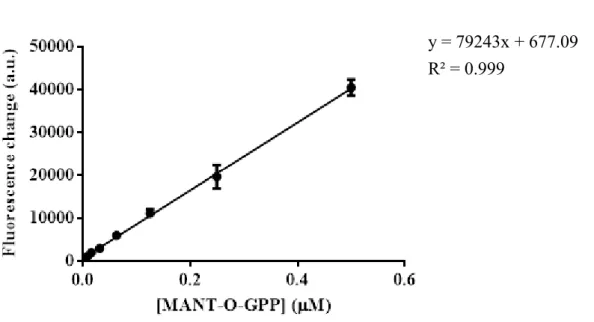
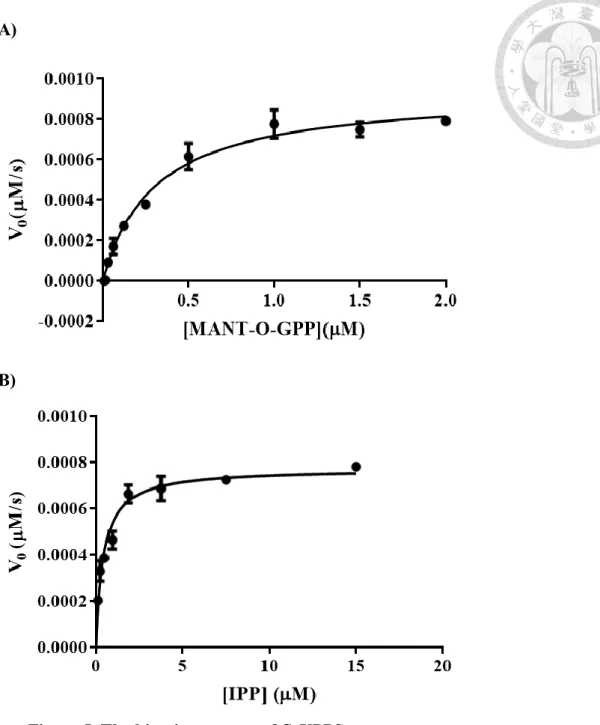
Because our compounds had absorption at 360 nm which is the detective wavelength in EnzChek pyrophosphate assay kit, MANT-O-GPP was chosen to measure the activity of UPPS. When MANT-O-GPP reacted with IPP to undergo chain elongation by EcUPPS or SaUPPS, its emission at 420 nm increased. The fluorescence change of MANT-O-GPP can be converted to reaction velocity by using its linear
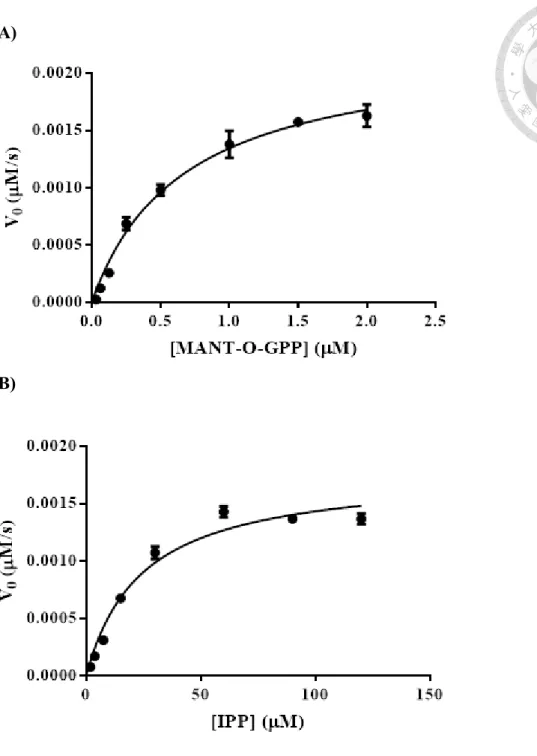
standard curve; this method can be used to measure the kinetics of UPPS33-34. The linear standard curve of MANT-O-GPP was determined in Figure 3. As shown in Figure 4 and 5, the Km of MANT-O-GPP and IPP were 0.67 and 24.33 µM, respectively, for EcUPPS.
The K of MANT-O-GPP and IPP were 0.32 and 0.38 µM, respectively, for SaUPPS.
3.4 Compound 2a-j inhibit UPPS activity
To test the inhibition of compound 2a-j on UPPS, we added different concentrations of compound 2a-j to IPP and MANT-O-GPP in the concentrations of their Km. The compound VK-278 was also tested with the same method (Figure 6, 7).
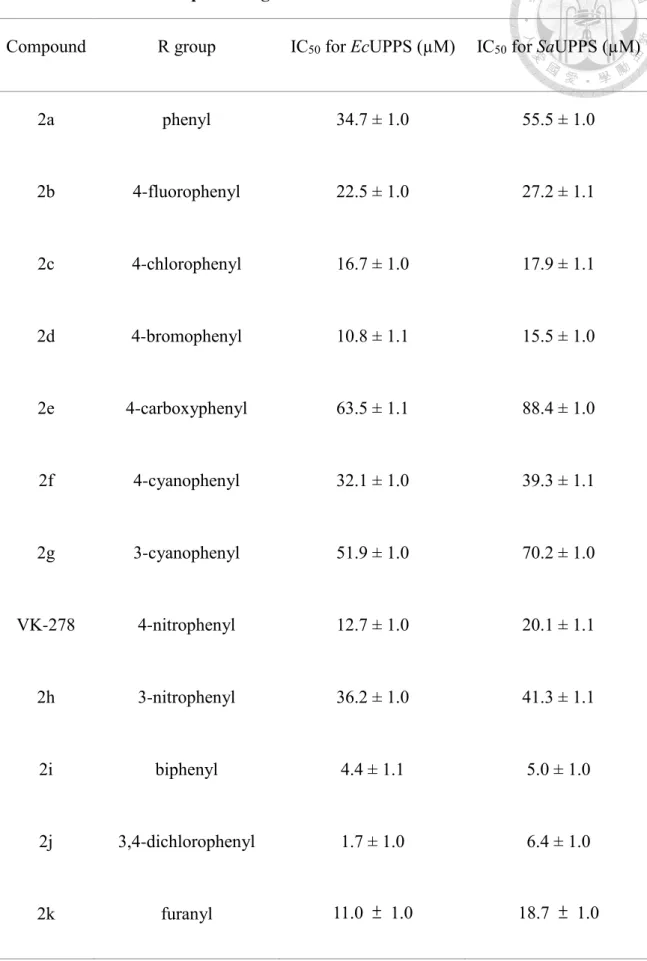
Their IC50 values are shown in Table 2. According to these results, we could get there conclusions. First, the compounds with halogen and benzene group were more potent to
inhibit the activity of UPPS. Compounds 2b-d with halogen more easily enter the activity site of UPPS due to their higher inductive effects and lower steric hindrance. On the other hand, the compound 2i with benzene group and FPP the substrate of UPPS
both were hydrophobic, so the compound 2i was more suitable in the active site of
UPPS. Second, comparing compound 2f to 2g or VK-278 to 2h, we found that the positions of substituents affected their inhibition. The para-substituted compounds were more potent to inhibit the activity of UPPS than the meta-substituted compounds. Third,
based on the properties of halogen, we tried to synthesize the compound with more halogen. Compound 2j having two chlorines were the most potent to inhibit the activity of UPPS and had low micromolar IC50 value.
3.5 Antibacterial activity of compound 2d, i, j
To test whether these compounds could inhibit the growth of bacteria, their EC50
values were measured. Three of compounds were displayingmore potent to inhibit the activity of UPPS were tested on E. coli first. Although these compounds could be dissolved in DMSO, they had to be added into LB medium. Since the survival of E. coli was little affected by 2 % DMSO36, these compounds were dissolved in LB medium with 2% DMSO as the final concentration. Under this situation, the maximum concentration of the compounds was 800 µM. After treating each compound overnight, E. coli grew well as the control without the compound. E. coli was one of the gram-negative bacteria which had the outer membrane, so these compounds were
difficult to cross the cell wall37. Then, we tested whether these compounds could inhibit gram-positive bacteria. Due to the biosafety Level of S. aureus, we chose B. subtilis to
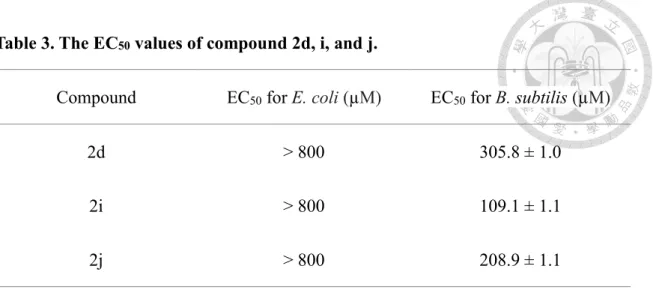
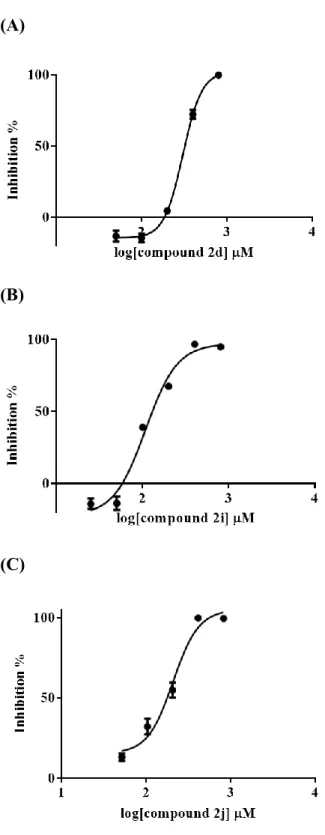
represent the gram- positive bacteria. Compound 2d in 800 µM and compound 2i, 2j in 400 µM could inhibit over 90 % B. subtilis growth (Figure 8). The values of EC50 are listed in Table 3. These results show that these compounds could inhibit the growth of B.
subtilis, so they may also inhibit the growth of other gram-positive bacteria. In addition, we could find that Compound 2i has more potential to inhibit the growth of B. subtilis
3.6 Compound 2d was a mixed inhibitor
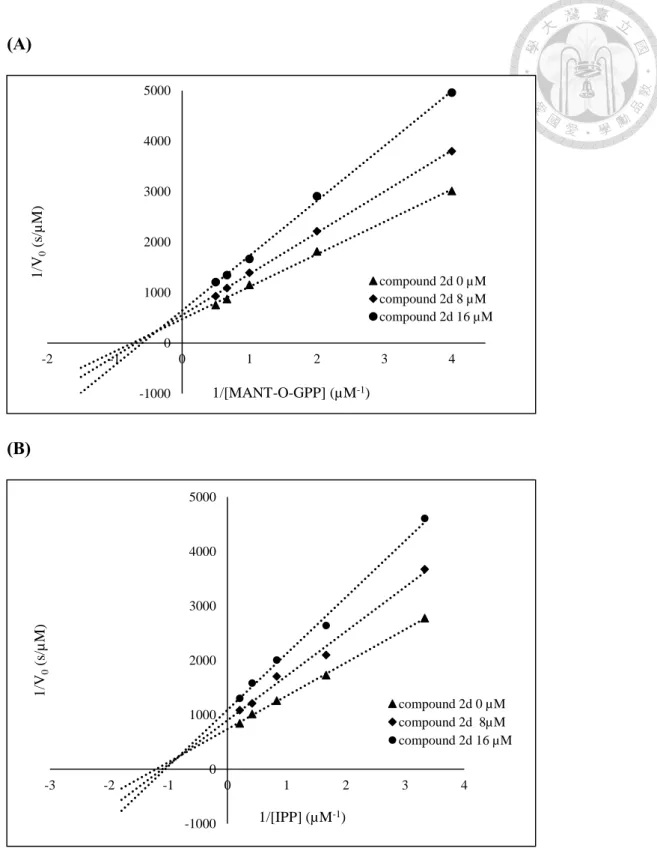
To investigate the inhibition types of these compounds, we chose compound 2d which had better yield during synthesis and more potent to inhibit UPPS activity to react with different concentrations of substrates. The lineweaver-burk plot shown in Figure 9 revealed mixed inhibition pattern (three lines intersect at the second quadrant and close to the y-axis) against SaUPPS with respect to both IPP and MANT-O-GPP.
Based on these results, compound 2d was supposed to bind at a different location from those for binding of IPP and MANT-O-GPP. Based on this result, the values of Ki of IPP and MANT-O-GPP were determined as 29.0 ± 1.8 and 30.2 ± 1.5 µM, respectively.
Then, the values of Ki’ of IPP and MANT-O-GPP were determined as 26.5 ± 7.1 and 34.5 ± 8.7 µM, respectively.
3.7 Compound 2d docked in the activity site of UPPS with FPP
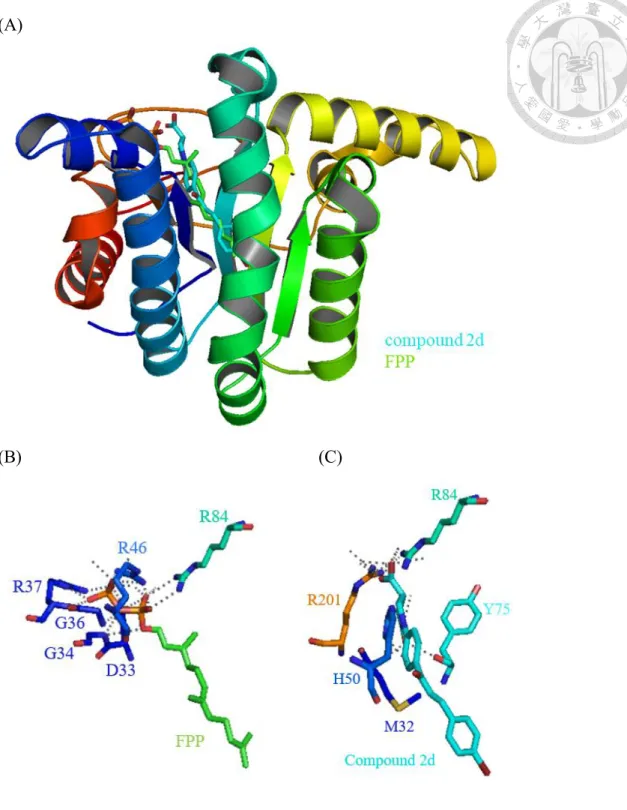
To predict the compound binding location, iGEMDOCK computer program was used to dock compound 2d and UPPS containing FPP. The best docking results are shown in Figure 10. Although compound 2d seemed to be docked in the active site of UPPS, the residues interacting with compound 2d were different from those with FPP.
The compound 2d did not interact with the p-loop (G-N-G-R motif) which is used to recognize FPP and catalysis (D33 in SaUPPS)38-39, confirming its non-competition in
binding. On the other hand, the compound 2d and FPP both interacted with R84 on the loop (F77-R84) which controls channel opening to release the products, so compound 2d could bind to the UPPS whether or not the UPPS has already bound with FPP.
4 DISCUSSION
UPPS catalyzes the condensation of IPP and FPP to form UPP which is a carrier for peptidoglycans synthesis, so it is a key enzyme for the synthesis of bacterial cell wall19. Because of its role, UPPS could be a valid target for antibiotic23-28. In fact, it has been postulated that several antibiotics without known targets may inhibit UPPS25, 37. Therefore, we designed and synthesized a series of 1-(4-Acetylphenyl)-4-carboxy-2-pyrrolidinone derivatives to inhibit the activity of UPPS and thus the growth of bacteria.
We tried to mainly synthesize the derivatives with electron-withdrawing
substituents on the benzaldehydes. Compound 2a-j were synthesized successfully.
Using the same approach, we intended to synthesize the compounds with electron-donating groups such as 4-diethylaminobenzaldehyde but the products were either with low yield or impure. We also tried to use other aldehydes to replace
benzaldehydes, but the products were also impure and difficult to be purified by precipitation. Therefore, the approach still requires modification.
Although the EnzChek pyrophosphate assay kit was commonly used to assay the activity of UPPS27, 40, our compound had absorbance at 360 nm, the same as the detected wavelength in this assay. The other assay method by using [14C]IPP to monitor the activity16, 33, 41 is tedious and expansive. As a result, we used MANT-O-GPP which
was an analog of FPP with fluorescence to evaluate the activity of UPPS33-34. Before measuring the IC50 values of compounds, the Km of UPPS had to be determined.
Although the Km value of IPP for SaUPPS was different from reported probably due to the different substrates used. Based on the Km of IPP and MANT-O-GPP, we used those concentrations to measure the IC50 of compounds. According to the inhibition assay, compound 2d, 2i, 2j, and 2k were more potent to inhibit UPPS activity. Compound 2d and 2j with halogens have inductive effects and low steric hindrance, so their structures suited to the active site of UPPS. Then, compound 2j was more potent to inhibit UPPS because it had one more halogen on benzene to withdraw electrons. On the other hand, compound 2i was highly hydrophobic like FPP, so it could fit into the active site of UPPS. These compounds had low micromolar ranges of IC50, so they may have the potential to inhibit the growth of bacteria.
To investigate the antibacterial activity of these compounds, we test their EC50
values for E. coli and B. subtilis. The EC50 values of compound 2d, 2i, and 2j for E. coli were too high to be determined probably because of the thick cell wall of E. coli. This situation was beneficial to the treatment for S. aureus because most of E. coli were good for human bodies. Due to the high risk of growing S. aureus, we chose B. subtilis and
the compounds across the cell wall, which needs to be further tested. Moreover, their solubility in water can be improved by using various acids to salify them37.
Based on the results of the inhibition and the docking experiments, we assume that these compound were the mixed-type or non-competitive type of inhibitors against UPPS. But the docking models were speculations, they might not be correct. However, the actual interactions between the compounds and UPPS have to be ensured by crystallographic structural studies.
In conclusion, although the antibacterial activities of the tested compounds were not good enough for the treatment of bacterial infectious diseases, they were effective to inhibit UPPS activity with low micromolar IC50. This series of compounds could serve as a starting point for a new class of antibiotics after optimization.
TABLE
Table 1. The kinetic constants of EcUPPS and SaUPPS.
Protein MANT-O-GPP Km (µM) IPP Km (µM) kcat (s-1)
EcUPPS 0.67 ± 0.077 24.33 ± 3.33 0.020 ± 0.001
SaUPPS 0.31 ± 0.03 0.41 ± 0.04 0.085 ± 0.002
Table 2. The IC50 of compounds against EcUPPS and SaUPPS.
Compound R group IC50 for EcUPPS (µM) IC50 for SaUPPS (µM)
2a phenyl 34.7 ± 1.0 55.5 ± 1.0
2b 4-fluorophenyl 22.5 ± 1.0 27.2 ± 1.1
2c 4-chlorophenyl 16.7 ± 1.0 17.9 ± 1.1
2d 4-bromophenyl 10.8 ± 1.1 15.5 ± 1.0
2e 4-carboxyphenyl 63.5 ± 1.1 88.4 ± 1.0
2f 4-cyanophenyl 32.1 ± 1.0 39.3 ± 1.1
2g 3-cyanophenyl 51.9 ± 1.0 70.2 ± 1.0
VK-278 4-nitrophenyl 12.7 ± 1.0 20.1 ± 1.1
2h 3-nitrophenyl 36.2 ± 1.0 41.3 ± 1.1
2i biphenyl 4.4 ± 1.1 5.0 ± 1.0
2j 3,4-dichlorophenyl 1.7 ± 1.0 6.4 ± 1.0
2k furanyl 11.0 ± 1.0 18.7 ± 1.0
Table 3. The EC50 values of compound 2d, i, and j.
Compound EC50 for E. coli (µM) EC50 for B. subtilis (µM)
2d > 800 305.8 ± 1.0
2i > 800 109.1 ± 1.1
2j > 800 208.9 ± 1.1
FIGURE
(A)
(B)
y = 79243x + 677.09 R² = 0.999
Figure 2. SDS-PAGE analysis of the purified EcUPPS and SaUPPS.
(A) SDS-PAGE analysis of EcUPPS after different steps of purification. (B) SDS-PAGE analysis of SaUPPS after different steps of purification. L: prestained protein ladder; S:
Supernatant; P: Pallet; FT1: flow through with 10 mM imidazole buffer from the first Ni-NTA column; W1 : washed with 25 mM imidazole; E1: eluted with 250 mM imidazole; TH : E1 treated with Thrombin at 4℃ overnight; FT2 : TH pass Ni-NTA column;
Figure 3. The linear standard curve of MANT-O-GPP converts to the product.
The plot of the total fluorescence change vs. the different concentrations of MANT-O-GPP used for converting to product catalyzed by 0.01 µM of UPPS 10mins.
The extinction coefficient of MANT-O-GPP converted to the product was determined to
(A)
(B)
Figure 4. The kinetic constant of EcUPPS.
(A) The plot of V0 vs. [MANT-O-GPP] was fitted with Michaelis-Menten equation to yield the Km of MANT-O-GPP and kcat of EcUPPS. (B) The plot of V0 vs. [IPP] for the Km of IPP and kcat of EcUPPS.
(A)
(B)
Figure 5. The kinetic constant of SaUPPS.
(A) The plot of V0 vs. [MANT-O-GPP] was fitted with Michaelis-Menten equation to yield the Km of MANT-O-GPP and kcat of EcUPPS. (B) The plot of V0 vs. [IPP] for the Km of IPP and kcat of EcUPPS.
(A) (B)
(C) (D)
(E) (F)
(G) (H)
(I) (J)
(K) (L)
Figure 6. The inhibition assay for EcUPPS.
These plots are EcUPPS activities relative to the control without any inhibitor vs. the logarithm values of compound concentrations for (A) 2a, (B) 2b, (C) 2c, (D) 2d, (E) 2e, (F) 2f, (G) 2g, (H) 2h, (I) 2i, (J) 2j, (K) 2k, and (L) VK-278.
(A) (B)
(C) (D)
(E) (F)
(G) (H)
(I) (J)
(K) (L)
Figure 7. The inhibition assay for SaUPPS.
These plots are SaUPPS activities relative to the control without any inhibitor vs. the logarithm values of compound concentrations for (A) 2a, (B) 2b, (C) 2c, (D) 2d, (E) 2e, (F) 2f, (G) 2g, (H) 2h, (I) 2i, (J) 2j, (K) 2k, and (L) VK-278.
(A)
(B)
(C)
Figure 8. The EC50 of compound 2d, I and j against B. subtilis.
These plots are cell numbers relative to the control without any inhibitor vs. the logarithm of compound concentrations for (A) 2d, (B) 2i, and (C) 2j.
(A)
(B)
Figure 9. Compound 2d is a mixed inhibitor of SaUPPS.
The lineweaver-burk plots of SaUPPS 1/V vs. 1/[MANT-O-GPP] (A) and 1/[IPP] (B)
-1000 0 1000 2000 3000 4000 5000
-2 -1 0 1 2 3 4
1/V0(s/µM)
1/[MANT-O-GPP] (µM-1)
compound 2d 0 µM compound 2d 8 µM compound 2d 16 µM
-1000 0 1000 2000 3000 4000 5000
-3 -2 -1 0 1 2 3 4
1/V0(s/µM)
1/[IPP] (µM-1)
compound 2d 0 µM compound 2d 8µM compound 2d 16 µM
(A)
(B) (C)
Figure 10. Docking of compound 2d in SaUPPS with FPP.
(A) The docking model of compound 2d in SaUPPS with FPP.
(B) The interactions between SaUPPS and FPP.
(C) The interactions between SaUPPS and compound 2d.
REFERENCE
1. Arturo Casadevall, L.-a. P., Microbiology: Ditch the term pathogen. Nature News
2014.
2. Smith, I., Mycobacterium tuberculosis pathogenesis and molecular determinants of
virulence. Clin Microbiol Rev 2003, 16 (3), 463-496.
3. Scallan, E.; Hoekstra, R. M.; Angulo, F. J.; Tauxe, R. V.; Widdowson, M.-A.; Roy, S. L.; Jones, J. L.; Griffin, P. M., Foodborne illness acquired in the United States--major
pathogens. Emerg Infect Dis 2011, 17 (1), 7-15.
4. Wilhelm, S., Pneumonia. In xPharm: The Comprehensive Pharmacology Reference,
Enna, S. J.; Bylund, D. B., Eds. Elsevier: New York, 2007; pp 1-6.
5. Prasad, G.; Dahiya, S., Study of the general characteristics of disease caused by
bacteria, viruses, fungi and protozoa. 2019.
6. Fleming, A., On the antibacterial action of cultures of a penicillium, with special
reference to their use in the isolation of B. influenzae. 1929. Bulletin of the World Health Organization 2001, 79 (8), 780-790.
7. R. R. Yocum, J. R. R., J. L. Strominger, The mechanism of action of penicillin.
Penicillin acylates the active site of Bacillus stearothermophilus D-alanine
Medicine 2004, 97 (11), 509-510.
9. Bradley, J. S.; Garau, J.; Lode, H.; Rolston, K. V. I.; Wilson, S. E.; Quinn, J. P., Carbapenems in clinical practice: a guide to their use in serious infection. International Journal of Antimicrobial Agents 1999, 11 (2), 93-100.
10. Neu, H. C., The Crisis in Antibiotic Resistance. Science 1992, 257 (5073), 1064-1073.
11. Rice, L. B., Federal Funding for the Study of Antimicrobial Resistance in
Nosocomial Pathogens: No ESKAPE. The Journal of Infectious Diseases 2008, 197 (8), 1079-1081.
12. Livermore, D. M., Linezolid in vitro : mechanism and antibacterial spectrum.
Journal of Antimicrobial Chemotherapy 2003, 51 (suppl_2), ii9-ii16.
13. Wang, Y.; Desai, J.; Zhang, Y.; Malwal, S. R.; Shin, C. J.; Feng, X.; Sun, H.; Liu, G.; Guo, R.-T.; Oldfield, E., Bacterial Cell Growth Inhibitors Targeting Undecaprenyl Diphosphate Synthase and Undecaprenyl Diphosphate Phosphatase. ChemMedChem 2016, 11 (20), 2311-2319.
14. Parmar, A.; Lakshminarayanan, R.; Iyer, A.; Mayandi, V.; Leng Goh, E. T.; Lloyd, D. G.; Chalasani, M. L. S.; Verma, N. K.; Prior, S. H.; Beuerman, R. W.; Madder, A.;
Taylor, E. J.; Singh, I., Design and Syntheses of Highly Potent Teixobactin Analogues against Staphylococcus aureus, Methicillin-Resistant Staphylococcus aureus (MRSA),
and Vancomycin-Resistant Enterococci (VRE) in Vitro and in Vivo. Journal of Medicinal Chemistry 2018, 61 (5), 2009-2017.
15. El Ghachi, M.; Howe, N.; Huang, C.-Y.; Olieric, V.; Warshamanage, R.; Touzé, T.;
Weichert, D.; Stansfeld, P. J.; Wang, M.; Kerff, F.; Caffrey, M., Crystal structure of undecaprenyl-pyrophosphate phosphatase and its role in peptidoglycan biosynthesis.
Nature Communications 2018, 9 (1), Article number : 1078.
16. Durrant, J. D.; Cao, R.; Gorfe, A. A.; Zhu, W.; Li, J.; Sankovsky, A.; Oldfield, E.;
McCammon, J. A., Non-bisphosphonate inhibitors of isoprenoid biosynthesis identified via computer-aided drug design. Chemical biology & drug design 2011, 78 (3),
323-332.
17. Gautam, A.; Rishi, P.; Tewari, R., UDP-N-acetylglucosamine enolpyruvyl transferase as a potential target for antibacterial chemotherapy: recent developments.
Applied Microbiology and Biotechnology 2011, 92 (2), 211.
18. Liang, P.-H.; Ko, T.-P.; Wang, A. H.-J., Structure, mechanism and function of prenyltransferases. European Journal of Biochemistry 2002, 269 (14), 3339-3354.
19. Robyt, J., Essentials of Carbohydrate Chemistry. Springer Verlag, New York: 1998;
Vol. pp. 305–318 (Chapter 10).
21. Guillaume, M.; Sophie, R.; Rodolphe, A.; Ahmed, B.; Hélène, B.; Dominique, M.-L.; Thierry, T., Deciphering the Metabolism of Undecaprenyl-Phosphate: The Bacterial Cell-Wall Unit Carrier at the Membrane Frontier. Microbial Drug Resistance 2014, 20 (3), 199-214.
22. Marko Jukič, K. R. a. S. G., Recent Advances in the Development of Undecaprenyl Pyrophosphate Synthase Inhibitors as Potential Antibacterials. Current Medicinal Chemistry 2016, 23 (5), 464-482.
23. Teng, K.-H.; Liang, P.-H., Structures, mechanisms and inhibitors of undecaprenyl diphosphate synthase: A cis-prenyltransferase for bacterial peptidoglycan biosynthesis.
Bioorganic Chemistry 2012, 43, 51-57.
24. Zhu, W.; Zhang, Y.; Sinko, W.; Hensler, M. E.; Olson, J.; Molohon, K. J.; Lindert, S.; Cao, R.; Li, K.; Wang, K.; Wang, Y.; Liu, Y.-L.; Sankovsky, A.; de Oliveira, C. A. F.;
Mitchell, D. A.; Nizet, V.; McCammon, J. A.; Oldfield, E., Antibacterial drug leads targeting isoprenoid biosynthesis. Proceedings of the National Academy of Sciences 2013, 110 (1), 123-128.
25. Sinko, W.; Wang, Y.; Zhu, W.; Zhang, Y.; Feixas, F.; Cox, C. L.; Mitchell, D. A.;
Oldfield, E.; McCammon, J. A., Undecaprenyl Diphosphate Synthase Inhibitors:
Antibacterial Drug Leads. Journal of Medicinal Chemistry 2014, 57 (13), 5693-5701.
26. Dodbele, S.; Martinez, C. D.; Troutman, J. M., Species Differences in Alternative
Substrate Utilization by the Antibacterial Target Undecaprenyl Pyrophosphate Synthase.
Biochemistry 2014, 53 (30), 5042-5050.
27. Czarny, T. L.; Brown, E. D., A Small-Molecule Screening Platform for the Discovery of Inhibitors of Undecaprenyl Diphosphate Synthase. ACS Infectious Diseases 2016, 2 (7), 489-499.
28. Concha, N.; Huang, J.; Bai, X.; Benowitz, A.; Brady, P.; Grady, L. C.; Kryn, L. H.;
Holmes, D.; Ingraham, K.; Jin, Q.; Pothier Kaushansky, L.; McCloskey, L.; Messer, J.
A.; O’Keefe, H.; Patel, A.; Satz, A. L.; Sinnamon, R. H.; Schneck, J.; Skinner, S. R.;
Summerfield, J.; Taylor, A.; Taylor, J. D.; Evindar, G.; Stavenger, R. A., Discovery and Characterization of a Class of Pyrazole Inhibitors of Bacterial Undecaprenyl
Pyrophosphate Synthase. Journal of Medicinal Chemistry 2016, 59 (15), 7299-7304.
29. Kuo, C.-J.; Guo, R.-T.; Lu, I.-L.; Liu, H.-G.; Wu, S.-Y.; Ko, T.-P.; Wang, A. H.-J.;
Liang, P.-H., Structure-Based Inhibitors Exhibit Differential Activities against Helicobacter pylori and Escherichia coli Undecaprenyl Pyrophosphate Synthases.
Journal of Biomedicine and Biotechnology 2008, 2008, Article ID : 841312.
30. Danley, D. E.; Baima, E. T.; Mansour, M.; Fennell, K. F.; Chrunyk, B. A.; Mueller, J. P.; Liu, S.; Qiu, X., Discovery and structural characterization of an allosteric inhibitor
Wang, Y.; Oldfield, E.; Strynadka, N. C. J.; Brown, E. D., Antagonism screen for inhibitors of bacterial cell wall biogenesis uncovers an inhibitor of undecaprenyl
diphosphate synthase. Proceedings of the National Academy of Sciences 2015, 112 (35), 11048-11053.
32. Inokoshi, J.; Nakamura, Y.; Komada, S.; Komatsu, K.; Umeyama, H.; Tomoda, H., Inhibition of bacterial undecaprenyl pyrophosphate synthase by small fungal molecules.
The Journal Of Antibiotics (Tokyo) 2016, 69, 798-805.
33. Teng, K.-H.; Chen, A. P. C.; Kuo, C.-J.; Li, Y.-C.; Liu, H.-G.; Chen, C.-T.; Liang, P.-H., Fluorescent substrate analog for monitoring chain elongation by undecaprenyl pyrophosphate synthase in real time. Analytical Biochemistry 2011, 417 (1), 136-141.
34. Teng, K.-H.; Hsu, E.-T.; Chang, Y.-H.; Lin, S.-W.; Liang, P.-H., Fluorescent
Farnesyl Diphosphate Analogue: A Probe To Validate trans-Prenyltransferase Inhibitors.
Biochemistry 2016, 55 (31), 4366-4374.
35. Voskiene, A.; Mickevicius, V.; Mikulskiene, G., Synthesis and structural characterization of products condensation
4-carboxy-1-(4-styrylcarbonylphenyl)-2-pyrrolidinones with hydrazines. 2007; Vol.
2007(15), 303-314.
36. Ansel, H. C.; Norred, W. P.; Roth, I. L., Antimicrobial Activity of Dimethyl
Sulfoxide Against Escherichia coli, Pseudomonas aeruginosa, and Bacillus megaterium.
Journal of Pharmaceutical Sciences 1969, 58 (7), 836-839.
37. Mohammad, H.; Younis, W.; Chen, L.; Peters, C. E.; Pogliano, J.; Pogliano, K.;
Cooper, B.; Zhang, J.; Mayhoub, A.; Oldfield, E.; Cushman, M.; Seleem, M. N., Phenylthiazole Antibacterial Agents Targeting Cell Wall Synthesis Exhibit Potent Activity in Vitro and in Vivo against Vancomycin-Resistant Enterococci. Journal of Medicinal Chemistry 2017, 60 (6), 2425-2438.
38. Chang, S.-Y.; Ko, T.-P.; Chen, A. P.-C.; Wang, A. H.-J.; Liang, P.-H., Substrate binding mode and reaction mechanism of undecaprenyl pyrophosphate synthase deduced from crystallographic studies. Protein Science 2004, 13 (4), 971-978.
39. Chang, S.-Y.; Ko, T.-P.; Liang, P.-H.; Wang, A. H.-J., Catalytic Mechanism Revealed by the Crystal Structure of Undecaprenyl Pyrophosphate Synthase in
Complex with Sulfate, Magnesium, and Triton. Journal of Biological Chemistry 2003, 278 (31), 29298-29307.
40. Workman, S. D.; Worrall, L. J.; Strynadka, N. C. J., Crystal structure of an intramembranal phosphatase central to bacterial cell-wall peptidoglycan biosynthesis and lipid recycling. Nature Communications 2018, 9 (1), Article number : 1159.
41. Cornish, K.; Siler, D. J.; Grosjean, O.-K. K., Immunoinhibition of rubber
SPECTURM
1H (top) and 13C (bottom) spectura of compound 1
1H (top) and 13C (bottom) spectura of compound 2a
1H (top) and 13C (bottom) spectura of compound 2b
1H (top) and 13C (bottom) spectura of compound 2c
1H (top) and 13C (bottom) spectura of compound 2d
1H (top) and 13C (bottom) spectura of compound 2e
1H (top) and 13C (bottom) spectura of compound 2f
1H (top) and 13C (bottom) spectura of compound 2g
1H (top) and 13C (bottom) spectura of compound 2h
1H (top) and 13C (bottom) spectura of compound 2i
1H (top) and 13C (bottom) spectura of compound 2j
1H (top) and 13C (bottom) spectura of compound 2k