Chapter 6
Comparison of O, Shi-o, Zhende o, Zhende ma
6.0 Introduction
From chapter 3 to chapter 5, we have discussed the discourse functions of shi-o, o, zhende o, and zhende ma in MSN talk. In this chapter, we compare the findings and the analyses in the previous three chapters. Section 6.1 compares similarities and differences of the discourse functions among the four RTs. A functional continuum in terms of speaker’s interest will then be proposed for further illustration.
In section 6.2, we will briefly discuss the distributions of common RTs in oral conversation and MSN talk. Section 6.3 discusses whether there is significant relationship between social factors (age and gender) and the frequency of the RTs.
Then we discuss whether functional differences of RTs exist among speakers of different ages or among speakers of different genders. A summary is given in section 6.4.
6.1 Comparison of O, Shi-o, Zhende o, and Zhende ma
Before we compare o, shi-o, zhende o, and zhende ma, let’s take a look at their frequency in the MSN databank, given again in Table 9.:
Table 9. Frequency of O, Shi-o, Zhende o, and Zhende ma in the MSN Databank Types of RT IRT o FRT o Shi-o Zhende o Zhende ma
Total 576 419 330 25 46
Table 9 shows that o is the most frequent token among the four RTs which signal the
receipt of an informing. Although the four RTs are all information receipts, the
different frequencies of the four RTs in the databank may have correlation with their
functions. In order to make clear the diversity and complexity of the tasks that the
four RTs can accomplish, we provide the comparison in terms of their preceding and following components respectively.
6.1.1 Degree of Unexpectedness
IRT o is a change-of-state-token which marks the reception of the information and the change of the speaker’s knowledge state. The prior informing that IRT o responds to is informative but not surprising, and is usually familiar information.
This supports the fact that IRT o signals the speaker’s indifference/detachment and is disruptive of the onward development of talk. On the other hand, the prior informing that FRT o replies is regularly new and unexpected and the primary function of FRT o is to indicate that the informing has not been in the speaker’s knowledge world until it is produced.
Interestingly, with o suffix, shi-o has inherited some properties of FRT o. One of the most prominent properties is that with FRT o, shi-o carries the overtones of the speaker’s surprise. This affective meaning of surprise is reinforced by the morpheme shi. As has been discussed, if the two elements which shi links are less similar elements, it will display salient emphatic contrast between them. The combination of shi and o therefore is placed after new and surprising informing.
This feature stands in contrast with IRT o which seldom indicates the speaker’s surprise. Therefore, although free-standing o and shi-o can indicate the chatter’s disinterest, o shows more negative feeling than shi-o since it does not contain much referential and affective meaning.
With final o, the behavior of zhende o is quite similar to the one of shi-o, i.e. in
response to new and unexpected information. However, the unexpectedness that
zhende o signals is of a greater degree than that shi-o does, which may be due to the
element zhende which involves referential meaning. Shi is a copular verb used to
link two elements and it does not contain much referential meaning. Shi-o therefore serves as a meta-talk connection. On the other hand, zhende is an utterance concerning the truth value of a proposition and thus more referential meaning is encoded in zhende o. The doubt conveyed by zhende o expresses more affective meaning, which in turn suggests the speaker’s higher involvement than shi-o and therefore seduces the prior speaker to further the current topic more easily.
Zhende ma, like zhende o and shi-o, is one of the newsmarkers in response to prior new and unexpected information. However, the use of zhende ma reveals that the prior informing is extremely unbelievable to the chatter. This results from the final particle ma, the primary function of which is to be tagged to an utterance to form a question. Zhende ma is thus an RT concerned about the truth value of the prior informing which is so incredible that the chatter even challenges the validity of it.
Therefore, zhende ma signifies the most unexpectedness in reply to the announced information. Furthermore, the request-to-tell form of zhende ma is continuative in essence and therefore makes the current topic develop further. By comparison, zhende o, which is not a typical request-to-tell form, it does not indicate explicitly that the next speaker is chosen to continue. Thus, the continuative force of zhende o is less than that of zhende ma.
To sum up, the informing preceding FRT o signals a greater degree of unexpectedness than IRT o.
1Comparing IRT o, shi-o, zhende o, and zhende ma, the information before zhende ma indicates the most unexpectedness, followed by that before zhende o, then shi-o, and IRT o. Put differently, zhende o and zhende ma suggest great surprise, while shi-o conveys the speaker’s small surprise. By contrast,
1 Since the utterances attached to FRT o are not the same, it is difficult to make comparison with those RTs can occur isolation without being tagged to a head utterance. In our following discussion, we only compare the functions IRT o and FRT o, and discuss some properities of shi-o and zhende o derived from this final o.
IRT o is used to indicate the reception of information, usually without marking much referential and affective meaning. Hence, it can be concluded that most of the informing before IRT o does not carry too much unexpectedness. The most economical RT o is used frequently to indicate the reception of prior information, which explains its highest incidence among the four RTs. The next frequent RT is shi-o, which signals smaller surprise. The more marked situations, i.e. greater surprise on the part of the chatter by zhende o and zhende ma, occur least frequently in the MSN talk.
6.1.2 Additional Moves
Regarding the following turn components after the four RTs, we can begin with statements. IRT o is a change-of-state token, and the following statement after it commonly describes the speaker’s currently informed state. IRT o plus a statement is topic-curtailing since IRT o is not produced until the chatter fully understands the announced information. However, the statement following shi-o scarcely describes the chatter’s informed knowledge state but often displays his/her subjective evaluation.
During ongoing discourse, it is understandable that the chatter responds affectively and subjectively to the new and unexpected informing. The following statement is particularly vital to shi-o since it may indicate disinterest without any subsequent talk.
Not only can shi-o occur with a statement, but the RTs zhende o and zhende ma can also be followed by a statement to show more participation of the speaker. This
‘shift in subjective orientation’ can commonly be seen during the conversation (Schiffrin 1987: 95-98).
This ‘shift in subjective orientation’ is most prominent in argument when a
speaker is so committed to his/her own proposition (Schiffrin 1987:95-98). Shi-o,
zhende o, zhende ma can prefigure the coming of dispreferred responses,
disagreement, which displays increasingly emotional reaction when the chatter holds a contrastive point of view. The common feature of shi-o and zhende o, i.e. with FRT o, can imply the overtone of disagreement since the prior assertion is contrary to the chatter’s default assumption. Their different elements shi and zhende respectively lead to different effects of disagreement. Shi can be an approbation token signifying partial agreement (cf. Pomerantz 1984:72-73), and it signals mild contrast (cf. Chang 2001), and the refutation force thus can be decreased. Compared to shi-o, zhende o shows doubt and therefore marks more refutation meaning. The disagreement encoded in zhende ma is the most prominent among the four RTs since the particle ma is used to challenge the prior assertion and doubt the truth value of it defensively. Nevertheless, the following disagreements are used to further express the chatter’s intention of refutation but they are not the obligatory components. By contrast, IRT o rarely prefaces a disagreement since it usually makes the current topic terminated soon and implies the meaning of acceptance.
Another turn component that can follow the four RTs is questions. The questions after the four RTs are used to request for further information.
O-plus-question makes up 10.3% of all the occurrences of IRT o whereas shi-o-plus-question 28.2%. The reason why the former is less than the latter can be explained by virtue of their own characteristics. The use of IRT o frequently makes the current topic terminal unless the chatter wants to request for further information.
By contrast, shi-o is not necessarily topic-curtailing. It is commonly used to indicate the speaker’s unexpectedness towards the prior new informing and he/she may therefore invite the informative party to elaborate more. Besides, the environment where shi-o occurring with a question is often associated with negative feeling, such as contempt.
On the other hand, as RTs responding to the new and surprising information,
zhende o-plus-question accounts for 20% of all tokens of zhende o and zhende ma-plus-question 13.0% of occurrences of zhende ma. Both frequencies are lower than the one of shi-o, which can be again explained by their characteristics of the two RTs. Both mark the speaker’s doubt of the prior information. Therefore their free-standing forms are sufficient to promote the continuation of the current topic even without another question. Furthermore, zhende ma itself is a question form, which further interprets the lower frequency of the combination of zhende ma and a question.
Finally, there are some distinctive features that the four RTs do not have in common. First, both IRT o and shi-o can introduce a new topic to maintain the topic in a disfiliative way while zhende o and zhende ma cannot. Both of IRT o and shi-o are used to claim topical disalignment and the speaker in the conversation can terminate the current topic and move on to a new topic. On the other hand, that change-of-activity use cannot be found in RT zhende o and zhende ma further supports the fact that the two RTs show the speaker’s more interest and involvement.
Second, on the basis of the meaning of doubt/disagreement in zhende ma, it can be used to downgrade the compliment on the speaker, which is a particularly singular characteristic among the four RTs. Although people like to be praised, however, compliments are regularly rejected, downgraded, or partially accepted (Pomerantz 1978:80). IRT o means acceptance, which will disobey the common phenomenon in compliment responses, while among shi-o, zhende o, and zhende ma, zhende ma can denote the most refutation force to downgrade the compliment. At the same time, it can express the speaker’s highest interest in the compliment on himself/herself by promoting the prior chatter to confirm the truth of the praise.
According to preceding and following components of RTs, we propose the
comparison on the functions of o, shi-o, zhende o, and zhende ma. The degree of
speaker’s involvement and interest is the determining factor on the use of them.
Their functional differences are derived from different degrees of speaker’s interest.
Based on the similarities and differences, in the following we propose a functional continuum to present how the four RTs express different degrees of the speaker’s interest.
6.1.3 Degree of Speaker’s Interest
Figure1 shows the functional continuum describing speakers’ tendency of using different RTs to express his/her different degrees of interest in the talk.
2Note that it only demonstrates a preferred pattern since approximately 20% of o and 30% of shi-o tokens are used in neutral contexts:
Fig. 1 Feedback Continuum of O, Shi-o, Zhende o, and Zhende ma Initial o shi-o zhende o zhende ma
Low interest
High interest
It can be seen that at one end of this continuum is IRT o which is produced to show
minimal speaker’s interest. Along the continuum to the right, the RTs indicate more speaker’s interest. Therefore, no matter the previous informing is a bad or good piece of news, zhende ma is the RT that can indicate most speaker’s highest interest with tone of happiness or sympathy which is based on contextual clues. The next most interest is indicated by zhende o. Shi-o is situated next since it regularly correlated with mildly dispreferred meaning. Accordingly, the more affective feedback an RT can mark, the more disagreement it can show in the quarrelsome talk.
2 Again, FRT o will not be discussed here since the affective meaning and speaker’s involvement are mainly marked by the o-suffixed utterance.
On the other hand, along the continuum to the right, more refutation force can be indicated by the RT when two chatters hold contrastive opinions.
It appears that the more morphologically complex an RT is, the more speaker’s involvement it can indicate, although zhende o is as morphologically complex as zhende ma. On the whole, we can draw a conclusion that IRT o and shi-o are disassociative RTs while zhende o and zhende ma are associative ones. Within the group of disassociative RTs, IRT o is an extremely disassociative RT while shi-o is a moderately disassociative one. In the group of associative RTs, zhende o is a moderately associative while zhende ma is an extremely associative one.
A speaker will usually verbalize a topic after judging that the topic is in some regard interesting to the listener (Chafe 1994:121). When the newsworthiness of the informing clashes with this expectation, it is more likely that the addressee will use disassociative RTs such as o and shi-o. Whereas when the newsworthiness of the news corresponds to the expectation, the listener tends to use associative RTs instead, such as zhende o and zhende ma. Thus, each of the four RTs can effect a different development of a topic and simultaneously expresses different affective meanings in the conversation. The consideration of speaker’s involvement which is sensitive to the context tends to govern the choice of the four RTs.
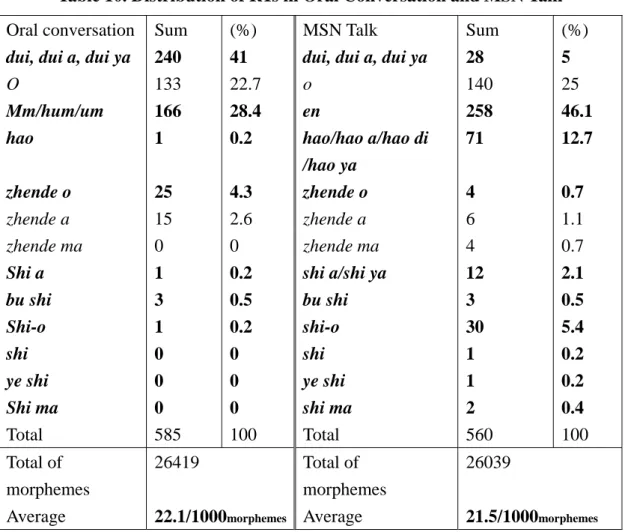
6.2 Distribution of Common RTs in Oral Conversations and MSN Talk
In order to make clear whether shi-o is a newly developed RT in recent years, we briefly discuss the frequency of common RTs in oral conversations recorded during 1993 and 1997
3and MSN talk during 2004 and 2005.
3 The data are taken from the Chinese spoken corpus established by the Linguistic Institute of National Taiwan University and I thank Professor Miao-Hsia Chang’s for her availing me of this databank for the purpose of investigation.
Table 10. Distribution of RTs in Oral Conversation and MSN Talk
Oral conversation Sum (%) MSN Talk Sum (%)
dui, dui a, dui ya 240 41 dui, dui a, dui ya 28 5
O 133 22.7 o 140 25
Mm/hum/um 166 28.4 en 258 46.1
hao 1 0.2 hao/hao a/hao di /hao ya
71 12.7
zhende o 25 4.3 zhende o 4 0.7
zhende a 15 2.6 zhende a 6 1.1
zhende ma 0 0 zhende ma 4 0.7
Shi a 1 0.2 shi a/shi ya 12 2.1
bu shi 3 0.5 bu shi 3 0.5
Shi-o 1 0.2 shi-o 30 5.4
shi 0 0 shi 1 0.2
ye shi 0 0 ye shi 1 0.2
Shi ma 0 0 shi ma 2 0.4
Total 585 100 Total 560 100
Total of morphemes
26419 Total of
morphemes
26039
Average 22.1/1000
morphemesAverage 21.5/1000
morphemesSeveral points of interest emerge from Table 10. First, according to Table 10,
there are 585 occurrences of RTs identified in the oral conversation with 26,419
morphemes while 560 in MSN talk with 26,039. On the average, the occurrences of
RTs per 1000 morphemes in oral conversation and MSN talk are almost the same,
22.1/1000 morphemes versus 21.5/1000 morphemes. Second, it appears that MSN
talk has more varieties of RTs than oral conversations, particularly the group of RTs
with shi and hao. This phenomenon may be associated with the characteristics of
MSN talk. Lack of chatters’ facial expressions in the MSN talk, more varieties RTs
need to be employed to show the listener’s feedback during the interaction activity,
which can compensate for the deficiency of on-line talk system.
Third, the groups of RTs, mm/hum/um/en
4and dui show obviously different frequencies in MSN talk and oral conversations. Mm/Hum/Um/En and dui are often used to indicate the listener’s attention in the progress of a talk which is not complete (cf. dui in Tsai 2001:17; yeah and mm in Gardner 2001:25, citing Schegoloff 1993). The subtle difference between en and dui relies on the fact that mm/hum/um/en commonly signals passive recipiency while dui can be used to take the floor (cf. mm and yeah in Jerfferson 1993). Since there are no facial clues from interlocutors in the conversational context of MSN talk, more signals from the listener are needed to show that he/she is on-line and listening to the other chatter’s talk.
The monosyllabic response en which is easy to be typed filling an appropriate turn is therefore more in MSN talk than in oral conversations.
On the other hand, with respect to RT dui, the low frequency of it in MSN conversations may result from the following facts. That is, dui can be used by the speaker to confirm his/her prior talk, organizing the flow of the talk, but this use of dui is never used in MSN talk since chatters have more time construct their ideas before sending messages. Furthermore, it is possible that more sincerity is needed in the face-to-face conversations while the primary purpose of MSN talk is to kill time and it occurs in extremely informal situation. Positive RT dui may be therefore produced more in the face-to-face conversations.
Finally, this brief investigation shows that shi-o rarely occurred in the oral conversations during 1993 and 1997, only one token of shi-o identified in the conversations with 26,419 morphemes in total. While in the MSN talk with similar amount of morphemes, there are 30 tokens of shi-o identified. This contrast shows that shi-o may emerge in recent years. Furthermore, shi-o and zhende o seem to
4 No tokens of um/mm/hum occur in MSN talk since there is no Chinese word corresponding to mm/hum but only en ‘恩(嗯)’ which is close to the two RTs.
present a complimentary distribution. Shi-o takes up 5.4% of all the occurrences of RTs in MSN talk while only 0.2% in oral conversations. Intriguingly, zhende o accounts for 0.7% of all the tokens in MSN talk whereas 4.3% in oral conversations.
Shi-o and zhende o are used similarly and their difference is based on the fact that they show different degrees of speaker’s affective meaning. Shi-o shows less interest of the speaker whereas zhende o shows more. Since the chatters use MSN talk to kill time, the topics in MSN talk are not as various and informative as the ones in oral conversations. Therefore, unless the informing the chatter receives can draw much attention from him/her, he/she would choose the RT shi-o rather than zhende o.
Another possible reason is that each morpheme of shi-o is monosyllabic, and shi-o is the token that is easy to be typed in MSN system and simultaneously expresses the speaker’s unexpectedness, compared to zhende o.
6.3 Social Factors and RTs
Previous studies show that female tend to use more RTs in the conversations.
Additionally, as shi-o may be a newly developed RT, it is possible that younger
chatters may contribute most to its high frequency (cf. Holmes 1992). In this section,
therefore, we first examine the data to see if there is significant relationship between
frequency of RTs and the social factors of gender and age. Then we proceed to
investigate if any relationship exists between social factors and the functional
differences of the use of RTs. Since the education background of the chatters in our
databank is at least senior high school, we do take this factor into consideration, and
this may be left for furthey study in the future. Additionally, we will focus on o and
shi-o since the numbers of zhende o and zhende ma are too small to be effectively
tested with statistical means. The number of RTs that each participant produced is
compared by the ratio of the number of each RT per 100 lines. In the following, we
will examine the data in the order of IRT o, FRT o and shi-o.
6.3.1 Social Factors and IRT o Gender
The relationship between gender and the frequency of IRT o is tested by one-way ANOVA and the results are given in Table 11. For convenience, the following tables only present p values. The readers are referred to the Appendixes for details.
Table 11. One-way ANOVA for Relationship between Gender and Frequency of IRT o
5Overall male and female groups
15-16 year-old males and females (Group1) 18-22 year-old males and females (Group 2) 24-26 year-old males and females (Group 3) 31-39 year-old males and females (Group 4)
p .0510 .1760
*.0150 .7887 .2278
One-way ANOVA shows that there is no significant difference between gender and the overall frequency of IRT o (p>0.05). That is, neither females nor males use more or less IRT o in the conversation. In addition, further comparisons show that no significant differences based on gender are found in the frequency of IRT o in group1, group3, and group4 (p>0.05). However, it is found that there is significant association between gender and the frequency of IRT o in the second group (p<0.05).
When we further compare the data in female and male production of IRT o in this group by means of Turkey test, the result shows that female chatters use more tokens of IRT o than male ones in the MSN talk (mean of female production: 1.577601/100 lines; mean of male production: 0.52716/100 lines). Some explanations of why
5 For more details, please see Table 1 to Table 5 in Appendix One.
women use more IRT o are provided here.
Men often respond unenthusiastically (Fishman 1983). Okamoto (1995:307, 313) argues that older female speakers use more feminine expressions showing gentleness than younger female ones. IRT o, which signals extreme indifference, was assumed to be the characteristic of men’s talk, although this is not significantly shown in our statistical result. However, our result reveals contradicting findings,.
This may be due to the fact that college-age females tend to use more masculine forms in the conversations to show an image of youthfulness and establish solidarity.
Since the participants in 18-22 groups are close peers and they are not clearly differentiated in gender roles (cf. Okamoto 1995:313), females in 18-22 years old group may use less feminine RTs, such as IRT o, which frequently shows impoliteness to their peers and differentiates themselves from older women.
Having investigated the effect of gender on the use of IRT o, we further test whether there is significant association between gender and functions of IRT o by way of two-factor ANOVA
6. However, no significant difference is found between speakers of different gender and different functions of IRT o (p=.3945 >.05). That is, speakers of different genders do not have a preference for a specific function of IRT o.
Age
With respect to the relationship between age and the frequency of IRT o, we use one-way ANOVA again to determine the strength of the relationship.
6 For more details, please see Table 6 in Appendix One.
Table 12. One-way ANOVA for Relationship between Age and Frequency of IRT o
7p
All age groups . .5994
15-16 year-old and 18-22 year-old groups .5049
15-16 year-old and 24-26 year-old groups .7924
15-16 year-old and 31-39 year-old groups .2093
18-22 year-old and 24-26 year-old groups .6923
18-22 year-old and 31-39 year-old groups .4134
24-26 year-old and 31-39 year-old groups .2924
As shown in Table 12, there is no significant relationship between age and the frequency of IRT o (p>0.05). Furthermore, according to the between-group analyses, different age groups are not significantly different from one another in the production of IRT o (p>0.05). This result may be generated from the fact that IRT o is the most common and economical RT used particularly to indicate the chatter’s change of information state and understanding. Hence, no matter which age group it is, no significant differences exist between age groups and the production of o.
In addition, we are curious about whether age is a determining factor affecting the uses of different functions of IRT o. Accordingly, the result of the two-factor ANOVA shows that there is significant difference found between different age groups and different functions of IRT o (p=.0146<.05).
8Tukey test
9is further performed on the data to investigate how the functional differences exist in different age groups and we can compare what functions of IRT o that each age group has preferences for.
When comparing the figures group by group, we can find that chatters of 15-16 years old significantly prefer using free-standing IRT o to IRT o combined with a question and introducing a new topic. Chatters of 18-22 years old tend to use free-standing o
7 For further information, please refer to Table 7 to Table 13 in Appendix Two.
8 For more details of the statistic data, please see Table 14 in Appendix Two.
9 The statistic results of Tukey test are shown in detail in Table 14.1in Appendix Two.
and o-plus-statement more than the sequences of o-plus-question and o shifting to a new topic. Chatters of 24-26 years old significantly use more o-plus-statement than o-plus-Q and o with change-of-activity use. Finally, 31-39 year-old chatters have a preference for the use of o in conjunction with a statement.
On the other hand, when comparing the figures function by function, we can only find a high incidence of the 15-16 year-olds in free-standing o than 31-39 year- olds. The other functions do not show significant differences in each group.
Overall, each group has a preference for the use of free-standing o or o-plus-statement or both, yet both of the functions regularly indicate the speaker’s change of information state, which further illustrates the core function of IRT o.
To sum up, there is no significant association between gender and the frequency of IRT o. Gender is also not a determining factor related to different functions of IRT o. On the other hand, age does not show significant association with the overall frequency of IRT o, but in 18-22 year-old group, there is significant association with the frequency of IRT o. In this college-age group, that females use more IRT o than males may be explained by the fact that young females are less polite than older ones, particularly in peer conversations. Regarding the relationship between age and functional differences of IRT o, each age group prefers using either free-standing o or o-plus-statement. Both of two types signal the reception of information, which further evidences that the primary function of IRT o is to serve as an information receipt.
With the same statistical tools, we continue to examine the data of FRT o.
6.3.2 Social Factors and Frequency of FRT o Gender
Table 13 shows the result of the relationship of gender and frequency of FRT o,
as is examined by one-way ANOVA.
Table 13. One-way ANOVA for Relationship between Gender and Frequency of FRT o
10Overall male and female groups
15-16 year-old males and females (Group 1) 18-22 year-old males and females (Group 2) 24-26 year-old males and females (Group 3) 31-39 year-old males and females (Group 4)
p .3744 .5365 .1448 .8555 .2652
As shown by the figure (.3744), statistically, no significant difference between gender the overall frequency of FRT o was detected (p>0.05). Similarly, there is no significant association between gender and the use of FRT o in each age group (p>0.05). Hence gender is not a determining factor as far as the frequency of FRT o is concerned.
By means of two-factor ANOVA, we test whether significant association can be found between gender and functions of FRT o. The result shows that there is no significant difference between speakers of different genders and different functions of FRT o (p=.0682 >.05). Hence, gender does not result in any functional differences of FRT o.
Age
After discussing the relationship between gender and the production of FRT o, in the same vein, one-way ANOVA is used to examine whether there is significant association between age and the frequency of FRT o.
10 For more details of the statistical data, please see Table 15 to Table19 in Appendix Three.
Table 14. One-way ANOVA for Relationship between Age and Frequency of FRT o
11p
All age groups . .5994
15-16 year-old and 18-22 year-old groups .5049
15-16 year-old and 24-26 year-old groups .7924
15-16 year-old and 31-39 year-old groups .2093
18-22 year-old and 24-26 year-old groups .6923
18-22 year-old and 31-39 year-old groups .4134
24-26 year-old and 31-39 year-old groups .2924
Inspection of the relationship between age and the frequency of FRT o reveals that age does not have significant association with the frequency of FRT o. This is also found in between-group analyses, which demonstrates that there is no significant association between any two age groups in the production of FRT o (p>0.05).
Analogously, we further examine the data of FRT o to investigate whether different age groups may lead to functional differences of FRT o, yet it is not significantly different among different age groups and different functions of FRT o (p=.9140
>.05)
12.
So far, we have examined whether there is association between social factors and FRT o. Neither gender nor age has significant relationship with the frequency of FRT o. The same pattern in found in the relationship between social factors and different uses of FRT o.
Next, we continue to examine the data of shi-o.
6.3.3 Social Factors and Frequency of Shi-o
Following the same pattern, we discuss the relationship between gender and
11 Please refer to Table 21 to Table 27 in Appendix Four for more information.
12 By reference to Table 28 in Appendix Four, more details are presented.
shi-o and then that between age and shi-o.
Gender
Table 15. One-way ANOVA for Relationship between Gender and Frequency of Shi-o
13Overall male and female groups
15-16 year-old males and females (Group 1) 18-22 year-old males and females (Group 2) 24-26 year-old males and females (Group 3) 31-39 year-old males and females (Group 4)
p
*.0457 .1947 .5267 .1654 .7102
The figures shows that there is significant relationship between gender and the frequency of shi-o (p<.05). We further examine whether females or males use more shi-o in the conversation by Tukeky’s test. The result shows that the overall frequency of female shi-o is significant higher than that of males (mean: female:
1.096542/ lines; male: 0.460612). However, there is no significant association between gender and the use of shi-o in each group (p>.05). As for the functional differences among speakers of different genders, the result shows that there is no significant difference between chatters of different genders and different functions of shi-o (p= .6867>.05).
Some studies point out that women tend to use more lexical hedges or minimal responses, such as you know, well, mm hmm and so on, in the conversation (Lakoff 1975; Maltz and Borker 1984; Coates 1989; Pilkington 1998), and our analysis demonstrates the same picture. Shi-o, although frequently associated with the speaker’s negative feelings and a dispreferred context, it shows attention to the previous utterance. And its following comments or questions are still used by
13 Table 29 to Table 33 in Appendix Five provide more details.
women for conversational maintenance. This has been considered general characteristic of women’s speech. That is, women are more actively engaged in ensuring the interaction in the conversation, enlarging and developing the ideas of the previous speaker (Fishman 1983; Holmes 1992). In the face of uninteresting informing, by contrast, men frequently offer no response or acknowledgement at all (cf. Maltz and Borker 1982:198 citing Hirschman 1973:11).
On the other hand, shi-o is one type of lexical hedge, foreshadowing the following dispreferred responses, such as disagreement or change of the current topic.
When they disagree, they do not explicitly state their disagreement but use an indirect way (Pilkington 1998:261). Shi-o, similar to well in English, is a good candidate for a female speaker to defer her disagreement. On the contrary, the male speaker seems to use direct and repeated expressions of disagreement in conflict with the prior proposition (Pilkington 1998:263). For the convenience of comparison, extracts from (3.13) and (4.9) are given in the following again.
(3.13) JA2: wo jiu buhui xiang shang gaozhi or wuzhuan ba 我 就 不會 想 上 高職 or 五專 吧
‘But I don’t want to enter vocational schools or five-year junior colleges.’
CK3: wo jie yeshi dudao xianzai cai houhei 我 姐也是 獨[讀]到 現在 才 後悔 = =
‘My elder sister didn’t feel regret entering a senior high school until now.’
ÆJA3: shi o wo bu zhidao la bukuo benneng fenyin jiushi bu 是歐~ 我 不 知道 啦~不過 本能 反應 就是 不 xiangiao nian gaozhi or wuzhuan
想要 唸 高職 or 五專
‘Really? I don’t know. But my first intuition is not to go to vocational or five-year college.’
(4.19) CB1: qianwan bu yao zuo didui de
千萬 不 要 坐 敵對 的 definitely NEG want sit opposite NOM
‘Never sit in the area of the opposite tem (when you watch a baseball game).’
WL1: zhi shi zai jia hui men si ba 只 是 在 家 會 悶 死 吧 only COP at home will bored die PAR
‘But if I just stay at home, I will feel extremely bored.’
WL2: me sheme cha la zhende 沒 什麼 差 啦 真的 NEG what difference PAR real
‘I do feel that it doesn’t make difference (if we sit in the area of opposite team to watch the game.)’
ÆCB2: zhende hen you cha 真的 很 有 差
real very have difference
‘It does make difference.’
WL3: zhi shi qu kan qiu 只 是 去 看 求[球]
only COP go watch ball
‘We only go there to watch the game.’
CB3: wo mei pian ni 我 沒 騙 妳[你]
1SG NEG cheat 2SG
‘What I said is true.’
The two examples are both in the situation of argument. In extract (3.13), the girl, JA’s use of shi-o in JA3 does not disagree with CK’s statement explicitly. It appears to serve as a hedge to defer the following disagreement. By contrast, in example (4.19), a conversation between males, the contents in CB2 directly conflict with those in WL2 and express CB’s disagreement. This may explain why female chatters use more shi-o than males. Moreover, this exemplifies that women seem to be considered cooperative conversationalists in the conversation.
Furthermore, the topics that men discuss are not bridged as smoothly as the ones
that women talk about (Pilkington 1998). Sudden changes happen more frequently in men’s conversation than in women’s, whereas women use lexical hedges, such as shi-o, to introduce another topic to alleviate the transition.
After examining the relationship between gender and shi-o, we continue to discuss the relationship between another social factor, age, and shi-o.
Age
Table 16 is the summary of examining the data of shi-o to test whether there is significant relationship between age and the frequency of shi-o.
Table 16. One-way ANOVA for Relationship between Age and Frequency of Shi-o
14p
All age groups . .5994
15-16 year-old and 18-22 year-old groups .5049
15-16 year-old and 24-26 year-old groups .7924
15-16 year-old and 31-39 year-old groups .2093
18-22 year-old and 24-26 year-old groups .6923
18-22 year-old and 31-39 year-old groups .4134
24-26 year-old and 31-39 year-old groups .2924
As shown in Table 16, there is no significant relationship between age and the frequency of shi-o (p>0.05). By virtue of between-group analyses, no significant association is found between different age groups and the production of shi-o (p>0.05). Although it has been noted that an innovated linguistic form will be used less by older people and more among younger people (Holmes 1992:170), in our study, there is no age-graded pattern in the frequency of shi-o.
Finally, we move on to discuss whether there is significant difference between age and different functions of shi-o. Drawing on two-factor ANOVA to test the data,
14 Please refer to Table 35 to Table 41 in Appendix Six for more details of the statistic data.