
顏色詞「黑/烏」與「白」在台灣華語、台灣客語以及台灣閩南語語意延伸之比較 - 政大學術集成
174
0
0
全文
(2) 顏色詞「黑/烏」與「白」在台灣華語、台灣客語以及台灣閩南語 語意延伸之比較 Semantic Extensions of the Color Terms, Black and White, in Taiwanese Mandarin, Taiwanese Hakka and Taiwanese Southern Min. 學. ‧ 國. 立. 政 治 大 BY. ‧. Shu-chen Lu. n. er. io. sit. y. Nat. al. Ch. engchi. i Un. v. A Thesis Submitted to the Graduate Institute of Linguistics in Partial Fulfillment of the Requirements for the Degree of Master of Arts. July 2012.
(3) 立. 政 治 大. ‧. ‧ 國. 學. n. er. io. sit. y. Nat. al. Ch. engchi. i Un. Copyright © 2012 Shu-chen Lu All Rights Reserved iii. v.
(4) Acknowledgements. For the completion of this thesis, I would like to express my sincere gratitude to some people. First and foremost, I am deeply indebted to my advisor, Dr. Huei-ling Lai, who carefully guides me along the process of research and patiently helps me polish my academic writing skills. I have always learned a lot from her courses whether in college or in graduate school. She is also very considerate to my concerns and I constantly gain encouragements and inspirations from our talks. My gratitude for her guidance and care cannot be overemphasized.. 立. 政 治 大. ‧. ‧ 國. 學. My appreciation is also extended to the instructions of many professors, Dr. One-soon Her, Dr. Yu-chau Hsiao, Dr. Chiung-chih Huang, Dr. I-ping Wan, Dr. Ka-wai Chui, Dr. Hui-chen Chan, Dr. Siaw-fong Chung, Dr. Chien-ching Mo, Dr. Yow-yu Lin and Dr. Li-yi Huang. Through their courses, I gradually accumulate linguistics knowledge and develop research abilities. Also, I am very grateful to Dr. Zhen-kuan Chen and my two committee members, Dr. Hsueh-o Lin and Dr. Miao-hsia. y. Nat. sit. n. al. er. io. Chang for offering me constructive and beneficial advice on my proposal and thesis. I would like to thank those classmates and group partners whom I have taken courses with over the past three years for explaining and solving my puzzles about studying despite my unintelligent comprehension. I thank Po-wen, who answers me many questions during thesis writing and Shi-min xue-jie, who explains Hakka data for me. I also thank Huei-ling zhu-jiao-xue-jie, who helped clarify my thoughts when I considered giving up studying in the second year. Besides, for listening to my gibberish talking and sharing my joys and worries, I am thankful to Yi-ru. Moreover, my warmest thanks go to Wei-ling, who leads me to the encounter with God and helps me step onto the road of faith. Also, thanks to the weekly. Ch. engchi. i Un. v. prayers with Shu-mei and those wonderful hymns in the church, I could carry on thesis writing with serenity and tranquility. I am much obliged for the Lord’s blessing through which I gradually re-find myself. Last but not the least, I truly owe what I am today to my industrious parents, who give me unconditional love, care and supports. They bring me to the world and now I dedicate this thesis, which may seem insignificant though, to this colorful world.. iv.
(5) TABLE OF CONTENTS. 立. 政 治 大. ‧. ‧ 國. 學 y. Nat. Acknowledgments…………………………………………………………………….iv. sit. n. al. er. io. Table of Contents………………………………………………………………………v Figures and Tables…...…………………………………………………………….…vii Chinese Abstract…………………………………………………………………….viii English Abstract……………………………………………………………………....ix. Ch. engchi. i Un. v. CHAPTER I. INTRODUCTION……………………………………………………………...1 1.1 Motivation and Purpose…………………………………………………….1 1.2 Conventions of Data………………………………………………………..4 1.3 Organization of Thesis………………………………………………..........8 II.. PREVIOUS STUDIES ON COLOR TERMS……………………….…….….9 2.1 Studies of Color Universals………………………………………………..10 2.2 Research of Color Terms in Taiwanese Mandarin…………………………16 2.3 Research of Color Terms in Taiwanese Hakka and Taiwanese Southern Min………………………………………….......21 2.4 Remarks……………………………………………………………………23 v.
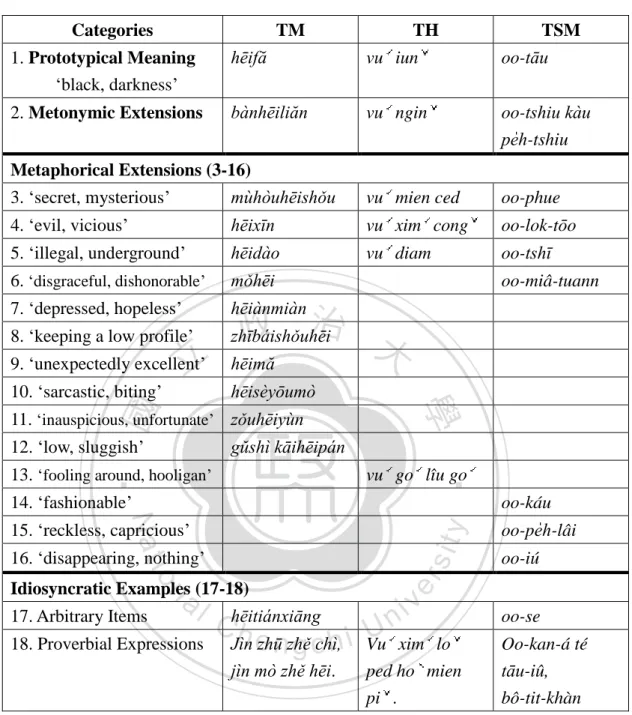
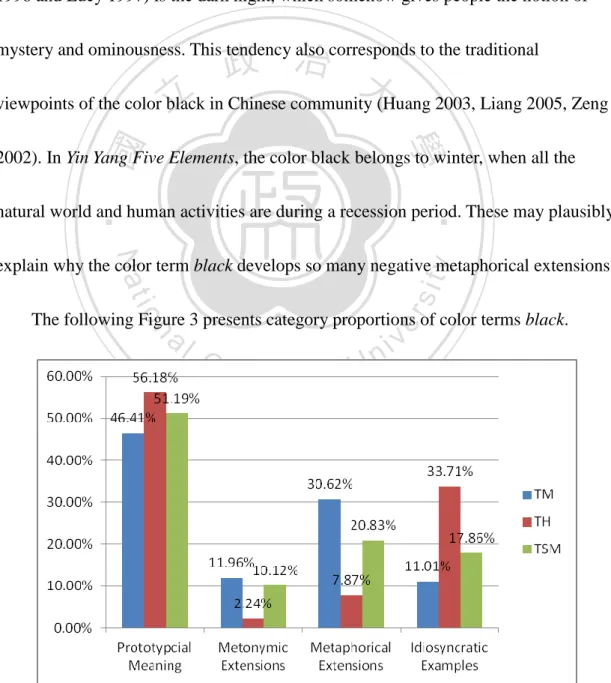
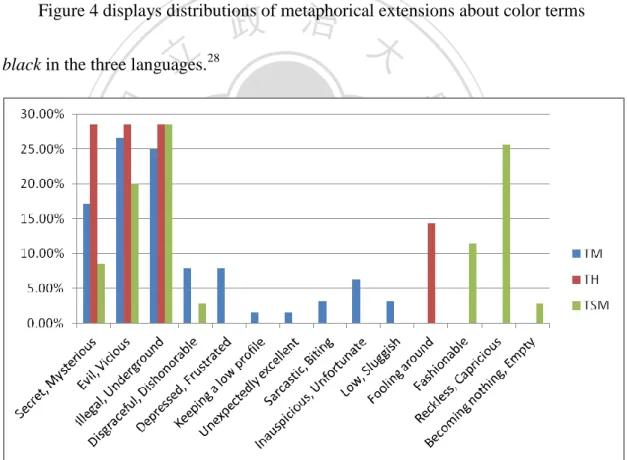
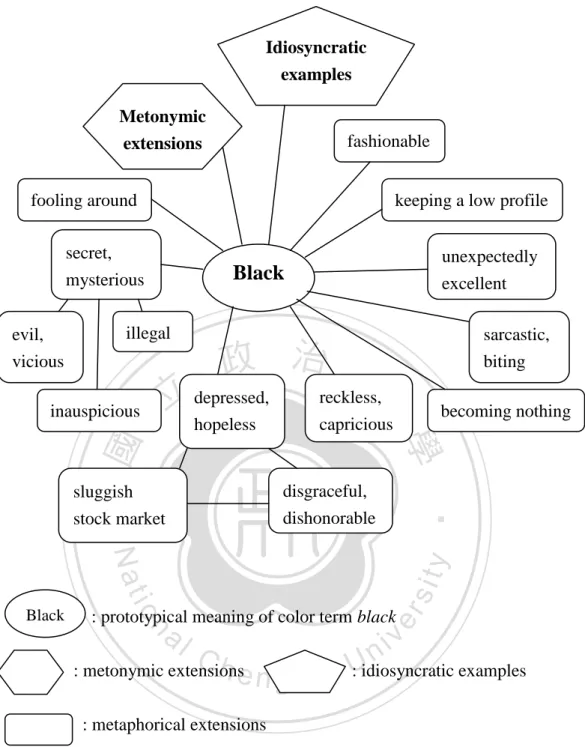
(6) III. THEORETICAL FRAMEWORK…………………………………………...29 3.1 Metaphor and Metonymy………………………………………………….29 3.2 Cultural Factors in Metaphor……………………………………………...37 3.3 Lexicalization……………………………………………………………...46 IV. ANALYSIS……………………………………………………………………..51 4.1 Analysis of the Color Terms Black in TM, TH and TSM…………….…...52 4.2 Analysis of the Color Terms White in TM, TH and TSM……………..…..86 4.3 Cultural Factors in Color Terms………………………………………….116 V.. CONCLUDING REMARKS………………………………………………...125 5.1 Summary of the Thesis…………………………………………………...125 5.2 Directions for Future Studies…………………………………………….130. APPENDIX I Color Terms Black in TM, TH and TSM………………………132 APPENDIX II Color Terms White in TM, TH and TSM...................................141 APPENDIX III Statistics of Figure 3, Figure 4, Figure 6 and Figure 7............152 REFERENCES…………………………………………………………………….154. 立. 政 治 大. ‧. ‧ 國. 學. n. er. io. sit. y. Nat. al. Ch. engchi. vi. i Un. v.
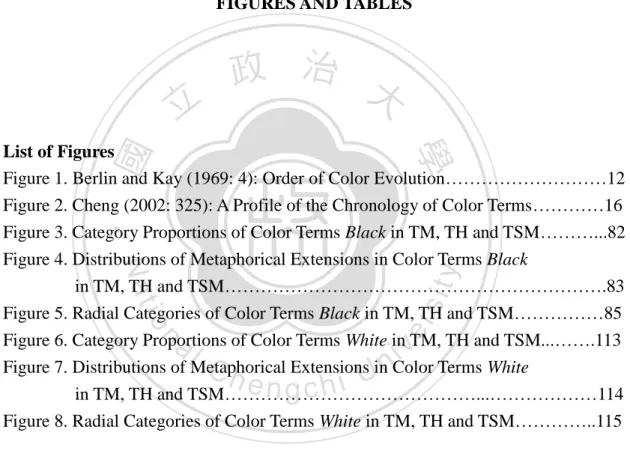
(7) FIGURES AND TABLES. 立. 政 治 大. ‧. ‧ 國. 學. List of Figures Figure 1. Berlin and Kay (1969: 4): Order of Color Evolution………………………12 Figure 2. Cheng (2002: 325): A Profile of the Chronology of Color Terms…………16 Figure 3. Category Proportions of Color Terms Black in TM, TH and TSM………...82 Figure 4. Distributions of Metaphorical Extensions in Color Terms Black. y. Nat. sit. n. al. er. io. in TM, TH and TSM……………………………………………………….83 Figure 5. Radial Categories of Color Terms Black in TM, TH and TSM……………85 Figure 6. Category Proportions of Color Terms White in TM, TH and TSM...…….113 Figure 7. Distributions of Metaphorical Extensions in Color Terms White in TM, TH and TSM……………………………………...………………114 Figure 8. Radial Categories of Color Terms White in TM, TH and TSM…………..115. Ch. engchi. i Un. v. List of Tables Table 1. Origins of Chinese Characters hēi, wū and bái……………………………..17 Table 2. Liu’s (2001) Categorization of Mandarin Six Basic Color Words……….…19 Table 3. Lin (2009): Corresponding Models Between English and Chinese………...20 Table 4. Categories of Color Terms Black in TM, TH, and TSM……………………79 Table 5. Categories of Color Terms White in TM, TH, and TSM………..…………109 Table 6. Metaphorical Extensions of the Color Black in TM, TH and TSM……….117 Table 7. Metaphorical Extensions of the Color White in TM, TH and TSM……….118. vii.
(8) 國. 立. 政. 治. 大. 學. 研. 究. 所. 碩. 士. 論. 文. 提. 要. 研究所別:語言學研究所 論文名稱:顏色詞「黑/烏」與「白」在台灣華語、台灣客語以及台灣閩南語 語意延伸之比較 指導教授:賴惠玲 博士. 政 治 大. 研究生:呂淑禎. 立. 論文提要內容:(共一冊,三萬一千六百六十八字,分五章). ‧ 國. 學. 本論文探討顏色詞「黑/烏」與「白」在台灣華語、台灣客語以及台灣閩南. ‧. 語中語意延伸之比較。黑與白是自然界中最原始的顏色,而在 Berlin and Kay. sit. y. Nat. (1969) 的顏色發展歷程中處於第一階段。本文觀察顏色詞黑與白背後的認知機. n. al. er. io. 制,並藉此將語料分成原始意義、轉喻延伸、隱喻延伸和特殊例子這些類別來詳. Ch. i Un. v. 述。本研究發現有些隱喻延伸普遍地存在三個語言當中,有些則是某個語言特有. engchi. 的,而這些語言特定的顏色詞通常蘊含文化根源、發展成構式或從外語借用而來。 本文還運用 Kövecses (2005) 隱喻中的文化因素來審視顏色詞黑與白。研究 發現就跨語言層面而言,台灣華語發展出最多的隱喻延伸,台灣閩南語次之,而 台灣客語最少。這顯示了台灣華語顏色詞的蓬勃發展跟該語言的文化、經濟或科 技等活躍發展密切相關。此外,本文發現顏色詞黑大多為負面意義,而顏色詞白 則多為非負面意義。顏色詞黑與白也發展出許多語意延伸的對立,例如神秘與明 確、惡與善、違法與合法。. viii.
(9) ABSTRACT. This thesis explores the similarities and differences regarding color terms of black and white among TM, TH and TSM. Black and white are the two most fundamental colors in the natural world as designated at stage one in Berlin and Kay’s (1969) evolutionary sequence. We classify data into cognitive categories of prototypical meaning, metonymic extensions, metaphorical extensions and idiosyncratic examples, observe their corresponding lexicalization types (Packard. 政 治 大 2000) and use Kövecses’ (2005) cultural factors in metaphor to examine them. 立 The three languages all contain abundant data of prototypical meanings which ‧. ‧ 國. 學. refer to the physiologically visual color, black and white, the representative colors of human conceptual universals about night and day (Wierzbicka 1996, Goddard 1998). Via different ICM mechanisms (Kövecses and Radden 1998), the three languages develop diverse metonymic extensions. Besides, through the general metaphor ABSTRACT QUALITY IS PHYSICAL QUALITY (Goatly 2011), numerous. y. Nat. sit. n. al. er. io. attributes are conceptualized through the visual color black or white in metaphorical extensions. Some metaphorical extensions are universal across the three languages; some are language-specific because of cultural roots, fixed constructions or language borrowing. Idiosyncratic examples include arbitrary items and proverbial expressions. We also use Kövecses’ (2005) cultural factors in metaphor to observe the cross-cultural and within-culture dimensions. For the cross-cultural dimension, in terms of the source domain of color black or white among the three languages, TM develops the most prolific metaphorical extensions of color terms, TH has the least versatile generations, and the development of TSM color terms is in between. The. Ch. engchi. i Un. v. complexity of TM color terms is closely related to the vivacity of cultural, economic or technological developments in that language. From the most primitive opposite of darkness and brightness, color terms of black and white also distinctively contrast with each other. The negative meanings of color terms black are proportionally dominant whereas the meanings of color terms white are mostly non-negative. Furthermore, color terms black and white reveal some evident oppositions in the metaphorical extensions such as mystery and clarity, viciousness and innocence and illegality and legality. ix.
(10) CHAPTER Ⅰ INTRODUCTION. 1.1 Motivation and Purpose. 政 治 大. Our living environment is surrounded by a wide variety of colors which we can. 立. all perceive whether we are conscious of them or not. Human beings speaking. ‧ 國. 學. miscellaneous languages have developed their own color terms to sketch this world.. ‧. The studies of color terms have been prosperous in various fields like linguistics (e.g.,. y. Nat. er. io. sit. Kay 1975, Cheng 1991), psychology (e.g., Sowden et al. 2011), neurophysiology (e.g., Abramov 1977, Wuerger and Purkes 2011) or anthropology (e.g., Zegura 1997,. al. n. iv n C U a linguistic perspective can be h e n g cwork Bramwell 2011). The earlier representative h i from attributed to Berlin and Kay’s (1969) investigation of 98 languages. They find that all languages seem to share similarity regarding the foci of basic color terms and they delineate the evolutionary stages of basic color terms. In addition, some typological studies such as Williams et al. (1970) or Derrig (1978) indicate the cross-cultural generality in the extensional meanings of basic color terms. Kay and McDaniel (1978) offer evidence of the existence of biologically based semantic universals.. 1.
(11) 2. Wierzbicka (1996) contends that we should resort to verbal explications and understand the ‘conceptual prototypes’ of color terms instead of explicating color universals in terms of neurophysiology of vision. Take the English color words black and white for example. Wierzbicka (1996: 303) suggests that “their semantic structure would reflect both their status of basic color terms learnt by ostension and their association with the concepts ‘dark’ and ‘light’.”. 政 治 大. Studies regarding color terms in Mandarin Chinese have been abundant in the. 立. past two decades. First, Berlin and Kay (1969) determine that Mandarin Chinese is at. ‧ 國. 學. stage five and the basic color terms are hēi (黑) ‘black’, bái (白) ‘white’, hóng (紅). ‧. ‘red’, lǚ (綠) ‘green’, lán (藍) ‘blue’ and huáng (黃) ‘yellow’. Conducting a. y. Nat. er. io. sit. diachronic research of Chinese color terms through classical literature and history books, Cheng (1991, 2002) delineates evolutionary stages of color terms from Hàn. al. n. iv n C U Liu (2001) or Wu (2007) h e nlike Dynasty to the present. Some studies h i(1994), g cChen. explicate cognitive mechanisms operating behind the basic color terms. With respect to color terms in Taiwanese Hakka (TH) or in Taiwanese Southern Min (TSM),1 most related studies (e.g., Huang 2003, Liu 2002) present illustration of data with descriptive adequacy. Studies of color terms in TH and TSM have received little attention in. 1. We use the abbreviation TM for Taiwanese Mandarin, TH for Taiwanese Hakka, and TSM for Taiwanese Southern Min in this thesis..
(12) 3. comparison with the abundant research of color terms in Taiwanese Mandarin (TM). Also, most of the studies only present the dialect data without offering analytic accounts. Therefore, more research about this field should be worthwhile. Black and white are the only two colors at stage one in Berlin and Kay’s (1969) sequence of color evolution. They are the most essential colors and seem to constitute the most evident oppositions in the natural world. Since the colors black and white are. 政 治 大. universally perceptible to all mankind, speakers of TM, TH and TSM are no exception. 立. in that they share some similarities in the usages of color terms. However, despite the. ‧ 國. 學. fact that the three languages are so contiguous geographically, there are some. ‧. variations among usages of color terms. Some extensional meanings of color terms. Nat. io. sit. y. about black or white2 are only existent in one language but not in the others. For. al. er. example, in TM, we have gŭshìkāihēipán (股市開黑盤) ‘The bonus of the stock is. n. iv n C h little low’ and xiăobáiliăn (小白臉) ‘a i Ua man who depends on a woman’. e n white g c hface; Vu mien ced (烏面賊) ‘objects of questionable origin; events of dubious background’ and ceu zau mi pag (樵燥米白) ‘dry woods and rice; an affluent life’ can only be seen in TH. In TSM, there are oo-káu-hiann (烏狗兄) ‘fashionable man’ and k ng-p h- sh. (講白賊) ‘tell lies’. Notice that the three languages have different. characters for the color black, namely, hēi (黑) in TM, vu (烏) in TH and oo (烏) in. 2. We use the italicized black and white to refer to their color terms in different languages such as hēi and bái in TM. The non-italicized black and white refer to the visual colors..
(13) 4. TSM. We will address the variations later on. Black and white are the most fundamental colors in our living environment but variations about their usages still exist in TM, TH and TSM, which are closely-related languages in Taiwan. Therefore, we aim to concentrate on investigating color terms about black and white in TM, TH and TSM. Our research questions are proposed in the following:. 政 治 大. (1) What are the similarities and variations in the extensional meanings of color terms. 立. black or white among the three languages?. ‧ 國. 學. (2) What cultural factors can account for these different usages of color terms in the. ‧. three languages?. y. Nat. er. io. sit. In Chapter Two, we will review some past studies about color terms, including studies of color universals and works of color terms in TM, TH and TSM.. al. n. iv n C U studies about the color Furthermore, we pay particular h attention e n gtocthose h i relevant terms, black and white.. 1.2 Conventions of Data The TM data in this thesis are collected from MOE Revised Mandarin Chinese Dictionary (教育部重編國語辭典修訂本), Academia Sinica Balanced Corpus of Mandarin Chinese (中研院平衡語料庫) and The NCCU Corpus of Spoken Chinese.
(14) 5. (國立政治大學口語語料庫). The TM data are transcribed into Hànyŭ Pīnyīn Phonetic Symbols (漢語拼音). For all TM data, we use Taiwan Google Search Engine to check whether data from the Chinese dictionary belong to Taiwanese Mandarin. In our data collection, we exclude proper names including those names about animals (e.g., hēimiànpílù (黑面 琵鷺) ‘black-faced spoonbill’), plants (e.g., báimùěr (白木耳) ‘tremella fuciformis’ ),. 政 治 大. geology (e.g., hēil ngjiāng (黑龍江) ‘a river name in China’), mineral (e.g., hēiyúnmŭ. 立. (黑雲母) ‘biotite’), people’s name (e.g., libai (李白) ‘a Chinese poet in ancient. ‧ 國. 學. times’), books (e.g., hēinúyù iānlù (黑奴籲天錄) ‘Uncle Tom’s Cabin’) or disease. ‧. (e.g., báixiěbìng (白血病) ‘leukemia’), to name just a few. These proper names will. Nat. 361 tokens of bái color terms in our TM data.. al. er. io. sit. y. not be included in our analysis. Finally, there are 209 tokens of hēi color terms and. n. iv n C h eMOE The TH data is gathered from n gTaiwanese c h i UHakka Dictionary of Common. Words (教育部臺灣客家語常用詞辭典), Min and Hakka Language Archives (中研 院閩客語典藏), The NCCU Corpus of Spoken Taiwanese Hakka (國立政治大學客語 口語語料庫), Taiwanese Hakka Proverbial Expressions Dictionary (台灣客家俚諺 語語典), Hakka Dictionary of Taiwan (臺灣客家話辭典), Sìxiàn Hakka Dictionary (四縣客音字典), A Chinese-English Dictionary Hakka-Dialect, Taiwanese Hakka Origins of Lexicon, Legend, Proverbs Anthology (台灣客家詞彙‧傳說‧俗諺由來文.
(15) 6. 集), Hakka Proverbs the Second Hundred—the Latest One Hundred Hakka Proverbs (客諺第二百首—收錄最新一百首客諺) and Interesting 1500 Hakka Proverbs (聽算 無窮漢—有趣的客話俚諺 1500 則). The transcription of TH data are based on Taiwanese Hakka Pīnyīn Program (臺灣客家語拼音方案) designated by National Language Committee (國語推行委員會) in 2009. For all TH data, we use the tone diacritics of Sìxiàn (四縣) dialect.3. 政 治 大. With regard to the TH data, we also exclude some proper names such as. 立. vu liau (烏鷯) ‘crested myna; a kind of bird’, iong sii vu (羊屎烏) ‘common. ‧ 國. 學. elaeocarpus; a kind of plant’, bau xim pag (包心白) ‘Chinese cabbage’, or pag teu. ‧. gung e (白頭公仔) ‘Formosan Chinese bulbul’, etc. In total, there are 89 items of vu. Nat. er. io. sit. y. (烏) color terms and 114 items of pag (白)4 color terms in our TH data. The source of the TSM data is from MOE Taiwanese Southern Min Dictionary of. al. n. iv n C h e n g c h Taiwanese Common Words (教育部閩南語常用詞辭典), i U Concordancer (台語文語詞 檢索), Taiwanese Southern Min Lexicon Dictionary (台語語彙辭典), Tōngyòng Taiwanese Southern Min Dictionary (通用台語字典), Min and Hakka Language Archives (中研院閩客語典藏), Táoyuán Taiwanese Southern Min Proverbs and. 3. The tone diacritics of Sìxiàn dialect is displayed in the following chart:. Tone Type Tone Diacritics Example 4. yīnpíng. yángpíng. shăngshēng. qùshēng. yīnrù d. v. (夫). v. (夫). v. (扶). v. (府). v (富). vd. (福). yángrù d vd (服). There are differences regarding the pronunciation of the color term white in Hakka. Pag (白) is a colloquial usage; ped (白) is used for rhetorical terms..
(16) 7. Riddles (1) (桃園市閩南語諺語謎語(一)), Táinán Taiwanese Southern Min Proverbs Collection (臺南縣閩南語諺語集), Taiwanese Southern Min Proverbs Dictionary (台 灣俗語辭典), Origin of Taiwanese Southern Min Expressions (新編台語溯源), Learning Taiwanese Southern Min Together (逗陣學臺語), The Wisdom of Taiwanese Southern Min (臺灣話ㄟ智慧) and Taiwanese Southern Min Proverbs (臺灣俗諺語 典). For TSM data, the transcription and tone diacritics are based on Taiwanese. 政 治 大. Southern Min Rome Pīnyīn Program (臺灣閩南語羅馬字拼音方案) issued by. 立. National Language Committee in 2008.5. ‧ 國. 學. Concerning our TSM data, proper names are also not included in our analysis. ‧. such as oo-tshuì-pit-á (烏喙筆仔) ‘spotted munia’, oo-tinn-á-tshài (烏甜仔菜) ‘black. Nat. er. io. sit. y. nightshade’, hài-p k-tshenn (太白星) ‘Venus’ and p h-lāi-tsiàng (白內障) ‘cataract; an eye disease’, to name just a few. There are 168 tokens of oo (烏) color terms and. n. al. 130 tokens of p h (白)6. i n C U h e nin g color terms TSM data. chi. v. For all TM, TH, TSM data, we will classify them into certain categories and conduct analysis in Chapter Ⅳ, where we will select a few items of data out of each category to analyze and illustrate. The complete display of all data is attached in. 5. The tone diacritics of TSM data in the thesis are illustrated below: Tone type yīnpíng yīnqù yīnrù yángpíng yīnshàng Diacritics tong tóng tòng tok tông Example 東 黨 棟 督 同 6. yángqù tōng 洞. yángrù t k 毒. In TSM, there are differences about the pronunciation of color term white. P h (白) is a colloquial usage; p k (白) is used for rhetorical terms..
(17) 8. appendix.. 1.3 Organization of Thesis After introducing our motivation and research purpose in this study, we will review previous studies on color terms in Chapter Ⅱ. Chapter Ⅲ will present theoretical background, including theories of metaphor and metonymy, cultural. 政 治 大. factors in metaphor (Kövecses 2005) and lexicalization (Packard 2000). Afterwards,. 立. in Chapter Ⅳ we will display the analysis of the present study. Finally, Chapter Ⅴ. ‧ 國. 學. concludes the results and suggests further research in the future.. ‧. n. er. io. sit. y. Nat. al. Ch. engchi. i Un. v.
(18) CHAPTER Ⅱ PREVIOUS STUDIES ON COLOR TERMS. Usages of color terms are widespread and indispensable in our languages. In this. 政 治 大. chapter, we will review some previous studies on color terms. Studies of color. 立. universals will be presented in Section 2.1 including representative work by Berlin. ‧ 國. 學. and Kay (1969), studies of semantic universals in the domain of color vocabulary. ‧. (Williams et el. 1970, Derrig 1978, Kay and McDaniel 1978), standpoints of using. y. Nat. er. io. sit. environmental reference in studying color terms (Wierzbicka 1996, Goddard 1998, Lucy 1997). In Section 2.2 we will display research of color terms in Taiwanese. al. n. iv n C h e n(Cheng Mandarin such as diachronic studies i U2002, Wu 2011), examination of g c h1991, cognitive mechanisms behind color terms (Chen 1994, Liu 2001, Lin 2009) and traditional viewpoints of colors (Zeng 2002, Huang 2003, Liang 2005, Xie 2011). Afterwards, research of color terms in Taiwanese Hakka and Taiwanese Southern Min is also mentioned in Section 2.3 (e.g., Cheng 2002, Liang 2005, Liu 2002). Finally, we will make some remarks on these previous studies and draw connections with our forthcoming research.. 9.
(19) 10. 2.1 Studies of Color Universals The doctrine of the Sapir-Whorf hypothesis emphasizes the relativity of semantic structures instead of the role of linguistic universals. Nevertheless, studies of color terms (Berlin and Kay 1969, McDaniel 1972, 1974) hold the belief that “all languages share a universal system of basic color categorization” and that “these universals are inherent in the human perception of color” as in Kay and McDaniel (1978: 610). Kay. 政 治 大. and McDaniel (1978) present the lexical categorization of color as a paradigmatic. 立. example of the existence of biologically based semantic universals.. ‧ 國. 學. The representative work by Berlin and Kay (1969) investigates 98 languages via. ‧. the use of standardized color chips. They find that color categorizations are not. y. Nat. er. io. sit. random and that all languages seem to share similarity regarding the foci of basic color terms. The eight criteria that Berlin and Kay (1969: 5-6) stipulate for defining. al. n. iv n C U first four criteria are the most the concept of basic color termshare e listed h i The n g cbelow. essential whereas the last four subsidiary criteria are for handling a few doubtful cases: 1.. It is monolexemic; that is, its meaning is not predictable from the meaning of its parts. This criterion eliminates [bluish, lemon-colored, salmon-colored, and the color of the rust on my aunt’s old Chevrolet] and perhaps also [blue-green]. Its signification is not included in that of any other color term. This criterion.
(20) 11. eliminates [crimson] and [scarlet], which are both kinds of red for most speakers of English. 2.. Its application must not be restricted to a narrow class of objects. This criterion eliminates [blond] which may be predicated only of hair, complexion, and furniture.. 3.. It must be psychologically salient for informants.. 4.. The doubtful form should have the same distributional potential as the previously. 立. 政 治 大. established basic terms. For example, in English, allowing the suffix –ish, for. ‧ 國. 學. example, reddish, whitish, and greenish are English words, but *anguaish and. ‧. *chartreuse(e)ish are not.. y. Nat. io. sit. Color terms that are also the name of an object characteristically having that. er. 5.. color are suspect, for example, gold, silver, and ash.. n. al. 6. 7.. i n C U Recent foreign loanwords h may suspect. e be ng chi. v. In cases where lexemic status is difficult to assess, morphological complexity is given some weight as a secondary criterion. The English term blue-green might be eliminated by this criterion.. Berlin and Kay (1969: 4) contend that “the referents for the basic color terms of all languages appear to be drawn from a set of eleven universal perceptual categories, and these categories become encoded in the history of a given language in a partially.
(21) 12. fixed order.” They delineate the evolutionary stages of basic color terms as displayed in the following:. White. Green. Yellow. Yellow. Green. red. Black. Blue. Brown. Purple Pink. ee. Orange Grey. Stage 1. Stage 2. Stage 3. Stage 4. Stage 5. Stage 6. Stage 7. 政 治 大. Figure 1. Berlin and Kay (1969: 4): Order of Color Evolution. 立. Furthermore, from their investigation of a wide variety of languages, Berlin and. ‧ 國. 學. Kay (1969: 104) discover that “[c]olor lexicons with few terms tend to occur in. ‧. association with relatively simple cultures and simple technologies, while color. y. Nat. er. io. sit. lexicons with many terms tend to occur in association with complex cultures and complex technologies.” Namely, the number of color lexicons is in direct proportion. al. n. iv n C h e n g candhtechnology to the complexity of culture development i U evolution.. Berlin and Kay (1969) discover that in some languages colors are divided into two categories, ‘brilliant’ such as white, most red and yellow and ‘dull’ like black and most greens. In their evolutionary stages of colors sequence, there are nine languages belonging to stage one7 and containing only two basic color terms, black and white,. 7. The nine languages containing only two basic color terms are Dugum Dani (New Guinea), Lower Valley Hitigima (New Guinea), Jalé (New Guinea), Murry Island (New Guinea), Ngombe (Congo), Paliyan (South India), Pyramid-Wodo (New Guinea), Upper Pyramid (New Guinea) and Torres Straits Tribes (New Guinea) (Berlin and Kay 1969: 46)..
(22) 13. which include the concepts of other associated colors or objects. Also, in revising the basic color category encoding sequence, Witkowsky and Brown (1978) define the stage one as ‘macro-white’ and ‘macro-black’. For these very aboriginal languages, it seems that their worldview is simply divided into a clear-cut black and white. In addition to Berlin and Kay (1969), a lot of researches indicate that semantic universals exist in the domain of color vocabulary. For instance, Williams et al. (1970). 政 治 大. support the hypothesis of cross-cultural generality in the connotative meanings of. 立. basic color terms through the semantic differential ratings of six languages of college. ‧ 國. 學. students, American Caucasians, American Negroes, Germans, Danes, Hong Kong. ‧. Chinese and Asiatic Indians. They conduct the rank-order displacement of ten English. y. Nat. er. io. sit. color terms along the Evaluation, Potency and Activity dimension. White is generally viewed as positive, weak and less active while black is usually considered to be. al. n. iv n C h ethey negative, strong and passive. Also, n gfind c hthati allUgroups rank white as the most favorable and brown and black as the least favorable. These colors are often used to designate major racial groups. For example, Caucasians are white and Negroes are black. Nevertheless, although color names retain evaluative connotations of racial groups, the authors discourage such inadequate usages because these terms fail to manifest mutual respect and cooperative harmony among miscellaneous races. Derrig (1978: 89) examines color terms of four “typologically, genetically,.
(23) 14. ecologically and areally diverse languages”—Chinese, Mongolian, Yucatecan Maya, and Zulu. She finds that the extensional senses of color terms share “the continuum of cross-cultural salience”. Moreover, through presenting evidence of the existence of biologically based semantic universals, Kay and McDaniel (1978: 610) verify the claim that “these universals are inherent in the human perception of color”. Despite the fact that some studies support color universals on the basis of. 政 治 大. neurophysiological evidence, some researchers hold another point of view. For. 立. example, Wierzbicka (1996) questions Berlin and Kay’s (1996) theory of evolutionary. ‧ 國. 學. sequence. She maintains that the use of color charts or Munsell’s color chips are not. ‧. suitable for showing the meaning of color terms. Wierzbicka (1996: 334) maintains. Nat. er. io. sit. y. that “[h]uman conceptualization of colour, which is reflected in language, may be constrained by the neurophysiology of vision, but it can be neither described nor. al. n. iv n C h e n gTocdescribe explained in terms of neurophysiology. h i Uit, we need to take recourse to human conceptual universals.” She proposes that we can associate our visual categories with certain easily accessible models such as fire, the sun, vegetation and the sky. It is these ‘shared concepts’ of fire, sun or sky that can function as cognitive anchors for color naming because only cognitive concepts rather than neurophysiological perceptions are intelligible and communicable to others. Goddard (1998) also holds the same standpoints as Wierzbicka (1996). He.
(24) 15. contends that meanings are communicable, color words are signs, but neural responses are not communicable and are not signs. Also, since speakers do not know the facts about neurophysiology and therefore we cannot use these scientific facts to measure the semantic competence of speakers. Goddard (1998) claims that we should use visual and environmental things as common reference points in the study of color meanings. Take black and white for example. The most obvious distinction in all. 政 治 大. colors is the light vs. dark distinction. The most significant environmental prototypes. 立. of this distinction are the night and day because “the cycle of day and night is a. ‧ 國. 學. recurrent and universal (or near-universal) human experience” as claimed by Goddard. ‧. (1998: 126). The representative colors for day and night are white and black,. er. io. sit. y. Nat. respectively.. Similar to the standpoints of Wierzbicka (1996) and Goddard (1998), Lucy (1997). al. n. iv n C h e n gofc color also recognizes that adequate knowledge terms cannot be restricted within hi U. color chips and color labeling and that color exists in human beings’ interpretation of light. Lucy (1997: 341) contends that “the communicatively relevant encodings of visual experience do not lie ‘in there’ in the biology but out in socially anchored linguistic systems.” Therefore, when studying semantic universals of color terms, we should take their corresponding reference into consideration..
(25) 16. 2.2 Research of Color Terms in Taiwanese Mandarin The pioneer study of color terms in Mandarin Chinese is done by Berlin and Kay (1969) and they determine that Chinese is at stage five and the basic color terms are hēi (黑) ‘black’, bái (白) ‘white’, hóng (紅) ‘red’, lǚ (綠) ‘green’, lán (藍) ‘blue’ and huáng (黃) ‘yellow’. Cheng (1991, 2002) examines Chinese color terms through the diachronic. 政 治 大. research of È rShíWŭShǐ (二十五史) ‘twenty-five books of Chinese history’. She. 立. traces the origin of basic color terms, outlines evolutionary stages from the ancient. ‧ 國. 學. times to the present and verifies the universal tendency proposed by Berlin and Kay. ‧. (1969) with Chinese data. Besides, she compares the semantic structure of color terms. y. Nat. color terms as displayed in the following figure 2:. n. al. Ch. engchi. er. io. sit. of different periods in Chinese history and sketches a profile of the chronology of. i Un. v. Figure 2. Cheng (2002: 325): A Profile of the Chronology of Color Terms.
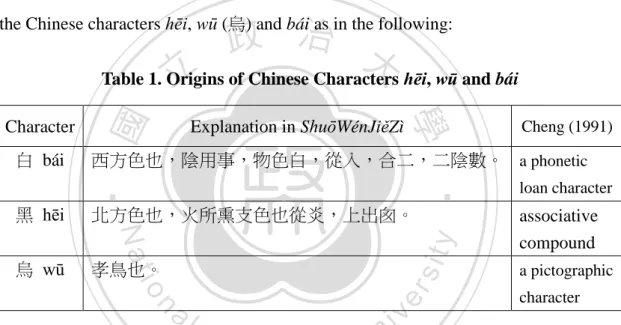
(26) 17. Like Cheng (1991, 2002), Wu (2011) also investigates the evolution of Chinese basic color terms over the past 4000 years through counting word frequency based on works of Chinese literature. He discusses what stages or periods of color terms in history should be categorized under Berlin and Kay’s (1969) work and divides the evolution into five phases and eight periods. Cheng (1991: 67) points out that ShuōWénJiěZì (說文解字) offers the origins of. 政 治 大. the Chinese characters hēi, wū (烏) and bái as in the following:. 立. Table 1. Origins of Chinese Characters hēi, wū and bái Cheng (1991). 北方色也,火所熏支色也從炎,上出囪。. compound. sit. loan character. y. 西方色也,陰用事,物色白,從入,合二,二陰數。 a phonetic. Nat. n. al. er. 孝鳥也。. io. 烏 wū. Explanation in ShuōWénJiěZì. ‧. 黑 hēi. ‧ 國. 白 bái. 學. Character. Ch. i Un. v. associative a pictographic character. We see that in Mandarin Chinese wū does not refer to the color black but stands. engchi. for a kind of bird, wūyā (烏鴉) ‘crow’. It is the character hēi that represents the color black in Mandarin. Cheng (1991: 63) finds that the terms for black are slightly different in Chinese dialects. Most dialects use the character hēi as the color black. However, NánChāng (南昌) is a transitional area where both hēi and wū are used. In some southern regions, people only use the character wū to denote the color black. These areas are MéiXiàn (梅縣), XiàMén (廈門), CháoZhōu (潮州) and FúZhōu (福.
(27) 18. 州), where people speak Hakka or Southern Min. This may be the reason why wū serves as the color black instead of hēi in TH and TSM. In addition, Huang (2003) finds that hēi is only used for rhetoric purposes or proper names in DōngShì (東勢) Hakka such as Hed Liung Gong (黑龍江). He and Zeng (2006) hold the same viewpoints in their study of color terms in SìXiàn Hakka. From the above-mentioned studies, we can tentatively conclude that the terms vu (烏) and oo (烏) represent the. 政 治 大. color black in TH and TSM, respectively.. 立. Chen (1994) investigates the linguistic universals and linguistic relativities of. ‧ 國. 學. color-word metaphors in Mandarin Chinese and in English. He proposes a model. ‧. which is based on Danesi’s (1993) idea and Fearing’s (1954) process of. y. Nat. er. io. sit. conceptualization. He hypothesizes that those lowly-abstracted color-word metaphors incline to be linguistic universals. On the other hand, if color-word metaphors are. al. n. iv n C 8 highly-abstracted, they are morehprone to linguistic eng c h i Urelativities.. 8. Chen (1994) divides color terms into five types: Perception-based Type (感知類), Prototype (典型 類), Sensational Type (情緒類), Symbols or signals (符號類) and Slang and idioms (俚語類). However, we consider Chen’s (1994) model to be erroneous because the five types are not classified in the same dimension or according to the same criteria..
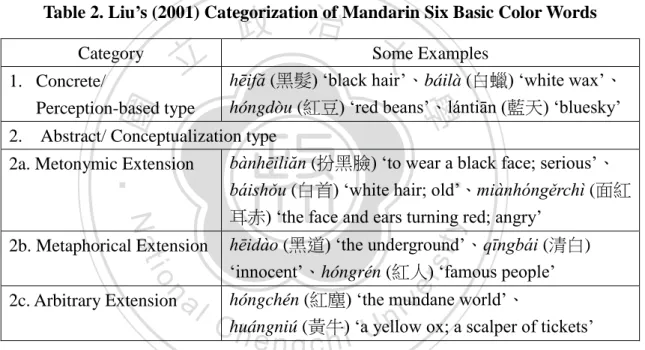
(28) 19. Some studies (e.g., Liu 2001, Lin 2009, Wu 2007) examine cognitive mechanisms of color terms. To begin with, Liu (2001) investigates the six color terms in Mandarin and proposes a model for the semantic extensions of the six basic color words as in the following Table 2. She divides color terms into Concrete/ Perception-based Type, Metonymic Extension, Metaphorical Extension and Arbitrary Extension.. 政 治 大 Some Examples. Table 2. Liu’s (2001) Categorization of Mandarin Six Basic Color Words. 立. Category. ‧ 國. hēifă (黑髮) ‘black hair’、báilà (白蠟) ‘white wax’、 hóngdòu (紅豆) ‘red beans’、lántiān (藍天) ‘bluesky’. 學. 1. Concrete/ Perception-based type. ‧. 2. Abstract/ Conceptualization type bànhēiliăn (扮黑臉) ‘to wear a black face; serious’、 2a. Metonymic Extension báishǒu (白首) ‘white hair; old’、miànhóngěrchì (面紅. y. Nat. 耳赤) ‘the face and ears turning red; angry’. n. al. sit. io 2c. Arbitrary Extension. hēidào (黑道) ‘the underground’、qīngbái (清白) ‘innocent’、hóngrén (紅人) ‘famous people’. er. 2b. Metaphorical Extension. v. hóngchén (紅塵) ‘the mundane world’、 huángniú (黃牛) ‘a yellow ox; a scalper of tickets’. Ch. engchi. i Un. Lin (2009) adopts the same division of data analysis as Liu’s (2001) and compares six basic color terms in Mandarin and in English, black, white, red, yellow, green and blue. One interesting observation she draws is the corresponding three models between the two languages as presented in Table 3..
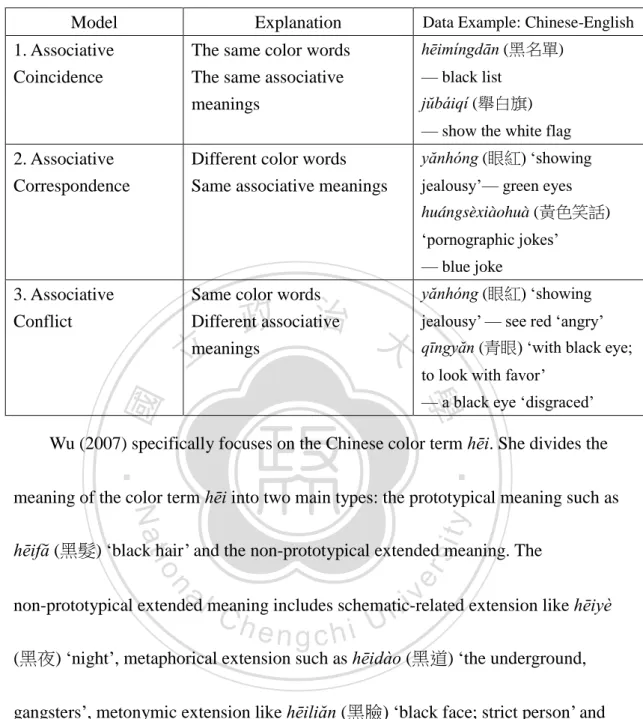
(29) 20. Table 3. Lin (2009): Corresponding Models Between English and Chinese Model. Explanation. 1. Associative Coincidence. Data Example: Chinese-English hēimíngdān (黑名單). The same color words The same associative meanings. — black list jŭbáiqí (舉白旗) — show the white flag. 2. Associative Correspondence. yănhóng (眼紅) ‘showing. Different color words Same associative meanings. jealousy’— green eyes huángsèxiàohuà (黃色笑話) ‘pornographic jokes’ — blue joke. 3. Associative Conflict. Same color words Different associative meanings. 立. 政 治 大. yănhóng (眼紅) ‘showing jealousy’ — see red ‘angry’ qīngyăn (青眼) ‘with black eye; to look with favor’. ‧ 國. 學. — a black eye ‘disgraced’. Wu (2007) specifically focuses on the Chinese color term hēi. She divides the. ‧. sit. y. Nat. meaning of the color term hēi into two main types: the prototypical meaning such as. n. al. er. io. hēifă (黑髮) ‘black hair’ and the non-prototypical extended meaning. The. i Un. v. non-prototypical extended meaning includes schematic-related extension like hēiyè. Ch. engchi. (黑夜) ‘night’, metaphorical extension such as hēidào (黑道) ‘the underground, gangsters’, metonymic extension like hēiliăn (黑臉) ‘black face; strict person’ and history-based and borrowed-translation extension like hēiànshídài (黑暗時代) ‘Dark Ages’. Zeng (2002) analyzes the relationship between five fundamental colors (五正色) and YīnYángWŭXíng (陰陽五行) ‘Yin Yang Five Elements’. He finds that Yin Yang Five Elements deeply influence the development and interpretation of the five.
(30) 21. fundamental colors, hēi, bái, chì(赤) ‘red’, qīng (青) ‘green or blue’, and huáng. Zeng (2002) discovers that the symbolic meanings of color terms are more prominent than the needs of visual aesthetics for Chinese people in early historical periods. These extensional meanings of color terms also reflect people’s philosophy of life about the natural world and the life cycle. From the traditional viewpoints (Huang 2003, Liang 2005, Zeng 2002, Xie 2011),. 政 治 大. in Yin Yang Five Elements, the color black in Chinese is situated in the north and. 立. belongs to winter, during which creatures become dormant, plants wither, and people. ‧ 國. 學. easily have negative emotions. Therefore, hēi has always been regarded as. ‧. inauspicious, disastrous, evil and negative in the Chinese community. The color white. y. Nat. er. io. sit. in Chinese is located in the north-east which is the position of death in Chinese FēngShuǐ (風水). Consequently bái has been connected with Chinese funerals and the. n. al. funeral clothes are white.. Ch. engchi. i Un. v. 2.3 Research of Color Terms in Taiwanese Hakka and Taiwanese Southern Min The research of color terms in TH (Huang 2003, Liang 2005, Cheng 1991, 2002, He and Zeng 2006) and in TSM (Cheng 1991, 2002, Liu 2002) has always been relatively little in comparison with those abundant studies of Chinese color terms. Cheng (1991, 2002) determines that the color category of TH or TSM is similar to.
(31) 22. that of ShuōWénJiěZì (說文解字) in Hàn period. There are five basic color terms. For TH, they are vu (烏) ‘black’, pag (白) ‘white’, fung (紅) ‘red’, vong (黃) ‘yellow’ and qiang (青) ‘grue category of blue and green’. For TSM, these basic color terms are oo (烏) ‘black’,. h (白) ‘white’, âng (紅) ‘red’, ng (黃)9 ‘yellow’ and tshenn (青) ‘grue. category of blue and green’. Cheng (1991) believes that studies of synchronic variation in dialects can contribute to our understanding of the development of Chinese basic color terms.. 立. 政 治 大. Liang (2005) makes a simple comparison of basic color terms in TM, TH and. ‧ 國. 學. English and thereby observes economic activities and unique culture in Hakka groups.. ‧. He and Zeng (2006) investigate TH of SìXiàn (四縣) dialects and find that the. y. Nat. er. io. sit. surroundings are often embedded in color terms or color-related proverbs. They believe that we can perceive the racial characteristics and customs of Hakka people. n. al. i n C U h e Hakka. through the color rhetoric in SìXiàn ngchi. v. Liu (2002) discusses color terms of ABB form in TSM such as oo-sim-sim (烏 BB) and analyzes the different meanings of ABB through prototype theory, semantic fields and semantic extensions. For example, describe the fair skin while. h-phau-phau (白 BB) is used to. h-bông-bông (白 BB) illustrates the scenery of natural. beauty. In addition, Liu (2002) contends that the development of semantic extensions. 9. Notice that in TSM ng (黃) ‘yellow’ is for colloquial usages and hông (黃) ‘yellow’ is for rhetorical usages..
(32) 23. is unidirectional from the concrete to the abstract. For instance, oo-ma-ma (烏 BB) describes the lack of lights, which derives from the concrete color of oo to the abstract notions of dirtiness and the lack of lights. Also,. h-siak-siak (白 BB) illustrates the. luster of objects, which originates from the concrete color of. h to the abstract. notions of cleanliness and the luster of objects.. 2.4 Remarks. 立. 政 治 大. In investigating the four diverse languages, Derrig (1978) does not address so. ‧ 國. 學. much on the cross-linguistic similarities among the extensional senses of color words.. ‧. Nevertheless, in reviewing Derrig’s (1978) work, Cheng (1991, 2002) deduces one. y. Nat. er. io. sit. conclusion. Namely, the earlier stages (black, white, red) in the implicational order are more productive in creating metaphorical uses than those at the later stages (yellow,. al. n. iv n C U h ecolor green, blue). In the study of basic Chinese, Cheng (1991, n gterms c hini Mandarin. 2002) and Liu (2001) both mention that their studies agree with this conclusion. We want to observe whether the color terms at the earlier stages, namely, black and white, in TH and TSM also contain abundant metaphorical usages. Liu (2001) proposes a model for the semantic extensions of the six basic color words in Chinese and classifies the meaning extensions into concrete perception-based type, metonymic extension, metaphorical extension and arbitrary.
(33) 24. extensions. Some studies like Wu (2007) or Lin (2009) adopt her model to analyze color terms in Chinese and in English. However, we have some doubts about their explanations of metonymic extension and metaphorical extension. First of all, we take some examples from Liu’s (2001) category of ‘metaphorical extension’ for illustration. For the phrases hēidào (黑道) ‘the underground’, hēijīn (黑 金) ‘underhand payment’ and hēishì (黑市) ‘black market’, Liu (2001: 36) gives the. 政 治 大. following explanation: “Therefore, hēi in hēidào, hēijīn and hēishì indicates such an. 立. ‘illegal’ property.” For the phrase báikāishuǐ (白開水) ‘plain water’, Liu (2001: 46). ‧ 國. 學. explains in the following: “As for example (42) báikāishuǐ, bái indicates ‘plain’. ‧. because plain water does not contain any flavor.” From Liu’s (2001) ambiguous. Nat. er. io. sit. y. explanations, it seems to us that she refers to the color terms themselves, i.e., hēi or bái, as the metaphorical extension. Maybe Liu (2001) does not clarify her explanation. al. n. iv n C clearly. However, we would likehtoeclarify i U that it is the whole chunks or n g candh contend compounds, e.g., hēidào, hēijīn, hēishì and báikāishuǐ, that are the manifestations of metaphor. Only when the color character collocates with its partner in the whole compound can the metaphorical extension be derived (e.g., hēi with dào, bái with kāishuǐ). Likewise, this clarification also applies to the category of metonymic. extension. For example, the whole phrase jŭbáiqí (舉白旗) ‘hold a white flag’ refers.
(34) 25. to the act of surrender through the metonymy ACTION FOR RESULT.10 The color character, bái, in this phrase still refers to the perception color, white, without denoting any metonymic meaning extension. In addition, we think Wu (2007) makes the same obscure explanation as Liu (2001) does with regard to the categories of metonymic extension and metaphorical extension as displayed in the following: “The second category is ‘Metaphorical. 政 治 大. Extension’ in which the concept of Hēi ‘black’ represents some abstract concepts in. 立. virtue of mapping properties across two different domains.” and “The third category. ‧ 國. 學. is ‘Metonymic Extension’ which means that Hēi ‘black’ here has its primary extension. ‧. with the metonymic extension of linguistic expression” (Wu 2007: 38). Wu (2007). y. Nat. er. io. sit. seemingly thinks of the color term hēi itself as the realization of metaphorical or metonymic extension. Therefore, we should reiterate our contention. From our. al. n. iv n C h e n that viewpoints, it is the whole compounds h itheUmanifestations of metaphorical or g care metonymic extension instead of the color terms hēi and bái themselves. All in all, at this moment we conclude that metonymic extension or metaphorical extension for color words happen only when they collocate with their modified components. We surmise that there are only two types for the meanings of the color terms. One type refers to the meaning of the physiologically visual color. The other. 10. We consider jŭbáiqí (舉白旗) to be the metonymy ACTION FOR RESULT (cf. Kövecses and Radden 1998). Specific data analysis will be presented in Chapter Ⅳ later on..
(35) 26. type refers to those extended meanings of the whole compounds. The extended meanings can be further classified into groups of metaphorical extension or metonymic extension. The color characters can denote the extended meaning only when they collocate with particular words in the whole compound. A lot of efforts have been devoted to the research of color terms in Chinese whether they are diachronic study (Cheng 1991, 2002), synchronic studies examining. 政 治 大. cognitive mechanisms (Chen 1994, Liu 2001, Wu 2007, Lin 2009) or experimental. 立. studies (Zhang 1998, Fei 1999, Liu and Zeng 2009). In comparison, studies of color. ‧ 國. 學. terms in TH or TSM have received relatively little attention. We find that except for. ‧. Liu’s (2002) study, other studies seem to merely present the data without offering. y. Nat. er. io. sit. linguistic accounts. We wonder whether TH or TSM contains abundant extended usages like TM. Since the research of color terms in dialects has been scanty, more. n. al. i n C U hengchi studies are necessary and worthwhile.. v. Furthermore, although color universals seem to be pervasive among all languages, there are color terms that are language-specific. Cheng (2002: 330) points out that “color itself is the reflection of neurophysiology, which exists objectively in the outer world, but the attitude, emotion evoked by a color or things which color symbolizes might be subjective or determined by a culture.” Huang (2003) holds the same viewpoint in that distinctive characteristics of culture among different racial.
(36) 27. groups can be uncovered through usages of color terms. In brief, it is maintained that studying color terms of different languages or dialects may open a window to the different facets of their lives (Cheng 2002, Huang 2003, Liang 2005, He and Zeng 2006, Zeng 2002 and Xie 2011). Therefore, we intend to compare color terms in TM, TH and TSM, which are the major languages in Taiwan, and observe the characteristics of different language groups.. 政 治 大. From the angle of science, the Greek philosopher Aristotle maintains that black. 立. and white are the fundamental components of the light and that all colors are. ‧ 國. 學. generated through various combinations of black and white. Aristotle’s viewpoints. ‧. remain persistent until the English scientist Newton discovers that the spectrum. y. Nat. er. io. sit. consists of seven essential colors, red, orange, yellow, green, blue, indigo and violet. In the field of optics, Netwon’s pioneer experiment is regarded as the first scientific. al. n. iv n C U these arguments are research of colors (Liang 2005).hIrrespective e n g c hofiwhether. scientifically valid or not, the colors black and white seem to constitute the two pillars in all colors and are thought of as the evident opposition in the natural world. Black and white are the two most fundamental and essential colors in the natural world as stipulated at stage one in Berlin and Kay’s (1969) evolutionary sequence. Wierzbicka (1996) and Goddard (1998) all contend that we should resort to visual and environmental things in the study of color terms. The most salient environmental.
(37) 28. prototypes of the colors black and white are the night and day, whose presence is considered universal human experience. Because the two colors, black and white, are universally perceivable to all mankind, speakers of TM, TH and TSM also possess some commonality in the usages of the color terms. However, as mentioned before, we do observe some variations about the two color terms black or white among so geographically contiguous languages. Therefore, we are curious about why there are. 政 治 大. variations of extensional usages about the most fundamental colors among TM, TH. 立. and TSM. In what follows, theories of metaphor and metonymy will be displayed in. ‧ 國. 學. order to understand the cognitive mechanisms lying behind color terms. In addition,. ‧. frameworks of Kövecses (2005) are provided in order to better account for. y. Nat. er. io. sit. universality and variations regarding usages of color terms. Also, Packard’s (2000) categorization of lexicalization enables us to observe color terms from another. n. al. perspective.. Ch. engchi. i Un. v.
(38) CHAPTER Ⅲ THEORETICAL FRAMEWORK. In Chapter Ⅲ we will lay out our theoretical framework. To begin with, theories. 政 治 大. of metaphor and metonymy will be introduced. Cultural factors in metaphor. 立. (Kövecses 2005) will be presented later on and include cross-cultural variations and. ‧ 國. 學. within-culture variations. Furthermore, we will display Packard’s (2000). ‧. categorization of lexicalization.. er. io. sit. y. Nat 3.1 Metaphor and Metonymy. n. al. 3.1.1 Metaphor. Ch. engchi. i Un. v. In classical theories of language, metaphor is regarded as a matter of language instead of thought and the word metaphor is confined to the definition of a novel or poetic linguistic expression. However, in contemporary theory of cognitive linguistics (e.g., Lakoff and Johnson 1980), metaphor is considered to be a conceptual and inherent part of our thoughts and languages instead of merely being a rhetorical device. This viewpoint originates from Michael Reddy’s (1979) stipulation of. 29.
(39) 30. metaphor: “The locus of metaphor is thought, not language, that metaphor is a major and indispensable part of our ordinary, conventional way of conceptualizing the world, and that our everyday behavior reflects our metaphorical understanding of experience” (Lakoff 1993: 204). Lakoff (1993) also clarifies some traditional false assumptions. He contends that metaphor structures our everyday conceptual system, in which most abstract concepts. 政 治 大. are included and that metaphor lies behind our everyday language. The metaphor is. 立. not just a matter of language but of thought and reason. Ungerer and Schmid (2006). ‧ 國. 學. also consider metaphor to be a way of thinking and a powerful cognitive tool for the. Nat. y. ‧. conceptualization of the world.. er. io. sit. Conceptual metaphor can be understood as a mapping from a source domain to a target domain. For example, in the conceptual metaphor LOVE IS A JOURNEY, the. al. n. iv n C U target domain, LOVE. The h isemapped source domain is JOURNEY and i the n g c honto. mapping is strictly structured and there are ontological correspondences. The entities in the domain of love such as lovers, the love relationship or the lovers’ common goals correspond to those in the domain of a journey such as travelers, the vehicle and their common destinations on the journey. The English expressions of this conceptual metaphor are like these sentences: Look how far we’ve come. We’ll just have to go our separate ways. This relationship is a dead-end street. (Lakoff and Johnson 1980).
(40) 31. Croft and Cruse (2004: 198) summarize Lakoff’s conceptual theory of metaphor as listed in the following: (i) It is a theory of recurrently conventionalized expressions in everyday language in which literal and metaphorical elements are intimately combined grammatically. (ii) The conventional metaphorical expressions are not a purely linguistic phenomenon, but the manifestation of a conceptual mapping between two semantic domains; hence, the mapping is general and productive (and assumed to be characteristic of the human mind). (iii) The metaphorical mapping is asymmetrical: the expression is about a situation in one domain (the target domain) using concepts mapped over from another domain. 立. (the source domain).. 政 治 大. ‧. ‧ 國. 學. (iv) The metaphorical mapping can be used for metaphorical reasoning about concepts in the target domain. In addition to source domain and target domain, Ungerer and Schmid (2006). y. Nat. io. sit. emphasize that another key element in metaphor is mapping scope. The mapping. al. er. scope can be understood as “a set of constraints regulating which correspondences are. n. iv n C h econcept eligible for mapping from a source h i aUchosen target concept” (Ungerer n g conto. and Schmid 2006: 119). Most importantly, the mapping scope is culturally constrained and deeply entrenched in the minds of speakers in a certain culture. Ungerer and Schmid (2006: 120) state that “the entrenchment of the mapping scope may vary widely, and this is reflected from a sociopragmatic angle in the degree of conventionalization (or social sanctioning) a metaphor has achieved in a speech community”. Take the metaphor TIME IS MONEY for example. The following are its.
(41) 32. metaphorical expressions: You’re wasting my time. We are running out of time. Can you give me a few minutes? Is that worth your while? These metaphorical expressions all revolve around an evaluation that the mapping scope incorporates, that is, money is a valuable commodity. Other attributes about money such as money is evil is thus not involved in this mapping scope. Here we know how intimately metaphor is constrained and corresponded with cultural evaluations.. 政 治 大. In a metaphor, the source domain is usually concrete whereas the target domain. 立. is invariably abstract. Abstract target concepts are usually grounded in more concrete. ‧ 國. 學. source concepts. Take these metaphors in English for example: LIFE IS A JOURNEY.. ‧. ANGER IS A DANGEROUS ANIMAL. UNDERSTANDING IS SEEING. The. y. Nat. er. io. sit. abstract target domain, LIFE, ANGER or UNDERSTANDING is conceptualized through the concrete source domain, JOURNEY, DANGEROUS ANIMAL or. al. n. iv n C h ea more SEEING. Goatly (2011) mentions metaphor: ABSTRACT QUALITY n g general chi U IS PHYSICAL [QUALITY]. There are some color-related metaphors that can be deemed as sub-metaphors of this general metaphor: BAD IS DARK. CLEVERNESS IN UNDERSTANDING/OBTAINING KNOWLEDGE IS BRIGHTNESS. INABILITY TO UNDERSTAND IS DARKNESS..
(42) 33. 3.1.2 Metonymy Metonymy is different from metaphor. Lakoff and Turner (1989) state that metaphor is defined as the conceptual mapping from source domain to target domain and both domains must belong to different superordinate domains. On the contrary, metonymy involves mapping within one superordinate domain. Lakoff and Johnson (1980: 36) clarify the distinction between metaphor and metonymy as below: “Metaphor is principally a way of conceiving one thing in terms of another, and its primary function is understanding. Metonymy, on the other hand, has primarily a. 政 治 大 referential function, that is, it allows us to use one entity to stand for another.” 立. ‧ 國. 學. The traditional view regards a metonymy as a stand-for relationship between entities and the nature of the relationship as contiguity or proximity. Kövecses and. ‧. Radden (1998) present a comprehensive cognitive-linguistic account of metonymy.. sit. y. Nat. io. al. er. They define metonymy as the following (Kövecses and Radden 1998: 39):. n. “Metonymy is a cognitive process in which one conceptual entity, the vehicle, provides mental access to another conceptual entity, the target, within the same domain, or ICM.”. Ch. engchi. i Un. v. ICMs (Idealized Cognitive Models) refer to a network of entities within one ontological realm and these entities are related to each other by specific conceptual relationships (Kövecses and Radden 1998: 48). The authors categorize metonymy-producing relationships into two major types: Whole ICM and its parts and Parts of an ICM. Specific classifications of the two conceptual configurations are summarized in the following:.
(43) 34. A. Whole ICM and its parts 1. Thing-and-part ICM a. Whole thing for a part of the thing b. Part of a thing for the whole thing 2. Scale ICM 3. Constitution ICM a. Object for material constituting that object b. The material constituting an object for the object 4. Complex event ICM a. Successive subevents for complex event b. Co-present subevents for complex event 5. Category-and-member ICM a. A category for a member of the category. 政 治 大 b. A member of a category for the category 立 6. Category-and-property ICM ‧. ‧ 國. 學. a. Category for defining property b. Defining property for category B. Parts of an ICM. n. al. er. io. sit. y. Nat. 1. Action ICM: Agent for action, Action for agent, Object involved in an action for the action, Action for object involved in the action, Result for action, Action for result, Instrument for action, Means for action, Manner of action for the action, Time period of action for the action, Destination for motion, and Time of motion for an entity involved in the motion. Ch. engchi. i Un. v. 2. Perception ICM: Instrument/organ for perception for the perception, Manner of perception for the perception, Perception for thing perceived and Thing perceived for the perception 3. Causation ICM: Cause for effect Effect for cause:(1) State/event for the thing/person/state that caused it. (2) Emotion for cause of emotion. (3) Mental state for object/person causing it. (4) Physiological/behavioral effect for emotion. (5) Sound caused for the event that caused it..
(44) 35. 4. Production ICM: Producer for product, Author for his work and Place for product made there 5. Control ICM: Controller for controlled, Controlled for controller and The object for the user of the object 6. Possession ICM: Possessor for possessed and Possessed for possessor 7. Containment ICM: Container for contained, Contained for container and Place for inhabitants 8. ICMs involving indeterminate relationships 9. Sign and reference ICMs For example, when we call somebody a jerk, we actually refer to his stupidity.. 政 治 大. This is the metonymy CATEGORY FOR DEFINING PROPERTY. Also, in the. 立. ‧ 國. 學. example We are reading Shakespeare, Shakespeare stands for Shakespeare’s work. This is an example of the metonymy AUTHOR FOR HIS WORK.. ‧. Furthermore, Ungerer and Schmid (2006) claim that a community of speakers. sit. y. Nat. io. n. al. er. share and accept certain encyclopedic knowledge, which serves as the mapping scope. i Un. v. for a metonymy. For example, in the sentence All hands are on deck, hands refer to. Ch. engchi. workers on the deck. Here the context of shipping denoted by the word deck is “socially sanctioned and situationally relevant” (Ungerer and Schmid 2006: 128). ‘Shipping’ offers a mapping scope for the part-whole link between HAND and BODY/PERSON. Also, in the sentence The university needs more clever heads, heads refer to intelligent people because the mapping scope ‘university’ also provides a link between HEAD and BODY/PERSON. Instead of discretely separating metaphor and metonymy, Radden (2000) holds.
(45) 36. the viewpoint that there is a metonymy-metaphor continuum with fuzzy cases in between. Metaphor and metonymy can be regarded as two prototypical categories at the two endpoints of this continuum. Metonymy-based metaphors are the fuzzy middle range of the continuum. Radden (2000: 93) defines metaphor, metonymy and metonymy-based metaphor as in the following: ‘Metonymy is a mapping within the same conceptual domain. Metaphor is a mapping of one conceptual domain onto. 政 治 大. another. Metonymy-based metaphor is a mapping involving two conceptual domains. 立. which are grounded in, or can be traced back to, one conceptual domain.’. ‧ 國. 學. Ruiz de Mendoza (2000) contends there are two types of metonymic mappings.. ‧. One is the source-in-target metonymy, in which the source is a subdomain of the. y. Nat. er. io. sit. target. Another is the target-in-source metonymy, in which the target is a subdomain of the source. She then identifies three possibilities regarding the interaction between. al. n. iv n C h e n g cmetonymy metaphor and metonymy: source-in-target h i U within the metaphoric source, source-in-target metonymy within the metaphoric target and target-in-source. metonymy within the metaphoric target. For example, the sentence He got up on his hind legs to defend his views. is the manifestation of the source-in-target metonymy within the metaphoric source (Ruiz de Mendoza 2000: 122). First, the scene of an animal rearing up represents its intention to attack out of fear (source-in-target metonymy). Then this metonymy serves as the metaphoric source in which a person.
(46) 37. energetically stands up on his two legs to prepare to argue in public. Finally, this metaphoric source is mapped onto the metaphoric target in which a person defends his views in public with vigor without actually standing up.. 3.2 Cultural Factors in Metaphor. 3.2.1 Universality and Variation in Metaphor. 政 治 大. The question of how metaphor is related to culture is addressed by Kövecses. 立. (2005). Kövecses (2005:1) regards culture as “a set of shared understandings that. ‧ 國. 學. characterize smaller or larger groups of people.” We often use metaphors to. ‧. understand intangible things such as time, inner life, emotions or moral values and. y. Nat. al. er. io. sit. these metaphors are essential in the ways we experience these intangible things in. n. cultures. Therefore, Kövecses (2005: 2) contends that “metaphor may be an inherent. Ch. engchi. i Un. v. part of culture.” Primary metaphors may be universal, but the combinations of primary metaphors are likely to be language-specific. Kövecses (2005: 4) further claims that “cultures greatly influence what complex conceptual metaphors emerge from the primary metaphors.”11 Metaphors can be universal or non-universal. On the one hand, universal bodily. 11. Boers (2003: 235) also holds the same viewpoints: “[V]ariations in metaphor usage could also be studied with a view to finding (indirect) evidence of linguistic relativity, in the sense that a community’s figurative language could be considered as a reflection of that community’s conventional patterns of thought or world views.”.
(47) 38. experience may generate universal primary metaphor. Kövecses (2005) presents some case studies of metaphors in some sufficiently diverse languages in order to demonstrate that metaphors can be universal or near-universal. For example, some metaphors about happiness all occur in English, Chinese and Hungarian such as HAPPINESS IS UP, HAPPINESS IS LIGHT and HAPPINESS IS A FLUID IN A CONTAINER. The anger metaphor THE ANGRY PERSON IS A PRESSURIZED. 政 治 大. CONTAINER is also widely found in English, Chinese, Japanese, Hungarian, Polish. 立. and Zulu. Kövecses (2005:42) concludes that the actual physiological process may be. ‧ 國. 學. universal. The universality of physiological mechanisms leads to the similarities in. ‧. conceptualized physiological reactions (the conceptual metonymies), giving rise to the. y. Nat. al. er. io. sit. similarity in the metaphorical conceptualization.. v. n. There are two major dimensions that metaphor variation is most likely to occur,. Ch. engchi. i Un. the cross-cultural and within-culture dimensions. We will introduce the two dimensions in the following. Furthermore, Kövecses (2005) mentions that the cognitive linguistic view of metaphors is composed of several components, which are regarded as aspects of metaphor. These aspects of metaphor include source domain, target domain, experiential basis, neural structures corresponding to source domain and target domain in the brain, relationships between the source and the target, metaphorical linguistic expressions, mappings, entailments, blends, nonlinguistic.
(48) 39. realizations and cultural models.. 3.2.2 Cross-Cultural Variation Kövecses (2005) stipulates four types of cross-cultural variation in conceptual metaphors, that is, congruent metaphors, alternative metaphors, preferential conceptualization of metaphors and unique metaphors. (1) Congruent Metaphors. 立. 政 治 大. ‧ 國. 學. Kövecses (2005:68) displays his explanation of congruent metaphors in the. ‧. following: “The metaphor constitutes a generic schema that is filled out by each. sit. y. Nat. culture that has the metaphor. The metaphors that are filled out in congruence with the. n. al. er. io. generic schema are called congruent metaphors. When the generic schema is filled. Ch. i Un. v. out, it receives unique cultural content at a specific level. In other words, a. engchi. generic-level conceptual metaphor is instantiated in culture-specific ways at a specific level. This is one kind of cross-cultural variation.” For example, different cultures have different concepts about the same anger-related metaphor, THE ANGRY PERSON IS A PRESSURED CONTAINER. In Japanese, a lot of anger-related expressions revolve around the Japanese concept of hara (literally, ‘belly’). The Chinese anger metaphors center around qì (氣) ‘gas’, which traces its roots in the.
數據


+7
相關文件
印尼語 164 班、柬埔寨語 13 班、泰語 131 班、菲律賓語 54 班、. 緬甸語 33 班、馬來語 36 班,計 3,523 位學生選習。另外,102 校以遠距直播教學開課,總計開設雲端班 87
The first case occurs when #1 is the second candidate after the sub- ordinate player’s rejection point and the best applicant before the subor- dinate player’s rejection point is
修習本專門課程者,應取得閩南語 中高級以上 能力證明,包括(一)中央教育主管機關核
(四)有意願參與閩南語沉浸式教學之幼兒園及中心應於每年四月三十日
7S 強化並且複習英國國定數學能力指標 level 4 的內容、主要學習 level 5 的內 容、先備一些 level 6 的延伸內容。. 8S 完成並且深化 level
我國「國民教育」之實施早期為小學六年,57 學年度以後延伸為九年,民國 86
語文運用 留意錯別字 辨識近義詞及詞語 的感情色彩 認識成語
健行學校財團法人健行科技大學 清雲科技大學 台灣首府學校財團法人台灣首府大學 致遠管理學院 大華學校財團法人大華科技大學 大華技術學院 醒吾學校財團法人醒吾科技大學
