
應用液相層析串聯式質譜鑑定中藥製劑中防己類藥材之研究;Application of LC/MS/MS on the identification of the Fangchi species in Traditional Chinese Medicines
122
0
0
全文
(2) 謝. 誌. 本論文承蒙張憲昌博士協助新鮮採集木防己原植物藥材,以及 提供文中各標準藥材之鑑定,使實驗得以順利進行,在此致十二萬 分之謝意。 本論文亦承蒙所長張永勳博士之指導,提供真正對中藥學術界 有意義之研究題目,以所長認知過去市場上所用之防己大多數為廣 防己,反而粉防己較為少用,因此廣防己在市場上一定有龐大的囤 貨,當衛生主管機關作出禁用廣防己之決定時,未見有廠商退運或 申請銷毀,則原本龐大廣防己藥材的囤貨將流向何處? 合理之懷 疑,是否摻雜於粉防己或其他防己中以消化囤貨。少量之摻雜,一 般以 HPLC 分析法之感度是很難檢出馬兜鈴酸,但若以液相層析串 聯式質譜分析法則不難檢出,因此囑我在這主題上以液相層析串聯 式質譜分析法研究四種防己之鑑別法,尤其製成中藥製劑後,摻雜 問題之鑑定。 研究過程中,一度因未能找到正確之漢防己而實驗中斷,所幸 所長即時由日本購得真品,使實驗得以繼續完成,在此致一併致謝。 在此仍要感謝組長林哲輝博士,除了提供分析技術之咨詢外,尚 支持我在職進修之機會,在此亦要向林組長致十二萬分之謝意。 研究生 曾木全 鞠躬 2006.05.27. I.
(3) 目. 錄. page. 謝. 誌---------------------------------------------------Ⅰ. 目. 錄---------------------------------------------------Ⅱ. 表 目 錄---------------------------------------------------Ⅳ 圖 目 錄---------------------------------------------------Ⅴ 中文摘要---------------------------------------------------Ⅹ 英文摘要--------------------------------------------------ⅩⅡ 第一章. 前 言-----------------------------------------------1. 第二章. 材料與方法. 一、材 料---------------------------------------------------6 二、儀器及裝置----------------------------------------------7 三、方 法---------------------------------------------------8 1.標準藥材鑑定---考證與切片鏡檢 1-1:粉防己--------------------------------------------8 1-2:廣防己--------------------------------------------9 1-3:木防己-------------------------------------------10 1-4:漢防己-------------------------------------------11 2. 藥材之薄層層析並與藥材指標成分比對-----------------21 3. 標準藥材之液相層析串聯式指紋質譜圖庫之建檔---------21 4. 指紋質譜圖庫適用性探討-----------------------------26 5. 再現性評估(Reproducibility)------------------------29 6. 最低檢出量(LOD)--- --------------------------------29 7. 案例分析-------------------------------------------29 四、結果與討論---------------------------------------------30 1. 粉防己之液相層析串聯式質譜分析指紋圖譜建立---------30 II.
(4) 2. 木防己之液相層析串聯式質譜分析指紋圖譜建立--------40 3. 漢防己之液相層析串聯式質譜分析指紋圖譜建立--------47 4. 廣防己之液相層析串聯式質譜分析指紋圖譜建立--------52 5. 質譜圖庫建檔之所見--------------------------------60 6. 四種藥材之快速篩檢試驗----------------------------61 7. 指紋質譜圖庫之比對--------------------------------65 8. 其他藥材之干擾之探討---防己藥材空白試驗-----------71 9. 指紋質譜圖庫比對再現性探討------------------------72 10. 最低檢出量(LOD)之探討----------------------------73 11. 指紋質譜圖之應用及市售品之調查研究----------------76 12.不明藥材之調查-------------------------------------92 13. 四種防己藥材成分之異同----------------------------96 五、結論--------------------------------------------------99 六、參考文獻 --------------------------------------------104. III.
(5) 表 目 錄. page. Tab. 1:. The parameters of LC/MS1 scanning --------------------------. Tab. 2:. The compositions of TCM preparation in market and its fangchi species labeled ------------------------------------------- 28. Tab. 3:. The Herb identity macro- method and MRM macro-method of Stephania tetrandra herb-------------------------------------- 38. Tab. 4:. The Herb identity macro- method and MRM macro-method of Cocculus trilobus herb----------------------------------------- 45. Tab. 5:. The Herb identity macro- method and MRM macro-method of Sinomenium acutumn herb---------------------------------- 51. Tab. 6:. The Herb identity macro- method and MRM macro-method of Aristolochia fangchi herb-------------------------------------- 55. Tab. 7:. The parameters of Aristolochic acid I& II analysis-----------. 59. Tab. 8:. Fangchi herbal MRM pre-screen macro-method -------------. 61. Tab. 9:. The matching quality of daughter ion spectrum during reproducibility test------------------------------------------------- 74. 23. Tab.10: The Limit of detection in single herb and model TCM------- 76 Tab.11: The identified results of TCM & herb by LC/MS/MS fingerprint----------------------------------------------------------- 78 Tab.12. Chemical structure collection------------------------------------. IV. 102.
(6) 圖 目 錄 Fig. 1:. page. Fig. 2:. Fenfangchi (A), Guangfangchi (B), Mufangchi(C) and Hanfangchi (D) are extremely similar in their appearance--- 5 The appearence of Micromass Quattro Ultima LC/MS/MS- 7. Fig. 3 :. The plant macromorphology of Stephania tetrandra S. Moore --------------------------------------------------------------. Fig. 4 :. 13. The microscopic observation and histologic biopsy of Stephania tetrandra herb(x 40)------------------------------ 14. Fig. 5 :. The plant macromorphology of Aristolochia fangchi Wu --- 15. Fig. 6 :. The microscopic observation and histologic biopsy of Aristolochia fangchi herb(x 40)------------------------------ 16. Fig. 7 :. The plant macromorphology of Cocculus trilobus D C .----- 17. Fig. 8 :. The microscopic observation and histologic biopsy of Cocculus trilobus herb(x 40)--------------------------------- 18. Fig.9 :. The plant macromorphology of Sinomenium acutumn Rehd. et Wi l s .---------------------------------------------------- 19. Fig 10 : Fig.11: Fig.12 : Fig.13: Fig.14: Fig.15: Fig.16: Fig.17: Fig.18:. The microscopic observation and histologic biopsy of Sinomenium acutumn herb --------------------------------------- 20 TLC pattern of 4 Fangchi herb vs reference standard-------- 20 The mechanism of MS 1 scan and obtained MS1 spectrum ----------------------------------------------------------------------- 22 The mechanism of daughter ion scan and obtained daughter ion spectrum-------------------------------------------------------- 24 The mechanism of MRM scan and obtained MRM/TIC chromatography--------------------------------------------------- 25 The TIC of ESI+/MS 1 scan and ESI+/MS 1 spectrums of Stephania tetrandra herb extract -------------------------------- 32 The ESI- m/z 191 daughter ion scan and the library search result----------------------------------------------------------------- 33 The daughter ion spectrums of selected fragments in Stephania tetrandra herb ---------------------------------------- 35 The chromatogram of Stephania MRM screen scan --------- 38 V.
(7) Fig.19: Fig.20 : Fig.21: Fig.22: Fig.23 : Fig.24: Fig.25: Fig.26: Fig.27: Fig.28: Fig.29: Fig.30: Fig.31: Fig.32: Fig.33: Fig.34: Fig.35:. Fig.36: Fig.37:. Fig.38: Fig.39:. The daughter ion spectrums of tetradraine standard---------The UV spectrums of tetradraine and Fangchinoline-------The TIC of ESI+/MS 1 scan and ESI+/MS 1 spectrums of Cocculus trilobus herb extract ---------------------------------The daughter ion spectrums of selected fragments in Cocculus trilobus herb ------------------------------------------The chromatogram of Cocculus MRM screen scan ---------The ESI+/MS 1 spectrums of Sinomenium acutumn herb extract-------------------------------------------------------------The daughter ion spectrums of selected fragments in Sinomenium acutumn herb -------------------------------------The daughter ion spectrums of Sinomenine standard-------The chromatogram of Sinomenium MRM screen scan ----The ESI+/MS 1 spectrums of Aristolochia fangchi herb extract--------------------------------------------------------------The daughter ion spectrums of selected fragments in Aristolo- chia fangchi herb-------------------------------------The chromatogram of Aristolochia MRM screen scan -----The ESI┼/MS 1 spectrums of Aristolochic acid I & II standard ----------------------------------------------------------The daughter ions spectrums of Aristolochic acid I (a) & II (b) standard-------------------------------------------------------The UV spectrums of Aristolochic acid I & II standard-----Quantitative analysis of Aristolochic acid I & II by LC/MS/MS--------------------------------------------------------The pattern of Fangchi herbal MRM pre-screen macromethod scanning and the sample had been found that contained both of Stephania tetrandra and Sinomenium acutumn herb------------------------------------------------------Double check of Sinomenium in Stephania tetrandra dry extract and found that the Sinomenium was non-detected--The pattern of Fangchi herbal MRM pre-screen macromethod scanning and the sample had been found that contained Sinomenium acutumn herb---------------------------. 39 39 41 42 45 46 45 50 51 53 55 56 57 58 58 60. 62 63. 64. The library search results of model sample preparations contained standard Stephania tetrandra herb------------------ 66 The library search results of model sample preparations VI.
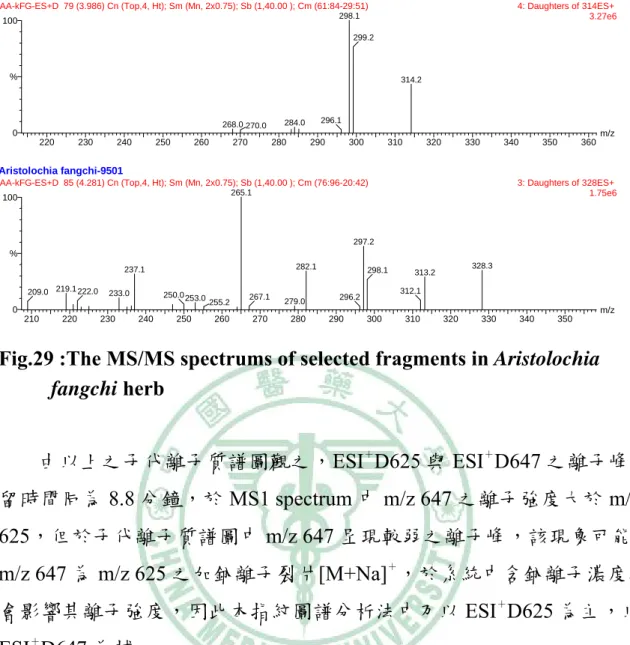
(8) Fig.40: Fig.41: Fig.42: Fig.43: Fig.44:. Fig.45: Fig.46: Fig.47: Fig.48: Fig.49:. Fig.50:. Fig.51:. Fig.52:. contained standard Cocculus trilobus herb-------------------The library search results of model sample preparations contained standard Sinomenium acutumn herb --------------The library search results of model sample preparations contained standard Aristolochia fangchi herb----------------MRM pre-screen macro-method scanning for Fangchi herbal blank preparation-----------------------------------------Aristolochia Fangchi herbal identity macro-method double check scanning for blank preparation--------------------------The DOL test for model Fangi-Jii-Hwang-Chi-Tang contains Stephania tetrandra herb is 50mg/10mL in concentration------------------------------------------------------The DOL test for raw materials extract contains Stephania tetrandra herb is 50mg/10mL in concentration--------------Unknown sample look like Stephania tetrandra suspiciously and sent for identification------------------------Unknown sample labeled as Cocculus herb and sent for identification------------------------------------------------------Fangchi herbal MRM pre-screen macro-method scanning and the result of Aristolochia fangchi was detected---------The MRM chromatograms of Fangchi dry extracted preparation and the tested result of containing Stephania tetrandra herb and suspect adulterated small portions of Sinomenium acutumn herb-------------------------------------The double check of ESI+D342 and ESI+D330 chromato grams of Fangchi dry extracted preparation and the tested result of containing Stephania tetrandra herb but Sinomenium acutumn herb had no detected ------------------The MRM chromatograms of Han-Fangchi dry extracted preparation and the tested result of containing Stephania tetrandra herb, was different from the formula label of Sinomenium acutumn--------------------------------------------The MRM chromatograms of Sheau-Shiuh-Ming-Tang (小 續命湯濃縮顆粒) dry extracted preparation and the tested result of containing Sinomenium acutumn herb and adulterated portions of Aristolochia fangchi (Formula label : Sinomenium acutumn)-----------------------------------VII. 68 70 71 72 73. 75 75 77 77 79. 80. 81. 81. 82.
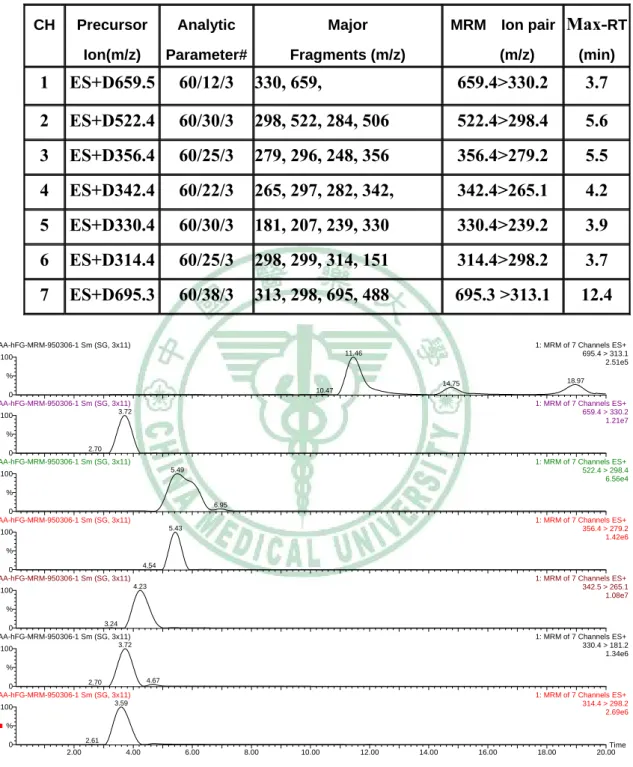
(9) Fig.53:. Fig.54:. Fig.55:. Fig.56:. Fig.57:. Fig.58:. Fig.59:. Fig.60:. Fig.61:. Fig.62:. The double check of Sheau-Shiuh-Ming-Tang (小續命湯 濃縮顆粒) dry extracted preparation contained aristolochic acid and Sinomenine by LC/MS/MS--------------------------The MRM chromatograms of Fangchi-Hwang- Chi-Tang (防己黃耆湯濃縮散) dry extracted preparation and double checked result of containing Sinomenium acutumn herb (Formula label : Stephania tetrandra )------------------------The MRM chromatograms of Fangchi-Hwang-Chi- Tang (防己黃耆湯濃縮散) dry extracted preparation and the tested result of containing Stephania tetrandra herb and adulterated portions of Aristolochia fangchi (Formula label : Sinomenium acutumn )----------------------------------The double check of Fangchi-Hwang-Chi-Tang (防己黃耆 湯濃縮散) dry extracted preparation contained Sinomenine by LC/MS/MS----------------------------------------------------The MRM chromatograms of Tong-Yonq-Tonq-Feng- Wan (通用痛風丸濃縮散) dry extracted preparation and the tested result of containing Sinomenium acutumn herb and Stephania tetrandra (Formula label : Fangchi)----------------The MRM chromatography of Tong-Yonq-Tonq-FengWan (通用痛風丸) pill preparation and the tested result of containing Aristolochia fangchi (Formula label : Fangchi) The double check of Tong-Yonq-Tonq-Feng-Wan (通用痛 風丸) pill preparation contained aristolochic acid I & II by LC/MS/MS--------------------------------------------------------The double check of Fangchi-Hwang-Chi-Tang (防己黃耆 湯濃縮散) dry extracted preparation contained aristolochic acid I by LC/MS/MS-------------------------------------------The MRM chromatography of Muh-Fangchi-Tang (木防己 湯濃縮散) dry extracted preparation and the tested result of containing none of the 4 kinds of Fangchi herb (Formula label : Cocculus)-------------------------------------The appearance of unknown sample had been adulterated in Muh-Fangchi-Tang (木防己湯濃縮散) dry extracted preparation as Coculus herb------------------------------------VIII. 84. 85. 86. 87. 88. 89. 90. 91. 93. 93.
(10) Fig.63: Fig.64:. Fig.65: Fig.66:. The apparence of Coculus sarmentosus(華南木防己)------- 94 The comparsion of ESI+/MS1 TIC (upper) and PDA chromatogram (below) among Erycibe obtusfolia, unknown sample and Coculus sarmentosus------------------- 95 The difference of ES+D342 spectrum between 4 species Fangchi herb------------------------------------------------------- 98 +. The difference of ESI D314 spectrum between 4 species Fangchi herb-------------------------------------------------------. IX. 98.
(11) 摘. 要. 為了鑑中藥製劑中經常被混淆誤用之防己類(Fangchi herb)藥材,包 括防己科(Menispermaceae)植物,粉防己( Stephania tetrandra S. Moore)、 木防己 Cocculus trilobus D C .、漢防己 Sinomenium acutumn Rehd. et Wi l s 及馬兜鈴科(Aristolochiaceae)植物廣防己(Aristolochia fangchi Wu)、。 本研究報告係嘗試應用液相層析串聯式質譜分析法(liquid chromatography-tandem mass spectrometry, LC/MS/MS)製作四種標準藥材 之指紋質譜圖庫(Mass Fingerprint Database),供搜尋比對之用。 首先經由搜集藥材或新鮮採集、並經組織切片及指標成分比對以確 立標準藥材後,配置標準藥材溶液,進行液相層析串聯式質譜分析。分離 管柱為 Cosmosil 5C18-AR, 4.6 x 150 mm。移動相溶媒系為 methanol: acetonitrile:各含 0.1﹪w/v 之 formic acid 及 ammonium acetate 混合水溶液 (17:17:66),流速:0.5 mL/min(1:1 分流),毛細管電壓(source capillary voltage)為 3 kV,以線性錐口電壓變化(cone voltage ramp)之質譜分析條件 進行正離子電灑法第一段全質譜掃描(positive ion electrospray ionization MS 1 scan),獲得第一段全掃描質譜圖(MS 1 spectrum)。由該質譜圖中選 取較大、明顯、穩定之離子裂片作為源頭離子(precursor ions),以固定 3 kV 及 60V 之毛細管電壓與錐口電壓(cone voltage)再進行子代離子掃描 (daughter ion scan),調整碰撞能 量(argon collision energy)使產生穩定明顯之鑑定離子(confirmation ion) 及定量離子(quantitative ion),獲得子代離子掃描質譜圖(daughter ion spectrum),並將此質譜圖,連同儀器分析參數,一併鍵入質譜圖庫中。 為檢驗單一藥材或複方製劑中是否含防己藥材,分別編輯四種防己 藥材鑑定試驗之巨集指令(fangchi herb identity macro-method)。對所配製 之四種防己黃耆湯模擬處方之再現性測試(reproducibility test)中,同日內 X.
(12) (Intraday)及異日間(Interday)之比對相似性(matching quality)均能符合 80% 以上,因此本分析法之藥材鑑定結果可靠。 為增加儀器掃瞄之靈敏度,另選定四種防己藥材之親代及生成子代配 對離子裂片,進行多重離子裂解監控(MRM, multiple reaction monitoring) 分析,能一次掃瞄數個管道所匯集成之 MRM 巨集指令分析法(MRM screen macro-method),用以摒除複雜天然成分之干擾,提升離子峰之 S/N 比使掃瞄結果更容易判定。另擇取上述四種藥材中各兩個主要管道整合成 MRM 預篩檢試驗(MRM pre-screen macro-method),用以快速預篩檢上述 四種易混淆防己藥材。當欲檢測之初,先以 MRM pre-screen macro-method 篩檢,獲得初步之結果,再以各別防己藥材之 MRM screen macro-method 及 fangchi herb identity macro-method 重行分析,並比對子代離子質譜圖,即可獲致確切 之檢出結果。 應用上述研究成果檢測隨機取樣市售防己藥材及標示含防己之中藥 製劑 共 20 件,標示不清楚者 8 件,檢出發現標示藥材與檢出藥材不符者有 13 件,真的如同古籍記載一般的混淆誤用。廣防己雖已禁用,但檢出率仍 高達 22.2%。由上述結果觀之,LC/MS/MS 指紋質譜圖分析法確實能有效 的分辨中藥製劑中所用防己之種類。 關鍵詞:防己藥材偽鑑定、粉防己、漢防己、木防己、廣防己、青藤、 液相層析串聯式質譜分析法、電灑法、子代離子掃描、指紋圖譜分析、 質譜圖庫、巨集指令、青藤鹼、木防己鹼、粉防己鹼、防己諾林鹼、輪 環藤酚鹼、木蘭花鹼. XI.
(13) Application of LC/MS/MS on the identification of the Fangchi species in Traditional Chinese Medicines Mu-Chuan Tseng Graduate Institute of Chinese Pharmaceutical Sciences, China Medical University 91 Hsueh-Shih Rd, North Section, Taichung City 404, Taiwan. Abstract In the ancient book literature,Fenfangchi (粉防己 Stephania tetrandra S. Moore , Menispermaceae),Mufangchi(木防己 Cocculus trilobus D C ., Menispermaceae) , Guangfangchi ( 廣 防 己 (Aristolochia fangchi Wu., Aristolochiaceae),Hanfangchi (漢防己 Sinomenium acutumn Rehd. et Wi l s ., Menispermaceae ) are all called Fangchi in TCM。Especially Guangfangchi and Fenfangchi are extremely similar in their appearance. Therefore, they are frequently misused. Guangfangchi contained aristolochic acid. It is concerned with Chinese Herb Nephropathy that give rise to the world to pay much attention to the misuse of TCM. This paper introduces a newly developed method of applying liquid chromatography-tandem mass spectrometry (LC/MS/MS) on the identification of the Fangchi species in Traditional Chinese Medicines. Analyses were carried out using a high performance liquid chromatograph interfaced to a tri-quadrupole mass spectrometer and a photodiode array detector through a PEEK tube by the split ratio as 1:1. Chromatographic separation was performed on a C18 column (Cosmosil 5-C18, 150 x 4.6 mm, i.d., 5μm) under an isocratic elution of a mixed solvent system in a composition of each 17% of methanol and acetonitrile and 66% of mixed aqueous solutions that contained 0.1% of ammonium acetate and 0.1% of formic acid at a flow rate of 0.5 mL/min. The source temperature and the desolvation temperature was. XII.
(14) set at 120℃ and 350℃, respectively. A full UV spectrum was scanned from 200 to 350 nm. This study attempts to fabricate Mass Fingerprint Database of four species of standard raw materials of Fangchi by LC/MS/MS for library searching. First, established standard raw material by the way of collection, microscopic examination and contrast their index ingredients. Then carry on creating the LC/MS/MS database process via MS 1 scanning, daughter ion scanning and MRM scanning. In order to examine what species of fangchi exist in Kampo medicines or TCM, we edited four kinds of Fangchic herb identity macro-method, for screening the daughter ion spectrum of selected fragments and compared with the LC/MS/MS Fingerprint Database. We also edited four kinds of MRM screen macro-method and MRM pre-screen macro-method for enhancing the signal peak and rapidly screen the sample.. By this. macro-method,. Fang-Jii-. we. processed. the. reproducibility. test. of. Hwang-chi-Tang (防己黃耆湯) model sample, and the result of the average matching quality of Intraday is 86.9%,SD is betweem 2.2~6.0. The Interday is 86.2%,SD is betweem 2.2~7.9. Both of the intraday and interday test are more then the basic demand of matching quality (80%)。This result indicate that this analytic method is reliable。 Apply the analysis method, Examining 20 kinds of random sampling materials;including 2 raw materials, 17 Kampo medicines, and the another one is TCM pill that comes from 7 different manufactory and 1 traditional pill manufactory. The results supported that there is 1 sample contain Guangfangji that labeled fangji herb. One labeled Mufangchi but detected none of four fangchies. 13 of 18 preparations contain Fenfangchi but one adulterated Guangfangchi and another one adulterated Hanfangchi. There are 4 samples contain Hanfangchi but 1 of 4 adulterated the Guangfangchi. XIII. There were.
(15) 22.2% of the tested sample Containing aristolochic acid.. Thus it can. be seen that although Guangfangchi is forbidden by law but still use in marketplace. There are none of Mufangchi was detected even labeled. This shows that the origin of Mufangchi is uncertainly, The government organization should take account of pharmaceutical preparation permission. According to the result of this research,the use of Fangchi chaos as that was described in traditional herb literature. From modern phytochemistry research, we know that the four materials of different Fangchis diverse. We ought to take more seriously about that diverse materials contain different ingredient that will lead to different effect and should apply to different sickness. Key word: Stephania tetrandra, Sinomenium acutumn, Cocculus trilobus, Aristolochia fangchi, LC/MS/MS, Electrospray, Mass fingerprint, MRM (Multiple Reaction Monitoring), Herb identity macro-method , MRM screen macro-method, MRM pre-screen macro-method tetrandrine, fangchinoline, trilobine, isotrilobine, magnoflorine, cyclanoline. XIV.
(16) 前. 言. 由「防巳、防已、防己之種種問題及其相關生藥製劑之應用」一文 (1). 中對防己之考證稱本經原載為「防巳」, 而後《名醫別錄》、《神. 農本草經集注》、《新修本草》、《嘉祐本草》、《四聲本草》、《圖 經本草》、《本草拾遺》、《雷公炮炙論》、《肘後方》、《初虞世方》 等晉、唐、宋諸家本草及臨床家均以「防巳」為名。至李時珍之《本草 綱目》( AD 1578 年 ) 問世後本草中始有「防已」之名出現,而後在 清乾隆初期汪昂之《本草備要》中更有「巳」「已」並出之現象,至民 國復刻之《本草綱目》則已然由「防已」衍變成「防己」。究竟防巳、 漢防巳、木防巳是否是否屬同一基原植物,確有詳加考證之必要。 防巳在《神農本草經》一書中之別名一名「解離」, 此正如《名醫別 錄》所云:「文如車輻理解者良,生漢中 ( 陝西、南鄭 ) 川谷二月 八月採根」,故從古以來「漢防巳」即為最被推崇之上品,唯至唐《新 修本草》云:「防巳中出漢中者作車輻解黃實而香,其青白虛軟者名 木防巳,都不任用,陶謂之佳者蓋未見漢中者爾。」而《嘉祐本草》 引用《藥性論云》:「漢防巳君味苦有小毒,能治濕風口面喎斜手足 疼散留痰主肺氣嗽喘。」又云「木防巳使...」從此導致日後防巳分別 成「漢防巳」與「木防巳」並因對其基原植物未作明確之交代,而歷 代本草中更因缺乏明確之說明以致在大陸上顯得非常紛亂,唯至最近 從《神農本經會通》( 此書之書稿成於 1485 年前後,刊行于明萬曆 四十四年 ( AD 1617 年 ) 一書中發現如是之記載: 「防巳君也 ... 採 根陰乾。去皮用文如車輻理解者良,要心花文黃色。漢防巳,君,木 防巳,使,即根苗之名 ...」。若照這種說法,則「漢防巳」與「木 防巳」乃指同一基原植物之「根」與地上部之「苗」, 此說就頗與《神 1.
(17) 農本草經》所記載之「防巳」回歸於一致。不過今所謂之漢中防己即 異葉兜鈴. (2). Aristolochia heterophylla Hemsl. 之根莖(4),實際上缺乏市. 場性,又非防巳科植物,是產地吻合,因此言其為本草經之正條品, 似稍有牽強之感。防己植物亦分布於本省中北部低海拔之山地。臺灣 之傳統式生藥店中,今已將其根部稱為「倒地拱」而不稱為防己,並 (3). 當防己使用。粉防己主產於浙江、安徽而浙江產者主銷華北及華東 。 此種防己從其性味似與《本草綱目》《名醫別錄》和《藥性論》所云 之防己相關,又從《本草綱目》「石解」之別名與本植物在杭州產地 稱為石蟾蜍,其根又有車輻理解之紋連想,故被當作防己不無有其理 由存在。防己始載於《神農本草經》列為中品, 為古代常用之中藥材 之一。另由唐陳藏器《本草拾遺》曰:「治風用木防己,治水用漢防 己」。以上古籍論述出現「漢防巳」與「木防巳」之名稱,但並未對 其基原植物作明確之交代,而歷代本草中更因缺乏明確之說明,以致使 用上顯得非常紛亂。直到明萬曆年間《神農本經會通》一書中記載: 「防巳君也 ... 採根陰乾。去皮用文如車輻理解者良,要心花文黃 色。漢防巳,君,木防巳,使,即根苗之名 ...」。據此一說,則「漢防 巳」與「木防巳」乃指同一基原植物之「根」與地上部之「苗」。至 於廣防己(Aristolochia fangchi Wu)之飲片外觀為維管束放射狀排列, 正與古籍載:「文如車輻理解者良」幾分相似,若無組織形態學之基 本常識,定難辨其真偽(Fig.1)。由於古代缺乏植物分類學之概念,更 無顯微鏡等科學儀器之鑑定,因此不同年代之不同醫方古籍記載多種 品名相近之藥材,諸如粉防己、漢防己、木防己、廣防己、漢中防己 等均未經考證、鑑定就都當作防己混淆使用,這些藥材之基原之種名、 屬名均不同(4),甚至於科名亦差異很大,其所含療效成分不同,當然 治病之適用性也會不同。. 2.
(18) (5). 因防己藥材具利水消腫滲濕作用 ,常用做減肥用途而長期使 用。西元 1993 年,比利時醫師 Vanherweghem 在 Lancet 雜誌上發表 一篇文章(6),指出在比利時有許多位婦女因服用了含防己的減肥藥而 造成腎衰竭的病例,其特徵是腎間質細胞廣泛性纖維化、腎小管萎縮, 而且很快就腎衰竭,他把這種現象稱為中草藥腎病(Chinese Herbs Nephropathy; CHN)。1994 年證實比利時所進口之粉防己實際上為 含馬兜鈴酸之廣防己(7),廣防己所引發腎病變,引起全世界廣泛之討 「馬兜鈴 論,在台灣亦有類似病例之報導。衛生署於 2000 年公告(8): 酸長期服用會造成腎衰竭現象」 ,2001 年再公告: 「馬兜鈴酸中藥材為 中醫師處方用藥」 。因此引起中醫界對馬兜鈴酸造成之副作用有所瞭解 與重視。2003 年衛生署再依據藥事法第 48 條及 76 條規定完成全面禁 用含馬兜鈴酸的中藥材及其製劑之公告。因此廣防己、青木香、關木 通、馬兜鈴、天仙藤等含馬兜鈴酸之中藥材均不得使用。但以過去廣 防己之偌大之市場,存貨未見退運或銷毀,是否混雜在粉防己或其他 外觀相似之飲片藥材中,繼續販售使用,就不得而知,因此亟需建立 客觀精確之辨識方法,以維護消費大眾用藥之安全。 當今中國大陸將粉防己( Stephania tetrandra S. Moore) 之根以 防己之名收載於中國藥典(9)中,也就是說,粉防己即是防己之正品。 由於中藥知識大都源於師徒傳承,以及所謂道地藥材之地域行,以至 防己之混淆誤用情形嚴重,引起廣泛之重視,因此各種辨識藥材真偽、 成分分析法,例如切片鏡檢(10~12)、薄層層析分析 (TLC) (10)、高效液相 層析(HPLC)分析(13,14)、HPLC 指紋圖譜(fingerprint)分析(15)、紫外譜線 鑑別法(UV) (16)、氣相層析質譜分析法(GC/MS) (14)、甚至於中藥二維相 關紅外光譜(two dimension IR)鑒定法等(17),琳瑯滿目地發表於期刊雜 誌中。據筆者多年之中西藥檢驗經驗,切片鏡檢適用於植物藥材之比 3.
(19) 對,若作成製劑(濃縮製劑、液劑、丸劑、粉末等)則難以鑑別;TLC 分析法雖為最常用最簡便之比對方法,但因所展開之薄層層析圖譜作 觀察,常因呈現多數斑點之重疊與模糊而使相似度之判定顯得太主觀 與不肯定;HPLC 成分分析,若無對照標準品,光靠波峰滯留時間相 同是尚無法判定成分相同,縱使加掛光二極體紫外光吸收檢測器 (Photodiarray detector ; PDA) , 能 顯 示 紫 外 線 吸 收 光 譜 圖 (UV spectrum),但植物分化過程產生許多類緣成分,具有相似之紫外線吸 收光譜圖(16),亦難判定成分之異同;至於 HPLC 指紋圖譜分析,則因 植物天然成分複雜,且藥材成分常因採收季節、植物藥用部位、炮製 方法等之不同,而影響其內所含成分比例之不同(18),其所獲致之指紋 圖譜很難有再現性可言;GC/MS 分析法最大之優點為所獲得之質譜圖 可與市售套裝質譜圖庫(Library)例如 Wiley、Nist、PMW 等作搜尋比 對,或許可比對出成分名稱,唯 GC/MS 分析法亦有許多限制(19),例 如分子量太大(大於 m/z 500)者、極性高、無法氣化之成分,大多數之 植 物 成 分 例 如 生 物 鹼 (alkaloids) 、 黃 酮 類 (flavones) 、 醣 質 (sugars, polysaccharides)等皆屬於這類成分,因此鑑定功能性不足;至於中藥 二維相關紅外光譜鑒定法(17),屬於新興檢驗技術,筆者未曾觸及,唯 由專書中瞭解,係未經分離直接測定二維相關紅外光譜,至於其如何 克服成分濃度間之差異,含水量之干擾等問題,所衍生再現性之問題。 然而液相層析串聯式質譜分析法 (20~23) (liquid chromatography-tandem mass spectrometry; LC/MS/MS )則結合 LC 之分離及離子源(ion source) 之離子化,以及四極棒之帶電離子裂片(m/z)之選擇進入,接續以不同 裂解條件作碰撞,產生各種不同強度之離子裂片組合成之質譜圖,就 如指紋般之特異性,可供搜尋比對之用。同時 LC/MS/MS 之分析一次 可同時監控多種成分,更能確定檢出結果。. 4.
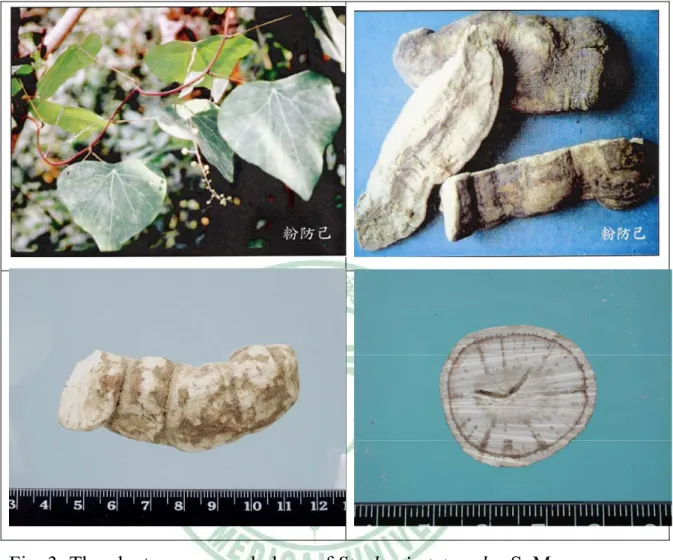
(20) 本研究報告則主要以液相層析串聯式質譜分析法探討粉防己、漢防 己、木防己、廣防己等易誤用藥材,建立上述藥材之指紋圖譜圖庫供電 腦自動搜尋比對之用,並將研究成果應用於藥材或製劑中之鑑定。. A. B. C. D. Fig.1: Fenfangchi (A), Guangfangchi (B), Mufangchi(C) and Hanfangchi (D) are extremely similar in their appearance.. 5.
(21) 材 料 與 方 法 一、材料: 1.對照用標準品:tetrandrine, aristolochic acid(I 40%, II 56%), sinomenine 對照用標準品,均購自 Sigma 公司(St. Louis, USA) 。 2. 標準藥材:粉防己(Stephania tetrandra),廣防己(Aristolochia fangchi)。以上藥材由張憲昌博士鑑定後提供,木防己(Cocculus trilobus) 由張憲昌博士由彰化採集新鮮植物陰乾使用。漢防己 (Sinomenium acutumn),為指導教授張永勳博士由日本津村藥廠 (Herbarium of Tsumura & Co.)購得(採自日本茨城縣真壁町加波山 西斜面)並經鑑定後使用。 3. 防己模擬處方:防己黃耆湯(原方出自:金匱要略) 組成比例: 防己 1.0 黃耆 1.0 白朮 0.75 甘草 0.5 生姜 0.5. 大棗 0.5. 其中防己以上述易混淆品分別配製模擬方劑,以上藥材由行政院 衛生署藥物食品檢驗局標準藥材室提供。 4.隨機取樣市售製劑包括防己單方濃縮製劑 3 件種,防己黃耆湯濃縮 製劑 7 件,小續命湯濃縮製劑 3 件,通用痛風丸濃縮製劑 2 件種, 木防己湯濃縮製劑 2 件,通用痛風丸傳統丸劑 1 件,標示防己及 木防己之藥材各 1 件,總共 20 件。 5.試藥:甲醇(Labscan 公司, Ireland)及乙氰(BDH laboratory, England)均為 LC 級。蟻酸(formic acid)、醋酸銨(ammonium acetate)、醋酸(acetic acid)均為特級試藥。 6.萃取溶媒:70%甲醇(300mL 甲醇加純水定容成 1000mL) 7. 層析板: Silica gel 60 F254(25 TLC aluminum sheets 20 x 20cm , MERCK, Germany) 8. Dragendoff's spray reagent:混合次硝酸鉍(Bismuth subnitrile) 6.
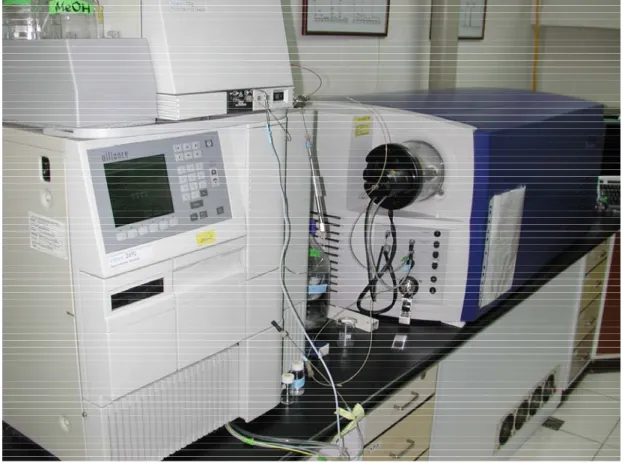
(22) 2g, 醋酸 25mL, 純水 100mL(A 液);碘化鉀(KI) 40g 溶於純 水 100mL(B 液),臨用前 A 液 B 液等量混合。 9. Vanillin / H2SO4 spray reagent:取 Vanillin 0.5g 加入濃硫酸及 乙醇 4:1 混合液 100 mL 中。. 二、儀器及裝置: 串聯式質譜儀:Micromass Quattro Ultima LC/MS/MS(Fig.2). Fig. 2: The appearence of Micromass Quattro Ultima LC/MS/MS 2.液相層析儀:Waters 2690 Alliance LC & 996 PDA with Automatic Liquid Sampler and Injector 3.數據處理軟體:MassLynx NT Quattro Data Acquisition 4.電腦質譜資料圖庫:行政院衛生署藥物食品檢驗局所建立之電腦質 譜資料圖庫(NLFD3/LM:Library Database created by Division 3 of BFDA on LC/MS/MS analysis)。 5.顯微鏡 7.
(23) 三、方 法 1. 標準藥材鑑定----考證與切片鏡檢:搜集來之藥材經切片鏡檢,並與文 獻記載(3,4,11,12)之性狀及組織特徵作比對,確定為真品,才進行液相層 析串聯式質譜指紋圖譜分析與建檔。 1-1:粉防己:本品為防己科(Menispermaceae)植物粉防己 Stephania tetrandra S. Moore 之根或根莖(Fig.3),又稱之為石蟾蜍《中藥大 辭典》、瓜防己《本草原始》、漢防己《儒門事親》等。粉防己之名 稱在歷代之本草鮮少記載,但在梁代陶弘景曰:”今出宜都、建平大 而青白虛軟者良”, 宜都、建平則為湖北西北部及四川之東南部, 又無”內黑文如車輻解”之記載,應非馬兜鈴科植物,此為粉防己最 早之記載。另在本草原始之漢防己下附有瓜防己圖,極像粉防己之斜 切飲片藥材。明代《品匯精要》謂防己以根大而有粉者良,應指粉防 己無誤。 【性狀】本品根剖切成呈不規則圓柱形、半圓柱形、塊状或塊片状,多少 彎曲,彎曲處有橫溝而呈結節狀瘤塊樣,彎區處有縊縮之橫溝,長約 5 ~15 ㎝,直徑約2 ~6 ㎝。未刮去栓皮者表面灰棕色,粗糙且多細 皺,具橫向突起皮孔。去栓皮者,表面灰白色,較平滑。可見殘留灰 褐色栓皮。質重而堅脆,易折,具粉質。橫斷面灰白色至灰黃色,有 排列較稀疏的放射狀紋理,具淺棕色維管束,呈放射狀紋理,紋如車 輪。氣微,味苦。主產於浙江、安徽、江西、湖北等地,集散於漢口, 故 又 名 為 漢 防 己 , 是 為 名 稱 混 淆 原 因 之 一 。粉 防 己 含 粉 防 己 鹼 (tetrandrine)、防己諾林鹼(fangchinoline)、小檗胺(berbamine)、輪環藤 酚鹼(cyclanoline) 、二甲基粉防己鹼(dimethyltetrandrine)、氧防己鹼 (oxofangchirine)、防己斯任鹼(stephanthrine)及小檗銨(berbamine)等, 均屬異喹啉生物鹼(isoquino- line alkaloids)。主治效能為利水消腫、 袪風止痛。用於水腫腳氣、小便不利、風濕痺痛、濕疹瘡毒、高血壓 8.
(24) 症(,4)。其化學結構可參閱(Tab.12)。 【組織】粉防己根之橫切面組織圖:(Fig.4) 1. 皮層極薄,木栓細胞10 ~20 餘層,呈切線性延伸。 2. 韌皮部外緣有單個或2 ~ 3 個成群石細胞或厚壁纖維散生。韌皮部 薄壁細胞中含有許多草酸鈣結晶,除單晶以外,尚有柱狀晶、砂 晶,澱粉粒。 3. 木質部放射狀排列,導管徑約5 0 ~ 7 0 µ m ,具有厚膜填充部。 導管周圍有纖維性假導管、木質部纖維、薄壁細胞,均木質化。 1-2.廣防己:本品為馬兜鈴科(Aristolochiaceae)植物廣防己(Aristolochia fangchi Wu.)之根(Fig.5)。 防己始載於《本經》:”一名解離,生 川谷”, 《別錄》云:” 文如車輻理解者良,生漢中,二月八月採 根陰乾”。 《范子計然》云:”防己出漢中甸陽”,吴普曰:” 木 防己一名解離,一名解燕……如葛藤,蔓延如芄,白根,外黃似桔梗, 內黑文如車輻解,二月、八月、十月採根”。由此可見,最早使用之 防己,又名木防己,一名解離,產於漢中,用根,具有內黑文如車輻 解之特徵,應非防己科之Cocculus屬之木防己。由此觀之,此防己應 屬馬兜鈴科植物漢中防己,又稱異葉馬兜鈴(Aristolochia heterophylla Hemsl.).,因未取得異葉馬兜鈴藥材之正品,且在台灣市場以廣防己 Aristolochia fangchi Wu.為多見,因此本研究報告乃以廣防己為研究 之主體。 【性狀】本品呈圓柱形或多少彎曲,彎曲處有橫溝,直徑約2 ~ 6 ㎝,一 般約3 ㎝。外觀灰褐色,並覆有栓皮,栓皮粗糙多縱皺紋(Fig.5)。 有時栓皮部份或全部刮除。除去粗皮者呈淡黃色,較光滑。橫斷面為 灰白色至淺棕黃色,無粉質。具細而較密的放射紋,從髓部射出一次 維管束數多,二次維管束在形成層附近成短條放射狀排列,為灰褐色 維管束與類白色髓線相間排列而成。順維管束方向,易成片剝下,質 9.
(25) 地堅硬,不易折斷。無臭,味微苦而澀。廣防己含馬兜鈴酸Ⅰ及 Ⅱ(aristolochic acid)(4) 、馬兜鈴酸內環酯(aristololactam)、木蘭花鹼 (magnoflorine)、β-sitosterol、allantoin,其化學結構可參閱(Tab.12)。 效能為袪風止痛、清熱利水,主治濕熱身痛、下肢水腫、小便不利、 腳氣腫痛。主產於廣東、廣西,又因極像粉防己,故名廣防己,此為 外觀上之混淆。 【組織】廣防己根之橫切面組織圖:(Fig.6) 1. 栓皮特別明顯發達,為數十層木栓細胞組成。 2. 栓內層為薄壁細胞,內含草酸鈣簇晶與澱粉粒,內側有石細胞群 大致成環狀排列,缺乏韌皮纖維。 3. 二次皮層及木質部射出之髓線含有多量的澱粉粒和少量的草酸鈣 結晶。 4. 維管束放射狀排列。 5. 韌皮部射線寬廣,篩管皺縮,有少數石細胞散生。 6. 木質部射線寬,導管較大,旁有木纖維束,壁較厚。 7. 中心為異形複合維管束,髓由薄壁細胞及少數厚壁細胞所組成。 1-3:木防己:本品為防己科(Menispermaceae)植物木防己 Cocculus trilobus D C .之根或根莖(Fig.7)。 【性狀】本品略呈疙瘩狀突起之不完整彎曲之圓柱形,直徑約 1.5~ 3 ㎝。 外表灰褐色,有深淺不等彎曲縱溝及橫皺,具支根之痕跡及部份皮層 剝落而露出黃白色木質部。質地堅硬,不易折斷,不具粉質。橫斷面 皮層很窄,約 1.2 ㎜,約佔半徑 1 / 7,呈淡灰黃色。木質部寬廣排 列整齊具放射狀紋理。斷面呈暗褐色,徑約 1.5~ 3 c m ,皮層狹窄 易脫落,木質部約 1 2 束,排列整齊,可見導管小孔,灰白色放射狀 導管與暗褐色髓線呈放射狀排列。木射線寬廣,中心有之髓線(菊花 心)。(Fig.8)味微苦。木防己含 木防己鹼( trilobine)、異木防己鹼 (isotrilobine)、木蘭花鹼(magnoflorine)、木防已胺(trilobamine)、去甲 10.
(26) 毛木防己鹼(normenisarine)、毛木防已鹼(menisarine)、表千金藤鹼(epistephanine)、木防己賓鹼(coclobine) 、mufangchinoline C14H21N14O11、 thunbergin C20H14O9 等成分,其化學結構可參閱(Tab.12)。效能為 袪風除濕、通經活絡、解毒消腫,主治風濕痺痛、小便淋痛、閉經、 跌打損傷、咽喉腫痛、瘡瘍腫毒、溼疹、毒蛇咬傷。主產於陜西、甘 肅、四川、貴州等地,台灣亦有產,唯一般以草藥使用。 【組織】木防己根之橫切面組織圖:(Fig.8) 1. 栓皮下皮層很薄,為薄壁細胞所組成,內含很多砂晶與小板狀晶。 2. 維管束鞘為薄膜性石細胞環繞韌皮部外側,韌皮部具癒合組織, 缺韌皮纖維。 3. 木質部導管及薄壁細胞均木化,導管徑約300 µ m ,假導管徑約 18µm。放射狀狹窄之導管群穿過,質較堅硬,不易折斷。 4. 髓全部厚膜化。. 1-4:漢防己:本品為防己科(Menispermaceae)植物漢防己 Sinomenium acutumn Rehd. et Wi l s .之根或根莖(Fig.9)。又名為青藤,據仇良 棟. (11). 在日本考證結果發現日本所用防己即為青藤,日本多數文獻以. 此稱為「漢防己」。 【性狀】本品為屈曲不整圓柱形,直徑約0 .5~2 ㎝,外表覆蓋栓皮層, 呈灰褐色,粗糙具細皺,具疣狀皮孔突起。質硬不易折斷,不具粉 質。橫斷面灰黃色至灰棕色,皮部窄,僅佔半徑1 / 6。維管束約可 見導管小孔。灰褐色維管束與黑褐色之髓線呈放射狀紋理。髓線較 維管束為窄,每一維管束外側各有一條淡色弧狀線(中柱鞘纖維) 相互連結成波狀環。中央為黃白色之圓心髓,UV366下照射下呈淡 藍色之螢光。味苦。青藤(漢防己)則含青藤鹼(sinomenine) 、青風 藤鹼(sinoacutine)、尖防己鹼(acutumine)、N-去甲尖防己鹼 11.
(27) (N-acutumidine)、白蘭花鹼(michelalbine)、光千金藤鹼(stepharine)、 雙青藤鹼(disinomenine)、異青藤鹼(isosinomenine)、木蘭花鹼 (magnoflorine)等成分, 【組織】漢防己根之橫切面組織圖:(Fig.10) 1.一次皮層,由類圓形薄壁細胞組成,散存少數木化的厚壁纖維及 石細胞。皮層薄壁細胞含有針晶。 2. 韌皮部外有維管束鞘(中柱鞘纖維),具厚壁細胞,其內側常有 2~3 列石細胞,排列於每一維管束之外側,而此部分常和髓線之 石細胞相連而成環。篩管外部有癒合韌皮組織,篩管下為韌皮部 薄壁細胞,有束間形成層。 3. 木質部有導管、薄壁細胞及纖維,導管徑約40~150 µ m ,呈階梯 狀排列,導管具填充物。 4. 髓線為薄壁細胞,多少破裂。有髓。中央部分細胞較周圍者為大。 外圍為厚壁細胞;中央為薄壁細胞,含有針晶。 ,其化學結構可參閱(Tab.12)。. 12.
(28) Fig. 3: The plant macromorphology of Stephania tetrandra S. Moore. 13.
(29) Fig.4 : The microscopic observation and histologic biopsy of Stephania tetrandra herb(x 40). 14.
(30) Fig.5: The plant macromorphology of Aristolochia fangchi Wu.. 15.
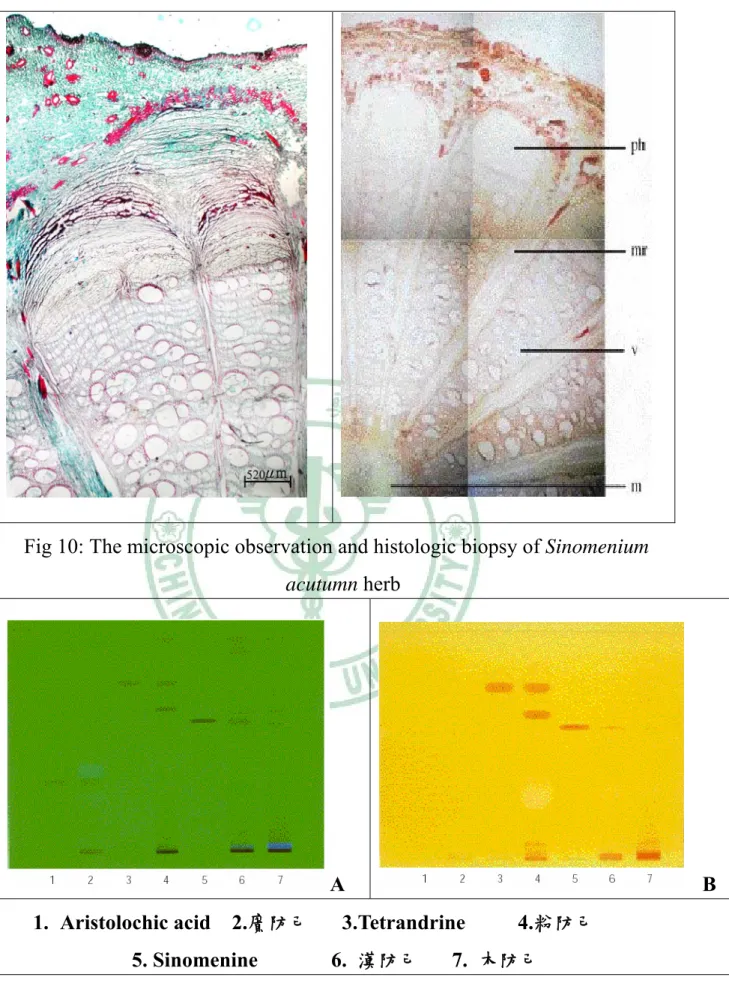
(31) Fig.6 : The microscopic observation and histologic biopsy of Aristolochia fangchi herb(x 40). 16.
(32) Fig.7 : The plant macromorphology of Cocculus trilobus D C .. 17.
(33) Fig.8 : The microscopic observation and histologic biopsy of Cocculus trilobus herb(x 40). 18.
(34) Fig.9 : The plant macromorphology of Sinomenium acutumn Rehd. et Wi l s .. 19.
(35) Fig 10: The microscopic observation and histologic biopsy of Sinomenium acutumn herb. A 1. Aristolochic acid. 2.廣防己. 5. Sinomenine. B. 3.Tetrandrine 6. 漢防己. 4.粉防己. 7. 木防己. Fig. 11: TLC pattern of 4 Fangchi herb vs reference standard. 20.
(36) 2.藥材之薄層層析並與藥材指標成分比對(10) 2-1. 對 照 標 準 品 溶 液 之 調 製 : 取 對 照 標 準 品 aristolochic acid 、 sinomenine、tetrandrine 各2 m g,分別加入甲醇,定容至10 ml ,供 作對照標準品溶液。 2-2. 檢液之調製:取廣防己、粉防己、漢防己、木防己檢體生藥粉末各2 . 5 g ,分別加入乙醇10 ml ,超音波振盪1 小時,過濾,濃縮後定容 至10 ml,供作檢液。 2-3. 薄層層析條件 † 層析板: Silica gel 60 F254 † 展開溶媒:乙酸乙酯:甲醇:氨水(8:1:1) † 點注量:各10 µl † 展開距離:10 cm † 檢出方法:置於U.V. 254 nm下檢視(Fig.11A)。 † 噴Dragendoff's spray reagent後檢視。(Fig.11B)。 † 噴 Vanillin/sulfuric acid spray reagent ,置於 U.V. 366nm 下檢視 3.標準藥材之液相層析串聯式指紋質譜圖庫(LC/MS/MS database)之建檔 3-1. 檢品溶液配製:各取上述經鑑定之標準藥材粉末 1.0 g,分別以兩次 10 mL 之 70% MeOH 萃取,以濾紙過濾,收集濾液,置於減壓濃縮 裝置中濃縮到接近乾,以 70% MeOH 溶解殘渣,並定容成 10 mL 供 作檢品溶液。 3-2. 正離子電灑法第一段全質譜掃描(ESI+/MS 1 scan)(20~21):取上述 3-1 之檢品溶液,依下列表一之儀器參數設定液相層析串聯式質譜儀,待 溶 媒 系 平 衡 後 , 開 始 進 行正離子電灑 法 第 一 段 全 質 譜 掃 描 分 析 (Fig.12)。質譜儀之毛細管電壓設定為 3.0 kV,錐口電壓設定為線 性上升(ramp),離子源溫度(source temperature)為 120℃、溶媒揮 散溫度(desolvation temperature)為 350℃;液相層析儀之分離管柱 21.
(37) (column)為 Cosmosil 5-C18, 4.6 x150mm, 5um,mobil phase 為 methanol : acetonitrile: 0.1% ammonium acetate + 0.1% formic acid mixed aqueous solution (17:17: 66),流速為 0.5mL/ min,photodiode array 掃描範圍為 200 〜350nm,待溶媒系穩定平衡後,注入 10 μL 之上述 2-2 之檢品 溶液,並以 1:1 之比例分流(spit)。各藥材分別獲得第一段全質譜掃描 圖(MS 1 scan total ion current,MS 1/TIC)(Fig.12A),並經解析 每 個 明 顯 波 峰 , 獲 得 數 張 第 一 段 全 掃 描 質 譜 圖 (MS 1 spectrum) (Fig.12B)。. AA-pFG-MS1-950223-Dill Sm (SG, 3x22). 1: Scan ES+ TIC 5.60e9. 7.85. 100. Stephania tetrandra-9502 AA-pFG-MS1-950223-Dill 933 (7.874) Cn (Top,4, Ht); Sm (M 623.7 6.60e7 100. 5.93. 381.6. %. %. 624.7. 312.7. 580.6 382.6. 5.40. 253.5. 3.11. 0 1.00. 2.00. 3.00. 4.00. 5.00. 6.00. 7.00. 8.00. 9.00. 10.00. 11.00. 12.00. 13.00. 14.00. 15.00. 16.00. 17.00. Time 18.00. 310.5. 0. A. 625.5. 577.6. 474.8 535.3. m/z 200. 300. 400. 500. 600. 700. Fig.12 : The mechanism of MS 1 scan and obtained MS1 spectrum. 22. B.
(38) Tab.1:The parameters of LC/MS1 scanning Function 1: Mass analysis Instrument:. QUATTROULTIMA LC/MS/MS. Ionization mode:. ESI+ MS1 Scan. Capillary Voltage:. 3.0 kV. Cone Voltage (V):. Ramp. Collision Energy:. 5 eV. Cone temperature:. 120 ℃. Desolvation temperature:. 350 ℃. Function 2: HPLC analysis Waters Alliance 2695 HPLC Pump Column: Cosmosil 5-C18, 4.6 x150mm, 5um Mobil phase: MeOH:AcCN:Buffer solution=(17:17:66) * Buffer solution= 0.1%NH4AC+ 0.1%HCOOH aqueous solution Flow. rate:. Injection volume:. 0.5 ml/min 10 uL. Acquire Time. 0 ~20(mins). Function type:. Diode Array. Wave length range ( nm ) :. 200 to 350. 3-3. 子代離子掃描(ESI+Daughter ion scan)(22):取上述 3-2 第一段全質譜 掃描,獲得各較大波峰之質譜圖中之主要裂片,或疑似藥材指標成分 之有意義之裂片[M+1]+予以進行子代離子掃描。開始先以一般子代離 子質譜分析條件分析,即以毛細管電壓:碰撞能量:進樣圓錐口電壓 (cone voltage/ collision energy/ capillary voltage)為 60/20/3 進行分析, 檢視其獲得之子代離子質譜圖(daughter ion spectrum) (Fig.13B), 23.
(39) 親代離子(parent ion 或稱源頭離子 precursor ion)與最大離子裂片斷 (basal peak)之比值須大於 1/10〜1,若未能獲得該比值,則調整碰撞 能量,重行分析,祈使質譜圖獲得穩定明顯之鑑定離子裂片群組,並 予以載入質譜圖庫(LC/MS/MS database)中,俾便於日後之搜尋比對 之用(Fig.17,22,25,29)。. Stephania tetrandra-9502 AA-pFG-MS2-950217 82 (8.795) Cn (Top,4, Ht); Sm(Mn, 2x0.75); Sb (1,40.00 ); Cm(80:91-62:75) AA-pFG-MS2-950217 Sm (SG, 3x1). 381.2. 100. 4: Daughters of 624ES+ TIC 1.43e8. 8.90. 100. 9.36e5. 174.1. % %. 623.3. 191.1 580.2. 592.3 162.1. 227.2 267.3 310.1. 137.0 0. Time 1.00. 2.00. 3.00. 4.00. 5.00. 6.00. 7.00. 8.00. 9.00. 10.00. 11.00. 12.00. 13.00. 14.00. 0 100. A. 363.2 398.2 425.6. 545.9 560.3 593.2. m/z 150. 200. 250. 300. 350. 400. 450. 500. 550. 600. 650. B. Fig.13: The mechanism of daughter ion scan and obtained daughter ion spectrum 3-4. 編 輯 各 別 藥 材 鑑 定 試 驗 巨 集 指 令 (fangchi herb identity macro-method):綜合上述分析結果,經過歸納後,每個藥材選定 5~7 個親代離子,每個親代離子之子代離子質譜分析稱之為一個管道 (Channel)(22),將這些多重管道(5~7 channels)之儀器分析參數集合製作 成儀器分析指令,存入電腦中以執行分析,將可獲得數張子代離子質 24.
(40) 譜圖(daughter ion spectrum) (Fig.13B),並與標準質譜圖庫作比對。 因中藥成分複雜,為摒除其他成分之干擾,提高分析之感度,另編輯 各藥材選定藥材之親代離子裂片及子代離子裂片所配對成限制性分 析之巨集指令,以進行多重離子裂解監控分析 (22) (MRM, Multiple Reaction Monitoring),稱之為各別藥材 MRM 鑑定試驗之巨集指令 (MRM screen macro-method) (Fig.14)。例如粉防己中 tetrandrine 以 m/z 623.5 為親代離子裂解獲得 m/z 381.4 之子代離子裂片符合該條件 者才予以記錄,簡記為 m/z 623.5>381.4,是為 MRM/TIC 圖。唯該圖 無法與標準質譜圖庫作比對,主要檢視各管道波峰滯留時間與標準藥 材是否相符,以及相符管道數之百分比,做為 MRM 比對相似性(MRM Matching quality) 評估量化之表示法。. A A -p F G 1 -E S + M R M S m (S G , 3 x 1 0 ). 1 : M R M o f 7 C h a n n e ls E S + 6 2 3 .5 > 3 8 1 .4 1 .9 4 e 6. 7 .8 9. 100. %. 6 .8 4. 0 1 .0 0. 2 .0 0. 3 .0 0. 4 .0 0. 5 .0 0. 6 .0 0. T im e. 7 .0 0. 8 .0 0. 9 .0 0. 1 0 .0 0. 1 1 .0 0. 1 2 .0 0. 1 3 .0 0. Fig.14: The mechanism of MRM scan and obtained MRM/TIC chromatography. 25. 1 4 .0 0.
(41) 3-5.編輯易混淆防己藥材之 MRM 預篩檢試驗(MRM pre-screen macromethod):為同時快速掃描易混淆防己各藥材,選定各藥材之指標 成分或 1~2 個親代離子作為篩檢之標的,集合成 7 管道進行多重 離子裂解監控,例如粉防己選定 tetrandrine 及 fangchinoline (m/z 623.5 及 m/z 609.5),廣防己選定 m/z 625.3,木防己選定 m/z 652.4 及 m/z 577.4,漢防己選定 sinomenine (m/z 330.4)及 m/z 522.4 之離 子裂片。彙集上述各管道之儀器分析參數集合製作成 MRM 預篩 檢試驗巨集指令(Tab.8 ),存入電腦中,當欲進行中藥製劑中是否 含防己藥材或淆防品時,先以 MRM pre-screen macro- method 分 析方式篩檢,檢視 MRM 之 TIC 圖,若出現明顯之波峰,疑似檢 出何種防己,再另以上述 3-4 之特定藥材之 fangchi herb identity macro-method 及 MRM screen macro-method 重行分析(Tab.3〜 6 ),比對子代離子質譜圖或呈現藥材相似性百分比。 4. 指紋質譜圖庫適用性探討 4-1.含防己藥材之模擬處方配製:選自古籍《金匱要略》所載--防己黃 耆湯,其組成比例為防己 1.0 黃耆 1.0 白朮 0.75 甘草 0.5 生 姜 0.5 大棗 0.5 ,主治風濕,關節炎,多汗症,肥胖症,腎炎, 陰囊水腫,下肢浮腫,月經不順等功效,也用於減肥之用途。配製 上述處方時,分別以粉防己(Stephania tetrandra S. Moore) ,漢防己 (Sinomenium acutumn Rehd. et. Wi l s .),木防己(Cocculus trilobus D. C .),廣防己(Aristolochia fangchi Wu)取代方中之防己,加入其餘五 味藥材,研成粉末以備用。 4-2.模擬處方溶液配製:稱取 4.25 g(相當於防己 1 g)之上述粉末,如同 上述 3-1 所載方法萃取、過濾定容成 10 mL 供作檢品溶液。 4-3.另配製防己藥材空白試驗檢體:依防己黃耆湯之處方配製,唯不加 防己藥材,並如同 3-1 所載方法萃取、過濾定容成 10 mL 供作空白 26.
(42) 檢品溶液。用以瞭解其餘五味藥材或儀器系統是否造成干擾。 4-4. 搜集市售防己藥材或含防己之中藥製劑予以分析,統計藥材之誤 用率。 4-4-1.藥材檢品溶液配製:取藥材粉末 1.0 g ,如同 3-1 之配製法以 10 mL 之 70%甲醇萃取,過濾,收集濾液,再以 70%甲醇定容成 10mL,即為檢品溶液。 4-4-2.中藥製劑檢品溶液配製:取相當於防己標示量 1g 之中藥製劑粉 末或剪碎之小片,先以少許之純水濕潤,再如同 3-1 之配製法以 兩次 10 mL 之 70%甲醇萃取兩次,過濾,收集濾液,減壓濃縮 成約 3 mL,再以 5 mL 甲醇溶解,濾除沉澱物,再以 70%甲醇定 容成 10mL 即為檢品溶液。 4-4-3. 依上述 3-5 所載篩檢儀器分析巨集指令,先以 MRM 預篩檢試驗 (MRM pre-screen macro-method)分析方式篩檢,檢視 MRM 之 TIC 圖,若出現明顯之波峰,疑似檢出何種防己,再另以上述 3-4 之 特定藥材之 Fangchi herb identity macro-method 及 MRM. screen. macro-method 重行分析,比對子代離子質譜圖或呈現藥材相似性 百分比。. 27.
(43) Tab. 2 : The compositions of TCM preparation in market and its fangchi species labeled 檢體編號 FG-1a FG-2. 檢體名稱 防己 粉末(濃縮散). b. 防己 濃縮散. 處方藥材標示 粉防己. 檢體全處方 粉防己. 防己. 防己. FG-3c. 漢防己 濃縮粉. 漢防己. 漢防己. FGHT-1 a. 防己黃耆湯濃縮顆粒. 粉防己. 粉防己 黃耆 白朮 甘草 生薑 大棗. FGHT-2 a. 防己黃耆湯濃縮顆粒. 粉防己. 粉防己 黃耆 白朮 甘草 生薑 大棗. 防己黃耆湯濃縮散. 粉防己. 粉防己 黃耆 白朮 甘草 生薑 大棗. FGHT-4d. 防己黃耆湯濃縮顆粒. 漢防己. 漢防己 黃耆 白朮 甘草 生薑 大棗. e. 防己黃耆湯濃縮顆散. 漢防己. 漢防己 黃耆 白朮 甘草 生薑 大棗. FGHT-6c. b. FGHT-3 FGHT-5. 防己黃耆湯濃縮顆粒. 防己. 防己 黃耆 白朮 甘草 生薑 大棗. f. 防己黃耆湯濃縮散. 防己. 防己 黃耆 白朮 甘草 生薑 大棗. FGST-1 c. 小續命湯濃縮顆粒. 防己. 防己 麻黃 甘草 人參 生薑 川芎 杏仁 白芍. FGHT-7. 防風 大棗 炮附子 黃芩 桂枝 FGST-2 e. 小續命湯濃縮顆粒. 漢防己. 漢防己 麻黃 甘草 人參 生薑 川芎 杏仁 白 芍 防風 大棗 炮附子 黃芩 桂枝. FGST-3 a. 小續命湯濃縮顆粒. 防己. 粉防己 麻黃 甘草 人參 生薑 川芎 杏仁 白 芍 防風 大棗 炮附子 黃芩 桂枝. FGU-1 a. 通用痛風丸濃縮顆粒. 粉防己. 粉防己 天南星 蒼朮 黃柏 川芎 白芷 神麴 桃仁 羌活威靈仙 桂枝 紅花 龍膽. FGU-2 b. 通用痛風丸濃縮散. 防己. 防己天南星 蒼朮 黃柏 川芎 白芷 神麴 桃 仁. FGU-3g. 通用痛風丸. 防己. 羌活 威靈仙 桂枝 紅花 龍膽. 防己 天南星 蒼朮 黃柏 川芎 白芷 神麴 桃 仁 羌活 威靈仙 桂枝 紅花 龍膽. FGMT-1b. 木防己湯濃縮散. 木防己. 木防己 石膏 桂枝 人參. 木防己湯濃縮顆粒. 木防己. 粉防己 石膏 桂枝 人參. Herb-1. 標示木防己藥材. 木防己. 木防己. Herb-2. 疑似廣防己藥材. 防己. FGMT-2. a. 防己. 28.
(44) 5. 再現性評估(Reproducibility): 取 模 擬 處 方 溶 液 以 同 日 內 (interday) 進 行 五 次 之 Fangchi herbal identity macro-method 分析﹔另進行異日間(intraday)連續 五天每日各進行一次之 Fangchi herbal identity macro-method 分 析,將所獲得子代離子質譜圖與所建立之指紋質譜圖庫 (LC/MS/MS Fingerprint Database)作比對,matching quality 需 80% 以上(Tab. 9 )。 6. 最低檢出量(LOD): 取上述 3-1.之標準藥材溶液以 70%甲醇,予以稀釋 2、5、10、 20、50 倍後(相當於含防己藥材 0.5、0.2、0.1、0.05、0.02g),再 依 3-5 之各藥材之 Fangchi herbal identity macro-method 及 MRM screen macro- method,檢視各稀釋濃度所呈現波鋒對雜訊比(S/N) 需大於 3 以上,至於子代離子掃描之質譜圖與電腦質譜圖庫之比 對相似性需 80﹪以上。 7. 案例分析---指紋質譜圖之應用(Application of LC/MS/MS Fingerprint): 搜集市售疑似廣防己藥材及疑似木防己藥材各一件,以及標示 含防己之單方或複方中藥製劑 18 件,予以進行各項分析,檢視其 daughter ion spectrum,並與 LC/MS/MS Fingerprint Database 比對, 探討市售中藥製劑防己藥材之使用情形。 7-1.藥材檢品溶液配製:取藥材粉末 1.0 g,以 70%甲醇 10 mL 萃取, 過濾,收集濾液,再定容成 10 mL,即為檢品溶液。 7-2.中藥製劑檢品溶液配製:取中藥製劑相當於防己 1 g 之粉末,以少 許之純水濕潤,再以兩次 10 mL 之 70%甲醇萃取兩次,過濾,收 集濾液,減壓濃縮成約 3 mL,加 5 mL 甲醇溶解,濾除沉澱物,再 以 70%甲醇定容成 10 mL 即為檢品溶液。 29.
(45) 7-3.依下列 Tab.8 所載防己藥材 MRM 預篩檢試驗(MRM pre-screen macro-method),進行多重離子裂解監控(MRM)掃描分析,檢視 MRM 之 TIC 圖,是否出現表中何種防己之波峰,則另以各別防己 藥材鑑定試驗之巨集指令(Fangchi herbal identity macro-method)重 行分析(Tab.3〜6),並與電腦質譜圖庫比對,將可獲知檢出結果。 若有疑似檢出廣防己,則以 Journal of Food and Drug Analysis 中所 載 Analyzing Aristolochic acids in Chinese Herbal Preparations Using (25). LC/MS/MS, 2005, (13)之分析條件. (Tab.7)予以分析,並比對子代. 離子質譜圖、離子峰滯留時間及 UV 圖譜(Fig.32)。 7-4. 分析統計檢出結果(Tab.11),以及探討目前國內防己使用情形。 7-5. 異常案件之調查研究。. 30.
(46) 四、結果與討論 1. 粉防己之液相層析串聯式質譜分析指紋圖譜建立 1-1. 粉防己藥材經切片染色後顯微鏡下觀察(Fig.4 ),與文獻資料. (2~5). 比. 對,以及與粉防己之指標成分 tetrandrine 作 TLC 比對結果(Fig.11)相 符,確立其基原為 Stephania tetrandra,以此作為標準藥材(Fig.3 ), 進行液相層析串聯式指紋質譜圖之建檔,以及模擬處方配製。 1-2. 進行液相層析串聯式指紋質譜圖之建檔過程中之 HPLC 分析條件: 分離管柱為 Cosmosil 5C18-AR, 4.6 x 150 mm。移動相溶媒系為 methanol:acetonitrile:各含 0.1﹪w/v 之 formic acid 及 ammonium acetate 混合水溶液(17:17:66),流速:0.5 mL/min(1:1 分流) ,該分 析條件乃參考文獻. (24). 中「對利用高效液相層析質譜儀檢測粉防己之三. 各主要活性成分(tetrandrine, fangchinoline, cyclanoline) 」一文中所評 估之移動相溶媒系以 acetonitrile 及 0.1﹪w/v 之 formic acid 為最佳組 合,以及參考文獻中對 aristolochic acid 定性定量. (26~28). 時應用之移動相. 溶媒系,以及常用於分析中藥或食品摻加 sildenafil 西藥成分之移動 相溶媒系. (29). ,並予以部份修改,以適合四種防己於 20 分鐘以內溜出. 鑑別性之成分之移動相溶媒系,作為後續各藥材之分析,祈使比對過 程之一致性。又因中草藥成分複雜,不明成分尚佔多數,無法一一調 整適合各成分之毛細管電壓(capillary voltage )及錐口電壓(cone voltage)等質譜儀器參數作分析,權以常設(儀器 default 值)之毛細管 電壓為 3 kV 及線性錐口電壓變化(cone voltage ramp)作為質譜分析條 件。 1-3. 標準藥材離子裂片之選擇(Principle of fragment selection):以粉防己 為例,標準藥材萃取溶液經正離子電灑法第一段全掃描質譜分析 (ESI+MS1)結果,經扣除基線之干擾裂片,其中正離子全掃描質譜圖 所獲得之 TIC 圖有數支明顯之離子峰(Fig.15),每支離子峰之全質譜 31.
(47) A A -p F G -M S 1 -9 5 0 2 2 3 -C o n c S m (S G , 3 x 1 0 ). 1: Scan E S+ T IC 1 .2 3 e 1 0. 7 .2 8. 100. 5 .8 5. %. 2 .7 7. 4 .4 5. 5 .1 4. 9 .2 8 1 2 .5 5. 0 1 .0 0. 2 .0 0. 3 .0 0. 4 .0 0. 5 .0 0. 6 .0 0. 7 .0 0. 8 .0 0. 9 .0 0. 1 0 .0 0. 1 1 .0 0. 1 2 .0 0. 1 3 .0 0. 1 4 .0 0. 1 5 .0 0. 1 6 .0 0. 1 7 .0 0. T im e 1 8 .0 0. Stephania tetrandra-9502 AA-pFG-MS1-950223-Conc 858 (7.242) Cn (Top,4, Ht); Sm (Mn, 2x0.75); Sb (1,40.00 ); Cm (844:1030-607:809). 1: Scan ES+ 9.45e7. 623.7. 100. 624.7. %. 381.7 312.7 333.3. 349.6. 580.7 592.7. 382.6 534.6. 625.7. 549.6. 639.7. 0. m/z 200. 250. 300. 350. 400. 450. 500. 550. 600. 650. 700. Stephania tetrandra-9502 AA-pFG-MS1-950223-Conc 700 (5.910) Cn (Top,4, Ht); Sm (Mn, 2x0.75); Sb (1,40.00 ); Cm (671:773-178:292). 1: Scan ES+ 7.61e7. 609.7. 100. 610.7. %. 367.6 305.7 239.5. 0 200. 368.6. 342.6. 520.6. 280.6. 250. 546.6 566.7. 578.7 611.7 593.7. m/z. 300. 350. 400. 450. 500. 550. 600. 650. 700. Stephania tetrandra-9502 AA-pFG-MS1-950223-Conc 326 (2.757) Cn (Top,4, Ht); Sm (Mn, 2x0.75); Sb (1,40.00 ); Cm (322:663-75:263). 1: Scan ES+ 1.27e7. 342.7. 100. % 314.6. 298.6. 0 200. 250. 343.6 462.7 476.7 367.6 381.7 432.6. 328.6. 562.7. 520.6. 607.7 625.7. m/z. 300. 350. 400. 450. 500. 550. 600. 650. 700. Stephania tetrandra-9502 AA-pFG-MS1-950223-Conc 682 (5.758) Cn (Top,4, Ht); Sm (Mn, 2x0.75); Sb (1,40.00 ); Cm (616:682-(693:781+518:599)) 342.7. 100. 6.86e7. % 343.6 314.6. 344.6. 0. m/z 200. 250. 300. 350. 400. 450. 500. 550. 600. 650. 700. Stephania tetrandra-9502 AA-pFG-MS1-950223-Conc 858 (7.242) Cn (Top,4, Ht); Sm (Mn, 2x0.75); Sb (1,40.00 ); Cm (681:905-(510:653+971:1090)) 609.7 623.7. 100. 3.27e7. 624.7. %. 367.6. 239.5. 381.7. 312.7 305.7 333.3351.6 253.5 294.6. 275. 300. 325. 350. 503.7. 400.7. 0 250. 546.6. 382.6. 375. 400. 425. 450. 475. 500. 566.7 578.7. 625.7 626.7. 518.7. 525. m/z 550. 575. 600. 625. 650. Fig.15:The TIC of ESI+/MS 1 scan and ESI+/MS 1 spectrums of Stephania tetrandra herb extract 32.
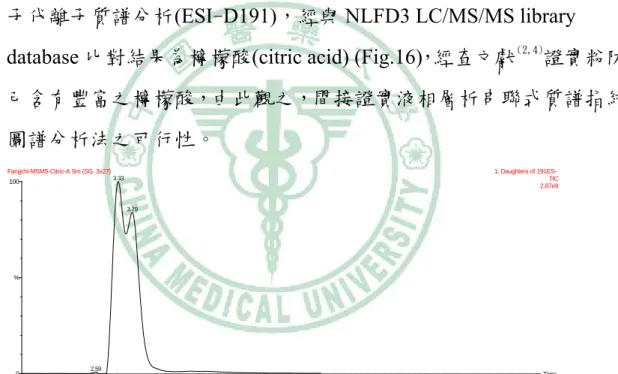
(48) 圖中選取 m/z 305.4, 312.8, 314.4, 333.1, 342.4, 609.4, 623.5 等離子強 度(abundance)較大者作為親代離子(parent ion),予以進行正離子電灑 法子代離子質譜分析(ESI+ Daughter ion scan)。 -. 1-4. 粉防己之負離子電灑法第一段全掃描質譜分析(ES /MS1) 所獲得 +. TIC 圖之離子強度,較 ESI /MS1 所獲得 TIC 圖離子強度為低,且未 見 tetrandrine 指標成分之負離子電灑法分析中理論上應能看到之 m/z . 621(M-H) ,因此於用於製作指紋圖譜,則較缺鑑別性。因此建立粉 . 防己之指紋圖譜,乃以正離子質譜圖為主。但於 ES /MS1 之質譜圖 中有明顯之 m/z 191 負離子裂片,以 m/z 191 為源頭離子進行負離子 子代離子質譜分析(ESID191),經與 NLFD3 LC/MS/MS library database 比對結果為檸檬酸(citric acid) (Fig.16),經查文獻. (2,4). 證實粉防. 己含有豐富之檸檬酸,由此觀之,間接證實液相層析串聯式質譜指紋 圖譜分析法之可行性。 Fangchi-MSMS-Citric-A Sm (SG, 3x27). 1: Daughters of 191ESTIC 2.87e9. 3.33. 100. 3.79. %. 2.59. 0 1.00. 2.00. Time 3.00. 4.00. Fig- 16: The ESI result. -. 5.00. 6.00. 7.00. 8.00. 9.00. 10.00. 11.00. 12.00. 13.00. 14.00. 15.00. 16.00. 17.00. m/z 191 daughter ion scan and the library search 33.
(49) A A -p F G -M S 2 -9 5 0 2 1 7 S m (S G , 3 x 1 ). 7 : D a u g h te rs o f 3 1 3 E S + T IC 1 .0 3 e 8. 8 .96. 100 % 0 A A -p F G -M S 2 -9 5 0 2 1 7 S m (S G , 3 x 1 ). 6 : D a u g h te rs o f 3 4 2 E S + T IC 3 .3 5 e 8. 5.7 1. 100 % 4 .4 1. 0 A A -p F G -M S 2 -9 5 0 2 1 7 S m (S G , 3 x 1 ). 5 : D a u g h te rs o f 6 0 9 E S + T IC 7 .7 1 e 7. 6.66. 100 % 0 A A -p F G -M S 2 -9 5 0 2 1 7 S m (S G , 3 x 1 ). 4 : D a u g h te rs o f 6 2 4 E S + T IC 1 .4 3 e 8. 8.90. 100 % 0 A A -p F G -M S 2 -9 5 0 2 1 7 S m (S G , 3 x 1 ). 3 : D a u g h te rs o f 3 0 5 E S + T IC 1 .6 6 e 8. 6.62. 100 % 0 A A -p F G -M S 2 -9 5 0 2 1 7 S m (S G , 3 x 1 ). 2 : D a u g h te rs o f 3 3 3 E S + T IC 7 .0 2 e 7. 8.87. 100 % 0 A A -p F G -M S 2 -9 5 0 2 1 7 S m (S G , 3 x 1 ). 1 : D a u g h te rs o f 3 1 4 E S + T IC 4 .8 8 e 7. 5.52. 100 % 0 1 .0 0. 2 .0 0. 3 .0 0. 4 .0 0. 5 .0 0. 6 .0 0. 7 .0 0. 8 .0 0. 9 .0 0. 1 0 .0 0. 1 1 .0 0. 1 2 .0 0. 1 3 .0 0. 1 4 .0 0. Stephania tetrandra-9502 AA-pFG-MS2-950217 82 (8.795) Cn (Top,4, Ht); Sm (Mn, 2x0.75); Sb (1,40.00 ); Cm (80:93-61:73). 4: Daughters of 624ES+ 8.30e5. 381.2. 100. 174.1. %. 623.3. 191.1 580.2 146.1 162.1 131.3. 0. 100. 125. 150. 218.8. 175. 200. 227.2. 225. 267.3. 250. 275. 310.1. 300. 350.2 363.2. 325. 350. 375. 545.9. 398.2 425.6 441.9. 400. 425. 450. 530.4. 475. 500. 525. 592.3 593.2. 560.3. 550. 575. 600. 625. 650. m/z 675. Stephania tetrandra-9502 AA-pFG-MS2-950217 62 (6.657) Cn (Top,4, Ht); Sm (Mn, 2x0.75); Sb (1,40.00 ); Cm (58:73-36:49). 5: Daughters of 609ES+ 4.74e5. 367.2. 100. 192.1. %. 609.4 174.0 146.1 161.9. 213.0223.0 237.1. 279.1. 200. 275. 143.0. 309.1 350.9 356.3 384.0 401.4. 546.2. 578.3. 444.2. 0 100. 125. 150. 175. 225. 250. 300. 325. 350. 375. 400. 34. 425. 450. 475. 500. 525. 550. 575. 600. 625. 650. m/z 675. T im e 1 5 .0 0.
(50) Stephania tetrandra-9502 AA-pFG-MS2-950217 53 (5.705) Cn (Top,4, Ht); Sm (Mn, 2x0.75); Sb (1,40.00 ); Cm (51:59-29:44). 6: Daughters of 342ES+ 1.45e7. 192.0. 100. %. 342.2. 177.0190.0. 0 110 120. 130. 140. 150 160. 170. 180. 190. 200. 210 220. 230. 240. 250 260. 270. 280. 290. 300. 310 320. 330. 340. m/z 350 360. Stephania tetrandra-9502 AA-pFG-MS2-950217 52 (5.516) Cn (Top,4, Ht); Sm (Mn, 2x0.75); Sb (1,40.00 ); Cm (48:55-34:41). 1: Daughters of 314ES+ 5.16e5. 107.0. 100. 143.1. %. 314.1. 120.9 145.0 269.2 174.9. 119.1 137.0 130.8. 209.0 176.1 211.0 192.0 194.9. 147.0 163.2. 237.2. 251.1 253.7. 271.1. 0. m/z 100. 120. 140. 160. 180. 200. 220. 240. 260. 280. 300. 320. 340. 360. Stephania tetrandra-9502 AA-pFG-MS2-950217 83 (8.867) Cn (Top,4, Ht); Sm (Mn, 2x0.75); Sb (1,40.00 ); Cm (80:93-67:77). 2: Daughters of 333ES+ 3.38e6. 312.7. 100. %. 0 110 120. 130 140. 150. 160. 170 180. 190 200. 210 220. 230. 240. 250 260. 270 280. 290 300. 310. 320. 330 340. m/z 350 360. Stephania tetrandra-9502 AA-pFG-MS2-950217 62 (6.621) Cn (Top,4, Ht); Sm (Mn, 2x0.75); Sb (1,40.00 ); Cm (58:71-41:53). 3: Daughters of 305ES+ 9.71e5. 191.0. 100. 122.0 305.2. % 173.9 137.0 121.0. 123.0. 0 110 120. 147.0. 130. 140. 158.1 161.0. 150 160. 170. 177.9. 192.0 193.0. 180. 190. 200. 280.1 203.9 213.0 227.1 237.2. 210 220. 230. 240. 250.0. 265.0 274.3. 250 260. 270. 280. 289.6 290.4. 290. 314.0. 300. 310 320. 330. 340. m/z 350 360. Stephania tetrandra-9502 AA-pFG-MS2-950217 82 (8.850) Cn (Top,4, Ht); Sm (Mn, 2x0.75); Sb (1,40.00 ); Cm (79:97-56:72) 100. 122.0. 7: Daughters of 313ES+ 2.60e5. 198.5. 188.0. % 123.0. 175.0. 137.0 149.1. 133.0. 0 110 120. 227.1. 176.1. 121.0. 130. 140. 204.0. 158.9 173.0. 150 160. 170. 180. 312.6. 189.0. 190. 200. 236.1. 213.0. 210 220. 251.0. 230. 240. 254.0 266.1268.2. 250 260. 294.0 297.1 289.6 281.7 311.4 318.0. 270. 280. 290. 300. 310 320. 336.2. 330. 341.2. 340. m/z 350 360. Fig.17 :The daughter ion spectrums of selected fragments in Stephania tetrandra herb 35.
(51) +. 1-5. 子代離子質譜圖製作: 製作過程,援用 ES /MS1 所設定之毛細管電 壓為 3 kV,錐口電壓設定為固定 60V,進行分析各別選定源頭離子 之子代離子質譜掃瞄,適時調整 collision energy,使獲得典型之子代 離子質譜圖(Fig.17 ),並將子代離子質譜圖連同儀器分析之參數建入 質譜圖庫中。 1-6.檢視其獲得之子代離子質譜圖,源頭離子與獲得之最大離子裂片斷 (based peak)之比值一般均能介於 1~ 1/10 之間,唯獨所選定之 m/z 333 則甚易裂解成 m/z 312.7(圖譜記載為 m/z 313)之單一裂片,且其離子 峰滯留時間(RT)與 m/z 312.7 之子代離子質譜離子峰相同,約 8.9 分 鐘(Fig.18),因此兩者應屬類緣成分,m/z 333 為 m/z 313 之不安定之 前趨物。另就 ES+D623.5, ES+D312.8, ES+D333.1 三者之 RT 相同, 應同源於 m/z 623.5 離子裂片,且 ES+D312.8 應為帶兩個電核(z=2) 之離子裂片,此推論正與文獻(24)所言為[M+2H]+2 裂片之結論不謀而 合,ES+D 333.1 則為 m/z 623.5 之降解離子裂片﹔同理 ES+D609.4 與 ES+D305.4 為同源離子裂片,後者應為 fangchi- noline 之[M+2H]+2 之 裂片(z=2)。 另就 m/z 314 與 m/z 342 而言,兩者離子峰滯留時間(RT)相同, 約 5.6 分鐘,但兩者裂解之代離子質譜圖並無相關性,因此難推定兩 者具有類緣關係。由文獻記載粉防己(4,13,)含 cyclanoline (C20H24NO4, M.W. 342),因屬於四級銨,本身即帶一個電核,因此 m/z 342 即可 能是 cyclanoline [M]+之分子離子裂片。 粉防己之指標成分為 tetrandrine(C38H42N2O6, MW. 622) 及 fangchinoline (C37H40N2O6, MW. 608) ,在 ESI+/MS 1 中有明顯之 m/z 623 及 m/z 609 [M+H]+離子裂片,經與 tetrandrine 對照標準品(Fig.19)比對 結果相符。m/z 623 與 m/z 609 之 daughter ion spectrum 主要子代離 子裂片均相差 14 個 amu,正好符合 fangchinoline 結構(Tab.12)中之一 36.
(52) phenolic-OH group 經 methylation 而得 tetrandrine 之證據。經查本分 析過程所獲得 fangchinoline 之子代離子質譜圖,與文獻(24) 用 fangchinoline 標準品所建立之子代離子質譜圖則相似。因此雖未取得 fangchinoline 對照標準品仍可確認 m/z 609 即為 fangchinoline,更間 接證實取得藥材之正確性,以及用 LC/MS/MS 分析法鑑定粉防己藥 材獲得初步之可行性。 1-7.編輯粉防己鑑定試驗巨集指令(Herb identity macro-method):綜合上述 分析結果,每個選定源頭離子之子代離子質譜掃瞄稱之為一個管道 (channel),簡記為 ES+Dxxx,粉防己設定 7 個管道,將此 7 個管道之 儀器分析參數集合製作成儀器分析指令,存入電腦中以執行分析 (Tab.3),一次同時掃瞄 7 個管道,檢液中若存在有選定之 m/z 源頭離 子,且適合儀器分析參數者,將有離子峰出現,經扣除基線處理,將 獲得該選定源頭離子之子代離子質譜圖(daughter ion spectrum),並與 標準質譜圖庫作比對,並顯示比對相似度(matching quality) ,以仟 分比表示(‰)(Fig.17)。 1-8.編輯粉防己 MRM 掃瞄巨集指令:因中藥成分複雜,為摒除其他成分 之干擾,提高分析之感度,另編輯粉防己藥材之親代離子裂片與子代 離子裂片之配對分析之巨集指令,以進行多重離子裂解監控分析 (MRM, Multiple Reaction Monitoring) ,稱之為 MRM 掃瞄巨集指令 (MRM screen macro-method)。以 tetrandrine 之 ES+D623.5 為例,分析 該管道時,儀器僅允許 m/z 為 623.5 之源頭離子進入,經碰撞裂解獲 得 m/z 381.4 之子代離子裂片者才予以記錄,簡記為 m/z 623.5>381.4 (Fig.18),是為 MRM/TIC 圖,因此粉防己之 MRM screen macro-method 也有 7 個管道,由 Fig.18 顯示幾乎是單一波峰,確實有效排除其他 干擾物質,頗具專一性。唯該圖無法與標準質譜圖庫作比對,主要檢 視各管道波峰滯留時間與標準藥材是否相符,以及相符管道數之百分 37.
(53) 比,做為 MRM 比對相似性(MRM Matching quality) 評估量化之表示 法。本分析法亦可比對紫外線吸收光圖譜,tetrandrine 與 fangchinoline 於 240 及 280nm 均有最大吸收(Fig.20)。 Tab.3 The Stephania identity macro-method and MRM screen macro-method CH. Precursor Ion(m/z). Analytic. Major. MRM Ion pair. Parameter# Fragments (m/z). (m/z). Max-RT (min). 1. ES+D623.5. 60/38/3. 381, 623, 174, 580. 623.5>381.3. 8.9. 2. ES+D609.4. 60/38/3. 367, 609, 192, 578. 609.4>367.3. 6.7. 3. ES+D342.4. 60/25/3. 192, 342, 177. 342.4>192.1. 5.7. 4. ES+D333.1. 60/ 5/3. 313. 333.1>312.8. 8.9. 5. ES+D314.4. 60/25/3. 107, 314, 269, 143. 314.4>107.1. 5.5. 6. ES+D312.8. 60/20/3. 199, 122, 313, 297. 312.8>198.6. 8.9. 7. ES+D305.4. 60/18/3. 191, 122, 290, 174. 305.4>191.1. 6.7. AA-pFG-MRM-950217 Sm (SG, 3x6). 1: MRM of 7 Channels ES+ 623.5 > 381.4 1.33e5. 8.09. 100 % 5.56. 0 AA-pFG-MRM-950217 Sm (SG, 3x6). 1: MRM of 7 Channels ES+ 609.5 > 367.4 1.02e5. 6.13. 100 % 5.56. 0 AA-pFG-MRM-950217 Sm (SG, 3x6). 1: MRM of 7 Channels ES+ 342.4 > 191.9 3.26e7. 5.47. 100 % 4.03. 0 AA-pFG-MRM-950217 Sm (SG, 3x6). 1: MRM of 7 Channels ES+ 333.1 > 312.7 1.73e6. 8.09. 100 % 7.49. 0 AA-pFG-MRM-950217 Sm (SG, 3x6). 1: MRM of 7 Channels ES+ 314.4 > 107.1 6.36e5. 5.26. 100 % 4.75. 0 AA-pFG-MRM-950217 Sm (SG, 3x6). 1: MRM of 7 Channels ES+ 312.8 > 198.6 3.24e5. 8.12. 100 % 7.52. 0 AA-pFG-MRM-950217 Sm (SG, 3x6). 1: MRM of 7 Channels ES+ 305.4 > 191 1.57e6. 6.16. 100 % 5.59. 0 1.00. 2.00. 3.00. 4.00. 5.00. 6.00. 7.00. 8.00. 9.00. 10.00. 11.00. 12.00. 13.00. 14.00. Fig.18 : The chromatogram of Stephania MRM screen scan. 38. Time 15.00.
(54) Std Tetrandrine-0919 22 (2.718) Cn (Top,4, Ht); Sm (Mn, 2x0.75); Sb (1,40.00 ); Cm (20:33-8:17). 1: Daughters of 624ES+ 3.40e5. 381.4. 100. 623.5 159.3 174.2 191.2. %. 192.2. 146.1. 0. 253.2. 117.1 144.9. 100. 325.2. 227.3. 386.4 331.8. 518.3 432.5. 580.4. 486.7. 592.1 607.6. m/z 150. 200. 250. 300. 350. 400. 450. 500. 550. 600. 650. Fig.19 :The daughter ion spectrums of tetradraine standard. Stephania tetrandra-S1 Fangchi-MS1-1 247 (4.232). 3: Diode Array 2.96e6. 241.43. 100. 280.43. %. 0 200. 210. 220. 230. 240. 250. 260. 270. 280. 290. 300. 310. 320. 330. 340. nm 350. Stephania tetrandra-S1 Fangchi-MS1-1 180 (3.115). 3: Diode Array 2.95e6. 238.43. 100. 280.43. %. 0 200. 210. 220. 230. 240. 250. 260. 270. 280. 290. 300. 310. 320. Fig.20 :The UV spectrums of tetradraine and fangchinoline. 39. 330. 340. nm 350.
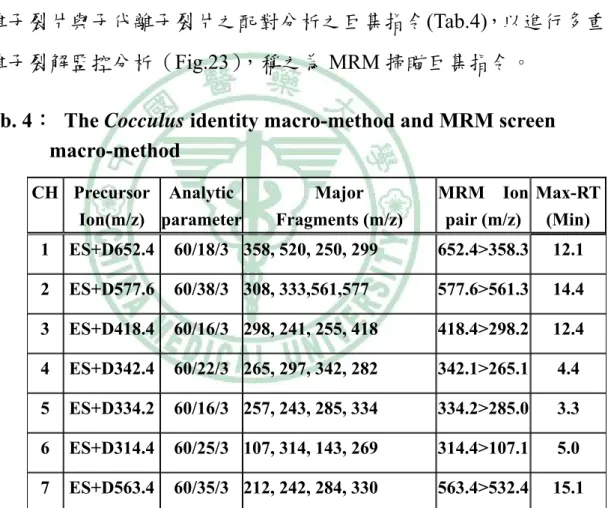
(55) 2. 木防己之液相層析串聯式質譜分析指紋圖譜建立 2-1. 木防己藥材係新鮮採集而得(Fig.7),其基原可確定為 Cocculus (11,12). 比對. trilobus,複經切片染色後顯微鏡下觀察(Fig.8),與文獻資料. 相符,以此作為標準藥材,進行液相層析串聯式指紋質譜圖之建檔, 以及模擬處方配製。 2-2.以木防己標準藥材萃取溶液經正離子電灑法第一段全掃描質譜分析 (ES+/MS1)結果(Fig.21 )觀察,其全掃描質譜圖所獲得之 TIC 圖有數 支明顯之離子峰,經扣除基線之干擾裂片,獲得數張離子峰之全質譜 圖(MS1 spectrum) (Fig.21 ),由其中選取 m/z 314, 334, 342, 418, 564 及 652 等離子強度(abundance)較大之離子裂片為源頭離子,用以進行 正離子電灑法子代離子質譜分析(ESI+ daughter ion scan)。. AA-mFG-MS1-950223-1 Sm (SG, 3x10). 1: Scan ES+ TIC 1.09e10. 2.27. 100. 2.75 3.05. % 3.97. 4.68. 0.60. 7.27. 0. Time 1.00. 2.00. 3.00. 4.00. 5.00. 6.00. 7.00. 8.00. 9.00. 10.00. 11.00. 12.00. 13.00. 14.00. Coculus trilobus-9502 AA-mFG-MS1-950223-1 1391 (11.750) Cn (Top,4, Ht); Sm (Mn, 2x0.75); Sb (1,40.00 ); Cm (1343:1637-1106:1289) 674.6. 100. 652.6. %. 1: Scan ES+ 8.90e5. 653.7 675.7 299.6. 316.6. 502.6. 358.6 380.6. 428.8. 0. 458.6. 520.7 546.8 532.4. 590.8 604.7. 692.8 634.7. 574.9. 654.7. 693.6. m/z 300. 325. 350. 375. 400. 425. 450. 475. 500. 40. 525. 550. 575. 600. 625. 650. 675. 700.
數據
+7

相關文件
(三)使用 Visual Studio 之 C# 程式語言(.Net framework 架構)、Visual Studio Code 之 JavaScript 程式語言(JavaScript framework 架構) ,搭配 MS
• 有許多MS Office2007之後的新功能轉換成ODF是會出 錯的,而ODF功能與MS Office2003相容度較高,所以 建議先將MS
pa dag nye bar len pa yin la shing rta nye par len pa po min pa de bzhin du / bdag kyang kun rdzob kyi bden par 'jig rten gyi tha snyad kun tu mi gcad par bya ba'i phyir shing
Starting from a discussion on this chapter, Jay a nanda proceeds to explain 22 kinds of mental initiation for the pursuit of enlightenment... The first chapter of Madhyamak a vat a
[r]
熟悉 MS-OFFICE
命令解釋程式 作業系統 (MS-DOS,UNIX, WINDOWS 98/NT, 2000, XP, LINUX).
熟悉 MS-OFFICE
