品質改進、跨功能合作與產品創新績效之實證研究: SEM 於中介與干擾效果混合 模式之運用 摘要 本研究探討品質活動及跨功能合作在「知識整合機制」中介及干擾效果之雙重功 能下,如何對產品創新績效造成影響。根據臺灣地區五種不同種類公司(自行車、 汽車、製造業、金融及保險)467 筆有效樣本,實證發現:品質團隊、跨功能合 作及高階管理者支持與溝通迫切需要知識整合;品質目標及跨功能合作對產品創 新績效具顯著影響。最後,跨功能合作×知識整合及 ISO 9000×知識整合分別對 產品創新績效具有正向及負向顯著影響。 【關鍵字】品質活動、跨功能合作、產品創新績效 Abstract
This study advances research on quality practices and product innovation performance by examining how critical quality practices and cross-functional cooperation will influence innovation, under the hybrid role (mediation and moderation) of knowledge integration mechanism. I based on the sample of 467 effective respondents from five categories of Taiwan’s companies: bicycles, motors, manufacturing, financial and insurance. I demonstrate that quality team, cross-functional cooperation, and coaching and communication by top executives have significant requirements for knowledge integration. Quality objective and cross-functional cooperation have significant influence on product innovation performance. Lastly, both terms, cross-functional cooperation×knowledge integration and ISO 9000×knowledge integration have positive and negative significant impacts on product innovation performance, respectively.
【Keywords】Quality practices, Cross-functional cooperation, Product innovation performance
Ⅰ. Introduction
Under bitter market competition, firms must provide high-quality goods and service (Dean & Bowen, 1994). Firms’continuous improvements in design, operation and support have important contributions on comprehensive quality increments. Since an organization consists of mutual connections, improvements in these procedures will be the basis for improvements in performance (Dean & Bowen, 1994). However, successful firms not only focus on zero-defects but also on innovation in products and services. For instance, Disney Magic not only wants zero-defects; it tries to satisfy its customers’desire for new experiences (Prahalad & Krishman, 1999). Linderman, Schroeder, Zaheer, Liedtke, and Choo (2004) hold that the integration of quality management practices and knowledge creation processes will lead to the maintenance and enhancement of organization performance. Cohen and Bacdayan (1994) insist that when one organization adopts new regulations (e.g., ISO 9000) will through the continuous and cyclic dialogues between explicit and implicit knowledge to generate organizational knowledge and help the organization to solve the obstacle of business performance.
Successful firms focus on zero-defects for quality improvements and emphasize innovation. Prior studies emphasize that knowledge or technology, cross-functional cooperation (CFC) and knowledge integration mechanism (KIM) have an important impact on product innovation. CFC signifies that the cooperation among marketing, R&D and other function units during the process of product innovation (Li & Calantone, 1998; Song, Montoya-Weiss, & Schmidt, 1997). KIM means the formal procedure and structure to ensure mastery, analysis, interpretation and integration of the knowledge of afirm’srelated function units (Zahra, Ireland, & Michael, 2000). Toyota both emphasizes CFC and takes additional steps to deploy KIM (Sobek, Liker, & Ward, 1998). However, without properly managing the potential interactive effects derive from related factors often lead to the failure of product innovation. For instance, Texas Instrument’s unsuccessful early entry into the desk-top computer business (Fisher, Maltz, & Jaworski, 1997: 54).
Even though prior studies emphasize the importance of quality practices for organization innovation, there is a lack of empirical studies that focus on how and why various quality practices will influence product innovation and importance. Therefore, this study will explore the individual contribution of these quality practices on product innovation. Existing studies focus on the individual or whole influence of quality improvements, and CFC on product innovation, but they fail to investigate how and why KIM influence, interact and integrate with each other. The knowledge-based view insists that it is not knowledge itself but the CFC that drives a firm’scontinuous competitive advantage (Grant, 1996). Product innovation is the
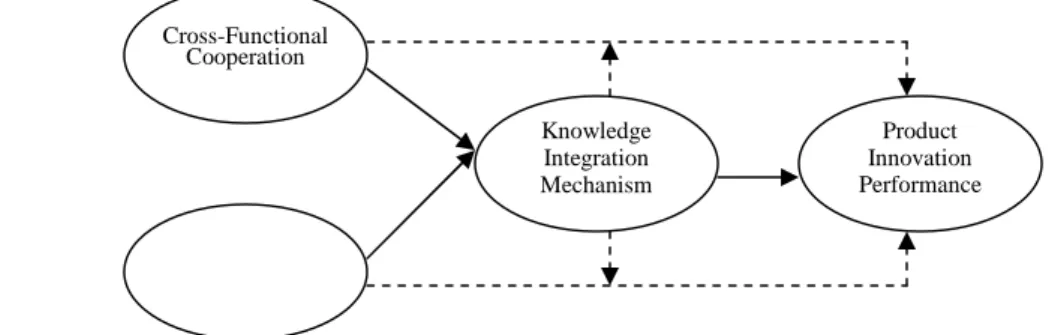
conversion of knowledge implicit in a cross-function team into new products (Madhavan & Grover, 1998). Hence, figuring out how quality practices and cross-cooperation will convert into innovation transmitted through KIM will bring benefits in interpreting the basis of the competitive edge of one firm. There are two perspectives on the influence of KIM on product innovation; one school of thought insists that it has a moderate function, which posits knowledge and CFC have instinctive value enabling KIM to decide their strengths toward product innovation. This school of thought argues that KIM has a moderate effect on the relationship between internal or external capability and innovation outcome (Zahra & Nielsen, 2002). Another school of thought argues that KIM has a mediate function; knowledge or resources not equipped with instinctive value, therefore they only can be transmitted through KIM design to influence a product’s innovation performance. Organization contingency theory insists that the increasing need of information-processing of interdependence between function units can only through KIM design to generate reinforced information-process capability (Galbraith, 1973). Therefore, the KIM plays either an active mediate function, or both a mediation and moderation role. This is one important issue for managers who are re-evaluating quality practices and CFC. The findings will shed light on the two sources of value of KIM. The framework of this study is illustrated in Figure 1: the dotted line represents the moderate role of KIM and the capital-face line represents the mediate role.
Figure 1: The Role of Cross-Functional Cooperation, Quality Practices and KIM on Product Innovation Performance
Ⅱ. Theory and Hypotheses
According to contingency theory there are two perspectives about the relationship between afirm’sorganizational structure and its strategic behavior. The fit-as-mediation view insists that organization is one information-process network; its design goal is to provide one efficient consistency or harmonization when it encounters the need of information-processing of its strategic contingencies and the information-processing capabilities of its integration mechanism (Galbraith, 1973). This school of thought insists that managers will design one organizational structure, procedure, and strategy to reflect one specific environment. Hence, through the
Cross-Functional Cooperation Knowledge Integration Mechanism Product Innovation Performance
increasing need for information-processing, the strategic interdependence and the collaboration among functional units, the type and degree of one firm’s organizational integration mechanism of its internal knowledge will be decided (Kumar & Seth, 1998). In addition, based on knowledge-based view (KBV), during transfer knowledge specificity leads to the increment of ambiguity and uncertainty of it, thus stimulates the development of one proper KIM. The fit-as-moderation or interactive fit argument attributes one firm’s performance to the match of its strategic behavior with its internal and external environment (Atuahene-Gima & Murray, 2004). Therefore, this perspective argues that KIM moderates the influence of quality practices and CFC on performance. This study will therefore conduct in-depth investigations on whether KIM plays a mediation role, and its dual roles of moderation and mediation will also be explored.
A. Effects of Quality Practices on KIM
Integration is the degree of integration of different but interdependent function units and resources into one (Barki & Pinsonneault, 2005: 166). An integration mechanism is one horizontal connection design or one structure integration mechanism which one firm uses to integrate the interaction of cross functions (Griffin & Hauser, 1996). KIM contains following structures and procedures: documents, information sharing meeting, successful and failed case sharing, plan audit, external expert briefings, to master, analyze, interpret and assemble one firm’s internal knowledge. These structures and procedures enable managers to realize the knowledge obtained from product innovation, to interpret the importance of this knowledge, and to make use of that knowledge to enhance one firm’s competitive edge (Zahra & Nielsen, 2002).
Quality practices provide customers with better products and services than those offered by their competitors (Dean & Bowen, 1994). This article examines the following quality practices: ISO 9000 (ISO), quality team (QT), quality objective (QO) and top managers’coaching and communication (TOP). These four practices will change the work structure and innovation (Anderson, Rungtusanatham, & Schroeder, 1994; Dean & Bowen, 1994).
(A) ISO 9000 quality assurance standard
A major requirement of ISO 9000 is that an organization must develop and conduct one set of the following routine procedures: product design, manufacturing, delivery, service and support. ISO 9000 stipulates one series of regulations to obey, if which not satisfied, will cause the work or product to be rejected (Naveh & Erez, 2004). ISO 9000 will be converted into part of the comprehensive quality and
management system of one organization as time pass way. However, only ISO 9000 is insufficient to enable one organization to survive and head for new challenges, new requirements how to be used, granted what meaning in specific environment, how to interact with other complement assets and activities will be more meaningful than new requirements. ISO 9000 for one organization’s learning can be important; it might stimulate new initiatives. Through the implementation of quality practices, one organization starts to use new requirements to replace existing regulations and implicit consensus routines, via the help of one integration mechanism or the continuous dialogues for specific or potential knowledge, resulting in knowledge retention and organization performance (Linderman et al., 2004). Based on these arguments I propose:
H1: When ISO 9000 is enforced, it will raise the requirements for knowledge integration mechanism.
(B) Quality team
It has become the basis for increasingly complicated and changing quality initiatives (Banker, Field, Schroeder, & Sinha, 1996). Members of a quality team combine their efforts, knowledge, and skill to complete objectives (West, 2004: 138). Quality teams often operate as self-management teams with considerable autonomy, from initiative creation, implementation to improvement. Compared to individuals, one quality team is easier to create initiatives via mutual stimulation, further, to increase the variety of initiatives and lead to more innovations (Lewis, Welsh, Dehler, & Green, 2002). What quality team better than ISO 9000 is that the former emphasizes the value of innovation. From knowledge breadth view to examine, one quality team consists of various functional staffs therefore own various fields’ knowledge. When one firm has a broad knowledge basis, it has more potential to reorganize categorical knowledge elements, thus has more potential for innovation (Kogut & Zander, 1992). Alternatively, the higher heterogeneity of knowledge elements will increase the transfer complexity of knowledge between cross-functional units (Galunic & Rodan, 1998; Leonard-Barton, 1992). Thus, an increase in the difficulty of sharing broad knowledge results in the development of KIM to provide one organization with the necessary information-processing capability. Evidence shows that the knowledge of one task faced by one firm is the premise to be resolved for knowledge incorporation; these procedures require mechanisms which can overcome over heterogeneous knowledge. Hence, based on preceding arguments, I propose:
H2: When quality team is implemented, there will be higher requirements for the knowledge integration mechanism.
(C) Cross-functional cooperation (CFC)
CFC is the degree of cooperation and the extent of representation by marketing, research and development (R&D), and other functional units in the product innovation process (Li & Calantone, 1998). Contingency theory offers two reasons which can explain the association of CFC and KIM. First, CFC implies the interdependence of resources, the increasing need for information-processing capability, and the need for the incorporation of relevant knowledge become more urgent. When the need to share cross-functional knowledge and resources increases, the interdependence grows with resource flow, thus increasing the use of the incorporation mechanism (Olson, Walker, and Ruekert, 1995). Incremental cooperation becomes a critical strategic contingency factor when designing one incorporation mechanism (Kumar & Seth, 1998: 581). Cooperation reflects the cooperation of different units; therefore, one firm must provide one structural mechanism to convert such will into concrete action. Functional interdependence influences one firm to establish one KIM to deal with cross-functional knowledge or management practices (Birkinshaw, Nobel, & Ridderstrale, 2002). Second, the movement and transfer of knowledge between interdependent units often cause high cost, ambiguity and uncertainty, due to the difference of functional information, background and experience. This makes the analysis and interpretation difficult and hinders the firm from reorganizing knowledge (Galunic & Rodan, 1998). Hence, knowledge among functional units only constitutes potential knowledge; one firm must develop one integration mechanism to convert potential whole knowledge into concrete knowledge for new products (Griffin & Hauser, 1996: 209). Therefore, this study insists that when CFC becomes stronger the usage intensity of KIM become higher, moderating the communication and learning of new the product plan. Hence, this study establishes the following hypothesis:
H3: When the degree of cross-functional cooperation increases, the requirements for the knowledge integration mechanism will become higher.
(D) Coaching and communication by top executives
Executives communicate their visions to their followers through written and oral messages, even acting as role models to implement their visions. For instance, Motorola’s former CEO, Bob Galvin listed quality as the first item on the agenda of top executives (Evans & Dean, 2000: 276). According to the knowledge-based view (KBV), quality management through effective deployment will be one crucial
resource of firm’s knowledge creation that results in a competitive advantage. However, this one necessary condition is not a sufficient condition for success, because the lack of senior or top management support in implementing quality management practices could also lead to poor results. Executives’vision, policy, and related practices will rely on one formal procedure and structure, for analysis, interpretation and integration, and convert into the value and priority of organization culture; as it receives the commitment and support from top executives (Zbaracki, 1998). Moreover, the ambiguity of top executives’vision complicates the process of transfer, and thereby increases the likelihood that firms will develop appropriate KIM (De Luca & Atuahene-Gima, 2007). These arguments suggest the following hypothesis:
H4: The coaching and communication of top executives will increase the requirements for KIM.
B. Effects of KIM on Product Innovation Performance
KBV insists that it is not knowledge but its integration that ensures competitive capability (Grant, 1991, 1996). More specifically, KIM, which can grant the capability of whole group learning of cross-functional units, increases the likelihood of finding solutions in product innovation, and ensures higher performance. The concept implicit in this argument is that KIM connects knowledge and performance, since KIM is the authorized platform for learning, cross-function units can through it to share, utilize, and learn mutual knowledge. Through the formal structure of knowledge-integration, KIM shall provide one common platform to assure the design and completion of one plan-team of quality. These arguments indicate KIM might reduce errors in product innovation. Hence, quality improvements and cross-functional cooperation contribute to KIM and have an impact, through KIM, on product innovation performance. Hence, based on preceding arguments I suggest:
H5: When the usage of KIM increases, it will improve product innovation performance.
C. Effects of Quality Objective on Product Innovation Performance
1. Quality objective
Goal-setting theory indicates that having one specific and challengeable objective will stimulate people to strive for high performance as long as they are devoted to that objective and obtain feedback on their performance (Locke & Latham, 2002). Objective setting converts a signal message into a measurable concrete goal
after it is completed (Pritchard, Jones, Roth, Stuebing, & Ekeberg, 1988). From a quality improvement perspective, quality objective setting can be the lowest level to achieve, in terms of re-doing, drawbacks, or innovation improvements (Shalley, 1991). Each unit sets certain defect percentage goal for next period, and achieving it via positive participation. The difference between quality team and quality objective is that the staff of the latter does not receive training to become a quality team, and does not learn the methods to achieve a quality goal. A quality objective brings benefits in moderating behavior toward the established objective; a creativity objective generates contribution for creativity (Shalley, 1991). Evidence indicates that one quality objective has significant influence on innovation (Eitan & Erez, 2004). Hence, based on this argument:
H6: When one organization implements more quality objectives it will cause positive impacts on product innovation performance.
D. Effects of Cross-Functional Cooperation on Product Innovation Performance
A cross-functional orientation helps organizational members understand how the components of the system interact to influence performance, and how their roles in the organization affect these interactions. Matrix organization and multifunctional improvement teams promote cross-functional orientations. These mechanisms encourage face-to-face socialization, the process of sharing experiences and thereby create tacit knowledge such as shared mental models and technical skills (Linderman et al., 2004), among dissimilar members of the organization and bring together a wide variety of skills and knowledge (Stevens & Campion, 1994). According to the knowledge-based view, socialization will help one organization to create organizational knowledge and generate improvements that enhance competitive performance (Davenport & Prusak, 1998). A new rule like ISO 9000 can be a central force or thrust for learning. It may trigger new quality initiatives (Marcus & Naveh, 2005). One steady growth facility like, Telecomm International Inc (TI), may through divergence process in sense of branching out, expanding, and exploring ideas new direction (Van de Ven, Polly, Garud, & Venkatarman, 1999) for innovation. In the divergent stage, rules expand, and dominant mode is exploration, involving innovation, learning, and changing rules beyond their literal requirements (Marcus & Naveh, 2005).
H7: When one organization implements more CFC will cause positive impacts on product innovation performance.
E. Moderation Effects of KIM
There are two different perspectives about the effects of KIM on innovation; first, the moderation view insists that knowledge and cross-functional cooperation generate instinctive value on innovation, hence KIM will influence the relation between knowledge and cross-functional cooperation on product innovation. This school of thought indicates that KIM influences the relationship between the external and internal capabilities of one organization and its innovation outcome therefore, it creates one moderation effect (Zahra & Nielsen, 2002). This view attributes the firm’s performance to a match between its strategic behaviors and the internal and external environment (Atuahene-Gima & Murray, 2004). The mediation view insists that knowledge or resources not have instinctive value, therefore, it only can transmit through KIM to influence product innovation. The mediation view, based on the organization contingency theory, insists that the increasing need of information processing of interdependence between cross-functional units, only through KIM design can generate intensify capability of information-processing (Galbraith, 1973). However, evidence shows that the highly incorporated KIM might hamper the creativity and flexibility derived from the interaction of knowledge and cross-functional cooperation (Kumar & Seth, 1998: 583). Hence, inferring that KIM might have one threshold; over it knowledge and cross-functional cooperation might bring negative impacts on performance. Therefore, various quality characteristics and cross-functional cooperation justify its need for KIM; however, the application of KIM might be moderated by its functional flexibility and autonomy (Eisenhardt & Martin, 2000). This article implies that the influence of important quality improvements on innovation performance is mediated and moderated by KIM. This article establishes the following hypotheses:
H8: The influence created by cross-functional cooperation on product innovation moderated by KIM.
H9: The influence created by quality improvements on product innovation moderated by KIM.
Ⅲ. Research Methods
A. Sample and Data Collection
Taiwan is an ideal context for this study because it suffers from the high labor cost and the bitter market competition from China and neighboring southeastern Asian countries. Therefore, cross-functional cooperation and KIM for quality practices in product innovation are needed for Taiwan’s firms to sustain their competitive
advantage. Convenience sampling is used in this study, surveyed industries including bicycle, automobile, manufacturing, insurance and financial. Questionnaires were distributed to the quality related units of the companies of above five industries.
B. Measures of Constructs
Most of the constructs of this study are measured on a five-point scale; product innovation is measured on a seven-point scale to provide a different psychological frame in informants’minds in order to prevent bias (De Luca & Atuahene-Gima, 2007).
(A) Cross-functional cooperation
Three items, adapted from Li and Calantone (1998), are used to ask respondents to answer on a five-point scale (1 = “to no extent,”and 5 = “great scope or degree”), the extent to which the respondents agree or disagree with the following statements: employees can fully cooperate and creative to screen out the initiatives for new products; employees can fully cooperate to establish the strategic objectives and priorities of their company; and individuals can fully express their opinions in plan-team and other strategic activities.
(B)Knowledge Integration Mechanism
Five items, adapted from Zahra et al. (2000) and Zahra and Nielsen (2002) are used to measure KIM. Informants are requested to response with five-point scale (1 = “never use,”and 5 = “broadly use”), to what extent to which the organization has achieved for following five activities, to master, interpret, and integrate related quality improvements knowledge and information. First, information -sharing meeting; second, cross-functional team’sface-to-face discussion; third, the formal analysis for the failure of product development; fourth, the formal analysis for the success of product development; fifth, the utilization of the relevant quality knowledge and skills of experts and advisers.
(C) Product Innovation Performance
Five items, adapted from Olson et al. (1995), are used as measurement scale to measure product innovation performance: (1) market share relative to the firm’s stated objectives; (2) sales relative to stated objectives; (3) return on asset relative to stated objectives; (4) return on investment relative to stated objectives; (5) profitability relative to stated objectives. Informants are requested to rank their answers along a seven-point scale (1 = “low,”and 7 = “high”), reflecting to what extent to which the company has met the objective of product development.
(D) ISO 9002
ISO 9002 is one special quality standard for production, it is the general category of ISO 9000. The following five activities adapted from Naveh and Erez (2004).
Informants recorded their answers along a five-point scale (1 = “none,”and 5 = “great extent”), the extent to which the company has performed the following activities: (1) examine the sufficiency of work procedures and methods to satisfy product specifications; (2) document work procedures, work instructions and quality assurance procedures; (3) use quality assurance experts to implement internal audits and to ensure that the requirements of documentations are met; and (4) use correct precautions to respond to audit reports.
(E) Quality team
The internal staff of one organization accepts a related training plan (e.g., statistical control procedures and people relationship skills) to constitute a quality team. Three items, adapted from Naveh and Erez (2004), are used to measure quality team and ask informants to respond along a five-point scale (1 = “zero degree or scope,”and 5 = “great extent or scope”) the extent to which the company has performed the following activities: (1) used the defect percentage of current term relative to previous term’s to represent firm’s quality performance; (2) used Pareto diagram to signify the main source of defects; (3) used a quality team to accept the internal and external opinions of customer.
(F) Quality objectives
Each department of one organization fully communicate to decide the next term’s plan of reducing defect percentage as the quality objective (Naveh & Erez, 2004), and takes it as the measurement variable of measuring quality objective. Informants are asked to response along a five-point scale (1 = “zero degree or scope,” and 5 = “great extent or scope”) the extent to which the company has achieved for above objective.
(G) The coaching and communication of top executive
The following six items, adapted from Naveh and Erez (2004), were used to measure the coaching and communication of top executive management. Informants were asked to answer along a five-point scale (1 = “zero degree or scope,”and 5 = “great extent or scope”) to what extent the top executive has done the following activities: (1) serving on a steering committee that develops, guide, and evaluate the quality initiatives implementation; (2) acting as quality auditor; (3) implementing one “open door”policy encouraging staffsto join thediscussion oftherelated issuesof quality; (4) joining the train plan and quality team meeting; (5) awarding quality improvement initiatives related activities; (6) devoting time and resources to the implementation of quality improvements; (7) publishing the quality improvements publications periodically, to communicate with employees about the related issues of quality and the messages from the management.
C. Estimating the Effects of Mediation and Moderation
Since there are CFC, quality practices, KIM and product innovation performance four categories of latent variables to be investigated and constitutes one nested structure, therefore, structural equation modeling (SEM) is appropriate for this model. SEM provides the ability to model latent variables and to estimate the parameters for both the observed variables – latent variables relationship and the structural relationship simultaneously using the full information contained in the observed variance-covariance matrix. In addition, SEM offers metamethodological promise for metatheoretical investigations into the superiority of competing theories of marketing phenomena. Especially, when many functional forms can be included in a single system, more theories can be statistically tested.
Since the moderator variable, KIM, is a function of CFC and quality improvements, its structural positioning is assumed to play the dual role of moderation and mediation from evidence and related rationales. Since the KIM is one continuous variable it is preferable to model moderated variable effects as multiplicative interactions to retain the full information contained in the continuous variables (Bagozzi, Baumgarter, & Yi, 1992). Bagozzi et al. (1992) contend that modeled interactions are favored over multi-group analysis for two reasons. Multi-group analysis may have lower statistical power and may confound group variance difference with true moderator effects while moderated regression maintains original scores on a moderator variable and avoids loss of information resulting from transformation of a continuous variable to a qualitative (discrete) one. In addition, observed relationships can be very sensitive to cutoff points used to form groups, especially when there is no natural cutoff point. If the direct link, (the influence of interactive term which consists of the measure variables of CFC multiply that of KIM to product innovation performance; the influence of the product of the measure variables of quality practices multiply that of KIM to product innovation performance) and the mediated link are significant and the parameter value of direct link is significantly different from what it is when the moderator variable effect is present, a hybrid moderator variable effect occurs (Baron & Kenny, 1986). If the mediation role of the KIM is non-significant, but the direct link is significantly altered, KIM is functioning as a pure moderator variable. Alternatively, if the direct link is rendered insignificant, the latent construct is not moderating the relationship, but then KIM is functioning as a mediator variable.
The interactions will be tested by the following procedure. First, each pair of constructs X (antecedent)and Z(moderator)is multiplied to forming an interaction. Second, for each pair of constructs X and Z, I compute a single indicator that represents the latent product xz as (x1+…xn)(z1+…zn). Third, I specify a model
including the two focal constructs and their interaction term. The loading and error for the latent product are given by following two equations:
λxz = (λx1+…λxn)(λz1+…λzm), and (1)
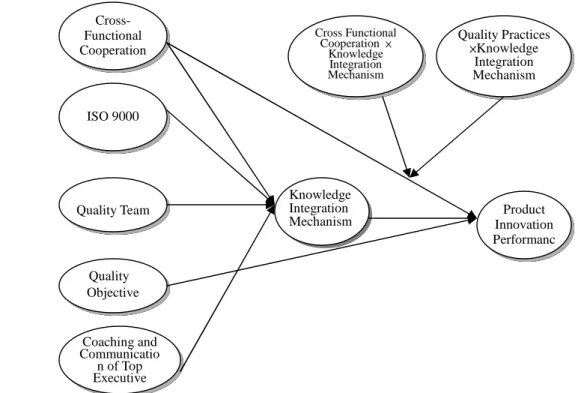
) 2 ( ) ... )( ... ( ) ... )( ( λ λ ) ... )( ( λ λ 1 1 1 zm z1 2 1 xn x1 2 xn x zm z xn x zm z Z VAR X VAR xz All of the terms on the right-hand side are taken from the measurement model (Ping, 1995). AMOS 6.0 software is used to estimate the hybrid model (Figure 2).
Figure 2: The Hybrid SEM Model of Mediation and Moderation: Quality Practices, Cross-Functional Cooperation and Product Innovation Performance
Ⅳ. Empirical Evidence
A. Sample Characteristics
Six hundred copies of questionnaires were issued to familiar executive managers and through them distributed to related departments. After the invalid copies were removed, there were 467 usable samples, so the effective sample rate is 77.83%, including 158 from bicycle industry (33.8%), 112 from automobile industry (24.0%),
Cross-Functional Cooperation ISO 9000 Quality Team Quality Objective Coaching and Communicatio n of Top Executive Knowledge Integration
Mechanism InnovationProduct Performanc e Cross Functional Cooperation × Knowledge Integration Mechanism Quality Practices ×Knowledge Integration Mechanism
74 from manufacturing industry (15.8%), 77 from insurance industry (16.5%), 46 from financial industry (9.9%). Forty-six percent of the firms sampled had implemented quality improvements practices for more than five years, and 60.9% of the informants had completed at least an undergraduate degree. The informants who described their supervisors’leadership style as authoritative, democratic and empowering are 12.2%, 56.1% and 31.5% respectively. More than half of the companies (50.1%) employ more than 200 people.
B. Factorial Invariance
This study samples Taiwan’sbicycle, automobile, manufacturing, finance and insurance industries. Before conducting formal empirical analyses, factorial invariance of the measure model between different pairs of industries should be certified in order to prove the factorial stability of measurement models across industries. First, the group analysis between bicycle and automobile industries was conducted. In this step, the measures’variance, covariance of latent variables, measure paths between latent variables and observable variables of both industries are restricted to be the same (restricted model) to test the invariance of the measure model across these two industries. Since the Chi-square difference value between baseline model (all parameters not restricted to be equal) and restricted model (invariance model) is 85.15 with degree of freedom (df ), 33, the Chi-square difference value divided by degree of freedom is 2.58 less than 3, so the factorial invariance is acceptable. This evidence proves that the bicycle and automobile industries should be pooled to implement further causal analyses. Second, the factorial invariance test between group one (consisting of the bicycle and automobile industries) and group two (manufacturing industry) is implemented. The Chi-square difference value between baseline model and restricted model is 62.88 with df = 33, thus the Chi-square difference value divided by the degree of freedom is 1.91 less than 2, so the factorial invariance is acceptable. Thus the result of factorial test suggests the suitability for pooling the sample data from the bicycle, automobile and manufacturing industries. Third, the factorial invariance test procedure between group one (consist of bicycle, automobile and manufacturing industries) and group two (insurance industry) was conducted. The Chi-square difference value between baseline model and restricted model is 88.90 with df = 33, the Chi-square difference value divided by degree of freedom is 2.69 less than 3, infer that the factorial invariance is acceptable. The factorial invariance test shows that the four industries, can be combined for further analyses. Fourth, the factorial invariance test procedure between group one (bicycle, automobile manufacturing and insurance industries) and group two (financial industry) is conducted. The Chi-square difference value between
the baseline model and the restricted model is 79.80 with df = 33, thus the Chi-square difference value divided by degree of freedom is 2.42 less than 3, so the factorial invariance is acceptable. The factorial invariance test result indicates that these five industries can be pooled for further analyses (De Luca & Atuahene-Gima, 2007).
C. Reliability and Validity
Internal consistency reliability is the extent to which the individual items that constitute a test correlate with one another or with the test total. The coefficient alpha, one of the most widely-used indices of internal consistency reliability is adopted. When other factors are held constant, the coefficient alpha will be high to the extent that many items are included in the scale, and the items that constitute the scale are highly correlated. The evidence shows that the coefficients of Cronbach’s Alpha of all constructs (Product Innovation Performance, PIP = .92, Cross-Functional Cooperation, CFC = .85, Knowledge Integration Mechanism, KIM = .87, ISO 9000, ISO = .87, Quality Team, QT = .80, Coaching and Communication by Top Executives, TOP = .90), except for Quality Objective (only one indicator), exceed .7; this indicates that the measure variable has an acceptable level of internal consistency reliability (Table 1, fourth column).
Indicator reliability is the square of the correlation between a latent factor and that indicator. In other words, the reliability indicates the percentage of variation in the indicator that is explained by the factor that is supposed to measure (Long, 1983). It can be calculated by squaring the standardized factor loadings in the analysis. Evidence shows that the indicator reliability varies from .55 (X23) to .83 (Y3). They all display relatively high reliabilities (TABLE 1, fifth column). Further, the composite reliability index of each latent factor is calculated to reflect the internal consistency of the indicators measuring a given factor. All the composite reliabilities, even the lowest one of QT is .84, far exceed the acceptable level of .70. These indicate that the indicators with high internal consistency to measure a given factor (Table 1, fifth column with a superscriptbsymbol).
Lastly, the index of variance extracted estimates assesses the amount of variance that is captured by an underlying factor in relation to the amount of variance due to measurement error. Evidence shows that even the lowest variance of extracted estimate of KIM and QT are .64 exceeds the required level of .50 (Table 1, last column). It indicates that variance due to measurement error is smaller than the variance captured by the factor (Fornell & Larcker, 1981).
Table 1: Reliabilities and Validities
Construct and Indicators Standardized Loading C.R.a Coefficient Alpha Reliability Variance Extracted
PIP Y1 Y2 Y3 Y4 Y5 0.77 0.85 0.91 0.91 0.86 -26.96*** 31.80*** 31.81*** 27.45*** 0.92 0.91b 0.59 0.72 0.83 0.83 0.74 0.68 CFC X1 X2 X3 0.89 0.89 0.87 -33.27*** 30.93*** 0.85 0.89b 0.79 0.79 0.77 0.74 KIM X4 X5 X6 X7 X8 0.88 0.82 0.85 0.84 0.83 -27.33*** 30.07*** 29.17*** 27.54*** 0.87 0.90b 0.77 0.67 0.72 0.71 0.69 0.64 ISO 9002 X9 X10 X11 X12 0.89 0.87 0.87 0.90 -32.02*** 31.35*** 34.98*** 0.87 0.92b 0.79 0.76 0.76 0.81 0.73 QT X13 X14 X15 0.88 0.82 0.84 -27.03*** 29.02*** 0.80 0.84b 0.77 0.67 0.71 0.64 QO X16 - - - - -TOP X17 X18 X19 X20 X21 X22 X23 0.89 0.85 0.88 0.87 0.88 0.86 0.74 -30.12*** 33.81*** 31.82*** 33.02*** 30.76*** 22.05*** 0.90 0.93b 0.79 0.73 0.77 0.76 0.77 0.74 0.55 0.67
a All test are significant at p = .001 (two-tailed) b Denotes composite reliability.
Convergent validity is demonstrated when different instruments are used to measure the same construct, and when the scores from these different instruments are strongly correlated. In this study, convergent validity is assessed by reviewing the test for the factor loadings. If all the factor loadings for the indicators measuring the same construct are statistically significant (greater than twice their standard errors) this is evidence of the convergent validity of those indicators (Anderson & Gerbing, 1988). The standardized factor loadings of all indicators (the critical ratio, C.R. for Y2~Y5 range from 26.96 to 31.81) is the ratio of the unstandardized path to the standard error associated with that estimate. This is tested against a z distribution, evidence that they are statistically significant at p = .001, thus supporting their convergent validity.
Discriminant validity is demonstrated when different instruments are used to measure different constructs, and the correlations among the measures of these different constructs are relatively weak. A test displays discriminant validity
when the test does not measure a construct that it is not designed to measure. Since the two constructs (the correlation between QT and TOP is .91) are so strongly correlated, is it reasonable to question whether they are measuring two different constructs? Therefore, the chi-square difference test is used to assess the discriminant validity of these two constructs. By creating a new measurement model identical to the standard measure model in which all factors are allowed to covary, except, that the correlation between these two factors is fixed at one, called unidimensional model. The chi-square of the standard model is 1114.33, df = 337 and the chi-square value of the unidimensional model is 1203.61, df = 338. Next, the difference in chi-square is 89.28 (1203.61-1114.33, df = 338 –337 = 1), finding the critical value of chi-square is 10.83 at p = .001, hence, the difference between these two models is significant at p = .001. In other words, the standard measure model in which the factors were viewed as distinct but correlated constructs provided a fit better than the fit provided by the unidimensional model. In short, this test supports discriminant validity.
D. The Evidence of KIM Mediation Model
Before interpreting the path coefficients, overall fitness of the mediate model of KIM needs to be verified. The fit indexes of specified model are compared with those of the one without any constraints, meaning that all variables in the correlation matrix are free to relate to one another. Considering the varying properties of fit statistics, this study adopts the model chi-square and significance test, combined with the root mean square error of approximation (RMSEA), normed-fit index (NFI), comparative fit index (CFI). Among them, if chi-square / df ratio for this model is less than 2, or with nonsignificant chi-square, the model may be acceptable. Other of these fit indexes (NFI, CFI) range from 0 to 1. When RMSEA value close to zero, NFI and CFI close to one indicate good fit. The fit indexes of the KIM mediation model, (chi-square / df = 709.96 / 333 = 2.13, close to 2 and with nonsignificant chi-square, NFI = .92, CFI = .96, RMSEA = .05) indicate a good fit, implying that little reliable score variance was lost from a completely free variance covariance matrix to one restricted model. Moreover, the absolute value of the t statistics for each factor loading and path coefficient almost exceed 1.96, except both ISO to KIM and KIM to PIP and the standardized factor loadings almost nontrivial in size (i.e., absolute values exceed .05) except that of ISO to KIM (.01). The squared multiple correlations for the KIM and PIP are quite large 0.78 and 0.47 respectively. Combined, these results show that the theoretical mediation KIM model provides an ideal fit to the data.
The statistical significance of paths in mediated KIM model involves the critical ratio (C.R.) or the ratio of the unstandardized path coefficient to standard error. This is tested against a z distribution, with a value of 1.96 or greater indicating one-tailed
significant at alpha = .05. Table 2 displays standardized path coefficients for KIM mediation model. Standardized path coefficients are usually more desirable because with these coefficients, all variables are on the same unit of measurement (all variables have a standard deviation of 1.00). They illustrate that following coefficients: from QT to KIM (b = .26, C.R. = 2.37, p < .05), from CFC to KIM(b = .46, C.R. = 6.79, p < .001), from TOP to KIM (b = .22, C.R. = 2.68, p < .01), from QO to PIP(b = .34, C.R. = 3.90, p < .001), from CFC to PIP (b = .31, C.R. = 3.10, p < .001) are significant and in the predicted direction. However, following two paths, from ISO to KIM (b = .01, C.R. = .14, p = .89 > .05)and KIM to PIP (b = .10, C.R. = .97, p = .33 > .05)not statistically significant. It is estimated that the predictors (QT, CFC, ISO, TOP) of KIM explain 77.6% of its variance, and the predictors (KIM, QO and CFC) of PIP explain 47.4% of its variance.
Table 2: Standardized Path Coefficients under Mediation and Hybrid Model
Hypotheses KIM Mediation Model KIM Hybrid Model Test results H1: ISO 9000 (ISO) →
Knowledge Integration Mechanism (KIM)
0.01 0.01 non-significant H2: Quality Team (QT) →
Knowledge Integration Mechanism
0.26* 0.26* supported H3: Cross-Functional Cooperation (CFC) →
Knowledge Integration Mechanism (KIM)
0.46*** 0.46*** supported H4: The Coaching and Communication of Top
Executive (TOP) →
Knowledge Integration Mechanism (KIM)
0.22** 0.22** supported
H5: Knowledge Integration Mechanism (KIM)→ Product Innovation Performance (PIP)
0.10 0.06 non-significant H6: Quality Objective (QO) →
Product Innovation Performance (PIP)
0.34*** 0.30*** supported H7: Cross-Functional Cooperation (CFC) →
Product Innovation Performance (PIP)
0.31*** 0.34*** supported H8: Cross-Functional Cooperation (CFC) ×Knowledge
Integration Mechanism (KIM)→ Product Innovation Performance (PIP)
- 0.18*** supported
H9: ISO 9000 (ISO)×Knowledge Integration Mechanism (KIM) →
Product Innovation Performance (PIP)
- -0.27*** supported
Note N = 467
* p < .05; ** p < .01; *** p < .001
E. The Evidence of KIM Hybrid Model
Before conducting the analysis of moderator model of KIM. First, the evidence of structural model of KIM hybrid model is analyzed. The model fit indexes, chi-square / df = 1212 / 388 = 3.1, close to 3 and with nonsignificant chi-square, however, considering the chi-square statistic will very frequently be significant even
if the model provides a good fit and it can be influenced by factors in addition to the validity of the theoretical model; these factors include departures from multivariate normality, sample size and even the complexity of the model. It has been recommended that it be treated as a general goodness of fit index, but not as a statistical test in the strictest sense (Joreskog & Sorbom, 1989). For these reasons, this study supplements the chi-square test with other stand-alone goodness fit indices, like, CFI = .91, NFI = .88, RMSEA = .06, these indexes indicate the acceptance of fit of the hypothetical model to the data. Next, table 2 (third column) displays standardized path coefficients for KIM hybrid model. They illustrate that following coefficients: QT to KIM (b = .26, C.R. = 2.37, p < .05), CFC to KIM (b = .46, C.R. = 6.78, p < .001), TOP to KIM (b = .22, C.R. = 2.69, p < .01), QO to PIP (b = .30, C.R. = 3.65, p < .001), CFC to PIP (b = .34, C.R. = 3.54, p < .001) are significant and in the predicted direction. However, following two paths, ISO to KIM (b = .01, C.R., p = .88 > .05) and KIM to PIP b = .06, C.R. = .64, p = .52 > .05)do not reach statistical significance. It is estimated that the predictors (QT, CFC, ISO, TOP) of KIM explain 77.6% of its variance, and the predictors (KIM, QO, CFC, CFC×KIM and ISO×KIM) of PIP explain 52.6% of its variance; where CFC×KIM and ISO×KIM are the statistically significant interaction terms illustrated in the next section.
As mentioned previously, in other contexts, scholars have argued that KIM are moderators. This study evaluates this view and finds significant interaction effects. In this study, KIM has one hybrid effect in which it acts as both a mediator and moderator. Evidence indicates that the KIM mediation model signifies partial significant mediation effects (between exogenous variables: CFC, QT, QO, and TOP to mediator variable KIM). Moreover, based on preceding evidence, I infer that the moderator effect of KIM on the process of quality practices on PIP is mediated partially through KIM. The interactive fit argument, or “fit-as-moderation”view argues that a firm’s performance is attributable to the match between its strategic behaviors and the internal and external environmental conditions. This suggests that KIM moderates the influence of quality practices on PIP (Atuahene-Gima & Maurray, 2004). This effect is called one “hybrid effect”(James & Brett, 1984). In addition, since the moderate role of KIM interacts with other exogenous variables and is directly related to criterion variable PIP, it is a quasi moderator (Sharma, Durand, & Gur-Arie, 1981). In the KIM hybrid model, the paths between exogenous latent variables (CFC, ISO, QT, QO and TOP) are anticipated to be minimal, but the effect of their interaction terms on PIP is anticipated to be meaningful and statistically significant. I calculate all possible interaction terms: CFC×KIM, ISO×KIM, QT×KIM, QO×KIM, TOP×KIM, and find that only two interaction terms are statistically significant: CFC×KIM (b = .18, C.R. = 3.35, p < .001) and QO×KIM (b = -0.27, C.R.
= -5.07, p < .001). To obtain these interaction terms, a factor analysis with varimax rotation was conducted on these interaction terms, except for QO, and the standardized factor scores on the first (only) factor were saved. Since QO has only one indicator variable, it is standardized (Christopher, 2007). Evidence suggests that KIM not only plays a mediation role but also a mixed mediation and moderation role. I suggest that KIM positively and significantly moderates the influence from CFC transmitted through KIM to PIP; it also generates a significantly negative moderating effect on the influence from ISO 9000 transmitted by KIM to PIP. The critical rations of the other paths are also statistically significant at p = .001, suggesting important main effects of quality practices on PIP, in addition to their moderation and moderation effects (Table 2).
Ⅴ. Discussion
The goal of this study is to advance quality theory by untangling the complex relationship among quality practices, cross-function collaboration, KIM and product innovation performance. I find that no matter in KIM mediation or KIM hybrid model CFC, QT and TOP positive related to KIM, this consistent with the structural contingency theory argument that increased information-processing demands that result from the interdependence of functional units determine the degree to which KIM are adopted. However their impacts transmitted through KIM on PIP are positive but not statistically significant. This insignificant impact of KIM on PIP is small relative to the effect of CFC and QO on PIP, it still plays one role to link important quality practices, quality improvements team (QT), cross-functional cooperation (CFC) and top managers’coaching and communication (TOP) to PIP.
The positive significant associations between CFC, QT, TOP and KIM provide consistent support for the view that some quality practices associated with sticky characteristics, hence, the design of KIM should consider these attributes. At the same time, the evidence echoes the knowledge view that if one organization can deploy quality management through integrated practices that support each of the knowledge creation processes (socialization, externalization, combination, and internalization) it should be more effective at creating organizational knowledge. Further, organization knowledge can generate more improvements that lead to firm performance. Based on this view, knowledge is a crucial resource for a firm and a source of competitive advantage that improve firm performance (Linderman et al., 2004). However, these three quality improvement practices still have different attributes, thus stimulating the need for in-depth investigations on the relationship between them and KIM. The potential reasons for the significant relationship of CFC, QT and TOP associated with KIM will be analyzed in sequence.
First, the significant positive association between CFC and KIM echoes the fit-as-mediation view that the resources and functional interdependence plus the increasing need of information-processing capability enable organizations to establish one KIM to convert cross-functional cooperation into concrete actions. However, reliance on the KIM is insufficient since the knowledge among functional units entails, tacitness, ambiguity and uncertainty. Therefore, socialization should be conducted to share experiences and thereby create tacit knowledge, such as shared mental models and technical skills. Organizations should adopt the following mechanisms to promote a cross-functional orientation: concurrent engineering, matrix organization, and multifunctional improvement teams. These mechanisms encourage face-to-face contact between dissimilar members of the organization. Effectively bring together a wide variety of skills, knowledge, and ability. This promotes socialization among diverse organizational members and helps develop a shared understanding of the system (Stevens & Campion, 1994). These activities will create and screen out new initiatives of products, (Stevens & Campion, 1994). Thus, the evidence echoes the argument of Linderman et al. (2004) that quality management practices that foster contact and interactions among heterogeneous organization members allow knowledge to be created through socialization. These arguments can be used to explain the insignificant association between KIM and PIP. In addition, the significant direct association between CFC and PIP, in KIM mediation and moderation models, indicates that the former generates instinctive value for product innovation: effective teams bring together a wide variety of skills and allow knowledge to be created through socialization that foster product innovation without the conversion mechanism of the formal process and structure, KIM. Based on the empirical evidence, I provide the new insight that if organizations can implement quality management practices to foster contact and interactions among different functional unit members in the product innovation process, CFC will become a valuable resource in product innovation. Therefore, cross-functional cooperation will be the potent driver of product innovation performance.
Second, the nonsignificant positive association between ISO and KIM only partly corresponds to the assertion of fit-as-mediation view (Venkatraman, 1989), which posits that managers choose organizational process that reflect the circumstances of their organizations. These organizational processes should meet the correspondence goal between the information-processing requirements of its strategic contingencies and the information-processing capabilities of its integration mechanism (Galbraith, 1973). However, the ISO still includes some tacit knowledge that cannot fully be converted via one structural mechanism, like KIM. On the contrary, they should be converted through socialization, or via externalization
process into tacit and explicit knowledge respectively (Linderman et al., 2004). Next, the potential reasons for the nonsignificant association between KIM and PIP, from ISO view, can be illuminated as follows: the creation of new knowledge comes from the dialogue between what is explicit and tacitly known and such dialogue can be stimulated by the introduction of ISO 9000. However, the introduction of such a new rule can come before or after other quality programs have been implemented. Depending on the purpose the new rule serves, when it is introduced, how it is understood, the meaning attached and reattached to it, and how it is then implemented and recast once it is introduced, it will play different role, and have different effects on organizations’performance. Thus, the effect of a new rule on performance depends on what, where, when, and how it falls into the flow of existing and future rules and routines, and how its introduction stimulates or fails to stimulate new knowledge creation. Hence, new rules can be sources of creation of new organizational competencies and competitive advantage (Cohen & Bacdayan, 1994) if they stimulate cycles of dialogue between explicit and implicit processes and create new knowledge that can help organizations adjust to situations where the bar on business performance is constantly being raised. Then the difficulty other organizations will encounter in imitating them will be high, as these are unique events in an organization’s internal development that cannot be perfectly replicated (Marcus & Naveh, 2005).
Third, the significant association between QT and KIM echoes the view that the higher heterogeneity of knowledge elements derives from functional staff who will increase the transfer complexity, thus increase the difficulty of sharing broad knowledge and prompt the development of KIM to provide one organization of necessary information-processing and knowledge-integration capability. The nonsignificant association between KIM and PIP can be illuminated by the arguments of the knowledge-based view. This school of thought insists that knowledge is a crucial resource for a firm and a source of the competitive edge that improves firm performance (Davenport & Prusak, 1998), and asserts that quality management is a source of knowledge creation that results in a competitive advantage. Therefore, quality management can be defined as customer focus, continuous improvement, and team work (Dean & Bowen, 1994). However, this is a necessary but not sufficient condition for success, for instance, lack of senior management support in implementing quality managements could also lead to poor results. In addition, when implementing teamwork, the importance of socialization process in knowledge creation should be noticed. Therefore, organizations should establish quality team to encourage socialization to generate knowledge and improve their competitive edge and innovation performance. Organizational knowledge creation amplifies the individual’s knowledge, as “original ideas”emanate from autonomous individuals,
diffuse within the team, and then become organizational ideals (Nonaka, 1994). Fourth, the significant direct association between QO and PIP echoes the finding of Eitan and Erez (2004) that quality objective generates significant influence on innovation. Since QO brings a direct positive significant contribution on PIP, it is one of the potent drivers of product innovation performance. Therefore, as long as the employee is devoted to the objective set and obtains feedback through positive participation, then goals regulate behavior toward goal accomplishment: creativity objective will generate creativity (Shalley, 1991).
Fifth, the significant association between TOP and KIM can be explained as follows. The deployment of quality management is one way for firms to create knowledge that increases firms’competitive advantage and to improve firms’ performance. This, however, is only one necessary but not a sufficient condition for success. The concrete support from top executives is necessary; hence, executives need to communicate with their subordinates about the values and priorities that shape the organizational culture and lead to performance improvements. The leadership reflects not only what leaders communicate to their employees but also the implementation of new managerial practices that serve to realize the vision (Zbaracki, 1998). Thus organizations need to adopt an open-door policy allowing employees to discuss quality-related issues; allocate time and other resources for the implementation of quality practices and through briefing, sharing meeting and face-to-face discussion to show the employees how their roles in the organization affect mutual interactions that improve organizations’performance (Naveh & Erez, 2004). These face-to-face contacts promote socialization, through KIM, among organizational members and create a shared understanding of the system (Linderman et al., 2004).
However, the “fit-as-moderation” view insists that firm’s performance is attributable to a match between its strategic behaviors and the internal and external environment (Atuahene-Gima & Murray, 2004). This strand of thought suggests that KIM moderates the effect of quality practices and cross-functional collaboration on PIP. After calculating all possible interaction effects I find only two interaction effects generate statistical significance on PIP: CFC×KIM (b = .18***, p < .001) and ISO×KIM (b = -.27***, p < .001). This finding suggests that the KIM plays not only one partial mediation role but also one mixed effect of moderation role associated with CFC and ISO respectively. On one hand, the CFC associated with KIM brings a positive significant contribution on PIP, consistent with the finding of De Luca and Atuahene-Gima (2007). This indicates that through deployment of quality management practices, CFC associated with KIM will foster contact and interactions among heterogeneous organization members and via socialization and combination
influence perceived effectiveness of knowledge management at the group and organizational levels, respectively (Sabherwal & Becerra-Fernandez, 2003), further cultivating the competitive advantage and improving firm’s performance. On the other hand, the significant negative association between ISO×KIM and PIP provides similar evidence to that of Naveh and Erez (2004). The possible reason may be that the implementation of ISO 9000 focuses on documentation, standardization, and conformity to rules and procedures; this resulted in a culture of attention to detail but not in a culture of innovation. Moreover, the KIM emphasizes the regular formal report, analysis, information meeting to synthesize knowledge but lacks interaction to learn and stimulate innovation.
Ⅵ. Theoretical Contributions
This study contributes to quality theory of product innovation in the following ways. First, the direct positive significant effects of CFC and QO on PIP shed new light on the importance of QO for innovation in addition to CFC, hence, the failure of firms in product innovation can not always be ascribed mainly to their failure in cross-functional collaboration. Rather, even though firms conduct their CFC efficiently and effectively, they may also result in the failure of innovation, if they do not establish one specific and challenging goal associated with a feedback system that motivates high performance and creativity. The evidence indicates that examining the separate direct contribution of CFC and QO on PIP may lead to erroneous implications and their correct role in product innovation.
Second, this study clarifies how KIM influences PIP by showing its dual roles of significant partial mediation effect for CFC, QT and TOP on KIM and its mixed effects of significant positive impact of CFC×KIM on PIP as well as the significant negative contribution of ISO×KIM on PIP. Thus, the evidence only verifies the necessary condition of information-processing demand of quality practices (CFC, QT and TOP) for KIM. However, the sufficient condition of KIM on PIP is not statistically significant; the potential reasons may be these three potent drivers of KIM need socialization combined with feedback to motivate the employees to generate creativity. In other words, one structural mechanism, like KIM, only converts explicit knowledge into PIP, however, those tacit knowledge elements will be conveyed via socialization to create their impact on PIP. In other words, CFC elements and QO contribute instinctive value to PIP, however, the residual value of CFC, QT and TOP may be realized through KIM but their subsequent impact on PIP should be distinguished by explicit or tacit elements, the former through KIM create their contributions on PIP, alternatively, the latter will rely on social process to create knowledge and creativity.
Third, given the complexity of the study context, the positive moderating effects of KIM on CFC to PIP suggests that effective deployment and integration of CFC and KIM will promote socialization among heterogeneous organization members and bring positive contribution on perceived effectiveness at the organizational level. At the same time, the significant negative effect of KIM on ISO to PIP suggests that at high levels, they could stifle the associated effects of quality assurance standard and CFC on PIP. It appears that though some characteristics of ISO make KIM necessary, however, the effectiveness of KIM will be tempered by the amount of the complexity the firms encounter and the resulting need for functional flexibility and perhaps, autonomy (Eisenhardt & Martin, 2000). At a high level, KIM will stifle the integration of effectiveness and creativity from heterogeneous organization members. This study offers one new insight: there may be a threshold of KIM beyond which quality assurance standard may be detrimental to PIP. Hence, the use of KIM seems to involve one trade-off between the necessity, occasioned by the match between strategic behaviors and internal and external environment and the information-processing demands, on the one hand, the stifling of functional integration and creativity on the other.
Ⅶ. Management Implications
This empirical evidence calls on managers to consider the attributes of diverse quality practices they adopted in new product projects to design KIM efficiently and effectively. Moreover, this study digs into the features of quality practices and finds that though CFC is a potent driver for PIP and managers need to pay equal attention to quality objective, this quality practice generates significant direct influence on PIP. Thus, the new insight for managers is that CFC and QO are inherently valuable for product innovation; emphasizing CFC over QO may be detrimental for the development of full potential of the firm’s new product innovation. Managers need to endow new product innovation project with the human and financial resources to conduct socialization of cross-functional collaboration associated with combination process and to establish potential and challengeable objectives to motivate the employees’creativity.
Second, the partial mediation effects of CFC, ISO, QT and TOP on KIM encourage managers to note the need for these quality practices to be converted by KIM, however, their subsequent contributions of tacit knowledge elements on PIP will be implemented via flexible effective deployment (a continuous dialogue between tacit and explicit knowledge, socialization) and based on well-established feedback system to obtain interactions from heterogeneous organization members. The results call on managers to pay equal attention to explicit and tacit knowledge
elements of quality practices via structural, flexible and interactive approaches, respectively. In addition, managers need to draw on combination process (intranet, Internet, database and repositories of information, best practices, and lessons learned), which enables the integration of chunks of explicit knowledge, and influence perceived effectiveness of knowledge management at organizational levels and contribute most to organization knowledge (Sabherwal & Becerra-Fernandez, 2003).
Third, the moderation effects of KIM associated with CFC and ISO on PIP, suggest that managers should draw on resources on the integration between cross-functional collaboration and KIM. In addition, managers need to avoid the trap of relying on quality assurance standards for innovation; in contrast, they should make efforts to lessen the negative impact that derived from the ISO’s sticky standardization procedures, they may stifle the potential creativity of the employee. When one organization adopts new rule, such as ISO 9000, it should draw on stimulating dialogue between explicit and implicit processes and creating new knowledge that can help organizations adjust to situations where the bar on business performance is constantly being raised. By this means, one organization will generate understanding and create knowledge (Marcus & Naveh, 2005).
Ⅷ. Limitations and Future Directions
There are several limitations to the interpretation of the findings. First, the cross-sectional data are used in this study cannot suggest a causal relationship. The structural contingency theory lens is adopted, thus, knowledge is a contingency variable; in this perspective, the type of knowledge determines the coordination mechanism for knowledge integration (Galbraith, 1973). However, future researchers can use the organization learning perspective to investigate how KIM affects the dimensions of quality practices.
Second, according to the arguments of KBV that knowledge tacitness is a key factor that could erect imitation barrier to protect the firm’s competitive advantage, hence, future studies are needed on why and how the two dimensions, characteristic ambiguity and linkage ambiguity (McEvily & Chakravarthy, 2002), will influence the firms’production innovation.
In conclusion, this study recommends that researchers and managers take a more sophisticated assessment of what, how and why quality practices and CFC influence PIP. This study delineates the importance of quality practices and CFC on PIP and the dual roles of KIM (partial mediation and mixed moderation). It therefore offers a more systematic view of how such an intended purpose can be achieved.
This author appreciate the financial aid from National Science Council NSC97-2410-H-212 -005
REFERENCE
Anderson, J.C., & Gerbing, D.W. 1988. Structural Equation Modeling in Practice: An Review and Recommended Two-Step Approach. Psychological Bulletin, 103: 411-423.
Anderson, J.C., Rungtusanatham, M., & Schroeder, R.G. 1994. A Theory of Quality Management underlying the Deming Management Method. Academy Management Review, 19: 472-510.
Atuahene-Gima, K., & Murray, J. 2004. Antecedents and Outcomes of Marketing Strategy Comprehensiveness. Journal of Marketing, 68 (October): 33-46.
Bagozzi, R.P., Baumgartner, H., & Yi, Y. 1992. State Versus Action Orientation and the Theory of Reasoned Action: An Application to Coupon Usage. Journal of
Consumer Research, 18 (March): 505-518.
Banker, R.D., Field, J.M., Schroeder, R.G., & Sinha, K.K. 1996. Impact of Work Teams on Manufacturing Performance: A Longitudinal Field Study. Academy of
Management Journal, 39: 867-890.
Baron, R., & Kenny, D.A. 1986. The Moderator-Mediator Variable Distinction in Social Psychological Research: Conceptual Strategic and Statistical Considerations. Journal of Personality and social psychology, 51(6): 1173-82. Barki, H., & Pinsonneault, A. 2005. A Model of Organizational Integration,
Implementation Effort and Performance. Organization Science, 16(2): 165-79. Birkinshaw, J., Nobel, R., & Ridderstrale, J. 2002. Knowledge as a Contingency
Variable: Do the Characteristics of Knowledge Predict Organizational Structure?
Organization Science, 13 (3): 274-289.
Christopher, J. H. 2007. Moderation and Mediation in Structural Equation Modeling: Application for Early Intervention Research. Journal of Early Intervention, 29(3): 262-272.
Cohen, M.D., & Bacdayan, P. 1994. Organizational Routines are Stored as Procedural Memory: Evidence from a Laboratory Study. Organization Science, 5: 554-568. Davenport, T.H., & Prusak, L. 1998. Working knowledge: How Organizations
Manage What They Know. Boston, M.A: Harvard Business School Press.
De Luca, L.M., & Atuahene-Gima, K. 2007. Marketing Knowledge Dimensions and Cross-Functional Collaboration: Examining the Different Routes to Product Innovation Performance. Journal of Marketing, 71(January): 95-112.
Improvement Research and Practice through Theory Development. Academy
Management Review, 19: 392-418.
Eisenhardt, K.M., & Martin, J.A. 2000. Dynamic Capabilities: What are They?
Strategic Management Journal, 21(10-11): 1105-1121.
Eitan, N., & Erez, M. 2004. Innovation and Attention to Detail in the Quality Improvement Paradigm. Management Science, 50: 1576-1586.
Evans, J.R., & Dean, W. 2000. Total quality: Management, Organization, and
Strategy (2nded.). Cincinnati, OH: South-Western College Publication.
Fisher, R.J., Maltz, E., & Jaworski, B.J. 1997. Enhancing Communication between Marketing and Engineering: The Moderating Role of Relative Functional Identification. Journal of Marketing, 61(July): 54-70.
Fornell, C., & Larcker, D.F. 1981. Evaluating Structural Equation Models with Unobservable Variables and Measurement Error. Journal of Marketing Research, 18: 39-50.
Galbraith, J. 1973. Designing Complex Organizations, Reading. MA: Addison-Wesley.
Galunic, C.D., & Rodan, S. 1998. Resource Recombinations in the Firm: Knowledge Structures and the Potential for Schumpeterian Innovation. Strategic Management
Journal, 19(12): 1193-1201.
Grant, R.M. 1991. Proposing in Dynamically-Competitive Environments: Organizational Capability as Knowledge Integration. Organization Science, 7(4): 375-387.
Grant, 1996. Toward a Knowledge-Based Theory of the Firm. Strategic Management
Journal, 17 (Winter Special Issue): 109-122.
Griffin, A., & Hauser, J.R. 1996. Integration R&D and Marketing: A Review and Analysis of the Literature. Journal of Product Innovation Management, 13(3): 191-215.
James, L.R. & Brett, J.M. 1984. Mediators, Moderators, and Tests for Mediation.
Journal of Applied Psychology, 69(2): 307-321.
Joreskog, K.G., & Sorbom, D. 1989. LISREL 7: A Guide to the Program and
Applications (2nded.). Chicago: SPSS Inc.
Kogut, B., & Zander, U. 1992. Knowledge of the Firm, Combinative Capabilities and the Replication of Technology. Organization Science, 3(3): 383-397.
Kumar, S., & Seth, A.A. 1998. The Design of Coordination and Control Mechanism for Managing Joint Venture-Parent Relationship. Strategic Management Journal, 19 (June): 579-99.
Leonard-Barton, D. 1992. Core Capabilities and Core Rigidities: A Paradox in Managing New Product Development. Strategic Management Journal, 13