
從體驗行銷觀點看台灣背包客異國旅行經驗 - 政大學術集成
179
0
0
全文
(2) . A Study on the Outbound Experiences of Taiwanese Backpackers —from the Perspective of Experiential Marketing . Student: 洪佳琳 (Hung Chia-Lin) Advisor: 張愛華 (Chang Ai-Hua) . 立. 治 政 國立政治大學 大. ‧ 國. 學. 國際傳播英語碩士學程 碩士論文. ‧ y. sit. io. al. A Thesis. er. Nat. . n. v i n C h Master’s Program Submitted to International in International engchi U Communication Studies National Chengchi University In partial fulfillment of the Requirement For the degree of Master in International Communication Studies . 中華民國 100 年 7 月 .
(3) . A Study on the Outbound Experiences of Taiwanese Backpackers —from the Perspective of Experiential Marketing . . A Master Thesis. National Chengchi University . n. al. er. io. sit. y. ‧. Nat. In Partial Fulfillment of the Requirements for the Degree Master of Art . Ch. engchi. i n U. by 洪佳琳 (Hung Chia Lin) 2011. Jul. . 學. ‧ 國. 立. 政 治 大. v.
(4) . Acknowledgements 終於到了寫致謝詞這一刻。 寫論文,本身就是一場大旅行。回顧去年,也是在剛結束一場人生的冒險 環球大旅行後,自己堅定而勇敢地換了關於自助旅行的論文題目,歷經千迴 百轉終於敲定指導教授,開始了孤獨的自我論文之旅。 對愛華老師有說不盡的感激。包容我非商院本科的思考邏輯,一步一步細 心耐心的指導我論文寫作技巧與架構,又提供我做質性研究的超好用軟體; 也很感謝白老師和祝老師在兩次口試上一針見血的評論,幫我突破盲點將研 究結果概念修得更佳完善!與三位高手老師互相討論激盪的快感,真的讓我有 做研究的感覺。. 立. 政 治 大. ‧. ‧ 國. 學. 還要感謝從找指導教授到論文口試一路陪伴我的小泱,這將近四百個日子 裡忍受我時好時壞的情緒起伏兼歇斯底里,真是辛苦你了!不僅當我的壞心情 垃圾筒,還身兼論文小軍師從你理工背景的角度提供我不同觀點,這本論文 的完成,你功不可沒!. y. Nat. er. io. sit. 陪我次多的應該就是背包客棧上的 37 位背包客啦!感謝你們圖文並茂的故 事,多次帶我遊走世界上各個角落,讓我在 coding 的過程中也過了神遊旅行 的癮。 a. n. iv l C n hengchi U 最後,感謝默默支持我的親愛老爸老媽外公外婆,雖然你們一直很擔心我. 畢不了業,但我成功地在身兼多職的情況下生出我的論文寶寶啦!能讓你們欣 慰,我想也是一種盡孝道的表現吧! 當然,完成論文這種苦盡甘來的心情,只有自己最懂。多少個蓬頭垢面躲 在家中、研究室整天足不出戶埋首一篇篇文獻與 data 中的日子?又有多少個 想破頭也想不出怎麼畫的圖表?多少次沮喪走出老師研究室,卻又樂觀地對自 己信心喊話?太多太多辛苦,但就像背包客一路上的千錘百鍊,苦過後那又甜 又悸動的感受也最深。 研究之旅已到盡頭,但我已開始期待下一次背包旅行!沒辦法,誰叫我是無 可救藥的 travelholic! . i .
(5) . Abstract Backpacker is an emerging new market niche in current International tourism market. It’s important to understand backpackers’ touring experiences with specific national identity to benefit global destination experience providers. Therefore, metaphors concerning backpacking experiences are projected first. Second, from the perspective of experiential marketing, this study is attempted to analyze Taiwanese backpackers’ outbound traveling experience elements which engage sense, feel, think, act, and relate experiences for creating unique and lasting memories, by examining direct influential factors. Then, according to their satisfaction statements, their perspectives about overall on-tour experiences are concluded.. 政 治 大. 立. ‧. ‧ 國. 學. This study adopts quasi-netnography methodology, alone with event-based narrative inquiry technique, to analyze 37 Taiwanese backpackers’ online narratives on backpackers.com.tw. The metaphors, direct influential factors (personnel, other tourist, product/souvenir, and physical environment) on five experience modules (sense, feel, act, think, and relate), and satisfaction (overall evaluation, recommendation, and willing of revisit) are examined. And, the reliability check achieves significance level.. n. er. io. sit. y. Nat. al. i n U. C. v. h e ncan The results show that five metaphors i as bases for designing g cbehseen unforgettable backpacking experiences. And, aside from direct influences, there are also other three indirect influences (media, cultural status, and resource constraint). Further, “people” and “environment” factors influence Taiwanese backpackers’ on-tour experiences most. Next, their experiences encompass multi-sensory experiences, engaged/involved emotions, personal cognitive development, social relationship building, and personal fulfillment. Finally, the finding regarding satisfaction can be used as a management tool to enhance the overall experience. Thus, this study sheds light on offering practical insights to International tourism industry. Key Words: Backpacking, Taiwanese backpackers, Experiential Marketing ii .
(6) . TABLE OF CONTENTS 1. Introduction…………………………………………………………………………….1 1.1 Background………………………………………………………………………...1 1.2 The purpose of the study…………………………………………………………...3 1.3 Research boundary and research target…………………………………………….4 1.4 Research process…………………………………………………………………...5. 2. Literature review…………………………………………………………………..…...7 2.1 Backpacker and backpacking………………………………………….……….…..7 2.1.1 definition and characteristic………………………………………………...8 2.1.2 backpacking—typology……………………………………………...13 2.2 Tourist experience and experiential marketing………………………………..….14 2.2.1 tourist experience………………………………………………………….14 2.2.2 backpacker as a collector and creator of experiences……………....……..22 2.2.3 experiential marketing and experiential value………………………...…..26 2.3 Retrospective narratives of backpacking experiences…………………..................35. 立. 政 治 大. ‧. ‧ 國. 學. Research design……………………………………………………………………….37 3.1 Methodology…………………………………………………………………..…...37 3.2 Data collection and definition…………………………………………………..….42 3.3 Coding standard and research framework……………………………………..…...44. 4. Data analysis…………………………………………………………………….….…48 4.1 Background information………………………………………………………..….48 4.1.1 Portrayal of Taiwanese Backpackers…………………………………………54 4.2 Analysis of Taiwanese backpackers’ narratives on experience………………...…..58 4.2.1 reliability check……………………………………………………………59 4.2.2 what are my traveling experiences like……………………………………59 4.2.3 the way influential factors have impact on backpacking experiences…….69 4.2.4 multi-factors on experience modules…………………………………….113 4.2.5 backpacker satisfaction…………………………………………………..114. 5. Conclusion……………………………………………………………………..……..122 5.1 Inter-relations between factors & experiences……………………………..……..122 5.2 Research contributions……………………………………………………..……..128 5.3 Applications, future research, and limitations……………………………...……..128. n. al. er. io. sit. y. Nat. 3. Ch. engchi. iii . i n U. v.
(7) . 5.3.1 5.3.2. applications……………………………………………………………….129 limitations………………………………………………………………...134. Reference.............................................................................................................................136 Appendix 1………………………………………………………………………………...143. List of Figures Figure 1-1: Research process of this research………………………………………………6 Figure 2-1: The conceptual model of the tourist experience………………………………..17 Figure 2-2: Proposed factors influencing the consumer experience within the context of tourism…………………………………………………………………………18 Figure 2-3: Backpacker’s Experience Formation…………………………………………...25 Figure 2-4: The Experience Realms……………………………………………………...…29 Figure 2-5: Strategic Issues of the Experiential Grid……………………………………….31 Figure 2-6: Example of Backpackers’ Experience Grid…………………………………….32 Figure 3-1: Complete ethnographic approach to consumption experiences………………..40 Figure 3-2: Research Framework of Taiwanese Backpackers’ Experiences………………..47 Figure 4-1: Interrelationship Analysis between Factors and Experiences…………………..69 Figure 4-2: Relationships between “personnel” factor and five experience modules………72 Figure 4-3: Relationships between “other tourist” factor and five experience modules……82 Figure 4-4: Relationship between “product/souvenir” factor and five experience modules..87 Figure 4-5: Relationship between “physical environmental” factor and five experience modules……………………………………………………………………...…91 Figure 5-1: Interrelations between Factors & Experiences………………………………..126 Figure 5-2: Conceptual Model of Taiwanese Backpackers’ Experiences………………….127 Figure 5-3: Creating Experience Platform for Taiwanese Backpackers…………………...132. 立. 政 治 大. ‧. ‧ 國. 學. n. er. io. sit. y. Nat. al. Ch. engchi. i n U. v. Image 4-1: 人間天堂………………………………………………………………………68 Image 4-2: 我應該是在天堂………………………………………………………………68 Image 4-3: 這個畫面好像一幅畫,好 Peace.......................................................................68. iv .
(8) . List of Tables Table 2-1: Definition and characteristic of backpacker……………………………………..10 Table 2-2: Research History of Backpacker………………………………………………...11 Table 2-3: Motivations, Behaviors, and Attitudes of Backpackers Worldwide……………12 Table 2-4: Important Elements of Backpacking Experiences………………………………23 Table 2-5: Experience Activity Design……………………………………………………..34 Table 3-1: Selected Narrators (Backpackers) on the backpackers.com.tw………………....43 Table 3-2: Interpretation of Coding Standard………………………………………………45 Table 4-1: Backpackers’ Statistical Table…………………………………………………..49 Table 4-2: Metaphors Used by Narrators…………………………………………………...64 Table 4-3: Other Indirect Influence—media……………………………………………….103 Table 4-4: Other Indirect Influence—cultural status………………………………………108 Table 4-5: Other Indirect Influence—budget………………………………………………110 Table 4-6: Satisfaction Description of Backpackers……………………………………….119 Table 5-1: Experience Providers for Taiwanese Backpackers……………………………..133. 立. 政 治 大. ‧. ‧ 國. 學. n. er. io. sit. y. Nat. al. Ch. engchi. v . i n U. v.
(9) . 1. Introduction. 1.1 Background. Tourism market has transformed rapidly during the past few decades, since the continually increased number of backpackers worldwide become a new expanding market niche. Tourism market in Taiwan has started to thrive since International tourism was launched in 1979. According to “2007 Survey of Travel by R.O.C. citizens” of. 政 治 大. Tourism Bureau of Taiwan, “independent travel” 1outnumbers “package tour” at the. 立. percentage of 58.3. There are two main dimensions among the studies of Taiwanese. ‧ 國. 學. backpackers so far; one is their experience of self-actualization in the journey, and the other is backpacking narratives from the female backpackers’ perspectives. However,. ‧. even if the backpacking phenomenon is becoming more and more popular, only a few. y. Nat. io. sit. study the Taiwanese backpackers; rather, most studies focus on the inbound International. n. al. er. backpackers to Taiwan. This study can therefore supplement the lack of relevant studies,. i n U. v. in order to know more profoundly about Taiwanese backpackers’ experiences and. Ch. engchi. therefore infuse new ideas into backpacker marketing. Maoz (2007), who dedicated to the study of Israel backpackers, stressed the importance of knowledge of backpackers from other countries, while most of the literatures about backpackers are dominant by Western perspectives.. The above phenomenon in tourism industry combined with the “back-to-basic-movement” (Rosenbloom, 7 Aug 2010), “hedonic consumption” 1. According to the investigation of “2007 Survey of Travel by R.O.C. citizens” of Tourism Bureau of Taiwan, “independent travel” includes 3 forms, which are the purchase of plane tickets and reservation of hotels (in Chinese we usually name it 「機加酒自由行」), partially arranged by travel agency, and totally self-arranged journey 1 .
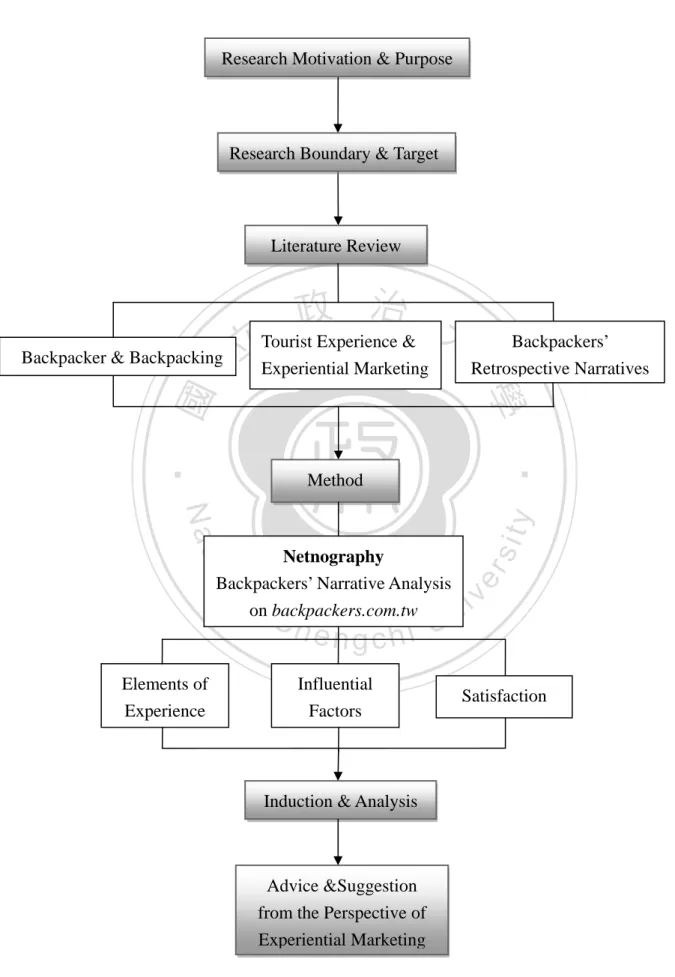
(10) . (Holbrook and Hirschman, 1982), and the transferring focus of economy into experience (cf. Pine and Gilmore, 1998; Schmitt, 1999) brings a universal issue of spending more money for an experience, such as traveling, which is believed to produce longer-lasting satisfaction. And, this is particularly true for “backpackers”, who tend to be motivated by experiential factors, compared with “tourists”. Because of this “experience hunger” in modern society, they are forced into becoming nomadic. Once they have consumed the experiences offered by one place, they need to move on to find new ones (Richards and Wilson, 2004). So, it can be inferred that compared to the external economic offerings,. 政 治 大 been engaged in an emotional, physical, intellectual, or even spiritual level (Pine and 立 experiences are inherently personal and exist only in the mind of individual who has. Gilmore, 1999). Looking in terms of consumer experience, impressive experiences. ‧ 國. 學. easily connect customers with a store, and memorable experiences generate strong. ‧. feelings of excitement, curiosity, joy, and surprise (Hanefors and Mossberg, 2003).. sit. y. Nat. Moreover, Arnould (2007) stresses the importance of the value of experiences to. io. er. consumers, and argued marketers need to know more about “…different types of consumers’ narrative frames and devices that consumers employ, the operation of. al. n. v i n Cways transportation or immersion, the narrative frames and devices facilitate U h e innwhich i h gc value-adding performances by firm-provided resources, and how marketer-provided. resources cue consumer narrative practices that turn performances into experiences.” Also, as Quan and Wang (2004) pointed out, tourism is surely one of the pioneer examples of the experience economy. Therefore, examining experiences of backpackers with particular cultural and national background should bring useful insights to both academia and marketing practitioners.. 2 .
(11) . Though researches regarding backpacker can date back to 1970’s, studies pertinent to the various conceptions and practical applications of the backpackers’ self-experiences is an area rarely explored.. 1.2 The Purpose of the Study. According to the co-investigation of “Money Magazine”, “Pension Fund Association,. 治 政 大“travel around the world” (洪素 the top one dream of life for them after retirement is to 立. R.O.C.”, and 104.com, above 80% of workers expect to retire before the age of 60. And,. 卿,2010). The reason may be verified in the researches of the tourism industry that. ‧ 國. 學. human beings tend to fulfill dream enactment and be self-actualized through travel. ‧. (Laing and Crouch, 2009). On the other hand, traveling can be seen as an experience of. sit. y. Nat. holistic immersion, which suggests that traveling experience (especially through the. io. er. form of backpacking) is truly valuable from the perspective of experiential marketing.. al. n. v i n Cexperiences, Previous literatures on tourist viewpoints from various fields, all h e n g cwith hi U. stress the importance of studying the narratives/storytelling of traveling experiences to gain more authentic insights (Dann, 2002; Carù and Cova, 2007; Elsrud, 2001; Noy, 2004; Sørensen, 2003; Uriely, 2002). Thus, understanding backpackers’ narrative interpretation of experience not only fits the global trend in the experience industry, but offers multidimensional insights to the propensity of marketing-oriented backpacking tourism industry. Research questions such as “What has been perceived or sensed when the backpackers step onto the backpacking journey?”, “What elements make a backpacker impressed when he or she describes a backpacking experience?” “What really satisfies them after they return from a journey recalling their experiences?” and 3 .
(12) . “What kinds of offerings can tourism industry provide for them?” In short, this study attempts to explore— (1) the elements/essence of outbound backpacking experiences by Taiwanese backpackers (2) the factors influencing their experiences (3) the indicators that point out their reasons of satisfaction (includes overall evaluation, recommendation, and willing of revisit) (4) the application of these experiences from the perspective of experiential marketing as. 政 治 大. reference for management, which provide advice for activity and marketing to enrich backpackers’ experiences.. 立. Nat. sit. y. ‧. ‧ 國. 學. 1.3 Research Boundary & Research Target. io. er. The research target in this study is Taiwanese backpackers. However, due to the design of methodology, only those who have registered as members on. al. n. v i n C h The following points backpackers.com.tw will be reached. demonstrate the selection engchi U criteria of this group of backpackers: ‧. Nationality: Taiwan (since the viewers of backpackers.com.tw include all the Chinese-speaking people, only Taiwanese backpackers will be selected.). ‧. Membership of backpackers.com.tw. ‧. Involvement: those who are chosen are not being passive viewers only; rather, they must be “self-reflexive” individuals and at least post one article on the website.. ‧. Backpacking history: at least one time of backpacking experience (as long as the experience is not in a form of package tour). 4 .
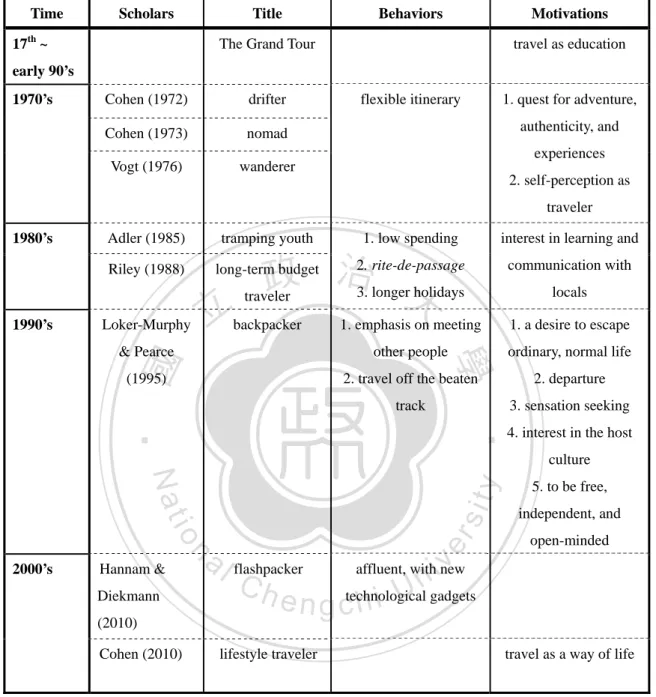
(13) . 1.4 Research Process. The above research questions will be explored following the research process indicated below (see also figure 1-1): Firstly, the concept of backpackers as a whole will be analyzed. Then, backpacking-related extraordinary experiences will be collected and integrated through past literatures, and based on the ideas discovered, the researcher intends to analyze Taiwanese backpackers’ outbound experiences via “retrospective narratives” from the most popular website of Chinese. 政 治 大 (Kozinets, 2002). Next, built on the findings from the previous phase, the components 立 backpackers—backpackers.com.tw, by using online ethnography, or netnography. which shape the “experiencescape” (O’Dell, 2005) of Taiwanese backpackers and the. ‧ 國. 學. influential factors that have impact on their experience will be pointed out. Finally,. ‧. according to the results of the findings, recommendations and insights will be drawn in. sit. y. Nat. satisfying the needs of Taiwanese backpackers from the perspective of experiential. io. er. marketing. Also, the study can shed light on the servicescape for both national and international tourism industries, and the management of online community for. n. al. backpackers in the long term.. Ch. engchi. 5 . i n U. v.
(14) . Figure 1-1: Research process of this research. Research Motivation & Purpose. Research Boundary & Target. Literature Review. Backpacker & Backpacking. 政 治 大 Experience & Backpackers’ 立Tourist Experiential Marketing Retrospective Narratives ‧. ‧ 國. 學. Method. n Elements of Experience. Ch. engchi. Influential Factors. Induction & Analysis. Advice &Suggestion from the Perspective of Experiential Marketing. 6 . er. io. al. sit. y. Nat. Netnography Backpackers’ Narrative Analysis on backpackers.com.tw. i n U. v. Satisfaction.
(15) . 2. Literature Review. In the following review of past literatures, three dimensions will be focused—backpacking, tourist experience pluses experiential marketing, and backpackers’ retrospective narratives.. Backpacker, as the research subject in this study, will be analyzed first. Since the research. 政 治 大 years, only their characteristics, typology, motivations, and behaviors will be focused here. 立 of backpackers covering wide ranges of exploration throughout the history lasts about 40. Section that follows is about experiences, including tourist experiences and experiential. ‧ 國. 學. marketing. The interconnections of people (backpackers) and experiences with the strategies. ‧. suggested by experiential marketers will be introduced in this part. Lastly, as it is agreed in. sit. y. Nat. literatures that the best way to analyze backpackers’ experiences is through their storytelling. io. er. or narratives, the relationship between the backpackers and their stories and the significance of travelling narratives is elaborated as the linkage with next methodology section about. al. n. v i n C h of narrative analysis. netnography combined with the technique engchi U. 2.1 Backpacker and Backpacking. Tourists stay in Hiltons, travelers don’t. [They] want to see the country at ground level, to breathe it, experience it—live it. This usually requires two things the tourist can’t provide—more time and less money. Wheeler et al (1992, p35). 7 .
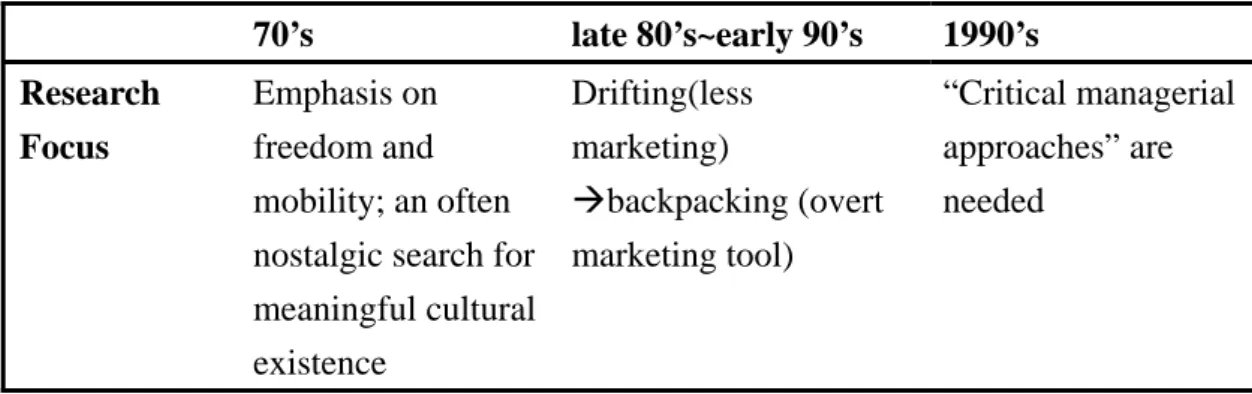
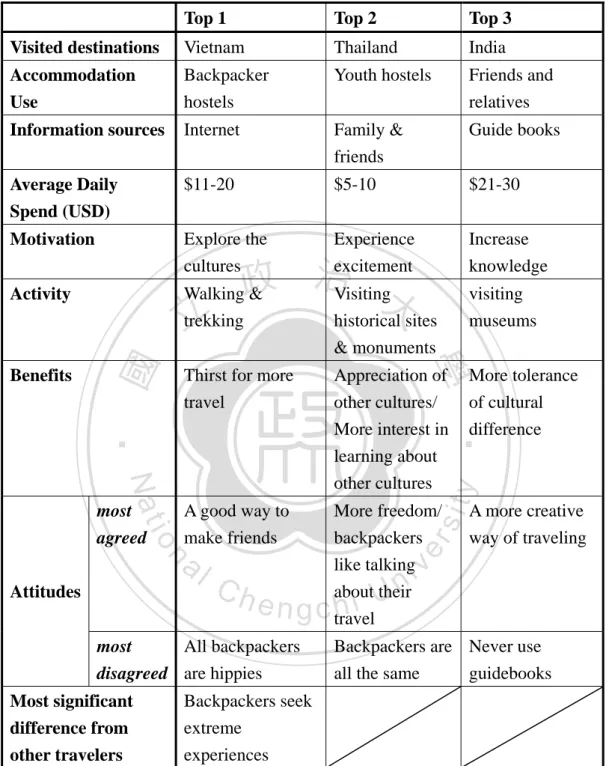
(16) . 2.1.1 Definition and Characteristic. In the history, traveling form that resembles backpacking the most can date back to the 17th to 18th centuries, when traveling made by the noble youth was seen as “Grand Tour” for the purpose of education. As movement of people, objects, capital, information and cultures across an increasingly globalised and apparently borderless world, there is more and more people prefer being “on the move” (Richards and Wilson, 2004). Gradually, a new form of travel is shaped, and Cohen (1972) is among. 政 治 大 typology of tourists, “drifter” is the prototype of the backpackers we perceive 立. the first ones who study this group of so-called “backpackers.” According to his. nowadays. In his later study (1973), he renamed these people as “nomad” based on. ‧ 國. 學. their specific behaviors. What followed is Vogt’s (1976) observation and he named. ‧. them “wanderer”, stressing their high mobility. Adler (1985) added further. sit. y. Nat. characteristics, and call them “tramping youth”, which indicated the young age and. io. er. behavioral pattern of these people. Focusing on another part, Riley (1988) found it more proper to call them “long-term budget traveler". Up until 1995, Loker-Murphy. al. n. v i n Cname and Pearce officially gave the in their study of this popular group U h e “backpacker” i h ngc of people in Australia. However, these travelers gradually become normalized and. institutionalized through increased mobilities (Noy, 2007; O’Reilly, 2006; Sørensen, 2003), especially ones through the help of new communication technologies. Currently, Hannam & Diekmann (2010) found a new emerging form—“flashpacker”, who are more affluent, with new technological developments, and have increased holidays and leisure time. What’s more, Cohen (2010) reconceptualised contemporary drifters as “lifestyle traveler”, who serves travel as a way of life that they may pursue indefinitely.. 8 .
(17) . Usually, backpacking takes place mostly as following modes: gap year travel, mini retirement, round the world travel, or volunteer abroad. And, their shared characteristics presented in the literatures can be grouped in terms of different behaviors and motivations. Behaviors such as “long-haul, have no rigid plans (i.e. flexible itinerary), and have a vague notion regarding their return (Cohen, 1972, 1973; Riley, 1988; Vogt, 1976), low spending (Riley, 1988), have more opportunities than tourists to initiate direct encounters with the local population, traveling “off the beaten track” (Richards and Wilson, 2004), and rite-de-passage (Turner, 1987)”, can best. 政 治 大 for adventure, authenticity, and profound experiences; and their self-perception as 立. describe them. And motivations can be illustrated with the statements, like “their quest. travelers rather than tourists (Cohen 1972, 1973; Riley, 1988; Vogt 1976), a desire to. ‧ 國. 學. escape ordinary, ‘normal’ (Urry, 2002) life, “departure” (Urry, 2002, p1), sensation. ‧. seeking, interest in the culture of the host country, and interest in learning and. sit. y. Nat. communicating with locals (Riley, 1988), and to be (or to feel) free, independent, and. io. er. open-minded (Richards and Wilson, 2004). Uriely et al. (2002) concluded that the heterogeneous nature of backpacking leads us to “regard multi-type backpackers as. al. n. v i n C hof experiences during ones who enjoy different types her/his excursion”, emphasizing engchi U the active role of the human actor as a consumer of tourism and the diverse nature of. contemporary touristic experiences. An integrated structure of the above discussion is illustrated in table 2-1 and table 2-2.. 9 .
(18) . Table 2-1: Definition and characteristic of backpacker (organized by the author). Time. Scholars. Title. th. Behaviors. Motivations. The Grand Tour. 17 ~. travel as education. early 90’s 1970’s. Cohen (1972). drifter. Cohen (1973). nomad. Vogt (1976). wanderer. flexible itinerary. 1. quest for adventure, authenticity, and experiences 2. self-perception as traveler. 1980’s. tramping youth. Riley (1988). long-term budget. 治2.3. rite-de-passage 政 longer大 holidays traveler. 立backpacker. communication with locals. 1. emphasis on meeting. 1. a desire to escape. & Pearce. other people. ordinary, normal life. (1995). 2. travel off the beaten. 2. departure. track. 3. sensation seeking. Loker-Murphy. 學. ‧. 4. interest in the host. er. io. sit. y. Nat. a l flashpacker v affluent, withinew n Ch e n g ctechnological h i U gadgets. n. 2000’s. interest in learning and. 1. low spending. ‧ 國. 1990’s. Adler (1985). Hannam & Diekmann (2010) Cohen (2010). lifestyle traveler. culture 5. to be free, independent, and open-minded. travel as a way of life. Sources: Cohen, 1972; Cohen, 1973; Vogt, 1976; Adler, 1985; Adler, 1989; Loker-Murphy & Pearce, 1995; Hannam & Diekmann, 2010; Cohen, 2010. 10 .
(19) . Table 2-2: Research History of Backpacker. Research Focus. 70’s. late 80’s~early 90’s. 1990’s. Emphasis on freedom and mobility; an often nostalgic search for meaningful cultural existence. Drifting(less marketing) backpacking (overt marketing tool). “Critical managerial approaches” are needed. Source: Hannam and Ateljevic, 2008. 政 治 大. Richards and Wilson (2004) tried to evaluate the activities and impacts of current. 立. backpackers for its significance for the tourism market through organizing a. ‧ 國. 學. transnational research. The need for market research that reveals more heterogeneity and is context-specific is stressed. According to the survey of Association of Tourism. ‧. and Leisure Education (ATLAS) Backpacker Research Group conducted in 2002,. Nat. sit. y. several issues of backpackers are examined, including traveler type (backpacker,. n. al. er. io. traveler, and tourist), destinations visited, accommodation used, information sources,. i n U. v. average daily spend, motivations (4 factors: experience seeking, relaxation seeking,. Ch. engchi. sociability, contributing to destination), activities, benefits. This transnational survey was comprised of over 2300 responses, from 8 countries, 42 different nationalities. A summary is presented in table 2-3.. 11 .
(20) . Table 2-3: Motivations, Behaviors, and Attitudes of Backpackers Worldwide. Top 1. Top 2. Top 3. Visited destinations. Vietnam. Thailand. India. Accommodation Use. Backpacker hostels. Youth hostels. Friends and relatives. Information sources. Internet. Family & friends. Guide books. Average Daily Spend (USD). $11-20. $5-10. $21-30. Motivation. Explore the cultures. Experience excitement. Increase knowledge. Activity. Walking & trekking. ‧ 國. historical sites & monuments. Thirst for more travel. Appreciation of other cultures/ More interest in learning about other cultures. A good way to make friends. More freedom/ backpackers like talking about their travel. y. sit. n. al. er. io. Attitudes. Ch. engchi. All backpackers most disagreed are hippies Most significant difference from other travelers. More tolerance of cultural difference. ‧. Nat. most agreed. visiting museums. 學. Benefits. 立. 政 治Visiting大. i n U. v. Backpackers are Never use all the same guidebooks. Backpackers seek extreme experiences. Source: Richards and Wilson, 2004 (re-organized by the author). 12 . A more creative way of traveling.
(21) . 2.1.2 Backpacking—typology. The typologies of backpacking differ in accordance with various perspectives. Loker-Murphy (1996) identifies four subgroups of backpackers with respect to their motivations: escapers/relaxers, social/excitement-seekers, self-developers, and achievers. According to Pearce’s (1982) “Travel Career Ladder”, escapers/relaxers require the lowest psychological needs, and achievers the highest. Uriely et al. (2002) integrated previous literatures and contended that backpacking can be viewed in two. 政 治 大 practices by which tourists organize their journey: length of trip, flexibility of the 立. ways—a form or a type. The former refers to “visible institutional arrangements and. itinerary, visited destinations and attractions, means of transportation and. ‧ 國. 學. accommodation, contact with locals, and so forth”, while the latter refers to “less. ‧. tangible psychological attributes, such as tourists’ attitudes toward fundamental values. sit. y. Nat. of their own society, their motivations for travel, and the meanings they assign to their. io. er. experiences.” It was concluded by the above research that backpackers may have more than one type of experience across their backpacking biography or even during a. al. n. v i n C h should be viewed single trip. Furthermore, backpackers as ones who enjoy different engchi U types of experiences during his/her excursion. Therefore, Uriely et al. made a. conclusion that Israel backpackers commit to the form of backpacking, while its type-related aspects are more heterogeneous.. Hence, the following part will focus on analyzing tourist experiences as a whole, and extracting the essential formation of backpacking experiences. Then, the development of experiential marketing will be introduced.. 13 .
(22) . 2.2 Tourist Experience and Experiential Marketing. “…spending more money for an experience—concert tickets, French lessons, sushi-rolling classes, a hotel room in Monaco—produces longer-lasting satisfaction than spending money on plain old stuff.” NY Times “But Will It Make You Happy?” (7,Aug., 2010). 2.2.1 Tourist Experience. 政 治 大 Tourist experiences infuse the mundane.” 立. McCabe (2002). ‧ 國. 學 ‧. According to Oxford English Dictionary, experience is defined in two ways as. sit. y. Nat. “practical contact with and observation of facts or events” or “an event or occurrence. io. er. which leaves an impression on someone.” Thus, resulting from direct observation of or participation in events is the core meaning which this word signifies. In academic. al. n. v i n literatures, “an experience isC made up inside a person h e n g c h i U and the outcome depends on. how an individual, in a specific mood and state of mind, reacts to the interaction with the staged event.” (Pine & Gilmore, 1999). In a word, experiences are something personally encountered, undergone, or lived through, and the individual personally learns obtains, and accumulates conscious or unconscious feeling, knowledge or skill. In this study, the backpacker is seen as an experiencing subjective, and what they experience during the journey is thus examined. Larsen (2007) tried to define tourist experience through his finding from the perspective of psychology as follows:. 14 .
(23) . “A tourist experience is a past personal travel-related event strong enough to have entered long-term memory.”. The past studies of tourist experiences indicate the research focus on examination of discourses and dynamics of interaction between tourism and everyday life. The importance of tourist experience is stressed, and further, this kind of experience requires more than one sense, a longer period of time, which enables tourists to be fully immersed.. 政 治 大 Since Pine & Gilmore (1999) announced the emergence of the experience economy, 立. more and more studies aim to explore this fascinating area, including the tourism. ‧ 國. 學. studies, as it is a necessity to provide an experience which can satisfy the needs of. ‧. tourists. Researches on tourist experience (cf. Cohen, E., 1979; Dann, G., 2002;. sit. y. Nat. Henning, 2002; MacCannell, 1973; MaCabe, 2002; Urry, 1995) shows the efforts to. io. er. understand these group of experiencing subjects in tourism industry. Cohen (1979), based on the premise that everyone search for meanings in terms of the “quest for a. al. n. v i n Cofh “five modes of tourist center”, developed a typology experiences” that range engchi U. between tourism motivations on one end and the attitudes toward daily life on the other. He referred to these five types of experiences as: (1) Recreational mode—committed to the center of one’s own society, while the traveling experience for them serves the need for relaxation and entertaining (2) Diversionary more—involves the pursuit of mere pleasure without any quest for a center. This type of tourist looks for escape. (3) Experiential mode—involves a search for meaning in the centers of other cultures. This type of tourist enjoys observing the “authentic life” of others without any attempt to be converted or even engaged in their life. 15 .
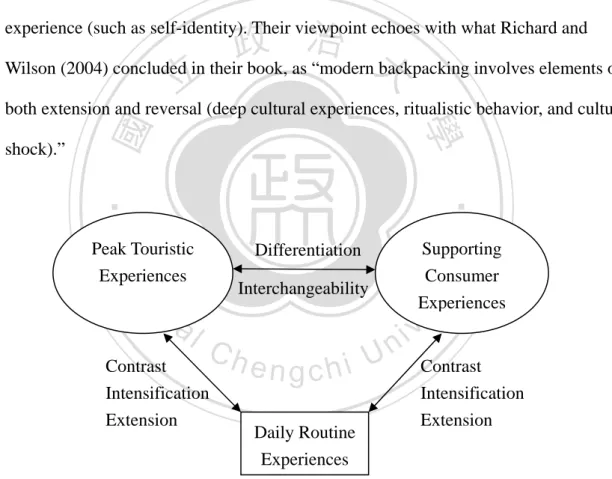
(24) . (4) Experimental mode—involves a search for meaning in the centers of other cultures. Usually found in drifter-like form of tourism, they try out the authentic life of others. (5) Existential mode—involves a search for meaning in the centers of other cultures. They already commit to an “elective center”, which can be associated with pilgrims.. On the other hand, in terms of psychological angle, Larsen (2007) suggested that “individual experiences, as they are formed within the individual by means of psychological processes is one, but only one, viable focus for tourism research if the. 政 治 大 threefold idea of the phenomenon of the tourist experience—expectations, event, and 立 aim is to understand (i.e. to explain and predict) tourist behavior.” Thus, he proposed. memory—which are believed to be the general psychological process of the formation. ‧ 國. 學. of tourist experiences. The stage of memory is especially emphasized on the statement. ‧. that “episodic memory consisted in long-term memory is the individual store of. sit. y. Nat. factual memories concerning personal experiences”, which suggests that tourist. io. er. experiences are stored in an episodic way and what becomes episode ends finally in our long-term memory. Thus, he concluded that “the best predictor of the desire to. al. n. v i n repeat a trip is memories of C the trip, indicating theU h e n g c h i importance of retrospective measures when the issue is tourist experience.”. Further, Quan and Wang (2004) provided a conceptual framework for identifying the position and the role of total tourist experience. According to them, there are two perspectives so far in the literatures regarding tourist experience—one from social science and the other from marketing/management. The former regards tourist experience as “experience contrast to daily experience” (i.e. Peak Experience), which mainly derived from attractions; the latter sees tourist as consumer, so tourist experience equals to consumer experience that is an extension of the daily experience, 16 .
(25) . such as accommodation or transportation. According to their integrated conceptual framework as showed in figure 2-1, they found both peak touristic experiences and supporting consumer experiences are interchangeable; in other words, some components of supporting consumer experience can turn to be peak experience, and vice versa. Also, the specific relationship between the tourist experience and the daily experience lies in three dimensions: the tourist experience is in sharp contrast to the daily experience (such as “routine” vs. “unusually”, “the familiar” vs. “novel” etc.); it is the extension of the daily experience, and it is the intensification of the daily. 政 治 大 Wilson (2004) concluded in their book, as “modern backpacking involves elements of 立 experience (such as self-identity). Their viewpoint echoes with what Richard and. both extension and reversal (deep cultural experiences, ritualistic behavior, and culture. ‧. ‧ 國. 學. Nat. Peak Touristic Experiences. y. Supporting Consumer Experiences. Interchangeability. n. er. io. al. Differentiation. sit. shock).”. Ch. Contrast Intensification Extension. engchi Daily Routine Experiences. i n U. v. Contrast Intensification Extension. Figure 2-1: The conceptual model of the tourist experience (Source: Quan and Wang, 2004). To conclude, they pointed out that “tourism is in a sense involved in our aesthetic or sensual existence.” Urry (2002, p146), in his book “The Tourist Gaze”, also suggested 17 .
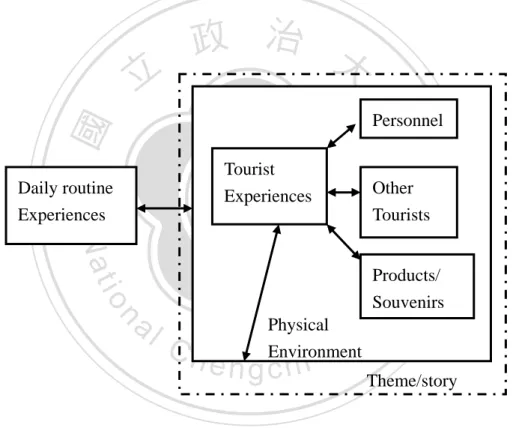
(26) . that “tourism should involve various sensescapes, such as soundscapes, smellscapes, tastescapes, geography of touch, in addition to landscapes.” This echoes what is emphasized in the theories of experiential marketing.. Further, Mossberg (2007) proposed a marketing approach to the tourist experience. This is a precursor to her research a year later finding that the facilitators of an extraordinary tourist experience are “involvement, co-creation, and guide” (Mossberg, 2008). Factors influencing the tourist experience are illustrated as figure 2-2 shows.. 立. 政 治 大 . ‧ 國. 學. Personnel Tourist Experiences. Other Tourists. ‧. Daily routine Experiences. n. er. io. sit. y. Nat. al. Products/ Souvenirs. Ch. i n U. Physical Environment. engchi. v. Theme/story. Figure 2-2: Proposed factors influencing the consumer experience within the context of tourism (Source: Mossberg, 2007). This framework further revised Quan and Wang (2004)’s and provided the influential factors of tourist experiences. These selected factors are further explained in the following for its importance of tourist experience. 18 .
(27) . ‧. The effects of physical environment The ambient elements are stressed. The pioneering work of Kotler (1973) on atmospherics as a marketing tool was a starting point for discussions concerning environmental influences on consumer behavior. Another inspiration was the article by Belk (1975) on “situational variables.”. ‧. The effects of personnel Research about service encounters, such as “critical incident technique” (Bitner et al, 1994), has been conducted based on different methods. As Arnould and. 政 治 大 experience are embedded in relationships between consumer and service 立. Price (1993, p41) noted, “Emotional outcomes associated with extraordinary. provider.” “Interactive skills” rather than technical skills of employees should be. ‧ 國. 學. focused more on training. Examples are like opera singing waiters and chefs (e.g.. The effects of other tourists. sit. y. Nat. ‧. ‧. Hanefors & Mossberg, 2003). io. er. “Positive aspects of togetherness” is pointed out in certain literatures. It is also argued that an exciting and stimulating audience can enhance the experiences.. al. n. v i n C h value if the participants Also, a subculture can enhance are members in a club. engchi U. ‧. The effects of products and souvenirs. Gordon (1986) brought up five types of souvenirs—pictorial, such as images on postcards, piece of the rock, a natural item like coral, symbolic shorthand, a manufactured item such as a porcelain replica of a Chinese temple, markers, like inscribed t-shirts, and local products, which for instance can be peanuts from Gambia. To him, the souvenir is a reminder of an experience that differs from daily routine and that otherwise would remain intangible. The souvenirs can remind of people, places, and events. ‧. The effects of a theme or story 19 .
(28) . According to Gilmore and Pine (1999) a service turns into an experience automatically when using a theme. “A good story needs to have an arena, characters, and a structure. The arena is the experiencescape where the action/consumption takes place and the characters can be both the personnel, but also other tourists consuming simultaneously. The structure often consists of the presentation of the story, the conflict, and the solution.” However, two questions still remain unsolved in the literatures are “How tourists perceive the theme/story?” and “How the theme/story is linked to the tourist’s experience and satisfaction?”. 立. 政 治 大. After understanding the constitution and essence of tourist experience, several. ‧ 國. 學. researches (Mossberg, 2008; Carù and Cova, 2006) further propose the important. ‧. concept of “immersion”, which is defined by Carù and Cova (2006) as “a moment of. sit. y. Nat. intensity that a consumer lives through.” Firstly, context factors are examined. Carù. io. er. and Cova (2007) stated that three qualities that constitute the underlying foundations of the context are: (1)thematized, (2) enclavized, and (3) secure. In such an. al. n. v i n C hleaving social hierarchy environment, tourists can relax, and status behind and engchi U. meeting others in a natural and friendly way (Wang, 1999). This is very close to what Turner (1987) mentioned “the state of liminality”, which make people temporally let go of ay condition outside or on the peripheries of everyday life—a state of being pilgrims. Second, Arnould & Price (1993) emphasized the necessity of studying the touring process because it is there that meaning is created. They specifically emphasize: (1) affect, (2) narrative, and (3) ritual understanding. Third, Wakefield and Blodgett (1994) found in their study on servicescapes in leisure settings that involvement had a strong influence on excitement and re-patronage intentions. Based on their results, they suggest that the servicescape should be designed to enhance 20 .
(29) . entertainment and involvement. Lastly, in Carù and Cova (2006)’s article, “operations of appropriation” are provided as a base to evaluate the state of immersion: (1) Nesting—feeling like home and familiarity (2) Investigating—context knowledge is enhancing in order to develop points of anchorage and control (3) Stamping—personal attribution, imbue with personal meaning. To conclude, researchers should focus more on consumer/tourist’s attitudes,. 政 治 大 non-ordinary, degree of involvement, and search for authenticity. Try to make 立. feelings, behaviors, their need for fantasies and dreams, their consumption in the. consumers/tourists see and act on the scene, take an interest and co-create. The issue. ‧ 國. 學. of creating a unique personal experience in the journey is the top priority.. ‧. n. er. io. sit. y. Nat. al. Ch. engchi. 21 . i n U. v.
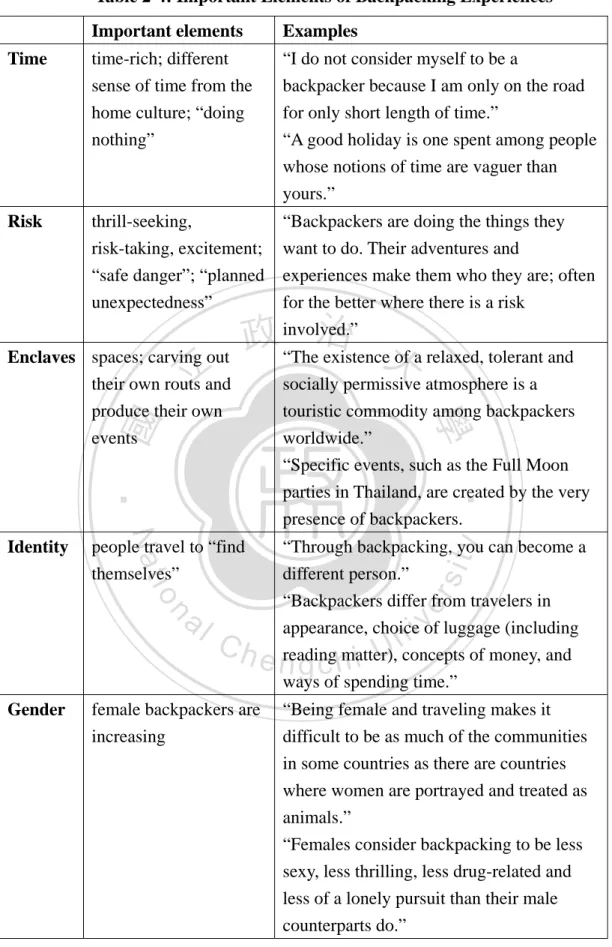
(30) . 2.2.2 Backpacker as a Collector and Creator of Experiences. “…the continuing development of reflexive self-identity and the ability to project the desirable attributes of aesthetic cosmopolitanism (Urry 1995) are the key benefits of backpacker experience, and that these can have an impact on people’s life trajectory in both career and personal spheres.” O'Reilly( 2006). 政 治 大 elements of both extension and reversal (deep cultural experiences, ritualistic behavior, 立 According to Richard and Wilson (2004), “…modern backpacking seems to involve. and culture shock)”, which reinforces Quan and Wang (2004)’s finding about peak. ‧ 國. 學. experience and supporting experience. They further concluded five most important. ‧. elements of backpacking experiences (see also table 2-4):. sit. y. Nat. (1) time: time-rich; different sense of time from the home culture; “doing nothing”. io. er. (2) risk: thrill-seeking, risk-taking, excitement; “safe danger”; “planned unexpectedness”. al. n. v i n C hout their own routesUand produce their own events (3) enclaves: spaces; they carve engchi (4) identity: finding oneself (5) gender issues. 22 .
(31) . Table 2-4: Important Elements of Backpacking Experiences Important elements. Examples. Time. time-rich; different sense of time from the home culture; “doing nothing”. “I do not consider myself to be a backpacker because I am only on the road for only short length of time.” “A good holiday is one spent among people whose notions of time are vaguer than yours.”. Risk. thrill-seeking, risk-taking, excitement; “safe danger”; “planned unexpectedness”. “Backpackers are doing the things they want to do. Their adventures and experiences make them who they are; often for the better where there is a risk involved.” socially permissive atmosphere is a touristic commodity among backpackers worldwide.” “Specific events, such as the Full Moon parties in Thailand, are created by the very presence of backpackers.. y. Nat. io. n. al. Gender. “Through backpacking, you can become a different person.” “Backpackers differ from travelers in appearance, choice of luggage (including reading matter), concepts of money, and ways of spending time.”. sit. people travel to “find themselves”. er. Identity. ‧. ‧ 國. 立. 學. Enclaves spaces; carving out their own routs and produce their own events. 政 “The治 existence大 of a relaxed, tolerant and. Ch. engchi. female backpackers are increasing. i n U. v. “Being female and traveling makes it difficult to be as much of the communities in some countries as there are countries where women are portrayed and treated as animals.” “Females consider backpacking to be less sexy, less thrilling, less drug-related and less of a lonely pursuit than their male counterparts do.”. Source: Richard and Wilson, 2004. 23 .
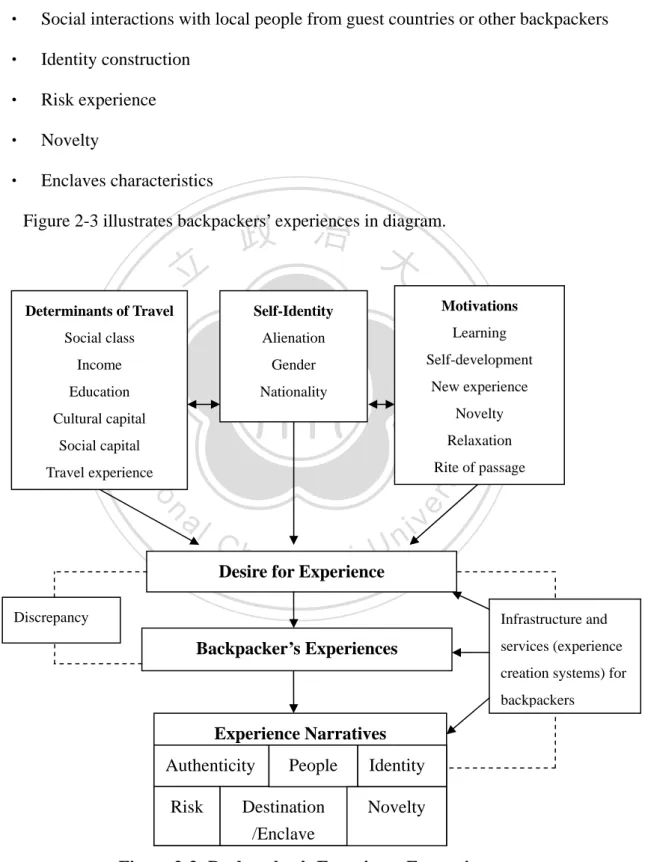
(32) . Other researcher also provided their own findings. For example, Elsrud (2001) found that “experiences of novelty, of places never before seen, of situations never experienced, of people never met” are the most indispensable in backpacking experiences. Others stressed the “experience of adventure, risk, and authenticity” (Elsrud, 2001; Noy, 2004), and still the others highlighted on “social interaction and meeting others is an integral part of the experience” (Murphy, 2001).. Wang (1999) explored the idea of authenticity deeply, and found out that only. 政 治 大 her research, she further divided authenticity into two kinds—intrapersonal and 立. activity-related existential authenticity can explain the diverse tourist experiences. In. interpersonal. The former covers bodily feelings and self-making, and the latter stresses. ‧ 國. 學. the “touristic communitas.” (i.e. similar with pilgrimage, and the pleasure of sharing. ‧. and communicating with other tourists). Carù & Cova (2006) investigated “immersion”. sit. y. Nat. experience of consumers, and this can also be viewed with combination of Pine &. io. er. Gilmore (1999)’s idea about the experience subject’s “escapist” experience, which involves active participation and immersion. This way, it can be induced that. al. n. v i n C hexperiences by departure backpacker try to make the best from daily routine engchi U experiences, through fully immersion and active involvement.. To sum up, the idea of backpacking roots mainly from Western countries, while in Taiwan we refer this similar phenomenon as a new form of travel—自助旅行(which means the traveler basically organizes everything, including pre-tour, on-tour, and post-tour stages of plans, by him/herself.) Judging from the development of backpacking phenomenon in Taiwan so far, Taiwanese backpackers embrace most of the characteristics, behavioral or motivational, which are discussed above. Though. 24 .
(33) . slightly different from person to person, or occasion to occasion, backpacking experience on principle is unique in the following aspects, compared with package tour: ‧. Taste for authenticity. ‧. Social interactions with local people from guest countries or other backpackers. ‧. Identity construction. ‧. Risk experience. ‧. Novelty. ‧. Enclaves characteristics. 政 治 大. Figure 2-3 illustrates backpackers’ experiences in diagram.. 立. Motivations. Social class. Alienation. Income. Gender. Self-development. Education. Nationality. New experience. Learning. ‧. ‧ 國. Self-Identity. 學. Determinants of Travel. Novelty. Cultural capital. Nat. y. Relaxation. sit. Social capital. Rite of passage. io. n. al. er. Travel experience. Ch. engchi. i n U. v. Desire for Experience. Discrepancy. Infrastructure and. Backpacker’s Experiences. services (experience creation systems) for backpackers. Experience Narratives Authenticity Risk. People. Destination /Enclave. Identity Novelty. Figure 2-3: Backpacker’s Experience Formation (Source: adapted from Richards & Wilson, 2004, p269) 25 .
(34) . 2.2.3 Experiential Marketing and Experiential Value. According to Pine and Gilmore (1999), “Experiences are events that engage individuals in a personal way.” Many relevant arguments regarding experiences were proposed, such as experience economy (Pine and Gilmore, 1999), experiential marketing (Schmitt, 1999), and the dream society (Jenson, 1999). It is a concept that integrates elements of emotions, logic, and general thought processes to connect with the consumer. Its goal is to establish the connection or a sense of rapport in such a. 政 治 大 rational response levels. It focuses on inspiring thoughts about comfort and pleasure 立. way that the consumer responds to a product offering based on both emotional and. and inspiring a sense of practicality. The experiential perspective is phenomenological. ‧ 國. 學. in spirit and Holbrook and Hirschman (1982) perceived consumption as a primarily. ‧. subjective state of consciousness with various symbolic meanings, hedonic responses,. sit. y. Nat. and esthetic criteria. The consumption experience is accordingly regarded as a. io. er. phenomenon directed toward pursuing fantasies, feelings, and fun. For marketing practice, experience is considered as offering, and companies can create or even. al. n. v i n C hcustomers’ individual customize experiences to fulfill needs. Experience, which engchi U. represents customers’ personal sensations of feeling and fulfills customers’ inner needs, is becoming a key element of a new economic stage (cf. Pine and Gilmore, 1999; Schmitt, 1999).. In order to know better about what experience is, some scholars had made some discussions. For instance, Carù and Bernard (2008) thought “experience is associated with two things—(1) feelings of great intensity that will extract the experience from the normal flow of everyday life, and (2) framing operations that serve to translate ongoing activities into reportable stories. And, Jensen (1999) suggests that people do 26 .
(35) . not want to buy the products, but rather the stories and the experience behind the product. Carlson (1997) believed that an experience can be defined as a constant flow of thoughts and feelings that occur during moments of consciousness. Finally, “An experience is made up inside a person and the outcome depends on how an individual, in a specific mood and state of mind, reacts to the interaction with the staged event” (Pine & Gilmore, 1999; Wang, 2002; Mossberg, 2003).. On the other hand, O’Dell (2005) defines “experiencescape” as “a space of pleasure,. 政 治 大 move about and come in contact with each other.” Mossberg (2007) also stressed that 立 enjoyment and entertainment, as well as the meeting ground in which diverse groups. “in tourism it is highly relevant to consider the process of construction of the space as. ‧ 國. 學. it is done by the tourists and not only as a component element of the environment, but. ‧. also as a co-creator, which gives meaning to the place.” Therefore, she found that “…. sit. y. Nat. create dream worlds, which consumers can dive into. These dream worlds contain. io. er. stages, where tourists can play different roles, they represent meeting places, where people can interact, and arenas, where tourists can experience new things.”. n. al. Ch. engchi. i n U. v. There are two premises to explain the concept of experience. First, experiences address the psychic needs of a society (cf. Schmitt, 1999). What customers nowadays want are offerings that “dazzle their senses, touch their heart, and simulate their minds.” (Schmitt, 1999, p22) Second, customers are emotional as well as rational (Schmitt, 1999). In other words, customers are emotionally driven while experiences are directed toward pursuing fantasies, feelings, and fun (Schmitt, 1999; Holbrook and Hirschman, 1982).. 27 .
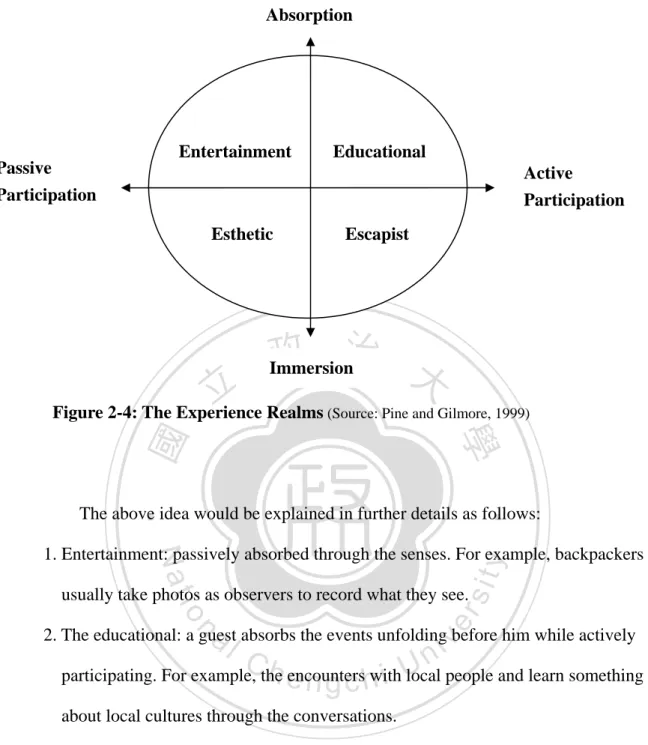
(36) . Pine and Gilmore (1999)’s idea about experience economy partly responded to the above discussions. They claimed that each experience derives from the interaction between staged event (like a theatrical play) and the individual’s state of mind. The authors thereby defined that an experience happens “when a company intentionally uses services as the stage and goods as props, to engage individual customers in a way that created a memorable event” (Pine and Gilmore, 1999, p98). Similar concept concerning the link between consumer experience and theatre is what Grove et al.(2000) stated that “the people (actors), processes (script) and physical environment. 政 治 大 the notion of the staging a performance in delivering memorable experience (Pine and 立. (set) are parallel to a live theatrical performance. This theatrical approach conforms to. Gilmore, 1999).. ‧ 國. 學 ‧. According to another statement of Pine and Gilmore (1999), there are two most. sit. y. Nat. important characteristics for an experience. The first is the level of guest participation.. io. er. One end lies passive participation, where customers do not directly affect or influence the performance. And, the other end lies active participation, in which customers. al. n. v i n C h or event that yields personally affect the performance the experience. The second engchi U describes the kind of connection, or environmental relationship, which unites. customers with the event or performance. At one end lies absorption—occupying a person’s attention by bringing the experience into the mind—at the other end immersion—becoming physically (or virtually) a part of the experience itself. The dimensions of the four “realms” of an experience—entertainment, education, escape, and estheticism—is showed in figure 2-4.. 28 .
(37) . Absorption. Entertainment. Educational. Passive Participation. Active Participation Esthetic. 立. Escapist. 政 治 大. Immersion. Figure 2-4: The Experience Realms (Source: Pine and Gilmore, 1999). ‧. ‧ 國. 學. The above idea would be explained in further details as follows:. sit. y. Nat. 1. Entertainment: passively absorbed through the senses. For example, backpackers. n. al. er. io. usually take photos as observers to record what they see.. i n U. v. 2. The educational: a guest absorbs the events unfolding before him while actively. Ch. engchi. participating. For example, the encounters with local people and learn something about local cultures through the conversations. 3. The Escapist: experience actively participates in an immersive environment. For example, when backpackers are totally immersed in the guest cultures and live as the locals do. 4. The Esthetic: individuals immerse themselves but remain passive. For example, when backpackers are in front of breath-taking natural beauties and are stunned by them.. 29 .
(38) . So, we can say that backpacking experiences are included in these four quadrants of experiences. However, according to the previous discussion, it can be inferred that “the escapist” is the most important because of the active involvement and immersion.. Another claim of Pine and Gilmore’s (1999) is the economic distinction of experience. The nature of its offering is memorable, its key attribute is personal, its method of supply is revealed over duration, its seller is the stager and the buyer is the guest, and the factors of demand are sensations. They further argued that “while the. 政 治 大 concept of “experience value” was synthesized by Mathwick (2002) from scholars of 立 work of the experience stager perishes the value of the experience lingers.” The. 80’s dedicating to the two classification of consuming value: (1) utility (2) hedonism.. ‧ 國. 學. While the experience values are highlighted, Schmitt (1999) stressed that business. ‧. enterprisers should return to the basic concept of experience modules and providers.. sit. y. Nat. His important pioneer finding is the five strategic experiential modules (SENSE,. io. er. FEEL, THINK, ACT, and RELATE) and seven experience providers (communication, signage verbal identity, product presence, co-branding, spatial environment, electronic. al. n. v i n C hshows the experiential media, and people). Figure 2-5 gird provided by him: engchi U. 30 .
(39) . ExPro . E . SENSE FEEL THINK . ACT . M RELATE . . . Enriching VS. Simplifying . Broadening VS. Focusing . S . . Connecting. Intensifying VS. Diffusing . Separating . 政 治 大. 立. Figure 2-5: Strategic Issues of the Experiential Grid (Source: Schmitt, 1999). ‧ 國. 學. Matching this strategic experience module with backpackers’ experiences, several. ‧. interconnections are showed:. y. Nat. ‧. FEEL—affective experiences—backpacker’s motivations. ‧. THINK—creative cognitive experiences—identity construction/ skill cultivating. n. al. er. sit. SENSE—sensory experiences—Urry (2002)’s “gaze” about visual excitement. io. ‧. of backpackers. Ch. engchi. i n U. v. ‧. ACT—behaviors and lifestyles—lifestyle traveler/backpacker. ‧. RELATE—social-identity experiences that result from relating to a reference group or culture—backpacker enclaves and virtual online community. Concluding from all the researches mentioned above, experiences are regarded as outcomes, which result from individual’s participation in consuming or purchasing activities. During the process of consuming or purchasing, customers themselves obtains sensation, feeling, change of knowledge or skill, and memory. Therefore, 31 .
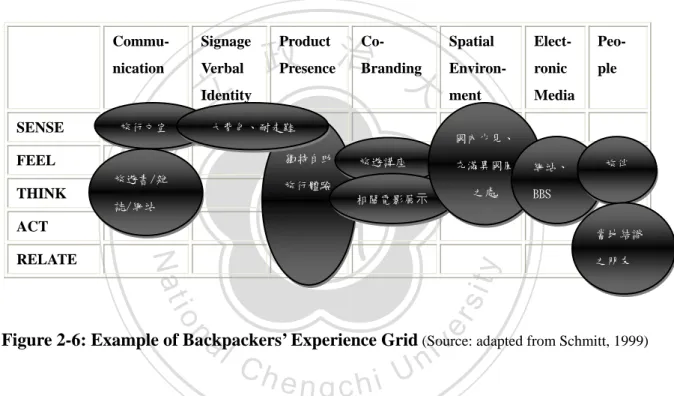
(40) . experience is inferred as an output of consuming—coming along with goods or services. Additionally, experiences are seen as distinct offerings, which are different from products and services, owing to meeting with customers’ inherent, internal, personal, emotional or psychic needs. To combine backpacker experiences from the perspective of experiential marketing, it can be illustrated as an example like how figure 2-6 demonstrates:. Commu-. Signage. nication. Verbal. 立. Identity. Peo-. Environ-. ronic. ple. ment. Media. 旅遊講座. 充滿異國風. 旅行體驗. 之處. 相關電影展示. 誌/網站. 旅伴. 網站、 BBS. 當地結識 之朋友. n. al. er. io. sit. y. Nat. RELATE. Elect-. ‧. ACT. Spatial. 國內少見、. 獨特自助. 旅遊書/雜. THINK. Co-. 大背包、耐走鞋. ‧ 國. FEEL. 旅行文宣. Product. 學. SENSE. 治Branding 政 Presence 大. i n U. v. Figure 2-6: Example of Backpackers’ Experience Grid (Source: adapted from Schmitt, 1999). Ch. engchi. For practical and market purpose, Pine and Gilmore (1999) developed an experience design, showing business a way to design and manage customers’ experiences. They contended that what companies need is a well-organized, comprehensive strategy of managing customers’ experiences. They identified five key principles of experience design. The first is giving a theme to the experience, which means companies need to create a well-defined and consistent theme that ties all the design elements together into a staged experience. The second is harmonizing. 32 .
(41) . impressions with positive cues. Because positive cues can provide customers with desirable impressions, companies need to manage cues that are consistent with the theme. The third principle of experience design is eliminating negative cues that diminishes, contradicts or distracts from the theme. Poor cues create more displeasured customer experiences. The forth is mixing in memorabilia. As they themselves mentioned, if business have allowed the first three principles, their customers would be willing to pay for memorabilia as physical reminders and commemoration of experiences. The fifth is engaging all five senses. Accompanying. 政 治 大 principle is very similar to Schmitt (1999)’s sense making. With well-organized senses, 立 with sensory stimulants, experiences are more impressible and more memorable. This. sense marketing can create unique sensory experiences to differentiate companies and. ‧ 國. 學. products, motive customers and deliver value to customers. Table 2-5 demonstrates. ‧. the experience design process.. n. er. io. sit. y. Nat. al. Ch. engchi. 33 . i n U. v.
(42) . Table 2-5: Experience Activity Design Design Process. Meaning. Implement. Examples of Backpacking. Theme the. Envision a well-organized. 1. An engaging theme must alter a guest’s sense of reality.. Luxury Holiday. experience. theme and script a. 2. Alter fully one’s sense of reality by affecting the experience of space, time, and matter.. Frontier adventure. participative story. 3. Engaging themes integrate space, time, and matter into a cohesive, realistic whole.. 政 治 大 5. A theme should fit the character of the enterprise staging the experience. 立 1. Time: traditional, contemporary… 4. Themes are strengthened by creating multiple places within a place.. impressions. indelible impressions.. with positive. 2. Space: city/country, East/West, home/business. 4. Authenticity: original or imitative. 3. Technology: natural. y. sit er. al. n. distracts from the theme.. io. eliminate anything that. Nat. negative cues. Too many haphazard cues can ruin an experience. Ch. i n U. 4. Authenticity: local and original. 6. Scale: representing the theme as grand or small Experience stagers. 2. Space: exotic, extraordinary, relaxing. 5. Sophistication: luxurious/cheap. Eliminate. 1. Time: flexible. 3. Technology: hand-made/machine-made, natural/artificial. ‧. cues. ‧ 國. The experience must leave. 學. Harmonize. v. No tour-related elements. Mix in. People purchase. 1. Selling memorabilia associated with an experience. flags, local coins or. memorabilia. memorabilia as tangible. 2. Turning items inherently part of the experience into personalized memorabilia. paper bills, badge…. artifacts of experiences.. 3. To give the memorabilia away. engchi. 4. Develop a wholly new sort of memorabilia. Engage the five. The more sensory an. The more effectively an experience engages the senses, the more memorable it will be.. sight—landscapes. senses. experience, the more. Experience-based enterprises will require architectural and musical skills not just to. local market—smell. memorable it will be.. design buildings and select music but to fill the experience with senses that make sense.. local food—taste. Source: Pine and Gilmore, 1999 34 .
(43) . 2.3 Retrospective Narratives of Backpacking Experiences. “One can legitimately argue that tourism is grounded in discourse.” Graham Dann (1996), The Language of Tourism. In everyday speech, we often hear references about the “language of dance”, the “language of architecture”, the “language of music”, and so on. How about the language of tourism, or the “language of backpacking”? Padgett et al. (1997) analyzed storytelling of experiences from the perspective of drama and narrative interpretation of experience. They believed that “drama” can be used to describe the consuming-related context, and. 政 治 大. apply to what Holbrook and Hirshman(1982)’s idea of “consumer experience.” Fog et al. 立. (2003) stressed their idea further in saying that “a story is built on common fundamental. ‧ 國. 學. elements in dramaturgy, such as message, conflict, division of roles and action.” On the. ‧. other hand, the interpretation of experience involves the domain of narrative psychology, which is premised on the idea that “people have a natural propensity to organize. y. Nat. io. sit. information about people and their actions in story format.” Also, narrative theory. n. al. er. explains that people relate their interpretations of experience to others by narrating. This. Ch. i n U. v. perspective was clearly illustrated by Bruner (1986)’s Narrative mode of thought, in. engchi. which the goals are the understanding and construction of meaning. It mainly emphasizes on the self-relevant reflection on experience. This narrative mode seeks to orient experience in time and location by use of case studies and interpretation. The evaluation is based on causality. Bruner himself suggested people use the narrative mode of thought to understand storied stimuli (including causality/chronologically connected events enacted by characters; involving actors with motives, an event sequence, and a setting that has physical, social, and temporal components). Other theorists echo Bruner's contention that people use narrative to understand experience (Sarbin, 1986).. 35 .
數據
+7
相關文件
Boston: Graduate School of Business Administration, Harvard University.. The Nature of
The second question in this paper is raised from the first question – the relationship between constructing Fo Guang Pure Land and the perspective of management beginning
This study intends to bridge this gap by developing models that can demonstrate and describe the mechanism of knowledge creation activities from the perspective of
Therefore, the focus of this research is to study the market structure of the tire companies in Taiwan rubber industry, discuss the issues of manufacturing, marketing and
In this study, we took some elementary schools located in Taichung city as samples to analyze the quality properties of academic administration services from the perspective
As a result banks should be so proactive as if they are doing the marketing job to make their employees feel the importance of internal marketing, who can only in
The objective of this study is to analyze the population and employment of Taichung metropolitan area by economic-based analysis to provide for government
The purpose of this research is to explore the important and satisfaction analysis of experiential marketing in traditional bakery industry by using Importance-Performance and
