
語意在句法處理中的角色:中文關係子句的眼動閱讀研究 - 政大學術集成
203
0
0
全文
(2) THE ROLE OF SEMANTICS IN SYNTACTIC PROCESSING: EYE-TRACKING EXPERIMENTS OF READING CHINESE RELATIVE CLAUSES. 學. ‧ 國. 立. 政 治 大 BY. ‧. Tsui-Ping Lu. n. er. io. sit. y. Nat. al. Ch. i Un. A Thesis Submitted to the Graduate Institute of Linguistics in Partial Fulfillment of the Requirement for the Degree of Master of Arts. engchi. July 2010 . v.
(3) 立. 政 治 大. ‧. ‧ 國. 學. n. er. io. sit. y. Nat. al. Ch. engchi. i Un. Copyright © 2010 Tsui-Ping Lu All Rights Reserved iii . v.
(4) Acknowledgements. 話說從頭,我和語言學結緣得很早。高二時,美藉老師 John Partee 知道我 決定讀外語學群,就建議我可以朝語言學發展。當時懵懵懂懂,只覺得很有趣, 發現語言竟可以從不同層次切入,每一層都像是個小宇宙,循著某些規則在運作。 因此,我選擇了台灣師範大學英語系,因為在大學部就有多元的語言學課程。 大學時期,我開始真正認識語言學。畢永峨老師循循善誘,深入淺出,讓龐 雜的語言學概論和深奧的語意學也變得平易近人、生動有趣。吳靜蘭老師準備了 各式各樣的語料訓練我們語言分析的能力,讓我開始認識到世界上語言類型的博 大精深。李櫻老師說古道今,細數英國語言在歷史上的重大轉變,令人讚嘆不已。 林雪娥老師春風風人,她讓言談分析與英語教學接軌,帶領我們銜接理論與實務。 馮宜蓁老師循序漸進、精采多元的語音學教學活動讓我受益匪淺。林蕙珊老師引 導我進入音韻學的世界,耐心地指導我撰寫研究報告,因為這篇報告,我才得以 走入研究的殿堂。 研究所時,我更深刻地擁抱了語言學。政大語言所的黃瓊之所長,細心指導 我們研究方法,讓我更能領略論文寫作的要點。蕭宇超老師的勉勵讓我們克服了 精奧難讀的音韻學,使我們往後更能掌握研究報告的重點。鍾曉芳老師紮實的課 程,讓我們在讀文章時不會只是全盤接受,能建立清晰的邏輯以及批判思考的能 力。在討論學期報告的過程中,鍾老師總是給予具體的建議。因為蕭老師及鍾老 師的鼓舞和指導,我和郁賢合作的報告以及與鍾老師合寫的文章均獲得了在國際 會議發表的機會。 然後,語言學又遇上了心理學。因為大學時曾經修習程景琳老師的發展心理 學以及林正昌老師的認知心理學,需要自己設計心理實驗,我試著連結語言習得 和心理發展層面,也開始對心理學充滿興趣,心想有機會定要多多探究心理語言 學。擔任萬依萍老師的研究助理的期間,我有了到台大醫院參與語言治療過程的 機會,更參與了失語症語料庫的建置。每週例行的音檔轉譯工作雖然辛苦,但是 很值得,讓我了解到做學問是多麼地不容易。也很感謝台大心理系的周泰立老師 和師大心輔系的盧雪梅老師願意讓我旁聽語言心理學和統計學,在這兩門課所建 立的基礎對於這本論文的寫作有很大的幫助。也因為這兩門課,讓我下定決心跨 足心理的領域,期能更加緊密地結合語言學和心理學。 但,真要跨出這一步,卻不是容易的事。尚未上過蔡介立老師的課的我,偶 然逛到了蔡老師的網頁,仔細看了眼動與閱讀實驗室的介紹後,覺得用眼動儀來 做句法的實驗真是再棒不過了!我鼓起勇氣和蔡老師,聊了幾種可能的研究主題, 並參觀了實驗室,旋即決定要進入蔡老師的實驗室做研究。老師笑著問:「你不. 立. 政 治 大. ‧. ‧ 國. 學. n. er. io. sit. y. Nat. al. Ch. engchi. iv . i Un. v.
(5) 怕上了賊船?」 ,我不知道哪兒來的靈光,馬上回了句: 「上了賊船,當賊就好!」 當時的情景仍歷歷在目,現在回想起來,十分慶幸自己上了這一條賊船,船 上有各路好漢,來自不一樣的領域,在船上的生活很刺激卻又很溫馨。面對陌生 的心理學領域和嚴謹又複雜的眼動實驗時,很多基本功課都要重頭學起;但每當 遇到困難時,各路好漢一起腦力激盪,同心協力克服難題,讓這條船有了最棒的 心理語言學研究環境。非常感謝這些像家人一樣伙伴,總是盡心盡力協助我、鼓 勵我、安慰我:妙璇學姊和家興學長不厭其煩地技術指導,幸虧有你們,我的實 驗、程式、統計、口試等等,才能如此順利。謝謝雅嵐、熊和致潔,平時和你們 談心,互相打氣,給我繼續前進的動力。謝謝玉翎、思禎、宜潔、雅婷、育稜、 佩如和怡璇,每當我需要協助時,你們總是願意給予支援。謝謝騭瑩學姊,總是 耐心回覆我絮絮叨叨的問題。而蔡老師這個賊老大,心思細膩,一步一步帶著我 建立起論文的骨架,一點一滴安排各種實作實習的機會,並且字斟句酌地考究論 文中的用字譴詞。我很高興能有這樣神奇的緣份,上了賊船,且當了一個賊! 我要特別感謝另一位指導教授何萬順老師。在課堂上,何老師精闢的見解和 令人印象深刻的譬喻,讓我逐漸領略抽象的句法學,也慢慢地建立起信心。何老 師總是能很快地抽絲剝繭,釐清我的問題,組織各種證據和想法,然後「一竿子」 讓我頓悟!很喜歡聽您說南道北,天文地理,卻又三句不離本行,儼然是已在萬 物萬象中了然一切的高人。我也很感謝兩位口試委員李佳穎老師和許淳潔老師。 感謝老師在計劃書口試及論文答辯時提出寶貴的問題與建議。老師的提問,使我 的思考面向能夠更深入也更寬廣;而老師們的建議,讓這一本論文更臻完整。 再來要謝謝同樣讀語言學的同窗─郁賢、玲毓、佩霖、郁玲、光中、依庭, 在寫論文的過程中,能和你們互相噓寒問暖、交流心得,一起苦中作樂,是很美 好的回憶。最感謝的,是我從國小到現在的知己楊婷婷,總是在 MSN 的另一端 用各種方式為我加油打氣,在我需要幫忙的時候,盡最大的心力助我一臂之力。 還有在政大的兩個妹妹,堂妹翠珮和貌似親妹妹的安婷,我每天最期待的就是和 你們一起吃飯、游泳和說笑。非常感謝你們三個願意忍受三百八十四個可怕的關 係子句,無怨尤地評比、修改、校閱。 最後,我要感謝我我的家人—我的父親呂永欽先生、母親曾嘉瑛小姐以及弟 弟呂奐模先生,還有一直陪伴著我的粘志章先生。因為你們全心全力的支持,我 才能鼓足勇氣奮鬥下去;因為你們無窮無盡的包容,我才能專心致志埋首其中。 最終,我要感謝阿公從小到大的提攜,雖然您來不及看到我穿上碩士袍,但我一 定會努力達成您的期許。 謹以此論文獻給我摯愛的阿公—呂楓先生。. v .
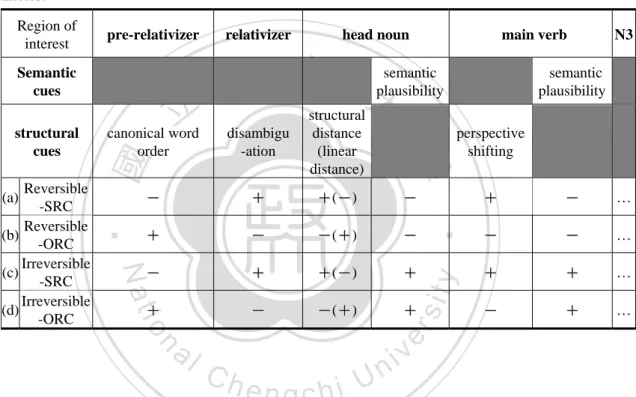
(6) TABLE OF CONTENTS. Acknowledgment ......................................................................................................... vi List of Tables................................................................................................................ ix. 政 治 大 Chinese Abstract ........................................................................................................ xv 立. List of Figures ........................................................................................................... xiii. English Abstract ........................................................................................................ xvi. ‧ 國. Introduction ............................................................................................. 1. Relative clause processing ............................................................................. 1 The issues in Chinese relative clauses processing ......................................... 5. Nat. y. Literature Review ................................................................................. 10. sit. Chapter 2. ‧. 1.1 1.2. 學. Chapter 1. n. al. er. io. 2.1 Processing of Relative Clauses .................................................................... 10 2.1.1 Subject-object asymmetry ........................................................................ 10 2.1.2 Sentence Processing Models .................................................................... 13 2.1.2.1 Syntax-based theories ...................................................................... 13 2.1.2.2 Perspective-shifting theory .............................................................. 16 2.1.2.3 Memory-based resources theories.................................................... 17 2.1.2.4 Interactionist approaches ................................................................. 20 2.1.3 Semantic cues in Sentence Processing ..................................................... 21 2.2 Grammar of Chinese relative clauses .......................................................... 26 2.2.1 Syntactic properties .................................................................................. 26 2.2.2 Typological uniqueness ............................................................................ 30 2.2.3 Interim summary ...................................................................................... 32 2.3 Processing of Chinese relative clauses ........................................................ 34 2.3.1 Predictions of processing models............................................................. 34 2.3.2 Debate on asymmetry issue in Chinese ................................................... 43 2.3.3 Semantic cues in Chinese sentence processing ........................................ 45 2.3.4 Advantages of eye movement recording technique ................................. 48. Ch. engchi. vi . i Un. v.
(7) . Chapter 3 Experiment One: subject-object asymmetry and semantic plausibility .................................................................................................................................... 49 3.1 Method ......................................................................................................... 54 3.1.1 Participants............................................................................................... 54 3.1.2 Design ...................................................................................................... 54 3.1.3 Material .................................................................................................... 58 3.1.4 Plausibility rating ..................................................................................... 64 3.1.5 Apparatus ................................................................................................. 67 3.1.6 Reading span test procedure .................................................................... 68 3.1.7 Eye movement recording procedure in reading experiments .................. 69 3.2 Data analysis ................................................................................................ 71 3.3 Results .......................................................................................................... 76 3.3.1 Reading span score and comprehension accuracy ................................... 76 3.3.2 Eye movement indices ............................................................................. 77 3.3.2.1 First-pass reading time and probability............................................ 77 3.3.2.2 Go-past reading time and probability .............................................. 81 3.3.2.3 Total viewing time and re-reading rate ............................................ 86 3.3.2.4 Supplementary analyses of V1 and N1 ............................................ 90 3.4 Discussion .................................................................................................... 93 3.4.1 Different syntactic ambiguities at different positions .............................. 94 3.4.2 Semantic plausibility and the bias of thematic role assignment .............. 99 3.4.3 Interim summary .................................................................................... 106. 立. 政 治 大. ‧. ‧ 國. 學. n. er. io. sit. y. Nat. al. Chapter 4. Ch. i Un. v. Experiment Two: animacy configuration in RC processing ........... 108. engchi. 4.1 Method ....................................................................................................... 112 4.1.1 Participants............................................................................................. 112 4.1.2 Design .................................................................................................... 112 4.1.3 Materials ................................................................................................ 115 4.1.4 Plausibility rating ................................................................................... 117 4.1.5 Apparatus & procedure .......................................................................... 119 4.2 Data analysis .............................................................................................. 119 4.3 Results ........................................................................................................ 119 4.3.1 Reading span score and comprehension accuracy ................................. 119 4.3.2 Eye movement indices ........................................................................... 121 4.3.2.1 First-pass reading time and probability.......................................... 121 4.3.2.2 Go-past reading time and probability ............................................ 125 4.3.2.3 Total viewing time and re-reading rate .......................................... 130 vii .
(8) . 4.3.2.4 Supplementary analyses of V1 and N1 .......................................... 134 4.4 Discussion .................................................................................................. 136 4.4.1 The hypotheses and the results .............................................................. 136 4.4.2 Main effects of RC type and main effects of animacy ........................... 141 4.4.3 Bias of role assignment with contrastive animacy ................................. 143 4.4.4 Interim summary .................................................................................... 147 Chapter 5 5.1 5.2 5.3 5.4 5.5. General Discussion.............................................................................. 149. Interplay of syntactic and semantic cues ................................................... 149 Bias of thematic role assignment ............................................................... 154 Dynamic process of sentence processing ................................................... 158 Normal reading process in eye-tracking experiments ................................ 165 Pedagogical implications ........................................................................... 168. 政 治 大 Reference .................................................................................................................. 171 立. ‧ 國. 學. Appendixes................................................................................................................ 177 A. Experiment materials of Experiment 1 ....................................................... 177. n. al. er. io. sit. y. Nat. . ‧. B. Experiment materials of Experiment 2........................................................ 182. . Ch. engchi. viii . i Un. v.
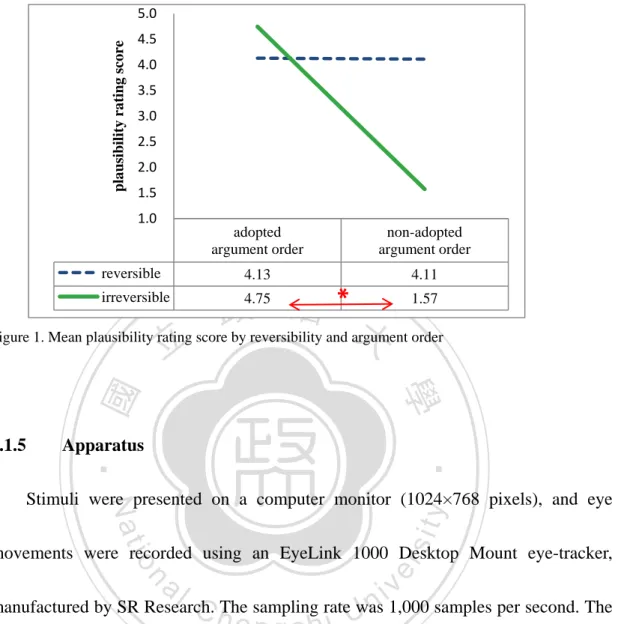
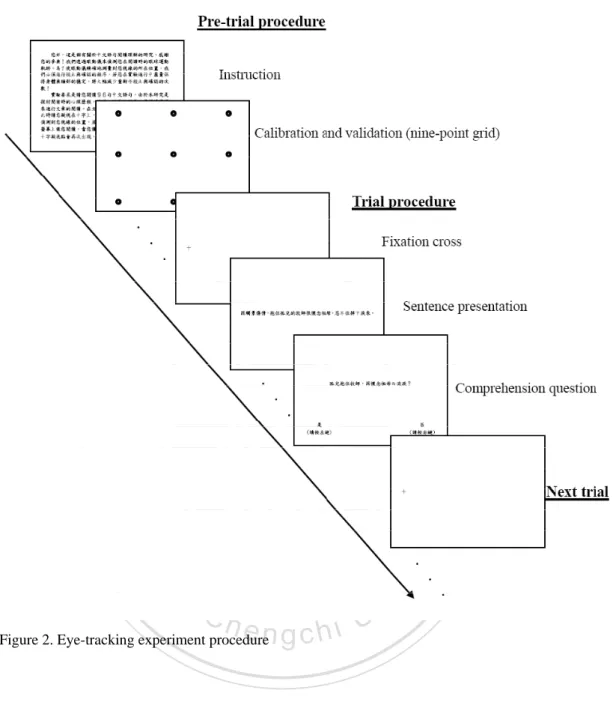
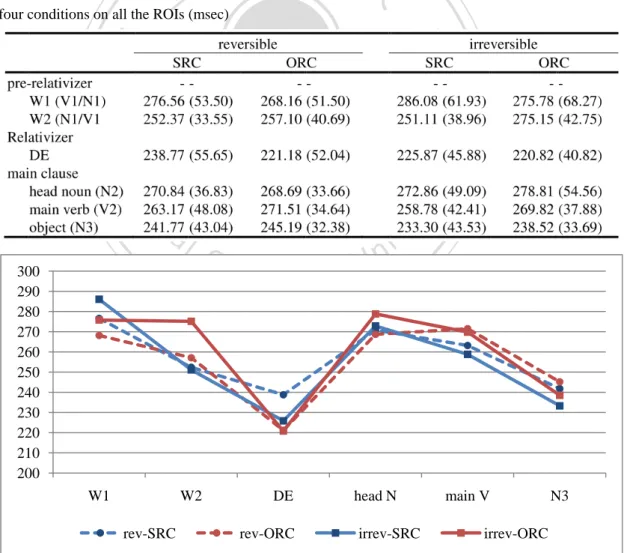
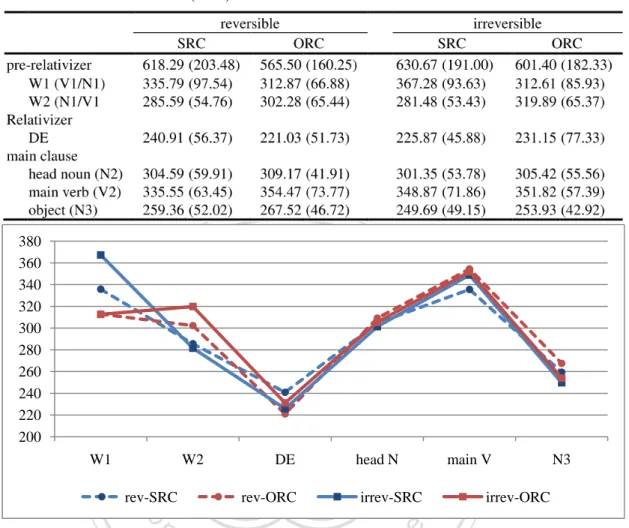
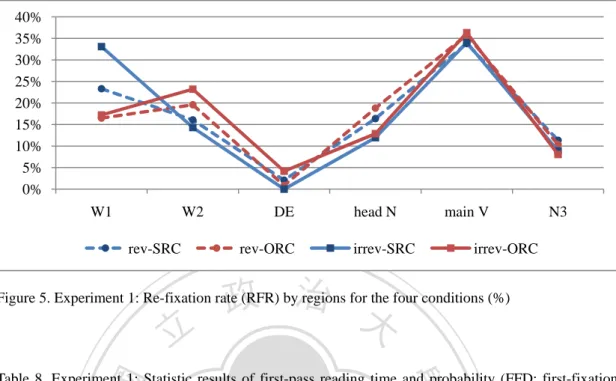
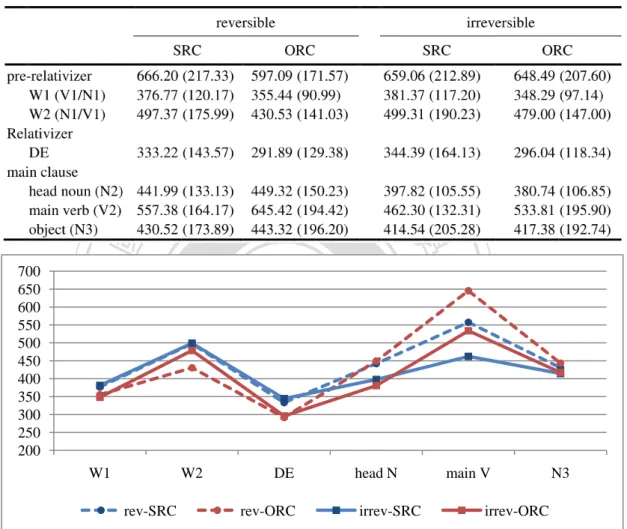
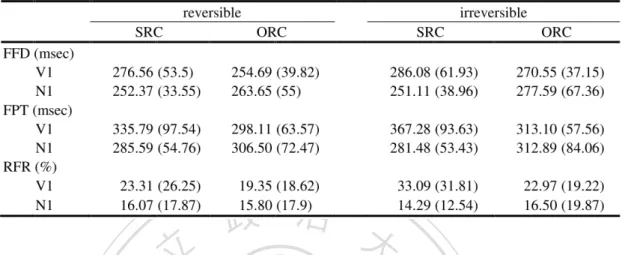
(9) List of Tables. Table 1. Hypotheses for Experiment 1 in terms of advantage (+) and disadvantage (-) resulted from semantic and structural cues during the incremental processing of the four conditions by region of interest................................ 50 Table 2. Example sentences with the manipulation of semantic plausibility of argument-verb relation and RC type ............................................................ 50. 政 治 大. Table 3. Experiment 1: Word frequency (per million words) of critical words in target (relative & main clause) ............................................................................... 61. 立. ‧ 國. 學. Table 4. Experiment 1: Word class dominancy for the critical words in the target ..... 61. ‧. Table 5. Experiment 1: Mean and standard error (in parenthesis) of first fixation duration (FFD) for the four conditions on all the ROIs (msec) ................... 79. y. Nat. sit. n. al. er. io. Table 6. Experiment 1: Mean and standard error (in parenthesis) of first first-pass time (FPT) for the four conditions on all the ROIs (msec) .................................. 80. Ch. i Un. v. Table 7. Experiment 1: Mean and standard error (in parenthesis) of re-fixation rate (RFR) for the four conditions on all the ROIs (%) ...................................... 80. engchi. Table 8. Experiment 1: Statistic results of first-pass reading time and probability (FFD: first-fixation duration, FPT: first-pass time, RFR: re-fixation rate) on each ROIs in the by-participant analyses (F1) and by-item analyses (F2) with repeated measures two-way ANOVAs testing the effect of plausibility (plau), RC type (RC), and their interaction (plau*RC) ........................................... 81 Table 9. Experiment 1: Mean and standard error (in parenthesis) of go-past time (GPT) for the four conditions on all the ROIs (msec) ............................................ 84 Table 10. Experiment 1: Mean and standard error (in parenthesis) of regressions-out rate (ROR) for the four conditions on all the ROIs (%) .............................. 85 ix .
(10) . Table 11. Experiment 1: Statistic results of go-past reading time and probability (GPT: go-past time, ROR: regressions-out rate) on each ROIs in the by-participant analyses (F1) and by-item analyses (F2) with repeated measures two-way ANOVAs testing the effect of plausibility (plau), RC type (RC), and their interaction (plau*RC)................................................................................... 85 Table 12. Experiment 1: Mean and standard error (in parenthesis) of total viewing time (TVT) for the four conditions on all the ROIs (msec) ......................... 88 Table 13. Experiment 1: Mean and standard error (in parenthesis) of re-reading rate (RRR) for the four conditions on all the ROIs (%) ...................................... 89. 政 治 大. Table 14. Experiment 1: Statistic results of total viewing time (TVT) and re-reading rate (RRR) on each ROIs in the by-participant analyses (F1) and by-item analyses (F2) with repeated measures two-way ANOVAs testing the effect of plausibility (plau), RC type (RC), and their interaction (plau*RC) ........ 90. 立. ‧ 國. 學. ‧. Table 15. Experiment 1: Mean and standard error (in parenthesis) of first-pass reading time and probability (FFD: first-fixation duration, FPT: first-pass time, RFR: re-fixation rate) for the four conditions on V1 and N1 regions ................... 92. io. sit. y. Nat. n. al. er. Table 16. Experiment 1: Mean and standard error (in parenthesis) of go-past reading time and probability (GPT: go-past time, ROR: regressions-out rate) for the four conditions on V1 and N1 regions ......................................................... 92. Ch. engchi. i Un. v. Table 17. Experiment 1: Mean and standard error (in parenthesis) of total viewing time (TVT) for the four conditions on V1 and N1 regions .......................... 92 Table 18. Experiment 1: Mean and standard error (in parenthesis) of re-reading rate (RRR) for the four conditions on V1 and N1 regions .................................. 93 Table 19. Revised hypothesis for Experiment 1 .......................................................... 97 Table 20. Example sentences with the manipulation of distinct animacy configuration of the critical nouns in the RC and RC type .............................................. 111 Table 21. Hypotheses for Experiment 2 in terms of advantage (+) and disadvantage (-) x .
(11) . resulted from semantic and structural cues during the incremental processing of the four conditions by region of interest.............................. 111 Table 22. Experiment 2: Word frequency (per million words) of critical words in target (relative & main clause) ................................................................... 116 Table 23. Experiment 2: Word class dominancy for the critical words in the target . 116 Table 24. Experiment 2: Mean and standard error (in parenthesis) of first fixation duration (FFD) for the four conditions on all the ROIs (msec) ................. 123. 政 治 大. Table 25. Experiment 2: Mean and standard error (in parenthesis) of first first-pass time (FPT) for the four conditions on all the ROIs (msec) ........................ 123. 立. ‧ 國. 學. Table 26. Experiment 2: Mean and standard error (in parenthesis) of re-fixation rate (RFR) for the four conditions on all the ROIs (%) .................................... 124. ‧. Table 27. Experiment 2: Statistic results of first-pass reading time and probability (FFD: first-fixation duration, FPT: first-pass time, RFR: re-fixation rate) on each ROIs in the by-participant analyses (F1) and by-item analyses (F2) with repeated measures two-way ANOVAs testing the effect of animacy (anim), RC type (RC), and their interaction (anim*RC) ........................... 125. er. io. sit. y. Nat. al. n. iv n C Table 28. Experiment 2: Meanhand U (in parenthesis) of go-past time e nstandard h ierror c g (GPT) for the four conditions on all the ROIs (msec) ............................... 128 Table 29. Experiment 2: Mean and standard error (in parenthesis) of regressions-out rate (ROR) for the four conditions on all the ROIs (%) ............................ 129 Table 30. Experiment 2: Statistic results of go-past reading time and probability (GPT: go-past time, ROR: regressions-out rate) on each ROIs in the by-participant analyses (F1) and by-item analyses (F2) with repeated measures two-way ANOVAs testing the effect of animacy (anim), RC type (RC), and their interaction (anim*RC) ............................................................................... 129. Table 31. Experiment 2: Mean and standard error (in parenthesis) of total viewing time (TVT) for the four conditions on all the ROIs (msec) ....................... 132 xi .
(12) . Table 32. Experiment 2: Mean and standard error (in parenthesis) of re-reading rate (RRR) for the four conditions on all the ROIs (%) .................................... 133 Table 33. Experiment 2: Statistic results of total viewing time (TVT) and re-reading rate (RRR) on each ROIs in the by-participant analyses (F1) and by-item analyses (F2) with repeated measures two-way ANOVAs testing the effect of animacy (anim), RC type (RC), and their interaction (anim*RC)......... 133 Table 34. Experiment 2: Mean and standard error (in parenthesis) of first-pass reading time and probability (FFD: first-fixation duration, FPT: first-pass time, RFR: re-fixation rate) for the four conditions on V1 and N1 regions ................. 135. 政 治 大. Table 35. Experiment 2: Mean and standard error (in parenthesis) of go-past reading time and probability (GPT: go-past time, ROR: regressions-out rate) for the four conditions on V1 and N1 regions ....................................................... 136. 立. ‧ 國. 學 ‧. Table 36. Experiment 2: Mean and standard error (in parenthesis) of total viewing time (TVT) for the four conditions on V1 and N1 regions ........................ 136. Nat. n. al. er. io. sit. y. Table 37. Experiment 2: Mean and standard error (in parenthesis) of re-reading time (RRT) for the four conditions on V1 and N1 regions ................................ 136. i Un. v. Table 38. Experiment 2: Hypothesis by regions (top) in comparison with the summarized results (middle) in different groups of eye movement indices and the revision of hypotheses (bottom). ................................................... 139. Ch. engchi. Table 39. Hypotheses and revision of hypotheses for Experiment 2 in terms of advantage (+) and disadvantage (-) resulted from semantic and structural cues during the incremental processing of the four conditions by region of interest ........................................................................................................ 140 Table 40. Example sentences with the manipulation of distinct animacy configuration of the critical nouns in the RC and RC type .............................................. 141. . xii . .
(13) . List of Figures. Figure 1. Mean plausibility rating score by reversibility and argument order ............. 67 Figure 2. Eye-tracking experiment procedure ............................................................. 71 Figure 3. Experiment 1: First fixation duration (FFD) by regions for the four conditions (msec) ......................................................................................... 79. 政 治 大. Figure 4. Experiment 1: First-pass time (FPT) by regions for the four conditions (msec) ........................................................................................................... 80. 立. ‧ 國. 學. Figure 5. Experiment 1: Re-fixation rate (RFR) by regions for the four conditions (%) ...................................................................................................................... 81. ‧. Figure 6. Experiment 1: Go-past time (GPT) by regions for the four conditions (msec) ...................................................................................................................... 84. sit. y. Nat. er. io. Figure 7. Experiment 1: Regressions-out rate (ROR) by regions for the four conditions (%) .............................................................................................. 85. al. n. iv n C Figure 8. Experiment 1: Total viewing h e n gtime i Uby regions for the four conditions h(TVT) c (msec) ........................................................................................................... 89. Figure 9. Experiment 1: Re-reading rate (RRR) by regions for the four conditions (%) ...................................................................................................................... 89 Figure 10. Experiment 2: First fixation duration (FFD) by regions for the four conditions (msec) ....................................................................................... 123 Figure 11. Experiment 2: First-pass time (FPT) by regions for the four conditions (msec) ......................................................................................................... 124 Figure 12. Experiment 2: Re-fixation rate (RFR) by regions for the four conditions (%) .................................................................................................................... 124 xiii .
(14) . Figure 13. Experiment 2: Go-past time (GPT) by regions for the four conditions (msec) .................................................................................................................... 128 Figure 14. Experiment 2: Regressions-out rate (ROR) by regions for the four conditions (%) ............................................................................................ 129 Figure 15. Experiment 2: Total viewing time (TVT) by regions for the four conditions (msec) ......................................................................................................... 132 Figure 16. Experiment 2: Re-reading rate (RRR) by regions for the four conditions (%) .................................................................................................................... 133. 立. 政 治 大. ‧. ‧ 國. 學. n. er. io. sit. y. Nat. al. Ch. engchi. xiv . i Un. v.
(15) . 國. 立. 政. 治. 大. 學. 研. 究. 所. 碩. 士. 論. 文. 提. 要. 研究所別:語言學研究所 論文名稱:語意在句法處理中的角色:中文關係子句的眼動閱讀研究 指導教授:蔡介立、何萬順 研究生:呂翠屏 論文提要內容:(共一冊,34,249 字,分 5 章 18 節,並扼要說明容,共 514 字). 政 治 大. 本文以兩個眼動閱讀實驗探討語意訊息 (semantic cues) 和句法訊息 (syntactic. 立. cues) 如何在中文關係子句的處理中運作及交互作用。實驗一旨在研究兩種動詞. ‧ 國. 學. 與論元之間的合理性關係 (plausibility) 是否會影響讀者理解不同結構的關係子 句。結果顯示,當兩個論元都是合理施事者 (agent) 時,論旨角色的指派 (thematic. ‧. roles) 有歧義,較難理解;而當只有一個論元是合理的施事者時,讀者趨向指派. y. Nat. sit. 正確的論旨角色,且較快整合句法上的困難。此外,因中文句法結構特殊,讀者. n. al. er. io. 在關係詞之前就處理主語關係子句 (subject relative clauses) 的歧義,在主要動詞. i Un. v. 上則會遇到賓語關係子句 (object relative clauses) 的理解困難。此發現解決了. Ch. engchi. Hsiao & Gibson (2003) 和 Lin (2006) 的歧見,證明中文讀者在不同位置會遇到 不一樣的困難。實驗二所關注的語意訊息為論元的生命性 (animacy),關係子句 中的兩個論元分屬有生命的 (animate) 及無生命的 (inanimate) 名詞。結果發現 論旨角色的指派和生命性相互關聯,有生命性的論元較傾向當施事者,而無生命 的論元傾向當受事者。讀者仍在關係詞之前遇到主語關係子句的理解困難,但在 主要動詞,讀者主要依循生命性的引導來指派論旨角色,句法訊息的影響並不顯 著。因此語意訊息在中文的語句處理扮演重要的角色,結果大致上與 Traxler (2002)的研究相符。讀者同時受到當下的句法訊息以及語意訊息影響,在不同的 位置會遇到不一樣的歧義性,而產生花園路徑效果 (garden-path effect)。 xv .
(16) . Abstract. Two eye movement experiments were conducted to investigate how semantic cues and syntactic structural cues function and interact in Mandarin Chinese relative clause (RC) processing. Mandarin Chinese is unique in combining head-final RCs with a VO basic order (Dryer, 1992, 2003) and also in relying solely on word order as. 政 治 大 preserves flexibility in 立 word order that is motivated by pragmatics. Semantic cues, structural cues, without case marking or agreement. However, Mandarin Chinese still. ‧ 國. 學. including the plausibility of the argument-verb relation and argument animacy within. ‧. RCs, may be crucial to sentence processing in Mandarin Chinese.. Nat. io. sit. y. Experiment 1 aims to examine whether the meaning of the verb allowing only. er. one of the two animate arguments to be a plausible agent may lead to reduction of. al. n. iv n C ORC difficulty (cf. Traxler, 2002). showed that the plausibility effects h e nThe hi U g cresults were robust at the head noun and the main verb. A bias of thematic role assignment in. the irreversible relation leads readers to correct interpretations, while the reversible relation does not elicit such a bias. The results also solved the discrepancy between the two previous studies (Hsiao and Gibson, 2003 & Lin, 2006) by unveiling a dynamic process in which readers encounter diverse ambiguities at different positions for different structures. Chinese readers disambiguate SRCs earlier due to their xvi .
(17) . non-canonical word order and have trouble integrating the main verb in ORCs owing to perspective shifting. The interaction between plausibility and RC type on re-reading rate suggested that plausibility cues were used to solve syntactic ambiguity. Experiment 2 manipulated contrastive argument animacy in order to investigate whether thematic role assignment correlates with animacy. The results confirmed the hypothesis that while animate entities bias towards agent roles, inanimate ones incline. 治 政 大 Besides, inanimate entities are towards patient roles (c.f., Valin & LaPolla, 1997). 立 ‧ 國. 學. conceptually less accessible than animate ones. Contrastive animacy shows its impact on syntactic processing with robust interactions at different positions.. ‧ sit. y. Nat. The findings of interactions between semantic cues and RC types in two. n. al. er. io. experiments suggest that semantic cues play an important role in Chinese relative. Ch. i Un. v. clause processing. Semantic plausibility and argument animacy can influence the. engchi. process of thematic role assignment. The semantic cues that accord with the biases of thematic role assignment then would ease the syntactic ambiguities. Not only syntactic cues but also semantic cues are utilized by readers in sentence comprehension. In this thesis, the eye movement data provide clear evidence indicating that readers solve various temporary ambiguities syntactically and semantically at different positions of the sentence with relative clauses.. xvii .
(18) . Chapter 1 Introduction. 1.1 Relative clause processing Language comprehension usually comes to pass swiftly. In the twinkling of an. 政 治 大. eye, incoming words are rapidly integrated with our stored knowledge to form a. 立. complete interpretation. However, such an intact interpretation does not just show up. ‧ 國. 學. in a snap. Sentence processing is an incremental evolution of interpretations. Readers. ‧. process one word at a time and constantly integrate each incoming word into the. y. Nat. al. er. io. sit. structure constituted by the previous words as soon as we see (or hear) it (Garnsey,. v. n. Pearlmutter, Myers, & Lotocky, 1997a; Philipp, Bornkessel-Schlesewsky, Bisang, & Schlesewsky, 2008).. Ch. engchi. i Un. During the course of incremental processing, the relationships among the accumulating words in a sentence are indeterminate at many points. These temporarily ambiguous spots often make readers misinterpret the sentence meaning, leading them up the garden path. Thus, readers may have to move the eyes back to previous words to reanalyze the sentence. This is a so-called “garden-path” experience. Many people may be aware of garden-pathing occasionally. However, 1 .
(19) 2 . previous studies have indicated that readers “garden-path” much more often than they realize (cf. Fernanda Ferreira & Henderson, 1990; Garnsey, et al., 1997a). In the field of psycholinguistics, garden-path effect is a topic of great interest. A variety of syntactic processing models were developed to explain this phenomenon, with a common ultimate goal to unveil the mechanism of human sentence processing.. 政 治 大. Most of the theoretical accounts for sentence processing have been built up with the. 立. understanding of relative clause (RC) processing whose structural complexity often. ‧ 國. 學. elicits garden-path effects.. ‧. Relative clause is a subordinate clause embedded within nominal phrases. The. y. Nat. er. io. sit. nominal phrase is the syntactic and semantic head of the construction. The head (highlighted with underline in the examples) is associated with an extracted element. al. n. iv n C h ecalled in the subordinate clause, usually as ∅ in the examples of (1) i U n gacgaph (represented. and (2)). In terms of the position of the gap, relative clauses can be classified into two basic types: subject relative clause (SRC) and object relative clause (ORC). When the gap occurs at the subject position of a relative clause, the construction involves subject-extraction and is called subject relative clause, as in (1). As for the object relative clause in (2), the object of relative clause is extracted. To comprehend relative clauses, the dependency between the head (or called “filler” because it should be .
(20) 3 . “filled” in the gap to develop such a dependency) and the gap should be correctly established.. (1) Subject relative clause (SRC) (subject-extraction) a.. The pastor who ∅ hugged the orphan missed his grandmother very much.. b.. ∅. 抱住. 孤兒. 的. 牧師. 很. 懷念. 祖母。. guer. de. mushi. hen. huainian. zumu.. orphan. DE. ∅ Baozhu hug. 立. pastor Very miss 政 治 大. Grandmother. (2) Object relative clause (ORC) (object-extraction). ‧ 國. 學. a.. The orphan who the pastor hugged ∅ missed his grandmother very much.. b.. 牧師. 抱住. Mushi. baozhu. pastor. hug. 的. 懷念. 祖母。. guer. hen. huainian. orphan. Very. miss. zumu. grandmother. n. al. er. io. sit. Nat. DE. 很. ‧. ∅ de. 孤兒. y. ∅. i Un. v. In processing relative clauses, garden-pathing occurs when readers encounter. Ch. engchi. difficulty building up the filler-gap dependency and integrating the embedded clause with the main clause. In English, readers confront less difficulty processing subject relative clauses than object relative clauses at the RC and at the main verb, suggesting a subject preference for relative clause processing (Gibson, Desmet, Grodner, Watson, & Ko, 2005; Traxler, Morris, & Seely, 2002). This subject-object asymmetry has been found in the experiments conducted with two methodologies: self-paced word-by-word reading task and eye-tracking recording technique. In the former .
(21) 4 . methodology, participants read the sentence word by word, one word at a time, and for only once. They press a button to read the next word and the reading times on each region are measured for analyses. The previous studies found the reading times were longer for ORCs than SRCs at the RCs (‘who hugged the orphan’ / ‘who the orphan hugged’) and the main verb if the main verb follows the RCs (e.g., Gibson, et al.,. 政 治 大. 2005). On the other hand, the eye movement recording technique allows participants. 立. to read under a normal reading environment. The fixation locations and durations can. ‧ 國. 學. provide measures to look into processing in detail. The previous studies have showed. ‧. SRC difficulty at the RC region (‘hugged the orphan’ / ‘the orphan hugged’) on total. y. Nat. er. io. sit. viewing time and at the main verb following the RC on first-pass time, the time to get ready for further materials (go-past time or quasi-first-pass time), first-pass regression,. al. n. iv n C h e nMorris, and total viewing time (e.g., Traxler, g c hetial.,U2002).. In literatures, the subject preference is consistently found in other head-initial languages, in which the head precedes the relative clause (e.g., French: Holmes & O'Regan, 1981; Dutch: Mak, Vonk, & Schriefers, 2002; Mak, Vonk, & Schriefers, 2006; German: Schriefers, Friederici, & Kuhn, 1995). Head-final languages, instead, have the head noun follow the relative clause. Japanese and Korean belong to head-final languages and subject preference is also found in their relative clause .
(22) 5 . processing (e.g., Korean: Kwon, Polinsky, & Kluender, 2004; Japanese: Ueno & Garnsey, 2008).. 1.2 The issues in Chinese relative clauses processing As a head-final language, Chinese relative clause processing has undergone. 政 治 大. heated debate. (Examples of Chinese relative clauses are presented in item b of (1). 立. and (2).) Previous experimental research with the self-paced reading task had mixed. ‧ 國. 學. findings. Lin (2006, 2008) found a preference for SRCs, based on the effects found at. ‧. the relativizer and the head noun. However, Hsiao & Gibson (2003) indicated that. y. Nat. n. al. er. io. DE.. sit. ORCs are easier, according to the effects observed at the region before the relativizer. Ch. engchi. i Un. v. The discrepancy implies that, in addition to head position, more factors should be taken into consideration in Chinese. First, Chinese is unique in embedding the head-final relative clauses in a typical SVO word order, which is the one-and-the-only combination (known so far) in the world (Dryer, 1992, 2003). Besides, word order is the sole structural cue available for readers since Chinese does not have case marking or agreement. The other head-final languages, such as Japanese and Korean, have a SOV typical word order and a case and/or agreement system. Therefore, the .
(23) 6 . distinction between the RC types in Chinese relies only on the gap position. In consequence, SRCs comprise a “V-N” pattern (identified as “V-O”) and ORCs comprise an “N-V” pattern (identified as “S-V”), representing a non-canonical and canonical word order respectively. According to Bever’s (1970) canonical word order account, the non-canonical word order of SRCs may lead to an earlier disambiguation. 政 治 大. than ORCs. ORCs, with a canonical word order “N-V”, may be interpreted as an “S-V”. 立. main clause. ORCs may be disambiguated when the relativizer occurs, or at least. ‧ 國. 學. when the head occurs and may also face perspective shifting at the main verb. The. ‧. head of object relative clauses may further suffer from the memory load resulted from. y. Nat. er. io. (MacWhinney, 1977).. sit. the perspective shift from object to subject when integrating the main clause. al. n. iv n C h e inn g Second, although word order Chinese c h i isUthe sole structural cue in sentence. processing, it is not fixed and tidy; rather, several alternatives may be driven by pragmatics. Accumulating evidence shows that semantic cues, such as plausibility of argument-verb configuration, animacy configuration, thematic role structure, and frequency-bias of verbs, also modulate sentence processing in English (e.g., Garnsey, Pearlmutter, Myers, & Lotocky, 1997b; Traxler & Pickering, 1996; Traxler, Williams, Blozis, & Morris, 2005; J. C. Trueswell, Tanenhaus, & Garnsey, 1994). For example, .
(24) 7 . Traxler, Morris, & Seely’s (2002) eye movement experiments showed that when only one of the two animate nouns in the relative clause can be a plausible agent of the verb, readers speed up the reanalysis caused by the ORC difficulty in English. When the two critical nouns contrast in animacy, an animate head deteriorates the ORC penalty but an inanimate head mitigates the ORC difficulty. In Chinese, animacy was. 政 治 大. also found to play a relational role as its effects occurred at the second noun and it. 立. highly correlated with thematic role assignment (Philipp et al. (2008)). If semantic. ‧ 國. 學. cues of plausibility from the argument-verb relation play a crucial role in Chinese,. ‧. then there is a bias of thematic role assignment in sentence processing that is closely. y. Nat. er. io. sit. related to the real world experience. Certain verbs are inclined to have one argument be the agent and the other the patient. If argument animacy is highly correlated with. al. n. iv n C h e narguments assignment, animate bias towards gchi U. thematic role. an agent role while. inanimate arguments bias towards a patient role (c.f., Valin & LaPolla, 1997). In Chinese, little experimental research has been carried out to explore how and when semantic cues function during the processing of RCs. Third, temporal ambiguities may come from different sources at different positions as the sentence unfolds incrementally. On the one hand, SRCs and ORCs in Chinese have their respective ambiguities resulting from diverse structural cues to .
(25) 8 . solve at different positions. The “preference” for SRCs or ORCs in processing may not fairly describe Chinese relative clause processing. On the other hand, semantic cues provided by the argument-verb relation or the argument animacy may alleviate or aggravate the structural ambiguities at different positions. The biases relating to thematic role assignment leads readers to develop an interpretation based on real life. 政 治 大. experience or cognitive conceptions. As the sentence unfolds word by word, such an. 立. interpretation “evolves” accordingly and checks with the structural cues to ascertain. ‧ 國. 學. or to revise. Both structural cues and semantic cues may initiate their influences on. ‧. processing at different positions in a sentence and lead readers up the garden-path.. y. Nat. er. io. sit. In sum, the head-final syntactic property is not the only prominent factor affecting RC processing in Chinese. Chinese is unique in combining this property. al. n. iv n C with SVO basic word order. Ash aneisolating language, i U it is also distinct in not having a ngch case or agreement system. The fact that it relies solely on word order structurally and that its word order is alterable by pragmatics implies that semantic cues may play a crucial role in sentence processing. Moreover, as readers comprehend sentences incrementally, various structural cues and semantic cues may launch at different positions in the sentence to lead, and sometimes mislead, readers during the course of processing. This thesis aims to address: (a) the syntactic ambiguities of Chinese RCs .
(26) 9 . at different positions in the sentence based on its unique syntactic properties, (b) the influence of the cues of semantic plausibility based on the argument-verb relation in Chinese RC processing, (c) the influence of animacy cues on Chinese RC processing, (d) the ambiguities contributed by both syntactic and semantic information at different positions as readers read incrementally and evolve their interpretations over time.. 政 治 大. The following parts of the thesis are organized into four chapters. Chapter 2. 立. reviews previous research on relative clauses from the perspectives of processing and. ‧ 國. 學. grammar. Chapter 3 and Chapter 4 present two eye-tracking experiments on Chinese. ‧. RCs with the manipulation of semantic plausibility of argument-verb relation and. y. Nat. discussion based on the findings of the experiments.. n. al. Ch. engchi. . . er. io. sit. animacy respectively. The last chapter, Chapter 5, offers a conclusion and general. i Un. v.
(27) . Chapter 2 Literature Review. 2.1 Processing of Relative Clauses Relative clauses are a major focus in the sentence processing research because. 政 治 大. they often induce garden-path effect. The difficulty of processing relative clauses may. 立. be attributed to the complexity of the embedded structure. In languages that adopt the. ‧ 國. 學. gap strategy such as English and Chinese, the relativized NP leaves a gap in the. ‧. relative clause. This gap should be filled by the head noun in order to understand the. y. Nat. al. er. io. sit. sentence. In the following subsections, subject-object asymmetry in relative clause. v. n. processing is presented in Section 2.1.1. Then, four sentence processing models are. Ch. engchi. i Un. introduced in Section 2.1.2. The research that focused on semantic cues in sentence processing is reviewed in Section 2.1.3.. 2.1.1. Subject-object asymmetry In most languages, the noun phrase in the subject and object position can be. relativized (cf. Comrie & Keenan, 1979; Keenan & Comrie, 1979). Relative clauses with subject extraction, as in (3), are called subject relative clauses (SRCs). They are 10 .
(28) 11 . RCs with a gap in the subject position. The relative clauses with object extraction in (4) are object relative clauses, with a gap in the object position. In example (3) and (4), English example sentences (a) are accompanied by its corresponding Chinese examples (b).. (3) Subject relative clause (SRC) (subject-extraction) a.. [RC . 孤兒. Baozhule guer hug. orphan. 的] 牧師. 很. 懷念. de. mushi. hen. huainian. zumu.. DE. pastor. very. miss. grandmother. er. io. sit. The orphan [RC who the pastor hugged ]missed his grandmother very much.. al. Mushi. v Ch 的] 孤兒 很U n i 懷念 e g c h ihen huainian baozhu de nguer. zumu.. pastor. hug. grandmother. [RC 牧師. n. b.. y. Nat. (4) Object relative clause (ORC) (object-extraction) a.. 祖母。. ‧. ‧ 國. 抱住了. 學. 立. much. b.. 政 治 大. The pastor [RC who hugged the orphan] missed his grandmother very. 抱住. DE. orphan. Very. miss. 祖母。. Previous research has found a subject-object asymmetry in processing relative clauses. A preference (or priority) for sentential subject is found in typological studies (Comrie & Keenan, 1979; Keenan & Comrie, 1979). A universal tendency called Noun Phrase Accessibility Hierarchy was proposed with a survey on more than 100 languages. The hierarchy ranks from Subject to Object of comparison as follows: .
(29) 12 . Subject, Direct Object, Indirect Object, Oblique Object, Possessor, and Object of comparison. According to this hypothesized hierarchy, a language which can relativize a given position in the hierarchy can also relativize all higher positions. Almost all of the languages under survey are capable of relativizing subjects while noun phrases in other positions are less likely to be relativized. From the perspective. 政 治 大. of typology, such a universal tendency implies that subject relative clause is easier for. 立. sentence processing.. ‧ 國. 學. Tavakolian (1981) also observed a preference of children to treat the sentential. ‧. subject as the subject for both the interpretations of the main clause and the relative. y. Nat. io. sit. clause. Hence, they interpret both subject relatives and object relatives in a common. er. conjoined clause. For example, “The pastor hugged the orphan and the pastor missed. al. n. iv n C h e n g cforhboth Grandmother very much.” is interpreted i USRC “The pastor who hugged the orphan missed Grandmother very much.” and ORC “The pastor who the orphan hugged missed Grandmother very much.” Such a subject preference account predicts that the subject relative is easier than the object relative in head-final languages, as well as in head-initial languages. In addition, the subject-object asymmetry is also found in psycholinguistic studies. This subject preference for relative clause processing is consistently found not .
(30) 13 . only in head-initial languages such as European languages but also in head-final languages such as Japanese and Korean (e.g., Englsih: Gibson, Pearlmutter, Canseco-Gonzalez, & Hickok, 1996; Korean: Lee, Lee, & Gordon, 2007; Dutch: Mak, et al., 2002; Japanese: Ozeki & Shirai, 2007; German: Schriefers, et al., 1995). However, studies of Chinese relative clause showed inconsistent results and different. 政 治 大. theoretical explanations were proposed. This debate on the asymmetry issue in. 立. Chinese relative clause processing is discussed in Section 2.3.2.. ‧. ‧ 國. 學. 2.1.2. Sentence Processing Models. y. Nat. al. er. io. sit. In the following subsections, we summarize the theoretical backgrounds for four. v. n. prominent branches of theories, including syntax-based theories, memory-based. Ch. engchi. i Un. resources theories, perspective-shifting theory, and interactionist approaches.. 2.1.2.1 Syntax-based theories The term “garden-path” derives from the best known model of language comprehension, the Garden-Path Theory, developed by Frazier and colleagues (Lyn Frazier & Charles Clifton, 1996; Lyn Frazier & Fodor, 1978; Lyn Frazier & Villiers, 1990). In the model, two stages of sentence parsing mechanism were proposed to .
(31) 14 . explain the ambiguity resolution. In the first stage, the sentence parser establishes an initial interpretation based on the available information for the moment. Then, as more information approaching, the initial interpretation is revised if it turns out to be inconsistent with the information that arrives later. That is, if the initial syntactic analysis fails, a reanalysis is required. Since the parser in the two-stage models. 政 治 大. (Fernanda Ferreira & Henderson, 1993; Lyn Frazier & Charles Clifton, 1996; Lyn. 立. (for. example,. noun-verb-noun). to. 學. information. assign. syntactic. position. ‧. ‧ 國. Frazier & Fodor, 1978; Lyn Frazier & Villiers, 1990) uses only the word class. (noun-verb-noun as subject-verb-direct object) in the first stage, a certain types of. y. Nat. er. io. sit. sentences with specific misleading word orders are subject to, or even doomed to, occasion a garden-path effect.. al. n. iv n C h e n gincEnglish For example, in a classic example h i UThe horse raced past the barn fell.,. Readers are very likely to parse this sentence as an intransitive sentence, but then stumble at the word “fell” and regress to look for other possible structures. This sentence is a reduced relative clause sentence with a passive participle, in which relativizer and the copula were missing. The correct reading of this sentence should be “The horse (that was) raced past the barn fell.” Such a reduced relative clause without a relativizer often leads to comprehension difficulty. .
(32) 15 . An important hypothesis within the Garden-Path Theory is the Active Filler Strategy (Lyn Frazier & Charles Clifton, 1996; Lyn Frazier & Clifton, 1989). The head noun (as a filler) initiates a search for the gap. To explain the relative asymmetry in English, a subject preference accompanies the filler’s search. Under this circumstance, readers would tend to insert the sentential subject as the subject of the. 政 治 大. relative clause, since a “doubtful gap” would appear immediately after the relativizer.. 立. When reading the object relative clauses, this subject preference leads to a syntactic. ‧ 國. 學. misanalysis and the second-stage reanalysis is then required, and so are more reading. ‧. times.. y. Nat. er. io. sit. Based on the syntax of relative clauses, Bever (1970) proposed a canonical word order account that may explain the difference between subject and object relative. n. al. clauses. In English, the. iv n C wordhorder i U pronoun e n ofg ctheh relative. “who” (denoting the. subject, S) plus the verb (V) and object (O) accords with the basic word order SVO in subject relatives. As in the example (5a), who hugged the orphan is in an order of S-V-O, just like the canonical word order in English.. .
(33) 16 . (5) a. subject relative clause (SRC) The pastor [RC who hugged the orphan] missed his grandmother very much. who (S). V. O. b. object relative clause (ORC) The orphan [RC who the pastor hugged ]missed his grandmother very much. who (O). 立. S. V. 政 治 大. In contrast, the object relative has a non-canonical word order, with “who”, subject,. ‧ 國. 學. and verb in a line (OSV), which leads to greater difficulty. That is, as in (5b), who the. ‧. pastor hugged is in an O-S-V order, which is not the canonical word order. Because. y. Nat. al. er. io. sit. object relative clauses in English is different from its canonical word order, more. v. n. processing efforts is needed and it is more likely to be led down the garden path,. Ch. engchi. i Un. compared with subject relative clause. As the examples show, Bever’s (1970) canonical word order account can also explain the subject preference in English.. 2.1.2.2 Perspective-shifting theory The perspective-shifting theory (MacWhinney, 1977) regards the mapping of the syntactic subject onto the reader’s perspective. It is assumed that speakers and listeners prefer to take the viewpoint of active agents, rather than passive recipients. .
(34) 17 . Perspective shifts are time-consuming and costly for working memory. Readers have to shift perspectives in object relative clauses, while the perspective of the sentential subject in subject relative clauses is maintained. For example, readers have to shift from subject perspective to object perspective for the sentential subject ‘the lion’ in the ORC (6b). However, readers do not have to shift the perspective in the SRC (6a).. 政 治 大. Relative clause in terms of perspective of the sentential subject. 立. SRC: The dog [RC that jumps over the pig] bumps into the lion. (SÆS). b.. ORC: The lion [RC that the horse bumps into] jumps over the giraffe. (SÆO). 學. a.. ‧. ‧ 國. (6). Therefore, object relative clauses are more difficult than subject relative clauses. The. y. Nat. al. er. io. sit. maintenance of an inconsistent viewpoint, memory demands, and syntactic. v. n. complexity contributes to the difficulty of processing relative clauses.. Ch. engchi. i Un. 2.1.2.3 Memory-based resources theories Daneman and Carpenter (1980) proposed a working memory test especially for reading. Since poor readers may process in an inefficient way, they can maintain less additional information in working memory. Thus, this working memory test for reading, called reading span test, poses heavy demands for processing and storage in order to measure the working memory capacity of reading. In the test, readers were .
(35) 18 . asked to recall the last word of each sentence after reading a set of sentences and doing comprehension questions right after reading each sentence. A set of sentences ranges from two sentences to six. Each reader started with the two-sentence set. The number of sentences in a set increases until the reader was unable to recall the final words. A correlation between the scores of reading span and reading comprehension. 政 治 大. performance was found in this study. Readers with smaller reading span had a worse. 立. performance in reading comprehension.. ‧ 國. 學. The correlation between reading span tests and comprehension of relative clauses. ‧. in English was also established (King & Just, 1991). Individual differences in. y. Nat. er. io. sit. syntactic processing were found in relative clause reading. Reading the verbs in object relative clauses takes more time for readers with low reading span. Though they spend. al. n. iv n C h e n g cishless more reading time, their comprehension i Uaccurate. This finding supports the Capacity Constrained Model for sentence parsing (also called CC READER) (Just &. Carpenter, 1991). CC READER successfully models the individual difference in the processing of object relative clauses. If the activation limit in the model is set high enough, the model will always make the correct thematic role assignments. If the activation limit is lowered, the model starts to make errors because of the capacity limit. .
(36) 19 . Gibson’s (1998; See also Gibson & Pearlmutter, 1998; Hsiao & Gibson, 2003) Dependency Locality Theory (DLT) predicts ORC difficulty as well, but it is based on a different cause. Increased working memory demands are imposed on processing object relative constructions because the memory cost needed for the intervening discourse referents is greater. These intervening discourse referents are located. 政 治 大. between the filler and the gap, causing temporarily incomplete dependencies. For. 立. instance, the unattached constituents involved in the English ORC, as shown in (7b),. ‧ 國. 學. are who, the pastor, hugged. In contrast, the SRC (7a) involves only the relativizer. Nat. er. io. sit. intervening discourse referents, are on the terminal nodes.. y. ‧. who between the filler and the gap. Syntactically, the unattached constituents, or the. al. n. iv n C U his grandmother very much. h e nthegorphan] The pastor [RC who hugged c h i missed. (7) a. subject relative clause (SRC) filler. gap. b. object relative clause (ORC) The orphan [RC who the pastor hugged ]missed his grandmother very much. filler gap. According to DLT, the unbounded dependencies result in the cost of storage and integration. On the one hand, storage resources are required to keep track of the syntactic head, so the fact that object relatives carry the filler unattached longer than .
(37) 20 . the subject relatives explains the asymmetry. On the other hand, the effort of connecting an incoming word to its head in the current structure calls for integration resources. Indexical pronouns, such as I, you, and me suffer less integration load. Gordon et al. (2006) views the effect of indexical pronouns in a slightly different way. It is considered an effect led by the similarity-based interference. That is,. 政 治 大. indexical pronouns are easier to process because they are distinct from other NPs,. 立. such as common nouns. They are from different categories in terms of. ‧ 國. 學. similarity-based interference. Gordon et al. (2006) demonstrated three categories of. ‧. the sort: indexical pronoun, short name (e.g., Tom), common noun (e.g., pastor).. y. Nat. in the relative clause came from different categories.. n. al. Ch. engchi. er. io. sit. Difficulty in object relatives is greatly decreased if the head noun and the noun phrase. i Un. v. 2.1.2.4 Interactionist approaches In addition to syntactic structure of the sentence, there are many other types of information available to reach a correct interpretation of the sentence when readers process a sentence. These sources of information include semantic content of the words in the sentence and pragmatic influences from the discourse. Recent studies have suggested that readers utilize multiple sources of information interactively to .
(38) 21 . constraint interpretations (e.g., Boland, Tanenhaus, Carlson, & Garnsey, 1989; Boland, Tanenhaus, Garnsey, & Carlson, 1995; Gennari & MacDonald, 2008; Pearlmutter & Gibson, 2001; J. C. Trueswell, et al., 1994; John C. Trueswell, Tanenhaus, & Kello, 1993). Interactionist approaches propose that syntactic and non-syntactic cues are. 政 治 大. simultaneously available as soon as each word is recognized. In contrast, the serial. 立. parsing accounts, which are assumed by the syntax-based theories, divide the. ‧ 國. 學. syntactic parsing into two stages. In the first stage, only the syntactic cues are used. It. ‧. is not until reanalysis is required that the semantic cues such as thematic roles become. y. Nat. er. io. sit. available in the second stage. An important difference between the serial parsing accounts and the interactionist approaches is that the semantic cues participate in. n. al. i n C U hengchi syntactic processing from the beginning.. 2.1.3. v. Semantic cues in Sentence Processing Previous studies conducting eye-tracking experiments or self-paced reading. experiments have shown that semantic cues, such as thematic roles, verb types, verb bias towards a certain structure, plausibility, and animacy of subject and object, do play a role in syntactic processing and may interact with each other or with syntactic .
(39) 22 . cues. For example, Trueswell, Tanenhaus, and Kello (1993) showed that verb bias, namely the frequency with which a particular verb is used in a particular structure, has rapid effects on temporary ambiguity resolution. Garnsey, et al. (1997a) replicated their results and further showed that plausibility of particular verb-object combination interact with verb bias. Wilson & Garnsey (2009) investigated verb bias effects in. 政 治 大. simple direct object sentences and found evidence that attested the influence of. 立. combinational properties of individual words on the earliest stages of sentence. ‧ 國. 學. comprehension.. ‧. In the present study, the influence of plausibility and animacy on relative clause. y. Nat. er. io. sit. processing is the focus of our interest. Traxler, Morris, & Seely (2002) found that plausibility speed up the recovery from misanalysis and that animacy configuration. al. n. iv n C h eIn ntheir processing. h i UTraxler, g cstudy,. modulates sentence. et al. (2002) manipulated. plausibility of argument-verb relation (specifically, the plausibility for both critical NPs or only one of them being the agent of the relative-clause verb) and animacy in eye-tracking experiments. A reversible argument structure, in which both the subject and object of the verb in the relative clause can be a plausible agent of the verb, is designed for Experiment 1. The example sentences for the four-condition design are shown in (8). .
(40) 23 . (8). Reversible argument-verb relations in Experiment 1 (manipulation of plausibility) (Traxler, et al., 2002) a.. The lawyer that irritated the banker filed a hefty lawsuit.. b.. The lawyer that the banker irritated filed a hefty lawsuit.. c.. The banker that irritated the lawyer played tennis every Sunday.. d.. The banker that the lawyer irritated played tennis every Sunday.. 政 治 大. The key to the manipulation is the meaning of the verb irritate. Both the lawyer and. 立. the banker are a plausible agent of irritate. The results showed that a great difficulty. ‧ 國. 學. in object relatives was found.. ‧. In the Experiment 2, an irreversible argument structure is manipulated, with. y. Nat. er. io. sit. examples in (9).. al. n. iv n C Reversible argument-verb h relations in Experiment e n g c h i U 2 (manipulation of plausibility). (9). (Traxler, et al., 2002) a.. The policeman that arrested the thief was known to carry a knife.. b.. The thief that the policeman arrested was known to carry a knife.. c.. The thief that robbed the policeman was known to carry a knife.. d.. The policeman that the thief robbed was known to carry a knife.. In this design, only one of the arguments can be a plausible agent of the verb in relative clauses. The policeman, instead of the thief, is the plausible agent of arrested. .
(41) 24 . As for the verb robbed, the thief, instead of the policeman, is the plausible agent. The results showed that although object relative difficulty still exists, the difficulty is reduced. The reason may be that plausibility help readers keep the relevant discourse entities distinct. In the third experiment, animacy of the sentential subject and the noun within the. 政 治 大. relative clauses is manipulated. Examples for the four conditions are listed in (10).. 立. (10) Contrastive animacy configuration in Experiment 3 (manipulation of animacy). ‧ 國. 學. (Traxler, et al., 2002). The director that watched the movie received a prize at the film festival.. b.. The director that the movie pleased received a prize at the film festival.. c.. The movie that pleased the director received a prized the film festival.. d.. The movie that the director watched received a prized the film festival.. ‧. a.. n. er. io. sit. y. Nat. al. Ch. engchi. i Un. v. In the examples, every relative clause involves an animate NP the director and an inanimate NP the movie, which contrast in terms of animacy. As a result, the difficulty of object relative clauses was greatly reduced when the sentential subject was inanimate. It seems that manipulation of the verb-noun relation or the animacy moderates the difficulty associated with object relative clauses. Traxler, et al. (2002) proposed .
(42) 25 . that semantic factors affected how much difficulty readers had while reanalyzing the sentence. It is also argued that the results offer evidence that readers may temporarily ignore a word-order syntactic cue, especially when the cue indicates that a complex structure is required. What is more, both Experiment 2 and Experiment 3 support the similarity-based. 政 治 大. interference proposed by Gordon, et al. (2006), but in a different way. Gordon, et al.. 立. suggested that if the critical NPs are from different categories—namely, indexical. ‧ 國. 學. pronouns, short names, and common nouns, the interference caused by similarity of. ‧. the NPs will be lessened. The critical NPs in Experiment 2 and Experiment 3 all. y. Nat. er. io. sit. belong to common noun category, but the distinction within a pair of critical NPs is created through argument-verb relation and animacy configuration, respectively.. al. n. iv n C h e nMak, Following Traxler, et al. (2002), i U& Schriefers (2002, 2006) found a g c hVonk,. similar effect of animacy in Dutch, a head-initial language with a SOV word order. The experiment in Mak, et al., (2002) showed that animacy influences the processing difficulty of relative clauses. No subject preference is found for relative clauses with an animate subject and an inanimate object, similar to Traxler, et al. (2002). Moreover, Mak et al. (2006) showed that the animacy of the head per se is not the key to the modulation of processing difficulty, since the usual preference for SRC was still found .
(43) 26 . in relative clauses with two inanimate critical NPs. Instead, the force of modulation comes from the interplay of animacy and verb semantics.. 2.2 Grammar of Chinese relative clauses From a cross-linguistic perspective, relative clauses surface as different. 政 治 大. structures. Since present syntactic theories and processing models are established. 立. primarily based on European languages such as English, we first offer a. ‧ 國. 學. comparison-and-contrast of the structural different between Chinese and English with. ‧. a review of typological and syntactic literature in Section 2.2.1. In Section 2.2.2, the. y. Nat. io. al. of. its. syntactic. properties. is. sit. uniqueness. clarified. with. the. er. typological. v. n. morpho-syntactic difference between Chinese and head-final languages such as Japanese and Korean.. 2.2.1. Ch. engchi. i Un. Syntactic properties Relativization is a complex sentence construction. Semantically, the relative. clause modifies the nominal phrase. Syntactically, the relative clause is a subordinate clause embedded in the nominal phrase. Since the syntactic properties of Chinese languages are much different from the European languages, we compare and contrast .
(44) 27 . the morpho-syntactic characteristics of Chinese and English in order to better describe the syntactic properties of Chinese relative clauses. First, the word order of English is SVO (subject-verb-object), as exemplified in (11a). Chinese, as shown in (11b), has a basic SVO word order just like English, but it is argued that its manifested word order is not as fixed as English.. (11) Simple sentence. 立. English. [subj. That pastor] [v hugged] [obj. the orphan].. Chinese. io. [subj. Na-wei mushi] [v baozhule] That-CL(human) pastor hugged ‘That pastor hugged the orphan.’. n. al. Ch. engchi. 孤兒。. sit. 抱住了. [obj. guer]. the orphan. er. Nat. 那位牧師. y. ‧. b.. 學. ‧ 國. a.. 政 治 大. i Un. v. Chinese allows several word order variations for different pragmatic situations, such as SOV, OSV, and VOS (C. Li & S., 1981). Moreover, pro-drop is possible when the reference is retrievable from context (e.g., Huang, 1984). Second, unlike English, Chinese is an isolated language which lacks inflectional morphology. There are no case-markings to indicate the grammatical role of the nouns. There is also no argument-verb agreement in terms of gender, person, or number to indicate the .
(45) 28 . connection between the verb and the argument. Third, in the writing system, Chinese does not have spaces to indicate word boundaries or any overt markers to indicate clause boundaries. Forth, the embedded structure within the nominal phrase is different in these two languages. In English, relative clause follows the nominal head and thus belongs to. 政 治 大. head-initial language (cf. Comrie, 2008). In contrast, Chinese relative clauses posses a. 立. head-final structure1, with its relative clause preceding the head noun. Examples of. ‧ 國. 學. Chinese relative clauses and their counterparts are provided in (12). In the examples,. ‧. the head nouns are marked with an underline, and the gaps with ∅. The brackets. y. Nat. n. al. (12) Typological distinction in head position a.. Ch. engchi. English: head-initial relative clause. er. io. sit. indicate the relative clauses.. i Un. v. The pastor [RC who ∅ hugged the orphan]. b.. Chinese: head-final relative clause [RC ∅. 抱住了. ∅ Baozhule hug. 孤兒. 的]. 牧師. guer. de. mushi. orphan. DE. pastor. 1. A thorough typological grouping according to head positions of relative clauses includes head-initial, head-internal, and head-internal. Usually, only externally-headed (i.e. head-initial and head-final) relative clauses are discussed because internally-headed relative clauses are very rare in human languages (cf. Comrie, 2008). .
(46) 29 . The head of a relative clause refers to the relativized noun phrase, such as mushi ‘pastor’ in (12b). In the examples, it is clear that the head noun precedes the relative clause in English while the head noun follows the relative clause in Chinese. Consequently, the gap position relative to the head (also called “filler”) is different in English and Chinese. Thus, the structural difference results in a distinction of relative. 政 治 大. clause processing. More specifically, the filler-gap dependency that functions in the. 立. relative clause processing may be very different. Since both Chinese and English. ‧ 國. 學. relative clauses place a gap for relativizing subject and direct object, a filler-gap. ‧. dependency should be established in order to comprehend the sentence. That is to say,. y. Nat. n. al. Fifth, in addition to. er. io. the whole sentence.. sit. the gap should be able to be filled by the head noun in order to obtain the meaning of. iv n C U differ headh position, e n g cthey h i also. in the morpho-syntactic. behavior of the relativizer. In English, there are three basic relativizers—who, which, that, which can also be called relative pronouns as they are case-marked. While that is a neutral relative pronoun, who select human head nouns and which select non-human head nouns. Moreover, English relative pronouns are optional under specific circumstances. Unlike English, Chinese relativizer DE is the only relativizer and is obligatorily required. In the typology research, the strategies for encoding the notional .
數據
+7

Outline
相關文件
a substance, such as silicon or germanium, with electrical conductivity intermediate between that of an insulator and a
Experiments show that involving derived relational surface forms as local cues together with prior knowledge can significantly improve the relation detection task and help open
計畫推動持續在學科建立團隊共識。專業研習 的部分則以PLC核心成員為主做課程研發,再
To stimulate creativity, smart learning, critical thinking and logical reasoning in students, drama and arts play a pivotal role in the..
有考生認為閱讀能力中的長答題難以取得高分,細察原因,在於他們的答案沒有緊扣題
語文運用 留意錯別字 辨識近義詞及詞語 的感情色彩 認識成語
Hence, we have shown the S-duality at the Poisson level for a D3-brane in R-R and NS-NS backgrounds.... Hence, we have shown the S-duality at the Poisson level for a D3-brane in R-R
中國語文科卷一 閱讀理解 學生做小測.. 中國語文科卷一 閱讀理解
