
在銷售中建立融洽關係的影響因素之實証研究
66
0
0
全文
(2)
(3) ABSTRACT We never face the severe competitive environment like this moment. The salespersons encounter the tremendous competitor and diversified customers’ requirement. It is inevitably crucial for salespeople to meet and clearly identify the clients’ need. In this situation, salespeople need to instantly build the enjoyable interactions and personal connection, rapport, with customers in order to get the prospect. Brook (1989) presented in his research that salespersons attempt to sell without first establishing rapport, customers will avoid purchase the product or service. The first purpose of this study integrates relevant literature and develops a comprehensive research model for rapport building.. The model discusses two phases: the. personal factors which include “characteristics”, “experience and knowledge” and the organizational factors that include “training”, “company culture and reputation”. The second purpose of this study is to test the research model through conducting survey of helping rapport factors. 98 questionnaires were sent out to 3M Taiwan sales representatives and got 54 valid responses. The valid responded rate is 55%. The study uses Internal Consistency Analysis and Paired Sample T-Test to evaluate weather the factors are significant and reliable to rapport. Meanwhile, the study observes the important elements of the four factors, “Characteristics”, “Experience and Knowledge”, “Company culture and reputation”, “Training” that indicate strongly reliable and significant to the rapport building.. Key word: Personal Selling, Rapport, Salespeople, Selling. i.
(4) 摘 要 在人類歷史上, 我們從未碰到像現在那麼競爭的年代, 以業務員來說,他們得面對多 如牛毛的競爭對手及消費者挑剔的需求。唯一心法就是找出及滿足客戶需求,但是如何 達到呢? 簡單的方法就是有效快速的與客戶建立愉悅的互動及交心的連結; 布魯克 (1989)曾舉出,業務人員若不先建立愉悅的關係, 客戶的購買行為是很難發生的。 本研究整理出有關業務人員建立愉悅關係的文獻, 然後從文獻中加上研究者的實務 經驗建立此模組, 即業務人員欲有效快速建立愉悅的關係, 需培養”人格特質”, ” 經驗及知識”, ”教育訓練”, 及”公司文化及聲譽”著手; 我們從美商 3M 台灣分公 司的業務人員問卷來檢驗此模組,問卷發出 98 份,有效問卷共 54 份。 我們使用信度分析及 T 檢定來分析我們問卷結果, 結果顯示,我們的模組對於建立 客戶愉悅關係具有非常高的可信度及幫助,可以做為業務人員自修及訓練的參考。. ii.
(5) Acknowledgement. 以此論文獻給愛妻淑芬,及二犬子景行、景安,感謝您們的愛及支持。 本論文的完成,感謝指導教授陳得發老師,以啟以發; 老師學涵義豐富,治學嚴謹, 我如入寶山,帶走可貴的資產;我還要感謝口試老師,黃賀,高明瑞教授給我論文的寶貴 意見;同時感謝 3M 的施存強,張健雄幫忙問卷完成; 最後感謝 Peithe 及 Mia 幫我論文 潤飾及校訂。. iii.
(6) TABLE OF CONTENTS CHAPTER ONE INTRODUCTION… … … … … … … … … … … … … … … … … … .....1 1.1 Background … … … … … … .… … … … … … … … … … … … … … … … … .… .....1 1.2 Motivation … … … … … … … … … … … … … … … … … … … … … … … … ..… ...2 1.3 Objectives… … … … … … … … … … … … … … … … … … … … … … … … ..… ....4 1.4 Research Process… … … … … … … … … … … … … … … … … … … … … … … … 5 CHAPTER TWO LITERATURE REVIEW… .............................................................6 2.1 Personal Selling … … … … … … … … … … … … … … … … … … … … … … … .....6 2.2 What is rapport? ................................................................................................6 2.3 Why rapport is important ? … … … … … ..… … … … … … … … … … … … … … 10 2.4 NLP builds the rapport … .… … … … … … … … … … … … … … … … … … … ...10 2.4.1 What is NLP ?..............................................................................................11 2.4.2 NLP model … … … … … … … … … … … … … … … … … … … … … … … … .12 2.5 Rapport in the selling process ..… … … … … … … … … … … … … … … ...........15 2.6 Factor helps Rapport. … … … … … … … … … … … … … … … … … … … … … ..18 2.7 The study factor review … … … … … … … … … … … … … … … … … … … … ...18 2.7.1 Characteristics … … .… … … … … … … … … … … … … … … … … … … ........18 2.7.2 Experience and Knowledge … … … … … … … … … … … … … … … … … … 19 2.7.3 Company Culture and Reputation … … … … … … … … … … … … … … … … 20 2.7.4 Training … … … … … … … … … … … … … … … … … … … … … … … … .......23 Chapter Three Research Methodology … … … … … … … … … .… … … … … … … ...25 3.1 Research structure… … … … … … … … … … … … … … … … … … … … … ........25 3.2 The research target and the data collection .… … … … … … … … … … … ........26 3.3 Questionnaire design … … … … … … … … … … … … … … … … … … … … … ...26 3.4 Data Analysis Methodology … … … … … … … … … … … … … … … … … … … 31 3.4.1 Descriptive analysis… … … … … … … … … … … … … … … … … … … … … .31 iv.
(7) 3.4.2 Internal Consistency Analysis … … … … … … … … … … … … … … … … … 31 3.4.3 Paired-Sample t-test … … … … … … … … … … … … … … … … … … … … ...31 Chapter Four Result Finding..… … … … … .… … … … … … … … … … … … … … … … .32 4.1 Descriptive Statistics Analysis … … … … … … … … … … … … ..… … … … . … 32 4.2 Internal Consistency Analysis … … … … … … .… … … … … … … … … … … ....33 4.3 Repaired sample t-test … … … … … … … … … … … … … … … … … … … … … .34 Chapter Five Conclusion and Suggestion … .… … … … … … … … .… ..… … … … .… ..42 5.1 Conclusion … … … … … … .… … … … … … … … … … … … … … … … ..… … ...42 5.2 Research limitation and suggestion for future research … … … … … … … … .43 REFERENCES… … … … … … … … … … … … … … … … … … … … … … … … … … … 45 APPENDIX… ..............................................................................................................50. v.
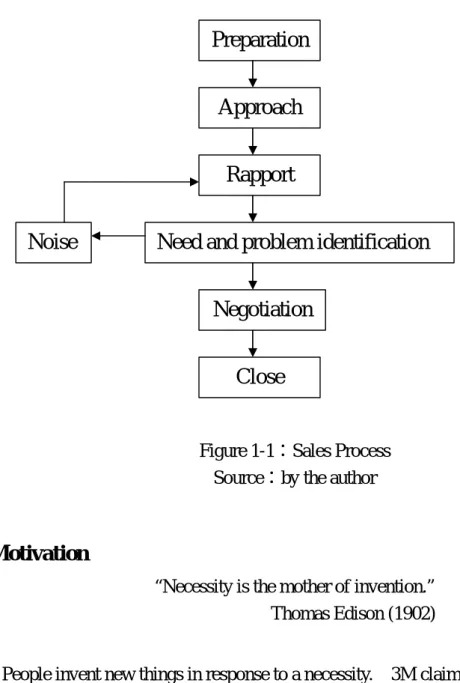
(8) LIST OF TABLES TABLE 2–1 TABLE 2–1 TABLE 2–2 TABLE 2–3 TABLE 2–4 TABLE 2–5 TABLE 2–6 TABLE 3–1 TABLE 3–2 TABLE 3–3 TABLE 3–4 TABLE 4–1 TABLE 4–2 TABLE 4–3 TABLE 4–4 TABLE 4–5 TABLE 4–6 TABLE 4–7 TABLE 4–8 TABLE 4–9 TABLE 4–10 TABLE 4–11. THE CONTEXT OF RAPPORT IN SALES RELATIONSHIP ...............................8 THE CONTEXT OF TEXT OF RAPPORT IN SALES RELATIONSHIP (CONTINUED)...........................................................................................9 THE VISUAL CUES TABLE .......................................................................13 THE AUDITORY CUES TABLE ...................................................................14 THE KINESTHETIC CUES TABLE ..............................................................15 CHARACTERIRSTICS TYPE ......................................................................20 SALES REPRESENTATIVE WEEKLY REPORT … … … … … … … … … ...… ...24 CHARACTERISTICS OF QUESTIONNAIRE REFERENCE .............................27 EXPERIENCE AND KNOWLEDGE OF QUESTIONNAIRE REFERENCE ..........28 CULTURE OF QUESTIONNARIE REFERENCE ............................................29 TRAINING OF QUESTIONNAIRE REFERENCE ...........................................30 CHARACTERIRSTICS OF THE RESPONDENTS ..........................................30 RELIABILITY MEASUREMENT .................................................................34 RELIABILITY OF THIS 4 FACTORS............................................................34 PAIRED SAMPLE TEST OF CHARACTERISTICS ..........................................34 CHARACTERISTICS ELEMENT ASCEDNING BY MEAN AND LEVEL.............35 PAIRED SAMPLE TEST OF EXPERIENCE AND KNOWLEDGE .......................36 EXPERIENCE AND KNOWLEDGE ASCENDING BY MEAN AND LEVEL .........37 PAIRED SAMPLE TEST OF COMPANY CULTURE AND REPUTATION .............38 COMPANY CULTURE AND REPUTATION ELEMENT ASCENDING BY MENA AND LEVEL ............................................................................................39 PAIRED SAMPLE TEST OF TRAINING ........................................................40 TRAINING ELEMENT ASCENDING BY MEAN AND LEVEL ..........................41. vi.
(9) LIST OF FIGURES FIGURE 1–1 FIGURE 1–2 FIGURE 2–1 FIGURE 2–2 FIGURE 3–1. SALES PROCESS .......................................................................................2 THE RESEACH PROCESS… … … … … … … … … … … … … … … … … … … 4 NLP 3 MODE POPULATION SHARE … … … … … … … … … … … … … … ..11 INTERACT WITH CUSTOMER IN PERSONAL SELLING… … … … … … … … .17 THE RESEARCH MODEL OF THIS RESEARCH ..........................................18. vii.
(10) CHAPTER ONE INTRODUCTION 1.1 Research Background Everyone is a salesperson who sells product, service or idea. Everyone can become a top seller by studying, practicing, concentrating and focusing on his own performance (Basis international 2002).. Former Acer CEO, Stan Shih used the smile curve to describe the industry value chain. The first and last sections reflect high profit from large R&D or marketing investments. The middle section reflects the manufacturing industry where profits are the lowest. Most of Taiwan’s companies are good at manufacturing. They are key suppliers in the international market. However, there are few sales forces in place to promote their brand products. Take 3M for example, they pay a lot of attention to R&D, and marketing which two sections of smile curve contribute great profit. They are not only famous for their R&D, but also have effective sales forces to distribute their business.. Personal Selling plays a vital role in every organization. An exquisitely made product will not automatically turn into a sale without the help of a salesperson who can push the product. In particular, technical products that requires the specialist to demonstrate the merits of the product and be able to hurdle the complex buying situation in an industrial set-up.. In this highly competitive environment, it is necessary for a firm to be able to clearly understand the needs of its clients. Sometimes companies would only look at the tip of the iceberg and miss out the large part. This study focuses on the factors that establish rapport between a firm and its clients. By having good rapport with the customers the salespeople 1.
(11) easily identify their requirements and speed up the selling process (please refer to figure 1).. Preparation Approach Rapport Noise. Need and problem identification Negotiation Close. Figure 1-1:Sales Process Source:by the author. 1.2 Motivation “Necessity is the mother of invention.” Thomas Edison (1902) People invent new things in response to a necessity.. 3M claims that over two-third of. its product improvement ideas come from listening to customer’s complaints (Kotler 1991). It is important for salespeople to listen to their customers and to prioritize customers’concerns. Over 80% of the Forbes Magazine’s top 500 companies disappeared in the past 20 years, because they did not meet their customers’needs.. Salespeople can easily identify customers’ need by simply asking. Most customers would openly tell their experiences with our products, if we know how to penetrate through 2.
(12) these people and get able to juice out the necessary information.. An ineffective salesperson spends a lot of time on selling. He intensely demonstrates products, floods his prospects with a stack of brochures and endlessly uses a certain degree of persuasion. On the other hand, an effective salesperson may use the last 5 minutes to talk products. Firstly he listens to the customer’s problem and presents the item as a solution to the problem. Facing unprecedented competitive environment, most of our clients would not really have the convenience of listening to repertoire . However, they no longer buy boxes but solutions for their problems.. It is necessary for a salesperson to clearly identify the prospective need during his canvassing stage. This would also save salesperson from the unnecessary objections that could hamper the sales process. could be done.. If one could to overcome this stage then it is likely a deal. To be able to dig out the requirement is necessary to establish a certain level. of rapport with your prospective client. Such level of relationship likewise helps during crisis situations, such as post-sale service concerns.. Hence, having a good rapport with a. client is a sure key to an order. Rapport provides “a state of grace” for service problems after the sales. When a sales representative attempts to sell without first establishing rapport, customers will avoid purchasing the product or service (Brook, 1989).. Establishing the right connection with the client would be essentially beneficial to any salesperson. Not only it assures a smooth transactions but it also ensures a chance of having more referrals, which can lead to better prospects.. “The Chinese have two identities: the individual and the organization person, which results in people acting one way but thinking another. The Chinese do not separate the 3.
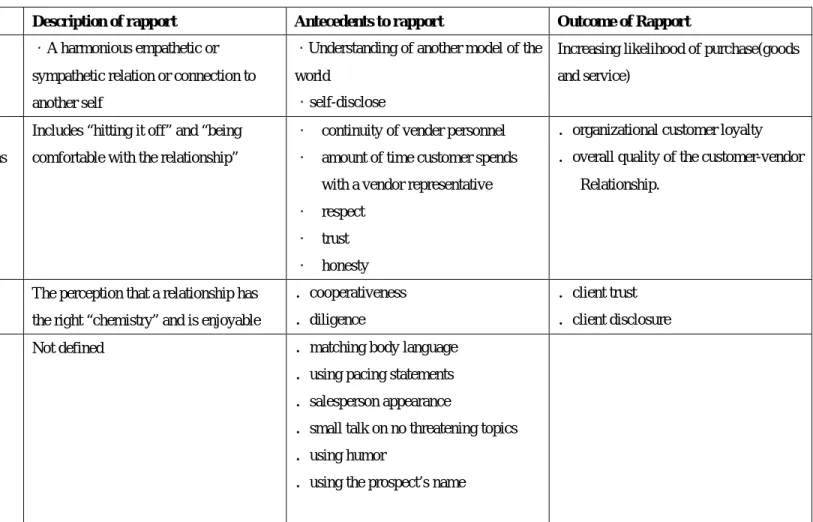
(13) personal and professional, so power struggles and politics often dominate Chinese corporate behavior.”( James McGregor,” One billion Customers” 2005). Chinese people have a different way of doing things which make foreign businesses suffer losses. However, if the foreign company could build up a close agreement or understanding, then they can avoid a disadvantage.. Sometimes the salespeople arrange customers’ field calls and they are always resisted by customers. The salespersons need to identify the customers’need and not insist to visit them. Building rapport help salesperson to identify the need and reminded by the customers when the need arise in the future.. 1.3. Objective: Selling is an ancient occupation. Kotler (1991) identified 6 concepts guide a company’s marketing efforts. From the oldest production concept to the newer customer concept, the companies move to care about the customers need.. The customers are now the top priority. for the marketing companies’efforts. We need to capture the customers’ need. The good quality of relation, rapport, will help meet the prospects. This study try to find the factors that help customers’rapport building.. 1.4 Research Process Relevant literature was initially collected and reviewed to better understand the subject on rapport building. The development of the conceptual framework and the scope of this study followed an actual survey of this study took. the data was analyzed and then completed the study.. 4. Upon collecting all the responses,.
(14) Identify research objective and research scope. Literature collection and study. Construction of conceptual framework. Questionnaire designs and revision. Collection of survey data. Data analysis. Discussion of the interrelation between variables. Conclusions and suggestions. Figure1- 2:The Research Process. 5.
(15) Chapter Two Literature review 2.1 Personal selling “The successful salesperson cares first for the customer , second for the products” Philip Kolter (2001) Personal selling is defined as a person-to-person communication with a prospect.. It is. a process of developing customer relationships, discovering customers’ needs, matching appropriate products with such needs, and communicating the benefits by way of information or a reminder and/or persuading (Manning & Reece 1990).. Selling is one of the. components of Kotler’s communication mix and the other elements are advertising, sales promotions, public relations and direct marketing.. Most customers would not blindly book an order with someone who they hardly know. Impulse buying does not exist in organizational buying. The selling process is usually longer and the level of intimacy between the seller and the buyer matters.. In most cases,. customers would only sign with people who they get along with. This is where rapport comes in, the salesperson initiates the interaction with his prospect.. 2.2 What is rapport? “When sales representatives attempt to sell without first establishing rapport, customers will avoid purchasing the product or service” Brook (1989) Longman Dictionary (1987) defines rapport as “a close agreement and understanding”, while Gfeller and Pribble (1897) define it as the quality of a relationship. Gremler & Gwinner 6.
(16) (2000) established that rapport has two facets - enjoyable interaction and personal connection. Campbell and Davis (2006) based Gremler&Gwinner context and used the sociolinguistic theory to overcome customers’ objections. Campbell and Davis’s theory proposes a verbal communication behavior to build rapport and overcome objections. Neuro-linguistic Programming founder, Bandler and Grinder (1975) gave a very interesting insight on why rapport is important and build trust: “We all have different ideas of reality ways in which we perceive the world and we can only really trust people who look at the world the way we do. If we feel understood, we give people our trust and open up to them more easily.” Below is a summary of the different views of various scholars on rapport.. 7.
(17) Table 2-1:The context of rapport in Sales Relationships Author(s)-context. Description of rapport. Antecedents to rapport. Outcome of Rapport. Brook(1989). •A harmonious empathetic or. •Understanding of another model of the. Increasing likelihood of purchase(goods. Salesperson –customer interactions. sympathetic relation or connection to. world. and service). another self. •self-disclose. Dell(1991). Includes “hitting it off” and “being. • continuity of vender personnel. .organizational customer loyalty. Vendor-industrial customer interactions. comfortable with the relationship”. • amount of time customer spends. .overall quality of the customer-vendor. with a vendor representative. Relationship.. • respect • trust • honesty LaBahn(1996)- advertise agency and. The perception that a relationship has. .cooperativeness. .client trust. client. the right “chemistry” and is enjoyable. .diligence. .client disclosure. Marks(1994)—salesperson prospect. Not defined. .matching body language. interaction. .using pacing statements .salesperson appearance .small talk on no threatening topics .using humor .using the prospect’s name. 8.
(18) (Continue) Author(s)-context. Description of rapport. Antecedents to rapport. Outcome of Rapport. Moine(1982)—salesperson-client. Not defined. .hypnotic pacing( statement and gesture that play back a customer’s. Increased likelihood of. interactions. observations, experience, or behavior). purchase. .properly using the customer’s name in conversation .telling stories, anecdotes, or parables Nancarrow and Penn(1998)—telemarketing. (Other’s definitions of rapport. .harmony of purpose. •developement of a. are provided). .salesperson capabilities(knowledge and expertise). relationship. .similarity of business and personal value .expressive behavior or mannerisms .Neuro-linguistic programming, which includes pacing behavior, matching. •. trust. established similarity with. voice patterns, matching posture, matching voice tone, matching breathing. •. increased sales. another person. patterns, matching gesture. Nickels, Everett, and Klein(1983)—. The perception of having. salesperson-customer interaction. •. perceived ideological similarity. Progress in the. industrial salesperson-customer. •. supporting the self-image of the customer. sales-interaction process. interaction. •. empathizing with the customer. Spiro, Perreault, and Reynolds(1977)—. Not defined. Weitz,Castleberry, and Tanner(1992)—. A close, harmonious. Common links(e.g. mutual friends, common hobbies, attendance at the same. Greater customer. salesperson-customer interactions. relationship founded on mutual. schools). receptivity to the. trust. salesperson. Source: Dwayne D. Gremler and Kevin P. Gwinner “Customer-Employee Rapport in Service Relationhsips”, (2000).. 9.
(19) Once rapport has been established with the customer, it is likely to yield multiple positive effects that can be directly translated into sales (Campbell and Davis 2006). Rapport , provides a longer grace period for after sales service concerns. A customer may find it annoying and is likely to reject a proposal from a salesperson who directly present a product without listening voice of the customer.. 2.3 Why Rapport is Important ? (1). Rapport helps build trust. Trust is an essential component of any business transaction and everything revolves around it. (2). Rapport finds the prospective customers need. Rapport helps in identifying the right prospect. Canvassing is a very important aspect in the selling sequence. Your customer can easily notice the amount of effort you put in as he see a clear solution to his concerns. By doing so, you are likely to bring home the contract. (3). Rapport helps the communication efficient. Rapport enhances the mode of communication. Rapport would not dwell on persuasion rather than it focuses on agreements and understandings thus leading to a more harmony, and emphatic mode in dealing with the customers’issues.. 2.4 NLP builds the Rapport 2.4.1 What is NLP ? NLP (Neuro-Linguistic Programming) is a technique for enhancing one’s ability to detect personality types through an increased awareness of verbal and physical cues (Capon, Noel and Swasy 1977). Neuro: Your neurological system and your sense of sight, hearing, touch, taste and smell. Linguistic: Your language pattern and how you think.. 10.
(20) Programming:The coding of experience. (Sue Knight 1994) Before 1975, Therapists and psychotherapists use NLP to establish almost instant rapport with clients. The NLP founders, Richard Bandler and John Grinder were fascinated by therapists and psychotherapists to build instant rapport with clients. A linguist, Richard Bandler, and a programmer, John Grinder, code the sequence of thinking and language pattern. They used video camera to observe the people’s eye movement to perceive the mind. The founders of NLP, Bandler and Grinder discovered that the thinking pattern is actually the sorting, processing and storing of sensory impressions. In 1983, Nickels, Everett and Klein propose to use NLP to build rapport for salespeople. According Richard’s and John’s study, NLP has 3 model. There are visual, auditory and kinesthetic: Visual (35%) Auditory (25%) Kinesthetic (40%). Visual 35% auditory 25% kinesthetic 40%. Figure 2-1 :NLP 3 mode ratio Buzzotta, Lefton, and Shemberg(1972, 1982) studied the interaction of salespersons and customers and concluded that “professional” salesperson are able to detect the personality style of the customers and have the flexibility to adapt accordingly. Capon and Swasy (1977) observed some NLP studies have been made of compliance-gaining techniques in selling. Dilts et al. (1980) expressed NLP has been a practical model that reveals how rapport is most effectively created. Moine (1982) found. 11.
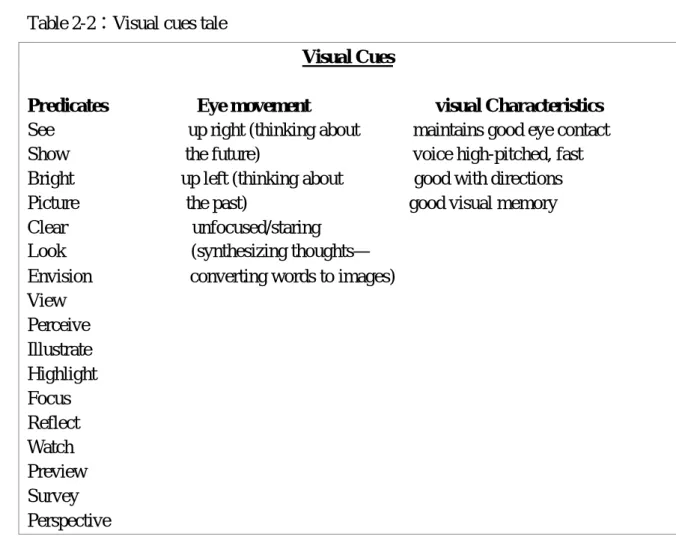
(21) that NLP be used in successful salespeople who seem to be able to “read” customers and respond to them warmly and openly thus creating trust and inevitably sales. Nickels, Everett and Klein (1983) devoted NLP to build rapport for salespeople. They suggest using verbal and nonverbal cues to match the target. The salesperson use verbs to match customers’ voice tone (e.g. excited, relaxed, loud, etc) and voice pattern (e.g. descriptive words matching thinking mode). Meanwhile, using the nonverbal, such as eye movements, breathing patterns, body posture, and skin match customers’respond. A neophyte salesperson might not have the necessary skills to identify his customers’ needs. He may present directly a brochure or demonstrate to his clients.. As. the salesperson moves further and realizes the different techniques in getting through his customer, he would appreciate the logic behind developing rapport with the target.. 2.4.2 NLP model (1) Visual Bandler and Grinder estimate that 35% of the people tend to be more visual. These people would play around with the different constructs in their mind and they are more likely to work well in seeing things. In effect, a brochure, a catalog, or a CD would be an ideal reference material for them. Salespeople who can “read” these cues and respond to them immediately would have bigger chances of closing a sale. The visual customer would be very interested in seeing a product catalog or other relevant sales paraphernalia. The human eye can be a good indicator of how one thinks. Bandler and Grinder have studied the relationship between the way people think and their eye movement. All 3 modes of NLP have their eye movement cues and meanings to the following 3 tables to gain a better understanding of eye movement cues. You can easily size-up the nonverbal expressions of your clients. All you need is a little practice familiarizing yourself with some of the most common gestures.. Let us. say, in presenting a quote to a client you would get feedback that your price is too high. 12.
(22) or someone else have offered a much lower quote, pay attention to his body movements and facial expressions to validate his statements. Below is a list of some of the most common movements and their meanings.. Table 2-2:Visual cues tale Visual Cues Predicates See Show Bright Picture Clear Look Envision View Perceive Illustrate Highlight Focus Reflect Watch Preview Survey Perspective. Eye movement visual Characteristics up right (thinking about maintains good eye contact the future) voice high-pitched, fast up left (thinking about good with directions the past) good visual memory unfocused/staring (synthesizing thoughts— converting words to images). Source: Kerry L. Johnson (1994). (2) Auditory: An auditory person is someone who listens to what is going on around him, and devises his strategy based on what he hears. People whose mental maps are primarily auditory make up about 25% of the population. The auditory like use “tone”, “sounds”, “say”, “tell”, and “hear”. If you have good voice, you have good impression. The auditory mode person doesn’t like see the catalog, slides, or computer presentations. They prefer your voice. Use your voice to close the deal. 13.
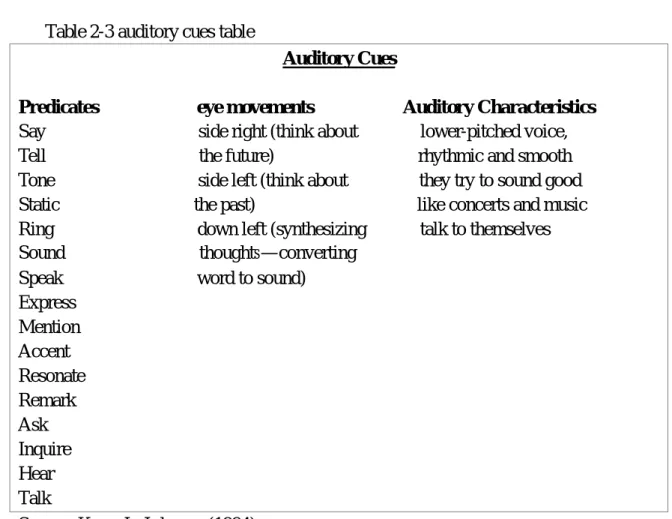
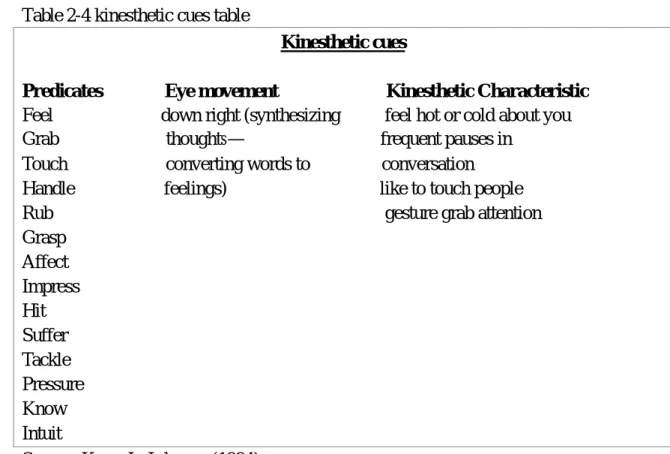
(23) The auditory person prefers to listen than to see things. He can easily be pleased with the use of tone and voice projection rather than pictures and literatures.. Table 2-3 auditory cues table Auditory Cues Predicates eye movements Say side right (think about Tell the future) Tone side left (think about Static the past) Ring down left (synthesizing Sound thoughts—converting Speak word to sound) Express Mention Accent Resonate Remark Ask Inquire Hear Talk Source: Kerry L. Johnson (1994). Auditory Characteristics lower-pitched voice, rhythmic and smooth they try to sound good like concerts and music talk to themselves. (3) Kinesthetic (Feeling): What would you like to accomplish today? What would come out of your mind as you hear Disneyland?. Experiential marketing is considered as one of the best tools that can. be applied to through an audience by way of sales presentation or product demonstration. An anecdote help kinesthetic develop a quick feeling of trust. A good demonstrate also instantly give them high impression.. 14.
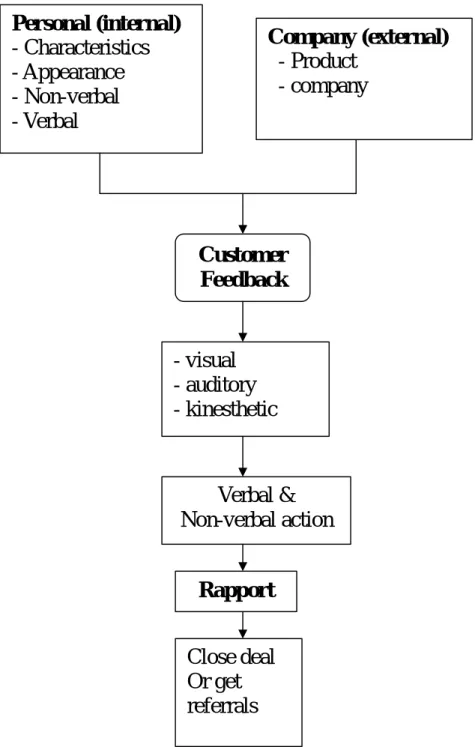
(24) Table 2-4 kinesthetic cues table Kinesthetic cues Predicates Eye movement Feel down right (synthesizing Grab thoughts— Touch converting words to Handle feelings) Rub Grasp Affect Impress Hit Suffer Tackle Pressure Know Intuit Source: Kerry L. Johnson (1994). Kinesthetic Characteristic feel hot or cold about you frequent pauses in conversation like to touch people gesture grab attention. NLP is one of the tools we can apply in trying to get through to a particular audience. By carefully assessing the profile of a target, we can easily choose among the three alternatives stated above as a means to catch our prospect’s attention.. 2.5 Rapport in Selling Process “The sales encounter is much like a dance. Ideally, the two soon merge into a couple moving together in rapport” Nickels (1983) The salespersons constant interaction with his prospect gives him the liberty to assess some of its peculiarities.. He can make use of his four senses in carefully. studying the body movement as well as voice and tone quality, breathing patterns, style of dressing to better familiarize himself with the personality of the target. As the salesperson makes a prospective call he brings along three personalities his own individuality, an image developed by the company, and a technically trained mindset. (Reference figure2-2). Rapport is a matter of complementing or getting along 15.
(25) with the target. One should be cautious of every movement he manifest regardless of weather it is verbal or nonverbal language and other cues that may seem important to the other party.. The selling process begins with simple conversation. In this initial stage, the salesperson tries to get a feeling of his clients’ mood and attempts to make a good impression by reading his clients actions and words.. Precision questions are also undoubtedly one of the most powerful tools for challenging the constraints that people create for themselves. You could get what you want from asking and arrange the image for your customers. These words could be paraphrase, key words, jargon, or same experience sharing. These help rapport building. Asking questions to clarify things or to fish out information is another option that would help a salesman links up with the customer.. Constant use of the other party’s jargon or. by continually paraphrasing his lines would give customer the idea that you are paying a close attention to what he says.. Lastly, the use of body language is the easiest and most obvious technique to get through to the target.. However, it should be very careful not to send to the wrong. signal.. 16.
(26) Personal (internal) - Characteristics - Appearance - Non-verbal - Verbal. Company (external) - Product - company. Customer Feedback. - visual - auditory - kinesthetic. Verbal & Non-verbal action Rapport Close deal Or get referrals. Figure 2-2:Buyer - Seller Interaction Mode Source :By the author. 17.
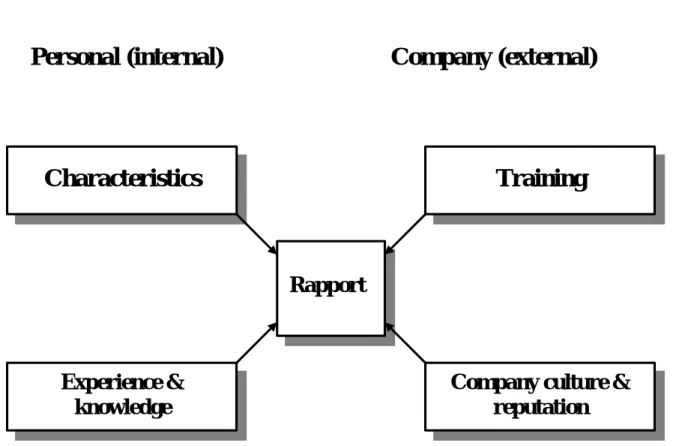
(27) 2.6 Factors Help Rapport Rapport could help sellers to build instant understanding and agreement, that are very useful in the selling process. The top salespersons could effectively detect customers’personality and modify themselves to meet customers’requirement. Some salespersons can perform the skills professionally, but some can’t. Form the study of transfer of training , the researchers devote. from internal and external factors that will. influence the learners’performance. (Huczynski & Lewis,1980;Noe,1986;Baldwin & Ford,1988;Tracy,1995;Xiao,1996). Some researchers (Tracey et al.,1995; Factean et al.,1995) strength on the characteristics and company culture that help the learning behaviors. We integrate the studies and previous literatures to design the factors that help the rapport. The internal factors are characteristics, experience and knowledge. On the other hand, the external factors are company culture, reputation and training. 2.7 The study factors review 2.7.1. Characteristics Compared with the average annual turnover rate of 20% for all industries, the 5% turnover rate of 3M Taiwan is impressive. This low turnover rate is not only due to the compensation package offered by 3M, but also to the emphasis that 3M places on recruiting the right people. 3M’s employees, otherwise known as 3Mers, have similar characteristics. One of senior 3Mers said they didn’t specifically highlight any trait in 3M, but the top management has similar characteristics. Salespeople are influenced in such environment. Of the diversified characteristics, the integrity is the most strongly impressed (3M Taiwan Forum). There are a number of studies that focuses on successful characteristics of salespersons. This research presents three sets of successful salesperson attributes that researchers have identified for top sellers.. 18.
(28) Table 2-5:Characteristics of a superior Salesperson Harvard Business School(2002) Set1 Do not take “no” personally Possess empathy Take 100% responsibility for result Above average ambition ,empathy and willpower and determination intensely goal-oriented easily approach strangers Greenberg and Greenberg(1983) Set2 Empathy Ego drive Ego strength Patton and Sardar(2002) Set3 Job commitment Strategic orientation Intellect Mental alertness Sociability Authoritative Dependability Persistence Courage Ability to improvise Inquisitiveness Forcefulness Tenacity straightforwardness Source:Amanda Ruth and Allen Wysocki, (2002). 2.7.2. Experience and Knowledge 1. Experience Anderson (1982, 1983) proposed three stages of knowledge acquisition: (1).the declarative stage (2).knowledge compilation (3).the procedural state When learning a foreign language, we start by reading a textbook to acquire knowledge on how to speak or write. Such knowledge is at the declarative stage. Then, the 19.
(29) knowledge is converted into knowledge at the procedural stage through practicing alone or with an instructor. Anderson’s skill acquisition model is consistent with expertise research. Glaser and Chi (1988) point out those experts excel mainly in their own domain and they perform quickly with little error. Makoto’s (2000) study shows that the more experience people have, the stronger the relationship between knowledge and performance. Generally, 3M Taiwan prefers an applicant who has some relevant sales experience in the same industry.. Previous work experience is seen as a strength that minimizes the. need for training to familiarize the salesperson with the industry or its products.. 2 Knowledge Empirical evidence shows that effective and ineffective salespeople have different knowledge bases (Leigh and McGraw, 1989; Weitz 1986). In selling, declarative knowledge provides a database for recognizing customer types, needs and the sales situation, whereas procedural knowledge indicates what type of selling method or strategies should be used in specific situations (Weitz et al. 1986) Sujan et al. (1988) found that effective salespeople have richer and more interrelated knowledge structures about their customers than inefficient salespeople. Matsuo’s (2000) research shows that salespeople’s knowledge have major influences on their performance.. 2.7.3. Company culture and reputation (1) Reputation Levitt (1965), showed that (I) a company’s reputation improves its sales force’s chance of getting a favorable first impression and an early adoption of the product. Corporate advertising builds-up the company’s reputation. This in turn, benefits sales representatives.. 20.
(30) (ii) Sales representatives from well-known companies have a sight advantage over sales representatives from smaller companies. (iii)Company reputation usually affects decision making, specifically if the perceived risk is high.. 3M is known as a solution provider.. Most of its customers see their sales. representative as an agent that can resolve some of their concerns. (2) Organization Culture︰ Culture is the set of value, norms guiding beliefs, and understanding that is shared by members of an organization and taught to new members as correct (Ducan 1989) Company culture exist on two levels (Edgar, 1984) (i). surface level: observable symbols, ceremonies, stories, slogans, behaviors, dress, physical settings 3M prefers to locate its offices in buildings that are less than 13-storeies high with. a lot of open public spaces for employees to meet and interact. Furthermore, 3M prefers to be surrounded with trees. 3M sales representatives would shares a common space that promotes colleagues’ interaction and would encourage salespeople to do more field work. The company has a very flexible dress code that easily adapts to the industry or customer their targeting.. Further, regular social gatherings such as. family day, company outing are encouraged to further build camaraderie among its ranks.. (ii). Deep level: underlying values, assumptions, beliefs, attitudes, and feelings.. 21.
(31) One 3M executive put it that way:. Our objective is first and foremost to have a steady flow of new products. Then, once we hit, we expect to dominate the niche, sometimes for only three or four years. During that stretch we price according to full value to the customer. We’re providing a new tool that is some kind of a labor saver and we expect the market to pay what it is worth. Sure, we create an umbrella. But when others come them for share, we usually give in—that is, get out. Because by then we’re developing the next several generations of products for that market and others. (Peters and Waterman, “in search of excellence”) That vividly expresses 3M key success factors. 3M’s products are well received in the market which gives them profit to go on product development and the luxury to hire the best potential candidates in the field. The recycle factors help 3M lives over a century. Besides, there are other important core values in the 3M (a) Innovation: The innovative culture has helped 3M sustain the operations for more than a century.. The 3M Company slogan is “innovation for you”. With this in mind,. 3M has a high standard for performance and expect each person to be able to bring in the desired results at the end of the day.. One of their division targets requires that at. least 25% of its sales must be derived from products that did not exist five years ago. (b). Close to customers: 3M encourages their representatives to spend more time with their customers. Most of the business has be handled by the customer services and distributors. (c). Respect for employee: A 3M’s sales representative is not expected to report to the office unless he deems it is necessary. They have a strong honesty system that allows the salesperson to simply document his activities on a weekly basis and submit the weekly report (Table 2) to his supervisor for confirmation. The weeklyreport is also the working plan which records the sellers schedule this week and encounter situation or opportunities last week. Table 2-6 Sales representative weekly report. 22.
(32) MONDAY. 1. CTC. 7. N. 2. Nan-ya. 7. N. L. 3. Ten-r. 7. F. L. 4. Radiant. 7. W. L. s. #OF NEW ITEM. #OF LINE ITEM. #OF PEOPLE CALLED. CLALL WITH. AREA CODE. CUSTOMER NAME. RANK CODE. MONTH DAY YEAR. SOURCE LEAD. 26. THE CALL. Aug. REASON(S) OF MAKING. WEEK OF. TYPE OF ORDER TAKEN. David Chen DIVISION. TYPE OF CUSTOMER/PROSPECT CALLED. NAME. ORDER HANDLE BY (DISTRIBUTOR, ETC/3M). WEEKLY ACTIVITY REPORT. YOUR COMMENTS. L. MAJOR OPPORTUNITIES. 5 6 7. Source: 3M handbook 2.7.4. Training (1)Sales Training are jointly conducted by the Human Resource Department and the Sales Department.. Basic Selling is being facilitated by the Human Resources. Department and Product Training is being conducted by the Sales Department. Most of the training modules come from 3M headquarters and training are conducted by senior managers. (2)Activities: There are some activities or meetings conducted by some committees, like sales meeting, Star Club activities, family day and incentive trip… and so on, that are good motivators to communicate and stimulate the sales force efforts. Harrison and Janice’s (1984) study indicated that activities and ceremonies are the patterns of culture and evolve “we are one family of people who truly care about each other”. Wietz’s (1986) study shows that sales training has no immediate effect on acquiring useful procedural knowledge. The sales manager should pay attention to team-oriented 23.
(33) selling, which gives inexperienced salespeople the opportunity to coach the skill of excellent salesperson. (3) F.A.B and Demonstration: The F.A.B concept and demonstrating cultivate in every 3Mer’mind. Sales representative also facilitate the selling by following a features, advantages and benefits (F.A.B).. Feature describes physical characteristics of a. products offering, such as tape color, material and thickness. Advantage describes why the features provide an advantage to the customers. Benefits describe the economic, technical, and service delivered by the offering. The tool and method effectively offer a formula for salesperson to approach the customers. By demonstrating the demo kits, the sales effectively show the AIDA formula of gaining attention, holding interests, arousing desire and obtaining action.. 24.
(34) Chapter Three Research Methodology 3.1 Research structure The objective of this study is to find out the importance of factors that influence the rapport as experienced in personal selling. The identified factors shall be presented in two phases: personal factors which include characteristics, experience and knowledge; organizational factors that include training, culture and reputation. This chapter will establish the research framework, research variables and explain the methods used in analyzing the data.. Personal (internal). Company (external). Characteristics. Training. Rapport. Experience & knowledge. Company culture & reputation. Figure 3-1:Research structure. 25.
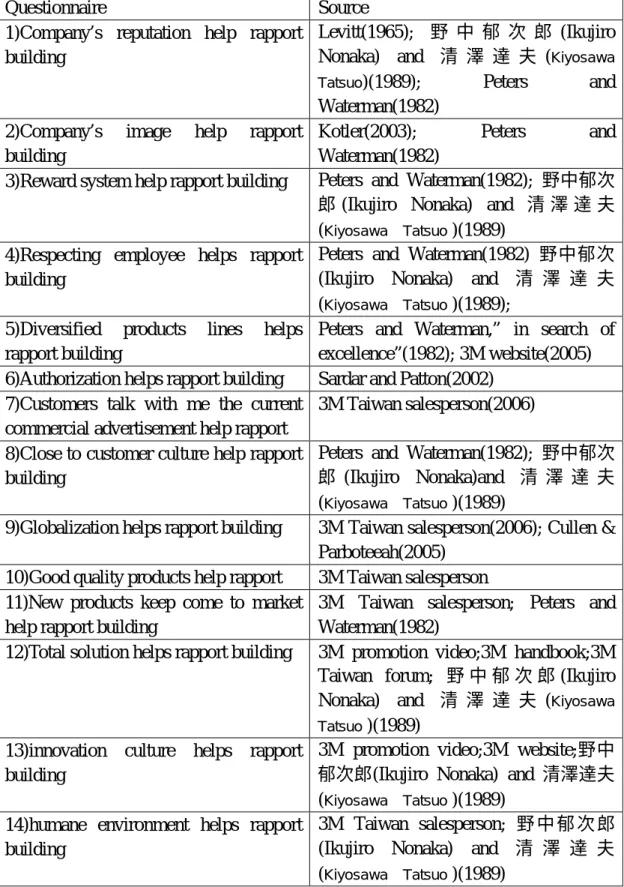
(35) 3.2 The research target and the data collection The subject for this study was the 98 salesperson of 3M in Taiwan. 98 questionnaires were initially sent out and 58 copies were sent back.. Among those that returned 4 were. classified as invalid and 54 were considered for further testing.. Overall response rate. was at 59%.. 3.3 Questionnaire design Likert scale was used to gauge their level of importance with 5 as deemed very important and 1 not important at all. Sex: Male and female Marital status:. single and married. Age: divided into 7 categories: (1) below 30 (2)30- 35 (3)35-40 (4)40-45 (5)45-50(6) 50-55(7) above 55 Seniority: (1) less than 3 years (2)3-6 years (3)6-9 years (4)9-12 years (5)12-15 (6)15-18 (7) more than 18 Educational level: (1) senior high school (2) college/University (3) master (4) PhD. We integrate the previous relevant study. Meanwhile, 16 salespersons from 3M were invited to a panel discussion to develop some insights in constructing the questionnaire. The following tables express the reference.. 26.
(36) Table 3-1:The Characteristics questionnaire references Questionnaire. Source. 1)Humor sense helps rapport building. Marks(1994);Ruth and Wysocki(2002). 2)Aggressive. attitude. helps. rapport 3M salesmen(2006),. building 3)Integrity trait helps rapport building. Hawes(1994);Milliman and Fugate(1988); Raelson(1990); Rohrer(1985); Spitzer and Turner(1995); Swan and Nolan(1985) Geoff Lancaster(2000);. 4)Good discipline helps rapport building 5)Independent. trait. helps. Gitomer(2000). rapport 3M Taiwan salesperson(2006). building 6)Responsibility helps rapport building. BASIS international(2002). 7)Personal relationship help rapport Beatty et al.(1996);Bitner, Booms and building. Tetreault(1990). 8)Open minded helps rapport building. Harrigan and Rosenthal(1983). 9)Passion for work and customers helps Jack Welch, “ Jack”(2001); rapport building 10)Positive. attitude. helps. rapport 3M Taiwan salesperson(2006). building 11)Empathy helps rapport building. Greenberg and Greenberg(1983). 12)Ambition helps rapport building. Geoff Lancaster(1994). 13)Caring helps rapport building. Geoff Lancaster(1994). 14)Curtness helps rapport building. Beth & Vera(1990);Ford and Etienne(1994). 15)Liking your customers helps rapport Bernieri(1988);Kotler(2002) building 27.
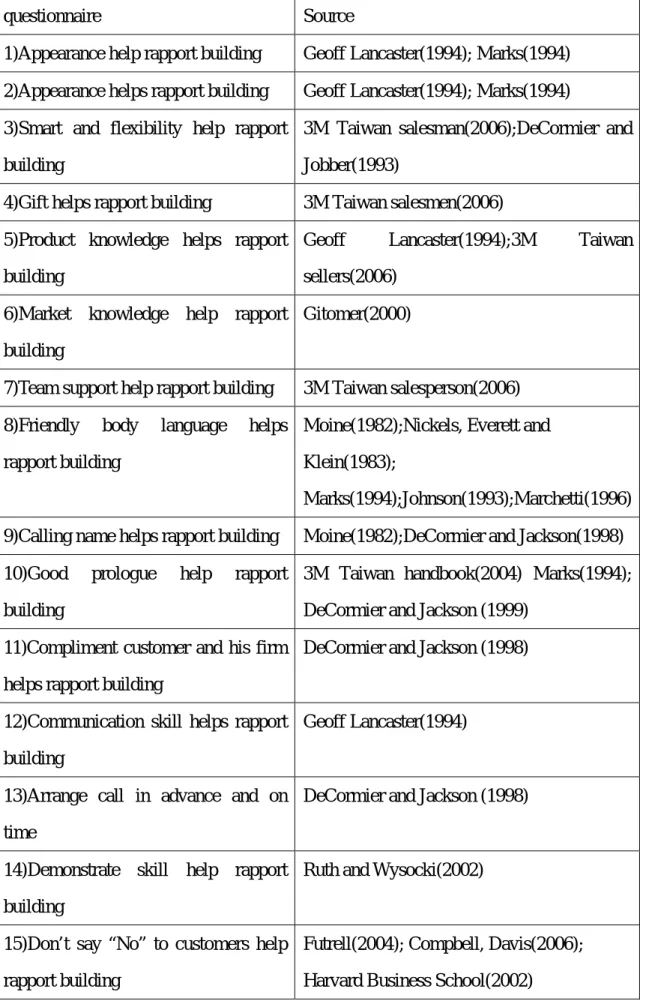
(37) Table 3-2:The Experience and Knowledge questionnaire references questionnaire. Source. 1)Appearance help rapport building. Geoff Lancaster(1994); Marks(1994). 2)Appearance helps rapport building. Geoff Lancaster(1994); Marks(1994). 3)Smart and flexibility help rapport 3M Taiwan salesman(2006);DeCormier and building. Jobber(1993). 4)Gift helps rapport building. 3M Taiwan salesmen(2006). 5)Product knowledge helps rapport Geoff building 6)Market. Lancaster(1994);3M. Taiwan. sellers(2006) knowledge. help. rapport Gitomer(2000). building 7)Team support help rapport building 8)Friendly. body. language. 3M Taiwan salesperson(2006). helps Moine(1982);Nickels, Everett and. rapport building. Klein(1983); Marks(1994);Johnson(1993);Marchetti(1996). 9)Calling name helps rapport building 10)Good. prologue. help. building. Moine(1982);DeCormier and Jackson(1998). rapport 3M Taiwan handbook(2004) Marks(1994); DeCormier and Jackson (1999). 11)Compliment customer and his firm DeCormier and Jackson (1998) helps rapport building 12)Communication skill helps rapport Geoff Lancaster(1994) building 13)Arrange call in advance and on DeCormier and Jackson (1998) time 14)Demonstrate skill. help. rapport Ruth and Wysocki(2002). building 15)Don’t say “No” to customers help Futrell(2004); Compbell, Davis(2006); rapport building. Harvard Business School(2002). 28.
(38) Table 3-3:The Culture questionnaire references Questionnaire Source 1)Company’s reputation help rapport Levitt(1965); 野 中 郁 次 郎 (Ikujiro Nonaka) and 清 澤 達 夫 (Kiyosawa building Tatsuo)(1989); Peters and Waterman(1982) 2)Company’s image help rapport Kotler(2003); Peters and building Waterman(1982) Peters and Waterman(1982); 野中郁次 3)Reward system help rapport building 郎 (Ikujiro Nonaka) and 清 澤 達 夫 (Kiyosawa Tatsuo )(1989) 4)Respecting employee helps rapport Peters and Waterman(1982) 野中郁次 (Ikujiro Nonaka) and 清 澤 達 夫 building (Kiyosawa Tatsuo )(1989); 5)Diversified products lines helps Peters and Waterman,” in search of rapport building excellence”(1982); 3M website(2005) 6)Authorization helps rapport building Sardar and Patton(2002) 7)Customers talk with me the current 3M Taiwan salesperson(2006) commercial advertisement help rapport 8)Close to customer culture help rapport Peters and Waterman(1982); 野中郁次 郎 (Ikujiro Nonaka)and 清 澤 達 夫 building (Kiyosawa Tatsuo )(1989) 9)Globalization helps rapport building 3M Taiwan salesperson(2006); Cullen & Parboteeah(2005) 10)Good quality products help rapport 3M Taiwan salesperson 11)New products keep come to market 3M Taiwan salesperson; Peters and help rapport building Waterman(1982) 12)Total solution helps rapport building 3M promotion video;3M handbook;3M Taiwan forum; 野 中 郁 次 郎 (Ikujiro Nonaka) and 清 澤 達 夫 (Kiyosawa Tatsuo )(1989) 13)innovation culture helps rapport 3M promotion video;3M website;野中 郁次郎(Ikujiro Nonaka) and 清澤達夫 building (Kiyosawa Tatsuo )(1989) 14)humane environment helps rapport 3M Taiwan salesperson; 野 中 郁 次 郎 (Ikujiro Nonaka) and 清 澤 達 夫 building (Kiyosawa Tatsuo )(1989). 29.
(39) Table 3-4:The Training questionnaire references questionnaire. source. 1)Selling skill training(天龍八部) help 3M hand book(2006) rapport building 2)Supervisor behavior and remark help 3M Taiwan salesmen(2006) rapport building 3)Filed. call. with. supervisor. helps 3M handbook(2006) and 3M Taiwan. rapport building. salesmen(2006). 4)Colleague behavior and remark help 3M Taiwan salesperson(2006) rapport building 5)Sales Department conduct meeting 3M Taiwan salesmen(2006) help rapport building 6)HRM conduct training help rapport. 3M Taiwan salesmen(2006). 7)Access environment and body language help rapport building 8)Technical engineer joining call help rapport building 9 Conducting seminar to customer helps rapport building 10)Globalization environment help rapport building 11)Preparation well help rapport building. Nickels, Everett, and Klein(1983);Decormier. 12)Active listening help rapport building. Kerry L. Johnson(1994). 13)APEC Training help rapport building. 3M. and Jobber(1993) 3M Taiwan salesmen(2006) 3M Taiwan salesmen(2006) 3M Taiwan salesmen(2006) Geoff Lancaster(1994). website(2005),. 3M. Taiwan. salesmen(2006) 14)Firm’s activities and ceremonies help 3M Taiwan website(2006), interview 3M rapport building. Taiwan. salesmen(2006);3M. Taiwan. Forum(2005);Harrison and Janice(1984) 15)Sales Group meeting and division 3M meeting help rapport building. forum(2005);. salesmen(2006). 30. 3M. Taiwan.
(40) 3-4 Data Analysis Methodology In order to achieve the purposes of this research and test the hypotheses, SPSS 12.0 was used to help in analyzing the collected data.. Data analysis were conducted as. follows. 3.4.1 Descriptive Statistic Analysis To better understand the characteristics of each variable, descriptive statistic analysis has been used to illustrate the means, and standard deviation of each research variable.. 3.4.2 Internal Consistency Analysis (Cronbach’s alpha) Coefficient alpha (α) is a measure of squared correlation between observed scores and true scores.. In other words, reliability is measured in terms of the ratio of true score. variance to observed score variance.. It can test the internal consistency of each factor.. According to Robinson and Shaver (1973), if α is greater than 0.7, it means that it has high reliability and if α is smaller than 0.3, then it implies that there is low reliability.. 3.4.3 Paired sample t-tests A paired sample t-test is used to determine whether there is a significant difference between the average values of the same measurement made under two different conditions. Both measurements are made on each unit in a sample, and the test is based on the paired differences between these two values. The usual null hypothesis is that the difference in the mean values is zero The null hypothesis for the paired sample t-test is H0: d = µ1 - µ2 = 0 Where d is the mean value of the difference. This null hypothesis is tested against one of the following alternative hypotheses, depending on the question posed: H1: d ≠ 0 31.
(41) Chapter Four Result Finding 4.1 Descriptive Statistic Analysis Table 4-1 :Characteristics of Respondents Characteristic gender marriage age. Working years. education. Monthly salary. Define female male married single Below 30 30-35 35-40 40-45 45-50 50-55 Above 55 Below 3 years 3-6 years 6-9 years 9-12 years 12-15 years 15-18 years Above 18 years High school College and master PhD 40 K 40-60K 60-80K 80-100K 100-120K 120-150K Above 150K. person 11 43 36 18 5 19 19 9 9 2 0 17 10 8 12 6 1 0 0 37 17 0 3 22 20 8 0 0 1. 32. Percentage 21 79 66.7 33.3 9.3 35.2 35.2 16.7 16.7 3.7 0 31.5 18.5 14.8 22.2 11.1 1.9 0 0 68.5 31.5 0 5.6 40.7 37 14.8 0 0 1.9.
(42) (1) Gender: 79% of salespeople are male, female share 21% (2) Marriage: 66.7% of salesperson gets married. (3) Age: Over 90% salespersons are 30 years old 53.6% salesperson age is over 35 years old. (4) Working period: 50% salesperson’s working period is over 6 years. (5) Education: All salesperson education is college or University at least. 31.5% has master degree. (6) Salary: The monthly salary of 40-60 thousand is 40.7%. 60-80 thousand is 37%. Salesperson have bonus and incentive are exclude in the salary.. 4.2 Internal Consistency Analysis (Cronbach’s alpha) This is to see if the questionnaires in the survey are reliable or not. The most common type is Cronbach’s a reliability measurement. Table 4-2:Reliability measurement a<0.3 not reliable 0.4≦ a<0.5 reliable 0.7≦ a<0.9 strongly reliable (the second most common) Source:吳明隆, Wu, Ming-Long (2005). 0.3≦ a<0.4 slightly reliable 0.5≦ a<0.7 very reliable (most common) 0.9 ≦α extremely reliable. From the table below we know that the factors are strongly reliable or extremely reliable. Table 4-3:Reliability of these study 4 factors Factors Cronbach’s a Characteristic 0.889 Experience & Knowledge 0.884 Company Culture & reputation 0.931 Training 0.885. 33.
(43) 4.3 Paired sample t-test 1. Characteristic The Table4-4 is the output of Characteristics factor elements’paired sample t test. The significant greater than 0.05 has the pair of p3- p6 that are the same group and have relatively high important to the rapport. On the other hand, the rest of elements have relatively low important to the rapport. The test shows that Characteristics’elements have two group that indicate the important level to the rapport( Table 4-5).. Table 4-4 Paired Samples Test Sig. Paired Differences. t. df. (2-tailed). Std.. Mean. Deviatio. Std. Error. 95% Confidence Interval. n. Mean. of the Difference Lower. Upper. Pair 1. p3 - p8. 1.000. 1.082. .147. .705. 1.295. 6.794. 53. .000. Pair 2. p3 - p5. .833. .947. .129. .575. 1.092. 6.469. 53. .000. Pair 3. p3 - p12. .741. 1.013. .138. .464. 1.017. 5.374. 53. .000. Pair 4. p3 - p15. .667. 1.028. .140. .386. .947. 4.766. 53. .000. Pair 5. p3 - p14. .611. .878. .119. .372. .851. 5.116. 53. .000. Pair 6. p3 - p10. .593. .765. .104. .384. .801. 5.691. 53. .000. Pair 7. p1 - p3. -.593. .790. .107. -.808. -.377. -5.516. 53. .000. Pair 8. p3 - p7. .500. .841. .114. .270. .730. 4.368. 53. .000. Pair 9. p3 - p4. .500. .720. .098. .303. .697. 5.101. 53. .000. Pair 10. p3 - p9. .500. .818. .111. .277. .723. 4.489. 53. .000. Pair 11. p3 - p11. .370. .734. .100. .170. .571. 3.705. 53. .001. Pair 12. p3 - p13. .259. .732. .100. .060. .459. 2.604. 53. .012. Pair 13. p2 - p3. -.222. .634. .086. -.395. -.049. -2.574. 53. .013. Pair 14. p3 - p6. .167. .637. .087. -.007. .341. 1.923. 53. .060. Note: “p” is the symbol of characteristics element. 34.
(44) Table 4-5 Characteristics elements ascending by mean and level element. mean. Std Dev level. Characteristics. 3)Integrity help build rapport. 4.7037. .6028. 4.2. 6)Responsibility. build 4.5370. .7181. help. Level I. rapport 2)Aggressive help build rapport. 4.4815. .6028. Level. 13) Caring help rapport building. 4.444. .6635. II. 11)Empathy help build rapport. 4.3333. .6143. 9)Passion to work and customer 4.2037. .6835. help build rapport 4)discipline help build rapport. 4.2037. .6553. 7)Public relationship help rapport 4.2037. .6553. building 1)Humor sense help build rapport. 4.1111. .7181. 10)Positive attitude help build 4.1111. .6635. rapport 14)Curtness help rapport building 15)Like. your. customers. 4.0926. .7076. help 4.0370. .8233. rapport building 12)Motivation help build rapport. 3.9630. .8233. 5)Independent help build rapport. 3.8704. .8912. 8)Open mind help build rapport. 3.7037. .8385. 2. Experience and knowledge. The Table4-4 is the output of Experience and knowledge factor elements’paired sample t test. The significant greater than 0.05 have the pair of e5- e6 and e5- e12 that are the same group and have relatively high important to the rapport. On the other hand, the rest 35.
(45) of elements have relatively low important to the rapport. The test shows that Experience and knowledge’ elements have two group that indicate the important level to the rapport ( Table 4-7).. Table 4-6 Paired Samples Test Paired Differences. Mean. t. Std.. Std. Error. 95% Confidence Interval. Deviation. Mean. of the Difference Lower. df. Sig. (2-tailed). Upper. Pair 1. e5 - e15. 1.259. .975. .133. .993. 1.525. 9.492. 53. .000. Pair 2. e5 - e11. .722. .998. .136. .450. .995. 5.316. 53. .000. Pair 3. e4 - e5. -.704. 1.002. .136. -.977. -.430. -5.159. 53. .000. Pair 4. e5 - e10. .593. .922. .125. .341. .844. 4.724. 53. .000. Pair 5. e5 - e14. .519. .818. .111. .295. .742. 4.657. 53. .000. Pair 6. e5 - e9. .519. .926. .126. .266. .771. 4.113. 53. .000. Pair 7. e1 - e5. -.481. .947. .129. -.740. -.223. -3.738. 53. .000. Pair 8. e2 - e5. -.426. .903. .123. -.672. -.179. -3.467. 53. .001. Pair 9. e5 - e8. .296. .861. .117. .061. .531. 2.530. 53. .014. Pair 10. e5 - e13. .333. .801. .109. .115. .552. 3.058. 53. .003. Pair 11. e3 - e5. -.278. .811. .110. -.499. -.056. -2.518. 53. .015. Pair 12. e5 - e7. .278. .899. .122. .032. .523. 2.271. 53. .027. Pair 13. e5 - e12. .167. .818. .111. -.057. .390. 1.496. 53. .140. Pair 14. e5 - e6. .019. .714. .097. -.176. .213. .191. 53. .849. Note: “e “is the symbol of experience and knowledge element’s element. 36.
(46) Table 4-7 : Experience & knowledge element ascending by mean and level element mean Std Dev Level Experience & 5)Product knowledge help 4.4815 .6366 Level I knowledge rapport building 4.0334 6)Market knowledge help 4.4630 .6358 rapport building 12)Communication skill 4.3148 .6089 help rapport building 7)The supporting function 4.2037 Level II .5949 colleague support help rapport building 3)Smart and flexibility help 4.2037 .5949 rapport building 13)arrange visit in advance 4.1481 .5633 and on time help rapport building 8)friendly body language, 4.0556 .7376 e.g. smile, handshake help rapport building 2)clear and active 4.0566 .7268 pronounce 1)Appearance help rapport 4.0000 .7268 building 9) call customer’s last name 3.9630 .6994 14) demonstrate skill help 3.9630 .6719 rapport building 10) prologue help rapport 3.8889 .7931 building .6914 4)gift, e.g. post-it, 3.7778 scotch-brite, hanger, help rapport building 11)compliment customer 3.7593 .7755 and company help rapport building 15)Don’t said ”No” help 3.2222 .9450 build rapport. 37.
(47) 3. Company culture and reputation The Table4-4 is the output of Experience and knowledge factor elements’paired sample t test. The significant greater than 0.05 have the pair of c1-c12, c2-c12 and c6- c12 that are the same group and have relatively high important to the rapport. On the other hand, the rest of elements have relatively low important to the rapport. The test shows that Company culture and reputation’s elements have two group that indicate the important level to the rapport (Table 4-9).. Table 4-8 Paired Samples Test Sig. Paired Differences. Mean. t. Std.. 95% Confidence. Std.. Error. Interval of the. Deviation. Mean. Difference Lower. df. (2-tailed). Upper. Pair 1. c3 - c12. -.722. .878. .119. -.962. -.483. -6.046. 53. .000. Pair 2. c12 - c14. .704. .838. .114. .475. .933. 6.167. 53. .000. Pair 3. c7 - c12. -.667. .752. .102. -.872. -.461. -6.512. 53. .000. Pair 4. c4 - c12. -.593. .813. .111. -.815. -.371. -5.356. 53. .000. Pair 5. c9 - c12. -.444. .718. .098. -.640. -.248. -4.548. 53. .000. Pair 6. c5 - c12. -.370. .681. .093. -.556. -.184. -3.995. 53. .000. Pair 7. c8 - c12. -.296. .717. .098. -.492. -.101. -3.036. 53. .004. Pair 8. c12 - c13. .296. .633. .086. .123. .469. 3.438. 53. .001. Pair 9. c11 - c12. -.204. .683. .093. -.390. -.017. -2.190. 53. .033. Pair 10. c10 - c12. -.167. .575. .078. -.324. -.010. -2.131. 53. .038. Pair 11. c6 - c12. -.148. .684. .093. -.335. .039. -1.591. 53. .118. Pair 12. c2 - c12. -.111. .664. .090. -.292. .070. -1.231. 53. .224. Pair 13. c1 - c12. -.037. .643. .088. -.213. .139. -.423. 53. .674. Note: “c” is the symbol of the company culture and reputation factor element. 38.
(48) Table4-9:Company culture & reputation elements ascending by mean and level element mean Std Dev Level Company 12)total solution help 4.2963 .5366 Level I culture & rapport building reputation 1)3M reputation help 4.2593 .6781 3.9510 rapport building 2)3M imagine help rapport 4.1852 .7288 building 6)authorization help 4.1481 .7869 rapport building 10)good quality products 4.1296 .6456 Level II help rapport building 11)new product comes to 4.0926 .7835 market continuously help rapport building 13)value innovation 4.0000 .7268 culture help rapport building 8)close to customer help 4.0000 .7004 rapport building 5)diversified products help 3.9259 .7974 rapport building 9)present brochure help 3.7778 .6635 rapport building 4)respect employee help 3.7037 .8385 rapport building 7)talking about 3M current 3.6296 .8309 commercial advertise help rapport building 14)humane environment 3.5926 .9011 help rapport building 3)Firm reward help rapport 3.5741 .9437 building. 4. Training. 39.
(49) The Table4-4 is the output of Experience and knowledge factor elements’ paired sample t test. The significant greater than 0.05 has the pair of t11-t12 that is the same group and have relatively high important to the rapport. On the other hand, the rest of elements have relatively low important to the rapport. The test shows that Training’s elements have two group that indicate the important level to the rapport (Table 4-11).. 4-10 Paired Samples Test Sig. (2-taile Paired Differences. t. df. d). 95% Confidence. Mean. Std.. Std. Error. Interval of the. Deviation. Mean. Difference Lower. Upper. Pair 1. t11 - t14. 1.296. 1.192. .162. .971. 1.622. 7.994. 53. .000. Pair 2. t11 - t13. .963. 1.197. .163. .636. 1.290. 5.912. 53. .000. Pair 3. t11 - t15. .667. .869. .118. .430. .904. 5.639. 53. .000. Pair 4. t4 - t11. -.611. .878. .119. -.851. -.372. -5.116. 53. .000. Pair 5. t1 - t11. -.556. .816. .111. -.778. -.333. -5.000. 53. .000. Pair 6. t3 - t11. -.537. .818. .111. -.760. -.314. -4.827. 53. .000. Pair 7. t10 - t11. -.611. .856. .116. -.845. -.377. -5.246. 53. .000. Pair 8. t5 - t11. -.519. 1.077. .147. -.812. -.225. -3.538. 53. .001. Pair 9. t2 - t11. -.463. .693. .094. -.652. -.274. -4.912. 53. .000. Pair 10. t6 - t11. -.426. .838. .114. -.655. -.197. -3.736. 53. .000. Pair 11. t7 - t11. -.389. .656. .089. -.568. -.210. -4.354. 53. .000. Pair 12. t8 - t11. -.315. .948. .129. -.574. -.056. -2.440. 53. .018. Pair 13. t9 - t11. -.278. .811. .110. -.499. -.056. -2.518. 53. .015. Pair 14. t11 - t12. .093. .708. .096. -.101. .286. .962. 53. .341. Note: “t” is the symbol of training factor’s element. 40.
(50) Table 4-11 Training elements ascending by mean and level element. Training 3.879. mean 11) prepare well help rapport building 4.3889 12)listening and feedback help rapport 4.2963. Std Dev .5961 .6652. Level Level I. 9) conduct seminar for customer help 4.1111 rapport building. .6914. Level II. 8)filed call with technical engineer help 4.0741 rapport building. .8434. 7)access the meeting environment and 4.0000 customer body language help rapport building. .5828. 6)time& territory management, 3.9630 negotiation, leading& managing, marketing...and so on selling management course help rapport building. .7761. 2)supervisors’ behavior and talking help 3.9259 rapport building. .6964. 5)braining storming meeting, distributor 3.8704 meeting, product & application training… conducted by sales department help rapport building. .9526. help 3.8519. .7869. 3)field call with supervisor help rapport 3.8519 building. .7869. 1)the selling skill training conduct by HR 3.8333 help the rapport building. .7709. 4)colleagues’ behavior and talking help 3.7778 rapport building. .7689. 15)group meeting or division meeting help 3.7222 rapport building. .8777. 13)training conduct by oversea, like, 3.4259 APEC, help rapport building. 1.1092. 3.0926. 1.1205. building. 10)internationalized rapport building. environment. 14)participate the firm activities, like, sales. 41.
(51) meeting, family day, incentive trip, outing or sports activities help rapport building. Chapter Five Conclusion and suggestion. 5.1. Conclusion (1) Four factors help rapport building: There are plenty of researches on the salespersons and customers relationships, but there are few models on how to build the rapport. This study does not claim to have built the conceptual domain of rapport structure. However, this study confirmed the earlier sayings from the interview made from various 3M sales representatives that characteristics, experience & knowledge, company culture & reputation, and training are the key factors that influence rapport. (2) Warm characteristics help establish rapport: With warm characteristics, a salesperson is inclined to caring, liking, passion, and positive attitude to customers. Our study supports that the warm characteristics have the extremely help to the rapport building. Salespeople with warm characteristics have interests in people. That helps them apt to get close to people and care the customers. (3) Integrity is important to build a relationship: There have been dozens of studies regarding top sellers’ characteristics. Integrity has always showed up and as a high priority attribute. This study supports that the trait is significant to rapport establishing. (4) Experience contributes to rapport building: Previous studies propose that rapport building needs to access the customers’. 42.
(52) reaction. Selling is an art process. The experience plays a crucial role and expedites the harmonious relationship building. It is not easy to be trained and taught. It comes from the salesperson’s personal experiences. (5) Enjoyable and humane culture: This study shows that company culture influences the salesperson’s ability to build rapport. That helps the intensity of customer interaction. The managers should build the enjoyable environment for employee. The intangible asset will shape employee and provide good service to customers. (6) Company image and reputation play an important role in personal selling: Nickels (1983) put it on his research that a salesperson should observe nonverbal and verbal patterns to build rapport with customers. Based on the previous studies, company reputation and image provide a prominent motivator to stimulate a better foundation for building customer-seller relationships. That helps the salesperson instantly build the immediacy. (7) Interaction among employees help facilitate the learning process of rapport building : Employee interaction offers opportunities to learn from others’ experience. In particular, senior employee could share their knowledge of rapport building with the more inexperience junior staff.. 5.2 Research Limitations and Suggestions for Future Research (1) Rapport as a particular component of relationship between salespersons and customers lacks of specific measure method. Boshoff (1999) pointed out that what does not get measured does not get managed. In the real world, the experimental test is difficult to design to access specific components of relationships. This should limit our understanding of how the rapport influences valuable outcomes of relationship of customers. (2) The effective rapport mode insufficient: Except NLP model, there is lack of models about building rapport. That strict the. 43.
(53) future research could pay attention to this area. (3) Enlarge the population: The result of this study was limited with the only contacts among the sales representatives of 3M Taiwan and should not be generalized as applicable to the general population.. It is therefore suggested that this study should be replicated. on a larger scale to further test the results obtained. (4) Extend to other area: Aside from the personal selling, the rapport concept could be duplicated to other platform of selling, like telephone marketing, e-business, complain handle. Especially, some industries (banks, supermarkets, fast-foot restaurant, ticket terminals) receive rapport from the clerks may not be an essential condition for retaining customer loyalty. Rapport provides an eminent tool. (5) Rapport helps for cross-culture: Rapport help establish the close agreement and understanding for each other. In the international environment, rapport helps bridge the different culture gap. Campbell (2006) put it on his recent research that rapport increases as Western corporation grow globally and sell across culture. As soon as the rapport is built, the customers from collective culture begin to purchase.. 44.
(54) Reference 1. Adler Stan(1998), The Zen of Selling: the Way to Profit from Life’s Everyday Lessons, N.Y.: AMACOM 2. Anderson, Sweeney and William(2002), Statistics for Business and Economics 8th Edition, Mason: South-Western 3. Archambault Susan, “Paired sample t-test” , Retrieved July 13, 2006, from http://www.wellesley.edu/Psychology/Psych205/pairttest.html. 4. Ashley. Dowlen. (1996),”NLP-Help. or. Hype?. Investigating. the. Use. of. Neuro-Linguistic Programming in Management Learning”, Career Development International 1/1, pp. 27-34. 5. Baldwin, Timothy T. & Ford J. K. (1988), ”Transfer of Training:A Review and Direction for future research” Personnel Psychology, Vol. 1, Spring, pp. 36-42 6. BASIS international. “What makes a successful seller? How to make the Big Bucks Selling” BASIS International. Retrieved (February 6, 2002) from the internet. http://www.basisinternational.com/sales/selling/sellingasis.pdf 7. Beatty, Sharon E., Morris Mayer, James E. Coleman, Kristy Ellis Reynolds and Jungki Lee (1996), “Customers-sales Associate Retail Relationships” Journal of Retailing, 72(fall), 223-47. 8. Beth Hall Manning and Vera Marie Reece (1990), Selling Today, A Personal Approach, an Extension of the Marketing Concept, Fourth Edition, Boston: Allyn and Bason. 9. Boshoff, Christo (1999), “RECOVSAT: An Instrument to Measure Satisfaction with Transaction Specific Recovery,” Journal of Service Research, 1(February), 236-49. 10. Brook, Michael (1989), Instant Rapport, 1st Edition, New York: Warner Books.. 45.
(55) 11. Campbell Kim Sydow (2003), “Leader-Member Relations as a Function of Rapport Management”, Journal of Business Communication, pp. 170-194. 12. Capon, Noel and John Swasy(1977) , An exploratory study of compliance Gaining Techniques in buyer behavior, in B. Greenberg and D. Bellenger, eds., Contemporary Marketing Thought, 1997 Educators’ Proceedings, Chicago: American Marketing Association. 13. Cullen B. John and K. Praveen Parboteeah (2005), Multinational Management: A Strategic approach, 3rd Edition. Mason: Thomson 14. DeCormier A. Ray and Anita Jackson (1998), “Anatomy of a Good Sales Introduction-Part I”, Industrial and Commercial Training V.30 o.7,1998,pp.255-262 15. DeCormier A. Ray and Anita Jackson (1999), “Anatomy of a Good Sales Introduction-Part II”, Industrial and Commercial Training V.31 No.1, 1999, pp.24-29. 16. DeCormier, A. Ray and Jobber (1993), “The Counselor selling method: concept and constructs”, Journal of Personal Selling and Sales Management, Vol. XIII No.4, Fall, pp. 39-59. 17. Dell, Sherry A. (1991),” Relational Communication and Organizational Customer Loyalty (Customer Loyalty),” Doctoral Dissertation, University of Denver. 18. Dilts, Robert (1982), “Let NLP Work for You”, Real Estate Today, 15(January), 21-23. 19. Easton J. Valerie and John H. McColl, “Paired sample t-test”, Retrieved July13,2006, from http://www.stats.gla.ac.uk/steps/glossary/paired_data.html#pairsampt. 20. Edgar H. Schein(1990), “Organizational Culture,” American Psychologist 45, 109-119. 21. Ford, Zabava S. Wendy and Christina Nation Etienne (1994), “Can I Help You? A Framework for Interdisciplinary Research on Customer Service Encounters” Management Communication Quarterly, 7(May), 413-41.. 46.
數據
+7

Outline
相關文件
研習影響工業區位的各種因素是地理科的一個重要課題。本主題旨在以鋼
Q.10 Does your GRSC have any concerns or difficulties in performing the function of assisting the SMC/IMC to review school‐based policies and
成 功 。因 為畫 中顯 示中 國已 成立 製造 局, 自行 生產 西方 的來 福槍 及彈 藥,.
The first stage of the Delphi Method expert questionnaire to confirm the initial structure of the questionnaire, then Analytic Hierarchy processto calculate the overall
工期變化 間接工程費 售價 土地成本 營建因素 客戶自備款收入 工法選擇 土地融資比率 銷售率 銀行貸款收入 銷售方式 運算數值 銷售費 利息收入 土地取得方式 變動成本
為上圖座標的意涵進行說明。橫軸是 D-R 原因度,縱軸是 D+R 中心度。當 D+R 越 大且 D-R
在與 WINS 有關的研究之中,除了研發感測器硬體這個領域之外,其它的領域均需要
本研究旨在使用 TI-Nspire CAS 計算機之輔助教學模式,融入基礎 統計學的應用,及研究如何使用 TI-Nspire CAS
