石門水庫集水區崩塌災害地理資訊模型之建立—應用可信
度因子分析及羅吉斯迴歸模型的比較研究
研究成果報告(精簡版)
計 畫 類 別 : 個別型 計 畫 編 號 : NSC 95-2415-H-002-031- 執 行 期 間 : 95 年 08 月 01 日至 96 年 10 月 31 日 執 行 單 位 : 國立臺灣大學地理環境資源學系暨研究所 計 畫 主 持 人 : 張康聰 共 同 主 持 人 : 林俊全 計畫參與人員: 碩士班研究生-兼任助理:顏士閔、姜壽浩 報 告 附 件 : 國際合作計畫研究心得報告 處 理 方 式 : 本計畫可公開查詢中 華 民 國 96 年 10 月 19 日
1. Introduction
It is well known that many landslides are triggered by rainfall. How to incorporate
rainfall into landslide modelling and prediction is therefore an important research
topic. The literature has so far suggested three general approaches for relating rainfall
to landslide research. First, researchers have attempted to find landslide-triggering
rainfall thresholds (Wieczorek and Glade 2005; Guzzetti et al. 2007). Campbell (1975)
reported rainfall intensity and antecedent rainfall thresholds that could trigger soil
slips in the Santa Monica Mountains of southern California. Caine (1980) produced a
limiting curve for shallow landslides by using rainfall intensity and duration from 73
observations worldwide. These two early works were followed by numerous studies
relating initiation of landslides to minimum rainfall thresholds (Cannon and Ellen
1985; Au 1993; Larsen and Simon 1993; Finlay et al. 1997; Guzzetti et al. 2004;
Baum et al. 2005; Chen et al. 2005; Cannon et al. 2007; Chen et al. 2007; Floris and
Bozzano 2007), antecedent rainfall conditions (Crozier 1999; Glade et al. 2000; Ibsen
and Casagli 2004; Cardinali et al. 2006), and both antecedent rainfall and rainfall
conditions (Aleotti 2004; Godt et al. 2006).
Second, rainfall has been used as an input to process-based landslide models. As
pore water pressure above a hydrologic impeding layer increases due to rain water, the
stability (Montgomery and Dietrich 1994; Wu and Sidle 1995; Pack et al. 1999;
Casadei et al. 2003; Meisina and Scarabelli 2007). Variations to this general approach
have also been developed. For example, pore water pressure response to transient
unsaturated flow can be incorporated into a model to see the effect of rainfall intensity
and duration (Iverson 2000; Morrissey et al. 2004; Baum et al. 2005).
Third, at least one study has used rainfall as a dynamic explanatory variable
along with the static variables of geologic and geomorphic factors in logistic
regression for landslide modelling (Dai and Lee 2003). Other studies have not done so
for different reasons. Ohlmacher and Davis (2003) claimed that it was impossible to
consider combinations of rainfall intensity, rainfall duration, and antecedent moisture
conditions for landslide modelling. Ayalew and Yamagishi (2005) assumed uniform
precipitation over their study area (central Japan).
Regardless of the approach, the scarcity of rain gauges has been a common
problem of using rainfall for landslide modelling and prediction, especially in
mountainous areas. For example, Guzzetti et al. (2004) had seven rain gauges
available for a study area of 5418 km2. Researchers have handled insufficient local
data by using reference gauges (e.g., Aleotti 2004), Thiessen polygons (e.g., Godt et
al. 2006), or spatial interpolation (e.g., Guzzetti et al. 2004). Nevertheless, results
Radar data can provide an alternative to rain gauges. The use of radar data for
landslide studies is not new. Campbell (1975) overlaid air traffic control radar maps
with soil-slip locations. More recently, rainfall data derived from NEXRAD (NEXt
generation RADar) reflectivity imagery have been used for predicting debris flows
(Morrissey et al. 2004; Chen et al. 2007). Compared to the sparse distribution of rain
gauges, the high spatial and temporal resolutions of the NEXRAD imagery are highly
desirable for landslide studies at the local or watershed level. However, to apply
NEXRAD imagery effectively in landslide studies requires selecting a rigorous
method for estimating rainfall data from the imagery and finding a reliable statistical
model for linking rainfall and landslide.
This paper presents a new and innovative approach to incorporate radar-derived
rainfall data into landslide modelling. Using a method developed by Taiwan’s Central
Weather Bureau (CWB), the study first estimated rainfall data from radar
measurements associated with a typhoon (tropical cyclone). Then it derived a
landslide prediction model by having maximum rainfall intensity and total duration as
the explanatory variables. The model was later validated with estimated rainfall data
associated with another typhoon. Satisfactory results from model validation suggest
that the model is capable of predicting landslide occurrence by using critical rainfall
monitoring system during a typhoon and, potentially, a warning system for landslides
associated with an approaching typhoon.
2. Study Area and Data
2.1. Study Area
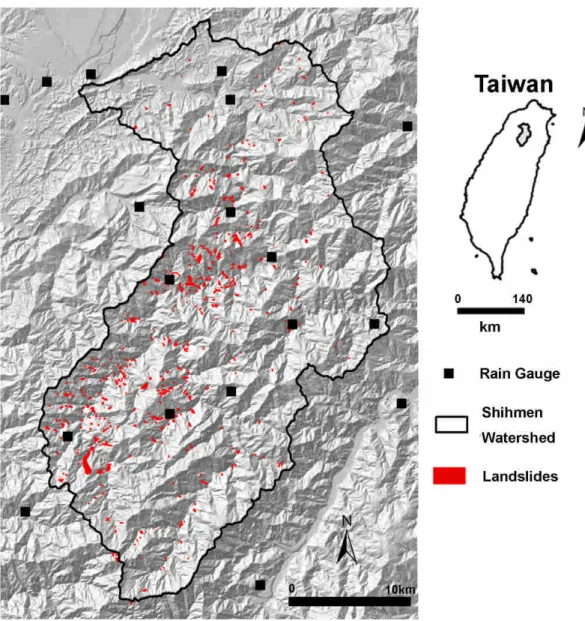
The 760 km2study area is located in the Shihmen Reservoir watershed in northern
Taiwan (Figure 1). Elevations in the watershed range from 135 m in the northwest to
3529 m in the southeast, with generally rugged topography. Nearly 90% of the study
area is forested. The climate is influenced by typhoons in summer and the northeast
monsoon in winter. The mean annual temperature is 21oC, with a mean monthly
temperature of 27.5oC in July and 14.2oC in January. The annual precipitation
averages 2370 mm. Because of the aforementioned typhoons, large rainfall events
Figure 1. Study area and landslides triggered by Typhoon Aere.
2.2. Typhoon Aere
Taiwan is an island, about 380 km long and 140 km wide, separated by the Strait of
Formosa from southeastern China. The island is prone to an average of four to five
typhoons originating from the Pacific each year. These intense storms bring torrential
rains that trigger landslides in the Central Mountain Range (CMR), which occupies
almost two thirds of the island in a north-south orientation. From August 23 to 25,
before turning southwestward. The typhoon affected Taiwan, especially the northern
half, for three days. During its peak intensity on August 24, Typhoon Aere had a
200-km storm radius and a low pressure reading of 955 mb, packing winds of 140 km
hr-1and gusts to 175 km hr-1. Thirty-four people were killed as a result of the storm,
including 15 died as a landslide buried a remote mountain village in the north. The
passage of Typhoon Aere brought 1604 mm of rainfall to the study area, with a
maximum 24-hr intensity of 51.7 mm hr-1(CWB 2004). The silt accumulation from
the upland landslides and stream scouring forced to stop the outlet of drinking water
from the Shihmen Reservoir and jammed the water supply pipes for days (Chen et al.
2006). Based on the damage to properties and human lives, Typhoon Aere was the
worst typhoon that struck northern Taiwan in recent years.
2.3. Landslide Data
Landslides triggered by Typhoon Aere were interpreted and delineated by comparing
ortho-rectified aerial photographs taken before and after the typhoon. These colour
orthophotographs were compiled by theAerialSurvey OfficeofTaiwan’sForestry
Bureau from the stereo pairs of 1:5000 aerial photographs. They have a pixel size of
0.35 m and an estimated horizontal accuracy of 0.5 m. For model validation, this
study interpreted and delineated landslides triggered by Typhoon Haitang (July 17 to
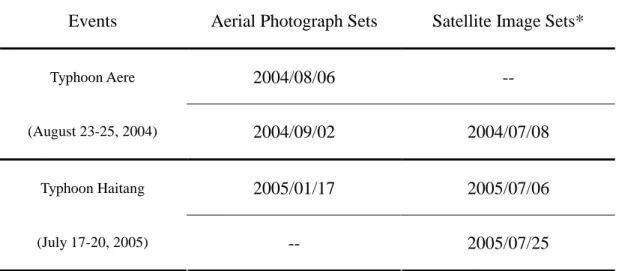
dates of flights of aerial photographs and satellite images.
Table 1. Image data sources
Events Aerial Photograph Sets Satellite Image Sets*
2004/08/06 --Typhoon Aere (August 23-25, 2004) 2004/09/02 2004/07/08 2005/01/17 2005/07/06 Typhoon Haitang (July 17-20, 2005) -- 2005/07/25
-- No Images; *2-m FORMOSAT-2 panchromatic images.
Typhoon Aere triggered 703 landslides of which 50 were enlarged or reactivated
old landslides. Typhoon Haitang triggered 1042 landslides of which 455 occurred on
existing landslides. Most observed slope failures were shallow landslides on soil
mantled slopes with depths less than 2 m. To develop our model, we only considered
new landslides triggered by typhoons: 653 by Aere, covering 4.87% of the study area;
and 587 by Haitang, covering 2.18% of the study area. Figure 1 shows the spatial
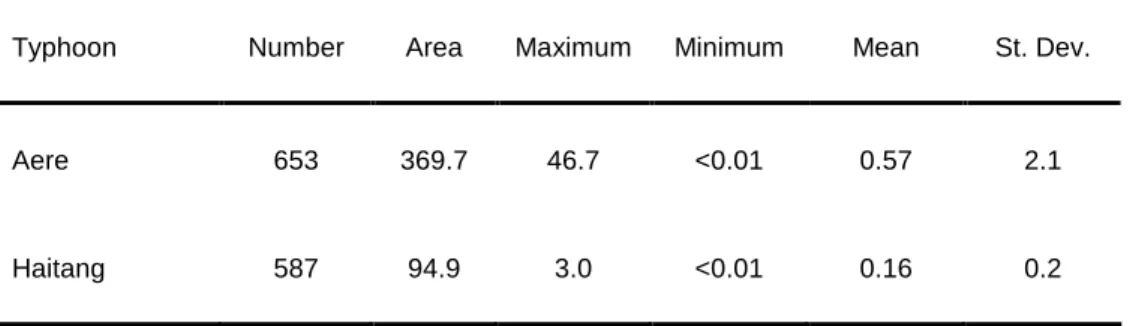
distribution of landslides triggered by Typhoon Aere, and Table 2 summarizes the
Table 2. Descriptive statistics of landslide areas (ha) triggered by typhoons
Typhoon Number Area Maximum Minimum Mean St. Dev.
Aere 653 369.7 46.7 <0.01 0.57 2.1
Haitang 587 94.9 3.0 <0.01 0.16 0.2
2.4. Rainfall Radar Data
Taiwan has over 400 rain gauge stations of which most are located in the lowland
areas on the west side of the mountain range. To better understand the spatial
distribution of precipitation in mountainous areas, the CWB has collaborated with the
U.S. National Oceanic and Atmospheric Agency’s National Severe Storms Laboratory
to deploy the QPESUMS system (quantitative precipitation estimation and
segregation using multiple sensors) (Vieux et al. 2003). The system uses four Doppler
weather radar (WSR-88D) sites to cover the island and the adjacent ocean. It records
base reflectivity with a spatial resolution of 0.0125° (~ 1.25 km) in both longitude and
latitude and a temporal resolution of 10 minutes.
The CWB provided radar base reflectivity data for August 23 to 25, 2004,
corresponding to the event of Typhoon Aere, for the study area. We also secured
ground rainfall measurements for the same time period from 19 automatic rain gauges
reflectivity data and rainfall measurements associated with Typhoon Haitang for
model validation.
3. Analysis
3.1. Rainfall Estimation
Developed by the CWB, the method for estimating ground-level area rainfall from
radar measurements involves two basic steps. First, radar reflectivity Z, measured in
decibels (db), is converted into rainfall rate R, measured in mm hr-1, by the following
Z-R power relationship (Marshall et al. 1947; Wilson 1970):
Z = 32.5R1.65 (1)
The parameter values of 32.5 and 1.65 proposed by Xin et al. (1997) are reported to
be more accurate than other values for fast moving convective storms.
Rainfall estimates can be improved when rain gauge observations are used to
calibrate radar data (Brandes 1975). The calibration method developed by the CWB
uses the inverse distance weighted method (IDW) to first create a grid representing
the deviations between R and hourly rainfall measurements. IDW is a spatial
interpolation method. The weight for IDW is defined by:
i i i W W dev dev0 (2) i W = 1 / di2, if di<= 30 km; Wi= 0, otherwisei,Withe weight at rain gauge i, and dithe distance between cell 0 and rain gauge i. To
complete the calibration, the deviation grid is added to the R grid to calculate the final
calibrated rainfall grid.
For this study, we summed the 10-minute radar reflectivity data by hour and
divided the sum by six for the hourly average. Then we followed equations (1) and (2)
to convert the hourly average reflectivity data into hourly rainfall data. This
conversion was performed for typhoons Aere and Haitang. The projection of the
hourly rainfall grid from geographic to plane coordinates resulted in a 36 by 55 grid
with a spatial resolution of 1 km.
Using the hourly rainfall data, we derived various measures of rainfall intensity,
total, and duration associated with Typhoon Aere. Figures 2a, 2b, and 2c display the
maximum 3-hr rainfall intensity, total rainfall, and total duration, respectively. The
spatial distributions of maximum 3-hr rainfall intensity and total rainfall show similar
pattern. Both have the highest values in the southwestern and western parts of the
watershed, near the ridge that faced the dominant southwesterly and westerly winds
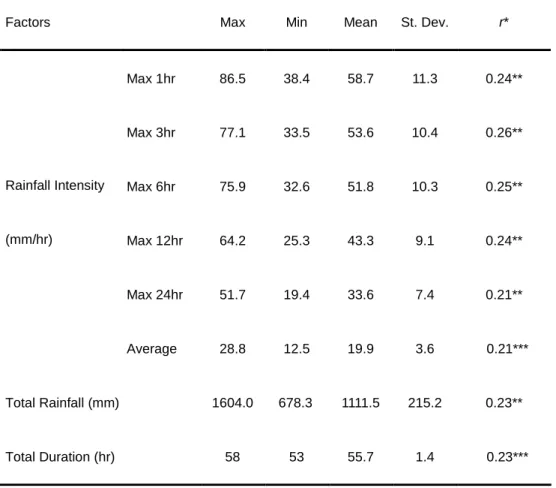
during the passage of Typhoon Aere. Table 3 shows the descriptive statistics of these
various rainfall factors as well as the correlation coefficients (r) between landslide
density (number of landslides km-2) and each factor. Maximum 3-hr intensity and
differences are small.
rainfall duration) and rain gauges (d).
Table 3. Rainfall factors and statistics
Factors Max Min Mean St. Dev. r*
Max 1hr 86.5 38.4 58.7 11.3 0.24** Max 3hr 77.1 33.5 53.6 10.4 0.26** Max 6hr 75.9 32.6 51.8 10.3 0.25** Max 12hr 64.2 25.3 43.3 9.1 0.24** Max 24hr 51.7 19.4 33.6 7.4 0.21** Rainfall Intensity (mm/hr) Average 28.8 12.5 19.9 3.6 0.21*** Total Rainfall (mm) 1604.0 678.3 1111.5 215.2 0.23** Total Duration (hr) 58 53 55.7 1.4 0.23***
*Correlation coefficient between rainfall factor and landslide density
** Significant at 1% level
*** Significant at 5% level
3.2 Logistic Regression
Logistic regression is useful when the dependent variable is categorical (e.g., presence
or absence) and the explanatory variables are categorical, numeric, or both (Menard
2002). The logit model from a logistic regression has the following form:
where the logit of y is the dependent variable, xiis the explanatory variable i, a is a
constant, biis the regression coefficient i, and e is the error term. The logit of y is the
natural logarithm of the odds: logit (y) = ln ) 1 ( p p (4)
where p is the probability of the occurrence of y and p/(1 - p) is the odds. To convert
logit (y) back to the probability p, equation (4) can be rewritten as:
...) exp( 1 ...) exp( 3 3 2 2 1 1 3 3 2 2 1 1 x b x b x b a x b x b x b a p (5)
A logit model can be evaluated by the receiver operating characteristic (ROC).
The ROC measures the fitness of a model on the basis of true positive (proportion of
incidences correctly reported as positive) and false positive (proportion of incidences
erroneously reported as positive) (Pontius and Batchu, 2003). Typically, a probability
value of 0.5 is used to determine whether the model has made a correct prediction (>
0.5) or not (< 0.5). Additionally, Cox and Snell R2and Nagelkerke R2measure how
well the explanatory variables can predict and explain the dependent variable. Cox
and Snell R2cannot achieve a maximum of 1, whereas Nagelkerke R2stretches the R2
value to range from 0 to 1.
For this study, the dependent variable (y) represented landslide (1) or stable area
cell (0) and the explanatory variables were maximum 3-hr rainfall intensity (x1) and
in previous studies can be generally grouped into two categories. The first category
uses rainfall intensity and duration (Caine 1980; Cannon and Ellen 1985; Larsen and
Simon 1993; Finlay et al. 1997; Aleotti 2004; Godt et al. 2006), and the second uses
total or cumulative rainfall (Au 1993; Dai and Lee 2003; Guzzetti et al. 2004; Ibsen
and Casagli 2004). This study followed the first category of studies but chose
maximum 3-hr rainfall intensity instead of average intensity because maximum 3-hr
rainfall intensity had a slightly higher r value with landslide density.
4. Results
4.1. Logit Model
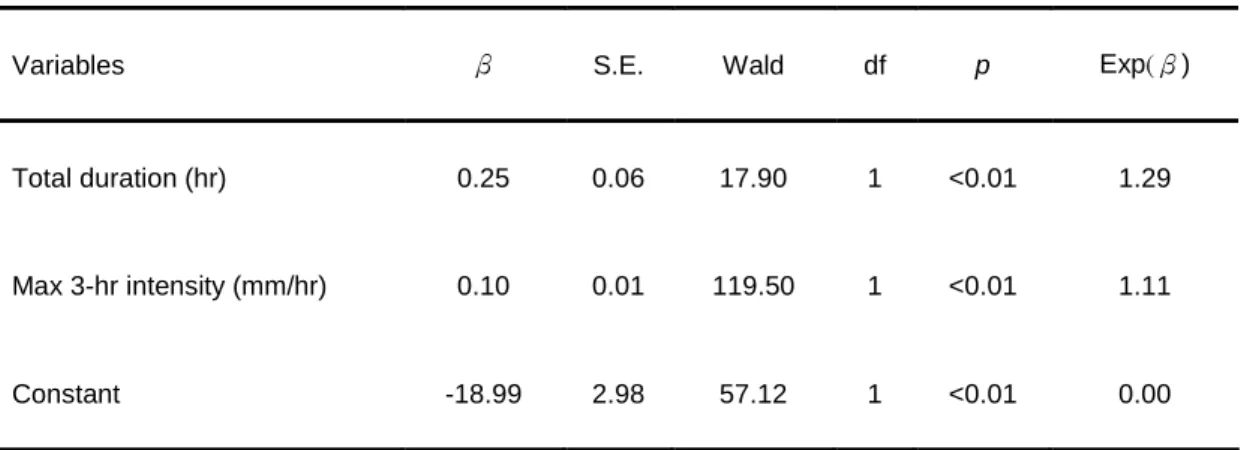
The logit model is significant at the 0.01 level, with ROC = 0.76, Cox & Snell R2=
0.27, and Nagelkerke R2= 0.36. Both explanatory variables are significant at the 1%
level, with total duration being slightly more important than maximum 3-hr intensity
in explaining landslide occurrence (Table 4).
Table 4. Logistic regression resultsa
Variables β S.E. Wald df p Exp(β)
Total duration (hr) 0.25 0.06 17.90 1 <0.01 1.29
Max 3-hr intensity (mm/hr) 0.10 0.01 119.50 1 <0.01 1.11
Constant -18.99 2.98 57.12 1 <0.01 0.00
a
the standard error (S.E.) given. The Wald statistic is the ratio of theβto S.E. of the
regression coefficient squared. df is the degree of freedom. The significance of each
explanatory is given by the p value. Exp(β) is the predicted change in odds for a unit
increase in the explanatory variable.
4.2. Critical Rainfall Conditions
To use rainfall data for predicting landslides, critical rainfall intensity and total
duration can be derived from the logit model. Substituting logit (y) by equation (4)
and ignoring the error term, equation (3) becomes:
2 2 1 1 ) 1 ln( a b x b x p p (6)
Equation (6) can be rewritten as: ) ( ) 1 ln( 1 2 2 1 1 b x a p p b x (7)
By specifying the p value (e.g., 0.5) and an x2value in equation (7), we can compute a
corresponding x1value. By going through the computation twice, we can get two pairs
of x1and x2values to plot a straight line representing the specified p value (e.g., 0.5).
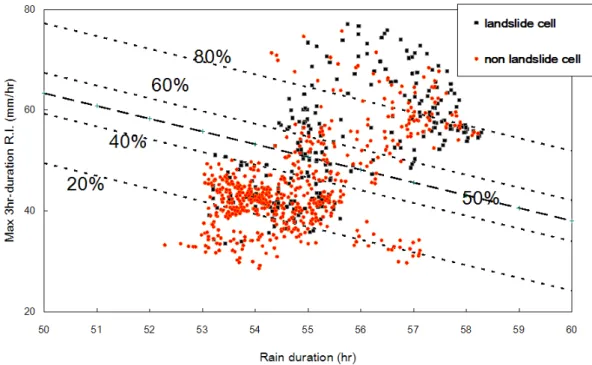
Figure 3 shows such lines representing the probabilities of landslide occurrence at 0.2,
0.4, 0.5, 0.6, and 0.8. Equation (7) is hereafter referred to as the probability model.
Figure 3 also shows dots for landslide and stable-area cells. The location of a dot or
cell corresponds to its maximum 3-hr rainfall intensity and total duration values, and
landslides triggered by Typhoon Aere against calculated probabilities from equation
(7). As to be expected, most landslides fall within areas of high probabilities.
Figure 3. Critical rainfall conditions for triggering landslides. The lines show different
Figure 4. Probability maps of landslide occurrence derived from the model and
landslides triggered by Typhoon Aere (a) and Typhoon Haitang (b).
4.3 Model Validation
Landslides triggered by Typhoon Haitang were used for validating the probability
model derived from the landslide and rainfall data associated with Typhoon Aere.
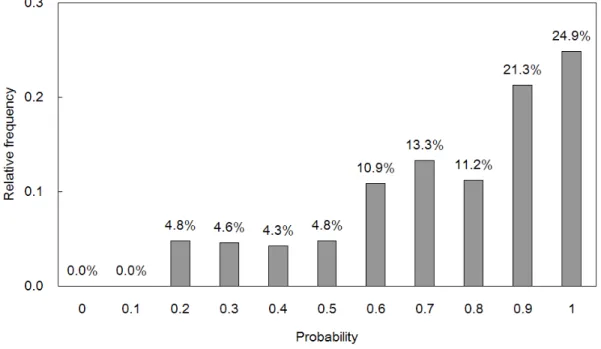
Using 0.5 as the threshold, the model correctly predicted 81.6% of landslides
triggered by Typhoon Haitang. In other words, 81.6% of landslides fall within areas
with probabilities greater than 0.5 as predicted by the model (Figure 5). This is
visually confirmed in Figure 4b, which plots landslides triggered by Typhoon Haitang
against calculated probabilities from equation (7).
Figure 5. A comparison of relative frequencies of landslides triggered by Typhoon
rainfall data associated with Typhoon Aere.
5. Discussion
5.1. The Probability Model vs. Minimum Rainfall Threshold
The probability model that this study has developed differs from minimum rainfall
thresholds of previous studies in two fundamental aspects. First, the probability model
is a spatially explicit model, which is based on logistic regression that statistically
separate landslides from stable areas by maximum 3-hr rainfall intensity and rainfall
duration. In contrast, a minimum rainfall threshold represents the lower bound of a
log-log plot of rainfall data that have resulted in landslides without considering the
locations of landslides and stable areas. Second, the probability model computes a
probability for a given combination of rainfall values and offers a measure of the
likelihood of landslide occurrence. In comparison, a minimum rainfall threshold
simply suggests that, if a rainfall event exceeds the threshold, it will likely trigger
landslides. No measure of confidence is provided with such prediction. Given these
two differences, we feel that the probability model is better suited for a landslide
monitoring or warning system than the minimum rainfall threshold.
5.2. Radar Data for Landslide Studies
The high spatial and temporal resolutions of the NEXRAD reflectivity imagery are
based. But the Z-R relationship for converting radar reflectivity data to rainfall rate
can be complicated by ground clutter, beam blockage, close clustering of cells, and
differences in precipitation echoes between water droplets and ice particles and
between different-sized water droplets (Howard et al. 1997; Steiner and Smith 2002;
Wilson 2005).
This study adopted a method developed by Taiwan’s CWB for estimating rainfall
from radar measurements. Because we used all 19 automatic gauge stations in and
around the study area for calibration, we could not perform an accuracy assessment of
radar-derived rainfall data. However, previous studies have shown the robustness of
the CWB method. Based on two typhoon events, Chang et al. (2006) reported that
calibrated rainfall estimates from QPESUMS reflectivity imagery deviated from
ground measures of 100 gauge stations in Taiwan by less than 1 mm for hourly
rainfall, 12 to 34 mm for daily rainfall, and 29 to 79 mm for total rainfall. Chen et al.
(2007) found that calibrated rainfall data by QPESUMS estimation agreed well with
those from four ground-based stations in central Taiwan, with the correlation
coefficients all above 0.9 between the two. Both studies therefore support the
QPESUMS system and the CWB method for rainfall estimation.
Rainfall data derived from QPESUMS imagery have a spatial resolution of 1.25
of ground-based rain gauges, it still cannot match that of landslides delineated and
mapping on aerial photographs or high-resolution satellite images. On the other hand,
landslide data cannot match the temporal resolution (10 minutes) of QPESUMS
imagery. In fact, the timing of landslides is usually gathered from interviews of local
residents and its accuracy can only be described as reasonably accurate (e.g., Guzzetti
et al. 2004). The incompatibility of scales/resolutions is common in landslide studies
(e.g., 1:5000-scale soil map vs. 1:100,000-scale geology map), but it can create
problems in interpreting and applying results. How to match landslide and rainfall
data in both spatial and temporal resolutions is certainly an important topic for future
investigation.
5.3 Applications of the Model
The probability model that this study has developed is simple to use: given maximum
3-hr rainfall intensity and total rainfall duration, the model computes probabilities for
landslide occurrence on a cell basis. It can be part of a real-time landslide monitoring
system in which the two rainfall variables calculated from the QPESUMS system are
entered to compute the probability of landslide occurrence at a regular interval (e.g.,
every six hours) during a typhoon event. The probability map thus derived will show
which areas are likely to have landslide occurrence, and the difference in probability
The model can also be used as an aid for landslide delineation and mapping
following a typhoon event. A mask based on the model or a model with additional
variables can highlight areas that are more likely to have landslides, thus facilitating
such tasks as coordinating mitigation efforts. For example, if we add elevation, slope,
and lithology as explanatory variables to the logit model in this study, the model has
ROC = 0.78, Cox & Snell R2= 0.32, and Nagelkerke R2= 0.42. This model can
therefore better assist in locating areas that are more prone to landslides than the
initial logit model with only two rainfall variables.
But to use the probability model for a landslide warning system will require a
robust typhoon precipitation model at a high spatial resolution. Because Taiwan is
extremely vulnerable to the damages from typhoons, numerical models for simulating
typhoons have been a top research priority (Wu and Kuo 1999). The fifth-generation
Pennsylvania State University-National Centre for Atmospheric Research Mesoscale
Model (MM5) has been used in several recent studies to simulate the rainfall
distribution associated with a typhoon (Wu et al. 2002; Witcraft et al. 2005; Yang and
Ching 2005). A typhoon rainfall climatology-persistence (R-CLIPER) has also been
used for rainfall estimation in the 2004 and 2005 typhoon seasons (Cheung et al.
2006). Although these studies all reported good simulation or prediction results, they
spatial scale issue must be resolved before the integration of a typhoon model and this
study’s landslide probability model can be realised for a watershed-level warning
system.
6. Conclusion
This study compiled Doppler weather radar reflectivity data during Typhoon Aere
(August 2004), estimated rainfall from radar data, and used maximum 3-hr rainfall
intensity and rainfall duration as the explanatory variables in logistic regression for a
landslide prediction model. The logit model had a ROC of 76%. Results of model
validation showed an accuracy rate of 82% in predicting landslides triggered by
Typhoon Haitang (July 2005). This cell-based model can be part of a landslide
warning system by incorporating predicted rainfall data from a typhoon precipitation
model. It can also be part of a real-time landslide monitoring system by being able to
compute probabilities of landslide occurrence at a regular interval during a typhoon
event. Finally, the model can be used as an analysis mask for landslide delineation and
mapping following a typhoon event. Compared to minimum rainfall thresholds of
previous studies, this probability model has the distinct advantage of providing a
measure of confidence in predicting landslides and landslide locations associated with
a typhoon event.
approach to incorporate rainfall into landslide modelling and prediction. Further
improvement of the model requires a better integration of landslide data, radar
reflectivity data, and estimated typhoon precipitation data in both spatial and temporal
References
Aleotti P. 2004. A warning system for rainfall-induced shallow failures. Engineering
Geology 73: 247-265.
Au SWC. 1993. Rainfall and slope failure in Hong Kong. Engineering Geology 36:
141-147.
Ayalew L, Yamagishi, H. 2005. The application of GIS-based logistic regression for
landslide susceptibility mapping in the Kakuda-Yahiko Mountains, Central Japan.
Geomorphology 65: 15-31.
Barm RL, Coe JA, Godt JW, Harp, EL, Reid ME, Savage WZ, Schulz WH, Brien DL,
Chleborad AF, McKenna JP, Michael JA. 2005. Regional landslide-hazard assessment
for Seattle, Washington, USA. Landslides 2: 266-279.
Brandes EA. 1975. Optimizing rainfall estimates with the aid of radar. Journal of
Applied Meteorology 14: 1339-1345.
Caine N. 1980. The rainfall intensity-duration control of shallow landslides and debris
flows. Geografiska Annaler 62A: 23-27.
Campbell RH. 1975. Soil Slips, Debris Flows, and Rainstorms in the Santa Monica
Mountains and Vicinity, Southern California. USGS Professional Paper 851. US
Geological Survey: Reston, VA.
San Francisco Bay region, California. California Geology 38: 267-272.
Cannon SH, Gartner JE, Wilson RC, Bowers JC, Laber JL. 2007. Storm rainfall
conditions for floods and debris flows from recently burned areas in southwestern
Colourado and southern California. Geomorphology, in press. DOI:
10.1016/j.geomorph.2007.03.019.
Cardinali M, Galli M, Guzzetti F, Ardizzone F, Reichenbach P, Bartoccini P. 2006.
Rainfall induced landslides in December 2004 in Southwestern Umbria, Central Italy.
Natural Hazards and Earth System Sciences 6: 237-260.
Casadei M, Dietrich WE, Miller NL. 2003. Testing a model for predicting the timing
and location of shallow landslide initiation in soil-mantled landscapes. Earth Surface
Processes and Landforms 28: 925-950.
Chang C, Sun C, Lay J. 2006. Integration of radar detection and real time rainfall data
for estimation during typhoon period. Environment and Worlds 13: 1-22. (in Chinese)
Chen C, Chen T, Yu F, Yu W, Tseng C. 2005. Rainfall duration and debris-flow
initiated studies for real-time monitoring. Environmental Geology 47: 715-724.
Chen C, Lee W, Yu F. 2006. Debris flow hazards and emergency response in Taiwan.
In Monitoring, Simulation, Prevention and Remediation of Dense and Debris Flows,
Lorenzini G., Brebbia CA, Emmanouloudis DE. (eds). WIT Press: Southampton,
Chen C, Lin L, Yu F, Lee C, Tseng C, Wang A, Cheung K. 2007. Improving debris
flow monitoring in Taiwan by using high-resolution rainfall products from QPESUMS.
Natural Hazards 40: 447-461.
Cheung KKW, Huang L, Lee C. 2006. A tropical cyclone rainfall
climatology-persistence model for the Taiwan area. Proceedings: 27thSymposium on
Hurricane and Tropical Meteorology, April 24-28, Monterey, CA.
Crozier MJ. 1999. Prediction of rainfall-triggered landslides: A test of the antecedent
water status model. Earth Surface Processes and Landforms 24: 825-833.
CWB (Central Weather Bureau). 2004.
http://photino.cwb.gov.tw/tyweb/tyfnweb/htm/2004aere.htm(accessed April 22,
2006).
Dai FC, Lee CF. 2003. A spatiotemporal probabilistic modelling of storm-induced
shallow landsliding using aerial photographs and logistic regression. Earth Surface
Processes and Landform 28: 527-545.
Finlay PJ, Fell R, Maguire PK. 1997. The relationship between the probability of
landslide occurrence and rainfall. Canadian Geotechnical Journal 34: 811-824.
Floris M, Bozzano F. 2007. Evaluation of landslide reactivation: a modified rainfall
threshold model based on historical records of rainfall and landslides. Geomorphology,
Glade T, Crozier MJ, Smith P. 2000. Applying probability determination to refine
landslide-triggering rainfall thresholds using an empirical “Antecedent Daily Rainfall
Model”. Pure and Applied Geophysics 157: 1059-1079.
Godt JW, Baum RL, Chleborad AF. 2006. Rainfall characteristics for shallow
landsliding in Seattle, Washington, USA. Earth Surface Processes and Landforms 31:
97-110.
Guzzetti F, Cardinali M, Reichenbach P, Cipolla F, Sebastiani C, Galli M, Salvati P.
2004. Landslides triggered by the 23 November 2000 rainfall event in the Imperia
Province, Western Liguria, Italy. Engineering Geology 73: 229-245.
Guzzetti F, Peruccacci S, Rossi M, Start CP. 2007. Rainfall thresholds for the
initiation of landslides. Meteorology and Atmospheric Physics, in press. DOI:
10.1007/s00703-007-0262-7.
Howard KW, Gourley JJ, Maddox RA. 1997. Uncertainties in WSR-88D
measurements and their impacts on monitoring life cycles. Weather and Forecasting
12: 166-174.
Ibsen M-L, Casagli N. 2004. Rainfall patterns and related landslide incidence in the
Porretta-Vergato region, Italy. Landslides 1: 143-150.
Iverson RM. 2000. Landslide triggering by rain infiltration. Water Resources Research
Marshall JS, Langille RC, Palmer WM. 1947. Measurement of rainfall by radar.
Journal of Meteorology 4: 186-191.
Meisina C, Scarabelli S.2007. A comparative analysis of terrain stability models for
predicting shallow landslides in colluvial soils. Geomorphology 87: 207-223.
Menard S. 2002. Applied Logistic Regression Analysis, 2d ed. Thousand Oaks, CA:
Sage.
Montgomery DR, Dietrich WE. 1994. A physically based model for topographic
control on shallow landsliding. Water Resources Research 30: 1153-1171.
Morrissey MM, Wieczorek GF, Morgan BA. 2004. Transient hazard model using
radar data for predicting debris flows in Madison County, Virginia. Environmental &
Engineering Geoscience 10: 285-296.
Ohlmacher GC, Davis JC. 2003. Using multiple logistic regression and GIS
technology to predict landslide hazard in northeast Kansas, USA. Engineering
Geology 69: 331-343.
Pack RT, Tarboten DG, Goodwin CN. 1999. GIS-based landslide susceptibility
mapping with SINMAP, Proceedings: 34th Symposium on Engineering Geology and
Geotechnical Engineering, April 28-30, Logan, Utah; 219-231.
Pontius RG, Jr., Batchu K. 2003. Using the relative operating characteristic to quantify
467-484.
Steiner M, Smith JA. 2002. Use of three-dimensional reflectivity structure for
automated detection and removal of nonprecipitating echoes in radar data. Journal of
Atmospheric and Oceanic Technology 19: 673-686.
Vieux BE, Vieux JE. 2003. Operational deployment of a physics-based distributed
rainfall-runoff model for flood forecasting in Taiwan. Paper presented at the
International Symposium on Information from Weather Radar and Distributed
Hydrological Modelling, July 7-8, 2003, Sapporo, Japan.
Wieczorek GF, Glade T. 2005. Climatic factors influencing occurrence of debris flows.
In Debris Flows Hazards and Related Phenomena, Jakob M, Hungr O. (eds). Springer:
Berlin; 325-362.
Wilson JW. 1970. Integration of radar and raingage data for improved rainfall
measurement. Journal of Applied Meteorology 9: 489-497.
Wilson RC. 2005. The rise and fall of a debris-flow warning system for the San
Francisco Bay region, California. In Landslide Hazard and Risk, Glade T, Anderson
M, Crozier MJ (eds). Wiley: Chichester, England; 493-516.
Witcraft N, Lin Y, Kuo Y. 2005. Dynamics of orographic rain associated with the
passage of a tropical cyclone over a mesoscale mountain. Terrestrial, Atmospheric
Wu C, Kuo Y. 1999. Typhoons affecting Taiwan: current understanding and future
challenges. Bulletin of the American Meteorological Society 80: 67-80.
Wu C, Yen T, Kuo Y, Wang W. 2002. Rainfall simulation associated with Typhoon
Herb (1996) near Taiwan, Part I: The topographic effect. Weather and Forecasting 17:
1001-1015.
Wu W, Sidle RC. 1995. A distributed slope stability model for steep forested basins.
Water Resources Research 31: 2098-2110.
Xin L, Reuter G, Larochelle B. 1997. Reflectivity-rain rate relationships for
convective rainshowers in Edmonton. Atmosphere-Ocean 35: 513-521.
Yang M, Ching L. 2005. A modelling study of typhoon Toraji (2001): physical
parameterization sensitivity and topographic effect. Terrestrial, Atmospheric and
Tom Veldkamp and Gerald Schoorl. Profs. Veldkamp and Schoorl are developers of
the LAPSUS (LandscApe ProcesS modelling at mUlti-dimensions and scaleS), a
multi-module dynamic landscape evolution model. Since the trip, we have been
working on a joint research project involving graduate students at National Taiwan
University and Wageningen University.
In September 2007 I was invited by KITAC Corp in Niigata, Japan to give a keynote
speech on my research work on rainfall-triggered landslides. Following the trip, I
have been working with Dr. Cheibany of KITAC Corp to test the critical rainfall
model that we have developed at National Taiwan University using precipitation and