
論台灣華語 [gei wo]、台灣閩南語 [ka gua]、及台灣客語 [lau ngai]句式的語法化 - 政大學術集成
129
0
0
全文
(2) 論台灣華語 [gei wo]、台灣閩南語 [ka gua]、及台灣客語 [lau ngai]句式的語法化 On the Grammaticalization of Taiwan Mandarin [gei wo], Taiwan Southern Min [ka gua], and Taiwan Hakka [lau ngai] constructions. By. 學. ‧ 國. 立. 政 治 大 Po-wen Tseng. ‧. n. er. io. sit. y. Nat. al. Ch. engchi. i n U. A Thesis Submitted to the Graduate Institute of Linguistics In Partial Fulfillment of the Requirements for the Degree of Master of Arts. July 2012. v.
(3) 立. 政 治 大. ‧. ‧ 國. 學. n. er. io. sit. y. Nat. al. Ch. engchi. Copyright © 2012 Po-wen Tseng All Right Reserved. i n U. v.
(4) Acknowledgements 誌謝. 本篇論文得以完成首要歸功於指導老師賴惠玲教授。在學術上,認知語意學 為語言學領域當中我最感興趣的主題,賴老師即是此領域中的箇中翹首,從我論 文主題的決定、理論的分析、到文字的修改,賴老師皆一步步的細心引領著我, 讓我得以少走些岔路,直搗語言學領域的核心。在生活上,賴老師也時時關心我 在學業之外的生活,不但給予我研究助理的職務,減少求學過程中的經濟壓力, 更提點我在社會上一些做事的細節以及適應社會變化的價值觀。這些都是除了論 文之外,能夠一輩子受用的人生智慧。 此外,在所上各個領域老師們的教導下,也讓我能夠打下穩固的學術基礎,. 立. 政 治 大. ‧. ‧ 國. 學. 往更深的部分探索,由衷感謝所長徐嘉慧老師、何萬順老師、蕭宇超老師、黃瓊 之老師、萬依萍老師、莫建清老師;也要特別感謝論文計畫書口試時給予修改建 議的張郇慧老師與新竹教育大學的黃漢君老師;此外也要感謝論文口試時給予精 闢建議的的師大張妙霞老師與林雪娥老師,老師們的見意都能讓學生的論文更臻 完美。另外,也要特別感謝在大學期間,激發學生對語言學的興趣,並對學生的. y. Nat. sit. n. al. er. io. 語言學理論打下基礎的中山大學蔡美智老師與徐淑瑛老師。 接著,也要感謝所上的惠玲助教,對於我大大小小的提問,不論是學術及行 政上的事務,總是不厭其煩的協助我。感謝客語工作室的學姐們:詩敏學姊常細 心提醒我在做研究上的細節,並讓整個工作室能在辛苦工作之餘,更增添了幾分 笑聲;秋杏學姊的細心讓我得已在處理行政事務上順利許多,還有在英國行多虧 學姐的帶領,讓旅行能更精彩,充滿珍貴的回憶。另外,也要感謝各位同學們, 曉貞、琬婷、媛媜、姿幸、淑禎、晉瑋、書豪、心綸,不論是日常的聚會,或是 在最後的階段給彼此的加油打氣,都讓我的研究生活更增色彩;也不忘要感謝在 眼動實驗室和我奮鬥過的怡璇學姊,讓我的研究生活有了更豐富的體驗。 最後,要感謝家人在我求學期間的支持與陪伴,父母總是不厭其煩的提醒我. Ch. engchi. i Un. v. 為人處事上的細節,也讓我能夠有一個順利的求學過程,生活上沒有後顧之憂, 也感謝弟弟彈著吉他,當作我念書時的伴奏,一路上充滿熱情與美妙的旋律。 論文的完成是人生中一個階段的見證,非常感謝能在這麼多人的幫助下完成 這個階段的任務;這不是一個結束,而是下個階段的開始。. iv.
(5) TABLE OF CONTENTS. 立. 政 治 大. ‧. ‧ 國. 學. Acknowledgment .......................................................................................................... iv Table of Contents ........................................................................................................... v Figures and Tables ...................................................................................................... viii Chinese Abstract ............................................................................................................ x. sit. n. al. er. io CHAPTER. y. Nat. English Abstract ............................................................................................................ xi. Ch. engchi. i Un. v. Ⅰ. INTRODUCTION.................................................................................................. 1 1.1 Motivation and Purpose .......................................................................................... 1 1.2. Organization of the Thesis ..................................................................................... 5. Ⅱ. LITERATURE REVIEW ..................................................................................... 7 2.1 Studies on Gei in TM ...................................................................................... 8 2.1.1 Semantic Extensions of Gei................................................................... 8 2.1.1.1 Newman (1996) ........................................................................ 8 2.1.1.2 Her (2006) ................................................................................ 9 2.1.1.3 Hu (2007)................................................................................ 10. ⅴ.
(6) 2.1.1.4 Lee (2008, 2009) .................................................................... 11 2.1.2 [Gei Wo] in TM ........................................................................................... 14 2.1.2.1 Generative Perspective Studies................................................... 14 2.1.2.2 Semantic Extension Studies ........................................................ 16 2.1.2.3 Grammaticalization Studies ........................................................ 17 2.2. Studies on Semantic Extensions of Ka in TSM ............................................ 19. 2.3 Studies on Semantic Extensions of Lau in TH .............................................. 20 2.4 Remarks ......................................................................................................... 22 Ⅲ. THEORETICAL BACKGROUND ................................................................... 25. 學. ‧ 國. 3.1. 治 政 Mechanisms for Syntactic Change ................................................................ 27 大 立 3.1.1 Reanalysis ............................................................................................ 27 3.1.2 Analogy ............................................................................................... 35. ‧. 3.2 Mechanisms for Semantic Change ................................................................ 38. sit. y. Nat. 3.2.1 Metaphorization ................................................................................... 38. io. er. 3.2.2 Metonymization ................................................................................... 39. al. 3.3 Motivation for Language Change ................................................................. 43. n. iv n C 3.3.1 Pragmatic Strengthening 43 h e n g..................................................................... chi U 3.3.2 Subjectivity, Subjectification, and Counter-expectation ..................... 45. 3.4 Remarks ......................................................................................................... 50 Ⅳ. ANALYSIS ........................................................................................................... 53 4.1 The Emergence of Imperative Meaning ........................................................ 53 4.1.1 Mechanisms for Syntactic Change: Reanalysis and Analogy ............. 53 4.1.2 Mechanisms for Semantic Change: Metonymy .................................. 65 4.2 The Emergence of Evaluative Meaning in TM ............................................. 73 4.2.1 Mechanism for Syntactic Change: Analogy ........................................ 74 4.2.2 Mechanisms for Semantic Change: Metonymy .................................. 75 ⅵ.
(7) 4.3. Motivation for Language Change ................................................................. 77 4.3.1 Pragmatic Strengthening ..................................................................... 77 4.3.2 Subjectivity, Subjectification, and Counter-expectation ..................... 88. 4.4. Remarks ......................................................................................................... 98. Ⅴ. CONCLUDING REMARKS ............................................................................ 101 5.1 Summary of the Thesis ................................................................................ 101 5.2. Implications and Future Studies .................................................................. 104. REFERENCES ......................................................................................................... 107. 立. 政 治 大. ‧. ‧ 國. 學. n. er. io. sit. y. Nat. al. Ch. engchi. ⅶ. i Un. v.
(8) FIGURES AND TABLES. 立. 政 治 大. ‧ 國. 學. List of Figures Figure 2.1. The topography of Mandarin outer affectives and benefactives (=Yang. ‧. 2010: 83) .................................................................................................. 15. sit. y. Nat. Figure 2.2 The syntactic structure of gei as a verb ‘give’ and as a preposition ‘for’. n. al. er. io. (=Sun 2003: 354, figure 1) ....................................................................... 18. i Un. v. Figure 3.1 Reanalysis of Dutch kei. (=De Smet 2009: 1729, Figure 2.) ...................... 28. Ch. engchi. Figure 3.2 Categorial incursion (=De Smet 2009: 1749, Figure 7.) ............................ 31 Figure 3.3 Category-internal change (=De Smet 2009: 1749, Figure 8.) .................... 32 Figure 3.4 Automation (=De Smet 2009: 1750, Figure 9.) .......................................... 33 Figure 3.5 Schema of development of auxiliary be going to (=Hopper and Traugott 2003: Figure 3.2) ........................................................................................ 37 Figure 3.6 Revised Schema of development of auxiliary be going to (=Hopper and Traugott 2003: Figure 4.1) ......................................................................... 42 Figure 4.1 Categorial incursion.................................................................................... 56 Figure 4.2 Category-internal change............................................................................ 59 Figure 4.3 Automation ................................................................................................. 60 ⅷ.
(9) Figure 4.4 Reference-point construction (=Langacker 1999: 174, figure 6.1) ............ 93. List of Tables Table 2.1. The comparison between verbs in TM and M (Lee 2008: 89) ................ 11 Table 4.1.. Cause-effect formation for the imperative construction .......................... 66. Table 4.2. Data of evaluative [gei wo + stative predicate] construction ................... 73 Table 4.3. Cause-effect formation for [gei wo + stative predicate] .......................... 77 Table 4.4. Six parameters for calculating FORCE EXERTION (=Takahashi 2011, Table 1) .................................................................................................... 84. 立. 政 治 大. ‧. ‧ 國. 學. n. er. io. sit. y. Nat. al. Ch. engchi. ⅸ. i Un. v.
(10) 國 立 政 治 大 學 語 言 學 研 究 所 碩 士 論 文 摘 要 研究所別:語言學研究所 論文名稱:論台灣華語 [gei wo]、台灣閩南語 [ka gua]、及台灣客語 [lau ngai] 句式的語法化 指導教授:賴惠玲 博士 研究生:曾柏溫. 立. 政 治 大. 論文提要內容:(共一冊,二萬一千九百五十二字,分五章). ‧ 國. 學. 本論文採用 Traugott (2010)及 Hopper and Traugott (2003)的語法化觀點,探討 」句式在動前位置的. ‧. 台灣華語「給我」 、台灣閩南語「共我」 、及台灣客語「摎. Nat. io. sit. y. 祈使用法,主要分析產生此祈使用法的背後動因與機制,包含類推(analogy)、重. er. 新分析(reanalysis)、轉喻(metonymy)、語用強化(pragmatic strengthening)、及語言. al. n. iv n C hengchi U 接觸(language contact)等概念。本論文的另一焦點為探討台灣華語「給我」的評. 價用法,此為台灣華語的新興用法,尚未見於台灣閩南語及台灣客語中。本研究 將提出,語法化、主觀性(subjectivity)、及主觀化(subjectification)能闡釋新興用 法產生的動因與機制。. ⅹ.
(11) ABSTRACT. This thesis aims to investigate the preverbal [gei wo], [ka gua], and [lau ngai] construction in Taiwan Mandarin, Taiwan Southern Min, and Taiwan Hakka. The original meaning of these constructions presents beneficial meaning, but they can also. 政 治 大 discussed the pragmatic functions of the imperative meaning, why and how the 立 frequently appear in imperative constructions. While the extant literature has. ‧ 國. 學. imperative meaning emerges is still unexplored. Aspects of grammaticalization are adopted (cf. Traugott 2010; Hopper and Traugott 2003). To elaborate how and why. ‧. the imperative meaning emerges, syntactic and semantic mechanisms and their. Nat. sit. y. motivations are proposed. The other issue of the thesis aims to explore the newly. n. al. er. io. emergent evaluative [gei wo] construction in Taiwan Mandarin. In addition to. i Un. v. mechanisms and motivation for its development, the notion of subjectivity and. Ch. engchi. subjectification plays a crucial role to account for the motivation for the emergence of the construction in question. Overall, this thesis illuminates the notion that the emergence of special constructions can derive from their original constructions through cognitive and functional foundation.. xi.
(12) 立. 政 治 大. ‧. ‧ 國. 學. n. er. io. sit. y. Nat. al. Ch. engchi. i Un. v.
(13) CHAPTERⅠ INTRODUCTION. 1.1 Motivation and Purpose. 政 治 大. Across languages, the properties of GIVE sense are complicated, exhibiting. 立. multiple meanings and functions (Newman 1996, 1998). With no exception, in. ‧ 國. 學. Mandarin, GIVE verb represented as gei, has attracted relatively rich studies due to its. ‧. syntactic and semantic intricacies. Attention has mostly been emphasized on. y. Nat. er. io. sit. justifying its part-of-speech in different structures involved: a goal marker, a beneficiary, affectee, or patient marker, or a source marker in certain special. al. n. iv n C h 1994, constructions (cf. Chao 1968, Xu i UZhang 1999, Her 2006). One of e n gShen c h1999, the special [gei wo] construction, i.e. [gei wo + active predicates], stands for an imperative construction, which has already been addressed and substantially considered as an emphatic phrase, indicating the meaning ‘by the authority of…’ (Newman 1996: 201), as (1) illustrates. Such a phrase requires the first person singular pronoun to be the object of gei.. 1.
(14) 2. (1) 請你給我站好 Qing ni gei wo please you give I ‘Please stand upright for my sake.’. zhanhao. stand upright. In addition to specifying the syntactic categories of gei, its semantic relatedness has also been explored. Several studies account for its semantic extension by metaphoric and metonymic mechanism (cf. Shen 1999, Zhang 1999, Hu 2007). Some take the view of semantic linking between the marking of beneficiary and the marking. 政 治 大. of an agent in passive to explain the semantic relatedness (Hideki 2005).. 立. Given the fact that gei is syntactically and semantically complex, its further. ‧ 國. 學. development into other constituents for communicative purposes is not surprising. In. ‧. fact, the appearance of a newly emergent [gei wo] construction which is followed by. y. Nat. al. er. io. sit. stative predicates, i.e. [gei wo + stative predicate] in Taiwan Mandarin (TM), as. v. n. example (2) illustrates, stands out and draws our attention. How such a construction. Ch. engchi. i Un. emerges, and what its meaning is, are still unknown and uninvestigated.. (2) 天氣也給我太熱了 Tianqi. ye. gei. wo tai re. weather too give I ‘It’s way too hot for me.’. 1. le.. too hot sentence-final particle (SFP)1. The abbreviations used in this thesis are: PP = preposition phrase; NP = noun phrase; VP = verb phrase; ASP = aspect marker; SFP = sentence final particle; PART = particle; CL = classifier; DO = direct object; SP/W = speaker/writer; NOM = nominal..
(15) 3. More interestingly, cross-linguistically, the correspondences of gei in the preverbal position can be ka in Taiwanese Southern Min (TSM) and lau in Taiwan Hakka (TH). Similar to the multiplicity of TM gei, both of ka and lau also reveal several functions and meanings in the preverbal position (cf. Tsao 2002, Lai 2003a, Lai 2003b). What interests us is that even though in all of these languages, the [gei wo], [ka gua], and [lau ngai] constructions have developed into an imperative. 政 治 大. construction, denoting an ordering meaning, as examples (3) and (4) illustrate, only. 立. TM has stepped further to the newly developed construction, i.e. [gei wo + stative. ‧ 國. 學. predicate], as the example (2) shows.. ‧. n. al. (4) 這草籃仔你摎. Ch. engchi. 等先行. sit er. io. Lí ka guá khah sè jī. you ka I much careful ‘I warn you to be much careful.’. y. Nat. (3) 你 ka 我卡小二 (=Tsao 2002 (65a)). i Un. v. Lia colame ni LAU ngai kai den this basket you LAU I carry on ASP ‘Please carry this basket for me and leave first.’. xien first. In TSM and TH, while their imperative [ka gua] and [lau ngai] construction are widely used, how and why they emerge have not yet been spelled out. In response to the above observations, the following research questions are proposed:. hang. leave.
(16) 4. a. What mechanism and motivation can contribute to the appearance of the newly emergent construction? b. What is the meaning and function of the [gei wo + stative predicate] construction? c. Concerning the appearance of the imperative construction, can the mechanisms operated in TM be applied to those in TSM and TH?. 政 治 大. Obviously, the newly developed usages emerge due to structural and semantic. 立. changes. Hence, grammaticalization, which has been widely deemed as the approach. ‧ 國. 學. to investigate language change (Traugott and Heine, eds. 1991, Heine et al. 1991,. ‧. Hopper and Traugott 2003, among others), will be applied as the major theoretical. y. Nat. al. er. io. sit. framework in this study. The meanings and functions of the newly emergent. v. n. construction, [gei wo + stative predicate], will also be thoroughly dealt with.. Ch. engchi. i Un. Moreover, a cross-linguistic investigation regarding their unparallel developments among TM, TSM, and TH will be preliminarily examined in the thesis. The data of TM and TSM presented in this research are collected from not only previous studies, but also the Google search, setting in Taiwan Mandarin only, and the data of TH are mainly from the NCCU Corpus of Spoken Hakka (國立政治大學客語 口語語料庫) and Hakka informants. The data are transcribed into Hanyu Pinyin phonetic symbols..
(17) 5. 1.2 Organization of the Thesis After the presentation of motivation and purposes of this study, Chapter Two introduces previous studies on gei, ka, and lau in TM, TSM, and TH, respectively. Chapter Three provides the theoretical background, including motivation and mechanisms for grammaticalization. Chapter Four presents data analysis in each language based on the framework of grammaticalization. Chapter Five concludes the. 政 治 大. results and suggests for further research.. 立. ‧. ‧ 國. 學. n. er. io. sit. y. Nat. al. Ch. engchi. i Un. v.
(18) 立. 政 治 大. ‧. ‧ 國. 學. n. er. io. sit. y. Nat. al. Ch. engchi. i Un. v.
(19) CHAPTERⅡ LITERATURE REVIEW. Due to their intricate meanings and functions, gei, ka, and lau in TM, TSM, and. 政 治 大. TH, have been extensively studied, and relevant studies will be reviewed in this. 立. chapter. To thoroughly demonstrate their semantic extensions, we will organize this. ‧ 國. 學. section by different languages. First, in section 2.1, researches on gei will be. ‧. presented, including the display on its multiple meanings and functions by Newman. y. Nat. er. io. sit. (1996), its ambiguous meanings in preverbal position by Her (2006), mechanisms of semantic extension of gei constructions by Hu (2007), and the language contact. al. n. iv n C U meanings of gei, the fixed analysis by Lee (2008, 2009). Inhaddition e n g cto hthei lexical. expression [gei wo] will be concerned, especially pertaining to its ordering meaning, including a generative analysis by Tsai (2009, 2010) and Yang (2010), semantic extension studies by Newman (1996) and Hu (2007), and a grammaticalization viewpoint by Sun (2003). Next, in section 2.2, studies on ka in TSM will be introduced with regard to its semantic development, particularly the fixed expression [ka gua] investigated in Tsao (2002) and Cheng and Tsao (1995) will be addressed.. 7.
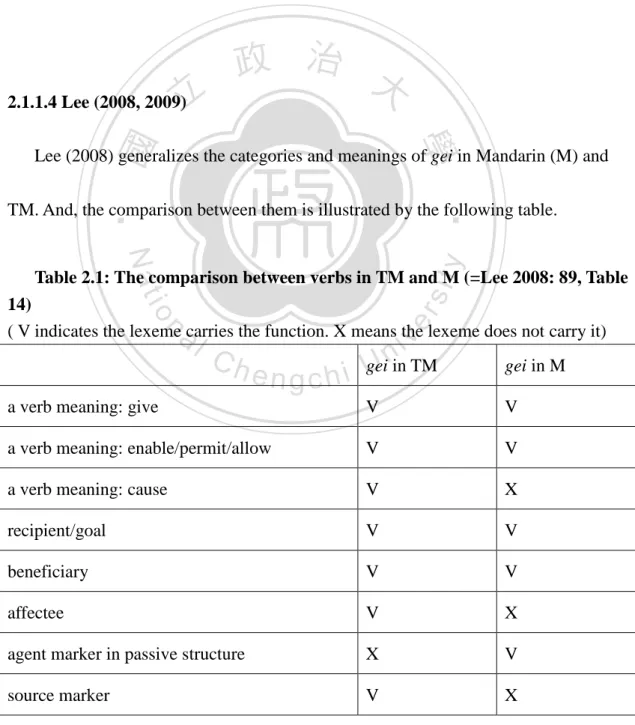
(20) 8. Then, in section 2.3, the semantic extension of lau in TH discussed in Lai (2003a, 2003b) will be presented.. 2.1 Studies on Gei in TM 2.1.1 Semantic Extensions of Gei With its multiple meanings and functions,1 this section will present several. 政 治 大. studies that account for semantic extensions of gei in different syntactic categories,. 立. especially the preverbal gei as a preposition.. Nat. y. ‧. ‧ 國. 學. 2.1.1.1 Newman (1996). er. io. sit. Newman (1996), exerting a cognitive linguistic view, examines the GIVE morpheme in various languages. Concerning morphosyntactic and semantic. al. n. iv n C extensions, he observes that thehextension e n g ccategories h i U of GIVE can involve. interpersonal communication, emergence/manifestation, causative/purpose, permission/enablement, schematic interaction, recipient/benefactive marking, movement, and completedness (Newman 1996: 134). In Newman’s (1996) study, gei, the representation of GIVE morpheme in. 1. Gei can be treated as a heterosemy. The term heterosemy, differing from polysemy, is defined as “two or more meanings that are historically related but are associated with reflexes which belong to different morphosyntactic categories” (cf. Lichtenberk 1991: 476). Newman (1996) maintains that the semantic extension of GIVE is closely related to the notion of heterosemy..
(21) 9. Mandarin, also exhibits semantic extensions into various functions such as of causative, permission/enablement, and recipient/benefactive functions. In addition, there is a special use of gei phrase in Mandarin, i.e.[gei wo] phrase, which is investigated as an emphatic use, as Newman (1996: 199) indicates: “Mandarin gei appears in imperative clauses lending a kind of emphasis to the command,” as the example Ni gei wo chifan (你給我吃飯) ‘(You) eat!’ illustrates. More details on the. 政 治 大. imperative [gei wo] construction will be discussed in section 2.1.2.. 立. ‧ 國. 學. 2.1.1.2 Her (2006). ‧. In Her’s (2006) study, the syntactic categories of gei in different constructions are. y. Nat. er. io. sit. analyzed and determined. Among syntactic categories he argues, the one related to our study is the preverbal gei. Her (2006) argues that not only the postobject gei but also. al. n. iv n C U the preverbal one are able to acthasea n preposition. the following examples in g c h i Examine Her (2006):. (1) a. 李四送了一個雕像給學校 (=Her 2006 (8b)) Lisi song-le yi ge diaoxiang gei Lee give-ASP one CL statue to ‘Lee gave a statue to the school.’ b. 李四給老師寄了一份文件 (=Her 2006 (34a)) Lisi gei laoshi ji-le yi Lee to/for teacher post-ASP one ‘Lee posted a document to/for the teacher.’. xuexiao. school. fen CL. wenjian. document.
(22) 10. c. 張三給李四還了一本書 (=Her 2006 (36c)) Zhangsan gei Lisi huan-le yi ben shu. John for Lee return one CL book ‘John returned a book for/*to Lee.’. Her (2006) holds that gei in the postobject position as in (1a) acts as a preposition, which encodes the goal meaning; that is, xuexiao (學校) ‘school’ is the destination where the diaoxiang (雕像) ‘statue’ goes. The intricate issue is that gei in the. 政 治 大. preverbal position as in (1b) exhibits ambiguous readings. One is the goal reading. 立. which indicates the destination of the document, while the other is the beneficial. ‧ 國. 學. reading which addresses that the teacher is benefited from Lisi’s post, but the. ‧. destination of the document is uncertain. The crucial evidence lies in (1c) which. y. Nat. er. io. sit. solely designates a beneficiary meaning. Therefore, according to the above semantic analyses, it is worthy of noticing that gei in the preverbal position can act either a. n. al. C beneficiary or a goal marker. h. engchi. i Un. v. 2.1.1.3 Hu (2007) Hu (2007), applying construction framework to investigate different gei constructions, claims that there are eight gei constructions in Mandarin, and the unmarked, superordinate one would be [N(agent)+gei+N(recipient)+N(patient)], such as Fumu gei ta ling yong qian (父母給他零用錢) ‘His parents gave him pocket.
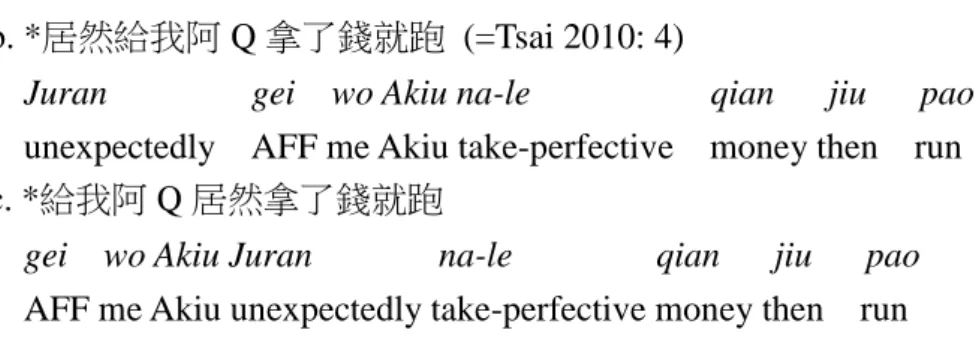
(23) 11. money.’ In this construction, its meaning can be realized as SUBJECT CAUSE OBJECTGEI+N TO RECEIVE SOMETHING. Among constructions suggested in Hu’s study, a special imperative [gei wo] construction related to our study will be discussed in section 2.1.2. Hu (2007) also illustrates that the semantic extensions of gei constructions can be accounted for through metaphor and metonymy (Hu 2007: 43ff). Section 2.1.2 will come back to the discussion.. 立. 2.1.1.4 Lee (2008, 2009). 政 治 大. ‧ 國. 學. Lee (2008) generalizes the categories and meanings of gei in Mandarin (M) and. ‧. TM. And, the comparison between them is illustrated by the following table.. y. Nat. sit. Table 2.1: The comparison between verbs in TM and M (=Lee 2008: 89, Table. al. er. io. 14) ( V indicates the lexeme carries the function. X means the lexeme does not carry it) gei in M. a verb meaning: give. V. V. a verb meaning: enable/permit/allow. V. V. a verb meaning: cause. V. X. recipient/goal. V. V. beneficiary. V. V. affectee. V. X. agent marker in passive structure. X. V. source marker. V. X. n. iv n gei in TM U. Ch. engchi.
(24) 12. patient/theme marker. V. X. resultative (verb+gei+ta+complement). V. X. gei+ta as a semi-infix to express subjectivity. V. X. Lee also holds that the appearance of new meanings in TM can be attributed to language contact between M and TSM in Taiwan. Among those new usages, a special construction [gei ta], as (2) shows, is investigated with the view of mismatch and. 政 治 大. grammaticalization.. (2) 在開學前給他玩個痛快. 學. ‧ 國. 立. (=Lee 2008 (14c)). ‧. qian gei ta wan ge tong kuai zai kaixue LOC school begins before give it play CLA happily ‘Let’s have a great time before the school begins.’. n. er. io. sit. y. Nat. al. i Un. v. The [gei ta] construction, which can be followed by adjectives, is similar to our. Ch. engchi. evaluative [gei wo] construction. Lee argues that gei in the construction in question has undergone grammaticalization, turning into “a function word denoting reason, perspective or affection” (cf. Lee 2008: 133), as the argument presented below:. Gei in the structure functions as a preposition introducing the topic, the reason or affectedness of an event. In some cases, it encodes the speaker’s stance, including his subjective approving or disapproving attitude. Gei in some cases could be interpreted as something like “because of, concerning, as far as… is concerned” (cf. Lee 2009: 50)..
(25) 13. Then, with regard to the construction in question, Lee proposes the grammaticalization of the insertion of [gei ta], as (3) indicates below:. (3) transfer of object/ goal of transfer, (=Lee 2008: 133) Gei ta i ben shu Give him a book. > transfer of abstract evaluative/goal of evaluated, Gei ta zhu fu/ ping lun Give him a bless/ a comment. > textual, metalinguistic meaning Na tian shang ban gei ta puo cao dao. I went to work very early that day. > strengthening of speaker’s belief Chuang wai de fong jing zhen shi gei ta you gou band de The scenery outside (the window) is really great.. 立. 政 治 大. ‧. ‧ 國. 學. y. Nat. er. io. sit. The study on [gei ta] can provide some insights to our study. We will elaborate that certain characteristics of [gei ta] are found in our [gei wo] construction in chapter 4.. al. n. iv n C U it can be not only To sum up, as gei is locatedh ine thenpreverbal g c h i position,. syntactically realized as a preposition, but also semantically perceived as having ambiguous readings, i.e., a beneficiary or a goal marker. Then, after grammaticalized and combined with ta or wo, [gei ta] and [gei wo] become fixed expressions in a certain context, generally serving an emphatic function. In the next section, studies on [gei wo] construction will be presented..
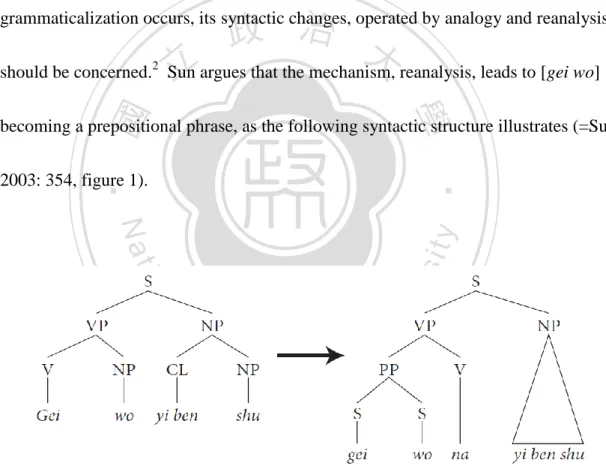
(26) 14. 2.1.2 [Gei Wo] in TM As the discussion of preverbal gei, which is syntactically realized as a preposition (cf. Li and Thompson 1981, Her 2006), the prepositional phrase [gei wo] can not only indicate the meaning as ‘for me,’ but also serve an ordering meaning. The semantic extension from a giving verb to an ordering meaning has been examined by some studies, including Tsai (2009, 2010), Yang (2010), Hu (2007), and Sun (2003). They will be reviewed below.. 2.1.2.1 Generative Perspective Studies. 學. ‧ 國. 立. 政 治 大. ‧. In Tsai’s (2009, 2010) studies, an affective construction is applied to examine the. y. Nat. er. io. sit. syntactic position of [gei wo]. Tsai (2009, 2010) claims that gei is an applicative marker which marks wo, an affectee. Structurally, wo is in the spec of applicative and. al. n. iv n C h e nstructure. gei is moved to the higher evaluative g c h iInUaddition, Tsai (2010) contends that,. in Mandarin, the external argument, i.e., the subject, must appear higher than the [gei wo] construction. Compare the example (4a) from Yang (2010: 80) and (4b-c) from (Tsai 2010: 4).. (4) a. 他居然給我拿了錢就跑 (=Yang 2010: 80) Ta juran gei wo na-le qian jiu pao He unexpectedly AFF me take-perfective money then run ‘Unexpectedly, he took the money and run away from me.’.
(27) 15. b. *居然給我阿 Q 拿了錢就跑 (=Tsai 2010: 4) Juran gei wo Akiu na-le unexpectedly AFF me Akiu take-perfective c. *給我阿 Q 居然拿了錢就跑. qian jiu money then. gei wo Akiu Juran na-le qian jiu AFF me Akiu unexpectedly take-perfective money then. pao run. pao run. Along with Tsai’s (2009, 2010) proposal, Yang (2010) further assumes that “the subject was originally in the spec of TP, but later topicalized in the outer affective construals” (Yang 2010: 82), as the following figure indicates:. 立. 政 治 大. ‧. ‧ 國. 學. n. er. io. sit. y. Nat. al. Ch. engchi. i Un. v. Figure 2.1 The topography of Mandarin outer affectives and benefactives (=Yang 2010: 83 (112)). Such an affective construal analysis can not only syntactically serve as a possible explanation of [gei wo] in the structure, but also semantically feature wo as an affectee..
(28) 16. Moreover, Tsai (2010) argued that such as affective construal can be licensed by imperative mood, as (5) shows (Tsai 2010: 3).. (5) 給我跪下 gei wo gui-xia AFF me knwwl-down ‘Kneel down for my sake.’. However, neither the mechanism nor the motivation of the semantic extension can. 政 治 大. be illustrated by the affective construction. That is, how and why the semantic. 立. ‧. ‧ 國. unknown.. 學. extension occurs from the original giving meaning to an ordering meaning is still. sit. y. Nat. io. n. al. er. 2.1.2.2 Semantic Extension Studies. i Un. v. The studies on the [gei wo] construction can be seen in Newman (1996), who. Ch. engchi. holds that when gei appears in an imperative clause, the phrase [gei wo] can carry an emphatic reading. Consider the following example.. (6) (你)給我吃飯. (=Newman 1996: 199 (60a)). (Ni) gei wo chi-fan (you) give me eat ‘(You) eat’. Example (6) contains two readings. One is the “enable” meaning, indicating “You let.
(29) 17. me eat;”the other is the emphatic meaning, referring to “by the authority of.” The major distinction is that, in the emphatic reading, wo is not the agent who eats, but the authority who asks for the demand to be done (cf. Newman 1996: 199-201). Such ambiguous readings play a crucial role for grammaticalization, but none of the research has delved into this issue. We will elaborate on this in the following chapters. Hu (2007), with the view of the constructional approach, maintains that [gei wo] is. 政 治 大. a marked and less prototypical imperative construction, such as Dixiongmen, gei wo. 立. qiangqizi.(弟兄們,給我搶旗子) ‘Soldiers, grab chess pieces for my sake.’, whose. ‧ 國. 學. meaning can be realized as ‘SUBJECT CAUSE OBJECT OF GEI TO RECEIVE. ‧. BENEFIT BY DOING AS IS ASKED’. One of the characteristics of this imperative. y. Nat. er. io. sit. construction is that [gei wo] is deemed as a construction. More importantly, the metonymic mechanism CAUSE FOR EFFECT is activated. Specifically speaking, the. al. n. iv n C first person pronoun wo (我) ‘I’hise affected by the activity qiangqizi (搶旗子) ‘grab ngchi U chess pieces’ caused by dixiongmen (弟兄們) ‘soldiers’.. 2.1.2.3 Grammaticalization Studies As we have indicated above, the prepositional phrase [gei wo] is derived from the original meaning of gei, i.e., giving. In other words, the content meaning is weakened and turns into a preposition; afterwards, the preposition develops into an ordering.
(30) 18. meaning. Such a process is characterized as grammaticalization, which can be defined as “the change whereby lexical items and constructions come in certain linguistic contexts to serve grammatical functions, and once grammaticalized, continue to develop new grammatical functions” (Hopper and Traugott 2003: 18). Such a grammaticalization study on [gei wo] can be seen in Sun (2003), who argues that [gei wo] has been grammaticalized and turned into a pragmatic marker. As. 政 治 大. grammaticalization occurs, its syntactic changes, operated by analogy and reanalysis,. 立. should be concerned.2 Sun argues that the mechanism, reanalysis, leads to [gei wo]. ‧ 國. 學. becoming a prepositional phrase, as the following syntactic structure illustrates (=Sun. ‧. 2003: 354, figure 1).. n. er. io. sit. y. Nat. al. Ch. engchi. i Un. v. Figure 2.2 The syntactic structure of gei as a verb ‘give’ and as a preposition ‘for’.. In addition, the grammaticalized [gei wo] can be attested by characteristics of. 2. The discussion on analogy and reanalysis will be addressed in Chapter 3..
(31) 19. gramamticalization, including layering and divergence, reported in the study (Sun 2003: 355). In sum, the emergence of the imperative [gei wo] construction can be accounted for by the application of metonymy as a mechanism, which is motivated by reanalysis. However, the emergence of the evaluative [gei wo] construction remains uninvestigated.. 立. 政 治 大. 2.2 Studies on Semantic Extensions of Ka in TSM. ‧ 國. 學. Researches on the development of ka can be found in Tsao (2002) and Cheng and. ‧. Tsao (1995). Based on a phonological viewpoint, Cheng and Tsao (1995) illustrate (合) ‘with’.. er. io. sit. y. Nat. that the original meaning of ka is the comitative function,. Subsequently, the preposition function occurs and four senses including a source, a. al. n. iv n C h emarker goal, a patient, and a beneficative i U (cf. Tsao (2002)). Examine n g are c hdeveloped the following examples:. (7). a. 阿三 ka 阿美借一本冊 (= Tsao 2002: (6b)) Asam ka Abí tsioh -pún tsheh. Asam ka Abí borrow one-CL book ‘Asam borrowed a book from Abí.’ b. 老師 ka 我回答一個問題 (= Tsao 2002: (9’)) Lāu u ka guá huêtap -e . teacher ka me answer one-CL question ‘The teacher answered a question for me.’.
(32) 20. c. 蚊仔 ka 我叮 (= Tsao 2002: (19b)) Bûn-a ka guá ting. mosquito ka me sting ‘A mosquito bited me.’ d. 媽媽在 ka 弟弟洗身軀 (= Tsao 2002: (59a)) Má-mah āi ka ī ī sé-sin-khu. mother ASP ka brother take a bath ‘Mother is helping the brother to take a bath.’. The source, goal, patient, and benefactive meanings can be illustrated in (7a-d), respectively. The semantic developments of these meanings have been investigated by. 政 治 大. means of context-induced and two-tier analyses.. 立. ‧ 國. 學. Tsao (2002) argues that the appearance of the ordering meaning of ka, such as example (8), originates from the benefactive meaning. In addition, comparing. ‧. languages between TSM and TM, Tsao demonstrates that the benefactive marker ka. sit. y. Nat. io. n. al. er. corresponds to TM gei, functioning alike (cf. Tsao 2002: 132). However, little. i Un. v. attention has been paid to the mechanism and motivation of the ordering meaning.. Ch. engchi. (8) 你 ka 我卡小二 (=Tsao 2002 (65a)) Lí you. ka ka. guá I. khah much. è jī. careful. ‘I warn you to be much careful.’. 2.3 Studies on Semantic Extensions of Lau in TH Lai (2003a, 2003b) illustrates that the original meaning of lau is the verb denoting.
(33) 21. to mix, to blend, or to put things together. Then, based on the metaphorical mechanism, the sense expands to a comitative preposition and a comitative conjunction. More importantly, as the comitative preposition is established, other senses will occur resulting from the mechanism of metonymic strengthening and underspecification of participant roles. The semantic senses including the comitative, the source, the goal, the benefactive, and the patient are illustrated in (9a-e),. 政 治 大. respectively; the data are taken directly from Lai (2003b: 534 (1-5)):. 立. a. 阿英摎阿姨共下去街頂. ‧ 國. 學. ‧. Ayin LAU ayi kiungha hi LAU aunt together go Ayin ‘Ayin, together with her aunt, went downtown.’ b. 阿英摎佢借錢. io. n. al. Ch. gia her. i Un. i e n g c hgong. Ayin LAU Amin Ayin LAU Amin ‘Ayin told a story to Amin.’ d. 阿英摎厥孻仔買一坵田 LAU LAU. qien. money. lai-e son. sit. y. Nat. Ayin LAU gi jia Ayin LAU him borrow ‘Ayin borrowed money from him.’ c. 阿英摎阿明講故事. Ayin Ayin. giedang. downtown. er. (9). v. gusi. story. tell. mai yit kiu tien. buy one CL land. ‘Ayin bought a piece of land for her son.’ e. 阿英摎杯子打爛哩 Ayin LAU Ayin LAU ‘Ayin broke the cup.’. bi-e cup. da-lan hit-break. le. PART.
(34) 22. More refined analyses on the semantic extension of these interrelated senses can be found in Lai (2003b). In addition, cross-linguistically, Tsao (2002) holds that lau in TH is syntactically similar with ka in TSM (Tsao 2002: 134). That is, their preverbal functions are both derived from the comitative meaning. However, the same situation, as ka found in TSM, also occurs. Though the multiplicity of lau has been examined, the ordering. 政 治 大. meaning such as (10) is missing.. 立. ‧ 國. 等先行. 學. (10) 這草籃仔你摎. ‧. Lia colame ni LAU ngai kai den this basket you LAU I carry on ASP ‘Please carry this basket for me and leave first.’. hang. leave. al. er. io. sit. y. Nat 2.4 Remarks. xien first. n. iv n C Gei in TM exhibits multiplehmeanings i U as previous researches have e n g candh functions. demonstrated. The mechanism for the semantic extension has attempted to examine the various meanings by means of metonymy, metaphor, and usage-based approach. However, although the special imperative [gei wo] construction has been examined, including its mechanism and motivation, a complete survey on each phase of its development should be conducted. In particular, the linguistic data that can trigger the emergence of the ordering meaning needs to be identified and elaborated. Moreover,.
(35) 23. regarding the emergence of the evaluative meaning, neither the mechanism nor the motivation has been explored. With a cross-linguistic comparison, while semantic relatedness of ka in TSM and lau in TH has been investigated, attention has not been paid to their ordering meanings, i.e., [ka gua] and [lau ngai] constructions. More specifically, researches are not yet available concerning the motivation and mechanism for the emergence of. 政 治 大. imperative [ka gua] and [lau ngai] constructions.. 立. With the insights evoked by previous studies as well as the issues that remain. ‧ 國. 學. unexplored, we will, hence, present theoretical foundations grounded upon. ‧. mechanisms of grammaticalization, including reanalysis and analogy, metaphor and. y. Nat. n. al. er. io. sit. metonymy, and subjectivity.. Ch. engchi. i Un. v.
(36) 立. 政 治 大. ‧. ‧ 國. 學. n. er. io. sit. y. Nat. al. Ch. engchi. i Un. v.
(37) CHAPTER III THEORETICAL BACKGROUND. Grammaticalization is originated in Meillet (1912), which leads to a broad. 政 治 大. investigation (Lehmann 1982 [1995, 2002], Hopper and Traugott 1993 [2003],. 立. Campbell and Janda 2001, Heine 2003, among others). A general view of. ‧ 國. 學. grammaticalization can be seen in Heine’s (2003) study, which mainly focuses on the. ‧. framework of grammaticalization and the process of grammaticalization. Concerning. y. Nat. io. sit. the framework of grammaticalization, mechanisms and motivations are proposed.. er. Heine suggests that “the main motivation underlying grammaticalization is to. al. n. iv n C h e2003: communicate successfully” (Heine n g 578). c h iForUmechanisms, desemanticization, extension, decategorialization, and erosion are held by Heine (2003: 579). More specifically, desemanticization refers to semantic bleaching; extension indicates uses in new contexts; decategorialization represents the loss in morphosyntactic properties, such as cliticization, affixation; erosion means the loss in phonetic characteristics (Heine 2003: 579). Grammaticalization can also be taken from a synchronic view, examining the 25.
(38) 26. language change at a single point of time, as can be seen from the synchronic parameters of grammaticalization put forward by Lehmann (cf. Lehmann 1985, 2002, Heine el al. 1991). Another line of grammaticalization can be seen in Traugott’s (2010a) study, which compares two opposite viewpoints of grammaticalization, i.e. reduction versus expansion. Traugott (2010a) argues that while considering grammaticalization as reduction is convincing, especially in morphosyntactic change,. 政 治 大. the view of expansion is also crucial and fundamental when concerning semantic. 立. change and pragmatic inference. In addition to the stance of grmmaticalization, she. ‧ 國. 學. also examines mechanisms and motivations of grammaticalization, including analogy,. Nat. y. ‧. reanalysis and pragmatic inference.. er. io. sit. In this section, attention will be drawn on the mechanisms and motivations for grammaticalization. Specifically, mechanisms will be divided into syntactic. al. n. iv n C h e n gand mechanisms, i.e. analogy and reanalysis, i U ones, i.e. metonymy and c hsemantic metaphor (Traugott 2002, 2010b). Furthermore, motivations will be illustrated by means of pragmatic strengthening, including invited-inference and context-induced reinterpretation. This chapter will be organized as follows. Mechanisms for syntactic change will be discussed in section 3.1. Next, in section 3.2, mechanisms for semantic change will be presented. Then, the motivation for semantic change will be concerned in section.
(39) 27. 3.3. Finally, some remarks are given in section 3.4.. 3.1 Mechanisms for Syntactic Change 3.1.1 Reanalysis Let us begin with reanalysis. Harris and Campbell (1995) propose that there are only three mechanisms for syntactic change, including reanalysis, extension, and. 政 治 大. borrowing. What we concern are reanalysis and extension, or analogy, both of which. 立. are internal mechanisms (Hopper and Traugott 2003). Traugott and Dasher (2002). ‧ 國. 學. also maintain that “for most of this century, reanalysis has been considered the major. ‧. factor in morphosyntactic change” (Traugott and Dasher 2002: 27). More specifically,. Nat. er. io. sit. y. reanalysis is referred to as a mechanism “which changes the underlying structure of a syntactic pattern and which does not involve any modification of its surface. al. n. iv n C U of the examples in English is try h e n1995: manifestation” (Harris and Campbell h i One g c 51). and VERB sequence in I’ll try and contact you, where reanalysis occurs, combining try and as a single word (Hopper and Traugott 2003: 50). Based on the example, reanalysis can be characterized as the change on the underlying structure, rather than on surface manifestation. A developed view of reanalysis can be seen in De Smet’s (2009) study. He deals with the logical flaw in ambiguity and ontological difficulties on the appearance of.
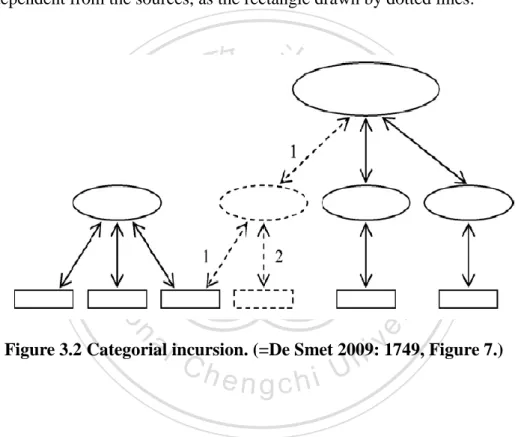
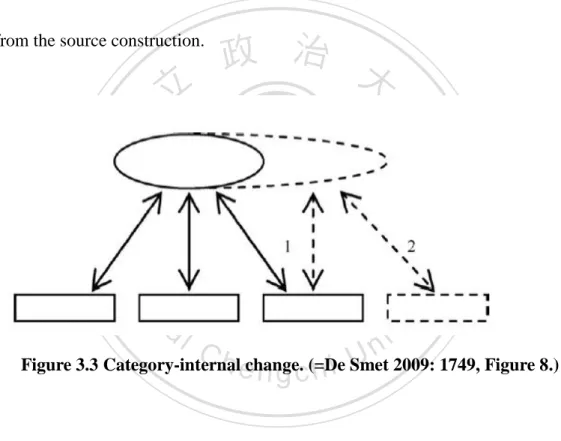
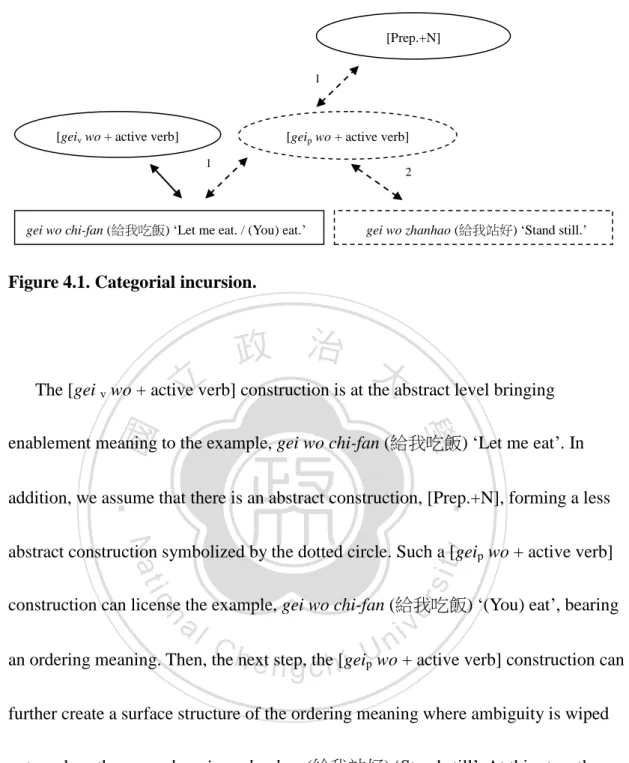
(40) 28. innovative structural representations. The example that can exhibit the issue in question is the development of Dutch kei ‘boulder, peddle’, which can be used as an intensifying prefix, such as keimooi ‘very beautiful’ or keilang ‘very long’. Such a development can be attributed to the comparative N+A compounds, e.g. bloedrood ‘blood-red’ or beenhard ‘bone-hard.’ The crucial example, keihard ‘rock-hard,’ could be seen as the context for reanalysis. The following figure visualizes the development of kei.. 立. 政 治 大. ‧. ‧ 國. 學 er. io. sit. y. Nat. al. n. iv n C U 2009: 1729, Figure 2.) h e nkei.g(=De Figure 3.1 Reanalysis of Dutch c h iSmet. As Figure 3.1 illustrates, rectangles indicate surface sequences; circles mean the more abstract syntactic structures. Full lines refer to the starting point of change, and dotted lines, the innovations. Double arrows mark the relationships of instantiation, and numbering demonstrates different stages (ibid., 1729). More specifically, concerning the issue that De Smet (2009) raises, that is, the logical flaw in ambiguity.
(41) 29. and ontological difficulties on the appearance of innovative structural representations, it seems difficult to explain how language users could apply N+A compounds to Pref+A structure. Thus, there could be more basic mechanisms prior to the application of reanalysis (De Smet 2009: 1729-1730). To underline the notion of reanalysis, De Smet further suggests three basic mechanisms, involving categorial incursion, gradual category-internal change, and. 政 治 大. automation. One of the cases he proposes to exemplify the analysis is that worth is. 立. developed from a transitive to an intransitive use, and worthwhile is changed from an. ‧ 國. 學. intransitive to a transitive use (De Smet 2009: 1732ff). Consider the following. ‧. examples:. sit. y. Nat. n. al. er. io. (1) a. A touchdown is worth six points. (=De Smet 2009: 1732, (1)) b. The outcome had been worth the long battle.. Ch. engchi. i Un. v. (2) a. The restaurant was crook and therefore not worth visiting. (=ibid. 1732 (2)) b. Now was not this heroic lover worth running after? (3) a. With anthems like that it’s worth emigrating isn’t it. (=ibid. 1733 (3)) b. However, I think it is worth issuing a word of warning about unusual vegetables.. In (1a-b), they are transitive structures due to that worth should select a subject and an object; that is, the deletion of object can cause ungrammaticality. In (2a-b), the syntactic structure is changed in that the object of worth turns into a gerund clause,.
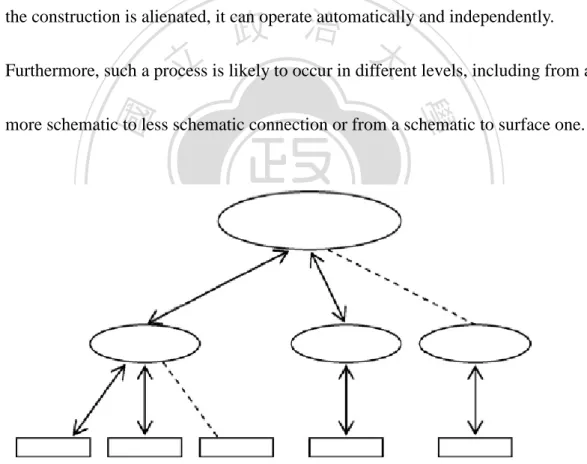
(42) 30. which can be represented as an adjectival predicate; however, worth is still transitive because it requires an object. Crucial examples are in (3a-b), which can be interpreted as intransitive since syntactically worth behaves like other intransitive adjectives such as easy in it hadn’t been easy breaking the news to Nicole (De Smet 2009: 1732), and semantically the gerund clause following worth acts as “a positive value” by itself, rather than “an exchange value for a given subject” (De Smet 2009: 1732). Then,. 政 治 大. consider the examples of worthwhile:. 立. ‧ 國. 學. (4) a. all the work has been worthwhile. (=De Smet 2009: 1733 (4a-b)) b. Hardly any novel writing, or reading, seemed to him worth while.. ‧. sit. y. Nat. (5) a. it is certainly worthwhile stopping off on the way. (=ibid. 1733 (5a-b)) b. Sir William does not think it worth while making another application.. n. al. er. io. (6) a. no more than a shadow too vain and futile to be worth while watching as it passed. (=ibid: 1733 (6a-b)) b. there is much that is worthwhile visiting.. Ch. engchi. i Un. v. Worthwhile is originally an intransitive adjective, as (4a-b) indicates. In addition, it can be followed by extraposed gerund clauses as (5a-b) shows. What attracts our attention are examples in (6a-b), whose subject (a shadow; that) “simultaneously functioning as the missing object of the gerund clause following the adjective” (De Smet 2009: 1733). Such a construction can be considered as a transitive construction. Let us begin to introduce these three mechanisms. First, categorial incursion refers.
(43) 31. to that one construction extends to another one which already exists. Such a mechanism can clarify the notion of ambiguity as the interpretation to an existing model, as the following figure shows. In figure 3.2, step 1 manifests the interaction between one construction and the other already existing construction, as the circle drawn by dotted lines, and then step 2 demonstrates the appearance of new meaning independent from the sources, as the rectangle drawn by dotted lines.. 立. 政 治 大. ‧. ‧ 國. 學. n. er. io. sit. y. Nat. al. i Un. v. Figure 3.2 Categorial incursion. (=De Smet 2009: 1749, Figure 7.). Ch. engchi. Categorial incursion can be well demonstrated by the change of worth and worthwhile. The transition from transitive worth to intransitive one is not random but is the analogical extension to the already existing construction, i.e. worthwhile. This can also explain why worth is able to become intransitive like worthwhile, while other adjectives are not. The second mechanism is called gradual category-internal change, defined as that.
(44) 32. “a construction undergoes minor semantic change which manifest themselves in new instances, but not necessary in a new category” (ibid., 1749), as the following figure illustrates. There are two steps for the process. The first step is the expansion of the syntactic structure, denoted by the extended dotted circle, thereby the meaning extension becoming possible. The second one is the result of actualization, symbolized by the dotted rectangle, thereby the new meaning being established, free from the source construction.. 立. 政 治 大. ‧. ‧ 國. 學 er. io. sit. y. Nat. al. n. iv n C U 2009: 1749, Figure 8.) h echange. Figure 3.3 Category-internal h i Smet n g c(=De. The instance of the application of such a mechanism can be held by the rise of intransitive worth. The emergence of intransitive worth can be seen as a process, whereby the transitive meaning of worth is weakened, and its existing categorial boundary is extended, allowing worth to receive the effects of categorial incursion from worthwhile..
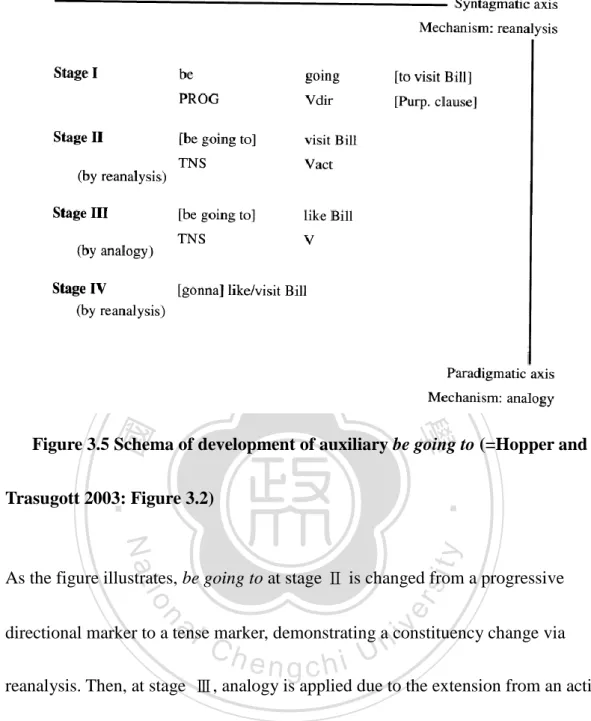
(45) 33. The third mechanism is automation, referring to the process whereby “a less schematic construction gradually becomes alienated from its more schematic parent construction” (ibid., 1750). Such a mechanism can support the phenomenon of language use, which results in a specific construction becoming a chunk, independent from the original construction. As the following figure shows, the instantiations can be connected by the arrowless dotted lines, which means that the link is weakened. As. 政 治 大. the construction is alienated, it can operate automatically and independently.. 立. Furthermore, such a process is likely to occur in different levels, including from a. ‧ 國. 學. more schematic to less schematic connection or from a schematic to surface one.. ‧. n. er. io. sit. y. Nat. al. Ch. engchi. i Un. v. Figure 3.4 Automation. (=De Smet 2009: 1750, Figure 9.). Automation can be applied to account for the difference between intransitive worth and other intransitive adjectives. Even though worth behaves like an intransitive.
(46) 34. adjective, some constraints, such as fronting of the gerund clause, are imposed. Compare the following examples:. (7) a. With anthems like that it’s worth emigrating isn’t it. (=De Smet 2009: 1733 (3a)) b. *emigrating is worth with anthems like that, isn’t it. (see ibid. 1733) (8) a. It’s easy imagining a scenario. b. Imagining a scenario is easy.. 政 治 大 From the above examples, it is represented that although worth can be characterized 立. ‧ 國. 學. as intransitive, it can neither be originated from its original function, nor be the same. ‧. as other ordinary intransitive adjectives; in other words, the construction of. sit. y. Nat. intransitive worth has developed through the mechanism of automation.. n. al. er. io. In addition to ambiguity for reanalysis, Harris (2005) maintains that causes of. Ch. i Un. v. reanalysis can involve not only ambiguous readings but also the provision of stylistic. engchi. variety or greater expressiveness. The latter cause, i.e. the provision of stylistic variety or greater expressiveness, indicates that when reanalysis appears, the innovative structure can co-exist with, rather than replace, the source structure. Take unda in Georgian as an example. The innovative modal usage of unda in mas unda (rom) gaak’etos ‘S/he wants to do it.’ exists side by side with the source ‘want’ usage as in man unda gaak’etos ‘S/he should do it’..
(47) 35. 3.1.2 Analogy After the demonstration on reanalysis, the other significant mechanism for syntactic change, i.e. analogy, will be addressed in this section. In Meillet’s (1912) study, analogy is seen as the model of proportion, applied at the morphological level, such as singular-plural alternation, as in (9).. (9) cat: cats = child: X. 立. 政 治 大. 學. ‧ 國. X = childs. 1. (= Hopper and Traugott 2003: 64, (24)). In addition to the morphological level, the notion of analogy extends to the structural. ‧. or semantic changes by means of similarity, applying on the paradigmatic axis (cf.. sit. y. Nat. io. n. al. er. Fisher 2007; Hopper and Traugott 2003, Traugott 2010). The example for the. i Un. v. application of analogy can be seen in “going construction” (Fischer 2010: 285) as (10) indicates.. Ch. engchi. (10) a. I am going (to the market) to buy some fish. (=Fischer 2010: 285(4)) b. I am going to marry (tomorrow). c. I am going to like it. d. It is going to rain. e. I am going to go there for sure. f. I’m gonna go there for sure. g. * I’m gonna Haarlem to visit my aunt. 1. Such an analogical process whereby the result is different from adults’ usage, i.e. children, can usually be discovered at the early stage of children’s language acquisition..
(48) 36. As the above examples indicate, verbs that co-occur with be going to can be changed from concrete movement verbs, such as (10a) and (10b), to more mental ones, such as (10c). Next, the extension can contribute the subject to be inanimate, as in (10d). Cases in (10e) and (10f) further support that be going to has turned into future tense since the appearance of two concessive go is only allowed when the first one is the auxiliary. Thus, (10g) is not acceptable.. 政 治 大. The difference between reanalysis and analogy can be demonstrated as in Hopper. 立. and Traugott’s (2003: 39) study, which states that “[i]n reanalysis, the grammatical. ‧ 國. 學. syntactic and morphological – and semantic properties of forms are modified….. ‧. Analogy…modifies surface manifestations and…does not effect rule change.”2 While. y. Nat. er. io. sit. their difference exists, they are able to interact to deal with grammaticalization. Such an interaction can be exemplified by the development of be going to from directional. al. n. iv n C h easnthe expression to future representation, h i U figure exhibits. g cfollowing. 2. Different from Traugott’s viewpoint, Fischer (2007, 2008) argues that analogy can involve reanalysis..
(49) 37. 政 治 大. 立. ‧ 國. 學. Figure 3.5 Schema of development of auxiliary be going to (=Hopper and. ‧. Trasugott 2003: Figure 3.2). sit. y. Nat. io. n. al. er. As the figure illustrates, be going to at stage Ⅱ is changed from a progressive. i Un. v. directional marker to a tense marker, demonstrating a constituency change via. Ch. engchi. reanalysis. Then, at stage Ⅲ, analogy is applied due to the extension from an active verb, i.e. visit, to a stative one, i.e. like. Finally, at stage Ⅳ, reanalysis is exerted again, turning be going to into gonna whereby phonological contraction occurs. Thus, from the observation of the development of be going to, reanalysis is applied on the underlying structure, while analogy is manifested on the surface structure. In this section, we have already presented mechanisms for syntactic change, i.e. reanalysis and analogy. Specifically, we have sketched how reanalysis applies to.
(50) 38. grammaticalization, and more importantly, examined three basic mechanisms that underlie the notion of reanalysis. These three more basic mechanisms will be undertaken for our research.. 3.2 Mechanisms for Semantic Change Metaphor and metonymy are generally regarded as mutually related concepts and. 政 治 大. mechanisms to account for not only human conceptualization, but also meaning. 立. change (Heine, Claudi, and Hünnemeyer 1991). In this section, a general idea of. ‧ 國. 學. metaphor and metonymy will be laid out, and further elaboration on how they interact. al. er. io. sit. y. Nat 3.2.1 Metaphorization. ‧. with grammaticalization will be presented.. n. iv n C h easnthegunderstanding Metaphor is generally defined c h i U of one thing by means of. another, or the transfer from one concrete meaning to more abstract one. The understanding or the transfer can refer to the mappings between conceptual domains, i.e. from concrete sources to abstract concepts (Lakoff and Johnson 1980; Heine, et al. 1991; Croft and Cruse 2004). For example, our sensorimotor domains can be mapped to the subjective experience domain (Lakoff and Johnson 1999: 45ff), such as up in I’m feeling up today, which represents “feeling happy and energetic and having an.
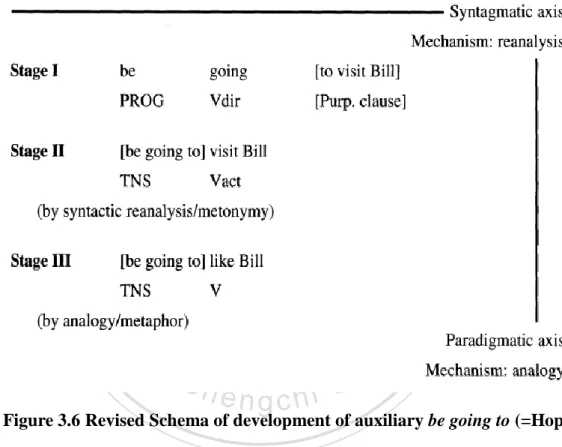
(51) 39. upright posture,” applying the primary metaphor, HAPPY IS UP (Lakoff and Johnson 1999: 50). With the view of dynamic dimension, metaphor can be viewed as a dynamic process in meaning change, i.e., metaphorization, which is claimed as a mechanism for semantic change (Traugott and Dasher 2002). Moreover, metaphoric processes are argued to be the motivation for early grammaticalization (Hopper and Traugott 2003:. 政 治 大. 85). As Hopper and Traugott (2003) state, the development of spatials into temporals. 立. the years ahead, both of which denote future tense.. 學. ‧ 國. can be accounted for by the metaphor, TIME IS SPACE, illustrated by be going to, in. ‧ y. Nat. er. io. sit. 3.2.2 Metonymization. From a traditional view, metonymy is merely a way that we apply the name of. al. n. iv n C U indicates: “metonymy is a h the something to signify the other, as e nfollowing g c h idefinition figure of speech in which the name of one thing is used in place of that of another associated with or suggested by it” (Webster’s New World Dictionary Third College Edition, S.V. “metonymy” p.854). However, from the cognitive viewpoint, metonymy not only reveals language use, but also fundamentally reflects human cognitive processes. Kövecses and Radden (1998: 39) indicate that “metonymy is a cognitive process in which one conceptual entity, the vehicle, provides mental access to another.
(52) 40. conceptual entity, the target, within the same domain, or [idealized cognitive model] ICM.” In addition, Kövecses and Radden propose several ICMs3, among which we adopt Causation ICM to account for semantic extensions in our study. Causation ICM is defined as “[w]hen one thing or event causes another, we have a cause-and-effect type of relationship” (Kövecses and Radden 1998: 56). Two possible relationships can be produced; that is, CAUSE FOR EFFECT or EFFECT FOR CAUSE metonymies.. 政 治 大. The following examples illustrate these two kinds of metonymies, respectively:. 立. (11) healthy complexion. ‧ 國. 學. (12) sad book. ‧ sit. y. Nat. The realization of (11), healthy complexion, relies on the fact that a better health. n. al. er. io. condition can bring out a healthier complexion. On the other hand, in (12), it is the. Ch. i Un. v. book that can make the reader feel sad; in other words, the book is the cause that leads. engchi. to the effect of sadness. More importantly, compared with metaphor, as some researchers have argued, metonymy is a more basic and fundamental phenomenon to language and cognition (cf. Barcelena 2000). In this regard, semantic changes can occur by metonymization. 3. Two categories of ICMs are proposed. One is Whole ICM and its parts, including Thing-and-part ICM, Scale ICM, Constitution ICM, Complex event ICM, Category-and-member ICM, Category-and-property ICM, and the other is Parts of an ICM, including Action ICM, Perception ICM, Causation ICM, Production ICM, Control ICM, Possession ICM, Containment ICM, Assorted ICMs involving indeterminate relationships, Sign and reference ICMs..
(53) 41. as the following example illustrates (cf. Stern 1968:376):. (13) concern (n.): interest (in some matter) > (the) matter that concerns. The example illustrates a metonymic process from a mental state to its object or cause. Or, for other examples, consider the following semantic change:. (14) England for Great Britain (Kövecses and Radden 1998: 50). 政 治 大. The metonymic principle of a part-whole relationship can contribute to such a kind of. 立. semantic change whereby the notion of PART entails the notion of WHOLE. In. ‧ 國. 學. addition, R-heuristic can be seen as the mechanism that accounts for the part-whole. ‧. metonymy; that is, “Say no more than you must, and mean more thereby” (Levinson. Nat. er. io. sit. y. 1983: 146).4 Likewise, compared to metaphor, metonymy is argued to play a more important role in the change of syntactic constituents (Hopper and Traugott 2003:. n. al. 88ff).. Ch. engchi. i Un. v. More importantly, semantic mechanisms, i.e. metaphor and metonymy, and syntactic mechanisms, i.e. analogy and reanalysis, are mutually related, as Hopper and Traugott put.. 4. The R(elevance)-heuristic is also called the Principle of Informativeness (Levinson 1983: 146), which is inspired by Grince’s Quantity Maxim. Not only in writing but also in speech can we find the application of R-heuristic..
(54) 42. [M]etonymic and metaphorical inferencing are complementary, not mutually exclusive, processes at the pragmatic level that result from the dual mechanisms of reanalysis linked with the cognitive process of metonymy, and analogy linked with the cognitive process of metaphor (Hopper and Traugott 2003: 93).. The following figure represents the relation between semantic and syntactic mechanisms.. 立. 政 治 大. ‧. ‧ 國. 學. n. er. io. sit. y. Nat. al. Ch. engchi. i Un. v. Figure 3.6 Revised Schema of development of auxiliary be going to (=Hopper and Trasugott 2003: Figure 4.1). In figure 3.6, the syntactic reanalysis occurs on the syntagmatic axis, followed by the metonymic process, while analogy occurs in the paradigmatic axis, accompanied by the metaphorical process. In this section, we have presented mechanisms for semantic change including.
(55) 43. metaphorization and metonymization, both of which are complementary processes for semantic change. More importantly, as the illustration of the example be going to, these two mechanisms can cooperate with mechanisms of syntactic change to account for the development of grammaticalization. After the discussion of these mechanisms, one of the important questions is why they are able to be applied in grammaticalization. Thus, in next section, we will proceed to investigate why language change happens.. 3.3 Motivation for Language Change. 學. ‧ 國. 立. 政 治 大. ‧. In order to understand metonymic and metaphorical processes, pragmatic. y. Nat. er. io. sit. meaning or pragmatic invited inference, should be taken into consideration (Traugott and König 1991, Traugott and Dasher 2002, Traugott 2010). Specifically, pragmatic. al. n. iv n C h ofe meaning factors happen in the initial stage i U followed by the metaphoric and n g c hchange, metonymic processes. In other words, it is the interactions between speakers that motivate metaphorization and metonymization. Thus, we will begin with pragmatic factors.. 3.3.1 Pragmatic Strengthening Pragmatic strengthening has been considered the motivation for.
(56) 44. grammaticalization (Trangott 1989, Tragott and König 1991, Bybee 1990, Hopper and Traugott 2003). Such a proposal can be seen to demonstrate maximization of economy, i.e., maximization of efficiency through minimal differentiation and maximization of informativeness (Traugott 2003). It is proposed that grammaticalization can be described through three semantic-pragmatic tendencies (Tragott and König 1991: 208-209), as (15-17) indicates (= Tragott and König 1991, (36)-(38)).. 立. 政 治 大. (15) Semantic-pragmatic Tendency Ⅰ:. ‧. ‧ 國. 學. Meanings based in the external described situation > meanings based in the internal (evaluative/perceptual/cognitive) situation. (16) Semantic-pragmatic Tendency Ⅱ:. y. Nat. sit. n. al. er. io. Meanings based in the described external or internal situation > meanings based in the textual situation. i n C U h e n gⅢ:c h i (17) Semantic-pragmatic Tendency. v. Meanings tend to become increasingly situated in the speaker’s subjective belief-state/attitude toward the situation.. One of the examples illustrating these three tendencies can be found in OE hraþor, which originally means ‘sooner, earlier.’ In some context, it can be inferred as ‘more,’ becoming evaluative meaning, pertaining to Tendency Ⅰ. Then, the textual connective hraþor þanne ‘rather than’ arises, expressing either a temporal or a newly.
(57) 45. developed preference meaning via Tendency Ⅱ. As the meaning ‘rather than’ can appear in clauses whose subjects are not necessary to be the speaker, the subjective attitude emerges by Tendency Ⅲ (Tragott and König 1991: 209). A follow-up research, mainly focusing on pragmatics and language change, can be seen in Traugott’s (2011) study, which attributes language change to pragmatic factors, focusing on implicatures, inference, subjectification, and context. More specifically,. 政 治 大. regarding the appearance of new meanings, the concepts of invited inference,. 立. referring to the inference on meanings beyond what is said, and context-induced. ‧ 國. 學. reinterpretation, referring to the process whereby new meanings appear through the. ‧. reinterpretation on ambiguous contexts, are elaborated (cf. Heine et al. 1991, Traugott. er. io. sit. y. Nat. 2011).. In short, grammaticalization can be motivated by pragmatic strengthening, i.e. the. al. n. iv n C h einncommunication increase of speaker’s involvement g c h i U (Traugott 1995). Thus, the notion of subjectivity will be dealt with in the following section.. 3.3.2 Subjectivity, Subjectification, and Counter-expectation Subjectivity has been widely discussed in literature, whose definition can be illustrated in Finegan (1995:1), “subjectivity… concerns expression of self and the representation of a speaker’s…perspective or point of view in discourse - what has.
(58) 46. been called a speaker’s imprint.” He also argues that, as subjectivity is concerned, there are three correlated aspects, including a speaker’s perspective, affect, and epistemic modality being focused on. The appearance of subjectivity is often expressed by linguistic markers, such as adverbs in Powell (1992) and Athanasiadou (2007), and modality in Nuts (2001), De Smet and Verstraete (2006), Traugott (1989, 1999, 2010) and Traugott and Dasher. 政 治 大. (2002). Consider the modal verb in the following examples (=De Smet and Verstraete. 立. 2006: 367 (3)-(4)):. ‧ 國. 學 ‧. (18) Mum won’t let us go out tonight. I asked her but she said we had partied more than enough this week.. er. io. al. sit. y. Nat. (19) Judith won’t be late. She never is.. n. iv n C In example (18), the modal verbhrefers to thehunwillingness of the subject, i.e. Mum, eng c i U who does not allow her children to go out, while in (19), the modal verb illustrates the speaker’s judgment on the understanding of Judith. In other words, the modal verb in (19) endows the description of subjectivity. In sum, Traugott and Dasher (2002: 23) propose the generalization on the characteristics of the most subjective expressions, including:.
(59) 47. (20) a. overt spatial, and temporal deixis, b. explicit markers of SP/W attitude to what is said, including epistemic attitude to the proposition, c. explicit markers of SP/W attitude to the relationship between what precedes and what follows, i.e. to the discourse structure; many aspects of discourse deixis are included here, d. the R-heuristic predominates.. Following the view of subjectivity, Traugott addresses the diachronic analyses on semantic change, i.e. subjectification, as the following indicates:. 立. 政 治 大. ‧. ‧ 國. 學. [S]ubjectification refers to a pragmatic-semantic process whereby meanings become increasingly based in the speaker’s subjective belief state/attitude toward the proposition (Traugott 1995: 31).5. Nat. er. io. sit. y. Moreover, it is hypothesized that “online production in the flow of speech” can motivate subjectification (Traugott 2010: 55). Subjectification is also considered the. al. n. iv n C U speaker to encode and regulate hare mechanism by which “meanings e nrecruited g c hbyi the attitudes and beliefs” (Traugott 2010: 35). The construction be going to can be. exemplified to illustrate the emergence of subjectification through diachronic change, as the following example shows (adapted from Traugott 2010: 36, (5)).. 5. Another viewpoint about subjectivity can refer to Langacker (1985, 1995) who indicates that the expression of subjectivity largely with zero subject, or at least “off-stage”; that is, the communicative dyad between Speaker-Hearer is implicit..
(60) 48. (21) a. I am going to visit the prisoner. Fare you well. b. I ha’ forgot what I was going to say to you. c. I am afraid there is going to be such a calm among us, that we must be forced to invent some mock Quarrels.. (21a), dated in the sixteenth century, expresses the motion that the speaker intend to do, while (21b), dated in seventeenth century, demonstrates non-motion expression. The subjective meaning emerges in (21c), whose subject becomes inanimate, denoting the speaker’s judgment.. 立. 政 治 大. For a better understanding of subjectivity, the notion of counter-expectation can be. ‧ 國. 學. concerned, as Traugott (1999) states that “[c]ounter-expectation is a matter of point of. ‧. view and is therefore an example of the subjectivity of language.” The notion of. y. Nat. n. al. er. io. sit. counter-expectation can be addressed, as Heine et al. (1991: 192) indicate:. Ch. i Un. v. In all languages known to us, there is some means for expressing a distinction between situations that correspond to shared norms on the one hand and situations that deviate from these norms on the other. This distinction is encoded typically by using some marker for the latter, while the former remain unmarked.. engchi. With regard to this explication, it is considered that counter-expectation is a ubiquitous linguistic characteristic by means of the marked linguistic forms. Consider the following example:.
(61) 49. (22) Your house is too small, even if you are only two (Heine et al. 1991: 192(42)).. The italic forms, i.e. too and only, express that the norms or standards that exist in a speaker’s mind are deviated with the context. They further indicate that particles and sentence adverbs are considered “counter-expectation (CE) markers,” whose properties can be listed below in (23) (Heine et al. 1991: 192):. 政 治 大 (23) a. Their use implies a comparison between what is asserted on the one hand 立. ‧ 國. 學. and what is either presupposed, expected, or assumed to be the norm on the other.. ‧. b. The former is at variance with the latter, and the main function of the CE. Nat. sit. y. marker is to relate the assertion to the world of presuppositions,. n. al. er. io. expectations, and norms.. Ch. engchi. i Un. v. Similar to Heine et al.’s study (1991), Traugott (1999: 178) mentions that “[w]hen a speaker expresses counter-expectation, he or she expresses beliefs or points of view contrary to his or her own interlocutor’s expectations regarding the states of affairs under discussion.” A provisional summarization is presented below:. (24) U2 is not expected given U1 (Traugott 1999:179 (3)) Note: U= utterance.
(62) 50. In line of this argument, Traugott (1999: 179) further maintains that: “[c]ounter-expectation is a matter of point of view and is therefore an example of the subjectivity of language.” Therefore, it is plausible to claim that the appearance of counter-expectation is closely related to subjectivity since counter-expectation indicates a speaker’s point of view in discourse, which corresponds to the concept of subjectivity.. 政 治 大. In this section, we have discussed motivation for language change. First,. 立. pragmatic strengthening is mentioned as the motivation for grammaticalization,. ‧ 國. 學. especially for metaphoric and metonymic processes. Then, since pragmatic. ‧. strengthening is related to meaning expansion, i.e. speaker’s attitudes or judgment are. y. Nat. er. io. sit. added, the notion of subjectivity is introduced. Some related notions, such as subjectification, that is, a dynamic view of subjectivity, and counter-expectation, that. al. n. iv n C h e n g careh ialsoUdemonstrated. is, a considerable example for subjectivity,. 3.4 Remarks The notion of grammaticalization is contended, including how and why language change occurs. More specifically, on mechanism for language change, we deal with reanalysis and analogy with a syntactic aspect, and metaphor and metonymy with a semantic facet. In addition, on motivation for language change, we undertake.
數據

+7
相關文件
至於在台灣的學術佛教,基礎相當脆弱,自 1950 年至 1960 年代,在台
印尼語 164 班、柬埔寨語 13 班、泰語 131 班、菲律賓語 54 班、. 緬甸語 33 班、馬來語 36 班,計 3,523 位學生選習。另外,102 校以遠距直播教學開課,總計開設雲端班 87
修習本專門課程者,應取得閩南語 中高級以上 能力證明,包括(一)中央教育主管機關核
語文運用 留意錯別字 辨識近義詞及詞語 的感情色彩 認識成語
健行學校財團法人健行科技大學 清雲科技大學 台灣首府學校財團法人台灣首府大學 致遠管理學院 大華學校財團法人大華科技大學 大華技術學院 醒吾學校財團法人醒吾科技大學
語文素養重視積累、感悟和薰陶,基本內涵 和要素包括:字詞句篇的積累,語感、讀寫 聽說能力、語文學習方法和習慣的培養,以
大學教育資助委員會資助大學及絕大部分專上院 校接納應用學習中文(非華語學生適用)的「達 標」
喜而告其妻曰﹕我有家當矣。妻問安在?持卵示 之,曰﹕此是,然須十年,家當乃就。因與妻計
