Department of International Master of Business
Administration National University of Kaohsiung
Master Thesis
The Exploration of Green Supply Chain Value in
Kaohsiung Screw Industry: A Means-End Chain
Application
以方法目的鏈探討綠色供應鏈實行於
高雄螺絲產業的實務價值
Advisor:Dr. Chao, Chian-Hsueng
指導教授:趙建雄 博士
Graduate:Ciou, Jian-An
研究生:邱健安
誌謝
在這個時間點還能寫下論文的誌謝,應該是年前的我無法想像的事。就讀碩 士期間發生不少劇變,幾經波折還可以順利完成,一路上真的需要感謝不少人的 指引和幫忙。 首先要感謝高大資管系的 趙建雄老師與 陶幼慧老師的悉心指導。能在眾多 的資料與文獻中適時指引並提出相關的問題,才能讓我的研究從零一直到最終的 結果出爐。也感謝擔任我外校口委的 吳傳春老師,能在百忙中接受邀請,並於 過程中點出一些沒看見的瑕疵,讓我的論文可以更加完備。 其次是在人文院結識的良師與益友,傅鈺雯老師;她在人文知識上的傳達與 理念思辨上的影響,至今還是令我深覺受益良多。在她的數堂課程中,我也認識 許多來自不同領域的朋友,並在課堂的互動中逐步的理出自己的核心思想。這在 研究所期間還能結識這樣跨領域與思維的情誼,是我在學期間深感幸運的事情。 我另外也要感謝在這數年中與我結識的各式友人。你們的思想理念、人生經 歷與專業素養,都在你們不經意的時刻給予我很大的助力與支持。沒有你們,這 條路不會走的如此有趣與寬廣;沒有你們,我可能無法發現那些不一樣的可能性 然後回頭完成一切。 最後,這篇論文的寫作初衷來自我的家人以及先走一步的父親;少了這個原 生家庭的環節與遭遇,我可能無法意識這個題目後續所帶來的議題範圍。那些思 索和論證的過程,都是完成這項研究的關鍵要素。 邱健安 國立高雄大學 IMBA 2017.7 月Abstract
This study aims to use Means-Ends Chain approach to find out potential value
chain and factors influencing green supply chain management (GSCM) applied in
screw industry. Screw and fastener are one of the important exporting products in
Taiwan. Recently, Taiwan government and screw industry announced NICE upgrade
project and screw 4.0 to respond to the incoming intensely competition from China and
other overseas countries. One of the project targets is the Eco-friendly production
process; to achieve this goal, a few companies’ effort won’t be enough to sustain this
upgrade. Therefore, building up a stable and strong GSCM could be one of critical steps
to success. This research used soft laddering method to interview 32 senior screw
companies’ managers in Kaohsiung. This research extracts 6 critical linkages which can
be separated into two types of value path. First type of linkage shows GSCM have
positive influence and provide two terminal values- Stable Business and Reputation.
By fitting the customer’s requirement and applying GSCM beforehand, screw
companies can gain their business reputation and become long-term business partners.
Second type of value path represents that GSCM is still considered as a risky investment. Screw companies’ capital limitation is the biggest obstruction. To construct a GSCM
system or follow the environmental regulation, plenty of money and resource have to
be invested in advance; the maintenance fee will be another issue for system’s
long-term sustainability. According to the result found, some managerial implications are
provided, which may contain some valuable information for government, managers and
relative stakeholders.
Key Words: Green Supply Chain Management; Kaohsiung Screw Industry; Means-End
摘要
本研究使用方法目的鏈的理論和軟性階梯訪談萃取高雄區螺絲產業對綠色 供應鏈的價值取向。高雄地區的螺絲產業是台灣數個螺絲生產基地的重要一環; 近年由於中國和東南亞等國的螺絲產業日趨成熟,相關業者經常面臨低利潤的價 格戰,在長遠上對整體螺絲業是個潛在危機。因此,工業局與台灣螺絲相關公會 推出 NICE 升級計畫與螺絲 4.0 的產業口號,希望能因應當前的產業瓶頸並升級 台灣的總體螺絲產業。相關計畫當中包含 Eco-friendly 生產過程也正呼應國際 間實行一段時間的綠色供應鏈。本研究共訪談 32 家高雄螺絲廠商並利用方法目 的鏈來探討各項屬性、結果和價值的取向;在最後的結果中,本研究共萃取出 6 條關鍵的路徑,並且可以由最終的價值取向分成兩大類。第一類是綠色供應鏈對 自身公司有產生正向影響的價值路徑。藉由早期的制度建立和符合客戶的相關要 求,最終可形成長期穩定的商業關悉與信譽。第二類是由於建立相關制度與因應 環保法規變化未必能保證的企業正向成長,讓螺絲產業對綠色供應鏈的建立充滿 疑慮;也因為中小企業的資本結構,讓這所費不貲的綠色供應鏈提高許多資金運 用的風險。本研究藉由前述的研究結果提出管理方面的建議,相關的決策單位可 將這些狀況納入考量並為此制定適當的因應方向。 關鍵詞:方法目的鏈、高雄螺絲產業、綠色供應鏈Catalogue
Chapter 1 Introduction ... 1
Chapter 2 Literature Review... 4
2-1 Green Supply Chain Management ... 4
2-2 Screw Industry ... 10
2-3 Means-End Chain Theory ... 14
2-4 Laddering ... 16
Chapter 3 Research Methodology ... 18
3-1 Target ... 18
3-2 Laddering ... 19
3-3 Data Analysis ... 19
Chapter 4 Data Analysis and Results ... 22
4-1 Basic Sample Structure ... 22
4-2 Laddering Data Analysis ... 24
Chapter 5 Conclusions and Advices ... 36
5-1 Research Conclusion ... 36
5-2 Management Implications ... 37
5-3 Limitation and Future Research ... 39
Reference ... 40
Appendix ... 47
I. Attributes Meaning ... 47
II. Consequences Meaning ... 48
III. Values Meaning ... 49
IV. Questionnaire ... 50
1
Chapter 1 Introduction
The industry development in Taiwan bought an enormous living quality
improvements. Since the 1960s, Taiwanese government’s export-oriented strategy did
attract lots of foreign investment; part of the USA and Japan labor-intensive industries
or manufacturing technique came to Taiwan. Hence, processing export areas and
industries were rapidly increased. This policy did bring a tremendous economic
development, but without a comprehensive environmental regulation and awareness,
which had left many environmental problems. Due to Taiwan’s geography feature, the
buffer zone between industrial and residential areas are often without clear division,
which has caused many safety and pollution problems.
Taiwan’s recent environmental research (Chi, Hsieh & Wang, 2010; Yeh et al.,
2013; Jhou, 2015; Shie, Lee & Chan, 2016) has indicated the pollution resource from
industry area, especially, in the Southern Taiwan is the potential risk of health for
residential people. Moreover, the main exhaust from the factories and cargo
transportation have been proved that is relative to cardiovascular and respiratory
Diseases (Sie, 2014). In recent years, the conflict between local governments,
residential people and industry companies have continuously happened; this situation
will impact the company’s long-term developing and increase the overall society cost.
Besides, Taiwan has seriously influenced by Global Warming that is linking the issue
of water and energy consumption, greenhouse gas emission. Jhou and Sie (2012)
concluded Taiwan’s industry developing policy should not only pursue high economic
growing, but consider environmental sustainability; government, industry and
academics need to work together.
2
Another issue with Taiwan’s export-oriented industries is an international trend.
After the 1960s, economic integration and free trade region had led regional trade
organization becoming a powerful international influence. Product imported to their own countries or trade region has to follow the restriction. The well-known example is European’s RoHS and WEEE restriction impacted Taiwan’s electrical component and
relative product in 2003. After a few years’ industry upgrading, Taiwan’s electrical
enterprises successfully overcome this challenge. The other example is Advanced
Semiconductor Engineering (ASE) group which discharged sewage into the Hou-Jin
River in 2013. This event not only caused local residents’ strong discontent but also let
ASE lose part of customer orders and international reputation. Besides, USA, Japan has
also set up their own environmental regulation for imported products, even China
started to do so; Taiwan’s domestic policy has the similar trend which environmental
regulation has been much stricter and diverse (Industrial Development Bureau, 2016).
To sum up, present product and business model have to consider environmental
sustainability and green issue, which will be an incoming trend. Those international
restrictions, government policies and public pressure will affect Taiwan’s
export-oriented economy and it relies on entire supply chain’s effort to adapt.
Taiwan’s screw manufacturing is one of the typical export-oriented industries.
According to the Ministry of Economic Affairs report on Oct. 2016, Taiwan’s screw
manufacturing had created gross output value around 55.2 billion NTD before the end
of the third quarter. And over 80% of screw product is exported to overseas market,
such as, Japan, USA, EU, and Canada. In year 2016, Industrial Development Bureau
announced the NICE screw and fasten upgrade project to lead the overall screw industry
into next generation. The content of the NICE project includes Niche Product,
3
improve the additional value of screw and prevent the price-cutting competition from
China and Southeast Asia countries. To achieve the goal of the Eco-friendly process,
building up a complete green supply chain (GSC) could be one of the options.But the
screw industry is constructed by the high percentage of Small and Medium Enterprises
(SMEs), which have some features like low capital, small scale and high diversity
which could limit the abilities to build a highly integrated GSC. Besides, present
researches of the screw industry mostly focused on production process and overall
operation management (Jhuo, 2013; Liou, 2014; Huang, 2014) seldom mentioned the
GSC management issue.
By applying the Means-End Chain theory and interviewing 32 screw companies,
hierarchical value map (HVM) can display what are the main concerns for screw
industries applying GSC. This research will dedicated to providing overview
perspectives and some management implication for relative organizations. First, for
government, it could picture Kaohsiung area’s screw industry situation. Second, screw
managers or companies could know what are the benefits for applying GSCM and
improve their own competitiveness by integrating original supply chain into
Eco-friendly process. Third, according to the potential factors may affect screw industries
to adopt GSC, NGO or people who concerning environmental issue can push companies
4
Chapter 2 Literature Review
2-1 Green Supply Chain Management
The concept of supply chain management (SCM) can be tracked back to manufacturing’s assemble line; since the early 1970s, supply chain management had
started to be highlighted by academics and business management because of the global
trade booming. The overall SCM is including all kinds of logistic planning and
management, such as material sourcing, procumbent, product manufacturing, suppliers
choosing and cargo distribution. Hence, a superior SCM can bring a comprehensive
business success (Burgess, Singh & Koroglu, 2006). The green supply chain
management (GSCM) has been paid more attention from the early 1990s because the
awareness of environmental protection was raised. GSCM can be considered as an
advanced SCM which integrates the environmental sustainability and part of corporate
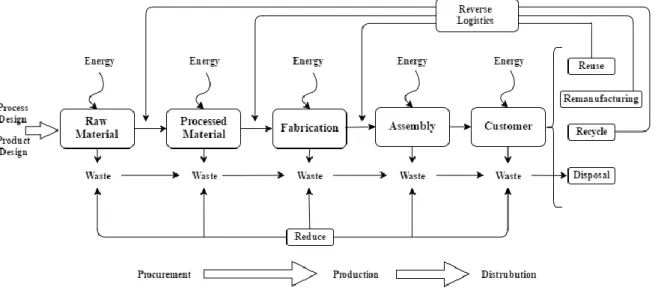
social responsibility. The basic concept of GSCM can be explained by the product’s life
cycle. Sarkis (1995) viewed the entire product’s life cycle as Fig. 1. showing three
primary phases of the life cycle, including procurement, production and distribution.
5
The GSCM’s main purpose is to improve the efficiency of the whole supply chain.
By process and product designing beforehand, the material can be used properly and
the waste can be reduced in each process; even the product enters distribution phase or
customer’s hand, those secondary material or waste still can be reversed by the logistic. Therefore, the entire product’s life cycle can minimize all kinds of waste and energy
consumption. Besides, if the process has hazardous compound and potential
environmental risk harming labors, a proper GSCM can provide the management
procedure that can increase safety in the working environment (Darnall, Jolley &
Handfield, 2008).
Take the screw industry for example; the screw life cycle will necessarily affect
the degree of GSCM. Steel is the major material for manufacturing screw and fastener;
the mining process of iron ore and coal is considered as a high pollution activity. In the
material procurement phase, if screw companies can choose material suppliers with
more environmental awareness or recycled material, it will increase the level of green
procurement. During the manufacturing process, metal fragment or lubricant can be
recycled and reused. Screw factories are usually a high temperature, noisy environment
and volatile gas that are harmful to workers; in the GSCM procedures, those potential
risks for workers should be decreased and minimized. Besides, in the distribution phase,
cargo shipment can produce CO2, NOX, SOX and other particular matter; if the
transportation vendors apply GSCM properly, those air pollution emissions should be
reduced or eliminated.
Previous researches (Azevedo et al., 2011; Kuo et al., 2012; Nulkar, 2014; Kuei et
al., 2015) have proved that GSCM can increase companies’ competitiveness and bring
many business advantages, such as market profit and product quality increased, supply
6
features, low-capital and limitation of resources, usually hamper the effective response
to environmental pressures (Lee & Klassen, 2008). Screw industry is constructed by
the high percentage of SMEs; the similar situation may occur and limit the will to apply
GSCM. Therefore, the factors affecting enterprises to adopt GSCM are usually
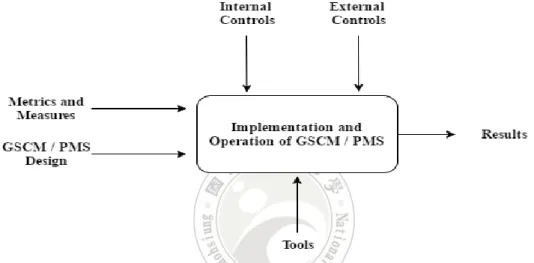
discussed with internal factors and external factors. Hervani, Helms & Sarkis (2005)
explained those factors with detail; the Fig. 2. shows how the factors influencing the
implementation of GSCM.
Figure 2. Factors Influence GSCM. (Hervani, Helms & Sarkis, 2005)
PMS: Performance Measurement System.
The internal control factors indicate that internal pressure from companies, such
as the cost of equipment adding and disposal fee. The various manufacturing process
and product of screw industry may increase potential obstacle for building up GSCM.
Chun, Hwang & Byun (2015) studied Korea’s SMEs and explained that an upfront
capital investment is usually a gap for SME adopting GSCM. The other internal factors
come from the knowledge of constructing a GSCM with potential benefit to sustain company’s profit margins. Hervani et al. (2005) mentioned that “A successful
environmentally beneficial innovations requires new combinations of knowledge with
7
and markets.” Without relative knowledge and information, applying GSCM may not
bring positive effect on profit earning; therefore, the uncertainty of profit margin is
another reason that causes SMEs’ hesitance. To sum up, despite the competitiveness
increasing advantage by adopting GSCM, if SMEs cannot get the proper knowledge
and information support, GSCM may be considered as a high-risk investment for SMEs.
The external pressure comes from environmental regulation and stakeholders. Due
to lots of environmental issues affected by human activity, environmental regulation
will be more comprehensive and stricter. Regional trading organizations often have
their own environmental regulation which has influenced product vendors and trading
partners; a significant body of research indicates that regulation is one of the major
driving forces for companies’ environmental efforts (Walker, Di Sisto & McBain, 2008).
The most famous regulation example came from EU’s RoHS which not only affected
electronic companies, but also impacted the screw industry in Taiwan. Chien’s (2007)
research mentioned that pressure from environmental regulation and stakeholders have
a very significant effect on the company’s willing to apply GSCM; stakeholder’s
pressure is also a critical factor to drive company to conduct relative issues. Walker et
al. (2008) collected previous research and indicated that stakeholders have the power
to force companies applying GSCM. The stakeholders include customers, competitors,
business partners and even the entire society, which bring regulatory pressure or market
pressure to company. Taiwan’s screw industry is a high export-oriented business; the customers’ demand comes from the EU, Japan and USA, where have more stringent
environmental regulation than Taiwan. Besides, potential competitors from China and
Southeast countries have part of the profit margin from the international market. Hence,
8
In order to build up a GSCM, some procedures should be followed; Beamon (1999)
suggested that by using the ISO 14000 series certificate could improve the overall
outcomes of GSCM. Moreover, following the international standard can reduce the
chance denied by other trading partners and customers. Table 1 simply introduces some
certificates relative to GSCM and may apply to screw industry. ISO 14001 and ISO
50001 are based on the management procedures of ISO 9001 which represented the
quality management system (QMS). Part of screw companies have adopted ISO 9001 due to product quality can remain consistent and fit customer’s demand.
Table 1
GSCM Certification Relative to Screw Industry
Certification Content
ISO 14001
The ISO 14001 standard is included in the ISO 14000 series. This standard provides a brief framework for companies or organizations to follow and set up an effective Environmental Management System (EMS).
ISO 50001 Based on the structure of ISO 9001 or ISO 14001. This standard more focuses on integrating energy management into original management system.
ISO 26000 ISO 26000 offers a guidance on socially responsible behavior and possible actions. Its goal is to establish sustainable operational development that will encourage business and other organizations to practice social responsibility.
FSC FSC’s main goal is the forest and relative material management. They addresses issues such as illegal logging, deforestation and global warming, and other commercial activities relative to wood.
Table content came from ISO official website: https://www.iso.org/home.html and FSC official website: https://us.fsc.org/en-us.
9
Previous researches (Karapetrovic & Willborn, 1998; de Sousa et al., 2014) had
mentioned those organizations or companies which have conducted ISO 9001 or QMS
can upgrade their management system into the environmental management system
(EMS) without too much adaptation troubles. Therefore, it will be a good starting for
screw industry apply GSCM. ISO 26000’s main target is to provide a management
procedure to establish corporate social responsibility (CSR). This standard can maximize company’s sustainability and improve the relationship with stakeholders (e.g.,
labors, residential people, and customers). FSC stands for Forest Stewardship Council
that is dedicated to international forest management. They encourage business activities
to choose qualified suppliers who follow the procedures of forest sustainability and
recyclable pulp and wood material. FSC also tracks the entire wood supply chain from logging to customer’s using behaviors, which is a very good example of GSCM. Screw
industry is not directly related to FSC standard but during the cargo shipment process,
lots of pallets and package material suppliers need to follow this stander; therefore, FSC
10
2-2 Screw Industry
Current State
Taiwan’s screw industry is one of the important export-oriented products which
contributes plenty of profit. According to the Metal Industry Intelligence’s 2016 report
(Ji, 2016), screw industry created total 88.5 billion NTD in 2015. This industry includes
numbers of SME, which have characteristics like low capital intensity, clustering and
export-oriented. There are over 1,300 companies and screw relative industries in
Taiwan. Moreover, one half of the companies located at Kaohsiung and nearby area due
to the source of material; others are located in New Taipei, Taoyuan, Taichung, and
Changhua (Lin, Wu & Huang, 2010; Jheng, 2013). Those SMEs have very different
types of manufacturing process can be outsourced, which can fit various customers’
demand. Over 90% of the products export to overseas market; USA, EU and Japan are
the top three buyers.
During the year of 2003-2006, EU launched their first stage of RoHS, which
impacted the entire industry relative to electronic production. After spending lots of
effort on improving manufacturing process and redesigning products, eventually, they
overcame this impact from this new environmental regulation. In recent years, screw
industry has met very aggressive competition from China and Southeast Asian due to
their blooming screw manufacturing. This situation made the screw industry lose part
of the Taiwan screw market share losing by price-cutting competition. On February
2016, EU repealed the anti-dumping duties on certain screw and fasteners originating
in China. This event, by the estimate of Taiwan Industrial Fasteners Institute, may
significantly decrease the market share in the EU. Therefore, Industrial Development Bureau’s NICE (Niche Product, Intelligent Equipment, Competent Workers and
Eco-11
Friendly Process) screw and fasten upgrade project is to respond the incoming
challenge and bring entire screw industry to a new level of production type.
Potential Pollution Source
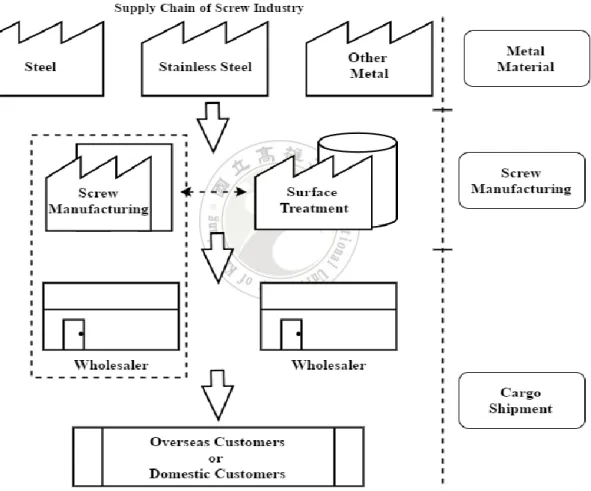
The entire screw supply chain can be simplified by Fig. 3. Three main states,
including Metal Material, Screw Manufacturing and Cargo Shipment. Each state causes
specific environmental problem and pollution.
Figure 3. Kaohsiung’s Screw Industry Supply Chain
Steel, stainless steel and copper alloy are the three major types of material to
produce screw and fastener. In Kaohsiung, high amount of metal material source is from
China Steel Corp. (CSC) and Yieh United Steel Corp. (YUSCO). CSC provides most
12
companies provide the rest of the metal material. Screw industry supply chain in this
state is a high energy intensity, and high CO2, NOx, SOx emission process. Recent
research (Jhong, 2012; Wu, 2014; Yao, 2015) also showed that the steel industry is one
of the main source for the particular matter (PM) 2.5 and PM 10 source which has been
confirmed relative to respiratory problems and carcinogenic rate. Besides, during the
smelting process, unscrupulous vendors dump huge amounts of slag randomly, which
causes serious environmental problem.
In order to fulfill various customer needs, screw manufacturing often has
customization service, which makes the entire screw manufacturing process become
very complicated. Therefore, the procedures for handling industry waste are very
diverse and difficult. Adding new equipment or improving the manufacturing process
is costly and become a hard issue for most of SMEs. According to Industrial Development Bureau’s information, potential waste pollution comes from metal
processing, heat treatment, and surface treatment; those potential pollution sources are
listed in Table 2.
Table 2
Potential Pollution in Screw Manufacturing Process
Processing Item Potential Pollution
Metal Processing Lubricant Cooling water Noise Surfactant Metal Fragment Heat Treatment Quenching Oil Volatile Gas Heat Coolant Lampblack Noise Surface Treatment Volatile Gas Acid Solution Plating Solution Surface Particular Organic Solvent Alkali Solution Waste Water Heavy Metal
13
Metal processing and heat treatment are common processes for screw industry.
Comparing to surface treatment, those two processes producing simpler industrial
waste can be properly controlled and recycled. But the working environment is full of heat and noise which may damage workers’ body condition (Jhang & Wang, 2011).
Surface treatment is a complicated process which can extend and improve the
performance of metal feature, but it produces much acid, alkali solution, and plating
sludge containing metal fragment or heavy metal icon. Those by-products have the
value to recycle and reproduce, but relative equipment and process are expensive. Some
factories just dispose the waste through tile drainage, which cause very serious water
and soil pollution.
Potential pollution source from cargo shipment phase is simpler. The major
discussions usually focus on cargo transportation’s exhaust emission and cargo package
material. Recent year’s researches (Lu, 2013; Jhong, 2016) have indicated that most of
greenhouse gas emission is from private vehicle. However, Gu (2016) explained the
diesel particulate matter (DPM) from diesel trucks and cargo carries contains
carcinogenic substances; this will increase the health risk for residential people living
nearby industry area or harbor. March 2017, Environmental Protection Administration
developed a new policy that sets higher exhaust standard and encourage cargo
transportation industries to replace old diesel truck. The result still needs time to
observe, but it is a positive beginning for DPM control.
FSC had been applied for years. Most of the cases are relative to pallets and
package material. Screw industry’s product usually uses marine transportation; in this
case, FSC encourages industry to reuse pallets and wood container. However, without
proper treatment, that stuff may contain unexpectedly pest following cargo to overseas
14
which is a toxic and ozone depletion substance. Therefore, those containers with FSC
standard ensure that no pest and chemical residue are remained, which is another
practical example for GSCM.
2-3 Means-End Chain Theory
Means-End Chain (MEC) model has been used widely in the marketing or
psychology to study factors influencing choice or decision-making by individuals and
customers. By using the expectancy-value theory, Gutman (1982) developed MEC theory to discover the customers’ decision-making process. Customers usually face
various brands and products. To know what kind of factors affecting their purchasing
decision is not an easy task for marketing strategy makers; hence, MEC provides a
method to discover the critical factors influencing customers (Reynolds & Olson, 2001).
The core assumption of MEC is that consumers selecting products or services are more
relevant for achieving their personal values. This theory separated the selecting process
into three parts, products/services attributes, consequences of using products/services
and personal goals or values achieved by the use of that product/service (Reynolds &
Olson, 2001). Attributes means the observable or perceived features of a
product/service, consequences are the benefits attained by the specific attributes, and
values imply highly abstract motivations that guide usage behavior (Reynolds &
Gutman, 1988). Olson and Reynolds (1983) adjusted Gutman’s (1982) model by
describing more details in attribute, consequence, and value, which is shown in Fig. 4.
15
Concrete attributes are the physical and concrete product/service character which
can be directly measured, such as the taste of food or color of a car. Abstract attributes
are more subjective and existing in the minds, such as communication quality of cell phone or company’s reputation. By sensing those basic product’s attributes, the
consuming behavior will occur and move to second level-consequence. After using the
product, customer will gain the consequence that can be separated into Functional
Consequence and Psychosocial Consequence. Functional consequences refers to the
practical benefits and performance outcome affecting directly to the consumers from
consuming the products or service, such as, contacting friends or saving time to work.
Psychosocial consequences are defined as psychological feelings or social
considerations (e.g., satisfaction and security). The highest level of MEC is Personal
values that have Instrumental Values and Terminal Values. Instrumental values are
defined as specific modes of behavior (e.g., be cheerful, be independent); terminal
values refer to the end states of being (e.g., self-esteem, self-fulfillment) (Rokeach,
1973; Pitts, Wong & Whalen, 1991)
Jenkins and Yakovleva (2006) mentioned that “Corporate Social Responsibility
(CSR)” and “sustainability” are two of the many terms used to describe the social and
environmental contributions and consequences of business activity. In this case, screw
companies are just like individual customers; building up a GSC can be considered as
a new business model (product) which is chosen and contained sustainability and CSR.
According to MEC theory, screw companies have their own value with GSC containing
its own product attributes. Therefore, by using the MEC approach, the relationship
between attributes, consequences and values can be linked and the critical factors which
16
2-4 Laddering
MEC approach often adopts Laddering interview to elicit consumer’s
Attribute-Consequence-Value (A-C-V) chain linkages. This technique was originally developed
by Hinkle (1965) and allowed the interviewers to conduct an in-depth, one-to-one
interviewing. It allows researchers to dig down customers’ surface cognition of
product/service attributes and connect back to their values motivating behavior
(Reynolds & Olson, 2001). Depending on the way of proceeding the interview,
laddering can be distinguished from soft laddering and hard laddering. The soft
laddering is a free elicitation interview, respondents can freely answer the question and the interviewer can continuously ask, “why is it important for you?” to know deeply
from the respondent’s answers. Hard laddering is usually conducted by
paper-and-pencil or computerized questionnaires with option lists to choose. Respondents have to
answer the question level by level, which can reduce the personal prejudice influencing
the result (Gutman, 1982; Botschen & Hemetserger, 1988). Both types of laddering
have their proper ways to apply; according to Bieberstein and Roosen (2015) compared
previous researches, soft and hard laddering can generate similar result, but soft
laddering can extract more complex and abstract result. However, soft laddering may contain interviewer’s subjective opinion and not easy to conduct mass scale of
respondents; in order to get more precise results, two types of laddering should be
applied by different situation or cross-use properly (Russell et al., 2004).
After the interview, transferring those qualitative information into quantitative
data has to rely on three steps. (Reynolds and Gutman, 1988) The process begins by
performing a content analysis which can create the A-C-V’s elements to construct an
17
among the A-C-V. The second step is to draw a Hierarchical Value Map (HVM), which
has the advantage of providing a well-organized summary of data from the implication
matrix. A HVM consists of nodes and lines which represent the linkages of A-C-V. The
final step is categorizing the concepts into a smaller number of categories and the chains
can form pathways from one attribute to one value, which will reflect the means-end
18
Chapter 3 Research Methodology
The methodology of this research is based on Means-End Chain Theory. In this
research, senior managers or company owners were interviewed to collect data by using
soft laddering. Content analysis will be used to encode the respondents’ answers and
catalogue into Attributes, Consequences and Values. Next, Implication Matrix is
applied to analyze the relationship linkages between each factor and construct the
Hierarchical Value Map which can visualize the result.
3-1 Target
The potential target companies were chosen from the register provided by the
Taiwan Industrial Fasteners Institute and narrowed them down within the Kaohsiung
area. Because GSCM certification is still not popularized in screw industry, this
research will more focus on companies with ISO 9001 certification and their business
partners. ISO 9001 is an international standard for QMS and GSCM certifications
usually base on this standard to construct detailed procedures. Therefore, if a company
have this certification, they may have much understanding of GSCM. Another resource
of target companies is the media or business magazines, which can provide some
companies already have had the green production line or green management.
The target companies were contacted by telephone and E-mail to confirm they
were willing to interview or not. The qualification of respondents should be senior
managers who had serviced this company for years or instinctively knew their supply
chain management policy. Some obstruction may encounter during the process of
connecting target companies and interviews. First, most companies are very concerned
19
Second, recording equipment may be prohibited by respondents and it will increase the
difficulty in collecting information. During the interview process, the researcher would
mark the key phrase and confirm their meaning carefully to prevent information
missing or misunderstanding. All the interviews were controlled within 30 to 45 minutes. After the interview, extra questions about other business partner’s information
would be asked, which could improve the success rate of contacting the next company.
3-2 Laddering
This research used a semi-structured questionnaires (Appendix IV) and interview
with soft laddering. According to Reyonlds and Gutman (1988), the respondent was
informed that there would be no right or wrong answer, which allows participants to
express their views in their own words and allows researchers to probe deeper into the
responses. Three main questions are relative to A-C-V catalog. Before the beginning of
the interview, a simple chit chat can help respondents who are more willing to discuss;
from previous personal experience, respondents usually cannot tell apart the different
between Attributes, Consequences, and Values. Therefore, the interviewer has to
provide practical example and connect to GSC issue. After a few times of questionnaire
test, the best question sequence is C-V-A; “What are the possible consequences when
you apply GSC ?”, “How will those consequences make you feel ?”, “What do you
think about GSC ?” Due to the feature of semi-structured questionnaire, the interviewer
can question respondents deeply and check the real meaning of answers.
3-3 Data Analysis
This research is constructed by MEC approach; the data analysis will process
20
mentioned that Content Analysis could extract the information from the interview
context into quantitative data. This process includes information collection, context
condensing, sampling, quantization, encoding and analysis (Krippendorff, 1980). First,
translate the interview transcripts into proper phrase element and delete the redundant
or unimportant information. Second, encode all phrase elements that are relevant for
each level of the MEC (Reynolds, Dethloff & Westberg, 2001). During the coding
process, the interview transcript includes many abstract phrases which may cause
misunderstanding and coding errors. Therefore, a high degree of reliability can increase
the overall consistency and intersubjectivity of the research. This research will invite 3
master degree students who are quite familiar with MEC process and 2 senior screw company’s managers to check the coding content. This research will use Stemler’s
(2001) advice to test the Intercoder Reliability. The process includes two steps; first,
three encoders should inspect the interview transcript and coding content. Second, using the formula for Intercoder Reliability = (2M)(N1+N2); M is the number of
the elements agreed by Encoder 1 and Encoder 2. N1 means the number of variables
agreed by Encoder 1; N2 is the number of variables agreed by Encoder 2. And the Reliability = (n Average Intercoder Reliability )[ 1+(n-1) Average Intercoder
Reliability ]; n means the number of encoders. According to Kassarjain’s (1977)
suggestion, the Reliability should be over 0.85 and then it can be considered an effective
coding process.
Once finishing all the coding process, the elements will be put into Implication
Matrix to calculate the frequency in each coding element. The Implication Matrix can
conclude all linkage results which can be the basic data to develop the HMV (Reynolds
& Gutman, 1988). Each frequency represents the strength of the relationship, the higher
21
But if the HMV displays all the linkage form A-C-V relationship, the diagram will
be too complex to show the significant connection. According to Gengler and Reynolds
(1995) suggested, the cutoff value can be 5% of sample size; Reynolds and Gutman (1988) set the cutoff value from sample size’s 6% to 8.3%. When the frequency is over
22
Chapter 4 Data Analysis and Results
4-1 Basic Sample Structure
This research collected 32 samples from screw industry in Kaohsiung and located
at Gangshan, Cianjhen, Daliao, Renwu, and Linyuan. There are 15 screw
manufacturing companies, 17 screw wholesalers (9 of them also have their own
manufacturing factories). Most of the respondents are senior managers or company
owners who have relative experience over 20 years; 3 of them are the second generation
of their companies, all of them are very familiar with their family business and entire
screw industry.
During the interview, 25 respondents claimed that they didn’t know the clear
definition of GSCM; their first expression always connected to environmental protection or government’s regulation issue. But after the brief explanation, most of the
respondents can associate part of the GSCM procedures with their business or previous
experience. The other 7 respondents have the experience of constructing GSCM, but
those companies are still in the progress of integration. During this research interview,
2 companies even mentioned that noise problem caused highly tense relationship with
nearby residents. Eventually, they moved factories to another location and ceased the
conflict. In this research, collecting companies’ actual capital is difficult. But, from
observing their company scales, it is easy to know that the ability to apply GSCM are
still relative to their capital size.
Overseas customers are the major business; only 5 companies supply the industry
components to Kaohsiung industry area or harbor’s maintenance requirements. Those
23
overseas customers are from Indonesia and South Africa. The demands of customers
are very various; the green production demands usually come from electronic industry,
automobile industry or product shipped to EU, Japan and USA. A few of the
respondents mentioned that their business won’t be affected by GSCM because their material is stainless steel and it won’t produce much pollution. Besides, those
wholesalers usually encounter the green issue because the cargo shipments need to
provide certain certifications and testing reports.
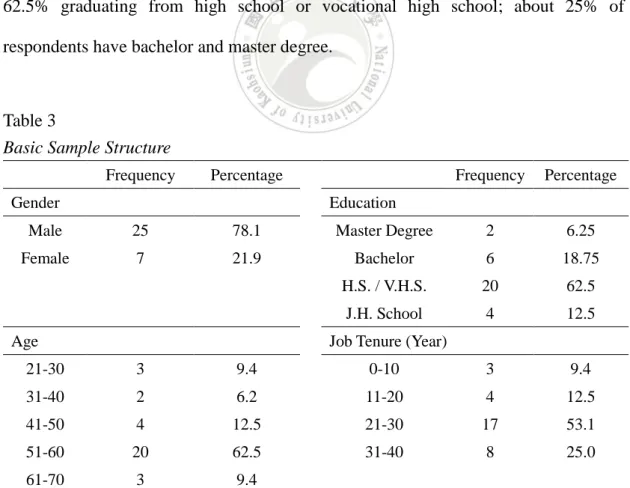
Table 3 provide the basic structure of the respondents. Male is still the majority in
the screw industry. 81.9 % of respondents are over 50 years old; 3 respondents under
30 years old are the second-generation company’s owner. Over 75% of respondents
have above 20 years working experience in screw industry. The education level has
62.5% graduating from high school or vocational high school; about 25% of
respondents have bachelor and master degree.
Table 3
Basic Sample Structure
Frequency Percentage Frequency Percentage
Gender Education
Male 25 78.1 Master Degree 2 6.25
Female 7 21.9 Bachelor 6 18.75
H.S. / V.H.S. 20 62.5
J.H. School 4 12.5
Age Job Tenure (Year)
21-30 3 9.4 0-10 3 9.4
31-40 2 6.2 11-20 4 12.5
41-50 4 12.5 21-30 17 53.1
51-60 20 62.5 31-40 8 25.0
61-70 3 9.4
24
4-2 Laddering Data Analysis
This research extracted 13 Attributes, 11 Consequences and 9 Values. The more
frequencies are mentioned by respondents the more they concerned. From the
frequencies are shown in Table 4. A08 (Market Orientation), A01 (Costly), A07
(Regulation) are top three Attributes which were mentioned most times from
respondents; A06 (Resource Shortage) and A05 (Long-Term Investment) are secondary
factors mentioned during interview. C03 (Cost Increased), C01 (Recyclable Resource)
are the Consequences concerned mostly by screw companies. C05 (Fit Requirement)
and C02 (Must) are the secondary Consequences factors. V09 (Industry Upgraded),
V03 (Stable Business), V04 (Reputation) are the major Value factors. Other detail
meanings are shown in Appendix I to III.
Table 4
A-C-V Elements and Frequencies Distribution Attributes
Code Attributes (A) Frequency Percentage
A01 Costly 10 11.9
A02 Must 7 8.3
A03 New Model 7 8.3
A04 Troublesome 6 7.1
A05 Long-Term Investment 8 9.5
A06 Resource Shortage 8 9.5
A07 Regulation 10 11.9
A08 Market Orientation 12 14.3
A09 Integration Difficultly 7 8.3
A10 Impractical Model 3 3.6
A11 Avoid Conflicts 2 2.4
A12 Paperwork 1 1.3
A13 No Effect 3 3.6
25
Consequences
Code Consequence (C) Frequency Percentage C01 Recyclable Resource 11 16.7 C02 Environmental Protection Improved 8 12.1 C03 Cost Increased 16 24.2 C04 Convenient to Overseas Shipment 6 9.1 C05 Fitting Requirement 9 13.6 C06 Safety Increased 3 4.6 C07 Employees Complaints 3 4.6 C08 Complaints Decreased 2 3.0 C09 Fitting Regulation Stander 4 6.1 C10 Financially Rewarding 2 3.0 C11 Not Significant 2 3.0 Total Frequencies 66 100.0 Values
Code Values (V) Frequency Percentage V01 Environmental Sustainability 3 5.0 V02 Corporate Culture 5 8.3 V03 Stable Business 9 15.0 V04 Reputation 9 15.0 V05 Relationship Improved 6 10.0 V06 Profitable 4 6.7 V07 New Industry 4 6.7 V08 Riskful 7 11.7 V09 Industry Upgraded 13 21.7 Total Frequencies 60 100.0
26
Besides, this research followed Stemler’s (2001) suggestion and invited 3 encoders
to test the reliability of ACV elements. Table 5. shows the intercoder reliability between
each encoder; more details are located at Appendix V. After the calculation, the
reliability is 0.86 which has been over the standard 0.85 mentioned by Kassarjain
(1977). Therefore, this coding process has an effective reliability.
Table 5.
Reliability
A B
B 0.72
C 0.64 0.64
Average Intercoder Reliability =(0.72 + 0.64 + 0.64 ) ÷ 3 = 0.67 Reliability = (3 × 0.67) ÷〔1 + (3-1) × 0.67〕= 0.86
By utilizing the Implication Matrix, the linkage relationship between each A-C-V
can be quantized. The calculations are shown in Table 6. and Table 7. According to
previous literature reviewed (Gengler & Reynolds, 1995; Reynolds & Gutman, 1988),
the cutoff value can be set from 5% to 8.3% of sample size and the cutoff value will be 1.6 to 2.656; however, this cutoff value can’t show the significant number of the links.
27
Table 6
Implication Matrix for Attributes and Consequences
A-C A01 A02 A03 A04 A05 A06 A07 A08 A09 A10 A11 A12 A13
C01 3 3 2 1 7 5 3 2 2 1 1 C02 3 4 2 3 2 2 1 C03 6 2 4 6 2 3 8 12 2 3 1 1 C04 1 4 2 2 3 2 C05 2 1 1 1 3 2 2 7 1 3 C06 1 3 1 1 1 1 C07 2 2 1 1 1 C08 1 2 1 1 C09 2 1 1 1 1 1 1 1 C10 2 2 2 2 C11 1 1 1
28
Table 7
Implication Matrix for Consequences and Values
C-V C01 C02 C03 C04 C05 C06 C07 C08 C09 C10 C11 V01 2 2 1 2 V02 3 3 1 3 1 V03 2 6 2 7 1 V04 6 2 4 3 3 2 1 V05 3 3 2 2 2 V06 5 1 2 1 1 1 V07 3 1 1 1 1 V08 1 2 7 4 1 2 V09 2 1 4 5 4 3 2 2 2
29
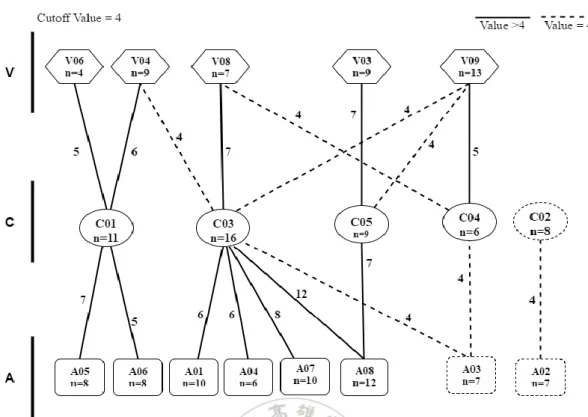
Figure 5. Research Result of HVM
In order to find the more critical A-C-V linkages, the cutoff value is raised to 6. And 6
main A-C-V linkages shown in Table 8. will be discussed in following context. Table 8.
Critical Linkage
A08 Market Orientation C05 Fitting Requirement V03 Stable Business
A05 Long-Term Investment C01 Recyclable Resource V04 Reputation
A01 Costly C03 Cost Increased V08 Riskful
A04 Troublesome C03 Cost Increased V08 Riskful
A07 Regulation C03 Cost Increased V08 Riskful
30
1. Market Orientation Fit Requirement Stable Business
Figure 6.
From the HVM, the trend is very significant that screw industry is seeking the
long-term stabilization of business. Besides, this path also shows the potential driving force for applying GSCM comes from customer’s demands. During the interview, many
respondents mentioned green product or green manufacturing process are still the extra requests. Without those demands, screw companies usually won’t apply this kind of
production process. Laari’s et al. (2016) research mentioned a similar result that
customer’s demand is the major power to let firms apply GSCM; it also mentioned that
if companies want to improve the financial performance with GSCM, a highly
collaborative relationship with customers is necessary. Moreover, it is notable that there
are 28 companies mentioned that overseas demands cover most of their profit earning.
Those customers sometimes ask for a certain green product; therefore, this path may
also represent the green product demand have been increased or become a specific
31
2. Long-Term Investment Recyclable ResourceReputation
Figure 7.
Screw companies are considering GSC as a long-term investment which can’t get
the benefit immediately; the biggest incentive comes from the part of material or
expendables which can be reused or recycled to other profitable product. Some
respondents mentioned the secondary product can get extra income, but it also needs
upfront investment and research to fulfill. This path represented a phenomenon that
GSCM or green production is still not fully applied. Those companies which have the
ability to make green products and handle relative issues usually get lots of credit from
customers and business partners. Therefore, this path can be considered as a positive
effect that the company applied GSCM successfully. But, according to some respondents’ opinions, it is not easy to apply GSCM just with few successful cases. The
entire screw industry contained various production process and customization service;
a successful GSCM needs high integration of suppliers stander, product quality and
management procedure. Without an experienced integration and support, screw
32
3. Market Orientation Cost Increased Riskful
Figure 8.
Market orientation is still the main attribute affecting screw company’s decision.
This path shows a fact that the demand of green production is still full of uncertainty.
Respondents usually mentioned that screw company has to change parts of producing
process or production line in order to fulfill customer’s demand; especially, customization product usually has the specific size and material features so it can’t be
put into mass production line and the production cost will increase. Moreover, there is
another issue can be explained from the perspective of product volume; Luo’s et al.
(2014) research result just support and describe the situation. Those green products
nowadays are still an uncommon demand for the entire screw industry. Unexpected
production costs and excess inventory are two main concerns for companies. Both cases
for most of SMEs will bring them lots of troubles; besides, unexpected orders can’t be
considered as constant and steady market demands, which screw companies don’t very
prefer them . Therefore, by following the uncertain market demand, applying GSC is
33
4. Costly Cost Increased Riskful
Figure 9.
Applying GSCM is a costly business decision. Although there are no companies
which have fully applied GSCM, but some companies have had the experience of
constructing a green production facility and waste recycling mechanisms. They
mentioned that it needed plenty of money to achieve and it was not olny form adding
new equipments but also employees training and maintenance cost. Those respondents
also admitted that the overall green market demands of screw industry are still not stable
and usually having the barrier from company’s capital size. Besides, GSCM need time
and plenty of efforts to get certain certification and it can’t guarantee the profit
immediately. Therefore, to build up a green supply chain without enough capital and
34
5. Regulation Cost Increased Riskful
Figure 10.
The regulation pressure usually comes from domestic environmental restriction, which affects Taiwan’s industry developing. Those environmental regulation has also
been proved that it is one of the critical factors to drive company to operate GSCM
(Walker et al., 2008). According to one report from the Ministry of Economic Affairs
(2016), it said that Taiwan’s overall environmental restriction is getting stricter and
trying to follow the international trend; this also impacted screw companies’
manufacturing and transportation procedures. Even though most of respondents are
willing to improve their ability to protect the environment and decrease the possibility
of pollution events happened, screw companies have cost a lot to keep up with the
changing of regulation. During the interview, there were two extreme cases that
companies had to relocate their facilities because of the regulation pressure. For those
small capital SMEs, this situation often impacts their cash flow a lot; not to mention
35
6. Troublesome Cost Increased Riskful
Figure 11.
For some respondents, GSCM represents a complicated event which will bring
many changes and troubles. Their impression on the relative green issue is passive and
negative; this situation may come from their production process. Screw industry
contains various manufacturing processes; if their processes use more Cold Work and
stainless steel as material, they are not necessary to apply too many green production
procedures. But GSCM is more than green manufacturing, it contains suppliers strategy,
transportation policy and other details. Hence, when we mentioned more events relative
to the GSCM issue for those companies, they would consider GSCM as an unnecessary
and troublesome business model. Those reasons will also make screw companies think
36
Chapter 5 Conclusions and Advices
5-1 Research Conclusion
By using MEC approach, this research extracted factors that significantly affect screw industry’s willing to apply GSC. 6 main HVM paths can sum up in 2 kinds of
terminal values which are more concerned by screw companies. First is the long-term
stabilization from becoming regular business partners and getting reputation by
applying GSCM. This type of result usually comes from the companies which have the
experience of applying parts of GSCM or having green product demands from
customers. But they have already spent years’ effort and cost to build up this type of
business model. According the result form HVM, customer and market pressure are the
main driving force to construct GSCM. Two previous research (Gualandris &
Kalchschmidt, 2014; Laari, Töyli, Solakivi & Ojala, 2016) have similar result and
indicate customer pressure and market demand can significantly improve the company’s environmental and financial performance.
However, the biggest limitation comes from the industrial structure; most of SMEs can’t afford the huge investment beforehand and maintenance cost after building up
GSCM. The second type of path just shows most screw companies’ concerns that
GSCM is a riskful investment. Because GSCM needs plenty of resources to construct
and sustain; for those SMEs, it will be too risky to apply this kind of business model.
Although market demands and environmental regulations have been identified as
critical factors for companies to apply GSCM. Screw companies will still encounter the
situation of cost increased and insufficient capital to sustain, which will be a huge
37
equipment maintenance, relative certification and market uncertainty would be another
obstacles for them. Therefor, without some incentive factors to support, screw companies won’t apply GSCM spontaneously.
5-2 Management Implications
GSCM’s advantage has been mentioned by previous researches. Regional Trading
Agreements also follow the trend of environmental protection and business
sustainability to set their own regulation; Taiwan screw industry highly relies on
overseas market. Eventually, this will be an issue that affects the entire screw industry.
Therefore, there are some advices mentioned in following context.
First, government should consider the screw industry’s real concerns. Although,
Industrial Development Bureau had announced the NICE project to upgrade screw
industry; one of the target is to be Eco-Friendly manufacturing process. But the concrete
detail procedures and steps are still unknown. Screw industry is full of various
production process and complex supplier relationship, which will not be so easy to just
adopt a single procedure to upgrade this industry. However, most of screw companies
usually have constructed relative equipments and self-control procedure in order to
follow domestic environmental regulations; this means our screw industry has a basic
knowledge and experience to integrate them into GSCM. This research’s result has
showed that market demands can encourage screw industry to apply GSCM. But, at the
same time, most of companies will still concern about their capital limitation and
market uncertainty. To do so, government can’t just pour money into hardware adding
but try to promoting and displaying Taiwan’s ability of green production; it will attract
38
for them but also reduce the risk and concerns. Besides, those GSCM certification (e.g.,
ISO 14001, ISO 50001 and FSC) need a lot of efforts and professional information to apply. Most of screw companies havn’t had such ability to do so; government should
provide resource and money support to help them. In addition, the government has the
power to legislate domestic environmental which should follow the international
stander; this will be another push for screw industry to apply environmental procedures.
Second, screw industry or relative managers may consider GSCM could be an
issue impacting companies’ profit margin. Due to screw industry is an export-oriented
industry and facing increasing competition, it won’t be enough to passively follow the
pressure from regulation or market demands. Even though GSCM is an enormous
integration and most of SMEs have capital limitation; taking small and ongoing steps
to upgrade is a great principle for screw industry. During the interview process, some
respondents even mentioned that their companies would be very pleased to share their
experience to construct their green management procedures. Besides, GSCM needs lots
of supply chain integration and business cooperation. Forming an industry alliance may
be a good strategy to improve overall competitiveness and achieve this target; Taiwan’s
Bicycle A-Team strategy has demonstrated a very great example, which brought the
entire bicycle industry and relative companies into a brand-new level. Recently, the
Taiwan Industrial Fasteners Institute has speeded up this kind of integration, which is
an excellent start. Finally, screw industry should really concern that the phenomenon of
screw industry ageing and lacking young generation employees. One of the core values
of GSCM is labor-friendly environment that may attract more young and talented
worker to join this industry. Therefore, applying GSCM can bring many win-win
39
Third, NGO or customers can utilize customer’s pressure to push screw industry
to apply GSCM or following the environmental regulation. Although screw industry
puts more efforts on the overseas market, domestic people still can press for
government’s regulation legislation and supervise their environmental procedures. To
sum up, by uniting customers’ influences, it will not be an ignored power to push and
encourage screw industry to follow environmental regulation and GSCM procedures.
5-3 Limitation and Future Research
This research used MEC approach and interviewed 32 screw companies in
Kaohsiung. Some research limitations and future research advices are described in
following context. First, this research only focused on Kaohsiung screw companies
which are just part of the screw industry. There are several important screw industry
areas located in New Taipei, Taoyuan, Taichung, Changhua, and Tainan. Each area may
have their own unique perspective of GSCM, which may find out some useful
information by comparing their differentiation. Second, the sample size may not show
the entire perspective of Kaohsiung screw industry; according to office report, around
600 screw companies spreading in Kaohsiung’s industrial area, which may have more
undiscovered factors affecting GSCM decision. Besides, respondents are only from
manufacturing factories and wholesalers; it may limit the research result not able to get
an overall aspect. Hence, future research can expand the diversity of respondents and
the sample size. Third, this research only operated soft laddering method, which may
contain personal prejudice and misunderstanding. Future research may consider
40
Reference
Azevedo, S. G., Carvalho, H., & Machado, V. C. (2011). The influence of green practices on supply chain performance: a case study approach. Transportation
research part E: logistics and transportation review, 47(6), 850-871.
Botschen, G., & Hemetsberger, A. (1998). Diagnosing means-end structures to determine the degree of potential marketing program standardization. Journal of
Business Research, 42(2), 151-159.
Beamon, B. M. (1999). Designing the green supply chain. Logistics information
management, 12(4), 332-342.
Burgess, K., Singh, P. J., & Koroglu, R. (2006). Supply chain management: A structured literature review and implications for future research. International Journal of
Operations & Production Management, 26(7), 703-729.
Bieberstein, A., & Roosen, J. (2015). Gender differences in the meanings associated with food hazards: A means-end chain analysis. Food Quality and Preference, 42, 165-176.
Chien, M. K. & Shih, L. H. (2007). Practices of Green Supply Chain Management: Pressures, Drives and Organization's Performance with Taiwanese Electrics and Electronics Industry. NPUST Humanities and Social Science Research, 1(1), 72-98. [錢銘貴、施勵行 (2007)。 綠色供應鏈管理實務採行之驅力壓力與組織
績效關係之實證研究-以台灣電機電子產業爲例。人文社會科學研究,1(1),
72-98。]
Chi, M.C., Hsieh, Y. L. & Wang, Y.C. (2010). The Effect of Ambient Air Quality on Respiratory Diseases in Taiwan. Journal of Chang Gung University of Science and
Technology, (13), 1-16. [紀妙青、謝依倫、王玉純 (2010)。台灣空氣污染與 呼吸道疾病健康風險。長庚科技學刊,(13),1-16。]
Chun, S. H., Hwang, H. J., & Byun, Y. H. (2015). Supply Chain Process and Green Business Activities: Application to Small and Medium Enterprises.
Procedia-Social and Behavioral Sciences, 186, 862-867.
Darnall, N., Jolley, G. J., & Handfield, R. (2008). Environmental management systems and green supply chain management: complements for sustainability?. Business
Strategy and the Environment, 17(1), 30-45.
de Sousa Jabbour, A. B. L., Jabbour, C. J. C., Latan, H., Teixeira, A. A., & de Oliveira, J. H. C. (2014). Quality management, environmental management maturity, green supply chain practices and green performance of Brazilian companies with ISO 14001 certification: Direct and indirect effects. Transportation Research Part E:
41
Department of Statistics, Ministry of Economic Affairs, Taiwan. (2016). Statistics of industry and economic, October 2016. Received form:
https://www.moea.gov.tw/Mns/DOS/bulletin/wHandBulletin_File.ashx?file_id= 8322. [經濟部統計處 (2016)。10 月份產業經濟統計簡訊。取自:
https://www.moea.gov.tw/Mns/DOS/bulletin/wHandBulletin_File.ashx?file_id =8322。]
Department of Statistics, Ministry of Economic Affairs, Taiwan. (2017).Statistics of industry and economic, March 2017. Received form:
https://www.moea.gov.tw/Mns/DOS/bulletin/wHandBulletin_File.ashx?file_id=8 154. [經濟部統計處 (2017)。3 月份產業經濟統計簡訊。取自:
https://www.moea.gov.tw/Mns/DOS/bulletin/wHandBulletin_File.ashx?file_id=8 154。]
Gutman, J. (1982). A means-end chain model based on consumer categorization processes. The Journal of Marketing,46(2), 60-72.
Gengler, C. E., & Reynolds, T. J. (1995). Consumer understanding and advertising strategy: analysis and strategic translation of laddering data. Journal of advertising
research, 35(4), 19-34.
Gualandris, J., & Kalchschmidt, M. (2014). Customer pressure and innovativeness: Their role in sustainable supply chain management. Journal of Purchasing and
Supply Management, 20(2), 92-103.
Gu, W. T. (2016). Carcinogenic Air Toxics Emission Profile and Risk Assessment in
the Industrial Metropolitan Area (Master Thesis). Department of Environmental
Engineering, National Cheng Kung University, Tainan, Taiwan. [古瑋庭
(2016)。都會工業區有害空氣污染物排放特徵暨暴露風險評估研究。成功 大學環境工程學系學位論文,1-181。]
Hinkle, D. N. (1965). The change of personal constructs from the viewpoint of a theory
of construct implications (Doctoral dissertation, Ohio State University).
Hervani, A. A., Helms, M. M., & Sarkis, J. (2005). Performance measurement for green supply chain management. Benchmarking: An international journal, 12(4), 330-353.
Huang, J.K. (2014). A study of the influence on ISO 9001:2008 Quality Management
Systems and Operating Performance; Evidence of Fastener Industry in Tainan and Kaohsiung (Master Thesis). EMBA, Chang Jung Christian University, Tainan,
Taiwan. Available from Airiti Library. [黃俊凱 (2014)。企業實施品質管理系 統 ISO 9001: 2008 對整體營運績效影響之研究-以臺南及高雄地區螺絲螺 帽業為例。長榮大學高階管理碩士在職專班 (EMBA) 學位論文,1-147。]