Department of Business Administration
I-Shou University
Master Thesis
A research of factors affecting consumer behaviors
toward Viettel Ben Tre
Advisor: Ching-Sung Lai, Ph.D.
Co-advisor: Ho Sy Tan, Ph.D.
Graduate Student: Nguyen Cong Danh
ACKNOWLEDGEMENTS
First, I would like to express sincerely thanks the teachers of I-SHOU University who has equipped me with wide valuable knowledge over time.
Especially, I would like to thank to Professor Ching-Sung Lai for his guidance in scientific dissertation, helping me practical approach to detect topics and has dedicated instructions to complete this thesis. Particularly, I am extremely grateful and thankful to Professor Ching-Sung Lai who is always interested in and follows my learning process, guidelines, providing valuable comments and suggestions for the accomplishment of the thesis.
Next, I am very much grateful to people who have helped to make this research possible. This research is greatly based on information from the board of Directors of Viettel Ben Tre. Without these valuable inputs, this research can’t be successfully completed.
Finally, I sincerely thank my family, colleagues, friends and relatives who give me enthusiastic supports, suggestions and helps during my study and research.
Please send sincere thanks to everyone. Author: Nguyen Cong Danh
ABSTRACT
The main purpose of this research are building a research model, adjusting the measurement of factors which affect the decision to purchase of products so that it is suitable to products of Viettel in the in Ben Tre, testing the hypothesis model and determining what affects the decision to purchase, based on the survey results, solution and suggestions are proposed to improve consumer behaviors toward Viettel in the in Ben Tre
The recommended research model was built on the basis of the theory of the consumer behavior. Inheritance and selective discovered from studies consumer behavior. Based on the reference model, we can see that the decision to buy of consumer Viettel Ben Tre was stimulated by the external and internal factors. Based on the reference model, we can see that the decision to buy of consumer Viettel Ben Tre was stimulated by the external and internal factors include the following factors: (1) brand (2) price (3) promotion (4) contribution (5) Demands (6) affection (7) Faith. A quantitative study with a sample size 195 customer Viettel Ben Tre is carried out to assess the scale and test theoretical models. Cronbach Alpha reliability results and explored factor analysis (EFA) showed that the scale will meet the reliability, value and acceptance. Thus, based on the research findings, policy makers, managers of Viettel Ben Tre will further understand the level of interest, consumer behaviors toward Viettel in the in Ben Tre.
Results after testing scale by Cronbach Alpha, we have identified seven factors affecting to consumer behaviors toward Viettel in the in Ben Tre ((1) brand factors (2) price factors (3) promotion factors (4) contribution factors (5) Demands factors (6) affection factors (7) Affection factors) regression analysis results seven components scale consumer behaviors. The most powerful factor to the consumer behaviors is Demand factors; Brand factors; Faith factors; Affection factors; Price factors
TABLE OF CONTENTS
ACKNOWLEDGEMENTS ... I
ABSTRACT ... II
TABLE OF CONTENTS ...III
LIST OF FIGURES ... VI
LIST OF TABLES ... VII
CHAPTER 1 INTRODUCTION ... 1
1.1 RESEARCH BACKGROUND ... 1
1.2 RESEARCH OBJECTIVES ... 2
1.3 SCOPE AND METHODOLOGY OF RESEARCH ... 2
1.3.1 Scope and target group ... 2
1.3.2 Method ... 2
1.4 SIGNIFICANCE OF RESEARCH... 3
1.5 STRUCTURE OF THE RESEARCH ... 3
CHAPTER 2 LITERATURE REVIEW ... 4
2.1 THE BASICS ... 4
2.1.1 Definition of marketing ... 4
2.1.2 The aims of marketing ... 8
2.1.3 The role of Marketing ... 8
2.1.4 The functions of Marketing. ... 9
2.1.5 Marketing Mix ... 11
2.2.1 Definition. ... 12
2.2.2 Reasoning of consumer behavior ... 13
2.2.3 Elements effecting on the consumer behaviors. ... 14
2.3 RESEARCH MODEL AND THEORIES ... 18
2.3.1 Consumer behavior model ... 18
2.3.2 Research model ... 21
2.4 OVERVIEW ON VIETTEL BEN TRE ... 25
2.4.1 Establishment and Development ... 25
2.4.2 Structure of company ... 25
2.4.3 Service of Viettel Ben Tre ... 25
CHAPTER 3 RESEARCH METHODOLOGY ... 27
3.1 RESEARCH METHODS ... 27
3.2 THE PRELIMINARY RESEARCH ... 27
3.2.1 Discussing Expert Group ... 27
3.2.2 Designing Questionnaire ... 28
3.2.3 Adjusted scale ... 29
3.3 QUANTITATIVE RESEARCH ... 31
3.3.1 The method collecting information ... 31
3.3.2 Research Sample ... 32
3.4 DATA ANALYSIS PLAN ... 32
3.4.1 Planning data collection. ... 36
3.4.2 Describing research sampling ... 36
3.4.4 Exploratory Factor Analysis: ... 37
3.4.5 Analysis of the relationship. ... 38
3.4.6 Regression Analysis ... 38
3.5 SUMMARY OF CHAPTER 3 ... 39
CHAPTER 4 RESEARCH RESULTS AND ANALYSIS ... 40
4.1 DESCRIPTIVE RESEARCH SAMPLING ... 40
4.2 EVALUATING SCALE BASED ON CRONBACH ALPHA ... 41
4.3 EVALUATING SCALE BY USING EXPLORATORY FACTOR ANALYSIS EFA. ... 44
4.3.1 The components scale ... 44
4.3.2 Buying decision scale ... 49
4.4 OFFICIAL RESEARCH MODEL ... 50
4.5 TESTING RESEARCH MODEL THROUGH REGRESSION METHOD ... 52
4.5.1 Testing correlation between the variables ... 52
4.5.2 Regression analysis ... 53
CHAPTER 5 CONCLUSIONS AND RECOMMENDATIONS ... 56
5.1 CONCLUSIONS... 56 5.2 RECOMMENDATIONS ... 56 5.3 LIMITATIONS ... 57 REFERENCES ... 58 APPENDIX ... 60 APPENDIX 1 QUESTIONNAIRE ... 60
LIST OF FIGURES
Figure 1 . The relationship between the core concepts in Marketing ... 5
Figure 2 : The function to supply a chain of benefits to customers. ... 12
Figure 3 : Research mode ... 24
LIST OF TABLES
Table 1 : Scale is encoded ... 33
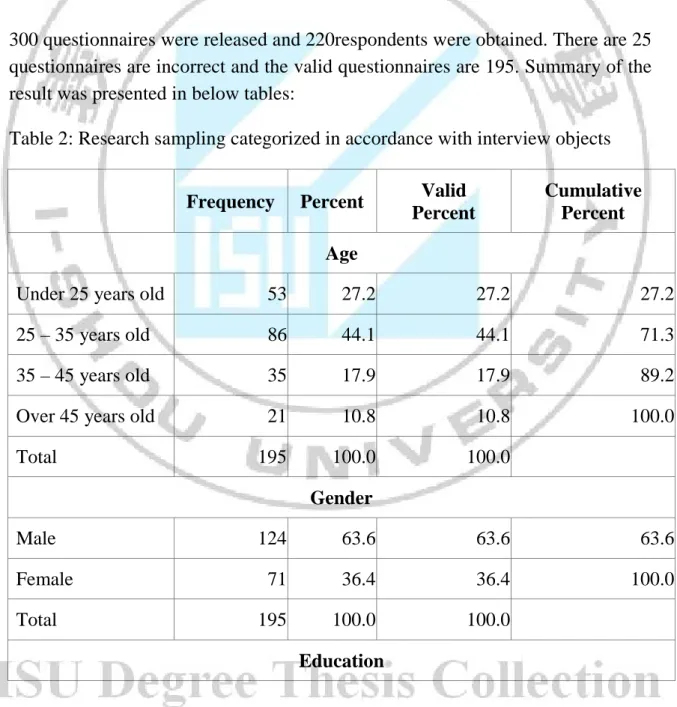
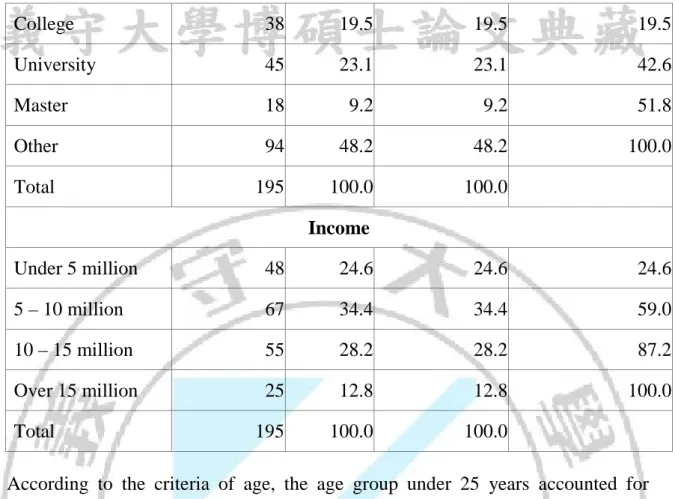
Table 2 : Research sampling categorized in accordance with interview objects ... 40
Table 3 : The Cronbach alpha coefficients of components ... 41
Table 4 : the KMO and Bartlett's component measurement coefficient of factors affect the Buying ... 44
Table 5 : Extracted variance ... 45
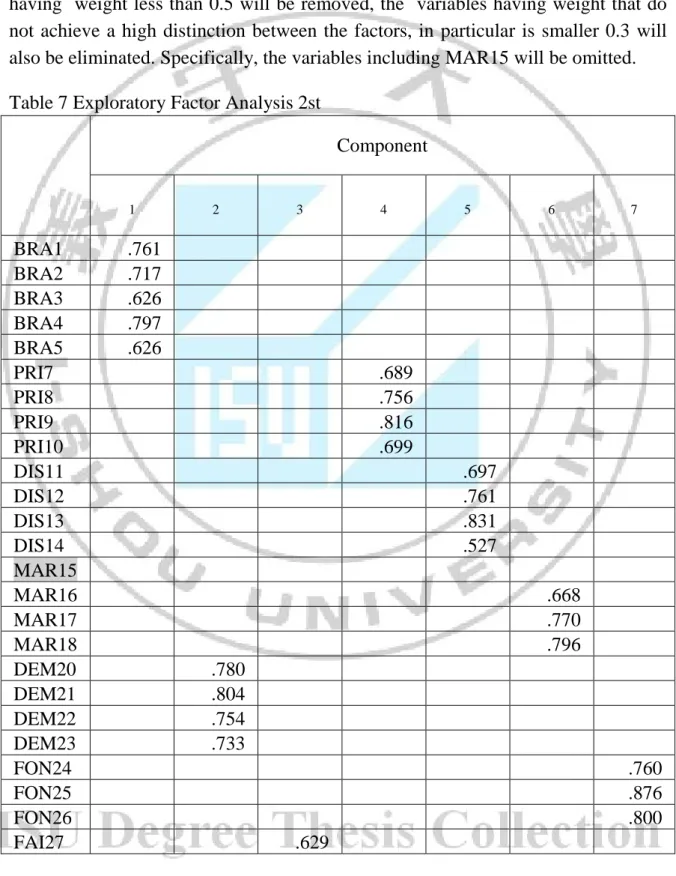
Table 6 :Exploratory Factor Analysis 1st ... 46
Table 7 :Exploratory Factor Analysis 3st ... 48
Table 8 :Buying scale KMO and Bartlett's coefficient ... 49
Table 9 : Extracted variance ... 50
Table 10 :Exploratory Factor Analysis at buying decision ... 50
Table 11 : Correlation matrix between the variables: ... 52
Table 12 : Regression analysis ... 53
CHAPTER 1 INTRODUCTION
1.1 RESEARCH BACKGROUND
In 2008, Viettel was the only Vietnamese company presented in top 100 world’s largest branches in telecommunication sector of Informa PLC– ranked at 83th. This milestone marked a gigantic grown in telecommunication’s international market of Viettel. Viettel is also one of the 4 best telecommunication providers in developing countries, as choice of Terrapin Communication Company in England. Beside, this corporation also constantly raises his standing in the telecommunication provider ranking based on account’s quantity, announced by Wireless Intelligence - GSMA. According to this ranking, in first quarter 2008, Viettel was ranked 53th and 42th in 2nd quarter, until now, he is ranked 41th of 650 telecommunication provider in the world.
Nowadays, to exist and develop in market economy, whose competitive level is getting more and more intense, manufacture and trade of companies have to rely on market. To do this, companies should have known to apply marketing on their real production and business. In addition, reality also shows that their existence and development largely depend on product consumption which is the factor not only decide their growth but also decide their ability to compete with opponents. Only when the product consumption is good, company will get revenue, be able to re-provide useful service to customers, accumulate fund and create employs. It can be affirmed that a successful company is one who do the product consumption well. Therefore, build and complete of marketing strategy with specific methods to promote product consumption will be the sharpest and the most effective tool to help company overcome.
The author is aware of the importance of this problem, also desires to apply the knowledge to support Viettel Ben Tre to push up their business activity, advance their product’s competitiveness in Ben Tre. From the real need at Viettel Ben Tre, which requires a scientific and serious research to determine factors affecting customer behavior towards products of Viettel Ben Tre, author does the research: “Research of factors affecting consumer behaviors toward Viettel in the in Ben Tre”
1.2 RESEARCH OBJECTIVES
The research is carried out with these objectives:
- Building a research model about factors which affect the decision to purchase of products of Viettel in the in Ben Tre.
- Adjusting the measurement of factors which affect the decision to purchase of products so that it is suitable to products of Viettel in the in Ben Tre.
- Testing the hypothesis model and determining what affects the decision to purchase of Viettel in Ben Tre.
- Based on the survey results, solution and suggestions are proposed to improve consumer behaviors toward Viettel in the in Ben Tre
1.3 SCOPE AND METHODOLOGY OF RESEARCH
1.3.1 Scope and target group
The scope of the research is limited to providence Ben Tre.
Target group are customers who visit and purchase products at shops and agencies of the company in Ben Tre.
1.3.2 Method
The procedure for this research was carried out through two main steps: a preliminary study using qualitative methods and formal study using quantitative methods.
Preliminary study was done by qualitative research with group discussion and interviewing technique. The purpose of this study was to calibrate and supplement the scale factors affecting consumer behaviors toward Viettel in Ben Tre.
Formal study was done by quantitative research methods. Direct interviewing technique was used to gather information from customer.
The collected information is processed by SPSS 20 software. Scale was assessed by Cronbach alpha reliability coefficient and exploratory factor analysis (EFA), and then regression analysis was used to test the research model.
1.4 SIGNIFICANCE OF RESEARCH
This research has a practical significance of supplying a suitable marketing strategy for Viettel in Ben Tre in the next stage.
It also helps the management understand all factors affecting the current market share of the company.
With the model of assessing factors affecting the market share of the company, the research helps the company focus its resources on necessary activities to promote the marketing strategy.
1.5 STRUCTURE OF THE RESEARCH
The study is divided into five chapters with contents as follows:
Chapter 1 Introduction: This chapter gives a brief introduction about research background, and objectives of research.
Chapter 2 Literature Review: This chapter introduces conceptual framework about some related concepts and theories of the study, then hypotheses are built based on these basic concepts.
Chapter 3 Research Methodology: This chapter states the method used in research which includes research design and instrument, data collection and sampling and also the way how to analyze data in order to test the measurement and conceptual framework.
Chapter 4 Research Results and Analysis: This chapter presents and discusses the results of the correlation analysis of the research hypothesis and the assessment of the reliability of the research data.
Chapter 5 Conclusions and Recommendations: Research limitations are identified and recommendations of the research are also discussed in this chapter.
CHAPTER 2 LITERATURE REVIEW
Based on the background and objectives mentioned in chapter one, the theoretical model with hypotheses and preliminary scale for the subject are discussed in the chapter two.
2.1 THE BASICS
Nowadays, enterprises are operating in a complex environment which continually changes and contains many risks. The competition among enterprises increases intensely in every field. Every activity now has to involve in market. Market becomes a cornerstone in all decision of enterprises. If enterprises operate with market orientation, the role of marketing becomes very important.
2.1.1 Definition of marketing
Actually, there are many ways to understand the term “Marketing” such as: establishing a sales team to sell product for company; organizing the advertising and promotion; understanding and satisfying the needs of the market. Depending on different perspectives, there are those different interpretations. However, they are only a few certain aspects of Marketing. In order to understand more completely “Marketing”, authors would give some notion in the world below: The British Chartered Institute of Marketing defined: “The management process responsible for identifying, anticipating and satisfying customer requirements profitably.” (Philip Kotler, 2005)
This concept suggests that Marketing is an integration of organization and operation of the company. The essence of marketing is to detect and satisfy the needs of customers for a certain kind of product, then produce, complete and distribute it to consumers so that the company’s final profits are ensure expectedly.
According to American Marketing Association, Marketing is "The process of planning and executing conception, pricing, promotion, and distribution of ideas, goods, and services to create exchanges that satisfy individual and organizational objectives." (Philip Kotler, 2005)
This concept describes fully Marketing activities which are planning and implementing productivity, pricing, proposing promotion programs and
constructing distribution networks in market to supply customer needs and achieve the standards that company’s desire.
“Marketing is the human activity directed at satisfying human needs and wants through an exchange process” – Philip Kotler, 2005
In this concise definition, Marketing is all activities of marketer that meet customer’s need through exchanging. It also includes the process of non-trading exchange as a part of Marketing
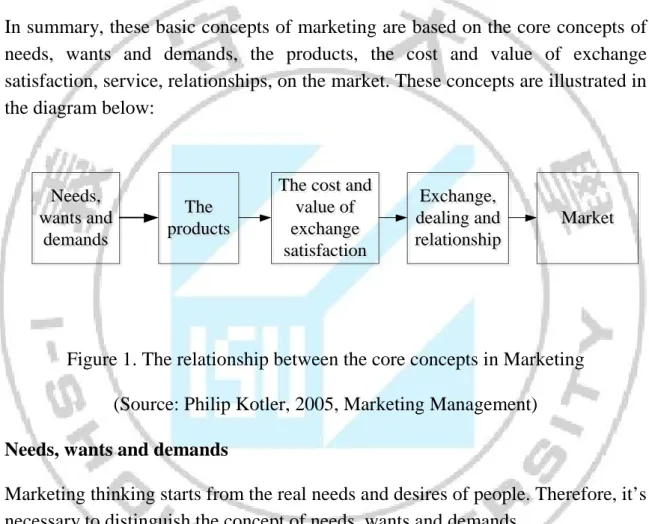
In summary, these basic concepts of marketing are based on the core concepts of needs, wants and demands, the products, the cost and value of exchange satisfaction, service, relationships, on the market. These concepts are illustrated in the diagram below:
The products The products Needs, wants and demands Needs, wants and demands
The cost and value of exchange satisfaction
The cost and value of exchange satisfaction Exchange, dealing and relationship Exchange, dealing and relationship Market Market
Figure 1. The relationship between the core concepts in Marketing (Source: Philip Kotler, 2005, Marketing Management) Needs, wants and demands
Marketing thinking starts from the real needs and desires of people. Therefore, it’s necessary to distinguish the concept of needs, wants and demands.
“A human need is a state of deprivation of some basic satisfaction” (Philip Kotler, 2005). Human needs are not the creation of society or marketers but an integral part of the human bodies such eating, drinking and relaxing.
Wants are desires to get particular things to satisfy human needs. In another words, wants are needs expressed by specific objects. For example, a person needs to eat and wants a bowl of Pho, needs to drink and wants a cup of Coca-cola. In different society, human needs are satisfied by different ways depending on each culture, habit and identity. Desire of humanity is always various and changeable due to development of society.
Demands are desires for specific products which are backed by the ability and willingness to purchase those products. Wants with the support of buying power become demands. For instance, lots of people want to own a car, but very few of them have ability and willingness to buy one. Thus, not only does the company need to quantify how many people desire their products, but it also need to quantify how many people can afford theirs.
These distinctions above make it clear that marketers are not the ones who create demands but demands create marketers. Marketers, together with other factors in society, only impact on customer’s desires and demands by producing attractive affordable products.
Product
“A product is anything that can be offered to a market for attention, acquisition, use or consumption that might satisfy a need or want.” (Philip Kotler, 2005)
The term “product” here is considered as both goods and services. It can be physical assets such as houses, carsor invisible assets such as labour power or ideas.
Value and expenditure
The value is the consumer's assessment of the product quality. Consumers have their own ideal products for their demands. And the value of every product depends on the degree of similarity between it and consumer’s ideal product. Expenditure is an amount of money you have to pay in order to buy and consume the products.
Before making a decision to buy a product, consumers always assess its value and expenditure.
Exchange, transaction and relationships
Marketing significance is not only about human needs, desires or valuing and pricing a product. It is through exchanging that Marketing occurs when people decide to satisfy their desires and demands.
“Exchange, the core of marketing, involves obtaining a desired product from someone by offering something in return” (Philip Kotler, 2005)
Exchange is a decisive concept, creating the foundation of Marketing. It only occurs in these following conditions:
- There must be at least two sides.
- Each party must have something that represents value for the other. - Each party must be able to communicate and deliver.
- Each party must be free to accept or reject the offer.
- Each party must believe that it is appropriate or desirable to deal with the other party.
If for any reason, any of the parties involved in the exchange is not satisfied, the exchange does not occur. Exchange has to be recognized as a process that is completed when an agreement is made. In reality, the exchange occurrence also depends on the tacit agreement among parties so that beneficial provisos are made before the exchange. It is this meaning that exchange is considered as a process of producing values.
A transaction is the primary unit of exchange which involves at least two things of value. In the most general sense, the marketers are looking for ways to create reactions from the other side. A business firm wants those reactions buying behavior of consumers. Therefore, Marketing consists of activities undertaken to generate reactions that the company wants from particular customers.
Wise marketers are always trying to build long-term trustworthy beneficial relationships with major customers, the distributors, agents and the suppliers. This task is accomplished by promising and ensuring high qualities, thorough services and affordable prices for the other side. It is also done by binding closely to their partners in economy, technology and society. Marketing relationships will reduce outlay and time of transactions. In the best-case scenario, one time negotiation will become long-term relationships.
The final sequence of marketing is the company’s original property called network marketing. It includes the company and the suppliers, distributors and customers that the company has built the confident business relationships. Marketing increasingly tends to move from maximizing profits in each transaction to maximizing the mutually-beneficial relationship with partners. The principle is: good relationships lead to beneficial transactions.
Markets
Markets consist of all existing and potential customers sharing a particular need or want who might be willing and able to engage in exchange to satisfy the need or want. The scale of the market depends on the number of people in need who has the resources interesting to other people and those resources are ready to exchange for what they want.
Consequently, the concept of the market has brought us back to the very first concept of marketing. Marketing means human activities that take place in relation to the markets. And in the markets, marketing makes potentials into real exchanges with the aim of satisfying the needs and desires of humans.
2.1.2 The aims of marketing
To enterprises, the aims of marketing include:
- Maximum the consumption of products and satisfaction of customers: Enterprises satisfy customers via their products and services. At the moment of needing a product, if the quality of the product is good, the price is suitable, information is perfect, the distribution is widespread, then the customer will decide much faster and easily to buy the product. Then, enterprises will sell products and gain revenue. So, satisfying the need of customers is a vital issuefor each enterprise and all marketing activities are for attracting customers, making them satisfied and loyal to enterprises.
- Win the competition: Marketing solutions help enterprises deal better with changes in the changes of the market and business environment; therefore they ensure and improve the competitive position of enterprises on the market.
- Long-term profit: Marketing also helps enterprises create necessary profit level in order to survive and develop stably.
2.1.3 The role of Marketing
Joining the marketplace:Every enterprise has to accept competition as an inseparable principle of the economy. Competition is a motivation to anticipate the development as well as a tool to eliminate weak enterprises. Therefore, to survive and develop, the enterprise must be always active, flexible and keep researching to meet the market demand, perceive the customer’s role to the existence of the enterprise. Only if the enterprise satisfies customer need can their
profit be assured. And, so Marketing becomes “the golden key” for enterprises to achieve success.
Marketing connects producer and consumer: Because of time and space distance between them, manufacturers, businessmen cannot collect latest information about rapidly changing market needs if they do not have the useful support from the marketing information system. Through the marketing activities, companies can collect and process information in the most effective way, make correct business decisions, and satisfy even the highest customer demands.
Marketing encourages the development and creates new things to improve our quality of life both physically and mentally: With the rapid changes in demand, taste, and technology, etc., every enterprise can only sell their limited items to the market. Customers always expect and look for new and higher quality of products. Competitive environment forces enterprise to never stop creating and improving their products and services to meet the increasing customer demands. Therefore, nowadays, more and more new products, useful information and perfect services were introduced to diversify customer’s choice. And, as a result, it enhances the quality of human life.
Increase the productivity of business: Through the study of purchasing behavior, marketing will help enterprises to find the best solutions to customer’s complaint or reclamation to improve their products as well as promote trading capacity. 2.1.4 The functions of Marketing.
Considering its role in economic environment, marketing has four following functions:
2.1.4.1 Adapting product to market demands.
Eachindividual has his/her own personalities, tastes and different consumption abilities. A product appeals to purchasers when it fits their certain needs. For different types of products, the consumer will require different levels of different quality. This requirement is constantly grown with time and the development of society. Consequently, the enterprises must always keep examining, capturing the current needs and predicting how they will change to produce new products or improve the recent ones to adapt to new customer demands. Marketing will show enterprises what the customers need, where to sell the product at what prices. With this function, Marketing solves two following problems:
- To research the market to orient the manufacturers to design products according to demand.
- To coordinate activities of all processes from emerging ideas for the product to the production, consumption to ensure quality and service of that product adapts to the selected target market.
2.1.4.2 Distribution function
This function includes activities to organize the most reasonable movement for the product after it finished production process until transport to stores, agents or directly delivery to consumers. These activities consist of:
- Examining and deciding the potential customers (determine target market). - Guiding clients in the contracting procedures, ordering, mean of transport,
customs clearance and other formalitiesto ready for delivery.
- Organizing customer services, if necessary, support finance and payment terms.
- Detecting the stagnation points of distribution channels to quickly adjust or reduce some ineffective channels that result in slowing down the speed of delivering goods.
2.1.4.3 Consumption function
For the product being consumed quickly to ensure reproducible processes, enterprises have to solve the issues of pricing policy, price structure, price component to suit target customers and still ensure operating costs and make a profit. For this, the enterprises must strictly control the price.
2.1.4.4 Support function
Enterprises have to make agood impression, creating affinity for the products to stimulate consumers to buy them. Support function of Marketing - advertise, frequently propagandize brilliant features – will help customers recognize and engrave the image of the product in their minds. This function comprises following activities:
- Advertising: enchant, persuade consumers to purchase the product.
- Sales promotion: attract attention and appeal to consumers at the place of sale or consumption.
- Supporting services: taking care of customers by organizing fairs, exhibitions and providing guidebooks, warranty services, or free hotline. 2.1.5 Marketing Mix
2.1.5.5 Definition
“Marketing mix is the set of marketing tools that the firm uses to pursue its marketing objectives in the target market.”(Philip Kotler, 2005)
Four basic tools of marketing mix includes: Product, Price, Place, Promotion (often abbreviated as “4P”)
Marketing tools are blended and combined together to form a unified whole to create specific competitiveness for every single product. 4P is frequently adjusted to suit the market to help the co-operations deal with changes.
2.1.5.6 “4P” in Marketing Mix.
- Product: set of goods and services that the company offers to the target market.
- Price: total amount of money that consumers have to spend to get the product.
- Place: all the activities to bring product to the target customers easily. - Promotion: all activities of the company in order to spread information
about the advantages of product and persuade target customers to buy that product.
The content of “4P” in Marketing Mix represents the views of the enterprise about marketing tools can be used to influence the target market. 4P’s content in Marketing Mix is express as:
- Product: types, quality, design, feature, brand name, packaging, size, service, warranty.
- Place: distribution channel, scope, location, storage, transportation.
- Price: various in prices, trade discount, payment, credit.
- Promotion: Advertisement, sales promotion, sales force, public relation, direct marketing
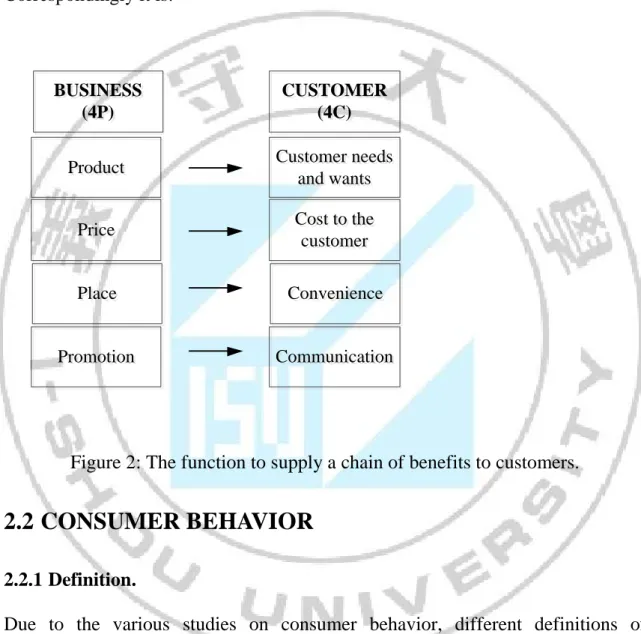
In McCarthy’s opinion, to success, each of marketing tools used by entrepreneur must have the function to supply a chain of benefits to customers. Correspondingly it is: CUSTOMER (4C) CUSTOMER (4C) BUSINESS (4P) BUSINESS (4P) Customer needs and wants Customer needs and wants Product Product Cost to the customer Cost to the customer Price Price Convenience Convenience Place Place Communication Communication Promotion Promotion
Figure 2: The function to supply a chain of benefits to customers.
2.2 CONSUMER BEHAVIOR
2.2.1 Definition.
Due to the various studies on consumer behavior, different definitions of consumer behavior are unavoidable. Each definition of each researcher is also expressed in their own words. However, on the whole, they still have certain significance in explaining to the reader the best understanding of the concept “Consumer Behavior”. To more objectively, the author would like to present some typical following definitions:
“Consumer behavior is the interaction between the factors of environmental stimuliwith the perception and interaction of human beings through whichpeople
change their lives” (American Marketing Association, 2000)
“Consumer behavior is the behavior of a particular individual making the decision to purchase, use and dispose of products or services” (Philip Kotler, 2007) "Consumer behavior is a process that allows an individual or group selection, purchase, use or remove a product/service, the thought was there, and accumulated experience, to deal meet the needs or desires of them"(Solomon Michael, 1992).
"Consumer behaviorsare all the activities directly related to the process of finding, collecting, purchasing, possessing, using, and removing products/services. It includes the decision-making process of taking place before, during and after the action." (James F.Engel, Roger D. Blackwell and Paul W.Miniard; 1993)
In general, all the definitions given above lead us to the essence of “Customer Behavior” is cognitive processes and actions from the accumulated experience to make the decision to purchase and after - purchase behavior of customers for a product or specific service. For this study, the product is superior to lighting equipment for buildings, companies, households; consumer behavior at this time is an accumulated experience process which has many stimulating factors leads to the buying decision and using to satisfy their needs and their positive/negative action with the product after using.
Actually, before buying the lighting equipment, the customer must have gained experience through some reference sources (newspaper, radio, television, friends, relatives and so on) as well as the inside psychological processes related to needs, perception, personality, attitude to make a final decision to purchase the product. After using the product, his/her experience will be intensified. If the customer satisfies, he/she will continue to use the product, introduce the superior lighting equipment to other people. On the contrary, he/she will stop using and advise the others not to use this product if the expectation is not satisfied. That’s the basic definition of buying behavior.
2.2.2 Reasoning of consumer behavior
In this section, the author would like to briefly introduce the basic theory of consumer behavior which leads to some extent explaining the reasons of applying consumer behavior theory to Lap Đuc Company’s project for lighting equipment product.
First of all, the author would like to have a look at some of the theory of consumer behavior from some famous researchers around the world which have successfully researched and applied in practice. Generally, the theories of authors such as Michael Solomon, James F.Engel, Roger D. Blackwell, Paul W.Miniard, David L. Loudon, Albert J.Della Bitta, McGraw-Hill, Schiffman, and Kanukare quite similarabout consumer behavior concept, the elements that form and affect consumer behavior. However, we must admit the fact that most of these studies were quite old and were applied to consumer behavior in countries with extremely different culture, politics, economy, or level of wealthy from Vietnam. Therefore, applying those theories needs considering a lot to adapt to products and customers of Vietnam market. Due to those differences, the author consulted some other work which was translated into Vietnamese and reformed by well-known Vietnamese marketing researchers. Analyzing these extra materials will help the project come closer to real situation of product and market in Vietnam. Consumer behavior of individual customer is written quite clearly in the "Nguyên lý Marketing” (Nguyễn Đình Thọ - Nguyễn Thị Mai Trang, 2003) and “Tiếp thịvà các tình huống thực tế” (Vũ Thế Dũng, 2001).
Most of the related documents in the field of consumer behaviors concentrate on analyzing the features that affect on consuming ones, while the exploration of how they are made is not really clear since this is a broad category. According to these documents, the core of consumer behaviors is the process of making a decision for buying a product or a service of customers.
Focusing on the topic about examining the elements impacting on making decision to buy lighting equipment at Ho Chi Minh City, author divided into two main parts. The first one is all of the factors affecting upon buying decision and the other is how those factors influencing on decision to buy the Company’s product. Thus, the initial issue in theoretical level understood clearly is what is the buying decision, and then we move on the impacting elements and their effecting extent.
2.2.3 Elements effecting on the consumer behaviors.
The theories about elements implementing on the consumer behaviors is the core content in this research topic. Therefore, in this part, author have already consulted and distilled the theories from before researchers and then, analyzed and synthetized them in order to get the firm theoretic basic for this research topic.
2.2.3.1 Buying decision process
Buying decision process of consumer includes 5 steps used in order to assess consumer behavior for whatever kinds of products and services. The preliminary information about these steps is mentioned below.
Recognizing needs: Recognizing needs happen when the consumers figure out some differences between the status and the wish, while these differences can evoke or activate their buying decision process.
Seeking information: Recognizing needs, consumers will seek for information. Generally, at first, they will use the related information from their memories – which is called inner information. If there is no inner information, the consumer will seek for outer one to solve the problem.
Assessing and choosing the solution: After knowing the needs and seeking information from different related sources, consumers will assess and choose for their own the suitable solution to meet their demand.
Choosing the stores and shopping: After having the suitable solution, consumers will choose the stores and go shopping. This is an essential step in process of making their buying decision.
Process after shopping: This process mentions to the problem after shopping how consumers feel, satisfy and use the product.
2.2.3.2 Elements effecting on consumer behavior:
Elements that affect on consumer behavior or buying decision process is quite sensible in comparison with processes in buying decision process. The fact that these elements can or cannot make the impact depends on the product, the market, and the different cultures. However, when the theories is mentioned, it is needed to show the whole factors creating the impact according to what before researchers have already checked and given. Following the full model of consumer behavior of authors David L. Loudon, Albert J.Della Bitta, McGraw – Hill in above picture 2.1, there 4 groups of elements that effect on buying decision, which are: cultural elements, social elements, individual elements and psychological elements. The detailed analysis about these groups of elements is explained below:
Cultural elements:
Cultural elements take the most deeply and broadly affect upon consumer behavior. We will review the role of cultural background, cultural branch and social class of customers.
Cultural background: is the most basic elements which decide someone’s wishes and behaviors. In the different culture, single person will get the distinct feeling about the value of goods, dressage, etc. This leads to the differences in consumer behavior.
Cultural branch: is the smaller lateral contributing culture. Cultural branch creates the significant characteristic for its members. It can be divided by criteria such as geography, people, and religion. The different cultural branch has the different lifestyle, consuming style and creates some important market.
Social elements:
Consumer behavior is under the effects of social elements such as reference group, family and the role of social status.
Social status: the consuming style depends much on someone’s social status; especially for the goods with highly showing such as clothes, shoes, vehicles, etc. People in the same class tend to have the same acts in comparison with those belonging to two distinct social classes. Those with what kinds of social status often consume goods and services have such correspondences. Those in the high class use to spend their money a lot in luxury products such as famous label things, golf equipment, etc.
Reference group: reference group of someone is groups that implement directly or indirectly on his/her attitude and behavior. These groups can be family, friends, neighbors and colleagues, who that consumer communicates every day. In addition, there are some groups, which have less affect such as federations and unions.
Family: members of the family are the strongest effected reference group on the consumer behavior. Firstly, his/her parents will influence that customer. At this family, the values of culture, politics, ideology, etc. will orientate that person. After getting married, the level of affect from the wife or the husband in deciding the kinds of product will be essential.
Individual elements
Gender: gender is the first individual factor that is influential prerequisites on consumer behavior. Because of natural characteristics, male and female have distinct demand and choosing products. Researches showed that, while female choosing products mostly depend on price, appearance and models of products, male focus on technology and reputation.
Age and stages of life cycle: even though there are the same services for same demands in whole life, people still purchase for different products and services. In the same demand of eating, when they are young, people will choose the vary kinds of foods. But when they are older and older, they tend to diet some kind of food. The tasted in clothes, wood furniture and ways of entertainments also change according to the age. Therefore, age tightly relate to choosing products such as foods, clothes, accommodations for living and kinds of entertainments. Career and income: career and economic situation are one of the influential prerequisites on the way someone consumes. The quality of product and services are implemented by career. Worker will purchase for clothes and shoes for working, and use entertainment services in the different ways with a president or director of a company. Economic circumstance contributes a big part in choosing products. When people have the good one, they tend to spend for luxury products. Lifestyle: people who have the same cultural branch, social class and career may have his own the totally distinct lifestyle and consuming ways. The conservative lifestyle is illustrated by the conservative dressage, time for family and contribution in the church. Or people who choose the modern way will have the characteristic such as working overtime for essential projects, participating actively in travel or sports and spending much more in meeting the individual demands.
Psychological elements
Choosing shopping is also effected by four psychological factors including motivation, awareness, knowledge and belief.
Motivation: motivation is so urgent demand that people are forced to satisfy it. At any period, people also have a lot of demands. Some of them origin from psychology such as they want to be admitted, respected or close to spirit.
Abraham Maslow found out the explanation why people are forced by some special need at the special time. Why do someone who spends lots of money and time for the safety of him/herself and others want to be respected? The answer of
Maslow is that human needs are arranged in order from the most to the least urgent. They will try to satisfy the most important one first. After being completed, that need is no longer a pressing motivation and people will try to satisfy the next.
Awareness: awareness is a human thinking ability. Motivation forces people to act; yet the way it happens depends on the awareness. Two housewives go into a supermarket with the same motivation, but they choose very different product labels. Their awareness about models, prices, qualities and service attitude is totally distinct.
Knowledge: knowledge support people to generalize and find the different when they approach to the same size products. When consumers get knowledge in goods, they will consume in the most useful way.
Belief and attitude: thanks to practice and knowledge, customers put the belief and attitude into the products. According to some people, price and quality move together. They don’t believe that low price can go with good quality. Therefore, they quite hesitate in choosing the lower price product among the same ones. The belief and attitude of customers strongly effect on the income of manufacturers. Belief and attitude is hardy changeable, which create the firm habits of consumers.
2.3 RESEARCH MODEL AND THEORIES
2.3.1 Consumer behavior model
The general theory about consumption behavior is examined in the last part; in this part, the author introduces a reference research model to build a suitable research model to apply for the matter which investigates many factors affecting the decisions to buy lighting equipment products of Lap Duc Company. In spite of the research also on the consumption behavior through original documents of Schiffman and Kanuk (2000), a suitable document for using the research model is the document of the authors Nguyen Dinh Tho and Nguyen Thi Mai Trang with the research model of the consumption behavior on the below picture 2.2. This model of consumption behavior is of the famous authors about Marketing in Vietnam built, based on the basic theory about consumption behavior of two authors Schiffman and Kanuk (2000) which has the completion and adjusting.
So, what are the differences and similarities between the research model of the two authors Nguyen Dinh Tho and Nguyen Thi Mai Trang and that of the authors David L. Loudon, Albert J. Della Bitta, McGraw_ Hill (1993) on the above picture 2.1? Actually, two modals sum up the theory about consumption behavior; many factors affecting the consumption behavior have already investigated a lot by many different authors. However, the theoretical approach, as well as, the applicability of each model is different. The model of David L. Loudon, Albert J. Della Bitta, McGraw-Hill (1993) has the theoretical approach for the readers to know deeper about theory; it just applies for the theoretical research about the consumption behavior. To the model of the author Nguyen Dinh Tho and Nguyen Thi Mai Trang, the approach is more practical research; the system is also developed much better; this model can apply suitably for the market and the practical research products in Vietnam. Although the research process on applying this model will be quite difficult, the author still sees the applicability of this model on applying to the practical product research and the consumers of Vietnam.
Input triggers
The input includes external triggers. These triggers function as a source of information for a brand and impact the attitudes and behaviors of the consumers as well as judging the value of the products. There are two types of triggers: marketing and non-marketing.
The process
The process relates to the problem that is how the consumers make decisions. When they make decisions, they are affected by internal triggers (their psychology). Those contain motive, awareness, knowledge, personality and attitude. The decision-making process can be divided into three steps:
+ Identifying needs
Purchase process starts with identify needs. The needs can be created by the stimulations inside the consumers or from the environment. Therefore, the problem of this stage is that marketers need to identify the factors and the situations that affect the needs of the consumers. The marketers have to research the consumers to find out unexpected demands and their triggers and the reason why a consumer buys a product.
+ Searching information
The consumers themselves need or needn’t seek information about the product when they know what they need. There are four main sources of information that the consumers can use to look for data when they decide to buy something. Those are from: - The group - The marketing - The public - The experience + Alternative assessment
After having essential information, the consumers will consider other choices. In this process, the consumers base on two collections of data: the brand and the evaluative standard. There is no option-assessing process that all of the consumers or a consumer uses all the purchase situations. The assessing process model of the consumers is often set by basing major on the awareness and logic.
Output
Output is the result of the decision-making process. It relates to purchasing and behaviors after purchasing.
+ Purchasing decision
Two factors can affect the plan to buy a product are the attitude of other people and unexpected factors. The marketers, therefore, have to find out the reasons why the consumers feel risk-aversion to provide them information and help them to reduce this feeling. When deciding to buy a product, the consumers also make other decision related to the place to buy, delivery, payment, etc.
+ Behaviors after purchasing
The consumers’ behavior is a continuous process because they buy products again and again, so as to find out whether the consumers satisfy after purchasing helps the marketers have a suitable strategy to satisfy the consumers’ demand. Then the consumers will:
- Be loyal longer - Buy more products
- Say nice things about the company - Pay less attention to the price.
Satisfying the consumers’ demand is one of the prerequisite determining the existence of the company. Satisfying the consumers’ demand is a general definition not just about the quality of a product but the satisfaction of it. The expectations in products are created by the information that the consumers gathered (through friends, advertisements, etc.). The consumers will satisfy if the actual performance and quality of the product lives their expectation. They will feel happy and love that product. Thus, to ensure the success of the products on the market, the marketers have to concern about the content of the consumers after purchasing, not just selling the product.
2.3.2 Research model
Based on the reference model, we can see that the decision to buy of consumer Viettel Ben Tre was stimulated by the external and internal factors. Based on the reference model, we can see that the decision to buy of consumer Viettel Ben Tre was stimulated by the external and internal factors.
Firstly, decision-making process is demand-identifying process, data seeking, alternative assessing, purchase deciding and behaviors after purchasing. These are the basic stage for the decision of buying a product or not, which is decided by the external and internal factors. To the extent of this study, purchasing decision is the decision of purchasing and using Viettel products to satisfy and behave after buying.
In term of external factors, the companies cannot control the non-marketing aspect and often omit this trigger in research because it is microscopic properties and covers the whole market. The companies concentrate on marketing to orientate the consumers purchase under the tendency that the companies want. It includes 4 sub-triggers: the brand, the price, the promotion and the distribution.
Brand recognition which is one of the important criterions to measure the power of the brand is the first stage in shopping process. The more famous the brand is, the more easily the consumers choose. The degree of brand recognition can be divided into three levels, according to Laurent, Kapferer and Roussel (1995). The highest level is top of mind, the next one is spontaneous and the lowest one is prompt. For the various cosmetic products on the market, specially, facial cleanser for men, the degree of brand recognition plays an important role in purchase decision because they have not much knowledge about shopping. Therefore, they inevitably concern the brand of the facial cleaner. Thus, it can be seen that the
more their satisfaction about the brand recognition assessment is, the higher capacity the consumers buy the products is.
The price is also an important factor influenced on purchase decision. The consumers buy a product with acceptable amount of money which is equaled to the value of it. When the price is higher than the value the consumers receive from the products, they will eliminate them from their purchase intent. With the lightening equipment for family, its price focuses on the medium income customers who care a lot about the price. Hence, before deciding to buy a product, the costumers have to evaluate between the usage and the price of a product to use it efficiently. Therefore, it can be inferred that the consumers are more likely to purchase a product when they feel pleased with its price.
Promotion is an important tool to popularize the brand to the public. What attracts the consumers is not the product’s value but how to make the consumers know its value. Indeed, according to “Managing Marketing Theory and Case Study” by Vu The Dung published in 2004, the main aim of promotion is to let the consumers know about the value of the products to encourage them buy the products. The better the advertising is, the more chances to sell products are. The main forms of promotion for these products are advertising, direct marketing, trade fairs. To a certain extent, promotion, therefore, also affect the purchase decision of the consumers. So, when the consumers are appreciated the promotion, they are prone to buy the products.
Distribution is a series of activities of independent organizations such as the supermarkets and the shops that join in the process to bring the lightening equipment to the consumers. The distribution systems ensure that the consumers can easily buy this product when they want because they can change their mind if it’s difficult to buy or the shops don’t have Viettel products; they can choose the alternative one. Purchase decision can easy to make if the consumers are happy with the distribution systems. In brief, purchase decision is affected by 4 external factors, i.e. the brand, the price, the promotion and the distribution.
In internal factors term, Schiffman believes that psychology which strongly impacts and influences the consumers purchase decision includes motive (1), awareness (2), knowledge (3), personality (4) and attitude (5). Purchase motive relates to the demand that is stimulated to a certain degree that the consumers need to please it. In other words, the motive is the consumers’ demand.
Attitude is the inside mood that express through actions, behaviors, gesture to other people and events, opinion and oneself (Encyclopedia, Vietnam dictionaries and encyclopedias institute). Attitude stands for personality. In three-element of attitude model of Schiffman (Schiffman et al 2006), attitude consists of emotional component, behavioral tendency and identity component. In fact, identity component research means searching the knowledge of the consumers about the products, in other words, we consider the belief of the consumers in the products. Analyzing behavioral tendency to know about the trend to choose the product of the consumers based on the brand, the price, the promotion and the contribution that will be detailed in external factors research.
It can be seen that demand makes consumers’ motive. Personality builds attitude. Attitude comprises belief, emotion, behavioral tendency which involves in many outside factors. Demand (1), trust (2), affection (3) will be researched as the psychology elements affect the purchase decision.
The more and more urgent need urges the consumer buy the products. For Viettel products, the demand for the product is the need of telephone, security and durability. These requirements are the motivation to promote the consumers purchase Viettel’s products. Therefore, when a customer’s satisfaction about assessing his demand increases, he is prone to decide to buy the products.
The more valuable the consumers believe products have, the more easily the purchase decisions they make. When buying Viettel’s products, the customers of Viettel Company surely have learnt and known the products to some certain extent or they have good feelings about the product, which make the consumers’ belief in the products. When they believe in the products, they tend to purchase them faster. Therefore, when a customer’s satisfaction about assessing his trust of the products increases, he is prone to decide to buy them.
The better affection the customers have, the more easily purchase decision is made. Based on three-element of attitude model by Schiffman and Kanuk, affection comprises favor, emotion, feelings, loving or hating products. If the consumers have good feelings about the products, they will easily purchase them. To Viettel’s products, creating good to the customers at early stage may let them interest in and conceive well the products so they would buy the products. Therefore, when a customer’s satisfaction about assessing his affection of the products increases, he is prone to decide to buy them.
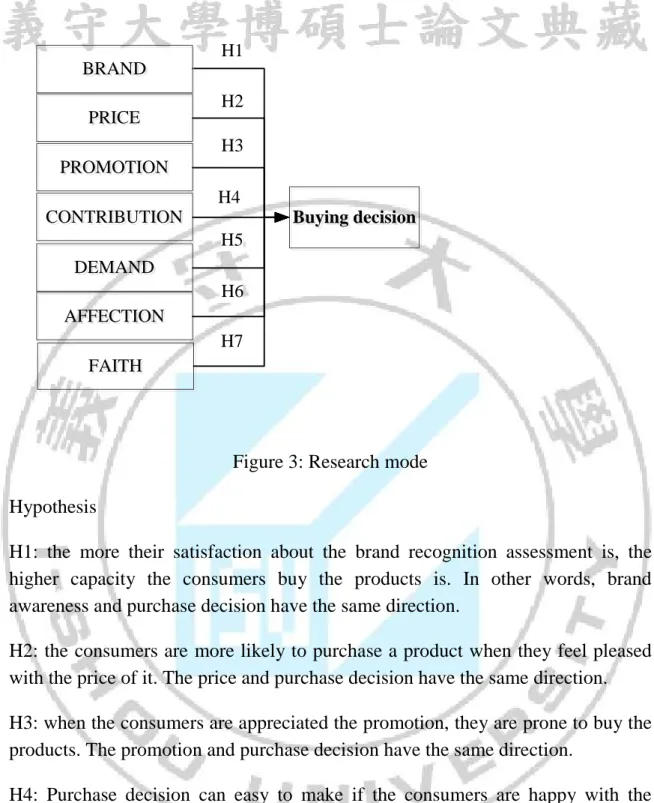
Buying decision Buying decision H1 DEMAND DEMAND BRAND BRAND AFFECTION AFFECTION PRICE PRICE FAITH FAITH PROMOTION PROMOTION CONTRIBUTION CONTRIBUTION H2 H4 H5 H3 H6 H7
Figure 3: Research mode Hypothesis
H1: the more their satisfaction about the brand recognition assessment is, the higher capacity the consumers buy the products is. In other words, brand awareness and purchase decision have the same direction.
H2: the consumers are more likely to purchase a product when they feel pleased with the price of it. The price and purchase decision have the same direction. H3: when the consumers are appreciated the promotion, they are prone to buy the products. The promotion and purchase decision have the same direction.
H4: Purchase decision can easy to make if the consumers are happy with the distribution systems. The contribution and purchase decision have the same direction.
H5: The consumers gratify their needs may decide to buy the products. Demands and purchase decision have the same direction.
H6: the consumers desire to buy the products if they are pleased about the affection evaluation. The affection and purchase decision have the same direction.
H7: the more the consumers believe in the products, the more chances they buy them. The Faith and purchase decision have the same direction.
2.4 OVERVIEW ON VIETTEL BEN TRE
2.4.1 Establishment and Development
20/032006 Viettel Ben Tre to be incorporated, with product telephone intercity and international 178 marked change in the telecommunications market nationwide and Ben Tre. As a dependent accounting units Military Telecom Corporation (Viettel) 100% state-owned, business lines include telecommunications services and information technology. The first year revenue is less than 1 billion VND, current total revenue this branch up to 800 billion state budget 48 billion per year in the province.
2.4.2 Structure of company
The company started from 12 employees. And presently, the Viettel Ben Tre has more than 400 staffs and collaborators, 17 trading centers serving customers in 15 districts/cities, with over a thousand Point of Sale and retail dealers to serve customers.
Viettel Ben Tre has 1 Director; 3 Deputy Director; 11 Department board support and 17 Centers (sales, customer support, telecom network operators)
2.4.3 Service of Viettel Ben Tre
The services of the Viettel Ben Tre include the following items.
Mobile Services: Viettel has a vast network covering all the territory of Vietnam, with the number of 3G stations 3 times higher than other network providers. The company has used the fiber technology for all of its BTS stations to reduce the information loss in bad weather.
Fixed Telephone Services Wired and Wireless: After merging with EVN Telecom, Viettel has a huge store of phone number to satisfy the customer’s demand.
ADSL Services: With the boom of broadband Internet in 2013, the high speed Internet service is now available to every family in Vietnam not just business customers like before.
TV IPTV Services: The company also focuses on the television service with various television options for customers including analog television service, two-way television service, IPTV.
Products terminal (mobile phone): This is a new investment target of Viettel with the current aim of exploring and expanding market.
Provides telecommunications equipment and information technology: CA, Vtracking, BankPlus, SMAS: These are the new services that Viettel is offering in Vietnam to businesses and schools to increase values for customers. These services are also expected to contribute to the growth of Viettel in the increasingly competitive market in Vietnam.
CHAPTER 3 RESEARCH METHODOLOGY
Chapter 2 presented the theoretical basis and research model built on the hypothesis.Chapter 3 will introduce the method of the study and it will comprise of two parts, including design of the study and processing skills of statistics data. The design of the study will mention the construction of the scale, the choosing of samples, collection tools of surveyed data and the data collecting process. The data processing skills will introduce measure to test the credibility of the scale by checking Cronbach’s alpha coefficient, Exploratory Factor Analysis and the hypotheses would be tested based on personal attributes.
3.1 RESEARCH METHODS
Implementing this research includes two main steps: Preliminary research - Qualitative research and Official research - Quantitative research.
3.2 THE PRELIMINARY RESEARCH
3.2.1 Discussing Expert Group
Wegner (1993:17) states: “the design of a questionnaire is critical to ensure that the correct research questions are addressed and that accurate and appropriate data for statistical analysis is collected”. Extensive research was conducted to obtain the most valid and reliable customer satisfaction questionnaires.
In this study, the authors come in contact with real customers to discover the information that the author has not thought to support the complete set of questionnaires. In qualitative research, the authors discuss directly with 5 clients and discuss directly with 5 business staff Viettel Ben Tre.
The objectives of talking directly with business staff are to have information on the characteristics of customers buyingproducts and the promotion of the company.
The objectives of discussions with customers are to gain more information at each stage of the buying decisions of customers.
Content preliminary interview
Interview Questions:
Part I: Exploring the consumer behaviors factors
Question 1: As for your own ideas, what are factors affecting the consumer behaviors toward Viettel in the in Ben Tre? Why? What are important factors? Why?
Question 2: In addition to the factors that you mentioned previously, what other influencing factors affect the purchasing behavior to Viettel in the in Ben Tre? Part II: Reaffirmation of the consumer behaviors factors:
Question 3: You are pleasant to view the factors in the same group (provide objects with the factors of each component of consumer behaviors based on the scale of author) and arrange the order of their importance in each groups, including: 1: very important, 2: less important, etc. Why?
Qualitative research results are listed in scale study 3.2.2 Designing Questionnaire
After the group discussion, the designed questionnaire consists of two parts as follows:
Part I of the questionnaire is designed to collect the customer's assessment consumer behaviors toward Viettel in the in Ben Tre
Part II of the questionnaire is used to classify information provided by respondents.
Part I of the questionnaire consists of 33 variables in which include the initial 30 observation variables used to measure the amount factors affect consumer behaviors. The next 3 observation variables used to measure consumer behaviors Completed questionnaire was tentatively used to interview 20 people to check the clarity of the questionnaire and collected information. After the questionnaire is adjusted, the official questionnaire (see Appendix 1) was sent to officially interview.
3.2.3 Adjusted scale
Scale is a tool used to estimate the status or level of the surveyed units by the characteristic. There are 4 basic types of scales are: nominal scale, ordinal scale, interval scale, ratio scale (Hoang Trong – Chu Nguyen Mong Ngoc, 2008).
In this study, the authors used only two types of scales: nominal scale, interval scale
Likert scale is a type of range scale, is a scale in which a series of statements relate to the attitude in raised questions and the answers will select one to answer. The reason to choose 2 types of scale: nominal scale, interval scale
One of the purposes of this topic is to find out, determine the satisfaction level of the faculty member, thus Likert scale format is best suited for the answers of the respondents in the form of this scale, we will see the fulfillment of workers in every aspect in the satisfaction or dissatisfaction and much and less level (specifically, authors use 5 level Likert scale, 1 Strongly Disagree, 2 Disagree, 3 Neutral, 4 Agree and 5 Strongly Agree). At the same time, because of the scale Likert scale is range one, we can use the collected data for processing, quantitative analysis to determine the correlation relationships, linear relationship among variables in general, as well as among the independent variables and the dependent variable.
In addition, to examine if the satisfaction level of the target group (age, gender...) is different or not, it must have the parts for asking about this group then namely scale will be used.
From the theoretical basis and research model proposed in Chapter 2 in combination with qualitative research the author made a scale of model research about consumer behaviors are as below:
Component of the brand
1. When you talk about telecommunication products, you will first mention telecommunication products of Viettel.
2. A telecommunication product of Viettel is the famous brand.
3. Viettel’s product can be easily distinguished from the others on the market.
4. Viettel telecommunication logo can be easily and quickly reminded. 5. There is no difficulty in figuring out the telecommunication brand. Component of the price
1. Telecommunication products of Viettel have reasonable price. 2. You are satisfied with the price.
3. The price of Viettel's brands compete against the others in trade. 4. The price is stable.
5. The price is equivalent to the quality. Component of the distribution
1. Viettel’s product can be easily bought at agents.
2. Viettel’s product can be easily bought at specialized stores. 3. Viettel’s distribution system has uniform price.
4. Viettel’s points of sales are reliable. Component of the marketing
1. Telecommunication product is widely advertised. 2. Telecommunication advertisement is impressive.
3. Telecommunication advertisement is on media frequently. 4. Viettel’s product is displayed spectacularly.
5. Viettel’s product is usually on special offer. Component of the demand
1. You buy Viettel production for personal use.
2. You buy Viettel production for use in the organization. 3. You use Viettel production to working.
4. You buy Viettel production for use in the family. Component of the fondness
1. You are interested in Viettel products.
2. You enjoy using telecommunication products of Viettel. 3. You find products of Viettel good.
Component of the faith
1. You believe Viettel products can have an effectiveness as theirs advertisement.
2. You believe Viettel products have high quality. 3. You believe Viettel products are safe for using.
4. You believe Viettel products the very convenient for your life. The scale of buying decision
1. You decide to buy telecommunication products of Viettel. 2. You continue using telecommunication products of Viettel.
3. You recommend telecommunication products of Viettel to your friends.
3.3 QUANTITATIVE RESEARCH
Quantitative research is implemented by using quantitative research methods. Quantitative research solely tests the scale in the research model through the questionnaire used to survey.
3.3.1 The method collecting information Collecting secondary information
References include: theories of satisfaction, consumer behaviors, market research, and analyzing research data with SPSS and documentation for internal use on website Viettel.
Collecting primary information
Primary data was collected through surveying customer. Direct interview technique and interviewing through the Internet are used to collect data.
3.3.2 Research Sample
Resembling other marketing research this research used a convenient sampling method. In general, the sample size is as large as better, but how many the samples are enough in a convenient sampling, which is a question that is not clearly answered. According to Hair et al (1998), in order to be able to use exploratory factor analysis, the sample size is least at 5 upon an observation variable and the sample size should not be less than 100.
The questionnaire used in this study consists of 33 questions, so the tentative sample size is n = 165. Total released questionnaires are 300 the total number of collected questionnaires was 220. The collected data is processed, the number of valid questionnaires are used to handle SPSS 20.0 are 195, which is a proportion of 85.3%.
3.4 DATA ANALYSIS PLAN
Once the questionnaires had been completed, the responses in each question were then coded.
In section related to demographic, there are five items: age, gender, education and income.
Age: an ordinal variable ranges as following: - Under 25 years old: coding = 1
- 25 – 35 years old: coding = 2 - 35 – 40 years old: coding = 3 - Over 40 years old: coding = 4
Gender: a nominal variable ranges as following: - Male: coding = 1
- Female: coding = 2
Education: an ordinal variable ranges as following: - College: coding = 1
- University: coding = 2 - Master: coding = 3 - Other: coding = 4
Income: an ordinal variable ranges as following: - Under 5 million: coding = 1
- 5 – 10 million: coding = 2 - 10 – 15 million: coding = 3 - Over 15 million: coding = 4 The scale is encoded as Table 1 Table 1: Scale is encoded
No Encryption Interpretation
Component of the brand (BRA)
1 BRA1 When you talk about telecommunication products, you will first mention telecommunication products of Viettel.
2 BRA2 A telecommunication product of Viettel is the famous brand.
3 BRA3 Viettel’s product can be easily distinguished from the others on the market.
4 BRA4 Viettel telecommunication logo can be easily and quickly reminded.
5 BRA5 There is no difficulty in figuring out the telecommunication brand.
Component of the price (PRI)
6 PRI6 Telecommunication products of Viettel have reasonable price.
7 PRI7 You are satisfied with the price.
8 PRI8 The price of Viettel's brands competes against the others in trade.
9 PRI9 The price is stable.
10 PRI10 The price is equivalent to the quality. Component of the distribution (DIS)
11 DIS11 Viettel’s product can be easily bought at agents.
12 DIS12 Viettel’s product can be easily bought at specialized stores.
13 DIS13 Viettel’s distribution system has uniform price.
14 DIS14 Viettel’s points of sales are reliable. Component of marketing (MAR)
15 MAR15 Telecommunication product is widely advertised.
16 MAR16 Telecommunication advertisement is impressive.
17 MAR17 Telecommunication advertisement is on media frequently.
18 MAR18 Viettel’s product is displayed spectacularly.
19 MAR19 Viettel’s product is usually on special offer. Component of the demand (DEM)