國立臺灣大學管理學院商學研究所 碩士論文
Graduate Institute of Business Administration College of Management
National Taiwan University Master Thesis
是什麼因素驅使員工做環保行為?
探討員工環境價值觀與職場環保規範的影響
What Cause Employees to Perform Pro-Environment Behaviors?
The Effects of Employees’ Environmental Values and Pro-Environment Norms at Work
陳詩晴
Shih-Ching Chen 指導教授:戚樹誠 博士
Advisor: Steve Shu-Cheng Chi, Ph.D.
中華民國 105 年 6 月 June, 2016
誌謝
能完成這篇論文,學生要特別感謝我的指導教授戚樹誠老師。謝謝老師在倫 文上的指導,尤其是學生的題目算是一個在台灣比較少見的題材,老師所給予的 建議與研究方向上的指點都是莫大的幫助,非常感謝老師的支持!寫論文的這一 年也是麻煩老師了不少,感謝老師在論文指導上所花費的精力與時間,使學生看 到自己還需努力的地方,也學到商學所需學會的研究方法。另外也感口委羅新興 教授與梁欣光教授,感謝教授們特地撥冗來為學生做論文口試,並給予指正與建 議,使學生的論文更加完善,並得到更多的啟發與收穫,也感謝教授們對學生論 文的肯定,學生於此衷心感謝。
謝謝博班的朱志傑學長在研究技術上問題的指導,也非常感謝賴璽方學長在 論文撰寫時的建議、解惑與鼓勵,若沒有學長們的幫助,我想我的論文會更難產 吧。另外也非常感謝一同為口試奮戰的張耀元與方琦雯,我們一起討論論文內容、
研究方法與模擬口試練習的時光讓我們有種革命情感啊。也感謝你們接受我在口 試上的臨時加入,你們兩個先準備了許多前置作業,並提醒我許多注意事項,真 的由衷感謝!也因為有你們這些戰友,最後的關卡才能不孤單地達成呀。另外感 謝黃彥斌,你的支持與幫助我永遠會感激!謝謝你在我內心脆弱的時候給予我支 持與鼓勵,在我忙碌的時候從旁協助我,並在壓力大的時候當我的垃圾桶。感謝 你陪我走完研究生涯的最後一哩路,謝謝你!
最後感謝我的家人,在寫論文的時候一直在忙而不常回家,但感謝爸爸媽媽 的包容與支持,讓我在寫論文時能無憂地向前進。也感謝你們你們偶爾專程來台 北來看我,有爸爸媽媽的支持,我是幸福的!
以上雖然不是什麼漂亮文藻的致謝(我的國文不好大家應該也知道吧),但都
是我的肺腑之言。再次感謝老師、同學、朋友與家人,讓我研究所兩年的生涯過 得很精彩!我會永遠記得這段日子的!謝謝大家!
陳詩晴 謹致
中文摘要
因環境問題日趨嚴重,關於環保行為的探討與研究在這幾十年開始蓬勃發展,
但半個世紀的研究依然難以讓學者找出能使人進行環保行為的背後因素。而在這 環保行為領域中,探討關於組織員工所做的環保行為因素目前更尚處在起步階段,
本研究將分析可能影響員工做環保行為的內在與外在因素:內在因素運用新生態 典範量表(New Ecological Paradigm, NEP)來了解員工的環境價值觀是否會影響其 環保行為;外在因素討論工作環境中,環境環保規範是否會影響員工的環保行為。
本研究運用線上問卷調查的方式,共收集到 187 筆有效問卷,結果發現員工的環 境價值觀與環保行為有正相關:有較高的新生態典範之員工會有較高程度的環保 行為。研究另外發現,在擁有較高環境環保規範的工作空間中,其員工的環保行 為程度亦較高。因此本研究能顯示在工作環境中,員工的環境價值觀與工作場合 中的環境環保規範皆會影響其員工之環保行為程度。
關鍵字:環保行為;環境價值觀;新生態典範;工作環境規範;環境環保規範
ABSTRACT
In this study, we examine how employee’s Environmental Values and Pro-Environment Norms at work are related to Pro-environment Behaviors. As firm’s action is one of the main sources of environmental problems, it is vital that we investigate how we can make them greener, both external and internal. Here we explore the internal aspect of what influences employees to perform pro-environment behaviors.
An online survey was distributed randomly to employees in different companies and industries of Taiwan, and a number of 187 usable surveys were returned. Our results confirm the positive link between the relationships between employees’ Environmental Values to Pro-environment Behavior, and Pro-Environment Norms at work to Pro-environment Behavior. In the latter finding, it gives us a clue that if firms could build an environmental friendly atmosphere, it may influence one’s Pro-environment Behavior. The results may benefit managers and organizations that hope to increase their employee’s green behavior, and governments that wish to promote Pro-environment Behaviors within organizations.
Key words: Pro-environment behavior; Environmental values; Pro-environment Norm; Social Norm; Ecological Behavior
CONTENTS
口試委員會審定書 ... #
誌謝 ...i
中文摘要 ... ii
ABSTRACT ... iii
CONTENTS ...iv
LIST OF FIGURES ...vi
LIST OF TABLES ... vii
Chapter 1 Introduction ... 1
Chapter 2 Theoretical Development and Hypotheses ... 5
2.1 The development of Pro-environment Behavior in historical studies ... 5
2.2 The potential factors of Pro-environment Behavior in organizations ... 8
2.3 Environmental Values of individuals and their impact on Pro-environment Behavior ... 9
2.4 Pro-environment Norm at work and their impact on Pro-environment Behavior ... 10
2.5 Moderating Role of Pro-environment Norm at work... 11
2.6 Research Framework ... 12
Chapter 3 Methodology ... 14
3.1 Research Setting ... 14
3.1.1 Participants ... 14
3.1.2 Procedures ... 14
3.2 Measures ... 15
3.2.1 Employee’s Environmental Values ... 15
3.2.2 Pro-environment Norms at work ... 16
3.2.3 Employee’s Pro-environment Behavior ... 17
3.2.4 Control Variables ... 18
3.3 Analytical Strategy ... 18
3.3.1 Descriptive Statistics ... 18
3.3.2 Reliability Analysis ... 18
3.3.3 Pearson Correlation Analysis ... 19
3.3.4 Hierarchical Regression Analysis ... 19
Chapter 4 Results ... 20
4.1 Descriptive Statistics ... 20
4.2 Hypothesis Tests... 20
4.2.1 The Main Effect of Individual’s Environmental Values ... 24
4.2.2 The Main Effect of Pro-Environment Norms at work ... 24
4.2.3 The Moderation Effect of Pro-Environment Norm ... 24
Chapter 5 Discussion... 25
5.1 Theoretical Implications ... 28
5.2 Managerial Implications ... 29
5.3 Limitations and Future Directions ... 31
5.4 Conclusion ... 33
REFERENCE ... 34
Appendix A ... 37
Appendix B ... 40
LIST OF FIGURES
Figure 1: Theoretical Model ... 13 Figure 2: Result of Theoretical Model ... 27
LIST OF TABLES
Table 1: Overview of the studies related to PEB factors throughout Chapter 2 ... 7
Table 2: Hierarchical Regression Analysis for the Mediated Model ... 19
Table 3: The Analysis of Participant’s Profiles ... 21
Table 4: Overall Descriptive Statistics and Correlations ... 22
Table 5: Regressions Predicting Pro-Environment Behavior ... 23
Table 6: Summary of Results ... 26
Chapter 1 Introduction
In the last half century, the relatively short research history of Environmental Psychology emerged, and as more attention was derived towards climate change, numerous studies examine the complex factors and relations that lie behind the question most frequently asked in this field—what causes people to have Pro-environmental Behavior (PEB)? (Bamberg & Möser, 2007; Cheng, 2004; Fietkau & Kessel, 1981a, 1981b; Harland, Staats, & Wilke, 2007; Hines, Hungerford, & Tomera, 1987; Karp, 1996; Kollmuss & Agyeman, 2002; Nordlund & Garvill, 2002; Stern, 2000; Stern, Dietz, Abel, Guagnano, & Kalof, 1999; Turaga, Howarth, & Borsuk, 2010)
Since firm’s action is one of the main direct sources of many environmental problems (Stern, 2000)., both directly and indirectly, it is vital that firms act green no matter whether they provide environmental friendly products/service or not. Studies in different fields of business have started to investigate in ways of how a corporation could act greener through strategies such as environmental marketing strategy (Menon
& Menon, 1997), green-supply chains, green buildings, eco-labeling, degradable product materials, etc. Shrivastava (1995) also gave insight on more strategies on total quality environmental management, ecologically sustainable competitive strategies, technology transfer through technology-for nature-swaps, and reducing the impact of populations on ecosystems. Banerjee (2002) also discusses about corporate environmental orientation and environmental strategy focus, and found both to be a two-dimensional construct of internal and external orientations.
As the momentum of going green is increasing, there are still firms that still run inefficiently and pollutes by finding loopholes in the law. Therefore, it is important to find out what are the intentions that make firms go green. In Bansal and Roth (2000)’s
study, we learned some of the main intentions of why firms act green—competitiveness, legitimation, and ecological responsibility (which were influenced by three contextual conditions: field cohesion, issue salience, and individual concern). From here, we can learn that one of the main intentions that influence firms go green the most is competitiveness, and by this fact, we can connect that if employees act environmentally, the related costs may go down and increase their competitiveness. For example, some of the aspects that employers usually expect employees to act green on are actions such as reusing used paper, conserving electricity by using less air-conditioning and taking the stairs instead of the elevator, etc. Moreover, Ciocirlan (2016) refines the concept of the environmental workplace behaviors (EWBs), and stated that “green employees (subset of all employees)” with the right mix of individual traits and organizational characteristics, can make a positive impact on the environment, no matter what level of the organization they are situated at. Other benefits that might intriguer firms to go green are the “enhanced corporate image” to customers if they obtain environmental management system certifications, such as ISO-14001(Eng Ann, Zailani, & Abd Wahid, 2006). Moreover, a positive correlation between the environmental effort of managers and organizational operation efficiency, profits and business image were also shown in the Empirical study of Naffziger, Ahmed, and Montagno (2003).
A growing body of research refers to imply the importance of environmental decisions to managers, customers and other stakeholders are thriving these years;
however, only recently can we see researches on the topic on Green Human Resources Management (Green HRM), and to see the importance, we reference to Mandip (2012), where the study develops a more detailed process involved in Green HRM, and claimed
opening of the discussion about managing employees’ actions in this field is a good start, since the responsibility to act pro-environmentally it shouldn’t be just the “green employees,” but all of members of them firm. Takala and Pallab (2000) mentions that
‘employees have to be socialized into the fact that along with the firm, they are equally responsible for morally right, pro-environmental actions; Maclagan (1999) also stated that ‘a better alignment of organizational policy and employee’s values holds possibilities for enhanced motivation and work performance.’ Stern (2000) also argued that behaviors of individuals could significantly affect the environment through influencing the actions of organizations that they belong to.
We have discussed the many researches that demonstrate the importance of acting green in all dimensions, how firms may benefit from green employees, and that individuals can have an influence on the organization; however, the arguments seldom focus on the topic about Pro-environment Norm (PEN) within the firm, and how it may affect the “average” employees, and the relationship between one’s Environmental Value (EV) and their PEB. In Stern’s Value-Belief-Norm Theory (Stern et al., 1999), it states that in an environmental movement, people who accept a movement’s basic values, and believes that their actions can help the movement to achieve their aim, has a larger probability to provide support for the movement. Though Stern’s theory puts emphasis on personal norm than social norm, from this theory we can still refer that people who has a positive relationship with their EV and PEBs, with adding a factor of PEN, it may strengthen the relationship of the two. For example, people who believe global warming would conserve energy and may choose to walk the stairs instead of the elevator once in a while; when in a strong PEN environment where everyone takes the stairs, one may increase their frequency of their behavior of taking the stairs, as a
reflection of the increased relationship between their EV and PEB. Besides Stern’s Value-Belief-Norm Theory, there might be other social phycology explanations such as herd behavior, bandwagon effect, etc., but this would not be the focus in our discussion.
However, studies on PEBs in organizational work environments were seldom discussed, and the importance of implementing individual’s PEB influence on organizations is significant, since the act of firms can cause direct environmental impact (Stern, 2000). Therefore, in this study, whether the PEN of the work environment would affect employee’s PEB would be examined, in hope the find some of the factors that will influence employee’s PEB within the work environment they are in.
Chapter 2 Theoretical Development and Hypotheses
2.1 The development of Pro-environment Behavior in historical studies
As climate change grows more intense, an increasing body of research has started to discuss what causes humans to act pro-environmentally (Ajzen, 1985; Ajzen &
Fishbein, 1980; Bamberg & Möser, 2007; Burgess, Harrison, & Filius, 1998; Chawla, 1998; Cialdini & Trost, 1998; Fietkau & Kessel, 1981b; Fritsche, Jonas, Kayser, &
Koranyi, 2010; Hines et al., 1987; Hirsh, 2010; Kollmuss & Agyeman, 2002; Nordlund
& Garvill, 2002; Stern et al., 1999).
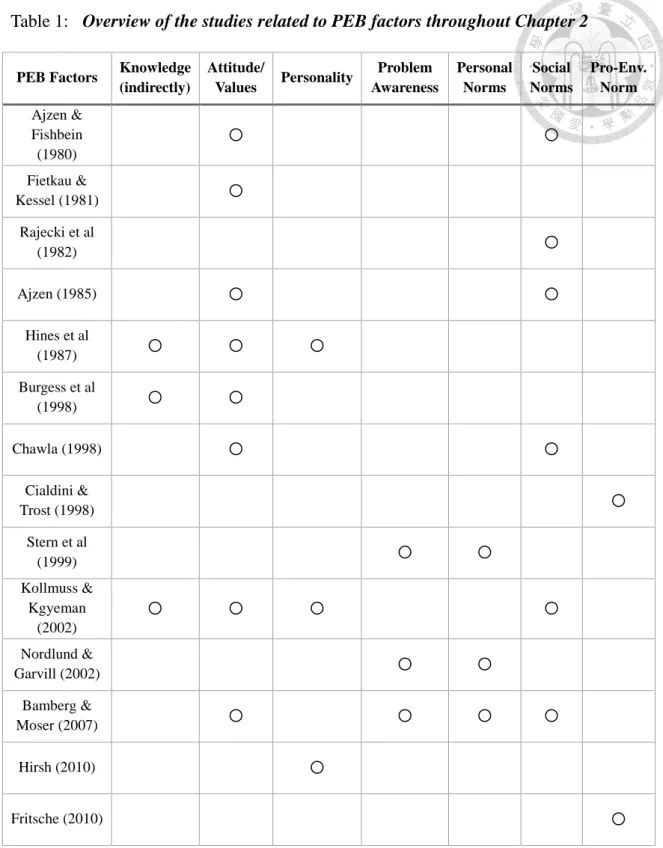
One of the early simple model discussing PEB was developed by Burgess et al.
(1998). The study was based on a linear progression that environmental knowledge leads to environmental attitude/awareness, and environmental attitude/awareness leads to PEB. However, the models were soon proven wrong, where other researches started to show that there were discrepancy between attitude and behavior.
Seeing the findings of the gap between environmental attitude and PEBs, researchers started to base their model on attitude-behavior model in Theory of Planned Behavior (Ajzen, 1985; Ajzen & Fishbein, 1980, 1988), where they imply that when given people act rationally, people’s behavior should be influenced by behavior intention, which was influenced by attitude toward behavior, subjective norm, and relative importance of attitudinal and normative considerations. Studies that were based on this theory tried to breakdown on what were the behavior intentions of PEB, such as Hines et al. (1987)’s Model of Responsible Environmental Behavior, where they did a meta-analysis of 128 PEB research studies. The variables found in their theory were knowledge of issues, knowledge of action strategies, locus of control, attitudes, verbal
commitment, and individual sense of responsibility; however, their relationships with each other were weak at best, and stated that many more situational factors influenced the PEB, such as economic constraints, social pressures, and opportunities to choose different actions. In 2002, Kollmuss and Agyeman (2002) summarized multiple models of PEBs at that time and gave a model combining the internal factors, such as personality traits and value system, external factors, for example social and cultural factors; and integrated the barriers of PEB, like old behavior patterns.
Later on, more studies based on the Hines et al’s theory seemed not reliable due to the weak relationship outcomes, a more recent study did a replication and extension on Hines et al’s theory, and reported that the correlations between psycho-social variables and PEB were similar to that of Hines et al. Other findings stated that besides attitude and behavioral control, personal moral norm was a third predictor of PEB intentions (Bamberg & Möser, 2007).
In Turaga et al. (2010)’s research, where they discuss about the determinants of PEB of trends in social psychology and rational choice models. They also discussed about the two most acknowledged, and empirically supported theories of moral motivation: norm-activation theory and value-belief-norms. In the conversation of norm-activation theory, Turaga et al summarized that ‘people with high awareness of consequences of their actions and who demonstrate some ascription of responsibility to themselves for those consequences are more likely to engage in PEBs.’ As for the theory of Value-Belief-Norms, they used Schwartz’s (Schwarz, 1977) explanation of construction of personal norms in an action situation, which suggested that ‘norms are constructed by reference to a stable set of underlying values relevant to the action.’
Table 1: Overview of the studies related to PEB factors throughout Chapter 2
PEB Factors Knowledge (indirectly)
Attitude/
Values Personality Problem Awareness
Personal Norms
Social Norms
Pro-Env.
Norm
Ajzen &
Fishbein
(1980)
○ ○
Fietkau &
Kessel (1981)
○
Rajecki et al
(1982)
○
Ajzen (1985)
○ ○
Hines et al
(1987)
○ ○ ○
Burgess et al
(1998)
○ ○
Chawla (1998)
○ ○
Cialdini &
Trost (1998)
○
Stern et al
(1999)
○ ○
Kollmuss &
Kgyeman
(2002)
○ ○ ○ ○
Nordlund &
Garvill (2002)
○ ○
Bamberg &
Moser (2007)
○ ○ ○ ○
Hirsh (2010)
○
Fritsche (2010)
○
2.2 The potential factors of Pro-environment Behavior in organizations
For PEB, we used the definition of Kollmuss and Agyeman (2002), which is defined as ‘behavior that consciously seeks to minimize the negative impact of one’s actions on the natural and built world’ (e.g. minimize resource and energy consumption, use of non-toxic substances, reduce waste production),” in short, it is to act environmentally friendly. Though Burgess et al’s model implies that environmental attitude attributes to PEB; there are other researches that found discrepancies between attitude and behavior. Ickes, Patterson, Rajecki, and Tanford (1982) have tried to explain the gap of the discrepancy of environmental attitude/awareness and PEB, and defined four causes: Direct versus indirect experience, normative influences, and temporal discrepancy and attitude-behavior measurement (e.g. measured attitudes are broader in scope than measured actions, which leads to discrepancies in results). Due to these potential causes, abundant of studies had tried to figure out what fills the gap between the relationship of environmental attitude and PEB, and in this study, the foundation of the model would be based on a simplified model of Kollmuss and Agyeman (2002) will be proposed, which breaks the model down to the internal and external factor that might influence one’s PEB. The simplified model was hypothesized to clarify the relationship between EV (internal factor) to PEB, PENs (external factor) to PEB, and whether PEN plays a moderating role or not.
2.3 Environmental Values of individuals and their impact on Pro-environment Behavior
Values are the guidelines that people decide what is right or wrong, good or bad, should or shouldn’t do. Similarly, Environmental Value (EV) is the value based on one’s views, attitude and concern towards the environment. From the Theory of Planned Behavior (Ajzen, 1985; Ajzen & Fishbein, 1988), we know that beliefs and attitude towards the behavior is one of the major factors behind one’s behavior intention.
Though there are studies that suggest that personal norm acts as mediator of EV towards PEB (Harland et al., 2007; Nordlund & Garvill, 2002), other research implies that EV has a relationship with PEB were also proposed, such as Fietkau and Kessel (1981a)’s model stated that environmental attitudes and values is an independent variable of PEB, and Kollmuss and Agyeman (2002) regards value systems as internal factors that influence PEB.
Dunlap, Van Liere, Mertig, and Jones (2000) developed a measurement called the New Ecological Paradigm (NEP), which gave a more stable set of basic human values and updated terminology of environment problems. It was the revised measure of the older version of New Environmental Paradigm, which was used to measure Environmental Beliefs in the Value-Belief-Norm (VBN) theory of Stern et al. (1999).
However, the scale of NEP was soon used broadly to measure environmental attitudes, beliefs and values (Dunlap et al., 2000), and is still used in numerous studies related to PEB(Turaga et al., 2010).
To sum up, the hypothesis of the relation of Personal EV to PEB is proposed:
Hypothesis 1. Employees who have stronger Environmental Values would more likely to preform pro-environment behavior at work.
2.4 Pro-environment Norm at work and their impact on Pro-environment Behavior
PEN is one of the branches of social norms, which is defined as ‘rules and standards that are understood by members of a group, and that guide and/or constrain social behavior without the force of laws’ (Cialdini & Trost, 1998, p. 152). Although personal norms influencing PEB is highlighted in studies (Bamberg & Möser, 2007;
Harland et al., 2007; Nordlund & Garvill, 2002; Stern, 2000), the relationship between PEN and employee’s PEB is seldom discussed and still far from perfect. However, norms play an important role in the promotion of behaviors (Ajzen & Fishbein, 1980), especially in Asia where people are more considered to be collectivists, which could be influenced greatly by the surrounding people around them. Thus, if organizations could create PENs in employee’s working environment, employees who were not engaged in PEB, may be influenced and would start to follow their colleagues’ behavior and act environmentally, which would benefit both the firm and the environment. Hence, the investigation of whether PEN in work environments could result in more PEBs, is an important research agenda in Environmental Psychology.
Hypothesis 2 Work environments with stronger Pro-environment Norms would more likely to have a positive influence on Pro-Environment
behaviors of employees.
2.5 Moderating Role of Pro-environment Norm at work
Numerous literatures implies that moral norms may act as a mediator for social norms, guilt and attribution which processes towards PEB intentions (Bamberg &
Möser, 2007), we also referred previously of how might PEN affect the relationship between one’s EV and PEB in Chapter 1, with examples of environmental movements and energy conserving behaviors; however, due to the lack of studies on this topic, the question of whether norms at work might really be a moderator is a new topic yet to be discuss. On one hand, we previously predicted that employee’s EV is a factor behind why PEB is performed; conversely, on the other hand, we would like to know whether the relationship is moderated by other factors, such as PEN. The third hypothesis was proposed due to the observation of when people was involved in a high PEN environment, people’s EV may be gradually changing due to the higher frequencies of conversations or actions perceived in their work places, and would strengthen their intentions to perform PEBs. Therefore we suggest that, with higher PENs given, employee’s EV relationship towards PEB would be enhanced.
Hence, a hypothesis of whether PEN plays a moderating role or not is discussed:
Hypothesis 3 The Pro-environment norms at work moderate the relationship between employee’s individual Environmental Values and their Pro-environment Behavior, such that when in situations with high Pro-environment Norms, the relationship between individual Environmental Values and Pro-environment Behavior is higher than situations with low Pro-environment Norms.
2.6 Research Framework
According to the literature review and hypotheses mentioned above, this study creates the relationships among three constructs which include employee’s EV, the PEN of their work environment, and employee’s self-perceived PEB. Figure 1 shows the research framework of this study.
Employee’s Environmental Values Pro-Environment Behavior
Pro-Environment Norms at Work H3
H2 H1
Figure 1: Theoretical Model
Chapter 3 Methodology
3.1 Research Setting 3.1.1 Participants
Participants of the study were random employees from different status, companies and industries that volunteered to do the questionnaire. The status includes workers, technicians, low-level supervisors, mid-level executives and senior executives.
A total of 213 surveys were returned, after eliminating surveys with missing data yielded 187 samples with a response rate of 88%. As shown later on in Tables 2 and 3, respondents were 72 male (39%) and 115 female (61%); their average age was 28.85 years (SD=7.60); their average tenure in their current work was 28.54 months (SD=41.45). Education backgrounds showed all participants completed 9th grade, and consists mostly Bachelor degree and Master degree, with 92 (49%) and 80 people (43%); the rest were 10 people with Associate degree (5%) and 5 completed high school only (3%). The sample’ status of the participants in their current job includes 97 workers (54%), 63 technicians (35%), 11 low-level supervisors (6%) and 10 mid-level executives (5%); there were also 16 senior executive who done the survey, but were excluded due to the setting of the questionnaire, and for the consistency of data for later analysis.
3.1.2 Procedures
The questionnaire was done online using Google Survey, and was distributed through social media and via email. The participants were informed about the survey process, assured complete confidentiality and their answers would not affect their work
3.2 Measures
In this research, we used a five-point scale and a four-point scale due to different developed measures. The survey was conducted in Taiwan, therefore the measures that were originally constructed in English was changed into Mandarin. In order to ensure that the Mandarin version of all items were comparable at a high degree of accuracy, the transformation of the measures followed a back-translation process (Brislin, 1986). Also, the measure orders of the questionnaire were also reversed, putting the dependent variable first and the predictor variable at the end to reduce potential priming effect that may cause bias in data (Podsakoff, MacKenzie, Lee, & Podsakoff, 2003).
3.2.1 Employee’s Environmental Values
A measure of a 15-item New Ecological Paradigm (NEP) Scales developed by Dunlap et al. (2000) was used, it was a commonly used measure to extract participants’
personal values towards their pro-environmental orientation; it uses a five-point Likert scale, ranging from 1, “strongly disagree,” to 5, “strongly agree.” Furthermore, the NEP is a revised version the original NEP in 1978 (Dunlap & Van Liere, 1978) by including wider facets of the ecological worldview and terminology that is more up to date.
The Mandarin version of NEP was validated by Shen and Chiu (2014), though few sentences were changed moderately to make the meaning closer to the original English version by the author. The Cronbach’s alpha coefficient for this scale was .76.
3.2.2 Pro-environment Norms at work
A four-items measure found in Videras, Owen, Conover, and Wu (2012) was used. The measure consisted of two sections: the first section consists one item, and used a four-point scale ranging from 1, “none of them,” to 4, “most of them”; the second section uses a four-point scale with three-items, scale ranging from 1 “none” to 4, “more than 3 times per week.” Both sections had a dummy “I don’t know” added to the scale.
The scale measured the PEN of the given group, and we take the one that was used to measure which indicates coworker’s interactions at their work place to measure the perceived PEN by employees in the current study.
Since there were two aspects to measure in the PEN category—perceived supervisor’s pro-environment concern and the perceived work environment pro-environment concern, the author developed a scale to measure the supervisor’s pro-environment concern by using the format discussed previously in the work of Videras et al. (2012). Small modifications was made to adapt the measure asking about a group to fit the logic of asking a person’s concern about the environment. The first section for measuring employee’s perceived supervisor’s pro-environment concern uses a five-point scale, ranging from 1 “never” to 5, “always.” This section’s calculation was later modified to fit the four-point scale, by multiplying .80 to the first section’s response. The second section uses a four-point scale, ranging from 1 “none” to 4, “more than 3 times per week,” which is the same format discussed previously.
The two perceived concerns, the perceived supervisor’s pro-environment concern and perceived work environment pro-environment concern, were later calculated together to form the variable of the PEN. The Cronbach’s alpha coefficient for the items
3.2.3 Employee’s Pro-environment Behavior
The items for the pro-environmental Behavior developed in this study mainly used Y. H. Chen (2009)’s scale of 15-items, but four more items were added by the author to make it more complete and suitable for Taiwanese employees.
A 15-item environmental behavior scale developed by Y. H. Chen (2009) was mainly used; it uses a five-point Likert scale, ranging from 1, “never,” to 5, “always.”
The scale measures the perceived frequency of one’s own PEB. Samples are “I recycle my trash and put it in the right ban” and “I do my part to conserve electricity, such as closing the lights after use, turn on AC only above 26 degrees and use energy saving light bulbs.” However, the measure lacks measurement items about new habits of Taiwanese employees that may refer to a pro-environmental behavior; due to this fact, an item was added to suit the PEB seen in Taiwanese firms. The item added was according to Yang (2014), which stated that 26.50% of Taiwanese employees had a habit change to bring their own lunchbox to work, therefore the author modified one of Y. C. Chen (1999) measure to meet the qualification to be adapted into the measure: “I bring my own lunchbox to work, in order to reduce the usage of paper lunchboxes.”
Also, the measure lacks of measurements about “environmental activists’
activities”. Consequently, an activist item that was more suited to Taiwan’s background was adopted from two studies: one from Karp (1996), “I did volunteer work for an environmental group;” and the other two from Cheng (2004), “I had signed environmental-related petitions before” and “I had participated in environmental-related protest marches.”
Combining the additional four-items into the 15-item measure of Y. H. Chen (2009), there were a total of 19-items in the measure of the PEB. The Cronbach’s alpha coefficient for the items was .79.
3.2.4 Control Variables
The subjects’ demographic variables such as age, gender, marriage, educational level, status, tenure and whether the firm consists ecological products or services were obtained to control potential confounding effects on the subjects’ PEB.
3.3 Analytical Strategy
The hypothesis predicts the relationships between employee’s Environmental Values, work place’s Pro-environment Norm and PEB. The collected data were analyzed using the SPSS 22.0 to execute this study, and statistical methods included descriptive statistics, reliability analysis, Pearson correlation analysis, factor analysis, and hierarchical regression analysis.
3.3.1 Descriptive Statistics
Descriptive analysis was used throughout data analysis in a number of different ways. It consisted of the frequency and percentage of the participants’ age, gender, marriage, education, status, ecological products/services, tenure in months, and each dimension of the questionnaire.
3.3.2 Reliability Analysis
Reliability analysis was used to examine the internal consistency of the scales in the questionnaire. We assessed the internal consistency of three dimensions: employee’s EV, PEN of the work environment, and employee’s PEB in this study.
3.3.3 Pearson Correlation Analysis
Pearson Correlation analysis was used to find out the relationships between two or more variables or sets of variables. Thus, we used it to examine the relationships between employee’s EV, PEN of the work environment, and employee’s PEB in this study.
3.3.4 Hierarchical Regression Analysis
Hierarchical regression analysis was used to examine the causal effects on each hypothesis we proposed. First, we entered the control variables: respondents’ age, gender, marriage, education, status, tenure in months, and whether acquire ecological products/services into Model 1, as shown in Table 2 below, to value the effects on PEB.
Then we added EV and NEP into Models 2 and 3 to figure the independent effects on PEB. In Model 4, we entered both EV and NEP as independent variables to see the effects on PEB when analyzed together. Finally in Model 5, we entered the interaction of EV and NEP (EV x NEP) to examine the moderating effect on the relationship between EV and NEP. Table 2 lists the five regression models used in the hierarchical regression analysis.
Table 2: Hierarchical Regression Analysis for the Mediated Model
Variables PEB as DV
Model 1 Model 2 Model 3 Model 4 Model 5
CV CV CV CV CV CV
IV EV PEN EV & PEN EV
Moderator PEN
Note.
CV= Control Variables IV= Independent Variable DV=Dependent Variable
Chapter 4 Results
4.1 Descriptive Statistics
Tables 3 demonstrated the frequencies, percentage for the study variables, and Table 4 displays the means, standard deviations, reliability coefficients, and correlations analysis for all study variables. About the main effect, the signs on the signify correlations implied that EV was positively related to PEB (r=.20, p<.01). Also, PEN was positively related to PEB (r=.29, p<.01).
4.2 Hypothesis Tests
Using the approach of Hierarchical Regression, the influence of employee’s EV and PEN towards employee’s PEB was analyzed. The controlled demographic items in the hypothesis test consisted: participant’s age, gender, marriage, education level, status at work, tenure (months) and ecological products/services. The last control variable—ecological products/services—was considered extremely important, since whether they had ecological products or services at their work place had a significant correlation to the PEN and PEB.
Table 3: The Analysis of Participant’s Profiles
Frequency Percent
Age Under 20 (including 20) 2 1%
21-25 79 42%
26-30 60 32%
31-35 20 11%
36-40 8 5%
41-45 9 5%
46-50 2 1%
50 and above 7 4%
Gender Female 115 61%
Male 72 39%
Marriage Not Married 157 84.0%
Married 30 16.0%
Education Below 9th grade 0 0%
Completed High school 5 3%
Associate Degree 10 5%
Bachelor Degree 92 49%
Master Degree and above 80 43%
Status Worker 103 54%
Technicians 63 35%
Low-level Supervisor 11 6%
Mid-level Executive 10 5%
Eco. P/S Does not have Eco. P/S 132 71%
Have Eco. P/S 55 29%
Tenure (months) Less than 12 (including 12) 95 51%
12-24 33 18%
25-36 26 14%
37-48 7 3%
49-60 4 2%
61-72 1 1%
73-84 3 1%
85-96 1 1%
97-108 2 1%
109-120 5 3%
121-132 3 1%
133-144 0 0%
145-156 2 1%
157 and above 5 3%
Note. N=187
Eco. P/S= Ecological Products/Services
Note: n=187 (exceptions of missing data of some); coefficient alphas are listed in parentheses along the diagonal.
**. Correlation is significant at the 0.01 level (2-tailed tests).
*. Correlation is significant at the 0.05 level (2-tailed tests).
a Gender: 0=Female; 1=Male.
b Marriage: 0=Not married; 1=Married.
c Education: 1=Completed less than 9th grade; 2=Completed high school; 3=Associate’s degree; 4=Bachelor’s degree; 5=Master degree and above.
d Status: 1=Workers; 2=Technicians; 3=Low-level supervisors; 4=Mid-level executives.
f Eco. P/S= Ecological Products/Services: 0=No product or services involved in their work; 1=Have product or services involved in their work.
Table 4: Overall Descriptive Statistics and Correlations
Variables Mean SD 1 2 3 4 5 6 7 8 9 10
1. Age 28.85 7.60 --
2. Gender a .39 .49 -.01** --
3. Marriage b .16 .37 .61** -.02** -- .
4. Education c 4.32 .70 -.25** .16** -.14** --
5. Status d 1.64 .83 .53** .20** .40** -.08** --
6. Eco. P/S .29 .46 .11** .09** -.03** .01** .07** --
7. Tenure (months) f 28.54 41.45 .60** .02** .44** -.22** .35** .13** --
8. Environmental Values 3.94 .52 -.02** -.13** -.09** -.02** -.13** .02** -.00* (0.76)
9. Pro-Environment Norm 1.83 .69 .13** .01** .04** -.04** -.02** .31** .09* -.10** (0.89)
10. Pro-Environment Behavior 3.19 .49 .15** -.09** -.06** -.15** -.09** .27** .16* .20** .29** (0.79)
Table 5: Regressions Predicting Pro-Environment Behavior
Control Variables EV as IV PEB as DV
PEN as IV PEB as DV
EV & PEN as IV PEB as DV
EV as IV PEN as M
Model 1 Model 2 Model 3 Model 4 Model 5
Predictor β β β β β
(Constant) 3.18** 2.60** 2.96** 2.24** 2.53**
Control Variables
Age -.02** -.02** -.01** -.01** -.01**
Gender -.06** -.04** -.06** -.04** -.04**
Marriage -.25** -.22** -.25** -.22** -.22**
Education -.07** -.07** -.07** -.07** -.07**
Status -.12** -.10** -.10** -.09** -.09**
Ecological Product/Service -.26** -.25** -.19** -.18** -.18***
Tenure (months) -.00** -.00** -.00** -.00** -.00**
Variables **
Environmental Values (EV) -.15** -.18** -.18**
Pro-Environment Norm (PEN) -.14** -.16** -.16**
Interaction
EV X PEN -.04**
R2 -.16** -.19** -.20** -.23** -.23**
Adjusted R2 -.13** -.15** -.17** -.19** -.19**
ΔR2 -.03** -.04** -.07** -.00**
F 5.03** 5.16** 5.60** 6.00** 5.39**
Note. N=187; *p<.05; **p<.01; IV= Independent Variable; DV= Dependent Variable; M= Moderator
4.2.1 The Main Effect of Individual’s Environmental Values
Hypothesis 1 suggested that employees who have stronger EV tend to perform more PEB than people who have weaker EV. As shown in Table 5, the results supported the prediction as follows: (a) in Model 2, employee’s EV was significantly related to PEB (β=.15, p<.05); (b) in Model 4, where both independent variable, EV and PEN, was analyzed, EV showed a more significant relationship towards PEB than in Model 2 (β=.18, p <.01). Therefore, Hypothesis 1 was supported.
4.2.2 The Main Effect of Pro-Environment Norms at work
Hypothesis 2 posited that if the work environments where the employees work have a strong PEN, their PEB would be enhanced. Results in Table 5 supported the prediction: (a) in Model 3, the PEN at employee’s work place was significantly related to PEB (β=.14, p<.01); (b) in Model 4, the PEN increased its signification of prediction when regressed along with employee’s EV (β=.18, p<.01). Thus, Hypothesis 2 was supported.
4.2.3 The Moderation Effect of Pro-Environment Norm
Hypothesis 3 proposed that PEN would positively moderate the relationship between employee’s EV and PEB. The regression results are revealed in Table 5. As shown in the table, the EV x PEN interaction term was not significant (β=.04, n.s.), indicating that the interaction effect of PEN was not a significant predictor of PEB.
Consequently, PEN did not influence on the relationship between employee’s EV and
Chapter 5 Discussion
The primary objective of this study was to develop and examine a model of internal and external factors of EV and PEN that explains why employees perform PEBs, and whether the PEN, or environmentally friendly atmosphere, of organizations would influence employees’ mind set, and making their green behaviors, PEB, increase.
With the support of theoretical analysis, the results of the research found that the EV which employees consists was related to their PEBs, which was in tone to previous literatures investigating factors, such as individual’s attitude and values, that influenced individual’s PEB (Stern et al., 1999).
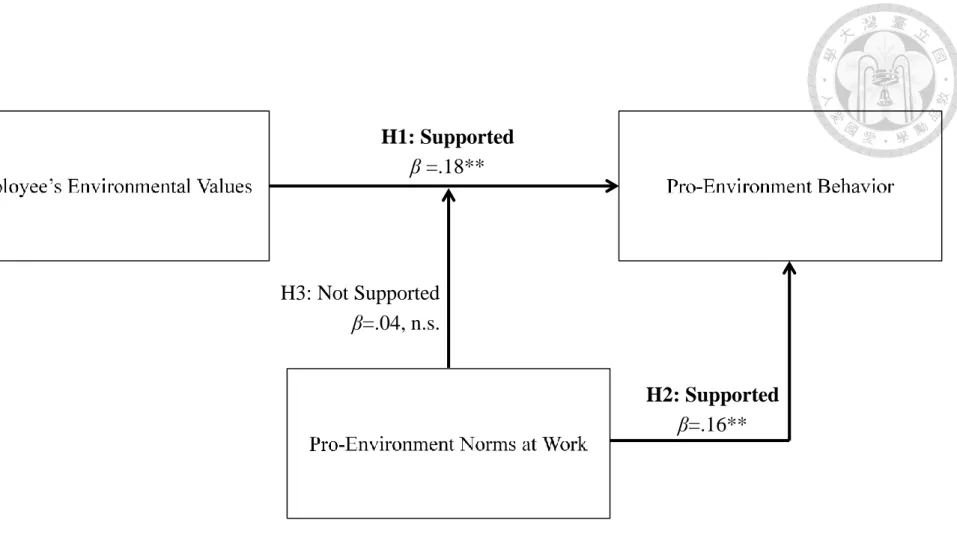
In addition, as hypothesized, PEN in organizations did put forth a positive main effect on employee’s PEB, which indicates that with a more environmentally friendly work environment, employees’ tendency of PEB increases. However, no support was found for the hypotheses, H3, that the moderator of PEN at work had an influence on the relationship between employee’s EV and PEB. Table 6 shows the summery of the hypothesis test, and Figure 2 shows the results of the Theoretical Model.
Why H3 wasn’t supported may be explained through different aspects. One may be that people don’t voluntarily perform additional PEB behaviors, due to their values, which may not be easily changed in a short period of time and work environment.
Another, people’s PEB may change due to pure social pressure from colleagues, which somewhat reflects H2, instead of H3. Lastly, the participants in this research have an average tenure of 28.54, with 51% less than 12 months, which may cause the lack of social norm engagement. In spite of all, the research on PEBs in organizations is just starting, and given this new field, the current study yielded some insights with theoretical and managerial implications.
Table 6: Summary of Results
Item Hypothesis Result
H1 Employees who have stronger Environmental Values would more likely to preform pro-environment behavior at work.
Supported
H2 Work environments with stronger Pro-environment Norms would more likely to have a positive influence on pro-environment behaviors of employees.
Supported
H3 The Pro-environment norms at work moderate the relationship between employee’s individual environmental values and their pro-environment behavior such that when in situations with high pro-environment norms, the relationship between individual environmental values and pro-environment behavior is higher than situations with low pro-environment norms.
Not supported
H3: Not Supported β=.04, n.s.
H2: Supported β=.16**
H1: Supported β =.18**
Figure 2: Result of Theoretical Model
5.1 Theoretical Implications
This study contributes to the pool of studies of PEB and a stepping stone to PEN studies by constructing a simple model indicating factors of that influence the PEBs of employees in the following ways:
To begin with, the current study advances the literature of PEBs by focusing on the intentions of act in organizational environments. Although research in PEB has grown, and models demonstrating why individuals act environmentally was conducted, little is yet to know about what impacts the green behaviors of employees. Extending the research steam, this study focused on the implications of EV (internal factor) and PENs (external factor) and how they influence employee’s PEB. The findings suggested that both factors contributes employees to act environmentally, and performs better when looked together. This finding is a valuable addition to the field of PEB’s research, as it explains the potential factors that provoke employees to act green, and this may give light to new insights and bigger possibilities for organizations to conduct green movements to achieve better act, for both external competitiveness and internal ethics.
Although past research found that personal norm and the factors behind it was an indicator of why people perform PEBs in organizations (Stern et al., 1999); to our knowledge, seldom studies use PEN at work to predict the outcomes of PEB. Thus, the present study advances our understanding on the PEN in organizations by concentrating on the relationship of where the PEN interacts, such as whether the norm interacts as an independent variable, a moderator, or both.
5.2 Managerial Implications
The present study provides implications for HR managers, firms and governments that hopes to encourage the good deed of organizations acting green.
Due to the increase of environmental problems that cannot be ignored, there has been a momentum of green movements throughout the world. From a company’s perspective, this research recommends that firms should promote an environmentally friendly atmosphere in work places to achieve a bigger pool of “green employees (Ciocirlan, 2016).” Also, a pull of demand from customers increasing significantly;
people is starting to choose greener products and services, and tends to buy products from companies that is perceived to be more sustainable and environmentally friendly.
Furthermore, empirical studies has further implied that having green employees achieves better profits and business images (Eng Ann et al., 2006; Naffziger et al., 2003), for example, American Airlines stated that their flight attendants recycle over 616,000 pounds of aluminum cans, earning at least $40,000 in one year (Govindarajulu & Daily, 2004). Therefore, enhancing the work environment into an environmental friendly one may help organizations to acquire better profits and business image through the indirect effect of green employees.
For the HR managers who wish to conduct in Green HRM, the study gives a different insight of those presented in the study in Green HRM. Though only a few literature focuses on Green HRM, and is still developing its basis of entry-to-exit process in HRM, such as the designing of recruiting green employees, which was mentioned in the study of Mandip (2012). This research implies that, besides investigating the process of entry-to-exit to obtain green employees, creating a PEN atmosphere in work places can encourage employees to act greener, making them to
become a potential green employee.
Finally, from the government’s viewpoint, this study gives the government an insight on what aspects they may help firms to become greener. After Paris Agreement of 2015 United Nations Climate Change Conference, Conference of Parties 21 (COP 21), 162 countries submitted the Intended Nationally Determined Contributions (INDCs). This indicates that more countries are deciding reduce greenhouse gases and carbon emissions actively. Due to this trend, the study implies that government may conduct an elaboration on the concept of Green Work Environment certifications, which would encourage firms to create a greener working atmosphere and environment norm, influencing more people to act environmentally responsible, and receive a better image from consumers. With more “green employees” situated in different positions throughout in firms and in different industries, the results can make a positive impact on the environment, as implied by Ciocirlan (2016).
5.3 Limitations and Future Directions
Despite the above contributions, limitation and future research in this study remains. First, because the present study was conducted through surveys online, the setting of the experiment was difficult to control. Though it was encouraged that participants use computers to fill the questionnaire, some participants used smartphones to fill out the survey. It was heard that some experience an incomplete view of the questionnaire and had difficulty seeing the full-scale width of measures conducted.
Future work may take this limitation into concern when conducting the research.
Thirdly, the definition of PEB mentioned in this research is based on former research in Environmental Psychology. However, it is worth arguing that the factors of PEB intentions are still not settled, especially when combined with the field of organizations. The model in this study only specifies two factors effecting employee’s green behavior, one was employee’s EV and the other as the PEN in work areas; it is believed that more factors could be dug out in the future through the extension on present models and studies of PEB, such as adding Ascription of Responsibility, which was mentioned in Stern et al. (1999)’s VBN theory, and could be extended to the direction of an organization context.
Moreover, the overall R2 scores of all models in this study did not exceed 25%.
This may indicate that other variables might be needed to interpret variable variances and enhance the explanation power in this study. For example, economic factors can be added towards the intentions of acting environmentally, like whether the payback time for the energy saved is considered short or not (Kollmuss & Agyeman, 2002).
Finally, this research is conducted in Taiwan, and it would be interesting to see empirical research conducted in different cultures, especially to compare countries that differ in the cultural orientations context of collectivism and individualism, such as Japan and the US—Japan is known for their thrift in conserving energy, especially after the 311 nuclear crisis and the US is recognized as a country representing individualism.
The results in their difference in PEN may result to a different conclusion to that of ours.
5.4 Conclusion
Previous research has acknowledged that one’s EV may greatly affect the behavior of individuals. The past few years, PEB has increasingly received research attention as climate change continues to rocket. This urged the demand for theoretical advancement in defining the indicators that make people perform environmentally responsible behaviors. This study thus contributes to this research stem by exploring the association of employee’s EV and PEN with their behavior—PEB—with the given setting at work.
Our data suggests that employees who have high EV, perform PEBs, and work places with high PENs also tends to influence employees to act Pro-environmentally. All in all, though this study does not yet give a complete picture of PEB in work environments, it is hoped that the model and the theoretical implications of this study can give some light for future research achievements to advance people’s understanding of the mysterious indicators of PEB, and PEB in organizations; moreover, to help our planet to become beautiful once again.
REFERENCE
Ajzen, I. (1985). From intentions to actions: A theory of planned behavior: Springer.
Ajzen, I., & Fishbein, M. (1980). Understanding attitudes and predicting social behaviour.
Ajzen, I., & Fishbein, M. (1988). Theory of reasoned action-Theory of planned behavior.
University of South Florida.
Bamberg, S., & Möser, G. (2007). Twenty years after Hines, Hungerford, and Tomera: A new meta-analysis of psycho-social determinants of pro-environmental behaviour. Journal of Environmental Psychology, 27(1), 14-25.
Banerjee, S. B. (2002). Corporate environmentalism: The construct and its measurement.
Journal of Business research, 55(3), 177-191.
Bansal, P., & Roth, K. (2000). Why companies go green: A model of ecological responsiveness. Academy of management Journal, 43(4), 717-736.
Brislin, R. (1986). The Wording and Translation of Research Instruments. 1986. Field Methods in Cross Cultural Research. Beverly Hills, California: Sage Publications, 159-163.
Burgess, J., Harrison, C. M., & Filius, P. (1998). Environmental communication and the cultural politics of environmental citizenship. Environment and planning A, 30(8), 1445-1460.
Chawla, L. (1998). Significant life experiences revisited: A review of research on sources of environmental sensitivity. The Journal of Environmental Education, 29(3), 11-21.
Chen, Y. C. (1999). 嘉南藥理學院專題研究計畫成果報告大專院校垃圾資源再利用 推動情形及知識態度與行為調查.
Chen, Y. H. (2009). 台灣民眾對環境保護認知, 態度與行為之調查研究. 淡江大學 水資源及環境工程學系碩士班學位論文, 1-140.
Cheng, S.-I. (2004). 影響環保團體成員三種環境行為意向之因素的比較. (博士), 國 立中山大學, 高雄市.
Cialdini, R. B., & Trost, M. R. (1998). Social influence: Social norms, conformity and compliance.
Ciocirlan, C. E. (2016). Environmental Workplace Behaviors: Definition Matters.
Organization & Environment, 1(20).
Dunlap, R. E., & Van Liere, K. D. (1978). The “new environmental paradigm”. The Journal of Environmental Education, 9(4), 10-19.
Dunlap, R. E., Van Liere, K. D., Mertig, A. G., & Jones, R. E. (2000). New trends in measuring environmental attitudes: measuring endorsement of the new ecological paradigm: a revised NEP scale. Journal of social issues, 56(3), 425-442.
Eng Ann, G., Zailani, S., & Abd Wahid, N. (2006). A study on the impact of environmental management system (EMS) certification towards firms' performance in Malaysia. Management of Environmental Quality: An International Journal, 17(1), 73-93.
Fietkau, H.-J., & Kessel, H. (1981a). Umweltlernen: Handlungsleitende Konsequenzen.
umweltbewusstseins. Modell-Erfahrungen (Koenigstein, Hain).
Fritsche, I., Jonas, E., Kayser, D. N., & Koranyi, N. (2010). Existential threat and compliance with pro-environmental norms. Journal of Environmental Psychology, 30(1), 67-79.
Govindarajulu, N., & Daily, B. F. (2004). Motivating employees for environmental improvement. Industrial Management & Data Systems, 104(4), 364-372.
Harland, P., Staats, H., & Wilke, H. A. (2007). Situational and personality factors as direct or personal norm mediated predictors of pro-environmental behavior:
Questions derived from norm-activation theory. Basic and Applied Social Psychology, 29(4), 323-334.
Hines, J. M., Hungerford, H. R., & Tomera, A. N. (1987). Analysis and synthesis of research on responsible environmental behavior: A meta-analysis. The Journal of Environmental Education, 18(2), 1-8.
Hirsh, J. B. (2010). Personality and environmental concern. Journal of Environmental Psychology, 30(2), 245-248.
Ickes, W., Patterson, M. L., Rajecki, D., & Tanford, S. (1982). Behavioral and cognitive consequences of reciprocal versus compensatory responses to preinteraction expectancies. Social Cognition, 1(2), 160.
Karp, D. G. (1996). Values and their effect on pro-environmental behavior. Environment and Behavior, 28(1), 111-133.
Kollmuss, A., & Agyeman, J. (2002). Mind the gap: why do people act environmentally and what are the barriers to pro-environmental behavior? Environmental education research, 8(3), 239-260.
Maclagan, P. (1999). Corporate social responsibility as a participative process. Business ethics: A european review, 8(1), 43-49.
Mandip, G. (2012). Green HRM: People management commitment to environmental sustainability. Research Journal of Recent Sciences, ISSN, 2277, 2502.
Menon, A., & Menon, A. (1997). Enviropreneurial marketing strategy: the emergence of corporate environmentalism as market strategy. The Journal of Marketing, 51-67.
Naffziger, D. W., Ahmed, N. U., & Montagno, R. V. (2003). Perceptions of environmental consciousness in US small businesses: An empirical study. SAM Advanced Management Journal, 68(2), 23.
Nordlund, A. M., & Garvill, J. (2002). Value structures behind proenvironmental behavior. Environment and Behavior, 34(6), 740-756.
Podsakoff, P. M., MacKenzie, S. B., Lee, J.-Y., & Podsakoff, N. P. (2003). Common method biases in behavioral research: a critical review of the literature and recommended remedies. Journal of applied psychology, 88(5), 879.
Schwarz, S. H. (1977). Normative influences on altruism. Advances in experimental psychology, 10, 222-280.
Shen, S. D., & Chiu, H. Y. (2014). 影響綠色大學教職員採取環保行為意願之因素以 台灣北部某大學為例. 設計學研究, 17(1), 71-90.
Shrivastava, P. (1995). The role of corporations in achieving ecological sustainability.
Academy of management review, 20(4), 936-960.
Stern, P. C. (2000). New environmental theories: toward a coherent theory of environmentally significant behavior. Journal of social issues, 56(3), 407-424.
Stern, P. C., Dietz, T., Abel, T. D., Guagnano, G. A., & Kalof, L. (1999). A value-belief-norm theory of support for social movements: The case of environmentalism. Human ecology review, 6(2), 81.
Takala, T., & Pallab, P. (2000). Individual, collective and social responsibility of the firm. Business ethics: A european review, 9(2), 109-118.
Turaga, R. M. R., Howarth, R. B., & Borsuk, M. E. (2010). Pro‐environmental behavior.
Annals of the New York Academy of Sciences, 1185(1), 211-224.
Videras, J., Owen, A. L., Conover, E., & Wu, S. (2012). The influence of social relationships on pro-environment behaviors. Journal of Environmental Economics and Management, 63(1), 35-50.
Yang, Z. B. (2014). 2014 年 04 月 薪貧世代省錢大作戰調查. Retrieved from https://www.yes123.com.tw/admin/white_paper/index_detail.asp?id=201404171 13725#
Appendix A
ORIGINAL Questionnaires
New Ecological Paradigm (NEP) (Dunlap et al., 2000)
1. We are approaching the limit of the number of people the earth can support.
2. Humans have the right to modify the natural environment to suit their needs.
(reversed)
3. When humans interfere with nature it often produces disasters consequence 4. Human ingenuity will insure that we do NOT make the earth unlivable. (reversed) 5. Humans are severely abusing the environment
6. The earth has plenty of natural resources if we just learn how to develop them.
(reversed)
7. Plants and animals have as much right as humans to exist.
8. The balance of nature is strong enough to cope with the impacts of modern industrial nations. (reversed)
9. Despite our special abilities humans are still subject to the laws of nature
10. The so-called “ecological crisis” facing human kind has been greatly exaggerated.
(reversed)
11. The earth is like a spaceship with very limited room and resources.
12. Humans were meant to rule over the rest of the nature. (reversed) 13. The balance of nature is very delicate and easily upset.
14. Humans will eventually learn enough about how nature works to be able to control it. (reversed)
15. If things continue on their present course, we will soon experience a major ecological catastrophe.
Workplace Pro-Environment Norm Questionnaire (Videras et al., 2012)
1. Please tell us how many of the following people [people at work] you think do things to help the environment?
a) A lot
b) Some or only a little or not at all
2. How often do you discuss with people at work?
2-1. Ways to conserve gas, energy, and water:
a) All topics several times a week, once or twice a week, or a few times per month
b) Two of the topics several times a week, once or twice a week, or a few times per month
c) one of the topic several times a week, once or twice a week, or a few times per month
d) None of the topics several times a week, once or twice a week, or a few times per month
2-2. Environmental problems such as water pollution and air pollution:
a) All topics several times a week, once or twice a week, or a few times per month
b) Two of the topics several times a week, once or twice a week, or a few times per month
c) one of the topic several times a week, once or twice a week, or a few times per month
2-3. Ways to slow down global warming:
a) All topics several times a week, once or twice a week, or a few times per month
b) Two of the topics several times a week, once or twice a week, or a few times per month
c) one of the topic several times a week, once or twice a week, or a few times per month
d) None of the topics several times a week, once or twice a week, or a few times per month
Appendix B
Questionnaires in Chinese 個人問卷
您好,
我是國立臺灣大學商學研究所的研究生,現在正在進行碩士畢業論文的研 究工作。在此研究中,主要是探討職場上環保行為與他人的環保行為之影響。
希望各位能協助學生進行此項研究,幫助我填答此份問卷。您所填寫的答 案並無對錯之分,其結果也僅供整體統計分析,絕對不會單獨對外公開發表,
敬請安心填答。
再次懇請各位惠撥一些時間填寫問卷,並謝謝您的熱心參與。
敬祝
健康快樂
國立臺灣大學商學研究所研究生
陳詩晴
中華