
K.K.音標補救教學
113
0
0
全文
(2)
(3)
(4) ACKNOWLEDGEMENTS I would first express my sincere gratitude to my advisor, Dr. Li-Hung Chang, for his essential inspiration and insightful advice to the completion of the thesis. I would also like to thank Dr. Tzung-Hung Tsai, and Dr. Wei-Yao Li, as the committee for their valuable comments and suggestions to the thesis. Thank you to my students in Kuang Chun Junior High School for attending the Remedial Program. Thank you to my dear friends for giving me so much encouragement in the process of writing the thesis. Finally, I am grateful to my family for providing me with continuous support during the years of study.. i.
(5) 摘要 教育部自 2005 年起,針對小學三年級學生實施英語教學,多年的英語教學卻未 能全面提升學生的英語能力。目前仍然有部分國中學生無法正確地拼讀英文單字, 而導致識字的困難,進而影響英語學習表現。本研究旨在探究 K.K.音標補救教 學能否提升低成就學生的拼讀能力,改善其拼讀技巧以及建立英語學習信心。本 研究以屏東縣光春國中六位八年級學生為研究對象,利用 K.K.音標進行為期六 週,十二堂課的補救教學。透過行動研究,了解學習者在學習過程中面臨的困難 以及運用不同的教學策略協助解決學習問題。此外,研究者更利用每日午休時間 督促學習者複習發音知識,熟練拼讀技巧。依據兩項測驗,教師日誌,觀察者日 誌,問卷及訪談資料進行質量分析與討論。主要發現如下: 一、K.K.音標補救教學有助於提升英語低成就者的拼讀能力。 二、K.K.音標補救教學改善英語低成就者的拼讀技巧。 三、K.K.音標補救教學增進英語低成就者英語學習的信心。 依據以上的研究結果,建議國中英語教師透過 K.K.音標補救教學增進英語低成 就學習者的拼讀能力,改善其拼讀方式以利提升英語學習信心與成效。 關鍵字: 關鍵字: K.K.音標 K.K.音標, 音標,補救教學, 補救教學,拼讀能力. ii.
(6) ABSTRACT This study aimed at helping low achievers acquire the basic skill of pronunciation, improve their strategies of spelling and reading, and build their confidence in learning English. Action research was adopted as the method in the study. The participants were six eighth graders recruited from Kuang Chun Junior High School in Chao Zhou Township. In addition, they received a 12-session K.K. phonetic symbols instruction in six weeks. Data collected from Test 1, Test 2, researcher reflection log, observer’s log, questionnaires, and interviews were discussed and analyzed. The findings were as follows: 1. The K. K. phonetic symbols remedial program helped low achievers enhance their spelling and reading competence. 2. The K. K. phonetic symbols remedial program helped low achievers change their strategies of spelling and reading. 3. The K. K. phonetic symbols remedial program helped low achievers acquire a positive attitude to learn English. Based on the results of the study, the pedagogical implications and suggestions for English teachers and further studies were provided. Keywords: K.K. phonetic symbols, remedial program, spelling and reading competence. iii.
(7) TABLE OF CONTENTS Page ACKNOWLEDGEMENTS………………………………………………………….i CHINESE ABSTRACT……………………………………………………………..ii ENGLISH ABSTRACT……………………………………………………………..iii TABLE OF CONTENTS…………………………………………………………....iv LIST OF FIGURES………………………………………………………………..viii LIST OF TABLES…………………………………………………………….……..ix CHAPTERS CHAPTER ONE INTRODUCTION………………………………………………...1 Motivation and Background of the Study………………………………….…..1 Purpose of the study…………………………………………………………...…4 Research Questions…………………………………………………………...….4 Significance of the Study…………………………………………...........….…..5 Definition of Terms…………………………………………………………..…..6 CHAPTER TWO LITERATURE REVIEW…………………………………..……..8 English Pronunciation Instruction………………………………………..…….8 Phonics Instruction……………………………………………………..………..9 Phonics Instruction in Taiwan……………………………………..…………..10 iv.
(8) Limitation of Phonics………………………………………………..………...11 Phonetics Instruction………………………………………………..………....13 Phonetic symbols Instruction in Taiwan ……..……………………………...16 Related Studies of K.K. Phonetic Symbols Instruction …....………………18 Low Achievers……………………………………………….…………...….…19 Low Pronunciation Achiever …………………………...................................21 Remedial Program……………………………………………….……….........21 Related K.K. Phonetics Remedial Program……………………………........22 Taiwan EFL Students’ Learning difficulties………………………….……...23 CHAPTER THREE METHODOLOGY…………………………………….……..25 Action Research……...………………………….……………………....26 Participants………………………………………………………….…...27 The Teacher…………………………………………………………..….27 Research Design and Procedures……………………………………..…28 The Material……………………………………………………………..31 Data Collection……………………………………………………….....33 Trustworthiness…………………………………………………….…... 34. v.
(9) CHAPTER FOUR FINDINGS AND DISCUSSION……………………….….….36 The Effect of K.K. Phonetic Symbols Remedial Program on Spelling and Reading Competence…………………………………………………....36 The Effect of K.K. Phonetic Symbols Remedial Program on Spelling and Reading Strategies………………………………………………….…....39 The Effect of K.K. Phonetic Symbols Remedial Program on English Learning Attitude…………………………………………………............40 The Findings of the Remedial program..……………………….……...…41 Summary of Major Findings..………………………………....................74 CHAPTER FIVE CONCLUSIONS AND IMPLICATIONS…………….….….….77 Conclusions…….…………….……………………………...………......77 Limitations of the Study…….……………………………..………….....78 Pedagogical Implications….……………………..……………………...79 Suggestions for Further Studies……….……………..……………….…81 REFERENCES…………………………………………….………...……………. 83 APPENDICES Appendix A. Questionnaire on K.K. Learning Background………..…....90 Appendix B. Questionnaire on Strategies of English Words Reading….94 Appendix C. Test 1…………………………………………………………..96 vi.
(10) Appendix D. Test 2………………………………………………….…….....97 Appendix E. Students’ Interview Questions after Attending K.K. Phonetic Symbols Remedial Program………………………..…..…..98 Appendix F. Schedule for K.K. Phonetic Symbols Program…...….…....100. vii.
(11) LIST OF FIGURES Page Figure 1 Process of Reading Acquisition……………………………………………9 Figure 2 Process of Word Recognition……………………………………………..15 Figure 3 Research Design and Process of the Study……………………………….30 Figure 4 Schedule of the K.K. Phonetic Symbols Remedial Program…………….32. viii.
(12) LIST OF TABLES Page Table 1 Results of Test 1……………………………………………………………37 Table 2 Results of Test 2…………………………………………………………....38 Table 3 K.K. Phonetic Symbols Remedial Program for reading and Spelling…….40 Table 4 K.K. Phonetic Symbols Remedial Program for Learning Attitude…......…41. ix.
(13) CHAPTER ONE INTRODUCTION Background and Motivation English is used as a lingua franca to connect with the world. Many believe that a good command of the English language broadens their scope of knowledge and widens their horizons. More parents, today, are urging their children to study English. In addition, since 2005, the Ministry of Education (MOE) has implemented the instruction of English on third graders in elementary schools. However, this policy does not ensure the communicative competence improvement of all the students. In junior high schools, while some students excel in English tests, others still struggle to memorize words. Their performance has seen the emergence of “bimodal distribution” (Wan, Tseng & Sung, 2010). This phenomenon has caused some serious problems and concerns for teachers and educators. Observations during class reveal that most students, who fail in their English exams, have problems with pronunciation, and remembering vocabulary. Memorizing words produces anxiety and frustration. Moreover, their poor performance results in a loss of self-confidence, and a desire to avoid any form of English learning. Lack of money for extra tuitions after school, ensures that they do not gain any support from their families as well. All these negative factors make them reluctant to learn English, ensuring that their. 1.
(14) communicative competence falls far behind their peers. English is an alphabetic language, so the concept of speech sounds is important for learners to develop their basic knowledge of English, and study the consistency of letters and sounds. Kreidler (1989) stated that learning a language begins at the speech learning. Morley (1991) pointed out that pronunciation instruction is crucial for learners to master the sound system of a language. Learners, who are acquainted with English speech units, are able to sound out printed words effortlessly and avoid incorrect spellings. Excellent pronunciation is a key competence, necessary for beginning learners to reach the threshold of communication (Celce-Murcia, Brinton & Goodwin, 2011). In contrast, learners who lack a well-developed knowledge of pronunciation are unable to perceive or produce speech sounds, and thus, fail to recognize words. Consequently, this deficit knowledge of pronunciation impairs their English learning. In junior high schools, according to English textbook syllabi, such as Hanlin and Nanyi, which are two popular publishers in Taiwan, pronunciation is divided into separate portions in each lesson. Teachers do not employ intensive pronunciation courses on students. Wang (1999) mentioned that pronunciation instruction might even be ignored in the early stages of English teaching. Some teachers believe that students can perceive speech sounds naturally; others assume that students, who have. 2.
(15) studied English for several years, must already possess rudimentary skills of producing speech sounds, thus there is no need to provide pronunciation instruction. Therefore, students who do not assimilate the basics of pronunciation, struggle to produce and recognize words. During the early stages of learning English, students need a systematic linguistic tool to associate speech sounds with orthographic units. Through phonetic symbols, students understand how to perceive and produce speech sounds, decompose or combine speech units accurately and develop competence in word recognition and spelling. Li and Young (1980) claim that phonetics instruction is relative to the performance of English learning. Students, who do not know the phonetic symbols, are unable to pronounce new words. In contrast, successful phonetic symbols instruction helps students perceive the sounds of vocabulary, correct their mispronunciation and memorize words effectively. It also enhances their reading and spelling competence. In Taiwan, Kenyon and Knott (K.K.) phonetic symbols are commonly used to teach pronunciation. Liu (1988) indicated that it is difficult to teach pronunciation without the aid of K.K. phonetic symbols. Since K.K. phonetic symbols present letters and sounds accurately, knowing them is beneficial as it helps learners develop their spelling and reading abilities.. 3.
(16) Therefore, K.K. phonetic symbols instruction, plays a pivotal role in teaching and learning English (Liu, 1988). If students are able to master the sound system, they can sound out and recognize English words effortlessly and more effectively (Dai, 2003; Wang, 1985). The stress of memorizing vocabulary words will be reduced as well (Wen, 2014). In addition, their English pronunciation will improve. Therefore, the researcher planned to enhance students’ competence in pronunciation, and help them decrease the gap between their peers and themselves, through a remedial program that incorporated K.K. phonetic symbols. Purpose of the Study The study aimed at helping students with low English as a foreign language (EFL) learning to acquire a basic knowledge of the sound system by implementing a “K.K. phonetic symbols remedial program.” Furthermore, the researcher executed a 12-session phonetic symbols instruction schedule to enhance students’ competence in word recognition and retention. In addition, the knowledge of K.K. phonetic symbols ensured that learners could comprehend the rules of pronunciation, thus building their confidence to further continue learning English. Research Questions According to the purposes mentioned above, this study entails three research questions:. 4.
(17) (1) Did low achievers improve their spelling and reading competence by participating in the remedial program? (2) Did low achievers change their strategies of spelling and reading by participating in the remedial program? (3) Did low achievers acquire a positive attitude to English learning after participating in the remedial program? Significance of the Study The K.K. phonetic symbols remedial program was designed to help low achievers learn to pronounce English words and to develop the skill of word recognition. In the past, many studies have either focused on the importance of phonics instruction (Chang, 2003; Chen, 2015; Hsu, 2015; Huang, 2002), or have integrated phonics with phonetic symbols in pronunciation instruction (Hsu, 2000; Lin, 2001; Wen, 2014; Yeh, 2005). Li (2010) adopted phonics and phonetics as tools to implement remedial programs on junior high school underachievers. Tsai (2013) provided remedial instruction on phonetic symbols, to low achievers in vocational schools. There are a few rare studies, like Ko (2012), which are comparative to the present study on the K.K. phonetic symbols remedial program in junior high schools. Therefore, this study discusses how the K.K. phonetic symbols remedial program can help low achievers operate a linguistic system and improve their spelling and reading. 5.
(18) strategies.. Definition of Terms K.K. Phonetic Symbols A pronunciation dictionary of American English designed by J.S. Kenyon and T.A. Knott is widely used as a guide to English pronunciation in Taiwan. K.K. phonetic symbols consist of 41 symbols of English speech units, (14 vowels, 3 diphthongs and 24 consonants.) With K.K. phonetic symbols, EFL beginning learners can produce English words accurately and unambiguously. In addition, learners who have the concepts of K.K. phonetic symbols can look up new words in a dictionary and learn vocabulary independently. The Zhu-Yin-Fu-Hao Chinese phonetic symbols that are called BoPoMoFo or Zhu-Yin-Fu-Hao are a linguistic system to notate the speech sounds of Chinese. Learners employ Chinese phonetic symbols to read Chinese vocabulary words accurately. Moreover, the linguistic system is used only in Taiwan. Low Achievers Students who have low motivations to do their study or weak self-regulation are classified as low achievers. In class, neither can they follow the teachers nor do they have good strategies to catch up with their peers. After school, they hardly gain. 6.
(19) extra support or resources from their families. They typically cannot complete their homework on time. Remedial Program The remedial program was designed to help low achievers cultivate their basic skills to reach the average achievement of their peers. Furthermore, the remedial program will be divided into chunks for delivering closely to meet what the low achievers may need. Low achievers are expected to acquire the core knowledge in order to deal with their learning problems.. 7.
(20) CHAPTER TWO LITERATURE REVIEW English Pronunciation Instruction. Dai (2003) adopted the theory of scaffolding to expound his views on learning a language. “To master a systematic language, there must be constructed an external linguistic system first, such as Zhu-Yin-Fu-Hao for Chinese or K.K. phonetic symbols for American English” (Dai, 2003, p.97). “Taking English teaching in junior high schools as an example: In the early stage of English instruction, teachers could employ K.K. phonetic symbols as an external and systematic tool for learners to be familiar with segmentals. As learners acquire the scaffolding, they are able to use a dictionary to know pronunciation of vocabulary” (Dai, 2003, p.96). For beginning learners of English in Taiwan, phonics or K.K. phonetic symbols are adopted as linguistic tools to address segmental knowledge. When learners are able to master the speech sounds of English, they can pronounce printed words and recognize vocabulary unambiguously. Moreover, other aspects of language competence can be developed. If learners fail to produce speech sounds, they may be unable to comprehend the meaning of English words, or, their pronunciation may be unintelligible. Accurate pronunciation benefits future implementation of English learning. 8.
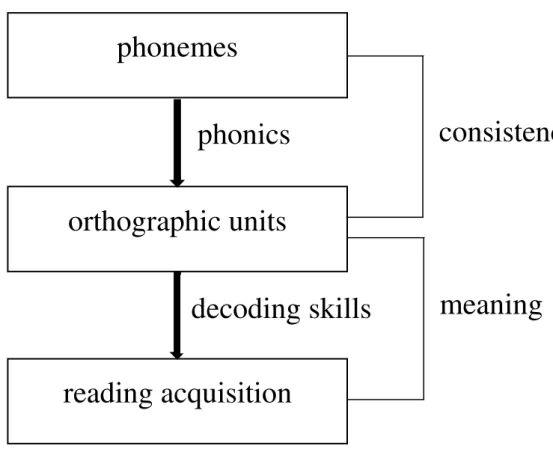
(21) Phonics Instruction Phonics is employed to help native speakers develop the basic skill of reading. With phonics training, learners cultivate their phonological abilities to recognize the consistency between sounds and letters, which gives them the competence to decode orthographic units.. phonemes phonics. consistency. orthographic units decoding skills. meaning. reading acquisition Figure 1. Process of Reading Acquisition Note. Modified from “Reading Acquisition, Developmental Dyslexia, and Skilled Reading Across Language: A Psycholinguistic Grain Size Theory,” by J. C. Ziegler and U. Goswami, 2005, Psychological Bulletin, 131(1), p. 4. Copyright 2005 by the American Psychological Association.. 9.
(22) Knowing the consistency between sounds and letters is the key to reading (Blevins, 1988). Adam (1990) argued that skillful readers read words automatically, unambiguously manipulating phonology and orthography by phonological decoding. Native speakers, who have never received literacy tuition like phonics instruction, tend to lack an understanding of the relationships between sounds and letters. The inability to recognize orthographic units makes them illiterate. Consequently, phonics instruction is used to cultivate learners’ competence in decoding phonemes and orthographic units accurately. When they are able to blend and segment speech sounds, their reading competence increased (Ziegler & Goswami, 2005). Phonics Instruction in Taiwan English is an alphabetic language, so developing the ability to perceive and produce speech units is important for beginning learners. When learners are able to master the speech sounds, they can sound out orthographic units and recognize their meaning. In Taiwan, phonics has been employed for pronunciation instruction in elementary schools since 1994. Even junior high school teachers utilize phonics instruction to enhance students’ phonemic awareness (Huang, 2002). Elementary school students receive phonics instruction to know the consistency of letters and sounds, and develop phonemic awareness through identifying, blending, or segmenting speech units. When they learn phonics, they can sound out printed words. 10.
(23) instantly. For example, it is easy for learners to pronounce “bag” with their phonological decoding ability. Phonics instruction facilitates the production of speech units from knowledge of letter-sound representations. Thus, by knowing the rules of phonics, they can spell or read, immediately. The instruction adheres to Gilbert’s spelling system (2001), which states certain rules, like when there are two vowel letters in a stressed syllable, the first one is produced its alphabet sound while the latter one is silent, for example /o/ as in boat, or /e/ as in take. Therefore, when there is no need for learners to learn another linguistic system for pronunciation, they are more confident in learning English (Chang, 2000; Yi, 1997). Through studies on phonics instruction, Chang (2003) declared that students’ word recognition and spelling had improved after receiving this teaching. Hsu (2015) indicated that students outperformed themselves in spelling and oral reading and developed a positive attitude towards learning English after receiving 15-weeks of phonics instruction. Consequently, it was deduced that phonics instruction enhances learners’ pronunciation and confidence. Limitations of Phonics Kreidler (1972) stated that the English spelling system was too complicated for learners to predict the speech sounds from orthographic units, since the relationship between sound and letter was inconsistent. One letter may have multiple phonemes,. 11.
(24) such as the letter “a” in call, boat, apple, and mate; or one phoneme may be represented in multiple letters: such as /I/ in bit, minute, and woman. In the following pairs: allow//swallow and imply//simply, each pair seems to rhyme, but in actually, it does not. Hence, English learners have trouble mapping sounds and letters (Glushko, 1979; Kreidler, 1972). Kenworthy (1989) outlined some rules about the sound values of consonants and vowels, for example, “c” can be /k/ as in cat or /s/ as in city , or “ph” can be /f/ as in phone. In addition, the major value of “ee” is /i/ as in see, and the minor value of “ee” is /I/ as in been. The vast number of phonics rules and substantial rote learning burden beginning learners, and make English learning boring and nonsensical. Wang (1985) pointed out that phonics instruction helped learners produce monosyllabic words effortlessly, but did not equip them to sound out polysyllabic words correctly. Moreover, learners could not identify the stressed syllable in a multisyllabic word, or correctly pronounce the words borrowed from French, Greek, or any other language (Yang, 2003). Dai (2003) indicated that the existence of too many irregular words, confuse learners’ prediction of the correct pronunciation of a new word. The proportion of irregular words is 60% among the 300 high-frequency English words as well as 25% in the 10,000 high-frequency English words. Consequently, learners have to memorize many irregular rules. Since the relationship between letters and sounds is intricate, it is never easy for learners to. 12.
(25) sound out printed words effectively and unambiguously. Though phonics helps learners predict the correct pronunciation of words 80% of the time, learners still have problems during the remaining 20% (Chang, 2004; Wang & Wen, 2011).When learners read a 100-word article, they may mispronounce 20 words and misunderstand the meaning of the lines. Wu (2004) declared that receiving phonics instruction does not significantly enhance the ability of EFL junior high school students to decode vocabulary, or pronounce multisyllabic words correctly. A study by Hung (2004) showed that students could not manipulate complicated word pronunciation rules only with phonics instruction. Though most junior high school students have acquired phonics instruction in elementary schools, when they encounter polysyllabic vocabulary, they are unable to sound it out immediately; they usually need assistance to decipher the correct pronunciation of the word. Consequently, though phonics instruction develops learners’ phonological abilities and enables them to read rule-governed words aloud, there are, apparently, still some inconsistences. Phonetics Instruction Because of the intricate relationship between letters and sounds, EFL learners require a substantial amount of information to comprehend English speech sounds thoroughly. Morley (1975) indicated that phonetics has the most significant, visual features to represent abstract phonemes and aid learners in mastering the sound. 13.
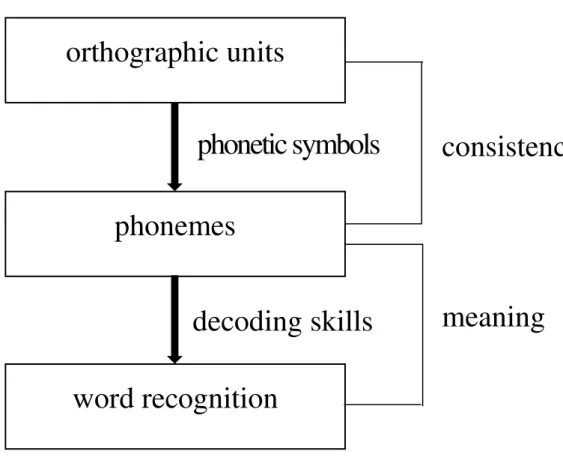
(26) system. Celce-Murcia et al. (2011) noted that the phonetic alphabet is a system to help learners grasp the speech units of a target language more accurately, because there is one-to-one correspondence between the symbol and the sound it represents. Ladefoged (2006) argued that phonetics, a linguistic tool, is not only useful, but also important for learners to transcribe speech sounds, visually and aurally. Phonetic symbols help learners recognize the consistency between orthographic units and speech sounds. With phonetics, learners are able to perceive the sound of a printed word and pronounce it accurately. Simultaneously, they are also able to recognize the word and acquire its meaning effectively.. 14.
(27) orthographic units phonetic symbols. consistency. phonetic phonemes decoding skills. meaning symbols. word recognition. Figure 2. Process of Word Recognition Note. Modified from “Reading Acquisition, Developmental Dyslexia, and Skilled Reading Across Language: A Psycholinguistic Grain Size Theory,” by J. C. Ziegler and U. Goswami, 2005, Psychological Bulletin, 131(1), p. 4. Copyright 2005 by the American Psychological Association.. 15.
(28) Phonetic Symbols Instruction in Taiwan For decades, K.K. phonetic symbols have been widely implemented to teach English pronunciation in Taiwan. They have helped learners acquire the basic skills of perceiving and producing speech sounds, identify stressed syllables in words, and sound out multisyllabic words unambiguously. Though K.K. phonetic symbols are advantageous in delivering pronunciation instruction, the percentage of those using the linguistic system declines every year (Huang, 2013). Bai (1994) pointed out that one of the reasons, why teachers of English in junior high schools did not emphasize using K.K. phonetic symbols, was because phonetics was only believed to be used by phoneticians to transcribe speech sounds. Thus, teachers have not adopted phonetics to teach pronunciation since the 1980s. Besides, most elementary school or cram school teachers believe that phonics instruction not only cultivates students’ phonological abilities but also makes students read aloud printed words easily. Furthermore, students do not have to learn a new linguistic system, which may be an added burden. Therefore, phonetics instruction has become less important. In contrast, more teachers employ phonics as a useful linguistic tool to teach pronunciation (Chung, 1999; Huang, 1999; Lin, 2010; Yi, 1997). As students learn the rules of phonics, they are able to read and spell vocabulary words, effortlessly and effectively. Even though some students are unfamiliar with the. 16.
(29) spellings, they are able to improve their decoding competence through more practice (H. R. Lin, 2010; Y. C. Lin, 2002). However, phonics is not employed for the purpose of teaching pronunciation, but to enhance native speakers’ English reading competence (Liu, 2005; Tsao, 2005). In addition, the English spelling system is too complicated for most second language learners. Thus, students cannot master the sound system by memorizing the rules of phonics alone. Students in Taiwan have limited exposure to spoken English. Nor do they have adequate opportunity to practice English; hence, they cannot classify the rules of spelling on their own. If there is no significant linguistic tool to assist students in mapping letters and sounds, they fail in word production and recognition (Hung, 2004). Gradually, then, learning English becomes more difficult. If students lose confidence, or have declining interest in learning English, they will distance themselves from it and eventually quit (Chou, 2002). In the early stages of learning a language, learners tend to need a systematic linguistic tool to help them connect speech sounds and orthographic units. A linguistic tool that transcribes phonemes systematically and precisely is applied, such as the International Phonetic Alphabet (IPA). Devised by the International Phonetic Association, the IPA is an alphabetic system that notates the speech sounds of an oral language. Language learners construct an idea with phonetic symbols to discern the. 17.
(30) speech sounds of orthographic units correctly. Liu (1988) indicated that K.K. phonetic symbols are an important tool for teachers during pronunciation lessons. For example, learners can distinguish between two similar phonemes, such as /I/ and /i/, /e/ and /ɛ/. This way, they can avoid any ambiguous pronunciation while learning. As learners study the K.K. phonetic symbols, they can use a dictionary to handle unfamiliar words; meanwhile, they also cultivate the ability to learn by themselves (Wang, 1985). Phonetic symbols play the role of a facilitator in helping learners learn a language (Fu, 1995). Furthermore, according to junior high school English textbook curriculum, the vocabulary that students encounter has more syllables and is more complicated than what they have learned in elementary school. If students are not well trained in pronunciation, they will fail to recognize words, which will lead to other problems in speaking, listening, reading, and writing. In contrast, learners who have a thorough knowledge of phonetics are equipped with the basic skills required to excel at English pronunciation. Related Studies of K.K. Phonetic Symbols Instruction Phonetic symbols are vital in pronunciation instruction. Lin (2001) conducted various studies to discuss the possibility of phonics plus phonetics instruction enhancing adults’ English pronunciation. The study revealed that while both phonics, and phonics plus phonetics instruction had a positive effects on adults’ pronunciation,. 18.
(31) learners who received phonics plus phonetics instruction, performed better on oral tests than those who received phonics instruction alone. Hsu (2003) implemented a 25-week K.K. phonetics instruction program on fifth graders, in which the experimental group outperformed on segmenting, blending, word recognition, and spelling. Yeh (2005) integrated phonics with phonetics instruction while focusing on a pronunciation experiment in which the phonics plus K.K. phonetics group, which learned consonants and vowels together, significantly differed from the other. Studies also revealed the importance of K.K. phonetics on the improvement of sixth graders pronunciation and word recognition. Liu (2009) discovered that K.K. phonetics instruction also benefited fifth graders’ phonemic pronunciation. In addition, Lee (2009) provided 10-minutes of phonetics instruction before every English class. The students, who participated in this experiment, saw a significant influence on their phonemic awareness and spelling. Wen (2014) probed that both, phonics plus K.K. phonetic symbols and K.K. phonetic symbols instructions, enhanced the vocabulary of EFL underachievers from vocational high schools. The above studies indicate that phonetics is crucial in enabling learners gain competence in phonemic awareness such as segmenting and blending. Moreover, with K.K. phonetics, learners are able to sound out new words accurately and achieve their goal of spelling and recognizing words immediately. Thus, K.K. phonetics does play a role in pronunciation. 19.
(32) instruction. Low Achievers Students who have low motivation to study, weak self-regulation, or do not meet the average academic performance of their peers are considered low achievers (Reis & McCoach, 2000). According to Mclaughlin and Vacha (1992) and Chang, Chiu and Li ( 2000), a low achiever might possess the following distinct attitudes and behaviors: Learning Attitudes and Behaviors. Low achievers tend to lack the basic skills to handle complicated subjects such as mathematics or science. They are unable to satisfactorily cope with academic evaluations and easily fail; these negative experiences leave them frustrated and with no interest in further learning. Moreover, low achievers barely concentrate in class and seldom comprehend what teachers teach. Sometimes, they give excuses to not submit assignments, and copy the reports of fellow students. Consequently, they need more support and encouragement while learning. Daily Life Behaviors. Low achievers who grow up in low socio-economic families often receive less support from their families. They lack the confidence to attempt new opportunities, or communicate with others. Gradually, their self-regulation, self-discipline, and patience are undermined. They are impulsive and easily irritated,. 20.
(33) so they retreat when they encounter difficulties. In addition, this makes them lazy and gives them more excuses to skip class. To summarize, low achievers do not excel in academics and are seldom praised. These negative experiences of learning produce poorly motivated students. Low Pronunciation Achievers Low pronunciation achievers can neither recognize phonetic symbols nor name them. In addition, they lack the basic skills to perceive or produce printed words. In class, they are distracted because they cannot understand what the teacher is teaching. Consequently, they are unable to recognize or memorize vocabulary, and word retention becomes difficult for them. This factor leads to their poor performance in other aspects of English learning as well. Without mastering the speech sounds, they cannot grasp the meaning of words, or comprehend the primary idea of a sentence. When asked to take quizzes or tests, their answers are purely guesswork. They cannot complete their assignments on time. Gradually, they lose confidence and struggle to learn English, eventually choosing to abandon it. Remedial Program The MOE recently announced that the remedial program was a complementary measure to their 12-year Compulsory Education program. Every student would be provided valuable attention to ensure that all were treated fairly, justly, and equally.. 21.
(34) “No Child Left Behind” (MOE, 2015) was the remedial instruction program that was implemented. When students’ performance is far behind their peers, the remedial program is employed to increase their deficit knowledge and develop their basic skills so that they are academically on part with their peers. Before implementing the remedial program, low achievers are evaluated to gauge their learning problems. Based on the collected data, teachers analyze each student’s problem and design a suitable program to meet each one’s need. Following the principles of curriculum planning, the program is composed from easy to difficult, simple to complex. Moreover, the course is divided into several units and taught in quick succession to help low achievers master K.K. phonetic symbols and acquire the basic skills rapidly. During this process, teachers not only provide instruction, but also offer feedback and advice on modifying low achievers’ performance until they are familiar with what they have learned. At the end of the remedial program, they are re-evaluated to gauge whether this program has improved their competence (Chang, Chu & Li, 2000). Through the remedial program, students’ learning experience becomes more meaningful and successful. It also builds a positive relationship between students and teachers. When students’ confidence and motivation increases, their performance automatically improves.. 22.
(35) Related K.K. Phonetics Remedial Program Li (2010) revealed that both phonics and phonetics remedial programs improved the word producing and phoneme blending ability of six ninth graders. Their attitude toward English learning also became more positive. After attending the three-week remedial program, these participants showed significant improvement in word identification, learning attitude, class participation, concentration, and self-study competence. Therefore, phonics and phonetics remedial programs are beneficial to low achievers in junior high school. Research conducted by Tsai (2013) revealed that the K.K. phonetics remedial program improved the vocabulary retention and word pronunciation competence of four low achievers from a vocational school. The researcher implemented a 12-session phonetics remedial program to enhance their basic pronunciation skills and word retention ability. This program helped these participants improve their word production. Though their performance did not improve significantly after the program, results showed that the students were motivated to perform better in the future. Learning Difficulties of EFL Students in Taiwan EFL students in Taiwan may encounter several difficulties. First, during the early stages of learning English, learners might be anxious about learning a new linguistic system, like K.K. phonetic symbols, to acquire segmental knowledge. However, since. 23.
(36) most K.K. phonetic symbols are similar to the English alphabet, with only seven consonants: /ð/, /θ/, /ʃ/, /ʒ/, /tʃ/, /dʒ/, /ŋ/, seven vowel sounds: /ɛ/, /æ/, /ɔ/, /ʌ/, /ə/, /ɚ/, /ɝ/, and three diphthongs: /aɪ/, /aʊ/, /ɔɪ/ that are completely different, it should not be too difficult for beginning learners to learn them. Second, there are no distinctive features between tense and lax vowels in Chinese, but in English, the length of the vowel sounds are regarded as distinctive features that impute different meanings to English words. Since EFL students are usually not familiar with English vowels, it is challenge for them to distinguish between says, /I/ or /i/ as in fill or feel. To help learners acquire the ability to differentiate between tense and lax vowels, “minimal pairs” drills are often conducted. Third, Kenworthy (1989) points out that learners who are Chinese, find it more difficult to perceive and produce interdental consonants like /ð/, /θ/ because these sounds do not exist in the Chinese language. They are able to produce it only after perceiving the sound, so teachers have to model it first and then help students sound it out (Celce-Murcia et al, 2011). Kenworthy also mentions that consonant clusters are rare in Chinese, so comprehending consonant clusters and sequences is another difficult subject for learners. For example, word- final consonant clusters, such as /ld/ in mold, /mold/ may be pronounced as /mod/, where /l/ is deleted. Therefore, students need more practice to reduce pronunciation errors.. 24.
(37) CHAPTER THREE METHODOLOGY. The purpose of this study was to discover if the K.K. phonetic system was essential to improving low achievers’ spelling and reading competence, and motivating them to continue learning English. In addition, data from interviews, observations, questionnaires, Test 1, and Test 2 were collected and analyzed. This chapter is divided into seven sections: (a) problem statement, (b) action research, (c) participants, (d) the teacher, (e) research design and procedures, (f) material, and (g) data collection. Problem Statement This study was conducted at Kuang Chun Junior High School, which is located in Chao Zhou Township. The school contained 20 classes with a total of 432 students. Investigations revealed that one-third of the students at the school were from low or middle-low income families, and had limited support or resources to improve their English learning skills. In class, the students were passive and provided very little feedback to the teachers. In terms of reading and speaking English, only one-third of the students in any class were able to pass their monthly examination, while half the students failed to produce English words. Even though they had studied phonics in. 25.
(38) elementary schools, the complicated rules of pronunciation left them confused and unable to sound out English words correctly. In junior high school, they do not receive thorough K.K. phonetic symbols instruction, so they had trouble connecting the orthographic units and phonemes of vocabulary. Gradually, their performance in English deteriorated. These negative learning experiences left them frustrated and indifferent in class. Thus, this research intended to provide a K.K. phonetic symbols remedial program to enhance these students’ interest in English learning, foster their skills and build their confidence. Action Research Tsai (2000) stated that action research was also a practitioner action research. When a practitioner has problems at work, he/she will find ways and means to solve them. Moreover, in the process of implementing the solution, the practitioner can keep revising and modifying his/her plan based on the data received from self-reflection and observations. Thus, through action research, a practitioner can solve his/her work problems immediately. This study aimed at enhancing low achievers’ word recognition competence, so the researcher adopted action research as the method and designed a remedial program to help students enhance their ability to decode words, acquire a strategy to read words, and build their confidence to learn English.. 26.
(39) Participants Based on the researcher’s in-class observations and students’ English reports, six participants, three males and three females, from the same class (class 8-4) were recruited to participate in the remedial program. They possessed normal intelligence, and did not suffer from any sensory problems or neurological damage. All of them were familiar with the English alphabet and had studied phonics during elementary school. However, they still had difficulty pronouncing English words. The strategies (see Appendix B) they adopted to sound out English words were that four of them often used phonics, BoPoMoFo, and Chinese characters, and three of them sometimes consulted teachers or classmates. None of them used K.K. phonetic symbols. After class, they did not attend cram schools, so they barely spent any time on English each day. Lack of knowledge and limited support and practices, ensured that their English competence did not improve. Besides, all of them considered English learning too difficult and lacked confidence. All the participants were asked to attend the 12-session K.K. phonetic symbols remedial program to improve their performance and cope with their pronunciation problems. The Teacher The teacher who had taught English at Kuang Chun Junior High School for 11 years was also the researcher who implemented the remedial program. The researcher. 27.
(40) observed that more students were beginning to lose interest in learning English and she discovered that poor pronunciation skill was the first obstacle. When students were unable to pronounce printed words, they failed to recognize words as well. Though all the participants in the remedial program have studied phonics, and two-thirds of them have even studied K.K. phonetic symbols, all of them still had difficulty producing English words correctly. The researcher planned to improve these students’ ability to connect orthographic units and phonemes on the assumption that if they can produce English words, they can simultaneously recognize the words as well. Thus, if their basic competence developed, they would be able to learn English words independently. Research Design and Procedures Though the students had studied English for several years, they were still unable to pronounce English words correctly. In addition, they had trouble recognizing words. Through the K.K. phonetic symbols remedial program, the researcher intended to improve the low achievers’ basic skills of pronunciation and build up their confidence to study further. Before designing the study, the researcher ascertained all the causes for the failure to learn English among low achievers. Then she identified the research topics that needed to be studied to enhance students’ English competence. Initially, the. 28.
(41) researcher collected related references and studies in order to design a suitable program to solve students’ learning problems. Once the program had been created, based on the data collected from questionnaires and Test 1, the researcher recruited the participants and implemented the 12-session remedial program. After the remedial program was completed, the researcher revised the students’ performance through in-class observations, Test 2, and interviews. All the data from the remedial program were collected and analyzed, and the results are presented in this study.. 29.
(42) Find out teaching problems and select research topics. Collect related references and studies. Pre-process of the remedial program. Design the K.K phonetic symbols remedial program. Design evaluations and choose participants. Carry out diagnosis tests (questionnaires, Test 1) During-process of the remedial program. Implement the12-session K.K. remedial program. Revise the program (Test 2, interview). Post-process of the remedial program. Discuss and Analyze. Compose the thesis Figure 3. Research Design and Process of the Study 30.
(43) Material The K.K. phonetics lesson that is introduced in Book 3 of the Hanlin version is simply K.K. phonetic symbols. Students could not master the K.K. phonetic symbols from that textbook alone. Therefore, the researcher chose the K.K. & Phonics textbook to teach pronunciation and select content, related to K.K. phonetics, to design 10 units of the remedial program. Consonants, vowels, and phonological rules were introduced. Moreover, all the K.K. phonetic symbols were presented with orthographic units in order to foster the concept of letter-sound consistency. There were also several exercises and quizzes that were provided in the textbook, which the researcher gave out to the students at the end of each session. If any of the participants did not do well on them, the researcher used the recess between classes to help him/her solve his/her learning problems. The program was completed in six weeks with the participants attending a 45-minute session, twice a week. At the beginning of the program, the researcher measured the participants’ abilities through Test 1 (see Appendix C), and then taught them consonants, vowels, blends, and consonant clusters, sequentially. At the end of the program, the researcher interviewed all the participants and evaluated their competence and pronunciation through Test 2 (see Appendix D). The schedule of the remedial program is presented in Figure 4.. 31.
(44) Test 1 / Consonants. Session1-Session5. Vowels/ Blends / Consonant clusters. Session6-Session10. Decompose syllables / Identify stressed syllable Test 2, Interview. Figure 4. Schedule of the K.K. Phonetic Symbols Remedial Program. 32. Session11-Session12.
(45) Data Collection The data was collected through questionnaires, Test 1, and Test 2. Apart from that, interviews, videos, researcher’s reflection log and observation log were also used to record the information that needed to be reviewed. Questionnaires. The questionnaires (see Appendix A and Appendix B) were used to determine students’ English learning background, and the strategies they adopted to pronounce English words. This information helped the researcher understand how to help the participants more effectively. Test 1 and Test 2. Test 1 was employed to identify the participants’ initial ability and pronunciation difficulties, so the researcher could focus on what problems they had and find ways to resolve them. Test 2 was the means to evaluate students’ word decoding competence, after they completed the remedial program. From the results, the researcher could gauge students’ spelling and reading skills. Interviews. Since the participants lacked the confidence to learn English, they assumed English learning was difficult. One of the purposes of the remedial program was to build the participants’ confidence in their ability to learn English. Through interviews (see Appendix E), the researcher was able to understand if the participants’ English learning attitude had changed or not, after the remedial program.. 33.
(46) Videos. Videos provided visual data for the researcher, to review and incorporate what had been ignored in each session. The researcher had to focus on specific things while teaching, so certain points could easily be overlooked. Participants’ behavior and feedback could be recorded in detail through videos. Researcher Reflection Log. The reflection log was recorded to describe the researcher’s actions, her feelings, and the occurrences in class. At the same time, reviewing the reflection log helped the researcher deduce the problems the participants encountered, and helped her modify the sessions to make the program more effective. Observer’s Log. The researcher was also the observer during sessions. She recorded students’ interaction with each other or with the teacher during the sessions, the difficulties students encountered in class, and their learning behavior. Moreover, through the observer’s log, the researcher was able to acquire more information from the sessions, and modify the program to ensure that it went smoothly. Trustworthiness Lincoln and Guba (1985) claimed that the triangulation technique could facilitate the validity and reliability of a research. Therefore, the researcher employed triangulation to collect data from Test 1, Test 2, the researcher’s reflection log, observation log, and interviews.. 34.
(47) The results of Test 1 and Test 2 helped the researcher gauge whether the participants’ spelling and reading competence had improved or not. Apart from that, the researcher could understand the difficulties the participants faced and how they felt about learning English, by analyzing the data from the researcher reflection log, in-class observations, and interviews.. 35.
(48) CHAPTER FOUR FINDINGS AND DISCUSSION. In this chapter, the data collected from Test 1, Test 2, researcher’s reflection log, observer’s logs, and interviews are analyzed and discussed. In addition, the results of the study are used to the answer the three research questions mentioned in Chapter One. The Effect of the K.K. Phonetic Symbols Remedial Program on Spelling and Reading Competence (1) Did low achievers improve their spelling and reading competence by participating in the remedial program? At the start of the K.K. phonetic symbols remedial program, the researcher employed Test 1 to identify the participants’ initial pronunciation ability. There were 25 monosyllabic words listed in Test 1, and participants were asked to read the words aloud, sequentially. The results are presented in Table 1.. 36.
(49) Table 1 Results of Test 1 ____________________________________________________________________ Participants. Correct words. Total. Correct Rate. S1. 10. 25. 40%. S2. 5. 25. 20%. S3. 8. 25. 32%. S4. 3. 25. 12%. S5. 3. 25. 12%. S6. 9. 25. 36%. According to Table 1, S1 had the highest correct rate, which was 40%, with S6 coming next at 36%, followed by S3, who achieved 32%. S2, S4, and S5 obtained 20%, 12 %, and 12% respectively. All the correct rates were below 50%. In other words, all the participants failed to sound out most of the words in Test 1. The results revealed that these participants were poor at reading and spelling. The researcher designed Test 2 for the last session of the remedial program, in order to evaluate any improvement in the participants’ reading and spelling competence. The test encompassed various syllable structures, such as CV, CVC, CVCC, CCVC, CCVCC, and CCCVCC. In addition, there were 14 vowels, 3 diphthongs, and 24 consonants, randomly distributed in the 50 words in Test 2. After. 37.
(50) completing the K.K. phonetic symbols remedial program, the participants were asked to take Test 2. The results are illustrated in Table 2. Table 2 Results of Test 2 Participants. Correct words. Total. Correct rate. S1. 48. 50. 96%. S2. 45. 50. 90%. S3. 48. 50. 96%. S4. 48. 50. 96%. S5. 37. 50. 74%. S6. 44. 50. 88%. Based on Table 2, S1, S3, and S4 achieved the highest correct rate of 96%, followed by S2 at 90%, with S6 coming next at 88%, and finally S5, at 74%. Since four of the correct rates were over 90%, it proved that most of the participants were able to sound out the printed words with K.K. phonetics. Therefore, these participants had acquired the basic skill of reading aloud vocabulary words. A comparison of Test 1 and Test 2 revealed that though the words in Test 1 were simpler than Test 2, low achievers had poorer correct rates in Test 1. This showed that, after participating in the 12-session remedial program, the students were able to sound. 38.
(51) out English words independently, which improved their reading and spelling competence. The Effect of the K.K. Phonetic Symbols Remedial Program on Spelling and Reading Strategies (2) Did low achievers change their strategies of spelling and reading by participating in the remedial program? Before attending this program, the participants used to employ Chinese characters or Chinese phonetic symbols to pronounce vocabulary words. Sometimes, they asked their classmates for help, to know the sound of a word. Due to a lack of knowledge in how to pronounce correctly, the participants were unable to read English words aloud, correctly and effortlessly. Through the remedial program, the participants learned how to operate a systematic linguistic tool, and sound out printed words effectively, thus developing their basic skills of reading and spelling. In order to learn whether they would adopt the linguistic tool as their strategy to read and spell, the researcher interviewed all the participants and the results are presented in Table 3.. 39.
(52) Table 3 K.K. Phonetic Symbols Remedial Program for Reading and Spelling Simplified Interview Questions. Yes. No. K.K. phonetics remedial program is helpful. 6. 0. Using K.K. phonetics to read and spell. 6. 0. Changing the ways of learning English. 6. 0. Note. N=6 All the participants agreed that the K.K. phonetics remedial program was helpful. They also stated that they would use K.K. phonetic symbols to read and spell, thus changing their technique of learning English. The Effect of the K.K. Phonetic Symbols Remedial Program on English Learning Attitudes (3) Did low achievers acquire a positive attitude to English learning after participating in the remedial program? Initially, the participants lacked pronunciation knowledge, so they did not know how to read out vocabulary words accurately. Gradually, this led to difficulty in recognizing new words. These negative factors caused a loss of confidence in the participants and increased their anxiety in learning English. During the final session of the remedial program, the researcher asked the. 40.
(53) participants some questions in order to understand whether they had acquired a positive attitude towards learning English after attending the remedial program. The results are displayed in Table 4 Table 4 K.K. Phonetic Symbols Remedial Program for Learning Attitude Simplified Interview Questions. Yes. No. Reducing anxiety of learning English. 6. 0. Raising more confidence in learning English. 6. 0. Acquiring a positive attitude on learning English. 6. 0. Note. N=6 All the participants reported that the remedial program had reduced their anxiety and built their confidence in learning English. Furthermore, all the participants pointed out that they had acquired a positive attitude toward learning English. The Findings of the Remedial Program In the first session of the remedial program, the six participants took turns to read 25 monosyllabic words aloud (see Test 1). The words that they sounded out correctly were: so, at, not and May; they were unable to pronounce the words desk, light, free, print, stamp, strict, wheat, and so on. The results (see Table 1) showed that the six participants had trouble producing printed words. Though the words were presented. 41.
(54) with phonetic symbols, they were unable to read out most of the words because of their lack of pronunciation knowledge. In-class Perception and Performance of Consonant Sounds In the beginning of the first tutorial session, the teacher used the alphabet letters, p, b, t, d, f, v, k, and g to help the participants read out the sounds, /p/, /b/, /t/, /d/, /f/, /v/, /k/, and /g/. Extract 1. The Perception and Performance of /p/ and /b/ (The teacher drew “/ /” on the blackboard.) T: Do you know what it is? Participants: It is a bracket. T: Good. It’s a slash bracket. And tell me what it is for? (All the participants kept silent.) (The teacher wrote “p” on the blackboard and pointed at it.) T: What is it? Participants: P ah. (The participants answered loudly.) T: OK, now I put “p” in the slash bracket, do you know what it means? (The teacher wrote /p/ and pointed at it.) (All the participants kept silent.) T: Come on, everybody, make a guess. Try to say something.. 42.
(55) (The teacher encouraged the participants, but they still kept silent.) T: It’s /p/. Repeat after me, /p/. Participants: /p/. T: P is a letter. However, if I put it in the slash bracket, it is called /p/. It is a phonetic symbol. Did you follow me? Participants: Yes. T: P, /p/, /i/, p. Participants: P, /p/ /i/, p. (Then the teacher pointed at the letter b, and asked the participants to read aloud.) T: B, /b/ /i/, b. Now I put “b” in the slash bracket, tell me what it is? (The teacher pointed at /b/.) Participants: /b/. T: Very good. You are so great. With the guidance, the participants felt comfortable learning the sounds, /p/, /b/, /t/, /d/, /f/, /v/, /k/, and /g/. They also articulated these sounds clearly. After the participants learned the sounds, the teacher designed two class activities to help them become proficient in phonetic symbols and examine their pronunciation. In the first activity, the teacher chose two participants to come. 43.
(56) up to the stage each time, and pronounce the phonetic symbols she indicated. At first, the participants were shy and embarrassed to read aloud in front of their classmates, but eventually they completed the task and satisfactorily. In the second activity, the teacher divided the participants into two groups. Each of the three participants in each group had a task: one displayed the phonetic cards, another read out the phonetic symbols, and the third one listened. All the participants took turns to be the presenter, reader, and listener. Concurrently, the teacher observed their performance and noticed what problems they encountered. During the second activity, S5 was confused with /b/ and /d/, so the teacher gave him more minimal-pair practices, and taught him how to distinguish the two sounds. (Observer’s Log, April 1, 2016) In the first class, everything seemed to go well. The participants had no problem reading out the sounds, except S5. Observation in class showed that S5 had trouble recognizing /b/ and /d/. No matter how I taught him, he was unable to distinguish them. After teaching it several times, when I assumed he knew the two symbols, I asked him to read them out, yet, he failed. I cannot understand why he is unable to distinguish the two symbols. Though I gave him many practices, he is still confused. What should I do? Is there a better. 44.
(57) method to help him? (Researcher’s Reflection Log, April 1, 2016) The second session began with a 10-minute warm-up activity. Though most of the participants compiled with the teacher’s instructions, and concentrated on reviewing consonants, S2 was distracted. So the teacher prompted S2 and encouraged him to engage in the activity. When the teacher taught the participants how to produce /m/, /n/, /l/, /r/, and /ŋ/, they easily figured out the articulation of these sounds, and enjoyed, producing the sound /ŋ/ in particular. However, S2 was embarrassed to produce /ŋ/. S5 looked at S2 and said “/ŋ/.” S2 repeated it and both of them smiled. Extract 2. The Perception and Performance of /l/ (The teacher pointed at the words “lion” and “bell.”) T: Say the words, “lion/ bell.” S1: Lion, /bɛlo/. T: Listen up. Lion, bell. When /l/ occurs in the syllable final, remember to keep your tongue tip on the alveolar ridge. Don’t put down your tongue tip. S2, say the word, “bell”. S2: /bɛlo/. T: Don’t put down your tongue tip. Say it again.. 45.
(58) S2: Bell. T: Perfect. Huang, try to say the word “bell.” S4: /bɛlo/. T: You made the same mistake. Remember to keep your tongue tip on the alveolar ridge, and do not put it down. S4: Bell. T: Good job. The participants were accustomed to putting their tongue tip down when they pronounced /l/ in the syllable-final. They were also confused about how to articulate /r/. They had no difficulty producing /r/ when it occurred in the syllable-initial. However, when /r/ occurred in the syllable-final, they did not know how to produce it. The teacher reminded the participants to keep the body of their tongue against the roof of their mouth when they produced the word “air.” Furthermore, the participants neglected their lip gestures when they produced /m/ or /n/ in word endings. They forgot to close their lips when they articulated the final sound /m/ as in ‘swim,” but closed their lips when they produced /n/ as in “ten.” The teacher noticed that the participants were puzzled when they encountered the words, swim, ten, bell, and air. To help them read more effortlessly, she had them articulate the words repeatedly.. 46.
(59) Through rote learning, they were finally able to read the words aloud, effortlessly, and correctly. (Observer’s Log, April 8, 2016) I kept thinking about how to solve S5’s problem and to help him learn better. Finally, I realized that what seemed easy to me might be difficult for the participants. Thus, I need to understand their weaknesses and offer them substantial support. Most important of all, I should be more patient with them. Today, S2 seemed to have no interest in learning. Was the content too difficult for him? Was the class too boring? Maybe I need to reexamine my teaching and enhance the class activities so that the participants enjoy it more. (Researcher’s Reflection Log, April 8, 2016) In class, all the participants recognized the sounds, /s/, /z/, and /h/, and knew how to produce them. However, when S6 mispronounced /h/ as /tʃ/, the teacher corrected her mistake immediately. Extract 3. The Perception and Performance of /θ/ and /ð/ (The teacher pointed at /θ/ and /ð/.) T: Have you seen these two symbols? S2: Yes, I have seen them. (In Taiwanese) T: Could you read them aloud? (The participants shook their heads and kept. 47.
(60) silent.) T: OK. Say the words “Thank you.” S2: Dank you. (The teacher watched S2’s mouth.) T: All right, please show me your tongue tip. Put your tongue tip between your upper and lower front teeth and say “Thank you.” S2: Thank you. T: Pretty good, you have good pronunciation. (S2 smiled lightly.) T: S4, say “Thank you.” S4: Sank you. T: No. Don’t be shy. Please protrude your tongue tip. S4: Thank you. T: Good, you did a good job. (The teacher pointed at the words, “this” and “that.”) T: S1, repeat after me, this/ that. S1: /lIs/, /dæt/. T: Protrude your tongue tip, please. And say “This”. S1: This. T: Yes, you pronounced so well. Next time, don’t forget to protrude your. 48.
(61) tongue tip, all right? (S1 nodded her head.) The participants were unfamiliar with /θ/ and /ð/. In addition, they were reluctant to protrude their tongue tips while reading out the words that contained /θ/ or /ð/. It took them some time to master these two sounds. Though the participants had studied English for years, they had not perceived the correct articulation of /θ/ and /ð/. They pronounced /θ/ as /d/, or /ð/ as /l/. When the teacher explained the difference to them clearly, they finally understood the places of articulation. At the end of the session, the teacher evaluated the participants, and the results showed that the participants excelled in the following activities: Writing the Symbols, Listen and Circle the Ending Sounds and Listen and Choose the Picture with the Matching K.K. Symbol. However, they were unable to distinguish between /θ/ and /ð/ when these sounds were in the syllable-initial. (Observer’s Log, April 8, 2016) At the beginning of the session, I had all the participants read out the words, swim, ten, bell and air, but most of them failed. How can this be possible? I was sure that they had learned in the previous session, so how could they completely forget how to read the words out. I feel so frustrated. Though I am. 49.
(62) making every effort to teaching them well, they are still performing poorly. What am I doing wrong? I think the participants’ self-regulation is very weak, so they need further prompting. Therefore, I shall use the lunch break to make them practice phonetics every day in case they forget what they have learned. (Researcher’s Reflection Log, April 8, 2016) During the fourth session, the teacher took nearly half the class time to review consonants, which the participants had learned before. The class activity involved playing the game Heart attack, which made every participant very excited. After the game, they learned /j/, /w/, and the new symbols /tʃ/, /dʒ/,/ʃ/,and /ʒ/. Though the phonetic symbols were new to the participants, they were able to perceive and produce /tʃ/, /dʒ/, and /ʃ/ effortlessly. The main problem they had was with the articulation of /ʒ/. Extract 4. The Perception and Performance of /ʒ/ (The teacher pointed at “/ʒ/, vision.”) T: /ʒ/, vision. Repeat them after me. S5: /dʒ/, vision /′vIdʒən /. S6: /dʒ/, vision /′vIdʒən /. T: Oh, it is /ʒ/, not /dʒ/. Vision /′vIʒən /. Look at my hands. I take the left hand as the oral, (The teacher bent her left hand.) and take the right hand as the. 50.
(63) tongue. When you produce /ʒ/, you have to raise the body of your tongue to the top of the mouth and round your lips. Now, try again. Say /ʒ/. S5: /ʒ/. T: Good. S2, say it. S2: /ʒ/. T: Yes, that’s it. (Observer’s Log, April 15, 2016) I was in a hurry to implement the new lesson today because I spent too much time reviewing consonants which they had learned before. Next time, I should manage my time better. The participants tended to pronounce /ʒ/ as /dʒ/, so I needed to teach them how to produce the sound and make them practice it. Eventually, they were able to pronounce the sound accurately. However, the results of the quiz showed that S5 had trouble recognizing and producing the new symbols today, so I used the lunch break to help him resolve this problem. First, I wrote down the BoPoMoFo script beside the symbols, /tʃ/ㄑㄩ and /dʒ/ ㄐㄩ.. Second, I asked him to read out the symbol I pointed at and keep. practicing until he was familiar with them. Third, I erased the BoPoMoFo script, and had S5 read out the symbols again in order to gauge if he was able to pronounce them accurately. With the aid of BoPoMoFo, he was finally able to. 51.
(64) recognize the two new symbols. (Researcher’s Reflection Log, April 15, 2016) Discussion of Low Achievers’ Perception and Performance of Consonant Sounds Observations during class revealed that the participants learned the sounds that were similar to graphemes, quickly, but had trouble perceiving certain new speech units, such as /ð/, /θ/, and /ʒ/. Since these sounds do not exist in the Chinese language, they had no knowledge of the places of articulation. A point that needed to be kept in mind was that, since these participants were teenagers, they felt embarrassed to protrude their tongue, or make mistakes, in front of their classmates. In order to help them improve their pronunciation, the teacher gave them more detailed examples and practices to help them distinguish the unfamiliar consonants. However, though they were able to pronounce the sounds /m/, /n/, /l/, and /r/ clearly, they failed to notice the places of articulation when /m/, /n/, /l/, and /r/ occurred in the syllable-final. By observing and examining each participant’s pronunciation, the teacher was able to discern the problems he/she encountered, and offer support immediately. If a participant was unable to catch up with his/her peers, the teacher would arrange time during the lunch break, to help him/her conquer the difficulty. In-class Perception and Performance of Vowel Sounds At the beginning of the class, the teacher drew a vowel chart on the blackboard,. 52.
數據

相關文件
• involves teaching how to connect the sounds with letters or groups of letters (e.g., the sound /k/ can be represented by c, k, ck or ch spellings) and teaching students to
In order to ensure a sufficient quality and quantity of city water, the engineering quality of relevant works must be controlled so as to comply with the designed
In the processing following action recognition, this paper proposes a human behavior description model to describe events occurring to human and exerts as decision and
Based on a sample of 98 sixth-grade students from a primary school in Changhua County, this study applies the K-means cluster analysis to explore the index factors of the
In order to serve the fore-mentioned purpose, this research is based on a related questionnaire that extracts 525 high school students as the object for the study, and carries out
Therefore, in this research, innovative curriculum was designed with the combination of horticultural therapy program and activities with Special Education Syllabuses
Therefore, in this research, innovative curriculum was designed with the combination of horticultural therapy program and activities with Special Education Syllabuses regulated
The purpose of this study is to use schematic video and animation to help students with LD solve real-life mathematical word problems.. The single-subject
