CHAPTER III METHODOLOGICAL DESIGN
This chapter describes the framework, methods and procedures used in the research.
It explains the mixed research strategies of qualitative and quantitative processes used to explore leadership styles, practices, and influential factors contributing to leadership styles and practices among Secondary School Principals in Belize based on transactional, laissez-faire and transformational leadership style.
Research Framework
The framework (figure 3.1) of the study as developed in accordance with the study’s literature review and purpose. In the study transformational, transactional and laissez-faire leadership styles were explored among secondary school principals.
Trait Characteristics of leadership style either shown in transformational, transactional or laissez-faire
Subjects’ Demographic Background (age, gender, qualification, years of serves etc.)
Influential factors (background and philosophy)
Influences Influences Influences
Practice of
Secondary School Principal
Practice of
Secondary School Principal
Practice of
Secondary School Principal
LEADERSHIP STYLE
Fig. 3.1 Framework of the study
Although this study was done by previous researchers in the field of education and showed that some of the demographic variables were not significant in influencing the leadership style, we still include all possible variables in this research since this is a pioneer study in Belize. It is hoped that this study will be beneficial to Belize.
Research Methods
Qualitative and quantitative research methods were employed in this study for data gathering to address the research questions. Smith (1975) cited in Sauders, Lewis, Thornhill (2007), explained that qualitative and quantitative data collection techniques and analysis have strengths and weaknesses and that researchers can cancel out ‘method effects’ through the use of multiple methods that allow for effective triangulation to take place. This was the fundamental reason to utilize this mixed research method for the study.
Quantitative research was utilized for exploring leadership style preference and demographic influence against leadership style preference among Secondary Education Principals in Belize. The instrument for data gathering of leadership style preferences was the Multifactor Leadership Questionnaire (MLQ FORM 5X). This instrument was developed by Brass and his associates in 1994 - 1996 and was fully tested in 1996.
Transformational, transactional, and laissez-faire were indicated by using this instrument.
The data were analyzed using the SPSS software. The quantitative data were tested to find the dominantly preferred leadership style. Then the dominantly preferred leadership style was tested against the demographic data so as to test the relationship and statistical significance.
Qualitative research was also done in order to explore leadership practices and factors contributing to leadership style and practices among Secondary Education Principals in Belize. A case study approach was used to explore the leadership practices and factors contributing to leadership styles and practices. The purpose of the case study was to conduct an exploration of a case over time through detailed, in-depth data collection involving multiple sources of information rich in context (Creswell, 1998). In
the context of the case the researcher explored the uniqueness of the participants. Stake (1995), as cited in Creswell, 1998, mentioned that through data collection, a detailed description of the case emerges, as well as an analysis of themes or issues and an interpretation or assertions about the case by the research. Merriam (1988) states this analysis is rich in context or settings in which the case present itself (Creswell, 1998).
Semi-Structured Interview, observation and document research were conducted for data gathering in the case study (LeCompte, M., Millroy,W. & Preissle, J., 1992). These researchers provide the guidelines for conducting the in-depth exploratory study.
Semi-Structured Interview, observation and documentation were conducted on eight Secondary Principals, in Belize. Observation was conducted in staff meetings or parent meetings where principals were either main facilitator or guest speaker. Documentation research was compiled from an examination of published articles produced by the principal in the in-depth case study.
Validity and Reliability
Quantitative research, according to Johnson & Christensen (2004), attempts to operate under the assumption of objectivity whereby all observers in the world will look at the same phenomena and basically agree on its existence and characteristics.
Therefore, the researcher in this study collected data from secondary school principals in Belize to test leadership style preference and influence on demographic data using questionnaire to collect the data. The questionnaire adopted has been extensively tested in the field for reliability and validity. To determine the reliability of the MLQ 5x Form Bass & Aviolo (2000) analyzed nine studies that were based on the use of this questionnaire. These analyses included studies of four business firms, three groups of college undergraduates, a government researcher agency and a military unit. These studies represented the responses of 2154 raters. In the analysis, Bass & Aviolo (2000) found that reliabilities for each factors ranged from .74 to .94 (cited in Baldygo, 2003).
Saunders, Lewis & Thronhill (2007) stated that a valid questionnaire will enable accurate data to be collected, and one that is reliable will mean that the data are collected consistently and reliably for accurate interpretation. Often, when discussing the validity
of a questionnaire, researchers refer to content validity, criterion validity and construct validity (Saunders, Lewis & Thronhill, 2007). Statistical criteria are often used in quantitative research to form conclusions (Johnson & Christensen 2004). Hence, in this study SPSS was used to test the hypotheses so as to interpret the results obtained from the data and thereby form objective opinions on the results.
According to Maxcy, 1991 efforts to construct a qualitative posture in educational research have received widespread applause from researchers and practitioners alike.
Since so-called scientific research has failed to provide a predictable picture of educational practices, and since all inquiry is based upon assumptions and values, researchers should admit the existence of biases and imprecision, and should direct their attention to multiple paradigms including qualitative research (Walker & Dimmock, 2002).
The case study used in this research refers primarily to accounts, not to data or method. These matters of descriptive accuracy are emphasized by almost every introductory qualitative method textbook in its discussion of field notes and interviews (Maxwell, 1992). Through this data collection a detailed description of the case emerges as well as an analysis of themes or issues and an interpretation of the case by the researcher (Stake, 1995). This analysis is rich in the context in which the case presents itself (Merriam, 1988) Therefore, the researcher is close to reality since the data collection is in-depth dialogue between researcher and participants (Creswell, 1998).
Triangulation is one of the best methods in qualitative research for enhancing internal validity. Triangulation is conducted by using multiple sources of data or multiple methods to confirm the findings in the qualitative research study (Leedy and Ormrod 2001, 105). In this study the researcher conducted multiple methods of data collection for enhancing the validity of the research. These methods were in-depth interview, observation and document research.
The reliability is based on the assumption that the triangulation method is effective.
Using multiple methods of data collection is one of the best strategies for strengthening reliability in qualitative research. In addition, in qualitative research the researcher tries to describe and explain the phenomenon as the researcher experiences them in order to enhance the reliability of the account (Creswell, 1998).
Data Analysis
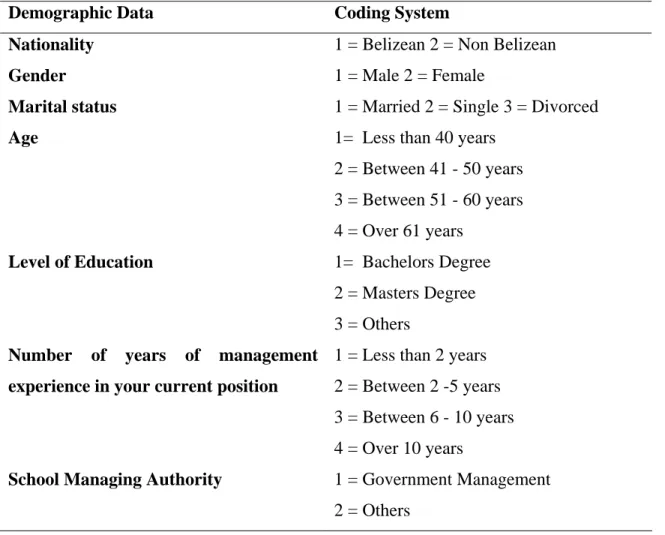
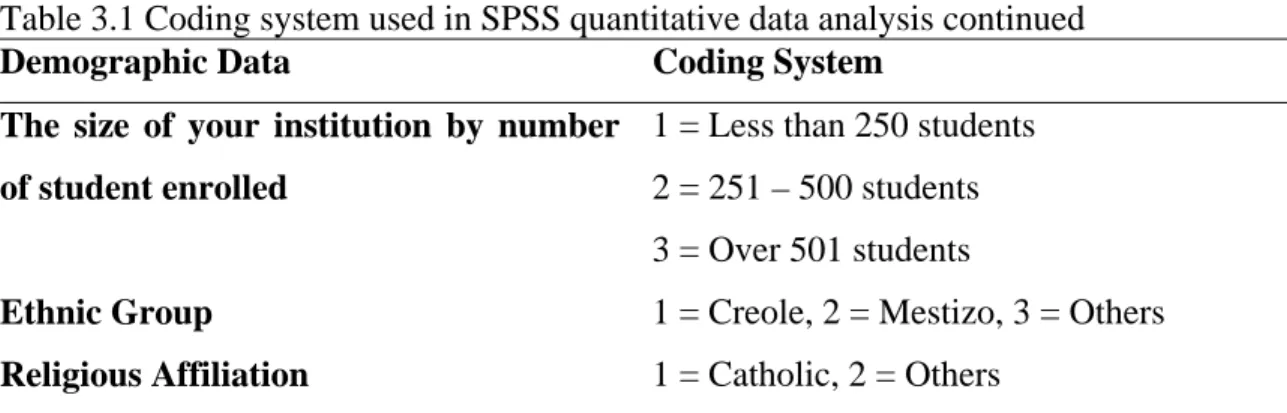
The quantitative data were analyzed using SPSS software. Before the analysis the data were coded using number sequences. The responses to questions 1-45 were coded with the Likert scale of 0-4. All missing data were assigned the number 9. These ranges and coding system were chosen for easier analysis using the SPSS software. Ranges were clustered and those ranges without data were deleted or coded as “others”. See table 3.1 for closer look at the coding system.
Table 3.1 Coding system used in SPSS quantitative data analysis Demographic Data Coding System
Nationality 1 = Belizean 2 = Non Belizean
Gender 1 = Male 2 = Female
Marital status 1 = Married 2 = Single 3 = Divorced
Age 1= Less than 40 years
2 = Between 41 - 50 years 3 = Between 51 - 60 years 4 = Over 61 years
Level of Education 1= Bachelors Degree 2 = Masters Degree 3 = Others
Number of years of management experience in your current position
1 = Less than 2 years 2 = Between 2 -5 years 3 = Between 6 - 10 years 4 = Over 10 years
School Managing Authority 1 = Government Management 2 = Others
Table 3.1 Coding system used in SPSS quantitative data analysis continued Demographic Data Coding System
The size of your institution by number of student enrolled
1 = Less than 250 students 2 = 251 – 500 students 3 = Over 501 students
Ethnic Group 1 = Creole, 2 = Mestizo, 3 = Others Religious Affiliation 1 = Catholic, 2 = Others
For Hypothesis 1 the three leadership styles (transformational, transactional and laissez-faire leadership style) were tested to determine the dominantly preferred leadership style among secondary education principals. To formulate the dominant practice style the mean scores were calculated using the descriptive analysis from the SPSS software (Johnson & Christensen, 2004). For hypotheses 2-11 the dominantly practiced leadership style, which was transformational leadership style, was tested against the demographic data listed in the study. The variables that contained two levels were tested using the independent t-test and the data with three or more were tested using the one-way ANOVA test.
The independent groups t-test is used if a quantifiable variable can be divided into distinct groups using a descriptive variable, to test differences between these two groups (Saunders, Lewis & Thronhill, 2007) using a measure of the spread of scores. Hay 1994 cited in Saunders, Lewis & Thronhill (2007) concluded that although the t-test assumes that the data are normally distributed this can be ignored without too many problems even with samples sizes less than 30, which is an important point because in this research the population size is 33 participants. The one-way analysis of variance or one-way ANOVA is used for quantifiable variables that are divided into three or more distinct groups using a descriptive variable to assess the differences between these groups (Saunders, Lewis &
Thronhill, 2007). Here the F ratio or F statistic represents these differences and is used to test statistical significance. For results to be statistically significant a probability value below .05 must be obtained, values calculated in this range would be judged to support the alternative hypothesis while rejecting the null hypothesis, and the null hypothesis is not rejected for probability values above .05.
The qualitative data were analyzed using intertwined triangulation strategies that have been practiced by many qualitative researchers in their field. The “constant comparative method” of data analysis that was used has been adapted by many qualitative case study researchers. The basic strategy of this method is the comparison among collected data which leads to tentative categories that are then compared to each other to create a pattern for interpretation (Maykut, P. & Morehouse, R., 1994).
This current case study employed the constant comparative method; figure 3.2 explains how data patterns were generated. The data were gathered from semi-structured interview, documentation and observation which were then compiled to report and discuss the practice of individual leaders and the similarities and differences amongst the leaders chosen in the study. The general idea, at the end of the report, was to provide integrated documentation of practices of leaders in secondary high schools in Belize.
Inductive category coding and simultaneous comparing of units of meaning across categories
Refinement of categories
Exploration of relationships and patterns across categories
Integration of data yielding an understanding of people and setting being studied
Fig. 3.2 Constant comparative method of data analysis Source: Maykut & Morehouse (1994)
Research Procedure
The researcher first wrote to Ministry of education requesting a list of 8 principals for the in-dept interview (appendix A). The criterion was based on principals
administrating in outstanding schools and the outstanding school criteria was based on top Caribbean Examination (CXC) performance. After which two separate letters of consent were sent to the participants to request active participation in the research. A copy was sent to each of the 47 secondary school principals to request participation in filling out the MLQ (see appendix B) and another was sent to the 8 principals selected for the in-depth study (see appendix C). The letter distributed for solicitation entailed: an explanation of the research purpose; an explanation of the research; a note of confidentiality that the data collected was to be used solely for the researcher’s thesis purposes; and that all names would be concealed. For the in-depth study participants were issued another letter to further explain that their names would be concealed and that they would be given alphabets for identification purposes. This was followed by a request to seek the appropriate interview time, date, and place; and permission to enter any kind of activities in which the researcher could observe each principal’s leadership practices (see appendix D). As common courtesy to each principal participating, in the research, the research provided them a copy of the document after publication. After the researcher gained access, for the in-depth study of the principals, the researcher then sent the semi-structured interview questions to each principal (see appendix E).
After the interview, the researcher collected documents and writings from the principals. In accordance with the interview schedule, the researcher contacted each principal and conducted an interview based on the semi-structured interview handed out in advance. The content of the interview were recorded by audio tape after the interviewee granted permission.
Finally, the collected data were compared among the selected principals. Data analysis of the research questions consisted of comparing leadership style preferences by using the MLQ Form (5X Short). The similarities and differences found among principal leadership style preference were discussed, as well as the roles and constraints encountered among the principals in their respective institutions.
In addition, the data gathered from the case study were analyzed by comparing the patterns of the answers through semi-structured interviews and the patterns of the results from the researcher’s observations and investigation of published articles and newsletters.
The similarities and differences found in patterns of interview answers and the result of
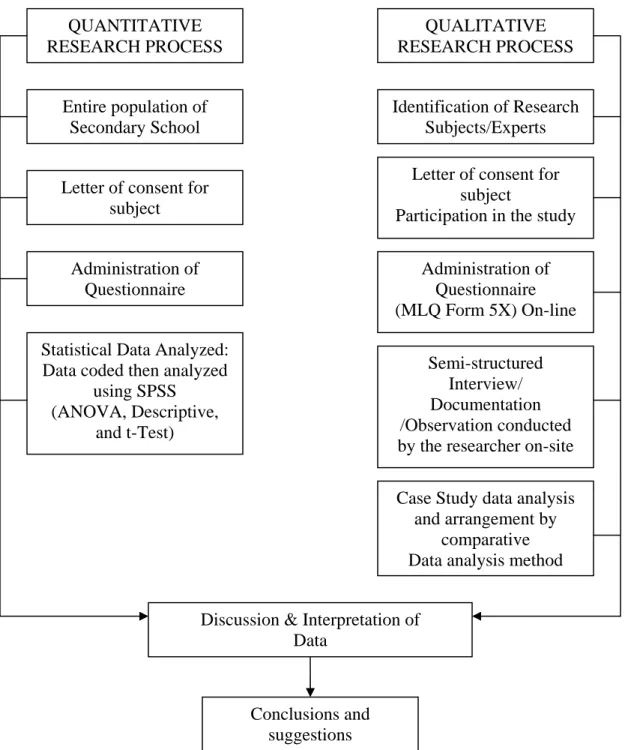
observation and document analysis are discussed later. The patterns were generated from the bottom up, using an induction strategy. The process of the study’s integrated mixed research method is further illustrated in fig. 3.3 below:
QUANTITATIVE RESEARCH PROCESS
QUALITATIVE RESEARCH PROCESS
Entire population of Secondary School
Letter of consent for subject
Identification of Research Subjects/Experts Letter of consent for
subject
Participation in the study Administration of
Questionnaire (MLQ Form 5X) On-line Administration of
Questionnaire
Semi-structured Interview/
Documentation /Observation conducted by the researcher on-site
Discussion & Interpretation of Data
Conclusions and suggestions
Case Study data analysis and arrangement by
comparative Data analysis method Statistical Data Analyzed:
Data coded then analyzed using SPSS
(ANOVA, Descriptive, and t-Test)
Figure 3.3 The mixed research method of the study process
Population and Sampling
In the population and sampling section the researcher discusses the sampling technique used in the selection of participants and the instrumentation used for data collection in the study.
The population for this current study consisted of all secondary school principals in Belize, CA, who were selected in the August 2006 academic school year. All school principals were sent electronic copies of the MLQ questionnaires. However, the response rate was 70.2%, i.e. from the 47 principals only 33 principals returned the questionnaire.
The response rate showed that over half the principals responded; therefore the results represent the majority of the secondary school principals in Belize.
For the in-depth case study, the criterion of reputation case selection was used to identify the 8 secondary school principals that were used to further explore the practices and influential factors. In the reputation case sample selection procedure, the researcher chose the study participants based on the recommendation of experts (LeCompte, M &
Preissle, 1993). The researcher requested experts or senior educationalists to complete the list of exemplary leaders mainly based on outstanding CXC performance which is the standard criterion that has become accepted in Belize to measure school achievement.
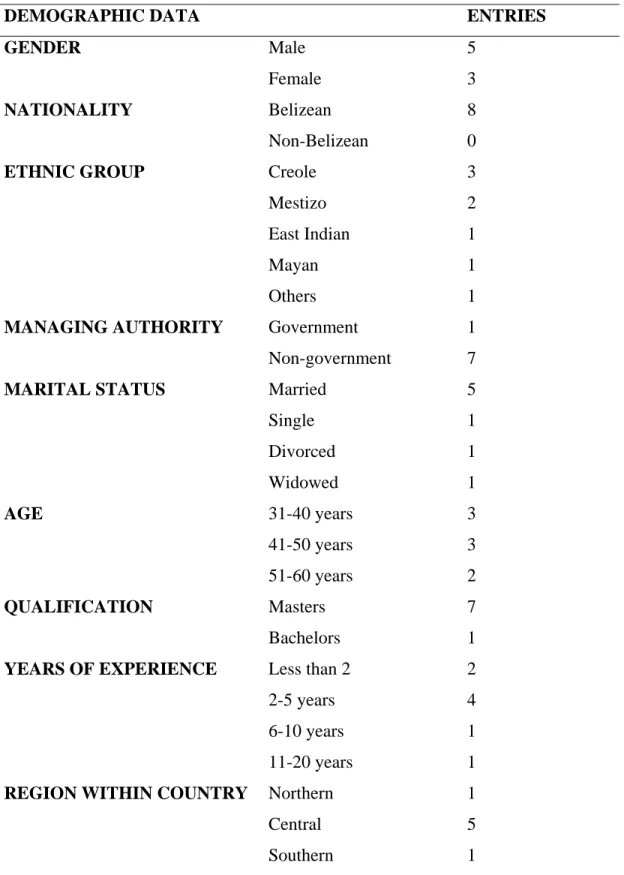
Together the experts selected and recommend 8 secondary school principals. The sample was drawn from secondary school principals in private, public, community based and denominational institutions in the country of Belize. Table 3.1 below shows the demographic distribution of the principals who participated in the in-depth study.
Table 3.2 Demographic data of principals used in the in-depth study (total principals=8)
DEMOGRAPHIC DATA ENTRIES
GENDER Male 5
Female 3
NATIONALITY Belizean 8
Non-Belizean 0
ETHNIC GROUP Creole 3
Mestizo 2
East Indian 1
Mayan 1 Others 1 MANAGING AUTHORITY Government 1
Non-government 7
MARITAL STATUS Married 5
Single 1 Divorced 1
Widowed 1
AGE 31-40 years 3
41-50 years 3
51-60 years 2
QUALIFICATION Masters 7
Bachelors 1 YEARS OF EXPERIENCE Less than 2 2
2-5 years 4
6-10 years 1
11-20 years 1
REGION WITHIN COUNTRY Northern 1
Central 5 Southern 1
Instrumentation
The instrumentation for data collection of leadership style preferences was the Multifactor Leadership Questionnaire (MLQ Form 5X). This instrument was developed by Bass and his associates in 1994 and re-tested in 2000 by Bass and Avolio (modified from Baldygo, 2003; We Son, 2003). Transformational, transactional and laissez-faire leadership was indicated by using this instrument. This instrument allowed the researchers and participants to know the type of leadership style that was indicative of the participant. In addition to the MLQ, the participants were questioned on their demographic data in order to test its statistical significance against the dominantly preferred leadership style of the participants. An electronic copy of the questionnaire was emailed to all secondary school principals in Belize.
The semi-structured interview questions were the main instrument for the case study. The leadership practices and factors contributing to leadership style were identified among the 8 secondary school principals, using the data collection instruments.