
以母語語法為基礎之教學法對台灣國中生文法學習的成效之研究
102
0
0
全文
(2) . 摘要 本研究旨在探討以轉換母語語法為基礎之教學法與傳統英語文法教學對台灣國 中生學習英文文法之成效。並且,本實驗也研究母語及英語的語法差異性以及學 生的程度是否會影響學生的學習成效。實驗對象為五十八名台灣的國三學生,並 且隨機分為實驗組及對照組;本實驗持續六週。實驗結束後,兩組學生都施以後 測(學校段考)以及文法成就測驗。最後,對實驗組學生施以一份問卷。實驗結果 指出:一、以母語語法為基礎學習英語語法的實驗組在文法成就測驗和後測的文 法部分之表現都顯著優於以傳統教學法學習文法的控制組。二、低成就者較高成 就者更適合以轉換母語語法為基礎之教學法來學習文法。三、當學生學習母語及 英語的語法愈相似時,成效愈好;反之,當母語及英語語法差異愈大時,學習成 效愈差。四、多數學生都表示母語的協助有正面成效。本實驗在教學上的應用以 及對未來研究之建議都呈現在結論裡。. 關鍵字:轉換母語語法之教學法、文法學習、中英文同質句型、學生程度、母語 的協助. . i.
(3) . Abstract The experimental study aimed to probe the effect of mother tongue grammar transformation (MTGT) method in contrast to traditional English structure instruction (TESI) on the learning of sentence structures by ninth graders in Taiwan. Besides, it also conducted whether the convergent sentence types between L1 and L2 or whether the students’ proficiency would affect students’ grammar learning. The participants were 58 ninth graders in junior high school in Taiwan. They were randomly assigned to either MTGT group or TESI group. The experiment lasted for six weeks. The posttest (the school monthly exam) and the structure achievement tests were administered to the students after the instruction. Finally, a questionnaire was distributed to the MTGT group. The results showed: (a) MTGT group significantly outperformed TESI group on all of the three structure achievement tests and the posttest, (b) low-achievers benefited significantly more from MTGT method than high-achievers, (c) the students learned significantly better when the sentence patterns were more similar between L1 and L2; on the contrary, they performed the worst when the sentence pattern was the most different between L1 and L2, (d) most MTGT group students confirmed the positive effects of the assistance of L1. Pedagogical implications and suggestions for further research were provided in the conclusion. keywords: mother tongue grammar transformation method (MTGT), grammar learning, convergent sentence types, students’ proficiency, the assistance of L1 . ii.
(4) . Ackonwledgements The thesis could not have been completed without the support and assistance of many people. First, I would like to express my deepest gratitude to my advisor, Dr. Shih-Chung Lin. He provided support, vision, and insight at each step of the writing process of my thesis. Moreover, he planned a tight schedule for me and encouraged me to finish it on time. With his extreme patience and constant encouragement, we accomplished the difficult mission—to complete my thesis in time. He is not only a respectable advisor but also a beloved mentor for me. Also, I would like to thank my committee members, Dr. Feng-Hung Tsai, and Dr. Mei-Chen Chen, who contributed much of their precious time to read my thesis in detail and gave me many valuable suggestions and comments. Following their suggestions, I am sure the thesis would be much better. In addition, special thanks go to Dr. Ching-Ying Lin, who always encourage and believed in me when I was in frustration. I am particularly grateful to my classmates during the graduate study, Robbie Fang and Jocelyn Lu. They gave me endless encouragement and comfort. They were always there when I needed them. During the hard time, their accompany made my life more meaningful and colorful. It would be very hard for me to go through the writing process without their accompany.. . iii.
(5) . Moreover, I want to thank my colleagues at Yen-Pu junior high school, whose understanding and help have been so vital. Besides, I am also grateful to the participants in the thesis. I learned a lot from the experiment and they gave me a lot of valuable feedback for the further improvement of my teaching. Finally, my most sincere thanks go to my beloved parents and my husband. Their unflagging support and encouragement helped to see me through the hard time during the writing process of the thesis. I owe my deepest gratitude to my husband, for the accompany of every critical moment and the many sacrifices he made while providing me with constant love and support.. . iv.
(6) . Table of Contents Abstract (Chinese)...……………………………………………………………………i Abstract ………………………………………………………………………..……ii Acknowledgements…………………………………………………………………...iii Table of Contents………………………………………………………………………v Figures ..……………………………………………………………………….vii Tables ………………………………………………………………………..vii CHAPTER1……………………………………………………………………………1 Introduction………………………………………………………………………1 Background of the Study……………………………………………………1 Rationale of the Study………………………………………………………5 Problem Statement………………………………………………………….7 Purpose of the Study………………………………………………………..9 Research Questions…………………………………………………………9 Significance of the Study……………………………………...…………..10 Definition of Terms………………………………………………………..10 CHAPTER2………………………………………………………………………..…13 Literature Review ...…………………………………………………………….13 The Historical View of Grammar Instruction in SLA……………………..13 The Role of Mother Tongue in SLA……………………………………….17 Related Studies on the Effectiveness of L1 on L2 Acquisition……………26 CHAPTER3…………………………………………………………………………..30 Methodology……………………………………………………………………30 Participants…………………………………………………….…………..30 Instruments…………………………………...……………………………32 Procedure…………………………………………………….…………….39 Data Analysis………...…………………………………………………….44 CHAPTER4………………………………………………………………………..…46 Rusults………………………………………………………………………….46 Validity and Reliability…………………………………………………….46 Effects of MTGT and TESI Groups……………………………………….47 Effects of MTGT Method Between High- and Low-Achievers……….......52 Effects of Convergence vs. Divergence Between L1 and L2 on SLA…….54 Results of the Questionnaire………………………………………………57 Summary of the Major Findings………………………………………..…60 CHAPTER5………………………………………………………………………..…62 Discussion and Conclusion.…………………………………………………….62 Discussion and Conclusion.……………………………………………….62 . v.
(7) . Pedagogical Implications………………………………………………….66 Limitations of the Study…………………………………………………...67 Suggestions for Future Studies…………………………………………….68 References …………………………………………………………………………69 Appendix A ….………………………………………………………………………79 Appendix B ….………………………………………………………………………82 Appendix C ….………………………………………………………………………84 Appendix D ….………………………………………………………………………86 Appendix E ….………………………………………………………………………89. . vi.
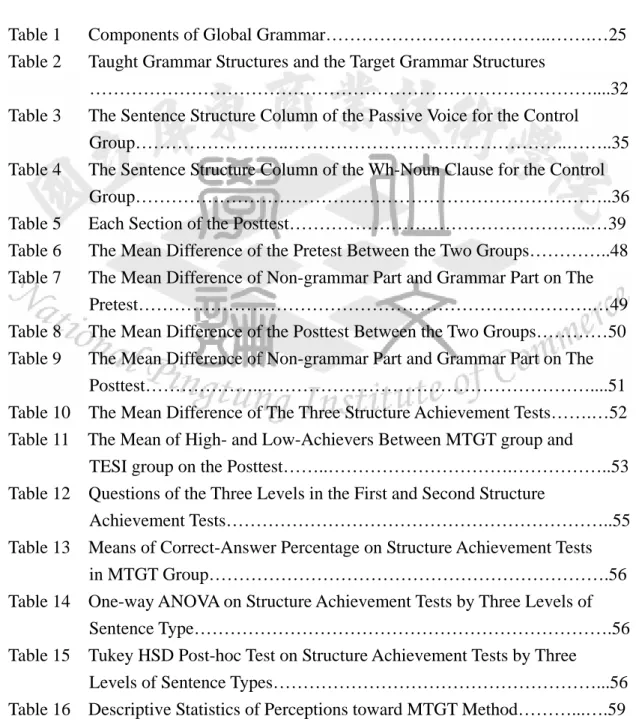
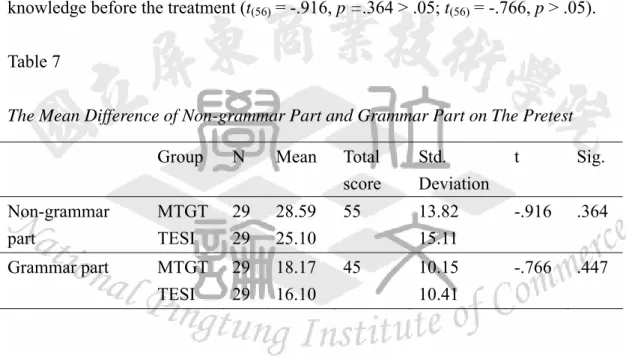
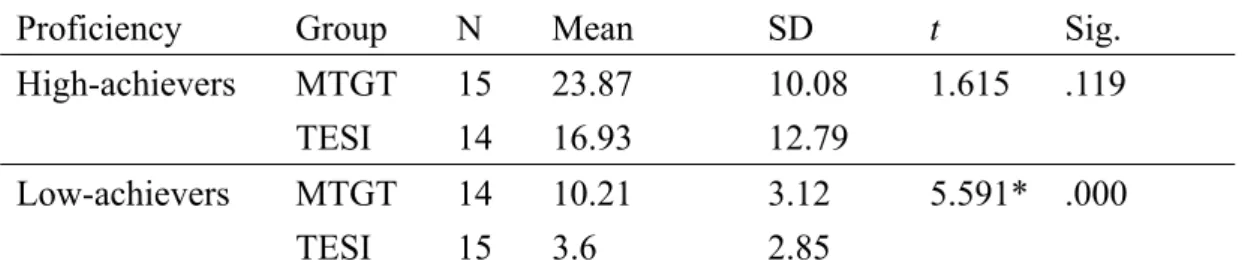
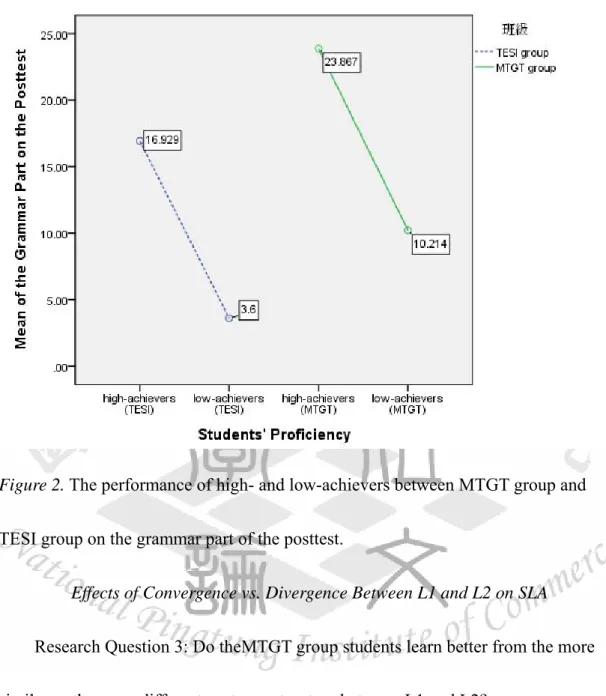
(8) . Figures Figure 1 Basic assumption of the MTGT………………….…………………….…24 Figure 2 The performance of high- and low-achievers between MTGT group and TESI group on the grammar part of the posttest…………………….…...54 Figure 3 Mean of the percentage on structure achievement tests by three levels of sentence type……………………………………………………………..57. Tables Table 1 Table 2 Table 3 Table 4 Table 5 Table 6 Table 7 Table 8 Table 9 Table 10 Table 11 Table 12 Table 13 Table 14 Table 15 Table 16. . Components of Global Grammar………………………………..…….…25 Taught Grammar Structures and the Target Grammar Structures …………………………………………………………………………....32 The Sentence Structure Column of the Passive Voice for the Control Group……………………..………………………………………..……..35 The Sentence Structure Column of the Wh-Noun Clause for the Control Group……………………………………………………………………..36 Each Section of the Posttest…………………………………………...…39 The Mean Difference of the Pretest Between the Two Groups…………..48 The Mean Difference of Non-grammar Part and Grammar Part on The Pretest………………………………………………………………….…49 The Mean Difference of the Posttest Between the Two Groups…………50 The Mean Difference of Non-grammar Part and Grammar Part on The Posttest………………...………………………………………………....51 The Mean Difference of The Three Structure Achievement Tests…….…52 The Mean of High- and Low-Achievers Between MTGT group and TESI group on the Posttest……..………………………….……………..53 Questions of the Three Levels in the First and Second Structure Achievement Tests………………………………………………………..55 Means of Correct-Answer Percentage on Structure Achievement Tests in MTGT Group………………………………………………………….56 One-way ANOVA on Structure Achievement Tests by Three Levels of Sentence Type…………………………………………………………….56 Tukey HSD Post-hoc Test on Structure Achievement Tests by Three Levels of Sentence Types………………………………………………...56 Descriptive Statistics of Perceptions toward MTGT Method………...….59. vii.
(9) . CHAPTER 1 Introduction Background of the Study The role of mother tongue has long been a controversial issue in learning a foreign language. Many debates have been around whether L1 hinders or facilitates L2 learning. The widespread belief for the last two or three decades is students’ maximum exposure to the foreign language (Bouangeune, 2009; Ellis, 1984). Some scholars indicated that the use of mother tongue may be the interference in acquiring another language (Bhela, 1999; Lightbown & Spada, 1999; Sinha, at al., 2009); however, recently a growing interest in the use of L1 in EFL classes is rising. A number of studies have been conducted to investigate the effectiveness of the use of learners’ mother tongue and more and more research has proved the supporting role of the use of L1 (Al-Harbi, 2010; Al-Nofaie, 2001; Auerbach, 1993; Miles, 2004; Schweers, 1999). Thus, many researchers and teachers have started to re-evaluate the role of L1 in the EFL classroom and think of ways to best incorporate it into EFL teaching (Jadallah & Hasan, 2011). In the historical regard of the role of mother tongue, the traditional method in the field of English language teaching is grammar-translation method. It is the method in which nearly all phases of the lesson employ the use of students’ L1 and translation. . 1.
(10) . techniques (Nazary, 2008). It fucuses on the application of grammar and correct sentence structure through direct translations. However, direct translations between the target language and the first language without the analysis of both language structures could not raise the consciousness of potential universal grammar that lies within learners and could not help learners internalize the target laguage structure. The focus on written language led to the phenomenon: students could not use the language but only translate it instead after having studied the language for a long time. This phenomenon led to the idea that the use of L1 translation should be avoided, because L1 translation has been thought as uncommunicative and irrelevant (Brown, 2000; Harmer, 2001; Kavaliauskienė, 2009). Advocates of the Direct Method and the Audio-lingual Method later on emphasized banning the use of L1, and viewed L1 and a foreign language as two different systems that should not be linked so as to avoid L1 interference (Jadallah & Hasan, 2011). The target language should be learned through actually using it or through habit formation. Therefore, the superiority of the target language may lead to the prohibition of L1 in the classroom. Subsequently, the total use of English to teach English as a foreign language was obligate, and throughout the 1970s and 1980s, the use of L1 was still considered as undesirable (Mahmoud, 2006).. . 2.
(11) . Communicative language teaching method (CLT) is the most prevailing method in the last two decades, whose fundamental principle is to focus on students’ communicative competence rather than on mastery of language structures. In the view of CLT, fluency is the main focus, and forms are not taught explicitly and sometimes are even ignored in the classroom (Richard, 2006). However, CLT is not flawless. First, Fotos (2002) pointed out that when learners receive only communication lessons without grammar supports, their accuracy suffers. People gradually realize that they need accuracy in a language to achieve higher level communication. Second, CLT does not pose explicit rule explanations, but rather give learners textual enhancement of the target structure to help them acquire the structure. Nevertheless, Overstreet (1998) indicated that textual enhancement did not help learners notice or comprehend the target form and those who read the enhanced text had lower scores on comprehension. Moreover, the attempt to immerse the learners in the L2 environment and to exclude L1 is hard to be achieved in EFL countries. “You can banish the MT from the classroom, but you cannot banish it from the pupils’ heads” (Butzkamm, 2003, p.31). Recently, there is a rising issue about whether or not to use L1 and how to use it in a foreign language instruction (Baker, 2001; Benson, 2004; Cummins 2000). Advocacy for an English-only policy has been declined; more and more educators. . 3.
(12) . tend to agree that the first language of students has a necessary and facilitating role in all aspects of language instruction (Hassanzadeh , at al., 2011; Mart, 2013; Nazary, 2008). Butzkamm (2003) contended that there is a need to associate L2 with L1. The connection between languages should be clearly founded and not ignored or suppressed. To exclude mother tongue links would deprive learners of the richest source for building cross-linguistic networks. Unlike Grammar Translation Method, which focuses more on translating L2 and L1, it aims to awaken the L1 grammar knowledge that lies within learners and uses it as the background knowledge to acquire the structures of the target language. The role of L1 in EFL classrooms was highlighted by Brown (2001); he confirms that “this is when students feel that the task is too hard, or that the directions are not clear, or that the task is not interesting, or that they are not sure of the purpose of the task, then teachers may invite students to take shortcuts via their native language” (p.180). Similarly, Auerbach (1993) also pointed out some situations when L1 should be used as: (a) classroom management, (b) language analysis, (c) presenting rules that govern grammar, (d) discussing cross-cultural issues, (e) giving instructions or prompts explaining errors, and (f) checking for comprehension.. . 4.
(13) . Rationale of the Study Many researchers believed that L2 learners construct a second language from their prior conceptual knowledge in L1 and develop language in predictable stages (Albert & Obler, 1978; Larsen-Freeman & Long, 1991; Richard-Amato, 1996). Based on the developments in the field of second language acquisition, researchers have refocused on the influence of L1. Some researchers found that learning L2 becomes less problematic if a child masters the mother language in listening, speaking, reading, and writing, and is able to transfer it to the learning of the second language. An adequate level of competence in the learning of mother tongue is highly desirable before any formal learning of a second language takes place through classroom instruction. (Hassanzadeh, 2011; Keeves & Darmawan, 2007). Therefore, the unconscious knowledge of mother tongue is a useful source for L2 learners to understand the English instruction. Moreover, Gass and Selinker (1983) disclosed that “there is overwhelming evidence that language transfer is indeed a real and central phenomenon that must be considered in any full account of the second language acquisition process.” (p. 7). Al-Harbi (2010) more specifically suggested that language classes should invest in teaching not only the grammar of a second language but it should be concerned with preserving and refining the grammar of the mother tongue as well.. . 5.
(14) . The current study probed MTGT method to teach grammar. By means of the contrast between the sentence structure in both languages, a second language learner might be able to perceive the similarities and differences, and further transform the subconscious grammar knowledge of mother tongue to the new-learned sentence struture of L2. Besides, such transformation helps to reinforce the learning of L2 sentence structure as well as to avoid first language interference or negative transfer (Al-Harbi, 2010). Meanwhile, Hassanzadeh (2011) emphasized if mother tongue was supported in the educational settings, it would lead to language awareness and explicit knowledge. Language metacognitive awareness was that learners were more aware of the intuitions they held about their mother tongue and turning their implicit knowledge into explicit knowledge. Goethe, the German philosopher, once said: “The person who knows only one language does not truly know that language” (Cummins, 2001, p.2). Hassanzadeh (2011) believed that every new language could only be established through the transformation of the mother tongue since it is the essential tool in the progress of any human being. Furthermore, the mother tongue opens the door, including its own grammar, to all grammars, in which it awakens the potential for universal grammar that lies within all of us.. . 6.
(15) . Problem Statement Grammar instruction is regarded as important and essential in typical Taiwanese EFL English classes (Chang, 2012; Chen, 2000; Lee, 2005). English teaching in Taiwan, especially in high schools, emphasizes teaching grammar rules. Traditional structural instruction is the mainstream in Taiwan junior high schools when teachers teach grammar. For example, Chen (2000) conducted a questionaire survey on senior high school EFL teachers’ concepts and attitudes about grammar instruciton and found 80% of the teachers agreed that English grammar rules should be presented and illustrated to students. Traditional grammar teaching has been conducted by means of activities in which students produce sentences containing the target structure. These activities consist of mechanical pattern-practice drills and the underlying assumption of the activities is that having students produce the structure correctly and repeatedly helps English learning (Chang, 2012). However, some problems of the traditional structural instruction consist in L2 learning. Instructing students to produce a target structure which they are not ready to produce does not help them; besides, practice does not make perfect. Students produce something new only when they feel ready to do so; that means, they need enough input before they are ready to output (Chang, 2012; Ellis, 2001; Krashen, 1982). Moreover, asking learners to produce a grammatical structure they find it. . 7.
(16) . difficult and then correcting them when they make mistakes may result in anxiety and a psychoaffective block to prevent them from further learning (Krashen, 1982). The problem could be solved with mother tongue grammar transformation (MTGT) method. Al-Harbi (2010) indicated that explaining the rules of one language by using the rules of the other language awakens learners’ grammar awareness, and the comparison of grammar structures between L1 and L2 could connect the L1 grammar knowledge which is familiar to learners with those L2 unfamiliar grammar structures. The process of comparison provides learners with enough input to assist their learning of the target language. Furthermore, the learners are led to grammatical insights through the aids of mother tongue and see the underlying grammar rules of their own (Hassanzadeh, at al., 2011). The motivation to conduct the present study was on account of the following reason: though the mother tongue transformation has become a rising issue in the second language acquisition, and various kinds of theoretical study has been conducted overseas in recent years, relevant empirical studies on the advantages of the transformation of mother tongue are limited. Besides, in Taiwan, a few empirical studies related to grammar teaching have been conducted, including focus-on-form (Li, 2001), task-based language teaching (Hsieh, 2008), input-based versus output-based instruction (Wu, 2003), meaningful input-based versus meaningful. . 8.
(17) . output-based instruction (Liou & Wang, 2009), the exploration method (Chen, 2006) and inductive versus deductive instruction (Chang, 2004; Huang, 2007). However, none of the studies pay attention to the transformation of mother tongue. Purpose of the Study The present study aimed to examine the effects of the mother tongue grammar transformation (MTGT) method on learning English grammar structures for EFL junior high school learners in Taiwan. Besides, students’ language ability was also detected. Furthermore, the study probed whether the convergence or the divergence between L1 and L2 structures would affect students’ learning. Finally, it aimed to investigate the learners’ attitudes toward MTGT method. Research Questions The present study attempted to answer the following questions. Based on the aforementioned purposes of the study, the specific research questions are presented as follows: 1. Compared to traditional English structural instruction (TESI), does mother tongue grammar transformation (MTGT) method have different effects on the grammar performance of junior high school students in Taiwan? 2. From which instructional method (MTGT or TESI), do the high- and low-achievers benefit more?. . 9.
(18) . 3. Do the MTGT group students learn better from the convergent or the divergent sentence types between L1 and L2? 4. What are the MTGT group students’ attitudes toward mother tongue grammar transformation (MTGT) method? Significance of the Study The results of the study may contribute to grammar instruction in Taiwan, especially for teachers in junior high schools. The results of the current study may be used as a reference by teachers in Taiwan as an alternattive choice for grammar instruction in junior high schools. Moreover, the results of this study may be of use to scholars in the field of SLA research, especially concerning grammar teaching for junior high schools in Taiwan. Definition of Terms 1. Mother Tongue Grammar Transformation Instruction (MTGT) MTGT was first brought up by Al-Harbi (2010) and the underlying assumption is that most L2 learners rely on the grammar of L1 to understand that of L2. It supports contrastive analysis as a means to teach L2 grammar in particular. This method is different from grammar translation method in all aspects. The only similarity is that the grammar is taught explicitly in the class. Translation is not the basis of this method; it is comparison.. . 10.
(19) . On the mental stage of adult L2 learners, the process of learning is done consciously, unlike young children who learn their language naturally. At this stage, learners should be enforced and encouraged to create new mental patterns that their L1 lacks to enable them to acquire the L2 faster and more accurately and the process of creating new mental patterns is transformation. Al-Harbi (2010) then proposed three main ‘hypotheses’ which constitute the MTGT method: (a) The Conscious Mental Patterning-Fluence Hypothesis, (b) The Learning-Acquisition Process Hypothesis, (c) Monitoring-Fluency Proocess Hypothesis. 2. Traditional English Structural Instruction (TESI) Traditional English structural instruction is an output-oriented approach of formal instruction in SLA, and is termed focus-on-forms (Chang, 2012; Long, 1991; Long & Robinson, 1998). The assumption of TESI is that with presentation and manipulation of forms through drills and practice, learners will develop the kind of knowledge they need for language use. TESI is widely adopted in Taiwanese EFL classrooms. It typically involves giving learners explicit explanation of a from followed by controlled output practice (Chang, 2012). In the present study, the control group conducted the target grammar through TESI; the participants first receive the explanation of the L2 rules then followed by output exercises.. . 11.
(20) . 3. English Language Proficiency Generally speaking, language proficiency is the ability of an individual to speak or perform in an acquired language. Nevertheless, among different theories, pedagogues, and organizations, English language proficiency is classified with little consistency. For example, the well-known ACTFL Proficiency Guidelines describe what individuals can do with language in terms of listening, speaking, reading and writing. For each skill, these guidelines identify five major levels of proficiency: Distinguished, Superior, Advanced, Intermediate, and Novice. However, in the study, the students’ grammar performance on the pretest (the school monthly exam) was used to classify their English proficiency. The top-half students were classified as high-achievers, and the bottom-half students were grouped as low-achievers. 4. Convergent vs Divergent Sentence Types Hopp (2005) implied that the acquisition of learners’ L2 grammar knowledge required them to reconfigure from the way how the grammar features are represented in L1. In the present study, each target grammar structure was divided into three levels according to the convergence between L1 and L2. Level 1 represents the same structure between L1 and L2. In Level 2, the sentence structure is a little different between the two languages. Finally, in level 3 , the target structure which was shown to the students was completely different from L1 and L2.. . 12.
(21) . CHAPTER 2 Literature Review In this chapter, the historical view of grammar instruction in SLA is presented first. Second, the role of mother tongue in SLA is submitted; besides, the research of MTGT method is introduced. Finally, related studies on the effectiveness of L1 on L2 acquisition are presented. The Historical View of Grammar Instruction in SLA From the historical view of foreign language learning, Grammar Translation Method is the traditional method of teaching foreign languages derived from the Classical Method of teaching Latin or Greek. Because Grammar Translation Method was originally used to teach ‘dead’ languages, the main focus was on the learning of grammar rules, memorization of vacabulary and of various declensions and conjugations, translation of texts and practice of the written exercises (Brown, 2001). In Grammar-Translation classes, students learn grammatical rules and apply those rules by translating sentences between the target language and their native language. However, the popularity of the deductive grammar instruction declined and its necessity has been questioned with the prevalence of other teaching methods (Brown, 2001; Chang, 2012; Hossein & Sandra, 2004; Larsen-Freeman, 2000; Scheffler, 2008).. . 13.
(22) . The Direct Method, also known as the natural method, originated around the 1900s as an alternative to Grammar Translation Method due to the demand of oral proficiency for the increased communicative opportunities among Europeans (Richards & Rodgers, 2001). The method refrains from using the learner’s native language, and uses only the target language. Concepts and vocabulary are taught through pantomiming, real-life objects and other visual aids. Besides, grammar is taught inductively and the students find out the grammatical rules through the presentation of adequate linguistic forms. The main focus is the oral ability, including a native-like pronunciation. Nevertheless, this method was criticized for its high costs of native-speaking teachers and small classes, as well as its weak theoratical foundations. By the end of the first quarter of the twentieth century, the use of the Direct Method had declined in both Europe and the United States. When the World War II broke out, the United States thrusted into a worldwide conflict, hightening the need for the Americans to communicate in the languages of their allies and their enemies. It was the time for a language-teaching revolution. The Audio-lingual Method came to be known in the 1950s as the Army method. Likewise, the Audio-lingual Method prohibited the use of the students’ native language, and advised the students to learn new words and grammar in the target language. In the Audio-lingual grammar instruction, the instructor would present a correct model of a. . 14.
(23) . sentence, and the students would have to repeat it. Then the instructor continued by presenting new words for the students to sample in the same structure. The idea is for the students to practice the particular structure until they can use it spontaneously. However, the theoretical foundations were criticized as being unsound in both language theory and learning theory. Moreover, students were found to be unable to transfer skills acquired through Audiolingualism to real communication outside the classroom (Richards & Rodgers, 2001). Until the late 1960s, Situational Language Teaching was the major approach to teach English as a foreign language. In Situational Language Teaching, language was taught by practicing basic structures in meaningful situation-based, whereas the use of the students’ native language was forbidden. However, its theoretical assumptions were put into question. Chomsky (1957) addressed that the fundamental characteristic of language, the creativity and uniqueness of individual sentences, was not capable to be stressed beneath the current standard structural theories. Therefore, Communicative Language Teaching was brought to emphasize the functional and communicative potential of language and focus on communicative proficiency rather than on mere mastery of structures (Richards & Rodgers, 2001). In Communicative Language Teaching, grammar is not learned through the patterns of the system. The target linguistic system is learned best through the process of communication; besides,. . 15.
(24) . linguistic competence is just one part of communicative competence. The more important part of communicative competence is the knowledge of the functions which language is used for. Therefore, a variety of forms can be used to accomplish a single function. Conversely, the same form of the language can be used for a variety of functions (Larsen-Freeman, 2000). Judicious use of native language is accepted; however, the target language should be used during communicative activities, and explaining the activities or assigning homework as well because the target language is a tool for communication, not just an object to be studied (Richards & Rodgers, 2001). Recently, the trend of the research in SLA has shifted from the effects of instruction in general to the effects of various approaches to grammar instruction. There has been much disagreement among researchers over which type of instruction is more effective (Hossein & Sandra, 2004; Larsen-Freeman, 2001; Nassaji & Fotos, 2004). Among these argumentations, the concern about the contrastive role of mother tongue on the target language has been rising. More and more research has been conducted on the effectiveness of the use of learners’ mother tongue (Baños, 2009; Cagri, 2013; Kavaliauskienė, 2009; Koucká, 2007).. . 16.
(25) . The Role of Mother Tongue in SLA The issue of the first language role has had a long history in second language acquisition studies. By definition, the mother tongue (L1) is learned first and a second language (L2) is learned later on in life. Research has shown that adult L2 learners do not acquire a new language as children usually do. Unlike young children who pick up their first language naturally in a cultural and linguistic environment, those who learn a second language after the critical period learn their second langugae at later time and sometimes in isolation from the appropriate cultural-linguistic environment (Al-Harbi, 2010). Richard-Amato (1996) believes that learners construct language from prior conceptual knowledge and develop language in predictable stages. Thus, mother tongue plays an important role in second language acquisition. Endless amount of extensive research have already been carried out to study first language interference and its effects on the process of learning a second language (Al-Harbe, 2010; Butzkamm, 2003; Kavaliauskienė, 2009). First Language Interference in ESL When a new language is acquired, second language learners tend to rely on their native language (L1) structures and use their L1 as a tool. If the structures of the two languages are distinctly different, a relatively high frequency of errors could be expected to occur in L2, thus indicating an interference of L1 on L2. There is a. . 17.
(26) . widespread assumption that the use of L1 is not utilized in L2 learning; therefore, should be used as little as possible. Dulay et al (1982) define interference as the automatic transfer, due to habit, of the surface structure of the first language onto the surface of the target language. Lott (1983) defines interference as ‘errors in the learner’s use of the foreign language that can be traced back to the mother tongue’ (p. 256). Many researchers stated that first language interference is quite a normal phenomenon, and the interference can evolve in any area of the target language such as grammar, spellings, pronunciation, syntax, vocabulary, accent and so on (Baloch, 2013; Bhela, 1999). Beardsmore (1982) contended that many of the difficulties which a second language learner has of the phonology, vocabulary, and grammar of L2 are due to the interference of habits from L1. Furthermore, L1 used within the context of L2 often results in errors in L2, when the structures of the two languages are different. Carroll (1964) has the same point of view; he argues sometimes the interferences from one language system will intrude into the other language. Moreover, he claimed that learning is most successful when the situations in which the two languages are learned, are kept as distinct as possible. To successfully learn L2 requires the L2 learners to preclude the L1 structures from the L2 learning process, if the structures of the two languages are distinctly different.. . 18.
(27) . Ellis (1997) further refers to interference as ‘transfer,’ which he says is ‘the influence that the learner’s L1 exerts over the acquisition of an L2’ (p. 51). He argues that transfer is governed by learners’ perceptions about what is transferable and by their stage of development in L2 learning. In learning a target language, learners construct their own interim rules with the use of their L1 knowledge, but only when they believe the interim rules will help them in the learning task or when they have become sufficiently proficient in the L2 for transfer to be possible (Ellis, 1997; Selinker, 1971). Therefore, some scholars began to advocate the benefit of L1 support in second language learning (Auerbach, 1993; Cagri, 2013; Hassanzadeh et al, 2011). The Facilitating Role of L1 in ESL The use of L1 in ESL classes has been debated for many years. There have been many arguments about the use of L1 whether it hinders or facilitates L2 learning. A considerable amount of attention has been given to the use of L1 in L2 learning and teaching. Stern (1992) argued that it is impossible to keep L1 and L2 apart and concludes that ‘the L1-L2 connection is an undisputable fact of life, whether we like it or not, the new knowledge is learnt on the basis of the previously acquired language’ (p.282). Since the two languages are inseparable, the relationship between them must then be considered. Richard-Amato (1996) contended that L2 learners are supposed to be more developed cognitively and linguistically, because of their prior knowledge of. . 19.
(28) . L1, which enables them to use their analytical powers in learning a new language. Similarly, Cagri (2013) indicated one benefit of using L1 in ESL classes is that students see differences between their mother tongue and the second language. Hence, prohibiting the use of students’ mother tongue in the classroom will not give them the opportunity to make a comparison between L1 and L2. Besides, Macaro (2005) argued that the avoidance of L1 results in increased usage of input modification (e.g. repetition, speaking more slowly, substituting basic words for more complex ones, simplifying syntax, etc.) and this input modification might bring about negative effects in the interaction, such as making the discourse less realistic, reducing the lexical diversity, and eliminating exposure to complex syntax (adapted from Pan & Pan, 2010). Moreover, Brooks and Donato (1994) encouraged the use of L1 because it helps students with efficient comprehension and communication. Similarly, in the study by Tang (2002) about the use of learners’ L1 in EFL classes, it was found that the use of L1 did not reduce students’ exposure to the target language; on the contrary, it aided the learning of the foreign language. Furthermore, some scholars brought up some other important points of using L1 in SLA, which are presented in the following (Auerbach, 1993; Cagri, 2013; Kavaliauskiene, 2009; Schweers, 1999) Sense of security. Carless (2008) explained that mother tongue may serve social and cognitive functions. He argued that students do not have to speak English all the. . 20.
(29) . time and the use of mother tongue relates to learner identity. Since the use of mother tongue provides learners with a sense of security, they learn with much ease and comfort. Similarly, Auerbach (1993) believes that the use of L1 could reduce affective barriers and allow more rapid progress to English acquisition. In his view, monolingualism implies the rejection of other languages and meanwhile, the rejection of students’ existential experience. The monolingual ESL instruction results in severe negative consequences in terms of students’ self-esteem. The students’ sense of powerlessness is reinforced either because they are excluded from the classroom or because their life experiences and language resources are excluded. In one word, he contends that allowing the use of L1 in early ESL acquisition is critical to later success and the use of both languages facilitates the transition from L1 to L2. Metacognitive language awareness. Metacognitive language awareness is that learners are more aware of the intuitions they hold about their mother tongue and turn their implicit knowledge into explicit knowledge (Hassanzadeh, 2011). Meanwhile, Andrews (1999) defined metacognitive awareness as to reflect the qualitative differences between languages. He also believed that the explicit knowledge about language is an important part of learners’ language awareness. The learners have to be aware of the knowledge of the underlying systems of the language, and this is also recognized as grammartical awareness. Roehr’s (2006) research indicated that. . 21.
(30) . learners’ language proficiency is correlated with their metalinguistic knowledge, and he described metalinguistic knowledge as learners’ ability to correct, describe, and explain L2 errors; moreover, it also includes learners’ L1 language-analytic ability. Furthermore, Hassanzadeh (2011) stated that there is considerable evidence showing that the positive consequences of metalinguistic development accounts for the acquisition of foreign language; people who have acquired literacy in two languages did significantly better than people who were from monolingual backgrounds or those who did not acquire literacy in their mother tongue. Besides, when people go on to expand their abilities in two or more languages in their primary school years, they catch a deeper understanding of language and are able to learn it effectively. When people gain literacy in both languages, they practice more in processing languages, and they are able to compare and contrast the ways in which their two languages organize (Cummins, 2000). Translation. Translation is sometimes referred to as the fifth language skill alongside with the other four basic skills (listening, speaking, reading, writing). Translation plays an important role at an intermediate and advanced level: in the advanced or final stage of language teaching, translation from L1 to L2 and L2 to L1 is recognized as the fifth skill and the most important social skill since it promotes communication and understanding between strangers (Ross, 2000). The real. . 22.
(31) . usefulness of translation in English classes lies in comparing the grammar, vocabulary, word order and other language points in the learners’ L1 and L2 (Kavaliaokiene & Kaminskiene, 2007). According to Ross (2000), if learners are aware of the differences, language interference and intervention from their own language are likely to be reduced. Mother Tongue Grammar Transformation Method Al-Harbi (2010) suggests a method to teach explicit grammar through the mother tongue grammar transformation (MTGT) method. His study focuses on the assumption that most L2 learners rely on the grammar of L1 to understand that of L2. It also identifies that the learner’s knowledge of the grammar in L1 may cause difficulty in L2. With the L1 grammar knowledge, learners are aware of the errors they made (or they may make) and how the errors may be rectified. This method is different from grammar translation method in all its aspects. The only similarity is that the grammar is taught explicitly in both methods. In grammar translation method, the target language is taught through translation, with little active use of L1. However, the basis of MTGT method is not translation; it is comparison. Besides, it is very important for teachers to have knowledge of L1 and L2 grammar in order to understand and guide first language interference. Teachers who have knowledge of L1 and L2 can predict areas and reasons of difficulties, confusion, and mistakes.. . 23.
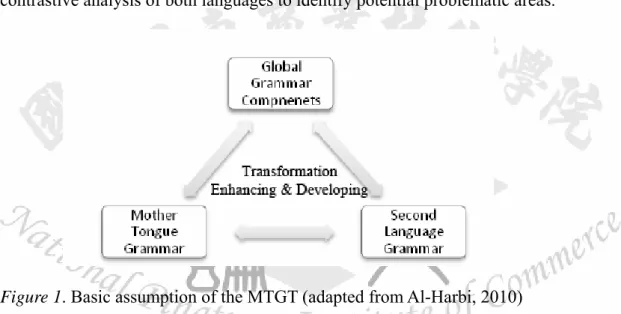
(32) . In addition, Al-Harbi (2010) pointed out that the basic assumption of the MTGT method is global grammar (see Figure 1). The basic components of grammar are globally shared among languages in the world. In his study, global grammar is defined as the essential grammatical and structural components which all languages have in common. L2 learners should be able to identify the similar components for a better understanding of the grammar of L2. Besides, L2 teachers should conduct a linguistic contrastive analysis of both languages to identify potential problematic areas.. Figure 1. Basic assumption of the MTGT (adapted from Al-Harbi, 2010) Table 1 summarizes the big picture of global grammar, and meanwhile, illustrates how grammatical components of a language can be used to teach learners those of a second language. Basically, languages share these components in general; yet, these components differ from one language to another. L2 learners should understand this and take it into consideration to avoid making mistakes.. . 24.
(33) . Table 1 Components of Global Grammar (adapted from Al-Harbi, 2010) Elements of the syntactic construction of the sentence ‧ Clauses ‧ Phrases. Elements of the sentence. ‧ subject ‧ Verb ‧ Direct/indirect object ‧ Complements ‧ Modifiers. Parts of speech. ‧ ‧ ‧ ‧ ‧ ‧ ‧ ‧ ‧. Articles Verbs Nouns Pronouns Adjectives Adverbs Prepositions Conjunctions Interjections. Types of sentences. ‧ Nominal/ verbal ‧ Simple ‧ Compound ‧ Complex. Verb Tense. ‧ Present ‧ Past ‧ Future. Al-Harbi (2010) believes L2 learners use their previous knowledge of L1 as a scale to measure, understand, and acquire L2 especially when they are learning grammar. He then proposed three main hypotheses which constitute the MTGT method. In the first hypothesis, the Conscious Mental Patterning-Fluence Hypothesis, he indicated that when L2 learners are aware of the similarities and differences between L1 and L2, they will create a new mental pattern consciously in stead of monitoring the language. The new mental pattern clearly differentiate the two languages by comparison. Therefore, comparing L1 and L2 will show the L2 learners how the mental patterns of L1 are different from those of L2. Comparison is only the first step by which the learners will understand the patterns they need to create. At the. . 25. Moods of the sentence ‧Activ e voice ‧Passi ve voice.
(34) . moment when the patterns are created, L2 learners will stop comparing the two languages. At this stage, L2 learners will start acquiring the language naturally. The second hypothesis is the Learning-Acquisition Process Hypothesis. It is a little different from Krashen’s (1982) learning-acquisition hypothesis, which identifies two different ways of L2 learners to develop their language competence, namely acquisition and learning. On the contrary, Al-Harbi (2010) believes that acquisition happens only after a learning process took place first, and through which the learner used L1 to understand L2. In other words, in a second language acquisition, learning happens first and then leads to acquisition. In the last hypothesis, Monitoring-Fluency Process Hypothesis, Al-Harbi (2010) states that after creating the new patterns through the comparison, L2 learners will be aware of them. However, at this stage, mistakes occur because the new patterns of L2 are not as strong and influential as those of L1 for the learners. Thus, practicing and monitoring these new patterns is crucial to achieve fluency. Though comparison will not prevent L2 learners from making mistakes, they will be able to identify and correct themselves when such errors occur. Related Studies on the Effectiveness of L1 on L2 Acquisition A number of studies have examined the effectiveness of L1 on L2 acquisition. For instance, Hassanzadeh (2011) conducted an experiment to investigate the effect of. . 26.
(35) . awareness and explicit knowledge of L1 grammar on the learning of L2 grammar. In the experimental study, 40 EFL learners were involved and were randomly assigned to control and experimantal groups. Both groups were taught the same grammar structures; however, the target grammar structures were taught to the experimental group both in English and in their mother tongue. Moreover, a questionnaire was given to the students to get their opinions about being taught in their mother tongue. The result indicated that the experimental group did significantly better than the control group. The learners got deeper understanding of their mother tongue and gained language awareness during the experiment. The result proved that the learners’ awareness of mother tongue had a positive effect on the learning of English grammar. In other words, language awareness in grammar instruction did help the learners to acquire a better and comprehensive understanding of how the structures worked. Likewise, Huang (2010) agreed the effectiveness of L1 awareness on L2 acquisition. He presented some salient linguistic features of Chinese that might explain the communication challenges for Chinese speaking learners of English. Moreover, he emphasized the importance of the instructors’ awareness of the similarities and differences between the learners’ L1 and English and he pointed out that the instructors’ awareness of such features will better inform their teaching and help learners develop communicative strategies to counter potential intefering. . 27.
(36) . influence from learners’ L1 during communication in English. Meanwhile, Cagri’s (2013) and Miles’ (2004) study also proved that using L1 does not hinder learning, and that L1 has a facilitating role which can actually help learning. Moreover, Kavaliauskienė (2009) conducted a survey to examine students’ perceptions of the use of mother tongue. The findings demonstrate that all learners need a support of mother tongue in English classes, but the amount of the native language needed depends on students’ proficiency in English and linguistic situations. The less proficient learners required more reference to mother tongue. These research studies basically investigated the necessity of the use of L1 in L2 acquisition. Most researchers confirm the facilitating role of L1 in ESL; however, some researchers have different opinions. Nazary (2008) investigated the attitudes toward the use of L1 (Farsi) in L2 (English) instruction of eighty-five Iranian university students who are non-English majors. The results showed that all of the students despite their proficiency reproted a negative view and rejected L1 use. He further explained this result might due to that their teacher insists on not using L1 and identifies it as hindrance for language learning. Furthermore, some researchers reported negative impact L1 causes on L2 acquisition. Hussein and Mohammad (2011) states that it is very common when students write in English but attempt to bring their L1 knowledge to bear on the English writing mode. Besides, three factors have impact. . 28.
(37) . on L1 negative transfer to L2 writing: students’ proficiency, writing topic, and mode. Their study was conducted to sixteen university students whose first language was Arabic. In the study, they found that the participants resorted to compensatory strategy in that they tended to compose words and sentences in L1 at first and then translate them into L2, and thus negative L1 transfer occurs. Moreover, they found that the negative L1 transfer was irrespective of studnets’ proficiency, but writing topic and mode turned out to be important factors that affect L1 negative transfer in L2 writing depending on their familiarities and cultural appropriateness. To sum up, the argument about whether the use of L1 would foster or hinder the L2 learning is endless. In the present study, the MTGT method developed by Al-Harbi (2010) was taught to the subjects to examine the effects of the use of mother tongue in teaching English grammar. First of all, global grammar components that the both languages share on the target structures were elicited. Next, enhace the mother tongue grammar on the target structures and then develop those of the second language grammar through comparison, which he called transformation (see Figure 1). After the process, the effects were examined and the results and discussion would be presented in chapter 4 and 5.. . 29.
(38) . CHAPTER 3 Methodology The experimental study aimed to compare the effects of mother tongue grammar transformation instruction (MTGT) and traditional English structural instruction (TESI) on the grammar instruction for junior high school students in Taiwan. This chapter comprises four sections. In the first section, the learning background of the participants is briefly introduced. The second section describes the procedure of mother tongue grammar transformation instruction and the traditional structural instruction. In the third section, the instructional materials and the testing instruments are explained. Finally, the data collection procedure is described. Participants The participants were 58 ninth-graders from two mixed-level classes in southern Taiwan with 29 male and 29 female students. One class was randomly assigned to mother tongue grammar transformation (MTGT) instruction and the other to traditional English structural instruction (TESI). The students in MTGT group were divided into high- and low-achievers based on the overall score on the pretest, which was the first school monthly exam. MTGT group includes 29 subjects. The top-half fifteen subjects in MTGT group were classified as high-achievers, and the bottom-half fourteen subjects as low-achievers. The subjects were unaware of such classifications.. . 30.
(39) . The participants had at least six years of experience of learning English in an EFL environment since they were at the third grade. Nevertheless, grammar was not taught explicitly, and the main focus of English learning was listening and speaking when they were in elementary school. After they went to junior high school, grammar was taught in a structural syllabus. Therefore, grammar instruction played an important role in junior high school. They have five 45-minute regular English classes every week. The textbook used was published by Kang Hsuan Educational Publishing Company. The teacher in the present study was a female junior high school English teacher, who was also the researcher of the present study. In the present study, the target structures they were about to learn were the passive voice construction, wh-noun clause and whether-noun clause. The concepts which they need before learning the target structure such as, subjects, objects, past participle, complements, noun clauses, and wh-questions, had been learned earlier. Table 2 shows the grammar structures which they had already learned and the target structures in the present study.. . 31.
(40) . Table 2 Taught Grammar Structures and the Target Grammar Structures Taught Grammar Structures. The Target Grammar Structures. subjects, objects, past participle,. the passive voice construction,. complements, noun clauses, and. wh-noun clause. wh-questions. and whether-noun clause Instruments. The instruments in the study comprised a pre-test (school monthly exam 1), two different sets of materials for the two treatment groups, a questionnaire, three self-developed structure achievement tests and a post-test (school monthly exam 2) for both groups. Materials In the present study, the researcher aimed to explore whether grammar instruction through mother tongue grammar transformation instruction (MTGT) or the traditional English structural instruction (TESI) would have a different effect on the junior high school students. The researcher designed the material for the experimental group to teach the students passive voice, wh-noun clause and whether/if-noun clause; on the other side, students in the control group learned the target structure through the traditional English structural instruction (TESI).. . 32.
(41) . The designed material for the experimental group contained three divergent sentence levels according to the similarity of structures in both languages and the sequence of the three level were arranged from the most similar one to the most different one. A sample of the worksheets for the experimental group is shown in Appendix A. All the sentences in the worksheets were derived from the textbook; besides, as comparing the similarities and differences of L1 and L2 is important for MTGT, all of the grammatical rules and sentences in the worksheets were provided in both languages and put on arrows to show the corresponding positions between both languages. Level 1 of the worksheet is the most similar structure in L1 and L2. For instance, when instructing the first target structure, the passive voice, the instructor explained the differences between Chinese and English. Verbs in the passive voice in Chinese do not have any inflections and that makes them look just the same as in the active voice. Simply adding the most common character ‘被’ in the sentence indicates the passive voice. In Level 1, the sentence pattern in Chinese is exactly the same as in English and the character ‘被’ is not allowed to be omitted in Chinese. Level 1: L1:法蘭克被邀請至這場派對。 L2: Frank was invited to the party. In Level 2, the sentences are a little different between the both languages, so that students could be reminded to notice the differences and avoid making mistakes. In. . 33.
(42) . Level 2 of the passive voice, the passive character ‘被’ is often omitted in Chinese. This bare form of verbs and sentence structure usually cause confusion while judging the voice in English learning; because students could neither judge the voice of the sentence by its passive character, nor by the form of verb, they were trained to distinquish the voice by recognizing whether the subject is the one who received the action, or the one who did the action. Level 2: L1: 這件毛衣是去年我祖母做的。 In the Level 2 example, the character ‘被’ is omitted; the sentence should be rewritten by adding the passive character ‘被’: L1: 這件毛衣是去年(被)我祖母做的。 L2: The sweater was made by my grandmother last year. The students were reminded to notice the deletion of the word ‘被’ in L1, and distinguish that the subject ‘這件毛衣’ is the receiver of the action. In Level 3, the grammar rules are the most different between the two languages. In Chinese, the subjects could be omitted in the active voice when they are not important or unknown; however, the same sentences are changed into the passive voice when the subjects are omitted in English. For example: Level 3: L1: 台灣種植稻米。 In the Level 3 example, the subject ‘農夫’ is omitted because it is unimportant and the. . 34.
(43) . rest segments remain in the same position. However, students should be reminded to rewrite this Chinese sentence into the passive voice; thus, the voice becomes the same as in English: L1: 稻米在台灣被種植。 L2: Rice is grown in Taiwan. On the other side, in the control group, a sentence structure column was provided in the textbook and the instructor analyzed the parts of speech of the sentences in the column so that the students could apply the sentence pattern to other sentences. Table 3 shows the sentence structure column of the passive voice and Table 4 shows the sentence structure column of the wh-noun clause. Table 3 The Sentence Structure Column of the Passive Voice for the Control Group A. The restaurant The windows B. Rice The job C. The job The soup. . is owned. by a famous star.. were broken. by the boy.. is grown. in Taiwan.. was done. nicely.. will be finished. before 10:00.. can be cooked. in this way.. 35.
(44) . Table 4 The Sentence Structure Column of the wh-noun clause for the Control Group A. Who broke the window?. I don’t know who broke the window.. What will come next?. They aren’t sure what will come next.. B. Who does the girl like? What is Jimmy looking at? C. Why did Susan make the cookies?. I want to know who the girl likes. Please tell me what Jimmy is looking at. They are asking me why Susan made the cookies.. When does the boy play the guitar?. Do you have any idea when the boy plays the guitar?. Where will Lillian learn Japanese?. We are not sure where Lillian will learn Japanese.. Take the passive voice for example, the instructor first analyzed the parts of speech of the sentence pattern and gave the following rule: [subject] + [beV] + [past participle] ( + by [doer] ). Ex: The restaurant is owned by a famous star. Afterwards, students were assigned to the output practice in the text book, such as Example 1 and Example 2. Example 1: Use the hint words to make passive sentences Example find / Jack / yesterday The dog was found by Jack yesterday. the dog . 36.
(45) . Example 2: Rewrite the interrogative sentence into a wh-noun clause Example Who will win the game? Nick isn’t sure who will win the game. To sum up, the students in the control group were required to do the exercise, and then checked their answers with the teacher. The main focus of the whole instruction was on the explanation and practice of English grammar rules. Structure Achievement tests After each lesson was taught, the students in both groups were given a self-developed structure achievement test to examine the learning of the target grammar. A sample of the self-developed structure achievement test is shown in Appendix B, C, and D. The structure achievement test contained three sections. The first section focused on the identification of the target grammar in L1 and L2. For example, in the first target lesson, some sentences are presented in both L1 and L2, and the students had to check which ones among them are in the passive voice. The novel was written by J. K. Rowling. 這本小說是 JK 羅琳寫的 The second section asked the students to rewrite sentences according to the grammatical demand, and then to transform them from L1 to L2, or from L2 to L1. The example showed that the students rewrote an active sentence into a passive sentence first, and then transform it from L2 to L1. . 37.
(46) . Example: A child brought up the idea.. 英:. The idea was brought up by a child.. 中:. 這想法是由一個孩子提出的。. The last section focused on a two-way translation of the two languages. It contained the translation not only from L1 to L2, but also from L2 to L1. The total score of each structural test is 100. Post-test The post-test was conducted to both groups after six weeks of instruction and contained the three target lessons. A sample of post-test is shown in Appendix D. It was the monthly exam, and was produced by an English teacher of the school, not by the instructor. It contained six sections. The first section was listening comprehension part. The students listened to the dialogue and chose an corresponding response. The second section was vocabulary part. Each question has a blank and the students wrote down the vocabulary to fill in the blank according to the context of the sentence. The third section was grammar multiple choice. This section contained the three target grammar structures and there are 20 questions. The students had to choose an answer to fill in the blank in the sentence and made the sentence become grammatically correct. The fourth section was reading comprehension part. A reading contained three questions to examine the students’ understanding of the reading. The fifth section was sentence rewritting part. Each question asked the students to rewrite the sentence . 38.
(47) . based on some certain requests; for example, to rewrite an active sentence into a passive sentence. The last one, translation section, required the students to translate sentences from L1 to L2. Table 5 shows each section of the posttest (school monthly exam 2) and whether it is related to the target grammar competence or not. Table 5 Each Sectiont of the Posttest 1. listening comprehension section. Unrelated to the target grammar. 2. vocabulary section. Unrelated to the target grammar. 3. grammar multiple choice section. Related to the target grammar. 4. reading comprehension section. Unrelated to the target grammar. 5. sentence rewriting section. Related to the target grammar. 6. translation section. Related to the target grammar Procedure. There were two different teaching methods involved in the present study and the two classes were randomly assigned to these two teaching methods. One was the mother tongue grammar transformation (MTGT) instruction, ie. the experimental group, and the other was the traditional English structural instruction (TESI), ie. the control group. The experiment lasted for six weeks, and five 45-minute classes per week. There were three lessons to be accomplished during the six weeks, and each. . 39.
(48) . lesson contains a target structure. Before the experiment started, a pre-test (school monthly exam 1) was given to both groups to check the homogeneity. The instructor taught the grammar structures through MTGT in the experimental group. Every target structure was divided into three levels according to the convergence between L1 and L2. Level 1 represents the same structure between L1 and L2. In Level 2, the sentence structure is a little different between the two languages. Finally, in level 3 , the target sturcture which was shown to the students was completely different from L1 and L2 due to different linguistic usages. When instrucing every target structure, the instructor first led the students to make sentences of the target structure in L1, and wrote down on the board. Then, the instructor classified the sentences which were made by students according to the three levels. Afterwards, the instructor rewrote Level 1 sentences into English and demonstrated how they were the same in L1 and L2 by putting on arrows to mark the positions of the fragments. For instance, the students made an L1 passive sentence (see Ex1) and the L1 sentence was rewritten into English and the instructor drew arrows to show their relationship: Ex1: L1: 我被警察攔下來。 L2: I was stopped by the police officer.. . 40.
(49) . After the sentences were demonstrated on the board, the students began to complete Level 1 part in the worksheet, which involved L1 and L2 transforrmation practice. After the students finished Level 1 part, the instructor went on to introduce Level 2 of the target grammar structure on the board, which was slightly different between L1 and L2. Similarly, after the instructor demonstrated how the Level 2 sentences were different in L1 and L2, the subjects completed the Level 2 practice in their worksheet. For instance, the instructor provided a sentence in both L1 and L2 (see Ex2), and explained that sometimes the character ‘被 bei’, which indicated the passive voice would be omitted in L1. The structure would be the same by simply adding the character ‘被 bei’ into the sentence. Ex2: L1: 這間餐廳是一個有名的明星擁有的。 →這間餐廳是(被)一個有名的明星擁有的。 L2: The restaurant is owned by a famous star. Finally, in Level 3, the instructor had to explain the grammar usage in both L1 and L2 because the target sturcture was completely different from L1 and L2 due to different linguistic usages. Take the first target struture, the passive voice, for example, when the doer of the verb is unknown or unimportant, it would be omitted in L1. For instance, the doer is omitted in the following L1 sentence because it is unimportant.. . 41.
數據
+2
相關文件
TPR教學法是一種利用肢體動作和聲音 連結的直覺教學法,研究發現TPR教學
例如,參閱:黃啟江,《因果、淨土與往生:透視中國佛教史上的幾個面 相》〈第六章·從佛教研究法談佛教史研究書目資料庫之建立〉,(台北:臺 灣學生書局,2004 年),頁 237-252; Yasuhiro
主頁 >課程發展 >學習領域
主頁 > 課程發展 > 學習領域 > 中國語文教育 > 中國語文教育- 教學 資源 > 中國語文(中學)-教學資源
如何 如何在小學語文課程中加強中華文化的學習 在小學語文課程中加強中華文化的學習 在小學語文課程中加強中華文化的學習
2.「情境」創設對非華語學生學中文的影響 3.應用「調適架構」配合情境訂立教學目標 二、 第二語言教學流派..
「 「小學中國語文評估系列 小學中國語文評估系列 小學中國語文評估系列 小學中國語文評估系列: : :課堂追問 : 課堂追問 課堂追問 課堂追問」 」 」 」研討會
歷史文獻回顧法又稱史學方法、史學研究法、歷史法或歷史研究法。歷史文獻回顧 法的英文名稱除了 Historical Method 之外,亦有 Historical Research、Historical Study
