National Chiao Tung University
Institute of Education
Master Thesis
以數位說故事教學法融入新加坡小學道德教育課之
課程設計、發展與評鑑
The Design, Development and Evaluation of
a Digital Storytelling-integrated Moral Education Curriculum
for Primary School Students in Singapore
Student: Liu Ying-Tzu
Advisor: Chien Chou, Ph.D.
以數位說故事教學法融入新加坡小學道德教育課之
課程設計、發展與評鑑
The Design, Development and Evaluation of a
a Digital Storytelling-integrated Moral Education Curriculum
for Primary School Students in Singapore
研 究 生:劉映孜
Student: Liu Ying-Tzu
指導教授:周 倩 博士 Advisor: Chien Chou, Ph.D.
國立交通大學
教育研究所
碩士論文
A Thesis
Submitted to Institute of Education National Chiao Tung University in partial Fulfillment of the Requirements
for the Degree of Master
in Education September 2012
Hsinchu, Taiwan, Republic of China
i
以數位說故事教學法融入新加坡小學道德教育課之
課程設計、發展與評鑑
研究生:劉映孜 指導教授:周 倩 博士 教育研究所 國立交通大學 中文摘要 本研究目的在於透過數位說故事的方式引導學生運用簡單的科技,培養學生的 道德認知、情感和行爲,並同時掌握 21 世紀所需的技能與能力。本研究以新加坡某一 小學五年級學生為對象,發展一套以「尊重」為道德核心價值的數位說故事之道德教 育課程,並以形成性評鑑評估新課程之可行性與成效。 本研究文獻探討的部分探討道德相關理論與教學策略,以及科技在教育方面的 使用方式,以作爲發展新課程之依據。本研究依照 Smith 和 Ragan(2005)之「分 析」、「擬定教學策略」、「評鑑及修正」之系統化教學設計架構進行課程設計。在 分析階段,透過資料分析、訪談教師之方式了解教學目標、學習者、教材需要與内 容,及教學環境。分析結果發現現有的道德教學策略欠缺了資訊科技融入的元素與以 學習者為中心的教學方式,由此可見本研究課程的需求性,同時也凸顯了新課程的特 點。本研究以 Lambert(2010)的數位說故事步驟,以及 Lickona(1991,1993, 2001)的道德教育架構,設計以數位說故事之道德教學課程,並規劃四個課程單元。 本研究所設計與發展出的課程配套包括教案、教學素材、圖文簡報和評估表等。 在課程評鑑的部分,本研究藉由自我檢核、專家評鑑、一對一之學習者檢核和 實地試教的方式評估課程之可行性與成效。根據自我檢核的結果,本課程修正並補充 了現有道德教學的缺點與不足之處。專家認爲課程具有適當的内容性、一致性、設計 性和可行性。參與一對一評鑑的學生認爲本課程的活動具有挑戰性、有趣,對學習有 所幫助。 本研究以形成性評估進行課程評鑑與修改後,選取了二十位五年級小學生,進 行近兩個月實地試教。實地試教結果顯示,學習者能夠理解尊重的涵義、能以不同角 度理解道德情境,做出正確的價值判斷、自我反省,達成了課程所設的道德認知和情 感的教學目標。在道德行爲方面,學習者在各自的合作小組裡,展現了良好品德的行 爲,實踐了道德行爲目標。學習者課後滿意度問卷和訪談顯示所提供的合作學習活動 時間不夠充裕,但學生對於整體學習過程表示滿意。學習者反映本課程可促進其道德 發展,也提升其資訊科技能力、社交能力和思維能力。 最後,綜合以上結果,研究者提出研究限制及未來教學與研究建議,供教師與 研究者參考。 關 鍵 字 : 數 位 說 故 事 教 學 法 、 道 德 教 育 課 、 道 德 核 心 價 值 、 系 統 化 教 學 設 計 、 新加坡、小學五年級學生ii
The Design, Development and Evaluation of
a Digital Storytelling-integrated Moral Education Curriculum
for Primary School Students in Singapore
Student: Liu Ying-Tzu Advisor: Chien Chou, Ph.D.
Institute of Education National Chiao Tung University
ABSTRACT
The purposes of this study include the design and development of a digital storytelling (DST) integrated Civics and Moral Education (CME) curriculum unit, anchoring on the core value of respect, for primary 5 students in Singapore; and the formative evaluation of the new curriculum to test its feasibility and effectiveness. Through DST, the study intends to put the simple and affordable technologies in the students’ hands to facilitate them in their moral development and concurrently equip them with the essential skills of the digital era.
The researcher first presented an overview of the established morality theories and the approaches to moral education, and then reviewed the use of technology, particularly DST, in the education field. Smith and Ragan’s (2005) Analysis-Strategy-Evaluation instructional design model was adopted. The analysis phase involved the analysis of instructional goal, learner characteristics learning content and environment, via document analysis and interviews. The lack of the information and communication technology (ICT) and student-oriented CME instructional approaches justified the needs and highlighted the niche of the new curriculum. In the strategy phase, with Lambert’s (2010) DST steps and Lickona’s (1991, 1993, 2001) moral life framework, the instructional package was designed and developed, in which included lessons plans, presentation slides, samples and assessment forms.
The new curriculum was formatively evaluated via design reviews, expert reviews, one-to-one evaluation and field trial. The design reviews showed that most of the identified inadequacies had been rectified, and the experts revealed that the curriculum had met the design standards of congruency, relevance, accuracy and feasibility. The students involved in the one-to-one review found the activities challenging yet interesting and beneficial.
The revised curriculum was administered as a field test, to a class of twenty primary 5 students. From the student participants’ work, it was found that the learners were able to grasp the meaning of the value, take perspectives to make sound moral decisions, and seek self-improvement, achieving the moral cognitive and affective objectives. For the moral behaviour performance aspect, they consistently showed respectful behaviours to their group-mates. The post-curriculum feedback revealed that the amount of time for activities seemed insufficient, but the student participants found the overall learning experience enjoyable and effective in advancing their moral development and enhancing their ICT, social and critical thinking skills.
Finally, according to the research results, the researcher identified the research limitations and provided recommendations for future researchers and educators to further explore the use of digital storytelling in moral education.
Keywords: digital storytelling (DST), Civics and Moral Education (CME), moral values,
iii
Acknowledgement
I would like to send my greatest gratitude to my advisor, Dr. Chien Chou(周倩老 師). Without Prof Chou, I would not have the opportunity to be pursuing my Master degree in NCTU, not mentioning to be here celebrating the completion of my Master thesis. Despite her busy schedule, Prof Chou always made time to have a meeting with me and spent much time reviewing my long-winged thesis. Her encouragement, support and belief in my capability gave me much motivation and confidence to always perform proficiently. I am really fortunate to have Prof Chou as my thesis advisor, who is always concerned about both my academic progress and my well-being.
I would also like to thank Dr. Chao-Hsiu Chen(陳昭秀老師), Dr. Jerry Chih-Yuan Sun(孫智元老師), Dr. Jiun-Yu Wu(吳俊育老師)and all other teaching staff in the NCTU Institute of Education for making my two years in NCTU intellectual and fruitful. Thank you my external oral examiner, Dr. Lin Ching Chen(林菁老師), for tediously travelling all the way from Chiayi to Hsinchu to attend my thesis oral defence sessions, and provide valuable suggestions and comments to my thesis. To the administrative staff, especially 嘉凌姊 , thank you for always being so enthusiastic and helpful in providing me with the much needed assistance in the school administrative matters.
To my family, thank you for being supportive to me. Especially to my Dad: thank you for being so liberal and supportive, enabling me to grow to be independent and responsible. I have to thank my aunt(小姑姑), who took much care of me when I was in Taiwan, driving me around, bringing me to nice restaurants, and even giving me a shelter whenever I went to Taipei. Not forgetting all my other relatives who showed care and render help during my stay in Taiwan.
Last but not least, thank you to all the friends I have made in Taiwan. Without them, my stay in Taiwan would not be as exciting and colourful as it was. To Yu Shan(鄭伃珊): thank you for introducing me to the many classmates and seniors in the institute, helping me to quickly adapt to the life in NCTU. Thank you for accompanying me on travelling trips, and helping me in my academic work, especially the terrifying Statistics. To Hsiao Ching (施曉晴): thank you for being such a sweet, thoughtful and mature-thinking friend whom I could truly confide to. To Yun Ru(徐韻茹): thank you for spending nights and hours with me working on my thesis-related assignment. To Xin Chun (吳欣純) : thank you for helping me with the statistics and the thesis administrative matters, and all the moral support you have given during my thesis writing period. To Michal: thank you for giving me all the care, concern and moral support I needed during critical periods of the semester, and thank you for being such an amazing travelling companion. To Winky: thank you for making my dormitory life really fantastic with the.midnight girls’ talks and snack time. To Agata: it has been a great pleasure to have you as my first room-mate. To Marta: thank you for being such a wonderful room-mate who quietly showed care for me and for bringing me around when I was in Krakow. To Olesya, Nina and Karen: it has been fantastic to have three of you to fill the dormitory room with a lively atmosphere in my final semester. My gratitude also goes to all the seniors who have given me advices or support in one way or another.
iv
Table of Contents
Chinese Abstract ………..…………... i English Abstract ………..…………... ii Acknowledgement ………. iii Table of Contents ………..…………... ivList of Tables ………..…………... vii
List of Figures ………..…………... viii
Chapter 1 Introduction………. 1
1.1. Research rationale………... 1
1.2. Research purposes………... 4
Chapter 2 Literature review………. 5
2.1. Overview of morality theories……… 5
2.1.1. Theory of moral development………. 5
2.1.2. Ethics of care………... 9
2.1.3. Social domain theory………... 10
2.1.4. Lickona’s framework for character education………. 12
2.2. Approaches to moral education………... 14
2.2.1. Direct instruction………. 14
2.2.2. Moral dilemma discussion………... 15
2.2.3. Role-playing……… 16
2.2.4. Service learning………... 17
2.3. Narrative approach………... 18
2.4. Technology integration in moral education………. 20
2.5. Background of digital storytelling………... 28
2.5.1. Definition of digital storytelling………... 28
2.5.2. Process of digital storytelling………... 30
2.5.3. Development of digital storytelling………. 34
2.5.4. Educational applications of digital storytelling………... 36
Chapter 3 Research methods...………. 44
3.1. Research context………. 44
3.1.1. Brief overview of the Singapore primary education system…... 44
3.1.2. Participating school………. 46
3.1.3. Student participants………. 47
3.1.4. Role of the researcher……….. 48
3.2. Ethical considerations……….. 48
3.3. Research procedure………. 50
3.3.1. The analysis phase………... 51
3.3.2. The strategy phase………... 54
3.3.3. The evaluation phase………... 56
3.4. Data analysis…………..……….. 67
3.5. Quality of qualitative research………...……….. 68
Chapter 4 Design and development of curriculum……….. 70
4.1. The instructional analysis……… 70
4.1.1. Instructional goal analysis………... 70
4.1.2. Learning content analysis……… 72
4.1.3. Learner analysis………... 81
4.1.4. Learning environment analysis……… 87
4.2. The strategy phase………... 94
v
4.2.2. Development of curriculum unit………. 101
Chapter 5 Formative evaluation of curriculum ………...…… 104
5.1. Design reviews..……….. 104
5.2. Expert reviews..………... 107
5.3. One-to-one evaluation………. 113
5.4. Field trial process……… 120
5.4.1. Lesson unit one: We are one!... 120
5.4.2. Lesson unit two: Think twice before we act……… 123
5.4.3. Lesson unit three: It all makes a difference………. 124
5.4.4. Lesson unit four: We are considerate……….. 128
5.4.5. Summary of the encountered problems………... 130
Chapter 6 Learning outcomes……….. 132
6.1. Moral cognitive performance………..…… 132
6.1.1. Moral knowledge and awareness………. 132
6.1.2. Moral reasoning and decision-making……… 136
6.2. Moral affective performance………... 145
6.2.1. Empathy……….. 145
6.2.1. Conscience and humility………. 147
6.3. Moral behavioural performance……….. 149
6.3.1. Self and peer assessment of collaborative process……….. 150
6.3.2. Researcher’s assessment of collaborative process……….. 152
6.3.3. Interviews with teachers………. 157
6.4. Student participants’ post-curriculum feedback………. 161
Chapter 7 Conclusion and future work.………... 171
7.1. Conclusion……….. 171
7.1.1. Design and development of curriculum unit……….. 171
7.1.2. Feasibility and effectiveness of curriculum unit……….…… 173
7.2. Limitations and suggestions……… 177
7.2.1. Instructional design and content………. 177
7.2.2. Time allowance for field trial……….. 180
7.2.3. Evaluation methods………. 181
7.2.4. Role of researcher…………..……….. 182
7.2.5. Research participants..………. 183
7.3. Future research……… 183
7.3.1. Instructional design and content………. 183
7.3.2. Evaluation methods………. 184
7.3.3. Research participants..………. 185
References ………. 186
Appendix 1 A consent letter for participating school authority……….. 193
Appendix 2 Consent forms for student participants of one-to-one evaluation……… 194
Appendix 3 Consent form for student participants of field trial………. 196
Appendix 4 Interview questions for DST workshop expert in needs analysis phase………... 198
Appendix 5 Interview questions for teacher interviewees in needs analysis phase………... 200
Appendix 6 Expert review survey form……….. 202
Appendix 7 One-to-one evaluation log………... 204
Appendix 8a Feedback form for student participants of field trial………... 205
vi
Appendix 9 Interview questions for teacher interviewees of formative
evaluation……… 207
Appendix 10 Excerpts of the MOE CME 2007 syllabus……….. 209
Appendix 11 Excerpts of the CME textbook……… 217
Appendix 12 A lesson plan in the Teacher’s guide file……… 220
Appendix 13 Samples of pictorial resources………. 223
Appendix 14 Participating school’s year 2011 CME rubrics………... 225
Appendix 15 Participating school’s ICT plan………... 228
Appendix 16a Lesson unit 1 – Lesson plan……… 230
Appendix 16b Lesson unit 1 – Sample digital story………... 234
Appendix 16c Lesson unit 1 – Presentation slides on group rules and roles (revised version)……….. 237
Appendix 16d Lesson unit 1 – Weekly self and peer assessment rating scale forms (revised version)……… 239
Appendix 16e Lesson unit 1 – Collaborative performance rubric (moral behavioural aspect)……….. 241
Appendix 16f Lesson unit 1 – Two moral scenarios on group work………. 242
Appendix 16g Lesson unit 1 – Moral scenario checklist……… 244
Appendix 17a Lesson unit 2 – Lesson plan……… 245
Appendix 17b Lesson unit 2 – Moral scenario illustrations………... 249
Appendix 17c Lesson unit 2 – Story and problem mind-map examples………… 250
Appendix 17d Lesson unit 2 – Problem mind-map templates……… 251
Appendix 17e Lesson unit 2 – Mind-map checklist………... 253
Appendix 17f Lesson unit 2 – Weekly group work observation rating scale form 254 Appendix 18a Lesson unit 3 – Lesson plan……… 255
Appendix 18b Lesson unit 3 – Sample storyboard………. 261
Appendix 18c Lesson unit 3 – Storyboard rating scale……….. 264
Appendix 19a Lesson unit 4 – Lesson plan……… 266
Appendix 19b Lesson unit 4 – Task-list for digital reflection story-making (revised version)……….. 271
Appendix 19c Lesson unit 4 – Digital reflection story template……… 272
Appendix 19d Lesson unit 4 – Moral scenario on bullying……… 275
Appendix 19e Lesson unit 4 – Digital reflection story rubric (evaluation of moral cognitive and affective aspects)……… 276
vii
List of Tables
Table 1 Kohlberg’s Stages of Moral Development………..……… 7
Table 2 Development of Gilligan’s Ethics of Care………..……… 9
Table 3 A Summary Table of Digital Storytelling Process... 32
Table 4 The 2012 Academic Year Calendar for Singapore Primary Schools…..… 46
Table 5 Background Information of Teachers Interviewed in Analysis Phase…… 54
Table 6 A Summary Table of Formative Evaluation Methods Used……….. 57
Table 7 Design Review Checklist Table……….. 58
Table 8 Background Information of Experts in Evaluation Phase………... 59
Table 9 Basic Profiles of Student Participants in One-to-one Evaluation Phase…. 60 Table 10 Group Compositions of Participating Class……… 61
Table 11 Administered Field Trial Time Schedule……… 62
Table 12 Basic Teaching Information of Teachers Interviewed in Formative Evaluation Phase………. 66
Table 13 Data Source Codes………...………... 67
Table 14 A Summary Table of Learning Content Analysis Results……….. 73
Table 15 A Summary Table of Learner Analysis Results……….. 82
Table 16 A Summary Table of Learning Environment Analysis Results………….. 88
Table 17 A Digital Storytelling Integrated CME Curriculum Unit Plan……… 96
Table 18 The Problem Rectification Checklist Results……….. 105
Table 19 The Design Review Checklist Results……… 106
Table 20 Expert Reviews Results…………...……… 108
Table 21 Descriptive Statistical Results of Self and Peer Assessments……...…….. 151
Table 22 Descriptive Statistical Results of Student Participants’ Collaborative Learning Process………. 153
Table 23 A Summary Table of One-Way Repeated Measures ANOVA Results….. 153
viii
List of Figures
Figure 1 The interplay of the three moral domains……… 12
Figure 2 The SAGE authoring function………. 22
Figure 3 The Zora ICE space………. 23
Figure 4 The Kaleidostories ICE interface……… 24
Figure 5 The Clover scene editor………... 25
Figure 6 The instructional design model for the digital storytelling-integrated moral education curriculum unit………. 51
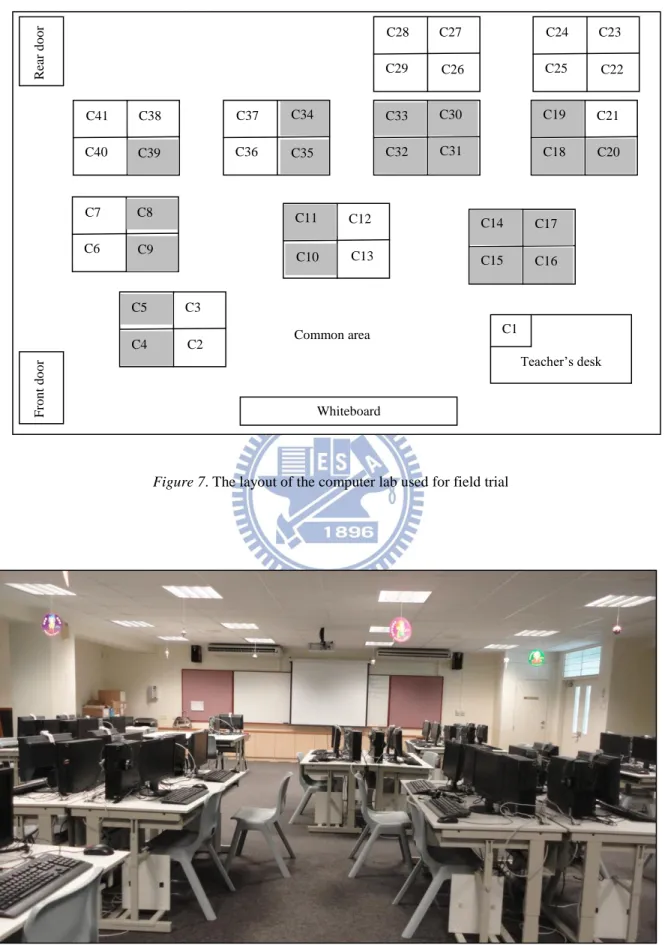
Figure 7 The layout of the computer lab used for field trial……….. 63
Figure 8 Photograph of the computer lab used for field trial………. 63
Figure 9 The MOE CME syllabus framework………... 71
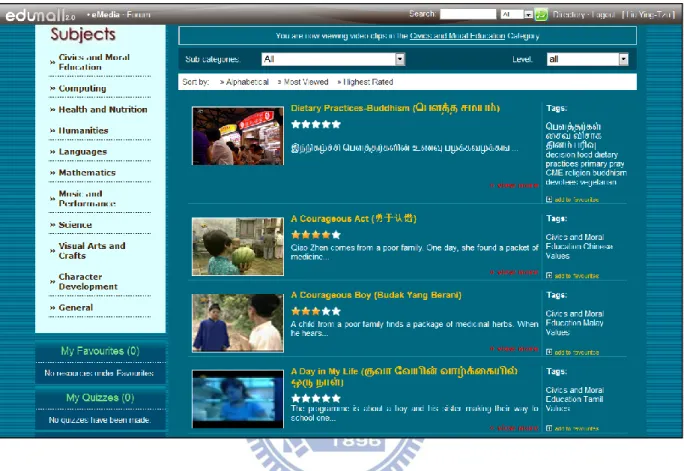
Figure 10 The MOE eMedia Edumall website……… 77
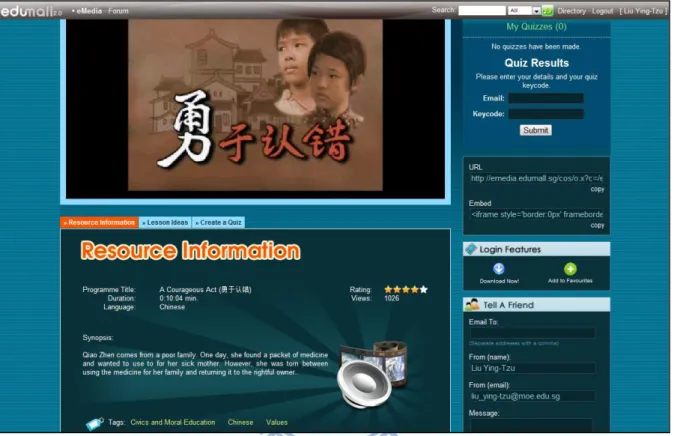
Figure 11 A video clip with its resource information on the MOE eMedia Edumall website………. 78
Figure 12 Photographs of the groups working on mind-maps (14 February 2012)…. 124 Figure 13 Photograph of student participants demonstrating a role-play scenario (20 February 2012)……….. 125
Figure 14 Photographs of student participants working on the role-playing activity (20 February 2012)……….. 126
Figure 15 Photograph of student participants doing voice-recording for their reflection slides (26 March 2012)……… 130
Figure 16 The definition of “considerate” slide in Group 3’s digital reflection story. 133 Figure 17 The four participating groups’ slides explaining the reasons to be considerate……….. 134
Figure 18 Examples of considerate and inconsiderate behaviours in Group 1’s digital reflection story……….. 135
Figure 19 Group 2’s mind-map to resolve moral scenario 4………... 137
Figure 20 Group 1’s mind-map to resolve moral scenario 1………... 138
Figure 21 Group 4’s mind-map to resolve moral scenario 2………... 139
Figure 22 Excerpts of Group 4’s storyboard……….... 141
Figure 23 Excerpts of the mind-maps done by Group 3……….. 144
1
Chapter 1 Introduction
1.1. Research rationale
As Ryan and Bohlin (1999) wrote, “Since education seeks to help students to develop as persons, character development is part and parcel of whole enterprise” (p. 93) and as Pring (2001) argued “education itself is a moral practice”, scholars attempt to bring across the point that a holistic education would have to incorporate both the intellectual and moral development to wholly develop a person. The Singapore Ministry of Education (MOE) desired outcomes of education too emphasises the importance of the character and moral values of a person, other than the academic achievement. Under the Singapore education system, one should develop to become a confident person, self-directed learner, active contributor and concerned citizen (Ministry of Education Singapore, 2010a). Six core values of respect, responsibility, integrity, care, resilience and harmony underpin the educational framework for the aforementioned desired outcome of education and the development of the 21st century skills, such as critical and creative thinking, information and communication skills, global awareness and civics literacy (Ministry of Education Singapore, 2010a). These values are crafted in the Civil and Moral Education (CME) syllabus and explicitly taught to students during the CME lessons in the primary schools.
However, parents had pointed out in the newspapers that non-core subjects, like Social Studies, Health education and CME, had taken a backseat to the examinable subjects in school as the examinable subjects were deemed as more important and crucial by teachers (Chua, 2010). Another news article commented that young people nowadays were less fearful of breaking rules and social conventions as parents failed to prohibit the misbehaviour of their children and teachers in schools were less willing to discipline the students for the fear of parents’ complaint and students’ negative responses (Hoi, 2010). In the 2009 parliamentary
2
supply debate, the government had been urged to place greater emphasis on instilling the young Singaporeans with sound values while in pursuit of academic excellence (People’s Action Party, 2010). To prepare the Singapore students for the challenges in the globalised and knowledge-based world, education in Singapore has seek to rebalance to focus more on the moral formation aspects, equipping them with both the 21st century competencies and core moral values. Researchers agreed that children in the elementary schools are at a formative and malleable period, thus moral education can be impactful to their moral development (Baliey, Tappan & Brown, 1998). The Primary Education Review and Implementation committee was formed to review the primary education, reflecting the ministry’s recognition of the integral role of moral education. The committee recommended the strengthening of the quality of non-academic education in primary schools, with greater investment in subjects such as physical education, art and music, which play a central role in character development (Ministry of Education Singapore, 2009). In addition, the recently released Secondary Education Review and Implementation report too had its focus placed on the strengthening of teacher-student relationship, social-emotional support, character-building and citizenship education (Ministry of Education Singapore, 2010b). Moral education is increasingly integrated into the formative education and more proactively promoted by the government as the new Character and Citizenship Education module is expected to be introduced and infused into the core examinable subjects by 2013 (See, 2011).
At the same time, recognising the potential impact of Information and Communication Technology (ICT) could bring to education, the MOE has launched a series of 5-year ICT Masterplans since 1997 to integrate ICT into education to enrich and transform the learning environment to assist students in the acquisition of higher order of thinking skills and the 21st century competencies (Education Technology Division, 2010). The latest ICT Masterplan with its vision of “harnessing ICT, transforming learners” prompts teachers to leverage on the
3
affordances of ICT to assimilate ICT into curriculum in order to promote and develop self-directed and collaborative learning skills in students (Education Technology Division, 2010). However, while the ministry policy is promoting the integration of ICT into curriculums, the MOE CME syllabus lacks mentioning the ICT pedagogical approach to moral education and ICT resources for the CME curriculum are limited (Curriculum Planning and Development Division, 2006).
There are studies that investigated the use of technology to enhance moral education; some involve the creation of computational authoring systems to assist students in self-identity construction (Bailey, Tettegah & Bradley, 2006; Bers, 2001, 2003; Bers & Cassell, 1998; Umaschi, 1996) while others attempted to explore the use of multi-users virtual environment (Jamaludin, Yam & Ho, 2009; Lee & Hoadley, 2006) or simply the use of readily available film video clips for moral development (Samuelson, 2007). With technology, students are able to engage in active learning as they take charge of their learning process and progress. Collaboration in online communities connects students to authentic learning context, and gain wide and alternative perspectives to moral issues. Digital storytelling (DST) offers an alternative and viable way to cultivate values in students. Creating digital moral stories may prompt students to review the surrounding moral issues or their experiences, clarify their values and present the abstract value concepts into a concrete and sequential manner (Watson, 2003). At the same time, students’ literacy and technological skills can be enhanced (Lowenthal, 2009; Robin, 2008).
Thus, this study proposes to leverage on the digital storytelling pedagogy to foster moral development in a Singapore primary school, as an attempt to create ICT-enriched learning environment that could empower learner to engage in collaborative, authentic and self-directed learning to form and refine their value systems, as well as to acquire the 21st century skills concurrently.
4
1.2. Research purposes
The research purposes of this paper include the following:
(1) design and develop a digital storytelling incorporated CME curriculum unit on the moral value, respect, for the primary five students;
(2) formatively evaluate the feasibility and effectiveness of the newly designed and developed curriculum unit.
5
Chapter 2 Literature review
The literature review chapter first presents a brief overview of the developmental moral theories, and then outlines a few approaches to moral education and placed particular focus on the narrative pedagogy. The chapter also reviews the integration of technology in moral education, emphasising on the digital storytelling (DST) approach which fuses technology with the narrative teaching practice.
2.1. Overview of morality theories
This section briefly introduces a few significant developmental morality theories which include the Kohlberg’s stages of moral development, Turiel’s social domain theory, Gilligan’s ethics of care and finally the character framework initiated by Lickona.
2.1.1. Theory of moral development
Piaget contributes significantly to the theory of moral development, by extending the cognitively-structural, stage-sequential and age-related formulations from his cognitive development work to moral development (Lockwood, 2009; Nucci, 2008; Tan, Parsons, Hinson & Sardo-Brown, 2003). He theorised based on his observation of the ways children play games and apply the game rules, concluding that children construct their moral values via interactions with the environment. He then divided children’s moral reasoning into two stages, namely heteronomous morality and autonomous morality.
Heteronomous morality. Children under the age of ten tend to demonstrate
heteronomous morality, viewing rules as constant, inflexible and absolute as they perceive the rules to be set by an authority figure and thus must be obeyed. They base their moral judgement and behaviours on external forces, such as rules and the consequences of the
6
actions, rather than the intentions behind the actions, thus believing that immediate punishment is inevitable when rules are broken, yet they are unable to explain why certain acts are forbidden or undesirable. This stage of moral reasoning is closely associated with young children’s cognitive structure of ego centrism, whereby young children at this stage tend to focus more on self than perceiving issues from others’ perspective.
Autonomous morality. Children’s moral reasoning shifts from the heteronomous to
autonomous moral orientation after the age of ten as they become less self-centred to become more considerate and able to demonstrate perspective-taking. They begin to view rules as flexible and negotiable, thus application of rules is selectively and based on situations. They understand rules as cooperatively developed based on mutual respect and reciprocity, instead of associating rules to power. When a rule is broken, the older children tend to consider both the outcomes and the intentions of the acts, and together work out a resolution which they deem as fair to all. This interpersonal interaction and cooperation process aids in the children’s moral development, thus Piaget emphasised on cooperation and problem solving for moral education.
Another influential contributor to the field of moral education and psychology is Lawrence Kohlberg. In consistent with Piaget, Kohlberg argued that it will be myopic to simply view moral development as culture and value transmission from parents; instead, children can be philosophers, having their own morality (Carpendale, 2000; Kohlberg, 1981). Kohlberg built his theory on the foundation of Piaget’s early work on cognitive and moral development. He took reference to Piaget’s conception of stages and developed the theory of moral development in a more extensive manner encompassing three levels with six stages (Crain, 1985; Kohlberg, 1981; Lickona, 1994; Lockwood, 2009; Nucci, 2008; Tan, Parsons, Hinson & Sardo-Brown, 2003; Tong, 1993). The stages are age-related and in hierarchical
7
order, with each stage being qualitatively different from the other. Kohlberg’s stages of moral development are listed in Table 1.
Pre-conventional level. The pre-conventional level is most common in young children.
At this level, children behave to avoid punishment. In stage one, children view rules as fixed and absolute and fail to see the perspectives of other. They tend to obey the rules in order to avoid punishment. As the children move to stage two, they begin to take note of their individual opinions and tend to behave in a reciprocal way and react to immediate interest.
Conventional level. The conventional level brings one to out of the ego-centric phase
to consider the society and is typical of teenagers and adults. At this level, one will behave to conform to the social roles and expectations of the community or society. Stage three delineates that one conforms to the majority’s stereotypical expectation in order to gain good relationships with surrounding people, usually community or family. When one decides to comply with the law and order to maintain social order, one has reached stage four. Kohlberg (1981) found that most people hardly go beyond stage four to attain higher stages of moral development.
Post-conventional level. At the post-conventional level, individual has internalised
moral reasoning and will tend to operate according to one’s own principles. At stage five, one
Table 1
Kohlberg’s Stages of Moral Development
Level 1: Pre-conventional morality Stage 1: Punishment and obedience orientation Stage 2: Individualism and exchange
Level 2: Conventional morality Stage 3: Good interpersonal relationships Stage 4: Law and order
Level 3: Post-conventional morality Stage 5: Social contract and individual rights Stage 6: Universal principles
Adapted from “The philosophy of moral development: Moral stages and the idea of justice,” Vol. 1., p.409-412 , by L. Kohlberg, 1981, San Francisco: Harper & Row. Copyright 1981 by Lawrence Kohlberg.
8
begins to realise that while laws are important for maintaining social order, one should take into account of differing views and rights in order to maintain a social system that benefits the people. The highest stage emphasises on the universal principles of justice and human rights and one should follow these abstract universal principles even if they are in conflict with the laws.
Kohlberg’s theory suggests moral education programmes to be developmentally appropriate and provides moral reasoning that is a stage above the students’ existing one. He advocates the use of moral dilemma discussions and “just community” to resolve complex moral issues. Faced with moral dilemmas, one encounters cognitive dissonance, and requires reasoning and rationalising through one’s values to achieve the next stage of moral development. If one is unable to comprehend the moral reasoning at one stage, one may not be able to reach a higher level of moral maturity.
There are criticisms to Kohlberg’s theory. Kohlberg claims that the stage is universal and can transcend across culture. However, there are views that his theory emphasises on individualistic culture on the Western countries and may not be as applicable to Asian countries with collective culture (Crain, 1985; Tan, Parsons, Hinson & Sardo-Brown, 2003). Different individuals in various cultures develop through the stages at different rates. Gilligan (1993) argued that Kohlberg’s theory is male-oriented, focusing too much on rationality; and as compared to the male counterparts, the females are more inclined to interpersonal relationships. Based on Kohlberg’s scale, woman may have difficulties going beyond stage 3 (Tong, 1993). While Kohlberg has offered a detailed stage sequence for moral thinking, the effects of moral emotions and behaviours may not have been emphasised in the theory (Lickona, 1994; Nodding 1992, 2002).
9
2.1.2. Ethics of care
Gilligan (1993) provided a divergent perspective from Kohlberg, emphasising on the aspect of care and responsibility of relationships rather than universal principles and rules. Gilligan’s initial studies focused on the gender differences and their different orientations towards moral problems, developing the ethics of care which are framed within the feminism premise (Gilligan, 1993; Noddings, 1992, 2002; Nucci, 2008; Tong, 1993). Nevertheless, the caring ethics has considerable practical implications for the moral education, to have the emphasis shifted from the cognitive to the affective aspects. For females, moral reasoning and decisions are made contextually and based on interconnectedness and relations, to achieve care and responsibility for all. Women constantly negotiate between the concepts of self and others as they move in and out of the three identified levels during the moral development process. Gilligan illustrated women’s moral development with the abortion study in her book, “In a different voice: psychological theory and women’s development”. The three levels and two transitional phases are presented in Table 2.
Table 2
Development of Gilligan’s Ethics of Care
Level 1 Self-survival
Transitional phase 1: From selfishness to responsibility
Level 2 Self-sacrifice
Transitional phase 2: From goodness to truth
Level 3 Morality of non-violence
Adapted from “In a different voice: Psychological theory and women’s development,” p. 74, by C. Gilligan, 1993, Cambridge, England: Harvard University Press. Copyright 1982, 1993 by Carol Gilligan.
Level 1: self survival. Woman, in the initial stage, tend to focus on self and pragmatic
concerns that are of self-interests and for survival. A powerless and helpless self tend to be manifested in this level. This may be perceived as selfishness. However, in order to establish
10
relationships and connectedness with others, one undergoes the transitional phase to do what one should do as an appropriate moral choice.
Level 2: self-sacrifice. At this level, one assumes responsibility and equates goodness
with caring. One would forgo self-interests in favour of those of others. However, such suppression of self has the possibilities of leading to sour relationships. Thus, while caring for other, one begins to recognise one’s needs and concurrently reconsider what is considered as selfish.
Level 3: morality of non-violence. To overcome the intense suppression, one may need
to proceed to the next level. One would attempt to resolve the tensions between the concerns for self and others, achieving care and avoiding hurt to both self and others. At this level, one attains moral maturity, taking into consideration of both self and others as the way to maintain the social relations.
Moral education, based on the ethics of care approach, emphasises on four aspects, namely modelling, dialogue, practice and confirmation (Noddings, 1992, 2002). The role model establishes a caring relationship with the cared-for targets, showing them the ways to care. To more deeply involve the care-for targets, a dialogue can be carried out with an open mind and the aim to achieve mutual understanding, empathy or appreciation. Opportunities for moral actions, as a form of practice, may have the effects of instilling certain values and positive attitudes by putting their moral values in social situations. Confirmation through encouragement and affirmation will promote the person to keenly work towards a better self.
2.1.3. Social domain theory
Turiel’s social domain theory differs from Kohlberg’s paradigm with the understanding that the former suggests that children’s concepts of morality and other domains of social knowledge, such as social conventions, are considered as separate entities instead of
11
one as they are in Kohlberg’s theory (Nucci, Killen & Smetana, 1996; Nucci, 2008; Smetana, 1999; Turiel, 1983). Morality refers to the set of impersonal and obligatory criteria, laying on universal principles of welfare, trust, justice and rights, governs one’s conducts; while social conventions encompass the arbitrary and socially agreed rules, coordinating and determining the socially appropriate behaviours in the social systems (Smetana, 1999; Turiel, 1983). Though both concepts may differ, they are inter-related, since all social events occur within the larger society context (Nucci, 2008). Children understand the aspect of moral domain in the terms of how they should relate to others on the basis of the universal features, and comprehend the social conventions domain in terms of how they could relate to others effectively and maintain the relationships with the socially accepted behaviours. In the process of coordinating between the moral and societal constraints to determine the right conduct, the situation and developmental aspects may come into play. According to the social domain theory, children construct varied conceptions of morality and social knowledge through their reciprocal social experiences and interaction with the social environments and surrounding people. Thus, moral judgment and decisions may be contextually based and inconsistent among individuals.
The theory calls for domain appropriate moral and social values education that focuses on the broad common features of the moral and societal domains, such as the universal principles of human welfare and fairness, and not confined to particular community values. Nevertheless, it is also recommended that discussion issues or activities could be concordant with the respective moral or societal domains; moral discussion issues should have focus on the universal principles, while learning activities would emphasise on the social norms, rules and expectations (Nucci, 2008).
12
2.1.4. Lickona’s framework for character education
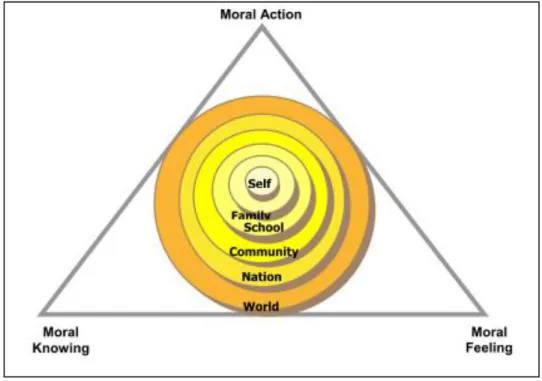
Lickona (1991, 1993, 2001) approached character development from the heart, mind and behaviour dimensions within a moral environment. Differing from Kohlberg who had his major focus on the cognitive aspect, Lickona had taken a more holistic approach to develop the character of a person by including the moral feeling and action domains other than moral thinking. Similar to Turiel’s view, Lickona asserted that one’s moral decisions and value system may be affected by the social environment. The framework offers the desirable goals of the character education of a whole person. Figure 1 illustrates the Lickona’s framework which consists of the interrelationship and interactions between the three moral domains taken place in a social environment, and specifies the moral qualities included in each component.
Figure 1. The interplay of the three moral domains. Reprinted from “Educating for character: How our schools can teach respect and responsibility,” p. 53, by T. Lickona, 1991, New York: Bantam Books. Copyright 1991 by
Dr. Thomas Lickona.
Moral knowing. To develop moral knowing, one needs to be aware of the moral
situation that requires moral judgement and apply values when appropriate. Lickona mentioned children often fail to recognise whether the situation involves moral issue and
Moral knowing: 1. Moral awareness 2. Moral values 3. Perspective-taking 4. Moral reasoning 5. Decision-making 6. Self-knowledge Moral feeling: 1. Conscience 2. Self-respect 3. Empathy 4. Loving the good 5. Self-control 6. Humility Moral behaviour: 1. Competence 2. Will 3. Habit Social environment
13
consequently take the wrong action. To make moral judgement, one needs to have a set of moral values. These moral values may include honesty, respect, care, integrity, compassion, fairness and many more. While resolving a moral conflict, one should also be able to take in different perspectives for sound moral judgement. Based on a set of principles and values, one engages in moral reasoning to make decision. Moral reasoning and perspective-taking are the major foci of Kohlberg’s stages of moral development, which are included in the framework. The most integral part of moral thinking is “self-knowledge”, meaning to be clear of one’s strength and weakness, and be able to do self-reflection to clarify personal doubts and affirm one’s values.
Moral feeling. As Lickona had mentioned, many people know but do not feel the need
to do the right thing, this is when one’s conscience and humility come into play. One who is committed to one’s moral values is more likely to apply them. In relation to conscience, if one desires the good, one will naturally engage in moral action. Empathy plays a part in perspective-taking; when one takes the standpoint of others, one should be able to identify with the others and show empathy to others’ plights. Before one could take into consideration of others, one should value oneself and be able to control oneself from vices. With self-respect, one would learn to respect others and with self-control, one would be less likely to engage in inappropriate behaviours.
Moral behaviour. Besides having the knowledge of and desire for moral values, it is
important to put the values into practice. Moral competency refers to the ability to put moral knowledge and emotions into action. It will require social skills, like active listening, conflict resolution and communication skills. Moral action depends on how willing and determined one wants to perform the action. However, once doing a moral deed becomes a habit, one will naturally perform it again without conscious thinking; therefore, students need to be provided with various opportunities to develop and nurture the good habits.
14
Ryan and Lickona (1992) referred to earlier theories such as those by Piaget, Kohlberg and Gilligan as structuring moral growth in the form of vertical development which challenges one to climb up the hierarchical stages to achieve moral maturity through increasingly diverse and complex educational experiences, roles and responsibilities. Lickona seek to advocate horizontal moral development which prompts one to firmly establish and consistently apply each stage of moral capacity over a wide range of life situations (Lickona, 1994; Ryan & Lickona, 1992). Before advancing to the next higher stage of moral maturity, Lickona wished to nurture one to extend and thoroughly apply the current stage of moral reasoning to daily life situations, turning the desirable values to be part of the moral behaviours and good habits. Thus, moral or character education should be broadly promoted not only in curriculums, but also in instructional methods, classroom management and school culture (Lickona, 1991, 1993; Ryan & Lickona, 1992). Lickona’s framework conceives a comprehensive concept of a person’s sound character with specific moral attributes, which could function as a lamppost for the formulation of the goals and objectives for a curriculum-oriented moral education.
2.2. Approaches to moral education
This portion of the paper outlines some of the instructional practices to moral education, including direct instruction, moral dilemma discussion, role-playing and service learning.
2.2.1. Direct instruction
Being an integral stakeholder of education, teachers play a part in articulating the nation and school values. The classroom is a place where teachers share their common humanity with the pupils (Pring, 2001), while teacher as the role model to students implicitly
15
and explicitly transmit values through their teaching methods, relationships with students and colleagues and the learning environment they construct (Cooper, Burman, Ling, Razdevsek-Pucko, & Stephenson, 1998). As teaching is a social practice that embodies the values of the teacher, students may be inherently influenced by the teacher, thus teachers have the responsibility to teach the students directly the right moral values (Halstead & Taylor, 2000). In the course of teaching, teachers demonstrate and transfer their principles and values to students, helping them to make sense of the world. At times, students may need clear and direct moral guidance and explanations from the teachers to know what exactly what certain value means and why it is important (Lickona, 1991). Direct teaching can explicitly and intentionally promulgates the desirable values to students, raising their awareness to the importance of the sound values.
2.2.2. Moral dilemma discussion
The moral dilemma discussion method has its basis on Kohlberg’s moral development theory. Moral development goes through the identified six stages in an invariant sequence, meaning one does not skip stages to get to a higher stage, thus one will have to resolve the cognitive dissonance in order to be able to proceed from one stage to the next (Crain, 1985; Kohlberg, 1981; Lockwood, 2009; Nucci, 2008). If one is unable to comprehend the moral reasoning at one stage, one may not be able to reach a higher level of moral maturity. Thus, it could be possible that one becomes physically mature but morally immature. Kohlberg emphasised the discussion of moral dilemma issues to promote moral reasoning to push one through the stages of moral development. One of the widely known moral dilemmas used by Kohlberg in his research was the “Heinz steals the drug” issue, which illustrated whether the poor Heinz should steal the newly invented yet expensive drug to save his sickly wife (Crain, 1985; Gilligan, 1993; Kohlberg, 1981; Lockwood, 2009).
16
Teacher-led or group-based dilemma discussions assist in moral reasoning through exposing the students to various difficult moral conflicts and eventually lead to ethical decision-making (Halstead & Taylor, 2000; Vezzuto, 2004). Seldom do students face moral dilemmas in life; the hypothetical moral situations raise the students’ moral awareness, challenge their existing value system, engaging them to carry out moral reasoning (Lickona, 1991). Discussions give the students the opportunities to articulate the value systems they possess and express the ways their values guide their behaviours (Lockwood, 2009). Guidance from teachers and competent peers could help students to attain a higher level of moral maturity by presenting a moral reasoning stage higher than the students’ (Halstead & Taylor, 2000; Vezzuto, 2004). Discussions also encourage perspective-taking, teaching student to respect diverse and even minority views, weigh the different viewpoints thoughtfully to reach an agreement harmoniously (Halstead & Taylor, 2000).
2.2.3. Role-playing
Children engage in role-playing everyday when they socialise or interact with other children, informally learn to make sense of the surrounding activities and have understanding of others’ feelings (Stauh, 1971). Role-playing is often scripted, thus providing a non-threatening situation for students to act out the moral scenarios (Day, 2002; Lockwood, 2009). This approach enables students to extend beyond superficial thinking to assume social roles, not only to identify and demonstrate values, but also to put themselves in others’ shoes to perceive matters from another perspective, so as to understand others’ plights and gain a more balanced view of matters for sound moral judgement (Cooper, Burman, Ling, Razdevsek-Pucko & Stephenson, 1998; Day, 2002; Lickona, 1991; Lockwood, 2009). The enjoyable process involves both cognitive and affective components of moral development when students work out the matter from the standpoint of the distressed party and empathise with
17
the victims. Empathy is a central emotional response in role-playing, whereby one appropriates one’s feeling to other’s situation than one’s own (Vitz, 1990). Through role-taking, students develop their social sensitivity and empathy for others. The other students, as the audience, too may develop a sense of empathy as they observe how the characters engage in values decision-making, act upon the values and the consequences of the moral actions (Day, 2002; Lockwood, 2009). With guidance and induction from adults or peers, students can have a better understanding of the predicament of the ‘victim’ and are more likely to provide assistance, advancing a step forward to putting desirable values into practice (Stauh, 1971), or extending the empathetic feeling to general human experience to form moral codes of conduct (Day, 2002).
2.2.4. Service learning
Service learning, a form of experiential learning, engages students with the wider community, enabling them to put their value convictions into action (Hill & Steward, 1999). The approach provides students a structured experience to demonstrate civics responsibility to assess and meet the needs of the community as a team (Butin, 2003; Vezzuto, 2004). In the event of serving the community, students will be challenged with complex and ambiguous moral situations that require them to reflect, evaluate and make decision based on their value systems, which could help to develop their moral competency (Butin, 2003). These personal experiences in real-life situations enhance the students’ moral reasoning skills and nurture students to be a social responsible being. In Eyler and Giles’ (1999) study, students who actively participated in service learning perceived themselves to appreciate the community more, become more tolerant to others, and had acquired leadership and communication skills (as cited in Hinck & Brandell, 1999). In addition, students who engage in service learning are required to keep a self-reflection journal to record experiences, observation and thoughts. The
18
reflection process raises the students’ self-awareness, enables them to connect to the inner thoughts and internalise values, contributing to character development (Hill & Steward, 1999).
2.3. Narrative approach
Storytelling is an ancient art of transmitting knowledge, culture, values and wisdom from the old generation to the new generation, and has been central to moral education (Umaschi, 1996; Vitz, 1990). Thus, telling stories serves as a natural way to effectively engage students emotionally. Stories offer a simple yet powerful way to understand the realistic and complicated world as the students could directly witness how moral thinking, feelings and actions being put forward by the plot characters (Lockwood, 2009; Sadik, 2008). Real or fictitious stories appeal to the affective realm and relate to life experiences of students without intrusion (Vitz, 1990). Watson (2003) indicated that stories exemplify moral standards for students to follow and inspire them to become a better person. He also argued that stories are able to present abstract value conceptions in a more concrete manner, facilitating understanding as people visualise the scenarios in mind. The Heartwood (2010) and Giraffe Heroes (2011) projects are two of the well-known programmes in the United States that use the narrative approach to conduct character or moral education.
Heartwood. The Heartwood curriculum bases on the use of multi-cultural literatures,
like folktales and fairy tales, to inculcate seven attributes (courage, loyalty, justice, respect, hope, honesty and love) in students (Heartwood Institute, 2010; Leming, 2000). Leming (2000) had done an evaluation of the effects of the Heartwood curriculum in four elementary schools in the western Pennsylvania and Illinois. Each school was given the Heartwood curriculum kit which consisted of children literature books and teachers were trained to conduct the curriculum. The teaching process involved introducing value concepts to students, reading of the literature book, discussion and application of concepts via written work.
19
Instruments were developed to measure students’ “ethical understanding”, “sensibility” and “conduct”. Results showed that students benefited from the programme in terms of their understanding of the value concepts and demonstrated more tolerance towards other races. This is in accordance to the study by Vitz (1990) who advocated the use of stories to directly bring out the values to be learnt. Stories are morally neutral; they constitute complex plots, good and bad characters, desirable values and vices put into practice. As such, stories allow students to image various moral experiences and moral actions and subconsciously inculcate the values in students, instead of having them to work through moral dilemmas.
Giraffe Heroes. The Giraffe Heroes project enlists stories of heroes from the everyday
life to illustrate how desirable values have applied into action, teaching students courage, compassion and leadership (Giraffe Heroes Program, 2011; Ryan & Bohlin, 1999). These heroes are known as the “Giraffes”, referring to anyone who has “struck their neck out for the common good” (Giraffe Heroes Program, 2011). In the programme, students will first be told of stories of the people who have contributed to the good of the society. After which, students will look within their families, neighbourhood and community for these ordinary heroes. Service learning is included in the curriculum, whereby at the end of the programme, students will carry out a community service project, analysing and meeting the needs of their community. Students will present their stories of them being the heroes. Compared to the fictional heroes, these ordinary heroes are closer to the students’ life, allowing students to be better able to relate to their stories and the moral lessons in the stories.
A simple story could help students to make sense of the complex world, engaging the students cognitively and affectively. Thus, they are better able to remember stories and the lessons taught in the stories. While listening to or reading stories exposes one to the social norms and values in a vivid social context, telling a story engages the storyteller in self-scrutiny and gain insight of self. Personal narratives, in particular, personalise students’
20
learning experience by having them to tell their own stories and experiences, while teacher would serve as a facilitator to guide student in the construction of the personal stories and understanding of the moral lessons in the stories (Halstead & Taylor, 2000). Nevertheless, this method requires teachers’ open-ended questioning, clarification and summarising to facilitate students’ understanding and consideration of the values embedded in the stories (Halstead & Taylor, 2000).
2.4. Technology integration in moral education
In this highly digitalised and interconnected world, technology serves as a good complement and catalyst to the current character education (He & Zhang, 2001). Integration of technology into the moral development curriculum enables the incorporation of the various pedagogies strategies mentioned in the previous section. According to Lickona (2001), a social environment, where values can be put to test, has inherent impact on one’s values and moral development, technology is able to provide this social context or environment through which students could be exposed to and able to interact with a diverse range of culture and perspectives in order to think more critically and make a more sound moral judgement to issues. Technology also allows students to become an active learner who direct, self-regulate and be responsible for one’s learning. Through technology, students can learn by doing, making meaning to their learning process and further motivating them to take initiative in their learning progress (Bers & Cassell, 1998; He & Zhang, 2001). Past research had looked into the promises and practices of technology-enhanced curriculum related to moral education (Bailey, Tettegah & Bradley, 2006; Banaszewski, 2005; Bers, 2001, 2003; Bers & Cassell, 1998; Farmer, 2004; Jamaludin, Yam & Ho, 2009; Lee & Hoadley, 2006; Norhayati & Siew, 2004; Samuelson, 2007; Umaschi, 1996).
21
Bers, at the Massachusetts Institute of Technology Media Laboratory, had carried out a series of design experiments and prototypes which involved the storytelling pedagogy and computational systems, aiming to assist youth in self-identity and values construction. Her research projects include the SAGE authoring system (Storytelling Agent Generation Environment) (Bers & Cassell, 1998; Umaschi, 1996), the Zora (Bers, 2001) and Kaleidostories ICEs (Identity Construction Environments) (Bers, 2003), which are further introduced in the following paragraphs.
SAGE. The SAGE is an example of an interactive storytelling computational tool
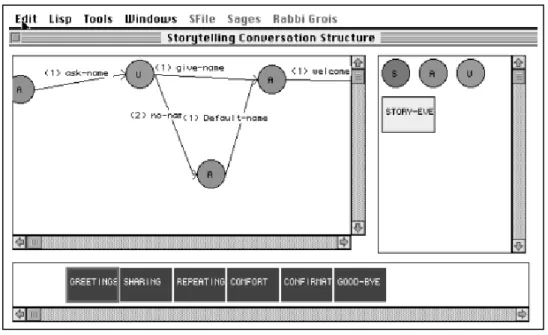
which allows students to listen, tell and make stories in an authoring environment (Bers & Cassell, 1998; Umaschi, 1996). In the level of “interacting”, students converse with and listen to stories told by the programmed SAGE storytellers, “Rabbi” and “Tao”. The stories told contain one of the core values found in the Ten Commandments. Such design has reference to the traditional way of storytelling, whereby the moral values are indirectly instilled in students as they listen to stories told by a wise adult. The inspiring stories would help the students to decipher their way out of their personal problems. The “authoring” function (see Figure 2) allows students to do role-playing, by taking up the role of an astute SAGE storyteller to construct their own conversational flow and write their own inspirational stories for further interaction with other children. In Bers and Cassell’s (1998) investigation with fourth and fifth grade students, they found that the storytellers created by the students embodied their anticipation, emotions, interest and admiration, which are part of their identity. Story-making enables the students to connect with their inner world to construct their own identities and form their own set of values.
22
Figure 2. The SAGE authoring function. Students can construct their conversational flow and stories through
manipulating the objects—circles (turns), arrows (communicative actions) and boxes (parts of conversation). Reprinted from “Interactive storytelling systems for children: Using technology to explore language and identity,” by M. U. Bers & J. Cassell, 1998, Journal of Interactive Learning Research, 9(2), p. 213. Copyright 1998 by ACM.
Zora. According to Bers (2001, 2003), both the Zora and Kaleidostories are a form of
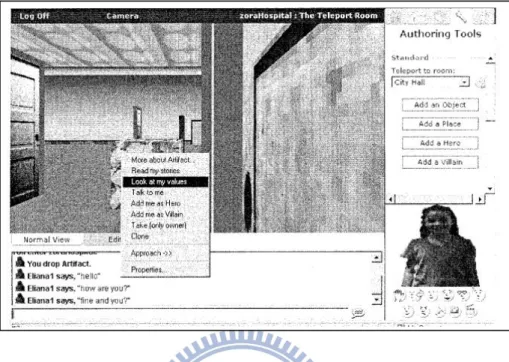
identity construction environment (ICE) with a multi-user virtual community. An ICE is designed specifically for the purpose of introspection, reflection and discussion about moral values, to construct a self-identity. The Zora ICE (see Figure 3) is a multi-user virtual space with three-dimensional interface which resembles computer games, attracting attention of students and making user experience to be pleasant. The authoring tools allows user to customise the environment and characters to meet one’s needs. Students could create characters with narrations or descriptions to illustrate the personality and values of the characters. In the process of building the story characters’ profiles, they demonstrate the values they have. The collaborative values dictionary available in Zora is initially empty and requires users’ effort to build it as they develop their objects and characters in the Zora space. This dictionary can be used by the user to review the values formed and embedded in the environment, as well as to evaluate and reason the clashes between them to achieve deeper
23
understanding of the value system. The multi-user community provides an authentic social context for user to interact and manifest their values in behaviour.
Figure 3. The Zora ICE space. This is a 3-D virtual world where students can bring their collaborative values
dictionary, build objects and characters, and interact with other users. Reprinted from “Identity construction environments: Developing personal and moral values through the design of a virtual city,” by M. U. Bers, 2003,
Journal of the Learning Sciences, 10(4), p. 379. Copyright 2001 by Lawrence Erlbaum Associates.
Kaleidostories. Consolidating the previous experiences with the SAGE and the Zora
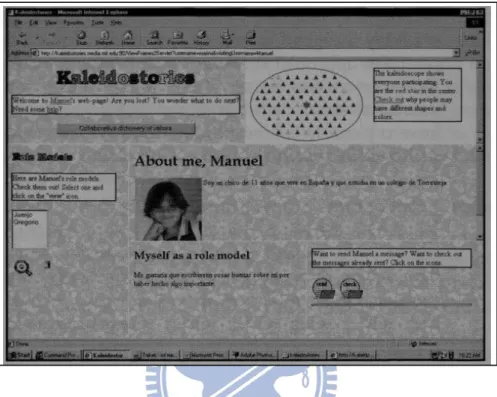
computational tools, Bers (2003) designed the Kaleidostories ICE, which appeared to be an advanced version of the Zora. Instead of confining to a micro-community of the ICE users, the Kaleidostories has extended the community to the web, allowing exchanges and interaction beyond the classroom. In addition, based on the notion that an identity is multiple, complex and dynamic, students should construct and explore a number of identities by designing their own online portraits (see Figure 4) accompanying self-written stories, instead of working on and with surreal system characters. It is through this authentic and personalised way of constructing and experiencing the various identities that aid in the identity formation. The narrative-writing process enables students to organise and engage in deep thinking about the values that the particular identity carries. Students could also view the pages of other users and interact with others within the community, to explore, compare and differentiate the
24
values to establish a more definite and firm identity. Both the Zora and the Kaleidostories tools comprise mainly the narrative construction and social participation functions to assist users to develop identity and values via the constructionist approach.
Figure 4. The Kaleidostories ICE interface. Students create their online self-portraits with self-written stories in
order to construct their self-identities. Reprinted from “Kaleidostories: Sharing stories across the world in a constructionist virtual community for learning,” by M. U. Bers, 2003, Convergence: The International Journal
of Research into New Media Technologies, 9, p. 64. Copyright 2003 by SAGE Publications.
Besides the sophisticated authoring computational systems mentioned above, other researchers attempted to promote moral development in students with simpler version of authoring system (Bailey, Tettegah & Bradley, 2006), or make use of readily available technology resources, such as the Second life platform (Jamaludin, Yam & Ho, 2009; Lee & Hoadley, 2006) and film clips (Samuelson, 2007).
Clover. As compared to the SAGE, the Clover is a more simplified authoring system
which merely focuses on facilitating moral story construction, lacking the pre-installed storytellers and an interactive platform. In addition, it is specifically catered for children aged 10 to 14 in assisting them to build their own animated vignettes based on their personal
25
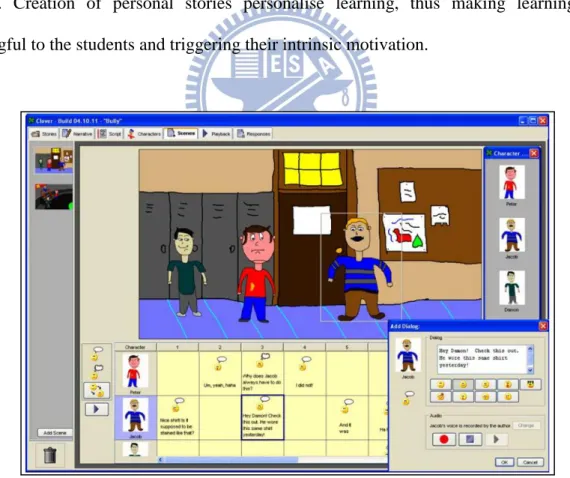
experiences or stories (Bailey, Tettegah & Bradley, 2006). An animated vignette will enable moral or social situations to be presented in a dynamic and vibrant way, to facilitate role-playing, problem-solving, reflection and discussion. Basically, an animated vignette consists of four parts—narrative, script, storyboard and animation. First, the student will organise his thoughts and narrate his experience in written form, then transforms the written narration into a script with characters. Next, the student will contextualise his story in visual form, sketching characters and story scenes, and finally to add audio effects to his vignettes (see Figure 5). In the midst of creating the vignettes, students could be reflecting on their own moral and social situations and considering the perspectives of others as they created characters of others. When the created vignettes are placed online, students could engage in dialogue and problem-solving. Creation of personal stories personalise learning, thus making learning more meaningful to the students and triggering their intrinsic motivation.
Figure 5. The Clover scene editor. Students create animated vignettes by adding sketched characters, dialogues
and audio effects. Reprinted from “Clover: connecting technology and character education using personally-constructed animated vignettes,” by B. P. Bailey, S.Y. Tettegah, & T. J. Bradley, 2006, Interacting with