行政院國家科學委員會補助專題研究計畫
█ 成 果 報 告
□ 期中進度報告
整合產學為基礎之工程教育遊戲性教學系統開發及
教與學評估
計畫類別:■ 個別型計畫 □ 整合型計畫
計畫編號:NSC 97-2511-S-151-001-MY2
執行期間:民國 九十七年 八月 一 日 至 民國 九十九 年 七 月 三十一 日
計畫主持人:吳文雄 教授
共同主持人:
計畫參與人員:吳毅緯、李松霖、黃思涵
成果報告類型(依經費核定清單規定繳交):□精簡報告 ■完整報告
本成果報告包括以下應繳交之附件:
□赴國外出差或研習心得報告一份
□赴大陸地區出差或研習心得報告一份
■出席國際學術會議心得報告及發表之論文各一份
□國際合作研究計畫國外研究報告書一份
處理方式:除產學合作研究計畫、提升產業技術及人才培育研究計畫、
列管計畫及下列情形者外,得立即公開查詢
□涉及專利或其他智慧財產權,□一年□二年後可公開查詢
摘要 本研究旨在發展與評估兩個使用在「軟體工程課程」中的遊戲式教學系統。第一個 系統以角色扮演之遊戲策略為主軸,讓學生以小組的方式,諸如專案領導人、系統 分析者、系統設計者或是企劃者來扮演不同的角色,以學習軟體發展的過程。第二 個系統則以傳統的練習式(drill-and-practice)遊戲策略來指引學生學習軟體發展。本 研究採實驗研究法,來比較這兩個不同的系統對學生學習成就與態度上的差異。藉 由單變量因素分析,得知遊戲式教學在知識測驗的變項上具有顯著的主要效果 (F=5.166, p<.05),但在「意向」與「滿足」這兩個變項上的測量並無顯著差異 (p>.05)。此外,研究結果亦顯示在傳統練習式教學的小組成就(M=72.86)顯著比角 色扮演的小組成就來得高(M=61.90);學生的「意向」與「滿足」變項可能為影響 此結果的調節變項。然而,研究結果進一步發現兩個系統中的小組成員在情意測量 的部份並無顯著差異:(1)利用遊戲教學平台的意向(F=.016, p>.05)、(2)使用遊戲教 學平台後的滿足感(F=1.854, p>.05)。顯示兩個系統中的小組成員在動機因素上的 影響效果相同。 關鍵字:遊戲式教學、軟體工程教育、量化評估、實驗研究 Abstract
This study developed and evaluated two varied game-based learning systems in a software engineering course. The first system adopted a role-playing gaming strategy for students to learn about the process of software development effort estimation in a team-based environment. They play different characters, such as a project leader, a system analyst, a system designer, or a programmer. The second system used a traditional drill-and-practice gaming strategy to guide design. An experimental study involving human subjects was conducted to compare the effects of both systems on students’ learning performance and attitude. Univariate analyses revealed that the game-based learning had a significant main effect on dependent variables in the knowledge test (F=5.166, p<.05), but not in the intention and satisfaction measures (p>.05). The results showed that students in the drill-and-practice gaming group achieved significantly higher scores in the knowledge test (M=72.86) than the role-playing gaming group (M=61.90). The measures of students’ intention and satisfaction were in the range of a moderate to high level. However, no significant differences were found between the two groups about their affective measures: (1) intention to use gaming platforms (F=.016, p>.05) and (2) satisfaction toward the assigned gaming platforms (F=1.854, p>.05). The effect of students’ motivational factors in both gaming groups was about the same.
Keywords: game-based learning; software engineering education; quantitative evaluation; experimental study
INTRODUCTION
ENGINEERING EDUCATION is rapidly evolving as the advancement of technological innovations accelerates. With the prevalence of game-based technologies in engineering education, instruction and learning are changing from a teacher-centered approach to a student-centered learning environment. Many research studies in engineering education revealed that the use of instructional gaming strategies in classrooms facilitated students’ learning in a variety of engineering disciplines [1-2]. Compared to a traditional teacher-centered learning mode, in a game-based learning environment, students can perform better academic achievement not only in obtaining factual information (lower-level thinking), but also in creating reasoning-related knowledge (higher-order thinking) [3-4].
Mayo [3] suggested that game-based learning could be a good pedagogical approach to compensate traditional teacher-centered learning in the field of engineering education. Mayo considered that game-based learning has the potential to improve overall learning outcomes of engineering students by owing the following six features: (1) experiential learning (learning by doing), (2) inquiry-based learning (experimentation or simulation), (3) self-efficacy (decision making), (4) goal setting, (5) cooperation (team work), and (6) cognitive modeling (continuous feedback). However, these observations and suggestions in implementing game-based learning into classrooms seem to lack scientific evidence to support the claim. In other words, very few research studies explore whether the use of gaming learning technologies will result in positive student learning achievement, which warrants a further investigation.
This study designed, developed, and evaluated varied game-based learning systems in a software engineering course. Two different types of game-based learning systems were investigated. The first system adopted a role-playing gaming (RPG) strategy for students to learn about the process of software development effort estimation in a team-based environment. They play different characters, such as a project leader, a system analyst, a system designer, or a programmer. The second system used a traditional drill-and-practice (DAP) gaming strategy to guide design. An experimental study involving engineering undergraduate students was conducted to compare the effects of both systems on students’ learning performance and attitude.
Based upon the purpose of the study, one research null hypothesis is drawn: no statistically significant differences in student knowledge test achievement, intention to use systems, and satisfaction toward systems when they learn by playing in the two types of gaming systems. The course content for developing the game-based learning systems is one unit of instruction in an undergraduate software engineering course - the process of software development effort estimation, including the stages of initial estimation, cost estimation, time estimation, risk estimation, and final decision making.
LITERATURE REVIEW
learning games.” van Eck [6] proposed that three factors resulted in widespread public interest in games as learning tools. The first factor is the ongoing research conducted by game-based learning proponents. The second factor involves today’s “Net Generation” or Digital Natives” who have become disengaged with traditional instruction. The final factor is the increasing popularity of gaming that is currently a $10 billion industry. Hence, game-based learning is “edutainment” that is being successfully employed in schools, enterprises, and institutions.
Prensky [5] indicated that colleges and universities are where game-based learning is making great headway as an increasing number of teachers have realized the power of games for engaging and instructing students. However, colleges and universities are currently going through a significant crisis. For instance, instructors have traditionally been conservative bastions of knowledge that changes slowly; however, knowledge now moves very rapidly. Furthermore, they have to teach “game generation” students. Hence instructors need to apply additional effort to use complex game-based learning tools or developing systems.
Some commercial off-the-shelf games, such as SimCity, are integrated with classrooms. Most importantly, few instructors have performed resource-intensive work and attempted to integrate a game-based learning system into their classrooms. For example, in medical education, Mann et al. [7] implemented an interactive game system to teach surgical management algorithms. This system was developed using Microsoft Visual Basic, and interactive 3-D physical examination simulations were created using NewTek lightware version 6. Roubidoux et al. [8] developed an interactive web-based breast imaging game. With the help of computer experts from the Medical School Learning Resource Center and a graphic arts designer, a web site was constructed using JavaScript. The game was designed to be played by two students or by one student and a cyber player, and developed learning rules for playing the game. For computer science education, Baker et al. [9] developed a “Problems and Programmers” system, an educational card game that practically simulates software engineering development methodology based on the waterfall model, which is not sufficiently highlighted via lectures and projects. This system is organized as competitive game in which students take on the role of project leader in a company. Additionally, system development has seven phases based on the features of a card game: setup; turn structure; requirements; design; implementation; integration; and, product delivery.
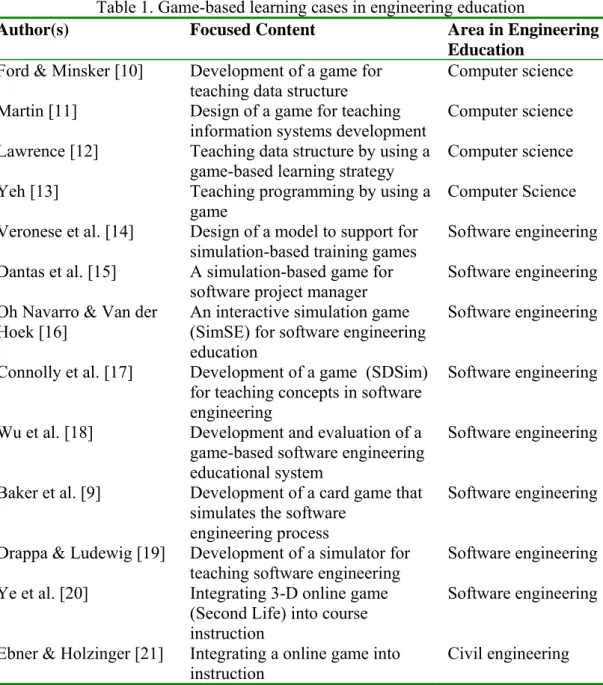
In engineering education, a review of existing literature showed that the number of studies integrating game-based learning into college curricula was limited. Many previous studies focused on computer science-related subjects. A summary of game-based learning case studies in engineering education is shown in Table 1.
Table 1. Game-based learning cases in engineering education
Author(s) Focused Content Area in Engineering
Education Ford & Minsker [10] Development of a game for
teaching data structure
Computer science Martin [11] Design of a game for teaching
information systems development
Computer science Lawrence [12] Teaching data structure by using a
game-based learning strategy
Computer science Yeh [13] Teaching programming by using a
game
Computer Science Veronese et al. [14] Design of a model to support for
simulation-based training games
Software engineering Dantas et al. [15] A simulation-based game for
software project manager
Software engineering Oh Navarro & Van der
Hoek [16]
An interactive simulation game (SimSE) for software engineering education
Software engineering Connolly et al. [17] Development of a game (SDSim)
for teaching concepts in software engineering
Software engineering Wu et al. [18] Development and evaluation of a
game-based software engineering educational system
Software engineering Baker et al. [9] Development of a card game that
simulates the software engineering process
Software engineering Drappa & Ludewig [19] Development of a simulator for
teaching software engineering
Software engineering Ye et al. [20] Integrating 3-D online game
(Second Life) into course instruction
Software engineering Ebner & Holzinger [21] Integrating a online game into
instruction
Civil engineering
In summary, researchers found that instruction incorporating game features led to improved teaching and learning. However, development and evaluation of a game-based learning system by professionals in higher education needs further investigation.
SYSTEM FRAMEWORK
The two game-based learning environments (role-playing game and drill-and-practice game) proposed in this study adopt the following system framework (Fig. 1). The system
layer, Instructional Game Design, provides learners with instructional tutorials about how to install the game-based learning tools and play. The third layer, XNA Framework, provides the development tools used in the game design including different audios, graphics, videos, and learning contents. The last layer, .Net Framework, uses Visual C# as the development language that connects ADO.NET and XNA.
Fig.1. System framework of the game-based learning design
METHOD
Participants
Forty-two undergraduate students in a software engineering participated in the study from the Electronic Engineering Department, National Kaohsiung University of Applied Sciences, Taiwan. Out of the participants, Thirty-one (74%) were male; 11 (26%) were female. Their age levels ranged from 20 to 24.
Instructional materials
The course content for developing the game-based learning systems is one unit of instruction in an undergraduate software engineering course - the process of software development effort estimation, including the stages of initial estimation, cost estimation, time estimation, risk estimation, and final decision making.
Independent/dependent variables
One independent variable with two varied levels was studied. These two levels are the two different types of game-based learning systems are developed and evaluated. The first system adopts a role-playing gaming (RPG) strategy for students to learn about the process of software development effort estimation in a team-based environment. They play different characters, such as a project leader, a system analyst, a system designer, or
a programmer. The second system uses a traditional drill-and-practice (DAP) gaming strategy to guide design.
Three dependent variables were measured: (1) a knowledge achievement test, (2) intention to use gaming platforms, and (3) satisfaction toward gaming learning environments. A knowledge test was given after students learned from the assigned experimental treatments. A questionnaire was designed to measure these two student affective constructs: (1) intention to use gaming platforms, and (2) satisfaction toward the assigned gaming platforms. The two affective constructs were measured by a seven-point Likert scale. In order to guarantee the validity of the two dependent measures, the test items and the questionnaire were reviewed by subject matter experts.
Research Design
The research design of the study was a 1 x 2 randomized post-test design. Since the dependent variables are typically related statistically and conceptually, the statistical correlation should be in the range of a low to moderate level. A Multivariate Analysis of Variance (MANOVA) is performed to analyze the results. Furthermore, the real value of using MANOVA is in controlling Type I error (also known as false positive error) while analyzing multiple dependent variables simultaneously. According to the research design, two gaming treatments were created: (1) role-playing gaming (RPG) strategy and (2) a traditional drill-and-practice (DAP) gaming strategy. A brief description of the two instructional treatments follows.
1) Treatment 1: Role-playing gaming (RPG) strategy. In this treatment, a unit of
interactive materials was developed using RPG strategy. Students can learn about the process of software development effort estimation in a team-based environment. They play different characters, such as a project leader, a system analyst, a system designer, or a programmer. Fig. 2 is one sample screen shot of the treatment 1.
2) Treatment 2: Drill-and-practice gaming strategy. This treatment used a traditional
drill-and-practice gaming strategy to guide design. Students can learn about the course knowledge and skills through repetitive practices. Fig. 3 is one sample screen shot of the treatment 2.
Fig.3. Sample shot of treatment 2
Experimental procedures
To avoid a sampling bias, all participants were randomly assigned into two groups. Before conducting the experiment, researchers explained to students about the purpose of experiment and demonstrated them how to use varied types of gaming platforms. To reduce interferences between different treatment groups, the RPG group and the drill-and-practice gaming (DAP) group were arranged in separate rooms. After being assigned to their experimental locations, the participants were presented with their assigned instructional treatments. They were allowed to play the assigned games in 45 minutes at their own pace. After this playing session was completed, the participants were first asked to take a knowledge test and then fill out questionnaires on their intention and satisfaction of using learning games.
FINDINGS
Descriptive Statistics
Table 2. Treatment means and standard deviations of dependent measures Dependent Measures Role-Playing
Game M/SD* Drill-and-Practice M/SD* Knowledge Test Intention Satisfaction 61.90/16.32 5.13/0.64 4.69/0.68 72.86/14.89 5.15/0.72 5.04/0.96 *M: Mean; SD: Standard Deviation
Results of the Multivariate Analysis of Variance (MANOVA)
Table 3 shows the value of Wilks’ Lambda was .760, which was significant at the p-value of .05. That is, a significant effect of gaming strategies was found (Lambda (1,40) = .760, p<. 05). .
Table 3. Results of multivariate tests
Effect Wilks’ Lambda F P Intercept Treatment Groups .010 .760 881.910 2.916 .000* .034* * Significant at .05 level
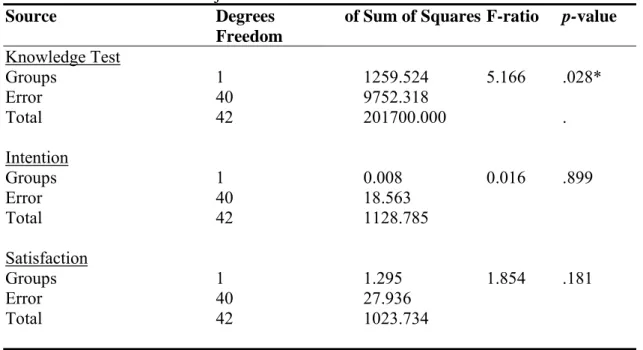
According Cronk [22], Wilks’ Lambda determines whether an independent variable has any effect on dependent variables. Table 3 indicated that a significant effect of instructional gaming strategies was found (Lambda=.760, p< .05). To further investigate the effect of the varied gaming strategies on dependent variables, univariate analyses (Table 4) revealed that the independent variable had a significant main effect on dependent variables in the knowledge test (F=5.166, p<.05), but not in the intention and satisfaction measures (p>.05). The results showed that students in the drill-and-practice gaming group achieved significantly higher scores in the knowledge test (M=72.86) than the role-playing gaming group (M=61.90) when they were assigned to varied gaming environments. The measures of students’ intention and satisfaction were in the range of a moderate to high level (Means range: 4.69~5.15). However, no significant differences were found between the two groups about their affective measures: (1) intention to use gaming platforms (F=.016, p>.05) and (2) satisfaction toward the assigned gaming platforms (F=1.854, p>.05). The effect of students’ motivational factors in both gaming groups was about the same.
Table 4. Tests of between-subjects effects
Source Degrees of
Freedom
Sum of Squares F-ratio p-value
Knowledge Test Groups Error Total Intention Groups Error Total Satisfaction Groups Error Total 1 40 42 1 40 42 1 40 42 1259.524 9752.318 201700.000 0.008 18.563 1128.785 1.295 27.936 1023.734 5.166 0.016 1.854 .028* . .899 .181 * Significant at .05 level;
The result of the study confirms Ebner and Holzinger’s findings [21] on implementing user-centered games in higher education that students seem to enjoy the game-based learning environment, when designed properly. The result is also in accordance with Foss and Eikaas’ finding [23] that the learners favor a combined use of a traditional exercise with an interactive gaming environment, as opposed to a traditional teacher-centered learning environment.
An interesting result was found that students in the DAP group yielded a higher satisfaction score (M=5.04) than in the RPG group (M=4.69). A possible explanation was that the students in the RPG group may take longer time and need extra efforts in learning the process of software development effort estimation in a team-based environment by playing different roles, such as a project leader, a system analyst, a system designer, or a programmer. During such a short period of time in experiment for the current study, they may need extra assistance in getting familiar with the system.
In terms of the knowledge test, the DAP group yielded a significantly better performance on the test than the RGB group. It may be due to that fact that this knowledge test of the experiment only consists of factual and conceptual knowledge, not involving higher-order thinking skills including procedures and other meta-cognitive problem solving skills. Therefore, Future research should consider assessing more advanced students’ learning outcomes such as procedures, principles, and problem solving skills.
CONCLUSION
This study explored the effects of varied game-based learning systems in a software engineering course. Forty-two undergraduate students majoring in Electronic Engineering
participated in the study. Two game-based learning systems were developed and evaluated by considering human participants. The role-playing gaming group learned about the process of software development effort estimation in a team-based environment by playing different characters, such as a project leader, a system analyst, a system designer, or a programmer. The drill-and-practice gaming group learned the same course contents through playing repetitive practices.
The results indicated that the students in both gaming groups expressed a positive intention to use the systems and were satisfied with the gaming platform features, which is consistent with other gaming research findings [13,18,23]. A simple game design (drill-and-practice) yielded a significantly better learning outcome than a complex game design (role-playing gaming) in terms of learning factual and conceptual knowledge. This study continues Wu et al.’s assertion [18] that future gaming research should focus on assessing students’ authentic learning achievement instead of simply reporting research data via surveys and questionnaires. The expected learning outcomes should include facts, concepts, comprehensions, problem solving skills and other higher critical thinking skills while the students use such a game-based learning system.
According to the findings of the study, future research should continue to investigate the impact of game-based learning technologies along with different instructional strategies on engineering students’ learning achievement, such as facts, concepts, comprehensions, problem-solving, and critical-thinking skills. In addition, future studies should consider human factors in a game-based learning environment, such as learners’ individual differences, learning styles, etc. Many of the independent variables associated with the study of aptitude-treatment interactions should be taken into account in the design of game-based learning environment. Learners’ prerequisites and prior competencies should be considered to further investigate how they interact with a game-based learning system.
While game-based learning technologies may be manipulated to influence engineering students' learning positively, particular attention must be given to guidelines derived from game-based instruction and experimental methodology, as well as consideration of learner characteristics and learning styles. Only by initiating a systematic program of investigation where independent variables are judiciously manipulated to determine their relative effectiveness and efficiency of facilitating specifically designated learning objectives will the true potential inherent in game-based learning be realized.
REFERENCES
1. J. Lean, J. Moizer, M. Towler, and C. Abbey, Simulations and games: Use and barriers in higher education, Active Learning in Higher Education, 7(3), 2006, pp. 227-242.
2. R.T. Hays, The effectiveness of instructional games: A literature review, 2004-2005
Technical Report, Naval Air Warfare Center, Orlando, FL, 2005.
3. M.J. Mayo, Games for science and engineering education, Communications of ACM, 50(7), 2007, pp.30-35.
4. C.A. Steinkuehler, Why game (culture) studies now? Games and Culture, 1(1), 2006, pp. 97-101.
5. M. Prensky, Digital Game-based Learning, McGraw Hill: New York, 2001.
6. R. van Eck, Digital game-based learning: It’s not just the digital natives who are restless, Educause Review, March/April 2006, pp. 17-30.
7. B.D. Mann, B.M. Eidelson, S.G. Fukuchi, S.A. Nissman, S. Robertson, and L. Jardines, The development of an interactive game-based tool for learning surgical management algorithms via computer, The American Journal of Surgery, 183, 2002, pp. 305-308.
8. M.A. Roubidoux, C.M. Chapman, M.E. Piontek, Development and evaluation of an interactive Web-based breast imaging game for medical students, Academic
Radiology, 9(10), 2002, pp. 1169-1178.
9. A. Baker, E.O. Navarro, and A. van der Hoek, An experimental card game for teaching software engineering processes, Journal of Systems and Software, 75, 2005, pp. 3-16.
10. C.W. Ford and S. Minsker, TREEZ - An educational data structures game, Journal of
Computing Sciences in Colleges, 18(6), 2003, pp. 180-185.
11. A. Martin, The design and evolution of a simulation/game for teaching information systems development. Simulation and Gaming, 31(4), 2000, pp. 445-463.
12. R. Lawrence, Teaching data structures: Using competitive games. IEEE Transactions
on Education, 47(4), 2004, pp. 459-466.
13. K.C. Yeh, Using an educational computer game as a motivational tool for supplemental instruction delivery for novice programmers in learning computer programming. Proceedings of SITE Conference, Charlton, South Carolina, USA, 2009, pp. 1611-1616.
14. G. Veronese, M. Barros, and C. Werner, Model support for simulation-based training games: From behavioral modeling to user interactions, In J. Munch & D. Pfahl (Eds),
Software Process Simulation and Modeling Workshop (ProSim), St Louis, USA, 2005,
pp. 9-15.
15. A.R. Dantas, M.O. Barros, and C. Werner, Simulation models applied to game-based
training for software project managers. In J. Munch & D. Pfahl (Eds), Software Process Simulation and Modeling Workshop (ProSim), St Louis, USA, 2005, pp.
110–116.
16. E. Oh Navarro and A. van der Hoek, Software process modeling for an educational software engineering simulation game, Software Process Improvement and Practice, 10(3), 2005, pp. 311–325.
17. T.M. Connolly, M. Stansfield, and T. Hainey, An application of games-based learning within software engineering, British Journal of Educational Technology, 38(3), 2007, pp. 416-428.
18. W.H. Wu, W.F. Chen, T.L. Wang, and C.H. Su, Developing and evaluating a game-based software engineering educational system, International Journal of Engineering
Education, 24(4), 2008, pp. 681-688.
19. A. Drappa, and J. Ludewig, Simulation in software engineering training, Proceedings
of the 2000 International Conference on Software Engineering, Limerick, Ireland,
2000, pp. 199-208.
20. E. Ye, C. Liu, and J. Polack-Wahl, Enhancing software engineering education using teaching aids in 3-D online virtual worlds, Proceedings of IEEE Frontiers in
Education Conference, Milwaukee, WI, USA, 2007, pp. T1A/1-6.
21. M. Ebner, and A. Holzinger, Successful implementation of user-centered game based learning in higher education: An example from civil engineering, Computer &
Education, 49, 2007, pp. 873-890.
22. B.C. Cronk, How to Use SPSS, Glendale, CA: Pyrczak Publishing, 1999.
23. B.A. Foss and T.I. Eikaas, Game play in engineering education: Concept and experimental results, The International Journal of Engineering Education, 22(5), 2006, pp. 1043-1052.
計畫成果自評
本 研 究 已 將 計 畫 內 容 改 寫 成 期 刊 投 稿 至 International Journal of Engineering Education (SCI 期 刊 ) , 並 被 該 期 刊 接 受 , 顯 示 本 研 究 計 畫 成 果 良 好 。
【附件一】出席國際學術會議心得報告及發表之論文各一份 (第一年)
國科會補助專家學者出席國際學術會議心得報告
日期: 99 年 10 月 16 日一、參加會議經過
第八屆ASEE工程教育國際會議在匈牙利布達佩斯舉辦。此次會議共舉辦四 天,研討會主題為:「文化、市場與法規:形塑全球工程教育 (Cultures, Markets and Regulations: Shaping Global Engineering Education)」,其下又可 分 為 三 大 議 題 , 分 別 為 : 未 來 從 事 工 程 的 工 程 師 (Engaging our Future Engineers)、變動職業的認證 (Accreditation for Mobile Profession)、以及建構 有效的夥伴關係 (Building Effective Partnerships),顯示此研討會涵蓋內容繁 多,且圍繞著日後工程教育之發展與前瞻思考。除了Forum、Workshop以及 Poster之外,還有Keynote Speech,總計發表文章篇數共超過三百篇,參與 程度相當踴躍。本人發表的文章係在第一日以Poster報告方式進行,其他時 間則至發表場地聆聽相關報告內容。二、與會心得
(一) 論文發表多元且議程緊湊 此次研討會共計四天,每天有三個 track 一同進行,預估每天約有 100 篇論文發表。此外,本研討會又分成三大議題,各自針對不同的 細項議題進行討論。整體而言,議程安排緊湊,論文發表內容多元。 (二) 對工程教育的研究議題,有更進一步的啟發 環顧此次投稿大會的研討會文章,不難發現此次會議的主軸係放在如 何培育未來工程人員之發展,更重要的是如何將新科技與創造力的概 補助編號 NSC 97-2511-S-151-001-MY2 計畫名稱 整合產學為基礎之工程教育遊戲性教學系統開發及教與學評估 出國人員 姓名 吳文雄 服務機構 及職稱 國立高雄應用科技大學 資訊管理系 教授 會議時間 98 年 10 月 12 日 至 98 年 10 月 15 日 會議地點 匈牙利 布達佩斯 會議名稱 (中文) 第八屆ASEE 工程教育國際會議(英文) 8th ASEE Global Colloquium on Engineering Education 發表論文
題目
(中文)不同遊戲類型對工程教育課程之學習影響調查研究
(英文)An investigation of the different game style influences on the learning of software engineering courses
對「創造力可以教嗎?」的議題有更深一步的啟示,對日後進行教學 時將會將此思維注入課堂中,以活化課程內容。
(三) 與國外學者對話有益確認研究內容的方向
在本人進行 Poster 報告以後,於 10 月 15 日(禮拜二)聆聽了一位來自
丹麥的 Kolmos 學者發表了一篇名為"PBL-a Learning Methodology for Sustainability and Global Innovation in Engineering Education"的文 章。此篇文章主要以問題導向的方式來討論工程教育裡永續與全球革 新的議題。相信藉由這一次的參與,對日後欲進行相關工程教育研究 之議題有所影響。
三、考察參觀活動(無是項活動者略)
無四、建議
無
五、攜回資料名稱及內容
(一) 研討會手提袋一只。 (二) 研討會會議手冊一本。 (三) 研討會會議議程一張。 (四) 研討會論文光碟片一片。六、其他 (研討會剪影)
研討會會議議程 研討會識別證 研討會CD 光碟片 研討會大會標誌GC 2009-193: AN INVESTIGATION OF THE DIFFERENT GAME
STYLE INFLUENCES ON THE LEARNING OF SOFTWARE
ENGINEERING COURSES
Wen-Hsiung Wu, National Kaohsiung University of Applied Sciences Sheng-Hui Hsu, National Cheng Kung University
Shu-Chen Cheng, Southern Taiwan University Tsung-Li Wang, Shu Te University
Yueh-Min Huang, National Cheng Kung University Hsi-Chi Hsiao, Cheng Shiu University
An investigation of the different game style influences on a digital
game-based supported software engineering course
Wen-Hsiung Wu1, Sheng-Hui Hsu2, Shu-Chen Cheng3, Tsung-Li Wang4,
Yueh-Min Huang2and Hsi-Chi Hsiao5
1. National Kaohsiung University of Applied Sciences 2. National Cheng Kung University
3. Southern Taiwan University 4. Shu Te University 5. Cheng Shiu University
Abstract
Software engineering is an important course in engineering education. The most different part between software engineering and other courses is that software engineering is a course which teachers not only focus on lecturing the content of the textbook but also put emphasis on giving students practical experience. However it is never an easy thing to give students practical experience in this course due to school administration, finance, and lots of factors. Therefore we have to seek for the solutions. In order to fill the gap between knowledge of textbook and practical experience that we decide to adopt digital game-based learning to support the practice lesson of this course in the end. Digital game-based learning is an effective and attractive pedagogy moreover it is also a new research topic in recent years. Digital game-based learning provides simulated environments, context, and it can raise learners’ learning motivation. There are many styles of games in the world. In this research we choose adventure game and role play game from these styles of games due to the feasibility of merging experiential learning pedagogy with the games and implement the games which correspond to the content of software engineering course. Via students themselves playing the games, we observe the assessment process for the purpose to discover the different influences from these different styles of games. After the assessment observation and data analysis, we find some advantages and shortcomings of these two games for instance that adventure game is with highly interaction between computers and learners, and role play game provides better coherence. Besides, this research also concludes some suggestions of making a proper digital game-based learning game and indicates the key points to improve the learning for further related researchers.
I. Introduction
It is a necessary course for those who major in computer science and information management to learn software engineering. In early days, the purpose of education is helping students to learn from teachers and the content in the textbook. As time goes by, the pedagogies of software engineering course have changed into new ones in order to match the trend. However it is a well known education issue that there is a huge gap between content in the textbook and real situation. In order to give students not only knowledge from textbook but also practical experience, school administration arranges practice lesson for students.
After researchers proposed lots of pedagogies and some of them think that people should put emphasis on interaction during the teaching process1. Besides there exists a
question that it is never an easy thing to give students practical experience in this course due to school administration, finance, and lots of factors. Therefore researchers have to seek for the solutions. In recent years, researchers start using game-based learning. It is discovered that learners learn things in an easy way and also that game-based learning promote their motivation to learn. Using games in learning not only makes learning process with fun but also that learners can learn from it2. Some researchers adopt digital
game-based learning and create game or simulated environment in their software engineering course. Via digital game-based learning, they find that learners can have a chance to learn software more detail and with fun. Therefore using digital game-based learning as pedagogy in software engineering course seems a solution to solve the problems which we described before.
II. Motivation
Before starting the research we have to clarify the motivation and purpose of the research. The main motivation of this research is listed below:
z Fill the gap between knowledge of textbook and practical experience z The adoption of digital game-based learning
z Promote learners’ learning motivation
In traditional classroom lecturing process, most of the teaching and learning are that the teacher lecturing in front of the classroom and students listening and sitting on the chair. Unless there exists the need of practice such as practice lesson, otherwise learners have no chance to experience the real situations. Maybe during the practice lesson that students can experience the real situation, but not all the practice lesson are with the chance of practice. Some schools use video teaching in the practice lesson instead of learners practice themselves owing to the reason of shortage of equipment and finance support. And this bring out the problem that after their graduation learners have to accept additional training in order to use what they learned before in their future career.
The adoption of digital game-based learning can stimulate learners’ learning desire and make learning more interesting than before. In previous researches it can be found that there are lots of researches about software engineering learning. But it is really a pity that these papers do not talk about which kind of game style should be adopted in the learning. Most of these papers discuss about the learning motivation, attitude toward
discover more about the effect of digital game-based learning.
No matter we adopt which kind of strategies in the class, that we hope most is to make learners have confidence in their learning process. Learners today are quite different from before, they get used to live the digital and multimedia environment. The traditional teaching and learning method cannot effectively attract learners’ attention. In this research, we will promote learners’ learning motivation make them feel the learning process is not boring any longer by using digital game-based learning in the learning process.
III. Research purpose
As the title of the paper describes that our main purpose is to investigate the experiment and try to find out the different influences from different game styles in software engineering course. In this research we have to compare different styles of game. However the game itself is with its own characteristics, this makes the comparison a tough task. Thus before we achieve the final goal, we have to accomplish two essential factors to make the comparison fair and precisely as possible. First of all, the content used in the game has to close to the real situation. In order to combine the content of course with practice, the content developers have to familiar to the tasks in the real situation. Besides the created contents have to verify by experts for the reason to avoid the mismatch of content and real situation. The experts will also prevent the happening of the content that does not meet the need of the course. The other essential factor is that using the same content in different styles of game. In this research, we did not follow the pattern of previous researches. We use multiple styles of game at the same time in order to find out which style helps learners better, what is the proper situation to adopt the game, and which characteristic enhance the learning process. Therefore before the comparison, we have to control as many variables as possible to make these games under the same condition in the initial stage. The content of the game is an important variable in this comparison. For the reason controlling these games under the same situation, thus we have to develop these games with the same content.
After we affirm the research motivation and goal, and we can organize the whole research process. Firstly, we have to do the literature review to know the related previous researches. Our focus is in three research fields: digital game-based learning, experiential learning, and theory of game styles. In these researches we can emulate some of the theories or design concept of them to create our theory foundation. According to the theory foundation we can implement the system for the research. We also make an open questionnaire and examination paper for the assessment. The qualitative and quantitative data will be analyzed after the assessment learners do the post-test, answer the questionnaire, and interview.
IV. Literature review
There is no exact definition of digital game-based learning but Prensky3declare
that digital game-based learning is media which with an interesting interactive entertainment, serious education inherence, and people can participate together. And a good digital game-based learning can meet learners’ need, inspire learning desire, and be wide used in many subjects with good effects. Bramucci4proposes digital
learning in the game. Papastergiou5review many literatures and find that digital
game-based learning will become an interesting and efficient learning method if the educator use digital game-based learning in a learner centered game.
Game is the core of digital game-based learning. Developing a game consists of six important factors: 1. Rule 2. Goal 3. Feedback 4. Challenge 5. Interaction 6. Story. In Smith and Mann’s opinion, they think gameness can be broken into four models: interface model, underlying model, interactivity, and narrative6. Pivac and Dziabenko
further indicate the education design should take into consideration to transform a game into game-based learning. According above researches, we conclude and reconstruct the ideas to be our game design foundation.
1. Underlying model: technologies and logics used to develop the game 2. Rule and goal: the purpose and restricted condition of the game
3. Narrative and description: the story line and everything need to be described in the game
4. Simulation of learning activity: the learning activity which adopt in the game
If the game is the core of digital game-based learning, pedagogy will be the spirit of digital game-based learning. The purpose of practice lesson is providing learners a chance to practice by themselves. Learners will experience the real situation and learn knowledge after the practice. This is just match the concept of experiential learning. Deway7thinks that all the learning is coming from previous experience. The experience
can help learners take the appropriate actions in the future. Kolb8 proposes the
experiential learning cycle to explain the learning process (as shown in figure 1). Via self reflection and observation, learners learn things from the previous experience. Then they will generate an abstraction and adopt the new knowledge in the other new situation. Moreover Killi9 combines experiential learning and flow theory into an
experiential gaming model. Therefore we integrate experiential learning and digital game-based learning in the research as our main pedagogy for the reason providing learners a game learning environment with the chance for they to practice.
Besides experiential learning theory, each game we used is with an additional pedagogy. One of the additional pedagogy is role playing theory. Lasdousse10thinks that
role playing can be separated into two parts: roles and play the role. Role, the word means the learner is a character and a part of the environment. And play the role means that the learner character doing his or her duty in the environment. In this research we define that the learner plays a role in the simulated environment. The other additional is learning by doing theory. One of the purposes of practice lesson is to providing learners a situation to do things by their own. Most of the traditional class is just oral lecturing but without a chance for learner to practice for their own. Some knowledge cannot be learned before learners they experience by themselves. Learning by doing is just the theory encourages learners doing by themselves. And the best way to learn is directly to handle the problem.
There are a lot of game styles in the world. Prensky had made list of game style and its characteristics. According to the pedagogies and the need of software engineering course we choose two styles from the list: role play game (RPG) and adventure game (AVG). The characteristics of these two games are training players’ ability of judgment and skill training. These two characteristics exactly match the need of project management lesson of the software engineering course. RPG is the game which players play a role in the game. Players will use a long period of time in this style of game. Therefore we can use RPG to extend the training time in order to make learner practice more. AVG is a common name for several types of game. Ju and Waagner11 explain that an AVG is with the characteristics of problem solving,
explanation, and learning. Players interact with the objects, complete the tasks, and explore the game, and reach the final goal. As long as game designers choose different representation of AVG game, players can play different types of games in one time. In other words, the game designers make an AVG with learning materials, learners can learn from the game via various ways.
V. System architecture
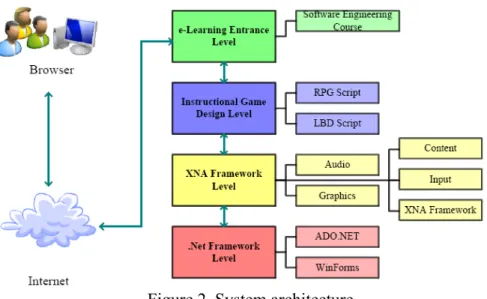
The second phase of the research is to implement the game software. We propose an four-level architecture for implementing the game. Dot Net framework and XNA framework are the fundamental programming language which proposed by Microsoft. We use API of these two frameworks to handle the presenting of I/O, graphics, audio, and content storage (as shown in figure 2).
Figure 2. System architecture
Instruction game design level is the content and main part to this research. This level is our original design based on experiential learning, digital game-based learning, and software engineering course. The content of software engineering course is referring from the chapter of project management in Pressman’s publication12. While
running a software project, the process can be separated into several parts. The content we adopt in the game is project estimation. Project estimation will face some subjects: understanding customers’ need, initial estimation, cost estimation, time estimation, risk estimation, and decision making. Therefore the game flow can be drawn as the flow chart below.
Figure 3. Flow chart of project estimation
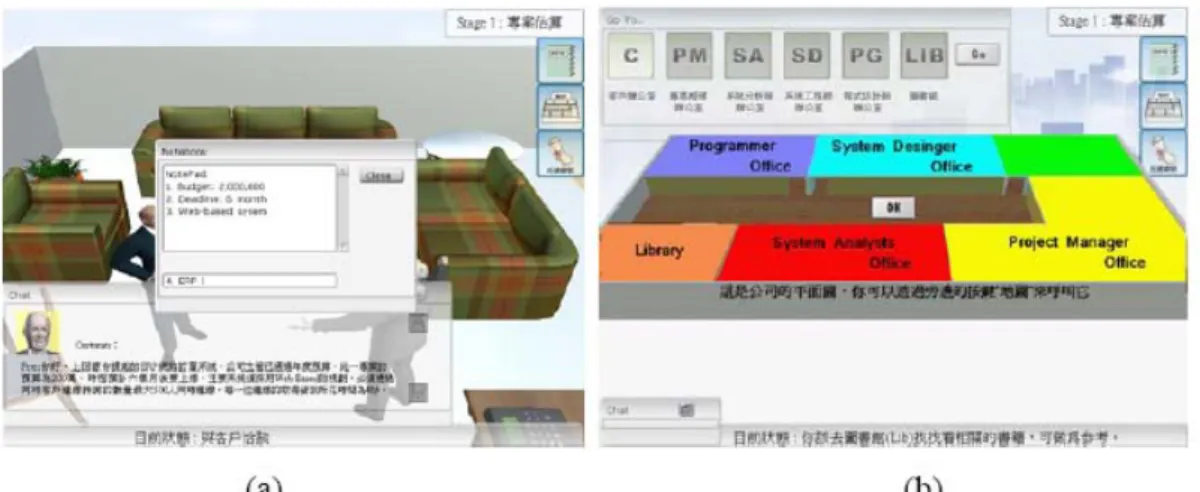
Figure 4. (a) Communicating with customer (b) office map
The game design of AVG is almost similar to the RPG game. The most different part is that AVG separates the project estimation into five games (as shown in figure 4 and 5).
Figure 5. (a) Cost estimation game (e) decision making game VI. Assessment
The assessment location is in the computer room of the school. The participants are randomly arranged into two groups. Before the assessment we have introduce the game system, content, and the process of the whole assessment. And after the assessment we have a post-test and questionnaire for them to understand their feelings to the assessment. The participants are students who attend the software engineering course and they are in their third or fourth year of college life. Therefore there participants are with prior knowledge about software engineering. The number of people of each group is twenty one, fourteen males and seven females in each group. The reason we cannot make equal number of male and female is for the reason that
there are few females attend the software engineering course.
After the assessment, participants have to take a post-test and answer a questionnaire. The content of the post-test is about project estimation in order to test if participants learn things from the game. As to the questionnaire, we design the questionnaire as an open questionnaire. We hope we can understand learners’ feeling and viewpoints from the questionnaire. And the results can help us improve the game and pedagogy design in the future.
VII. Result and discussion
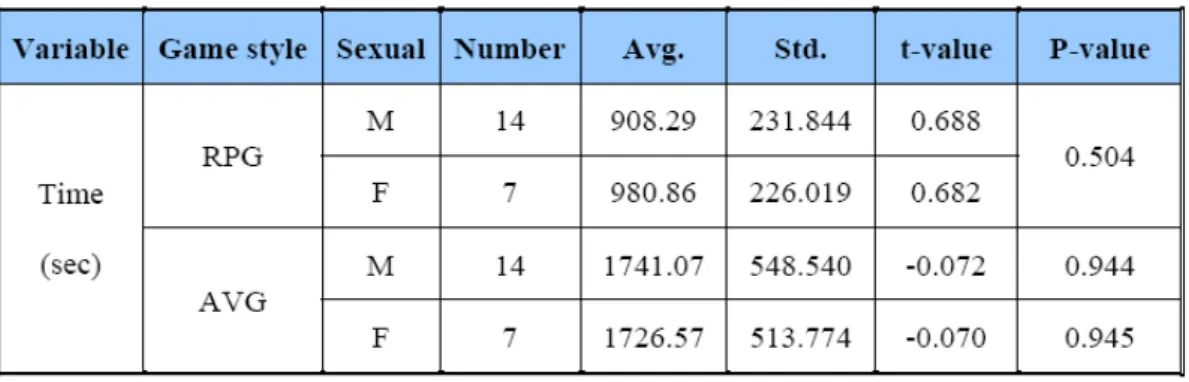
The quantitative results show that there are significant differences in learning time. Learners pay more time in the learning process and they may have better grades in the test (as shown in table 1 and 2). The other finding is that learners in AVG group get better grades than RPG group (as shown in figure 6). The reason for the result may owing to that learner have to continuously answer the questions of AVG game till they answer the correct answer. Therefore learners have lots of chance to practice in the AVG game. They also have a deep impression of the knowledge from the AVG game in the end. The last finding from quantitative data is that we do not have significant difference in the sexual variable (as shown in table 3 and 4). No matter the learners are male or female and which game they play, the learning result will be influenced by the difference of sexual variable.
Figure 6. Score of RPG and AVG
The open questionnaire provides us information to know learners’ attitude toward to the game. The qualitative data can be broke into several part for us to discuss.
a. Promote learning motivation: Many learners have the same opinion about this. The digital game-based learning method makes the learning not boring
any longer. The traditional learning way lacks for the fun factors. This makes learner feel boring and have no passion to pay attention in.
b. Familiar the process: About 30% of learners agree that the game helps them familiar to the whole project estimation process. They play the game and repeatedly review the process. Unconsciously learners learn the process during the playing period.
c. Hints: Some learners did not understand the content and goal of the game. But they can look up hints in the game to make themselves understand the previous status. Therefore the hint can be treated as support tool to help learners to learn the concepts in the game.
d. Warning message and knowledge search mechanism: No one can complete the game in one trial. Half of the learners think that there should be some warning messages to tell them that they are making mistakes. This is also a way for them to learn from making mistakes. The other suggestion of the learners is that they recommend us to create a knowledge search mechanism. After playing the game, learner can also learn knowledge from the game if there is a knowledge search mechanism.
e. Sense of achievement: Some learners get the sense of achievement from the game. Learners have to answer the questions, complete the tasks, and brain storming by their own in the game. After complete the tasks they feel they are with ability to complete the game. Hence that they are willing to continue play the game.
f. Promotion of specialized knowledge: In RPG group, there are over 70% of learners think that they can learn the specialized knowledge from the game. But in AVG group, there are only about 20% learners have the same opinion. We can directly know the project estimation process in the RPG game. In AVG game we can practice every single step of project estimation. But learners cannot easily to find the whole project estimation in AVG game. This is the reason why learners in AVG group think that the game cannot promote their specialized knowledge.
g. Case study: In the playing game period, 30% of learners think they cannot carry on the game due to the reason that they did not know how to play game in some stages of the game. The hints provide not enough information for them to understanding the task and question in the game. Learners suggest game designers can only use hints to educate them but also use some case study examples.
h. Interactivity of the game: 40% of AVG learners think that AVG game is with good interactivity. But in the RPG group, one fifth of the learners think the interactivity of RPG is bad. The reason is that there are different types of task in AVG game. Learners will feel that the game interact with them in various ways. The weak point of RPG is that there is an only one type of game. This phenomenon tells us the AVG is with better interactivity than RPG.
arrange much about the social interaction materials. In future research, we will take into consideration to add more materials about social interaction.
VIII. Conclusion
The assessment location is in the computer room of the school. The participants are randomly arranged into two groups. Before the assessment we have introduce the game system, content, and the process of the whole assessment. And after the assessment we have a post-test and questionnaire for them to understand their feelings to the assessment.
Digital game-based learning is a hot research topic and the pedagogy can help learners learn in the game with fun during the process. This phenomenon cannot be realized easily by traditional pedagogies. After the assessment we find that each game style is with its own advantages. Such as RPG game can make learners realizes the whole process of project estimation and AVG game provide learners a lot of chance to practice every step during the project estimation. Therefore we cannot have a conclusion of which game style is better. But we can adopt the advantages of these games in the proper situation in order to gain learners’ knowledge or make them practice more. With the game, learners learn not knowledge but also have a simulated environment which closed to the real situation for them to practice and with fun. Although there are some factors we did not take in considered such as the quantity of learning content, degree of difficulty, and lots detail of the representation. Therefore we still have room for improve the games in next research. Hope the results of the research can provide game designers and related researchers basis to follow. And makes digital learning better and more fitting to learners need.
Acknowledgement
The authors would like to thank the National Science Council of the Republic of China for financially supporting this research under Contract No. NSC97-2511-S-218-003-MY3, NSC97-2511-S-006-001-MY3, and NSC 97-2511-S-151 -001 -MY2.
References
[1] Rich, L., Cowan, W., Herring, S. & Wilkes, W. (2009). Collaborate, engage, and
interact in online learning: Successes with wikis and synchronous virtual classrooms at Athens State University, Online Submission [serial online]. January 01, 2009.
Available from: ERIC, Ipswich, MA. Accessed July 19, 2009
[2] Pivec, M. (2007). Editorial: play and learn: potentials of game-based learning, British Journal of Educational Technology, Vol. 38, No. 3, pp. 387-393.
[3] Prensky, M. (2001). Digital game based learning, McGraw-Hill, New York.
[4] Bramucci, R. S. (2002). Digital Game-Based Learning In Webct, Proceedings of WebCT 2002, 4th Annual User. Conference, 2002.
[5] Papastergiou, M. (2009). Digital game-based learning in high school computer
science education: Impact on educational effectiveness and student motivation,
Computers and Education, 52 (1), 1-12.
[6] Smith, L. & Mann, S. (2002). Playing the game: a model for gameness in interactive
game based learning, Proceedings of the 15th Annual NACCQ, New Zealand, pp.
397-402.
[7] Deway, J. (1938). Education and experience, Simon and Schuster, New York.
[8] Kolb, D. A. (1984). Experiential learning: experience as the source of learning and
development, Prentice Hall, New Jersey.
[9] Killi, K. (2005). Digital game-based learning: towards an experiential gaming model, The Internet and Higher Education, Vol. 8, No. 1, pp. 13-24.
[10] Ladousse, G. P. (1989). Role play: resource books for teachers, Oxford University Press, New York.
[11] Ju, E. & Wanger, C. (1997). Personal computer adventure: their structure,
principles, and applicability for training, The DATA BASE for Advances in
Information Systems, Vol. 28, No. 2, pp. 78-92.
[12] Pressman, R. (2005). Software engineering: a practitioner’s approach, 4th ed, McGraw-Hill, New York.
【附件二】出席國際學術會議心得報告及發表之論文各一份 (第二年)
國科會補助專家學者出席國際學術會議心得報告
日期: 99 年 10 月 16 日
一、參加會議經過
今年 Society for Information Technology & Teacher Education (SITE 2010)在美 國聖地牙哥舉辦。此次會議共舉辦五天,研討會主題為:「21世紀的學生學 習(Engaging Students through 21st Century Learning)」,其下又可分為五大議 題,分別為:學院學生學習(Collegial Learning)、21世紀成就與評量的技巧 (Performance and Assessment of 21st Century Skill)、教與學的新媒介與可能 性(New Media, New Possibilities for Teaching & Learning)、師培教育的全球 挑 戰(Global Challenges in Teacher Education) 、 以 及 K12 夥 伴 關 係 (K12 Partnerships),顯示此研討會涵蓋內容繁多。除了Symposium、Full Papers以 及Round Table之外,還有Keynote Speech,發表文章篇數共超過五百篇,參 與 程 度 相 當 踴 躍 。 本 人 發 表 的 文 章 係 在3/31 日 ( 會 議 進 行 第 三 天 ) 以 Roundtables方式進行,其他時間則至發表場地聆聽相關報告內容。
二、與會心得
(一) 論文發表多元且議程緊湊 此次研討會共計五天,每天有五個不等的 session 進行,預估每天約 有100 篇論文發表。此外,本研討會又分成五大議題,各自針對不同 的細項議題進行討論。整體而言,議程安排緊湊,論文發表內容多 元。 (二) 對資訊科技與社會的研究議題,有更進一步的視野與啟發 環顧此次投稿研討會的文章,發現不少研究者皆利用 TPCK 甚或 TPACK 作為課程或教學系統設計的主軸,顯示在新科技衝擊的影響 補助編號 NSC 97-2511-S-151-001-MY2 計畫名稱 整合產學為基礎之工程教育遊戲性教學系統開發及教與學評估 出國人員 姓名 吳文雄 服務機構 及職稱 國立高雄應用科技大學 資訊管理 系 教授 會議時間 99 年 03 月 29 日 至 99 年 04 月 02 日 會議地點 美國 聖地牙哥 會議名稱 (中文)2010 年資訊科技與社會&師培教育─二十一世紀國際研討會 (英文) Society for Information Technology & Teacher Education2010-21ST International Conference 發表論文
題目
(中文)班級中遊戲式教學環境的發展:一個概念性架構
(英文)Developing a Game-based Learning Environment in Classrooms: A Conceptual Model
下,傳統的教學策略已不敷教師們使用,因此發展一套結合教育理論 與科技的教學策略乃更為重要。此外,由於我國目前中小學甚或高等 教育階段直接利用遊戲式教學或是電腦遊戲進行學習的案例為少數, 因此藉由此次機會,可了解美國實務工作者如何應用遊戲式教學亦或 電腦遊戲來提升 K-12 年級或是高等教育階段學生之學習成效,以作 為未來進行遊戲式教學之參考指引。 (三) 對目前進行中的國科會專題研究有正向與啟發的影響
本人所發表的題目為”Developing a Game-based Learning Environment in Classrooms: A Conceptual Model”,主要以 TPCK 的教學策略發展
數位遊戲教學之學習環境。同場次在 Roundtables 發表的文章共有四 篇,皆環繞在遊戲式教學的議題上,這幾篇皆從遊戲式教學的角度作 為出發點,探討其運用在教學上之影響,可見在 21 世紀資訊科技發 達的資訊時代下,「科技」的確在教學中的角色日益增加。這樣的議 題對目前正在進行的國科會專題研究:「技專校院學生資訊科技與社 會基礎課程規劃與實施之研究─網際服務為基礎之教學輔助系統建置 與評估」亦有正向的啟發。相信這一次參與研討會,對本人目前進行 的國科會專題研究會有極豐碩的影響。
三、考察參觀活動(無是項活動者略)
無四、建議
無
五、攜回資料名稱及內容
(一) SITE 2010 大會手提包一個。 (二) SITE 2010 研討會會議手冊一本。 (三) SITE 2010 研討會會議議程一本。六、其他 (研討會剪影)
Developing a Game-based Learning Environment in Classrooms: A
Conceptual Model
Wen-Hsiung Wu1 & Wei-Fan Chen2
1 National Kaohsiung University of Applied Science, Taiwan 2The Pennsylvania State University, USA
Abstract
This study presents a conceptual model for developing a game-based learning environment. This model adopts a role-playing strategy in a digital gaming environment by considering the educational theory of TPCK (Technological Pedagogical Content Knowledge) that integrates pedagogical knowledge, content knowledge, and technological knowledge. The model includes three different modules: (1) input module, (2) developmental process module, and (3) evaluation module from the perspective of input-process-output.