National Chiao Tung University
Institute of Management of Technology
Dissertation
文化差異對於台灣製造業與西方消費者在電子產品
使用上所造成的影響
The Influence of the Cultural Difference between Taiwanese
Manufacturers and Western Consumers on Usability
Student: Steve Wallace
Advisor: Hsiao-Cheng Yu
文化差異對於台灣製造業與西方消費者在電子產品使用上所造成
的影響
The Influence of the Cultural Difference between Taiwanese
Manufacturers and Western Consumers on Usability
研 究 生:史蒂芬
Student: Steve Wallace
指導教授:虞孝成 Advisor:
Hsiao-Cheng
Yu
國 立 交 通 大 學
科 技 管 理 研 究 所
博 士 論 文
A ThesisSubmitted to Institute of Management of Technology National Chiao Tung University
in partial Fulfillment of the Requirements for the Degree of
Doctor of Philosophy in
Management of Technology January 2011
Hsinchu, Taiwan, Republic of China
The Influence of the Cultural Gap between Taiwanese Manufacturers and Western Consumers on Usability
Student: Steve Wallace
Advisors: Dr. Hsiao-Cheng Yu
Institute of Management of Technology
National Chiao Tung University
ABSTRACT
Designing products for usability is crucial for the success of Taiwanese manufacturers competing in overseas markets such as the U.S. To compete in overseas markets, Taiwanese companies need to know how overseas users understand usability and the usability problems overseas users experience when using their products. To support these goals, Taiwanese usability evaluators need usability evaluation tools that are effective in testing their products for overseas markets.
To answer these questions, a model of culture, usability and usability measurement is proposed based on ISO9124-defined usability attributes; effectiveness, efficiency and user satisfaction; and cultural dimensions identified by Hofstede and the World Values Survey. Studies are conducted which support the model and also suggest usability measurement tools which may be effective for Taiwanese producers interested in improving the usability of their products, particularly through heuristic evaluations and severity rating methods.
Table of Contents
English Abstract ··· i
ABSTRACT ··· i
Table of Contents ··· ii
List of Tables ··· vi
List of Figures ··· viii
I. Introduction ··· 1 1.1 Research Background ··· 2 1.2 Research Motivation ··· 2 1.3 Research Objective ··· 3 1.4 Research Method ··· 4 1.5 Organization of Dissertation ··· 4
II. Literature review ··· 5
2.1 Usability ··· 5 2.1.1 Definitions ··· 5 2.1.2 Models ··· 8 2.2 Culture ··· 11 2.2.1 Definitions ··· 11 2.2.2 Models ··· 12 2.3 Culturability ··· 16 2.4 Approaches ··· 18
III. Proposed Model of Culturability ··· 20
IV. Methodology ··· 25
4.1 Cultures ··· 25
4.2 Products ··· 26
4.3 Measurement Methods ··· 26
V. Culture and the Relative Importance of Usability Attributes, Effectiveness, Efficiency, and User Satisfaction for New Zealand, Philippine, Taiwanese, and U.S. Users of Cell Phones. ··· 28
5.1 Introduction ··· 28
5.2 Definitions and Models ··· 29
5.3 Research Propositions ··· 32
5.4 Methodology ··· 33
iii
5.4.1 Survey Participants ··· 34
5.4.2 Cultural Dimensions ··· 34
5.4.3 Product ··· 35
5.4.4 Survey and Procedure ··· 36
5.4.5 Analysis ··· 37
5.5 Results ··· 37
5.5.1 Selected Attributes ··· 37
5.5.2 Attribute Ratings ··· 38
5.5.3 Relationships between Usability Attributes and Cultural Dimensions ··· 40
5.6 Discussion ··· 41
5.6.1 In-country and Between-country Differences ··· 41
5.6.2 Cultural Dimensions and Usability Attributes ··· 44
5.6.3 Limitations of this Research ··· 45
5.6.4 Research Implications ··· 45
5.7 Conclusion ··· 46
VI. Culture and Usability Attributes- Effectiveness, Efficiency, and User Satisfaction - for North American and Taiwanese Users of a Taiwanese-made MP3 Player. ·· 47
6.1 Introduction ··· 47
6.2 Hypothesis ··· 48
6.3 Methods ··· 49
6.3.1 The Product ··· 49
6.3.2 Survey Sample Characteristics ··· 50
6.3.3 Measuring User Performance ··· 51
6.3.4 Measuring User Perceptions ··· 51
6.3.5 Measuring Correlations ··· 53
6.4 Results ··· 53
6.4.1 Comparing Averages for the Two Groups ··· 54
6.4.2 Correlations between Usability and Culture ··· 54
6.4.3 Comparing correlations between usability factors across cultures ··· 56
6.5 Discussion ··· 57
6.6 Implications ··· 59
6.6.1 Recommendations ··· 59
6.7 Conclusion ··· 60
VII. Culture and the Accuracy of Judgment-Driven and Data-driven Severity Rating Methods ··· 61
7.1 Introduction ··· 61
7.3 Methodology ··· 65 7.3.1 Product ··· 65 7.3.2 Subjects ··· 66 7.3.3 Procedure ··· 66 7.4 Results ··· 67 7.5 Discussion ··· 70
7.5.1 Limitations of This Research ··· 70
7.5.2 Research Implications ··· 70
7.6 Conclusion ··· 71
VIII. Improving the Cross-cultural Usability of Taiwanese-made Software Documentation with Heuristic Evaluations. ··· 72
8.1 Introduction ··· 72
8.1.1 Related Research ··· 72
8.1.2 Issues Related to Comparing Heuristic Evaluations ··· 73
8.1.3 Purpose and Hypothesis ··· 75
8.2 Methodology ··· 75
8.2.1 The Heuristic Evaluations ··· 75
8.2.2 The Documentation ··· 77
8.2.3 User Testing ··· 78
8.2.4 Heuristic Evaluations ··· 78
8.2.5 Data Collection and Analysis ··· 79
8.3 Results ··· 80
8.3.1 Effectiveness ··· 80
8.3.2 Efficiency ··· 82
8.3.3 User Satisfaction ··· 83
8.4 Discussion ··· 83
8.4.1 Implications of this Study ··· 84
8.4.2 Limitations of this Study ··· 85
8.5 Conclusion ··· 85
IX. Findings ··· 86
9.1 Culture and In-Country and Between-Country Differences in the Importance of Usability Attributes ··· 87
9.2 Culture, User Satisfaction, and Objective and Subjective Effectiveness and Efficiency ··· 88
9.2.1 Culture and the Accuracy of Judgment-Driven and Data-driven Severity Rating Methods ··· 89
v
9.3 Culture and the Usability Measurement of Taiwanese-made Software
Documentation Using Heuristic Evaluations ··· 90
9.4 Implications of this Research ··· 91
9.5 Limitations of this Research ··· 93
X. Conclusion ··· 95 References ··· 96 Appendix 1 ··· 104 Appendix 2 ··· 107 Appendix 3 ··· 109 Appendix 4 ··· 112
List of Tables
Table 2-1 Folmer and Bosch’s Four Level Model of Usability ··· 8
Table 2-2 Hornbaek’s Model of Usability Aspects ··· 10
Table 2-3 Models of Culture (1) ··· 12
Table 2-4 Models of Culture (2) ··· 13
Table 2-5 Overview of Ford and Kotzé’s Conceptual Model of Usability ··· 16
Table 2-6 Cultural Variables Affecting User Characteristics in Ford and Kotzé’s Model ··· 17
Table 2-7 Cultural Variables Affecting the Technical Environment in Ford and Kotzé’s model ··· 17
Table 3-1 Definitions and Models Summary ··· 20
Table 5-1 Sample Characteristics ··· 34
Table 5-2 Cultural Dimensions Described by the World Values Survey† ··· 34
Table 5-3 Cultural Dimensions Described by Hofstede† ··· 34
Table 5-4 Internal Consistency of Survey Items ··· 36
Table 5-5 Usability Attribute Ratings by Country ··· 39
Table 5-6 Correlations between Usability Attributes and Cultural Dimensions ··· 40
Table 5-7 Relationships between Usability Attributes and Cultural Dimensions Sets ··· 41
Table 5-8 Reported In-Country Differences in Usability Attribute Valuation ··· 43
Table 5-9 Reported Between-Country Differences in Usability Attribute Valuation ··· 44
Table 6-1 Sample Characteristics ··· 50
Table 6-2 Survey Reliability ··· 52
Table 6-3 Comparison of Mean Measures of Usability between Cultures ··· 54
Table 6-4 Correlations between Factors in Usability for Both Culture Groups ··· 55
Table 6-5 Correlations between Usability Factors for North American Users ··· 57
Table 6-6 Correlations between Usability Factors for Taiwanese Users ··· 57
Table 7-1 Severity Rating Methods ··· 63
Table 7-2 Severity Rating Methods ··· 67
Table 7-3 Association between Method and Rating Accuracy ··· 68
Table 7-4 Rating Method and Inter-Rater Agreement ··· 68
Table 7-5 Rating Method Accuracy ··· 69
vii
Table 7-7 Rating Method Accuracy based on UP Severity Criteria ··· 69
Table 7-8 Rating Method Accuracy ··· 69
Table 8-1 Summary of GeneralHE Heuristics ··· 77
Table 8-2 Summary of SpecificHE Heuristics ··· 77
Table 8-3 Average Usability Problems ··· 81
List of Figures
Figure 2-1 The MUSIC Usability Model ··· 9
Figure 2-2 Clemmensen’s Cultural Model Theory of Usability (CM-U) ··· 18
Figure 3-1 Usability Factors ··· 21
Figure 3-2 Culture and Usability Factors (1) ··· 22
Figure 3-3 Culture and Usability Factors (2) ··· 23
Figure 3-4 Culture and Usability Factors (3) ··· 24
Figure 3-5 Culture and Usability Factors (4) ··· 25
Figure 5-1 Usability Attribute Ratings by Country ··· 39
I. Introduction
Designing products for usability is crucial for the success of Taiwanese manufacturers competing in overseas markets such as the U.S. The advantages are many, with improvements to product branding, sales, and ultimately profits, and for the development of the Taiwanese export sector as whole. On the other hand, ignoring usability could mean lost competiveness, with increasing losses to the Taiwanese economy as a result.
To compete in overseas markets, Taiwanese companies need to understand their customers, and they need to know how to make their products usable for these customers. Companies therefore need the answers to the following questions.
Do overseas users understand usability the same way as Taiwanese customers? Do overseas users experience the same usability problems to the same degree as
Taiwanese users?
Are common usability measurement tools effective in supporting Taiwanese usability evaluators who test products designed for overseas markets?
If not, what solutions may support Taiwanese designers of products for overseas markets?
To answer these questions, we need to examine the interaction of culture and usability. This field of study is also called “culturability”, a term first coined by Barber and Badre (1998). Since its inception, the study of culturability has studied the use of a variety of products such as web sites, software, and consumer electronics, by users from a number of countries, particularly the U.S. and the Asian region, to identify the effect on usability as indicated by attributes such as product performance and user attitudes.
In the study of culturability, definitions of usability vary, but the ISO9241 definition of usability is perhaps one of the most commonly used in the HCI field (Clemmensen and Roese, 2010). ISO9241 defines usability in terms of usability attributes: effectiveness, efficiency, and user satisfaction (ISO, 1998). This definition was applied in this study to help understand culture’s effect on usability in more detail. Each ISO9241-defined usability attribute was examined to identify the effect culture has on usability attributes and usability as a whole.
In addition, understanding culture’s effect on usability is of little use without a means of solving the usability problems behind any differences that may exist. So, to solve usability problems for overseas users, this dissertation also examined the usefulness of usability
measurement tools in cross-cultural situations, focusing especially on heuristic evaluations and severity rating methods. These usability evaluation methods were selected for study as they are both based largely on evaluator opinion, and hence may be likely than other methods to be influenced by culture.
Based on this research, a model of culturability was developed, based on previous research and the results of this study. This model shows the relationship between culture, usability factors, usability attributes, and the measurement of usability. In so doing, this dissertation hopes to both add to the field of culturability, and provide practical support to Taiwanese manufacturers of products aimed at overseas markets such as the U.S.
1.1
Research Background
Taiwan is a major producer of consumer electronic products, most of which are sold overseas. However, to succeed in international markets, Taiwanese companies must realize the importance of good design. Designing for usability is clearly one way to sharpen Taiwan’s competitive edge. Mayhew and Mantei (1994) describe
improvements in usability resulting in increased sales, improved branding, decreased training costs, and less need for after-sales support. However, if the same product in different countries differs in its effectiveness, efficiency, and user satisfaction, then product designers need to be aware of these differing customer requirements and focus more on improving usability in a way that more effectively focuses on the usability requirements of the target market.
1.2
Research Motivation
The study of culture and usability has generally taken three approaches (Fitzgerald, 2004). The first is the cultural dimension approach, where quantifiable differences in attitudes due to culture are examined for their effect on usability. The second approach studies the effect on usability of features of product design which represent cultural values, such as a marker of social status on a web site. The final approach studies how users with different cultural values use the same product for different tasks. In these approaches, culture is typically represented by cultural values or dimensions. On the other hand, none of these approaches have a standard approach to the representation of usability.
The accurate representation of usability is a problem shared by usability literature as a whole, not just culturability. Hornbaek (2006), in his literature survey of 180
3
studies into usability, suggests that usability may not always have been accurately measured. Similarly, Frandsen-Thorlacius et al. (Frandsen-Thorlacius, et al., 2009) suggest that many studies only focus on single indicators such as user preference or efficiency as an indicator of usability as a whole. However, as shown by Frøkjær et al. (Frøkjær, et al., 2000), it cannot be certain that any single aspect of usability is
correlated with usability as a whole.
It is important, therefore, when studying the effect of culture on usability, to consider the effect of culture on all aspects of usability – effectiveness, efficiency, and user satisfaction. As well as the impact of culture on absolute values of usability attributes, the impact of culture on the relative values of usability attributes needs to be identified. Studies such as that of Frandsen-Thorlacius et al. (2009) suggest that
culture has an impact on the relative importance of usability attributes. By combining an understanding of how cultures weight usability differently with knowledge of differences in measures of usability attributes between cultures, we can more accurately focus product design on areas valued by overseas customers and avoid usability problems shown to be serious for overseas customers.
If culture influences usability and usability attributes, it is likely that it also influences usability evaluation. There is evidence that supports the idea that culture affects not only test subjects’ perception of usability, but also that of usability
evaluators (Clemmensen, et al., 2009), as well as the usability evaluation process (Shi and Clemmensen, 2008, Vatrapu and Pérez-Quiñones, 2006). It is likely that other aspects of the usability evaluation process which involve a high degree of subjectivity on the part of evaluators, such as heuristic evaluations and severity ratings, may also be influenced by culture. Inaccuracies in usability measurement caused by culture therefore, must be identified, as well as possible solutions to this problem.
1.3
Research Objective
The purpose of this research was, therefore, to identify how the cultural background of a user affects the usability of a product, and the evaluation of its usability. The study aimed to examine the effect of a user’s culture on the relative importance of these factors when determining overall usability, and as well as on their absolute values, and to more effectively measure and understand the usability
1.4
Research Method
To attain these objectives, four studies are carried out.
1. Users from different cultures were surveyed to determine the effect of culture on the relative importance of effectiveness, efficiency, and user satisfaction.
2. The effect of culture on these aspects of usability was investigated by usability testing users from different cultures as they used a Taiwanese-made consumer electronic device.
3. The effect of culture on usability evaluation was indicated by comparing severity ratings made by Taiwanese usability evaluators with those of U.S. users.
4. The usefulness of heuristic evaluations as a means of discovering usability problems in a cross-cultural context was assessed by using two heuristic evaluations to identify the usability problems of Taiwanese-made software documentation.
1.5
Organization of Dissertation
The dissertation is organized into nine main parts.
1. Literature relating to the topic of culture and usability is reviewed in order to identify relevant definitions and models.
2. A model of culturability is proposed. 3. An appropriate methodology is discussed.
4. The influence culture has on the user’s relative valuation of efficiency, effectiveness, and user satisfaction is examined.
5. The influence culture has on the effectiveness, efficiency, and user satisfaction of the product is examined.
6. The severity of usability problems of Taiwanese made software documentation is measured using Taiwanese evaluators in order to identify a severity rating method that is both more effective and consistent with definitions of usability.
7. The effectiveness of using heuristic evaluations to identify usability problems of Taiwanese-made software documentation is measured based on a framework of usability attributes.
8. Results from research into the effect of culture on usability are summarized and discussed with regard to their implications for the model of usability proposed in this dissertation.
5
II. Literature review
In this section usability and culture are discussed, and relevant definitions and models are presented.
2.1
Usability
As a social construct, usability is a notion that is difficult to agree on. Definitions of usability typically attempt to identify the aspects of usability that encapsulate its meaning. Models of usability are based on these definitions but attempt to incorporate factors that may influence usability such as context variables or variables affecting the measurement of usability.
2.1.1 Definitions
One approach to defining usability is to examine how users themselves
understood the concept of usability. McGee et al. (2004) looked at how 42 users rated 64 usability characteristics. They found users defined usability as a combination of consistency, efficiency, ease of use, effectiveness, controllability, usefulness, expectability, and naturalness. Satisfaction and style were excluded. Similarly,
Hertzum et al. (2007) discovered that a user’s concept of usability also varies between cultures. Danish and Indian users described usability as including concepts such as ‘easy-to-use’, ‘intuitive’, and ‘liked’. On the other hand, Chinese users offered a range of issues related to security, task types, training, and system issues. Such studies have not resulted in accepted usability definitions, no doubt because by nature, such
usability definitions differ across cultures and between individuals, and cannot become a standard.
An additional attribute, aesthetics has been suggested. Tractinsky (1997) and Kuroso, M. and Kashimura, K. (1995) found significant correlations between user’s perceptions of beauty and perceptions of usability for Israeli (r=0.921) and Japanese (r = 0.59) users respectively. Tractinksy therefore called for a more holistic
understanding of usability which includes aesthetics. This measure, however, is only intended as an addition to existing definitions of usability. In addition, it is possible that aesthetics may be similar to satisfaction, a commonly used attribute.
Shackel attempted to provide a standardized definition of usability. Shackel defined usability within a framework of user, task, tool and environment. (Shackel,
1991). Usability for individual users was determined by subjective ease of use and objective performance measures such as effectiveness, learnability, flexibility, ease of use, and user attitude. Shackel included a variety of possible measurement methods for these usability metrics such as number of errors, time taken to learn a task, and attitude measurement questionnaires. However, problems exist with implementation of some attributes. Learnability is not applicable to products that are used a single time only. For example, many websites are encountered only once. In addition, the flexibility of a product may be difficult to measure.
Nielsen suggested similar attributes to describe usability. Nielsen’s definition of usability includes learnability, efficiency, memorability, errors, and satisfaction (Nielsen) However, Nielsen’s definition has been criticized for its blending of usability measurement methods, such as number of errors, and usability attributes, such as efficiency, which could be measured a number of ways (Winter, et al., 2008).
The Consolidated Model of Usability (Witold, et al., 2003) was based on a combination of usability attributes found in the ergonomics standard set by the
International Standards Organization - ISO9241 - and additional attributes considered important in other definitions. Witold et al. incorporate learnability from Shackel and Nielsens’ definitions, despite issues with single use products. In addition, the model incorporates security from the ISO9126 software quality standard. However, while security may be an important feature in software design, it is not essential in all products, while usability is.
ISO/IEC 9126-1 is a software quality standard which incorporates a definition of usability. The definition describes usability as, “the capability of the software product to be understood, learned, used and attractive to the user, when used under specified conditions” (ISO, 2001). This definition aims at defining user interface qualities to ensure overall software quality, and so is not intended to provide a standalone definition of usability. As an example, effectiveness is not included as an attribute of usability in ISO9126. This definition appears to be non-intuitive, as, to be usable, a product must at least do the job for which it was intended. However, effectiveness appears in ISO9126 as an attribute of software quality, supporting the aim of this standard, which is to define aspects of software quality, rather than usability.
On the other hand, ISO9241 is an ergonomics standard, widely accepted in the HCI (Human-Computer Interaction) community (Frandsen-Thorlacius, et al., 2009),
7
The standard defines usability as “the extent to which a product can be used by specified users to achieve specified goals with efficiency, effectiveness and user satisfaction in a specified context of use” (Bevan, 2001). ISO9241 further defines usability measures as follows.
Effectiveness: the accuracy and completeness with which users achieve specified goals.
Efficiency: the resources expended in relation to the accuracy and completeness with which users achieve goals.
Satisfaction: the comfort and acceptability of use.
Of all usability definitions, ISO9241 most succinctly encapsulates actual product performance in terms of process and results, and perceptions of performance in terms of user satisfaction. For that reason and because of its widespread use in HCI
community it is adopted for use in this dissertation.
One problem with the ISO9241 definition is that there may be little correlation between usability attributes. Hornbæk and Law (2007) examined 73 published
usability studies and concluded that attributes showed little or no correlation with each other. This was supported by Frøkjær et al.’s work, which investigated the correlation between usability measures of a document retrieval system and found little evidence of a correlation between usability attributes (Frøkjær, et al., 2000). Walker et al. (Walker, et al., 1998) report a similar lack of correlation between usability measures in their study of a voice controlled email interface.
However, these findings have been challenged by the results of research by (Sauro and Lewis, 2009) who identified correlations between measures of usability in their analysis of the results of 90 unrelated usability tests. By examining actual
usability tests rather than academic studies, and by examining results at the task-level, rather than for a usability test as a whole, they were able to identify correlations ranging from -0.44 (errors vs. task satisfaction) to 0.6 (errors vs. time), all much higher than those identified by Hornbaek and Law or Frøkjær et al. They therefore argued that a usability construct exists, and that a single measure of usability is possible, based on usability metrics. However, their results also show such a measure would only account for 54% of variance in raw scores, which they acknowledge would result in the loss of a great deal of valuable information. Consequently, it is argued in this paper, that even if a single measure of usability were possible as Sauro and Lewis argue, the loss of information is too high to warrant combining measures, or to argue
that one usability measure sufficiently represents usability as a whole. Measurement of all usability attributes is still required to understand the effect of culture on usability.
2.1.2 Models
Another criticism of the ISO9241 usability definition is its high level of
abstraction (Winter, et al., 2008). Refinements therefore have been attempted in order to enhance definitions of usability to support a clearer distinction of usability’s attributes, usability problem classification, and usability measurement methods. For example, the User Action Framework (Andre, et al., 2001) provides a taxonomy of usability problem types intended to support the identification of usability problems, and so of usability overall. (Folmer and Bosch, 2004) are interested in usability insofar as it promotes good design. Consequently they suggest a four level model of usability, with high-level usability definitions described by usability indicators in the following level. The last two levels describe usability properties such as consistency or user control, with accepted usability solutions and heuristics or principles underlying these at the lowest level of the model. While Folmer and Bosch’s model succeeds in its goal of incorporating usability indicators and solutions, it still contains multiple definitions of usability, avoids attempts to identify which definition of usability is best, and fails to identify factors affecting usability.
Table II-1 Folmer and Bosch’s Four Level Model of Usability
Usability Usability Definitions ISO9241 Effectiveness Efficiency Satisfaction Shackel Effectiveness Learnability Flexibility Attitude Nielsen Learnability Efficiency Memorability Errors Satisfaction Others Throughput Learnability Evolvability Attitude Usability Indicators
e.g. completeness, time to learn, errors, speed, satisfaction
Usability Properties
Consistency, error management, feedback, guidance, user control Problem-solution boundary
Design Knowledge Usability patterns Heuristics/ guidelines design
techniques
On the other hand, the European Community ESPRIT project's MUSIC model (Measuring the Usability of Systems In Context) identifies variables that affect usability (Bevan, 1992), such as task, user, product, and the environment.
9 The user
o Personal details o Skills and knowledge
o Physical and mental attributes Equipment o Basic description o Specification Tasks o Job characteristics o Task characteristics Organizational environment o Structure
o Attitudes and culture o Worker control Technical Environment
o Hardware, software
o Reference materials Physical environment
o Workplace conditions o Workplace design, safety
The MUSIC model bases itself on the ISO9241 definition of usability by incorporating usability attributes effectiveness, efficiency and user satisfaction, but expands on this definition by describing the interaction of task, user, product, and environment. However, it is still limited by a lack of usability metrics, such as errors or time taken, and usability solutions.
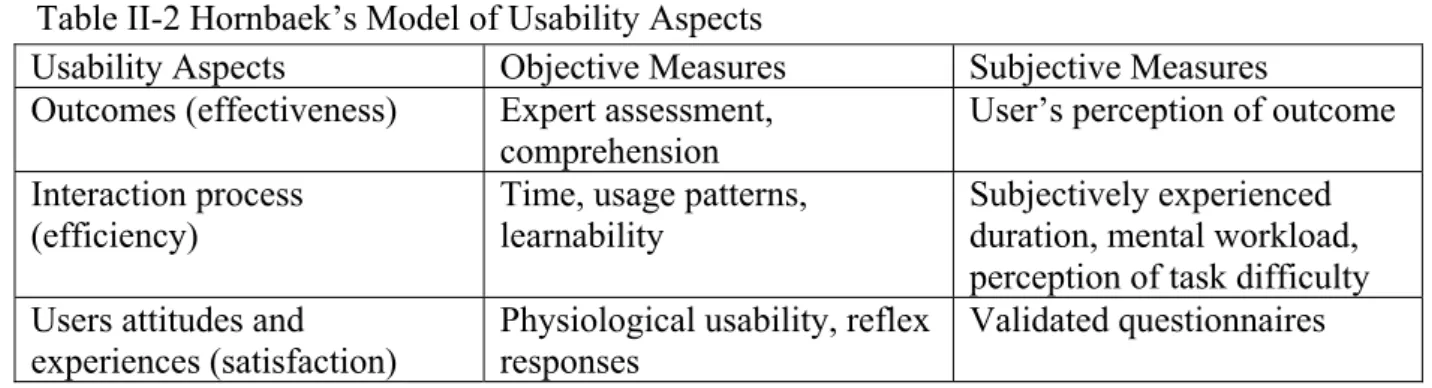
Hornbaek’s Model of Usability Aspects (2006), is similar to the MUSIC model in that is based on ISO9241, also includes usability metrics, a feature missing in the MUSIC model. The model is based on a literature survey of the more common approaches to usability in HCI literature and is perhaps the most comprehensive attempt so far to identify what researchers commonly understand is usability and how it is measured. Based on a survey of 180 articles on usability, Hornbaek distinguishes between measures of effectiveness, efficiency, and user satisfaction. Furthermore, he finds that effectiveness measures are related to outcomes of using a product, while efficiency measures are related to the process of interacting with the product. In addition, he finds differences in measuring subjective and objective usability. For example, time taken to perform a task is often measured as an indicator of efficiency, but a user’s perception of the time taken may differ from this measure. Measures of effectiveness may be similarly divided into actual effectiveness and the user’s perception of his/her effectiveness.
Table II-2 Hornbaek’s Model of Usability Aspects
Usability Aspects Objective Measures Subjective Measures Outcomes (effectiveness) Expert assessment,
comprehension
User’s perception of outcome Interaction process
(efficiency)
Time, usage patterns, learnability
Subjectively experienced duration, mental workload, perception of task difficulty Users attitudes and
experiences (satisfaction)
Physiological usability, reflex responses
Validated questionnaires
Based on these findings Hornbaek therefore defines usability as a construct comprising a user’s perceptions of product effectiveness, efficiency and user
11
satisfaction, combined with the actual effectiveness and efficiency of the product. As it is based on a literature survey, Hornbaek’s model has the advantage of consistency with other HCI research. Furthermore, it is a clarification of the ISO9241 definition of usability, and comes a long way in helping resolve the issue of connecting usability’s definition with its measurement. However, it fails to incorporate the effect of usability factors such as user, task, and product as described in the MUSIC model.
2.2
Culture
2.2.1 Definitions
The concept of culture is difficult to describe precisely, and there is little agreement on culture’s definition. By 1951, 164 different definitions for culture had been identified (Olie, 1995), suggesting that currently the number of definitions for culture must be significantly higher. Of these definitions, Straub, et al. (Straub, et al., 2002) have identified three groups of definitions of culture based on either values or cognitive style, or all-encompassing definitions of culture.
Studies of culturability however, base themselves on slightly different definitions of culture. These include differences either in nationality, communication style,
meanings, or a comprehensive set of differences including cognition and values. Badre (2000) loosely describes culture as no more than “a means of distinguishing between different countries”, indicating that culture is simply based on the nationality of the user. Cultural differences have also been based on differences in communication (e.g. (Hall, 1976), or meaning (e.g. (Bourges-Waldegg and Scrivener, 1998, Marcus, 2006). For Marcus, culture is based on differences in the meaning of group “behaviors, leaders/followers, values, artifacts, and signs”. Another type of definition of culture is more comprehensive and attempts to combine cognitive, emotional, communicational, and behavioral differences that help to distinguish groups of people (e.g. (Borgman, 1986, Hofstede, 1984). For Hofstede, culture is “the collective programming of the mind that distinguishes the members of one group or category of people from another, where the mind stands for thinking, feeling and acting, with consequences for beliefs, attitudes and skills”. In studies of culturability, the concept of culture is commonly separated into objective and subjective culture (Ford and Kotzé, 2005, Hoft, 1996). Objective culture includes expressions of culture such as institutions, language, and lifestyle etc, while subjective culture includes internal, psychological manifestations of culture, such as attitudes held in common with others.
2.2.2 Models
Models of culture used in studies on culturability usually describe dimensions along which national cultures vary (Badre, 2000, Choi, et al., 2005, Ford and Kotzé, 2005, Marcus and Gould, 2000). Typically, such studies are based on Hofstede’s cultural dimensions (Clemmensen and Roese, 2010). However, given the large number of cultural dimensions identified (Lee et al. (2008) reported 36 such dimensions), discussion of the relative merits of the more common cultural dimensions is required. These include Hall (1976), Triandis (1972), Trompenaars (1994), Schwartz (2004), Hofstede, and the World Values Survey.
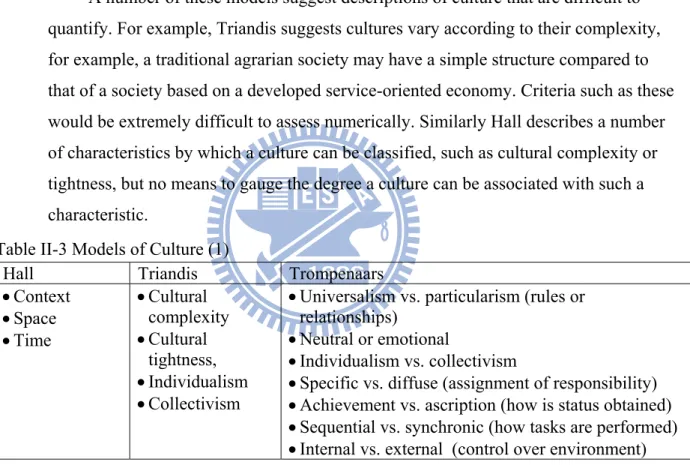
A number of these models suggest descriptions of culture that are difficult to quantify. For example, Triandis suggests cultures vary according to their complexity, for example, a traditional agrarian society may have a simple structure compared to that of a society based on a developed service-oriented economy. Criteria such as these would be extremely difficult to assess numerically. Similarly Hall describes a number of characteristics by which a culture can be classified, such as cultural complexity or tightness, but no means to gauge the degree a culture can be associated with such a characteristic.
Table II-3 Models of Culture (1)
Hall Triandis Trompenaars
Context Space Time Cultural complexity Cultural tightness, Individualism Collectivism
Universalism vs. particularism (rules or relationships)
Neutral or emotional
Individualism vs. collectivism
Specific vs. diffuse (assignment of responsibility) Achievement vs. ascription (how is status obtained) Sequential vs. synchronic (how tasks are performed) Internal vs. external (control over environment) On the other hand, a number of models provide quantifiable descriptions of culture that can be used to investigate culture’s effect on usability. For example, Trompenaars provides seven dimensions of culture, five relating to interpersonal relationships, the other two relating to time and space. However, apart from
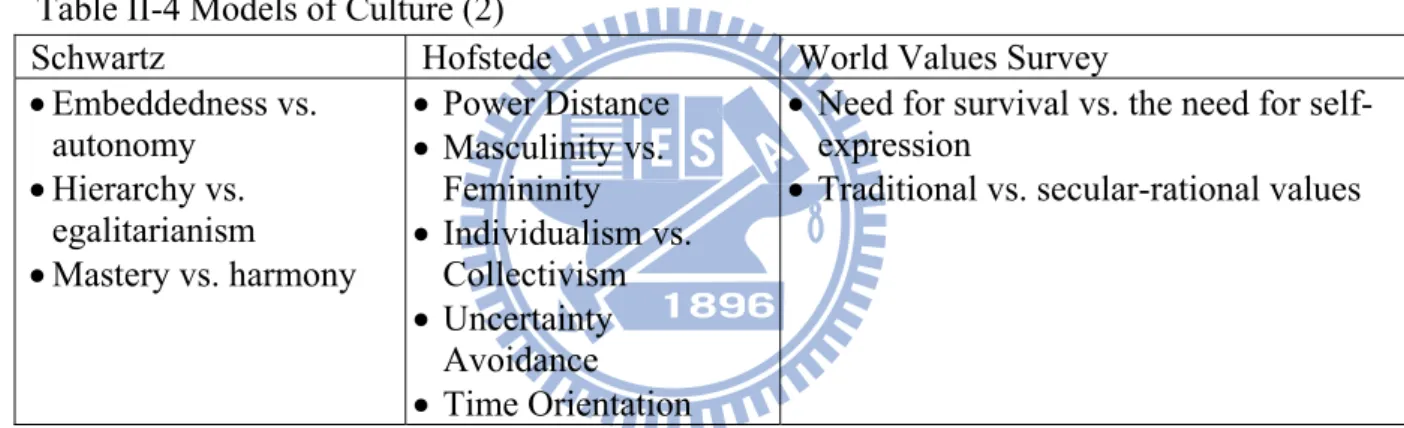
individual-collective dimensions, Trompenaar’s dimensions have little correlation with those of Schwartz, Hofstede, and the World Values Survey. The dimensions provided by the latter three researchers overlaps in the area of individual-collective values, hierarchical values, and control-acceptance values. Schwartz’s model of cultural
13
which culture varied. These axes consisted of embeddedness versus autonomy, hierarchy versus egalitarianism, and mastery versus harmony. Embeddness vs. autonomy refers to the extent an individual is embedded in a group. Hierarchy vs. egalitarianism naturally deals with acceptance of differences based on status. Mastery vs. harmony concerns attitudes towards controlling one’s social and physical
environment. While not exactly matching Hofstede’s results, Schwartz’s showed some consistency with Hofstede’s values of individualism-collectivism, power-distance, and masculinity-femininity, respectively. Similarly, Hofstede found that the WVS
dimensions well-being versus survival correlated strongly with his own dimensions individualism and masculinity, and that the WVS dimension secular-rational versus traditional authority correlated negatively with power distance. This overlap between these three models of culture suggests confirmation of the accuracy of these
dimensions.
Table II-4 Models of Culture (2)
Schwartz Hofstede World Values Survey
Embeddedness vs. autonomy Hierarchy vs. egalitarianism Mastery vs. harmony Power Distance Masculinity vs. Femininity Individualism vs. Collectivism Uncertainty Avoidance Time Orientation
Need for survival vs. the need for self-expression
Traditional vs. secular-rational values
Given the similarity of these three cultural models, it is worth questioning why Hostede’s work is so prevalent in academic literature compared to others. Hofstede’s study was conducted among IBM employees in 49 countries in 1967 and 1973.
Hofstede describes five main values by which cultures can be distinguished. These are power-distance, masculinity-femininity, individual-collective, uncertainty avoidance, and long-term orientation. Power-distance refers to the degree to which people with less power in a group accept the authority of more powerful members. Masculinity-femininity describes the degree to which the masculine values in a culture, such as assertiveness, independence, and ambitiousness, differ from feminine values, such as caring and cooperation. Individual-collective values describe the extent to which individuals identify themselves as a group member or as an individual. Uncertainty avoidance refers to the need for an individual to have certainty, for example, provided by rules or tradition. Additionally, Hofstede describes long term orientation, identified
in cooperation with Bond (Hofstede and Bond, 1998), which describes certain Confucian-oriented values related to long and short term views of the world such as persistence and the need to save face.
A number of criticisms of Hofstede’s methodology have been made, which perhaps have implications for other cultural dimension models as well. One point raised by McSweeney (2002) was that the idea of national culture being shared by all of a country’s citizens ignores the fact that there exist a number of distinctive cultures within one nation. The existence of national subcultures, McSweeney argues, makes it hard to say that there exists for each country a single shared culture that makes that country’s culture unique. In fact, cultures exist on every level of social interaction, below and above the level of a nation, and distinctive cultures within a nation help to make up the culture on a national level. For example, the cowboy culture of the American West, while clearly distinct from suburban culture in America’s cities, is still an important part of American national culture. In addition, it could be said that there exists a North American regional culture, comprising the cultures of the USA and Canada. To study the impact of culture on usability, therefore, researchers need to consider the possibility that nationality may not be the most reliable indicator of cultural background.
In addition, many of McSweeney’s criticisms concern Hofstede’s methodology. Hofstede’s conclusions were based on a survey of IBM employees, who do not necessarily represent the values of the country they represent. In fact, in a developing country, the values of educated, well-off IBM employees may even be that of a minority for that country. McSweeney also notes that the sample size of the survey varies between countries. For example, a country such as Singapore with a smaller local office provided much fewer results per head of population, compared to the USA with its large number of IBM offices.
Lastly, McSweeney argues that Hofstede’s survey of company employees may be overly influenced by the working context it was conducted in. Alternative values, such as family or societal values may have been ignored. In fact, Lee et al. suggest that instead of considering differences in work-related attitudes, or other attitudes such as those concerned with family or society, usability research should focus on product related attitudes. They raise the point that cultural dimensions which measure values related to human-to-human interaction may not be relevant to interaction that is, in fact,
15
human-to-interface. To support their argument they identified ten cultural dimensions which vary between machine types as well as between cultures.
Unfortunately, later, similar research by Schwartz on cultural dimensions may have repeated the methodological errors made by Hofstede. Although Schwartz’s model of culture was based on more recent research over a larger sample than
Hofstede’s, with research conducted students in 67 countries in the period 1988-2000, Schwartz restricted his survey to school teachers and college, thus making it hard to say his surveys represented a cross-section of society and contexts.
On the other hand, research conducted by the World Values Society (WVS) (http://www.worldvaluessurvey.org/) shows greater methodological rigor than both Schwartz’s and Hofstede’s studies. The WVS conducted research into global values in five waves of surveys between 1981 and 2008, with the latest survey covering 64 countries. Participants were chosen randomly, once quotas were decided, based on the demographic features of that country. National sub-cultures were also investigated. The greater spread of WVS survey suggests that the cultural values identified by the WVS more accurately represent the culture of the country surveyed than those identified by Hofstede. The World Values Survey identified two axes of variance in global values – the need for survival vs. the need for self-expression, and traditional vs. secular-rational values. Societies with low incomes cannot take survival for granted and values in such societies are based on the need for economic and physical security. On the other hand, countries with sufficient income can afford to focus on other needs such as personal well-being, an improved quality of life, and the need for
self-expression. Traditional values are strongly influenced by religion and include such values as the importance of traditional family values and national pride. Secular-rational values are based less on traditional religions and attitudes, and are more liberal on social issues such as divorce or euthanasia.
Given the differences in methodology between Hofstede, Schwartz, and the WVS, it is interesting to note that their results support each other. Schwartz’s (2004) research into regional groupings of cultural values shows that regions identified by the WVS, Hofstede and Schwartz’s own research are similar, and that the values identified by each study, while differing in nature, show some correlation with each other. This point supports the reliability of cultural dimension models such as those developed by Hofstede, Schwartz, and the WVS. Research conducted by the WVS showed the greatest methodological accuracy, yet arrived at similar conclusions to Hofstede’s.
Therefore, it appears reasonable to select cultural dimensions developed by WVS for study into the effect of culture on usability. In addition, the widespread use of
Hofstede’s model of culture allows comparison between studies, thus providing two models of culture for use in this study.
2.3
Culturability
Given the evidence indicating the effect culture has on usability it is surprising that there are so few models which incorporate culture’s role, such as the MUSIC model (Bevan, 1992). Two recent models make an attempt to do this. The first, Ford and Kotzé’s Conceptual Model of Usability (Ford and Kotzé, 2005), is an attempt to comprehensively model usability, incorporating many variables which influence usability, as well as the culture variable. The second, Clemmensen’s Cultural Model Theory of Usability (CM-U) focuses purely on culturability, focusing only on the interrelationships between culture, a user or evaluator’s understanding of usability, the product itself and its use, and perceptions of usability (Clemmensen, 2009).
Ford and Kotzé (2005) describe a conceptual model of usability made up of user, task, and environmental factors. In this model culture plays two roles. It is a factor influencing the characteristics of users, which in turn affect product usability. In addition, culture is a factor affecting product design, which in turn affects usability and the technical environment.
Table II-5 Overview of Ford and Kotzé’s Conceptual Model of Usability
Conceptual model of usability
User context User characteristics User knowledge Task context Task characteristics Task execution Environment context
Organization environment
Technical environment
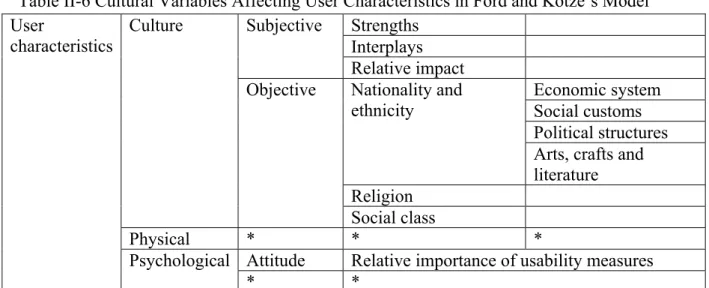
Physical environment User characteristics can be further divided into cultural, physical, and psychological factors.
17
Table II-6 Cultural Variables Affecting User Characteristics in Ford and Kotzé’s Model User
characteristics Culture Subjective Strengths Interplays Relative impact
Objective Nationality and ethnicity
Economic system Social customs Political structures Arts, crafts and literature
Religion Social class
Physical * * *
Psychological Attitude Relative importance of usability measures * *
* Additional items omitted for clarity
The technical environment can be further divided into hardware and software, the usability of which is affected by a number of cultural factors.
Table II-7 Cultural Variables Affecting the Technical Environment in Ford and Kotzé’s model
Technical
environment * * * Hardware Hardware Software Usability Partial representation of cultural platform dimensions
Nature of cultural dimensions Principles and heuristics Relative impact of components * Additional items omitted for clarity
While Ford and Kotzé’s Conceptual Model of Usability extensively models culture and usability, it omits usability attributes such as efficiency, effectiveness, and user satisfaction, which are incorporated in models such as the MUSIC model. If these factors are mentioned at all by Ford and Kotzé’s model, it is by implication, when the model indicates that the relative importance of usability measures is an attitudinal variable, influenced by a user’s individual, psychological user characteristics.
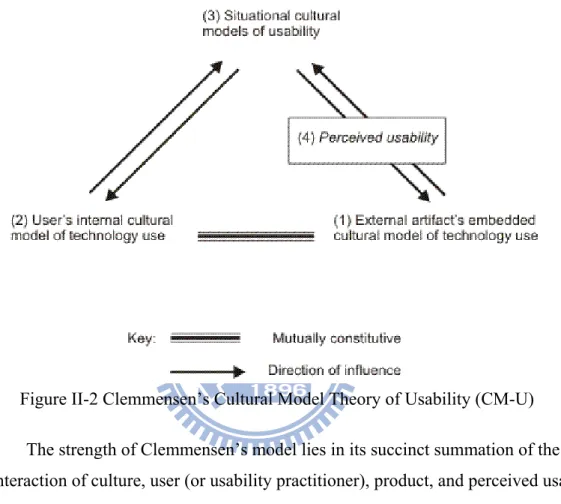
More recently, Clemmensen (2009) developed a theory which connects culture with usability, called the Cultural Model Theory of Usability (CM-U). This model shows how perceptions of usability are derived from the interaction between culture and the user, artifact (product), and understanding of usability. For Clemmensen the product has fixed functionality based on its design, which may be influenced by cultural context (1 – see diagram). The user’s interaction with the product is based on the user’s set of goals, actions, and emotions, which are also influenced by culture.
The user’s goals, actions, and emotions correspond to the effectiveness, efficiency, and satisfaction achieved when using the product (2). Clemmensen’s model also shows that culture also influences how usability is understood, not just by the user, but also the HCI practitioner (3). Based on an understanding of usability and the product’s actual usability, perceptions of usability are derived (4).
Figure II-2 Clemmensen’s Cultural Model Theory of Usability (CM-U) The strength of Clemmensen’s model lies in its succinct summation of the interaction of culture, user (or usability practitioner), product, and perceived usability. The question it raises is exactly how one factor affects another. Consequently, this study follows on from Clemmensen’s model and attempts to identify more exactly the nature of the influence of culture on usability, in terms of both the relative values of usability attributes that determine our understanding of usability, and also absolute values of objective and subjective measures of usability attributes.
2.4
Approaches
There are multiple approaches to understanding the effect of culture on usability. As mentioned, Fitzgerald (2004), in an overview of research on culture and website usability, identified approaches which may be equally suitable for studying
culturability generally. Among these approaches, Fitzgerald described cultural
19
behavior approach looks at how users from different cultures may have different uses for a product, for example, Chau et al. (Chau, et al., 2002). Cultural dimension studies examine the usability of a product based on the one of the many available models of culture described earlier, for example, Choi et al. (2005), and Marcus & Gould, (2000) of which Hofstede’s culture model predominates (Clemmensen and Roese, 2010). Studies on the interaction between culture and product design look at the cultural markers, sometimes called attractors, of a product. These are product features that signify or represent a culture, such as flags, or colors (Barber and Badre, 1998). In fact, it should be noted that the cultural dimension and cultural marker approaches can easily be combined. For example, Ford and Gelderblom (2003) include both the cultural dimensions of the user and culture-specific design features as part of their research. Models of culturability such as that of Ford and Kotzé (2005) or
Clemmensen (2009) attempt to the incorporate the results of these four approaches, as must this dissertation.
III. Proposed Model of Culturability
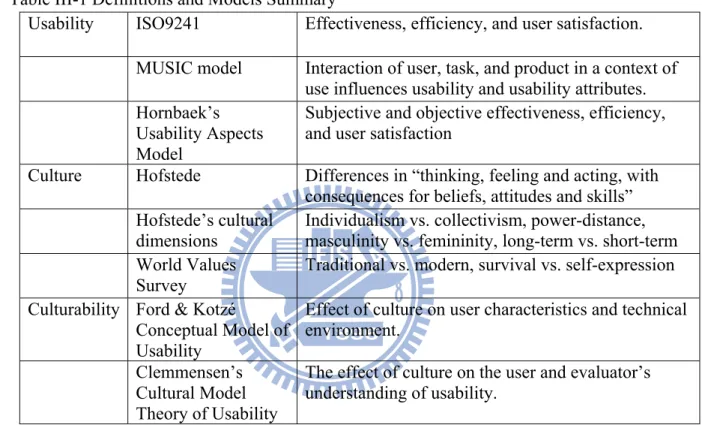
In this dissertation several definitions and models of usability, culture, and culturability are adopted and used in a proposed model of culturability, as shown in the table below.
Table III-1 Definitions and Models Summary
Usability ISO9241 Effectiveness, efficiency, and user satisfaction. MUSIC model Interaction of user, task, and product in a context of
use influences usability and usability attributes. Hornbaek’s
Usability Aspects Model
Subjective and objective effectiveness, efficiency, and user satisfaction
Culture Hofstede Differences in “thinking, feeling and acting, with consequences for beliefs, attitudes and skills”
Hofstede’s cultural
dimensions
Individualism vs. collectivism, power-distance, masculinity vs. femininity, long-term vs. short-term
World Values
Survey
Traditional vs. modern, survival vs. self-expression Culturability Ford & Kotzé
Conceptual Model of Usability
Effect of culture on user characteristics and technical environment.
Clemmensen’s Cultural Model
Theory of Usability
The effect of culture on the user and evaluator’s understanding of usability.
The proposed model of culturability is based on a synthesis of usability models and definitions. First, a model of usability is derived from ISO9241, the MUSIC model and Hornbaek’s Usability Aspects Model. Usability variables described in the MUSIC model – context, user, product, and task (A) interact to provide a level of usability. A product’s usability is expressed in terms of usability attributes identified in ISO9241 (C). Subjective and objective aspects of these attributes are described in Hornbaek’s Usability Aspects Model (B), as are possible ways to measure these attributes.
21
Figure III-1 Usability Factors
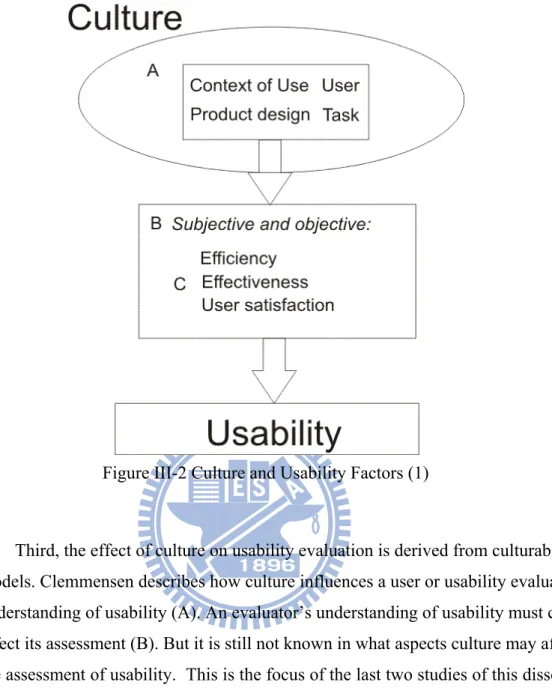
Second, the effect of culture on usability factors is derived from models of culturability. The effect of culture on MUSIC usability variables is described in both Ford and Kotzé and Clemmensen’s culturability models. Ford and Kotzé’s model shows culture affects user and product design and Clemmensen describes how culture affects task. Culture clearly must affect context of use. But it is still not known how culture affects usability attributes (B) and (C). This is the focus of the first two studies of this dissertation.
Figure III-2 Culture and Usability Factors (1)
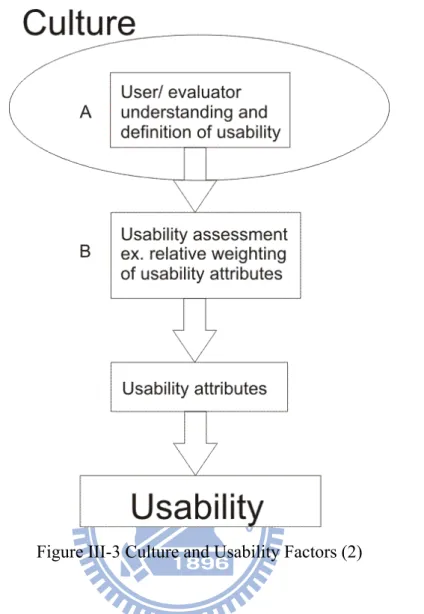
Third, the effect of culture on usability evaluation is derived from culturability models. Clemmensen describes how culture influences a user or usability evaluator’s understanding of usability (A). An evaluator’s understanding of usability must clearly affect its assessment (B). But it is still not known in what aspects culture may affect the assessment of usability. This is the focus of the last two studies of this dissertation.
23
Figure III-3 Culture and Usability Factors (2)
Finally, by adding aspects of Clemmensen’s model together with Ford and Kotzé’s, we can see how both understandings of usability (A) and contextual variables (B) are affected by culture. To confirm this proposed model of culturability, the effect of culture on usability assessment (C) and usability attributes (D) needs to be
Figure III-4 Culture and Usability Factors (3)
This dissertation proposes a model of culturability which describes the influence of culture on understanding of usability (A), context, user, product design, and task (B), usability assessment (C), and usability attributes (D).
25
Figure III-5 Culture and Usability Factors (4)
IV. Methodology
To confirm the proposed model and identify the effect of culture on usability attributes and assessment, methodological issues must be discussed.
4.1
Cultures
In determining the effect of culture and cultural dimensions on usability and usability measurement the choice of cultures to be studied is an important one.
identified a number of studies which focus on English speakers, especially the U.S., and with Asia becoming a greater focus, especially the Chinese speaking region. The focus on the China region and the U.S. has the advantage of allowing for a comparison of two very different cultures. On the other hand, limiting the number of cultures investigated to two main cultural groups does not allow for the effect of variation on a cultural dimension to be examined with any statistical reliability. In addition, it omits investigation into culturability in alternative cultural regions.
4.2
Products
The choice of product to be studied is also likely to have some impact on results. Culturability studies generally examine three main kinds of products – websites, software, and consumer items, particularly consumer electronics. Research by Lee et al. (2008) indicates the selection of product for study has implications for the results of any study into the effect of cultural dimensions on usability. Their study into the influence of culture on attitudes to mobile phones, MP3 players, refrigerators, and LCD TVs, indicates that culturally specific attitudes vary between products. For example, MP3 players and mobile phones both elicited an individualistic response from users, while refrigerators and TVs elicited collective values, as they were
generally shared by family members. The level of difference in values varied between countries, so an MP3 player elicited individualistic responses from all countries surveyed, but refrigerators and TVs elicited highly collective responses particularly from Russians, compared to other countries. Based on their research, care is therefore required before concluding a particular cultural dimension is responsible for a result, without considering the values elicited by the product examined in the study.
4.3
Measurement Methods
As mentioned, approaches to culturability use a variety of methods to measure usability and its attributes, making results inconsistent and the effect of culture on usability unclear. The cultural behavior approach provides information on an
important factor affecting usability, product use, but not usability itself. In the cultural marker approach Shen et al. (Shen, et al., 2006) and Choi et al. (2005) examined user preference to identify usability, and ignored other usability measurements.
Alternatively, Ford and Kotzé (2005) measured speed, accuracy, and user satisfaction to determine the effect of cultural markers on usability, and left user perceptions of
27
efficiency and effectiveness unmeasured. On the other hand, Evers and Day (1997), when examining the effect of culture on software usability, looked at subjective measures of usability such as perceptions of usefulness and ease of use, and user satisfaction, but did not record objective measures of usability, such as speed or accuracy. However, without information on how cultural dimensions affect all
usability attributes, objective and subjective, we cannot understand how usability as a whole is affected, given the lack of correlation between usability measures.
To compare usability across cultures evaluation methods typically include questionnaires and usability tests (Clemmensen and Roese, 2010). However, both methods vary in their application. Hornbaek identified a number of commonly used measures of effectiveness in usability testing such as success counts, accuracy,
completeness, or quality. Efficiency is commonly measured by time required, and also measures of effort, such as clicks required, or effort spent learning the system
(Hornbæk, 2006). Similarly, subjective aspects of usability are measured in a variety of ways. Many researchers develop their own survey instrument, focusing on wide range of aspects of user satisfaction, such as fun, attractiveness, etc. The lack of consistency may partly be explained by the wide range of usability questionnaires developed for specific use. Questionnaires may be product specific, focusing on websites (WAMMI: Website Analysis and Measurement Inventory), software (SUMI: Software Usability Measurement Inventory). Alternatively they may focus on usability attributes such as user satisfaction (QUIS: Questionnaire for User Interface
Satisfaction) or perceived effectiveness and efficiency (PUEU: Perceived Usefulness and Ease of Use). Only one standardized survey appears to be relevant to all product types, to cover all usability attributes, and this is the USE survey (Usefulness, Satisfaction, Ease of Use). More widespread use of this survey will allow the
comparison of results between studies, and support future research into culturability. Cross-cultural usability evaluation presents specific problems (Clemmensen, et al., 2009). There are a number of differences to be aware of when usability testing or interviewing Western or Eastern subjects, such as differences in tendency to talk aloud, and express surprise. To avoid such problems this study does not use the talking aloud approach to identify usability problems, and instead aims to record objective measures of efficiency and effectiveness, such as speed and number of errors. To identify subjective attitudes, the USE survey instrument will be used.
V. Culture and the Relative Importance of Usability Attributes,
Effectiveness, Efficiency, and User Satisfaction for New
Zealand, Philippine, Taiwanese, and U.S. Users of Cell Phones.
5.1
Introduction
Studies of usability across cultures (also termed cultural usability or culturability) in recent years have focused on a number of issues such as cultural differences,
globalization, localization, product design, product testing, and user-product
interaction (Clemmensen and Roese, 2010). In addition, the concept of usability itself may be worthy of consideration. Usability is socially constructed concept made up of attributes which may not be equally valued across cultures. It is possible that culture affects how usability is understood, thus adding an additional factor to our
understanding of culture’s effect on usability. To investigate this possibility, this study surveyed the attitudes of cell phone users from a variety of cultural groups to identify the differences in importance they placed on a number of usability attributes, and whether cultural values were a factor in these differences. Findings indicate significant in-country and between-country differences, and relationships between the importance of usability attributes and cultural dimensions.
Previous studies suggest that users’ valuation of usability attributes varies
between cultures. A study into the usability of software across cultures (Evers and Day, 1997) found Chinese users valued the effectiveness of the software more highly than its ease of use, while Indonesian users valued its ease of use more highly. Variations in the importance placed on effectiveness, efficiency and satisfaction are also reported by Vöhringer-Kuhnt. His study reports differences in how HCI practitioners rate the importance of concepts such as “minimal effort” or “reaching goals”, which represent usability attributes, effectiveness, efficiency and satisfaction. In his study he reports that Australians and South Africans place more importance on efficiency and satisfaction than do Americans and Europeans who value effectiveness more (Vöhringer-Kuhnt 2002). Most recently, Frandsen-Thorlacius et al. investigated between-country and in-country differences in the relative importance Chinese and
29
Danish users of email and word-processing software placed on usability attributes. For example, they found that Danes preferred efficiency over satisfaction and effectiveness over ease of use. On the other hand, Chinese users preferred ease of use over
effectiveness. They also found between-country differences with Danish respondents showing a higher preference for effectiveness and efficiency than Chinese did, and Chinese respondents preferring satisfaction more than Danes did (Frandsen-Thorlacius, et al., 2009).
Knowledge of how culture affects users’ preference for usability attributes is of both practical and theoretical importance. By identifying attributes that are valued in a target market, resources can be more optimally utilized to focus on product qualities that customers value. In addition, usability evaluators can make more accurate measurements of usability, thus improving a producer's competitive position. Understanding the effect of culture on the relative importance of usability attributes may also help to support and inform the few models of culturability that exist. Ford and Kotzé’s Conceptual Model of Usability is perhaps the only usability model that incorporates the weighting of usability attributes, while not ascribing this to culture (Ford and Kotzé, 2005). Clemmensen’s Cultural Model of Usability, while not specifically mentioning the importance different cultures place on usability attributes, describes how a culturally specific understanding of usability influences perceptions of usability (Clemmensen, 2009).
5.2
Definitions and Models
Usability has been defined in a number of ways, mostly as a construct based on a variety of attributes. Usability attributes suggested by Nielsen include, among others, learnability, efficiency, memorability, errors, and satisfaction (Nielsen), while Shackel proposed effectiveness, learnability, flexibility, ease of use, and user attitude (Shackel, 1991). Attractiveness has also been identified as an additional attribute (Kurosu and Kashimura, 1995, Tractinsky, 1997). By looking at how users themselves defined usability, McGee et al. identified a number of attributes including consistency, efficiency, ease of use, effectiveness, controllability, usefulness, expectability, and naturalness (McGee, et al., 2004).
It is also possible that different cultures see usability as comprising different sets of usability attributes. In a comparison of user attitudes towards computer applications regularly used by survey participants from China, Denmark, and India, Hertzum et al.
discovered a variance between cultures, which, the authors argue, is linked to a difference in understanding of usability (Hertzum, et al., 2007). Danish and Indian users made distinctions between applications based on concepts such as easy-to-use, intuitive, and liked. Study of Chinese users elicited a range of concepts related to security, task types, training, and system issues.
However, to compare attitudes to specific usability attributes across cultures, a standard set of attributes is required. The International Organization for
Standardization (ISO) has provided a number of definitions of usability depending on the purpose of the industry standard. For example, ISO9126-1 describes usability as, “the capability of the software product to be understood, learned, used and attractive to the user, when used under specified conditions” (ISO, 2001). ISO9126 is a software quality standard which incorporates a definition of usability. It defines usability in order to define software quality, and, so, is not intended to stand alone, or to describe products other than software. On the other hand, ISO9241 defined usability as “the extent to which a product can be used by specified users to achieve specified goals with efficiency, effectiveness and user satisfaction in a specified context of use” (Bevan, 1992, ISO, 1998). Attributes of usability implied within this definition included effectiveness, efficiency, and satisfaction, all of which were further defined in ISO9241 as follows:
Effectiveness: the accuracy and completeness with which users achieve specified goals.
Efficiency: the resources expended in relation to the accuracy and completeness with which users achieve goals.
Satisfaction: the comfort and acceptability of use.
ISO9241 is an ergonomics standard, widely accepted in the HCI
(Human-Computer Interaction) community (Frandsen-Thorlacius, et al., 2009), which provides a definition of usability aimed at user (and business) needs. The definition is both simple and comprehensive in its incorporation of subjective and objective usability by considering both user satisfaction and product performance, and its description of performance in terms of process (efficiency) and outcomes (effectiveness). For these reasons this study looks at the interaction between usability and culture in terms of ISO9241 usability attributes effectiveness, efficiency, and user satisfaction.
31
In studies of culturability, culture is commonly separated into subjective and objective culture (Ford and Kotzé, 2005, Hoft, 1996). The latter includes expressions of culture such as institutions, language, and lifestyle, while subjective culture includes internal, psychological manifestations of culture, such as attitudes held in common with others. It is this part of culture that Hofstede is describing when he describes culture as the “collective programming of the mind which distinguishes members of one group from people from another” (Hofstede, 1984). Although objective culture may influence usability as part of the context of use of a product, subjective culture may be more of a factor in attitudes towards usability, which is the focus of this study.
Cultural research so far has identified a large number of dimensions intended to describe subjective culture (Lee, et al., 2008). However, in research on cultural usability, Hofstede’s model is dominant (Clemmensen and Roese, 2010). Hofstede describes five main values by which cultures can be distinguished. These are power distance, masculinity/femininity, individual/collective, uncertainty avoidance, and long term orientation. Power distance refers to the degree to which people with less power in a group accept the authority of more powerful members.
Masculinity/femininity describes the degree to which the masculine values in a culture, such as assertiveness, independence, and ambitiousness, differ from feminine values, such as caring and cooperation. Individual/collective values describe the extent to which individuals identify themselves as a group member or as an individual. Uncertainty avoidance refers to the need for an individual to have certainty, for example, provided by rules or tradition. Additionally, Hofstede describes long term orientation (identified in cooperation with Bond (Hofstede and Bond, 1998)), which describes certain Confucian-oriented values related to long and short term views of the world such as persistence and the need to save face.
However, a number of criticisms of Hofstede’s methodology have been made. McSweeney cited weaknesses in Hofstede’s methodology in the following areas.
1. The research ignores subcultures such as different ethnic groups, or regional cultures.
2. It focuses on employees of a single company, who do not necessarily represent the values of the country they represent.
3. The sample size relative to population varies between countries.