行政院客家委員會獎助客家學術研究計畫
客語歇後語之語意類型
A taxonomic framework for
Hakka two-part allegorical sayings
研究計畫主持人:賴惠玲
所屬單位:國立政治大學英國語文學系
中華民國九十四年十二月十五日
A taxonomic framework for
Hakka two-part allegorical sayings
∗賴惠玲 國立政治大學
中文摘要
語言常藉助語言符號記載日常生活中的經驗及探討生命的體驗,這些反映 文化背景及觀點的語言形式即形成所謂的諺語或歇後語。歇後語的語言形 式是由前後兩個部分組成的口語,前後的關係是引注關係,表述事物性 質、狀態和人物行為心理,風格則多為幽默、風趣、功能也常含教育意味。 從語言層次上而言,歇後語雖非常有特色,仍可涵蓋在廣義的成語或慣用 語的範圍內,因為歇後語具有約定俗成性、固定性、引喻性、格言性、非 正式性及情感性等六種特性。西方認知語意派的學者指出大多數的成語或 慣用語均有認知基礎,可透過認知語意機制產生。如格瑞特斯(1995)即提 出同構性及語意透明度兩個面向來分析荷蘭文或英文的成語。 奠基在西方認知語意學派的理論基礎上,本計畫試圖為客語歇後語建立分 類架構,因為歇後語之獨特性,本計畫在大幅修正格瑞特斯的架構後,提 出歇後語的分類除了概念機制之外,還須考慮聲音機制,因而將歇後語分 成六大類: 聲音機制 (第一類) 部分同構 同構性 概念機制 (第二類) 聲音機制 (第三類) 完全同構 概念機制 (第四類) 聲音機制 (第五類)∗ The study is partly based on a research project granted by National Science Council in Taiwan, Hakka
two-part allegorical sayings: perspectives from metaphor and metonymy (NSC 93-2411-H-004-039; NSC 94-2411-H-004-007) and by Council for Hakka Affairs, Executive Yuan (行政院客家委員會). An
earlier version was presented at 9th International Cognitive Linguistics Conference in Seoul. Special thanks are extended to Cliff Goddard, Inger Moen, and Mei-jun Liu for their valuable comments.
非同構性 概念機制 (第六類) 同時,本計畫提出歇後語大致反映雷克夫及特耐提出的生命物種的大鏈; 即語言形式常引用動物、植物或其他物件的特質來暗喻人的行為、特質或 人格。然而,屬於客家文化特有的知識體系也必須同時啟動才能了解客語 歇後語的語言全貌。 關鍵詞: 客語歇後語、完全同構、部分同構、非同構性、聲音機制、概念機制、 生命物種大鍊、知識體系
Abstract
Examining two-part allegorical sayings—a unique genre pervasively found in many Asian languages—this study has two purposes: establishing a taxonomic framework to appropriately categorize this discourse form, and explicating the knowledge schemas involved for successful construal of this genre. While displaying most of the idiomatic characteristics observed in English or Dutch idioms, two-part allegorical sayings are different such that they cannot be succinctly classified by the conceptual apparatus proposed by Geeraerts (1995, 2003). The criteria of classification require not only form-meaning mappings but also conceptual and phonological associations. Six types are hence identified: partially isomorphic with sound associations, partially isomorphic with conceptual associations, totally isomorphic with sound associations, totally isomorphic with conceptual associations, non-isomorphic with sound associations, and non-isomorphic with conceptual associations. Furthermore, although this discourse form demonstrates the prevalent Great Chain of Being maintained by Lakoff and Turner (1989), specific local folk knowledge schemas are claimed to be activated both for the linguistic choice of surface forms and for the inferred interpretations.
Key words: two-part allegorical sayings, total isomorphism, partial isomorphism, sound associations, conceptual associations, the Great Chain of Being, folk knowledge schemas
Contrary to the traditional view of idioms as unanalyzable, the cognitive view of idioms holds that most idiomatic expressions are analyzable with their meanings motivated by conceptual mechanisms (Gibbs 1995, Kövecses and Szabó 1996, Nunberg et al. 1994, Geeraerts 1995, 2003, among others). Lakoff (1993), and Lakoff and Turner (1989) further advance that cognitive mechanisms such as metaphor, metonymy and the interactions of the two are highly involved in the interpretations of poems, fables, allegories, and proverbs. Several cognitive and psychological
experiments conducted have also evidenced not only that idioms are compositional but also that conceptual links between idiomatic expressions and their figurative interpretations can be activated by speakers (Gibbs 1990, 1995). In fact, Geeraerts (1995, 2003) proposes a conceptual apparatus that examines idioms from both the paradigmatic dimension and the syntagmatic dimension. Based on his model of the two criteria—motivation and isomorphism—idioms can be classified into four types: isomorphic and motivated (e.g. spill the beans), isomorphic and nonmotivated (e.g. face the music), nonisomorphic and motivated (e.g. wring one’s hands) and
nonisomorphic and nonmotivated (e.g. shoot the breeze).1
Nevertheless, such a succinct four-way classification of idioms in English or
Dutch, although partially covering some instances of two-part allegorical sayings, cannot appropriately categorize most of them. A quite pervasive colloquial form in Mandarin Chinese, Taiwanese Southern Min, and Hakka, among other Asian
languages, a two-part allegorical saying contains two parts—one portraying an image of an object, an event or a situation and the other indicating the intended meaning derived from the first part.2 To depict a better picture, let us see an example from
Hakka first:
(1) 火燒猪頭─熟面(熟面)。
fo31 seu24 zu24-teu11 --- suk5-mian55 (suk5-mian55)
fire burn pig’s head cooked face (looking familiar) ‘burning a pig’s head—looking familiar’
Example (1) contains a typical two-part allegorical saying found in Hakka or Taiwanese Southern Min. The first part of the expression indicates an event—burning a pig’s head. After being burned by fire, the face is cooked. The second part hence indicates the result of the event—cooked face. The most intriguing feature of such an expression lies in the derivation of the intended meaning. Like that of proverbs discussed in Lakoff and Turner (1989), the interpretation of such a discourse form relies heavily on a speaker’s activation of his conceptual schemas of the cultural
2 The term “two-part allegorical sayings” (called xie1-hou4-yu3 in Mandarin Chinese) is adopted from
Wang (1991). According to Cliff Goddard, Malay also has this kind of genre where there are two fixed expressions involved to obtain intended idiomatic meanings, while Inger Moen remarks that there is no such a discourse form in Norwegian. Investigation into cross-linguistic comparisons will be left for future endeavor, however.
models acquired through his experience and culture and deeply rooted in his
unconscious knowledge. Specifically, the first part—the source domain—captures a vivid concrete image and the second—the target domain—identifies the intended interpretation by identifying the most salient part of a head—the face—through
metonymy. To draw the intended meaning, a speaker needs to employ another strategy, the association of two homophones in Hakka—‘cooked face’ [suk5 mian55] and
‘looking familiar’ [suk5 mian55]. Such a sound association presents a distinctive
feature of two-part allegorical sayings. In fact, this strategy often brings forth
pragmatic-discourse functions such as humor, teasing or sarcasm, or exaggeration.3
Although the example above typifies a case of two-part allegorical sayings, it represents only one of the various variations of this unique genre. In general, a two-part allegorical saying contains two formulaic expressions, carries opaque figurative semantics that needs to be derived through conceptual mechanisms, and is often associated with evaluative connotations; therefore, it can in a sense be deemed as a genre of idioms (cf. Nunberg et al. 1994, Gibbs 1995, Kövecses and Szabó 1996). However, because their linguistic features are so distinctive that they cannot neatly fit into typical categories of idioms, an appropriate categorization of such a genre is an issue worth investigating. Moreover, since the emergence of such a genre is closely
3 Lakoff and Turner (1989) point out exhortation or description as two major functions of proverbs.
While both readings are possible with a proverb, whether exhortation can be induced from a two-part allegorical saying is in need of further exploration.
connected with the folk knowledge rooted in the culture, an examination of the
cultural elements is also a crucial issue for the understanding of such a linguistic form. This study hence aims first to structure a taxonomic framework for this special genre of idioms. Following introduction, section 2 presents Geeraerts’ (1995, 2003) model of classification of idioms. Section 3 then proposes the taxonomic framework for the classification of two-part allegorical sayings, highlighting specific features adherent to this genre. Then, section 4 explicates the major elements in the cultural models that are employed to portray two-part allegorical sayings. Finally, section 5 concludes the paper and points out future directions for interpretations of such a genre.
2. Geeraerts’ (1995, 2003) model of idioms
In classifying kinds of figurative specialization in idioms, Geeraert (1995, 2003) proposes two criteria—isomorphism and motivation—to examine idioms from both paradigmatic and syntagmatic dimensions. Isomorphism refers to syntagmatic transparency whereby there is a correlative correspondence between the syntactic construction and its semantic structure. Motivation, on the other hand, is defined as paradigmatic transparency in which the semantic extension that relates the original meaning of an idiom to its idiomatic meaning is observed. Based on this model, four types of idioms are given in Geeraerts (1995, 2003), using Dutch examples:
to take the cow by the horns >
‘to take the bull by the horns, to grasp the nettle’ (3) met spek schieten
to shoot with bacon > ‘to tell a tall story, to boast’
(4) met de handen in het haar zitten to sit with one’s hands in one’s hair >
‘to be at one’s wit’s end, to be in trouble’ (5) als puntje bij paaltje komt
when point reaches pole >
‘when it comes to the crunch, when all is said and done’
Example in (2) is isomorphic and motivated with the cow metaphorically mapping to the whole problem and the horns metaphorically indicating the most problematic situation. Example in (3) is isomorphic—the telling corresponding to spek and the tall tales corresponding to schieten. However, it is not motivated since it is opaque why shooting with bacon should come to denote boasting. Example (4) is nevertheless metonymically motivated since it is easy to come up with an image about what a person could do when handling a difficult problem. Yet, it is not isomorphic due to lack of direct mapping between the literal meaning and the idiomatic one. Finally, example (5) is neither isomorphic nor motivated: first, no one-to-one correspondence can be detected between the syntactic structure and the semantic structure; second, it is unclear why a point reaching a pole is related to becoming serious.
English idioms as maintained by Geeraerts. However, when it comes to two-part allegorical sayings, the model requires modification. For one thing, if we stick to Geeraerts’ criteria for the moment, several observations can be noted. Most conspicuously, whereas all interpretations of two-part allegorical sayings are motivated from the literal meaning to the intended interpretation, only a few are isomorphic. Furthermore, some cases require not only more than one layer of derivations but also intricate interactions of metaphor and metonymy in order to derive the intended meanings. Others, although isomorphic, need to activate both semantic and phonological processes to get the associated meanings. Still others are not isomorphic but strongly motivated with the activation of both phonological and semantic mechanisms. For another, two-part allegorical sayings often deeply involve diversified local practices heavily embedded in a particular cultural model. Such a complex apparatus hence deserves a finer-grained examination. In the next section, a taxonomic framework is to be established to holistically structure such a unique genre.
3. A taxonomic framework for two-part allegorical sayings
Total data of approximately1300 items from Hakka are examined forclassification.4 Out of the data, some of them are isomorphic—partially or
totally—whereas most of them are non-isomorphic.5 All of the two-part allegorical
sayings, however, are motivated either through activation of various cognitive mechanisms and the interaction of them or through activation of phonological apparatus resulting in frame shifts in Barcelona’s (2003) sense.6 Hence, cross
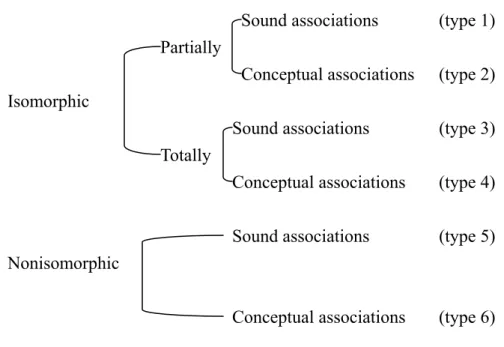
classification of two-part allegorical sayings will give us the following types:
Sound associations (type 1) Partially
Conceptual associations (type 2) Isomorphic
Sound associations (type 3) Totally
Conceptual associations (type 4) Sound associations (type 5) Nonisomorphic
Conceptual associations (type 6) Figure 1: types of two-part allegorical sayings
The figure displays a holistic picture of types of two-part allegorical sayings. Six
taken from the following sources: Taiwan Suyan Yudian (Dictionary of Taiwanese Sayings), Taiwan
Zhihui Xiehouyu (Two-part Allegorical Sayings of Taiwanese Wisdom), Taiwan Xiehouyu Yudian
(Taiwan Two-part Allegorical Sayings Dictionary), and Xiehouyu Quweiji (Collections of Interesting Two-part Allegorical Sayings). Nevertheless, only Hakka examples will be utilized for illustration unless there is a need for cross reference. The Hakka data are taken from the following sources: Kejia
Shifu Hua (Hakka Master’s Proverbs), Kejiahua Yanyu Xiehouyu Xuanji (Collections of Hakka
Proverbs and Two-part Allegorical Sayings), Kejia Yanyu Shiswei (Selections of Hakka Proverbs and Sayings), Miaolixian Keyu Yanyu Miyu Ji (Collections of Miaoli Hakka Sayings and Riddles), and
Keyan Yibai Shou (One-hundred Hakka Proverbs and Sayings).
5 Out of the 1300 items in Hakka, 34% of them are isomorphic whereas 66% of them are
non-isomorphic. Out of the 790 items in Taiwanese Southern Min, 10% of them are isomorphic whereas 90% of them are non-isomorphic.
6 Investigation into the derivations of the intended interpretation of such a genre is a follow-up project
types are observed. Some of the data demonstrate partial mappings between their surface forms and their semantic structures whereas some of them illustrate total mappings. The meanings exhibited by both types are motivated either through sound associations (type one and type three) or through conceptual mechanisms (type two and type four). In addition to isomorphic cases, non-isomorphic examples can also be motivated either through sound associations (type five) or through conceptual
mechanisms (type six). In what follows, each of the six types will be illustrated with Hakka examples.7 Section 3.1 discusses those that are isomorphic and section 3.2
examines those that are non-isomorphic.
3.1 Isomorphic two-part allegorical sayings
About 34% of the Hakka data exhibit isomorphic, with a partial or total mapping between the expressions of the first part and those of the second part. Often a
source-in-target or a target-in-source metonymy is invoked to highlight the characters that carry more pertinent information. A close one-on-one linking is observed for cases of total mapping whereas only a partial component of the compounded phrase in
7 The data used in this study come from Hakka in Taiwan. According to the data documented by
Council for Hakka Affairs in Taiwan in year 2005, there are approximately 6,800,000 Hakka people in Taiwan, about 27% of the total population (www.hakkayahoo.com.tw). Phonological and morphological differences can be observed between various sub-dialects including Hailu Hakka, Sixian Northern Hakka, Sixian Southern Hakka, Dapu Hakka, and Zhaoan Hakka. Hanyu Pinyin romanization system is rendered for the data. The tone diacritics in the data follow the system used in Taiwan
Kejiahua Cidian (Hakka Dictionary of Taiwan). The number 5 is the highest, and 1 is the lowest. 55 is yinping (high level), 51 is qusheng (high falling), 24 is yangping (low rising), 31 is shangsheng (low
falling), 2 is yinru (low entering), and 5 is yangru (high entering). The following abbreviations are used for the grammatical functions: NEG, negation; NOM, nominalizer; PF, prefix; SF, suffix. The corresponding character versions of the examples are given in the appendix.
the target is mapped with the source for cases of partial mapping. Both sound associations and conceptual associations are observed in either partially isomorphic type or totally isomorphic type. Each of the four types is illustrated with examples below. First consider the following examples of type one, partially isomorphic with sound associations:8
(6) 春天个果園─有桃李(有道理)。
cun11-tien24 ge55 go31-ien11 -- yu11 to11 li11 (yu11-to55-li24) spring NOM orchard exist peach plum make sense
‘Orchards in spring—making sense’ (7) 爛風車─賺絞(賺搞)。
lan55 fung11-ca24 -- con55 gau31 (con55-gau31)
broken windmill earn twine earn (time to ) fool around ‘A broken windmill—with some spared time to fool around’
(8) 猪利頭傍酒─雙舌(雙蝕)。
zu11-li55-teu11 bong31 ziu31 -- sung11 sat5 (sung11 sat5) pig’s tongue go together wine two tongues double loss ‘(Eating) a pig’s tongue together with wine—double loss’
All the cases display partial isomorphism between the source and the target. In example (6), partial isomorphism between the source and the target is observed since on the surface only the orchard go31
-ien11 is mapped to full of peaches and plums
yu11to11 li11. The first component with the expression depicts a vivid image—an
orchard in spring where peaches and plums grow abundantly. Such an image, however,
does not correlate with the image projected by the second part without a very crucial apparatus—sound associations. In Hakka, full of peaches and plums [yu11 to11li11] is
pronounced closely to making sense [yu11-to55-li24]—with the same segmental
combinations but different tone patterns. Due to sound associations of the two near homophones, two independent frames are linked together. A frame adjustment from an orchard frame to a frame of human’s comment is called for, resulting in frame shift in Barcelona’s sense (2003).9 In example (7), lan55
fung11-ca24 ‘a broken windmill’ is mapped onto gau31 ‘strangled’. Sound associations are activated in this example as
well. The target expresses how a broken windmill can have its wheel constantly strangled. The expression [con55 gau31] ‘to have the wheels constantly twined’ is a
homophone of [con55 gau31] ‘to have some spared time to fool around’. Frame
adjustment is triggered between two unrelated frames—one having to do with a windmill and the other having to do with a person’s reaction to a certain
states-of-affair. In the same vein, example (8) delineates a partial mapping between zu11-li55-teu11 ‘pig’s tongue’ and sat5 ‘tongues’. The target expression sung11sat5 ‘two tongues’ refers to the pig’s tongue and that of the person who is eating the pig’s tongue. Such an expression is phonologically associated with the expression double loss due to the same pronunciation in this Hakka dialect—[sung11 sat5]. What is
9 Barcelona (2003: 86f) points out that frame overlap and frame blend are two types of frame
interaction. The former occurs when two cognitive frames are connected by a shared conceptual substructure whereas the latter occurs when two unrelated frames are mingled into one.
intriguing is that because of the sound association between sat5 ‘tongue’ and sat5
‘loss’, a pig’s tongue, which should be pronounced as [zu11 sat5], is never called that
way by pork dealers. To diverge from such negative imagery of loss in business, a euphemistic expression zu11
-li55-teu11, literally meaning ‘pig profit head’, is coined by them instead. The coinage of this expression with li55
‘profit’, completely antonymous of sat5 ‘loss’, hence serves as a symbolism of converging to positive imagery of
making a lot of profit by selling this particular part of a pig’s head.
Next, let’s turn to examples of type two, partially isomorphic with conceptual associations between the source and the target:10
(9) 著蓑衣救火─惹火上身。
cok5 sui11-yi11 giu55 fo31-- ngia24-fo31-song55-siin24 wear coir raincoat fight fire put fire onto body ‘Trying to fight a fire with a coir raincoat on—asking for trouble.’ (10) 老虎借猪─有借無還。
lo31- fu31 zia55 zu11—yu24 zia55 mo11 van11 PF-tiger borrow pig have borrow NEG return ‘Tigers borrowing pigs—never returning what are borrowed’ (11) 燈盞無油─費心。
den24-zan31 mo11 yu11 -- fi55- sim24 oil lamp NEG oil burn wick
‘An oil lamp without oil—requiring mental exertion’
(12) 石頭頂種菜─難生根。
sak5-teu11 dang31 zung55 coi55 -- nan11 sang24 gin24
stone-SF top grow vegetable hard grow root ‘Growing vegetables on the stone—hard to put down roots’
(13) 十二月甘蔗─兩頭甜。
siip5-ngi55-ngiet5 gam11-za55 -- liong31 teu11 tiam11 December sugar cane two ends sweet
‘Sugar cane stems in December—a person trying to please both sides’
In all the five examples, partial mappings between the surface form and the semantic structure of the target component are observed. However, unlike those of type 1 which trigger sound associations, these cases exercise conceptual mechanisms to derive the intended meanings. In example (9), there is a causal relationship between the first component and the second—putting fire on the body because of trying to fight a fire wearing a coir raincoat whose material is easily burned by fire. Partial isomorphism is shown by giu55
fo31 ‘fight a fire’ and ngia24-fo31-song55-siin24 ‘put fire on the body’. The intended meaning of this item is conceptually motivated. It is easy to imagine a situation in which a person who tries to fight a fire when wearing an easily-burned coir raincoat is asking for trouble for himself. A physical action of a person is employed to metaphorically comment on his behavior. Next, example (10) indicates partial isomorphism whereby zia55 ‘borrow’ occurs in both the source and the target.
In this case, an animal’s behavior is used to metaphorically evaluate a person’s behavior. Since a tiger is carnivorous and fierce by nature, there is no chance that a borrowed pig by a tiger will be returned. Hence, such a saying is used to remark on a
person who never returns what are borrowed.
In addition to humans and animals, plants, complex objects or natural objects are utilized in the source domain. In example (11), an attribute of an oil lamp is
portrayed—den24
-zan31mo11yu11 ‘an oil lamp without oil’. Since the wick of an oil lamp serves to suck up oil so that the lamp can burn, an oil lamp without oil will have to burn its own wick. A wick that is in the middle of a lamp is analogically compared to the heart of a person that is also located in the center of his body. Hence burning the wick can be conceptually projected onto an image of burning a person’s heart, which then leads to the intended meaning ‘requiring mental exertion’. Example (12) illustrates another causal relationship between the source and the target. In this case, the domain of plants is employed, sak5
-teu11dang31zung55coi55 ‘growing vegetables on the stone’. Folk knowledge tells us that it is highly unlikely for vegetables to grow roots when they are planted on the stone. Without deep roots, vegetables will not grow strong. Likewise, if a person finds hard to put down roots somewhere, he does not fit in; hence he does not feel the place to be home; nor does he have friendly
relationships between the people there. Finally, example (13) illustrates a case whereby the essential biological nature of a plant is engaged in the source domain: siip5-ngi55-ngiet5gam11-za55 ‘sugar cane in December’. Folk knowledge tells us that sugar cane is extraordinarily sweet in December when the stems are to be harvested.
Such an attribute is used to characterize a person who is not trustworthy since he tends to sweet talk both sides in order to please them.
Whereas the above examples involve only partial mapping between the surface form and the semantic structure, the following examples to be discussed demonstrate total isomorphism. Type 3 with total isomorphism and sound associations will be presented first:11
(14) 火燒猪頭─熟面(熟面)。
fo31 seu24 zu24-teu11 --- suk5 mian55 (suk-5mian55) fire burn pig’s head cooked face (looking familiar) ‘Burning a pig’s head—looking familiar’
(15) 麥管吹蕭仔─小氣(小氣)。
mak5-gon31 coi11 seu24-e31 -- seu31 hi55 (seu31- hi55) straw blow bamboo vertical flute-SF small air (stingy) ‘Playing a bamboo vertical flute with a straw—being stingy’
(16) 伯公透大氣─神氣(神氣)。
bak5-gung24 teu31 tai55 hi55 -- siin11-hi55 (siin11- hi55) God of Earth let out big breath divine atmosphere (very proud) ‘God of Earth letting out strong breath—being very proud’
All the three examples delineate a very clear mapping between the first component and the second. Example (14) activates whole-for-part metonymy from zu24
-teu11 ‘pig’s head’ to mian55 ‘face’ and cause-for-effect metonymy from fo31
seu24 ‘fire burn’ to suk5 ‘cooked’. In example (15), mak5
-gon31 ‘straw’ is to seu31 ‘small’ and
coi11seu24-e31 ‘blow a vertical bamboo flute’ is to hi55 ‘air’ metonymically. Similarly, in (16), bak5
-gung24 ‘God of Earth’ is to siin11 ‘divine’, and teu31tai55hi55 ‘let out big breath’ is to hi55 ‘atmosphere’ metonymically. All three examples illustrate frame
shifts due to sound associations of homophones. In example (14), the frame of cooking a pig’s head is adjusted to that of familiarity of humans—[suk5 mian55]
‘cooked face’ pronounced the same as [suk5-mian55] ‘looking familiar’. In example
(15), the frame of playing a vertical bamboo flute is shifted into the remark on a person’s excessive carefulness about his money: [seu31 hi55] ‘small air’ pronounced
the same as [seu-31hi55] ‘stingy’. Likewise, in example (16), the frame of God of Earth
is transposed into the evaluation of a person’s attitude—[siin11 hi55] ‘divine
atmosphere’ articulated the same as [siin-11 hi55] ‘being very proud’. In general, two
independently unrelated frames are being linked due to the activation of sound associations.
Still some examples, although displaying total mapping, trigger conceptual associations for the intended meaning. The following cases illustrate type four:12
(17) 燈草打結─心毋開。
den24-co31 da31-giet2 -- sim24 m11 koi24 rush knotted knot NEG untied
‘Knotted rushes—unhappy or depressed’ (18) 書堆肚个蛀蟲─咬文嚼字。
su24-doi24 -du31 ge55 zu55-cung11 -- ngau24-vun11-ziok2-sii55 books-piles-inside NOM worms bite texts chew words ‘Worms in piles of books—paying excessive attention to wording’
(19) 糞缸肚个石頭─又臭又硬。
bun55-gong24-du31 ge31 sak5-teu11 -- yu55-cu55-yu55-ngang55 manure pit inside NOM stone-SF both smelly and hard ‘A stone inside a manure pit—extremely unpleasant and stubborn’
In all the three examples, a one-on-one mapping of the surface form and the semantic structure is observed metonymically—den24
-co31 ‘rush’ to sim24 ‘knot’ and da31-giet2 ‘knotted’ to m11
koi24 ‘not untied’ in (17); zu55-cung11 ‘worms’ to ngau24 ziok2 ‘bite and chew’ and su24
-doi24-du31 ‘piles of books’ to vun11 sii55 ‘texts and words’ in (18);
sak5-teu11 ‘a stone’ to ngang55 ‘hard’ and bun55-gong24-du31 ‘inside a manure pit’ to
cu55 ‘smelly’ in (19). The intended idiomatic meanings can be conceptually inferred from the second components. Knotted rushes, which are tied and twisted together, are employed to depict an unhappy person with a wrung heart. In (18), a person who pays excessive attention to wording is analogized as a worm buried inside piles of books that bites and chews the books. In the same manner, in (19), the attributes associated with a stone inside a manure pit are used to delineate a person’s character of being very unpleasant and stubborn.
Whereas approximately 34% of the Hakka data show isomorphic mapping between the surface form in the first part and the semantic structure in the second part, the other 66% or so of the data demonstrate non-isomorphism. In other words, the composite nature of the linguistic form in the first part does not syntagmatically correlate with the complexity of the semantic structure of the second part. However, in terms of the transition from the literal meaning to the idiomatic meaning,
non-isomorphic cases show two subtypes—type 5 with sound associations and type 6 with conceptual associations. Let’s come to type 5 with the following examples:13
(20) 十二月芥菜─上心(傷心)。
siip5-ngi55-ngiet5 gie55-coi55 -- song24 sim24 (song24-sim24) December Chinese mustard grow center stalks sad
‘Chinese mustard in December—feeling sad’ (21) 三月桃花─多謝(多謝)。
sam11-ngiet5 to11-fa11 -- do11 cia55 (do11 cia55) March peach blossom most wither thanks a lot
‘Peach blossom in March—thanks a lot’ (22) 棚頂个老鼠─無擠(無錢)。
pang-11dang31 ge55 lo31-cu31 -- mo11 ji24 (mo-11ji24) attic top NOM PF-mouse NEG crowded penniless ‘Mice on the attic—penniless’
In all the three examples, the correlation between the surface structure and the semantic structure cannot be detected. It is the global chunk as a whole that gives the
intended meaning, and cultural knowledge needs to be activated for the interpretations of their meanings. In addition, frame adjustment also needs to be brought forth for the derivation of the idiomatic meanings. Both examples (20) and (21) involve the natural features of particular plants in particular seasons. Chinese mustard grows in the winter. In December the leaves are blooming and the center stalks are growing stronger, ready for harvest. Likewise, peach flowers bloom in February and until March, they begin to wither. Both of the biological traits of the plants are used to describe human affairs through sound associations of homophones. In example (20), [song24 sim24]
‘grow center stalks’ is articulated the same as [song-24 sim24] ‘sad’; in example (21),
[do11 cia55] ‘most (of the peach flowers) wither’ is pronounced the same as [do-11 cia55]
‘thanks a lot’. In example (22), since there is plenty of space on the attic, mice will not feel crowded on it. What is most appealing about this example is that a code switch from a language to another is triggered here—[mo11 ji24] ‘not crowded’ in
Hakka is a homophone of [mo11 ji24] ‘penniless’ in Taiwanese Southern Min.14 The
frame is shifted from an animal domain to a human domain with the assistance of sound associations between two languages.
Other than sounds, conceptual mechanisms are also triggered for the derivations of the idiomatic meanings. That will lead us to the last type, type 6, which includes
non-isomorphic cases with conceptual associations. Examine the following examples:15
(23) 竹編个鴨仔─無心肝。
zuk2 bien11 ge55 ap2-e31 -- mo11 sim11 gon24 bamboo weave NOM duck-SF NEG heart liver
‘A bamboo-weaved duck—heartless’ (24) 六月芥菜─假有心。
liuk2-ngiet5 gie55 coi55 -- ga31 yu11 sim24
June Chinese mustard pretend have center stalks “Chinese mustard in June—pretended sympathy’
(25) 捉猴入山─顛倒做。
zok2 heu11 ngip5 san24 -- dien24- do31 zo55 bring monkey into mountain reverse do
‘Bringing monkeys into the mountain—putting the cart before the horse’ (26) 泥伯公過河─自身難保。
nei11 bak5-gung11 go55 ho11 -- zii55- siin11- nan11- bo11
earth God of Earth cross river self body hard protect ‘Earth-made God of Earth crossing the river—unable even to protect oneself’
In the four cases, the idiomatic meanings of the second parts need to be interpreted globally. The idiomaticity can be derived conceptually however. In example (23), zuk2
bien11 ge55 ap2-e31 ‘a duck weaved from bamboo’ does not have internal organs but only the structured shape. The literal description of such a hand-crafted complex object as without heart and liver is metaphorically utilized to portray a person’s character of being heartless or ruthless. Example (24) contains the plant gie55
coi55
15 Type 6 includes the largest chunk of the data—around 800 items—taking up 62% of the total Hakka
‘Chinese mustard’, but this time it is Chinese mustard in June. Folk knowledge tells us that such a plant grows in the winter; if the center stalks grow in June, they must not be real. Therefore, the literal depiction of a plant of pretending to have a sprout is analogized to delineate a person’s pretended sympathy. Example (25) shows an action-result relationship between the two components. Hakka ancestors used to live in mountainous areas, which are the habitats of monkeys. To experience a more civilized life, they needed to come down the mountain to the town where more chances could be explored both for doing business and for acquiring an education. In this case, monkeys are used to refer to mountainous people, who often strive to get out of the mountain to obtain a better life. Hence, from Hakka people’s common sense knowledge, someone who brings monkeys into the mountain is doing something in a reverse order—taking people back into a less developed place. Such a saying is therefore used to remark on a person who does things in a wrong order—namely putting the cart before the horse—as indicated by the English idiom. Lastly, example (26) contains bak5
-gung11 ‘God of Earth’, whose statue is made of earth instead of stone or metal. God of Earth, the most often worshipped god by Hakka, is believed by them to be the protector of their lands and crops. But in this example, the god is made of earth that dissolves in the river. Hence, this saying, nei11
bak5-gung11 ‘earth-made God of Earth’ is used to insinuate the incompetence of a person, who cannot even
protect himself, let alone protect others. This example of God of Earth will round up the explication of the 6 types of two-part allegorical sayings. The examples brought forth are highly involved with the local cultural models as have been implied through the discussion. In the next section, the main cultural elements employed are to be investigated into with respect to the Hakka cultural models.
4. The knowledge schemas
As mentioned several times in the previous section, frame adjustment occurs if the intended meaning of a two-part allegorical saying is to be successfully inferred. Now the question arises is: what are the pertinent frames or idealized cognitive models (ICMs), following Lakoff (1987), that serve as the foundation for the
activation of the cognitive mechanisms for such a wealthy array of data to begin with? The resolution of this issue lies in the exploration of the cultural models behind such a linguistic form (Lakoff 1987, Lakoff and Turner 1989). The first component of a typical two-part allegorical saying often evokes a vivid image of a source domain based on objects or events surrounding folks’ daily life experience. Yet, the intended meaning of the second component often evokes human features or human behavior to tease, to mock, or to instruct.
discussed about proverbs in Lakoff and Turner (1989). In particular, they point out a cultural model that is composed of the Nature of Things and the Great Chain. The chain consists of a vertical hierarchical ranking of forms of being—humans, animals, plants, complex objects and natural physical things. In accordance, a scale of the features that delineate these forms of being is formulated since the inherent features of forms of being result in their behavior and functions. As Lakoff and Turner maintain, the comprehension of language, especially of opaque linguistic forms like proverbs, strongly depends on such an unconscious cultural knowledge. Take the proverb “Big thunder little rain” illustrated in Lakoff and Turner (1989:174f) for example. The surface form depicts a natural event with two sub-events, thundering and raining. Although the surface form does not say anything about humans, it is to be
comprehended as a comment about a person given the fact that proverbs contain matters about human life in general. Such an inference of the intended meaning of a proverb lies heavily on the hearer’s cultural knowledge and the GENERIC IS SPECIFIC metaphor, as maintained by them.
Indeed, two-part allegorical sayings offer speakers ways of understanding the intricate faculties of human beings through other forms of being. In a two-part
allegorical saying, the first component depicts a vivid and concrete image of things or states-of-affairs, and the second part characterizes either the attributes of the things or
the result / manner of the situations. Like the answer of a riddle, which is deeply embedded in the linguistic expressions, the targeted meaning of a two-part allegorical saying needs to be drawn by an inference from the speakers. Such an inference requires the evocation of knowledge schemas profoundly grounded in the cultural models. In general, the ICMs induced by the first form involve things or
states-of-affairs. Things depicted by the first part, conforming to the basic or extended Great Chain pattern in Lakoff and Turner (1989), come from domains ranging from animals or plants to complex objects or natural physical things.Often, the inherent features or their essential attributes are metonymically highlighted to represent particular features or attributes of human beings. Whereas the data exhibit various forms of being as indicated by the Great Chain, exactly what specific elements in a particular domain are chosen is closely related to specific local cultural practices of Hakka.
Most Hakka people inhabited in less developed areas when they first moved to Taiwan.16 Their way of life vigorously fostered their cultural conception. They
learned to make use of the natural resources around them to live through the hardship.
16 Symbolizing the social status of the Hakka people, the word Hakka [hak6 ka1] literally means ‘guest
people’. Two views are held so as to the formation of Hakka people. One view holds that originating from the Central Plains of China, Hakka people, because of foreign invasions, civil wars and other historical reasons, moved southwards to mainly the areas of southern China. Subsequently, after a couple of major moves, some Hakka people finally migrated all the way down to Taiwan around the middle of the nineteenth century (Hashimoto 1973, Luo 1998). Another view holds that the Hakka have developed from southern Gan in the Song Dynasty, with the Hakka dialects bearing features similar to non-Chinese languages such as She and Yao. Afterwards, Hakka migrated southwards to Taiwan in the early Qing Dynasty (Chappell 2001). Refer also to Chappell and Lamarre (2005) for more detailed descriptions.
With astute observations of the weather and the climate, they practiced farming, raising animals for business or food, and growing vegetables to add to their staples. Hence their language, which is the most salient product of a culture, strongly reflects their cultural conception. Sayings, statements with wise advice of life, especially echo their folk knowledge established through their life.
Take the domain of plants for example first. Chinese mustard is one of the essential staples in Hakka cuisine. Because winter is too cold for rice to grow, during the winter, the rice field is used to grow Chinese mustard instead. The produce is often transformed into several shapes for later use: pickled, preserved or dried. This vegetable hence is a four-season staple for Hakka people. And owing to its importance, it is frequently employed in their language. Moreover, due to the inherent features of Chinese mustard—flourishing in the cold winter, but withering in the hot
summer—the second component of a two-part allegorical saying hence picks up such salient biological features, and in turn, the targeted meanings of the sayings can be easily inferred. Likewise, other than Chinese mustard, sugar canes, bamboos, celery, scallions, radishes are often found expressions in two-part allegorical sayings for the same reasoning. Domains of animals and complex objects exhibit similar
generalizations—expressions from farming are used. Hence, domestic animals such as dogs, cats, chickens, ducks, cows, or pigs are often highlighted in the source domain.
Animals such as mice, foxes, tigers, or snakes, which usually come to steal their crops or fowls, are utilized to represent evil behaviors. In the same vein, expressions of complex objects often come from instruments for farming such as windmills, coir raincoats, oil lamps, or bamboo baskets.
Whereas most pertinent ICMs of Hakka two-part allegorical sayings accord with the universal basic Great Chain proposed in Lakoff and Turner (1989)—with the lower forms of being signifying human affairs—some of them employ expressions related to gods. Although Lakoff and Turner (1989: 204ff) state that the extended Great Chain, which concerns gods or the universe, is central to Western tradition, the linguistic expressions observed in two-part allegorical sayings evoke such extended Great Chain. Gods, especially God of Earth and God of Death, are often made use of in this discourse form. God of Earth, who is believed to protect their lands and crops, is highly respected by Hakka. Nevertheless, because the temple for God of Earth is often built right around their fields, he is like “a member of the family”, who can be teased or ridiculed. On the other hand, God of Death, who is believed to dominate the world after death, is paid great reverence to by them. Because death is both unknown and inauspicious, expressions involving God of Death are often employed to teach or to curse.
discourse form can be further evidenced by the following examples. Both Hakka and Taiwanese Southern Min employ the conceptual frame of Chinese mustard in
December, as indicated in (27) and (28). However, the intended interpretations of the two languages are very distinguished due to the different perspectives these two languages take:
(27) 十二月芥菜─上心(傷心)。
siip5-ngi55-ngiet5 gie55-coi55 -- song24 sim24 (song24-sim24) December Chinese mustard grow center stalks sad
‘Chinese mustard in December—feeling sad’ (28) 十二月芥菜─有心(有心)。
chap8-ji7-geh8 koa3-chhai3 -- u5 sim5 (u5-sim5)17 December Chinese mustard have center stalks (sincere) ‘Chinese mustard in December—being sincere’
Both cultural models observe the same biological nature of Chinese mustard in December. Nevertheless, whereas Hakka puts emphasis of the action of growing the center stalks, Taiwanese Southern Min focuses on the state of having center stalks. Consequently, the sound associations of both languages lead to completely different intended meanings even though the source domains and the evoked commonplace knowledge are exactly the same.
17 The spelling of this Taiwanese Southern Min example is based on the Church romanization, adopted
5. Concluding
remarks
Two-part allegorical sayings, although carrying the main characteristics of idioms identified by previous studies (cf.Nunberg et al. 1994, Gibbs 1995, Kövecses and Szabó 1996), display uniqueness of their own. Geeraerts’ (1995, 2003) model of classification of idioms are substantially modified. Two-part allegorical sayings illustrate both isomorphic and non-isomorphic correlations between the linguistic forms and their semantic structures. However, the mappings can be either total or partial. Secondly, while all the intended meanings are motivated, some of them are derived through conceptual mechanisms but others are drawn from sound associations that heavily rely on speakers’ adjustments of the frames. A taxonomic framework is hence established to succinctly categorize this genre into six types—partially
isomorphic with sound associations, partially isomorphic with conceptual associations, totally isomorphic with sound associations, and totally isomorphic with conceptual associations, non-isomorphic with sound associations, and non-isomorphic with conceptual associations.
Moreover, in line with Lakoff (1987) and Lakoff and Turner (1989), this study maintains that the relevant ICMs of two-part allegorical sayings are closely related to the cultural models made up by Nature of Things and the Great Chain. This discourse form resorts to lower forms of being to signify human affairs. However, the study
further claims that the evoked knowledge schemas are deeply grounded in local cultural practices. Hakka examples investigated in this study clearly demonstrate how their language mirrors their cultural conception.
It has been mentioned frequently that interpretations of two-part allegorical sayings involve not only cognitive mechanisms but also sound mechanisms. Frame adjustments need to be triggered to obtain the intended meanings. Just exactly how the intended meanings are derived is another issue worth future endeavor. Various types of metonymy—part-for-whole, whole-for-part, action-for-result, among others—have been utilized in the source domain. A logical speculation is that the target domain should illustrate a reverse pattern of metonymy. Should such a speculation be validated, the GENERIC IS SPECIFIC and the SPECIFIC IS GENERIC metaphors claimed in Lakoff and Turner (1989) will demonstrate a mirror image in the source domain and the target domain. Examination of this hypothesis is a task for another context in the future. Furthermore, in addition to the two prevalent metaphors, interactions of metonymy and metaphor are detected in some of the derivations of the meanings (cf. Ruiz de Mendoza Ibáñez 2003). What are the possible patterns of interactions of the cognitive mechanisms and how they correlate with the various types of this genre are also issues that require further investigation.
附錄:客語歇後語語料
z 歇後語語料來源 客家師傅話 α 客家話諺語、歇後語選集 β 客家諺語拾穗 χ 苗栗縣客語、諺語、謎語集(二)δI.
部分同構(聲音機制)
1. 兩公婆吊頸-死對頭(β p.221) 2. 泗溝水人煠猪頭-打開钁蓋面熟熟(β p. 234) 3. 賊仔偷學堂-摸到全輸(書)(β p.239) 4. 觀音跌落井-罅佛(撈佛)(δ p.131) 5. 三十暗晡拜年-言之過早(年之過早)(δ p.15) 6. 三隻鼻孔-閒管(δ p.19) 7. 三腳蛤蟆-歪怪(歪蛙)(δ p.20) 8. 下山人打鼓-各顧各(敋鼓敋)(δ p.21) 9. 大箍牯食肥肉-加油(δ p.27) 10. 六月棉被-揀人講(揀人蓋)(δ p.36) 11. 孔夫子徙屋-盡係輸(盡係書)(δ p.39) 12. 水牛相鬥-各打各(角打角)(δ p.43) 13. 王爺笛-難炊(難吹)(δ p.52) 14. 四兩棉打被-談毋上(δ p.59) 15. 生吞鴨卵-喔呵(屙殼)(δ p.66) 16. 白紙貼窗-無該事(無該字)(δ p.68) 17. 老阿婆過樹橋-難過(δp.88) 18. 尿桶裝水-還有嫌味(還有馦味)(δ p.105) 19. 灶頭背个砧枋-絕東西(切東西)(δ p.108) 20. 兩節王公-脫神(δ p.115) 21. 長山烳 -無好話(無好煨)(δ p.130) 22. 阿公向孫仔行禮-豈有此禮(豈有此理)(δ p.132) 23. 阿義哥个赤牛-壞蹄(δ p.136) 24. 阿義哥剃頭-粘皮來(δ p.139) 25. 阿義哥磨粄-將來(漿來)(δ p.141) 26. 阿舅送逃亡費-生命要緊(甥命要緊)(δ p.143) 27. 春天个果園-有道理(有桃李)(δ p.153) 28. 海唇个岔坑仔-加講(加港)(δ p.172)29. 鈍刀破竹-想毋開(相毋開)(α p.220) 30. 新聞紙做衫-一身數(滿身字)(α p.226) 31. 隔夜油-詐鬼(炸鬼)(α p.240) 32. 蒙被骨打屁卵-獨住(獨臭)(α p.245) 33. 窮人个狗吠-了錢(了了了)(α p.250) 34. 窮木匠開張-只有一句(只有一鋸)(α p.250) 35. 猪利頭傍酒-雙舌(雙蝕)(α p.254) 36. 猪油點火-燈暈(登分)(α p.255) 37. 賣布毋用尺量-存心不良(存心不量)(α p.257) 38. 學生放學-包輸(包書)(α p.262) 39. 褲襠底吊鏡仔-照屄(照排)(α p.268) 40. 螺螷掛嘴-魽搭(憨搭) (α p.287) 41. 卵吊秤砣-砣擋(妥當) (α p.292) 42. 雞公打雞嫲-強撳 (強硬) (α p.294) 43. 響鼓毋使用搥-一點就鳴(一點就明) (α p.308) 44. 稈棚下吔糜稈-閒稈(管) (β p.225) 45. 鄉下人 糞-前後都是屎(死)(β p.229) 46. 十二兩吔秤仔-假正經(假秤斤)(β p.242) 47. 六月牛眼-白核(白齕)(χ p.24) 48. 六月毛蟹-冇膏(冇歌)(χ p.24) 49. 井肚撐船-難開交(篙)(χ p.28) 50. 嫁妹仔毋使嫁粧-當好價(嫁)(χ p.121) 51. 有錢人个狗吠-項項好(α p.76) 52. 鴨仔吞蟲 -該食(容易)(χ p.133) 53. 老虎入棺材-嚇死人(β p.82) 54. 蛇入棺材-驚死人(β p.200)
II.
部分同構(概念機制)
1. 基隆港出去-無 (α p.190) 2. 萬丹吔錶仔-無準(β p.244) 3. 一孔捉幾尾-好孔(χ p.4) 4. 十五隻井桶-七上八下(χ p.11) 5. 一日屙三到-屎浡浡(χ p.3) 6. 狗食猪利-多舌(χ p.64) 7. 食猪紅-掛血吞(χ p.76) 8. 馬著短褲仔-露出馬腳(χ p.89) 9. 深潭肚个鱸鰻-搞潭精 (χ p.101)10. 閻羅王嫁妹仔-鬼毋知係無(χ p.134) 11. 目瞎拿報紙-別人看(β p.211) 12. 目瞨坐轎-摸無路(β p.211) 13. 目瞎起屋仔-亂蓋(β p.213) 14. 目瞎拿書-假斯文(β p.213) 15. 鐵匠做官-淨管打(β p.218) 16 棺材店吔頭家-望人死(β p.224) 17 驚風散-緊張大師(β p.225) 18 雞公打雞嫲-硬撳(β p.227) 19 泗溝水人釣蛤蟆-釣唔到硬擒(β p.232) 20 砧板項吔肉-隨在人割(β p.238) 21 三隻手指拈田螺-穩拿(β p.243) 22 有轎唔坐甘願行路-毋識抬舉(β p.249) 24 屙瀉巴食補藥-白食(β p.252) 25 一尺風三尺浪-胖風(α p.2) 26 七歲罵八歲夭壽-罵過頭(α p.6) 27 三伏天吃吃惇-驚死(α p.17) 28 上轎正絭耳孔-亂穿(α p.22) 29 大砲打屋簷鳥「麻雀」-大做細用(α p.25) 30 大鬼無好樣,細鬼合和尚-學壞樣(α p.25) 31 大欄牛-使毋著(α p.27) 32 天公數簿-大本(α p.36) 33 孔夫子拜師-不恥下問(α p.38) 34 孔夫子掛腰刀-文武雙全(α p.39) 35 孔夫子掛腰刀-不文不武(α p.39) 36 手摸心肝-問良心(α p.41) 37 尼姑無老公,和尚無娘-汝無, 咩無(α p.61) 38 瓜子請客-小意思(α p.64) 39 別人个本錢做生理-毋驚蝕本(αp.100) 40 秀才當兵-文武雙全(αp.109) 41 姜太公擺卦攤-老謀深算(αp.148) 42 家臣透外鬼-食內扒外(αp.170) 43 做戲个歕鬚-假發譴(α p.186) 44 啉滾水假醉-騙人(α p.188) 45 唸一節經,打兩隻屁卵-作惡比行善多(α p.190) 46 棺材扛上山-一定愛埋(α p.206) 47 棺材店个頭家-望人死(α p.207) 48 湖蜞毋齧凳腳-毋係該個腳(α p.208)
49 湖鰍仔搵砂-緊搵緊大條(α p.208) 50 蛤蟆頦吊算盤-精打細算(α p.218) 51 塑膠花-無香(α p.224) 52 隔山打銅鑼-聽毋著(α p.239) 53 算盤打過桱-失算(α p.245) 54 劉備借荊州-有借無還(α p.248) 55 蝦公生鬚-假老人(α p.251) 56 嘴硬 朏冇-口是心非(α p.262) 57 導遊帶路-引人花錢(α p.263) 58 一丈差八尺-差多了(χ p.7) 59 八隻鍋仔七隻蓋-無論仰般蓋,都少一隻(χ p.10) 60 「烏了仔」學講話-人一句,你一句(χ p.14) 61 大鼓換小鼓-共樣係分打个(χ p.15) 62 乞食仔佔門樓-緊佔緊入頭(χ p.21) 63 水中投石-試深淺(χ p.26) 64 牛雄馬肚-強健(χ p.27) 65 目睡鳥,自有飛來蟲-飛來好運(χ p.35) 66 外地和尚-較會唸經(χ p.36) 67 老王介「痢肚」-橫瀉直瀉(χ p.42) 68 老人食嫩草-老夫少妻(χ p.44) 69 死蛇都冇恁懶-懶屍鬼(χ p.46) 70 行錯一隻子,輸了全盤棋-一錯全錯/愛步步小心(χ p.48) 71 地上全知,天上知一半-半仙(χ p.52) 72 卵黃肚尋骨頭-找麻煩(χ p.58) 73 狗咬呂洞賓-毋知好人心(χp.66) 74 看人屙屎,屎窟癢-技癢(χ p.75) 75 咬薑啜醋-省食儉用(χp.83) 76 屙尿抓鹹菜-順手(χ p.90) 77 衰鳥遇到長銃-運氣毋好(χp.95) 78 猪哥搭狗 -鬥毋搭/亂鬥(χp.106) 79 靴背/隔靴抓癢-癢還癢(χp.121) 80 猪个同做衫个相打-刀剪相加(χp.122) 81 雞用牛刀-小題大作/大材小用(χp.123) 82 窮巷追狗-反咬一口(χp.128) 83 貓公帶數珠-假慈悲(χp.130) 84 貓徙竇-常搬家/不安定(χp.131) 85 鴨仔聽雷-聽毋識(χp.132) 86 雙頭蛇-雙方都討好的(χp.143)
87 偷來吔鑼鼓-打唔得→此事不得宣揚 (βp.218) 88 泗溝水人釣蛤蟆-落線唔得(βp.232) 89. 敢食三斗米-敢餓七餐(βp.205) 90. 無婦人家个屋-毋成家(βp.211) 91. 發夢做皇帝-空歡喜(βp.213) 92. 碗肚个麵-唔止一條(βp.233) 93. 嘴唇兩垤皮-好壞由佢講(βp.262) 94. 閻王个長年-做鬼頭路(βp.272) 95. 閻王仲朘仔-鬼東西(βp.272) 96. 閻王做生日-鬼知(βp.272) 97. 閻王無著褲-笑死鬼(βp.272) 98. 閻王殿起擂台-鬼打鬼(βp.274) 99. 舊報紙還有麼介-新聞(βp.293) 100. 水打伯公-涼神(χp.25) 101. 伯公跌落水-涼神(χp.54) 102. 雷公打伯公-毃神(χp.113) 103. 閰羅王照鬼轉-官官相照(χp.135)
III. 完全同構(聲音機制)
1. 三個人共下屙尿-三合水(α p.18) 2. 乞食仔看戲-窮開心(α p.23) 3. 火燒猪頭-熟面(α p.49) 4. 伯公打屁-神氣(α p.97) 5. 伯公打觔斗-贊成(碾神)(α p.97) 6. 伯公透大氣-神氣(α p.98) 7. 伯公翻崩崗-贊成(碾神)(α p.99) 8. 伯公屙屎毋出-神秘(α p.99) 9. 新安伯公-無老成(無老神)(α p.225) 10. 肚臍講話-謠言(腰言)(α p.110) 11. 狗舐烳 -實話(食煨)(α p.127) 12. 狐狸相罵-胡言(狐言)(α p.128) 13. 屎缸底个石頭-又硬又臭(α p.149) 14. 食芹菜煮田螺-勤勞(α p.165) 14. 棚頂睡目-高明(高眠)(α p.208) 15. 無牙學生-無恥之徒(無齒之徒)(α p.210) 16. 黃連水洗頭那-苦惱(苦腦)(α p.221) 17. 煨仔烳王公-風神(烘神)(α p.228)18. 過年地動-謠言(搖年)(α p.237) 19. 隔年个假喜-老闆(老粄)(α p.239) 20. 喙仔吹笛-邪氣(斜氣)(α p.243) 21. 親家爺-加工(家公)(α p.268) 22. 粑膏嘴-糊口(湖口)(α p.304) 23. 背 項抓癢-倒找(抓)(β p.204) 24. 伯公生鬚-老神(β p.204) 25. 半天雲項吊燈籠-高明(β p.205) 26. 棚頂項睡目-高明(眠)(β p.207) 27. 麥管吹簫仔-小氣(β p.210) 28. 火燒月曆仔-無事(字)(β p.214) 29. 火燒猪頭-面熟(β p.214) 30. 點燈盞拈糞-尋死(屎)(β p.216) 31. 棺材項打紙炮仔-嚇死人(β p.224) 32. 嘴項捽石灰-白食(β p.238) 33. 牛埔吔放紙炮仔-吵死人(β p.246) 34. 伯公个該支-神經(神根)(χ p.55) 35. 青菜煮豆腐-清清(青青)白白(αχ p.62) 36. 河邊洗黃蓮-何(河)苦(χ p.71) 37. 圍牆背生个竹筍-外甥(外生)(χ p.109) 38. 二十兩-近視(斤四)(α p.6) 38. 十八隻錢平分-久聞久聞(九文九文)(α p.11) 39. 三九天著短裙-美麗動人(美麗凍人)(α p.14) 40. 女人腳脥下放火囱-北坑(煏坑)(α p.28) 41. 天庭頂開舞會-仙人跳(α p.37) 43. 心字少一點-無點心(α p.40) 44. 日本壽司-輸死(α p.41) 45. 水打伯公-神勿會勿會(誠愨愨)(α p.44) 46. 火燒寺廟-失神(α p.48) 47. 甥打燈籠-照舊(照舅)(α p.60) 48. 光頭擎遮-無法無天(無髮無天)(α p.72) 49. 汐止下來-難講(α p.77) 50. 老公撥扇-淒涼(妻涼)(α p.80) 51. 伯公个目珠-承蒙(神矇)(α p.96) 52. 伯公轉夜-收成(收神)(α p.99) 53. 宋三个老弟-送死(宋四)(α p.104) 54. 床公婆-奸臣(間神)(α p.105) 55. 男人腳脥下炙火囪-北京(煏莖)(α p.108)
56. 秀才个手帕-包輸(包書)(α p.109) 57. 兩个乞食拜堂-窮倍(窮配)(α p.114) 58. 和尚仔个屋-妙(廟)(α p.117) 59. 和尚出門-出事(出寺)(α p.117) 60. 河壩洗黃蓮-何苦(河苦)(α p.122) 61. 油畫中卷國書-話中有話(畫中有畫)(α p.122) 62. 空金斗-假壯(假葬)(α p.129) 63. 長尾仔跌落井-罅猴(撈猴)(α p.131) 64. 阿九个老弟-老十(老實)(α p.132) 65. 阿婆 妹仔-生菇(生姑)(α p.134) 66. 南港上去-七堵八堵(α p.147) 67. 城堭廟个蚊子-齧鬼(α p.148) 68. 食雞卵打屁-蛋氣(嘆氣)(α p.166) 69. 剖腹 細人-破產(α p.169) 70. 娘个阿爸-泰山(α p.169) 71. 教書先生个手帕-包輸(包書)(α p.196) 72. 新安伯公-無老成(無老神)(α p.225) 73. 雞公相打-胸對胸 (兇對兇) (αp.295) 74. 灶君吔老弟-灶(做)得(βp.237) 75. 毋使嫁粧-當好嫁(當好價)(χp.32) 76. 狐狸相吵-一派胡(狐)言(χp.70) 77. 棺材肚个 蜱-囓鬼(吝嗇鬼)(χp.108) 77. 王字少一橫一土(αp.51) 79 棺材肚个老鼠-齧鬼(αp.206) 80. 閻王殿个蚊仔-齧鬼(αp.273)
IV.
完全同構(概念機制)
1. 臭風鴨卵-壞蛋(α p.177) 2. 無火磨刀-暗暗幫(α p.209) 3. 壽星公唱曲-老調(α p.242) 4. 燈心草打結-心毋開(α p.265) 5. 關門打屁-暗中出氣(α p.302) 6. 叫化仔唱山歌-苦中作樂(β p.226) 7. 乞食仔唱山歌-窮開心 -苦中作樂(χ p.21) 8. 天頂唱山歌-唱高調(χ p.25)9. 石灰掞路-打白行(χ p.35) 10. ‘黃蓮樹下挨弦仔-苦中作樂(χ p.98) 11. 伯公食仙草-涼神(α p.97) 12. 伯公跌落埤塘-涼神(α p.98) 13. 阿公做事自家來-公事公辦(α p.133) 14. 皇帝相打-爭天(α p.156) 15. 蚊仔打屁-小氣(α p.180) 16. 旅舍个蚊仔-食客(χp.86) 17. 麥稈吹簫-小氣(χp.99) 18. 閻羅王个文章-鬼話連篇(χp.134) 19. 閻羅王請醫生-鬼病(χp.135) 20. 龍王爺透大氣-神氣(χp.137) 21. 四隻腳生毛-畜類(α p.60) 22. 後 喊心肝-嘴甜心冷(αp.152) 23. 無主家神-野鬼(α p.210) 24. 劉玄德个孻仔-阿斗(α p.248) 25. 觀音肚腹-慈善心腸(α p.310) 26. 三十六計頭一計一走(χ p.20) 27. 家娘冇好樣,心舅合和尚-上樑不正,下樑歪(χ p.87) 28 鳳凰頭上戴牡丹-好上加好(χp.125) 29 閻羅王个阿公/爺仔-老鬼(χp.134) 30 吞金自殺-死愛錢(αβp.218) 31. 無火捉蛤蟆-無本做生理(αp.209) 32. 閻王請醫生-鬼病(αp.274)
V.
非同構性(聲音機制)
1. 背囊揹糙米-愛人打(舂)(δ p.126) 2. 棚頂個老鼠-無錢(無擠)(δ p.126) 3. 十七兩-翹翹(α p.9) 4. 十二月芥菜-傷心(上心)(α p.10) 5. 三支牛嬤樑-大奸(大間)(α p.16) 6. 三年無洗身-慢多( 多)(α p.17) 7. 三個人舂斗米-毋會錯(毋會糙)(α p.18) 8. 三個錢買个豆腐干-有幾多喋(有幾多垤)(α p.18) 9. 三隻錢提个猪子-毋驚餵死(畏死)(α p.20) 10. 大猪公上上猪羊架-恭喜(弓起)(α p.26)11. 山猪著釣-恭喜(弓起)(α p.29) 12. 燒對聯-事壞哩(字壞哩)(α p.48) 13. 牛眼核摒屎-用手路(用手 )(α p.50) 14. 半夜響鑼鼓-過黃(過王)(α p.57) 15. 去赤柯山-打拚(打柄)(α p.59) 16. 尼姑合和尚-犯戒(犯界)(α p.60) 17. 伯公過家-盤駁(攀壆)(α p.98) 18. 卵打爛-真好(蒸好)(α p.102) 19. 坐稈仔到鹹菜甕-關死(關西)(α p.103) 20. 到八卦山-大齕(大佛)(α p.116) 21. 花鉢肚種蔥蒜-無緣(無園)(α p.129) 22. 長年菜-長年財(α p.131) 23. 阿婆唱曲-隨便上(鈴叮噹)(α p.134) 24. 阿義哥个皮鞋-無爭(無 )(α p.136) 25. 阿義哥閹牛-陷(渾)下來(α p.142) 26. 屎朏頭囦禾串-撩刁(撩鳥)(α p.150) 27. 食蒜-識算(α p.165) 28. 缺嘴仔流濞-頦食(該食)(α p.177) 29. 婦人家同契哥- 眾( 種)(α p.190) 30. 婦人家相打-百三(擘衫)(α p.191) 31. 屙屎扡鹹菜-閯液(續扡)(α p.193) 32. 屙屎無脫褲-詐欺(詐企)(α p.194) 33. 無頭遮仔-直拚(直柄)(α p.212) 34. 碗公舀酒-不在乎(不在壺)(α p.232) 35. 腳踏馬屎-靠官勢(靠官事)(α p.235) 36. 猪肚面-快變(快揙)(α p.255) 37. 猪嬤落菜園-大逩(大呠)(α p.256) 38. 龍潭人賣鹹菜-無撚水(無眼水) (αp.278) 39. 蕹菜過溝-探探(談談) (αp.287) 40. 醫生發癰-淨腫有限(像種有限) (αp.293) 41. 騎馬又拄杖-學老神 (學老成) (αp.298) 42. 爛布做衫-縺成(連城) (αp.306) 43. 三月桃花-多謝(χp.18) 44. 三个錢買條驢子-自誇(跨)(χp.18) 45. 目珠看上天-沙鼻(神氣)(傲慢)(χp.36) 46. 銅鑼人賣鹹菜-冇撚水(冇眼光)(χp.99) 47. 腦子背(或頭那背)-無額(χp.117) 48. 錯過交流道-白花油(χp.133)
49. 騎馬拄棍仔-學老成(神)(χp.143) 50 大雞拑,細雞啄-在過(α p.26) 51 趙孫李-缺錢/無錢(χp.124)
VI.
非同構性(概念機制)
1. 河壩吔擺攤仔-外行(β p.230) 2. 泗溝水人鋸絃仔-伊做伊 做 (β p.232) 3. 泗溝水人打銅鑼-一款還一款(β p.233) 4. 三十暗晡个尿桶-盡拚(α p.14) 5. 三十歲牽孫仔過橋-早種(α p.15) 6. 大蛇屙屎-棚(頭)大(絞起架)(α p.26) 7. 中壢人鋸弦仔-佢做佢、 做 (α p.32) 8. 水仙無開花-裝蒜(α p.44) 9. 半夜行路毋會蹌走-熟地(α p.55) 10. 好酒沈盎底- 罅哩(α p.75) 11. 江西人牽風箱-自顧自(α p.77) 12. 沙灘打極樂-有去無轉(α p.107) 13. 兩公婆拜堂-參隻禮拜(α p.115) 14. 阿義哥吹(歕)笛-知堵知(α p.138) 15. 阿義哥擎大旗-罅堵(α p.142) 16. 阿義哥烳番薯-無躁毋過心(α p.142) 17. 風車尾、二槽冇-毋精(α p.162) 18. 被單做手帕-大方(α p.200) 19. 鈍刀使利手-愛缸幫(α p.219) 20. 碗公裝飯-汝敢 也敢(汝減 也減)(α p.233) 21. 喙雞-揀米食(捲米食)(α p.244) 22. 褲頭下吊燈籠-照汝嘴(α p.267) 23. 鬍鬚頭-難剃 (α p.302) 24. 樹頂項吔貓仔-唔成猴(β p.241) 25. 尿桶項畜鯉嫲-好潑(β p.246) 26. 油漏仔-無底(β p.249) 27. 大風天, 禾稈-議議惹惹(χ p.17) 28. 三日冇行通-趨屎(χ p.18) 29. 洗淨身仔-冇味道(χ p.74) 30. 草索仔 豆腐-提毋得(χ p.87) 31. 核卵 朘碰-共下來去(一起活動) (χ p. 89) 32. 猪嫲落菜園-大爽(χ p.105)33. 稀奇你个糯米粥-冇愛(χ p.112) 34. 賣托盤-貼本(χ p.127) 35. 箭竹打松笱-尖 又尖 (斟酌又斟酌)(χp.129) 36. 流到嘴-頦食(χp.142) 37. 半夜吔望天光-還早(β p.205) 38 伯勞仔-嘴多(β p.205) 39. 八十歲學吹笛-發神經(β p.205) 40. 發癩吔碗-麼人敢用(β p.205) 41. 婊妹吔面-有錢就笑(β p.206) 42. 發夢做皇帝-真想吔(β p.206) 43. 蚊仔叨嚇卵-打唔得(β p.209) 44. 貓撩狗仔-唔係對手(β p.209) 45. 賣豆菜無用秤仔-亂撮(β p.209) 46. 貓仔屙屎-自家壅(β p.209) 47. 米篩篩麻仔-加做吔(β p.210) 48. 美濃人睡當晝-加搣吔(β p.210) 49. 味碟仔裝水-一眼看透透(β p.210) 50. 無老公又死孻仔-無望吔(β p.211) 51. 目瞨買針-看錯吔(β p.211) 52. 無著褲 賊仔-唔知羞恥(β p.212) 53. 麥仔田生禾苗-雜種(β p.212) 54. 目瞨算命-亂講(β p.213) 55 壞貓仔-屙無好屎(β p.214) 56 肚臍孔項打屁卵-無恁吔事(β p.216) 57 乳孃揇吔孻仔-別人吔(β p.219) 58 老鼠仔同貓公捋鬚-盡把結(β p.219) 59 老鼠仔跌落米盎-又暢又愁(β p.220) 60 老鼠仔舐貓鼻公-唔知死(β p.220) 61 老鼠仔尋貓公-自尋死路(β p.220) 62 兩公婆吵事-無事(β p.221) 63 六月吔天-講變就變(β p.221) 64 六月吔火煙囪-難兼身(β p.221) 65 老阿婆做事-嘀嘀嗒嗒(β p.222) 66 爛泥糊毋上壁-毋係個料仔(β p.222) 67 硫磺崎(村)吔新娘-項項都好(β p.223) 68 狗仔唔食屎-騙天吔(β p.224) 69 雞嫲孵鴨卵-無采(β p.224) 70 過時吔月曆仔-無效吔(β p.225)
71 關公食酒-看唔識(β p.225) 72 叫化仔做皇帝-過一日算一日(β p.226) 73 鞋底抺油-溜喔(β p.229) 74 卵皮項挷刀仔-真險吔(β p.229) 75 泗溝水人踏牛屎-的準(β p.233) 76 泗溝水人食猪嫲肉-使暗力(β p.233) 77 秀才堵到兵-有理講唔清(β p.233) 78 泗溝水人駛牛嫲-一身都無閒(β p.234) 79 四兩猪頭-懶得刨(β p.235) 80 祥二哥綯牛仔-看仔到食唔到(β p.236) 81 灶君爺上天庭-有一句講一句(β p.237) 82 猪嫲養狗仔-雜種(βp.237) 83 細人仔打紙炮仔-又好又畏(β p.240) 84 蛇過 正揹棍-無麼个用(β p.242) 85 食鹹魚仔蘸豆油-加了吔(β p.240) 86 三歲細人仔想妻仔-還早喔(β p.243) 87 三十暗晡看月光-無望(β p.243) 88 宋江吔軍師-無用(β p.243) 89 禾嗶仔嫁妹仔-嘰嘰喳喳(β p.244) 90 禾田出稗仔-雜種(β p.244) 91 溫火燉猪腳-慢慢來(β p.245) 92 和尚林人-無耳公懸裝(β p.245) 93 年初一看日曆仔-還早(β p.246) 94 年三十暗晡吔砧板-無閒(β p.247) 95 啞眵嫲嫁老公-哇滾滾(β p.248) 96 啞眵讀書-無麼个問題(β p.248) 97 啞眵吵事-唔知麼人正著(β p.248) 98 鴨子過河-各顧各(β p.248) 99 一隻腳踏兩條船仔-落空(β p.250) 100 袁世凱做皇帝-短命(β p.251) 101 二婚親-假貨(α p.7) 102 人家女恭細人-見毋得人(α.7) 103 入齋堂做和尚-看破(α p.8) 104 八十阿公討 娘-無採工(α p.8) 105 八月半蒸甜粄-忒早(α p.8) 106 八仙過海-隨人應變(α p.8) 107 八字少一撇-吂得時(α p.9) 108 刀尖頂打角刀 斗-毋驚死(α p.9)