行政院國家科學委員會專題研究計畫 成果報告
人力資本與競爭優勢之研究: 策略性觀點
研究成果報告(精簡版)
計 畫 類 別 : 個別型 計 畫 編 號 : NSC 95-2416-H-151-001- 執 行 期 間 : 95 年 08 月 01 日至 96 年 10 月 31 日 執 行 單 位 : 國立高雄應用科技大學人力資源發展系 計 畫 主 持 人 : 董玉娟 共 同 主 持 人 : 林義屏 計畫參與人員: 學士級-專任助理:陳玉珊 報 告 附 件 : 赴大陸地區研究心得報告 處 理 方 式 : 本計畫涉及專利或其他智慧財產權,2 年後可公開查詢中 華 民 國 96 年 12 月 09 日
Research on Influence of Human Capital Strategy and Human Capital on Competitive Advantage of Taiwanese Companies
ABSTRACT
With the knowledge economy coming and intellectual capital developing, it attracted many academic researchers’attention. Human capital plays an important role in the intellectual capital. Therefore, the researches for human capital are incremental increased these years. This study draws on the theories from strategic human resource management, resource-based, and human capital. In doing so, we examine firstly, the effects of human capital strategy on the different typology of human capital. Secondly, will human capital facilitate organization to gain competitive advantages. A questionnaire survey was held with total 93 Taiwanese companies were investigated, with valid questionnaire from 230 top managers, human resource managers, and line managers of Taiwan business in Mainland China.
The major research findings are concluded below:
1. The strategies for knowledge management and human capital acquisition have positive influence upon knowledge-based employees.
2. Knowledge-based employees could significant improve the competitive advantage of enterprises through the strategies for knowledge management and human capital acquisition. 3. Only human capital acquisition strategy has positive influence upon job-based employees. 4. Contractual and alliance employees hold a lower percentage in Taiwanese companies, and
have little influence on the competitive advantage. Keywords:
INTRODUCTION Research Background and Motives
A total of 68 Chinese companies (mainland China) are listed in 305 Asian enterprises, and 3 of which rank among top five companies in the rankings of best employers in 2003 investigated by Commonwealth magazine. Most of these companies are foreign-funded companies, such as Portman Ritz-Carlton (Shanghai), UT Star and Microsoft, which have made good results in attracting HR and managerial talents. Anotherresearch indicatesthat, with mainland China’s economic reform and opening to the outside world, the employees are inclined to job-hopping in order to obtain better development or training opportunities in other companies. Thus, HR managers of 57% Chinese companies are puzzled for this issue.
Most of Taiwanese companies in mainland China are SMEs unfavorably positioned in attracting HR due to lack of a comprehensive system for selecting, training and retaining human resources (Hsiao, 2003). According to “Taiwan Businessmen Information Web” of Straits Exchange Foundation, Taiwanese companies still face the problem of recruiting employees in labor-abundant Chinese market, possibly owing to the fact that many international companies have shown their presence in mainland China in recent years. These companies are well-positioned in attracting employees due to stronger competitive advantage in terms of salary and compensation, business image, training and other development opportunities. For this reason, Taiwanese companies often lose ground in this competition as a whole. However, some Taiwanese companies, e.g. Foxconn Tech, raise the concern of Chinese employees due to a perfect system. Thus, this study aims to probe into the human capital strategy of Taiwanese companies in mainland China.
Spurred by the advent of knowledge economy and intellectual capital concepts, many scholars put more efforts to study intellectual capital, of which human capital is a key element.
Notwithstanding that high human capital could generate sustainable competitive advantage and improve the organizational performance (Lado & Wilson, 1994; Wright, McMahan, & Mcwilliams, 1994), the research efforts for human capital were focused on financial and organizational performance (Bontis & Fitz-enz, 2002; Carpenter et al., 2001; Youndt & Snell, 2004; Lepak, Takeuchi & Snell, 2003; Hitt et al., 2001). But, only Luo (2005) was devoted to the empirical study of the relationship between human capital and competitive advantage. In this paper, organizational or financial performance is believed to reflect the existing performance, not long-term performance; the absolute figure, not the relative figure. Owing to external influential factors (e.g. political, economical), the existing performance unlikely reflects the overall performance of a company. From the viewpoint of Day & Wensley (1988), competitive advantage, as a result of long-lasting accumulation, could provide an insight into the position of an enterprise in a competitive market. Therefore, this research is concerned with exploring the relationship between human capital and competitive advantage.
According to the Resource-Based View of Barney (1991), a higher value, scarcity, uniqueness and replaceability of resources means a stronger competitive advantage. The human capital was divided into four types according to the uniqueness and value (Lepak & Snell. 1999), and the relationship between human capital and organizational performance was further verified in Lepak, Takeuchi, & Snell (2003). In the past, the human capital of an organization was measured with multiple indexes, thus obtaining an integral or average number. This research is to analyze if the deployment of four human capitals affect the competitive advantage of an organization.
Stewart (1997) stressed that, human capital could create value for the organizations only when the proprietary technologies and capabilities were taken as the objective of investment and management. Lepak & Snell (1999) believed that different types of human capital had varied
contributions to the organizations. So, HRM practices shall be required accordingly. Yet, there was little research devoted to explore the relationship between HR practices and human capital(Yen, 2004; Huang, 2003; Chen, 2003, Hung, 2003). Only Lepak & Snell(2002), Lepak et al. (2003) and Youndt & Snell(2004) explored HR constructs according to four types of human capitals. In this respect, previous researches concentrated on the acquisition and maintenance of human capital as well as knowledge management strategy, rather than human resources maintenance strategy. In addition to talent inflow and development, another important task of an organization is how to retain valuable employees. Though different types of human capitals should match the human resources constructs (Lepak & Snell, 2002), every type of human capital shall correspond to a single human capital strategy, e.g.: knowledge-based human capital versus human capital development strategy, job-based human capital versus human capital acquisition strategy. In this paper, training and development courses shall be organized to meet the changing mission even for job-based and contractual human capital. This research is to explore the influence of four strategies (human capital acquisition, human capital development, human capital maintenance, knowledge management) upon human capital, based upon the researches of scholars about human resources constructs and practices.
Research Purpose
1. Determine the distribution profile and types of human capital of Taiwanese companies in mainland China as well as their competitiveness.
2. Explore the relationship between human capital strategy and typology of human capital. 3. Explore the relationship between the utilization and diversity of human capital and
LITERATURE REVIEW Human Capital
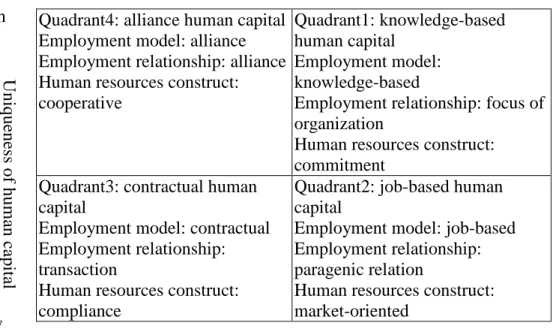
Lepak & Snell (1999) regarded the value and uniqueness of human capital as a decisive element to select the employment model, and integrated the value and uniqueness into a four-quadrant structure, namely, 1, knowledge-based human capital: when the special know-how cannot be procured from the labor market due to the scarcity, the company is inclined to in-house development; 2, job-based human capital: the human capital of certain value could be provided from the labor market, but the know-how of employees is neither unique nor proprietary to the company. This is because the resigned skillful employees may transfer the investment to other companies; 3, contractual human capital: this human capital mainly comprises common and limited strategic value; Leonard-Barton (1995) expressed that such knowledge could be acquired from open labor market; 4, alliance human capital: this human capital features high uniqueness, but cannot create high value for the customers, as shown in Figure 1:
Quadrant4: alliance human capital Employment model: alliance Employment relationship: alliance Human resources construct: cooperative
Quadrant1: knowledge-based human capital
Employment model: knowledge-based
Employment relationship: focus of organization
Human resources construct: commitment
Quadrant3: contractual human capital
Employment model: contractual Employment relationship: transaction
Human resources construct: compliance
Quadrant2: job-based human capital
Employment model: job-based Employment relationship: paragenic relation
Human resources construct: market-oriented
Figure 1 Schedule of Human Resources Structure Source: Lepak & Snell (1999, 2002)
Value of human capital
U n iq u en es s o f h u m an ca p ita l Low High High Low
The objective of a company could be achieved by combining HRM and organizational strategy (Way & Jonson, 2005). But, previous researches often discussed the effect of HRM practices on organizational performance from the perspective of individual aspects (e.g.: turnover rate) or individual criteria. So, the criteria of organizational performance are recommended to be measured and selected with respect to significance of performance, satisfaction of senior managers and interested parties. And, the criteria of performance shall comprise financial indexes (ROA, ROI) and capital market indexes (Tobin’sq).
Since many previous researches considered human capital as a construct of intellectual capital, this paper intends to integrate the intellectual capital into human capital study. And the study on dependent variables previously highlighted organizational performance (Bontis & Fitz-enz, 2002; Carpenter et al., 2 001; Chen, 2003; Huang, 2003), business performance (Youndt & Snell, 2004; Yen, 2004; Ling, 2004), market value and share price (Lepak, Takeuchi & Snell, 2003; Hitt et al., 2001). Only Wright et al. (1994) emphasized the need of linking human capital and competitive advantage, and Luo (2005) in Taiwan just made empirical study. Day & Wensley (1988) once pointed out the competitive advantage was the result of long-lasting and periodic creation and maintenance process. Ma (1999) regarded the competitive advantage and excellent performance as two different concepts. One company may provide better customer services due to one competitive advantage. On the other hand, one company requires a few competitive advantages to compete for good performance. In addition to some resources owned by the company, this study believes that company performance is partially influenced by external factors, such as: economic state, statutory constraint and energy shortage, etc. But, performance indexes such as ROI or ROA could only reflect the absolute performance value. Thus, competitive advantage shall be discussed to determine the consequence variables of human capital, thus providing a view into the status of Taiwanese companies in competition with foreign and
domestic companies. Human Capital Strategy
This paper attempts to discuss the human capital management and development for its value and uniqueness. While analyzing the human capital strategies of Singapore local enterprises (PLEs) and Cisco system, the human capital strategies are summarized to discuss their influence upon human capital by adding human capital maintenance strategy. The human capital strategies contain the following four constructs: human capital acquisition strategy, human capital development strategy, human capital maintenance strategy and knowledge management strategy:
Human capital acquisition strategy
This strategy is manly divided into external/internal acquisition, diversified labor force, extensive/intensive talent searching process, salary attraction; the external acquisition system could find a variety of employees through creative employment models or by offering attractive salary& compensation system, or acquire outstanding human capital by a series of merger, and recruit“passivejob seekers”through IT system.New capitaliscreated through induction and integration of external resources and then knowledge management; the internal acquisition system hasshifted itsfocusfrom “procurement”strategy to “establishment”strategy,namely “internal capacity building”. In addition, new capital is created by integrating the existing knowledge resources. (Delery & Doty, 1996; Gerald et al., 2002; Hsu, 2002; Chatman, et al., 2005)
Human capital development strategy
This strategy underlines the need of human capital development through education& training, vocational development and human capital accumulation. With reference to the intensity and scope of training, internal promotion and skill-based incentive or not (Youndt & Snell, 2004), the financial support on training, vocational management system and planning of successors shall
also be taken into account (Chatman, et al., 2005).
Human capital maintenance strategy
Based on the previous studies(Becker,2003; CIPD,2004; Brannick,2001; Kochanski & Ledford,2001; Applebaumet al., 2003; Melvin, 2001; Ramlall,2004), human capital maintenance refers to achieves its objective of retaining employees through financial/non-financial compensation, job planning, establishment of social support system, human resources information system and authorization of retaining subordinates, etc.
Knowledge management strategy
This strategy develops human capital by documented, informational and social models, e.g.: sharing and transferring explicit knowledge through documents, encoding and storing internal knowledge through IT technology, or storing and transferring implicit knowledge and expertise through interpersonal activities (Gerald et al., 2002).
Thus, this paper intends to verify the effect of human capital strategies on improvement of human capital with the following hypotheses:
Hypothesis 1.1 human capital acquisition strategy is helpful to enhance the human capital of organizations.
Hypothesis 1.2 human capital development strategy is helpful to enhance the human capital of organizations.
Hypothesis 1.3 human capital maintenance strategy is helpful to enhance the human capital of organizations.
Hypothesis 1.4 knowledge management strategy is helpful to enhance the human capital of organizations.
Porter (1980,1985,1990) proposed low-cost and differential competitive advantages, covering quality, characteristics, delivery, after-sale services, ease-of-use and easier for differentiation; from the perspective of Resources-Based View, Barney (1991) and Wright & McMahan (1992) stressed that internal resources should be centrally deployed to develop and maintain the competitive advantage; furthermore, the organizations had to manage properly the internal business process through their own elite knowledge and capacity (Nonaka, 1991; Hamel & Prahalad, 1989; Teece, Pisano, & Shuen, 1997; Winter, 1987).
The competitive advantage means that one organization could find its unique position more quickly than the competitors (Cater & Pucko, 2005); or the competitive advantage of an organization is to increase its value in the relevant market (Chen & Hsiech, 2005); the competitive advantage means that the companies provide valuable products and services to the customers and win outstanding competitive power via unique capacity and assets (Xu Cailiang, 2003).
Zou & Myers (1999) explored how to coordinate centrally the value chains and integrate into R&D, manufacturing and marketing capabilities, thus making aware of their influence upon global performance.
In sum, the competitive advantage indicates that the companies are capable of, with input of valuable and unique resources and capabilities, providing better products and services through positive utilization and management of value chains. Furthermore, the companies could win favorable global competitive status and competitive advantage by transferring their valuable resources, capabilities and in-house activities into global market.
Many scholars (Lado & Wilson, 1994; Wright, McMahan, & Mcwilliams, 1994) stressed that strategic human resources could generate sustainable competitive advantage and improve the organizational performance. According to the HRM strategic model developed by Petra & Juan
(2004), HRS (human resources system) could help the organizations create and maintain their strategic human capital and win sustainable competitive advantage. Thus, it’s concluded that human capital has influence upon competitive advantage. Viewed from the coordinative flexible model of Lepak et al.(2003), external employment(contractual and alliance human capital) could assist in improving the business performance, and contractual human capital could assist in improving flexibly the composition of organizational human capital with lower cost and higher efficiency. Lepak et al.(2003) demonstrated the positive influence of knowledge-based human capital upon organizational performance through flexible resources. Higher performance could be generated from more types of human capital(Lepak et al., 2003; Tsui, Pearce, Poter, & Hite, 1995). The research findings of Luo(2005) also show that proper utilization of professional human capital can improve significantly the quality and innovative advantage of companies, while proper utilization of HR can save the cost and improve the resources advantage.
As demonstrated by Luo(2005) in his empirical research, this paper suggests that utilization of contractual and knowledge-based human capital will help improve organizational performance, and utilization of alliance human capital will help acquire external knowledge to improve the possibility of achieving the strategies. Meanwhile, diversified labor force will contribute much to improve organizational performance as shown in the viewpoint of Lepak et al.(2003). So, the following hypotheses for the relation between human capital and competitive advantage are summarized:
Hypothesis 2.1 utilization of contractual human capital will help improve the organizations’ competitive advantage.
Hypothesis 2.2 utilization of knowledge-based human capital will help improve the organizations’competitiveadvantage.
RESEARCH DESIGN
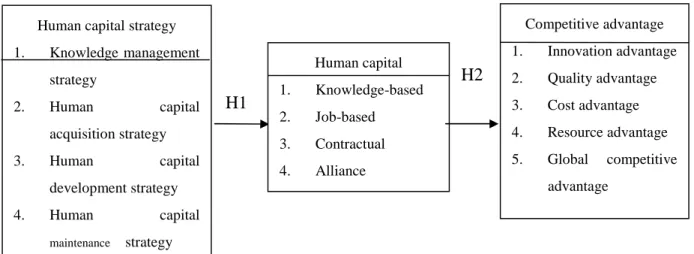
The major purpose of this paper is to discuss the influence of human capital upon the competitive advantage and the influence of human capital strategy upon human capital for Taiwanese companies in mainland China, as illustrated in Figure 2:
Measurement and Definition of Variables
Human capital
The human capital is defined by Lepak & Snell (1999, 2002) into four types: knowledge-based human capital, job-based human capital, contractual human capital and alliance human capital; This paper adopts the index of human capital developed by Lepak & Snell (2002).
Human capital strategy
This paper attempts to discuss the influence of different strategies upon the management and utilization of human capital, and propose four constructs of human capital strategy: knowledge management strategy, human capital acquisition strategy, human capital development strategy
Figure 2 Research framework Human capital strategy
1. Knowledge management strategy 2. Human capital acquisition strategy 3. Human capital development strategy 4. Human capital maintenance strategy Human capital 1. Knowledge-based 2. Job-based 3. Contractual 4. Alliance H2 H1 Competitive advantage 1. Innovation advantage 2. Quality advantage 3. Cost advantage 4. Resource advantage 5. Global competitive advantage
and human capital maintenance strategy; of which the knowledge management strategy is sourced from the index of Choi & Lee (2003), the human capital acquisition and development strategies are partially sourced from the index of Yundt & Snell (2004), and the remaining parts and human capital maintenance strategy are based upon the viewpoints of aforementioned scholars and self-developed indexes.
Competitive advantage
According to the definition of Xu (2003): competitive advantage means the companies can provide valuable products and services to the customers and win outstanding competitive power via unique capacity and assets. This paper adopts the index of competitive advantage developed by Xu (2003) and Zou & Myers (1999), namely, five constructs: resource advantage, innovation advantage, quality advantage, cost advantage and global advantage.
Research samples
The subjects of this study are Taiwanese companies in Mainland China, this paper aims to discuss the influence of human capital strategy upon human capital in order to improve their overall competitive advantage. In this paper, Snowball sampling method was applied for data collection along with field interview. To avoid common method biases, the questionnaire investigation was carried out randomly according to different types of human capital, and total 93 Taiwanese companies were investigated, with valid questionnaire from 230 top managers, human resource managers, and line managers.
Results
To verify the hypotheses of the research framework and clarify the relationship of constructs, the overall research framework was analyzed linearly based upon two-phase LISREL developed by Anderson & Gerbing (1998) andWilliams& Hazer(1986).Firstly,Crobach’sα valueand
confirmative factors were analyzed to understand the reliability, convergent and discriminant validity; secondly, the constructs were integrated into a few or single index, and then conduct LISREL analysis for verification of the hypotheses.
Reliability analysis
This paper firstly measured Crobach’s α value. As for reliability analysis of the human capitalindex,Crobach’sα valueofhuman capital’svalueand uniquenessis0.92 and 0.91. As for reliability analysisofthehuman capita strategy,Crobach’sα value oftheexplicitand implicit policies in knowledge management strategy is 0.81 and 0.72;Crobach’sα valueofhuman capital acquisition strategy is0.91;Crobach’sα valueofhuman capitaldevelopment strategy is 0.94; Crobach’sα valueofcompetitivesalary,non-financial , job design and social support in human capital maintenance strategy is 0.57, 0.78, 0.56, and 0.84,respectively;Crobach’sα valueof innovation, cost, resources and global competitive advantage in competitive advantage index is 0.85, 0.79, 0.70, and 0.79, respectively. It can thus be seen that, most of the scales have good reliabilities in view ofCrobach’sα valueup to 0.7.
Validity analysis
This is aimed at testing if every construct has sufficient convergent validity and discriminant validity.
Convergent validity
We used confirmatory factor analysis to assess convergent validity. The results show that satisfactory fit were achieved ( χ 2/df=0.26~2.98; GFI=0.90~0.95; CFI=0.96~0.98; RMR=0.045~0.055; see Table 1). We further assessed convergent validity by demonstrated the composite reliability. From table 1, we found that the values for most of the constructs were above the suggested threshold of 0.70. In addition, all items for all scales loaded significantly on
their intended construct with t-values of 1.96. Furthermore, all were significant with strong evidence of convergent validity.
Table 1
Results of Reliability and Convergent Validity
Variable Cronbach’s α Composite
reliability t-value χ
2/df
GFI CFI RMR
Human capital stateies
value 0.92 0.91 9.17~14.70 2.98 0.91 0.98 0.045 uniqueness 0.91 0.91 5.99~14.64 2.84 0.92 0.98 0.037 KM strategies 2.51 0.95 0.97 0.039 Explicit KM strategies 0.81 0.81 9.44~14.09 Implicit KM strategies 0.72 0.73 6.11~12.27 HC acquisition strategy 0.91 0.91 9.27~14.06 0.26 0.92 0.97 0.030 HC development strategy 0.94 0.93 10.03~14.83 2.51 0.90 0.98 0.029 HC maintenance strategy 4.93~7.11 1.77 0.92 0.96 0.055 Social support 0.84 0.78 5.00~5.38 Non-financial 0.78 0.74 1.96~5.32 Job design 0.56 0.58 4.97~9.51 Competitive salary 0.57 0.57 7.41~10.37 Competitive advantages 6.07~7.64 1.97 0.90 0.97 0.038 Innovation advantages 0.85 0.83 7.48~9.47 Cost advantages 0.79 0.75 6.54~6.68 Resource advantages 0.70 0.71 1.96~6.82 Global advantages 0.79 0.79 6.63~6.71 Table 2
Descriptive Statistics and Correlations
1 2 3 4 5 6 7 8 9 10 11 12 13 14 V alue 1 U niqueness .616*** 1 H C acquisition strategy .499*** .699*** 1 H C development strategy .519*** .638*** .770*** 1 S ocial support .328*** .392*** .408*** .598*** 1 .N on -financial .245*** .327*** .330*** .417*** .286*** 1 .J ob design .242*** .275*** .357*** .437*** .253*** .400*** 1 .C ompetitve salary .381*** .423*** .515*** .545*** .392*** .367*** .339*** 1 .E xplicit KM strategy .109 .219** .328*** .409*** .336*** .064 .124 .267*** 1 . Implicit KM strategy .127 .132* .219** .302*** .354*** .052 .076 .331*** .526*** 1 . Invovation advantages -.023 .178* .273*** .285*** .197** .071 -.027 .062 .357*** .210** 1 . Cost advantages .063 .067 .198** .252** .262** -.024 .127 .132 .236** .174* .454*** 1 . Global advantages -.011 .098 .176* .228** .214** .125 .018 .045 .233** .144 .561*** .441*** 1 . Resource advantages .161* .092 .186* .244** .397*** .084 .078 .292*** .272*** .301*** .405*** .493*** .472*** p <0.1 ** p<0.05 *** p<0.001
RESULTS
Table 2 presents the means, standard deviations, and correlations among the study variables. In order to test the hypotheses, structural equation modeling was conducted using LISREL to obtain maximum likelihood estimates of standardized path coefficient standard errors for the proposed model. As“contractual”and “alliance” typeshaven’tyetreached theenough samples for analysis,LISREL analysisisonly conducted for“knowledge-based”and “job-based”types. Knowledge-Based Employees’Theoretical Model Evaluation
Overall Model Fit
Linear structural model analysis shows that the goodness-of-fit index of the overall theoretical model is: 2=78.514 (d.f.=64), GFI=0.89, CFI=0.977, RMR=0.03, and NFI=0.90. Overall, integrating each index determination, the overall theoretical model fitness of this study is good (Bentler & Bonnett, 1980; Bentler, 1990)
Job-Based Employee’sTheoretical Model Evaluation
Overall Model Fit
Linear structural model analysis shows that the goodness-of-fit index of the overall theoretical model is: 2=55.632 (d.f.=46), GFI=0.89, CFI=0.977, RMR=0.03, and NFI=0.90. Overall, integrating each index determination, the overall theoretical model fitness of this study is good.
Hypothesis Testing
Relationship between knowledge-based human capital and competitive advantage
It’ssupposed thatknowledge-based human capital has positive influence on competitive advantage. According to the path coefficient of theoretical models listed in Table 4, the influence of knowledge-based human capital upon competitive advantage has reached a remarkable level,
showing thepositiveinfluenceupon competitive advantage.It’salso supposed thatthe human capital strategy has positive influence upon knowledge-based human capital.It’salso found that the influence of knowledge management strategy upon the knowledge-based human capital has reached a remarkable level, showing that a higher degree of knowledge management has positive influence upon knowledge-based human capital. Moreover,it’salso found thattheinfluence of human capital acquisition strategy upon knowledge-based human capital has reached a remarkable level, showing that the stringent and attractive recruitment strategy has positive influence upon knowledge-based human capital.
Table 3
Analysis of the hypotheses for knowledge-based human capital model
Path Path
coefficient Hypothesis Result
KM strategy knowledge based HC 0.30* H1.1a support
HC acquisition strategy knowledge based HC 0.36* H1.2a support HC development strategy knowledge based HC 0.21 H1.3a reject HC maintenance strategy knowledge based HC 0.004 H1.4 reject knowledge based HC competitive advantage 0.46*** H2-1 support * p<0.05,** p<0.01,*** p<0.001
Finally, it showed that human capital development strategy and human capital maintenance strategy haven’treached aremarkablelevel,showing thatthesetwo strategieshaveno positive influence upon the knowledge-based human capital. As a whole, most of hypotheses in the knowledge-based human capital theoretical framework are supported.
Relationship between job-based human capital and competitive advantage
According to the path coefficient of theoretical models listed in Table 4, the influence of job-based human capitalupon competitiveadvantagehasn’treached aremarkable level,thusnot showing a positive influence upon competitive advantage. It’s also supposed that the human capital strategy has positive influence upon job-based human capital. According to the path coefficient of theoretical models listed in Table 5, only human capital acquisition strategy is found to have reached a remarkable level, showing that the stringent and attractive recruitment strategy has positive influence upon job-based human capital; the other three human capital strategies are not found to have reached positive influence upon job-based human capital.
Table 3
Analysis of the hypotheses for job-based human capital model
Path Path
coefficient Hypothesis Result
KM strategy knowledge based HC 0.20 H1.1b reject
HC acquisition strategy knowledge based HC 0.53* H1.2b support HC development strategy knowledge based HC 0.13 H1.3b reject HC maintenance strategy knowledge based HC -0.02 H1.4b reject knowledge based HC competitive advantage 0.15 H2-2 reject
CONCLUSIONS AND SUGGESTIONS
The purpose of this paper is to discuss the influence of human capital strategy and human capital upon the competitive advantage of Taiwanese companies; the research findings and relevant suggestions based on LISREL analysis and hypotheses are concluded below.
Conclusions
Configuration of theoretical models
capital and overall competitive advantage. So, efficient utilization of human capital strategy will have positive effect on human capital and improve the competitive advantage of companies.
Previous researches on human capital were often devoted to discuss the influence of management measures or management systems upon human capital, showing a certain explanatory ability from certain aspects, nor from strategic level. Hence, the influential factors to human capital are combined in this paper to have a better understanding of the influence of human capital strategy. After Taiwanese companies are selected as the research objects, various indexes of theoretical models are assessed through LISREL fit, showing that these indexes have reached or approached acceptable fit test level. Thus, utilization of human capital strategy will have influence upon human capital and improve the competitive advantage.
Influence of variables
Knowledge-based human capital theoretical model
Influence of human capital strategies upon knowledge-based human capital
The knowledge management strategy and human capital acquisition strategy have positive influence upon human capital; the empirical results of Ling(2004) show that the companies could develop the human capital through documented and social models, whereas this paper believes that the human capital can be improved through explicit and implicit strategies. Thus, this hypothesis is reasonable.
Secondly, the research findings on human capital acquisition strategy comply with the empirical results of Gerlad et al. (2002), Yundt & Snell (2004) and Petra & Juan (2004), namely, the companies could affect and develop their human capital through prudential and efficient recruitment program and attractive HR system.
Influence of knowledge-based human capital upon competitive advantage
upon the companies’ competitive advantage, indicating that improved human capital of knowledge-based employees has effect on the competitive advantage, as demonstrate by the research by Luo (2005) and Petra & Juan (2004), namely, efficient and proper utilization of human capital may aid in obtaining sustainable competitive advantage; in addition, knowledge-based employees mainly include senior managers, researchers and planners, etc, who are in charge of business operation and strategic planning and playing a key role in improving the competitive advantage.
Job-based employee theoretical model
Influence of human capital strategies upon job-based employees
Only human capital acquisition strategy among four human capital strategies has positive influence upon job-based employees; that’sto say,thecompaniescould affectand develop their human capital through prudential and efficient recruitment program and attractive HR system.
Influence of job-based employees upon competitive advantage
It’slearntfrom LISREL analysisthat,the hypothesis that job-based employees have positive influenceupon thecompanies’competitiveadvantageisn’treasonable.Thisisbecausemostof job-based employees are involved in manual work or low-tech jobs, or make contributions less than knowledge-based employees. Furthermore, job-hopping occurs more frequently. Thus, job-based employeeshavelittleinfluenceupon the companies’competitiveadvantage.
Suggestions
Establishment and utilization of knowledge management system
It’sfound thatknowledgemanagement strategy could improve efficiently the human capital of knowledge-based employees. And, most of knowledge-based employees are senior staff of the companies, so a perfect knowledge management system, e.g.: integration of file system, setting a work group or forum and data exchange platform, etc, will improve their human capital.
Establishment and utilization of recruitment& screening system
It’s found that human capital acquisition strategy has positive influence upon both knowledge-based and job-based employees. So, a perfect recruitment channel and screening program shall be established, e.g.: recruiting talents from different provinces and regions through Internet. Besides, a talent pool shall be set up to recruit and screen highly qualified personnel, especially knowledge-based job seekers; in addition to various screening tools, a series of screening and training plans shall be required to ensure recruitment of qualified talents from various provinces and regions.
Utilization of human capital development strategy
In spite of the insignificance level of this strategy, this paper believes that human capital development has certain effect in this regard; and utilization of human capital development strategy may improve the qualification of human capital, and more particularly for knowledge-based employees who are senior managers and planners. So, a complete education& training plan and training opportunities shall be required to pour into new knowledge and new concepts; human capital strategy alsohascertain influenceupon thecompany’ssuccessorplan, sincethe“candidates”areencourageto improvetheirown human capitalvalueand competitive power; the job-based employees could also obtain development opportunities for promotion or learning new skills.
Utilization of human capital maintenance strategy
Notwithstanding the relatively low loyalty of mainland employees, some employees prefer to retain their posts if the salary& compensation level of one company is superior to other competitors, a Taiwanese manager is quoted as saying. However, such practice may bring about a certain burden of operating cost. A few Taiwanese companies have begun to take up some intangible retention measures, such as offering more development opportunities, regularly
holding activities and establishing partnership with the employees. Therefore, human capital maintenance strategy is believed to yield certain effects on maintaining qualified human capital.
REFERENCES
Anderson, J. C. & Gerbing, D. W. 1988. Structural Equation Modeling in Practice: A Review and Recommended Two-Step Approach. Psychological Bulletin, 103(3): 411-423.
Bagozzi, R. P. & Yi, Y. 1988. On the Evaluation of Structure Equations Models. Academy of
Marketing Science, 16(3): 76-94.
Barney, J. 1991. Firm resources and sustained competitive advantage. Journal of Management, 17(1): 99-120.
Bentler, P. M. & Bonnett, D. G. 1980. Significance tests and goodness of fit in the analysis of covariance structures. Psychological Bulletin, 88: 588-606.
Bentler, P. M. 1990. Comparative fit indexes in structural models. Psychological Bulletin, 107: 238-246.
Bontis, N. & Fitz-enz, J. 2002. Intellectual capital ROI: a causal map of human capital antecedents and consequents. Journal of Intellectual Capital, 3(3): 223-47.
Byrne, B. M. 2001. Structural Equation Modeling with AMOS, Basisc Concepts, Applications,
and Programming. N. J.: Lawrence Erlbaum Associates.
Carpenter, M. A., Sanders, W. G. & Gregersen, H. B. 2001. Bundling human capital with organizational context: The impact of international assignment experience on multinational firm performance and CEO pay. Academy of Management Journal, 44(3): 493-511.
Cater, T. & Pucko, D. 2005. How Competitive Advantage Influences Firm Performance: The Case of Slovenian Firms. Economic and Business Review, 7(2): 19-135.
Chatman,J.,O’Reilly,C.& Chang,V.2005. Cisco systems: developing a human capital strategy.
California Management Review, 47(2): 137-166.
Chatman, J., O’Reilly, C. & Chang, V. 2005. Cisco systems: Developing a human capital strategy.
California Management Review, 47(2): 137-166.
Chen, H. M. & Hsiech, Y. H. 2005. Incentive reward with organizational life cycle from competitive advantage viewpoint. Human Systems Management, 24: 155-163.
Chen, L. H. 2003. The Relationships among HRM, Human Capital, and Organizational
Taiwan University of Science and Technology.
Choi, B. & Lee, H. 2003. An empirical investigation of KM style and their effect on corporate performance. Information & Management, 40: 403-417.
Day, G. S. & Wensley, R. 1988. Assessing advantage: A framework for diagnosing competitive.
Journal of Marketing, 52(2): 1-20.
Delery, J. E. & Doty, D. H. 1996. Modes of theorizing in strategic human resources management: test of Universalistic, contingency, and configurational performance prediction. Academy of Management Journal, 39(4): 802-835.
Gerald, Z. D. H, Roy, M. H, Ahmed, Z. U., Heng, J. S. T. & Lim, J. H. M. 2002. Benchmarking the human capital strategies of MNCs in Singapore. Benchmarking, 9(4): 357-374.
Hair, J. F. Jr., Anderson, R.E., Tatham, R. L. & Black, W. C. 1998. Multivariate Data Analysis (5nd ed.). N. J.: Prentice Hall.
Hamel, G. & Prahalad, C. 1994. Competing for the future. Harvard Business Review, 72(4): 122-128.
Hitt, M. A., Bierman, L., Schimizu, K. & Kochhar, P. 2001. Direct and moderating effect of human capital on strategy and performance in professional service firms: A resource-based perspective. Academy of Management Journal, 44(1): 13-28.
Huang, K. L. 2003. A Study of the Relationships among Human Resource Management System,
Human Capital and Organization Performance in Manufacturing. A Dissertation,
National Chung Cheng University.
Hung, C. L. 2003. The Relationships of Human Resource Management Systems, Intellectual
Capital and Organizational Performance. A Dissertation, National Sun Yat-Sen
University.
Hus, M. I. 2002. A Study of the Intellectual Capital Acquisition of Taiwanese Firms in Mainland
China: Resource Dependence Perspective. A Dissertation, Da-Yeh University.
Lado, A. A. & Wilson, M. C. 1994. Human resource systems and sustained competitive advantage: A competency-based perspective. Academy of Management, 19(4): 699-727. Leonard-Barton, D. 1995. Wellsprings of Knowledge. Massachusetts: Harvard Business School
Press.
capital allocation and development. The Academy of Management Review, 24(1): 31-48. Lepak, D. P. & Snell, S. A. 2002. Examining the human resource architecture: The relationships
among human capital, employment, and human resource configurations. Journal of
Management, 28(4): 517-543.
Lepak, D. P., Takeuchi, R. & Snell, S. A. 2003. Employment flexibility and firm performance: Examining the interaction effects of employment mode, environmental dynamism, and technological intensity. Journal of Management, 29(5): 681-703.
Ling, Y. H. 2004. An Empirical Study on the Relationships among International Human Capital,
Global Initiatives, and Financial Performance. A Dissertation, National Sun Yat-Sen
University.
Ma, H. 1999. Creation and preemption for competitive advantage. Management Decision, 37(3): 25-266.
Nonaka, I. 1991. The knowledge-creating company. Harvard Business Review, 69(6): 96-104. Petra, D. S. P. & Juan, M. G. F. 2004. The influence of human resource management in savings
bank performance. The Service Industries Journal, 24(2): 51. Porter, M. E. 1980. Competitive Strategy. New York: Free Press.
Porter, M. E. 1985. Competitive Advantage: Creating and Sustaining Superior Performance. New York: Free Press.
Porter, M. E. 1990. Competitive Advantage: Creating and Sustaining Superior Performance. New York: Free Press.
Stewart, T. A. 1997. Intellectual Capital: The New Wealth of Organizations. New York: Bantam Doubleday Dell Publishing Group, Inc.
Teece, D. J., Pisano, G. & Shuen, A. 1997. Dynamic capabilities and strategic management.
Strategic Management Journal, 18(7): 509-533.
Tsui, A. S., Pearce, J. L., Porter, L. W. & Hite, J . P. 1995. Choice of employee- organization relationship: Influence of external and internal organizational factors. In G. R. Ferris(Ed.),
Research in Personnel and Human Resources Management: 117- 151. Greenwich, CT:
JAT Presss.
Way, S. A. & Johnson, D. E. 2005. Theorizing about the impact of strategic human resource management. Human Resource Management Review, 15(1): 1-19.
Williams, L. J. & Hazer, J. T. 1986. Antecedents and Consequences of Satisfaction and Commitment in Turnover Models: A Reanalysis Using Latent Variable Structural Equation Methods. Journal of Applied Psychology, 71(2): 219-231.
Winter, S. 1987. Knowledge and Competence as Strategic Asset. In D. Teece, (ed.), The
Competence Challenge-Strategies for Industrial Innovation and Renewal (pp. 159-184).
NY: New York.
Wright, P. M. & McMahan, G. C. 1992. Theoretical perspectives for strategic human resource management. Journal of Management, 18(20): 295-320.
Wright, P. M., McMaham, G. C. & McWilliams, A. 1994. Human resources and sustained competitive advantage: A resource –based perspective, International Journal of Human
Resource Management, 5(2): 301-313.
Youndt, M. A. & Snell, S. A. 2004. Human resource configurations, intellectual capital, and organizational performance. Journal of Managerial Issues, XVI(3): 337-360.
Zou, S. & Myers, M. B. 1999. The R&D manufacturing and marketing competencies and the firm’sglobalmarketing position:An empiricalstudy. Journal of Global Marketing, 12(3): 5-21.