行政院國家科學委員會專題研究計畫 成果報告
The study of intellectual Capital: OB/HRM
perspective--子計畫三 : 跨國經理人生涯發展:智慧資
本觀點(第 2 年)
研究成果報告(完整版)
計 畫 類 別 : 整合型 計 畫 編 號 : NSC 96-2416-H-151-008-MY2 執 行 期 間 : 97 年 08 月 01 日至 98 年 07 月 31 日 執 行 單 位 : 國立高雄應用科技大學人力資源發展系 計 畫 主 持 人 : 董玉娟 共 同 主 持 人 : 林義屏 計畫參與人員: 碩士班研究生-兼任助理人員:謝凱茵 博士班研究生-兼任助理人員:廖瑞原 報 告 附 件 : 出席國際會議研究心得報告及發表論文 處 理 方 式 : 本計畫涉及專利或其他智慧財產權,2 年後可公開查詢中 華 民 國 98 年 10 月 31 日
行政院國家科學委員會專題研究計畫 成果報告
The study of intellectual Capital: OB/HRM perspective
子計畫三 : 跨國經理人生涯發展:智慧資本觀點
研究成果報告(完整版)
計畫類別 : 整合型
計畫編號 : NSC
96-2416-H-151-008-MY2
執行期間 : 96 年08 月01 日至98 年07 月31 日
執行單位 : 國立高雄應用科技大學
計畫主持人 : 董玉娟
計畫共同主持人: 林義屏
計畫參與人員 : 博士班究生-兼任助理:廖瑞原
報告附件 : 出席國際會議研究心得報告
處理方式 : 本計畫涉及專利或其他智慧財產權,2 年後
可公開查詢
中
華 民 國 九 十 八 年 十 月 三 十 日
行政院國家科學委員會補助專題研究計畫
■ 成果報告
□期中進度報告
跨國經理人生涯發展:智慧資本觀點
計畫類別 : 整合型
計畫編號 : NSC
96-2416-H-151-008-MY2
執行期間 : 96 年08 月01 日至98 年07 月31 日
執行單位 : 國立高雄應用科技大學
計畫主持人 : 董玉娟
計畫共同主持人: 林義屏
計畫參與人員 : 博士班究生-兼任助理:廖瑞原
成果報告類型(依經費核定清單規定繳交):□精簡報告■完整報告
本成果報告包括以下應繳交之附件:
□赴國外出差或研習心得報告一份
□赴大陸地區出差或研習心得報告一份
■出席國際學術會議心得報告及發表之論文各一份
□國際合作研究計畫國外研究報告書一份
處理方式:■涉及專利或其他智慧財產權,□一年■二年後可公開
查詢
執行單位:國立高雄應用科技大學
中
華 民 國 九 十 八 年 十 月 三 十 日
Study 1
一、前言
This study will explore the career transition process of expatriates and its consequences, using theories of intellectual capital and career development. A career is a long term development process and relevant data will be collected by means of a longitudinal study. In the first year, this study will seek to understand how individual factors, including initial intellectual capital (human capital, social capital) and calling recognition, limit or benefit the career development of international managers. It will also explore how the perception of internal and external job opportunities affects whether the expatriates choose to accept a different assignment in another location or organization, start their own business, stay in the same organization, or return to the parent organization.
二、資料收集方法
In the first year of our three-year project, we interviewed Taiwanese expatriates working in international business. From these interviews, we were able to explore the career process, the limiting factors on career development, the various career strategies used, and the various career outcomes. Based on these results, we modified our previously proposed framework to ensure that the model is reasonable.
三、受訪者基本資料分析
從 96 年 10 月份至 97 年 4 月共訪談了十七位台商, 職位為副理、經理、總 經理、以及創業者, 年齡在 30~65 歲之間, 以 35~45 歲者居多, 外派年資在 1~18 年間, 以 5~10 年者居多; 性別以男性者居多佔 2/3 以上, 而受訪者中, 有小孩 的佔 2/3 以上; 派駐地點以華南、華中為主。最早派駐在中國大陸的時間為1989 年,大部份派駐時間為1997 年至 2004 年,十六人所任職之產業別以製造業為 主,娛樂業只佔一人。 表3.1 受訪者基本資料 受訪者 職位 外派總 年資 外派地 區 婚姻 年齡 性別 小孩人數,年齡 A 財務經理 7 年 華南 已婚 43 F 2 人, 國小B 財務經理 10 年 昆山 未婚 45 F 無 C 財務經理 8 年 昆山 離婚 45-50 F 2 人成年 D 生產部副 理 6 年 廣州 昆山 已婚 50-55 M 3 人 2 人就業, 一人大學 E 製發部經 理 3 年 廣州 未婚 30-35 M 無 F 生產部副 處長 7 年 上海— 深圳 已婚 40-45 M 2 個 10 歲 8 歲 G 生產管理 4 年 昆山— 深圳 已婚 30-35 M 1 人 2 歲 H 人資顧問 2 年 蘇州 已婚 45-50 F 2 人高中及大 學 I 紙品公司 行 9 年 上海 已婚 43 歲 M 3 個月 J 電子公司 管理部經 理 10 年 東莞 己婚 48 歲 M 2 人國一及大 學 K 電子公司 特助 7 年 深圳 己婚 43 歲 M 2 人, 國三及小 一 L 皮包公司 總經理 7 年 東莞 己婚 45 歲 M 3 人 M 副理 5 年 廣州 已婚 43 歲 M 二人國中 N 特助 1 年 深圳 己婚 40 歲 M
四、結果分析
(一)派外人員的生涯歷程 在經過訪談了十七位人曾接受派任人員後了解,外派人員接受外派時 皆以派任管理職居多,顯示企業在遴選海外派任人員,皆是期望能藉由外 派人員來帶領、管理、訓練當地人員之專業及團隊觀念。以期在未來能採 取全面或大部份當地化管理。而外派台幹之性別仍是以男性高於女性居 多。 在此項訪談中我們發現,接受外派訪談的十七位人員中,派任期最早的是在1988 年,大部份是介於 1997 年至 2004 年間,女性派任者以擔任財務 主管職為多,而目前尚有十位台幹仍就職在原派任公司,其中六位人員就 任原職(含三位創業家,其中一位創業家現改為不定期往返於中國及台灣之 間),另四位其職務己變更且職稱己被提昇,職稱最高則為副總經理。 另已轉任其它公司之七位台幹中,己有三位回到台灣,皆是女性人 員,一位因生病目前在家休養,一位預備攻讀在職碩士班,一位任職在上 市公司人資部門,工作任務仍不定時往返於台海之間,且未來可能接受長 期派駐在中國大陸訧職,一位目前己隨其主管由台資企業轉任至陸資企 業,預計在未來不排除與同事共同創業,一位由原派任公司轉換至不同公 司擔任同職務工作,二位由原派任公司轉至它家公司擔任不同職務之工 作。 表4.1 受訪者生涯歷程 受訪者 何時 生涯歷程 A 2000 年 財務經理(轉換二家公司) B 1997 年 財務經理(10 年) Æ外資企業之財務長Æ回國(生 病) C 1999 年 財務主管+管理部主管, 2006 年離職 D 2000 年 生產一部副理 E 2004 年 工程部副理Æ工程部經理(1 年)Æ製發部經理+ 新廠工程召集人 F 2000 年 生產部經理(5 年)Æ生產部副處長(陸資企業) G 2003 年 品管部副理Æ製造部經理(另外一家公司)Æ生 產管理經理 H 2002 年 品保課長+人資工作-Æ總務工作Æ回台Æ科技 公司通勤派遣人資顧問Æ今年聘用為正式人資 專員 I 1999 年 行銷總監Æ業務總監-Æ行銷總監 J 1992 年 高階主管(1 年)Æ管理部經理(惠穚 1 年多)-Æ製 造部經理(3 年) K 2000 年 廠長Æ特助(生管+倉庫+採購+經管) L 2000 年 後勤經理Æ副總 M 2000 課長Æ經理 N 2006 年 特助 (二)派外人員的社會網絡活動
派任人員在接受派任後,在當地除了正常工作時間外,經過訪談發 現,在十七位人員中,大部份派任人員休閒時間會跟自己公司同為派任之 台幹至外用餐或是旅遊,部份工作任務具備業務性質工作之派任人員,則 除跟公司同仁外會跟協力廠商或業務往來客戶共同出外用餐、唱歌或旅 遊。創業者或是派任至海外廠之高階主管則是會參加台商協會,或是當地 政府所舉辦的餐會、聯誼會。財務主管大部份則是會參與當地財務主管聯 誼會,有部份外派人員則因派任至海外時間較長,與當地人己建立良好之 關係,故也會參與當地的陸商網絡,建立屬於自己在當地的人脈。 表4.2 受訪者當地活動 受訪者 參加當地活動 A 昆山地區的財務主管聯誼會 B 昆山地區的財務主管聯誼會 C 財務主管聯誼會 D 無, 限於公司內同仁的活動 E 1. 公司內同仁的活動 2. 與廠商的活動 F 1. 公司內同仁 2. 廠商 3. 跟其他公司台幹網聚 G 無, 限於公司內同仁的活動 H 無, 跟公司之台幹到外吃飯、遊 玩 I 無, 限於公司內同仁的活動 J 無, 和客戶之間的互動 K 1. 台商協會去過幾次 2. 與客戶互動 3. 相同產業、不同產業的人際網 絡 L 和業務有往來的客戶互動 M 1.陸商網絡 N 目前接觸對外業務,人脈尚未很廣 (三)組織對派外人員提供的訓練計畫及生涯發展 目前在台灣國內對公司在職人員教育訓練己是相當的重視,但是往往 不一定能兼顧到海外派任人員在海外派任期間公司能否提供相對的教育訓
練機會,以提高或加強海外派任人員的職能。在經過與派任人員訪談後, 我們發現在十七位受訪的外派人員中,僅有五位外派人員其公司曾針對海 外廠派任人員安排在職教育訓練,而在該五位外派人員中,有一家僅提供 協理及總經理安排教育訓練,除此之外,有部份的海外派任人員是採取自 我學習(自費)來成長,有二人曾自費請外籍老師至公司來擔任英文家教, 派外人員因工作上有時遇到問題無法解決時,除在公司請求同仁支援外, 也會透過自己的人脈來建立溝通訉息的管道,尋求外在的協助。在此項訪 談中,我們發現在受訪談的人員其派任公司中,惟有少部份公司會針對台 幹做教育訓練及職涯發展規劃,大部份外派公司並無做此安排。 (四)派外人員提前回任傾向, 以及提前回任原因 外派人員在海外派任期間,因為公司任務導向要求的關係,我們在與 外派人員聊天時,常聽到很多外派人員提到在海外的甘苦談,甚至抱怨連 連,如:根本無所謂的下班時間,電話隨叫就須隨到,完全没有感覺可以 好好的休息,還有因隻身至海外廠工作,家人未陪同至中國大陸任職,故 在工作中根本無法兼顧到家庭,以致與家人甚至小孩之感情越來越疏遠, 還有因小孩正值叛逆期造成派外父母心理上的擔憂與遺憾。在經過訪談之 結果發現,在詢問受訪者是否願意回台灣任職時,其中在十七位受訪者 中,有九位選擇仍願意留在大陸任職,不願回到台灣,其中有二位希望能 留在大陸繼續工作是最主要的原因是能多賺些錢,其餘六位是認為回到台 灣己不易找到工作,且認為大陸仍商機無限,值得再他們繼續留在大陸打 拼,尋找另一個良機,另一位是因為己娶了大陸配偶,配偶不願再回到台 灣,故該派外員將以大陸為長期發展基地,職涯規劃都以大陸為目標。另 外己回台者共計有四位,其中一位因己退休結算完年資,且目前身患疾病 休養中,故將不考慮再到大陸覓職,另一位己將工作辭掉,回台休息,預 計未來將考在職進修班,繼續讀書,另二位雖是回台任職,但其工作職務 仍須不定期到中國大陸出差,甚至該新公司己告知不排除將來仍會派該二 員至中國大陸任職。
表4.3 受訪者訓練發展及機會來源 受訪者 公司安排的訓練及發展 其他發展機會資訊來源 A 無 向朋友請教 B 無 自己花錢請外籍老師上課及參加 社團認識的朋友亙相請益 C 無 自己花錢請外籍老師上英文,自己 想到交大修EMBA D 1. 聘請顧問訓練 2. 預計對台幹規劃職涯管理課 程 無,希望在公司就職直到退休,因 為年紀較大轉職不易. E 1. 總公司未來會請顧問至公司 開立主管訓練營 2. 未來公司會對我進行職涯規 劃 3. 預計今年會轉調回台灣進行 跨部門輪調,預計會由製發轉 調至業務部門,公司對某些特 定對象會進行規劃 4. 但詳情我不太清楚. 有時會跟廠商吃飯時,曾遇到廠商 開口向我挖角,希望我到他們公司 去工作,薪資較現在公司高,但我 無轉換工作的想法,故仍留在原公 司,,跟廠商在一起時有時可擴展 自己的人脈,增加自己未來的資 源.有些同學及朋友也到大陸來工 作,故有問題時可亙相請益. F 無 將來規劃與友人成立代理商公司 或隨公司到越南訧職. G 一年二次針對台幹聘請顧問訓練 預計申請轉調到其它部門 H 1. 與日本技師定期會議, 感覺逐 步成長 2. ISO9001 之認證訓練 3. 內部稽核員訓練 目前暫時仍以任職在此公司上班 為主,希望將來能開立一家拼布 店. I 無 預計轉職 J 1. 針對協理、總經理有生涯規 劃, 其餘沒有 2. 訓練課程沒有 1. 仍將任職在華新科技 2. 與客戶至球場打球 3. 與其它公司合辦球賽聯誼 K 1. 有機會升任總經理, 但自已並 不一定想要再留任 2. 有可能會創業 1. 自己做 SWOT 分析 2. 參加高爾夫球隊 3. 偶而參加台商協會 4. 不排斥自己創業 L 1. 以感恩心留在公司任職直至 退休 2. 無,自我學習. 1. 預計在五年退休 2. 自己會學習投資理財觀念. M 無 1 與陸商之協力廠感情良好 N 無 目前尚無人脈之建立.
表4.4 受訪者回任意願 受訪者 是否想要回台灣 原因 A 否 希望多賺點錢 B 已回台 公司有外資介入,故提早提出結算 年資+感情問題 C 己回台 公司引進新工作團隊, 對舊台幹 極力排擠 D 否 回台沒有工作 E 是 1. 獨子需成家 2.考量台灣女孩子為對象 3.未來留在台灣或大陸需視配偶 而定 F 否 以大陸做為職涯規劃 G 否 己娶大陸配偶,將以大陸為長期發 展基地,台灣已無發展空間 H 己回台 不定期至大陸出差 I 否 大陸還是有很多機會 J 是 1. 因大陸法令不健全, 在台老闆 不瞭解, 擔心按老闆意思做事 會在大陸當地遭受刑責 2. 因為小孩子正處於叛逆期 3. 老大要考大學 K 否 個人認為大陸仍是充滿商機 L 否 退休後再考慮是否回台 M 否 回台後薪資會比派駐低 N 是 當地員工的投機心態 (五)派外人員工作轉換傾向、以及工作搜尋行為 目前由於台灣企業至大陸設廠者己相當的多,故使外派人員在海外派 任時可轉任的機會也相形增多,無論是透過網路人力銀行、報紙或則是朋 友做為新工作的媒作,在經過實際訪談後,我們發現在十七個受訪者中, 除三位本身即是創業家,不會另尋工作機會,其餘的十四位受訪者中,有 五位會透過網路人力銀行或報紙來找尋新工作,有五位想轉換工作是透過 朋友或主管來協助介紹尋覓新的工作機會,有一人則因年紀己大不再另尋 工作,希望能待在原任公司直到退休為止,另三人則仍在待在原派任公 司,暫時不想有轉職的想法。
表 4.5 受訪者找尋工作資訊來源 受訪者 找工作資訊來源 A 有, 104、1111 人力銀行 B 朋友介紹至深圳擔任財務總監 C 無 D 無, 因為年紀大, 而且沒有其他專長 E 有, 曾提出辭呈 1.工作負擔太重且權責不清 2.,傾向從事業務性質的工作 F 1. 有, 跟著主管轉換至陸資企業工作 2. 打算做三年 G 104、1111 人力銀行 H 有, 朋友引薦 I 有, 獵人頭公司, 組織當時在調整, 策略不明 確 J 透過朋友介紹或透過網路104 K 有人挖角 L 報紙,及網路 M 原任公司 N 有, 有請朋友注意, 想回台灣, 最主要是照顧 家庭 (六)派外人員的生涯規劃, 以及生涯發展策略 派外人員在接受外派後,無論是生活習慣之適應,當地人文風情、員 工管理方法、思考邏輯、甚至家庭親情之連繫,都會影響到外派人員之未 來規劃,經訪談後發現,在十七人中,有四人願意跟隨派任公司之腳步到 中國內地或著是越南工作,因為派任者認為可以增加派任者的工作資歷, 且也可到較高的薪資,另有四人想要在職進修,想提升自我的英文能力, 其中有二人想要繼續考研究所,為將來謀職做準備,另一人因為目前身患 疾病在家休養中,故無法去規劃未來,須視治療的狀況再做決規劃,另三 人創業者中,其中有一位因本身無兒子,故擬在未來五年中將公司的管理 權轉給其弟弟的兒子來掌權管理,自己擬準備在五年內辦理退休,另一位 創業者擬轉型為服務業,開設職業訓練學校,還有一位創業者擬在三年內 在大陸當地開設第三家卡啦ok 店,因為目前第一家之營運相當好,預計在 一年內就可以回本,今年度擬開設第二家,明年或者後年再開設第三家, 且該創業者預計在這今年或者明年要舉家遷移至中國大陸,另有二位擬在
五年內能辦理退休,另有一位想要自己創業,開立電子零件代理商公司, 另一位擬轉換公司,但不會去挑戰總經理職務之工作,不想承擔太大的壓 力,另一位因為本身晚婚,故很希望有機會在五年內能回到台灣,陪伴家 人身邊。 表4.6 受訪者未來五年規劃 受訪者 未來五年規劃 原因 A 公司未來二年要到大陸設廠, 將隨 公司至越南, 可增加資歷及收入 薪 資 較 高 、 增 加 資 歷 、 預 先 卡 位、在不同國度生活 B 無法規劃 罹患疾病,治療中 C 至交大讀EMBA 協助家族事業 丈夫家為家族企業 D 1. 公司未來可能至內地、越南或 他國設廠, 想隨同公司腳步, 希 望順利領到退休金 因為年紀己大,無法再尋找新工 作,故將配合公司腳步移動. E 1. 英文學好 2. 考上研究所 3. 如轉調部門,,因業務部使用英文 的機會相當多,我就可利用工作 之便學習英文 希望能增加不同的工作歷練,並對 自我的學歷及學識能成長.以備將 來能任職更高層級. F 1. 瞭解被當地員工取代的危機 2. 做三年後打算與同事及認識廠 商開設半導體公司 3. 因新的勞動合同法, 考慮到越 南發展 因為與現行協行廠商都有良好的 亙動,且有同好的同事,故想共同 創業,若未創業,則再考慮到越南. G 1.在大陸工作 2.輪調不同部門 3.至越南發展 因為己娶大陸配偶,故將長期在海 外工作為主,薪資己較在台灣任職 為高. H 1. 繼續留在原公司 2. 接受海外派遣 3. 開設拼布社團 子女已長大.待退休後,希望能開 設拼布店或成立社團. I 1.想要換工作 2.五年後想退休 1.主管領導風格問題 2.工作績效壓力大 3.沒時間陪伴家人 J 1.先把二年任期做完 2.把英文學好 3.留在華新科技 1.老二要考高中 K 1. 強化英文能力 2. 系統觀 1. 英文若強,就可以和客戶接 觸時多一點瞭解,和總經理 開會時可以多學一點 2. 不斷增加自己的能力
表4.6 受訪者未來五年規劃(續) L 1. 把公司安頓建置完好 2. 計畫退休 3. 退休後投入投資 1.年紀己大,現以感恩在公司任 職2.退休後,希望學會投資理財 M 1.會 找 主 管 階 層 的 工 作 , 不 會 去 挑 戰 總 經 理 那 些 高 職 務 。 1.推 崇 老 二 哲 學 2.壓 力 太 大 了 N 1.希望有機會能回台灣 1.本身晚婚,小孩太小 (七)派外人員的工作意義 在職場工作一定會希望能為自己帶來某部份的滿足,尤其是派外人員 離鄉背井來到它鄉工作,最希望獲得是什麼?透過此次的訪談中,在十七 位接受外派的人員中,以工作所帶來的金錢報酬及工作的成就感是最受外 派人員所重視,十七人都有提到此二項中之一項,在此項的訪談中發現, 派外人員在工作所能獲得的金錢回報佔被視為派外人員最重要工作意義, 第二則是工作上的成就感。 表 4.7 受訪者對工作意義的認知 受訪者 工作意義 A 金錢、成就感自信 B 成就感、自信、收入 C 成就感 D 金錢 E 成就感、同事及主管認同、揮灑 空間 F 1. 人際關係的建立 2. 薪資的增加 3. 個人專業技術的提升 G 金錢,提早退休 H 成就感 I 金錢及成就感 J 金錢 K 成就感 L 金錢及回報感恩 M 金錢 N 金錢及增加視野
(八)派外人員的生涯目標 外派人員人生追求目標到底是什麼,在這個訪談中我們發現,在十七 位受訪者中,除了一位目前患病正在治療中的人員提到健康的身體對她來 說是最重要的,其它的受訪者認為人生想要追求的是:經濟的收入、經濟 不虞匱乏、工作的穩定、家庭的圓滿、事業的成就、自我滿足等以上都是 派外人員在人生追求最重要的項目。 表4.8 受訪者的人生目標 受訪者 人生目標 A 穩定工作 B 以前: 幸福的婚姻、穩定的工作 現在:健康的身體 C 家庭及學業 D 經 濟 不 匱 乏 、 子 女 順 利 完 成 教 育、順利退休 E 家庭圓滿、經濟不虞匱乏 F 1.60 歲退休時, 每年有 200 萬 2.投資控股公司 G 家庭圓滿,富有,提早退休 H 自我滿足、成就感 I 經濟不匱乏、提早退休 J 親情是很重要的 K 事業、親情, L 金錢及家庭 M 金錢及家庭 N 家庭 (九)派外人員對派外生涯的滿意 外派人員在離鄉背井到異國來工作,對於此一工作變遷甚至是家庭變 遷後所帶來的結果,與外派人員當初接受外派時的期望是否相符,或者與 當初接受外派時的期望是有所落差,經過訪談十七位外派人員後的結果顯 示,共有九人表示接受派外後在金錢上的期望最符合當初的期望,第二個 則是事業上讓自己感自己感到較有歷練,但其中有三人表示最失落的應是 無法長時間維繫與家人之間的親情,無法兼顧到家庭,讓他們感到相當的 遺憾。
表4.9 受訪者對於人生的期望 受訪者 人生期望 A 無 B 還好, 不錯的歷練, 也有存錢 C Ok, 但現在生活更快樂 D Ok, 只是想多賺點錢 E 否, 只是累積經驗而已 F 還OK, 未來要自己開店 G 是,家庭美滿,有錢 H 是/讓我有很多揮灑空間 I 是,經濟不匱乏 J 否,因為家人都在台灣 K 事業好,但親情無法完全兼顧 L 是, 金錢比預期還得到更多 M 錢, 其他的虧很多 N 否,家庭無法兼顧. (十)對派外生涯選擇的滿意 在這項訪談中我們發現在十七位接受外派的人員中,除了一位人員表 示如果再重新決定,她不會接受外派到中國大陸來工作,會選擇繼續留在 台灣,其餘的十六位均表示如果再重新決定,該十六位外派人員仍決定會 接受外派的安排。 (十一)派外人員對組織支持的期望以及期望的生涯發展策略 在此項的問題中,我們透過訪談中發現,在十七位受訪的外派人員 中,除了三位是創業者外,有二人希望公司能安排一個穏定的工作,讓其 在工作上能安心,有三人希望公司能安排教育訓練課程,工作輪調讓員工 有明確的職涯發展計劃,有一人因患病的關係不會再回去工作,有二人希 望無無有一位表示重新來過,自己會想留在台灣,不去中國針對外派人員 而言,公司應為外派人員做些什麼事讓外派人員感覺工作是有希望的,透 過訪談後發現,公司提供穩定的工作及協助外派人員工作輪調以發展新職 能是佔台幹對公司最高的期望。外派人員就算在重新來過,大部會仍會是 選擇接受外派至海外工作佔最高比例。
表4.10 受訪者留在大陸之意願 受訪者 是否仍決定到大陸發展 A 否/希望留在台灣 B 會 C 會 D 會 E 會 F 會 G 會 H 會 I 會 J 會 K 會 L 會 M 會 N 會 表4.11 受訪者對公司期望及人生重新來過的做法 受訪者 對公司的期望 重新來過, 自己想做什麼 A 穩定的工作 留在台灣 B 無 仍屬意到大陸找工作 C 不想再回去工作 賺錢後去讀書 D 工作穩定, 不會被裁員 仍屬意到大陸工作 E 1. 正常的娛樂及休閒活動 2. 教育訓練課程 3. 工作輪調 4. 明確的職涯發展計畫 大陸經驗很重要,故仍屬意到 大陸工作. F 尊重主管的建議, 讓員工有發揮 的舞台 仍選擇到大陸工作,待有機會 再轉換到新公司 G 1. 安排工作調職 2. 學習不同的職能 接受公司派任到任一國度 H 可以發揮的舞台 開立拼布店 I 1. 領導者的改變領導風格 2. 領導者明確的指示 3. 對主管的培訓及生涯發展 仍屬意到大陸工作
J 1.訓練外文能力 2.規劃台幹生涯 1.把英文學好(客戶在海外) K 1.能夠常回家 希望彌補親情的缺憾 L 1.可以在五年內找到接班人. 仍會在這家公司努力,不會想 再創業. M 升遷不要太著重學歷 仍屬意大陸工作,較有機會 N 1.提高居住環境 找機會留在台灣 (十二)派外人員的生涯成功知覺 外派人員在接受外派時或許基於組織之需求,或者是基於個人之需求 等等因素,但外派人員在接受外派後之職涯發展與未接受外派同仁之職涯 發展是否具其差異,以此次訪談之十七位外派人員後發現,共有十六位外 派人員認為,其接受外派後與未接受外派後之發展與未接受外派人員結果 較好,有一人認為接受外派與未接受外派之結果是差不多的,而認為接受 外派後結果較好的原因有一、經濟上所得較高 二、具全球性經驗 三、 人脈較廣 四、歷練機會多,具工作成就感 五、具創業機會。 表 4.12 受訪者與同儕比較 受訪者 和他人比較 A 經濟上所得較高 B 經濟上比較好 C 是 D 差不多 E 是. 1.薪資及升遷明顯增加快速 2.受到公司的重視 3.能力的增長(領導統御、工作協 調分配、抗壓性) F 都好, 但自己多了全球性經驗 G 是,具外派經驗且收入較高 H 是,具外派經驗,謀職被錄取機會 較高 I 是/當初薪水多一倍半, 且稅是公 司繳 J 是,工作成就感高 K 人脈較廣,且具有創業機會
L 是 M 是 N 歷練成長 五、結果討論 (一)生涯目標明確與否,影響派外人員是否有目的進行生涯的發展。 在本次訪談中發現,大部份的派外人員的生涯目標越明確,則其較能 對自己進行有目的的生涯發展,如派外人員會自行安排參與在職教育訓練 或是自費接受外語能力的提昇,且能進行有目的的資訊收集,知道自己的 發展,規劃自己的生涯目標,例如自行創業,或是轉至陸商公司,但是有 部份的派外人員對自己的生涯是無明確的生涯目標,其就只能選擇留在原 任公司,任憑原任公司做處置。 (二)家庭因素會影響派外人員生涯選擇,其中,婚姻是否幸福、小孩子教 育、小孩子的照顧是影響派外人員生涯選擇的因素。 在本次訪談中發現,若派外人員的小孩年紀較小或是小孩正值叛逆時 期,則會直接影響派外人員之派外留任意願。派外人員若是女性則派外的 抉擇會受婚姻狀況或是感情因素而有所影響。派外人員其配偶若是隨同派 外人員派駐到中國大陸,舉家遷移,則其婚姻關係較未有配偶隨同派駐的 夫妻關係緊密。若是配偶是中國大陸當地人,則外派人員大部份會將中國 大陸做為未來的職涯發展的重心,並且會協助大陸配偶成長,在經濟狀況 良好情況下,其婚姻也較幸福。 (三)派外人員本身的能力,影響派外人員生涯的發展。 在本次訪談中發現,當派外人員的能力越強或是是屬於組織中的關鍵 人才,則公司會花費較多的心力及安排在這位外派人員身上,包括回台後 的職位安排,且外派人員能力越強則在外派期間也較有機會找到新的工作 機會,或是被挖角到其它公司擔任較高的職務及得到較高的薪資報酬,在 受訪者中有一位新任公司願意給付高於原任公司之薪資的一位給這位受訪 者,只希望此受訪者能至其公司就職。故派外人員能力較高則可得到的生 涯發展空間較大,相反的,派外人員的能力越弱,則在組織內較無法得到 組織的認同,也公司也較不可能給予其職涯規劃的安排,甚至該派外人員
隨時都很憂心會遭到公司的裁員或降職。 (四)公司是否穩定,持續發展組織機會大小影響派外人員是否離開公司的抉 擇。 公司若是穩定,則派外人員留任的機率是較公司動盪不安為高,若是 公司將組織發展放在派外人員所任職之海外廠,則派外人員的留任率也會 較組織發展機會放在母公司或其它廠的留任率為高,在訪談中發現,有部 份派外人員想要離開原派任公司是因為組織異動太過頻繁,主管頻頻換 人,政策常常變動,故造成派外人員的適應不良,故會在生涯上做異動。 (五)派外人員普遍重視工作所能帶來的成就感,其次是薪資。 在本次訪談中發現,派外人員非常重視工作為他們所帶來的工作成就 感,因為派外人員一般在母公司可能是在部門中的次級主管,所管轄的人 數一般不多,但是在派外後,可能是擔任一個部門的主管,所管轄部屬人 數可能由原在台灣公司10 人以下,但到中國大陸後所管轄的人數可能是數 十人以上,若又能得到其主管的認同,則該外派人員在工作上也較能得到 成就感,且派駐到中國大陸後的薪資往往比在台灣母公司之薪資還多了派 駐津貼,又是由公司提供伙食,在大陸的花費相對也比在台灣來的便宜, 故在訪談中發現,若組織能滿足派外人員工作的成就感及較高的薪資待 遇,則派外留任率也相對的提高。 (六)經濟及家庭因素多數派外人員大多追求目標。 多數的派外人員都會提出對經濟的要求,因為派外人員願意離鄉背井 來到中國大陸工作,除了工作上的成就需求外,大部份的派外人員都會提 出希望能多賺些錢,讓家人不會為經濟煩憂,並希望籍此來達到提早退休 的目標,據受訪談的派外人員表示,若是配偶家人是同在大陸地區居住 者,則派外人員在提到自己的家庭時,則語氣是較歡欣的,但是若是派外 人員其配偶家人並未隨同到中國大陸派駐者,則外派人員都會提出對無法 照顧家人的遺憾用語,故經濟及家庭因素是大部份派外人想要追求的目 標。 (七)派駐大陸工作多數符合台商原先的期望,特別是在經濟方面,但仍對於
非工作領域有遺憾。 在本次訪談中發現,多數派外人員對其在派外期間所累積的經濟實力是 讓他們感到自滿而快樂的,因為受訪者認為,若是此種經濟實力能持續成 長,可以讓他們實現照顧家庭經濟及提早退休的願望,有些外派人員甚至 己規劃要將自己因外派所增加的經濟實力做為將來創業的資金,故外派人 員因外派所增加的經濟實力讓外派人員提早實現夢想,但另一方面,外派 人員若是獨自派任海外時,大部分都對自己因外派而無法照顧家庭而覺得 遺憾,家中有幼齡兒童的外派人員對自己無法照顧家庭所表達的遺憾更加 明顯。 (八)多數選擇繼續留在大陸工作。 在本次訪談中發現,大部分的受訪者都希望能繼續留在中國大陸工 作,最主要的原因是他們認為在中國大陸的機會較多,市場較大,且自己 能獲得的經濟所得較,若是回到台灣,則可能在工作上或是在經濟上都較 不能得到符合自己的心理預期。 本研究依據訪談的結果,以及前述的討論,提出以下的命題: 命題一:生涯目標愈明確,派外人員所進行的生涯發展的活動愈多。 在訪談的結果中發現,當外派人員的生涯目標越明確,如派外人員之 生涯是以長期派駐在中國大陸為主,則派駐人員會積極參加當地的聯誼 會、台商協會、球隊、讀書會等,並會積極在派駐當地結交當地的朋友建 立在當地的人脈。 命題二:對婚姻的滿意、家庭的負荷影響派外人員的生涯抉擇。 派駐人員若是家庭負荷越重,則派外人員基於經濟考量,則派駐人員 較願接受長期派駐在海外,以期待能在經濟上負荷減輕,甚至能存錢,派 駐人員也會因為對婚姻的滿意與否也會影響到派外人員的派駐意願,因為 派駐人員其婚姻狀況有問題,則往往會影響到派外人員的派外意願。 命題三:派外人員的人力資本影響派外人員的生涯抉擇。 派外人員的人力資本越高,則派外人員的生涯抉擇的機會就越多,且
組織對該派外人員所願意投入的心力也就越高。 命題四:組織的策略及未來發展前景,影響派外人員的生涯抉擇。 當組織的策略及未來發展前景越明朗,規劃越健全,則派外人員雖然 是遠離母公司核心,但是派外人員還是能感受到組織未來性,故派外人員 的生涯規劃也就多會以現今組織為主。留任意願也就越高。 命題五: 派外人員重視工作的內在酬償, 其次為外在酬償。 派外人員會接受派外,除了工作成就感的需求,最主要的是能獲得高 於在國內的薪資,故派外人員是相當重視工作的內在酬償,其次才是在工 作外的酬償。 命題六: 經濟因素及家庭因素為派外人員的生涯目標。 派外人員都希望在接受外派的時間內,能獲得較高的經濟補償,以期 待早日能實現自己的夢想,如自行創業或提早退休,同時大部份的派外人 員都表明能有一個美滿的家庭是他們最大的人生期望。 命題七: 派外人員透過派外的經歷達到個人的生涯成功, 但在心理成功部份 則較無法達到。 派外人員在此次訪談中表示,他們都很滿意自已接受外派的安排,讓 他們累積了跨國性的工作經驗,也提高了他們在工作上轉職的經驗,同時 薪資提高以及獲得較高職位的提升,但是派外人員在提到親情與家庭時, 則心理上的遺憾較多。 命題八: 派外人員一旦選擇無疆界的生涯,則想回台就任的機率就變小。 派外人員若是選擇無疆界的生涯時,則派外員會將生涯發展的視野放 在非台灣的本島以外的地區,未來的生涯規劃也多會以大陸發展為主,在 訪談中,大部份的派外人員就算重新選擇他們還是會選擇接受派外的決 定。
(六)建議
根據本次的研究後,將所有訪談資料歸納整理後,研究者發現,多數受訪者再度接受或者延長派駐的意願是較明顯,但是派外人員由於是遠離台灣 母公司的核心,所以外派人員會很擔心因為接受外派,而在母公司的組織中 就失去了原有的組織地位,故研究者建議組織在外派台幹至第三國就任時, 能清楚明暸的告訴外派者,公司對外派者在組織內之未來規劃、派駐時間的 長短、派駐地點、派駐職稱、派駐目標、派駐期之海外福利、派駐期之海外 績效考核方式、休假方式、其海外直屬主管名稱、派駐期在母公司可享受之 福利等等。以讓接受外派人員在接受外派時能夠安心,對組織也較能增加對 組織之認同感及向心力,以期待派外人員在外派期間能為組織創造更好的績 效。 在本次訪談結果中,研究發現派外人員接受在職教育訓練機會很少, 研究者建議台灣母公司需要協助派駐國之派駐人員安排在職教育訓練,因 為目前在台灣母公司大部份都是非常重視人力資源的培養,大部份的公司 也會編列公司教育訓練的預算,以在職教育訓練的方式,提高員工的職能 訓練。但是研究者在訪談中發現,海外派駐人員在海外派駐期間,接受在 職教育訓練的機會是非常少的,大部份的組織是完全没有安排海外派駐人 員接受在職教育訓練,如此當派駐人員派駐期結束時要轉調回母公司上班 時,則恐怕會與台灣母公司同儕之職能有相對的落差,造成人員回任適應 性的困難,故企業本身將人員派駐到海外後,有關在職教育的安排應儘量 比照母公司同職階的教育訓練安排,以避免派外人員人力資本的降低而造 成回任時任職的困難。 研究者也建議,台灣母公司應在組織內設立一個台幹家屬協助專線, 並建議由一位特定的人提供台幹家屬的協助,例如,當台幹在海外廠發生 意外事件時,則即啟動此專線功能,提供台幹家屬能訊速掌握外派家屬的 現況,並協助安排台幹家屬後續處理事宜,避免台幹家屬心急如焚卻找不 到任何可以協助的人。此協助專線也能讓台幹家屬吐苦水,安慰外派台幹 配偶因外派配偶不在身邊的無助,如此也可讓家屬隨時掌握台幹的訊息。 此台幹協助專線的負責人,也可協助建立台幹家屬連絡網,讓台幹家屬建 立一個亙助系統,可籍此與對方亙相打氣加油,建立台幹及台幹家屬一個 正面向上的力量,讓台幹及其家屬感覺組織用心,讓台幹更願意為組織付
出,創造更高的組織績效。
有台幹的生涯規劃方面,組織必須即早規劃,不管是否進行本土化, 都須協助派外人員進行生涯規劃,以便將來進行本土化時,派外人員不致 對公司心生怨恨和埋怨,同時也可使台幹不致淪為台流,建議組織在協助 做生涯劃時可進行:一.提供當地工作機會 二.提供能力的訓練。
Study 2
IntroductionWith the global economic boom, and in the face of business globalization, HRM is becoming increasingly challenging. The most serious limiting factor is now lack of human resources rather than lack of capital (Bartlett & Goshal, 1992). In the future, it is possible that there will be a shortfall in the number of competent global managers (Harvey et al., 1999; Gregersen et al., 1998). In order to respond to this challenge, the development of global talent is becoming a critical issue for HRM in global business operations. Global leadership is a new field of research and much less attention has been given to it than to domestic leadership. So far, research has taken two directions. One has attempted to develop competency frameworks for global leadership, while the other has focused on identifying methods that might be useful in developing such competencies. It is widely accepted that further research is required to better understand the connections between international assignments and future careers (Brewster & Suutari, 2005). Consequently, the issue of international careers needs to be addressed.
Up to now, the issue of global careers has, for the most part, been discussed in terms of expatriate assignments. It has been seen simply as in international part of a normal managers career (Carr et al., 2005).
International assignment is an efficient way to develop global managers. Expatriates can learn global operations and sills, and adjust culturally by gaining experience in a variety of international assignments and positions (Derr, 1993; Gregersen et al., 1998; Oddou et al., 2000; Pucik, 1992; Seibert et al., 1995; Suutari & Finland, 2003; Brewster & Suutari, 2005). However, Foster (2000) pointed out that only 13% of expatriates choose to accept this kind of career again. the reason being that taking on international assignments and positions are tough for the individual and few can do it successfully. This study aims to show that the choice for expatriates is also constrained by their limited capital.
More than one million Taiwanese expatriates have worked in Mainland China since the Taiwan government first permitted Taiwanese businesses to invest in Mainland China in 1992. Some of them have been working in Mainland China for over 13 years. According to a report in the Commercial Times by
Chang (2002), middle level expatriate managers remain in the same business for just three to five years. Most are forced to leave the business due to localization of the workforce. Some choose not to come back, but instead seek new opportunities. Some look for positions within a Taiwanese business based in Mainland China. Some transfer to non-Taiwanese MNCs and work in foreign companies. And others decide to be entrepreneurs and start a new business. What are the factors which affect the career decisions of these expatriates? This study aims to explore these factors in order to better understand why expatriate career choices are limited and what perceptions they have of their long term career outcome.
Fish & Wood (1997) point out that the increasing movement of managers to international assignments has attracted significant attention from scholars (Alder & Ghadar, 1990; Birdseye & Hill, 1995; Feldman & Thomas, 1992; Feldman & Tompson, 1993). In recent years researchers have become increasingly interested in the careers of global leaders. (Conner, 2000; Carr et al., 2005; Brewster & Suutari, 2005; Ang et al., 2006). Most of this research, however, has focused on single instances of expatriation. Little research has been done on the careers of global managers who take on a variety of international positions and assignments (Brewster & Suutari, 2005). Despite the fact that major changes occur when international career transition takes place, little research has been done on the transitional, discontinuous, recursionary and stage-interdependent nature of such moves (Fish & Wood,1997), or on the process of long term career transition (Brewster & Suutari, 2005).
In recent years, research into intellectual capital has attracted increasing attention. A number of studies have looked at the way that human and social capital influence career success (Terjesen, 2005; Ng et al., 2005; Metz & Tharenou, 2001; Seibert & Kraimer, 2001; DeFillippi & Arthur, 1996; Aryee et al., 1994). As well as discussing the various relationships between social capital, human capital and career outcomes, some scholars have also claimed that human and social capital affect career choice. Defillippi & Arthur (1996) point out that international careers involve three kinds of personal competencies: knowing-why (motivation and values), knowing-how (skills and experience), and knowing-whom (networks and reputation). Cappellen & Janssens (2005) state
that by looking at how managers make transitions in their global careers, we can better understand how their motivations and opportunities change over time and as circumstances vary. They suggest that future research should focus firstly on the degree of difference in knowing-why competency between global managers and traditional international managers. Secondly, since the nature of global careers and assignments is changing so fast, research should also look at the skills that are portable, transferable and useful globally. Finally, it should look in greater detail at the type of networks, both internal and external, that positively influence managerial careers. As few studies have explored expatriate career choice and the influence on it, this study plans to examine the roles of human capital, social capital, internal/external opportunities, and calling on expatriate career options.
Therefore, this study has the following objectives; 1. Understanding the career transition of expatriates.
2. Understanding how initial intellectual capital (human capital, social capital, organizational capital) limits or benefits the career development of
Lecture Review
Social capitalSocial capital is multidimensional and refers to the benefits which members can obtain from their social structures and networks. Social capital occurs at both the individual and the organizational levels (Lin et al., 1981; Portes, 1998). Bourdiu (1986) defined it as a network of relationships. It assists network members by providing valuable resources while they are involved in social activities, including the mutual exchange of information, knowledge, and resources, as well as help in seeking out opportunities. It allows the individual to gain the trust and support of other members.
Social capital can be identified by looking at networks and the various relationships within these networks. The level of social capital will vary according to the strength of the ties and frequency of formal and informal interactions (Davidsson & Honig, 2003). Nahapiet & Ghoshal (1998) have attempted to clarify its dimensions by looking at past studies. They identified three such dimensions, structural, relational, and cognitive. They also recognized that these three dimensions are highly interrelated. The connection patterns between people form the structural dimension - that is, who you come into contact with and how you do it. The most important facets in this dimensions are the network ties (weak tie/strong tie) between actors, network configuration (density, connectivity, and hierarchy), and appropriable organization – that is, the existence of networks that can be appropriated to several different functions. The relational dimension refers to the nature of personal relationships that people establish over the long term. In particular, it focuses on aspects that change behavior, such as respect and friendship. The key facets of this dimension are trust and trustworthiness, obligation and expectation, and identity and identification. The cognitive dimension encompasses the common values that people share, and involves systems of representation, interpretation and meaning. The important facets in this dimension are shared language and codes, and narratives.
Granovetter (1973) claimed that, within a particular social clique, ties are frequent and involve intense feelings. These ties encompass diverse relationships
such as those with friends and coworkers. Weak ties form a connection to information and resources outside the social clique. Weak ties are loose relationships between individuals. These ties are useful in helping us obtain information that would otherwise be unavailable or costly to locate. Strong ties, on the other hand, ensure the reliable and consistent availability of resources (Davidsson & Honig, 2003).
Some scholars (Burt, 1998; Metz & Tharenou, 2001) consider the mentoring relationship to be a feature of social capital. Higgins & Kram (2001) and distinguish two forms, the traditional perspective and the developmental perspective. In the traditional perspective, the mentoring relationship refers to a senior employee who assists in the development of protégés. In general, the mentor provides career and psychosocial support. Such a relationship can help to improve the protégés career development, career progress, rate of promotion, and job satisfaction. As the career environment has changed, so the concept of mentor relationship has changed accordingly. The new mentoring relationship focuses not only on psychosocial career support, but also takes note of who provides such assistance and how it is provided. In the developmental network perspective, the mentor may not only be from inside an organization, but may also come from outside. The mentoring relationship is not limited to one mentor and one protégé. It can also be multiple developers with one protégé. From the interactions provided by this new mentoring relationship, the mentors can also benefit. The mentors not only provide job-related support, but also focus on the protégés career and give related personal support.
Although various definitions of social capital have been proposed over the course of decades of research, a number of researchers have used the structural dimension as the operationalization of social capital. This study also defines social capital as a structural dimension and also considers the mentoring relationship to be one of its features.
Human capital
Human capital theory is based on the idea that as individuals accrue knowledge their cognitive abilities increase allowing them to be more productive and efficient (Schultz, 1959; Becker, 1964; Mincer, 1974). Not only formal education, but also non-formal education, such as training courses, as well as
experience and practical learning gained on the job, contributes to human capital (Davidsson & Honig, 2003). Some scholars regard human capital as autonomous knowing-how competencies. Such competencies make up the skills and knowledge, including tacit knowledge, that are required to perform one's work (Sullivan & Arthur, 2006).
Davidsson & Honig (2003) operationalized human capital in four aspects, that is years of education, years experience as a manager, years of work experience, and previous start-up experience.
Gerald et al. (2002) defined human capital as the knowledge, skill, ability, attitude and experience needed when accomplishing the task of an organization. It also consists of the abilities to recruit and retain talent. Lin & Huang (2005) defined human capital as an investment, reliant mainly on company inputs, which forms a unique and valuable ability and skill, resulting in a competitive advantage. Sveiby (1997) describes human capital as the capabilities of skill, education, and experience under various situations. Edvinsson & Malon (1997) pointed out that employees and managers are the human capital of business. Human capital may be measured at an individual, division, or organization level. Sullivan (1999) noted that human capital consists of skill, ability, knowledge and know-how that are owned by employees and whose effectiveness depends on appropriate relocation by the organization. A summary of past research data on the operationalization of human capital is given in table 2.
To sum up, although scholars agree on the significance of human capital, there is a lack of consensus on its precise definition. However, most scholars agree that human capital is concerned with employees’ knowledge, skill, ability, attitude and experience, and that this can be measured at the individual, group and organization levels. This study adopts the dimension of human capital most commonly used by scholars, as presented above. In addition, since this study focuses on expatriate careers, culture IQ and language are also considered to be within the concept of human capital.
Social & human capital and career choice
capital affect career outcome (Aryee et al., 1994; Seibert & Liden, 2001; Eby et al., 2003; Ng et al., 2005; Sullivan & Arthur, 2006) and entrepreneur (Grimeno et al., 1997; Davidsson & Honig, 2003). Burt (1998) claimed that human capital enhance one’s ability while social capital provide opportunities.
Granovetter (1973) emphasizes the importance of sustaining an extended network of weak ties in order to acquire resources. Aldrich & Zimmer (1986) have shown that social capital enables individuals to come into contact with new and different ideas, and a wider world views. This provides support in the development of new potential idea or venture. Shane & Venkataraman (2000) state that individuals with higher level of human capital are likely to discover opportunities and be more inclined to see these as starting points for developing their own businesses.
According to DeFillippi & Arthur (1996), boundaryless careers are sustained by three sets of personal competencies: knowing-why (motivation and values), knowing-how (skills and experience), and knowing-whom (networks and reputation). They compare the difference in competency profiles between bounded and boundaryless careers. The main characteristics of a boundaryless career are that the individual is employer-independent, has flexible employment and work tasks, and operates in a non-hierarchic and emergent network. Carr et al. (2005) further noted that these conditions provide a basis for considering the competencies of global boundaryless careerists. Career migrants may choose to pursue international careers because their specific needs can be satisfied better in a foreign setting (knowing-why). They may also contribute labor market value through their technical and professional skills (knowing-how). Finally, they may exploit and develop work, family and cultural networks to connect with outside organizations so as to attain career goals (knowing-whom).
Sullivan & Arthur (2006) proposed that the greater level of personal competencies based on knowing-why, knowing-how, and knowing whom, the more opportunities there will be for psychological and physical mobility.
A survey of 212 global leaders and their supervisors conducted by Ang et al. (2006) led the authors to cite international experience, workgroup diversity and cultural diversity as important influences on the political and cultural adaptation of global leaders. The study also suggested that future research could use cultural
IQ as a dimension of cultural adaptation.
As for the relationship between entrepreneurs and intellectual capital, Cooper & Dunkelberg (1986) found that entrepreneurs often start businesses related to their previous jobs. Davidsson & Honig (2003) explore the effects of social and human capital on the discovery and exploitation process of entrepreneurs. They show that previously invested human capital affect the choice of career, including the tendency toward entrepreneur. Many of the decisions made by entrepreneurs result from friendship associations commonly consisting of social capital based on weak ties. Strong ties may result in the more efficient use of resources. Results show that human capital affects the discovery process of entrepreneurs. Their sample of Swedish nascent entrepreneurs are better education, have more work and start-up experience than the general population. Furthermore, those individuals who have a higher level of strong ties are more likely to start a business enterprise. However, where weak ties are more evident, human capital is less important. Human capital facilitates the discovery process of entrepreneurs, but this will only lead to a successful career within the context of an appropriate social structure.
Fugate et al. (2004) state that the ability to identify and recognize career opportunities is significantly influenced by one's social capital. Higgins & Kram (2001) developed four types of development networks based on two core dimensions, developmental network diversity and developmental relationship strength. Receptive development networks are those with low strength (weak ties) and low diversity. Traditional development networks have high strength (strong ties) and low diversity. Opportunistic development networks are those with high diversity and low strength. Entrepreneurial development networks have high strength and high diversity. Higgins & Kram (2001) further proposed that people with entrepreneurial development networks, namely those with strong ties and a high diversity network, will have more opportunities to experience career change. Receiving career support from a variety of mentors should help the protégé to acquire information and resources, as well as access a variety of career opportunities (Burt, 1992).
Kanfer et al. (2001) conducted meta-analysis to investigate a number of individual difference factors that influence job search behavior and outcome. They identified six types of factors - big five personality, locus of control and
optimism, self-esteem and job search self-efficacy, motives, social context, and biographical variables. These non-ability individual differences influence both job search behavior and outcome. Fugate et al. (2004) refer to employability as an aggregate function of career identity, personal adaptability (personality), social and human capital. They also contend that employability is an important influence on job choice.
Fish & Wood (1997) observed that there has been little research on the issue of cross cultural management in individual development responsibilities. Companies are keen to know how the experience gained from international assignments can best be integrated into the continuing career development of their international managers (Hendry, 1994). Several researchers (Burack, 1988; Black et al., 1992; Feldman & Tompson, 1993) have pointed out that experience helps expatriates to understand how their long-term career interests are served by having a variety of functions within a variety of cultural settings. This is both subjective and objective, including elements such as values, attitudes and career beliefs as well as career experience and roles.
As can be seen from the above, most studies agree that both human and social capital can help an individual to find career opportunities. Moreover, people will seek career opportunities that take advantage of their human and social capital. Therefore, human capital and social capital provide a basis on which to make a career choice. Although much work has been done on examining the effects of human and social capital on career success, few studies have investigated how they affect career choice. Thus, we hypothesize the following:
H1: The initial social capital of expatriates (external network, internal network, mentoring relationship) will influence the choice of career.
H2: The initial human capital of expatriates (international experience, language, education, work experience, managerial experience, personality, culture IQ) will influence the choice of career.
Calling recognition
Calling refers to the situation where an individual perceives work as more than simply a job or a career, but as the main purpose in his life. Although
usually associated with religious beliefs, callings do not necessarily require these. Calling is a highly individualistic and subjective perception of one's career activities. When the individual perceive work as more than a job or a career, it can be considered a calling. (Hall & Chandler, 2005). Novak (1996) identified four characteristics. Firstly, an individual's calling is unique. Secondly, a calling requires certain preconditions, such as ability and love of one's job. Thirdly, a calling brings vitality and pleasure to one's work. And finally, finding a calling is difficult. Weiss et al. (2003) define a calling as knowing the right way for oneself, involving a process of introspection as a means of reaching a career goal. Hall & Chandler (2005) see it as being similar to a dream - an ideal career. At first a calling develops as a result of ‘knowing why’ investments-an understanding of oneself and one's needs. Later, ‘knowing how’ and ‘knowing whom’ investments become more influential.
Value and fulfillment are two sought-after features in modern life. A calling offers a useful way to satisfy the need for value, and can also provide fulfillment by utilizing an individual's special talent or quality (Baumeister, 1991).
Although Hall looked at the idea of calling, few studies have measured its components. From a more generalized viewpoint, career identity and work orientation are similar to the concept of calling. Career identity refers to way an individual defines himself in his career. It provides motivation and direction, so that one can adapt and take advantage of appropriate opportunities (Ashforth & Fugate, 2001).
Bellah et al. (1996) refer to calling as work orientation. Wrzesniewski (1997) proposed the tripartite set of Job-Career-Calling. People with a job orientation focus mainly on the financial rewards they receive for working, rather than on pleasure or fulfillment.
People with a career orientation have a more significant personal investment in their work. Money is only one sign of achievement, and promotion within an organization is also important. Wrzesniewski (2002) observed that those who see their job as their career seek to maximize their income, social status, power and prestige.
Work is not simply a way of gaining income and advancement, but an essential part of life. They often feel that they can improve society through their efforts. (Dutton et al., 2000).
Calling recognition vs. career choice
Wrzesniewski et al. (1997) found that individuals with a calling orientation experienced the highest life and job satisfaction, and also absence from work less often. Work orientation is connected with how people do their work (Wrzesniewski & Dutton, 2001), the goals they pursue when searching for a job, and the type and status of their new job (Wrzesniewski, 2002).
Hall & Chandler (2005) have proposed a calling model of psychological success. This model suggests that when an individual recognizes his career as a calling, he develops a clear sense of purpose and focuses all necessary effort to reach his goals and achieve that purpose. Dix & Savickas (1995) state that goal setting is a significant factor in re-establishing one’s career choice at various stages. Defillippi & Arthur (1996) indicate that a career identity which is independent of the employer creates boundaryless careers. An individual whose career is closely tied to his current employer may neglect external opportunities therefore not fully exploit his know-how or network. Sullivan & Arthur (2006) proposed that an individual’s motivation and value affect the opportunities for psychological and physical mobility. Further research is required to look at the conditions which give rise to callings, and to examine whether the source of the calling affects an individual's experience of psychological success (Hall & Chandler, 2005).
As mentioned earlier, little work has been done on the long-term international careers of expatriates. Foster (2000) reports that only 13% of UK expatriates would accept a new assignment in the future. In contrast, 96.5% of Japanese expatriates (The Japan Institute of Labour) and 91% of Finnish expatriates (Riusala & Suutari, 2000) would be willing to accept another international assignment after repatriation. Few studies have looked at which factors might influence such careers, but Suutari (2003) observed that an expatriate’s internal motivation is a critical factor.
A number of studies (Gomez-Mejia & Balkin, 1987; Gregersen & Black, 1996; Harvey, 1989) have shown that repatriates often end up with low levels of
authority and face inefficient utilization of their competencies, as well as insufficient challenges. About one quarter of US expatriates decide to leave their organization after repatriation (Black & Gregersen, 1999). One important reason is that the home country failed to adequately value their international competencies. This situation is exacerbated by the fact that experienced international managers find it easy to make career moves due to the favorable external job market.
As discussed above, scholars use various terms (work orientation, calling, goal setting, career identity, motivation) to point out that an individual's main pursuit in life will affect his career choice. Thus, the following hypothesis is proposed:
H3: The calling recognition of expatriates will influence the choice of career.
Internal/external job opportunities vs. career choice
Eby et al. (2003) define internal marketability as the belief that one is valuable to one's present employer while external marketability is the belief that one is valuable to other employers. Kanter (1989) regards employability as an individuals increased value of internal and eternal labor markets.
According to the turnover theory, once an individual has identified available opportunities, he then proceeds to weigh up the possible outcomes of his current job against the possible outcomes of the alternatives. By analyzing the likelihood of obtaining and being successful in a new position, the individual can calculate the probability of these outcomes coming true. Depending on how attainable these outcomes are, the individual might then choose to change his career, change his job, or stay in the same position. If an alternative job offers an attractive outcome that can't be found by movement into a similar job, the individual will choose career change (Rhodes & Doering, 1983).
Steel (1996) survey 402 U.S. military service members and found that leavers were more likely to be actively exploring the labor market opportunities than stayers. Steel (2002) proposed the dynamic model of turnover decision. The model states that when individuals perceive there is little internal opportunity (advancement opportunity), they began passive scanning of external job market.
Individuals then receive feedback from the job market on their employability. Negative feedback result in a downward adjustment of employment expectations, and it may also lead to reassessment of status quo. Positive feedback, on the contrary, may lead to individuals deciding to quit their job. Regardless of final result, job market feedback(internal/external market opportunities) give employees a better idea of what their employment prospects are.
Carr et al. (2005) point out that it is important for professionals to be in an environment where their skills are valued and where sufficient resources are provided. Entrepreneurship thrives where the regulatory environment allows them to use their skills and take advantage of market opportunities.
Kraimer et al. (2006) showed that where managers perceive high levels of career development there will be high levels of voluntary turnover one year later unless they also perceive high levels of career opportunity.
The opportunity structure that an individual faces is not constant. Society and organizations, as well as the individual himself change over time. This will influence an individual's decision to change jobs or not, and when to do so. This factor needs to be taken into account by researchers, along with the traits and resources of the individual himself and the time available to him. The specific ways in which a worker gets to know about a new job, and the process of being chosen for that job are also important points to consider (Lee & Mowday, 1987).
Several researchers have reported that career progress is the main motive for expatriates when they accept international assignments. An international assignment can provide opportunities to improve abilities, skill, and accumulated experience by exposure to a range of jobs, tasks and challenges. Along with the salary increase, career progress is a major motive for expatriates, especially in Mainland China (Dowling & Welch, 2004). The rapid development of the Mainland Chinese economy, which has been accompanied by large amounts of foreign capital investment, has created a large number of work opportunities. Moreover, the Manpower localization policy of MNCs has affected the employability of expatriates in subsidiaries. Expatriates may decide to exit the organization after relocation as they may perceive that the company can’t satisfy their career hopes, or they may decide that there are better career opportunities outside the company. This may be with a local firm, with another Taiwanese MNCs or with another foreign multinational (Dowling & Welch,
2004). Experienced international repatriates find it easy to make career moves because of the favorable external job market for such people (Brewster & Suutari, 2005). Therefore, the following hypothesis is proposed:
H4: The perception of internal/external market opportunity will influence the career choice of expatriates.
Method
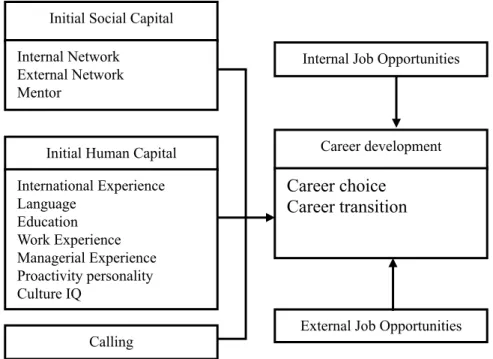
Research frameworkThis study explored the career transition process of expatriates and its consequences, using theories of intellectual capital and career development. In the first year, this study seeked to understand how individual factors, including initial intellectual capital (human capital, social capital) and calling, limit or benefit the career development of international managers. It will also explore how the perception of internal and external job opportunities affects whether the expatriates choose to accept a different assignment in another location or organization, start their own business, stay in the same organization, or return to the parent organization. The framework for the first year is presented in figure 3.
Initial Social Capital Internal Network
External Network Mentor
Initial Human Capital International Experience Language Education Work Experience Managerial Experience Proactivity personality Culture IQ Calling
Internal Job Opportunities
External Job Opportunities Career development
Career choice Career transition
Measures
Social Capital
1.External/internal Networks. We adopted internal networks and external networks scales developed by Eby, Butts, & Lockwood (2003), composed 3 itmes to measure internal networks and 4 items to measure external networks. 2. Mentor support. We adopted Ragins,& McFarlin’s (1990) 33-item scale of mentor support practice, including career and psychosocial mentoring support.
Human Capital
Human capital was measured in terms of international experience, language proficiency, education, work experience, managerial experience and personality. Participants will be asked to state the following:
1.International experience: the number of years of international work experience and the number of years living abroad.
2.Language proficiency: how many languages they have learned, and the degree of proficiency for each language.
3.Education: the number of years of education they received. 4.Work Experience: the number of years of work experience.
5.Managerial Experience: the number of years of managerial experience
6.Personality: For this, we used Bateman & Crant’s (1993) 17-item scale to measure proactive personality.
7.Culture IQ: Cultural IQ were assessed by Chen & Starosta's (2000) “Inter-cultural Communication Sensitivity Scale”, composed of 24 items.
Calling
We adopt Wrzesniewski's (1997) job-career-calling scale, composed 18
true-false items.
Internal/external job opportunities
Internal and external job opportunities were measured by means of a six-item Likert-type scale developed from Eby, Butts, Lockwood (2003). Respondents will report their perceptions on a scale of 1 (low) to 5 (high)