行政院國家科學委員會專題研究計畫 成果報告
組織違背心理契約時員工的偏差與沉默行為反應: 組織道
德氣候的調節作用
研究成果報告(精簡版)
計 畫 類 別 : 個別型 計 畫 編 號 : NSC 100-2410-H-009-003- 執 行 期 間 : 100 年 08 月 01 日至 101 年 07 月 31 日 執 行 單 位 : 國立交通大學管理科學系(所) 計 畫 主 持 人 : 王耀德 計畫參與人員: 博士班研究生-兼任助理人員:謝慧賢 博士班研究生-兼任助理人員:王志傑 博士班研究生-兼任助理人員:陳乙瑄 報 告 附 件 : 出席國際會議研究心得報告及發表論文 公 開 資 訊 : 本計畫可公開查詢中 華 民 國 101 年 10 月 29 日
中 文 摘 要 : 因為其廣泛之影響與對員工關係之負面作用,心理契約違背在 組織行為研究中已受到相當之重視.本研究檢視心理契約違背 對員工工作偏差行為與放棄式沉默行為之影響,並檢視員工道 德氣候知覺對此影響之調節作用.本研究對九個產業的 273 員 工--同事的配對進行問卷資料收集,分析結果顯示,心理契約 違背對員工偏差與沉默行為具有增強作用,而員工道德氣候知 覺會降低契約違背對沉默行為的作用.此結果意涵管理者除要 培養道德氣候,以消除員工的工作偏差與沉默行為,而且要校 正存在的心理契約違背,使組織的員工工作契約管理與其道德 氣候一致,以便能有效消除員工的偏差與沉默行為,提升組織 效. 中文關鍵詞: 心理契約違背,工作偏差行為,放棄式沉默,道德氣候知覺 英 文 摘 要 : Psychological contract breach at work has gained
increasing attention from organizational scholars because of its prevalence and its negative impact on employment relationship. The present study examined the effects of psychological contract breach on an employee's workplace deviance and acquiescent silence behaviors, while also investigating the moderating effect of the employee`s ethical climate perception on the above relationships. Survey data were collected from a sample of 273 employee-coworker pairs across nine high-tech firms in Taiwan. The results showed that psychological contract breach was positively related to both workplace deviance and acquiescent silence. In addition, the relationship between psychological contract breach and acquiescent silence was found to be moderated by ethical climate perception such that the lower the ethical climate perception, the stronger the positive relationship between psychological contract breach and acquiescent silence. Implications for managerial practice not only includes improving the ethical climate to discourage workplace deviance and acquiescent silence, but also includes striving to fix
psychological contract breaches in order to prevent the manifestation of workplace deviance behavior when it aligns with employees' ethical climate
perceptions.
1
行政院國家科學委員會補助專題研究計畫
■成果報告
□期中進度報告
組織違背心理契約時員工的偏差與沉默行為反應:組織道德氣候的調節作用
計畫類別:■個別型計畫 □整合型計畫
計畫編號:NSC 100-2410-H-009-003
-
執行期間:100 年 8 月 1 日至 101 年 7 月 31 日
執行機構及系所:交通大學管理科學系
計畫主持人:王耀德
共同主持人:
計畫參與人員:王志傑、謝慧賢、陳乙瑄
成果報告類型(依經費核定清單規定繳交):■精簡報告 □完整報告
本計畫除繳交成果報告外,另須繳交以下出國心得報告:
□赴國外出差或研習心得報告
□赴大陸地區出差或研習心得報告
■出席國際學術會議心得報告
□國際合作研究計畫國外研究報告
處理方式:
除列管計畫及下列情形者外,得立即公開查詢
□涉及專利或其他智慧財產權,□一年□二年後可公開查詢
中 華 民 國 101 年 10 月 30 日
2
Employee Deviance and Silence as Reactions to Psychological Contract Breach: The Moderating Role of Ethical Climate Perception
Abstract
Psychological contract breach at work has gained increasing attention from organizational scholars because of its prevalence and its negative impact on employment relationship. The present study examined the effects of psychological contract breach on an employee’s workplace deviance and acquiescent silence behaviors, while also investigating the moderating effect of the employee's ethical climate perception on the above relationships. Survey data were collected from a sample of 273 employee-coworker pairs across nine high-tech firms in Taiwan. The results showed that psychological contract breach was positively related to both workplace deviance and acquiescent silence. In addition, the relationship between psychological contract breach and acquiescent silence was found to be moderated by ethical climate perception such that the lower the ethical climate perception, the stronger the positive relationship between psychological contract breach and acquiescent silence. Implications for managerial practice not only includes improving the ethical climate to discourage workplace deviance and acquiescent silence, but also includes striving to fix psychological contract breaches in order to prevent the manifestation of workplace deviance behavior when it aligns with employees’ ethical climate perceptions.
Keywords: psychological contract breach, workplace deviance, acquiescent silence, ethical
3
Introduction
The concept of the psychological contract has often been employed to describe the exchange relationship between individual employees and their organizations, providing a useful theoretical basis for understanding the employee-organization relationship in contemporary organizations. The psychological contract concerns belief in mutual reciprocal obligations between an employee and his/her organization (Rousseau, 1989). However, employees often find that their organizations have failed to fulfill promised obligations (Robinson & Rousseau, 1994). This perception of psychological contract breach often stirs up a variety of responses, including negative affectivities, attitudes, and behaviors (Zhao, Wayne, Glibkowski, & Bravo, 2007) that can dampen the employee's as well as the organization's performance. Extant research on the consequences of psychological contract breach has focused primarily on the negative effects on employees with regards to desirable organizational outcomes such as trust in the organization, job satisfaction, organizational commitment, and optimal in-role and extra-role performance (Cantisano, Domínguez, & Depolo, 2008; Kickul, Lester, & Belgio, 2004; Lester, Turnley, Bloodgood, & Bolino, 2002; Lo & Aryee, 2003; Raja, Johns, & Ntalianis, 2004; Robinson,1996; Robinson & Morrison, 2000; Zhao et al., 2007). Few studies have examined the effects of psychological contract breach on employees’ undesirable work behaviors.
In the literature, some researchers have found that psychological contract breach is positively related to workplace deviance (Bordia, Restubog, & Tang, 2008; Chiu & Peng, 2008). Workplace deviance is defined as a “voluntary behavior of organizational members that violates significant organizational norms, and in so doing, threatens the well-being of the organization and/or its members” (Robinson & Bennett, 1995, p. 556) and has been considered as a type of negative work behavior (Dalal, 2005). Another type of negative work behavior that employees
4
are more likely to use as a response to a psychological contract breach is acquiescent silence. Acquiescent silence refers to a person’s involuntary or passive withholding of relevant ideas or opinions about one’s own work because of the feeling of resignation (Pinder & Harlos, 2001; Van Dyne, Ang, & Botero, 2003). Acquiescent silence has been regarded as a dysfunctional work behavior because it can reduce innovation in the workplace (Argyris & Schön, 1978), interfere with organizational change effort (Ryan & Oestreich, 1991; Morrison & Milliken, 2000), and devastate employees’ job attitudes such as satisfaction and commitment (Morrison & Milliken, 2000; Vakola & Bouradas, 2005). In comparison to an explicit and active act of workplace deviance, the passive and low risk qualities of acquiescent silence make it a more attractive option as a response to perceived contract breach. Employees’ work behaviors and performance are often monitored and controlled in organizations, but acquiescent silence is often unobservable by colleagues or managers. When employees feel that they are unable to right a perceived contract breach, they often stop voicing their concerns about it and engage in behaviors of acquiescent silence, such as withholding comments during a departmental meeting purposely (Morrison & Milliken, 2000), in order to express a soundless remonstrance. Even though acquiescent silence is a more likely potential reaction compared to other reactions to psychological contract breaches, it has generally been ignored in the literature. Thus the first purpose of this study was to examine the manifestation of negative employee work behavior in the form of workplace deviance or acquiescent silence as a response to psychological contract breach.
Another issue deserving our attention is that researchers have not devoted enough effort towards studying the influences of organizational context on the relationship between psychological contract breach and employees’ behavioral responses. It is unlikely that employees
5
in different organizational situations would react similarly to a perceived contract breach. After examining the moderating effects of cognitive variables (e.g., perceived likelihood of punishment, attractive employment alternatives) on the relationship between psychological contract breach and employees’ withdrawal behaviors, Turnley and Feldman (1999) concluded that individual employees’ perceptions of organizational situations can moderate the influences that a perceived contract breach has on their reactions. In the present study, we examined the influence of organizational context by considering individual employees’ ethical climate perceptions as potential moderators of the relationship between psychological contract breach and negative work behaviors. As noted by Barnett and Schubert (2002), ethical climate perception is an important factor that can affect an employee’s cognitive evaluation of the nature of the experienced psychological contract breach. With a higher level of perceived ethical climate, employees often experience feelings of organizational justice and supervisory support (Koh & Boo, 2001), which can help buffer the impact of contract breach on negative work behaviors. The second purpose of this study was to better understand how employees’ perceived ethical climates can moderate the relationship between a perceived psychological contract breach and negative work behavior.
Literature Review and Hypotheses Reactions to Psychological Contract Breach
The psychological contract is one form of social exchange relationship, a key framework for understanding the employment relationship (Shore & Tetrick, 1994). A core element in the psychological contract is an employee’s belief that the organization will fulfill its employment commitments. Psychological contract breach refers to an employee’s cognitive evaluation about
6
his or her employer’s failure in fulfilling promised obligations in the psychological contract (Morrison & Robinson, 1997). When an employee feels that his or her organization has failed to fulfill its employment commitments, the employee will experience a psychological contract breach (Rousseau, 1995).
Affective events theory (AET; Weiss & Cropanzano, 1996) offers a useful framework for understanding the relationship between psychological contract breach and employee behavioral reactions because it takes into account the dynamic nature of work events, affect, and behaviors. AET posits that experiencing a positive or negative work event can elicit affective reactions in employees that, in turn, lead to various affect-driven or judgment-driven work behaviors. According to AET, employees who think that their psychological contracts were violated by their employers are more likely to feel unbalanced in cognition and experience a negative emotion that motivates them to seek retribution by punishing the transgressors. These employees may reduce their positive behaviors toward employers and may further reciprocate with deviant behaviors, such as withholding effort or arriving late at work, in order to reduce their cognitive dissonance in the employment relationship (Uhl-Bien & Maslyn, 2003). Some empirical studies have supported the above conjecture concerning the effects of psychological contract breach on negative employee behaviors in the form of absenteeism (Deery, Iverson, & Walsh, 2006; Johnson & O’Leary-Kelly, 2003), psychological withdrawal behaviors (Lo & Aryee, 2003), and workplace deviance (Bordia et al., 2008; Chiu & Peng, 2008). Thus, the following hypothesis was proposed:
Hypothesis 1: Psychological contract breach is positively related to workplace deviance.
7
acquiescent silence in employees. Acquiescent silence is based on feelings of resignation (Van Dyne et al., 2003, p.1366), which can be elicited by dissatisfaction from having been treated unfairly due to a psychological contract breach. Employees who display resignation and passively accept the psychological breach nevertheless become distrustful of their organizations (Robinson, 1996; Zhao et al., 2007). Affected by the negative feelings, an employee may then choose to reciprocate by engaging in acquiescent silence instead of workplace deviance (Morrison & Milliken, 2000; Pinder & Harlos, 2001). Acquiescent silence is manifested through reluctance in showing concerns or sharing valuable information about work-related problems with colleagues. Compared to workplace deviance, acquiescent silence avoids detection by the manager and subsequent punishment while still causing disruptions in workgroup harmony. Through acquiescent silence, employees can reciprocate mistreatment from their employers by reducing input in their jobs and consequently reduce their cognitive dissonances. Based on the above argument, we generated the following hypothesis:
Hypothesis 2: Psychological contract breach is positively related to acquiescent silence.
The Moderating Role of Ethical Climate Perception
Ethical climate perceptions have been defined as “the prevailing perceptions of typical organizational practices and procedures that have ethical content” (Victor & Cullen, 1988, p. 101). Ethical climate perceptions may influence employees’ reactions to negative work events (e.g., a psychological contract breach) because they serve as “a perceptual lens through which workers diagnose and assess situations” (Cullen, Parboteeah, & Victor, 2003, p. 129). Drawing from the perspective of organizational justice, Koh and Boo (2001) argued that employees who perceive their organizations to be ethical are also likely to perceive their organizations as being
8
fair and supportive of them. That is, employees with a higher level of ethical climate perception will feel that they are receiving fair treatment and supervisory support from their organizations, a belief that can buffer them from the destructive effects of negative work events (Cummins, 1990; Muhammad & Hamdy, 2005).
Social information processing theory (Salancik & Pfeffer, 1978) suggests that individuals in the same organization are exposed to the same social contexts and possess shared information which will affect their attitudes and behaviors. According to this perspective, the ethical climate, which is an immediate social context of the organization, provides important cues to employees about the appropriate actions they can take as a response to perceived psychological contract breaches. For example, under a higher level of perceived ethical climate, the atmosphere of justice and equality permeating an organization can make employees cautious when speculating on the causes of the psychological contract breaches they have experienced. They are less likely to view the breaches as being intentionally and purposefully directed at them. Misunderstanding of the mutual expectations in the employment contract or other uncontrollable, unintentional factors (e.g., the employer being temporarily short of resources for meeting the employee’s expectations) becomes more likely explanations. As a result, the perceived ethical climate can help mitigate the influences of psychological contract breach on negative behavioral responses. In contrast, employees of organizations with a lower level of ethical climate perception are more likely to think that perceived contract breaches are committed on purpose by their employers because this kind of employer behavior is consistent with their impressions of a low ethical climate in their organizations. Thus, they may take negative actions to reciprocate their employer’s actions. Based on the reasoning above, we expected that individual employees’ ethical climate perceptions can buffer the effects of psychological contract breach on negative
9 work behaviors. Hence, the following were proposed:
Hypothesis 3: The effect of employees’ ethical climate perception on the relationship
between psychological contract breach and workplace deviance is such that employees with a lower level of ethical climate perception will have a stronger positive relationship between psychological contract breach and workplace deviance.
Hypothesis 4: The effect of employees’ ethical climate perception on the relationship
between psychological contract breach and acquiescent silence is such that employees with a lower level of ethical climate perception will have a stronger positive relationship between psychological contract breach and acquiescent silence.
Methods Sampling Procedure
In today’s knowledge-based economy, organizations have become increasingly dependent on their highly-skilled knowledge workers and make significant efforts to both strengthen the employee-organization relationship and reduce the likelihood psychological contract breach. Since employees in high-tech firms are critical in organizational performance, employee engagement in workplace deviance and acquiescent silence will greatly hamper the performance of their companies. Therefore, we were particularly interested in understanding high-tech employees’ negative behavioral reactions (i.e., deviant and silent behaviors) to psychological contract breach.
high-10
technology firms which included electronics, semiconductors, telecommunications, information technology, and software companies. We contacted the managers of these companies and requested consent for their employees to participate in our study. To avoid common method bias, we collected measures of independent variables and dependent variables from different respondents using the employee-coworker-pair design. A survey packet containing an employee’s questionnaire and a coworker questionnaire was given to each employee-coworker pair. In the employee questionnaire, the respondent was asked to assess his/her perception concerning how well his/her psychological contract had been fulfilled by the employer and his/her perceived level of organizational ethical climate. The respondent then identified a coworker who was familiar with the employee’s work and asked that coworker to complete the coworker questionnaire which was in a separate, sealed envelope. That questionnaire asked the coworker to rate the employee’s manifested behaviors of workplace deviance and acquiescent silence. The employee was asked to refrain from discussing the content of the coworker questionnaire, which was attached with a stamped envelope enabling the coworker to bypass the employee and directly return the questionnaire to the researcher. Both the employee and the coworker were assured of confidentiality in a letter stating that their responses to the questionnaires would remain anonymous and be used only for this research. A total of 450 packets were distributed and 284 were returned. After eliminating unmatched pairs, the final sample comprised of 273 pairs, yielding a valid response rate of 61%. Of the 273 respondents, 46.9% were males and 53.1% were females. The age of the respondents ranged from 21 to 63 years, with a mean of 33.87 years (SD = 8.42 years).
11
Because the measures we used were adapted from scales that originally appeared in English-language literature, a back-translation procedure (Brislin, 1986) was used to ensure the accuracy and semantic equivalence of translation from English into Chinese. First, a bilingual expert was hired to translate the English version of the scales into Chinese. Next, a different bilingual expert independently translated the Chinese version back into English. The translated English version was then compared to the original English version by the two experts and inconsistencies in verbal and semantic equivalence were used to guide a revision of the Chinese translation. Subsequent back translation to English, comparison, and revision of the Chinese translation was repeated until no further inconsistencies were detected between the original and back translated English versions. This procedure ensured the content validity of the measures.
Psychological contract breach. Psychological contract breach was measured using five
items adapted from Robinson and Morrison (2000). Sample items include: “Almost all the promises made by my employer during recruitment have been kept so far” (reverse scored) and “I have not received everything promised to me in exchange for my contributions.” Respondents were asked to evaluate their perceptions of how well their psychological contracts had been fulfilled by their employers using a 5-point Likert-type scale ranging from 1 (strongly disagree) to 5 (strongly agree). The Cronbach’s alpha for this scale was .87.
Ethical climate perception. To measure respondents’ perceptions of the ethical climate of
their organizations, we used Victor and Cullen’s (1988) 26-item ethical climate scale with five subscales including: caring climate (7 items; e.g., “What is best for everyone in the company is the major consideration here”), law and code climate (4 items; e.g., “In this company, the law or ethical code of their profession is the major consideration”), rules climate (4 items; e.g., “Everyone is expected to stick by company rules and procedures”), instrumental climate (7 items;
12
e.g., “In this company, people protect their own interests above all else”), independence climate (4 items; e.g., “In this company, people are expected to follow their own personal and moral beliefs”). Respondents were asked to rate how accurately each of the items described the ethical climates of their organizations on a 5-point Likert-type scale ranging from 1 (strongly disagree) to 5 (strongly agree). The Cronbach’s alpha were .79, .83, .77, .79, and .72 for caring climate, law and code climate, rules climate, instrumental climate, and independence climate, respectively. The Cronbach’s alpha for the entire scale was .86.
Workplace deviance. Stewart et al.’s (2009) 14-item scale was used to measure
workplace deviance with three subscales including: production deviance (7 items; e.g., “Put little effort into their work”), property deviance (3 items; e.g., “Took property from work without permission”), personal aggression (4 items; e.g., “Said something hurtful to someone at work”). Because this scale was developed based upon the observer-report approach, we asked a coworker to rate the workplace deviance of an employee. The rater (i.e., coworker) was asked to indicate how often the employee had engaged in the above deviant behaviors during the past 6 months using a 5-point Likert-type scale ranging from 1 (never) to 5 (always). The Cronbach’s alpha were .85, .70, and .82 for production deviance, property deviance, and personal aggression, respectively. The Cronbach’s alpha for the entire scale was .84.
Acquiescent silence. Acquiescent silence was assessed using five items adapted from Van
Dyne et al. (2003). A sample item is “This employee is unwilling to speak up with suggestions for change because he/she is disengaged.” To avoid common method bias, we used a coworker to rate the acquiescent silence of an employee. The rater was asked to indicate the extent to which the employee withheld his or her ideas, concerns, questions, or information about work-related improvements in their work group on a 5-point Likert-type scale ranging from 1 (strongly
13
disagree) to 5 (strongly agree). The Cronbach’s alpha for the entire scale was .85.
Control variables. The demographic variables of gender and age were included as control
variables in the statistical analyses used in this study. These control variables were assessed using an open-ended response format. A dummy-coded variable was used for gender (0 = female and 1 = male).
Data Analysis
Confirmatory factor analysis (CFA) was conducted to examine the convergent and divergent validities of our measures. To reduce the number of parameters and to keep a reasonable degree of freedom when conducting CFA, we used the item parceling method (Bagozzi & Edwards, 1998) on the variables ethical climate perception and workplace deviance, because they consisted of more than seven items. Ethical climate perception was modeled using five parcels corresponding to its five dimensions, and workplace deviance was modeled using three parcels corresponding to its three dimensions. Subsequently, we used hierarchical regression analysis to verify our hypotheses. Hierarchical regression analysis was chosen for testing interaction effects because it allowed us to examine the explanatory power of independent and moderating variables according to their causal priorities (Cohen & Cohen, 1983). All interactive variables were mean-centered in order to reduce their multicollinearities (Aiken & West, 1991).
Results
Before testing our hypotheses, we used CFA to check for the distinctions between the four main variables in our study. Table 1 shows that the four-factor model—psychological contract breach, ethical climate perception, workplace deviance, and acquiescent silence—was a better fit (χ2 [129] = 308.19; CFI = .90, IFI = .90, SRMR = .06, RMSEA = .07) than the other
14
three models that combined the four variables into a fewer number of factors. Chi-square difference tests also showed a significantly better fit for the four-factor model compared to the other three models (see Table 1). These results provide evidence for the attainment of satisfactory discriminant validity on the four variables. Moreover, the factor loadings of the items in each of the four variables were statistically significant (p < .05), indicating that a satisfactory convergent validity was attained (Anderson & Gerbing, 1988). Taken together, all the above results provide sufficient confidence in the convergent and discriminant validities of the measurement of the variables.
INSERT TABLE 1 ABOUT HERE
Table 2 presents the results of the descriptive statistics and zero-order correlations of the variables used in the present study. As expected, psychological contract breach was positively correlated with both workplace deviance (r = .14, p < .05) and acquiescent silence (r = .16, p < .01), while gender, age, and ethical climate perception were not.
INSERT TABLE 2 ABOUT HERE
Hypothesis Testing
Results from the hierarchical regression analysis (Table 3) show that psychological contract breach was positively related to both workplace deviance (β = .152, p < .05) and acquiescent silence (β = .160, p < .05). Therefore, Hypotheses 1 and 2 were supported.
For validating Hypotheses 3 and 4, we followed Aiken and West’s (1991) suggestion for centering the variables used in the interaction term before entering them into the regression equations. Hypothesis 3 was not supported by the results of the hierarchical regression analysis.
15
As shown in Table 3, the regression coefficient of the interaction term in Model 3 was not significant (β = -.046, p > .05; R2 change = .002, p > .05), indicating that the hypothesized moderating effect of ethical climate perception on the contract breach-workplace deviance relationship was not confirmed.
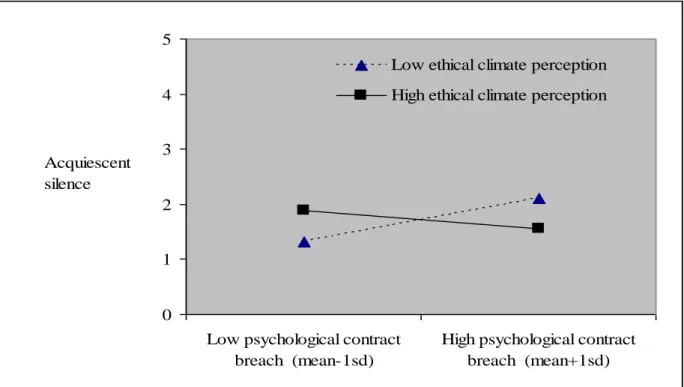
On the other hand, Hypothesis 4 was supported by the results of the hierarchical regression analysis. The regression coefficient of the interaction term in Model 6 (β = -.153, p < .05; R2 change = .023, p < .05) was significant, which supports the hypothesized moderating effect of ethical climate on the contract breach—acquiescent silence relationship. The negative sign of the beta coefficient of the interaction term is in opposite direction to the positive sign of the beta coefficient of the perceived ethical climate, suggesting that the moderation effect is nonmonotonic (Schoonhoven, 1981). Simple slopes tests showed that psychological contract breach was significantly positively related to acquiescent silence at a lower level of ethical climate perception (β = .302, p < .001), but unrelated to the silence at a higher level of ethical climate perception (β =.043, p > .05; see Figure 1).
INSERT TABLE 3 ABOUT HERE
INSERT FIGURE 1 ABOUT HERE
Discussion
We extended previous research on psychological contract breach and negative work behaviors by using different information sources for data collection to examine psychological contract breach in relation to workplace deviance and acquiescent silence. In addition, we examined the interaction effects of psychological contract breach and ethical climate perception
16
on workplace deviance and acquiescent silence. This study contributes to the literature by using a set of data uncontaminated by the common method bias to give a more accurate validation of the above relationships and effects.
Consistent with AET (Weiss & Cropanzano, 1996) and previous empirical studies in the literature (e.g., Bordia et al., 2008; Chiu & Peng, 2008), our results confirmed that psychological contract breach is positively related with workplace deviance. This suggests that when employees experience a psychological contract breach, they are likely to reciprocate the unfair treatment by engaging in workplace deviance. The positive relationship between psychological contract breach and acquiescent silence also suggests that a contract breach may trigger feelings of resignation in employees, resulting in the use of acquiescent silence as an alternative to workplace deviance. This finding coincides with Pinder and Harlos’s (2001) argument suggesting that employees often choose to remain silent as a response to their perceived organizational injustice (e.g., a perceived contract breach).
The results of the moderated regression analyses confirmed that perceived ethical climate moderates the positive relationship between psychological contract breach and acquiescent silence in such a way that the strength of the positive relationship is higher when the perceived ethical climate is lower. This finding suggests that the ethical climate may play a role in refraining employees from withholding ideas, information, and opinions about work-related problems when they experience psychological contract breach. Thus, an organization can attenuate the impact of psychological contract breaches on its employees’ behavior of acquiescent silence by cultivating a higher ethical climate.
The results showing an insignificant moderating effect of ethical climate on the psychological contract breach—workplace deviance relationship are inconsistent with
17
Hypothesis 3. A plausible explanation for this unexpected finding lies in the difference between workplace deviance and acquiescent silence. Compared to acquiescent silence, workplace deviance is directed at the employer rather than at other employees in the organization (e.g., coworkers in the same work unit) who are not complicit in the contract breach. The ethical climate may fail to mitigate the effect of contract breach on deviance behaviors since it emphasizes the norm of justice and equality, allowing employees to feel that engaging in deviant behavior is an equitable reciprocation to their employer’s psychological contract breach. Acquiescent silence, however, is perceived as inequitable by others and violates the norm of reciprocation for fairness expected by the ethical climate because it affects innocent coworkers. Thus, employees under a higher level of perceived ethical climate will be less likely to engage in acquiescent silence in their response to a perceived psychological contract breach.
Practical Implications
The present study has several practical implications for managers. The findings of a positive relationship between psychological contract breach and behaviors of workplace deviance and acquiescent silence suggest that in order to reduce employee workplace deviance and silence, managers should work hard to fulfill the perceived psychological contract in an employment relationship and keep managerial practices and company policies consistent with the expectations in the contract. In addition, the finding that ethical climate has a moderating effect on the relationship between psychological contract breach and acquiescent silence underscores the importance for managers to improve organizational ethical climate in order to buffer the effect of unintentional psychological contract breaches on acquiescent silence. At the individual level, it may be difficult to prevent some employees from perceiving breaches of psychological contract that were unintentional on the part of the employer. However, at the
18
group level, a high level of ethical climate will prevent those few employees from engaging in acquiescent silence. The lack of a moderating effect from perceived ethical climate on the contract breach—workplace deviance relationship suggests that ethical climate is insufficient for discouraging employees from engaging in workplace deviance when they perceive a psychological contract breach. An action of remedy that corrects the breach in contract would probably be more effective for preventing a response in the form of workplace deviance.
Limitations of the Study
Despite its contributions, the present study was not without limitations. The first limitation is that this study was conducted in a single, high-tech industry in Taiwan, limiting the generalizability of its findings. Application of the findings to different industries or different societies must be made with caution.
The second limitation is that because of the cross-sectional nature of our data, the direction of the causality of the variables in the hypotheses could not be ascertained, and caution must be exerted when making any causal inferences on the basis of our findings. In order to address this limitation, we used different sources for assessing the independent and the dependent variables so as to decrease the likelihood for a reversal in the cause-effect direction. In other words, the opportunity for our survey respondents, the employees, to infer their perceptions regarding psychological contract breach (the independent variables) from their own behaviors of workplace deviance or acquiescent silence (the dependent variables) was prevented because their coworkers were the ones that provided assessment of their behaviors.
The third limitation is that our study did not demonstrate a strong effect of psychological contract breach on workplace deviance and acquiescent silence (R2 = .021 and .025 respectively, Table 3) or a strong moderating effect of ethical climate on the relationship between
19
psychological contract breach and acquiescent silence (R2 = .023, Table 3). This may suggest that it is of low priority to implement the changes in managerial practices according to the practical implications concluded from our study. However, when taking into account the use of one source to assess the independent and moderating variables and a different source to assess the dependent variables, the weaker correlations between the variables could represent an evaluation that is more accurate and believable by avoiding inflation of the explanatory power of an independent or moderating variable due to common source bias.
20
References
Aiken, L. S., & West, S. G. (1991). Multiple regression: Testing and interpreting interactions. Newbury Park, CA: Sage.
Anderson, J. C., & Gerbing, D. W. (1988). Structural equation modeling in practice: A review and recommended two-step approach. Psychological Bulletin 103, 411-423.
Argyris, C., & Schön, D. (1978). Organizational learning: A theory of action perspective. Reading, MA: Addison-Wesley.
Bagozzi, R. P., & Edwards, J. R. (1998). A general approach for representing constructs in organizational research. Organizational Research Methods, 1, 45-87.
Barnett, T., & Schubert, E. (2002). Perception of the ethical work climate and covenantal relationships. Journal of Business Ethics, 36, 279-290.
Bordia, P., Restubog, S. L. D., & Tang, R. L. (2008). When employees strike back: Investigating mediating mechanisms between psychological contract breach and workplace deviance.
Journal of Applied Psychology, 93, 1104-1117.
Brislin, R. W. (1986). The wording and translation of research instrument. In W. Lonner & J. Berry (Eds.), Field methods in cross-cultural research (pp. 137-164). Beverly Hills: Sage. Cantisano, G. T., Domínguez, J. F. M., & Depolo, M. (2008). Psychological contract breach and
outcomes: Combining meta-analysis and structural equation models, Psicothema, 20, 487-496.
Chiu, S. F. & Peng, J. C. (2008). The relationship between psychological contract breach and employee deviance: The moderating role of hostile attributional style. Journal of
Vocational Behavior, 73, 426-433.
21
behavioral sciences (2nd ed.). Hillsdale, NJ: Erlbaum.
Cullen, J. B., Parboteeah, K. P., & Victor, B. (2003).The effects of ethical climates on organizational commitment: A two-study analysis. Journal of Business Ethics, 46, 127-141.
Cummins, R. (1990). Job stress and the buffering effect of supervisory support. Group &
Organization Studies, 15, 92-104.
Dalal, R. S. (2005). A meta-analysis of the relationship between organizational citizenship behavior and counterproductive work behavior. Journal of Applied Psychology, 90, 1241-1255.
Deery, S. T., Iverson, R. D., & Walsh, J. T. (2006). Toward a better understanding of PCB: A study of customer service employees. Journal of Applied Psychology, 91, 166-175.
Hofstede, G. & Bond, M. (1988). The Confucius connection: From cultural roots to economic growth. Organizational Dynamics, 16, 4-21.
Johnson, J. L., & O’Leary-Kelly, A. M. (2003). The effects of psychological contract breach and organizational cynicism: Not all social exchange violations are created equal. Journal of
Organizational Behavior, 24, 627-647.
Kickul, J., Lester, S. W., & Belgio, E. (2004). Attitudinal and behavioral outcomes of psychological contract breach: A cross-cultural comparison of the United States and Hong Kong Chinese. International Journal of Cross Cultural Management, 4, 229-252.
Koh, H. C., & Boo, E. H. Y. (2001). The link between organizational ethics and job satisfaction: A study of managers in Singapore. Journal of Business Ethics, 29, 309-324.
Lester, S. W., Turnley, W. H., Bloodgood, J. M., & Bolino, M. C. (2002). Not seeing eye to eye: Differences in supervisor and subordinate perceptions of and attributions for psychological
22
contract breach. Journal of Organizational Behavior, 23, 39-56.
Lo, S., & Aryee, S. (2003). Psychological contract breach in a Chinese context: An integrative approach. Journal of Management Studies, 40, 1005-1020.
Morrison, E. W, & Robinson, S. L. (1997). When employees feel betrayed: A model of how psychological contract violation develops. Academy of Management Review, 22, 226-256. Morrison, E. W., & Milliken, F. J. (2000). Organizational silence: A barrier to change and
development in a pluralistic world. Academy of Management Review, 25, 706-725.
Muhammad, A. H., & Hamdy, H. I. (2005). Burnout, supervisory support and work outcomes: A study from an Arabic cultural perspective. International Journal of Commerce and
Management, 15, 230-240.
Pinder, C. C., & Harlos, K. P. (2001). Employee silence: Quiescence and acquiescence as responses to perceived injustice. Research in Personnel and Human Resources
Management, 20, 331-369.
Raja, U., Johns, G., & Ntalianis, F. (2004). The impact of personality on psychological contracts.
Academy of Management Journal, 47, 350-367.
Robinson, S. L, & Rousseau, D. M. (1994). Violating the psychological contract: Not the exception but the norm. Journal of Organizational Behavior, 15, 245-259.
Robinson, S. L. & Bennett, R. J. (1995). A typology of deviant workplace behaviors: A multidimensional scaling study. Academy of Management Journal, 38, 555-572.
Robinson, S. L. (1996). Trust and breach of the psychological contract. Administrative Science
Quarterly, 41, 574-599.
Robinson, S. L., & Morrison, E. W. (2000). The development of psychological contract breach and violation: A longitudinal study. Journal of Organizational Behavior, 21, 525-546.
23
Rousseau, D. M. (1989). Psychological and implied contracts in organizations. Employee
Responsibilities and Rights Journal, 2, 121-139.
Rousseau, D. M. (1995). Psychological contracts in organizations: Understanding written and
unwritten agreements. Thousand Oaks, CA: Sage.
Ryan, K. D., & Oestreich, D. K. (1991). Driving fear out of the workplace: How to overcome the
invisible barriers to quality, productivity, and innovation. San Francisco: Jossey-Bass.
Salancik, G. R., & Pfeffer, J. (1978). A social information processing approach to job attitudes and task design. Administrative Science Quarterly, 23, 224-253.
Schoonhoven, C. B. (1981). Problems with contingency theory: Testing assumptions hidden within the language of contingency theory. Administrative Science Quarterly, 26, 349-377. Shore, L. M., & Tetrick, L. E. (1994). The psychological contract as an explanatory framework in the employment relationship. In C. L. Cooper, & D. M. Rousseau (Eds.), Trends in
organizational behavior (pp. 91-109). New York: Wiley.
Stewart, S. M., Bing, M. N., Davison, H. K., Woehr, D. J., & McIntyre, M. D. (2009). In the eyes of the beholder: A non-self-report measure of workplace deviance. Journal of Applied
Psychology, 94, 207-215.
Turnley, W. H., & Feldman, D. C. (1999). The impact of psychological violations on exit, voice, loyalty, and neglect. Human Relations, 52, 895-922.
Uhl-Bien, M., & Maslyn, J. M. (2003). Reciprocity in manager-subordinate relationships: Components, configurations and outcomes. Journal of Management, 29, 511-532.
Vakola, M., & Bouradas, D. (2005). Antecedents and consequences of organizational silence: An empirical investigation. Employee Relations, 27, 441-458.
24
voice as multidimensional constructs. Journal of Management Studies, 40, 1359-1392. Victor, B., & Cullen, J. B. (1988). The organizational bases of ethical work climates.
Administrative Science Quarterly, 33, 101-125.
Weiss, H. M., & Cropanzano, R. (1996). Affective events theory: A theoretical discussion of the structure, causes, and consequences of affective experiences at work. Research in
Organizational Behavior, 18, 1-74.
Zhao, H.,Wayne, S. J., Glibkowski, B. C, & Bravo, J. (2007). The impact of psychological contract breach on work-related outcomes: A meta-analysis. Personnel Psychology, 60, 647-680.
25
Table 1.
Results of Confirmatory Factor Analyses
Model χ2 df CFI IFI SRMR RMSEA Δχ2(Δdf)
Four-factor model 308.19 129 .90 .90 .06 .07 --
Three-factor model 1a 338.56 132 .87 .87 .07 .08 30.37** (3) Three-factor model 2b 568.14 132 .78 .78 .09 .11 259.95** (3) One-factor model 1562.08 135 .42 .43 .17 .20 1253.89** (6)
Note. Δχ2 and Δdf denote differences between the four-factor model and other models. CFI = comparative fit index; IFI = incremental fit index; SRMR = standardized root mean square residual; RMSEA = root mean square error of approximation.
a
This model combines workplace deviance and acquiescent silence into one factor. b
This model combines psychological contract breach and ethical climate perception into one factor.
**
26
Table 2.
Descriptive Statistics and Zero-order Correlations of the Study Variables
Note. Cronbach’s alpha is in parentheses.
a
Dummy coded variable: 0 = female; 1= male *p < .05; **p < .01.
Variable M SD 1 2 3 4 5 6
1. Gendera .47 .50 --
2. Age 33.87 8.42 .13* --
3. Ethical climate perception 3.34 .32 .13* .08 (.86) 4. Psychological contract breach 2.57 .65 .14* .01 .18** (.87)
5. Workplace deviance 1.43 .27 -.03 -.01 -.01 .14* (.84)
27
Table 3.
Results of Hierarchical Regression Analyses
Workplace deviance Acquiescent silence Model 1 Model 2 Model 3 Model 4 Model 5 Model 6
Gendera -.027 -.051 -.049 .013 -.013 -.009
Age .002 .002 .001 -.010 -.010 -.017
Ethical climate perception -.002 .029 .031 -.036 -.004 .001 Psychological contract
breach
.152* .154* .160* .169**
Ethical climate perception × psychological contract breach -.046 -.153* R2 .001 .022 .024 .001 .026 .049 F .063 1.531 1.340 .132 1.768 2.744* R2 change .021 .002 .025 .023 F change 5.931* .586 6.669* 6.503*
Note. N = 273. Standardized regression coefficients (beta) are shown in each equation.
a
Dummy coded variable: 0 = female; 1= male *p < .05; **p < .01.
28 0 1 2 3 4 5
Low psychological contract breach (mean-1sd)
High psychological contract breach (mean+1sd) Acquiescent
silence
Low ethical climate perception High ethical climate perception
Figure 1. The moderating effects of ethical climate perception on the relationship between
國科會補助計畫衍生研發成果推廣資料表
日期:2012/10/29國科會補助計畫
計畫名稱: 組織違背心理契約時員工的偏差與沉默行為反應: 組織道德氣候的調節作用 計畫主持人: 王耀德 計畫編號: 100-2410-H-009-003- 學門領域: 人力資源管理無研發成果推廣資料
100 年度專題研究計畫研究成果彙整表
計畫主持人:王耀德 計畫編號: 100-2410-H-009-003-計畫名稱:組織違背心理契約時員工的偏差與沉默行為反應: 組織道德氣候的調節作用 量化 成果項目 實際已達成 數(被接受 或已發表) 預期總達成 數(含實際已 達成數) 本計畫實 際貢獻百 分比 單位 備 註 ( 質 化 說 明:如 數 個 計 畫 共 同 成 果、成 果 列 為 該 期 刊 之 封 面 故 事 ... 等) 期刊論文 0 0 100% 研究報告/技術報告 0 0 100% 研討會論文 0 0 100% 篇 論文著作 專書 0 0 100% 申請中件數 0 0 100% 專利 已獲得件數 0 0 100% 件 件數 0 0 100% 件 技術移轉 權利金 0 0 100% 千元 碩士生 0 0 100% 博士生 0 0 100% 博士後研究員 0 0 100% 國內 參與計畫人力 (本國籍) 專任助理 0 0 100% 人次 期刊論文 0 0 100% 研究報告/技術報告 0 0 100% 研討會論文 1 1 100% 篇 論文著作 專書 0 0 100% 章/本 申請中件數 0 0 100% 專利 已獲得件數 0 0 100% 件 件數 0 0 100% 件 技術移轉 權利金 0 0 100% 千元 碩士生 0 0 100% 博士生 3 3 100% 訓 練 博 士 生 對 研 究 計 畫 整 體 執 行 工作之熟悉,以便 將 來 能 夠 獨 立 從 事研究. 博士後研究員 0 0 100% 國外 參與計畫人力 (外國籍) 專任助理 0 0 100% 人次其他成果
(
無法以量化表達之成 果如辦理學術活動、獲 得獎項、重要國際合 作、研究成果國際影響 力及其他協助產業技 術發展之具體效益事 項等,請以文字敘述填 列。) 無 成果項目 量化 名稱或內容性質簡述 測驗工具(含質性與量性) 0 課程/模組 0 電腦及網路系統或工具 0 教材 0 舉辦之活動/競賽 0 研討會/工作坊 0 電子報、網站 0 科 教 處 計 畫 加 填 項 目 計畫成果推廣之參與(閱聽)人數 0國科會補助專題研究計畫成果報告自評表
請就研究內容與原計畫相符程度、達成預期目標情況、研究成果之學術或應用價
值(簡要敘述成果所代表之意義、價值、影響或進一步發展之可能性)
、是否適
合在學術期刊發表或申請專利、主要發現或其他有關價值等,作一綜合評估。
1. 請就研究內容與原計畫相符程度、達成預期目標情況作一綜合評估
■達成目標
□未達成目標(請說明,以 100 字為限)
□實驗失敗
□因故實驗中斷
□其他原因
說明:
2. 研究成果在學術期刊發表或申請專利等情形:
論文:■已發表 □未發表之文稿 □撰寫中 □無
專利:□已獲得 □申請中 ■無
技轉:□已技轉 □洽談中 ■無
其他:(以 100 字為限)
已將研究計畫部分成果發表於 2012 年在大阪舉辦之 Third Asian Conference on Social Sciences,
題目為''Organizational Ethical Climate and Employee Silence: A Cross-Level Analysis.''