行政院國家科學委員會專題研究計畫 成果報告
邁向英語文教師專業發展之學習社群:探究社群文化以及
中介思考工具在專業發展之意義
研究成果報告(精簡版)
計 畫 類 別 : 個別型 計 畫 編 號 : NSC 95-2411-H-004-029- 執 行 期 間 : 95 年 08 月 01 日至 96 年 07 月 31 日 執 行 單 位 : 國立政治大學英國語文學系 計 畫 主 持 人 : 招靜琪 計畫參與人員: 博士班研究生-兼任助理:蔣宗益、王慧娟 處 理 方 式 : 本計畫可公開查詢中 華 民 國 96 年 10 月 16 日
行政院國家科學委員會補助專題研究計畫
V
成 果 報 告
□期中進度報告
英語文教師學習社群:探究學習文化以及中介思考工具在專業發展之意義
Towards a Learning Community for EFL Professional Development: Focusing on the Culture of Learning as the Mediation Tool
計畫類別:個別型計畫 (新進人員)
計畫編號:NSC 95-2411-H -004-029-
執行期間:九十五年八月至九十六年七月
計畫主持人:招靜琪
共同主持人:
計畫參與人員: 蔣宗益、王慧娟
成果報告類型(依經費核定清單規定繳交):V 精簡報告
□完整報告
本成果報告包括以下應繳交之附件:
□赴國外出差或研習心得報告一份
□赴大陸地區出差或研習心得報告一份
□出席國際學術會議心得報告及發表之論文各一份
□國際合作研究計畫國外研究報告書一份
處理方式:除產學合作研究計畫、提升產業技術及人才培育研究計畫、
列管計畫及下列情形者外,得立即公開查詢
□涉及專利或其他智慧財產權,□一年□二年後可公開查詢
執行單位:國立政治大學
中
華
民
國九十六年 十 月 十四 日
可供推廣之研發成果資料表
□ 可申請專利 □ 可技術移轉 日期: 年 月 日國科會補助計畫
計畫名稱: 計畫主持人: 計畫編號: 學門領域:技術/創作名稱
發明人/創作人
中文: (100~500 字)技術說明
英文:可利用之產業
及
可開發之產品
技術特點
推廣及運用的價值
※ 1.每項研發成果請填寫一式二份,一份隨成果報告送繳本會,一份送 貴單位 研發成果推廣單位(如技術移轉中心)。 ※ 2.本項研發成果若尚未申請專利,請勿揭露可申請專利之主要內容。 ※ 3.本表若不敷使用,請自行影印使用。英語文教師學習社群:探究學習文化以及中介思考工具在專業發展之意義 Towards a Learning Community for EFL Professional Development:
Focusing on the Culture of Learning as the Mediation Tool
Introduction
Around the mid 1990s, there were heated debates in the international field of TESOL, spreading across many major journals, including Applied Linguistics (1993), Modern Language
Journal (1994), and TESOL Quarterly (1997). Researchers following the positivist tradition were
challenged by a growing number of critics who started to see the problem of having the field dominated by only one type of ontology and epistemology (i.e., positivism) and by limited ways of explaining the process of language learning (i.e., the UG or the cognitive science). This group of critics and researchers, including Lantolf (1996), Firth and Wagner (1997), and
Larson-Freeman (2002), questioned the power of explanation rendered solely by cognitive science and through experimental studies on the complex phenomena involved in TESOL. Their discussions focused on Sociocultural Theory (SCT), developed by Vygotsky around the 1930s, and investigated how the emphasis of mediation and interaction on human development could provide alternative explanations for data collected from natural contexts. Instead of depending completely on experimental studies, these researchers have also adopted more qualitative methods in acquiring a deeper understanding of learner agency in the activity of developing language proficiency and learner participation in real-world practices (see Zuengler & Miller, 2006, for more information).
Today, more than 15 years after the debates, researchers following the SCT paradigm are active in a variety of trends of research in TESOL. Their communities are growing strong in
second language academic writing (e.g., Cansanave & Vandrickm 2003), teacher professional development (e.g., Karen Johnson), and technology or CALL (e.g., Steven Thorne), and many
others. Often researchers take SCT as a given, viewing the approach as widely accepted and understood.
While this is the case with the international field of TESOL, the changing paradigm is not as obvious here in Taiwan, and our researchers in SCT do not seem to be as active either. One needs only to take any conference proceedings or local TESOL-related journals to see an extremely low number of studies adopting SCT as the analysis framework. The reasons could be that it involves too steep a learning curve to move from positivism to relativism and that the paradigm shift is less acknowledged (or acceptable?) in our local academic community.
This researcher is interested in how graduate students, in this case who are also practicing teachers, dealt with the new paradigm when given the chance to learn about it. For the purpose of this study, I set the new paradigm to mean “qualitative inquiry”only, and I supported the student with a learning community setup, hoping that it would provide a safe heaven for them to explore difficult issues and resolve possible intellectual conflicts. The focus of this study was on (1) the culture of learning surrounding the community, (2) the struggles the participants had and how
they managed the struggles and conceptual conflicts, and (3) how the learning community helps.
Research Questions Three research questions below have guided this investigation:
1. When a learning community is formed to support a group of graduate students/practicing language teachers in developing concepts for qualitative inquiry, what culture of learning is influencing the members and their activities?
2. How do members perceive the learning community and its surrounding culture as scaffolding measures for their professional development?
3. What strategic orientations do members take to develop the necessary mediation tools for their studies?
Literature and Background
Before the research design is discussed, it is necessary to explain concepts central to this proposed investigation: (1) mediation in Vygotsky sociocultural perspective, (2) the cultural of learning, and (3) learning community.
‘Mediation’in Vygotsky Sociocultural Perspective
In Vygotsky Socioculturalperspective,‘mediation’refers to the physical and symbolic tools (e.g., language and signs) and activities that human beings rely on to change the world around them and to regulate their relationships with others. Mediation is signs, tools, and practices for thoughts, or “means and practices which, through social interaction, become internalized and thus available for independent activity”(John-Steiner, et al, 1994, p. 141). Examples include the use of knots, pictures, and language as means of recording events in the history of human beings. Mediation tools like these are cultural products indispensable for higher, or culturally shaped, mind which has already integrated symbolic artifacts into thinking through social interaction. For example, both Vygotsky’s asking children to replace color terms with colored cards and Wertsch’s (1998) asking an adult to multiply two sets of high numbers (such as 123X 456) have been
proved to be very difficult, because thought tools, or mediations, are indispensable.
The mediated nature of the human mind is fundamental to sociocultural theory (Lantolf, 2000). It has been considered Vygotsky’s most important and unique contribution (Wertsch, 1985, p.15). Bruner (1962) pointed out that Vygotsky
believed that in mastering nature we master ourselves. For it is the internationalization of overt action that makes thought, and particularly the internalization of external dialogue that brings the powerful tool of language to bear on the stream of thought. Man, if you will, is shaped by the tools and instruments that he comes to use, and neither the hand nor the intellect alone prevails, the tools and aids that do are the developing streams of internalized language and conceptual thoughts that sometimes run parallel and sometimes merge, each affecting the other. (p. vii)
In Vygotsky’s view, it is important to understand how human social and mental activity is organized through culturally constructed artifacts. He believed to develop higher functions
requires conscious control and internalization of signs, tools, and practices which allow learners to control or regulate their own as well as other’s activity. This process is considered social in two senses. First of all, signs, tools, and practices for thoughts, such as language, concepts, or other symbol systems, are “products of sociocultural evolution”(John-Steiner, et al, 1994, p. 141). These tools, available to individuals affiliated to a community, were invented and developed over the long history of human beings. No individual could have single-handedly brought the tools into being nor could one exclusively inherent the tools. Second, these tools must be acquired through the processes of social interaction. In the process of acquisition, one does not only learn to use the tools but also the social organization and the cultural process associated with the tool and the activity. As individuals master the tool, it is possible to see increasing role of
self-formulated plans and goals in the regulation of behavior and cognitive activity.
The Culture of Learning
Brown, Collins, and Duguid (1989) in their seminal work on situated cognition and the culture of learning emphasizes that learning does not happen in a vacuum; instead, learning is attached to the unique culture around it. They argued that
theactivity in which knowledgeisdeveloped and deployed…isnotseparablefrom or ancillary to learning and cognition. Nor is it neutral. Rather, it is an integral part of what is learned. (p. 32)
In addition to the situated nature of learning, these researchers also argue that knowledge and concept are progressively developed through activity. Like tools, the more conceptual
knowledge is used, the more it can change thelearner’sview oftheworld and allow theadoption of the belief system of the culture in which the conceptual knowledge is used. It is in the process of using the conceptual tools that the learner gradually develops him/herself into a legitimate member of the community of practice.
In order to endure learning, Brown et al., also point out that learners often develop survival skills to deal with theuniqueculturesurrounding theactivity.Sometimesin thelearner’smind such survival skills may be more prominent than the knowledge or concept that is supposed to be learned.
What socially created mediation tools and the culture of learning suggest to educators is that it is important to pay attention to what kind of signs, tools, and practices are being consciously internalized by learners and whether these tools really allow individuals to regulate activities.
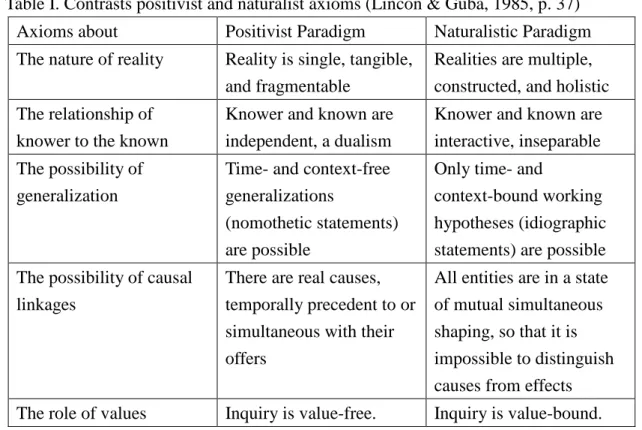
Paying attention to learning cultures is particularly important when helping students develop QI expertise. Lincon and Guba (1985) have contrasted positivist with naturalist axioms, or basic beliefs, using Table I below (p. 37). While positivist paradigm treats reality as a single, tangible and fragmentable unit, naturalistic paradigm underlying inquiry takes it as multiple, constructed and holistic. The relationship between researchers and the researched is also different: while positivists take a dualism point of view and look at the two as independent from each other, naturalistic researchers believe the two are interactive and inseparable. In terms of generalization, positivist paradigm pursues time- and context-free generalization, while naturalistic paradigm believes that generalization is always time and context-bound. Positivist paradigm believes there
are real causes to phenomena, but naturalistic paradigm believes it is impossible to tell causes from effects. Finally, while positivists believe that inquiry can be value-free (objective);
qualitative researchers think research is always value-bound. All of these suggest that if students have mostly been trained in the positivist paradigm, they will have to overcome many conceptual challenges before it is possible to develop themselves into a QI researcher.
Table I. Contrasts positivist and naturalist axioms (Lincon & Guba, 1985, p. 37) Axioms about Positivist Paradigm Naturalistic Paradigm The nature of reality Reality is single, tangible,
and fragmentable
Realities are multiple, constructed, and holistic The relationship of
knower to the known
Knower and known are independent, a dualism
Knower and known are interactive, inseparable The possibility of
generalization
Time- and context-free generalizations
(nomothetic statements) are possible
Only time- and
context-bound working hypotheses (idiographic statements) are possible The possibility of causal
linkages
There are real causes, temporally precedent to or simultaneous with their offers
All entities are in a state of mutual simultaneous shaping, so that it is impossible to distinguish causes from effects The role of values Inquiry is value-free. Inquiry is value-bound.
Learning Community
By forming a learning community to support graduate students/practicing teachers as they developed themselvesinto legitimatemembersofthequalitativeresearcher’scommunity,this study aimed to identify the culture surrounding their learning activities while documenting the process of acquiring the mediation tool: conceptual understanding of QI. Developing a learning community has been advocated as a useful model for second language education, not just for encouraging autonomous language learning among students (Chao, 2005) but also for the
professional development of language teachers (e.g., Chao, 2001; Yeh, 2003). Generally speaking, researchers of learning communities are interested in two features: the reflective and meaningful learning brought by the varied and stimulating interaction in a community (Brown, Collins, & Duguid, 1989; Dewey, 1938; Leve & Wenger, 1991, Vygotsky, 1978), and the affective support generated through a sense of community, highlighting the feature of mutual respect, caring, and commitment in the learning environment (Peck, 1987).
Bielaczyc and Collins (2000) maintain that a learning community aims to foster a culture of learning. To achieve this goal, it provides means for both individual development and group’s collaborative construction of knowledge. Sociocultural perspective also emphasizes that social interaction has an important role to play in an individual’s cognitive growth and development (Donata & McCormick, 1994). Learners create artifacts or performances together through
sustained inquiry and development over time. Their discourse in activities allows them to share skills and knowledge and to make the learning process visible. Members have the opportunity to work closely with experts and peers, forming, ideally, a community of practice (Lave & Wenger, 1991; Wenger, 1998).
Although learning community seems to be a useful framework, this researcher has been interested in how the ideal of learning community actually plays out in real-world contexts, particularly in second language education and language teacher profession development in the Taiwanese context. In the past research projects, I focused on relationships among members and how conflicts and challenges among members could diminish the ideal of a learning community (Chao, 2001; Chao, Yeh, Lo, in preparation). But, this proposed study focused on the culture of learning that the community situates in and the languageteacher’sstrategicorientation toward professional development, using the concept of mediation from sociocultural theory as the framework. The context of this investigation was a learning community for teacher professional development. It is in this unique context that this researcher once again attempted to discern possible challenges and difficulties associated with the ideal of learning community. The purpose was to understand how these graduate students/practicing teachers manage the conceptual
conflicts and how the learning community helps.
Methods The Context
The data for this study were taken from a teacher/graduate students’study group in Taiwan. The participants were ten English as a Foreign Language (EFL) teachers enrolled in an MA program designed for EFL teacher professional development. Because all the courses were offered only in the summer, the teachers felt the need to continue their learning through a study group which met regularly during the semester. In addition, because the MA program did not have a course focusing on qualitative inquiry (QI), these teachers were interested in using the study group to gain deeper understanding of QI in preparation for their MA theses.
The Participants
Participants were eight graduate students of an MA program for EFL teachers. Most of them were in the second or third year of their graduate study, a time when students are either preparing for the up-coming thesis or conducting their studies. All of them were also full-time English teachers of elementary school and high school. All are female, aged around 25 to 35, belonging to a new generation of EFL teachers who are motivated to learn and devoted to quality teaching practice.
This researcher was a full participate in the group. I became familiar with these teachers through a course on computer-assisted language learning that I offered three years ago. Since then, the teachers and I had kept in touch. During regular semesters when they did not have courses to take, we met once a month in coffee shops or some ofthemembers’homes to explore issues related to information and communication technology (ICT) which we did not have time to discuss in the course. Between August and October 2005, this group needed a theme that was
beneficial to all of the members, including the teachers and me. My original plan on exploring teaching approaches related to CALL was soon abandoned because it did not seem to tap into the most urgent needs of the teachers. With the request of some of the teachers, the study group decided in October 2005 to focus on QI in preparing fortheirmaster’stheses.
To manage my own bias, I relied on two doctoral student participants in the group. These two participants decided to join the group with the intention to learn, not to help me with this study. Their participation and involvement was at the same level as any other participants. However, frequent discussions with them helped verify some of my own observations about the group and made the situations presented here trustworthy.
The Study Group Meetings
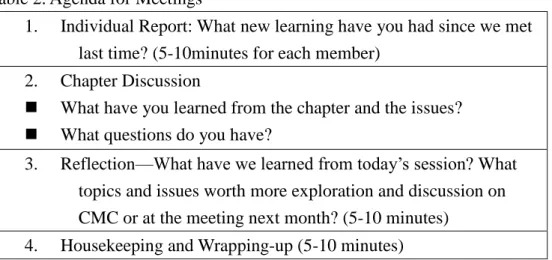
The meetings in this study held once every month from 2005-2007. Each meeting lasted for threehoursin acoffeeshop,oneofthemembers’homes,orotherlocationsthatweremost convenient to all members. The agenda for each meeting usually followed a five-stage structure as indicated in Table 2 below. We tried to stick to the agenda even though there were a few occasions when it was necessary to keep the agenda flexible in order to accommodate unanticipated needs of the group. For example, in the two December meetings the members wanted a gift-exchange session to celebrate the holiday. Generally speaking, the agenda was designed based on theresearcher’sexperiencewith other study groups. As the agenda could determine the nature of interaction and was one important means to foster a culture of learning within the group, there is a need to explain each stage in more detail.
Table 2. Agenda for Meetings
1. Individual Report: What new learning have you had since we met last time? (5-10minutes for each member)
2. Chapter Discussion
What have you learned from the chapter and the issues? What questions do you have?
3. Reflection—Whathavewelearned from today’ssession?What topics and issues worth more exploration and discussion on CMC or at the meeting next month? (5-10 minutes)
4. Housekeeping and Wrapping-up (5-10 minutes)
Data Sources
The transcript of all meetings constituted the data sources for this study. In addition, interviews the members were also conducted in a natural environment, allowing them to
articulate their thoughts in a space that was less public than the group meetings. Questions asked in the interviews were semi-structured focusing on the three research questions as well as other events in the community that needed to be discussed, elaborated, or clarified. In the process, the members’languageteaching experiencesand theirwaysofmanaging thethesiswerealso explored.
Data Analysis
The study follows the grounded theory method (Glaser & Strauss, 1967; Glaser, 1992; Glaser, 1998): using constant comparison as the means to discover the emerging themes. For all research questions, themes will be identified first through thorough reading of the data and notes. The themes are expected to emergebased on themembers’perceptionsand theresearcher’s observation of the actual events in the group. For example, being graduate students and EFL teachers in Taiwan, members may consider the local graduate school or the larger academic context as the culture of learning that is most influencing. Whether this culture impact their professionaldevelopmentand how exactly itinfluencesthemembers’learning activity is expected to be revealed from the data. The community may also have internal culture of learning which may also be influencing and thus will need to be documented. For example, when one member in the group demonstrates enthusiasm to her topic by posting a detailed handout one week before the meeting and eagerly expects everybody to provide feedback, it is likely to
suggest to some members of the group a prevailing culture of learning in the community is that of overly aggressive, while to others, that of vigorous and fulfilling. It can be expected that how members perceive the pattern of interaction can influence the way they use the group for advancing their professional understanding –that is, their strategic orientation.
Once the themes are decided, raters independently coded the data. The results were
compared, and differences were resolved through discussion between the raters until a consensus made 80 to 90 percent of the time. Trustworthiness will be managed through triangulation of different data sets, multiple perspectives, and member-checking. The result will be discussed based on themes discovered, and assertions will be made based on the result. The critical incident technique by Flanagan (1954) is then used in presenting findings.
Results
1. What culture of learning is influencing the members and their activities?
In order to understand what culture of learning is influencing the participants and their thesis development and whether such culture is conducive to qualitative inquiry, I attended a class regularly with the participants during data collection period.
As I focused my observation on the way knowledge is presented to the students, in many situations, the assumption prevailed that knowledge is well-packaged and must be acquired by the learners through lectures.“They must know how to walk before they can run,”as one faculty commented. In the class that I sat in and observed, declarative knowledge was transmitted to the students, and mostly in a traditional lecture format, often through reading directly from the note. Even when the students were asked to make a presentation, the information was already given in forms of readings and handouts. The presentation asked the students to rearrange and reorganize the information, but they were not challenged to analyze or make additional interpretations. The presenter was often observed to follow exactly theprofessor’slecturestyle:reading directly from handouts which had been prepared and distributed to the class. After the presentation, the
about the same content, reviewing the points that had been discussed by the presenter. During recess after one session on task-based learning, I asked two of the study group
members if they had not learned the approach discussed in the presentation. One responded,“Of course I have. I use it all the time in my class.”I realized that the students were not as ignorant about the information as the classroom observation seemed to suggest.
At one point, I also asked them what other courses they would suggest me to sit in, they told meacourseisinteresting:“Becausetheprofessorshowsalotofvideos.”Another suggestion was a professor who used a large amount of examples and anecdotes to illustrate the point he wanted to make.
In addition, many of the assignments were design tasks; for example, students were asked to design activities to teach English with narratives or the computer. Such assignments encouraged the students to become better teachers but may not sufficiently prepare them for the thesis requirement. What is more, since only quantitative research methods and statistics were introduced, students tend to follow one type of research method to discover numerical patterns between what teachers do to students (known as treatments) and what students actually acquire and learn.
All of these suggested that the students thought there was a fixed amount of information to be acquired and that they were comfortable positioning themselves as recipients of knowledge and information, rather than inquirers. It is thus not a surprise that students were more familiar with positivist research methods than qualitative reasoning.
2. How do members perceive the learning community and its surrounding culture as scaffolding measures for their professional development?
The kind of atmosphere students engaged in when taking courses was very different from that when they were about to engage in the thesis. The former mostly required them to take a recipient’srole, while the latter shifted their activities completely to those taken by a
self-regulated and self-motivated inquirer. The students knew that they were not ready for conducting a study. The pressure became high as the thesis requirement came near, typically around the second or third summer of their MA study. Many of them attempted to manage their anxiety by reserving their advisors as early as possible, while others chose to grasp the study group when it was offered.
The study group served two distinctively different purposes in the two years of data collection. In the first year, a large percentage of the meeting time was spent on relationship building and confidence development. The place where we chose to meet mattered. In first two meetings (October and November), we were in a coffee shop. Things went well. We were all on task all the time. However, the atmosphere was rather serious, probably due to the limited space and the background noise. We seemed to be trapped in the conventional teacher-student
interaction, in which the professor (i.e., I) did all the talking while others just listened. There was no authentic sharing from the heart. In December, we decided to celebrate the end of the year by exchanging gifts. Things started to change. This time we were in a member’s home. Being in a home seemed to make a lot of difference. The members were more relaxed and more willing to
discuss urgent needs. It is through this kind of interaction that the group gradually developed bonding relationships.
In the second year, the pressure of thesis became real, and thus the thesis was the focus of all meetings. At this point, the researcher became the advisor to some of the regular participants. The basic function of the group switched to be more goal-oriented: The meeting time became a time for them to report their progress and a reason for them to sustain their independent efforts. (More about this issue will be discussed in the published paper of this study.)
3. What strategic orientations do members take to develop the necessary mediation tools for their studies?
Besides regulating research efforts as discussed previously, the study group also had the function of addressing concerns, clarifying key concepts, and learning from other’s experiences.
However, with limited engagement, evidence indicates that student did not develop a deeper understanding of QI. Why this is the case is to be analyzed and investigated. (More about this will be discussed in the published paper of this study.)
Discussion and Conclusion
Adopting the concept of mediation from sociocultural theory, this study explored the culture of learning surrounding a learning community and the participants’strategicorientation toward developing QI concepts. Basically the kind of culture that the students had around them can be described as positivist in nature. There was a fixed set of materials to be learned, and good filling-up of information was considered important. These beliefs are in fact in sharp contrast to those needed for conducting a QI study, which emphasizes self-regulating learning in addition to developing many of the values in the inquiry process, as discussed earlier in the background section. It was in such a culture that the participants of this study embarked on learning QI in the study group. The group allowed them to address concerns, clarify key concepts, and learn from other’s experiences. With limited engagement, however, it would be unreasonable to expect high development of QI concepts and abandoning of concerns as they moved from a more solid understanding of quantitative tradition.
The results of this study provide more understanding of the learning community and the influence of a culture of learning surrounding the community. From the two-year engagement with the teacher’sstudy group,Iseethatthestudy group ishighly influenced by theparticipants’ goals and purposes in life, which are often influenced or limited by the culture of learning
surrounding them. More research is needed to focus on learning culture and how it influences student learning.
The observation presented above should not be considered a criticism; instead, it intends to encourage a more reflective attitude toward existing practice. Since the researcher is one of the faculty members who tended to engage in filling in information in graduate classes, gaining a deeper understanding of the culture of learning surrounding this learning community helped me see the problem of my own emphasis in class. I was able to re-design my course in the summer after this study and make it gear more toward exposing students to multiple ways of viewing the
world and preparing students for the thesis requirement. The response from the new cohort of students was encouraging, and this, I think, is a truly worthwhile result of this study.
計畫成果自評部份: 請就研究內容與原計畫相符程度、達成預期目標情況、研究成果之學術或應用價值、是否 適合在學術期刊發表或申請專利、主要發現或其他有關價值等,作一綜合評估。 原計畫採用網路工具執行社群活動,然因此舉會造成參與者諸多不便,也無法達成交流的 效果,故這部分並沒有實行。總體而言,這項改變並不影響原先希望探究的主題。如前文 最後結論所言,本次研究對參與者及研究人員而言都是非常好的學習機會。