Insect Vectors and Insect-Borne Diseases
主編 石憲宗 張宗仁
Edited by
Hsien-Tzung Shih and Chung-Jan Chang
行政院農業委員會農業試驗所
Taiwan Agricultural Research Institute, COA
行政院農業委員會動植物防疫檢疫局
Bureau of Animal and Plant Health Inspection and Quarantine, COA
中華民國一○○年七月
July 2011
目 錄
序 --- i 蟲媒病害與植物防疫政策 --- 張瑞璋 1 國際重要作物原核生物性病害及其媒介昆蟲之研究回顧 --- 張宗仁 9 台灣葡萄皮爾斯病及媒介昆蟲研究現況 --- 蘇秋竹 25 Xylella fastidiosa 的媒介昆蟲生態學與傳病機制 --- 段淑人 51 台灣農作物重要菌質體病害研究現況 --- 洪挺軒 63 柑橘黃龍病之發生生態及防治研究 --- 蔡佳欣 73 中國梨木蝨及其媒介病害梨衰弱病整合防治 --- 張淑貞 91 傳播植物原核生物性病害媒介昆蟲之整合防治研究進展 --- 石憲宗 107 傳播植物番茄斑點萎凋病毒群病害之薊馬及其防治研究 --- 林鳳琪 123 三十年來台灣瓜類病毒病的流行趨勢變遷 --- 鄧汀欽 147 小蠹蟲及其共生真菌與植物病害之關係 --- 陳啟予 165 傳播農作物病毒重要粉介殼蟲之防治策略 --- 陳淑佩 175 傳播農作物病毒重要蚜蟲之防治策略 --- 蔡志偉 183 銀葉粉蝨傳播蔬果雙生病毒及其防治研究 --- 林鳳琪 193 粉蝨傳播Criniviruses 之生物學及其防治策略 --- 黃莉欣 205效益與環境安全,建立適地與適用且受農友認同的整合管理技術。為
此,由本所與防檢局組成本次研討會籌備小組,針對國內外蟲媒病害
的研究現況、蟲媒病害整合防治技術與因應政策等議題,邀請國內外
專家與會報告,並將專家書面論文編印為本專刊,盼可作為我國擬定
蟲媒病害防治管理政策及研究重點的參考。
本研討會籌辦過程,值王清玲組長、錢景秦研究員及侯豐男教授等
昆蟲界傑出研究專家,於本年七月份陸續榮退,在此亦代表本所同仁
向三位專家致上敬意,並祝福他們身體健康、萬事如意。
行政院農業委員會農業試驗所
所長
中華民國一○○年七月
蟲媒病害與植物防疫政策
張瑞璋1 邱安隆1 陳保良1 蔡偉皇1,* 1 行政院農業委員會動植物防疫檢疫局 * 通訊作者 e-mail: [email protected]摘 要
由昆蟲媒介的蟲媒作物病害,近年來在臺灣的發生有逐漸加劇之現象,國內 此類蟲媒病害之病原菌以病毒與細菌為主,少數為真菌及其他病原菌,又媒介此 類病原菌之昆蟲多屬於小型害蟲,包括薊馬、蚜蟲、粉蝨與葉蟬等,其具有世代 短、隱匿性高、遷飛能力強及易產生抗藥性等特性。臺灣因地處亞熱帶及熱帶地 區,此類媒介昆蟲的族群數量龐大,不僅活動範圍廣且繁殖力強,農民如要同時 防治病害與蟲害,或當媒介昆蟲不是該項作物之主要害物時,蟲害防治容易遭忽 略,而未能即時阻斷傳播途徑,均提高蟲媒病害防疫工作之困難度。國內所發生 之洋香瓜病毒病、柑桔黃龍病及番茄斑點萎凋病等重大蟲媒病害,均增加農民於 農作物生產上之防治成本與風險,甚至造成嚴重疫情,嚴重影響產業及農民收益 至鉅。針對此類重大蟲媒病害,防檢局研擬相關疫情管理策略,包括:疫情監測 與組織分工、整合性防治技術開發、組訓農民與示範宣導、種子種苗病害檢查規 範訂定、國際疫情資訊蒐集與法規防治等,期能協助農民並強化蟲媒病害防疫體 系,除於第一線的檢疫把關外,並與第二線之防疫措施緊密配合,未來更應在現 有的基礎與成果上,順應國際趨勢的發展,加強國際疫情資訊蒐集,適時增修訂 相關法規,以落實生物安全農業措施,並在健全植物保護體系政策下,強化與各 植物保護單位之分工,且縝密規劃作物病害施政重點策略,持續改善各項防疫缺 失並提升相關防疫技術,以確保國內生產環境安全及農業之永續發展,維護農產 品的衛生安全及消費者的健康。 關鍵詞:防疫政策、植物病害、媒介昆蟲。前 言
臺灣地處亞熱帶及熱帶地區,多元而複雜的氣候及環境適於作物生產,作物 種類極具多樣性,依據「台灣植物病害名彙」及「台灣植物害蟲名錄」統計,植 物病蟲害種類約有 4,600 種 (郭等, 2008),氣候高溫多濕與作物全年栽培的環 境,極適合病蟲害全年繁衍發生蔓延。其中由昆蟲媒介的農作物病害,近來在臺 灣有逐漸加劇現象,國內發生之重大蟲媒病害如洋香瓜病毒病、柑桔黃龍病及番 茄斑點萎凋病等,均增加農民栽培農作物時之生產風險與防治成本,甚至發生嚴 重疫情,致嚴重影響該等產業之發展,影響農民收益甚鉅,例如 95 年 11 月底員會「健康、效率、永續經營之全民農業」農業施政方針下,執行健全動植物防 疫檢疫體系之政策,並訂定施政三大目標包括:一、健全農業防疫檢疫網,確保 農產品衛生安全;二、發展農業防疫檢疫功能,強化產學資源整合;三、加強國 際農業防疫檢疫合作,開拓農業發展空間 (張等, 2010a)。植物防疫工作積極推動 健全植物保護體系,建立區域性安全防疫體系整合機制,於行政與技術之面向上, 強化區域性植物保護業務的聯繫,除推動各地方政府成立植物保護專責單位,並 在此架構下依據植物防疫檢疫法及國際規範,落實推動相關疫情管理措施。 為達成防檢局訂定之施政三大目標,乃研擬包括:疫情監測與組織分工、整 合性防疫技術開發與推廣、種子種苗驗證、境外重要病害之偵察調查及緊急防治 等多項植物防疫施政重點工作。本研討會所邀請的國內外蟲媒病害專家,將就重 要蟲媒病害及其媒介昆蟲的研究現況、關鍵防治技術及研究缺口等議題進行報告 與意見交換,防檢局期能廣納建議作為作物蟲媒病害防治政策與研究方向的參 考。以下僅就目前防檢局所定植物防疫施政重點與蟲媒病害相關部分之略以說明。 一、疫情監測與組織分工 疫情監測主要任務,在於以有效掌握國內重大蟲媒病害疫情發生之時空分 布,並能採取相應措施,經累積長期監測資料,建構疫情預警機制,期能事先提 出疫情風險預告,使各級政府組織、農會及農民可提早準備從容因應 (郭等, 2008)。防檢局目前針對重要農作物之蟲媒病害,委請植物保護相關單位 (如農業 試驗所、農業藥物毒物試驗所、各區農業改良場及大專院校植物保護相關系所) 之 植物病理學與昆蟲學專家,組成團隊以分工方式共同執行蟲媒病害與媒介昆蟲密 度之專案計畫,以強化蟲媒病害及其媒介昆蟲的監測工作。 以洋香瓜病毒病害為例,為能充分掌握田間疫情發生情形,目前除執行計畫 之監測團隊,調查洋香瓜罹病情形與媒介昆蟲族群數量及帶毒率,並定期填報調 查資料外,亦列為臺南區農改場 (以下簡稱臺南場) 病蟲害之主動監測種類清 單,以監控疫情發生狀況,並在病害發生初期事先預警,通知各單位及農民啟動 防治措施;如遇即時疫情發生,接獲通報的單位隨即將資訊向防檢局通報,並經
良場及茶業改良場於發布警報後,均將疫情登錄於植物疫情管理資訊網,防檢局 經分析研判後啟動該些警報,透過農委會「田邊好幫手」手機簡訊,適時將資訊 傳送予相關單位及農民以加強防範。此外,對重要媒介昆蟲 (如粉蝨與薊馬) 之 抗藥性,亦組成團隊進行調查,以防範媒介昆蟲產生抗藥性,或是抗藥性生物小 種的出現。 二、整合性防治技術開發與推廣
防檢局在推動作物有害生物整合性管理 (Integrated Pest Management),係以 符合經濟成本並結合各種不同的防治措施,將作物病蟲害的數量壓制在經濟危害 水平之下,以獲得最大的效益。蟲媒病害防治工作,同時涉及病害與蟲害防治, 更須整合各種防治方法,包括透過建立田間衛生觀念及推動合理化用藥等措施 (張等, 2010b),運用生物防治、物理防治、化學防治及田間管理等技術 (古, 2003), 藉以研發省時、省力、省成本的田間操作程序,並提供農民最經濟有效的整合防 治技術。包括 (一) 進行產官學計畫研發能量整合,建立作物疫病蟲害整合管理 模式與作業流程,另盤點研發成果對技術缺口予以補強,並經田間試驗操作予以 檢討改進,俾求該管理模式完善符合農民之需求;(二) 舉辦整合管理講習及田間 觀摩,加強農民組訓工作,編印作物病蟲害整合性管理行事曆,宣導農民正確的 防治方法。 目前防檢局針對作物蟲媒病害整合防治之推動工作,包括 (一) 作物病蟲害 整合管理技術補強:請農委會所屬試驗研究機關與大專院校之專家,協助進行開 發該等技術,並規劃於 101 年度防檢疫領域計畫中,執行「小型昆蟲與蟲媒病害 防治技術之研究與應用」研究項目,針對小型害蟲與重要作物蟲媒病害之管理技 術進行研發;(二) 彙編作物病蟲害整合性管理摺頁或手冊,已完成洋香瓜、葡萄、 木瓜、文旦、柑橘等 18 種作物,進行作物病蟲害整合性管理,另請中興大學農 業推廣中心協助彙整並編製成冊供農民參考,未來將納入前項工作所開發之技術 與方法,隨時進行更新;(三) 辦理田間試驗:請農委會 7 個農業改良場及香蕉 研究所協助辦理作物病蟲害整合性管理田間試驗及成果示範觀摩會,以提供給農 友參考使用;(四) 辦理教育宣導:由農委會所屬試驗研究機關、地方政府及防檢 局分別舉辦作物病蟲害整合性管理講習會,宣導農民正確的防治方法。以防治洋 香瓜病毒病為例,2009 年防檢局與臺南場、臺南縣(市) (現合併為臺南市)政府及 相關農會共同辦理整合性防治技術示範推廣,有效控制臺南地區洋香瓜病毒病發 生率在 10% 以下,提高臺南地區農民收益約 6 千萬元 。 三、種子種苗病害驗證制度推動 種子種苗乃作物栽培之根本,健康種子種苗能保證作物初期正常生長,藉由 減少田間感染源而有效延緩或減輕後續栽培可能發生的病害,因此種子種苗病害 驗證成為關鍵性的病害管理策略 (張, 2008)。選用健康種苗,為防範蟲媒病害之 措施之一,為避免農民有種苗植株帶毒的疑慮,以及減少農藥使用,防檢局積極 推動植物健康種苗制度,輔導業者種植無指定疫病蟲害種苗,以提昇種苗品質及
性管理產品之能力,政府單位則積極研究改進取樣方法及研發快速專一性高且成 本低之病害檢定方式,提高檢定效率。 四、國際疫情資訊蒐集 防檢局將持續蒐集重要作物蟲媒病害之國際疫情資訊,包括水稻、洋香瓜、 柑桔、葡萄、番茄等,並加強研析可能對國內農業生產造成之影響,評估適時啟 動偵察調查機制 (目前針對水稻飛蝨類所媒介之病毒病害,業成立計畫進行偵察 調查工作),同時積極與國外植物保護機關與研究單位進行資訊交流。如:目前在 Plant Viruses Online 的網站上可以查到 45 種可以感染洋香瓜的植物病毒,而目 前臺灣瓜類作物上被確認的病毒約有 10 種,所以針對已於國外發生,但尚未在 國內發生之重要疫病害蟲,預先擬定風險管理管理計畫,並進行防治演練,以因 應未來可能發生之突發狀況與危機處理。 五、法規防治 我國自 2002 年加入世界貿易組織 (WTO) 後,有害生物隨著農產品傳入我 國的風險有增無減,蟲媒病害循此途徑入侵發生之機會大增,根據「中華民國輸 入 植 物 或 植 物 產 品 檢 疫 規 定 」 (2011 年 3 月 31 日 修 正 版 ) (http://www.baphiq.gov.tw/public/Data/141214355471.pdf) 的內容,屬於「甲、禁止 輸入之植物或植物產品」所列之蟲媒植物病原原核生物計有 5 種,分別為非洲型 柑 桔 黃 龍 病 (Candidatus Liberibacter africanus Garnier et al.) 、 柑 桔 矮 化 病 (Spiroplasma citri)、甘蔗叢蘗病菌質體 (Sugarcane grassy shoot phytoplasma)、椰 子致死性黃化病菌質體 (Lethal yellowing phytoplasmas)、Xylella fastidiosa。這類 蟲媒病原自原產地進入一個新的地區,其病原菌能否在新地區成功立足,需視病 原、寄主植物、媒介昆蟲與環境等條件而定。也因如此,國際上對於重要檢疫病 害及其媒介昆蟲所採取的規範,主要是採用法規防治,包括禁止輸入帶病植株、 並有條件檢測該病害及其媒介昆蟲的寄主植物,並針對此類病害及其媒介昆蟲進 行風險評估,以作為擬定植物檢疫法規與法規防治的參考依據,此時專家也有必
後,取得掌握撲滅或有效降低新病害流行危害的先機 (石, 2010)。
結 語
為推動健全動植物防疫檢疫體系之政策,達成健全農業防疫檢疫網之目標, 同時以符合法制規範,有效達到防疫檢疫目的,爰參酌國際規範及國內外相關法 規修正植物防疫檢疫法,將相關植物防疫重點工作修訂納入法規中,如有關植物 防疫監測及防治,修訂相關法條包括:中央主管機關得公告管制有害生物種類, 並授權植物防疫檢疫機關得先行採取防疫之緊急措施;又主管機關必要時得公告 該些有害生物防治計畫綱要,直轄市及縣(市)主管機關應依據計畫綱要,擬訂地 區防治計畫及編列年度預算,使中央及地方主管機關明確分工,有效防治國內之 有害生物疫情,並落實推動相關防治措施,確保農民權益及農產品收益 (張等, 2010a)。 另目前植物病原及其蟲媒的研究在國內尚缺乏整合之機制,但在美國,不論 是大學教授或農業研究部門,只要是蟲媒植物病害,均有學者從事傳播方法、傳 播能力及兩者相互作用等的研究。國內重要蟲媒病害不少,但多著重於找出病原 菌及蟲媒種類,對兩者及兩者間作用機制之基礎研究則相當缺乏,仍有許多的研 究空間可以發揮,期望國內學者能重視此領域的研究,共同組成團隊進行研究與 技術開發,以提升國內蟲媒病害之研究 (黃, 2010)。另為因應蟲媒病害的發生, 防檢局業研擬相關植物疫情管理措施,除加強開發有效防治技術,以解決防治技 術缺口外,並鑑於「防範未然」是作物病害防治的基本觀念,在監測預警方面, 期望在作物病害尚未大發生前,即將田間疫情資訊迅速傳送農民參考應用,以爭 取病害防治管理時間。未來將積極推動健全植物保護體系,建構安全、合適與有 效蟲害管理策略,並落實病害共同防治及輔導栽種健康種苗,依據病害發生種類 並配合氣候條件,適時協助農民採取適當、有效的防治措施,降低作物受害程度, 並確保農產品品質及產量。誌 謝
本文繕寫期間,承蒙防檢局植物防疫組同仁及農業試驗所應用動物組石憲宗博士 提供相關資料,致上無限謝忱。引用文獻
古德業。2003。永續管理植物保護成果與衝擊。1-22頁。植物保護管理永續發展研 討會專刊。356頁。 石憲宗。2010。認識農作物重要害蟲-可傳播重要作物病害之媒介葉蟬。臺灣昆 蟲通訊 2010 (6):1-2。 郭克忠、陳保良、劉天成、蔡偉皇。2008。節能減碳下植物防疫的方向與展望。 1-12頁。節能減碳與作物病害管理研討會專刊。206頁。Policy on the management of insect-borne
plant diseases
Ruey-Jang Chang1, An-Long Chiou1, Pao-Liang Chen1, Wei-Huang Tsai1*
1 Bureau of Animal and Plant Health Inspection and Quarantine, Council of Agriculture,
Executive Yuan
* Corresponding author, e-mail: [email protected]
Abstract
In recent years, Crop diseases vectored by the insects have gradually become serious in Taiwan. We found that the causing organisms spread via this mechanism were viruses and bacteria mainly, with small proportions of fungi, nematodes and other micro-organisms. Insects which carrying these pathogens are mostly belonged to the group of small insects, such as thrips, aphids, whiteflies and leafhoppers. They shared common characteristics including short generation, strong hiding and flying ability, and easily produced resistant offsprings against pesticides. Taiwan is located between the subtropical and tropical regions, where inhabit a great number of insect vectors characterized being very active and fecund, under such complicated and difficult circumstance, farmers are forced to face both the threat of the diseases and their vectors, when the insect vector is not the major pest of the crop, farmers always ignore the existence of the vectors, hence the insect-borne diseases prevail in certain local areas. For example, currently the local outbreaks of muskmelon virus diseases, citrus huanglongbing, and tomato spotted wilt disease had increased the costs of pest control and the risks on crop production, and even impacted the local agriculture industry. To deal with the issue on the control of major insect-borne diseases, BAPHIQ conduct the management programs including plant pests and diseases monitoring, task assignment, IPM technology development, farmers training and demonstration symposium, seed or seedling disease certification, collection of information on international epidemic situations, and regulations control etc., to assist farmers in crop production, and to strengthen insect-borne disease control system. The efforts of quarantine and plant protection measures should be integrated to tackle the problems. In the future, we should not only base on the existing of foundation and results to shape the plant protection policies that conform to the international trend and standards, but also strengthen the gathering of international epidemic information to timely amend related regulations for implementation of agricultural security. Finally, the sound and complete plant protection system will be established. By thoughtfully planning the priority of policy for management of crop diseases, ongoing improving the problems of epidemic prevention measures and non-stop upgrade of related disease control technology, the goal will be achieved for better ensuring the sustainable development of agriculture and security of domestic agricultural production environment as well as the food safety and the consumer health.
Important plant diseases, a review of the causal
fastidious prokaryotes and their insect vectors
*Chung-Jan Chang1,4**, Hsien-Tzung Shih2, Chiou-Chu Su3, Fuh-Jyh Jan4
1
Department of Plant Pathology, University of Georgia, Griffin, GA, USA
2
Applied Zoology Division, Taiwan Agricultural Research Institute, Council of Agriculture, Taichung, Taiwan
3
Pesticide Application Division, Taiwan Agricultural Chemicals and Toxic Substances Research Institute, Council of Agriculture, Taichung, Taiwan
4
Department of Plant Pathology, National Chung Hsing University, Taichung 402, Taiwan *
To be published in Plant Pathology Bulletin 20: xxx-xxx (2011)
**
Corresponding author, e-mail: [email protected]
Abstract
Phytopathogenic fastidious prokaryotes are plant pathogens that either resist to grow in any available bacterial culture mediums or require specific or enriched mediums to grow. They include Xylella fastidiosa, Leifsonia xyli subsp. xyli, L. xyli subsp. cynodontis and Clavibacter michiganensis subsp. sepedonicus and C.
michiganensis subsp. michiganensis that reside in xylem and spiroplasmas,
phytoplasmas and Candidatus Liberibacter spp. that reside in phloem. X. fastidiosa is the causal agent of more than 19 diseases; among them Pierce’s disease of grape and citrus variegated chlorosis are two major maladies that cause serious economic loss on wine and citrus juice industry. L. xyli subsp. xyli, and L. xyli subsp. cynodontis are associated with ratoon stunting disease of sugarcane and Bermuda grass stunting respectively and C. michiganensis subsp. sepedonicus with bacterial ring rot in potato and C. michiganensis subsp. michiganensis with bacterial tomato canker. Spiroplasmas are the causal agents of citrus stubborn, corn stunt and periwinkle diseases. Phytoplasmas are associated with more than 500 diseases worldwide. Ca. Liberibacter spp., are the causal agents of citrus Huanglongbing or citrus greening, zebra chip disease of potato and others. General characteristics of X. fastidiosa including its scientific classification, host ranges and diseases incited, and cell shape and size; specific and enriched media for X. fastidiosa; symptoms induced by X. fastidiosa; geographic distribution of X. fastidiosa; and the insect vectors that transmit the diseases will be discussed. Pierce’s disease is the limiting factor for the establishment of wine industry for the entire southeastern United States from Texas to the Carolinas along the gulf coast of Mexico. Recent introduction of the glassy-winged sharpshooter leafhoppers in California has threatened the winery industry of California. The significance of the isolation of X. fastidiosa from the tissues with citrus variegated chlorosis symptoms followed by the identification of the major insect vectors will be addressed. The biological characteristics of the three phloem-limited prokaryotes,
Introduction
In the Kingdom Prokaryotae, there are two taxa, bacteria and mollicutes. Bacteria have cell membrane and cell wall while mollicutes have only cell membrane and lack cell wall. Mollicutes, including spiroplasma, phytoplasma, mycoplasma and acholeplasma, are the smallest and simplest known free-living and self-replicating forms of life. They are bacteria of Gram-positive origin, as indicated by their 16S rRNA (Trachtenberg, 2005). Most bacteria do not require insect vectors for their dissemination except a few; e.g., Erwinia tracheiphila transmitted by cucumber beetles (Agrios, 2005) and Ralstonia syzygii by Hindola striata (Balfas et al., 1991). However, in the fastidious prokaryote group which includes Xylella fastidiosa, Candidatus Liberibacter spp., and spiroplasmas and phytoplasmas, insect vectors are essentially required for their dissemination (Markham, 1983; Redak et al., 2004; Weintraub & Beanland, 2006). X. fastidiosa and Ca. Liberibacter spp. possess cell walls belonging in bacteria taxon whereas spiroplasmas and phytoplasmas lack cell walls belonging in mollicutes taxon. In E. tracheiphila-induced bacterial wilt of cucumber case, the bacterium survives by overwintering in the intestines of striped cucumber beetles (Acalymma vittata) and spotted cucumber beetles (Diabrotica undecimpunctata), in which it hibernates (Agrios, 2005). Today, however, we are going to focus on the vectors that associated with the above-mentioned fastidious prokaryotes. To date among all known vectors, the single most successful insects vectoring the diseases belong to the Order of Hemiptera. In the past three decades, researches have emphatically addressed the biology, ecology, vector relationships and epidemiology of crop diseases caused by plant pathogenic prokaryotes which were well documented in the following review articles: Purcell (1982), Markham (1983), Purcell and Hopkins (1996), Redak et al. (2004), Almeida et al. (2005), Weintraub and Beanland (2006), Weintraub (2007), Janse and Obradovic (2010), and Gottwald (2010).
Fastidious prokaryotes are those that either resist to grow in any available mediums, such as phytoplasmas, Ca. Liberibacter spp., and Ca. Phlomobacter fragariae
michiganensis subsp. sepedonicus. Based on the inhabitant, X. fastidiosa, Leifsonia spp.
and C. michiganensis subsp. sepedonicus are xylem-inhabiting while spiroplasmas, phytoplasmas, Ca. Liberibacter spp., and Ca. Phlomobacter fragariae are phloem- inhabiting prokaryotes.
Herein a review of insect vectors of plant pathogenic fastidious prokaryotes is provided by the authors. The information of insect vectors of phytopathogenic fastidious prokaryotes by taxonomic groups and their geographic distribution is shown in Table 1.
Xylem-limited bacterial plant pathogens and their insect vectors
According to Wells et al. (1987), X. fastidiosa possesses the following characteristics: predominately single, straight rods with a cell size ranges from 0.25-0.35 µm in width and 0.9-3.5 µm in length; two types of colonies: convex to pulvinate smooth opalescent with entire margins or umbonate rough with finely undulated margins; Gram-negative, nonmotile, aflagellate, oxidase negative, catalase positive, and strict aerobic; nonfermentative, nonhalophilic, nonpigmented; and require a specific and enriched medium such as CS20, PD2, PW, or BCYE for growth. The optimal temperature for growth is 26-28C, whereas the optimal pH is 6.5-6.9. The habitat is the xylem of plant tissue. The G+C content of the DNA is 51.0 to 52.5 mol% determined by thermal denaturation or 52.0 to 53.1 mol% determined by bouyant density.Ever since Wells et al. (1987) named then xylem-limited bacterium as X.
fastidiosa in 1987, X. fastidiosa has been reclassified into five subspecies according to
their differences in genetic makeup, host range, physiology, and biochemistry. They are
X. fastidiosa subsp. fastidiosa for strains of grape, almond, alfalfa, and maple, X. fastidiosa subsp. multiplex for strains of peach, plum, almond, elm, sycamore, and
pigeon grape, X. fastidiosa subsp. pauca for strains of citrus (Schaad et al., 2004), X.
fastidiosa subsp. sandyi for strains of oleander, daylily, jacaranda, and magnolia
(Schuenzel et al., 2005), and X. fastidiosa subsp. tashke for strains of Chitalpa
tashkentensis, a common ornamental landscape plant (Randall et al., 2009).
X. fastidiosa requires specific and enriched mediums to grow as compared to
other bacteria (Chang & Walker, 1988). There are seven complex components that are used in the listed four media: soy peptone, tryptone, phytone peptone, trypticase peptone, soytone or phytone, and yeast extract; either one or two complex components for each medium; two iron sources for the medium either hemin chloride or soluble ferric pyrophosphate; four inorganic salts: ammonium phosphate, potassium phosphate (monobasic or dibasic) or magnesium sulfate; three amino acids and two Krebs cycle intermediates: citrate or succinate; and three detoxifying components: potato starch, activated charcoal, or bovine serum albumin. Rippled cell walls seemed to be unique for all X. fastidiosa cells regardless of the origin of its host plants. That was one of the reasons why they were first described as “rickettsia-like bacteria”. However, a thorough study of Pierce’s disease (PD) strain by Huang et al. (1986) disclosed that in addition to the predominated rippled cell walls there are intermediate cell walls and
There are 19 diseases that were confirmed to be caused by X. fastidiosa. They are Pierce’s disease of grape, alfalfa dwarf, phony peach (PP), plum leaf scald, CVC, periwinkle wilt, ragweed stunt, and leaf scorch of almond, elm, mulberry, oak, sycamore, pecan, maple, oleander, blueberry, coffee, pear, and Chitalpa. (Chang & Walker, 1988; Chang et al., 1993; Hartung et al., 1994; Sherald et al., 2001; Schaad et
al., 2004; Schuenzel et al., 2005; Hernandez-Martinez et al., 2007; Randall et al.,
2009). The common symptoms induced by X. fastidiosa include marginal leaf necrosis, scorching or scalding of leaves, early leaf fall, dieback of branches, and wilting to death. The specific symptoms are petioles remain attached to the canes after the leaves fall off and green islands formed along the stem both occurring in PD whereas darker green leaves and extreme shortening of the terminal growth occur in PP disease.
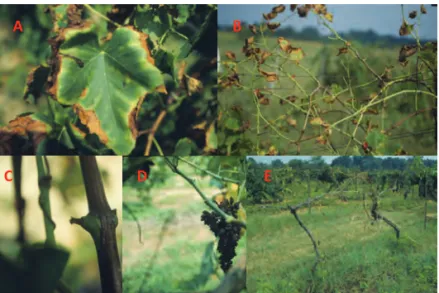
Symptoms of Pierce’s disease of grapes usually start with marginal leaf necrosis to chlorosis; normally a yellow band would form between the green and necrotic tissues for white wine grapes and a purple band for red wine grapes. The following unique symptoms will follow: petioles remain attached to the canes, green island formation due to irregular maturing process of barks, dried up raisins, and eventual dying and dead vines occurs in 2-4 years after initial infection in GA (Fig. 1). In the Order Hemiptera, four main sharpshooters in the Family Cicadellidae, e. g. glassy-winged sharpshooter, blue-green sharpshooter, red-headed sharpshooter, and green sharpshooter were the important vectors for PD X. fastidiosa.
CVC causes severe leaf chlorosis between veins when young trees are infected. Symptomatic leaves exhibit brown gummy lesions on the lower side in corresponding to the chlorotic yellow areas on the upper leaf surface. Reduced growth vigor and abnormal flowering and fruit set occur in infected trees. Fruits from affected trees are often small and hard with high acidity which is not fitting for juice making and no fresh market value (Chang et al., 1993; Hartung et al., 1994). The major vectors for citrus variegated chlorosis in Brazil are Acrogonia terminalis, Dilobopterus costalimai,
Oncometopia fascialis, and Oncometopia nigricans.
remaining stems display a yellow “skeletal” appearance (Fig. 2B) which was why “yellow stem” or “yellow twig” was often used to describe the disorder before “bacterial leaf scorch” was formally designated for the X. fastidiosa-caused disease (Chang et al., 2009). Insect vectors for the blueberry bacterial leaf scorch disease are under investigation in Georgia and the glassy-winged sharpshooter leafhopper,
Homalodisca vitripennis (formerly H. coagulata), is likely an important suspect.
Two xylem-limited bacteria (XLB), Xylella fastidiosa and Ralstonia syzygii, are transmitted by xylem sap-feeding insects (Balfas et al., 1991; Purcell & Hopkins, 1996; Redak et al., 2004; Almeida et al., 2005). In general, the sucking insects that feed predominantly on xylem sap are potential vectors of XLB (Purcell & Hopkins, 1996). Among them, the confirmed vectors that transmit X. fastidiosa possess the transmission characteristics including the lack of a latent period, no transstadial or transovarial transmission of the bacterium, the pathogens remain persistently in adults, and the bacterium can multiply in the foregut (Janse and Obradovic, 2010).
Redak et al. (2004) pointed out that 39 species of Cicadellinae and 5 species of Cercopoidea have been confirmed as vectors of different strains of X. fastidiosa in controlled experiments from the United States to Brazil. In the United States, the glassy-winged sharpshooter leafhopper, Homalodisca vitripennis (Germar) [synonym of Homalodisca coagulata (Say) (Takiya et al., 2006)], is the most economically important species among vectors of X. fastidiosa, because it provides more efficient transmission than other vectors in primitive or new distribution (e.g. in California). Furthermore, the machaerotid species Hindola striata is the only known vector of
Rolstonia syzygii (formerly Pseudomonas syzygii) from Indonesia (Balfas et al., 1991).
In fact, the number of vector species for different strains of X. fastidiosa will increase considerably in the future as a result of agricultural diversification in Latin America and additional research on X. fastidiosa-induced diseases and vectors in that region (Redak et al., 2004) or in Asia. Recently, DNA fragments of pear leaf scorch (PLS) strains of X. fastidiosa were identified in Kolla paulula (Walker) (Cicadellidae: Cicadellinae) captured in fields of central Taiwan (Su and Shih, unpublished data) via polymerase chain reaction (PCR) using X. fastidiosa-specific primers. The mechanism of PLS transmission and fulfillment of Koch's postulates using K. paulula are currently under investigation in the authors’ laboratories.
In summary, the majority of xylem-feeding insect vectors belong to the members of Cicadellinae, and the remainder species are from Aphrophoridae, Clastopteridae and Machaerotidae (Table 1; Balfas et al., 1991; Redak et al., 2004). Moreover, some taxa (Evacanthinae, Mileewaninae, and Cicadide) are supposed to be the potential vectors based on the phylogenetic hypothesis (Redak et al., 2004).
Phloem-limited plant pathogenic prokaryotes and their insect vectors
In Mollicutes, the cell wall-less and phloem-limited prokaryotes, there are two major plant pathogens: spiroplasmas and phytoplasmas. Spiroplasmas are cells with helical forms during logarithmetic growth. Most spriroplasmas are cultivable in enriched mediums that contain supplemented sterols and other ingredients (Chang,proliferation of secondary shoots in leaf axils; thus named corn stunt disease. Corn stunt disease is transmitted by Dalbulus maidis (DeLong and Wolcott) and D. elimatus (Ball) in nature whereas it can be transmitted experimentally by Graminella nigrifrons(Forbes),
G. sonora (Ball), Stirellus bicolor (Van Duzee), Exitianus exitiosus (Uhler),and Euscelidius variegatus (Kirsch.) (Tsai and Falk, 2009).
Walnut witches’-broom disease was reported by Chang et al. (1986) after the MLO particles were observed in the sieve cells of the symptomatic tissues collected from Griffin, GA. Abnormal proliferation of numerous small shoots with lighter green color which resembled the shape of a broom became evident in mid-July. The insect vector for this disease is still unknown even though DNA fragments were isolated and cloned from diseased walnut and later DNA probes were developed to monitor the seasonal occurrence of walnut witches'-broom MLO (Chen et al., 1992a; Chen et al., 1992b). There are other economically important phytoplasma diseases, such as lethal yellowing of coconuts in Jamaica and lime witches’-broom in Oman and many others in Taiwan which will be presented in depth by Dr. T.-H. Hung in this symposium.
Now let’s look at the other phloem-limited bacteria, the causal agent of Huanglongbing (HLB) and other diseases, Ca. Liberibacter spp. Striking symptoms of “yellow shoots” were often seen in sweet orange of young and high density orchard (1000 trees per hectare). Two most characteristic symptoms of HLB are leaves with blotchy mottle and fruits with small size and colour inversion (Bove, 2006). HLB are transmitted by psyllid vectors. In Asia, Southeast Asia, and Oceania, Diaphorina citri is the vector, Ca. L. asiaticus is the HLB agent, and both are heat tolerant (Asian form of HLB). In Africa and Madagascar island, Trioza erytreae is the vector, Ca. L. africanus is the HLB agent, and both are heat-sensitive (African form of HLB) (Bove, 2006). Another HLB agent, Ca. L. americanus, was found in 2004 in Sao Paulo State, Brazil (Teixeira et al., 2005) and 2005 in Florida, USA (Irey et al., 2006) and its vector is D.
citri. A thorough and in-depth report on HLB and its vectors will be presented by Dr.
C.-H. Tsai in this symposium.
According to the taxonomic groups for the above-mentioned 3 pathogens, the interaction between insect vectors and spiroplasmas or Ca. Liberibacter spp. is relatively more specific than the vector-phytoplasmas relationship. For example, the known vectors for HLB pathogen belong to the family Psyllidae only (Hung et al., 2004; Gottwald, 2010) and the vectors Circulifer tenellus and Dalbulus maidis belonging entirely to the subfamily Deltocephalinae of Cicadellidae disseminate 2 plant pathogenic spiroplasmas, S. citri and S. kunkelii respectively (Markham, 1983).
On the contrary, there are 92 known species belonging to 8 families in Hemiptera that are confirmed vectors of phytoplasmas. They respectively belong to each of the following family Cicadellidae (71 species), Cixiidae (6 species), Delphacidae (4 species), Derbidae (1 species), Flatidae (1 species), Psyllidae (7 species), Pentatomidae (1 species), and Tingidae (1 species) (Weintraub and Beanland, 2006). Furthermore, the above-mentioned 71 species in Cicadellidae that vector phytoplasmas could be categorized according to the following 10 subfamilies, Cicadellinae (1 species:
Graphocephala confluens (Uhler)), Typhlocybinae (3 species: Alebroides nigroscutellatus (Distant), Amrasca devastans (Distant), and Empoasca papayae
Oman), Agalliinae (1 species), Aphrodinae (2 species), Coelidiinae (1 species), Iassinae (1 species), Idiocerinae (2 species), Macropsinae (5 species), Scarinae (1 species), and Deltocephalinae (54 species) (see Table 1 by Weintraub and Beanland, 2006). In general, members of the first two subfamilies, Cicadellinae and Typhlocybinae, are known xylem feeders and mesophyll feeders, respectively; that means members of the two taxa can not transmit the phloem-limited pathogens. As to why they were reportedly able to transmit phytoplasmas which are strictly phloem inhabitants raises an intriguing but controversial issue that warrants further investigation.
References
Agrios, G. N. 2005. Plant Pathology, Fifth Edi. Elsevier Academic Press. Pages 639-642.
Almeida, R. P. P., M. J. Blua, J. R. S. Lopes, and A. H. Purcell. 2005. Vector transmission of Xylella fastidiosa: Applying fundamental knowledge to generate disease management strategies. Annu. Entomol. Soc. Am. 98:775-786.
Balfas, R., C. J. Lomer, T. L. Mardiningsih, and E. M. Adhi. 1991. Acquisition of
Pseudomonas syzygii by Hindola striata (Homoptera: Machaerotidae). Indones. J.
Crop Sci. 6:65-72.
Bove, J. M. 2006. Huanglongbing: a destructive, newly-emerging century-old disease of citrus. J. Plant Pathol. 88:7-37.
Chang, C. J., L. Impson, and B. Cunfer. 1986. Walnut witches'-broom disease in Georgia. Phytopathology 76:1139 (abstr).
Chang, C. J. and J. T. Walker. 1988. Bacterial leaf scorch of northern red oak: isolation, cultivation, and pathogenicity of a xylem-limited bacterium. Plant Dis. 72:730-733. Chang, C. J. 1989. Nutrition and cultivation of spiroplasmas. In "The Mycoplasmas, Vol.
microorganisms found in the pholem elements of plants infected with mulberry dwarf, potato witches’-broom, aster yellows, or paulownia witches’-broom. Ann. Phytopathol. Soc. Jpn. 33:259-266.
Gottwald, T. R. 2010. Current epidemiological understanding of citrus huanglongbing. Annu. Rev. Phytopathol. 48:119-139.
Grylls, N. E., C. J. Waterford, B. K. Filshie, and C. D. Beaton. 1974. Electron microscopy of rugose leaf curl virus in red clover, Trifolium pretense and in the leafhopper vector Austroagallia torrida. J. Gen. Virol. 23:179-183.
Hartung, J. S., J. Beretta, R. H. Brlansky, J. Spisso, and R. F. Lee. 1994. Citrus variegated chlorosis bacterium: axenic culture, pathogenicity, and serological relationships with other strains of Xylella fastidiosa. Phytopathology 84:591-597. Hernandez-Martinez, R., K. A. de la Cerda, H. S. Costa, D. A. Cooksey, and F. P.
Wong. 2007. Phylogenetic relationships of Xylella fastidiosa strains isolated from ornamentals in southern California. Phytopathology 97:857-864.
Huang, P.-Y., R. D. Milholland, and M. E. Daykin. 1986. Structural and morphological changes associated with the Pierce's disease bacterium in bunch and muscadine grape tissues. Phytopathology 76:1232-1238.
Hung, T. H., S. C. Hung, C. N. Chen, M. H. Hsu, and H. J. Su. 2004. Detection by PCR of Candidatus Liberibacter asiaticus, the bacterium causing citrus huanglongbing in vector psyllids: application to the study of vector-pathogen relationships. Plant Pathol. 53:96-102.
Irey, M. S., T. Gast, and T. R. Gottwald. 2006. Comparison of visual assessment and polymerase chain reaction assay testing to estimate the incidence of the hunaglongbing pathogen in commercial Florida citrus. Proc. Fla. State Hort. Soc. 119:89-93.
Janse, J. D., and A. Obradovic. 2010. Xylella fastidiosa: its biology, diagnosis, control and risks. J. Plant Pathol. 92 (1, Supplement): S1.35-48.
Markham, P. G. 1983. Spiroplasmas in Leafhoppers: A Review. Jale J. Biol. Med. 56:745-751.
Marwitz, H. Petzold, R. C. Sinha, M. Suguira, R. F. Whitcomb, I. L. Yang, B. M. Zhu, and E. Seemuller. (1989): Plant diseases associated with mycoplasma-like organisms. In "The Mycoplasmas, Vol. 5" (R. F. Whitcomb and J. G. Tully, eds.), pp. 545-640. Academic Press, New York.
Purcell, A. H. 1982. Insect vectors relationships with prokaryotic plant pathogens. Annu. Rev. Phytopathol. 20:397-417.
Purcell, A. H., and D. L. Hopkins. 1996. Fastidious xylem-limited bacterial plant pathogens. Annu. Rev. Phytopathol. 34:131-151.
Randall, J. J., N. P. Goldberg, J. D. Kemp, M. Radionenko, J. M. French, M. W. Olsen, and S. F. Hanson. 2009. Genetic Analysis of a Novel Xylella fastidiosa Subspecies Found in the Southwestern United States. Appl. Environ. Microbiol. 75:5631-5638. Redak, R. A., A. H. Purcell, J. R. S. Lopes, M. J. Blua, R. F. Mizell, III, and P. C. Anderson. 2004. The biology of xylem fluid-feeding insect vctors of Xylella fastidiosa and their relation to disease epidemiology. Annu. Rev. Entomol. 49:243-70.
Schaad, N. W., E. Postnikova, G. Lacy, M’Barek Fatmi, and C. J. Chang. 2004. Xylella
fastidiosa subspecies: X. fastidiosa subsp piercei, subsp. nov., X. fastidiosa subsp. multiplex subsp. nov., and X. fastidiosa subsp. pauca subsp. nov. System. Appl.
Microbiol. 27:290-300.
Schuenzel, E. L., M. Scally, R. Southammer, and L. Nunney. 2005. A multigene phylogenetic study of clonal diversity and divergence in North American strains of the plant pathogen Xylella fastidiosa. Appl. Environ. Microbiol. 71:3832-3839. Severin, H. H. P. 1950. Spittle-insect vectors of Pierce’s disease virus. II. Life history
and virus transmission. Hilgardia 19:357-382.
Sherald, J. L. 2001. Xylella fastidiosa, a bacterial pathogen of landscape trees. Pages 191-202 in Shade Tree Wilt Diseases, edited by C. L. Ash. American Phytopathological Society, St. Paul, MN.
Takiya, D. M., S. H. McKamey, and R. R. Cavichioli. 2006. Validity of Homalodisca and of H. vitripennis as the name for glassy-winged sharpshooter (Hemiptera: Cicadellidae: Cicadellinae). Ann. Entomol. Soc. Am. 99:648-655.
Teixeira, Diva do Carmo, C. Saillard, S. Eveillard, J. L. Danet, Paulo Ina cio da Costa, A. J. Ayres, and J. Bove. 2005. ‘Candidatus Liberibacter americanus’, associated with citrus huanglongbing (greening disease) in Sa˜o Paulo State, Brazil. International Journal of systematic and Evolutionary Microbiology 55:1857-1862. Trachtenberg, S. 2005. Mollicutes. Curr. Biol. 15:R483-484.
Tsai, J. H., and B. W. Falk. November 20, 2009. Insect vectors and their pathogens of maize in the tropics. In: E. B. Radcliffe,W. D. Hutchison & R. E. Cancelado [eds.], Radcliffe's IPM World Textbook, URL: http://ipmworld.umn.edu, University of Minnesota, St. Paul, MN.
Weintraub, P. G. 2007. Insect vectors of phytoplasmas and their control - an update. Bull. Insectol. 60:169-173.
Weintraub, P. G., and L. Beanland. 2006. Insect vectors of phytoplasmas. Annu. Rev. Entomol. 51:91-111.
國際重要作物原核生物性病害及其媒介昆蟲
之研究回顧
* 張宗仁1,4** 石憲宗2 蘇秋竹3 詹富智4 1 美國喬治亞大學植物病理學系 2 行政院農業委員會農業試驗所應用動物組 3 行政院農業委員會農業藥物毒物試驗所應用化學組 4 國立中興大學植物病理學系 *To be published in Plant Pathology Bulletin 20:xxx-xxx (2011)
**
Corresponding author, e-mail: [email protected]
摘 要
植物病原微生物中有一群營養苛求原核生物,此群病原細菌無法在一般細菌 性培養基生長或者需在含特殊成份或豐富複合配方之培養基才能生長,專一棲息 於植物導管組織內之細菌包括 Xylella fastidiosa, Leifsonia xyli subsp. xyli, L. xyli subsp. cynodontis, Clavibacter michiganensis subsp. sepedonicus, 及 C. michiganensis subsp. michiganensis , 另 專 一 棲 息 於 植 物 篩 管 組 織 內 細 菌 包 括 螺 旋 菌 質 體 (spiroplasmas)、植物菌質體 (phytoplasmas) 及 Candidatus Liberibacter spp.。X.
fastidiosa 曾經引起超過 19 個重要病害之致病因子,其中葡萄皮爾斯病 (Pierce’s
disease of grape) 及柑橘斑駁黃化病 (citrus variegated chlorosis) 為二個主要典型 病例,曾經造成葡萄釀酒及柑橘果汁加工產業重大損失;L. xyli subsp. xyli, and L.
xyli subsp. cynodontis 分別被認為引起甘蔗宿根矮化病 (ratoon stunting disease of
sugarcane) 及 百 慕 達 草 矮 化 症 (Bermuda grass stunting) 相 關 致 病 因 子 , C.
michiganensis subsp. sepedonicus 會引起馬鈴薯細菌性輪腐病 (bacterial ring rot in
potato) 及 C. michiganensis subsp. michiganensis 會 引 起 番 茄 細 菌 性 腫 瘤 病 (bacterial tomato canker) ; 螺 旋 菌 質 體 被 認 為 會 引 起 柑 橘 停 滯 生 長 (citrus stubborn)、玉米矮化 (corn stunt) 及日日春 (periwinkle) 等病害之致病因子;植物 菌植體在全世界被認為會引起超過 500 個病害之相關致病因子;Ca. Liberibacter spp. 被認為會引起柑橘黃龍病 (citrus Huanglongbing) 或別名柑橘綠化症 (citrus greening)、馬鈴薯薯片斑紋病 (zebra chip disease of potato) 及其他被影射病害致 病因子。本文將論述 X. fastidiosa 一般特性包括科學化分類屬性、寄主範圍、如 何誘導病害發生、細菌型態及大小、特殊培養基需求性、病徵學、世界地理分佈 及媒介昆蟲傳播病害等;美國東南地區墨西哥灣沿岸地區從德克薩斯到卡羅萊納 等州建立龐大葡萄釀酒產業體系,葡萄皮爾斯病一直是該地區葡萄產業之主要限 制因子,近年來加州地區人為引入媒介昆蟲褐透翅尖頭葉蟬 (glassy-winged sharpshooter leafhoppers) 已造成該地區葡萄釀酒產業極大衝擊;將會討論從罹病 柑橘斑駁黃化病病徵組織分離 X. fastidiosa 病原生物學意義進一步鑑定主要媒介
Rep o rted insect v ecto rs o f p hyto patho genic f astid io u s prok aryo tes by taxono mic groups an d their ge ographic d is tr ib u tio n V ectors Pathogen D istribution Referen ce X ylem-inhabiti n g P h loem -inhabiting Xyl ell a fasti dio sa Ra ls to n ia syzygii Cand idat us L iberibacter spp. P h yt o p la sm as Spiroplasmas ca do mo rp ha Cer co p oi dea A phrophorid ae + - - - - N o rth Ameri ca Severin (1 950) Cl as to pt eri d ae + - - - - N o rth Ameri ca Severin (1 950) Ma chaerotidae - + - - - Indon es ia Bal fas et a l. (1 991) Me mbracoi d ea Cica d ellidae Cic adellinae + 1 - - + 2 - America 1 ; No rt h A m er ic a 2 Redak et a l. (2 004) 1 ; W ein traub and Beanland (2006) 2 A g allii n ae - - - + 3, 4 - Australia 3 ; A ustria 4 Gry ll s et al . (1974 ) 3 ; Riedle-Bauer et al . (2 008) 4 A ph rodinae - - - + - E urop e W
eintraub and Beanland (2006)
Coelidi inae - - - + - India W
eintraub and Beanland (2006)
Deltocep halinae - - - + 5 + 6 W orl dw ide W
eintraub and Beanland (2006)
5 ; Markham (1983) 6 Ias sinae - - - + - A ustralia W
eintraub and Beanland (2006)
Id iocerinae - - - + - E u rop e W eintraub and Be anland ( 2006) Ma crops inae - - - + - Europ e; North Ame ric a W
eintraub and Beanland (2006)
Scarinae - - - + - N o rth Ameri c a W
eintraub and Beanland (2006)
T yphlocybina e - - - + 7 - Southeast As ia 7 ; Caribbean region 7 W
eintraub and Beanland (2006)
V ectors Pathogen D istribution X ylem-inhabiti n g P h loem -inhabiting Xyl ell a fasti dio sa Ra ls to n ia syzygii Cand idat us L iberibacter spp. P h yt o p la sm as Spiroplasmas or o mo rpha u lg or oi d ea iidae - - - + - Europ e; Subtropical America; Ne Ze aland - - + - Papua Ne
Guinea; Euro Asia; Cu
ba - - + - Southeast idae - - - + - E u rop e rh yncha ll oi d ea llidae - - + 8 + 9 - Asia 8 ; Af ri ca 8, 9 ; Ameria 8, 9 Eu ro p e 9 ; opte r a d ae - - - + - E ast A sia ingidae - - - + - Southeast
A B
C D E
Figure 1. Symptoms of Pierce’s disease of grapes: A close-up view of marginal leaf necrosis (A), petioles remained attached to the canes after leaves fall (B), green island (C) formed due to irregular maturing process of barks, dried up raisins (D), and eventual dying and dead vines (E) in 2-4 years after infection in GA. (Photo by Chung-Jan Chang)
A B
Figure 2. Symptoms of bacterial leaf scorch of blueberry. Marginal leaf necrosis or burn (A) which is very distinct and is surrounded by a dark line of demarcation between green and dead tissue. Prior to complete plant death, all leaves fall off, and the remaining stems display a yellow “skeletal” appearance (B) which was why “yellow stem” or “yellow twig” was often used to describe the disorder before “bacterial leaf scorch” was designated for this disease. (Photo by P. M. Brennen, University of Georgia)
台灣葡萄皮爾斯病及媒介昆蟲研究現況
蘇秋竹1,3 石憲宗2,4 林映秀 1 蘇文瀛1 高清文1 1行政院農業委員會農業藥物毒物試驗所應用化學組 2行政院農業委員會農業試驗所應用動物組 3 病害通訊作者 e-mail: [email protected] 4 蟲害通訊作者 e-mail: [email protected]摘 要
葡萄皮爾斯病 (Pierce’s disease, PD) 為國際檢疫病害,是由棲息導管細菌 Xylella fastidiosa 所引起,台灣往昔並無紀錄。行政院農業委員會動植物防疫檢疫局 (Bureau of Animal and Plant Health Inspection and Quarantine, 以下簡稱防檢局 (BAPHIQ)) 在 2002 年 針 對 國 內 是 否 存 有 PD , 啟 動 偵 測 調 查 (detection survey),歷年來透過分離技術及 PCR 檢測確認及剷除的 PD 罹病株約有 12023 棵,另確認雙輪瓜 (Diplocyclos palmatus (L.) C. Jeffrey)、漢氏山葡萄 (Ampelopsis
brevipedunculata (Maxim.) Trautv var. hancei (Planch.) Render)、葎草 (Humulus scandens (Lour.) Merr.) 及白匏仔 (Mallotus paniculatus (Lam.) Muell. -Arg.) 也是
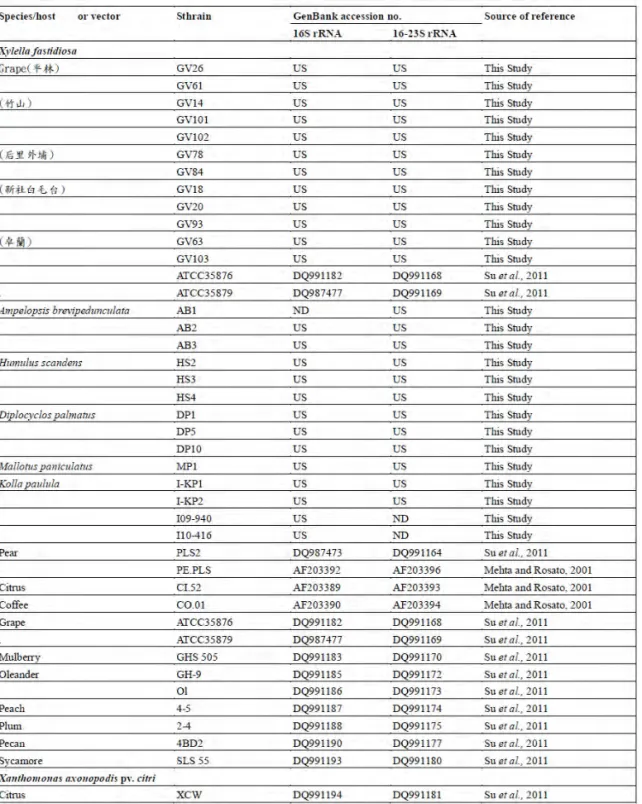
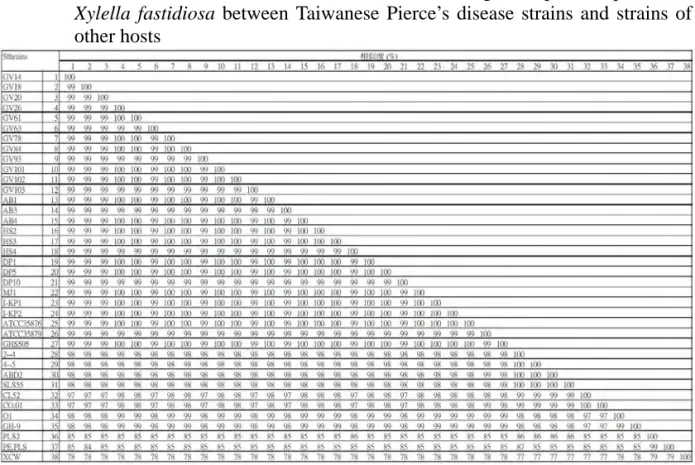
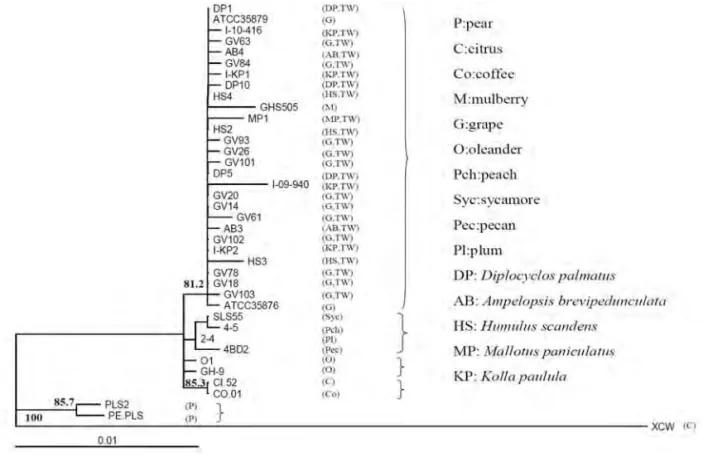
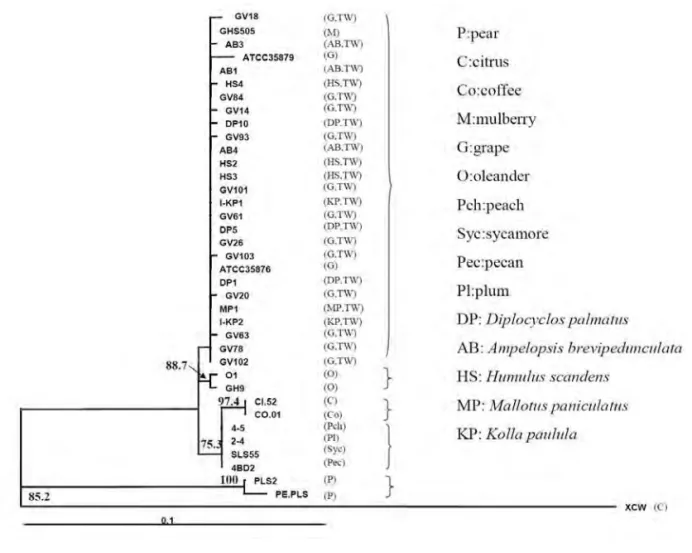
PD 的寄主植物;在媒介昆蟲的研究部分, 透 過 柯霍氏法則確認白邊大葉蟬 ( Kolla paulula (Walker)) 為台灣 PD 的媒介昆蟲,歷年來的野外調查則未發現國 外已記錄可傳播 PD 的媒介昆蟲。分析國內各地 PD 葡萄菌株、媒介昆蟲白邊 大葉蟬體內菌株與 4 種雜草寄主植物體內菌株,進行 16S rRNA 與 16-23S rRNA 區間序列基因解序,並與 X. fastidiosa 不同植物寄主菌株比對,寄主包含 台灣的梨樹與國外的葡萄、桑椹、李、核桃、無花果及夾竹桃等,再利用最大似 然法 (Maximum Likelihood) 親緣樹狀圖的分析,結果顯示各地區植物體內的 X. fastidiosa 菌株,可分為五個菌群:第一群為葡萄與桑椹菌群,第二群為咖啡與柑 橘菌群,第三群為胡桃、李、桃及無花果菌群,第四群為夾竹桃菌群,第五群為 梨菌群;而台灣的葡萄、雜草寄主與蟲媒體內的 PD 菌系,應該屬於第一群,且 兩者的基因序列相似度達 99-100%,幾可確認具有同源性。未來台灣應積極防杜 國外已知蟲媒藉由種苗植物入侵,並持續偵測調查 PD 在台灣的寄主植物 範圍與本土性的媒介昆蟲,以探討兩者在 PD 流行病學所扮演的角色。 關鍵詞:葡萄皮爾斯病,棲息導管細菌,雜草寄主,媒介昆蟲
前 言
台灣葡萄栽植主要集中在中台灣 4 個地區,據農業年報統計栽植面積達 3,200 餘公頃,分布在苗栗縣、台中市、彰化縣、南投縣及其他零星地區,生產(Wells et al., 1987) 所引起,病原細菌侵入葡萄後,能快速增殖建立其族群,會系 統 性 移 動 並 分 布 於 寄 主 維 管 束 組 織 之 導 管 內 (Hill & Purcell, 1995; Purcell, 1997),依栽培品系感病性之差異,危害之葡萄 1 至 5 年後即會死亡 (Smith et al., 1997; Varela et al., 2000),PD 會影響葡萄之正常生育,其形成之病徵包括葉緣壞 疽焦枯、提早落葉、新枝不正常老熟、樹勢衰落、延遲萌芽、植株矮化及枝條枯 死,目前罹病之植株仍無有有效治療方法 (Blua et al., 1999),PD 在美國東南地 區之葡萄栽植區為一風土病 (endemic),一直是該地區葡萄產業之主要限制因 子,影響釀酒工業之葡萄栽培及生產甚鉅,亦影響墨西哥、中美洲及美國西南地 區部分栽植區之葡萄生產並造成嚴重損失 (Hopkins, 2001)。PD 在加州許多葡萄 栽植區域之葡萄園每年皆會發生,在 Napa、Sonoma 及 Mendocina 等郡之商業 化栽植之葡萄園皆嚴重發生,一般推測該區域 PD 之流行發生與其蟲媒族群之建 立有密切關係 (Purcell, 2000)。PD 亦會影響畜牧之產業,PD 之病原會引起苜蓿 矮化病,造成苜蓿之嚴重減產 (Hewitt et al., 1946)。本文為首次正式論述台灣葡 萄皮爾斯病與媒介昆蟲研究現況,期能提供國內葡萄生產業者參考,減緩本病對 國內葡萄產業之衝擊。
葡萄皮爾斯病發生現況
PD 為國際檢疫病害,目前全世界有紀錄受 PD 危害的區域主要集中在美洲 地區,在北美州包括美國阿拉巴馬、加州、佛羅里達、喬治亞、密蘇里、路易斯 安納、北卡羅來納、南卡羅來納和德克薩斯等州 (Smith et al., 1997; Varela et al., 2000);中美洲包括哥斯達黎加 (Aguilar et al., 2008; Smith et al., 1997) 和委內瑞拉 (Jimenez, 1985);南美洲包括阿根廷 (Nome et al., 1992) 和秘魯 (Purcell, 1997); 1998 年南斯拉夫 Kosova 地區的葡萄園出現 PD 危害,為歐洲發生 PD 危害的 首例 (Berisha et al., 1998);至於亞洲地區,2000 年在中國大陸的陝西省禮泉、乾 縣及蒲城等地區發生 PD 疫情 (楚, 2001)。PD 於 1892 年首次發現在美國加州 南部地區,爾後被命名加州葡萄病 (Califonia vine disease),至今一直是美國東南各郡間進一步檢測是否有 PD 危害之計畫,仍未完全實行 (Hopkins, 2001)。 自2002 年防檢局針對國內是否存在 PD 啟動偵測調查 (detection survey), 調查區域涵蓋南投縣、台中市、彰化縣及苗栗縣等 4 縣市之葡萄產區,南投縣包 括信義鄉、水里鄉、集集鎮、竹山鎮、草屯鎮及埔里;台中市包括豐原區、石岡 區、東勢區、后里區、外埔區、新社區;苗栗縣包括卓蘭鎮及通霄鎮;彰化縣包 括二林鎮、埔心鄉、大村鄉及溪湖鎮;歷年來鄉鎮市葡萄產區幾已全面性調查完 畢,所有調查之果園防檢局疫情資訊中心皆已建立完整之 GIS 圖檔;自 91 年 葡萄夏果期至 99 年葡萄冬果採收期前上述之葡萄產區累計共調查 7388 個果園 數,面積共達約 4142 公頃,歷年來發現 10 個鄉鎮葡萄產區共 311 個罹病園共 達 12023 株 PD 罹病株,包括草屯鎮平林里 23 個罹病園 167 株罹病株、竹山 鎮社寮里 36 個罹病園 1116 株罹病株、集集鎮 1 個罹病園 80 株罹病株、豐原 區 2 個罹病園 3 株罹病株、東勢區明正里 3 個罹病園共 21 株罹病株、新社區 白毛台及復興村 20 個罹病園 368 株罹病株、外埔區 40 個罹病園 992 株罹病 株、后里區 150 個罹病園 6920 株罹病株、卓蘭鎮苗豐里及內灣里 9 個罹病園 876 株罹病株及通宵鎮 27 個罹病園 1480 株罹病株 (表 1)。 表1. 91-99 年各鄉鎮葡萄產區監測到葡萄皮爾斯病發生之罹病株及罹病果園數 Table 1. Survey results of Pierce’s disease incidence: total numbers of diseased plants
and orchards in various counties conducted from 2002 to 2010
綜合中部 4 縣市各鄉鎮區葡萄產區地毯式偵測調查分析,有 PD 發生鄉鎮 區之葡萄產區,罹病園分布地理特性可歸納為二:(一) 位於丘陵地形的栽植園: 典型的代表為通宵鎮、后里區及外埔區的葡萄產區;(二) 緊鄰於山溝或河川地的 栽植園:典型代表為卓蘭鎮苗豐里及內灣里、新社區白毛台及復興村、東勢區明 正里、草屯鎮平林里及竹山鎮社寮里,由地理特性顯示罹病園多位於產區的邊緣
株異常立即更新。 PD 田間調查及觀察顯示栽培的釀酒或鮮食葡萄品系皆能罹病,10 個葡萄產 區其中 5 個主要 PD 發生疫區歷年來累計罹病園率分別為草屯為 18%、竹山為 52%、外埔為 56%、后里為 85% 及通霄為 74% (圖 1)。由上述資料顯示 3 個 釀酒葡萄品系栽植區通霄鎮、后里區及外埔區為 PD 嚴重發生及分布區域,但鮮 食葡萄品系集中栽植區之疫區 PD 可有效管控且僅零星發生,但發現疫區周遭植 被大面積破壞導致鄰近新增葡萄罹病園同時園內感染 PD 葡萄植株明顯增加,竹 山鎮社寮里葡萄產區為典型例子,推論周遭大範圍植被內潛藏廢棄之葡萄園可能 有帶有 PD 病菌葡萄植株及雜草寄主,一旦遭人為破壞,帶菌之蟲媒被迫遷移直 鄰近葡萄園,另偶亦發現坡地單獨葡萄栽植園一旦 PD 被引入立足且周圍為雜林 地,罹病園病害明顯擴散蔓延;歷年各季在 10 個鄉鎮葡萄產區偵測及監測到 PD 罹病株,地方縣政府已配合防檢局緊急防疫措施,執行罹病株砍除事宜。
葡萄皮爾病寄主植物偵測調查
引起 PD 之 X. fastidiosa 菌株之寄主範圍相當廣,在加州地區曾被記錄超過 28 科涵蓋 94 種類之植物為其寄主,而其中許多寄主植物不會顯現病徵 (Freitag, 1951; Hill & Purcell, 1995; Purcell & Saunders, 1999b; Purcell, 1997; Raju et al., 1983)。許多寄主植物為天然寄主,例如長葉栲 (Acacia longifolia)、通艾 (Artemesiavulgaris)、野燕麥 (Avena fatua)、臭藜 (Chenopodium ambrodioides)、印度白蠟
(Fuchsia magellanica)、錐花八仙 (Hydrangea paniculota)、義大利黑麥草 (Lolium
multiflorum)、Marjorana hortensis、Poa annua, 加州薔薇 (Rosa California)、迷迭
香 (Rosemary officinalis)、葡萄葉懸鈎 (Rubus vitifolius)、柳樹屬植物 (Salix spp.)、 鍬草屬植物 (Veronica spp.) 和加州野葡萄 (Vitis califonica)等,許多其他之寄主植 物利用蟲媒室內試驗已被證實能感染 PD 之病原菌株 (Freitag, 1951; Purcell &
訊可資參考。例如,來自葡萄之 X. fastidiosa 菌株不能感染桃 (peach),同時來自 桃之 X. fastidiosa 之菌株不能感染葡萄;來自於感染 Acer、Morus、 Platanus 及
Ulmus spp. 等植物之 X. fastidiosa 菌株無法傳播至葡萄 (Smith et al., 1997);來自
夾竹桃葉緣焦枯病 (oleander leaf scorch) 之 X. fastidiosa 菌株無法感染葡萄、 桃、黑莓 (blackberry) 或苜蓿 (alfalfa) (Purecll, 1997);來自杏仁葉緣焦枯病 (almond leaf scorch) 之 X. fastidiosa 菌株可傳播至葡萄,相對地,來自之 X.
fastidiosa 菌 株 亦 可 傳 播 至 杏 仁 (Purcell, 1980b) 。 事 實 上 , 引 起 PD 之 X. fastidiosa 菌株在實際上發生之寄主範圍應該有許多寄主植物仍未被偵測證實?
一般認為有些非作物寄主 (non-crop hosts) 可能為引起 PD 之主要感染源,有潛 能傳播病原至葡萄園,其在流行病學扮演之角色仍不甚清楚?(Hill & Purcell, 1995)。 國內葡萄產區引起 PD 之 X. fastidiosa 菌株之寄主範圍偵測調查,自 92 年 9 月於東勢鎮明正里葡萄產區 PD 罹病園 (編號東勢-097) 鄰近邊坡地帶首次確 認雜草雙輪瓜植物為 PD 之其他寄主植物後,陸續於 8 個鄉鎮 PD 發生葡 萄產區標定罹病園進行其他寄主植物調查及採樣,總共標定 45 個罹病園包括 南投縣草屯鎮 4 個、竹山鎮 3 個、台中市東勢區 2 個、后里區 16 個、外埔區 8 個、新社區 5 個、苗栗縣卓蘭鎮 4 個及通宵鎮 3 個;迄今採集除葡萄以外 共 238 種植物,總樣品數高達 3,889 個 (表 2),分布於 72 科、183 屬 植物。採集樣品分別進行 PD 病原菌分離及 PCR 檢測,僅其中 4 種類雜草
植 物 ,分別為葎草 (Humulus scandens (Lour.) Merr.) (圖 2 A)、漢氏山葡萄 (Ampelopsis brevipedunculata (Maxim.) Trautv var. hancei (Planch.) Render) (圖 2B)、雙輪瓜 (Diplocyclos palmatus (L.) C. Jeffrey) (圖 2C)及白匏仔 (Mallotus
paniculatus (Lam.) Muell. -Arg.) (圖 2D);雙輪瓜累計 81 個樣品有 5 個為正反
應,分別在台中市外埔區、東勢區、新社區與苗栗縣卓蘭鎮各得到 2、1、1 及 1 個樣品;漢氏山葡萄累計 120 個樣品有 7 個為正反應,分別在台中市后里區、 外埔區、南投縣竹山鎮及苗栗縣卓蘭鎮各得到 1、4、1 及 1 個樣品;葎草累計 61 個樣品有 9 個為正反應,分別在苗栗縣卓蘭鎮、台中市后里區及外埔區各 得到 1、1 及 7 個樣品;白匏仔截至目前為止累計 51 個樣品僅在台中市新社區 得到一個正反應的樣本,歷年來總計共 22 個樣品經 PCR 檢測為正反應且成 功分離到病原菌 (表 3);分離自 4 種寄主雜草之 PD 病原菌經人工接種至健 康葡萄植株,已確認會在植株內繁殖且會造成典型葉緣焦枯病徵;進一步分析感 染 X. fastidiosa 寄主雜草的葡萄罹病園內罹病植株分布情況,發現部分罹病園 罹病植株分布與鄰近感染 X. fastidiosa 雜草寄主似乎有地緣相關性,此一現象 間接證實國內葡萄 PD 病害於田間可能藉由本土性蟲媒自然傳播病害。
ND:標定罹病園未進行調查。
表3. 92-99 年葡萄皮爾斯病標定罹病園鄰近四種雜草寄主植物採集檢測情形 Table 3. Detection of Xylella fastidiosa Pierce’s disease (PD) strains in four alternative
hosts collected from the proximity of PD-confirmed grape orchards conducted from 2003 to 2010
ND: 罹病園鄰近未採集到該雜草;*:PCR 及病原菌分離為正反應之樣品數。
證有關的研究,幾乎都在美國完成,但至今也僅有少數的大葉蟬與沫蟬被證實為 PD 的媒介昆蟲。台灣在數年之間已自台灣本土所產的 3 種大葉蟬體中偵測出 PD 的分子序列,其中白邊大葉蟬 (Kolla paulula) 已完成柯霍氏法則傳病驗,確 認為可傳播 PD 的本土性大葉蟬種類 (Shih & Su, unpublished data)。茲將美國與 台灣之研究現況,以及兩國可以互相交流的課題簡述如下:
一、美國研究現況
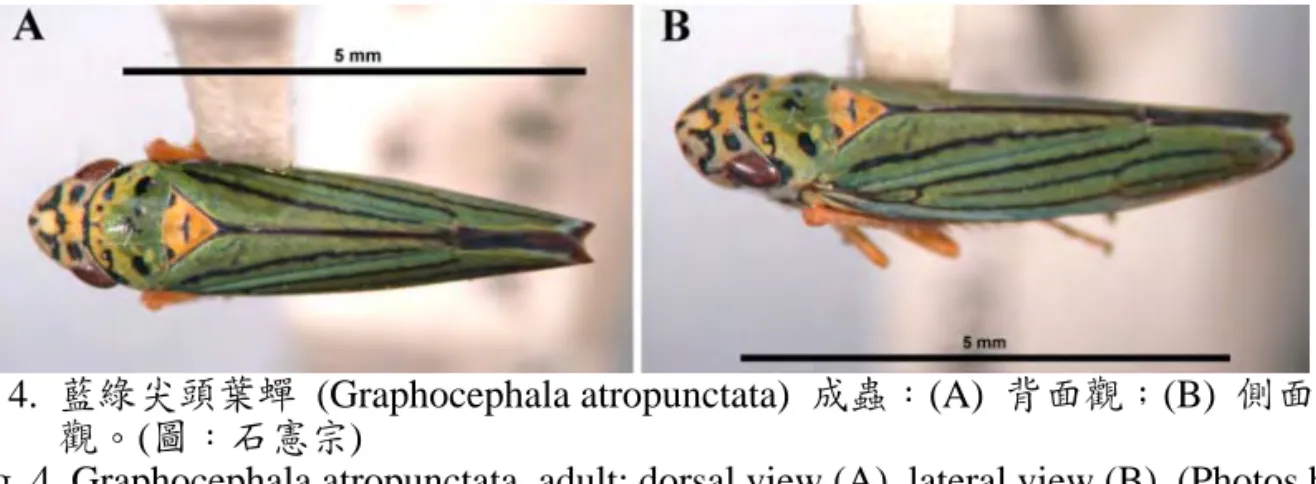
在美國已被證實可傳播 PD 的媒介昆蟲,包括半翅目 (Hemiptera)、葉蟬科 (Cicadellidae)、大葉蟬亞科 (Cicadellinae) 與沫蟬總科 (Cercopoidea)、尖胸沫蟬 科 (Aphrophoridae) 的 物 種 , 較 具 傳 病 效 率 的 包 括 褐 透 翅 尖 頭 葉 蟬 (Glassy-winged sharpshooter, Homalodisca vitripennis (Germar)) (簡稱 GWSS) (圖 3)、藍綠尖頭葉蟬 (Bluegreen sharpshooter, Graphocephala atropunctata (Signoret)) (圖 4)、綠尖頭葉蟬 (Green sharpshooter, Draeculacephala minerva (Ball)) (圖 5)、 紅首尖頭葉蟬 (Red-headed sharpshooter, Xyphon fulgida (Nottingham)) 與黃頭長 沫蟬 (Meadow spittlebug, Philaenus spumarius (Linnaeus)) (圖 6)。其餘透過室內傳 病 驗 證 確 認 可 傳 播 PD 的 媒 介 昆 蟲 尚 有 Amphigonalia severini DeLong,
Helochara delta Oman, Paragonia confusa Oman 與 Friscanus friscanus (Ball) 等
4 種大葉蟬亞科昆蟲;Aphrophora angulata Ball 與 A. permutata Uhler 等 2 種尖 胸沫蟬亞科昆蟲與 1 種鉤沫蟬科 (Clastopteridae) 的 Clastoptera brunnea Ball (Redak et al., 2004)。
褐透翅尖頭葉蟬 (GWSS) 為傳播 PD 最具效力的媒介昆蟲,且被確認可傳 播其他寄主之 X. fastidiosa 病原菌株,使寄主罹病,包括杏仁葉緣焦枯病、桃矮 小病 (phony peach disease)、李葉緣燒枯病 (plum leaf scald)、柑桔斑駁黃化病 (citrus variegated chlorosis, CVC) 和榆樹 (elm)、楓樹 (maple) 等植物病害 (Blua
et al., 1999; Hopkins, 1989)。從蟲媒生物學及行為學觀點而言,GWSS 有許多特 性有利其在葡萄園傳播 PD,包括:(1) 本種成蟲相對於其他 PD 的媒介昆蟲而 言,具有極佳的飛行能力,自罹病葡萄植株獲菌之後,可長距離的飛行,直接飛 入健康園區的內部 (飛行能力較短者,僅能從健康園區外圍慢慢入侵);(2) GWSS 為多食性的葉蟬,已紀錄的寄主植物超過 100 種以上 (Hoddle et al., 2003; Redak et al., 2004),但真正影響其營養需求的關鍵養分卻為導管中的特定胺基酸 (如 glutamine 與 asparagine) 與碳水化合物,且成蟲與若蟲利用植物養分的種類 與比例,也有不同程度的差異 (Redak et al., 2004);若成蟲尋找植物前已獲得 PD,在成蟲尋找適合自己養份的寄主植物過程,同時也進行病害的傳播;(3) GWSS 成蟲越冬後仍具感染力,至翌春會感染健康寄主植物 (Purcell & Saunders, 1999b; Varela et al., 2000),與其他種類葉蟬比較,GWSS 喜歡在葡萄植株較低位置之枝 條吸食,意味著 PD 病害之病原能靠近植株主幹組織建立及殘存,較不會被修剪 方式而去除病原,這種方式造成園內慢性罹病株之建立,有利植株與植株間之病 害傳播,促使病害快速成長;(4) GWSS 在冬天時期會在休眠狀態中之葡萄及核 果類植物吸食 (Purcell, 2000)。
7C) ; 角 頂 葉 蟬 亞 科 (Deltocephalinae) 13 種 (Tartessus sp., Balclutha laevis (Melichar), Balclutha saltuella (Kirschbaum), Balclutha incisa (Matsumura),
Hishimonus sp., Nephotettix cintriceps (Uhler), Nephotettix nigropictus (Stål), Goniagnathus punctifer (Walker), Macrosteles fascifrons Stal, Macrosteles sp., Deltocephalus distinctus Motschulsky, Deltocephalus sp., 與 Yamatotettix sp.);葉蟬
亞科 (Iassinae) 1 種 (Batracomorphus sp.);緣脊葉蟬亞科 (Selenocephalinae) 1 種 (Drabescus sp.) ; 橫 脊 葉 蟬 亞 科 (Evacanthinae) 2 種 (Sophonia orientalis (Matsumura) 與 Nirvana placida (Stål);小葉蟬亞科 (Typhlocybinae) 3 種 (台灣頂 斑小葉蟬 (Empoascanara formosella Dworakowska)、楚南氏二點頂斑小葉蟬 (Empoascanara sonani (Matsumura)) 及擬頂斑葉蟬 (Kapsa sp.))。
以上種類,可自野外獲得的蟲體之內,偵測到 PD 的分子序列者,包括白 邊大葉蟬、黑尾大葉蟬與縱脈斑大葉蟬等 3 種,其中白邊大葉蟬已透過柯霍氏法 則的傳病驗證程序,確認其為台灣本土第一種可以傳播 PD 的大葉蟬。除此,嗜 菊短頭脊沫蟬的成蟲,可在實驗室完成柯霍氏法則的傳病驗證,但仍無法自野外 採獲的本種沫蟬體內偵測出 PD 的分子序列。
Shih et al. (2009) 針對白邊大葉蟬 (Kolla paulula) 進行族群密度調查、測試 與確認寄主植物、分析飛行高度等系列研究,茲將重點簡列如下:(1) 近年來藥 試所與農試所兩單位於南投縣竹山與草屯、台中市后里區與新社區等地,以黃色 黏蟲紙監測與分析本種葉蟬全年的族群密度,發現本種葉蟬在各地罹病樣區的發 生盛期約有 3 次,分別為 2 月初至 4 月初、7 月初至 8 月底、10 月中旬至 12 月中旬,每次高峰維持約 2 個月,其中 2 月初至 4 月初之平均密度約為另兩次 高峰的 1 倍;(2) 在白毛台以不同吊掛高度 (1-5 m) 的黃色黏蟲紙誘集成蟲,分 析白邊大葉蟬的飛行高度範圍,結果顯示本種葉蟬飛行高度以離地 1-2 m 為主, 3-5 m 相對較少;(3) 農試所從事本種葉蟬之寄主試驗,發現本種葉蟬可在小花蔓 澤蘭、大白花鬼針、紫花霍香薊及鴨跖草等野外常見雜草上完成繼代發育,其中 以小花蔓澤蘭與大白花鬼針草為其最適寄主。農試所的研究結果也顯示,黑尾大