行政院國家科學委員會專題研究計畫 成果報告
台灣大專生在以面對面與電腦媒介溝通混合式教學方式之
參與模式與其所呈現批判性思考之個案研究
計畫類別: 個別型計畫 計畫編號: NSC93-2411-H-009-021- 執行期間: 93 年 08 月 01 日至 94 年 12 月 31 日 執行單位: 國立交通大學語言教學與研究中心 計畫主持人: 張靜芬 報告類型: 精簡報告 處理方式: 本計畫可公開查詢中 華 民 國 95 年 4 月 3 日
A case study of Taiwanese college students’ participation behaviors and critical thinking in both face-to-face and computer-mediated communication modes.
Ching-Fen Chang
National Chiao Tung University
Abstract
With the rapid development of Internet in the past decades, computer-mediated communication (CMC) has been widespread in education. Previous studies have claimed that the text-based and asynchronous features of CMC facilitate students to develop deeper thinking and make better contribution to class discussions than in face-to-face mode. However, few studies have been conducted to explore how CMC may help ESL/EFL students develop higher-order thinking while learning the target language. The study attempted to examine college students’ critical thinking performed through their English writing via various on-line tools.
This study was conducted in an elective English writing course at a public university. A Web-based learning system, Blackboard, was adopted as an alternative tool for 17 non-English majors to post their opinions on the issues discussed in face-to-face class sessions. The electronic transcripts from various sources (e.g. e-mail, on-line chat, and asynchronous forum), field notes from class observation, and a questionnaire were gathered and analyzed based on the “practical inquiry model” proposed in Pawan, et al.’s study (2003). The results showed that the college students not only practiced English writing but also developed explorative cognitive presence in the on-line discussions. The students’ background knowledge and interests toward a specific issues affected their while interacting with class members on issue discussions. Pedagogical suggestions were also provided.
Introduction
In the past two decades, CMC has become widespread in education since its first implications of networked classrooms for teaching writing in the late 1980s (Herring, 1996). The synchronous (e.g. on-line chat or InterChange1) or asynchronous (e.g. electronic mail or electronic forum) features of CMC have been credited to offer more equal opportunities for students to participate in class discussions as well as fewer physical boundaries and time limits than traditional face-to-face classroom learning (Kern, 1995; Warschauer, 1996).
In light ofthe language pedagogy in second and foreign language (SL/FL) learning, the paradigm shifts from the interaction between human beings and computers (e.g. traditional computer-based language programs) to the interaction between human beings has redefined the role of computer technology in language classrooms as mediation to “provide possibilities for new interpersonal contacts and communicative engagement” (Kern, 1995, p. 457). From theoretical perspectives of the Interactive Hypothesis and socio-cultural theory in second
1 InterChange is a synchronous (real-time) electronic conferencing program. According to Kern (1995),
language acquisition, the situated interaction generated in CMC helps language learners obtain comprehensive input, construct language acquisition, and then enhance their cognitive development. Previous studies have explored various issues regarding using CMC in L2/FL education (Beauvois, 1998; Chun, 1994; Gonzales-Bueno, 1998; Kern, 1995; Leh, 1997; Oliva & Pollastrini, 1995; Sotillo, 2000; Warschauer, 1996). These studies and theories have suggested that by providing authentic and situated communication through networked computers appears to be promising for EFL learning context, like in Taiwan, in which EFL students can hardly find practice opportunities out of their English classrooms and the language courses are usually constrained by limited class time (i.e. 100 minutes per week).
In Taiwan, with the rapid development and application of networked computers in education, more and more college courses in Taiwan begin to incorporate different types of computer technology as a medium for class activities. Many studies have also been conducted to examine the issues of involving CMC in EFL teaching and learning (i.e. Chang, 1992; Chen, 2003; Chen, Hsiao, & Lee, 1998; Huang, 1998; Liaw, 1998; Liaw & Chern, 2000; Liou, 2000; Shieh, Yang, & Katchen , 1998; Tang & Kao, 1998). However, few empirical studies to date have explored a wide range of issues and an in-depth understanding of the issues generated from the application of CMC in EFL classrooms in Taiwan. As Liaw (1998) claims, “a broad research agenda is therefore called for to gain more in-depth understand of the affective, cognitive, and social aspects involved in computer-mediated collaborative learning” (p. 338).
One crucial issue revealed from the studies of CMC in education is to examine how the text-based and asynchronous features of CMC facilitate students’ higher-order thinking and make better contribution to class discussions than in conventional face-to-face delivery mode (Garrison, Anderson, & Archer, 2000; Mikulecky, 1998; Warschauer, 1996). Interestingly, recent trends in L2 teaching have also paid much attention to students’ higher-order thinking as a major goal of L2 education (e.g. Atkinson, 1997; Davidson & Dunham, 1996; Stapleton, 2001).
To help EFL students develop critical thinking, a special instructional intervention was developed and employed in an elective English course. The major theory behind the instructional intervention is collaborative learning. By engaging EFL students in participating several collaborative activities (e.g. small group discussions, pro-con debate, role-play activities) via both face-to-face and on-line discussion modes, the intervention was expected not only to improve students’ English proficiency but also foster their’ critical thinking through meaningful interaction. Hence, the study purposes attempted to gain in-depth understanding whether the instructional intervention via both discussion modes helped to produce critical thinking as well as whether there are any differences between two modes. Based on the abovementioned two themes, the research questions are stated as follows,
face-to-face and on-line discussion modes?
2. What level of cognitive presence do EFL college students perform in social interaction via CMC mode?
3. What factors may influence the level and type of communicative discourse among students via CMC mode?
Before describing the methods of this study, outline a brief review of previous studies examining related to this study.
Literature Review
According to Herring (1996), “computer-mediated communication (CMC) is communication that takes place between human beings via the instrumentality of computers” (p.1). Santoro (1995) defines CMC as “the use of computer systems and networked for the transfer, storage, and retrieval of information among humans” (p. 11). Warschauer (1997) further indicates five features to distinguish CMC from other communication media: (a) text-based and computer-mediated interaction, (b) many-to-many communication, (c) time- and space-independence, (d) long distance exchange, and (e) hypermedia links. Compared with traditional computer-based instruction (CAI), the role of computers in CMC has shifted from a processor to a mediator. Fundamentally, social interaction via networked computers is the actual activity embedded in CMC. From a sociocultural perspective, learning “is a process that takes place in a participation framework, not in an individual mind” (Lave & Wenger, 1991, p. 15). Donato (2000) further explored the view of learning as “a semiotic process attributable to participation in socially-mediated activities. Additionally, this mediation becomes the eventual means fro mediating the individual’s own mental functioning” (p. 45). Hence, when the social interaction with certain groups in CMC has generated special virtual learning environment, apparently, social and cultural factors have impacted on learning in CMC model more than conventional computer-based instruction.
Previous studies have claimed numerous benefits of CMC classroom practices. First, CMC is credited with provide alternative opportunities for interactions among class members beyond time and physical constraint when compared with traditional face-to-face class discussion (Lowrer, Koneman, Osman-Jouchoux, & Wilson, 1996; Partee, 1996). Second, the feature of many-to-many interaction in CMC offers equal opportunities for class members to participate in class discussion (Kern, 1995; Lowrer, Koneman, Osman-Jouchoux, & Wilson, 1996; Sullivan & Pratt, 1996; Warschauer, 1996). Third, the synchronous (real-time) and asynchronous communication (delay-time) modes provide a less-threatening class atmosphere for students to express their thoughts than conventional face-to-face interaction. Through CMC, students, at their own pace, can spend more time constructing
their ideas to contribute to class discussion (Karayan, 1997; Lowry, Koneman, Osman-Jouchoux, & Wilson, 1994; Singhal, 1998; Warschauer, 1996).
In addition to exploring benefits from integrating CMC into classroom practices, a variety issues between CMC and face-to-face class delivery media have been raised and examined. These issues involve students' performance, learning approaches, perceptions, or patterns of interactions (see e.g. Carnwell, Moreland, & Helm, 2001; Gaddis, Napierkowski, Harriet, Guzman, & Muth, 2000; Lindner, Dooley, & Murphy, 2001; Merisotis & Phipps, 1999; Russel, 1999; Shoenfeld-Tacher, McConnell, & Graham, 2001; Tucker, 2000).
The growing phenomena of CMC in education also interested researchers in second and foreign language (L2/FL). Many CMC studies have explored how CMC benefits L2/FL education. From L2/FL perspectives, CMC is credited with facilitating L2/FL education in terms of (1) providing authentic interaction in the target language, (2) allowing more flexible interactive time frames, (3) enhancing the equality of L2/FL students’ participation, and (4) creating a less-threatening class atmosphere (e.g. Gonzáles-Bueno, 1998; Kern, 1995; Leh, 1997; Liaw, 1998; Warschauer, 1996). Hence, issues like how L2/FL education benefits from CMC have been raised. Kern (1995), for example, investigated the quantitative and characteristic differences of the language production between a synchronous CMC and an oral classroom discussion in a French course. He found that the FL learners obtained more opportunities to express their ideas in computer-mediated discussion than in oral discussions. Text-based CMC also led them to produce a greater variety of discourse functions and a wider range of morphosyntactic features of the target language than oral discourses. Warschauer (1996) further compared the equality of L2 students’ participation in a hybrid residential class, where a synchronous CMC was employed as an alternative discussion medium. He found that the synchronous electronic mode provided a more equal opportunity for L2 students to participate in class discussion than face-to-face discussion. In brief, these studies have provided positive evidence of the benefits of CMC in L2/FL education compared with face-to-face environments.
In addition to comparing the differences between synchronous CMC and oral face-to-face discussion mode for L2/FL learners, some SL/FL researchers (González-Bueno; Gray & Stockwell, 1998; Leh, 1997; Liaw, 1998; Ruhe, 1998) are interested in exploring how e-mail, an asynchronous CMC tool, enhances SL/FL. For example, González-Bueno (1998) attempted to examine the effects of using e-mail to promote students’ Spanish learning in and out of classroom. Working on dialogue journals via e-mail on arbitrary topics, the participants were offered opportunities to practice the target language with their instructor. By collecting and analyzing the e-mail transcripts, the findings showed that e-mail enhanced the quality of the students’ participation and provided a better time and space management than paper-based dialogue journals. Leh (1997) conducted a study to examine the effect of using e-mail on nonnative speaking of Spanish students’ language proficiency and cultural
acquisition. By collecting the data from multiple sources, including the participants’ achievement test, class writing reports, oral examination, attitude surveys, questions, and interviews, the quantitative results revealed that students’ language performance and confidence were not significantly different between the group who corresponded with native speakers via e-mail and those who did not. However, the qualitative results showed that the e-mail keypal project enhanced students’ cultural learning and social presence.
In general, these studies, primarily drawn from practical application of CMC in SL/FL classroom settings, have provided evidence on the promotion of language production and positive attitudes toward using CMC as a learning tool as well as the analysis of the linguistic features in different CMC tools. In Taiwan, the development of CMC has also interested some EFL researchers. Several EFL researchers have conducted several issues (i.e. Chang, 1992; Chen, 2003; Chen, Hsiao, & Lee, 1998; Huang, 1998; Liaw, 1998; Liaw & Chern, 2000; Liou, 2000; Shieh, Yang, & Katchen , 1998; Tang & Kao, 1998). For example, Tang & Kao (1998) explored the application of using BBS, e-mail, and synchronous electronic conferencing for EFL classes in high school. Liu (2000) conducted another study to explore how college EFL students learned from using e-mail, World Wide Web resources, Web-based MOO, and other multimedia tools in three courses. Another study by Liaw & Chern (2000) investigated the efficacy of integrating the use of Internet in EFL classes in elementary schools. In general, these studies mainly explored the application of CMC in Taiwan’s EFL education, either in elementary education or higher education, or examined the effects of using CMC on students’ English learning
In addition to NSC projects, other EFL researchers in Taiwan also explore the issues of comparing two modes in EFL classes. For example, Huang (1998) compared Taiwanese EFL college students’ peer response sessions through InterChange and in face-to-face settings. By analyzing 17 participants’ transcripts in both modes in terms of the lengths and frequencies from a sophomore composition course, she found that CMC did not facilitate these students’ writing in terms of producing speech and the frequencies of participation. However, another study by Liaw (1998) investigated how 26 Taiwanese college students perceive their participation in an e-mail exchange of a general EFL course. The results from survey and group interactions revealed that students perceived positively from the participants’ attitude toward the use of e-mail in their EFL classrooms.
The markedly different results revealed from the two studies appear to involve multiple factors, like the research questions, the course designs, and the nature of the students. More importantly, they employed the two different CMC tools, InterChange (a synchronous program) and e-mail (an asynchronous communication system). According to Sotillo (2000), the synchronous and asynchronous CMC environments can develop different discourse functions and syntactic complexity of the target language. The synchronous
discussion is similar to the types of discourses functions found in face-to-face conversations, whereas more syntactic complexity is found in the asynchronous discussion.
In general, the research of CMC in EFL has gradually become a conspicuous field among computer-assisted language learning (CALL) research. When more and more EFL
instructors integrate CMC as part of major class activities in their language classrooms, a wide range of issues needs to be explored to help EFL educators better understand the impact of CMC in EFL. However, to my knowledge, advanced issues like students’ behaviors in asynchronous CMC environments or the influence of CMC environment on students’ learning development have not been explored. Hence, the issues that the current study proposed become crucial in the field of CMC in EFL education. In the following section, the research method is described.
Method
This study attempted to examine EFL college students’ interaction patterns in both CMC and face-to-face modes and their cognitive presence performed especially in on-line
interaction. Case study methodology was adopted to address the research questions. A detailed description of the methods is described in the following section.
Setting and participants
The study setting was an elective English course offered for non-English undergraduates at a public university in Taiwan. To promote the application of e-learning in higher education, the university provided various electronic delivery platforms for teaching to reflect the
growing trend of e-learning in the past few years. Instructors who are interested in integrating technology in pedagogy may conveniently access the facilities. The target course adopted one of the electronic platforms, Blackboard®2, as the major on-line delivery medium. The course met once a week for two hours in a regular classroom or a computer lab equipped with networked computers.
The study participants were 17 students who took this course during the data collection semester. Based on the English requirements in this university, each undergraduate student was required to take at least 3 English courses with 6 credits before graduation. In addition to two “Freshman English” courses (4 credits) at his freshman year, an undergraduate was required to take one more elective advanced English course to fulfill this graduation
requirement. Hence, the 17 students took this elective advanced English course involved 1 graduate and 16 undergraduate students from different academic years except freshman. Their age ranged from 19 to 22. There were 14 male and 3 female students. Except one
2 Blackboard is a multi-language learning system, developed by Blackboard Inc. For detailed description of the
student majored in social science related filed, the rest students majored in science and technology related fields.
The course design and class activities
While many English writing courses focus on grammatical rules, basic paragraph writing, and the structure of an essay, the target course emphasized on writing for communication. By integrating Blackboard, with weekly face-to-face class sessions, the students were required to discuss issues assigned by the instructor in class meetings and write their comments on the issues discussed/occurred in face-to-face discussions. This course was held in the first 18-week regular semester, 2005. Hence, the face-to-face and on-line activities were described, respectively.
Face-to-face class activities
The English writing course met once a week in a writing lab, in which students could easily interact with each other from different seats. Every two-week was regarded as one unit, in which two topics were provided by the instructor for the major theme of class
activities. The topics included astrology and superstition, English education (GEPT), Hero (a movie), life plan, Frequency (a movie), Terri’s case (a vegetarian’s story), technology and life, educational inequality, and homosexual marriage. These topics were conducted in different formats: whole-class and small group discussion formats, pro-con debate basis, in-class hand-writing, and on-line chat. In addition to issue discussions, the class activities also included language practice, such as grammatical practice, writing problem diagnosis, co-writing, and co-editing.
On-line activities
After the class meetings, the students were required to participate in forum discussions in Blackboard. Starter and wrapper approach was adopted for the online activities. That is, in each week, one student was responsible to initiate the discussion based on the weekly theme by several questions. The forum lasted for one to two weeks, depending on the in-class activities. A wrapper was responsible to summarize the whole discussion.
Data collection procedure
A same course with the same title was first offered in the university right before the data collection semester. The instructor, also the researcher, designed several class activities and topics for 10 students taking the course. Their online transcripts were coded by the researcher and a research assistant who was a part-time English lecture in this university. Based on the coding results and teaching experience, part of the class activities or topics were adjusted to fit to the main study.
During the data collection semester, the researcher, also the instructor, not only conduced the class activities with various and appropriate topics fitting the participants’ English levels and interests, but also collected data from tape-recording major in-class activities and field notes of the on-line interactions. Additionally, one research assistant observed in the weekly class meetings and took notes about the participants’ interaction in class meetings. Each participant completed a questionnaire regarding to the overall class impression, the preference of discussion in face-to-face or on-line forum discussions, the difficulties participating in text-based on-line discussions, and their preference for the topics and class activities. The on-line transcripts were collected at the end of the semester and organized based on the topics.
Data analysis
To examine students’ participation frequencies in both face-to-face and on-line discussion modes, the filed notes from class observation and on-line transcripts were reviewed and students’ participation patterns were examined. Because most face-to-face discussions were small group discussion, it became difficult and meaningless to count students participation frequencies or they were compared with those in on-line mode. Hence, only the students’ participation frequencies in on-line mode were counted.
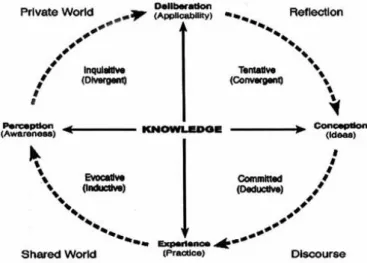
To address the research question regarding students’ cognitive presence in CMC mode, the inquiry model originally proposed by Garrison, Anderson, and Archer (2001) but later modified by Pawan, Paulus, Yalcin, and Chang (2003) was adopted. According to Garrison, et al., the model was developed to examine “the nature and quality of cognitive presence” (p. 8) within on-line text-based environment. In this model, four phases are identified to reflect an understanding of a critical thinking process, namely triggering event, exploration, reflection, and resolution. Figure 1 shows the circular process of a critical thinking process interwoven between personal and the situated context.
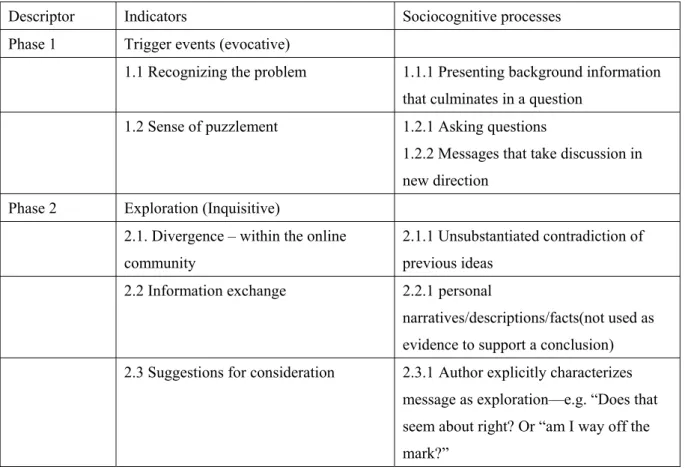
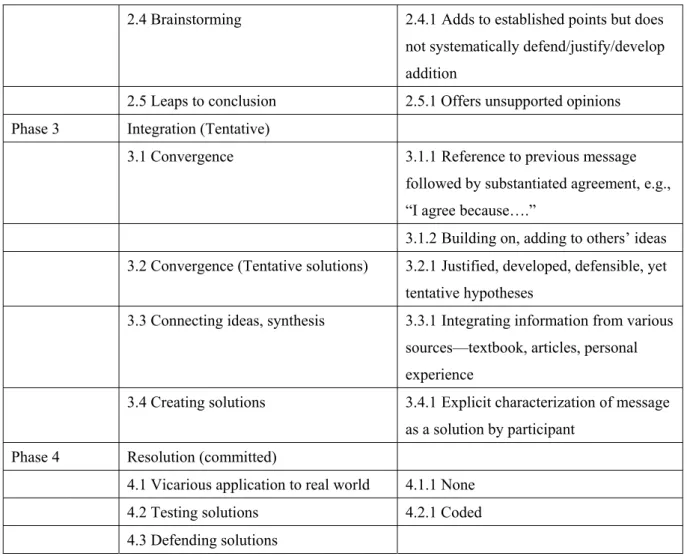
However, when accessing outcomes of collaboration in on-line environment with the practical inquiry model as a coding scheme, Pawan, et al found several sociocognitive indicators did not exist in their data. Hence, they modified the detailed indicators and sociocognitive processes in the model, as shown in Table 2.
Garrison, et al used the complete messages as the unit of analysis. However, Pawan, et al found that the interaction-based on-line forum transcripts did not fit their study because “some messages contained several themes addressing different issues or questions raised during the discussion” (p. 122). To identify an appropriate unit of analysis, two coders (including the researcher) first identified the unit of analysis and found that similar to Pawan et al.’s study, a speech segment was the most appropriate unit of analysis for the coding with the practical inquiry model. Herni and Rigault (1996) defined a speech segment as “the smallest unit of delivery linked to a single them, directed at the same addressee (all, individual, subgroup), identified by a single type (illocutionary act), have a single function (focus)” (p. 62). Hence, two coders (including the researcher) first identify the speech segments of coding. Next, coders individually code the whole set of on-line transcripts with the coding scheme by content analysis approach. Then, they compared their coding results and discussed the disagreement. A third coder coded the disagreement segments and decided the final coding results. The Cohen’s Kappa coefficient of the interrater reliability was 0.86.
Table 2: Pratical Inquiry Model (proposed by Pawan, et al., 2003)
Descriptor Indicators Sociocognitive processes
Phase 1 Trigger events (evocative)
1.1 Recognizing the problem 1.1.1 Presenting background information that culminates in a question
1.2 Sense of puzzlement 1.2.1 Asking questions
1.2.2 Messages that take discussion in new direction
Phase 2 Exploration (Inquisitive)
2.1. Divergence – within the online community
2.1.1 Unsubstantiated contradiction of previous ideas
2.2 Information exchange 2.2.1 personal
narratives/descriptions/facts(not used as evidence to support a conclusion) 2.3 Suggestions for consideration 2.3.1 Author explicitly characterizes
message as exploration—e.g. “Does that seem about right? Or “am I way off the mark?”
2.4 Brainstorming 2.4.1 Adds to established points but does not systematically defend/justify/develop addition
2.5 Leaps to conclusion 2.5.1 Offers unsupported opinions Phase 3 Integration (Tentative)
3.1 Convergence 3.1.1 Reference to previous message followed by substantiated agreement, e.g., “I agree because….”
3.1.2 Building on, adding to others’ ideas 3.2 Convergence (Tentative solutions) 3.2.1 Justified, developed, defensible, yet
tentative hypotheses
3.3 Connecting ideas, synthesis 3.3.1 Integrating information from various sources—textbook, articles, personal experience
3.4 Creating solutions 3.4.1 Explicit characterization of message as a solution by participant
Phase 4 Resolution (committed)
4.1 Vicarious application to real world 4.1.1 None
4.2 Testing solutions 4.2.1 Coded
4.3 Defending solutions
Results Participation frequencies and patterns
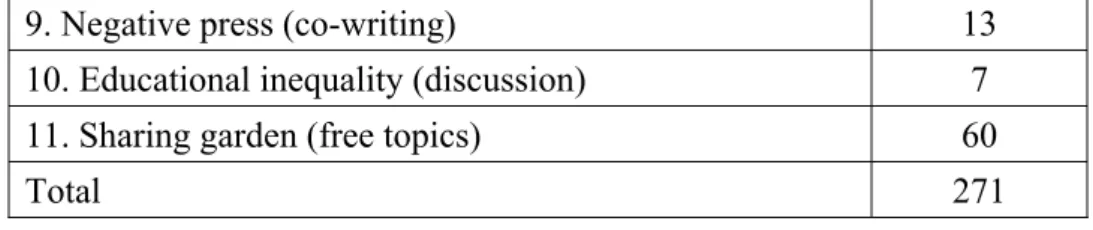
Table 3 shows an overview of posting frequencies under different topics. Most activities lasted for 1 or 2 weeks and sharing garden lasted through the whole semester. In total, the teacher and students posted 271 messages in discussion-based activities, 300 messages in total (a self-introduction activity). Posting numbers across activities range from 7 to 60.
Topics frequencies
1. Astrology (discussion) 27
2. English Education & GEPT (discussion) 39
3. Reflection on Hero (movie reflection) 25
4. Pro-Con Debate (Terri’s case) 17
5. Life Plan (discussion) 19
6. Reflection on Frequencies (movie reflection) 34
7. Technology (Hi tech hell) 14
9. Negative press (co-writing) 13
10. Educational inequality (discussion) 7
11. Sharing garden (free topics) 60
Total 271 Table 3 frequency of postings across different topics
Table 4 shows Table 4 shows the instructor and the students’ individual posting frequencies. In average, everyone posted 15 messages in the semester; 25 messages were posted each week. The teacher posted 32 messages (11%), and each student posted 10 to 22 messages (3% to 7%) under 12 topics/issues. Most students’ frequencies of postings reflected their participation mainly to meet the minimum class requirement (once a week). The time they spent in the course appeared to be limited. Most students tended to post more initial messages (their reflection on the issues discussions) than responding messages (comments on others’ opinions).
Name frequencies Type of posting
(initiation/response) percentage T 32 5/27 11% William 22 12/10 7% Elton 17 7/10 6% Ronny 16 6/10 5% Jimmy 21 11/10 7% GS 17 10/7 6% Eddie 16 10/6 5% Q 15 10/5 5% Ross 14 8/6 5% Neo 15 8/7 5% Anson 17 10/7 6% Paul 16 12/4 5% Ohya 14 10/4 5% Keith 11 5/6 4% Kenny 10 7/3 3% Alien 16 11/5 5% Jenny 15 7/8 5% Vicky 16 10/6 5% Total 300 159/141 100%
Restricted by time and space, participants showed fixed participation patterns in
face-to-face discussion: In terms of interaction patterns, students tended to sit with those from the same departments or those who they knew very well. Hence, although the instructor did not set fix class seat, the students tended to show fixed interaction patterns in the classroom setting. In whole class discussion, the instructor usually initiated one or few discussion
questions, and the students mainly commented on the issues. Since the students were required to participate in issue discussion in English, some students remained quietly but some
students who were confident to their English oral proficiency tended to dominate whole class discussions. In small group, on the other hand, the students tended to participate more
actively than in whole class sessions. Also, one or two students in a small group tended to facilitate the discussion; that is, they initiated the questions and asked others to comment on them. The instructor’s influence apparently became minimal in small group discussion form.
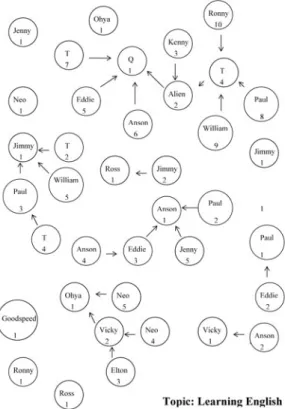
Interestingly, the interaction patterns in on-line discussion broke the fixed interaction patterns as shown in face-to-face sessions. Retrieved from three topic discussions, Figure 2 shows the interactive maps under different discussion topics in the online mode.
Figure 2 Interactive maps from different on-line discussion topics.
From these figures, students did not show fixed interactive patterns with specific group members. Their participation tended to be influenced by their posting time, the issues they were interested, and those who participated in the specific time.
Cognitive presence in the online discussion mode
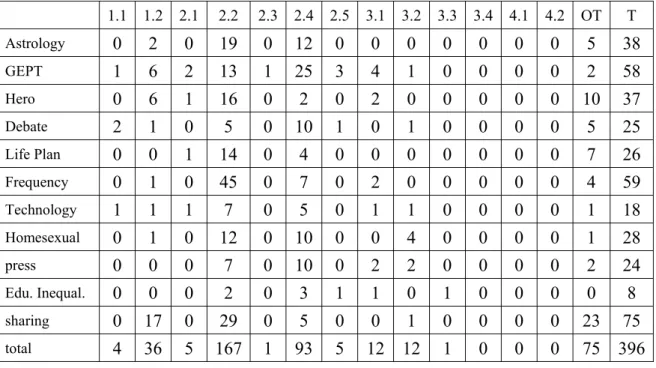
Among the 11 discussion topics through the data collection semester, students posted 300 messages in the on-line discussion board. 396 unites were identified by the two coders and the distribution of the cognitive presence based on the practical inquiry model by Pawan, et al. Table 5 shows the coding results from the online discussion transcripts. As Table 5 shows, the CMC interaction mainly fell into the second stage (exploration) as information exchange (42%) and brainstorming (23%) on the issue discussion. Off-topic statements also dominate 15% of the postings.
Discussions Participation patterns
Most students’ frequencies of postings reflected their participation mainly to meet the minimum class requirement (once a week). The time they spent in the course appeared to be limited. Although the target course was an elective language course, it was assumed that students might have higher motivation than other required language courses. However,
students were still not treated this course as their major academic focus when comparing to the courses offered in their professional fields.
Also, the participation patterns in Figure 2 show that most issues discussions in the on-line mode did not fall into threaded discussions. That is may help to explain why most issues discussions did not form as threaded discussions. That is, very few follow-up discussions were found in specific postings.
1.1 1.2 2.1 2.2 2.3 2.4 2.5 3.1 3.2 3.3 3.4 4.1 4.2 OT T Astrology 0 2 0 19 0 12 0 0 0 0 0 0 0 5 38 GEPT 1 6 2 13 1 25 3 4 1 0 0 0 0 2 58 Hero 0 6 1 16 0 2 0 2 0 0 0 0 0 10 37 Debate 2 1 0 5 0 10 1 0 1 0 0 0 0 5 25 Life Plan 0 0 1 14 0 4 0 0 0 0 0 0 0 7 26 Frequency 0 1 0 45 0 7 0 2 0 0 0 0 0 4 59 Technology 1 1 1 7 0 5 0 1 1 0 0 0 0 1 18 Homesexual 0 1 0 12 0 10 0 0 4 0 0 0 0 1 28 press 0 0 0 7 0 10 0 2 2 0 0 0 0 2 24 Edu. Inequal. 0 0 0 2 0 3 1 1 0 1 0 0 0 0 8 sharing 0 17 0 29 0 5 0 0 1 0 0 0 0 23 75 total 4 36 5 167 1 93 5 12 12 1 0 0 0 75 396
Table 5 cognitive presence in the on-line discussion mode
Cognitive presence (critical thinking)
As Table 5 shows, the CMC interaction mainly fell into the second stage (exploration) as information exchange (42%) and brainstorming (23%) on the issue discussion. Off-topic statements also dominate 15% of the postings. Few cognitive levels were promoted to the third phase—integration. No fourth phase—resolution was found from the data.
The finding is consistent with the findings from Garrison, et al. and Pawan, et al’s studies. Based on the practical inquiry model, the results appeared to be unsatisfactory since few integrative and resolution cognitive presences were found. However, different critical thinking coding schemes (e.g. Ennis & Weir’s critical thinking essay test, 1985; Johnassen’s mind tool, 1994; may be applied to assess the students higher-order thinking in order to gain various insights on the level of thinking that ESL students may imply to communication.
Factors influencing the online participation
As Table 5 shows and the data from students’ questionnaire, it appeared that the students’ specialized knowledge on the issues they were familiar (e.g. GEPT and frequency) may highly relate to critical thinking. This finding is consistent with Stapleton’s (2001) claim.
Also, the types of communication (threaded discussion) may affect the students’ involvement of a follow-up on a specific issue. In this study, since most students engaged in non-threaded discussions, few integration results were found in their on-line discussion. Also, since the major class objective was to provide the students opportunities practicing their English via the on-line discussion. They were not especially asked to seek resolution for a specific topic or issues. Consequently, no fourth phase was found in the study. Finally, since the average length of discussion was two weeks for an issue, the students were not led to follow a issue beyond the required time. The limited time seems to affect their cognitive presence into higher phase.
Conclusion
The study attempted to examine EFL college students’ participation patterns, cognitive presence in on-line discussions, and the factors affected their participation and higher-order thinking in on-line discussion mode. Through a case study from an elective English writing course at a public university, the case study showed that the on-line mode broke down the fixed interaction patterns in traditional face-to-face interaction mode. Several limitations were found to highly affect students’ cognitive presence in the online discussion mode, such as the types of on-line tasks, the length of discussion, the learning goals of the course, the students’ background knowledge, and the students’ priority to the target language and course.
The instructional intervention and the study results provided valuable pedagogical implementations for EFL writing course as follows. First, the integration of both
face-to-face and on-line discussion may create an effective English learning environment for students practicing English out of classroom settings. Second, the integration of the topics relating to students’ background knowledge and their interests may inspire the students’ high interests in participation. Third, starter-wrapper technique can be an effective technique for students’ autonomy in on-line environment. Also, from initiation, summary, or even the process of facilitating the on-line discussion, these techniques and process may facilitate their higher order thinking. Fourth, teacher’s high involvement in the online discussions not only may push students engage in on-line discussion but also can serve as a modeling for higher order thinking. Fifth, how to balance face-to-face and the online discussions may affect the learning outcomes. Hence, instructors may integrate discussion performance in on-line mode in face-to-face sessions or vice versa. Finally, engaging students in threaded discussion may help them focus on a specific issue and may promote advanced cognitive presences.
Atkinson, D. (1997). A critical approach to critical thinking in TESOL. TESOL
Quarterly, 31(1), 71-94
Beauvois, M. H. (1998). Conversation in slow motion: Computer-mediated
communication in the foreign language classroom. The Canadian Modern Language Review, 54(2), 198-217.
Carnwell, R., Moreland, N., & Helm, R. (2001). Co-opting learning: addressing their learning support needs through a learning support needs questionnaire. Part Two. A comparison of the learning support needs of campus and distance-based community nurse students. Research in Post-Compulsory Education, 6(1), 51-66.
Chamot, A. (1995). Creating a community of thinkers in the ESL/EFL classroom.
TESOL Matters, 5(1), 16.
Chang, C. (2003). Between face-to-face and cyberspace: Case studies of nonnative
speaking graduate students’ experiences in alternative discussion modes. Unpublished
doctoral dissertation, Indiana University, Bloomington, Indiana, U.S.A.
Chun, D. M. (1994). Using computer networking to facilitate the acquisition of interactive competence. System, 21(1), 17-31.
Davidson, B. (1994). Critical thinking: A perspective and prescriptions for language teachers. The Language Teacher, 18(4), 20-26.
Davidson, B. (1995). Critical thinking education faces the challenge of Japan. Inquiry: Critical thinking across the disciplines, 14(3), 41-53.
Davidson, B. W. & Dunham, R. L. (1996). Assessing EFL student progress in critical
thinking with the Ennis-Weir Critical Thinking Essay Test. Paper presented at the Annual
International Conference of the Japan Association for Language Teaching, Rohnert Park, California, U.S.A. (ERIC Document Reproduction Service No. ED 403302)
Donato, R. (2000). Sociocultural contributions to understanding the foreign and second language classroom. In J. P. Lantolf (Ed.), Sociocultural theory and second language
Gaddis, B, Napierkowski, H., Guzman, N., & Muth, R. (2000). A comparison of
collaborative learning and audience awareness in two computer-mediated writing
environments. Paper presented at the National Convention of the Association for Educational
Communications and Technology, Denver, Colorado (ERIC Document Reproduction Service No. ED 455 771).
Garrison, D. R., Anderson, T., & Ancher, W. (2001). Critical thinking, cognitive presence and computer conferencing in distance education. American Journal of Distance
Education, 15(1), 7-23.
González-Bueno, M. (1998). The effects of electronic mail on Spanish L2 discourse.
Language Learning & Technology, 1(2), 55-70.
Gray, R. & Stockwell, G. (1998). Using computer-mediated communication for language and cultural acquisition. ON-CALL, 12(3), 2-9.
Henri, F., & Rigault, C. (1996). Collaborative distance education and computer conferencing. In T. T. Liao (Ed.)., Advanced educational technology: Research issues and future potential (pp. 45-76). Berlin: Springer-Verlag.
Herring, S. C. (Ed.). (1996). Computer-mediated communication: Linguistic, social and
cross-cultural perspectives. Amsterdam, The Netherlands: John Benjamins Publishing.
Huang, S. (1998). A comparison between Chinese EFL students’ peer response sessions
held on networked computers and those held in a face-to-face setting. Paper prestned at the
Annual Meeting of the International NELLE Conference, Bieldfeld, Germany.
Karayan, S. S. (1997). Students’ perceptions of electronic discussion groups. T.H.E.
Journal, 24(9), 69-71.
Kern, R. G. (1996). Restructuring classroom interaction with networked computers: Effects on quantity and characteristics of language production. Modern Language Journal, 79, 457-476.
Lave, J., & Wenger, E. (1991). Situated learning: Legitimate peripheral participation. Cambridge, UK: Cambridge University Press.
Leh, A. S. (1997). Electronic mail in foreign language learning: Communication and culture. Paper presented at the 1997 National Convention of the Association for Educational Communications and Technology, Albuquerque, New Mexico.
Liaw, M. (1998). Using electronic mail for English as a foreign language instruction.
System, 26, 335-351.
Lindner, J. R., Dooley, K. E., & Murphy, T. H. (2001). Differences in competencies between doctoral students on-campus and at a distance. The American Journal of Distance
Edcuation, 15 (2), 25-40.
Lowry, M. Koneman, P., Osman-Jouchoux, R. & Wilson, B. (1994). Electronic discussion group: Using e-mail as an instructional strategy, Tech Trends, 39(2), 22-24.
Merisotis, J. P., & Phipps, R. A. (1999). What’s the difference? Outcomes of distance vs. traditional classroom-based learning. Change, 31(3), 12-17.
Mikulecky, L. (1998). Diversity, discussion, and participation: Comparing Web-based and campus-based adolescent literature classrooms. Journal of Adolescent & Adult Literacy,
42(2), 84-97.
Oliva, M. & Pollastrini, Y. (1995). Internet resources and second language acquisition: An evaluation of virtual immersion. Foreign Language Annals, 28, 551-563.
Partee, M. H. (1996). Using e-mail, Web sites & newsgroups to enhance traditional classroom instruction. T.H.E. Journal, 23(11), 79-82.
Pawan, F., Paulus, T., Yalcin, S., & Chang, C. (2003). Teachers online: Patterns of engagement and interaction. Language Learning and Technology, 7(3), 119-140.
Ruhe, V. (1998). E-mail exchange: Teaching language, culture, and technology for the 21st century. TESL Canada Journal, 16(1), 88-95.
Russel, T. L. (1999). The no significant difference phenomenon. Raleigh, NC: North Carolina State University.
Santoro, G. (1995). What is computer-mediated communication? In Z. Berge & M. Collins (Eds.), Computer-Mediated Communication and the Online Classroom (pp. 11-27). Cresskill, NJ: Hampton Press.
Schoenfeld-Tacher, R., McConnell, S., & Graham, M. (2001). Do no harm ─ A comparison of the effects of on-line versus traditional delivery media on a science course.
Journal of Science Education and Technology, 10(3), 257-265
Singhal, M. (1998). Computer-mediated communication (CMC): Technology for enhancing foreign language/culture education. ON-CALL, 12(1), 10-15.
Sotillo, S. M. (2000). Discourse functions and syntactic complexity in synchronous and asynchronous communication. Language Learning & Technology, 4, 82-119.
Stapleton, P. (2001). Assessing critical thinking in the writing of Japanese university students. Written Communication, 18(4), 506-548.
Tucker, S. Y. (2000). Assessing the effectiveness of distance education versus
traditional on-campus education. Paper presented at the Annual Meeting of the American
Educational Research Association. New Orleans, LA. (ERIC Document Reproduction Service No. ED 443 378)
Warschauer, M. (1996). Comparing face-to-face and electronic discussion in the second language classroom. CALICO Journal, 13, 7-26.
Warschauer, M. (1997). Computer-mediated collaborative learning: Theory and practice.
Modern Language Journal, 81, 470-481.
Yin, R. K. (1994). Case study research: Design and methods (2nd
edition). Thousand
Oaks, CA: SAGE.
Chang, Y. (張玉玲).(1992).。跨越文化界限的英語閱讀及寫作:中華民國與美國 的電傳遠景。行政院國家科學委員會專題研究計畫成果報告。計畫編號:
NSC81-0301-H017-005。
Chen, H., Hsiao, T., & Lee, S. (陳浩然,蕭聰淵,李思穎).(1999)。網際網路虛擬語 言教室對英語聽力之影響。行政院國家科學委員會專題研究計畫成果報告。計畫編號: NSC88-2411-H019-001。
Chen, Y. (陳怡如). (2003)。Online metacogntivion enhancement program for Essay
Conference on English Teaching and Learning in the Republic of China] (pp. 338-347). 台 北:文鶴[Taipei, Crane Publishing].
Liaw, M., & Chern, C. S. (廖美玲,陳秋蘭).(2000)。將網際網路整合於國小英語教 學中之成效研究。行政院國家科學委員會專題研究計畫成果報告。計畫編號: NSC89-2411-H029-022。 Liu, H. (劉顯親).(2000)。電腦、課室文化及社會情境:將電腦科技融入大專英語課 程之研究。行政院國家科學委員會專題研究計畫成果報告。計畫編號: NSC89-2411-H007-036。
Shieh, Y., Yang, S., & Katchen , J. (謝燕隆,楊淑卿,柯安娜). (1998)。虛擬英語教
學劇場兼教室—互動式英語教學評鑑網站。行政院國家科學委員會專題研究計畫成果報
告。計畫編號:NSC88-2411-H007-024。
Tang, J., & Kao, S. (唐經洲,高實玫).(1998). 網際網路在增進高中英文寫作教學—師生
會談中的應用與發展(II) 。行政院國家科學委員會專題研究計畫成果報告。計畫編號: