7 0 屏東師院學報 第二十一期
The Relationships among Teachers’ Work Life,
Work Value and Organization Commitment by
Using Structure Equation Modeling
Chun-chi Tasi Shun-fa Chang*
Abstract
This research combines both theories and literatures to construct a TQVC theory model and to conduct the model test with the actually observed data. Its purpose is to explore the relationship among teachers’ work life quality, work value and organization commitment. Samples for this study are 837 teachers of the public elementary schools in the greater Kaohsiung area and Pingtung County randomly selected to finish questionnaires such as Teacher’s Work Life Quality Measurement, Teacher’s Work Value Measurement and Teacher’s Organization Commitment Measurement. The obtained data are analyzed with the statistical language LISREL. The result shows: 1.) The TQVC model constructed in this study and the χ2 value of goodness of fit of the observed data achieve a significant level, but it can be known from other goodness of fit indices that the theory model and the actual observed data can fit. 2.) In the TQVC model, there is great direct effect of teachers’ work life quality on teachers’ work value and organization commitment, the direct effect of teachers’ work value on teachers’ organization commitment is not significant and the overall effect of the potential variable of the TQVC model is significant. Among them, the overall effect of the wage aspect on the organization commitment is best and the indirect effect of the potential variable of the TQVC model is insignificant. Finally, there are two recommendations submitted on the discovery and approach of this research as a reference for practice and research in the future.
Keywords: structure equation model, teachers’ work life quality, teachers’ work value, teachers’ organization commitment
*Chun-chi Tasi : National Taiwan College of physcal Education, Education program Center, Assistant progessor.
壹、緒
論
一 、 研 究 動 機 與 目 的
7 2 屏東師院學報 第二十一期 與 組 織 目 標 不 一 致 時 , 會 降 低 其 工 作 生 活 品 質 、 工 作 滿 意 、 工 作 表 現 及 組 織 承 諾 。 故 本 研 究 想 瞭 解 教 師 工 作 生 活 品 質 與 組 織 承 諾 之 關 係 時 , 基 於 上 述 分 析 擬 藉 結 構 方 程 模 式 分 析 , 來 考 驗 教 師 工 作 生 活 品 質 、 工 作 價 值 觀 與 組 織 承 諾 之 迴 歸 關 係 ; 因 此 , 本 研 究 主 要 研 究 目 的 細 分 如 下 : (一 )考 驗 教 師 工 作 生 活 品 質 、 工 作 價 值 觀 與 組 織 承 諾 的 整 體 迴 歸 模 式 。 (二 )分 析 教 師 工 作 生 活 品 質 對 工 作 價 值 觀 、 組 織 承 諾 的 直 接 、 間 接 與 整 體 效 果 。
貳、文獻探討
一 、 教 師 工 作 生 活 品 質 、 工 作 價 值 觀 與 組 織 承 諾 相 關
理 論
教 師 工 作 生 活 品 質 與 工 作 價 值 觀 會 影 響 組 織 承 諾 Reyes 和 Pounder(1990), 然 而 , 各 學 者 對 於 工 作 生 活 品 質 、 工 作 價 值 觀 與 組 織 承 諾 之 定 義 、 範 疇 、 分 類 及 影 響 因 素 見 解 不 一 。資 料 來 源:Reyes, P., & Pounder, D. G.(1990).Teacher commitment, job satisfaction, and school value orientation: A study of public and private school. University of Wisconsin, Madison, p.68.
8 0 屏東師院學報 第二十一期
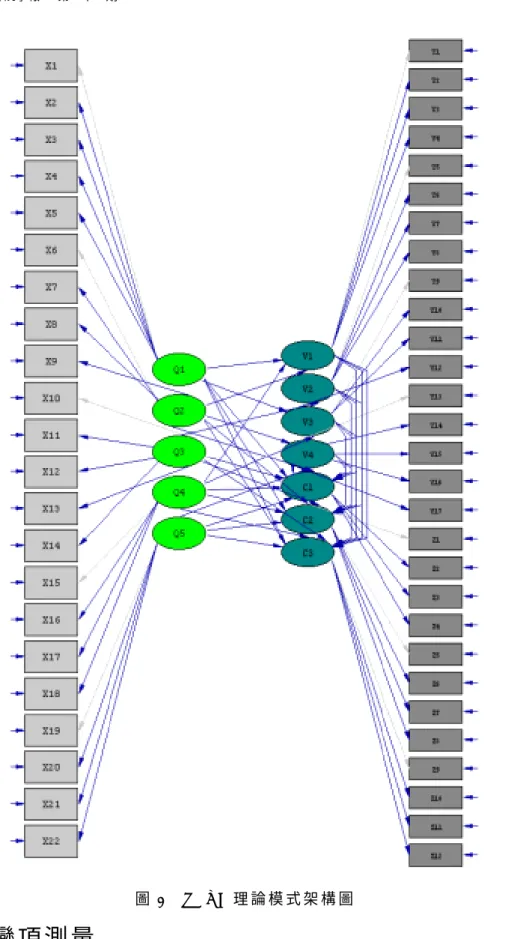
圖 1 TQVC 理 論 模 式 架 構 圖
二 、 變 項 測 量
8 6 屏東師院學報 第二十一期
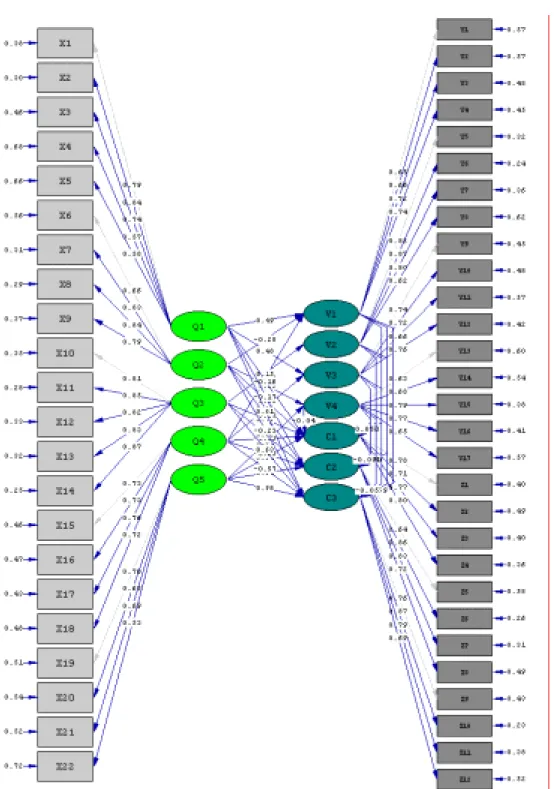
圖 2 TQVC 模 式 標 準 化 徑 路 因 素 結 構 模 型 圖
一 、
TQVC 模式的適配度考驗
5、不 能 有 很 大 的 標 準 誤。當 違 反 以 上 標 準 時,表 示 模 式 可 能 有 細 列 誤 差 及 辨 認 問 題 , 而 模 式 估 計 結 果 皆 符 合 這 五 項 標 準 , 則 可 以 進 一 步 考 驗 整 體 模 式 適 配 標 準 及 模 式 參 數 估 計 的 內 在 結 構 適 配 度 。 從 表 4 可 知 TQVC 模 式 估 計 結 果 沒 有 負 的 誤 差 變 異,及 其 誤 差 變 異 皆 達.05 顯 著 水 準,符 合 模 式 不 能 有 負 變 異 及 應 達 顯 著 水 準 之 標 準 。 其 次 , 經 過 疊 代 34 次 之 後 , 變 項 間 參 數 估 計 相 關 最 大 值 為 .83, 符 合 估 計 參 數 間 相 關 的 絕 對 值 不 能 太 接 近 1 的 標 準 。 再 者 , 所 有 因 素 負 荷 量 皆 符 合 高 於.5 與 低 於 .95 標 準 。 最 後 , 也 沒 有 過 大 的 標 準 誤 也 符 合 檢 定 標 準 。 因 此 ,TQVC 模 式 符 合 基 本 適 配 度 的 檢 定 標 準 。
(二 )整 體 適 配 度 考 驗
整 體 適 配 度 係 在 檢 定 整 體 模 式 與 觀 察 資 料 之 適 配 度 , 亦 即 考 驗 模 式 的 外 在 品 質。檢 定 理 論 模 式,發 現 TQVC 模 式 的 χ2值 達 顯 著 水 準 , 顯 示 理 論 模 式 與 觀 察 資 料 無 法 適 配 ; 然 而 , 過 去 考 驗 模 式 整 體 適 配 標 準 常 以 χ2值 是 否 達 顯 著 為 指 標 , 但 χ2值 常 受 樣 本 人 數 大 小 之 影 響 ; 換 言 之,一 旦 樣 本 人 數 很 大 時 χ2值 容 易 達 顯 著,模 式 就 可 能 被 拒 絕 (黃 芳 銘,民 92)。本 研 究 樣 本 837 人 約 為 估 計 參 數 的 5.7 倍 標 準 (837/147), 因 此 , 進 行 檢 定 時 除 以 χ 2值 考 驗 外 , 也 從 絕 對 適 配 量 測 (measures of absolute fit)、 增 值 適 配 量 測 (incremental fit measures)、 簡 效 適 配 量 測 (parsimonious fit measures)及 複 核 效 化 等 方 面 來 檢 定 整 體 適 配 度 。就 χ2值 與 自 由 度 比 值 χ2/df 而 言,當 χ 2之 p> .05 顯 著 水 準 時 ,
表 示 研 究 虛 無 假 設 沒 有 被 拒 絕 , χ2/df 值 小 於 2(Carmines & Mclver, 1981)或 3(陳 正 昌 、 程 炳 林 ; 民 87)時 表 示 模 式 與 觀 察 資 料 符 合 。 由 表 5 可 以 發 現 理 論 模 式 之 χ 2值 達 顯 著 水 準,χ2/df 值 則 小 於 3(3068.88÷
1179= 2.6)。
就 絕 對 適 配 度 而 言,GFI 及 AGFI 二 種 適 合 度 指 標,數 值 愈 接 近 1 時 表 示 適 合 度 愈 高 , 一 般 需 要 大 於.90 才 可 視 具 有 理 想 適 合 度 (Hu & Bentler, 1999);因 此,TQVC 模 式 檢 定 GFI 為 .91、AGFI 為 .90 皆 符 合 標 準 。
9 0 屏東師院學報 第二十一期
合 度 愈 高 , 表 示 模 示 比 起 另 一 個 不 良 模 式 時 , 可 以 被 視 為 一 個 更 佳 的 模 式( 改 善 後 更 適 配 ) , 一 般 也 需 要 大 於 .90 才 可 視 具 有 理 想 適 合 度 (Bollen, 1989);因 此,TQVC 模 式 檢 定 CFI 與 IFI 皆 為 .96,都 達 到 .90 標 準 。
就 簡 效 適 配 度 而 言 ,PGFI、 PNFI、 AIC、 CN 等 指 標 其 主 要 目 的 在 於 更 正 模 式 之 過 度 適 配 情 形 , 一 個 好 的 理 論 必 須 具 備 有 效 的 解 釋 力 及 簡 單 性 , 因 此 須 對 過 度 複 雜 的 模 式 加 以 懲 罰(黃 芳 銘 , 民 92)。 其 中 PGFI、PNFI 值 必 須 大 於 .5 以 上 才 可 視 為 良 好 模 式 (Mulaik, 1989);AIC 值 必 須 愈 小 愈 好 , 且 須 小 於 飽 和 模 式 與 獨 立 模 式 的 值 , 方 能 表 示 模 式 具 有 簡 效 性(Akaike, 1987)。 CN 值 則 反 應 樣 本 數 是 否 足 夠 用 以 檢 定 模 式 , 一 般 建 議 須 大 於 200 為 接 受 門 檻 (Hoelter, 1983)。因 此,TQVC 模 式 之 PGFI、 PNFI、 AIC、 CN 值 皆 達 評 鑑 標 準 。
就 殘 差 與 複 核 效 度 而 言 ,RMSEA 為 近 來 受 到 重 視 的 一 個 測 量 殘 差 適 配 指 標 , 一 般 以.05 為 良 好 適 合 度 門 檻 , 以 .08 為 可 接 受 的 門 檻 (McDonald & Ho, 2002), 另 Hu 和 Bentler(1999)建 議 指 數 低 於 .06 時 為 理 想 模 式 , 大 於.10 時 為 不 理 想 模 式 ; ECVI 為 複 核 效 度 評 鑑 指 標 , 其 數 值 愈 小 模 式 適 配 度 愈 好 , 表 示 模 式 能 應 用 到 不 同 樣 本 上 , 一 般 當 ECVI 值 小 於 飽 和 模 式 與 獨 立 模 式,或 ECVI 值 落 入 信 賴 區 間 時,表 示 模 式 可 以 被 接 受 。 因 此 ,TQVC 模 式 檢 定 RMSEA 值 為 .057 小 於 .06, ECVI 值 為 7.13 且 小 於 獨 立 模 式 與 飽 和 模 式 , 皆 符 合 檢 定 門 檻 。 從 表 5TQVC 模 式 整 體 適 配 度 考 驗 表 中 , 綜 合 衡 量 各 項 指 數 後 可 以 發 現 , 本 研 究 理 論 模 式 評 鑑 結 果 屬 理 想 模 式 。 表 5 TQVC 模 式 整 體 適 配 度 考 驗 表
Goodness of Fit Statistics
Degrees of Freedom= 1179
Normal Theory Weighted Least Squares Chi-Square(χ2)=3068.88(p= .000) Goodness of Fit Index(GFI)= 0.91
Adjusted Goodness of Fit Index(AGFI)= 0.90 Parsimony Goodness of Fit Index(PGFI)= 0.70
Incremental Fit Index(IFI)= 0.96
Root Mean Square Error of Approximation(RMSEA)= 0.057 Critical N(CN)= 227.12
Akaike Information Criterion(AIC)= 1962.88(< Incremental fit model、 < Saturated model)
研 究 建 議 後 續 研 究 者 進 行 相 關 研 究 時 , 可 以 朝 向 依 據 不 同 理 論 來 建 立 不 同 的 因 素 結 構 , 將 模 式 背 景 條 件 加 以 控 制 或 對 其 關 連 性 加 以 評 鑑 , 小 心 操 作 潛 在 變 項 , 且 每 一 潛 在 變 項 最 好 使 用 四 個 以 上 測 量 變 項 , 並 作 選 替 模 式 與 競 爭 模 式 的 比 較 , 儘 量 保 持 最 小 程 度 的 事 後 調 整 和 模 式 修 正 , 且 對 所 有 的 研 究 結 果 給 予 以 複 製 或 作 複 核 效 度 , 以 期 建 構 更 多 面 向 、 更 完 善 的 模 式 。
參考書目
吳 明 隆 (1999)。 SPSS 統 計 應 用 實 務。 台 北 : 文 魁 資 訊 公 司 。 邱 皓 政(2003)。結 構 方 程 模 式。 台 北 : 雙 葉 。 邱 馨 儀 (1996)。國 民 小 學 學 校 組 織 文 化 與 教 師 組 織 承 諾 關 係 之 研 究。 臺 北 市 立 師 院 初 等 教 育 研 究 所 碩 士 論 文 。 莊 榮 霖 (1994)。國 中 教 職 員 工 作 滿 足 與 組 織 承 諾 關 係 之 研 究 ─ 高 雄 市 地 區 市 立 國 中 調 查 分 析。 國 立 政 治 大 學 公 共 行 政 學 系 碩 士 論 文 。 黃 芳 銘(1993)。結 構 方 程 模 式 理 論 與 應 用。 台 北 : 五 南 。 陳 正 昌 、 程 炳 林(1998)。 SPSS、SAS、BMDP 統 計 軟 體 在 多 變 量 統 計 上 的 應 用。 台 北 : 五 南 。 陳 彩 (1994)。工 作 生 活 品 質 、 工 作 滿 足 與 離 職 意 願 關 聯 性 研 究 ─ 以 高 科 技 產 業 專 業 人 員 為 例。 交 通 大 學 管 理 科 學 研 究 所 碩 士 論 文 。 陳 瑞 惠(2003)。私 立 高 中 教 師 工 作 價 值 觀 、 工 作 壓 力 與 組 織 承 諾 之 研 究。 彰 師 大 教 研 所 碩 士 論 文 。 彭 雅 珍 (1998)。國 小 校 長 領 導 風 格 、 教 師 工 作 價 值 觀 與 教 師 組 織 承 諾 關 係 之 研 究。 國 立 政 治 大 學 教 育 研 究 所 碩 士 論 文 。Apasu, Yao. (1987). The importance of value structures in the
perception of rewards by industrial salespersons, Journal of Personal
Selling and Sales Management, 17, 51-62.
Bagozzi, R. P., & Yi, Y. (1988). On the Evaluation of Structural
Equation Models. Journal of the Academy of Marketing Science, 16, 74-94.
1 0 6 屏東師院學報 第二十一期
317-332.
Bartholomew, K., & Horowitz, L. M (1991). Attachment styles among young adults: A test of a four-category model. Journal of Personality
and Social Psychology, 61, 226-234.
Bollen, K. A. (1989). A New Incremental Fit Index for General
Structural Equation Models. Sociological Methods and Research, 17, 303-316.
Boyatzis, R. E., & Skelly, F. R. (1991). The impact of changing values on organizational life. In A. D, Kolb, I. M. Rubin, & J. S. Osland (Eds.), The organizational behavior reader. New York: Prentice Hall. Cliff, N. (1983). Some Cautions Concerning the Application of Causal
Modeling Methods. Multivariate Behavioral Research, 18, 115-126. Cudeck, R. (1989). Analysis of Correlation Matrices Using Covariance
Structure Models. Psychological Bulletin, 105, 281-302.
Dubin,R., Champoux, J.E.,& Poter, L.W. (1975). Central Life Interests and Organizational Commitment of Workers . Administrative Science
Quarterly, 20, 411-421.
Efraty, D., & Sirgy, M. J. (1990). The effects of quality of work life on employee behavioral responses. Social Indicators Research, 22(1), 31-47.
Ferris, K. R.,& Aranya, N. (1983).A Comparison of two
organizational commitment scales. Personnel Psychology, 36, 87-98. Gomez-mejia, L. R. (1981).Development and empirical testing of a need
deprivation and social processing of information model of work values. Unpublished doctoral dissertation, University of Minnesota.
Hackman, J. R., & Lawler. E. E. (1971). Employee Reaction to Job Characteristics. Journal of Applied Psychology, 55(3), 259-286. Hu, L., & Bentler, P. M. (1999). Cutoff Criteria for Fit Indexes in
Hoelter, J. W.(1983). The Analysis of Covariance Structures:
Goodness-of-fit Indices. Sociological Methods and Research, 11, 325-344.
Jurgensen, C. E. (1978).Job preferences (What makes a job good or bad? ).Journal of Applied Psychology, 69(3), 379-389.
Kanter, R. M. (1968).Commitment and social organization: a study of commitment mechanisms in utopian communities. American
Sociological Review, 33, 499-517.
Kawakubo, M. K. (1987).Perception of authority, control, and commitment in Japanese organizations. Dissertation Abstracts
International, 49, 01-A.
Kidron, A. (1978). Work values and organizational commitment.
Academy of Management Journal, 21, 239-247.
Kushman, J. W. (1992).The organizational dynamics of teacher workplace commitment: A study of urban elementary and middle schools. Educational Administration Quarterly, 28(1), 5-42. Locke E. A., & Henne, D. (1986). Work motivation theories. In C. L.
Cooper & I. Robertson (Eds.), International Review of I/O Psychology,
1,1-35.
Main, M., & Kaplan, N., & Cassidy, J. (1985)Security in infancy, childhood and adulthood: A move to the level of representation. In I. Bretherton, & E. Waters (Eds.), Growing points of attachment theory
and research (pp.66-104). Monographs of the Society for Research in
Child Development, 50 (1-2, Serial No209).
Marks, et (1986). Employee participation in a quality circle program: impact on quality of work life, productivity, and absenteeism. Journal
of Applied psycholog , 71(1), 61-69.
Magid, I., & Sidney, R. (1994). An Examination of the Antecedents of Turnover Propensity of Engineers: An Integrated Model. Journal of
1 0 8 屏東師院學報 第二十一期
Morris, J. H., & Sherman J.D. (1981).Generalizability of an
organizationnal commitment model.Academy of Management Journal,
24(3), 512-526.
McDonald, R. P., Ho, M. R. (2002). Principles and Practice in Reporting Structural Equation Analysis. Psychological Methods, 58, 431-443. Mulaik, S. A., James, L. R., Van Altine, J., Bennett, N., Lind, S., &
Stilwell, C. D. (1989). Ealuation of Goodness-of-fit Indices for Structural Equation Models. Psychological Bulletin, 105, 430-445. Near, J. P. (1989).Organizational commitment among Japanese and U.S.
workers. Organization Studies, 24, 424-433.
Nirenberg, J. (1986). The Quality of Work Life Issue: The Cor-
porationas. The Next Political Frontier. Internal Journal of Manpower
(UK), 7(3).
Nord, W. R., Brief, A. P., Atich, J. M., & Doherty, E. M.(1988).Work values and the conduct of organizational behavior.In G. R. Ferris and K.M. Rowland (Eds.), Research in Personnel and Human Resources
Management, 10, 1-42.
Porter, W. L., Steers, R. M., Mowday, R. T., &
Boulian,P.V.(1974).Organizational commitment, job satisfaction, and turnover among psychiatric technicians. Journal of Applied
Psychology, 59(5), 603-609.
Rabinowitz,S., Hall,D.T.,& Goodale,J.G. (1977). Job Scope and Individual Difference as Predictors of Job Involvement ; Independent or Interactive? Academy of Management Journal, 20(2),
273-281.
Ravlian, E. C., & Meglino, B. M. (1989).The transitivity of work values: Hierarchical performance ordering of socially desirable stimuli. Organizational Behavior and Human Decision Process, 44, 494-508.
satisfaction, and school value orientation: A study of public and private schools. University of Wisconsin, Madison.
Robey, D. (1974). Task Design, Work Value, and Worker Response; An Experimance Test. Organizational Behavior and Human Perfor mance,
12(2), 264-273.
Ronen, S. (1978). Personal Values; A Basis for Work Motivation Set and Work Attitude. Organizational Behavior and Human Perfor
mance , 21(1), 88-107.
Rothbard, J. C., & Shaverm, P. R. (1994). Continuity of attachment across the life span. In M. B. Sperling, & W. H. Berman (Eds.),
Attachment in adults:Clinical and development perspective (pp.31-71).
New York: The Guilford Press.
Sager,J.K., Futrell , M.C., & Varadarajan, R. (1989).Exploring Salesperson Turnover : A Causal Model. Journal of Business
Research, 18, 303-326.
Super, D. E. (1980). A life span, life space approach to development.
Journal of vocational Behavior, 16, 282-298.
Seashore, S. E. (1975). Defining and Measuring the Quality of working Life. in Davis, L.E. & Cherns, A.B .ends, The Quality of Working Life, vol.1: Problems, Prospects and the State of the Art, New York: The Free Press.
Sperling, M. B., & Lyons, L. S. (1994). Representations of attachment and psychotherapeutic change. In M. B. Sperling, & W. H. Berman (Eds.), Attachment in adults(pp. 331-347). New York: The Guilford Press.