行政院國家科學委員會補助專題研究計畫
5
成 果 報 告
□期中進度報告
ERP 導入過程中影響知識移轉之因素
計畫類別:
5
個別型計畫 □ 整合型計畫
計畫編號:NSC
96-2416-H-110 -015
執行期間: 96 年 8 月 1 日至 97 年 7 月 31 日
計畫主持人:
侯君溥
共同主持人:
計畫參與人員:
成果報告類型(依經費核定清單規定繳交):
5
精簡報告 □完整報告
本成果報告包括以下應繳交之附件:
□赴國外出差或研習心得報告一份
□赴大陸地區出差或研習心得報告一份
□出席國際學術會議心得報告及發表之論文各一份
□國際合作研究計畫國外研究報告書一份
處理方式:除產學合作研究計畫、提升產業技術及人才培育研究計畫、
列管計畫及下列情形者外,得立即公開查詢
□涉及專利或其他智慧財產權,□一年□二年後可公開查詢
執行單位:國立中山大學資管系
中
華
民
國
九
十
七
年
九
月
二
十
二
日
The Role of Knowledge Transfer in ERP
Implementation
摘要
ERP(Enterprise Resource System)是能串連商業流程與內部資源的關鍵軟體,因此讓企 業能快速回應市場需要,然而企業的導入成敗、深度各不相同,因此企業通常會雇用顧問 來協助導入。導入公司期望顧問能將導入知識移轉給內部員工,好讓內部員工能進行導入 工作,並學習維護獨立維護系統。本研究檢視在這種複雜資訊系統導入情境中,影響雙方 達成知識移轉的條件。文獻參考自 ERP 知識移轉先行條件以及 ERP 知識移轉之個案研究, 本研究提出知識移轉所需建立的機制,以及導入方與顧問方各自對知識移轉機制的影響。 本研究資料收集自 122 個 ERP 導入專案中導入方與顧問方的樣本,與先前研究不同的 是,本研究納入導入方資訊能力、顧問方代理人行為。分析結果則顯示知識移轉仰賴有良 好的知識移轉機制,而機制則受到雙方條件的影響,並證明 5 個主要假說皆為支持,分析 結果也驗證了資訊能力及代理人行為各自對導入方及顧問方條件的調節關係。 研究結果為:(1)整合 ERP 導入知識移轉先行條件與個案發現之各因素,來解釋 ERP 導入中雙方的因素影響。(2)確認各因素的顯著解釋力之後,更進一步提升了對知識移轉的 解釋效果 (3)納入了新的構面及測量尺度,並發展成一整合模式,可廣泛適用於 ERP 導入 情境及其他需要外部知識之資訊系統的情形。 關鍵字:知識移轉、ERP 導入、顧問、資訊能力、代理人行為、結構方程式、淨最小平方 法。
Abstract
Enterprise resource planning (ERP) system is a powerful and sophisticated software package supporting a wide range of organizational transaction information and processes. Despite its advantages, empirical studies reported a high failure rate of ERP implementation projects. A number of studies have focused on the steps, procedures, and critical success factors associated with a successful ERP implementation, yet few of them have explored the critical factors from the knowledge transfer perspective. This paper adopted the sender-receiver framework as theoretical basis for seeking the factors that impact the outcome of knowledge transfer, and then used these factors to develop an explanation model. Through a survey method and following multivariate analysis, the significances of these factors are verified, the role of them played during the knowledge transfer process, and their impact on the transfer process are revealed. This paper further suggests that overcoming the impediments of knowledge transfer requires the creation of a positive climate.
1. Introduction
Enterprise resource planning (ERP) system is a powerful and sophisticated software package supporting a wide range of organizational transaction information and processes (Markus and Tanis, 2000). In comparison with traditional information systems, the major difference lies in the provision of real time and integrated information to synergize the work in supply chain (Davenport and Prusak, 1998; Bryson and Sullivan, 2002). Despite its advantageous abilities, empirical studies surprisingly found that the rate for successful ERP implementation projects is lower than 50%, and possibly due to the high complexity of integrating system itself with various types of organizational processes and industrial contexts (Lewis, 2000; Langenwalter, 2000; Hong and Kim, 2002; Yahaya et al., 2004).
Therefore, a number of studies have explored how implementation steps, procedure, and critical success factors of ERP implementation (Falkowski et al., 1998; Welti, 1999; Holland and Light 1999; Markus and Tanis 2000; Zhang et al., 2003; Botta-Genoulaz et al., 2005; Cumbie et al., 2005). Interestingly, researchers found how well the knowledge transferred between the implementation participators play a critical role in the stage of ERP implementation, and indirectly impact the implementation outcome.
Concerning the stage of implementation specifically, ERP participants often have insufficient intension and willingness to transfer knowledge, and therefore may led to a failure of implementation (Scheer and Habermann, 2000; Brown and Vessey, 2003; Fichman, 2004, Carlile, 2004). Moreover, the opportunity behaviors engaged by the knowledge sender (the consulting firm) and the IT capability of the knowledge receiver (the implementing firm) may enforce/ease the malfunction of knowledge transfer during the ERP implementation (Singh et al, 1997; Haines and Goodhue, 2003; Ko et al., 2005).
This paper, based on the knowledge sender-receiver framework proposed by Lin et al (2005), will seek the critical factors that impact the knowledge transfer in the ERP implementation. Specifically, this research tends to answer the following question:
“What is appropriate knowledge transfer (KT) climate for ERP implementation?”
The rest of the paper is organized as follows. The next section reviews the literatures of knowledge transfer in ERP implementation and the factors affects the outcome of knowledge transfer. It then presents and develops a literature-based framework and hypotheses for explaining how knowledge sender and receiver influence the outcome of knowledge transfer through the mechanism of knowledge transfer. The subsequent section describes the research methodology used to test the proposed hypotheses, and is followed by presenting the data analysis and results. Finally, it discusses the research contributions and implications for both academics and practitioners.
2. Literature Review
2.1 ERP system implementation
The term of enterprise resource planning (ERP) was firstly proposed by Gartner Group in the early 90s. The major purpose of the ERP system is to integrate a wide range of information of organizational resources in order to fulfill customer’s orders and to enhance operational performance (Mraz, 2000). Nowadays, to cater to the internationalization and clock-speed changing environment, organizations are eager to embrace the ERP system to synergize with business partners and to persuade a higher profit.
Despite ERP plays such important role in companies (especially in manufacturing industry), a great number of research found that the failure rate for ERP implementation is abnormally high, and the implementation in certain cases even threatened the sustainability of organizations (Lewis, 2001; Legare, 2002; Hitt, 2002; Hong and Kim, 2002; Umble et al, 2003; Kocakulah et al, 2006). Meanwhile, a successful ERP implementation usually requires a well combination of the ERP system and the unique process of the implementation firm. Sometimes a fundamental revolution (e.g., the exercise of Business Process Reengineering) to the company will make firms hard to assess the real value of ERP in the phase of implementation (Wang et al., 2006).
The literature of the achievement of ERP implementation already practically discussed how ERP implementation steps, procedures, and critical success factors influence the result (Falkowski et al., 1998; Welti, 1999; Holland and Light 1999; Markus and Tanis 2000; Botta-Genoulaz et al., 2005; Cumbie et al., 2005). On the other hand, during the implementation process, a significant amount of information as well as knowledge are exchanged between the implementing firm and the consulting firm, and thus another research stream has suggested that it should be deemed as a knowledge transfer issue (Sharma and Patterson, 1999; McLachlin, 1999; Argote et al., 2000; Tan and Pan, 2002; Roberts et al., 2001; Lin et al., 2005; Wang et al., 2006).
2.2 Knowledge transfer
The topic of knowledge transfer has long received attention in the literature. Firms that are effective in transferring knowledge from one unit to another are theorized to be more productivity and profitability (Darr, et al., 1995; Powell et al., 1996; Baum and Ingram, 1998; Miner and Anderson, 1999; Lee and Choi, 2003).
An ERP system, due to its complicated implementation process, desperately needs the transfer of key knowledge between the participators in order to promise a best fit existed between the system and supported organizational processes (Kwon and Zmud, 1987; Welti, 1999; Mraz, 2000; Rajagopal, 2002). During the implementation process, the consulting firm needs to make sense to the characteristics of the industry or specific processes from the implementing firm to tune the system and to ensure a best fit as well as to provide relevant knowledge to the implementing firm for its lacks of understanding for appropriating values from the ERP system (Berger and Luckmann, 1967; Kostova, 1999; Hanseth and Braa, 1998; Davenport, 1998; Rosario, 2000;
Shanks et al., 2000; Rajagopal, 2002; Nah et al., 2003; Haines and Goodhue, 2003).
While knowledge transfer between the participators is critical to the success of ERP implementation, empirical studies found that the climate of KT is hard to build so as to bring the failure of ERP implementation (Armstrong and Sambamurthy, 1999; Purvis et al., 2001; Wang et al., 2006).
Climate of KT refers to a contextual situation at a point in time and its link to the thoughts, feelings, and behaviors between participators (Bock et al., 2005). Prior researches found that the members will have more wishes to transfer knowledge in a climate in which they are engaged in the same goal, be benefited from common association, and in a feeling of fair exchange (Constant et al. 1996; Wasko and Faraj 2000; Gibbert and Krause 2002; Hinds and Pfeffer 2003). Studies also proposed that information asymmetry, insufficient background information of each other, and lack of a shared language and common interests will hinder the climate of KT been creating (Lee et al., 2000; Markus and Tanis, 2000; Carlile, 2004).
Lin et al. (2005) proposed an information structure of KT based on the sender-receiver game literature in information economics to describe the above situation. As far as the implementing firm (the receiver) is concerned, a successful ERP implementation is the goal, and therefore, will endeavor to absorb the knowledge and skills related to the ERP system, and provide the information of special characters of the firm to the consultant to setup the system. Same as the consulting firm (the sender), reputation and service fee will be gained only if a successful implementation is done. Ideally, the two parties will be connected closely, contact frequently, have trust in each other, then the climate of KT is formed to enable the knowledge of ERP system being transferred between parties successfully. However, when the players are being aware of information asymmetry, the climate of KT will vanish and conflicts will arise (Szulanski, 1996). For example, the agency behavior, the organizational memory related problems, the unfamiliarity with the characteristics of the industry, and the inadequateness of IT operating skills, all have been proven that will harm the harmony and to be the major causes of the failure of ERP implementation (Stasser & Titus, 1987; Walsh and Ungson, 1991; Stein and Zwass, 1995, Lee et al., 2000; Gattiker and Goodhue, 2004, 2005; Wang et al., 2006). Therefore, this research proposes that creating a climate for KT will result in the realization of KT in the period of ERP implementation.
2.3 IT capability
The capability of deploying IT-based resource has a great impact on the results of implementing and utilizing a new system (Davenpor, 1990). When implementing ERP system, the company not only needs professional knowledge from the consultant, but also needs to equip with certain level of IT knowledge. Therefore, the company will be able to make sense of the system, to operate the system, and to provide feedbacks about its key characteristics or processes to the consulting firm, so that the consultant can make suggestions for best adjustment on the ERP system in order to fit with the environment and context where the organization is in (Nelson and Cooprider, 1996).
Moreover, the lack of IT knowledge will cause the implementing firm difficulties to evaluate the performance of the consultant, induce the consultant’s agency behaviors, and then damage the creation of the climate of KT (Amit and Schoemaker, 1993; Schendel, 1994; Russo and Fouts, 1997; Bharadwaj, 2000, Haines and Goodhue, 2003). This research believed that IT capability is constrained by the company’s familiarity on IT and consequently may influence the foster of KT climate and also the implementation result.
2.4 Agency behavior
Tuttle et al (1997) noticed that many ERP systems are launched despite the professional consultant knows there were certain problems of quality and poor performance. Such cases are often seen as the results of economic opportunism, shirking, and the ethical risks that derived from information asymmetry existed during the implementation process and so-called “agency behavior” (Basil et al., 1997; Welti, 1999). In regard to information asymmetry, studies also found that the more key knowledge is held by the consulting firm, the more difficulties the implementing firm audits the performance of the consultant (Esienhardt, 1985; Haines and Goodhue, 2003; Aron et al., 2005). This study therefore suspects that the agency behavior in the process of knowledge transfer may hinder the cultivating of KT climate and consequently creates effect on the implementation result.
3. The research model and hypotheses
In line with previous discussions, this study adopts the model of receiver (the implementing firm) and sender (the consulting firm) (Green and Stokey, 1980, 2007; Crawford and Sobel 1982; Lin et al., 2005) as theoretical basis for understanding the factors that impact the creation of KT climate during ERP implementation. This model incorporates the moderating factors which may influence the creation of KT climate, and concerns how the climate influences the outcome of knowledge transfer. The research model is shown in Figure 1.
來源方因素 IT Capability Receiver Related Factors 來源方因素 Agency Behavior Knowledge Transfer Climate Sender Related Factors Knowledge Transfer H1 H2 H3 H4 H5
Figure 1 The research model
In this model, sender related factors include industry experience, the project management capabilities, and incentives. The agency behavior has a positive impact on the relationship existed between sender related factors and KT climate. Receiver related factors include inter-departmental coordination, senior management support, and incentives. The IT capability of
receiver has a positive impact on the relationship existed between receiver related factors and KT climate. KT climate described in this model deals with environment established in the implementation process including the establishment of relationships, common language, and organizational memory. A good KT climate allows the receiver gains a profound understanding of the level of knowledge transfer. Next, we will develop the posited relationships.
3.1 Receiver related factors and KT climate
Haines and Goodhue (2003) and Gattiker and Goodhue (2004, 2005) revealed that a successful implementation depends on a successful knowledge transfer from the sender to the receiver. To transfer knowledge successfully, establishing a climate where the participators could be willing and feel free to share and receive knowledge is critical. On the receiver side, it is to use the standard operating procedures (SOPs), common language, and an inter-departmental team so as to learn the knowledge of ERP system from the consulting firm effectively (Karlsen and Gottschalk, 2004; Kim et al., 2005; Lee et al., 2006). Senior management support also helps build such KT climate (McKersie and Walton, 1991, Karlsen and Gottschalk, 2004). Ko et al (2005) found that the internal incentives initiated from the receiver are significant to enhance the willingness of learning. Based on these findings, this research sets the first hypothesis as follows:
H1: Receiver related factors have positive impact on the establishment of KT climate.
3.2 Sender related factors and KT climate
According to Kumar et al. (2002), the relevant industrial experience can serve as references, and enables the sender to make sense of the receiver’s unique business processes. (Keiley, 1973; Venkatesh, 1999; Bock and Kim, 2002; Ko et al., 2005). The sender’s project management skills are also proven to positively impact on knowledge transfer in many large-scale and complex ERP projects (Ryan et al, 1999, Somers and Nelson, 2004; Singla and Goyal, 2007). Meanwhile, the internal incentives in the consulting firm could stimulate the consultants to transfer their knowledge to help the firm implementing ERP system (Venkatesh, 1999; Bock and Kim, 2002). These reasons lead to the second hypotheses.
H2: Sender related factors have a positive impact on the establishment of the KT climate.
3.3 Receiver’s IT capability
Ko et al (2005) proposed that a firm’s absorptive capacity IT may affect the knowledge transfer. The receiver will have less willingness and feel hard to learn how to handle the new system if it has less capability of deploying IT-based resource (Amit and Schoemaker, 1993; Schendel, 1994; Russo and Fouts, 1997; Bharadwaj, 2000). On the contrary, with more IT capabilities, it is more likely for the implementing firm to seek more interactions with the consultant, and ask the consultant to adjust the ERP system instead of acceptance without a question (Nelson and Cooprider, 1996). This leads to the third hypothesis.
capability.
3.4 Agency behavior
In regard to the agency theory, if a conflict existed between the interests of the client and agent, the agent tends to act according to their own interests (Fama and Jensen, 1983). Dahlstrom et al (1995) and Bharadwaj (2000) pointed out that the agent tends to avoid the contractual obligations and to distort the facts or questions in order to evade the responsibilities and to maximize their own interests when there is no monitoring performed from the client. As Haines and Goodhue (2003) revealed, the agency behavior would hinder the creation of KT climate among the implementing firm (the receiver) and the consulting firm (the sender), and then harm the outcome of KT. The above discussion results in the fourth hypothesis.
H4: The influence made from sender related factors on the KT climate is moderated by agent’s behavior.
3.5 KT climate
Argote et al. (2000) pointed out that a smooth knowledge transfer depends on a positive KT climate. Participators will feel free and willing to share and to absorb knowledge only in a good KT climate (Huber, 1991; Osterloh and Frey, 2000). On the other hand, Ko et al (2005) and Gattiker and Goodhue (2005) revealed that if the implementing firm and the consulting firm feel drift apart, do not have same work values, norms, and attitudes, then behaviors of sharing and transferring knowledge will be hard to take place. This leads to the fifth hypotheses.
H5: KT climate has a positive impact on knowledge transfer.
4. Research Design and Results
This research developed the items in the questionnaire either by adapting measures that had been validated by other researchers or by converting the definitions of constructs into a questionnaire format. Then, the questionnaire was pre-tested by a group of business students who had at least three years managerial experiences. The questionnaire was mailed to 200 senior managers of domestic companies who conducted supply chain related activities. Finally, 122 valid questionnaires were returned, yielding a 61% valid response rate.
This study chooses partial least squares (PLS) for analyzing the model proposed in Figure 1. The analytical approach of PLS is generally recommended for predictive research models where the emphasis is on theory development, whereas LISREL is recommended for confirmatory analysis and requires a more stringent adherence to distributional assumptions (Jöreskog and Wold, 1982). Given that there have been little prior theory and very few empirical studies in exploring the impacts of information sharing strategy on supply chain performance, the focus of this study is on theory development.
The PLS structural model and hypotheses were assessed by examining path coefficients and their significance levels. The PLS method does not directly provide significance tests and confidence interval estimates of path coefficients in the research model. In order to estimate the significance of path coefficients, a bootstrapping technique was used. Bootstrap analysis was done with 200 re-samples and path coefficients were re-estimated using each of these samples. The vector of parameter estimates was used to compute parameter means, standard errors, significance of path coefficients, indicator loadings, and indicator weights.
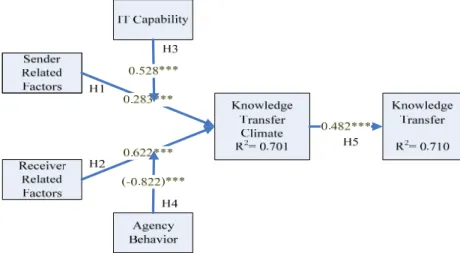
A test of the structural model is used to assess the structure of the impact of information sharing strategy on supply chain performance. Results of the analysis for the structural model are presented in Figure 2.
Figure 2 Results of path analysis
The results provide support for the research model. As shown in Figure 2, 70 percent of the variance in KT climate was explained by the factors of sender and receiver. 71 percent of the variance in knowledge transfer was explained by KT climate. Moreover, the results shown in Figure 5 provide strong significant (P<0.01) for all hypotheses.
5. Discussions and Conclusions
This study, based on the model of receiver and sender (Szulanski, 1996, Lin et al., 2005), developed a model which comprises three aspects that influence the result of knowledge transfer during ERP implementation: the factors related to receiver (the implementation firm), sender (the consultant), and KT climate. Through the survey method and following multivariate analysis, the significances of these factors are verified, and the role of them played during the knowledge transfer process, and the impact on the transfer process are revealed. This study also evaluates the modulation factors occurred in the process of ERP knowledge transfer from the perspective of IT capability and agent behavior. The verified model not only increases our understanding about how knowledge can be transferred successfully between the consultant and the implementation firm, but also provides strong revelations for the importance of building a substantial KT climate during the ERP implantation process.
For researchers, this paper provided three major contributions. Firstly, the concern of the knowledge transfer in ERP implementation in this paper is matched with the finding proposed by researches that accentuated the real result of knowledge transfer will not been realized until post-implementation (Zumd and Apple, 1992; Armstrong and Sambamurthy, 1999; Purvise et al., 2001; Lin et al., 2005). To consider the characters of irreversibility and high cost of an ERP system, it is important to a firm that implementing this system as successful as possible. Here, we developed a framework that is beneficial for knowledge transfer.
Secondly, this paper is grounded on solid theory base (Fama and Jensen, 1983; Dahlstrom et al, 1995; Szulanski, 1996; Bharadwaj, 2000; Lin et al., 2005; Ko et al., 2005), and provided the support for the research model by using empirical analysis. Future research then could extend this model extensively and consider more factors that may influence the knowledge transfer during implementation stage.
Thirdly, different from the personal viewpoint utilized by Ko et al. (2005), this research adopted organizational viewpoint to probe into how knowledge transfer is carried out interorganizationally and what factors influence this interorganizational knowledge transfer.
For practitioners, our empirical findings provide a critical language through which managers can describe and communicate the key factors that will influence the effect of knowledge transfer between the firm and the consultant during ERP implementation. This paper also proved that the creation of a KT climate is a prerequisite of a successful ERP implementation. Furthermore, a firm can only possess an ERP system and gain benefits from it when it absorbed the necessary knowledge of operating an ERP system.
5.2 Limitations and future research
This study, with no difference to other typical research, has two limitations that provide opportunities for future research. First, our study particularly focused on how knowledge transfer between the firm and the consultant contributes to a better outcome of ERP implementation. It paid limited attention to many managerial areas and variables, for example system or technological related factors that can influence the magnitude of implementation. Future research can capture more variables from other domain areas to enhance our understanding on implementing ERP successfully.
Secondly, this model was tested by using cross-sectional data in Taiwan’s manufacturing industry. Since the data represents a snapshot in time, the imputation of cause-effect relationships between the constructs in the model must be made with caution. Although we established the associations between the causing and caused constructs statistically, we recommend that other researchers could test this model through longitudinal studies and/or involves more respondents from different industries and countries.
of Senior Leadership and IT Infrastructures," Information Systems Research (10:4), 1999), pp. 304-327.
2. Argote, L., Ingram P., Levine, J. M., and Moreland, R. L. “Knowledge Transfer in Organizations, Learning from the Experience of Others,” Organizational Behavior and Human Decision Process (82:1), 2000, pp.1-8.
3. Aron, R., Clemons, E. K., and Reddi, S. “Just Right Outsourcing: Understanding and Management Risk,” Journal of Management Information System (22:2), 2005, pp. 37-55.
4. Basil, P., Yen D. C. and Tand H.L., “Information Consulting: Developments, Trends and Suggestions for Growth,” International Journal of Information Management (17:5), 1997, pp. 303-323.
5. Baum, J. A. C., and Ingram, P. “Survival-enhancing Learning in the Manhattan Hotel Industry,”
Management Science (44), 1998, pp. 996–1016.
6. Bharadwj A S. “A Resourced-based Perspective on Information Technology Capability and Firm Performance: an Empirical Investigation,” MIS Quarterly (24:1), 2000, pp. 169-196.
7. Bock, G. W., and Kim, Y. G. “Breaking the Myths of Rewards: An Exploratory Study of Attitudes about Knowledge Sharing,” Information Resources Management Journal (15:2), 2002, pp. 14-21. 8. Bock, G. W., Zmud, R. W., Kim, Y. G., and Lee, J. N. “Behavioral Intention Formation in Knowledge
Sharing: Examining the Roles of Extrinsic Motivators, Social-psychological Forces, and Organizational Climate”, MIS Quarterly (29:1), 2005, pp. 87-111.
9. Brown, C.V., and Vessey, I. “Managing the Next Wave of Enterprise Systems: Leveraging Lessons from ERP,” MIS Quarterly Executive (2:1), 2003, pp. 65–73.
10. Bryson, K., and Sullivan, W. “Designing Effective Incentive- Oriented Outsourcing Contracts for ERP Systems,” Proceedings of the 35th Hawaii International Conference on Systems Sciences, 2002, pp. 2760-2769.
11. Carlile, P. R. “Transferring, Translating and Transforming: An Integrative Framework for Managing Knowledge across Boundaries,” Organization Science (15:5), 2005, pp. 555–68.
12. Constant, D., Kiesler, S., and Sproull, L. “The Kindness of Strangers,” Organization Science (7:2), 1996, pp. 119-135.
13. Davenport, T. H. Process Innovation, Harvard Business School Press, Boston, 1990.
14. Davenport, T H. “Putting the Enterprise into the Enterprise System,” Harvard Business Review (76:4), 1998, pp. 121-131.
15. Eisenhardt, K. M. “Control: Organizational and economic approaches,” Management Science (31:2), 1985, pp. 134–149.
16. Fama, E. and Jensen, M. “Agency Problems and Residual Claims,” Journal of Law and Economics (26), 1983, pp. 301–25.
17. Fichman, R.G. “Real Options and IT Platform Adoption: Implications for Theory and Practice,”
Information Systems Research (15:2), 2004, pp. 132–154.
18. Gattiker, T. F., and Goodhue, D. L. “Understanding the Local Level Costs and Benefits of ERP through Organizational Information Processing Theory,” Information Management (41:4), 2004, pp. 431–443.
19. Gattiker, T. F., and Goodhue, D. L. “What Happens After ERP Implementation: Understanding the Impact of Interdependence and Differentiation on Plant-Level Outcomes,” MIS Quarterly (29:9), 2005, pp. 559–585.
20. Green, J. R., and Stokey, N. L. “A two-person game of information transmission,” Journal of Economic
Theory (135:1), 2007, pp. 90-104.
21. Hainens, M. N., and Goodhue, D. L. “Implementation Partner Involvement and Knowledge Transfer in the Context of ERP Implementations,” International journal of human-computer interaction (16), 2003, pp. 23-38.
22. Hanseth, O., and Braa, K. “Technology as Traitor: Emergent SAP Infrastructure in a Global Organization,” Proceedings of the International Conference on Information Systems, Finland, 1998. 23. Hitt, L. M., Wu D. J. and Zhou X. “Investment in Enterprise Resource Planning: Business Impact and
Productivity Measures,” Journal of Management Information Systems (19), 2002, pp. 71-98.
24. Holland, C. P, and Light, B. A. “Critical Success Factors Model for ERP Implementation,” IEEE
Software (13:3), 1999, pp. 30-35.
25. Hong, K. K., and Kim, Y. G. “The Critical Success Factors for ERP Implementation: An Organizational Fit Perspective,” Information and Management (40), 2002, pp. 25-40.
26. Huber, G.P. “Organizational Learning: The Contributing Processes and the Literatures,”
Organizational Sciences (2), 1991, pp. 88-115.
27. Ko, D. G., Kirsch L. J., and King W. R. “Antecedents of Knowledge Transfer from Consultants to Clients in Enterprise System Implementations,” MIS Quarterly (29:2), 2005, pp. 59-85.
28. Kocakulah, M. C., Embry, J. S., and Marvin A. “Enterprise Resources Planning (ERP): Managing the Paradigm Shift for Success,” International Journal of Information and Operations Management
Education (1:2), 2006, pp. 125-139.
29. Kumar, V., Maheshwari, B., and Kumar, U. “Enterprise Resource Planning Systems Adoption Process: A Survey of Canadian Organizations,” International Journal of Production Research (40:3), 2002, pp. 509-523.
30. Kwon T., Zmud R. “Unifying the Fragmented Models of Information System Implementation,”
Information System Research, 1987, pp. 227-251.
31. Lee, H., and Choi, B. “Knowledge Management nablers, Processes, and Organizational Performance: An Integrative View and Empirical Examination,” Journal of Management Information Systems (20:1), 2003, pp. 179–228.
32. Lin L., Geng X., and Whinston A. B. ”A Sender-Receiver Framework for Knowledge Transfer,” MIS
Quarterly (29:2), 2005, pp. 197-219.
33. McKersie R. B., and Walton R. E. “Organizational Change,” The Corporation of the 1990s:
Information Technology and Organizational Transformation, M. S. Scott Morton (ed.), Oxford
University Press, NY, 1991, pp. 244-277.
34. McLachlin, R.D. “Factors for Consulting Engagement Success, Management Decision (37:5), 1999, pp.394-402.
35. Mraz, S. J. “Keeping Up with ERP,” Machine Design (20), 2000, pp. 56-60.
36. Nelson, K. and Cooprider, J. “The Contribution of Shared Knowledge to IS Group Performance,” MIS
Quarterly (20:4), 1996, pp. 409-429.
37. Osterloh, M and Frey B.S. “Motivation, Knowledge Transfer, and Organizational Forms,”
Organizational Science (11:5), 2000, pp. 538-550.
38. Powell, W. W., Koput, K. W., and Laurel S. D. “Interorganizational Collaboration and the Locus of Innovation: Networks of Learning in Biotechnology," Administrative Science Quarterly (41), 1996, pp. 116-45.
39. Rajagopal P. “An Innovation-Diffusion View of Implementation of Enterprise Resource Planning (ERP) Systems and Development of Research Mode,” Information and Management, 2002, pp.87–114. 40. Ravichandran, T. and Rai A. “Quality Management in Systems Development: An Organizational
System Perspective,” MIS Quarterly (24:3), 2000, pp. 381-415.
41. Purvis, R. L., Sambamurthy, V., and Zmud, R. W. “The Assimilation of Knowledge Platforms in Organizations: An Empirical Study,” Organization Science, 2001, pp. 117-135.
42. Russo, M. V., and Fouts, P. A. “A Resource-based Perspective on Corporate Environmental Performance and Profitability,” Academy of Management Journal (40:3), 1997, pp. 534-559.
43. Ryan H. W. “Managing Development in the Era of Large Complex Systems,” Information Systems
Management (16:2), 1999, pp. 89-91.
44. Scheer, W., and Habermann, F. “Making ERP a Success,” Communications of the ACM (43:4), 2000, pp. 57–61.
45. Shanks, G., Parr, A., Hu, B., Corbitt, B., Thanasankit, T., and Seddon, P. “Differences in Critical Success Factors in ERP Systems Implementation in Australia and China: A Cultural Analysis,”
Proceedings of the 8th European Conference on Information Systems, Vienna, Austria, 2000, pp.
537–544.
46. Sharma, N., and Patterson, P. G. “The Iimpact of Communication Effectiveness and Service Quality on Relationship Commitment in Consumer, Professional Services,” Journal of Services Marketing (13:2), 1999, pp. 15-17.
47. Singla A. R., and Goyal D. P. “Success Factors in ERP Systems Design Implementation: An Empirical Investigation of the Indian Industry,” International Journal of Business Information Systems (2:4), 2007, pp. 444-464.
48. Somers, T. M., and Nelson, K.G. “A Taxonomy of Players and Activities across the ERP Project Life Cycle”, Information and Management (41:3), 2004, pp. 257-278.
49. Stein, E. W., and Zwass, V. "Actualizing Organizational Memory with Information Systems,"
Information Systems Research (6:2), 1995, pp. 85-117.
50. Szulanski, G. “Exploring Internal Stickiness: Impediments to the Transfer of Best Practice Within the Firm,” Strategic Management Journal, 1996, pp. 27–43.
51. Tan, C. W., and Pan, S. L. “ERP Success: The Search for a Comprehensive Framework,” Proceedings
of the 8th Americas Conference on Information Systems, Dallas, TX, 2002.
52. Tuttle, B., Harrell A., and Harrison, P. “Moral Hazard, Ethical Considerations, and the Decision to Implement an Information System,” Journal of Management Information Systems (13:4), 1997, pp. 7-27.
53. Umble, E. J., Haft, R. R., and Umble, M. M. “Enterprise resource planning: Implementation procedures and critical success factors,” European Journal of Operational Research (146:2), 2003, pp. 241-257. 54. Wang, E. T. G., Klein, G., and Jiang, J. J. “ERP Misfit: Country of Origin and Organizational Factors”,
55. Welti, N. “Successful SAP R3 Implementation,” Practical Management of ERP Projects, Addison-Wesley, USA, 1999.
56. Yahaya, Y., Gunasekaranb, A., and Mark, S.A. “Enterprise Information Systems Project Implementation: A Case Study of ERP in Rolls-Royce,” International Journal of Production
Economics (87), 2004, pp. 251-266.
57. Zumd, R. W., and Apple, L. E. “Measuring Technology Incorporation/infusion,” Journal of Product
Innovation Management (9),1992,pp. 148–155.